PREHISTORY Human evolution and social development
PREHISTORY STONE AGES METAL AGES Palaeolithic (5 million – 9000 BC) Neolithic (9000 – 6000 BC) Copper Age (6000 – 1800 BC) Bronze Age (1800 – 1200 BC) Iron Age (1200 – 300 BC)
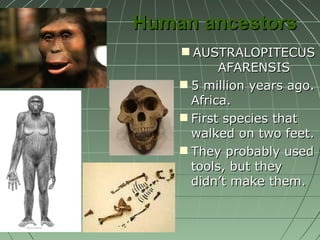
Human ancestors AUSTRALOPITECUS AFARENSIS 5 million years ago. Africa. First species that walked on two feet. They probably used tools, but they didn’t make them.
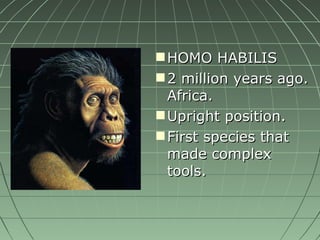
HOMO HABILIS 2 million years ago. Africa. Upright position. First species that made complex tools.
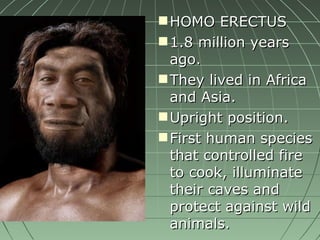
HOMO ERECTUS 1.8 million years ago. They lived in Africa and Asia. Upright position. First human species that controlled fire to cook, illuminate their caves and protect against wild animals.
HOMO ANTECESSOR 800.000 years ago. Iberian peninsula. They made complex tools (e.g.  Excalibur  biface) They lived in caves. They cared about their dead.
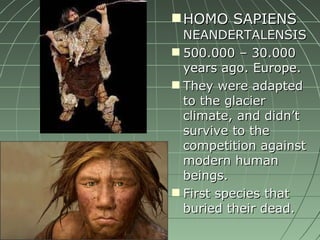
HOMO SAPIENS  NEANDERTALENSIS 500.000 – 30.000 years ago. Europe. They were adapted to the glacier climate, and didn’t survive to the competition against modern human beings. First species that buried their dead.
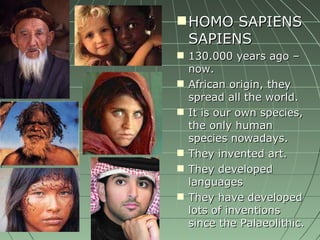
HOMO SAPIENS SAPIENS 130.000 years ago – now.  African origin, they spread all the world. It is our own species, the only human species nowadays. They invented art. They developed languages They have developed lots of inventions since the Palaeolithic.
Modern human spread
I) Stone Age Palaeolithic Neolithic
Palaeolithic Economical basis : Hunting, gathering and fishing Way of life : Nomadic. They lived outdoors or in caves. Inventions : Use of fire. Rough tools (of stone, wood or bone): knives, bifaces … Weapons: spears, arches and arrows, maces… Canoes.
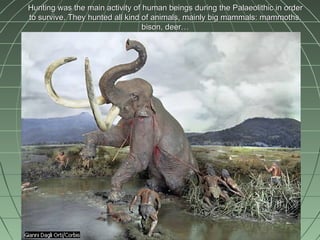
Hunting was the main activity of human beings during the Palaeolithic in order to survive. They hunted all kind of animals, mainly big mammals: mammoths, bison, deer…
Gathering consists in pick up fruits, seeds and roots of plants as food. It was another fundamental activity of human beings during the Palaeolithic to survive.
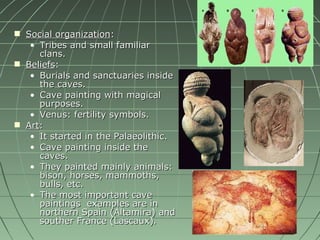
Social organization : Tribes and small familiar clans. Beliefs : Burials and sanctuaries inside the caves. Cave painting with magical purposes. Venus: fertility symbols. Art : It started in the Palaeolithic. Cave painting inside the caves. They painted mainly animals: bison, horses, mammoths, bulls, etc. The most important cave paintings  examples are in northern Spain (Altamira) and souther France (Lascaux) .
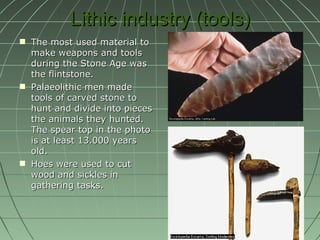
Lithic industry (tools) The most used material to make weapons and tools during the Stone Age was the flintstone. Palaeolithic men made tools of carved stone to hunt and divide into pieces the animals they hunted. The spear top in the photo is at least 13.000 years old. Hoes were used to cut wood and sickles in gathering tasks.
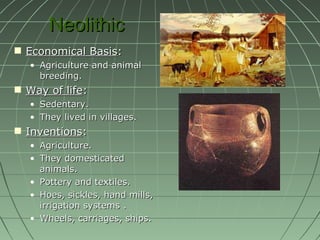
Neolithic Economical Basis : Agriculture and animal breeding. Way of life : Sedentary. They lived in villages. Inventions : Agriculture. They domesticated animals. Pottery and textiles. Hoes, sickles, hand mills, irrigation systems . Wheels, carriages, ships.
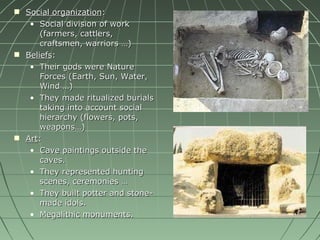
Social organization : Social division of work (farmers, cattlers, craftsmen, warriors …) Beliefs : Their gods were Nature Forces (Earth, Sun, Water, Wind …) They made ritualized burials taking into account social  hierarchy (flowers, pots, weapons…) Art : Cave paintings outside the caves. They represented hunting scenes, ceremonies … They built potter and stone-made idols. Megalithic monuments.
The expansion of agriculture
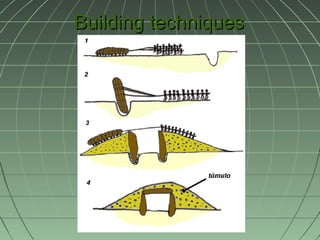
Megalithic  monuments Menhir  Dolmen Cromlech
Building techniques
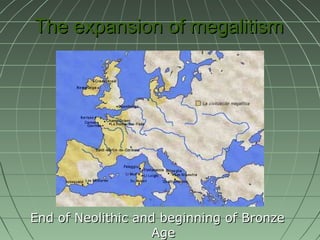
The expansion of megalitism End of Neolithic and beginning of Bronze Age
II) Metal Ages Copper Age Bronze Age Iron Age
Metal Ages Economical basis : Agriculture and animal breeding. Trade. Metal industry. Way of life : Villages. Born of first cities. Inventions : Metalworking: weapons and tools made of metal. Development of carriages (oxen and horses). Potter’s wheel, sailing ship, plough.
Social organization: Division of work increase. Social division increase. Building of cities’ walls. Birth of first kingdoms and dinasties. Beliefs : New burial customs: cremation (pottery pots for ashes) Art : Jewelry and goldwork. Pottery(campaniform vase) Megalithic monuments continue being built in Europe’s Atlantic Ocean facade.

Prehistory

  • 1.
    PREHISTORY Human evolutionand social development
  • 2.
    PREHISTORY STONE AGESMETAL AGES Palaeolithic (5 million – 9000 BC) Neolithic (9000 – 6000 BC) Copper Age (6000 – 1800 BC) Bronze Age (1800 – 1200 BC) Iron Age (1200 – 300 BC)
  • 3.
    Human ancestors AUSTRALOPITECUSAFARENSIS 5 million years ago. Africa. First species that walked on two feet. They probably used tools, but they didn’t make them.
  • 4.
    HOMO HABILIS 2million years ago. Africa. Upright position. First species that made complex tools.
  • 5.
    HOMO ERECTUS 1.8million years ago. They lived in Africa and Asia. Upright position. First human species that controlled fire to cook, illuminate their caves and protect against wild animals.
  • 6.
    HOMO ANTECESSOR 800.000years ago. Iberian peninsula. They made complex tools (e.g. Excalibur biface) They lived in caves. They cared about their dead.
  • 7.
    HOMO SAPIENS NEANDERTALENSIS 500.000 – 30.000 years ago. Europe. They were adapted to the glacier climate, and didn’t survive to the competition against modern human beings. First species that buried their dead.
  • 8.
    HOMO SAPIENS SAPIENS130.000 years ago – now. African origin, they spread all the world. It is our own species, the only human species nowadays. They invented art. They developed languages They have developed lots of inventions since the Palaeolithic.
  • 9.
  • 10.
    I) Stone AgePalaeolithic Neolithic
  • 11.
    Palaeolithic Economical basis: Hunting, gathering and fishing Way of life : Nomadic. They lived outdoors or in caves. Inventions : Use of fire. Rough tools (of stone, wood or bone): knives, bifaces … Weapons: spears, arches and arrows, maces… Canoes.
  • 12.
    Hunting was themain activity of human beings during the Palaeolithic in order to survive. They hunted all kind of animals, mainly big mammals: mammoths, bison, deer…
  • 13.
    Gathering consists inpick up fruits, seeds and roots of plants as food. It was another fundamental activity of human beings during the Palaeolithic to survive.
  • 14.
    Social organization :Tribes and small familiar clans. Beliefs : Burials and sanctuaries inside the caves. Cave painting with magical purposes. Venus: fertility symbols. Art : It started in the Palaeolithic. Cave painting inside the caves. They painted mainly animals: bison, horses, mammoths, bulls, etc. The most important cave paintings examples are in northern Spain (Altamira) and souther France (Lascaux) .
  • 15.
    Lithic industry (tools)The most used material to make weapons and tools during the Stone Age was the flintstone. Palaeolithic men made tools of carved stone to hunt and divide into pieces the animals they hunted. The spear top in the photo is at least 13.000 years old. Hoes were used to cut wood and sickles in gathering tasks.
  • 16.
    Neolithic Economical Basis: Agriculture and animal breeding. Way of life : Sedentary. They lived in villages. Inventions : Agriculture. They domesticated animals. Pottery and textiles. Hoes, sickles, hand mills, irrigation systems . Wheels, carriages, ships.
  • 17.
    Social organization :Social division of work (farmers, cattlers, craftsmen, warriors …) Beliefs : Their gods were Nature Forces (Earth, Sun, Water, Wind …) They made ritualized burials taking into account social hierarchy (flowers, pots, weapons…) Art : Cave paintings outside the caves. They represented hunting scenes, ceremonies … They built potter and stone-made idols. Megalithic monuments.
  • 18.
    The expansion ofagriculture
  • 19.
    Megalithic monumentsMenhir Dolmen Cromlech
  • 20.
  • 21.
    The expansion ofmegalitism End of Neolithic and beginning of Bronze Age
  • 22.
    II) Metal AgesCopper Age Bronze Age Iron Age
  • 23.
    Metal Ages Economicalbasis : Agriculture and animal breeding. Trade. Metal industry. Way of life : Villages. Born of first cities. Inventions : Metalworking: weapons and tools made of metal. Development of carriages (oxen and horses). Potter’s wheel, sailing ship, plough.
  • 24.
    Social organization: Divisionof work increase. Social division increase. Building of cities’ walls. Birth of first kingdoms and dinasties. Beliefs : New burial customs: cremation (pottery pots for ashes) Art : Jewelry and goldwork. Pottery(campaniform vase) Megalithic monuments continue being built in Europe’s Atlantic Ocean facade.