MOST IMPORTANT HISTORICAL
     EVENTS IN SPAIN
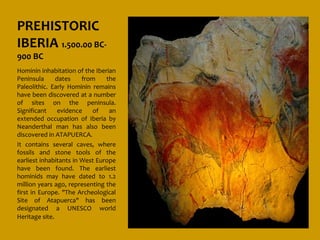
PREHISTORIC
IBERIA 1.500.00 BC-
900 BC
Hominin inhabitation of the Iberian
Peninsula      dates    from    the
Paleolithic. Early Hominin remains
have been discovered at a number
of sites on the peninsula.
Significant     evidence   of    an
extended occupation of Iberia by
Neanderthal man has also been
discovered in ATAPUERCA.
It contains several caves, where
fossils and stone tools of the
earliest inhabitants in West Europe
have been found. The earliest
hominids may have dated to 1.2
million years ago, representing the
first in Europe. "The Archeological
Site of Atapuerca" has been
designated a UNESCO world
Heritage site.
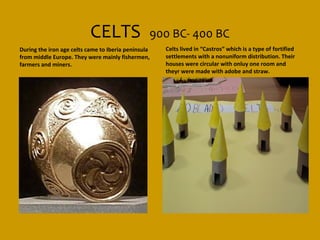
CELTS                 900 BC- 400 BC
During the iron age celts came to Iberia peninsula   Celts lived in “Castros” which is a type of fortified
from middle Europe. They were mainly fishermen,      settlements with a nonuniform distribution. Their
farmers and miners.                                  houses were circular with onluy one room and
                                                     theyr were made with adobe and straw.
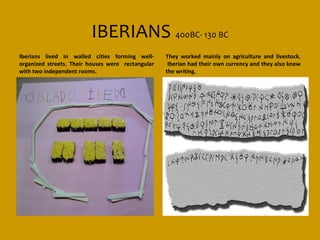
IBERIANS 400BC- 130 BC
Iberians lived in walled cities forming well-      They worked mainly on agriculture and livestock.
organized streets. Their houses were rectangular    Iberian had their own currency and they also knew
with two independent rooms.                        the writing.
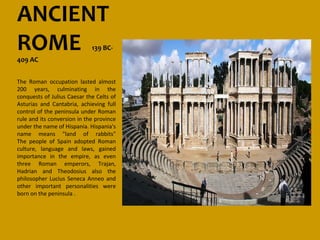
ANCIENT
ROME
409 AC
                             139 BC-


The Roman occupation lasted almost
200 years, culminating in the
conquests of Julius Caesar the Celts of
Asturias and Cantabria, achieving full
control of the peninsula under Roman
rule and its conversion in the province
under the name of Hispania. Hispania's
name means "land of rabbits"
The people of Spain adopted Roman
culture, language and laws, gained
importance in the empire, as even
three Roman emperors, Trajan,
Hadrian and Theodosius also the
philosopher Lucius Seneca Anneo and
other important personalities were
born on the peninsula .
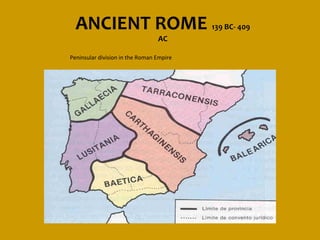
ANCIENT ROME 139 BC- 409
                                 AC

Peninsular division in the Roman Empire
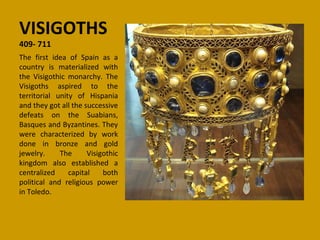
VISIGOTHS
409- 711
                    ​
The first idea of Spain as a
country is materialized with
the Visigothic monarchy. The
Visigoths aspired to the
territorial unity of Hispania
and they got all the successive
defeats on the Suabians,
Basques and Byzantines. They
were characterized by work
done in bronze and gold
jewelry.     The      Visigothic
kingdom also established a
centralized     capital    both
political and religious power
in Toledo.
AL-ÁNDALUS
711 - 1492
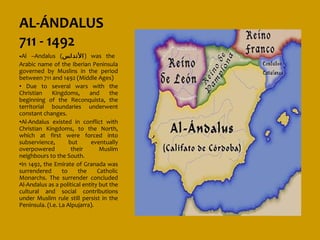
•Al –Andalus (‫ )الندلس‬was the
Arabic name of the Iberian Peninsula
governed by Muslins in the period
between 711 and 1492 (Middle Ages)
• Due to several wars with the
Christian    Kingdoms,       and     the
beginning of the Reconquista, the
territorial boundaries underwent
constant changes.
•Al-Andalus existed in conflict with
Christian Kingdoms, to the North,
which at first were forced into
subservience,        but     eventually
overpowered           their      Muslim
neighbours to the South.
•In 1492, the Emirate of Granada was
surrendered       to     the    Catholic
Monarchs. The surrender concluded
Al-Andalus as a political entity but the
cultural and social contributions
under Muslim rule still persist in the
Peninsula. (I.e. La Alpujarra).
AL-ÁNDALUS
711 - 1492
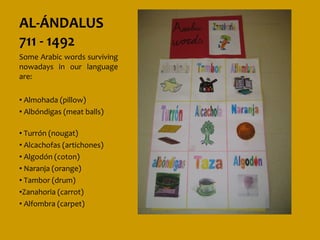
Some Arabic words surviving
nowadays in our language
are:

• Almohada (pillow)
• Albóndigas (meat balls)

• Turrón (nougat)
• Alcachofas (artichones)
• Algodón (coton)
• Naranja (orange)
• Tambor (drum)
•Zanahoria (carrot)
• Alfombra (carpet)
DISCOVERY OF
AMERICA 1492
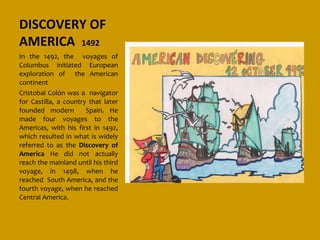
In the 1492, the voyages of
Columbus initiated European
exploration of the American
continent
Cristobal Colón was a navigator
for Castilla, a country that later
founded modern         Spain. He
made four voyages to the
Americas, with his first in 1492,
which resulted in what is widely
referred to as the Discovery of
America He did not actually
reach the mainland until his third
voyage, in 1498, when he
reached South America, and the
fourth voyage, when he reached
Central America.
SPANISH GOLDEN CENTURY XVI- XVII
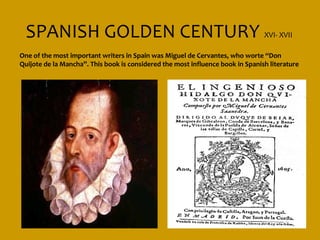
One of the most important writers in Spain was Miguel de Cervantes, who worte “Don
Quijote de la Mancha”. This book is considered the most influence book in Spanish literature
SPANISH GOLDEN CENTURY XVI- XVII
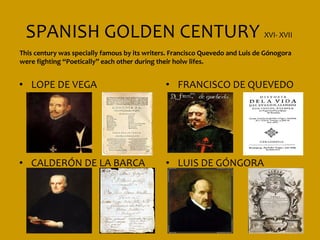
This century was specially famous by its writers. Francisco Quevedo and Luis de Gónogora
were fighting “Poetically” each other during their holw lifes.


• LOPE DE VEGA                                 • FRANCISCO DE QUEVEDO


• CALDERÓN DE LA BARCA                         • LUIS DE GÓNGORA
RAILWAY
ACROSS SPAIN
XIX
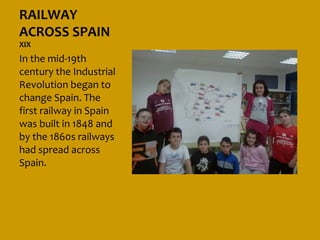
In the mid-19th
century the Industrial
Revolution began to
change Spain. The
first railway in Spain
was built in 1848 and
by the 1860s railways
had spread across
Spain.
INDUSTRIAL REVOLUTION XIX
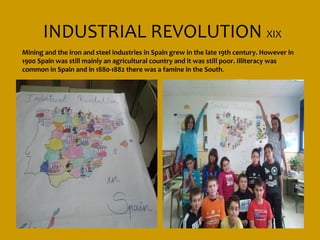
Mining and the iron and steel industries in Spain grew in the late 19th century. However in
1900 Spain was still mainly an agricultural country and it was still poor. Illiteracy was
common in Spain and in 1880-1882 there was a famine in the South .
SPANISH CIVIL
WAR 1936- 1939
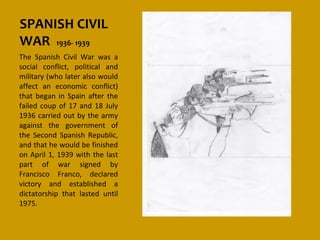
The Spanish Civil War was a
social conflict, political and
military (who later also would
affect an economic conflict)
that began in Spain after the
failed coup of 17 and 18 July
1936 carried out by the army
against the government of
the Second Spanish Republic,
and that he would be finished
on April 1, 1939 with the last
part of war signed by
Francisco Franco, declared
victory and established a
dictatorship that lasted until
1975.
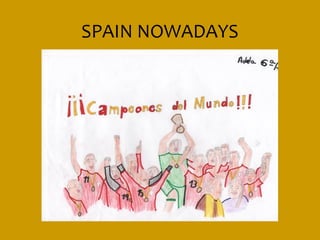
SPAIN NOWADAYS
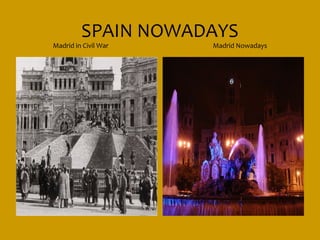
SPAIN NOWADAYS
Madrid in Civil War   Madrid Nowadays

Most important historical events in Spain

  • 1.
  • 2.
    PREHISTORIC IBERIA 1.500.00 BC- 900BC Hominin inhabitation of the Iberian Peninsula dates from the Paleolithic. Early Hominin remains have been discovered at a number of sites on the peninsula. Significant evidence of an extended occupation of Iberia by Neanderthal man has also been discovered in ATAPUERCA. It contains several caves, where fossils and stone tools of the earliest inhabitants in West Europe have been found. The earliest hominids may have dated to 1.2 million years ago, representing the first in Europe. "The Archeological Site of Atapuerca" has been designated a UNESCO world Heritage site.
  • 3.
    CELTS 900 BC- 400 BC During the iron age celts came to Iberia peninsula Celts lived in “Castros” which is a type of fortified from middle Europe. They were mainly fishermen, settlements with a nonuniform distribution. Their farmers and miners. houses were circular with onluy one room and theyr were made with adobe and straw.
  • 4.
    IBERIANS 400BC- 130BC Iberians lived in walled cities forming well- They worked mainly on agriculture and livestock. organized streets. Their houses were rectangular Iberian had their own currency and they also knew with two independent rooms. the writing.
  • 5.
    ANCIENT ROME 409 AC 139 BC- The Roman occupation lasted almost 200 years, culminating in the conquests of Julius Caesar the Celts of Asturias and Cantabria, achieving full control of the peninsula under Roman rule and its conversion in the province under the name of Hispania. Hispania's name means "land of rabbits" The people of Spain adopted Roman culture, language and laws, gained importance in the empire, as even three Roman emperors, Trajan, Hadrian and Theodosius also the philosopher Lucius Seneca Anneo and other important personalities were born on the peninsula .
  • 6.
    ANCIENT ROME 139BC- 409 AC Peninsular division in the Roman Empire
  • 7.
    VISIGOTHS 409- 711 ​ The first idea of Spain as a country is materialized with the Visigothic monarchy. The Visigoths aspired to the territorial unity of Hispania and they got all the successive defeats on the Suabians, Basques and Byzantines. They were characterized by work done in bronze and gold jewelry. The Visigothic kingdom also established a centralized capital both political and religious power in Toledo.
  • 8.
    AL-ÁNDALUS 711 - 1492 •Al–Andalus (‫ )الندلس‬was the Arabic name of the Iberian Peninsula governed by Muslins in the period between 711 and 1492 (Middle Ages) • Due to several wars with the Christian Kingdoms, and the beginning of the Reconquista, the territorial boundaries underwent constant changes. •Al-Andalus existed in conflict with Christian Kingdoms, to the North, which at first were forced into subservience, but eventually overpowered their Muslim neighbours to the South. •In 1492, the Emirate of Granada was surrendered to the Catholic Monarchs. The surrender concluded Al-Andalus as a political entity but the cultural and social contributions under Muslim rule still persist in the Peninsula. (I.e. La Alpujarra).
  • 9.
    AL-ÁNDALUS 711 - 1492 SomeArabic words surviving nowadays in our language are: • Almohada (pillow) • Albóndigas (meat balls) • Turrón (nougat) • Alcachofas (artichones) • Algodón (coton) • Naranja (orange) • Tambor (drum) •Zanahoria (carrot) • Alfombra (carpet)
  • 10.
    DISCOVERY OF AMERICA 1492 Inthe 1492, the voyages of Columbus initiated European exploration of the American continent Cristobal Colón was a navigator for Castilla, a country that later founded modern Spain. He made four voyages to the Americas, with his first in 1492, which resulted in what is widely referred to as the Discovery of America He did not actually reach the mainland until his third voyage, in 1498, when he reached South America, and the fourth voyage, when he reached Central America.
  • 11.
    SPANISH GOLDEN CENTURYXVI- XVII One of the most important writers in Spain was Miguel de Cervantes, who worte “Don Quijote de la Mancha”. This book is considered the most influence book in Spanish literature
  • 12.
    SPANISH GOLDEN CENTURYXVI- XVII This century was specially famous by its writers. Francisco Quevedo and Luis de Gónogora were fighting “Poetically” each other during their holw lifes. • LOPE DE VEGA • FRANCISCO DE QUEVEDO • CALDERÓN DE LA BARCA • LUIS DE GÓNGORA
  • 13.
    RAILWAY ACROSS SPAIN XIX In themid-19th century the Industrial Revolution began to change Spain. The first railway in Spain was built in 1848 and by the 1860s railways had spread across Spain.
  • 14.
    INDUSTRIAL REVOLUTION XIX Miningand the iron and steel industries in Spain grew in the late 19th century. However in 1900 Spain was still mainly an agricultural country and it was still poor. Illiteracy was common in Spain and in 1880-1882 there was a famine in the South .
  • 15.
    SPANISH CIVIL WAR 1936-1939 The Spanish Civil War was a social conflict, political and military (who later also would affect an economic conflict) that began in Spain after the failed coup of 17 and 18 July 1936 carried out by the army against the government of the Second Spanish Republic, and that he would be finished on April 1, 1939 with the last part of war signed by Francisco Franco, declared victory and established a dictatorship that lasted until 1975.
  • 16.
  • 17.
    SPAIN NOWADAYS Madrid inCivil War Madrid Nowadays