D. Monett – Europe Week 2015, University of Hertfordshire, Hatfield
A Structured Approach to
Requirements Analysis
Prof. Dr. Dagmar Monett Díaz
Computer Science Dept.
Faculty of Cooperative Studies
Berlin School of Economics and Law
dagmar@monettdiaz.com
Europe Week, 2nd – 6th March 2015
90 Minutes
D. Monett – Europe Week 2015, University of Hertfordshire, Hatfield
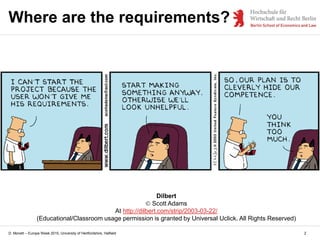
Dilbert
 Scott Adams
At http://dilbert.com/strip/2003-03-22/
(Educational/Classroom usage permission is granted by Universal Uclick. All Rights Reserved)
Where are the requirements?
2
D. Monett – Europe Week 2015, University of Hertfordshire, Hatfield 3
Main topics
D. Monett – Europe Week 2015, University of Hertfordshire, Hatfield 4
Main topics
 Where does the major content come from?
 Requirements and their relationships
 Requirements Engineering
- Definitions. Subdisciplines. Topics of related lectures.
 Requirements Development
- Definitions. Subdisciplines. A process framework.
 A Structured approach to Requirements Development
 Requirements risks
 Benefits from a high-quality requirements process
 What’s next? Further reading, sources of inspiration
D. Monett – Europe Week 2015, University of Hertfordshire, Hatfield 5
Next topics…
 Where does the major content come from?
 Requirements and their relationships
 Requirements Engineering
- Definitions. Subdisciplines. Topics of related lectures.
 Requirements Development
- Definitions. Subdisciplines. A process framework.
 A Structured approach to Requirements Development
 Requirements risks
 Benefits from a high-quality requirements process
 What’s next? Further reading, sources of inspiration
D. Monett – Europe Week 2015, University of Hertfordshire, Hatfield 6
©
D. Monett – Europe Week 2015, University of Hertfordshire, Hatfield
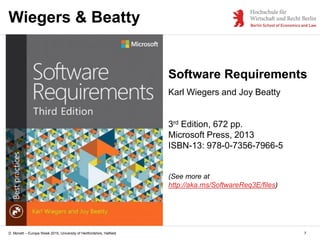
Software Requirements
Karl Wiegers and Joy Beatty
3rd Edition, 672 pp.
Microsoft Press, 2013
ISBN-13: 978-0-7356-7966-5
(See more at
http://aka.ms/SoftwareReq3E/files)

7
Wiegers & Beatty
D. Monett – Europe Week 2015, University of Hertfordshire, Hatfield
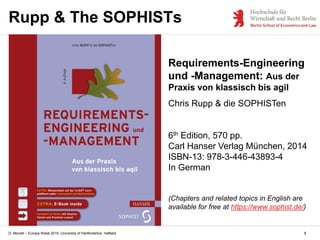
Requirements-Engineering
und -Management: Aus der
Praxis von klassisch bis agil
Chris Rupp & die SOPHISTen
6th Edition, 570 pp.
Carl Hanser Verlag München, 2014
ISBN-13: 978-3-446-43893-4
In German
(Chapters and related topics in English are
available for free at https://www.sophist.de/)
8
Rupp & The SOPHISTs
D. Monett – Europe Week 2015, University of Hertfordshire, Hatfield
Software Engineering
Ian Sommerville
9th Edition, 792 pp.
Addison-Wesley, 2010
ISBN-13: 978-0137035151
(10th Edition: April 2015. See more at
http://iansommerville.com/software-
engineering-book/)
9
Sommerville
D. Monett – Europe Week 2015, University of Hertfordshire, Hatfield 10
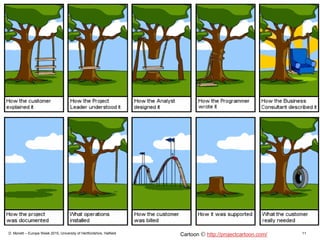
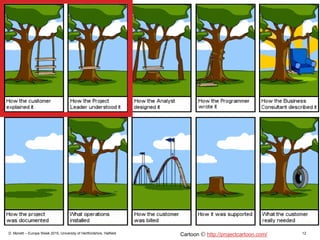
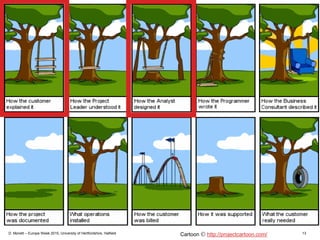
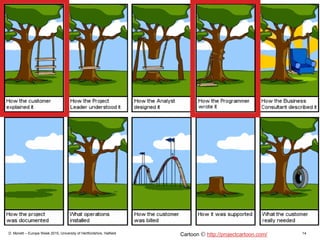
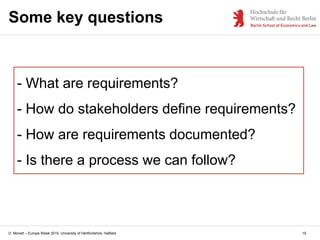
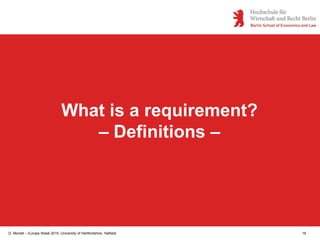
The traditional software
development process:
Perceptions, communication patterns
and interests…
D. Monett – Europe Week 2015, University of Hertfordshire, Hatfield 11Cartoon  http://projectcartoon.com/
D. Monett – Europe Week 2015, University of Hertfordshire, Hatfield 12Cartoon  http://projectcartoon.com/
D. Monett – Europe Week 2015, University of Hertfordshire, Hatfield 13Cartoon  http://projectcartoon.com/
D. Monett – Europe Week 2015, University of Hertfordshire, Hatfield 14Cartoon  http://projectcartoon.com/
D. Monett – Europe Week 2015, University of Hertfordshire, Hatfield
Some key questions
15
- What are requirements?
- How do stakeholders define requirements?
- How are requirements documented?
- Is there a process we can follow?
D. Monett – Europe Week 2015, University of Hertfordshire, Hatfield 16
What is a requirement?
– Definitions –
D. Monett – Europe Week 2015, University of Hertfordshire, Hatfield 17
IEEE-Standard 610.12 (1990)
 A requirement is:
(1). „A condition or capability needed by a user (be
it person or system) to solve a problem or
achieve an objective.“
D. Monett – Europe Week 2015, University of Hertfordshire, Hatfield 18
IEEE-Standard 610.12 (1990)
 A requirement is:
(1). „A condition or capability needed by a user (be
it person or system) to solve a problem or
achieve an objective.“
(2). „A condition or capability that must be met or
possessed by a system or system component to
satisfy a contract, standard, specification, or other
formally imposed document.“
D. Monett – Europe Week 2015, University of Hertfordshire, Hatfield 19
IEEE-Standard 610.12 (1990)
 A requirement is:
(1). „A condition or capability needed by a user (be
it person or system) to solve a problem or
achieve an objective.“
(2). „A condition or capability that must be met or
possessed by a system or system component to
satisfy a contract, standard, specification, or other
formally imposed document.“
(3). „A documented representation of a condition or
capability as in (1) or (2).“
D. Monett – Europe Week 2015, University of Hertfordshire, Hatfield 20
Requirement: A definition
According to Wiegers & Beatty:
“[A requirement is a] statement of a
customer need or objective, or of a condition
or capability that a product must possess to
satisfy such a need or objective. A property
that a product must have to provide value to
a stakeholder.”
D. Monett – Europe Week 2015, University of Hertfordshire, Hatfield 21
Requirement: A definition
According to Wiegers & Beatty:
“[A requirement is a] statement of a
customer need or objective, or of a condition
or capability that a product must possess to
satisfy such a need or objective. A property
that a product must have to provide value to
a stakeholder.”
D. Monett – Europe Week 2015, University of Hertfordshire, Hatfield 22
Requirement: A definition
According to Wiegers & Beatty:
“[A requirement is a] statement of a
customer need or objective, or of a condition
or capability that a product must possess to
satisfy such a need or objective. A property
that a product must have to provide value to
a stakeholder.”
D. Monett – Europe Week 2015, University of Hertfordshire, Hatfield 23
Requirement: A definition
According to Wiegers & Beatty:
“[A requirement is a] statement of a
customer need or objective, or of a condition
or capability that a product must possess to
satisfy such a need or objective. A property
that a product must have to provide value to
a stakeholder.”
D. Monett – Europe Week 2015, University of Hertfordshire, Hatfield 24
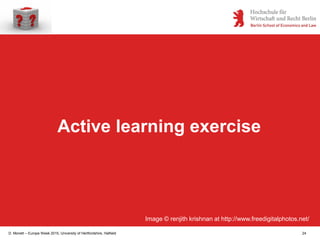
Active learning exercise
Image © renjith krishnan at http://www.freedigitalphotos.net/
D. Monett – Europe Week 2015, University of Hertfordshire, Hatfield
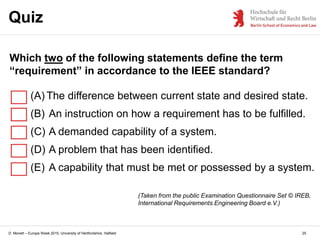
Quiz
25
(Taken from the public Examination Questionnaire Set © IREB,
International Requirements Engineering Board e.V.)
Which two of the following statements define the term
“requirement” in accordance to the IEEE standard?
(A) The difference between current state and desired state.
(B) An instruction on how a requirement has to be fulfilled.
(C) A demanded capability of a system.
(D) A problem that has been identified.
(E) A capability that must be met or possessed by a system.
D. Monett – Europe Week 2015, University of Hertfordshire, Hatfield 26
Relationships among several types
of requirements information
D. Monett – Europe Week 2015, University of Hertfordshire, Hatfield 27
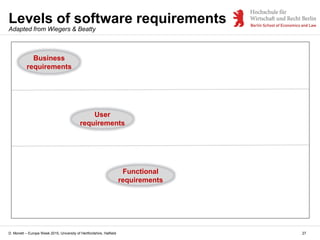
Levels of software requirements
Business
requirements
User
requirements
Functional
requirements
Adapted from Wiegers & Beatty
D. Monett – Europe Week 2015, University of Hertfordshire, Hatfield 28
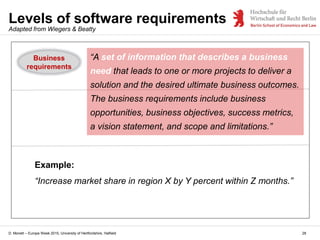
Levels of software requirements
Business
requirements
“A set of information that describes a business
need that leads to one or more projects to deliver a
solution and the desired ultimate business outcomes.
The business requirements include business
opportunities, business objectives, success metrics,
a vision statement, and scope and limitations.”
Example:
“Increase market share in region X by Y percent within Z months.”
Adapted from Wiegers & Beatty
D. Monett – Europe Week 2015, University of Hertfordshire, Hatfield 29
Levels of software requirements
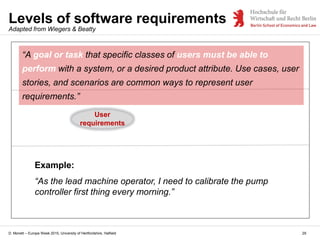
“A goal or task that specific classes of users must be able to
perform with a system, or a desired product attribute. Use cases, user
stories, and scenarios are common ways to represent user
requirements.”
Example:
“As the lead machine operator, I need to calibrate the pump
controller first thing every morning.”
User
requirements
Adapted from Wiegers & Beatty
D. Monett – Europe Week 2015, University of Hertfordshire, Hatfield 30
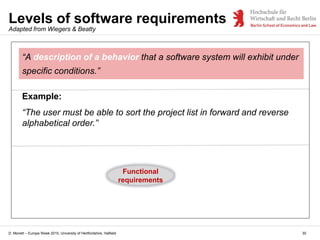
Levels of software requirements
“A description of a behavior that a software system will exhibit under
specific conditions.”
Example:
“The user must be able to sort the project list in forward and reverse
alphabetical order.”
Functional
requirements
Adapted from Wiegers & Beatty
D. Monett – Europe Week 2015, University of Hertfordshire, Hatfield 31
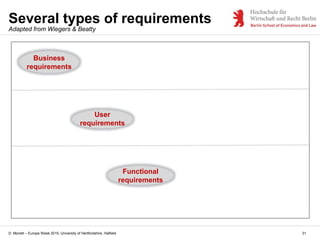
Several types of requirements
Business
requirements
User
requirements
Functional
requirements
Adapted from Wiegers & Beatty
D. Monett – Europe Week 2015, University of Hertfordshire, Hatfield 32
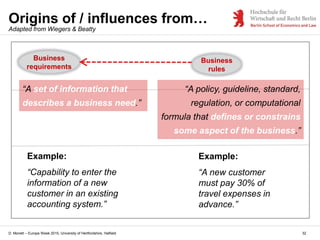
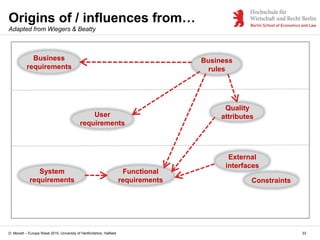
Origins of / influences from…
Business
requirements
Business
rules
“A policy, guideline, standard,
regulation, or computational
formula that defines or constrains
some aspect of the business.”
Example:
“A new customer
must pay 30% of
travel expenses in
advance.”
Example:
“Capability to enter the
information of a new
customer in an existing
accounting system.”
Adapted from Wiegers & Beatty
“A set of information that
describes a business need.”
D. Monett – Europe Week 2015, University of Hertfordshire, Hatfield 33
Origins of / influences from…
Business
requirements
Business
rules
User
requirements
Quality
attributes
System
requirements
Functional
requirements
External
interfaces
Constraints
Adapted from Wiegers & Beatty
D. Monett – Europe Week 2015, University of Hertfordshire, Hatfield 34
Active learning exercise:
“What can be a requirement?
Please mention other concrete
examples!”
Image © renjith krishnan at http://www.freedigitalphotos.net/
D. Monett – Europe Week 2015, University of Hertfordshire, Hatfield 35
So far…
 Where does the major content come from?
 Requirements and their relationships
 Requirements Engineering
- Definitions. Subdisciplines. Topics of related lectures.
 Requirements Development
- Definitions. Subdisciplines. A process framework.
 A Structured approach to Requirements Development
 Requirements risks
 Benefits from a high-quality requirements process
 What’s next? Further reading, sources of inspiration
D. Monett – Europe Week 2015, University of Hertfordshire, Hatfield 36
Next topics…
 Where does the major content come from?
 Requirements and their relationships
 Requirements Engineering
- Definitions. Subdisciplines. Topics of related lectures.
 Requirements Development
- Definitions. Subdisciplines. A process framework.
 A Structured approach to Requirements Development
 Requirements risks
 Benefits from a high-quality requirements process
 What’s next? Further reading, sources of inspiration
D. Monett – Europe Week 2015, University of Hertfordshire, Hatfield 37
What is
Requirements Engineering?
D. Monett – Europe Week 2015, University of Hertfordshire, Hatfield
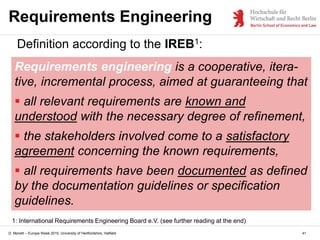
Requirements Engineering
Definition according to the IREB1:
Requirements engineering is a cooperative, itera-
tive, incremental process, aimed at guaranteeing that
38
1: International Requirements Engineering Board e.V. (see further reading at the end)
D. Monett – Europe Week 2015, University of Hertfordshire, Hatfield
Requirements Engineering
Definition according to the IREB1:
Requirements engineering is a cooperative, itera-
tive, incremental process, aimed at guaranteeing that
 all relevant requirements are known and
understood with the necessary degree of refinement,
39
1: International Requirements Engineering Board e.V. (see further reading at the end)
D. Monett – Europe Week 2015, University of Hertfordshire, Hatfield
Requirements Engineering
Definition according to the IREB1:
Requirements engineering is a cooperative, itera-
tive, incremental process, aimed at guaranteeing that
 all relevant requirements are known and
understood with the necessary degree of refinement,
 the stakeholders involved come to a satisfactory
agreement concerning the known requirements,
40
1: International Requirements Engineering Board e.V. (see further reading at the end)
D. Monett – Europe Week 2015, University of Hertfordshire, Hatfield
Requirements Engineering
Definition according to the IREB1:
Requirements engineering is a cooperative, itera-
tive, incremental process, aimed at guaranteeing that
 all relevant requirements are known and
understood with the necessary degree of refinement,
 the stakeholders involved come to a satisfactory
agreement concerning the known requirements,
 all requirements have been documented as defined
by the documentation guidelines or specification
guidelines.
41
1: International Requirements Engineering Board e.V. (see further reading at the end)
D. Monett – Europe Week 2015, University of Hertfordshire, Hatfield
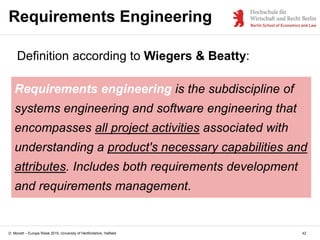
Requirements Engineering
Definition according to Wiegers & Beatty:
Requirements engineering is the subdiscipline of
systems engineering and software engineering that
encompasses all project activities associated with
understanding a product's necessary capabilities and
attributes. Includes both requirements development
and requirements management.
42
D. Monett – Europe Week 2015, University of Hertfordshire, Hatfield 43
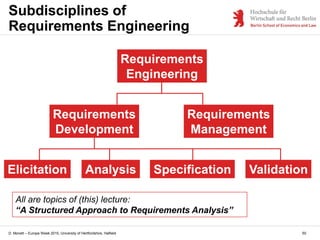
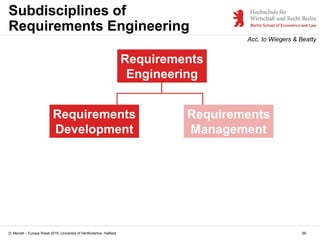
Subdisciplines of
Requirements Engineering
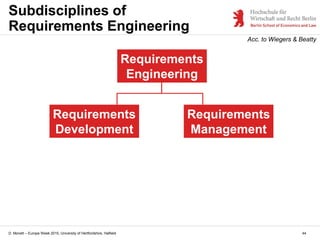
D. Monett – Europe Week 2015, University of Hertfordshire, Hatfield 44
Subdisciplines of
Requirements Engineering
Requirements
Engineering
Requirements
Development
Requirements
Management
Acc. to Wiegers & Beatty
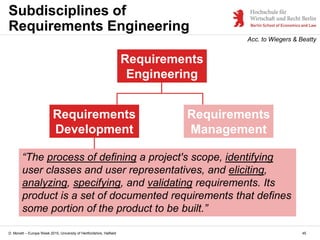
D. Monett – Europe Week 2015, University of Hertfordshire, Hatfield 45
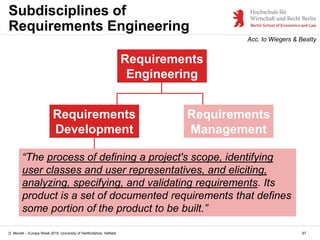
Subdisciplines of
Requirements Engineering
Requirements
Engineering
Requirements
Development
Requirements
Management
“The process of defining a project's scope, identifying
user classes and user representatives, and eliciting,
analyzing, specifying, and validating requirements. Its
product is a set of documented requirements that defines
some portion of the product to be built.”
Acc. to Wiegers & Beatty
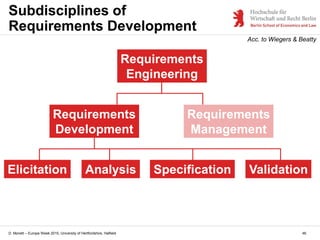
D. Monett – Europe Week 2015, University of Hertfordshire, Hatfield 46
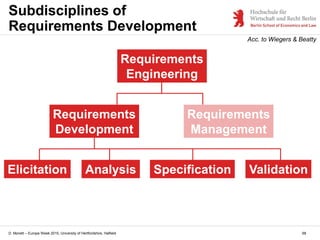
Subdisciplines of
Requirements Development
Elicitation
Requirements
Engineering
Analysis Specification Validation
Requirements
Development
Requirements
Management
Acc. to Wiegers & Beatty
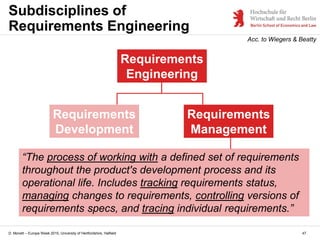
D. Monett – Europe Week 2015, University of Hertfordshire, Hatfield 47
Subdisciplines of
Requirements Engineering
Requirements
Engineering
Requirements
Development
Requirements
Management
“The process of working with a defined set of requirements
throughout the product's development process and its
operational life. Includes tracking requirements status,
managing changes to requirements, controlling versions of
requirements specs, and tracing individual requirements.”
Acc. to Wiegers & Beatty
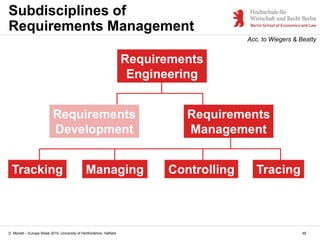
D. Monett – Europe Week 2015, University of Hertfordshire, Hatfield 48
Subdisciplines of
Requirements Management
Tracking
Requirements
Engineering
Managing Controlling Tracing
Requirements
Development
Requirements
Management
Acc. to Wiegers & Beatty
D. Monett – Europe Week 2015, University of Hertfordshire, Hatfield 49
Topics of other related lectures
D. Monett – Europe Week 2015, University of Hertfordshire, Hatfield 50
Subdisciplines of
Requirements Engineering
Elicitation
Requirements
Engineering
Analysis Specification Validation
Requirements
Development
Requirements
Management
All are topics of (this) lecture:
“A Structured Approach to Requirements Analysis”
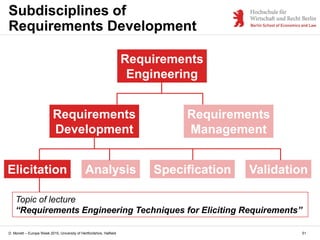
D. Monett – Europe Week 2015, University of Hertfordshire, Hatfield 51
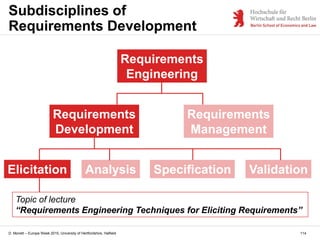
Subdisciplines of
Requirements Development
Requirements
Engineering
Requirements
Development
Requirements
Management
Elicitation Specification Validation
Topic of lecture
“Requirements Engineering Techniques for Eliciting Requirements”
Analysis
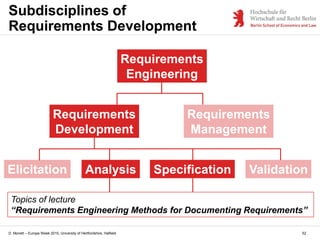
D. Monett – Europe Week 2015, University of Hertfordshire, Hatfield 52
Subdisciplines of
Requirements Development
Requirements
Engineering
Requirements
Development
Requirements
Management
Elicitation Specification Validation
Topics of lecture
“Requirements Engineering Methods for Documenting Requirements”
Analysis
D. Monett – Europe Week 2015, University of Hertfordshire, Hatfield 53
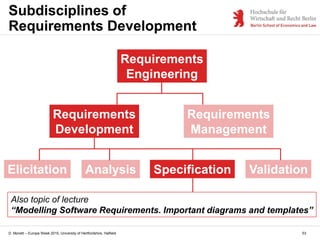
Subdisciplines of
Requirements Development
Requirements
Engineering
Requirements
Development
Requirements
Management
Elicitation Analysis Specification Validation
Also topic of lecture
“Modelling Software Requirements. Important diagrams and templates”
D. Monett – Europe Week 2015, University of Hertfordshire, Hatfield 54
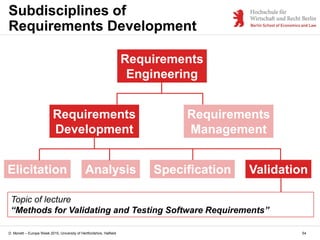
Subdisciplines of
Requirements Development
Requirements
Engineering
Requirements
Development
Requirements
Management
Elicitation Analysis Specification Validation
Topic of lecture
“Methods for Validating and Testing Software Requirements”
D. Monett – Europe Week 2015, University of Hertfordshire, Hatfield 55
Active learning exercise
Image © renjith krishnan at http://www.freedigitalphotos.net/
D. Monett – Europe Week 2015, University of Hertfordshire, Hatfield
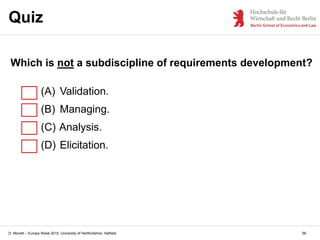
Quiz
56
Which is not a subdiscipline of requirements development?
(A) Validation.
(B) Managing.
(C) Analysis.
(D) Elicitation.
D. Monett – Europe Week 2015, University of Hertfordshire, Hatfield 57
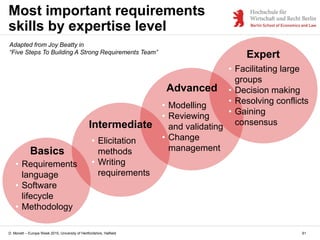
Requirements “skills”
D. Monett – Europe Week 2015, University of Hertfordshire, Hatfield 58
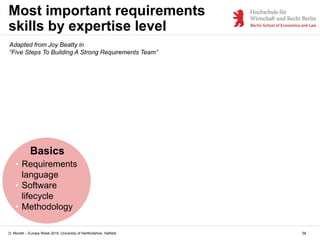
Most important requirements
skills by expertise level
Adapted from Joy Beatty in
“Five Steps To Building A Strong Requirements Team”
Basics
• Requirements
language
• Software
lifecycle
• Methodology
D. Monett – Europe Week 2015, University of Hertfordshire, Hatfield 59
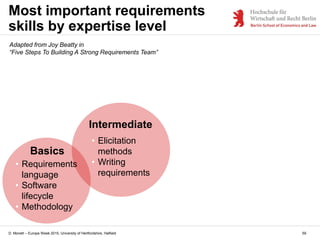
Most important requirements
skills by expertise level
Adapted from Joy Beatty in
“Five Steps To Building A Strong Requirements Team”
Basics
Intermediate
• Requirements
language
• Software
lifecycle
• Methodology
• Elicitation
methods
• Writing
requirements
D. Monett – Europe Week 2015, University of Hertfordshire, Hatfield 60
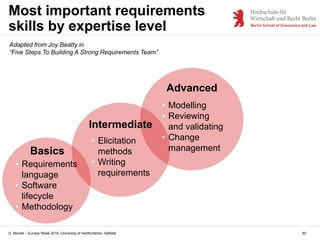
Most important requirements
skills by expertise level
Adapted from Joy Beatty in
“Five Steps To Building A Strong Requirements Team”
Basics
Advanced
Intermediate
• Requirements
language
• Software
lifecycle
• Methodology
• Elicitation
methods
• Writing
requirements
• Modelling
• Reviewing
and validating
• Change
management
D. Monett – Europe Week 2015, University of Hertfordshire, Hatfield 61
Most important requirements
skills by expertise level
Adapted from Joy Beatty in
“Five Steps To Building A Strong Requirements Team”
Basics
Advanced
Expert
Intermediate
• Requirements
language
• Software
lifecycle
• Methodology
• Elicitation
methods
• Writing
requirements
• Modelling
• Reviewing
and validating
• Change
management
• Facilitating large
groups
• Decision making
• Resolving conflicts
• Gaining
consensus
D. Monett – Europe Week 2015, University of Hertfordshire, Hatfield 62
So far…
 Where does the major content come from?
 Requirements and their relationships
 Requirements Engineering
- Definitions. Subdisciplines. Topics of related lectures.
 Requirements Development
- Definitions. Subdisciplines. A process framework.
 A Structured approach to Requirements Development
 Requirements risks
 Benefits from a high-quality requirements process
 What’s next? Further reading, sources of inspiration
D. Monett – Europe Week 2015, University of Hertfordshire, Hatfield 63
Next topics…
 Where does the major content come from?
 Requirements and their relationships
 Requirements Engineering
- Definitions. Subdisciplines. Topics of related lectures.
 Requirements Development
- Definitions. Subdisciplines. A process framework.
 A Structured approach to Requirements Development
 Requirements risks
 Benefits from a high-quality requirements process
 What’s next? Further reading, sources of inspiration
D. Monett – Europe Week 2015, University of Hertfordshire, Hatfield 64
Requirements Development
D. Monett – Europe Week 2015, University of Hertfordshire, Hatfield
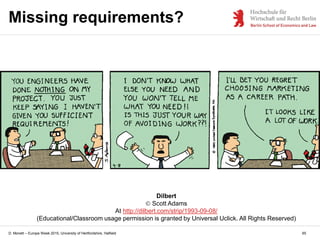
Dilbert
 Scott Adams
At http://dilbert.com/strip/1993-09-08/
(Educational/Classroom usage permission is granted by Universal Uclick. All Rights Reserved)
Missing requirements?
65
D. Monett – Europe Week 2015, University of Hertfordshire, Hatfield 66
Subdisciplines of
Requirements Engineering
Requirements
Engineering
Requirements
Development
Requirements
Management
Acc. to Wiegers & Beatty
D. Monett – Europe Week 2015, University of Hertfordshire, Hatfield 67
Subdisciplines of
Requirements Engineering
Requirements
Engineering
Requirements
Development
Requirements
Management
“The process of defining a project's scope, identifying
user classes and user representatives, and eliciting,
analyzing, specifying, and validating requirements. Its
product is a set of documented requirements that defines
some portion of the product to be built.”
Acc. to Wiegers & Beatty
D. Monett – Europe Week 2015, University of Hertfordshire, Hatfield 68
Subdisciplines of
Requirements Development
Elicitation
Requirements
Engineering
Analysis Specification Validation
Requirements
Development
Requirements
Management
Acc. to Wiegers & Beatty
D. Monett – Europe Week 2015, University of Hertfordshire, Hatfield
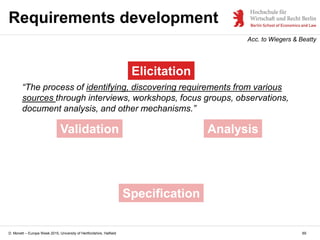
Requirements development
69
Acc. to Wiegers & Beatty
Elicitation
Analysis
Specification
Validation
“The process of identifying, discovering requirements from various
sources through interviews, workshops, focus groups, observations,
document analysis, and other mechanisms.”
D. Monett – Europe Week 2015, University of Hertfordshire, Hatfield
Requirements development
70
Acc. to Wiegers & Beatty
Elicitation
Analysis
Specification
Validation
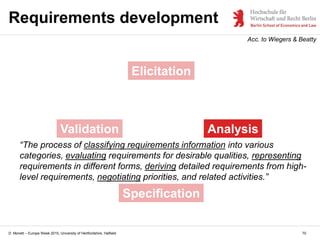
“The process of classifying requirements information into various
categories, evaluating requirements for desirable qualities, representing
requirements in different forms, deriving detailed requirements from high-
level requirements, negotiating priorities, and related activities.”
D. Monett – Europe Week 2015, University of Hertfordshire, Hatfield
Requirements development
71
Acc. to Wiegers & Beatty
Elicitation
Analysis
Specification
Validation
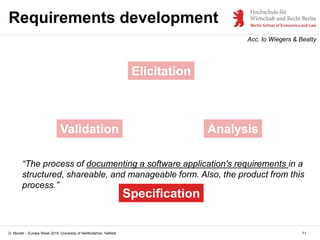
“The process of documenting a software application's requirements in a
structured, shareable, and manageable form. Also, the product from this
process.”
D. Monett – Europe Week 2015, University of Hertfordshire, Hatfield
Requirements development
72
Acc. to Wiegers & Beatty
Elicitation
Analysis
Specification
Validation
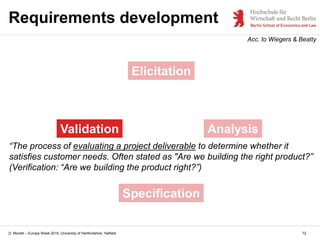
“The process of evaluating a project deliverable to determine whether it
satisfies customer needs. Often stated as "Are we building the right product?”
(Verification: “Are we building the product right?”)
D. Monett – Europe Week 2015, University of Hertfordshire, Hatfield 73
A Requirements Development
process framework
D. Monett – Europe Week 2015, University of Hertfordshire, Hatfield
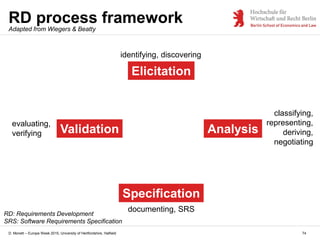
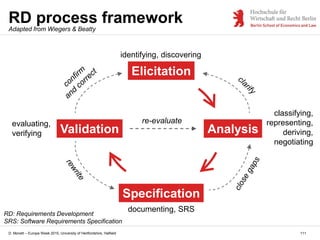
RD process framework
74
Elicitation
Analysis
Specification
Validation
RD: Requirements Development
SRS: Software Requirements Specification
identifying, discovering
evaluating,
verifying
documenting, SRS
classifying,
representing,
deriving,
negotiating
Adapted from Wiegers & Beatty
D. Monett – Europe Week 2015, University of Hertfordshire, Hatfield
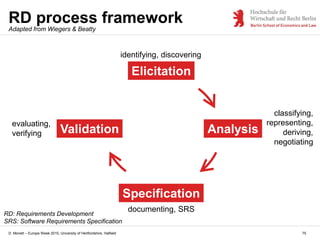
RD process framework
75
Elicitation
Analysis
Specification
Validation
RD: Requirements Development
SRS: Software Requirements Specification
identifying, discovering
evaluating,
verifying
documenting, SRS
classifying,
representing,
deriving,
negotiating
Adapted from Wiegers & Beatty
D. Monett – Europe Week 2015, University of Hertfordshire, Hatfield
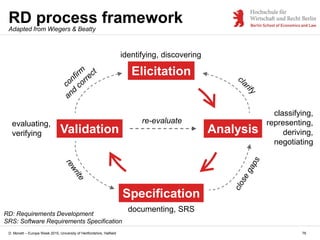
RD process framework
76
Elicitation
Analysis
Specification
Validation
re-evaluate
Adapted from Wiegers & Beatty
identifying, discovering
evaluating,
verifying
documenting, SRS
classifying,
representing,
deriving,
negotiating
RD: Requirements Development
SRS: Software Requirements Specification
D. Monett – Europe Week 2015, University of Hertfordshire, Hatfield 77
So far…
 Where does the major content come from?
 Requirements and their relationships
 Requirements Engineering
- Definitions. Subdisciplines. Topics of related lectures.
 Requirements Development
- Definitions. Subdisciplines. A process framework.
 A Structured approach to Requirements Development
 Requirements risks
 Benefits from a high-quality requirements process
 What’s next? Further reading, sources of inspiration
D. Monett – Europe Week 2015, University of Hertfordshire, Hatfield 78
Next topics…
 Where does the major content come from?
 Requirements and their relationships
 Requirements Engineering
- Definitions. Subdisciplines. Topics of related lectures.
 Requirements Development
- Definitions. Subdisciplines. A process framework.
 A Structured approach to Requirements Development
 Requirements risks
 Benefits from a high-quality requirements process
 What’s next? Further reading, sources of inspiration
D. Monett – Europe Week 2015, University of Hertfordshire, Hatfield 79
A structured approach to
Requirements Development
(Analysis included!)
D. Monett – Europe Week 2015, University of Hertfordshire, Hatfield
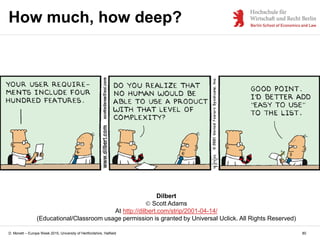
Dilbert
 Scott Adams
At http://dilbert.com/strip/2001-04-14/
(Educational/Classroom usage permission is granted by Universal Uclick. All Rights Reserved)
How much, how deep?
80
D. Monett – Europe Week 2015, University of Hertfordshire, Hatfield 81
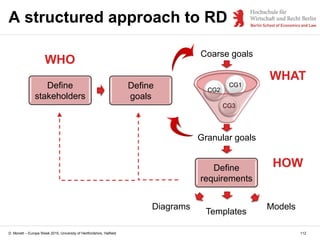
A structured approach to RD
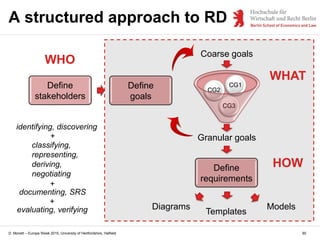
(1) Define stakeholders!
 Who is interested in the system?
 Who makes decisions?
 Who are the users, managers, developers, etc.?
In other words, WHO has influence on the software requirements?
D. Monett – Europe Week 2015, University of Hertfordshire, Hatfield 82
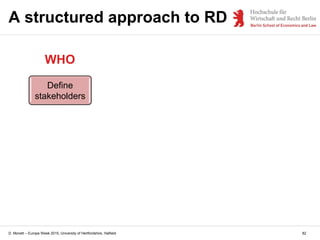
A structured approach to RD
Define
stakeholders
WHO
D. Monett – Europe Week 2015, University of Hertfordshire, Hatfield 83
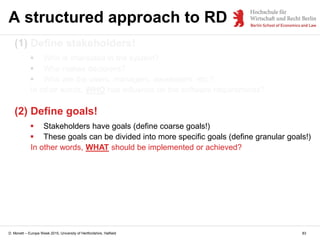
A structured approach to RD
(1) Define stakeholders!
 Who is interested in the system?
 Who makes decisions?
 Who are the users, managers, developers, etc.?
In other words, WHO has influence on the software requirements?
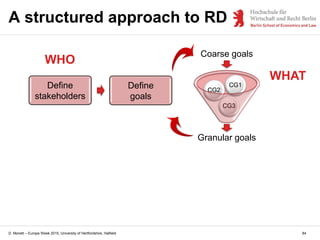
(2) Define goals!
 Stakeholders have goals (define coarse goals!)
 These goals can be divided into more specific goals (define granular goals!)
In other words, WHAT should be implemented or achieved?
D. Monett – Europe Week 2015, University of Hertfordshire, Hatfield 84
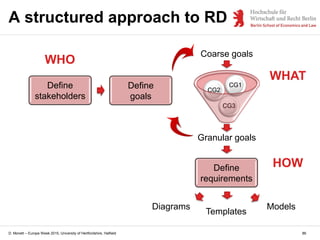
A structured approach to RD
Granular goals
CG3
CG2
CG1
Coarse goals
Define
stakeholders
Define
goals
WHO
WHAT
D. Monett – Europe Week 2015, University of Hertfordshire, Hatfield 85
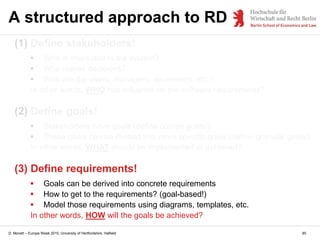
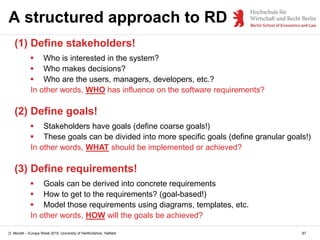
A structured approach to RD
(1) Define stakeholders!
 Who is interested in the system?
 Who makes decisions?
 Who are the users, managers, developers, etc.?
In other words, WHO has influence on the software requirements?
(2) Define goals!
 Stakeholders have goals (define coarse goals!)
 These goals can be divided into more specific goals (define granular goals!)
In other words, WHAT should be implemented or achieved?
(3) Define requirements!
 Goals can be derived into concrete requirements
 How to get to the requirements? (goal-based!)
 Model those requirements using diagrams, templates, etc.
In other words, HOW will the goals be achieved?
D. Monett – Europe Week 2015, University of Hertfordshire, Hatfield 86
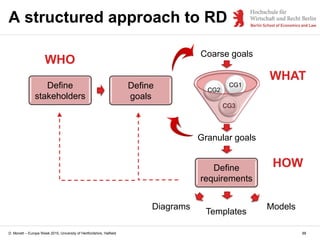
A structured approach to RD
Granular goals
CG3
CG2
CG1
Coarse goals
Define
stakeholders
Define
goals
Define
requirements
Diagrams
Templates
Models
WHO
WHAT
HOW
D. Monett – Europe Week 2015, University of Hertfordshire, Hatfield 87
A structured approach to RD
(1) Define stakeholders!
 Who is interested in the system?
 Who makes decisions?
 Who are the users, managers, developers, etc.?
In other words, WHO has influence on the software requirements?
(2) Define goals!
 Stakeholders have goals (define coarse goals!)
 These goals can be divided into more specific goals (define granular goals!)
In other words, WHAT should be implemented or achieved?
(3) Define requirements!
 Goals can be derived into concrete requirements
 How to get to the requirements? (goal-based!)
 Model those requirements using diagrams, templates, etc.
In other words, HOW will the goals be achieved?
D. Monett – Europe Week 2015, University of Hertfordshire, Hatfield 88
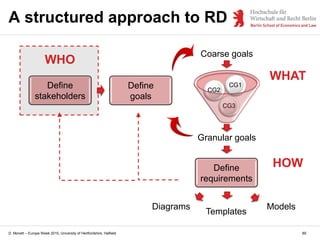
A structured approach to RD
Granular goals
CG3
CG2
CG1
Coarse goals
Define
stakeholders
Define
goals
Define
requirements
Diagrams
Templates
Models
WHO
WHAT
HOW
D. Monett – Europe Week 2015, University of Hertfordshire, Hatfield 89
A structured approach to RD
Granular goals
CG3
CG2
CG1
Coarse goals
Define
stakeholders
Define
goals
Define
requirements
Diagrams
Templates
Models
WHO
WHAT
HOW
D. Monett – Europe Week 2015, University of Hertfordshire, Hatfield 90
A structured approach to RD
Granular goals
CG3
CG2
CG1
Coarse goals
Define
stakeholders
Define
goals
Define
requirements
Diagrams
Templates
Models
WHO
WHAT
HOW
classifying,
representing,
deriving,
negotiating
identifying, discovering
documenting, SRS
+
+
evaluating, verifying
+
D. Monett – Europe Week 2015, University of Hertfordshire, Hatfield 91
Yet another Requirements
Development Process
D. Monett – Europe Week 2015, University of Hertfordshire, Hatfield 92
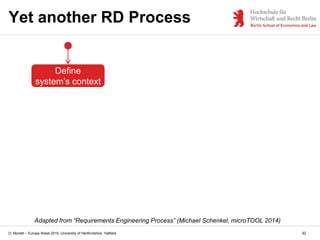
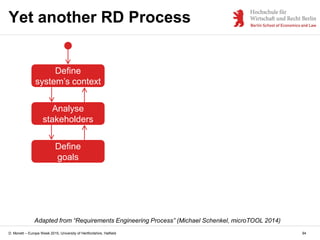
Yet another RD Process
Adapted from “Requirements Engineering Process” (Michael Schenkel, microTOOL 2014)
Define
system’s context
D. Monett – Europe Week 2015, University of Hertfordshire, Hatfield 93
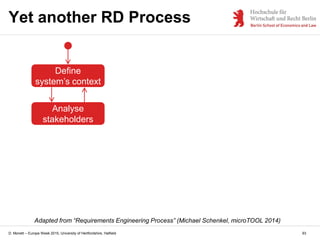
Yet another RD Process
Adapted from “Requirements Engineering Process” (Michael Schenkel, microTOOL 2014)
Define
system’s context
Analyse
stakeholders
D. Monett – Europe Week 2015, University of Hertfordshire, Hatfield 94
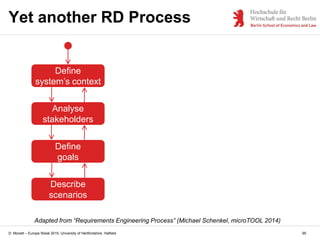
Yet another RD Process
Adapted from “Requirements Engineering Process” (Michael Schenkel, microTOOL 2014)
Define
system’s context
Analyse
stakeholders
Define
goals
D. Monett – Europe Week 2015, University of Hertfordshire, Hatfield 95
Yet another RD Process
Adapted from “Requirements Engineering Process” (Michael Schenkel, microTOOL 2014)
Define
system’s context
Analyse
stakeholders
Define
goals
Describe
scenarios
D. Monett – Europe Week 2015, University of Hertfordshire, Hatfield 96
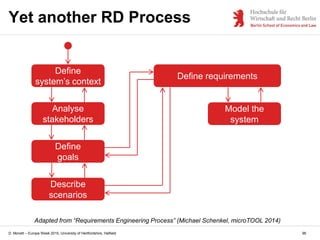
Yet another RD Process
Adapted from “Requirements Engineering Process” (Michael Schenkel, microTOOL 2014)
Define
system’s context
Analyse
stakeholders
Define
goals
Describe
scenarios
Define requirements
Model the
system
D. Monett – Europe Week 2015, University of Hertfordshire, Hatfield 97
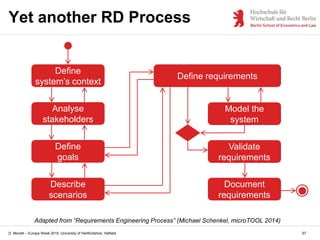
Yet another RD Process
Adapted from “Requirements Engineering Process” (Michael Schenkel, microTOOL 2014)
Define
system’s context
Analyse
stakeholders
Define
goals
Describe
scenarios
Define requirements
Model the
system
Validate
requirements
Document
requirements
D. Monett – Europe Week 2015, University of Hertfordshire, Hatfield 98
So far…
 Where does the major content come from?
 Requirements and their relationships
 Requirements Engineering
- Definitions. Subdisciplines. Topics of related lectures.
 Requirements Development
- Definitions. Subdisciplines. A process framework.
 A Structured approach to Requirements Development
 Requirements risks
 Benefits from a high-quality requirements process
 What’s next? Further reading, sources of inspiration
D. Monett – Europe Week 2015, University of Hertfordshire, Hatfield 99
Next topics…
 Where does the major content come from?
 Requirements and their relationships
 Requirements Engineering
- Definitions. Subdisciplines. Topics of related lectures.
 Requirements Development
- Definitions. Subdisciplines. A process framework.
 A Structured approach to Requirements Development
 Requirements risks
 Benefits from a high-quality requirements process
 What’s next? Further reading, sources of inspiration
D. Monett – Europe Week 2015, University of Hertfordshire, Hatfield 100
Most common
requirements risks
D. Monett – Europe Week 2015, University of Hertfordshire, Hatfield
Requirements risks
 Insufficient user involvement.
 Inaccurate planning.
 Creeping user requirements.
 Ambiguous requirements.
 Gold plating.
 Overlooked stakeholders.
101
According to Wiegers & Beatty
D. Monett – Europe Week 2015, University of Hertfordshire, Hatfield
Problems of Req. Analysis
 Stakeholders don’t know what they really want.
 Stakeholders express requirements in their own
terms.
 Different stakeholders may have conflicting
requirements.
 Organisational and political factors may influence
the system requirements.
 The requirements change during the analysis
process. New stakeholders may emerge and the
business environment change.
102
According to Ian Sommerville
D. Monett – Europe Week 2015, University of Hertfordshire, Hatfield 103
Benefits from a high-quality
requirements process
D. Monett – Europe Week 2015, University of Hertfordshire, Hatfield
Benefits, payoff
 Fewer defects in requirements and in the
delivered product.
 Reduced development rework.
 Faster development and delivery.
 Fewer unnecessary and unused features.
 Lower enhancement costs.
 Fewer miscommunications.
 Reduced scope creep.
 Reduced project chaos.
 Higher customer and team member satisfaction.
 Products that do what they are supposed to do.
104
According to Wiegers & Beatty
D. Monett – Europe Week 2015, University of Hertfordshire, Hatfield 105
So far…
 Where does the major content come from?
 Requirements and their relationships
 Requirements Engineering
- Definitions. Subdisciplines. Topics of related lectures.
 Requirements Development
- Definitions. Subdisciplines. A process framework.
 A Structured approach to Requirements Development
 Requirements risks
 Benefits from a high-quality requirements process
 What’s next? Further reading, sources of inspiration
D. Monett – Europe Week 2015, University of Hertfordshire, Hatfield 106
Next topics…
 Where does the major content come from?
 Requirements and their relationships
 Requirements Engineering
- Definitions. Subdisciplines. Topics of related lectures.
 Requirements Development
- Definitions. Subdisciplines. A process framework.
 A Structured approach to Requirements Development
 Requirements risks
 Benefits from a high-quality requirements process
 What’s next? Further reading, sources of inspiration
D. Monett – Europe Week 2015, University of Hertfordshire, Hatfield 107
Active learning exercise
Image © renjith krishnan at http://www.freedigitalphotos.net/
D. Monett – Europe Week 2015, University of Hertfordshire, Hatfield 108
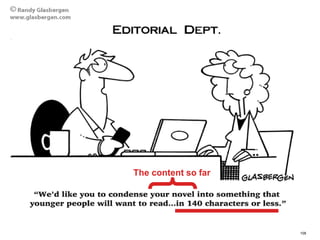
The content so far
D. Monett – Europe Week 2015, University of Hertfordshire, Hatfield 109
To take away…
D. Monett – Europe Week 2015, University of Hertfordshire, Hatfield 110
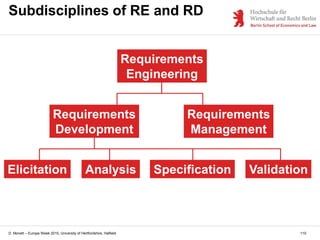
Subdisciplines of RE and RD
Elicitation
Requirements
Engineering
Analysis Specification Validation
Requirements
Development
Requirements
Management
D. Monett – Europe Week 2015, University of Hertfordshire, Hatfield
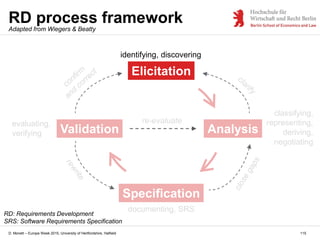
RD process framework
111
Elicitation
Analysis
Specification
Validation
re-evaluate
Adapted from Wiegers & Beatty
identifying, discovering
evaluating,
verifying
documenting, SRS
classifying,
representing,
deriving,
negotiating
RD: Requirements Development
SRS: Software Requirements Specification
D. Monett – Europe Week 2015, University of Hertfordshire, Hatfield 112
A structured approach to RD
Granular goals
CG3
CG2
CG1
Coarse goals
Define
stakeholders
Define
goals
Define
requirements
Diagrams
Templates
Models
WHO
WHAT
HOW
D. Monett – Europe Week 2015, University of Hertfordshire, Hatfield 113
What comes next?
D. Monett – Europe Week 2015, University of Hertfordshire, Hatfield 114
Subdisciplines of
Requirements Development
Requirements
Engineering
Requirements
Development
Requirements
Management
Elicitation Specification Validation
Topic of lecture
“Requirements Engineering Techniques for Eliciting Requirements”
Analysis
D. Monett – Europe Week 2015, University of Hertfordshire, Hatfield
RD process framework
115
Elicitation
Analysis
Specification
Validation
re-evaluate
Adapted from Wiegers & Beatty
identifying, discovering
evaluating,
verifying
documenting, SRS
classifying,
representing,
deriving,
negotiating
RD: Requirements Development
SRS: Software Requirements Specification
D. Monett – Europe Week 2015, University of Hertfordshire, Hatfield 116
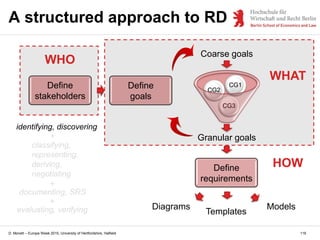
A structured approach to RD
Granular goals
CG3
CG2
CG1
Coarse goals
Define
stakeholders
Define
goals
Define
requirements
Diagrams
Templates
Models
WHO
WHAT
HOW
classifying,
representing,
deriving,
negotiating
identifying, discovering
documenting, SRS
+
+
evaluating, verifying
+
D. Monett – Europe Week 2015, University of Hertfordshire, Hatfield 117
Other references
D. Monett – Europe Week 2015, University of Hertfordshire, Hatfield
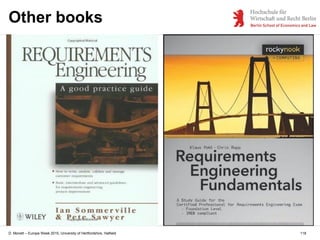
Other books
118
D. Monett – Europe Week 2015, University of Hertfordshire, Hatfield
Further reading
 IREB - International Requirements Engineering
Board e.V.
http://www.ireb.org/en/service/downloads.html
119
D. Monett – Europe Week 2015, University of Hertfordshire, Hatfield
Conference sites…
 21st International Working Conference on
Requirements Engineering: Foundation for Software
Quality (REFSQ 2015), Essen, Germany
http://refsq.org/2015/
120
D. Monett – Europe Week 2015, University of Hertfordshire, Hatfield
Conference sites…
 23rd IEEE International Requirements Engineering
Conference (RE’15), Ottawa, Canada
http://re15.org/
121
D. Monett – Europe Week 2015, University of Hertfordshire, Hatfield 122
Homework:
“Reflect on the topics that were
covered so far and write down
your own notes and conclusions!”
Image © renjith krishnan at http://www.freedigitalphotos.net/
D. Monett – Europe Week 2015, University of Hertfordshire, Hatfield 123
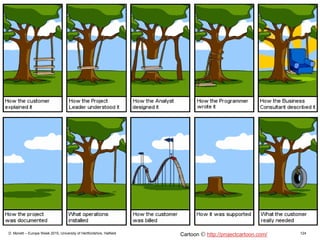
The traditional software
development process:
Perceptions, communication patterns
and interests…
D. Monett – Europe Week 2015, University of Hertfordshire, Hatfield 124Cartoon  http://projectcartoon.com/
D. Monett – Europe Week 2015, University of Hertfordshire, Hatfield 125
The ideal, perfect, still possible
software development process:
Perceptions, communication patterns
and interests…
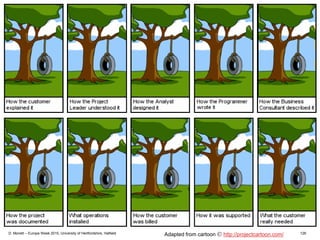
D. Monett – Europe Week 2015, University of Hertfordshire, Hatfield 126Adapted from cartoon  http://projectcartoon.com/
D. Monett – Europe Week 2015, University of Hertfordshire, Hatfield 127
Done!
 Where does the major content come from?
 Requirements and their relationships
 Requirements Engineering
- Definitions. Subdisciplines. Topics of related lectures.
 Requirements Development
- Definitions. Subdisciplines. A process framework.
 A Structured approach to Requirements Development
 Requirements risks
 Benefits from a high-quality requirements process
 What’s next? Further reading, sources of inspiration
D. Monett – Europe Week 2015, University of Hertfordshire, Hatfield
A Structured Approach to
Requirements Analysis
Prof. Dr. Dagmar Monett Díaz
Computer Science Dept.
Faculty of Cooperative Studies
Berlin School of Economics and Law
dagmar@monettdiaz.com
Europe Week, 2nd – 6th March 2015
monettdiaz@dmonett

A Structured Approach to Requirements Analysis (lecture slides)

  • 1.
    D. Monett –Europe Week 2015, University of Hertfordshire, Hatfield A Structured Approach to Requirements Analysis Prof. Dr. Dagmar Monett Díaz Computer Science Dept. Faculty of Cooperative Studies Berlin School of Economics and Law dagmar@monettdiaz.com Europe Week, 2nd – 6th March 2015 90 Minutes
  • 2.
    D. Monett –Europe Week 2015, University of Hertfordshire, Hatfield Dilbert  Scott Adams At http://dilbert.com/strip/2003-03-22/ (Educational/Classroom usage permission is granted by Universal Uclick. All Rights Reserved) Where are the requirements? 2
  • 3.
    D. Monett –Europe Week 2015, University of Hertfordshire, Hatfield 3 Main topics
  • 4.
    D. Monett –Europe Week 2015, University of Hertfordshire, Hatfield 4 Main topics  Where does the major content come from?  Requirements and their relationships  Requirements Engineering - Definitions. Subdisciplines. Topics of related lectures.  Requirements Development - Definitions. Subdisciplines. A process framework.  A Structured approach to Requirements Development  Requirements risks  Benefits from a high-quality requirements process  What’s next? Further reading, sources of inspiration
  • 5.
    D. Monett –Europe Week 2015, University of Hertfordshire, Hatfield 5 Next topics…  Where does the major content come from?  Requirements and their relationships  Requirements Engineering - Definitions. Subdisciplines. Topics of related lectures.  Requirements Development - Definitions. Subdisciplines. A process framework.  A Structured approach to Requirements Development  Requirements risks  Benefits from a high-quality requirements process  What’s next? Further reading, sources of inspiration
  • 6.
    D. Monett –Europe Week 2015, University of Hertfordshire, Hatfield 6 ©
  • 7.
    D. Monett –Europe Week 2015, University of Hertfordshire, Hatfield Software Requirements Karl Wiegers and Joy Beatty 3rd Edition, 672 pp. Microsoft Press, 2013 ISBN-13: 978-0-7356-7966-5 (See more at http://aka.ms/SoftwareReq3E/files) 7 Wiegers & Beatty
  • 8.
    D. Monett –Europe Week 2015, University of Hertfordshire, Hatfield Requirements-Engineering und -Management: Aus der Praxis von klassisch bis agil Chris Rupp & die SOPHISTen 6th Edition, 570 pp. Carl Hanser Verlag München, 2014 ISBN-13: 978-3-446-43893-4 In German (Chapters and related topics in English are available for free at https://www.sophist.de/) 8 Rupp & The SOPHISTs
  • 9.
    D. Monett –Europe Week 2015, University of Hertfordshire, Hatfield Software Engineering Ian Sommerville 9th Edition, 792 pp. Addison-Wesley, 2010 ISBN-13: 978-0137035151 (10th Edition: April 2015. See more at http://iansommerville.com/software- engineering-book/) 9 Sommerville
  • 10.
    D. Monett –Europe Week 2015, University of Hertfordshire, Hatfield 10 The traditional software development process: Perceptions, communication patterns and interests…
  • 11.
    D. Monett –Europe Week 2015, University of Hertfordshire, Hatfield 11Cartoon  http://projectcartoon.com/
  • 12.
    D. Monett –Europe Week 2015, University of Hertfordshire, Hatfield 12Cartoon  http://projectcartoon.com/
  • 13.
    D. Monett –Europe Week 2015, University of Hertfordshire, Hatfield 13Cartoon  http://projectcartoon.com/
  • 14.
    D. Monett –Europe Week 2015, University of Hertfordshire, Hatfield 14Cartoon  http://projectcartoon.com/
  • 15.
    D. Monett –Europe Week 2015, University of Hertfordshire, Hatfield Some key questions 15 - What are requirements? - How do stakeholders define requirements? - How are requirements documented? - Is there a process we can follow?
  • 16.
    D. Monett –Europe Week 2015, University of Hertfordshire, Hatfield 16 What is a requirement? – Definitions –
  • 17.
    D. Monett –Europe Week 2015, University of Hertfordshire, Hatfield 17 IEEE-Standard 610.12 (1990)  A requirement is: (1). „A condition or capability needed by a user (be it person or system) to solve a problem or achieve an objective.“
  • 18.
    D. Monett –Europe Week 2015, University of Hertfordshire, Hatfield 18 IEEE-Standard 610.12 (1990)  A requirement is: (1). „A condition or capability needed by a user (be it person or system) to solve a problem or achieve an objective.“ (2). „A condition or capability that must be met or possessed by a system or system component to satisfy a contract, standard, specification, or other formally imposed document.“
  • 19.
    D. Monett –Europe Week 2015, University of Hertfordshire, Hatfield 19 IEEE-Standard 610.12 (1990)  A requirement is: (1). „A condition or capability needed by a user (be it person or system) to solve a problem or achieve an objective.“ (2). „A condition or capability that must be met or possessed by a system or system component to satisfy a contract, standard, specification, or other formally imposed document.“ (3). „A documented representation of a condition or capability as in (1) or (2).“
  • 20.
    D. Monett –Europe Week 2015, University of Hertfordshire, Hatfield 20 Requirement: A definition According to Wiegers & Beatty: “[A requirement is a] statement of a customer need or objective, or of a condition or capability that a product must possess to satisfy such a need or objective. A property that a product must have to provide value to a stakeholder.”
  • 21.
    D. Monett –Europe Week 2015, University of Hertfordshire, Hatfield 21 Requirement: A definition According to Wiegers & Beatty: “[A requirement is a] statement of a customer need or objective, or of a condition or capability that a product must possess to satisfy such a need or objective. A property that a product must have to provide value to a stakeholder.”
  • 22.
    D. Monett –Europe Week 2015, University of Hertfordshire, Hatfield 22 Requirement: A definition According to Wiegers & Beatty: “[A requirement is a] statement of a customer need or objective, or of a condition or capability that a product must possess to satisfy such a need or objective. A property that a product must have to provide value to a stakeholder.”
  • 23.
    D. Monett –Europe Week 2015, University of Hertfordshire, Hatfield 23 Requirement: A definition According to Wiegers & Beatty: “[A requirement is a] statement of a customer need or objective, or of a condition or capability that a product must possess to satisfy such a need or objective. A property that a product must have to provide value to a stakeholder.”
  • 24.
    D. Monett –Europe Week 2015, University of Hertfordshire, Hatfield 24 Active learning exercise Image © renjith krishnan at http://www.freedigitalphotos.net/
  • 25.
    D. Monett –Europe Week 2015, University of Hertfordshire, Hatfield Quiz 25 (Taken from the public Examination Questionnaire Set © IREB, International Requirements Engineering Board e.V.) Which two of the following statements define the term “requirement” in accordance to the IEEE standard? (A) The difference between current state and desired state. (B) An instruction on how a requirement has to be fulfilled. (C) A demanded capability of a system. (D) A problem that has been identified. (E) A capability that must be met or possessed by a system.
  • 26.
    D. Monett –Europe Week 2015, University of Hertfordshire, Hatfield 26 Relationships among several types of requirements information
  • 27.
    D. Monett –Europe Week 2015, University of Hertfordshire, Hatfield 27 Levels of software requirements Business requirements User requirements Functional requirements Adapted from Wiegers & Beatty
  • 28.
    D. Monett –Europe Week 2015, University of Hertfordshire, Hatfield 28 Levels of software requirements Business requirements “A set of information that describes a business need that leads to one or more projects to deliver a solution and the desired ultimate business outcomes. The business requirements include business opportunities, business objectives, success metrics, a vision statement, and scope and limitations.” Example: “Increase market share in region X by Y percent within Z months.” Adapted from Wiegers & Beatty
  • 29.
    D. Monett –Europe Week 2015, University of Hertfordshire, Hatfield 29 Levels of software requirements “A goal or task that specific classes of users must be able to perform with a system, or a desired product attribute. Use cases, user stories, and scenarios are common ways to represent user requirements.” Example: “As the lead machine operator, I need to calibrate the pump controller first thing every morning.” User requirements Adapted from Wiegers & Beatty
  • 30.
    D. Monett –Europe Week 2015, University of Hertfordshire, Hatfield 30 Levels of software requirements “A description of a behavior that a software system will exhibit under specific conditions.” Example: “The user must be able to sort the project list in forward and reverse alphabetical order.” Functional requirements Adapted from Wiegers & Beatty
  • 31.
    D. Monett –Europe Week 2015, University of Hertfordshire, Hatfield 31 Several types of requirements Business requirements User requirements Functional requirements Adapted from Wiegers & Beatty
  • 32.
    D. Monett –Europe Week 2015, University of Hertfordshire, Hatfield 32 Origins of / influences from… Business requirements Business rules “A policy, guideline, standard, regulation, or computational formula that defines or constrains some aspect of the business.” Example: “A new customer must pay 30% of travel expenses in advance.” Example: “Capability to enter the information of a new customer in an existing accounting system.” Adapted from Wiegers & Beatty “A set of information that describes a business need.”
  • 33.
    D. Monett –Europe Week 2015, University of Hertfordshire, Hatfield 33 Origins of / influences from… Business requirements Business rules User requirements Quality attributes System requirements Functional requirements External interfaces Constraints Adapted from Wiegers & Beatty
  • 34.
    D. Monett –Europe Week 2015, University of Hertfordshire, Hatfield 34 Active learning exercise: “What can be a requirement? Please mention other concrete examples!” Image © renjith krishnan at http://www.freedigitalphotos.net/
  • 35.
    D. Monett –Europe Week 2015, University of Hertfordshire, Hatfield 35 So far…  Where does the major content come from?  Requirements and their relationships  Requirements Engineering - Definitions. Subdisciplines. Topics of related lectures.  Requirements Development - Definitions. Subdisciplines. A process framework.  A Structured approach to Requirements Development  Requirements risks  Benefits from a high-quality requirements process  What’s next? Further reading, sources of inspiration
  • 36.
    D. Monett –Europe Week 2015, University of Hertfordshire, Hatfield 36 Next topics…  Where does the major content come from?  Requirements and their relationships  Requirements Engineering - Definitions. Subdisciplines. Topics of related lectures.  Requirements Development - Definitions. Subdisciplines. A process framework.  A Structured approach to Requirements Development  Requirements risks  Benefits from a high-quality requirements process  What’s next? Further reading, sources of inspiration
  • 37.
    D. Monett –Europe Week 2015, University of Hertfordshire, Hatfield 37 What is Requirements Engineering?
  • 38.
    D. Monett –Europe Week 2015, University of Hertfordshire, Hatfield Requirements Engineering Definition according to the IREB1: Requirements engineering is a cooperative, itera- tive, incremental process, aimed at guaranteeing that 38 1: International Requirements Engineering Board e.V. (see further reading at the end)
  • 39.
    D. Monett –Europe Week 2015, University of Hertfordshire, Hatfield Requirements Engineering Definition according to the IREB1: Requirements engineering is a cooperative, itera- tive, incremental process, aimed at guaranteeing that  all relevant requirements are known and understood with the necessary degree of refinement, 39 1: International Requirements Engineering Board e.V. (see further reading at the end)
  • 40.
    D. Monett –Europe Week 2015, University of Hertfordshire, Hatfield Requirements Engineering Definition according to the IREB1: Requirements engineering is a cooperative, itera- tive, incremental process, aimed at guaranteeing that  all relevant requirements are known and understood with the necessary degree of refinement,  the stakeholders involved come to a satisfactory agreement concerning the known requirements, 40 1: International Requirements Engineering Board e.V. (see further reading at the end)
  • 41.
    D. Monett –Europe Week 2015, University of Hertfordshire, Hatfield Requirements Engineering Definition according to the IREB1: Requirements engineering is a cooperative, itera- tive, incremental process, aimed at guaranteeing that  all relevant requirements are known and understood with the necessary degree of refinement,  the stakeholders involved come to a satisfactory agreement concerning the known requirements,  all requirements have been documented as defined by the documentation guidelines or specification guidelines. 41 1: International Requirements Engineering Board e.V. (see further reading at the end)
  • 42.
    D. Monett –Europe Week 2015, University of Hertfordshire, Hatfield Requirements Engineering Definition according to Wiegers & Beatty: Requirements engineering is the subdiscipline of systems engineering and software engineering that encompasses all project activities associated with understanding a product's necessary capabilities and attributes. Includes both requirements development and requirements management. 42
  • 43.
    D. Monett –Europe Week 2015, University of Hertfordshire, Hatfield 43 Subdisciplines of Requirements Engineering
  • 44.
    D. Monett –Europe Week 2015, University of Hertfordshire, Hatfield 44 Subdisciplines of Requirements Engineering Requirements Engineering Requirements Development Requirements Management Acc. to Wiegers & Beatty
  • 45.
    D. Monett –Europe Week 2015, University of Hertfordshire, Hatfield 45 Subdisciplines of Requirements Engineering Requirements Engineering Requirements Development Requirements Management “The process of defining a project's scope, identifying user classes and user representatives, and eliciting, analyzing, specifying, and validating requirements. Its product is a set of documented requirements that defines some portion of the product to be built.” Acc. to Wiegers & Beatty
  • 46.
    D. Monett –Europe Week 2015, University of Hertfordshire, Hatfield 46 Subdisciplines of Requirements Development Elicitation Requirements Engineering Analysis Specification Validation Requirements Development Requirements Management Acc. to Wiegers & Beatty
  • 47.
    D. Monett –Europe Week 2015, University of Hertfordshire, Hatfield 47 Subdisciplines of Requirements Engineering Requirements Engineering Requirements Development Requirements Management “The process of working with a defined set of requirements throughout the product's development process and its operational life. Includes tracking requirements status, managing changes to requirements, controlling versions of requirements specs, and tracing individual requirements.” Acc. to Wiegers & Beatty
  • 48.
    D. Monett –Europe Week 2015, University of Hertfordshire, Hatfield 48 Subdisciplines of Requirements Management Tracking Requirements Engineering Managing Controlling Tracing Requirements Development Requirements Management Acc. to Wiegers & Beatty
  • 49.
    D. Monett –Europe Week 2015, University of Hertfordshire, Hatfield 49 Topics of other related lectures
  • 50.
    D. Monett –Europe Week 2015, University of Hertfordshire, Hatfield 50 Subdisciplines of Requirements Engineering Elicitation Requirements Engineering Analysis Specification Validation Requirements Development Requirements Management All are topics of (this) lecture: “A Structured Approach to Requirements Analysis”
  • 51.
    D. Monett –Europe Week 2015, University of Hertfordshire, Hatfield 51 Subdisciplines of Requirements Development Requirements Engineering Requirements Development Requirements Management Elicitation Specification Validation Topic of lecture “Requirements Engineering Techniques for Eliciting Requirements” Analysis
  • 52.
    D. Monett –Europe Week 2015, University of Hertfordshire, Hatfield 52 Subdisciplines of Requirements Development Requirements Engineering Requirements Development Requirements Management Elicitation Specification Validation Topics of lecture “Requirements Engineering Methods for Documenting Requirements” Analysis
  • 53.
    D. Monett –Europe Week 2015, University of Hertfordshire, Hatfield 53 Subdisciplines of Requirements Development Requirements Engineering Requirements Development Requirements Management Elicitation Analysis Specification Validation Also topic of lecture “Modelling Software Requirements. Important diagrams and templates”
  • 54.
    D. Monett –Europe Week 2015, University of Hertfordshire, Hatfield 54 Subdisciplines of Requirements Development Requirements Engineering Requirements Development Requirements Management Elicitation Analysis Specification Validation Topic of lecture “Methods for Validating and Testing Software Requirements”
  • 55.
    D. Monett –Europe Week 2015, University of Hertfordshire, Hatfield 55 Active learning exercise Image © renjith krishnan at http://www.freedigitalphotos.net/
  • 56.
    D. Monett –Europe Week 2015, University of Hertfordshire, Hatfield Quiz 56 Which is not a subdiscipline of requirements development? (A) Validation. (B) Managing. (C) Analysis. (D) Elicitation.
  • 57.
    D. Monett –Europe Week 2015, University of Hertfordshire, Hatfield 57 Requirements “skills”
  • 58.
    D. Monett –Europe Week 2015, University of Hertfordshire, Hatfield 58 Most important requirements skills by expertise level Adapted from Joy Beatty in “Five Steps To Building A Strong Requirements Team” Basics • Requirements language • Software lifecycle • Methodology
  • 59.
    D. Monett –Europe Week 2015, University of Hertfordshire, Hatfield 59 Most important requirements skills by expertise level Adapted from Joy Beatty in “Five Steps To Building A Strong Requirements Team” Basics Intermediate • Requirements language • Software lifecycle • Methodology • Elicitation methods • Writing requirements
  • 60.
    D. Monett –Europe Week 2015, University of Hertfordshire, Hatfield 60 Most important requirements skills by expertise level Adapted from Joy Beatty in “Five Steps To Building A Strong Requirements Team” Basics Advanced Intermediate • Requirements language • Software lifecycle • Methodology • Elicitation methods • Writing requirements • Modelling • Reviewing and validating • Change management
  • 61.
    D. Monett –Europe Week 2015, University of Hertfordshire, Hatfield 61 Most important requirements skills by expertise level Adapted from Joy Beatty in “Five Steps To Building A Strong Requirements Team” Basics Advanced Expert Intermediate • Requirements language • Software lifecycle • Methodology • Elicitation methods • Writing requirements • Modelling • Reviewing and validating • Change management • Facilitating large groups • Decision making • Resolving conflicts • Gaining consensus
  • 62.
    D. Monett –Europe Week 2015, University of Hertfordshire, Hatfield 62 So far…  Where does the major content come from?  Requirements and their relationships  Requirements Engineering - Definitions. Subdisciplines. Topics of related lectures.  Requirements Development - Definitions. Subdisciplines. A process framework.  A Structured approach to Requirements Development  Requirements risks  Benefits from a high-quality requirements process  What’s next? Further reading, sources of inspiration
  • 63.
    D. Monett –Europe Week 2015, University of Hertfordshire, Hatfield 63 Next topics…  Where does the major content come from?  Requirements and their relationships  Requirements Engineering - Definitions. Subdisciplines. Topics of related lectures.  Requirements Development - Definitions. Subdisciplines. A process framework.  A Structured approach to Requirements Development  Requirements risks  Benefits from a high-quality requirements process  What’s next? Further reading, sources of inspiration
  • 64.
    D. Monett –Europe Week 2015, University of Hertfordshire, Hatfield 64 Requirements Development
  • 65.
    D. Monett –Europe Week 2015, University of Hertfordshire, Hatfield Dilbert  Scott Adams At http://dilbert.com/strip/1993-09-08/ (Educational/Classroom usage permission is granted by Universal Uclick. All Rights Reserved) Missing requirements? 65
  • 66.
    D. Monett –Europe Week 2015, University of Hertfordshire, Hatfield 66 Subdisciplines of Requirements Engineering Requirements Engineering Requirements Development Requirements Management Acc. to Wiegers & Beatty
  • 67.
    D. Monett –Europe Week 2015, University of Hertfordshire, Hatfield 67 Subdisciplines of Requirements Engineering Requirements Engineering Requirements Development Requirements Management “The process of defining a project's scope, identifying user classes and user representatives, and eliciting, analyzing, specifying, and validating requirements. Its product is a set of documented requirements that defines some portion of the product to be built.” Acc. to Wiegers & Beatty
  • 68.
    D. Monett –Europe Week 2015, University of Hertfordshire, Hatfield 68 Subdisciplines of Requirements Development Elicitation Requirements Engineering Analysis Specification Validation Requirements Development Requirements Management Acc. to Wiegers & Beatty
  • 69.
    D. Monett –Europe Week 2015, University of Hertfordshire, Hatfield Requirements development 69 Acc. to Wiegers & Beatty Elicitation Analysis Specification Validation “The process of identifying, discovering requirements from various sources through interviews, workshops, focus groups, observations, document analysis, and other mechanisms.”
  • 70.
    D. Monett –Europe Week 2015, University of Hertfordshire, Hatfield Requirements development 70 Acc. to Wiegers & Beatty Elicitation Analysis Specification Validation “The process of classifying requirements information into various categories, evaluating requirements for desirable qualities, representing requirements in different forms, deriving detailed requirements from high- level requirements, negotiating priorities, and related activities.”
  • 71.
    D. Monett –Europe Week 2015, University of Hertfordshire, Hatfield Requirements development 71 Acc. to Wiegers & Beatty Elicitation Analysis Specification Validation “The process of documenting a software application's requirements in a structured, shareable, and manageable form. Also, the product from this process.”
  • 72.
    D. Monett –Europe Week 2015, University of Hertfordshire, Hatfield Requirements development 72 Acc. to Wiegers & Beatty Elicitation Analysis Specification Validation “The process of evaluating a project deliverable to determine whether it satisfies customer needs. Often stated as "Are we building the right product?” (Verification: “Are we building the product right?”)
  • 73.
    D. Monett –Europe Week 2015, University of Hertfordshire, Hatfield 73 A Requirements Development process framework
  • 74.
    D. Monett –Europe Week 2015, University of Hertfordshire, Hatfield RD process framework 74 Elicitation Analysis Specification Validation RD: Requirements Development SRS: Software Requirements Specification identifying, discovering evaluating, verifying documenting, SRS classifying, representing, deriving, negotiating Adapted from Wiegers & Beatty
  • 75.
    D. Monett –Europe Week 2015, University of Hertfordshire, Hatfield RD process framework 75 Elicitation Analysis Specification Validation RD: Requirements Development SRS: Software Requirements Specification identifying, discovering evaluating, verifying documenting, SRS classifying, representing, deriving, negotiating Adapted from Wiegers & Beatty
  • 76.
    D. Monett –Europe Week 2015, University of Hertfordshire, Hatfield RD process framework 76 Elicitation Analysis Specification Validation re-evaluate Adapted from Wiegers & Beatty identifying, discovering evaluating, verifying documenting, SRS classifying, representing, deriving, negotiating RD: Requirements Development SRS: Software Requirements Specification
  • 77.
    D. Monett –Europe Week 2015, University of Hertfordshire, Hatfield 77 So far…  Where does the major content come from?  Requirements and their relationships  Requirements Engineering - Definitions. Subdisciplines. Topics of related lectures.  Requirements Development - Definitions. Subdisciplines. A process framework.  A Structured approach to Requirements Development  Requirements risks  Benefits from a high-quality requirements process  What’s next? Further reading, sources of inspiration
  • 78.
    D. Monett –Europe Week 2015, University of Hertfordshire, Hatfield 78 Next topics…  Where does the major content come from?  Requirements and their relationships  Requirements Engineering - Definitions. Subdisciplines. Topics of related lectures.  Requirements Development - Definitions. Subdisciplines. A process framework.  A Structured approach to Requirements Development  Requirements risks  Benefits from a high-quality requirements process  What’s next? Further reading, sources of inspiration
  • 79.
    D. Monett –Europe Week 2015, University of Hertfordshire, Hatfield 79 A structured approach to Requirements Development (Analysis included!)
  • 80.
    D. Monett –Europe Week 2015, University of Hertfordshire, Hatfield Dilbert  Scott Adams At http://dilbert.com/strip/2001-04-14/ (Educational/Classroom usage permission is granted by Universal Uclick. All Rights Reserved) How much, how deep? 80
  • 81.
    D. Monett –Europe Week 2015, University of Hertfordshire, Hatfield 81 A structured approach to RD (1) Define stakeholders!  Who is interested in the system?  Who makes decisions?  Who are the users, managers, developers, etc.? In other words, WHO has influence on the software requirements?
  • 82.
    D. Monett –Europe Week 2015, University of Hertfordshire, Hatfield 82 A structured approach to RD Define stakeholders WHO
  • 83.
    D. Monett –Europe Week 2015, University of Hertfordshire, Hatfield 83 A structured approach to RD (1) Define stakeholders!  Who is interested in the system?  Who makes decisions?  Who are the users, managers, developers, etc.? In other words, WHO has influence on the software requirements? (2) Define goals!  Stakeholders have goals (define coarse goals!)  These goals can be divided into more specific goals (define granular goals!) In other words, WHAT should be implemented or achieved?
  • 84.
    D. Monett –Europe Week 2015, University of Hertfordshire, Hatfield 84 A structured approach to RD Granular goals CG3 CG2 CG1 Coarse goals Define stakeholders Define goals WHO WHAT
  • 85.
    D. Monett –Europe Week 2015, University of Hertfordshire, Hatfield 85 A structured approach to RD (1) Define stakeholders!  Who is interested in the system?  Who makes decisions?  Who are the users, managers, developers, etc.? In other words, WHO has influence on the software requirements? (2) Define goals!  Stakeholders have goals (define coarse goals!)  These goals can be divided into more specific goals (define granular goals!) In other words, WHAT should be implemented or achieved? (3) Define requirements!  Goals can be derived into concrete requirements  How to get to the requirements? (goal-based!)  Model those requirements using diagrams, templates, etc. In other words, HOW will the goals be achieved?
  • 86.
    D. Monett –Europe Week 2015, University of Hertfordshire, Hatfield 86 A structured approach to RD Granular goals CG3 CG2 CG1 Coarse goals Define stakeholders Define goals Define requirements Diagrams Templates Models WHO WHAT HOW
  • 87.
    D. Monett –Europe Week 2015, University of Hertfordshire, Hatfield 87 A structured approach to RD (1) Define stakeholders!  Who is interested in the system?  Who makes decisions?  Who are the users, managers, developers, etc.? In other words, WHO has influence on the software requirements? (2) Define goals!  Stakeholders have goals (define coarse goals!)  These goals can be divided into more specific goals (define granular goals!) In other words, WHAT should be implemented or achieved? (3) Define requirements!  Goals can be derived into concrete requirements  How to get to the requirements? (goal-based!)  Model those requirements using diagrams, templates, etc. In other words, HOW will the goals be achieved?
  • 88.
    D. Monett –Europe Week 2015, University of Hertfordshire, Hatfield 88 A structured approach to RD Granular goals CG3 CG2 CG1 Coarse goals Define stakeholders Define goals Define requirements Diagrams Templates Models WHO WHAT HOW
  • 89.
    D. Monett –Europe Week 2015, University of Hertfordshire, Hatfield 89 A structured approach to RD Granular goals CG3 CG2 CG1 Coarse goals Define stakeholders Define goals Define requirements Diagrams Templates Models WHO WHAT HOW
  • 90.
    D. Monett –Europe Week 2015, University of Hertfordshire, Hatfield 90 A structured approach to RD Granular goals CG3 CG2 CG1 Coarse goals Define stakeholders Define goals Define requirements Diagrams Templates Models WHO WHAT HOW classifying, representing, deriving, negotiating identifying, discovering documenting, SRS + + evaluating, verifying +
  • 91.
    D. Monett –Europe Week 2015, University of Hertfordshire, Hatfield 91 Yet another Requirements Development Process
  • 92.
    D. Monett –Europe Week 2015, University of Hertfordshire, Hatfield 92 Yet another RD Process Adapted from “Requirements Engineering Process” (Michael Schenkel, microTOOL 2014) Define system’s context
  • 93.
    D. Monett –Europe Week 2015, University of Hertfordshire, Hatfield 93 Yet another RD Process Adapted from “Requirements Engineering Process” (Michael Schenkel, microTOOL 2014) Define system’s context Analyse stakeholders
  • 94.
    D. Monett –Europe Week 2015, University of Hertfordshire, Hatfield 94 Yet another RD Process Adapted from “Requirements Engineering Process” (Michael Schenkel, microTOOL 2014) Define system’s context Analyse stakeholders Define goals
  • 95.
    D. Monett –Europe Week 2015, University of Hertfordshire, Hatfield 95 Yet another RD Process Adapted from “Requirements Engineering Process” (Michael Schenkel, microTOOL 2014) Define system’s context Analyse stakeholders Define goals Describe scenarios
  • 96.
    D. Monett –Europe Week 2015, University of Hertfordshire, Hatfield 96 Yet another RD Process Adapted from “Requirements Engineering Process” (Michael Schenkel, microTOOL 2014) Define system’s context Analyse stakeholders Define goals Describe scenarios Define requirements Model the system
  • 97.
    D. Monett –Europe Week 2015, University of Hertfordshire, Hatfield 97 Yet another RD Process Adapted from “Requirements Engineering Process” (Michael Schenkel, microTOOL 2014) Define system’s context Analyse stakeholders Define goals Describe scenarios Define requirements Model the system Validate requirements Document requirements
  • 98.
    D. Monett –Europe Week 2015, University of Hertfordshire, Hatfield 98 So far…  Where does the major content come from?  Requirements and their relationships  Requirements Engineering - Definitions. Subdisciplines. Topics of related lectures.  Requirements Development - Definitions. Subdisciplines. A process framework.  A Structured approach to Requirements Development  Requirements risks  Benefits from a high-quality requirements process  What’s next? Further reading, sources of inspiration
  • 99.
    D. Monett –Europe Week 2015, University of Hertfordshire, Hatfield 99 Next topics…  Where does the major content come from?  Requirements and their relationships  Requirements Engineering - Definitions. Subdisciplines. Topics of related lectures.  Requirements Development - Definitions. Subdisciplines. A process framework.  A Structured approach to Requirements Development  Requirements risks  Benefits from a high-quality requirements process  What’s next? Further reading, sources of inspiration
  • 100.
    D. Monett –Europe Week 2015, University of Hertfordshire, Hatfield 100 Most common requirements risks
  • 101.
    D. Monett –Europe Week 2015, University of Hertfordshire, Hatfield Requirements risks  Insufficient user involvement.  Inaccurate planning.  Creeping user requirements.  Ambiguous requirements.  Gold plating.  Overlooked stakeholders. 101 According to Wiegers & Beatty
  • 102.
    D. Monett –Europe Week 2015, University of Hertfordshire, Hatfield Problems of Req. Analysis  Stakeholders don’t know what they really want.  Stakeholders express requirements in their own terms.  Different stakeholders may have conflicting requirements.  Organisational and political factors may influence the system requirements.  The requirements change during the analysis process. New stakeholders may emerge and the business environment change. 102 According to Ian Sommerville
  • 103.
    D. Monett –Europe Week 2015, University of Hertfordshire, Hatfield 103 Benefits from a high-quality requirements process
  • 104.
    D. Monett –Europe Week 2015, University of Hertfordshire, Hatfield Benefits, payoff  Fewer defects in requirements and in the delivered product.  Reduced development rework.  Faster development and delivery.  Fewer unnecessary and unused features.  Lower enhancement costs.  Fewer miscommunications.  Reduced scope creep.  Reduced project chaos.  Higher customer and team member satisfaction.  Products that do what they are supposed to do. 104 According to Wiegers & Beatty
  • 105.
    D. Monett –Europe Week 2015, University of Hertfordshire, Hatfield 105 So far…  Where does the major content come from?  Requirements and their relationships  Requirements Engineering - Definitions. Subdisciplines. Topics of related lectures.  Requirements Development - Definitions. Subdisciplines. A process framework.  A Structured approach to Requirements Development  Requirements risks  Benefits from a high-quality requirements process  What’s next? Further reading, sources of inspiration
  • 106.
    D. Monett –Europe Week 2015, University of Hertfordshire, Hatfield 106 Next topics…  Where does the major content come from?  Requirements and their relationships  Requirements Engineering - Definitions. Subdisciplines. Topics of related lectures.  Requirements Development - Definitions. Subdisciplines. A process framework.  A Structured approach to Requirements Development  Requirements risks  Benefits from a high-quality requirements process  What’s next? Further reading, sources of inspiration
  • 107.
    D. Monett –Europe Week 2015, University of Hertfordshire, Hatfield 107 Active learning exercise Image © renjith krishnan at http://www.freedigitalphotos.net/
  • 108.
    D. Monett –Europe Week 2015, University of Hertfordshire, Hatfield 108 The content so far
  • 109.
    D. Monett –Europe Week 2015, University of Hertfordshire, Hatfield 109 To take away…
  • 110.
    D. Monett –Europe Week 2015, University of Hertfordshire, Hatfield 110 Subdisciplines of RE and RD Elicitation Requirements Engineering Analysis Specification Validation Requirements Development Requirements Management
  • 111.
    D. Monett –Europe Week 2015, University of Hertfordshire, Hatfield RD process framework 111 Elicitation Analysis Specification Validation re-evaluate Adapted from Wiegers & Beatty identifying, discovering evaluating, verifying documenting, SRS classifying, representing, deriving, negotiating RD: Requirements Development SRS: Software Requirements Specification
  • 112.
    D. Monett –Europe Week 2015, University of Hertfordshire, Hatfield 112 A structured approach to RD Granular goals CG3 CG2 CG1 Coarse goals Define stakeholders Define goals Define requirements Diagrams Templates Models WHO WHAT HOW
  • 113.
    D. Monett –Europe Week 2015, University of Hertfordshire, Hatfield 113 What comes next?
  • 114.
    D. Monett –Europe Week 2015, University of Hertfordshire, Hatfield 114 Subdisciplines of Requirements Development Requirements Engineering Requirements Development Requirements Management Elicitation Specification Validation Topic of lecture “Requirements Engineering Techniques for Eliciting Requirements” Analysis
  • 115.
    D. Monett –Europe Week 2015, University of Hertfordshire, Hatfield RD process framework 115 Elicitation Analysis Specification Validation re-evaluate Adapted from Wiegers & Beatty identifying, discovering evaluating, verifying documenting, SRS classifying, representing, deriving, negotiating RD: Requirements Development SRS: Software Requirements Specification
  • 116.
    D. Monett –Europe Week 2015, University of Hertfordshire, Hatfield 116 A structured approach to RD Granular goals CG3 CG2 CG1 Coarse goals Define stakeholders Define goals Define requirements Diagrams Templates Models WHO WHAT HOW classifying, representing, deriving, negotiating identifying, discovering documenting, SRS + + evaluating, verifying +
  • 117.
    D. Monett –Europe Week 2015, University of Hertfordshire, Hatfield 117 Other references
  • 118.
    D. Monett –Europe Week 2015, University of Hertfordshire, Hatfield Other books 118
  • 119.
    D. Monett –Europe Week 2015, University of Hertfordshire, Hatfield Further reading  IREB - International Requirements Engineering Board e.V. http://www.ireb.org/en/service/downloads.html 119
  • 120.
    D. Monett –Europe Week 2015, University of Hertfordshire, Hatfield Conference sites…  21st International Working Conference on Requirements Engineering: Foundation for Software Quality (REFSQ 2015), Essen, Germany http://refsq.org/2015/ 120
  • 121.
    D. Monett –Europe Week 2015, University of Hertfordshire, Hatfield Conference sites…  23rd IEEE International Requirements Engineering Conference (RE’15), Ottawa, Canada http://re15.org/ 121
  • 122.
    D. Monett –Europe Week 2015, University of Hertfordshire, Hatfield 122 Homework: “Reflect on the topics that were covered so far and write down your own notes and conclusions!” Image © renjith krishnan at http://www.freedigitalphotos.net/
  • 123.
    D. Monett –Europe Week 2015, University of Hertfordshire, Hatfield 123 The traditional software development process: Perceptions, communication patterns and interests…
  • 124.
    D. Monett –Europe Week 2015, University of Hertfordshire, Hatfield 124Cartoon  http://projectcartoon.com/
  • 125.
    D. Monett –Europe Week 2015, University of Hertfordshire, Hatfield 125 The ideal, perfect, still possible software development process: Perceptions, communication patterns and interests…
  • 126.
    D. Monett –Europe Week 2015, University of Hertfordshire, Hatfield 126Adapted from cartoon  http://projectcartoon.com/
  • 127.
    D. Monett –Europe Week 2015, University of Hertfordshire, Hatfield 127 Done!  Where does the major content come from?  Requirements and their relationships  Requirements Engineering - Definitions. Subdisciplines. Topics of related lectures.  Requirements Development - Definitions. Subdisciplines. A process framework.  A Structured approach to Requirements Development  Requirements risks  Benefits from a high-quality requirements process  What’s next? Further reading, sources of inspiration
  • 128.
    D. Monett –Europe Week 2015, University of Hertfordshire, Hatfield A Structured Approach to Requirements Analysis Prof. Dr. Dagmar Monett Díaz Computer Science Dept. Faculty of Cooperative Studies Berlin School of Economics and Law dagmar@monettdiaz.com Europe Week, 2nd – 6th March 2015 monettdiaz@dmonett