Rome, Italy, May 2 - 3, 2016
Teaching Students Collaborative
Requirements Engineering –
Case Study Red:Wire
Talk at the 18th International Conference on Parallel, Distributed Systems and Software Engineering
ICPDSS 2016
Prof. Dr. Dagmar Monett,
Sven-Erik Kujat, Marvin Hartmann
D. Monett
Topics
2Rome, Italy, May 2 - 3, 2016
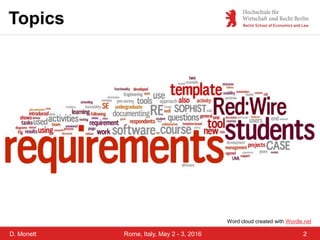
Word cloud created with Wordle.net
D. Monett 3Prague, Czech Republic, December 4 - 6, 2015
Requirements
Engineering
D. Monett 4Rome, Italy, May 2 - 3, 2016
Requirements Engineering
“[It] encompasses all project
activities associated with
understanding a product's
necessary capabilities and
attributes.”
Karl Wiegers and Joy Beatty (2013).
Software Requirements. 3rd Edition, 672 pp. Microsoft Press.
D. Monett
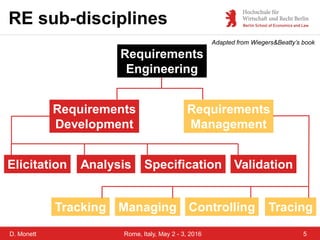
RE sub-disciplines
5Rome, Italy, May 2 - 3, 2016
Adapted from Wiegers&Beatty’s book
Elicitation
Requirements
Engineering
Analysis Specification Validation
Requirements
Development
Requirements
Management
Tracking Managing Controlling Tracing
D. Monett 6Rome, Italy, May 2 - 3, 2016
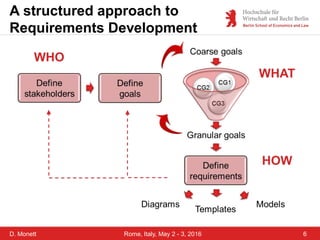
A structured approach to
Requirements Development
D. Monett 7Rome, Italy, May 2 - 3, 2016
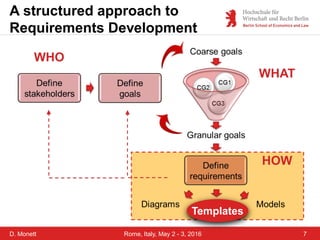
A structured approach to
Requirements Development
Templates
D. Monett 8Prague, Czech Republic, December 4 - 6, 2015
Rupp’s template-based
approach for constructing
requirements
D. Monett 9Rome, Italy, May 2 - 3, 2016
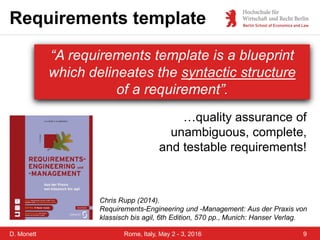
Requirements template
…quality assurance of
unambiguous, complete,
and testable requirements!
“A requirements template is a blueprint
which delineates the syntactic structure
of a requirement”.
Chris Rupp (2014).
Requirements-Engineering und -Management: Aus der Praxis von
klassisch bis agil, 6th Edition, 570 pp., Munich: Hanser Verlag.
D. Monett 10Rome, Italy, May 2 - 3, 2016
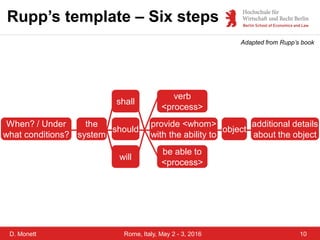
Rupp’s template – Six steps
the
system
should
provide <whom>
with the ability to
verb
<process>
be able to
<process>
will
shall
object
additional details
about the object
When? / Under
what conditions?
Adapted from Rupp’s book
D. Monett 11Rome, Italy, May 2 - 3, 2016
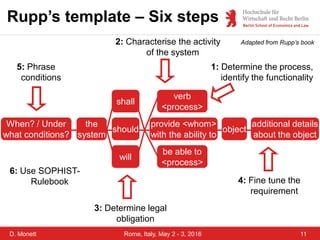
Rupp’s template – Six steps
Adapted from Rupp’s book
the
system
should
provide <whom>
with the ability to
verb
<process>
be able to
<process>
will
shall
object
additional details
about the object
When? / Under
what conditions?
1: Determine the process,
identify the functionality
2: Characterise the activity
of the system
3: Determine legal
obligation
4: Fine tune the
requirement
5: Phrase
conditions
6: Use SOPHIST-
Rulebook
D. Monett 12Prague, Czech Republic, December 4 - 6, 2015
D. Monett 13Rome, Italy, May 2 - 3, 2016
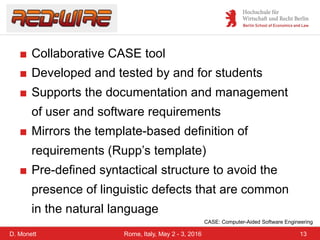
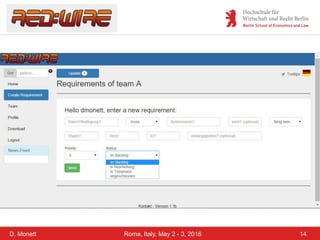
■ Collaborative CASE tool
■ Developed and tested by and for students
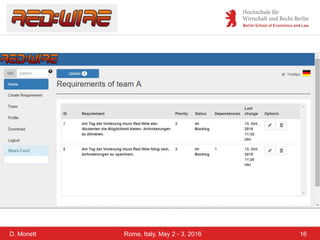
■ Supports the documentation and management
of user and software requirements
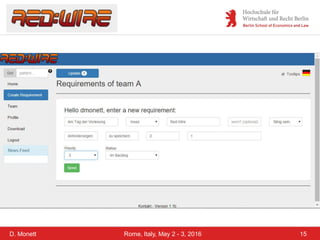
■ Mirrors the template-based definition of
requirements (Rupp’s template)
■ Pre-defined syntactical structure to avoid the
presence of linguistic defects that are common
in the natural language
CASE: Computer-Aided Software Engineering
D. Monett 14Rome, Italy, May 2 - 3, 2016
D. Monett 15Rome, Italy, May 2 - 3, 2016
D. Monett 16Rome, Italy, May 2 - 3, 2016
D. Monett 17Prague, Czech Republic, December 4 - 6, 2015
Pre- and Post-Surveys
D. Monett
Research questions
18Rome, Italy, May 2 - 3, 2016
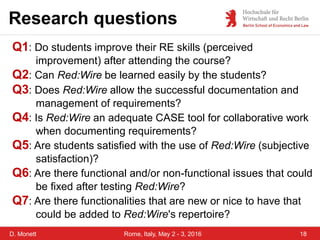
Q1: Do students improve their RE skills (perceived
improvement) after attending the course?
Q2: Can Red:Wire be learned easily by the students?
Q3: Does Red:Wire allow the successful documentation and
management of requirements?
Q4: Is Red:Wire an adequate CASE tool for collaborative work
when documenting requirements?
Q5: Are students satisfied with the use of Red:Wire (subjective
satisfaction)?
Q6: Are there functional and/or non-functional issues that could
be fixed after testing Red:Wire?
Q7: Are there functionalities that are new or nice to have that
could be added to Red:Wire's repertoire?
D. Monett
Methodology
19Rome, Italy, May 2 - 3, 2016
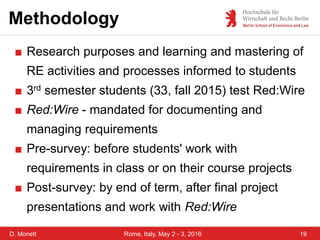
■ Research purposes and learning and mastering of
RE activities and processes informed to students
■ 3rd semester students (33, fall 2015) test Red:Wire
■ Red:Wire - mandated for documenting and
managing requirements
■ Pre-survey: before students' work with
requirements in class or on their course projects
■ Post-survey: by end of term, after final project
presentations and work with Red:Wire
D. Monett
Learnability measures
20Rome, Italy, May 2 - 3, 2016
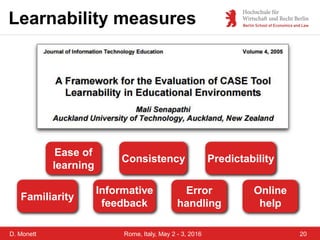
Ease of
learning
Consistency Predictability
Familiarity
Informative
feedback
Error
handling
Online
help
D. Monett 21Prague, Czech Republic, December 4 - 6, 2015
Findings
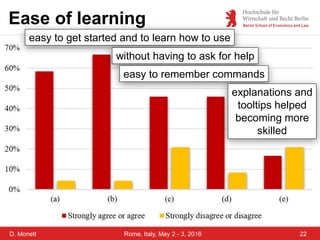
D. Monett 22Rome, Italy, May 2 - 3, 2016
Ease of learning
easy to get started and to learn how to use
without having to ask for help
easy to remember commands
explanations and
tooltips helped
becoming more
skilled
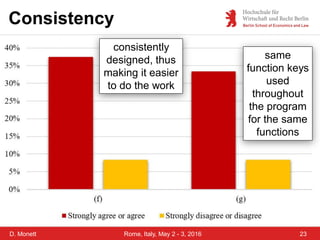
D. Monett 23Rome, Italy, May 2 - 3, 2016
Consistency
consistently
designed, thus
making it easier
to do the work
same
function keys
used
throughout
the program
for the same
functions
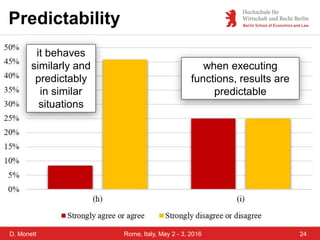
D. Monett 24Rome, Italy, May 2 - 3, 2016
Predictability
it behaves
similarly and
predictably
in similar
situations
when executing
functions, results are
predictable
D. Monett 25Rome, Italy, May 2 - 3, 2016
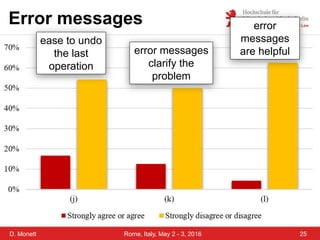
Error messages
ease to undo
the last
operation
error messages
clarify the
problem
error
messages
are helpful
D. Monett
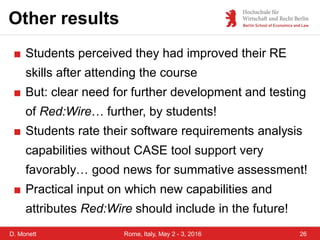
Other results
26Rome, Italy, May 2 - 3, 2016
■ Students perceived they had improved their RE
skills after attending the course
■ But: clear need for further development and testing
of Red:Wire… further, by students!
■ Students rate their software requirements analysis
capabilities without CASE tool support very
favorably… good news for summative assessment!
■ Practical input on which new capabilities and
attributes Red:Wire should include in the future!
D. Monett
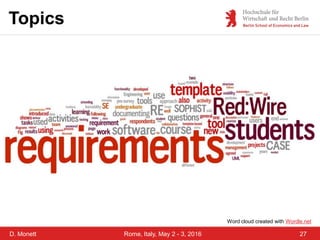
Topics
27Rome, Italy, May 2 - 3, 2016
Word cloud created with Wordle.net
dagmar@monettdiaz.com
monettdiaz
Contact:

Teaching Students Collaborative Requirements Engineering. Case Study Red:Wire

  • 1.
    Rome, Italy, May2 - 3, 2016 Teaching Students Collaborative Requirements Engineering – Case Study Red:Wire Talk at the 18th International Conference on Parallel, Distributed Systems and Software Engineering ICPDSS 2016 Prof. Dr. Dagmar Monett, Sven-Erik Kujat, Marvin Hartmann
  • 2.
    D. Monett Topics 2Rome, Italy,May 2 - 3, 2016 Word cloud created with Wordle.net
  • 3.
    D. Monett 3Prague,Czech Republic, December 4 - 6, 2015 Requirements Engineering
  • 4.
    D. Monett 4Rome,Italy, May 2 - 3, 2016 Requirements Engineering “[It] encompasses all project activities associated with understanding a product's necessary capabilities and attributes.” Karl Wiegers and Joy Beatty (2013). Software Requirements. 3rd Edition, 672 pp. Microsoft Press.
  • 5.
    D. Monett RE sub-disciplines 5Rome,Italy, May 2 - 3, 2016 Adapted from Wiegers&Beatty’s book Elicitation Requirements Engineering Analysis Specification Validation Requirements Development Requirements Management Tracking Managing Controlling Tracing
  • 6.
    D. Monett 6Rome,Italy, May 2 - 3, 2016 A structured approach to Requirements Development
  • 7.
    D. Monett 7Rome,Italy, May 2 - 3, 2016 A structured approach to Requirements Development Templates
  • 8.
    D. Monett 8Prague,Czech Republic, December 4 - 6, 2015 Rupp’s template-based approach for constructing requirements
  • 9.
    D. Monett 9Rome,Italy, May 2 - 3, 2016 Requirements template …quality assurance of unambiguous, complete, and testable requirements! “A requirements template is a blueprint which delineates the syntactic structure of a requirement”. Chris Rupp (2014). Requirements-Engineering und -Management: Aus der Praxis von klassisch bis agil, 6th Edition, 570 pp., Munich: Hanser Verlag.
  • 10.
    D. Monett 10Rome,Italy, May 2 - 3, 2016 Rupp’s template – Six steps the system should provide <whom> with the ability to verb <process> be able to <process> will shall object additional details about the object When? / Under what conditions? Adapted from Rupp’s book
  • 11.
    D. Monett 11Rome,Italy, May 2 - 3, 2016 Rupp’s template – Six steps Adapted from Rupp’s book the system should provide <whom> with the ability to verb <process> be able to <process> will shall object additional details about the object When? / Under what conditions? 1: Determine the process, identify the functionality 2: Characterise the activity of the system 3: Determine legal obligation 4: Fine tune the requirement 5: Phrase conditions 6: Use SOPHIST- Rulebook
  • 12.
    D. Monett 12Prague,Czech Republic, December 4 - 6, 2015
  • 13.
    D. Monett 13Rome,Italy, May 2 - 3, 2016 ■ Collaborative CASE tool ■ Developed and tested by and for students ■ Supports the documentation and management of user and software requirements ■ Mirrors the template-based definition of requirements (Rupp’s template) ■ Pre-defined syntactical structure to avoid the presence of linguistic defects that are common in the natural language CASE: Computer-Aided Software Engineering
  • 14.
    D. Monett 14Rome,Italy, May 2 - 3, 2016
  • 15.
    D. Monett 15Rome,Italy, May 2 - 3, 2016
  • 16.
    D. Monett 16Rome,Italy, May 2 - 3, 2016
  • 17.
    D. Monett 17Prague,Czech Republic, December 4 - 6, 2015 Pre- and Post-Surveys
  • 18.
    D. Monett Research questions 18Rome,Italy, May 2 - 3, 2016 Q1: Do students improve their RE skills (perceived improvement) after attending the course? Q2: Can Red:Wire be learned easily by the students? Q3: Does Red:Wire allow the successful documentation and management of requirements? Q4: Is Red:Wire an adequate CASE tool for collaborative work when documenting requirements? Q5: Are students satisfied with the use of Red:Wire (subjective satisfaction)? Q6: Are there functional and/or non-functional issues that could be fixed after testing Red:Wire? Q7: Are there functionalities that are new or nice to have that could be added to Red:Wire's repertoire?
  • 19.
    D. Monett Methodology 19Rome, Italy,May 2 - 3, 2016 ■ Research purposes and learning and mastering of RE activities and processes informed to students ■ 3rd semester students (33, fall 2015) test Red:Wire ■ Red:Wire - mandated for documenting and managing requirements ■ Pre-survey: before students' work with requirements in class or on their course projects ■ Post-survey: by end of term, after final project presentations and work with Red:Wire
  • 20.
    D. Monett Learnability measures 20Rome,Italy, May 2 - 3, 2016 Ease of learning Consistency Predictability Familiarity Informative feedback Error handling Online help
  • 21.
    D. Monett 21Prague,Czech Republic, December 4 - 6, 2015 Findings
  • 22.
    D. Monett 22Rome,Italy, May 2 - 3, 2016 Ease of learning easy to get started and to learn how to use without having to ask for help easy to remember commands explanations and tooltips helped becoming more skilled
  • 23.
    D. Monett 23Rome,Italy, May 2 - 3, 2016 Consistency consistently designed, thus making it easier to do the work same function keys used throughout the program for the same functions
  • 24.
    D. Monett 24Rome,Italy, May 2 - 3, 2016 Predictability it behaves similarly and predictably in similar situations when executing functions, results are predictable
  • 25.
    D. Monett 25Rome,Italy, May 2 - 3, 2016 Error messages ease to undo the last operation error messages clarify the problem error messages are helpful
  • 26.
    D. Monett Other results 26Rome,Italy, May 2 - 3, 2016 ■ Students perceived they had improved their RE skills after attending the course ■ But: clear need for further development and testing of Red:Wire… further, by students! ■ Students rate their software requirements analysis capabilities without CASE tool support very favorably… good news for summative assessment! ■ Practical input on which new capabilities and attributes Red:Wire should include in the future!
  • 27.
    D. Monett Topics 27Rome, Italy,May 2 - 3, 2016 Word cloud created with Wordle.net
  • 28.