Simulating the Fractional
Reserve Banking using Agent-
based Modelling with NetLogo
Talk at the 10th International Workshop on Multi-Agent Systems and Simulation, MAS&S 2016
Prof. Dr. Dagmar Monett
Dr. Jesús Emeterio Navarro-Barrientos
D. Monett 2Gdańsk, Poland, September 11 – 14, 2016
Finance is a black box
“If the physical world is so uncertain, so
difficult to know precisely, then how much
more uncertain and unknowable must be the
world of money?
Finance is a black box covered by a veil.”
Mandelbrot, Benoit, and Hudson, Richard L. (2004)
The (mis)Behavior of Markets: A Fractal View of Risk, Ruin, and Reward.
New York, NY: Basic Books.
Mandelbrot‘s work via C. Lewis
D. Monett 3Gdańsk, Poland, September 11 – 14, 2016
Background
D. Monett 4Gdańsk, Poland, September 11 – 14, 2016
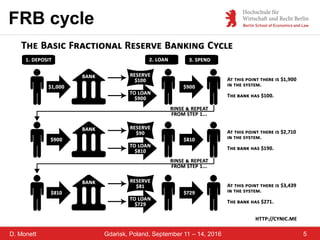
FRB
… “in which banks hold only a fraction of their
deposits in reserves, so that the reserve-
deposit ratio is less than 1”
(Abel & Bernanke, 2005)
The fractional reserve banking is a banking
system...
The bank invests or loans the rest of the deposits.
D. Monett 5Gdańsk, Poland, September 11 – 14, 2016
FRB cycle
D. Monett 6Gdańsk, Poland, September 11 – 14, 2016
Our approach
D. Monett 7Gdańsk, Poland, September 11 – 14, 2016
Start simple
“In building a model, start simple.”
(Mandelbrot & Hudson, 2004)
D. Monett 8Gdańsk, Poland, September 11 – 14, 2016
Paraphrasing...
In understanding a model, simulate it.
D. Monett 9Gdańsk, Poland, September 11 – 14, 2016
Our work
■ No “big” economics insights there...
■ ...but a simple agent-based computational model
■ ...that uses NetLogo
■ ...to focus on the dynamics of the fractional
reserve banking system
■ ...to ease its understanding through simulations
and graphical tools!
D. Monett 10Gdańsk, Poland, September 11 – 14, 2016
Why?
■ To anticipate economic scenarios that could
eventually be avoided
■ To provide artificial ways to represent and to
simulate the impact of the FRB system
■ To provide a basic playground setting for doing it
■ To drive the policies and behaviours of banks
before testing their validity in the real world
■ To find out the sufficient conditions for a banking
system to become fragile and unstable
D. Monett 11Gdańsk, Poland, September 11 – 14, 2016
An agent-based
computational model
for the FRB
D. Monett
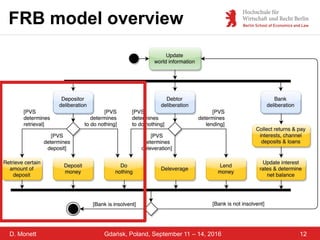
FRB model overview
12Gdańsk, Poland, September 11 – 14, 2016
D. Monett
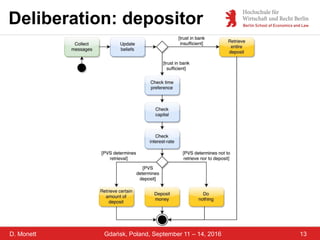
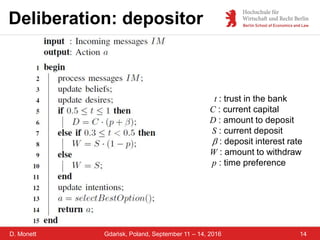
Deliberation: depositor
13Gdańsk, Poland, September 11 – 14, 2016
D. Monett
Deliberation: depositor
14Gdańsk, Poland, September 11 – 14, 2016
t : trust in the bank
C : current capital
D : amount to deposit
S : current deposit
 : deposit interest rate
W : amount to withdraw
p : time preference
D. Monett 15Gdańsk, Poland, September 11 – 14, 2016
Experimental settings
and results
(more: on the paper!)
D. Monett
Experiments
16Gdańsk, Poland, September 11 – 14, 2016
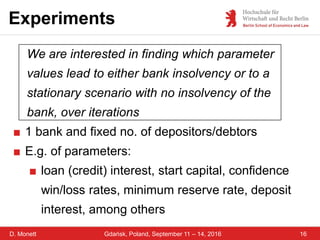
We are interested in finding which parameter
values lead to either bank insolvency or to a
stationary scenario with no insolvency of the
bank, over iterations
■ 1 bank and fixed no. of depositors/debtors
■ E.g. of parameters:
■ loan (credit) interest, start capital, confidence
win/loss rates, minimum reserve rate, deposit
interest, among others
D. Monett
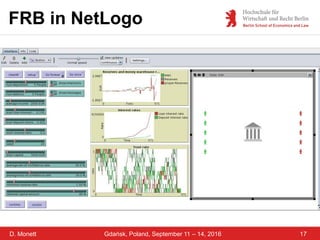
FRB in NetLogo
17Gdańsk, Poland, September 11 – 14, 2016
D. Monett
Some results
18Gdańsk, Poland, September 11 – 14, 2016
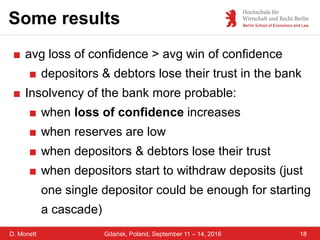
■ avg loss of confidence > avg win of confidence
■ depositors & debtors lose their trust in the bank
■ Insolvency of the bank more probable:
■ when loss of confidence increases
■ when reserves are low
■ when depositors & debtors lose their trust
■ when depositors start to withdraw deposits (just
one single depositor could be enough for starting
a cascade)
D. Monett 19Gdańsk, Poland, September 11 – 14, 2016
Further work
D. Monett
Further work
20Gdańsk, Poland, September 11 – 14, 2016
To consider/study…
■ different trust reputation mechanisms
■ whether the dynamics of the model scale in
size or not
■ impact of excluding external sources that would
help a bank to pay to the depositors and keep it
solvent
■ money needed on average to help a bank avoid
insolvency? average lifetime of banks?
D. Monett
Sources
21Gdańsk, Poland, September 11 – 14, 2016
Related work:
- See references list on our paper!
■ https://www.researchgate.net/publication/304244558_Simu
lating_the_Fractional_Reserve_Banking_using_Agent-
based_Modelling_with_NetLogo
dagmar@monettdiaz.com
monettdiaz
Contact:

Simulating the Fractional Reserve Banking using Agent-based Modelling with NetLogo [Slides]

  • 1.
    Simulating the Fractional ReserveBanking using Agent- based Modelling with NetLogo Talk at the 10th International Workshop on Multi-Agent Systems and Simulation, MAS&S 2016 Prof. Dr. Dagmar Monett Dr. Jesús Emeterio Navarro-Barrientos
  • 2.
    D. Monett 2Gdańsk,Poland, September 11 – 14, 2016 Finance is a black box “If the physical world is so uncertain, so difficult to know precisely, then how much more uncertain and unknowable must be the world of money? Finance is a black box covered by a veil.” Mandelbrot, Benoit, and Hudson, Richard L. (2004) The (mis)Behavior of Markets: A Fractal View of Risk, Ruin, and Reward. New York, NY: Basic Books. Mandelbrot‘s work via C. Lewis
  • 3.
    D. Monett 3Gdańsk,Poland, September 11 – 14, 2016 Background
  • 4.
    D. Monett 4Gdańsk,Poland, September 11 – 14, 2016 FRB … “in which banks hold only a fraction of their deposits in reserves, so that the reserve- deposit ratio is less than 1” (Abel & Bernanke, 2005) The fractional reserve banking is a banking system... The bank invests or loans the rest of the deposits.
  • 5.
    D. Monett 5Gdańsk,Poland, September 11 – 14, 2016 FRB cycle
  • 6.
    D. Monett 6Gdańsk,Poland, September 11 – 14, 2016 Our approach
  • 7.
    D. Monett 7Gdańsk,Poland, September 11 – 14, 2016 Start simple “In building a model, start simple.” (Mandelbrot & Hudson, 2004)
  • 8.
    D. Monett 8Gdańsk,Poland, September 11 – 14, 2016 Paraphrasing... In understanding a model, simulate it.
  • 9.
    D. Monett 9Gdańsk,Poland, September 11 – 14, 2016 Our work ■ No “big” economics insights there... ■ ...but a simple agent-based computational model ■ ...that uses NetLogo ■ ...to focus on the dynamics of the fractional reserve banking system ■ ...to ease its understanding through simulations and graphical tools!
  • 10.
    D. Monett 10Gdańsk,Poland, September 11 – 14, 2016 Why? ■ To anticipate economic scenarios that could eventually be avoided ■ To provide artificial ways to represent and to simulate the impact of the FRB system ■ To provide a basic playground setting for doing it ■ To drive the policies and behaviours of banks before testing their validity in the real world ■ To find out the sufficient conditions for a banking system to become fragile and unstable
  • 11.
    D. Monett 11Gdańsk,Poland, September 11 – 14, 2016 An agent-based computational model for the FRB
  • 12.
    D. Monett FRB modeloverview 12Gdańsk, Poland, September 11 – 14, 2016
  • 13.
    D. Monett Deliberation: depositor 13Gdańsk,Poland, September 11 – 14, 2016
  • 14.
    D. Monett Deliberation: depositor 14Gdańsk,Poland, September 11 – 14, 2016 t : trust in the bank C : current capital D : amount to deposit S : current deposit  : deposit interest rate W : amount to withdraw p : time preference
  • 15.
    D. Monett 15Gdańsk,Poland, September 11 – 14, 2016 Experimental settings and results (more: on the paper!)
  • 16.
    D. Monett Experiments 16Gdańsk, Poland,September 11 – 14, 2016 We are interested in finding which parameter values lead to either bank insolvency or to a stationary scenario with no insolvency of the bank, over iterations ■ 1 bank and fixed no. of depositors/debtors ■ E.g. of parameters: ■ loan (credit) interest, start capital, confidence win/loss rates, minimum reserve rate, deposit interest, among others
  • 17.
    D. Monett FRB inNetLogo 17Gdańsk, Poland, September 11 – 14, 2016
  • 18.
    D. Monett Some results 18Gdańsk,Poland, September 11 – 14, 2016 ■ avg loss of confidence > avg win of confidence ■ depositors & debtors lose their trust in the bank ■ Insolvency of the bank more probable: ■ when loss of confidence increases ■ when reserves are low ■ when depositors & debtors lose their trust ■ when depositors start to withdraw deposits (just one single depositor could be enough for starting a cascade)
  • 19.
    D. Monett 19Gdańsk,Poland, September 11 – 14, 2016 Further work
  • 20.
    D. Monett Further work 20Gdańsk,Poland, September 11 – 14, 2016 To consider/study… ■ different trust reputation mechanisms ■ whether the dynamics of the model scale in size or not ■ impact of excluding external sources that would help a bank to pay to the depositors and keep it solvent ■ money needed on average to help a bank avoid insolvency? average lifetime of banks?
  • 21.
    D. Monett Sources 21Gdańsk, Poland,September 11 – 14, 2016 Related work: - See references list on our paper! ■ https://www.researchgate.net/publication/304244558_Simu lating_the_Fractional_Reserve_Banking_using_Agent- based_Modelling_with_NetLogo
  • 22.