Rethinking Engineering Education The CDIO ApproachWEEF2014 DUBAI 
António Costa, ISEP, Portugal 
Original version by Edward Crawley, MIT 
December 2014 
This work is licensed under a Creative Commons Attribution 4.0 International License.
2 
PRESENTATION AGENDA 
Introduction 
The challenges of engineering education 
CDIO Initiative vision, mission and goals 
CDIO Initiative today and the future 
Conclusion
3 
ABOUT ISEP AND ME 
ISEP 
160 years old public engineering school 
6600 students, 400 teachers, 130 staff 
Adopted CDIO practices in 2006 
Accepted as CDIO collaborator in 2008 
12 engineering 3-year bachelor programs 
11 engineering 2-year master programs 
Many programs achieving the EUR-ACE® seal 
António Costa (CDIO mentor and advisor) 
Accreditation and certification coordinator
4 
CENTRAL QUESTIONS FOR ENGINEERING EDUCATION 
What knowledge, skills and attitudes should students possess as they graduate from university? 
How can we do better at ensuring that students learn these skills? 
We are all working on this! Can we work together?
5 
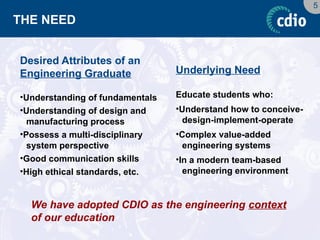
THE NEED 
Desired Attributes of an Engineering Graduate 
•Understanding of fundamentals 
•Understanding of design and manufacturing process 
•Possess a multi-disciplinary system perspective 
•Good communication skills 
•High ethical standards, etc. 
Underlying Need 
Educate students who: 
•Understand how to conceive- design-implement-operate 
•Complex value-added engineering systems 
•In a modern team-based engineering environment 
We have adopted CDIO as the engineering context of our education
6 
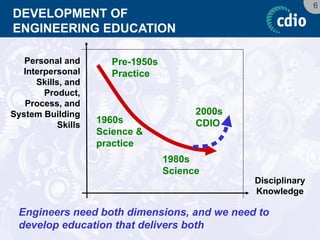
DEVELOPMENT OF ENGINEERING EDUCATION 
Personal and Interpersonal Skills, and Product, Process, and System Building Skills 
DisciplinaryKnowledge 
Pre-1950sPractice 
1960sScience & practice 
1980sScience 
2000sCDIO 
Engineers need both dimensions, and we need to develop education that delivers both
7 
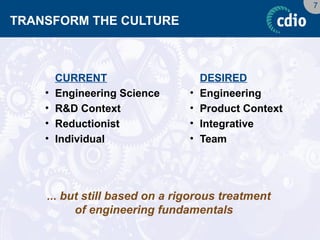
TRANSFORM THE CULTURE 
CURRENT 
•Engineering Science 
•R&D Context 
•Reductionist 
•Individual 
... but still based on a rigorous treatment of engineering fundamentals 
DESIRED 
•Engineering 
•Product Context 
•Integrative 
•Team
8 
GOALS OF CDIO 
•To educate students to master a deeper working knowledge of the technical fundamentals 
•To educate engineers to lead in the creation and operation of new products and systems 
•To educate all to understand the importance and strategic impact of research and technological development on society 
And to attract and retain students in engineering
9 
VISION 
We envision an education that stresses the fundamentals, set in the context of Conceiving – Designing – Implementing – Operating systems and products: 
•A curriculum organized around mutually supporting disciplines, with authentic CDIO activities highly interwoven 
•Rich with student design-implement experiences 
•Featuring active and experiential learning 
•Set in both classrooms and modern learning laboratories and workspaces 
•Constantly improved through robust assessment and evaluation processes
10 
BEST PRACTICE 
Standard 1 -- The Context 
Adoption of the principle that product and system lifecycle development and deployment -- Conceiving, Designing, Implementing and Operating -- are the context for engineering education 
It is what engineers do! 
It provides the framework for teaching skills 
It subtly allows deeper learning of the fundamentals 
It attracts, excites and retains students
11 
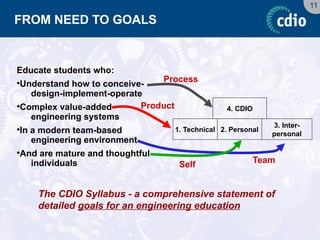
FROM NEED TO GOALS 
Educate students who: 
•Understand how to conceive- design-implement-operate 
•Complex value-added engineering systems 
•In a modern team-basedengineering environment 
•And are mature and thoughtful individuals 
The CDIO Syllabus - a comprehensive statement of detailed goals for an engineering education 
1. Technical 
3. Inter- 
personal 
2. Personal 
4. CDIO 
Process 
Team 
Product 
Self
12 
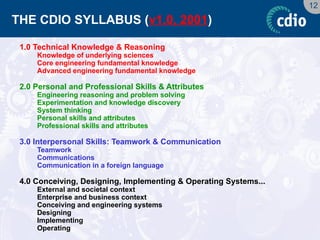
THE CDIO SYLLABUS (v1.0, 2001) 
1.0 Technical Knowledge & Reasoning 
Knowledge of underlying sciences 
Core engineering fundamental knowledge 
Advanced engineering fundamental knowledge 
2.0 Personal and Professional Skills & Attributes 
Engineering reasoning and problem solving 
Experimentation and knowledge discovery 
System thinking 
Personal skills and attributes 
Professional skills and attributes 
3.0 Interpersonal Skills: Teamwork & Communication 
Teamwork 
Communications 
Communication in a foreign language 
4.0 Conceiving, Designing, Implementing & Operating Systems... 
External and societal context 
Enterprise and business context 
Conceiving and engineering systems 
Designing 
Implementing 
Operating
13 
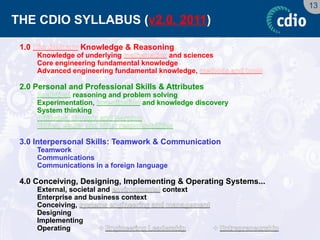
THE CDIO SYLLABUS (v2.0, 2011) 
1.0 Disciplinary Knowledge & Reasoning 
Knowledge of underlying mathematics and sciences 
Core engineering fundamental knowledge 
Advanced engineering fundamental knowledge, methods and tools 
2.0 Personal and Professional Skills & Attributes 
Analytical reasoning and problem solving 
Experimentation, investigation and knowledge discovery 
System thinking 
Attitudes, thought and learning 
Ethics, equity and other responsabilities 
3.0 Interpersonal Skills: Teamwork & Communication 
Teamwork 
Communications 
Communications in a foreign language 
4.0 Conceiving, Designing, Implementing & Operating Systems... 
External, societal and environmental context 
Enterprise and business context 
Conceiving, systems engineering and management 
Designing 
Implementing 
Operating+ Engineering Leadership + Entrepreneurship
14 
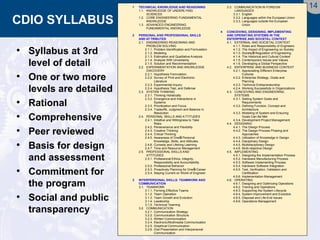
CDIO SYLLABUS 
•Syllabus at 3rd level of detail 
•One or two more levels are detailed 
•Rational 
•Comprehensive 
•Peer reviewed 
•Basis for design and assessment 
•Commitment for the program 
•Social and public transparency1 TECHNICAL KNOWLEDGE AND REASONING1.1. KNOWLEDGE OF UNDERLYINGSCIENCES1.2. CORE ENGINEERING FUNDAMENTALKNOWLEDGE1.3. ADVANCED ENGINEERINGFUNDAMENTAL KNOWLEDGE2 PERSONAL AND PROFESSIONAL SKILLSAND ATTRIBUTES2.1. ENGINEERING REASONING ANDPROBLEM SOLVING2.1.1. Problem Identification and Formulation2.1.2. Modeling2.1.3. Estimation and Qualitative Analysis2.1.4. Analysis With Uncertainty2.1.5. Solution and Recommendation2.2. EXPERIMENTATION AND KNOWLEDGEDISCOVERY2.2.1. Hypothesis Formulation2.2.2. Survey of Print and ElectronicLiterature2.2.3. Experimental Inquiry2.2.4. Hypothesis Test, and Defense2.3. SYSTEM THINKING2.3.1. Thinking Holistically2.3.2. Emergence and Interactions inSystems2.3.3. Prioritization and Focus2.3.4. Tradeoffs, Judgment and Balance inResolution2.4. PERSONAL SKILLS AND ATTITUDES2.4.1. Initiative and Willingness to TakeRisks2.4.2. Perseverance and Flexibility2.4.3. Creative Thinking2.4.4. Critical Thinking2.4.5. Awareness of OneÕs PersonalKnowledge, Skills, and Attitudes2.4.6. Curiosity and Lifelong Learning2.4.7. Time and Resource Management2.5. PROFESSIONAL SKILLS ANDATTITUDES2.5.1. Professional Ethics, Integrity, Responsibility and Accountability2.5.2. Professional Behavior2.5.3. Proactively Planning for OneÕs Career2.5.4. Staying Current on World of Engineer3 INTERPERSONAL SKILLS: TEAMWORK ANDCOMMUNICATION3.1. TEAMWORK3.1.1. Forming Effective Teams3.1.2. Team Operation3.1.3. Team Growth and Evolution3.1.4. Leadership3.1.5. Technical Teaming3.2. COMMUNICATION3.2.1. Communication Strategy3.2.2. Communication Structure3.2.3. Written Communication3.2.4. Electronic/Multimedia Communication3.2.5. Graphical Communication3.2.6. Oral Presentation and InterpersonalCommunication3.3. COMMUNICATION IN FOREIGNLANGUAGES3.3.1. English3.3.2. Languages within the European Union3.3.3. Languages outside the EuropeanUnion4 CONCEIVING, DESIGNING, IMPLEMENTINGAND OPERATING SYSTEMS IN THEENTERPRISE AND SOCIETAL CONTEXT4.1. EXTERNAL AND SOCIETAL CONTEXT4.1.1. Roles and Responsibility of Engineers4.1.2. The Impact of Engineering on Society4.1.3. SocietyÕs Regulation of Engineering4.1.4. The Historical and Cultural Context4.1.5. Contemporary Issues and Values4.1.6. Developing a Global Perspective4.2. ENTERPRISE AND BUSINESS CONTEXT4.2.1. Appreciating Different EnterpriseCultures4.2.2. Enterprise Strategy, Goals andPlanning4.2.3. Technical Entrepreneurship4.2.4. Working Successfully in Organizations4.3. CONCEIVING AND ENGINEERINGSYSTEMS4.3.1. Setting System Goals andRequirements4.3.2. Defining Function, Concept andArchitecture4.3.3. Modeling of System and EnsuringGoals Can Be Met4.3.4. Development Project Management4.4. DESIGNING4.4.1. The Design Process4.4.2. The Design Process Phasing andApproaches4.4.3. Utilization of Knowledge in Design4.4.4. Disciplinary Design4.4.5. Multidisciplinary Design4.4.6. Multi-objective Design4.5. IMPLEMENTING4.5.1. Designing the Implementation Process4.5.2. Hardware Manufacturing Process4.5.3. Software Implementing Process4.5.4. Hardware Software Integration4.5.5. Test, Verification, Validation andCertification4.5.6. Implementation Management4.6. OPERATING4.6.1. Designing and Optimizing Operations4.6.2. Training and Operations4.6.3. Supporting the System Lifecycle4.6.4. System Improvement and Evolution4.6.5. Disposal and Life-End Issues4.6.6. Operations Management
15 
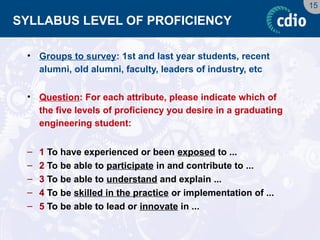
SYLLABUS LEVEL OF PROFICIENCY 
•Groups to survey: 1st and last year students, recent alumni, old alumni, faculty, leaders of industry, etc 
•Question: For each attribute, please indicate which of the five levels of proficiency you desire in a graduating engineering student: 
–1 To have experienced or been exposed to ... 
–2 To be able to participate in and contribute to ... 
–3 To be able to understand and explain ... 
–4 To be skilled in the practice or implementation of ... 
–5 To be able to lead or innovate in ...
16 
BEST PRACTICE 
Standard 2 -- Learning Outcomes 
Specific, detailed learning outcomes for personal and interpersonal skills, and product, process, and system building skills, as well as disciplinary knowledge, consistent with program goals and validated by program stakeholders 
“Resolves” tensions among stakeholders 
Allows for the design of curriculum 
Basis of student learning assessment
17 
HOW CAN WE DO BETTER? 
Re-task current assets and resources in: 
•Curriculum 
•Laboratories and workspaces 
•Teaching and learning 
•Assessment and evaluation 
•Faculty competence 
Evolve to a model in which these resources are better employed to promote student learning
18 
BEST PRACTICE: RE-TASK CURRICULUM 
Standard 3 -- Integrated Curriculum 
A curriculum designed with mutually supporting disciplinary subjects, with an explicit plan to integrate personal and interpersonal skills, and product, process, and system building skills 
Standard 4 -- Introduction to Engineering 
An introductory course that provides the framework for engineering practice in product, process, and system building, and introduces essential personal and interpersonal skills
19 
INTRODUCTION TO ENGINEERING 
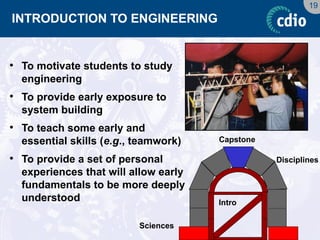
•To motivate students to study engineering 
•To provide early exposure to system building 
•To teach some early and essential skills (e.g., teamwork) 
•To provide a set of personal experiences that will allow early fundamentals to be more deeply understood 
Disciplines 
Intro 
Capstone 
Sciences
20 
BEST PRACTICE: RE-TASK LABS AND WORKSPACES 
Standard 5 -- Design-Implement Experiences 
A curriculum that includes two or more design- implement experiences, including one at a basic level and one at an advanced level 
Standard 6 -- Engineering Workspaces 
Workspaces and laboratories that support and encourage hands-on learning of product, process, and system building, disciplinary knowledge, and social learning
21 
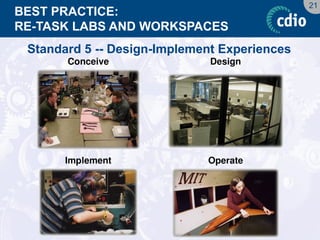
BEST PRACTICE: RE-TASK LABS AND WORKSPACES 
Standard 5 -- Design-Implement Experiences
22 
BEST PRACTICE: RE-TASK TEACHING AND LEARNING 
Standard 7 -- Integrated Learning Experiences 
Integrated learning experiences that lead to the acquisition of disciplinary knowledge, as well as personal and interpersonal skills, and product, process, and system building skills 
Standard 8 -- Active Learning 
Teaching and learning based on active and experiential learning methods
23 
BEST PRACTICE: RE-TASK FACULTY COMPETENCE 
Standard 9 -- Enhance Faculty Skills Competence 
Actions that enhance faculty competence in personal and interpersonal skills, and product, process and system building skills 
Standard 10 -- Enhance Teaching Competence 
Actions that enhance faculty competence in providing integrated learning experiences, in using active experiential learning methods, and in assessing student learning
24 
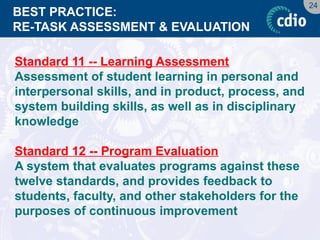
BEST PRACTICE: RE-TASK ASSESSMENT & EVALUATION 
Standard 11 -- Learning Assessment 
Assessment of student learning in personal and interpersonal skills, and in product, process, and system building skills, as well as in disciplinary knowledge 
Standard 12 -- Program Evaluation 
A system that evaluates programs against these twelve standards, and provides feedback to students, faculty, and other stakeholders for the purposes of continuous improvement
25 
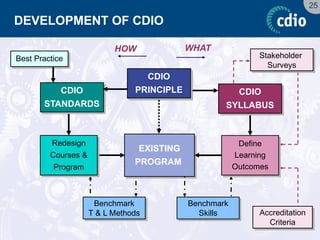
DEVELOPMENT OF CDIO 
Benchmark 
T & L Methods 
Benchmark 
T & L Methods 
Redesign 
Courses & 
Program 
Redesign 
Courses & 
Program 
CDIO 
STANDARDS 
CDIO 
STANDARDS 
Best Practice 
Best Practice 
HOW 
EXISTING 
PROGRAM 
EXISTING 
PROGRAM 
Stakeholder 
Surveys 
Stakeholder 
Surveys 
Benchmark 
Skills 
Benchmark 
Skills 
Accreditation 
Criteria 
Accreditation 
Criteria 
Define 
Learning 
Outcomes 
Define 
Learning 
Outcomes 
CDIO 
SYLLABUS 
CDIO 
SYLLABUS 
WHAT 
CDIO 
PRINCIPLE 
CDIO 
PRINCIPLE
26 
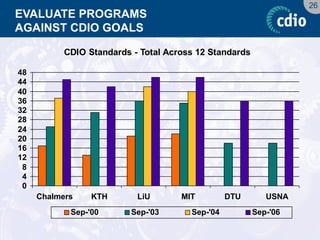
EVALUATE PROGRAMSAGAINST CDIO GOALS 
CDIO Standards - Total Across 12 Standards 048 12162024283236404448ChalmersKTHLiUMITDTUUSNASep-'00Sep-'03Sep-'04Sep-'06
27 
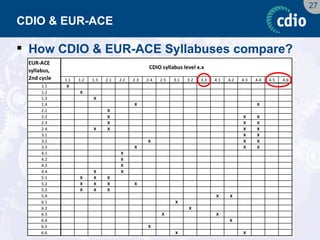
CDIO & EUR-ACE 
How CDIO & EUR-ACE Syllabuses compare?
28 
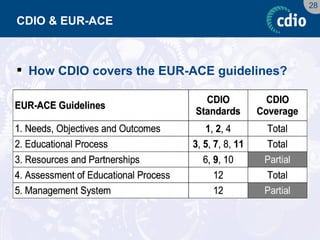
CDIO & EUR-ACE 
How CDIO covers the EUR-ACE guidelines?
29 
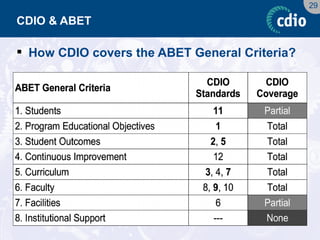
CDIO & ABET 
How CDIO covers the ABET General Criteria?
30 
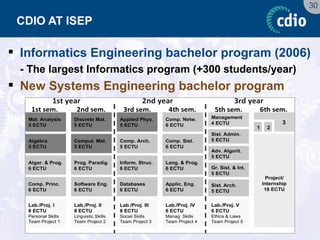
CDIO AT ISEP 
Informatics Engineering bachelor program (2006) 
- The largest Informatics program (+300 students/year) 
New Systems Engineering bachelor program
31 
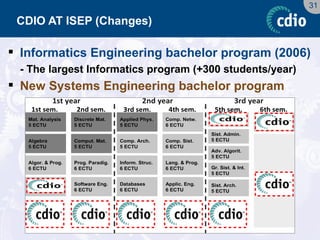
CDIO AT ISEP (Changes) 
Informatics Engineering bachelor program (2006) 
- The largest Informatics program (+300 students/year) 
New Systems Engineering bachelor program
32 
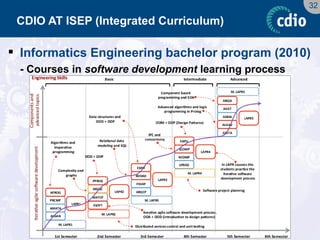
CDIO AT ISEP (Integrated Curriculum) 
Informatics Engineering bachelor program (2010) 
- Courses in software development learning process
33 
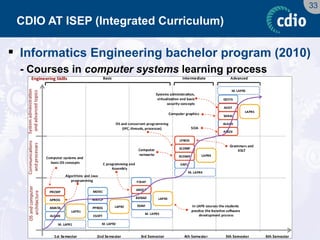
CDIO AT ISEP (Integrated Curriculum) 
Informatics Engineering bachelor program (2010) 
- Courses in computer systems learning process
34 
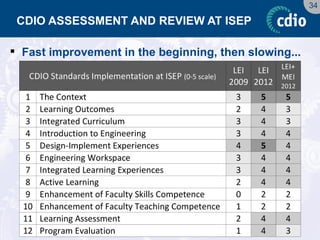
CDIO ASSESSMENT AND REVIEW AT ISEP 
Fast improvement in the beginning, then slowing...
35 
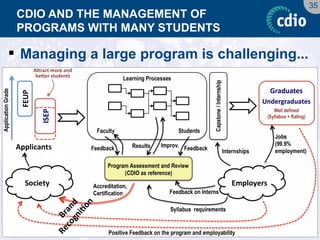
CDIO AND THE MANAGEMENT OFPROGRAMS WITH MANY STUDENTS 
Managing a large program is challenging...
36 
CONCLUSION 
CDIO website – www.cdio.orgAny HEI may join and participate 
CDIO Implementation Kit is available 
Free access to a Knowledge Library 
One conference and many meetings/year
37 
CONCLUSION 
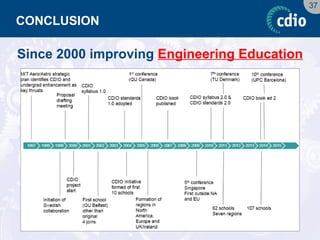
Since 2000 improving Engineering Education
38 
CONCLUSION 
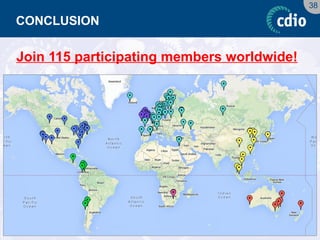
Join 115 participating members worldwide!

Rethinking Engineering Education - The CDIO Approach

  • 1.
    Rethinking Engineering EducationThe CDIO ApproachWEEF2014 DUBAI António Costa, ISEP, Portugal Original version by Edward Crawley, MIT December 2014 This work is licensed under a Creative Commons Attribution 4.0 International License.
  • 2.
    2 PRESENTATION AGENDA Introduction The challenges of engineering education CDIO Initiative vision, mission and goals CDIO Initiative today and the future Conclusion
  • 3.
    3 ABOUT ISEPAND ME ISEP 160 years old public engineering school 6600 students, 400 teachers, 130 staff Adopted CDIO practices in 2006 Accepted as CDIO collaborator in 2008 12 engineering 3-year bachelor programs 11 engineering 2-year master programs Many programs achieving the EUR-ACE® seal António Costa (CDIO mentor and advisor) Accreditation and certification coordinator
  • 4.
    4 CENTRAL QUESTIONSFOR ENGINEERING EDUCATION What knowledge, skills and attitudes should students possess as they graduate from university? How can we do better at ensuring that students learn these skills? We are all working on this! Can we work together?
  • 5.
    5 THE NEED Desired Attributes of an Engineering Graduate •Understanding of fundamentals •Understanding of design and manufacturing process •Possess a multi-disciplinary system perspective •Good communication skills •High ethical standards, etc. Underlying Need Educate students who: •Understand how to conceive- design-implement-operate •Complex value-added engineering systems •In a modern team-based engineering environment We have adopted CDIO as the engineering context of our education
  • 6.
    6 DEVELOPMENT OFENGINEERING EDUCATION Personal and Interpersonal Skills, and Product, Process, and System Building Skills DisciplinaryKnowledge Pre-1950sPractice 1960sScience & practice 1980sScience 2000sCDIO Engineers need both dimensions, and we need to develop education that delivers both
  • 7.
    7 TRANSFORM THECULTURE CURRENT •Engineering Science •R&D Context •Reductionist •Individual ... but still based on a rigorous treatment of engineering fundamentals DESIRED •Engineering •Product Context •Integrative •Team
  • 8.
    8 GOALS OFCDIO •To educate students to master a deeper working knowledge of the technical fundamentals •To educate engineers to lead in the creation and operation of new products and systems •To educate all to understand the importance and strategic impact of research and technological development on society And to attract and retain students in engineering
  • 9.
    9 VISION Weenvision an education that stresses the fundamentals, set in the context of Conceiving – Designing – Implementing – Operating systems and products: •A curriculum organized around mutually supporting disciplines, with authentic CDIO activities highly interwoven •Rich with student design-implement experiences •Featuring active and experiential learning •Set in both classrooms and modern learning laboratories and workspaces •Constantly improved through robust assessment and evaluation processes
  • 10.
    10 BEST PRACTICE Standard 1 -- The Context Adoption of the principle that product and system lifecycle development and deployment -- Conceiving, Designing, Implementing and Operating -- are the context for engineering education It is what engineers do! It provides the framework for teaching skills It subtly allows deeper learning of the fundamentals It attracts, excites and retains students
  • 11.
    11 FROM NEEDTO GOALS Educate students who: •Understand how to conceive- design-implement-operate •Complex value-added engineering systems •In a modern team-basedengineering environment •And are mature and thoughtful individuals The CDIO Syllabus - a comprehensive statement of detailed goals for an engineering education 1. Technical 3. Inter- personal 2. Personal 4. CDIO Process Team Product Self
  • 12.
    12 THE CDIOSYLLABUS (v1.0, 2001) 1.0 Technical Knowledge & Reasoning Knowledge of underlying sciences Core engineering fundamental knowledge Advanced engineering fundamental knowledge 2.0 Personal and Professional Skills & Attributes Engineering reasoning and problem solving Experimentation and knowledge discovery System thinking Personal skills and attributes Professional skills and attributes 3.0 Interpersonal Skills: Teamwork & Communication Teamwork Communications Communication in a foreign language 4.0 Conceiving, Designing, Implementing & Operating Systems... External and societal context Enterprise and business context Conceiving and engineering systems Designing Implementing Operating
  • 13.
    13 THE CDIOSYLLABUS (v2.0, 2011) 1.0 Disciplinary Knowledge & Reasoning Knowledge of underlying mathematics and sciences Core engineering fundamental knowledge Advanced engineering fundamental knowledge, methods and tools 2.0 Personal and Professional Skills & Attributes Analytical reasoning and problem solving Experimentation, investigation and knowledge discovery System thinking Attitudes, thought and learning Ethics, equity and other responsabilities 3.0 Interpersonal Skills: Teamwork & Communication Teamwork Communications Communications in a foreign language 4.0 Conceiving, Designing, Implementing & Operating Systems... External, societal and environmental context Enterprise and business context Conceiving, systems engineering and management Designing Implementing Operating+ Engineering Leadership + Entrepreneurship
  • 14.
    14 CDIO SYLLABUS •Syllabus at 3rd level of detail •One or two more levels are detailed •Rational •Comprehensive •Peer reviewed •Basis for design and assessment •Commitment for the program •Social and public transparency1 TECHNICAL KNOWLEDGE AND REASONING1.1. KNOWLEDGE OF UNDERLYINGSCIENCES1.2. CORE ENGINEERING FUNDAMENTALKNOWLEDGE1.3. ADVANCED ENGINEERINGFUNDAMENTAL KNOWLEDGE2 PERSONAL AND PROFESSIONAL SKILLSAND ATTRIBUTES2.1. ENGINEERING REASONING ANDPROBLEM SOLVING2.1.1. Problem Identification and Formulation2.1.2. Modeling2.1.3. Estimation and Qualitative Analysis2.1.4. Analysis With Uncertainty2.1.5. Solution and Recommendation2.2. EXPERIMENTATION AND KNOWLEDGEDISCOVERY2.2.1. Hypothesis Formulation2.2.2. Survey of Print and ElectronicLiterature2.2.3. Experimental Inquiry2.2.4. Hypothesis Test, and Defense2.3. SYSTEM THINKING2.3.1. Thinking Holistically2.3.2. Emergence and Interactions inSystems2.3.3. Prioritization and Focus2.3.4. Tradeoffs, Judgment and Balance inResolution2.4. PERSONAL SKILLS AND ATTITUDES2.4.1. Initiative and Willingness to TakeRisks2.4.2. Perseverance and Flexibility2.4.3. Creative Thinking2.4.4. Critical Thinking2.4.5. Awareness of OneÕs PersonalKnowledge, Skills, and Attitudes2.4.6. Curiosity and Lifelong Learning2.4.7. Time and Resource Management2.5. PROFESSIONAL SKILLS ANDATTITUDES2.5.1. Professional Ethics, Integrity, Responsibility and Accountability2.5.2. Professional Behavior2.5.3. Proactively Planning for OneÕs Career2.5.4. Staying Current on World of Engineer3 INTERPERSONAL SKILLS: TEAMWORK ANDCOMMUNICATION3.1. TEAMWORK3.1.1. Forming Effective Teams3.1.2. Team Operation3.1.3. Team Growth and Evolution3.1.4. Leadership3.1.5. Technical Teaming3.2. COMMUNICATION3.2.1. Communication Strategy3.2.2. Communication Structure3.2.3. Written Communication3.2.4. Electronic/Multimedia Communication3.2.5. Graphical Communication3.2.6. Oral Presentation and InterpersonalCommunication3.3. COMMUNICATION IN FOREIGNLANGUAGES3.3.1. English3.3.2. Languages within the European Union3.3.3. Languages outside the EuropeanUnion4 CONCEIVING, DESIGNING, IMPLEMENTINGAND OPERATING SYSTEMS IN THEENTERPRISE AND SOCIETAL CONTEXT4.1. EXTERNAL AND SOCIETAL CONTEXT4.1.1. Roles and Responsibility of Engineers4.1.2. The Impact of Engineering on Society4.1.3. SocietyÕs Regulation of Engineering4.1.4. The Historical and Cultural Context4.1.5. Contemporary Issues and Values4.1.6. Developing a Global Perspective4.2. ENTERPRISE AND BUSINESS CONTEXT4.2.1. Appreciating Different EnterpriseCultures4.2.2. Enterprise Strategy, Goals andPlanning4.2.3. Technical Entrepreneurship4.2.4. Working Successfully in Organizations4.3. CONCEIVING AND ENGINEERINGSYSTEMS4.3.1. Setting System Goals andRequirements4.3.2. Defining Function, Concept andArchitecture4.3.3. Modeling of System and EnsuringGoals Can Be Met4.3.4. Development Project Management4.4. DESIGNING4.4.1. The Design Process4.4.2. The Design Process Phasing andApproaches4.4.3. Utilization of Knowledge in Design4.4.4. Disciplinary Design4.4.5. Multidisciplinary Design4.4.6. Multi-objective Design4.5. IMPLEMENTING4.5.1. Designing the Implementation Process4.5.2. Hardware Manufacturing Process4.5.3. Software Implementing Process4.5.4. Hardware Software Integration4.5.5. Test, Verification, Validation andCertification4.5.6. Implementation Management4.6. OPERATING4.6.1. Designing and Optimizing Operations4.6.2. Training and Operations4.6.3. Supporting the System Lifecycle4.6.4. System Improvement and Evolution4.6.5. Disposal and Life-End Issues4.6.6. Operations Management
  • 15.
    15 SYLLABUS LEVELOF PROFICIENCY •Groups to survey: 1st and last year students, recent alumni, old alumni, faculty, leaders of industry, etc •Question: For each attribute, please indicate which of the five levels of proficiency you desire in a graduating engineering student: –1 To have experienced or been exposed to ... –2 To be able to participate in and contribute to ... –3 To be able to understand and explain ... –4 To be skilled in the practice or implementation of ... –5 To be able to lead or innovate in ...
  • 16.
    16 BEST PRACTICE Standard 2 -- Learning Outcomes Specific, detailed learning outcomes for personal and interpersonal skills, and product, process, and system building skills, as well as disciplinary knowledge, consistent with program goals and validated by program stakeholders “Resolves” tensions among stakeholders Allows for the design of curriculum Basis of student learning assessment
  • 17.
    17 HOW CANWE DO BETTER? Re-task current assets and resources in: •Curriculum •Laboratories and workspaces •Teaching and learning •Assessment and evaluation •Faculty competence Evolve to a model in which these resources are better employed to promote student learning
  • 18.
    18 BEST PRACTICE:RE-TASK CURRICULUM Standard 3 -- Integrated Curriculum A curriculum designed with mutually supporting disciplinary subjects, with an explicit plan to integrate personal and interpersonal skills, and product, process, and system building skills Standard 4 -- Introduction to Engineering An introductory course that provides the framework for engineering practice in product, process, and system building, and introduces essential personal and interpersonal skills
  • 19.
    19 INTRODUCTION TOENGINEERING •To motivate students to study engineering •To provide early exposure to system building •To teach some early and essential skills (e.g., teamwork) •To provide a set of personal experiences that will allow early fundamentals to be more deeply understood Disciplines Intro Capstone Sciences
  • 20.
    20 BEST PRACTICE:RE-TASK LABS AND WORKSPACES Standard 5 -- Design-Implement Experiences A curriculum that includes two or more design- implement experiences, including one at a basic level and one at an advanced level Standard 6 -- Engineering Workspaces Workspaces and laboratories that support and encourage hands-on learning of product, process, and system building, disciplinary knowledge, and social learning
  • 21.
    21 BEST PRACTICE:RE-TASK LABS AND WORKSPACES Standard 5 -- Design-Implement Experiences
  • 22.
    22 BEST PRACTICE:RE-TASK TEACHING AND LEARNING Standard 7 -- Integrated Learning Experiences Integrated learning experiences that lead to the acquisition of disciplinary knowledge, as well as personal and interpersonal skills, and product, process, and system building skills Standard 8 -- Active Learning Teaching and learning based on active and experiential learning methods
  • 23.
    23 BEST PRACTICE:RE-TASK FACULTY COMPETENCE Standard 9 -- Enhance Faculty Skills Competence Actions that enhance faculty competence in personal and interpersonal skills, and product, process and system building skills Standard 10 -- Enhance Teaching Competence Actions that enhance faculty competence in providing integrated learning experiences, in using active experiential learning methods, and in assessing student learning
  • 24.
    24 BEST PRACTICE:RE-TASK ASSESSMENT & EVALUATION Standard 11 -- Learning Assessment Assessment of student learning in personal and interpersonal skills, and in product, process, and system building skills, as well as in disciplinary knowledge Standard 12 -- Program Evaluation A system that evaluates programs against these twelve standards, and provides feedback to students, faculty, and other stakeholders for the purposes of continuous improvement
  • 25.
    25 DEVELOPMENT OFCDIO Benchmark T & L Methods Benchmark T & L Methods Redesign Courses & Program Redesign Courses & Program CDIO STANDARDS CDIO STANDARDS Best Practice Best Practice HOW EXISTING PROGRAM EXISTING PROGRAM Stakeholder Surveys Stakeholder Surveys Benchmark Skills Benchmark Skills Accreditation Criteria Accreditation Criteria Define Learning Outcomes Define Learning Outcomes CDIO SYLLABUS CDIO SYLLABUS WHAT CDIO PRINCIPLE CDIO PRINCIPLE
  • 26.
    26 EVALUATE PROGRAMSAGAINSTCDIO GOALS CDIO Standards - Total Across 12 Standards 048 12162024283236404448ChalmersKTHLiUMITDTUUSNASep-'00Sep-'03Sep-'04Sep-'06
  • 27.
    27 CDIO &EUR-ACE How CDIO & EUR-ACE Syllabuses compare?
  • 28.
    28 CDIO &EUR-ACE How CDIO covers the EUR-ACE guidelines?
  • 29.
    29 CDIO &ABET How CDIO covers the ABET General Criteria?
  • 30.
    30 CDIO ATISEP Informatics Engineering bachelor program (2006) - The largest Informatics program (+300 students/year) New Systems Engineering bachelor program
  • 31.
    31 CDIO ATISEP (Changes) Informatics Engineering bachelor program (2006) - The largest Informatics program (+300 students/year) New Systems Engineering bachelor program
  • 32.
    32 CDIO ATISEP (Integrated Curriculum) Informatics Engineering bachelor program (2010) - Courses in software development learning process
  • 33.
    33 CDIO ATISEP (Integrated Curriculum) Informatics Engineering bachelor program (2010) - Courses in computer systems learning process
  • 34.
    34 CDIO ASSESSMENTAND REVIEW AT ISEP Fast improvement in the beginning, then slowing...
  • 35.
    35 CDIO ANDTHE MANAGEMENT OFPROGRAMS WITH MANY STUDENTS Managing a large program is challenging...
  • 36.
    36 CONCLUSION CDIOwebsite – www.cdio.orgAny HEI may join and participate CDIO Implementation Kit is available Free access to a Knowledge Library One conference and many meetings/year
  • 37.
    37 CONCLUSION Since2000 improving Engineering Education
  • 38.
    38 CONCLUSION Join115 participating members worldwide!