Overview of CDIO:
Past, present and future
Professor Johan Malmqvist
Chalmers University of Technology
Gothenburg, Sweden
OUTLINE
• What is an engineer? What is the professional context of
engineering?
• The need for a new approach
– The CDIO goals and vision
– What do engineering graduates need to be able to do?
– How can we do better at educating them?
• Future developments to the CDIO approach
• Concluding remarks & discussion
WHAT DO ENGINEERS DO?
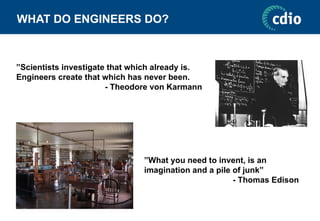
”Scientists investigate that which already is.
Engineers create that which has never been.
- Theodore von Karmann
”What you need to invent, is an
imagination and a pile of junk”
- Thomas Edison
INUSTRY EXPECTATIONS - DESIRED ATTRIBUTES OF
AN ENGINEER (BOEING, CA 1995)
• A good understanding of engineering science fundamentals
– Mathematics, Physical and life sciences, Information technology
• A good understanding of design and manufacturing processes
• A multi-disciplinary, systems perspective
• A basic understanding of the context in which engineering is practiced
– Economics, History, The environment, Customer and societal needs
• Good communication skills - written, oral, graphic, and listening
• A profound understanding of the importance of teamwork.
• Personal skills
– High ethical standards
– Ability to think both critically and creatively—independently and
cooperatively
– Flexibility
• Curiosity and a desire to learn for life
GOVERNMENTAL EXPECTATIONS
”The engineering profession aims to solve problems of
technical nature, concrete and often complex, and
associated with the creation, realization and operation of
products, systems and services. This ability is the result of
a combination of technical knowledge and and knowledge
of economics and social science, both firmly based in
science”
- Commission des titres d’ingénieur, France)
(my translation)
TO SUMMARIZE: THE MAIN GOALS OF
ENGINEERING EDUCATION
• Master a deeper working knowledge of the technical
fundamentals
• Lead in the creation and operation of new products,
processes, and systems
• Understand the importance and strategic impact of
research and technological development on society
To educate students who are able to:
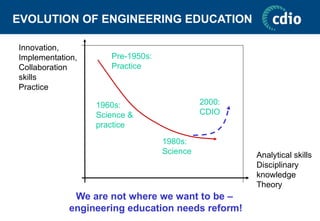
EVOLUTION OF ENGINEERING EDUCATION
Innovation,
Implementation,
Collaboration
skills
Practice
Analytical skills
Disciplinary
knowledge
Theory
Pre-1950s:
Practice
1960s:
Science &
practice
1980s:
Science
2000:
CDIO
We are not where we want to be –
engineering education needs reform!
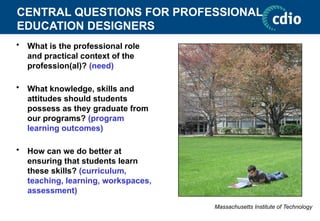
CENTRAL QUESTIONS FOR PROFESSIONAL
EDUCATION DESIGNERS
• What is the professional role
and practical context of the
profession(al)? (need)
• What knowledge, skills and
attitudes should students
possess as they graduate from
our programs? (program
learning outcomes)
• How can we do better at
ensuring that students learn
these skills? (curriculum,
teaching, learning, workspaces,
assessment)
Massachusetts Institute of Technology
THE PROFESSIONAL ROLE(S)
OF ENGINEERS
”Engineers Conceive, Design, Implement and Operate
complex products and systems in a modern team-based
engineering environment”
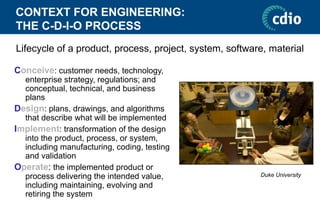
CONTEXT FOR ENGINEERING:
THE C-D-I-O PROCESS
Lifecycle of a product, process, project, system, software, material
Conceive: customer needs, technology,
enterprise strategy, regulations; and
conceptual, technical, and business
plans
Design: plans, drawings, and algorithms
that describe what will be implemented
Implement: transformation of the design
into the product, process, or system,
including manufacturing, coding, testing
and validation
Operate: the implemented product or
process delivering the intended value,
including maintaining, evolving and
retiring the system
Duke University
What is the full set of knowledge, skills and
attitudes that a student should possess as they
graduate from university?
– At what level of proficiency?
– In addition to the traditional engineering
disciplinary knowledge
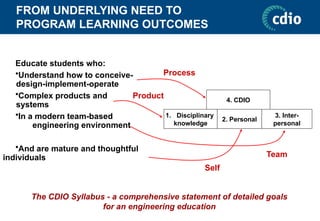
FROM UNDERLYING NEED TO
PROGRAM LEARNING OUTCOMES
Educate students who:
•Understand how to conceive-
design-implement-operate
•Complex products and
systems
•In a modern team-based
engineering environment
•And are mature and thoughtful
individuals
The CDIO Syllabus - a comprehensive statement of detailed goals
for an engineering education
1. Disciplinary
knowledge
3. Inter-
personal
2. Personal
4. CDIO
Process
Team
Product
Self
THE CDIO SYLLABUS
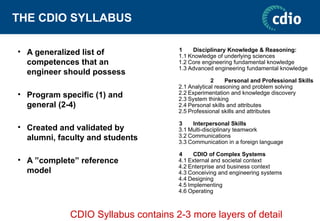
• A generalized list of
competences that an
engineer should possess
• Program specific (1) and
general (2-4)
• Created and validated by
alumni, faculty and students
• A ”complete” reference
model
•
1 Disciplinary Knowledge & Reasoning:
1.1 Knowledge of underlying sciences
1.2 Core engineering fundamental knowledge
1.3 Advanced engineering fundamental knowledge
•
2 Personal and Professional Skills
2.1 Analytical reasoning and problem solving
2.2 Experimentation and knowledge discovery
2.3 System thinking
2.4 Personal skills and attributes
2.5 Professional skills and attributes
•
3 Interpersonal Skills
3.1 Multi-disciplinary teamwork
3.2 Communications
3.3 Communication in a foreign language
•
4 CDIO of Complex Systems
4.1 External and societal context
4.2 Enterprise and business context
4.3 Conceiving and engineering systems
4.4 Designing
4.5 Implementing
4.6 Operating
CDIO Syllabus contains 2-3 more layers of detail
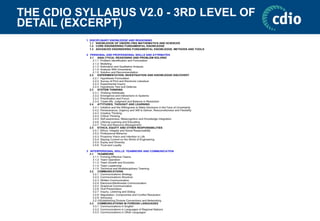
THE CDIO SYLLABUS V2.0 - 3RD LEVEL OF
DETAIL (EXCERPT)
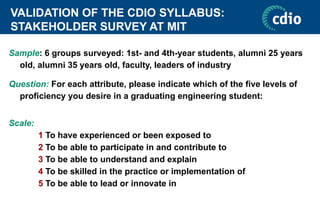
VALIDATION OF THE CDIO SYLLABUS:
STAKEHOLDER SURVEY AT MIT
Sample: 6 groups surveyed: 1st- and 4th-year students, alumni 25 years
old, alumni 35 years old, faculty, leaders of industry
Question: For each attribute, please indicate which of the five levels of
proficiency you desire in a graduating engineering student:
Scale:
1 To have experienced or been exposed to
2 To be able to participate in and contribute to
3 To be able to understand and explain
4 To be skilled in the practice or implementation of
5 To be able to lead or innovate in
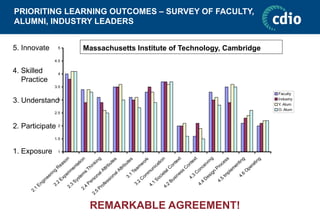
REMARKABLE AGREEMENT!
1
1.5
2
2.5
3
3.5
4
4.5
5
Faculty
Industry
Y. Alum
O. Alum
Massachusetts Institute of Technology, Cambridge
1. Exposure
2. Participate
3. Understand
4. Skilled
Practice
5. Innovate
PRIORITING LEARNING OUTCOMES – SURVEY OF FACULTY,
ALUMNI, INDUSTRY LEADERS
VALIDATION AGAINST NATIONAL
ACCREDITATION FRAMEWORKS
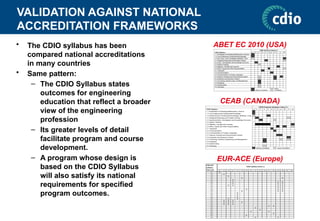
• The CDIO syllabus has been
compared national accreditations
in many countries
• Same pattern:
– The CDIO Syllabus states
outcomes for engineering
education that reflect a broader
view of the engineering
profession
– Its greater levels of detail
facilitate program and course
development.
– A program whose design is
based on the CDIO Syllabus
will also satisfy its national
requirements for specified
program outcomes.
ABET EC 2010 (USA)
CEAB (CANADA)
EUR-ACE (Europe)
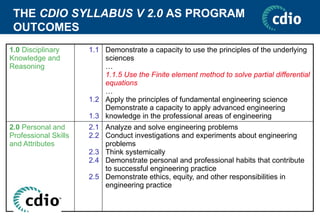
THE CDIO SYLLABUS V 2.0 AS PROGRAM
OUTCOMES
1.0 Disciplinary
Knowledge and
Reasoning
1.1
1.2
1.3
Demonstrate a capacity to use the principles of the underlying
sciences
…
1.1.5 Use the Finite element method to solve partial differential
equations
…
Apply the principles of fundamental engineering science
Demonstrate a capacity to apply advanced engineering
knowledge in the professional areas of engineering
2.0 Personal and
Professional Skills
and Attributes
2.1
2.2
2.3
2.4
2.5
Analyze and solve engineering problems
Conduct investigations and experiments about engineering
problems
Think systemically
Demonstrate personal and professional habits that contribute
to successful engineering practice
Demonstrate ethics, equity, and other responsibilities in
engineering practice
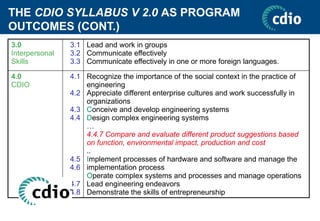
THE CDIO SYLLABUS V 2.0 AS PROGRAM
OUTCOMES (CONT.)
3.0
Interpersonal
Skills
3.1
3.2
3.3
Lead and work in groups
Communicate effectively
Communicate effectively in one or more foreign languages.
4.0
CDIO
4.1
4.2
4.3
4.4
4.5
4.6
4.7
4.8
Recognize the importance of the social context in the practice of
engineering
Appreciate different enterprise cultures and work successfully in
organizations
Conceive and develop engineering systems
Design complex engineering systems
…
4.4.7 Compare and evaluate different product suggestions based
on function, environmental impact, production and cost
..
Implement processes of hardware and software and manage the
implementation process
Operate complex systems and processes and manage operations
Lead engineering endeavors
Demonstrate the skills of entrepreneurship
How can we do better at assuring that students
learn these skills?
– Within the available student and faculty time,
funding and other resources
VISION FOR A CDIO-BASED EDUCATION
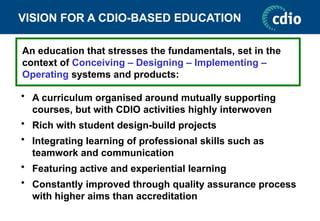
• A curriculum organised around mutually supporting
courses, but with CDIO activities highly interwoven
• Rich with student design-build projects
• Integrating learning of professional skills such as
teamwork and communication
• Featuring active and experiential learning
• Constantly improved through quality assurance process
with higher aims than accreditation
An education that stresses the fundamentals, set in the
context of Conceiving – Designing – Implementing –
Operating systems and products:
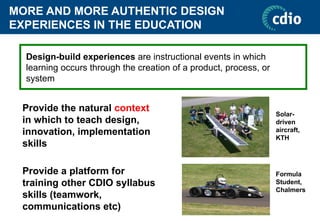
MORE AND MORE AUTHENTIC DESIGN
EXPERIENCES IN THE EDUCATION
Provide the natural context
in which to teach design,
innovation, implementation
skills
Provide a platform for
training other CDIO syllabus
skills (teamwork,
communications etc)
Design-build experiences are instructional events in which
learning occurs through the creation of a product, process, or
system
Solar-
driven
aircraft,
KTH
Formula
Student,
Chalmers
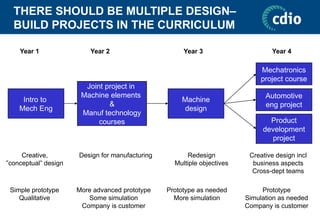
THERE SHOULD BE MULTIPLE DESIGN–
BUILD PROJECTS IN THE CURRICULUM
Intro to
Mech Eng
Joint project in
Machine elements
&
Manuf technology
courses
Machine
design
Mechatronics
project course
Product
development
project
Automotive
eng project
Creative,
”conceptual” design
Design for manufacturing Redesign
Multiple objectives
Creative design incl
business aspects
Cross-dept teams
Year 1 Year 2 Year 3 Year 4
Simple prototype
Qualitative
More advanced prototype
Some simulation
Company is customer
Prototype as needed
More simulation
Prototype
Simulation as needed
Company is customer
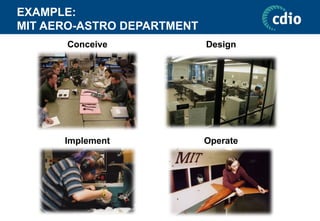
Operate
EXAMPLE:
MIT AERO-ASTRO DEPARTMENT
Conceive Design
Implement
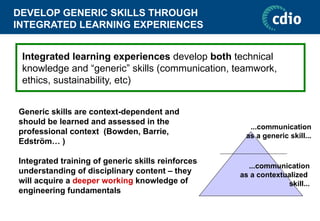
DEVELOP GENERIC SKILLS THROUGH
INTEGRATED LEARNING EXPERIENCES
Generic skills are context-dependent and
should be learned and assessed in the
professional context (Bowden, Barrie,
Edström… )
Integrated training of generic skills reinforces
understanding of disciplinary content – they
will acquire a deeper working knowledge of
engineering fundamentals
...communication
as a generic skill...
...communication
as a contextualized
skill...
Integrated learning experiences develop both technical
knowledge and “generic” skills (communication, teamwork,
ethics, sustainability, etc)
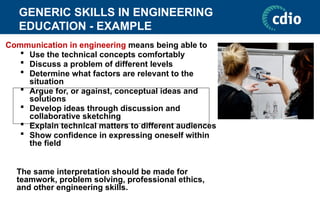
GENERIC SKILLS IN ENGINEERING
EDUCATION - EXAMPLE
Communication in engineering means being able to
 Use the technical concepts comfortably
 Discuss a problem of different levels
 Determine what factors are relevant to the
situation
 Argue for, or against, conceptual ideas and
solutions
 Develop ideas through discussion and
collaborative sketching
 Explain technical matters to different audiences
 Show confidence in expressing oneself within
the field
The same interpretation should be made for
teamwork, problem solving, professional ethics,
and other engineering skills.
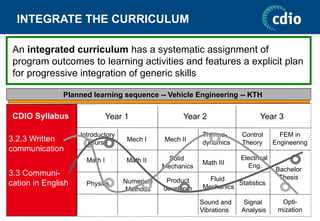
INTEGRATE THE CURRICULUM
An integrated curriculum has a systematic assignment of
program outcomes to learning activities and features a explicit plan
for progressive integration of generic skills
Introductory
course
Physics Product
developm
Numerical
Methods
Planned learning sequence -- Vehicle Engineering -- KTH
CDIO Syllabus
Mech I
Thermo-
dynamics
Mech II
Solid
Mechanics
Sound and
Vibrations
Math II
Fluid
Mechanics
Math I Math III
Control
Theory
Signal
Analysis
Statistics
Electrical
Eng.
Year 1 Year 3
Year 2
FEM in
Engineering
Bachelor
Thesis
Opti-
mization
3.2.3 Written
communication
3.3 Communi-
cation in English
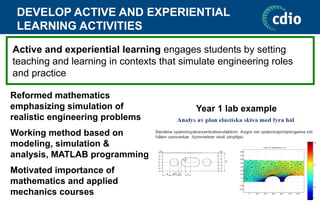
DEVELOP ACTIVE AND EXPERIENTIAL
LEARNING ACTIVITIES
Year 1 lab example
Active and experiential learning engages students by setting
teaching and learning in contexts that simulate engineering roles
and practice
Reformed mathematics
emphasizing simulation of
realistic engineering problems
Working method based on
modeling, simulation &
analysis, MATLAB programming
Motivated importance of
mathematics and applied
mechanics courses
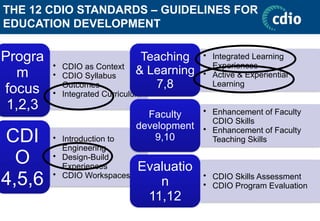
THE 12 CDIO STANDARDS – GUIDELINES FOR
EDUCATION DEVELOPMENT
• CDIO as Context
• CDIO Syllabus
Outcomes
• Integrated Curriculum
Progra
m
focus
1,2,3
• Introduction to
Engineering
• Design-Build
Experiences
• CDIO Workspaces
CDI
O
4,5,6
• Integrated Learning
Experiences
• Active & Experiential
Learning
Teaching
& Learning
7,8
• Enhancement of Faculty
CDIO Skills
• Enhancement of Faculty
Teaching Skills
Faculty
development
9,10
• CDIO Skills Assessment
• CDIO Program Evaluation
Evaluatio
n
11,12
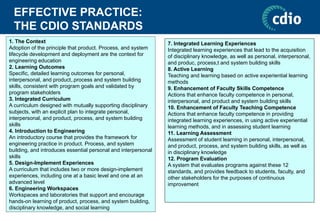
EFFECTIVE PRACTICE:
THE CDIO STANDARDS
1. The Context
Adoption of the principle that product. Process, and system
lifecycle development and deployment are the context for
engineering education
2. Learning Outcomes
Specific, detailed learning outcomes for personal,
interpersonal, and product,.process and system building
skills, consistent with program goals and validated by
program stakeholders
3. Integrated Curriculum
A curriculum designed with mutually supporting disciplinary
subjects, with an explicit plan to integrate personal,
interpersonal, and product, process, and system building
skills
4. Introduction to Engineering
An introductory course that provides the framework for
engineering practice in product. Process, and system
building, and introduces essential personal and interpersonal
skills
5. Design-Implement Experiences
A curriculum that includes two or more design-implement
experiences, including one at a basic level and one at an
advanced level
6. Engineering Workspaces
Workspaces and laboratories that support and encourage
hands-on learning of product, process, and system building,
disciplinary knowledge, and social learning
7. Integrated Learning Experiences
Integrated learning experiences that lead to the acquisition
of disciplinary knowledge, as well as personal, interpersonal,
and produc, process,t and system building skills
8. Active Learning
Teaching and learning based on active experiential learning
methods
9. Enhancement of Faculty Skills Competence
Actions that enhance faculty competence in personal,
interpersonal, and product and system building skills
10. Enhancement of Faculty Teaching Competence
Actions that enhance faculty competence in providing
integrated learning experiences, in using active experiential
learning methods, and in assessing student learning
11. Learning Assessment
Assessment of student learning in personal, interpersonal,
and product, process, and system building skills, as well as
in disciplinary knowledge
12. Program Evaluation
A system that evaluates programs against these 12
standards, and provides feedback to students, faculty, and
other stakeholders for the purposes of continuous
improvement
CDIO IS A REFERENCE MODEL,
NOT A PRESCRIPTION
Everything has to be translated-
transformed to fit the context
and conditions of each
university / program
You are probably doing some CDIO
elements already
Take what you want to use,
transform it as you wish, give it
a new name, assume ownership
CDIO provides a toolbox for
working through the process
CURRENT AND EMERGING CHALLENGES
FOR ENGINEERING EDUCATION
• Need to educate engineers to be more effective leaders
and entrepreneurs
• Need to educate engineers to work in interdisciplinary
teams
• Need for more experiential and project-based learning
• Adaptation of engineering education to prepare for
increasing globalization
• Increasing awareness and response to environmental
changes
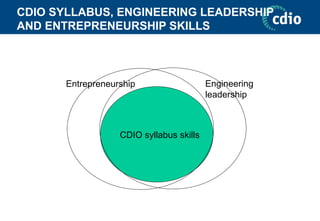
CDIO SYLLABUS, ENGINEERING LEADERSHIP
AND ENTREPRENEURSHIP SKILLS
CDIO syllabus skills
Engineering
leadership
Entrepreneurship
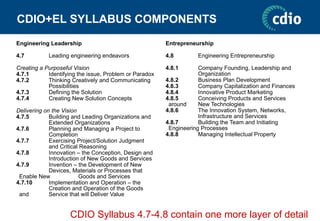
CDIO+EL SYLLABUS COMPONENTS
Engineering Leadership
4.7 Leading engineering endeavors
Creating a Purposeful Vision
4.7.1 Identifying the issue, Problem or Paradox
4.7.2 Thinking Creatively and Communicating
Possibilities
4.7.3 Defining the Solution
4.7.4 Creating New Solution Concepts
Delivering on the Vision
4.7.5 Building and Leading Organizations and
Extended Organizations
4.7.6 Planning and Managing a Project to
Completion
4.7.7 Exercising Project/Solution Judgment
and Critical Reasoning
4.7.8 Innovation – the Conception, Design and
Introduction of New Goods and Services
4.7.9 Invention – the Development of New
Devices, Materials or Processes that
Enable New Goods and Services
4.7.10 Implementation and Operation – the
Creation and Operation of the Goods
and Service that will Deliver Value
Entrepreneurship
4.8 Engineering Entrepreneurship
4.8.1 Company Founding, Leadership and
Organization
4.8.2 Business Plan Development
4.8.3 Company Capitalization and Finances
4.8.4 Innovative Product Marketing
4.8.5 Conceiving Products and Services
around New Technologies
4.8.6 The Innovation System, Networks,
Infrastructure and Services
4.8.7 Building the Team and Initiating
Engineering Processes
4.8.8 Managing Intellectual Property
CDIO Syllabus 4.7-4.8 contain one more layer of detail
EXAMPLE: GORDON ENGINEERING
LEADERSHIP PROGRAM (MIT)
Mission:
To educate and develop the character of outstanding MIT
students as potential future leaders in the world of engineering
practice and development, and to endeavor to transform
engineering leadership* in the nation, thereby significantly
increasing its product development capability.
* Engineering leadership is defined as the technical leadership
of the innovative conception, design and implementation of new
products/processes/projects/materials/molecules/
software/systems
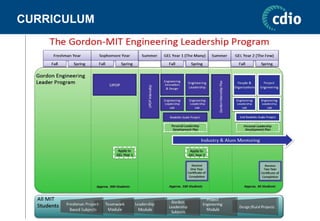
CURRICULUM
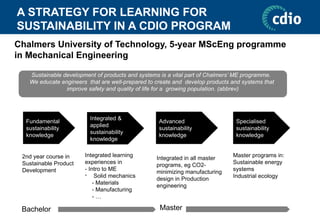
A STRATEGY FOR LEARNING FOR
SUSTAINABILITY IN A CDIO PROGRAM
Sustainable development of products and systems is a vital part of Chalmers’ ME programme.
We educate engineers that are well-prepared to create and develop products and systems that
improve safety and quality of life for a growing population. (abbrev)
Fundamental
sustainability
knowledge
2nd year course in
Sustainable Product
Development
Integrated &
applied
sustainability
knowledge
Integrated learning
experiences in
- Intro to ME
- Solid mechanics
- Materials
- Manufacturing
- …
Integrated in all master
programs, eg CO2-
minimizing manufacturing
design in Production
engineering
Advanced
sustainability
knowledge
Specialised
sustainability
knowledge
Master programs in:
Sustainable energy
systems
Industrial ecology
Chalmers University of Technology, 5-year MScEng programme
in Mechanical Engineering
Bachelor Master
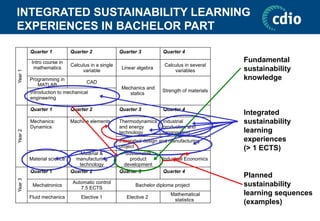
INTEGRATED SUSTAINABILITY LEARNING
EXPERIENCES IN BACHELOR PART
Year
1
Quarter 1 Quarter 2 Quarter 3 Quarter 4
Intro course in
mathematics
Calculus in a single
variable
Linear algebra
Calculus in several
variables
Programming in
MATLAB
CAD
Mechanics and
statics
Strength of materials
Introduction to mechanical
engineering
Year
2
Quarter 1 Quarter 2 Quarter 3 Quarter 4
Mechanics:
Dynamics
Machine elements Thermodynamics
and energy
technology
Industrial
production and
organisation
Integrated design and manufacturing
project
Material science
Material &
manufacturing
technology
Sustainable
product
development
Industrial Economics
Year
3
Quarter 1 Quarter 2 Quarter 3 Quarter 4
Mechatronics
Automatic control
7.5 ECTS
Bachelor diploma project
Fluid mechanics Elective 1 Elective 2
Mathematical
statistics
Fundamental
sustainability
knowledge
Integrated
sustainability
learning
experiences
(> 1 ECTS)
Planned
sustainability
learning sequences
(examples)
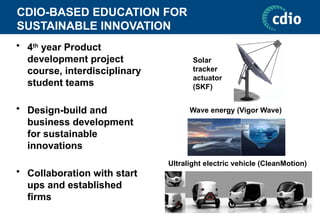
CDIO-BASED EDUCATION FOR
SUSTAINABLE INNOVATION
• 4th
year Product
development project
course, interdisciplinary
student teams
• Design-build and
business development
for sustainable
innovations
• Collaboration with start
ups and established
firms
Ultralight electric vehicle (CleanMotion)
Wave energy (Vigor Wave)
Solar
tracker
actuator
(SKF)
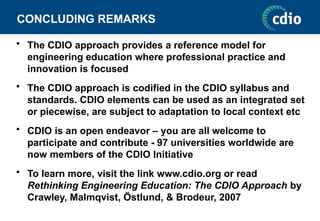
CONCLUDING REMARKS
• The CDIO approach provides a reference model for
engineering education where professional practice and
innovation is focused
• The CDIO approach is codified in the CDIO syllabus and
standards. CDIO elements can be used as an integrated set
or piecewise, are subject to adaptation to local context etc
• CDIO is an open endeavor – you are all welcome to
participate and contribute - 97 universities worldwide are
now members of the CDIO Initiative
• To learn more, visit the link www.cdio.org or read
Rethinking Engineering Education: The CDIO Approach by
Crawley, Malmqvist, Östlund, & Brodeur, 2007
Thank you for listening!
Any questions or comments?

CDIO an overview for Engineering Designs

  • 1.
    Overview of CDIO: Past,present and future Professor Johan Malmqvist Chalmers University of Technology Gothenburg, Sweden
  • 2.
    OUTLINE • What isan engineer? What is the professional context of engineering? • The need for a new approach – The CDIO goals and vision – What do engineering graduates need to be able to do? – How can we do better at educating them? • Future developments to the CDIO approach • Concluding remarks & discussion
  • 3.
    WHAT DO ENGINEERSDO? ”Scientists investigate that which already is. Engineers create that which has never been. - Theodore von Karmann ”What you need to invent, is an imagination and a pile of junk” - Thomas Edison
  • 4.
    INUSTRY EXPECTATIONS -DESIRED ATTRIBUTES OF AN ENGINEER (BOEING, CA 1995) • A good understanding of engineering science fundamentals – Mathematics, Physical and life sciences, Information technology • A good understanding of design and manufacturing processes • A multi-disciplinary, systems perspective • A basic understanding of the context in which engineering is practiced – Economics, History, The environment, Customer and societal needs • Good communication skills - written, oral, graphic, and listening • A profound understanding of the importance of teamwork. • Personal skills – High ethical standards – Ability to think both critically and creatively—independently and cooperatively – Flexibility • Curiosity and a desire to learn for life
  • 5.
    GOVERNMENTAL EXPECTATIONS ”The engineeringprofession aims to solve problems of technical nature, concrete and often complex, and associated with the creation, realization and operation of products, systems and services. This ability is the result of a combination of technical knowledge and and knowledge of economics and social science, both firmly based in science” - Commission des titres d’ingénieur, France) (my translation)
  • 6.
    TO SUMMARIZE: THEMAIN GOALS OF ENGINEERING EDUCATION • Master a deeper working knowledge of the technical fundamentals • Lead in the creation and operation of new products, processes, and systems • Understand the importance and strategic impact of research and technological development on society To educate students who are able to:
  • 7.
    EVOLUTION OF ENGINEERINGEDUCATION Innovation, Implementation, Collaboration skills Practice Analytical skills Disciplinary knowledge Theory Pre-1950s: Practice 1960s: Science & practice 1980s: Science 2000: CDIO We are not where we want to be – engineering education needs reform!
  • 8.
    CENTRAL QUESTIONS FORPROFESSIONAL EDUCATION DESIGNERS • What is the professional role and practical context of the profession(al)? (need) • What knowledge, skills and attitudes should students possess as they graduate from our programs? (program learning outcomes) • How can we do better at ensuring that students learn these skills? (curriculum, teaching, learning, workspaces, assessment) Massachusetts Institute of Technology
  • 9.
    THE PROFESSIONAL ROLE(S) OFENGINEERS ”Engineers Conceive, Design, Implement and Operate complex products and systems in a modern team-based engineering environment”
  • 10.
    CONTEXT FOR ENGINEERING: THEC-D-I-O PROCESS Lifecycle of a product, process, project, system, software, material Conceive: customer needs, technology, enterprise strategy, regulations; and conceptual, technical, and business plans Design: plans, drawings, and algorithms that describe what will be implemented Implement: transformation of the design into the product, process, or system, including manufacturing, coding, testing and validation Operate: the implemented product or process delivering the intended value, including maintaining, evolving and retiring the system Duke University
  • 11.
    What is thefull set of knowledge, skills and attitudes that a student should possess as they graduate from university? – At what level of proficiency? – In addition to the traditional engineering disciplinary knowledge
  • 12.
    FROM UNDERLYING NEEDTO PROGRAM LEARNING OUTCOMES Educate students who: •Understand how to conceive- design-implement-operate •Complex products and systems •In a modern team-based engineering environment •And are mature and thoughtful individuals The CDIO Syllabus - a comprehensive statement of detailed goals for an engineering education 1. Disciplinary knowledge 3. Inter- personal 2. Personal 4. CDIO Process Team Product Self
  • 13.
    THE CDIO SYLLABUS •A generalized list of competences that an engineer should possess • Program specific (1) and general (2-4) • Created and validated by alumni, faculty and students • A ”complete” reference model • 1 Disciplinary Knowledge & Reasoning: 1.1 Knowledge of underlying sciences 1.2 Core engineering fundamental knowledge 1.3 Advanced engineering fundamental knowledge • 2 Personal and Professional Skills 2.1 Analytical reasoning and problem solving 2.2 Experimentation and knowledge discovery 2.3 System thinking 2.4 Personal skills and attributes 2.5 Professional skills and attributes • 3 Interpersonal Skills 3.1 Multi-disciplinary teamwork 3.2 Communications 3.3 Communication in a foreign language • 4 CDIO of Complex Systems 4.1 External and societal context 4.2 Enterprise and business context 4.3 Conceiving and engineering systems 4.4 Designing 4.5 Implementing 4.6 Operating CDIO Syllabus contains 2-3 more layers of detail
  • 14.
    THE CDIO SYLLABUSV2.0 - 3RD LEVEL OF DETAIL (EXCERPT)
  • 15.
    VALIDATION OF THECDIO SYLLABUS: STAKEHOLDER SURVEY AT MIT Sample: 6 groups surveyed: 1st- and 4th-year students, alumni 25 years old, alumni 35 years old, faculty, leaders of industry Question: For each attribute, please indicate which of the five levels of proficiency you desire in a graduating engineering student: Scale: 1 To have experienced or been exposed to 2 To be able to participate in and contribute to 3 To be able to understand and explain 4 To be skilled in the practice or implementation of 5 To be able to lead or innovate in
  • 16.
    REMARKABLE AGREEMENT! 1 1.5 2 2.5 3 3.5 4 4.5 5 Faculty Industry Y. Alum O.Alum Massachusetts Institute of Technology, Cambridge 1. Exposure 2. Participate 3. Understand 4. Skilled Practice 5. Innovate PRIORITING LEARNING OUTCOMES – SURVEY OF FACULTY, ALUMNI, INDUSTRY LEADERS
  • 17.
    VALIDATION AGAINST NATIONAL ACCREDITATIONFRAMEWORKS • The CDIO syllabus has been compared national accreditations in many countries • Same pattern: – The CDIO Syllabus states outcomes for engineering education that reflect a broader view of the engineering profession – Its greater levels of detail facilitate program and course development. – A program whose design is based on the CDIO Syllabus will also satisfy its national requirements for specified program outcomes. ABET EC 2010 (USA) CEAB (CANADA) EUR-ACE (Europe)
  • 18.
    THE CDIO SYLLABUSV 2.0 AS PROGRAM OUTCOMES 1.0 Disciplinary Knowledge and Reasoning 1.1 1.2 1.3 Demonstrate a capacity to use the principles of the underlying sciences … 1.1.5 Use the Finite element method to solve partial differential equations … Apply the principles of fundamental engineering science Demonstrate a capacity to apply advanced engineering knowledge in the professional areas of engineering 2.0 Personal and Professional Skills and Attributes 2.1 2.2 2.3 2.4 2.5 Analyze and solve engineering problems Conduct investigations and experiments about engineering problems Think systemically Demonstrate personal and professional habits that contribute to successful engineering practice Demonstrate ethics, equity, and other responsibilities in engineering practice
  • 19.
    THE CDIO SYLLABUSV 2.0 AS PROGRAM OUTCOMES (CONT.) 3.0 Interpersonal Skills 3.1 3.2 3.3 Lead and work in groups Communicate effectively Communicate effectively in one or more foreign languages. 4.0 CDIO 4.1 4.2 4.3 4.4 4.5 4.6 4.7 4.8 Recognize the importance of the social context in the practice of engineering Appreciate different enterprise cultures and work successfully in organizations Conceive and develop engineering systems Design complex engineering systems … 4.4.7 Compare and evaluate different product suggestions based on function, environmental impact, production and cost .. Implement processes of hardware and software and manage the implementation process Operate complex systems and processes and manage operations Lead engineering endeavors Demonstrate the skills of entrepreneurship
  • 20.
    How can wedo better at assuring that students learn these skills? – Within the available student and faculty time, funding and other resources
  • 21.
    VISION FOR ACDIO-BASED EDUCATION • A curriculum organised around mutually supporting courses, but with CDIO activities highly interwoven • Rich with student design-build projects • Integrating learning of professional skills such as teamwork and communication • Featuring active and experiential learning • Constantly improved through quality assurance process with higher aims than accreditation An education that stresses the fundamentals, set in the context of Conceiving – Designing – Implementing – Operating systems and products:
  • 22.
    MORE AND MOREAUTHENTIC DESIGN EXPERIENCES IN THE EDUCATION Provide the natural context in which to teach design, innovation, implementation skills Provide a platform for training other CDIO syllabus skills (teamwork, communications etc) Design-build experiences are instructional events in which learning occurs through the creation of a product, process, or system Solar- driven aircraft, KTH Formula Student, Chalmers
  • 23.
    THERE SHOULD BEMULTIPLE DESIGN– BUILD PROJECTS IN THE CURRICULUM Intro to Mech Eng Joint project in Machine elements & Manuf technology courses Machine design Mechatronics project course Product development project Automotive eng project Creative, ”conceptual” design Design for manufacturing Redesign Multiple objectives Creative design incl business aspects Cross-dept teams Year 1 Year 2 Year 3 Year 4 Simple prototype Qualitative More advanced prototype Some simulation Company is customer Prototype as needed More simulation Prototype Simulation as needed Company is customer
  • 24.
  • 25.
    DEVELOP GENERIC SKILLSTHROUGH INTEGRATED LEARNING EXPERIENCES Generic skills are context-dependent and should be learned and assessed in the professional context (Bowden, Barrie, Edström… ) Integrated training of generic skills reinforces understanding of disciplinary content – they will acquire a deeper working knowledge of engineering fundamentals ...communication as a generic skill... ...communication as a contextualized skill... Integrated learning experiences develop both technical knowledge and “generic” skills (communication, teamwork, ethics, sustainability, etc)
  • 26.
    GENERIC SKILLS INENGINEERING EDUCATION - EXAMPLE Communication in engineering means being able to  Use the technical concepts comfortably  Discuss a problem of different levels  Determine what factors are relevant to the situation  Argue for, or against, conceptual ideas and solutions  Develop ideas through discussion and collaborative sketching  Explain technical matters to different audiences  Show confidence in expressing oneself within the field The same interpretation should be made for teamwork, problem solving, professional ethics, and other engineering skills.
  • 27.
    INTEGRATE THE CURRICULUM Anintegrated curriculum has a systematic assignment of program outcomes to learning activities and features a explicit plan for progressive integration of generic skills Introductory course Physics Product developm Numerical Methods Planned learning sequence -- Vehicle Engineering -- KTH CDIO Syllabus Mech I Thermo- dynamics Mech II Solid Mechanics Sound and Vibrations Math II Fluid Mechanics Math I Math III Control Theory Signal Analysis Statistics Electrical Eng. Year 1 Year 3 Year 2 FEM in Engineering Bachelor Thesis Opti- mization 3.2.3 Written communication 3.3 Communi- cation in English
  • 28.
    DEVELOP ACTIVE ANDEXPERIENTIAL LEARNING ACTIVITIES Year 1 lab example Active and experiential learning engages students by setting teaching and learning in contexts that simulate engineering roles and practice Reformed mathematics emphasizing simulation of realistic engineering problems Working method based on modeling, simulation & analysis, MATLAB programming Motivated importance of mathematics and applied mechanics courses
  • 29.
    THE 12 CDIOSTANDARDS – GUIDELINES FOR EDUCATION DEVELOPMENT • CDIO as Context • CDIO Syllabus Outcomes • Integrated Curriculum Progra m focus 1,2,3 • Introduction to Engineering • Design-Build Experiences • CDIO Workspaces CDI O 4,5,6 • Integrated Learning Experiences • Active & Experiential Learning Teaching & Learning 7,8 • Enhancement of Faculty CDIO Skills • Enhancement of Faculty Teaching Skills Faculty development 9,10 • CDIO Skills Assessment • CDIO Program Evaluation Evaluatio n 11,12
  • 30.
    EFFECTIVE PRACTICE: THE CDIOSTANDARDS 1. The Context Adoption of the principle that product. Process, and system lifecycle development and deployment are the context for engineering education 2. Learning Outcomes Specific, detailed learning outcomes for personal, interpersonal, and product,.process and system building skills, consistent with program goals and validated by program stakeholders 3. Integrated Curriculum A curriculum designed with mutually supporting disciplinary subjects, with an explicit plan to integrate personal, interpersonal, and product, process, and system building skills 4. Introduction to Engineering An introductory course that provides the framework for engineering practice in product. Process, and system building, and introduces essential personal and interpersonal skills 5. Design-Implement Experiences A curriculum that includes two or more design-implement experiences, including one at a basic level and one at an advanced level 6. Engineering Workspaces Workspaces and laboratories that support and encourage hands-on learning of product, process, and system building, disciplinary knowledge, and social learning 7. Integrated Learning Experiences Integrated learning experiences that lead to the acquisition of disciplinary knowledge, as well as personal, interpersonal, and produc, process,t and system building skills 8. Active Learning Teaching and learning based on active experiential learning methods 9. Enhancement of Faculty Skills Competence Actions that enhance faculty competence in personal, interpersonal, and product and system building skills 10. Enhancement of Faculty Teaching Competence Actions that enhance faculty competence in providing integrated learning experiences, in using active experiential learning methods, and in assessing student learning 11. Learning Assessment Assessment of student learning in personal, interpersonal, and product, process, and system building skills, as well as in disciplinary knowledge 12. Program Evaluation A system that evaluates programs against these 12 standards, and provides feedback to students, faculty, and other stakeholders for the purposes of continuous improvement
  • 31.
    CDIO IS AREFERENCE MODEL, NOT A PRESCRIPTION Everything has to be translated- transformed to fit the context and conditions of each university / program You are probably doing some CDIO elements already Take what you want to use, transform it as you wish, give it a new name, assume ownership CDIO provides a toolbox for working through the process
  • 32.
    CURRENT AND EMERGINGCHALLENGES FOR ENGINEERING EDUCATION • Need to educate engineers to be more effective leaders and entrepreneurs • Need to educate engineers to work in interdisciplinary teams • Need for more experiential and project-based learning • Adaptation of engineering education to prepare for increasing globalization • Increasing awareness and response to environmental changes
  • 33.
    CDIO SYLLABUS, ENGINEERINGLEADERSHIP AND ENTREPRENEURSHIP SKILLS CDIO syllabus skills Engineering leadership Entrepreneurship
  • 34.
    CDIO+EL SYLLABUS COMPONENTS EngineeringLeadership 4.7 Leading engineering endeavors Creating a Purposeful Vision 4.7.1 Identifying the issue, Problem or Paradox 4.7.2 Thinking Creatively and Communicating Possibilities 4.7.3 Defining the Solution 4.7.4 Creating New Solution Concepts Delivering on the Vision 4.7.5 Building and Leading Organizations and Extended Organizations 4.7.6 Planning and Managing a Project to Completion 4.7.7 Exercising Project/Solution Judgment and Critical Reasoning 4.7.8 Innovation – the Conception, Design and Introduction of New Goods and Services 4.7.9 Invention – the Development of New Devices, Materials or Processes that Enable New Goods and Services 4.7.10 Implementation and Operation – the Creation and Operation of the Goods and Service that will Deliver Value Entrepreneurship 4.8 Engineering Entrepreneurship 4.8.1 Company Founding, Leadership and Organization 4.8.2 Business Plan Development 4.8.3 Company Capitalization and Finances 4.8.4 Innovative Product Marketing 4.8.5 Conceiving Products and Services around New Technologies 4.8.6 The Innovation System, Networks, Infrastructure and Services 4.8.7 Building the Team and Initiating Engineering Processes 4.8.8 Managing Intellectual Property CDIO Syllabus 4.7-4.8 contain one more layer of detail
  • 35.
    EXAMPLE: GORDON ENGINEERING LEADERSHIPPROGRAM (MIT) Mission: To educate and develop the character of outstanding MIT students as potential future leaders in the world of engineering practice and development, and to endeavor to transform engineering leadership* in the nation, thereby significantly increasing its product development capability. * Engineering leadership is defined as the technical leadership of the innovative conception, design and implementation of new products/processes/projects/materials/molecules/ software/systems
  • 36.
  • 37.
    A STRATEGY FORLEARNING FOR SUSTAINABILITY IN A CDIO PROGRAM Sustainable development of products and systems is a vital part of Chalmers’ ME programme. We educate engineers that are well-prepared to create and develop products and systems that improve safety and quality of life for a growing population. (abbrev) Fundamental sustainability knowledge 2nd year course in Sustainable Product Development Integrated & applied sustainability knowledge Integrated learning experiences in - Intro to ME - Solid mechanics - Materials - Manufacturing - … Integrated in all master programs, eg CO2- minimizing manufacturing design in Production engineering Advanced sustainability knowledge Specialised sustainability knowledge Master programs in: Sustainable energy systems Industrial ecology Chalmers University of Technology, 5-year MScEng programme in Mechanical Engineering Bachelor Master
  • 38.
    INTEGRATED SUSTAINABILITY LEARNING EXPERIENCESIN BACHELOR PART Year 1 Quarter 1 Quarter 2 Quarter 3 Quarter 4 Intro course in mathematics Calculus in a single variable Linear algebra Calculus in several variables Programming in MATLAB CAD Mechanics and statics Strength of materials Introduction to mechanical engineering Year 2 Quarter 1 Quarter 2 Quarter 3 Quarter 4 Mechanics: Dynamics Machine elements Thermodynamics and energy technology Industrial production and organisation Integrated design and manufacturing project Material science Material & manufacturing technology Sustainable product development Industrial Economics Year 3 Quarter 1 Quarter 2 Quarter 3 Quarter 4 Mechatronics Automatic control 7.5 ECTS Bachelor diploma project Fluid mechanics Elective 1 Elective 2 Mathematical statistics Fundamental sustainability knowledge Integrated sustainability learning experiences (> 1 ECTS) Planned sustainability learning sequences (examples)
  • 39.
    CDIO-BASED EDUCATION FOR SUSTAINABLEINNOVATION • 4th year Product development project course, interdisciplinary student teams • Design-build and business development for sustainable innovations • Collaboration with start ups and established firms Ultralight electric vehicle (CleanMotion) Wave energy (Vigor Wave) Solar tracker actuator (SKF)
  • 40.
    CONCLUDING REMARKS • TheCDIO approach provides a reference model for engineering education where professional practice and innovation is focused • The CDIO approach is codified in the CDIO syllabus and standards. CDIO elements can be used as an integrated set or piecewise, are subject to adaptation to local context etc • CDIO is an open endeavor – you are all welcome to participate and contribute - 97 universities worldwide are now members of the CDIO Initiative • To learn more, visit the link www.cdio.org or read Rethinking Engineering Education: The CDIO Approach by Crawley, Malmqvist, Östlund, & Brodeur, 2007
  • 41.
    Thank you forlistening! Any questions or comments?

Editor's Notes

  • #1 Our graduates need to understand the entire life-cycle of a product. Too often our educational programs tend to focus on design-build, … or design, … or even more limited to just the analysis part of design. Our graduates go out into the work force thinking their jobs will be to just solve more problems and that the answer to the problem is the objective. We need to change the way they view engineering by changing the way we teach engineering.
  • #6 The next three slides offer an alternative to the information transfer model of education -- experiential learning. This approach to learning will be explored in Session 3. Refer to “Rethinking Engineering Education”, pp. 20 - 22. This is a key slide. Be sure participants understand the CDIO goals. Focus on the first two; the CDIO approach tells us how to achieve these goals. Engineering education should always emphasize the technical fundamentals. Nothing in the CDIO approach is meant to diminish the importance of the fundamentals or students’ need to learn them. Deep working knowledge and conceptual understanding are emphasized to strengthen the learning of technical fundamentals. This goal recognizes the need to prepare students for engineering. This goal recognizes that some students will not become practicing engineers, but will pursue careers as researchers in industry, government, and higher education. Despite different career interests, all students benefit from an education set in the context of product, process, and system development.
  • #7 It is important to note, this is not an either/or situation. Within the CDIO context, we can do both. We don’t need to sacrifice deeper disciplinary knowledge for gains in the personal, interpersonal, and systems level skills.
  • #12 Translating needs to goals is good engineering practice. The underlying goals, stated earlier in this session, are translated into four major categories: technical, personal, interpersonal, and the product, process, system lifecycle (CDIO). These four categories will be used to outline the REQUIREMENTS document, that is, the CDIO Syllabus.
  • #15 Refer to “Rethinking Engineering Education”, pp. 65 - 74.
  • #16 These graphs highlight the importance of collecting data to validate program decisions and persuade decision makers.
  • #21 This leads to the organization of the CDIO Themes: Curriculum Design-Build Teaching and Learning Assessment
  • #22 Point out that design-implement experiences are not restricted to product development. They are equally applicable in engineering disciplines that focus more on processes or systems, e.g., chemical engineering or biological engineering.
  • #27 Make the points that This is what it means to see skills as engineering skills. Engineering skills are not something other than technical content, they have everything to do with technical content, they are inseparable, embedded. We realise that providing opportunities to developing them is necessary is our students should become engineers who can engineer. Engineering skills are enabling for engineering. Colleagues who see skills as a ”soft” addition, something different to the ”hard” engineering core, will not understand the rationale for the integrated curriculum. It is because they don’t have this engineering-flavoured view on communication.
  • #31 The CDIO Standards are found in “Rethinking Engineering Education”, pp. 269-278; in the Handbook, pp. 3-15; and at the CDIO webstie, http://www.cdio.org. NOTE: The version in the Handbook is dated 2004; minor word changes were made for the book and the website in 2007.