Collaborative Learning and Teaching in InnovationMike Parsons and Mary Rose (IEED, Lancaster University Management School 28 February 2011Hull University Business School1
OverviewAbout us Innovation Courses Learning and Teaching Challenges   Course Design and Evolution  Collaborative practices and processes2
About usOur collaboration
We represent a ‘new combination’
Mike Parsons –businessman, Karrimor, OMM Ltd, Innovator in Residence, IEED
Mary Rose, academic, business historian
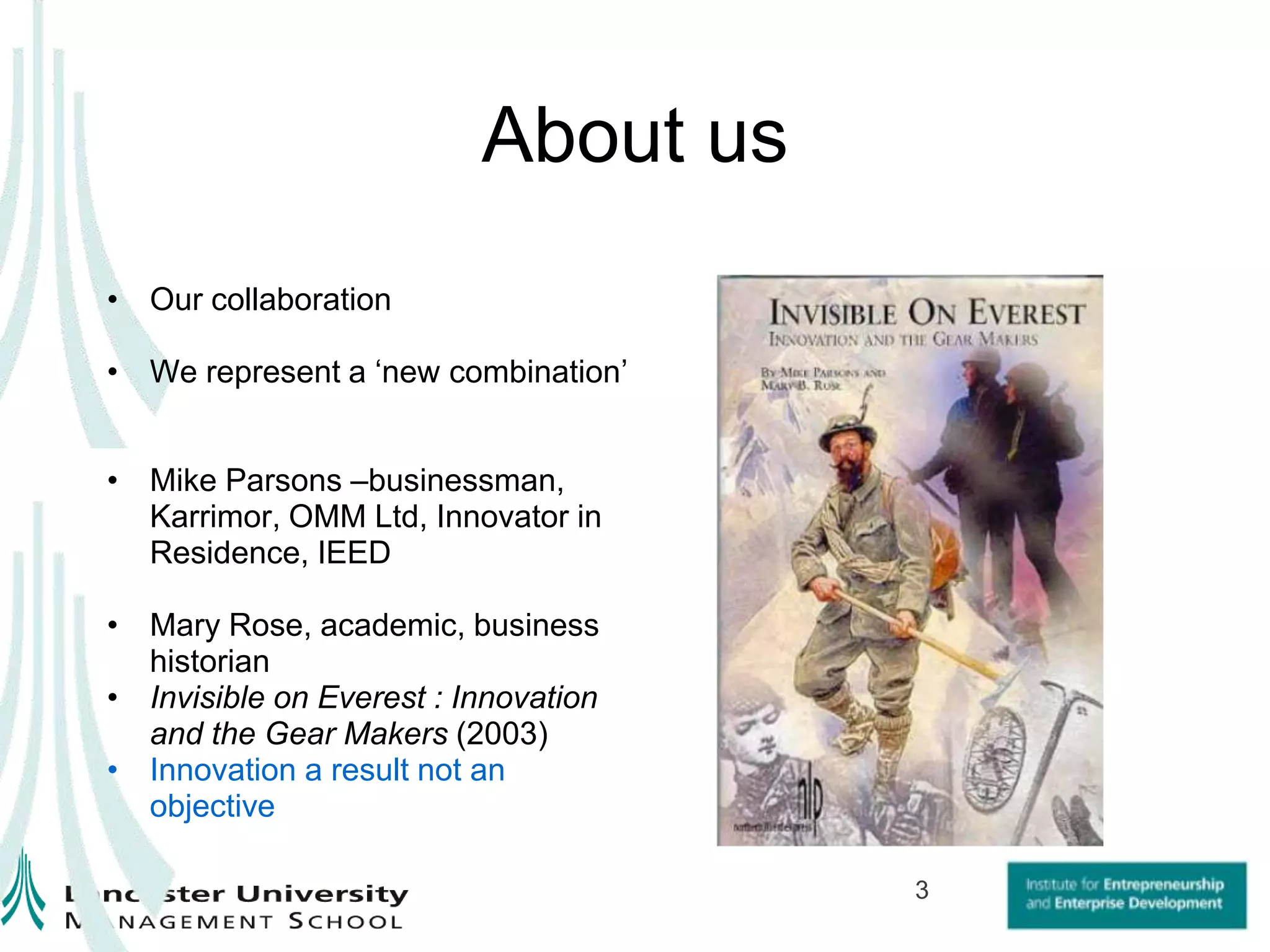
Invisible on Everest : Innovation and the Gear Makers (2003)
Innovation a result not an objective 3
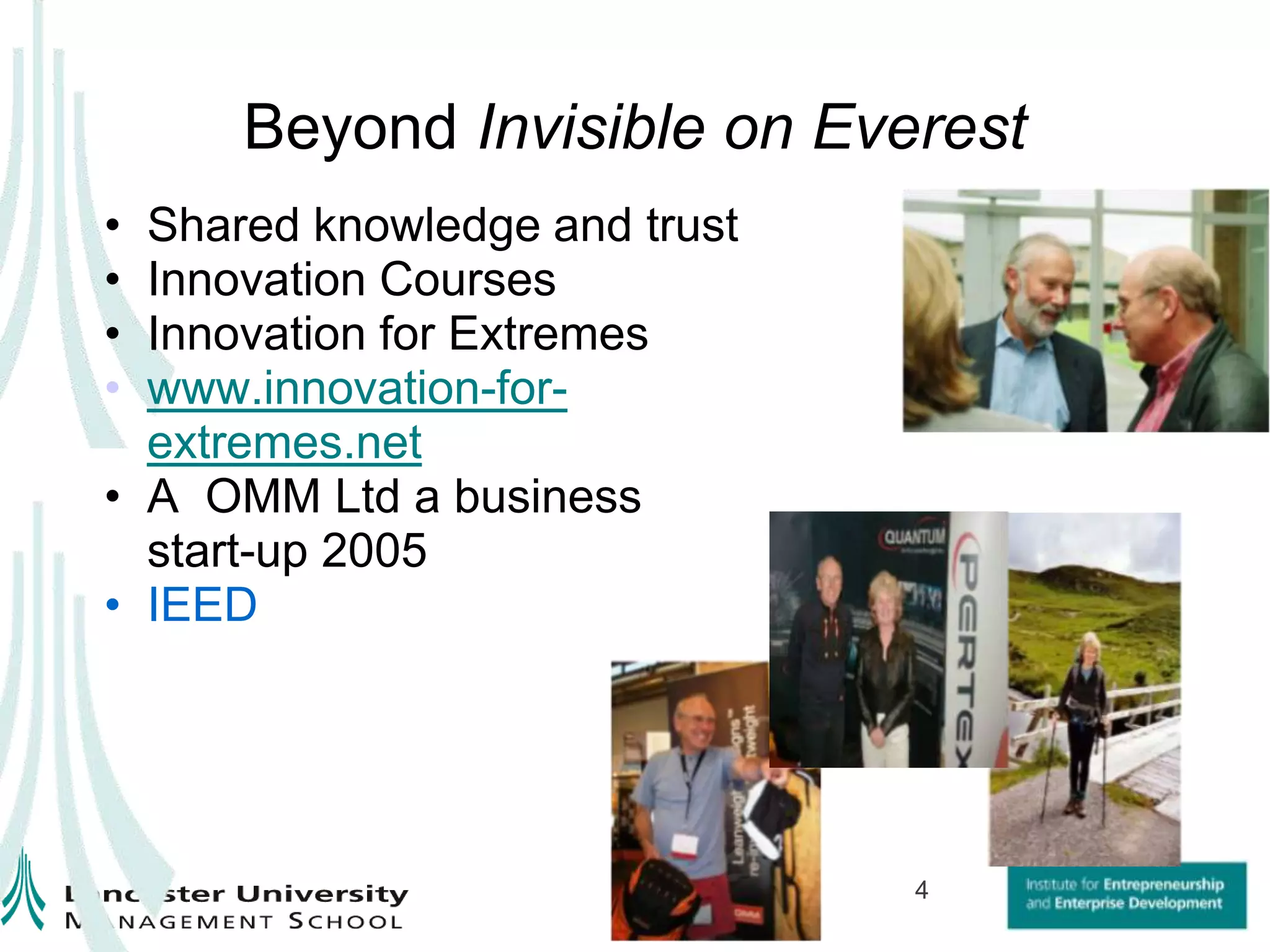
Beyond Invisible on EverestShared knowledge and trust
Innovation Courses
Innovation for Extremes
www.innovation-for-extremes.net
A  OMM Ltd a business start-up 2005
IEED4
Innovation Course Starting PointLaunched October 2004 5
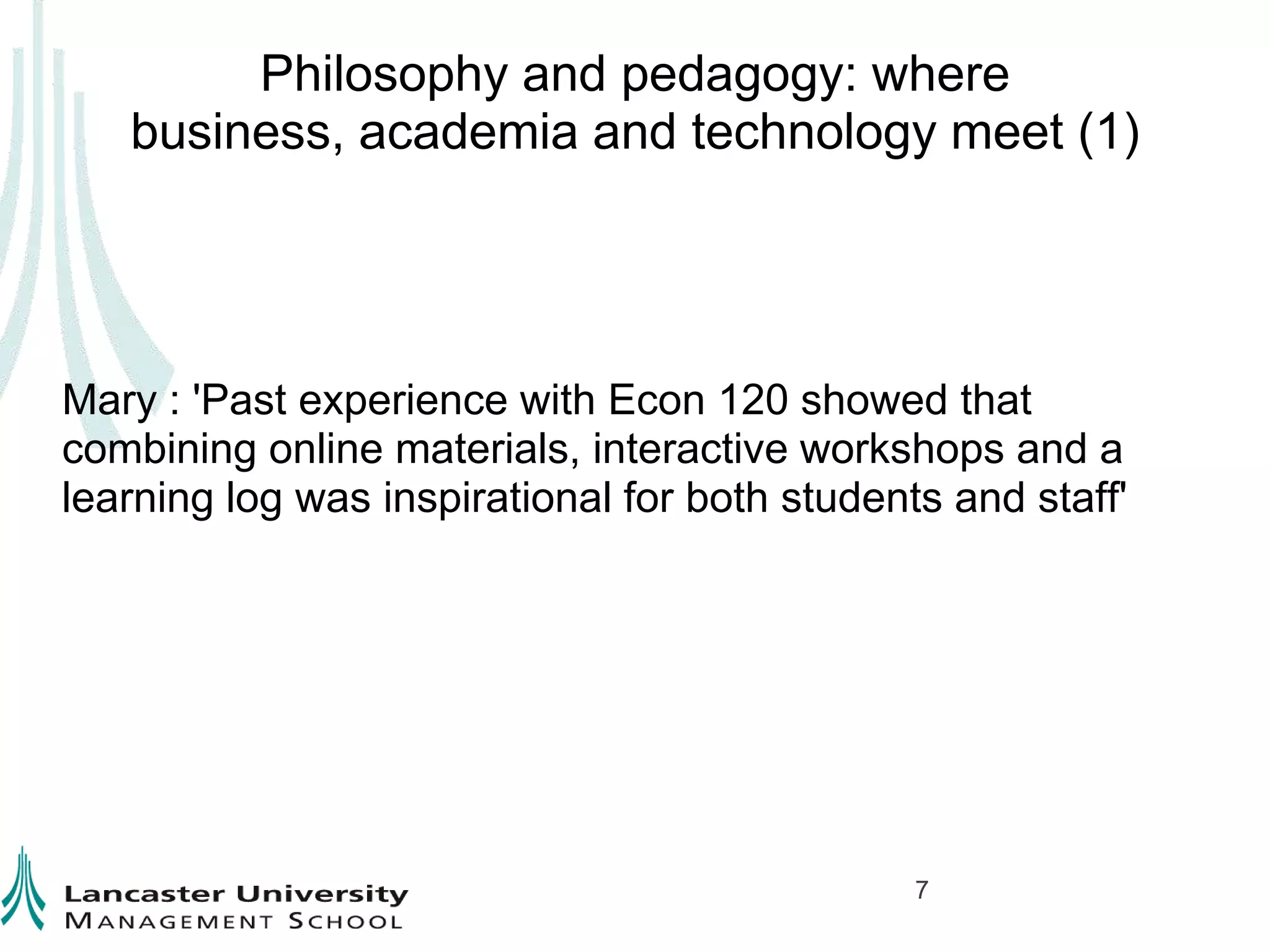
Teaching and Learning Challenges identified 2004How to set current innovation and management practices alongside theoretical analysisDeveloping critical analytical skill relating to the business pressMotivation80/20 rulePlagiarism6
Philosophy and pedagogy: where business, academia and technology meet (1)   Mary : 'Past experience with Econ 120 showed that combining online materials, interactive workshops and a learning log was inspirational for both students and staff'7
Philosophy and pedagogy: where business, academia and technology meet (2)Mike : “Mary agreed to my proposal that I treat the students as I would employees during an extensive period of management change."8
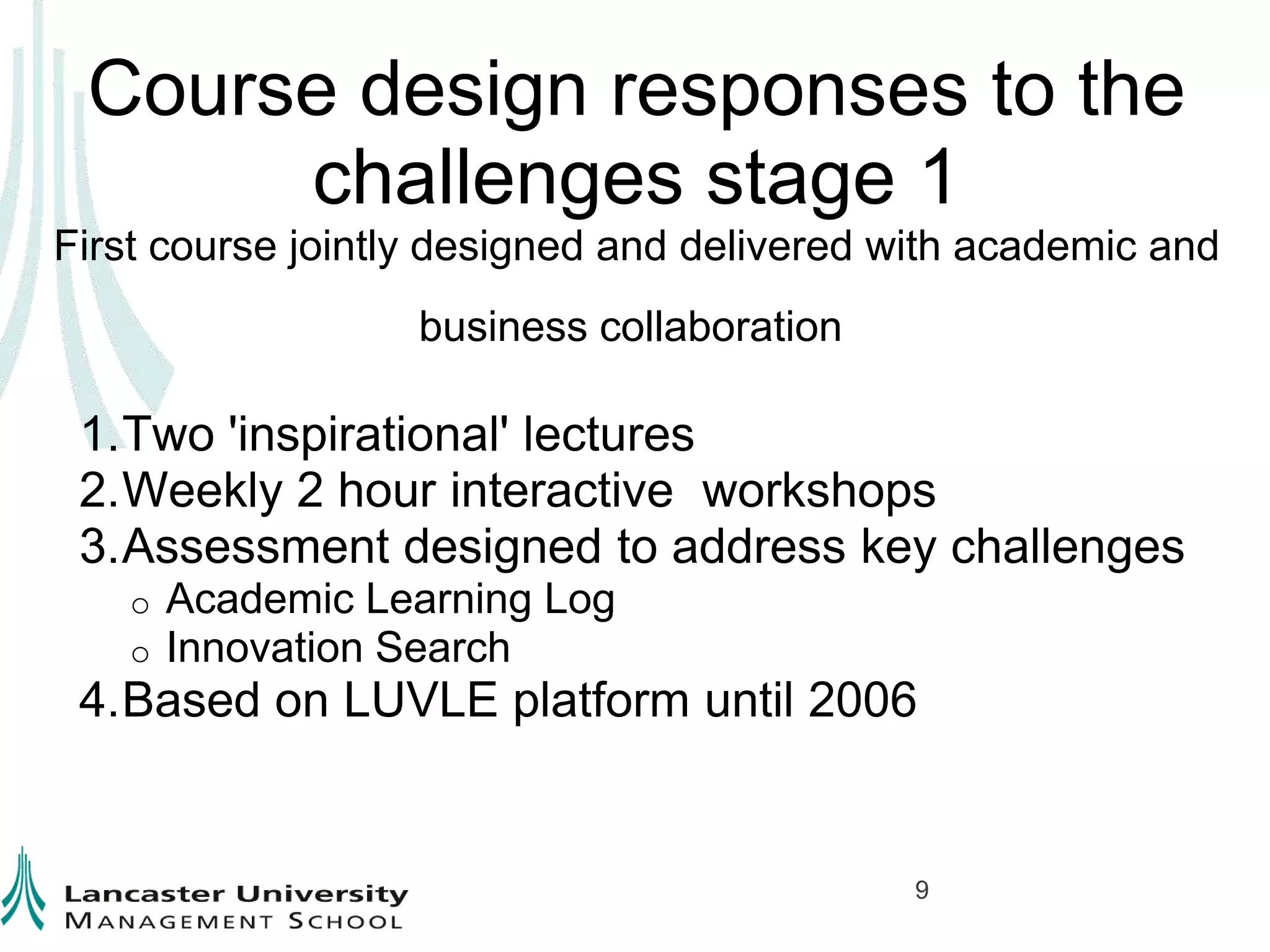
Course design responses to the challenges stage 1 First course jointly designed and delivered with academic and business collaboration  Two 'inspirational' lecturesWeekly 2 hour interactive  workshops  Assessment designed to address key challenges Academic Learning Log
Innovation SearchBased on LUVLE platform until 20069
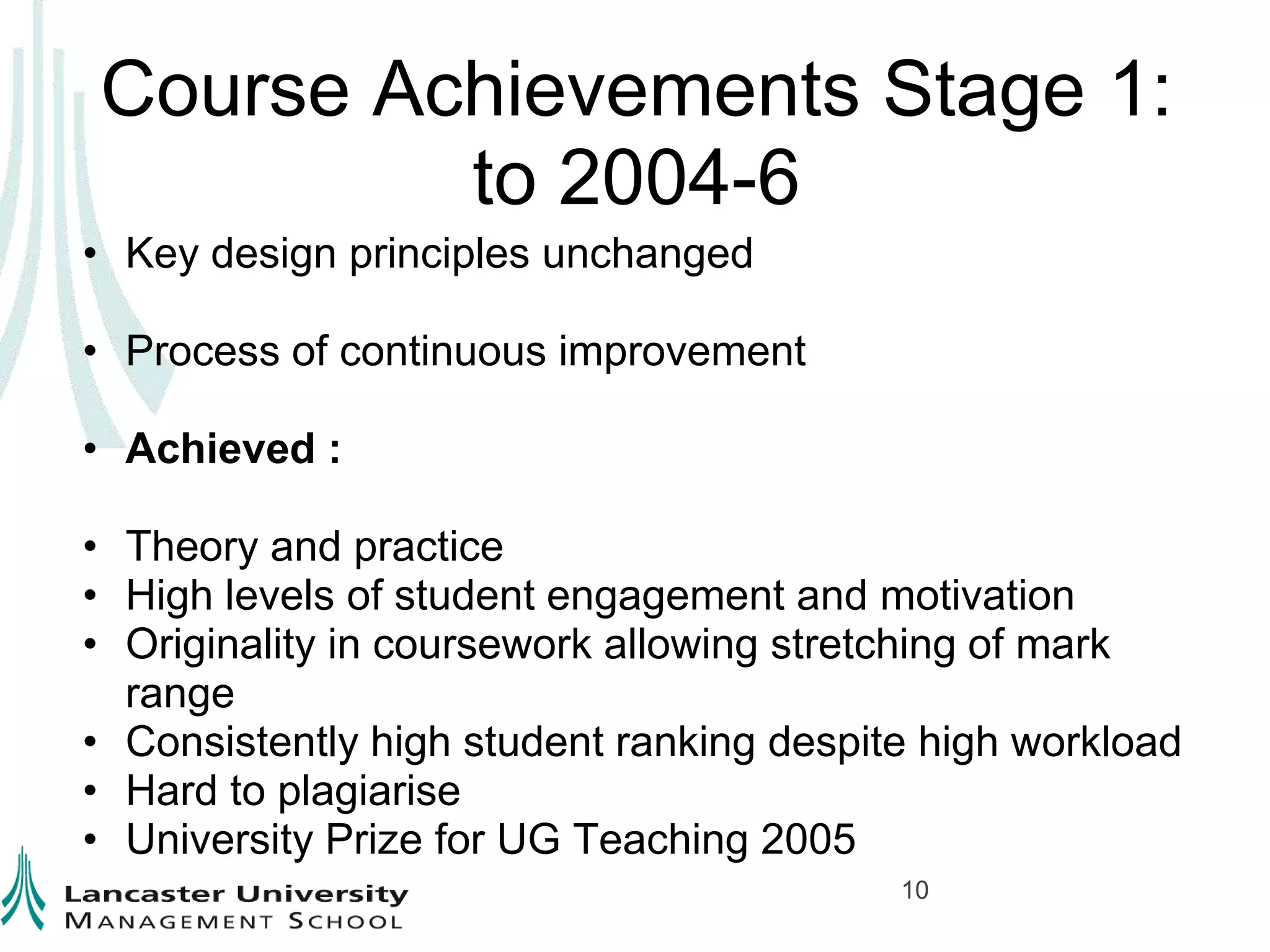
Course Achievements Stage 1: to 2004-6Key design principles unchanged
Process of continuous improvement
Achieved :

Collaborative learning and_teaching_in_innovat (1)

  • 1.
    Collaborative Learning andTeaching in InnovationMike Parsons and Mary Rose (IEED, Lancaster University Management School 28 February 2011Hull University Business School1
  • 2.
    OverviewAbout us Innovation Courses Learningand Teaching Challenges   Course Design and Evolution  Collaborative practices and processes2
  • 3.
  • 4.
    We represent a‘new combination’
  • 5.
    Mike Parsons –businessman,Karrimor, OMM Ltd, Innovator in Residence, IEED
  • 6.
    Mary Rose, academic,business historian
  • 7.
    Invisible on Everest: Innovation and the Gear Makers (2003)
  • 8.
    Innovation a resultnot an objective 3
  • 9.
    Beyond Invisible onEverestShared knowledge and trust
  • 10.
  • 11.
  • 12.
  • 13.
    A  OMM Ltda business start-up 2005
  • 14.
  • 15.
    Innovation Course StartingPointLaunched October 2004 5
  • 16.
    Teaching and LearningChallenges identified 2004How to set current innovation and management practices alongside theoretical analysisDeveloping critical analytical skill relating to the business pressMotivation80/20 rulePlagiarism6
  • 17.
    Philosophy and pedagogy:where business, academia and technology meet (1)   Mary : 'Past experience with Econ 120 showed that combining online materials, interactive workshops and a learning log was inspirational for both students and staff'7
  • 18.
    Philosophy and pedagogy:where business, academia and technology meet (2)Mike : “Mary agreed to my proposal that I treat the students as I would employees during an extensive period of management change."8
  • 19.
    Course design responsesto the challenges stage 1 First course jointly designed and delivered with academic and business collaboration  Two 'inspirational' lecturesWeekly 2 hour interactive  workshops  Assessment designed to address key challenges Academic Learning Log
  • 20.
    Innovation SearchBased onLUVLE platform until 20069
  • 21.
    Course Achievements Stage1: to 2004-6Key design principles unchanged
  • 22.
  • 23.
  • 24.
  • 25.
    High levels ofstudent engagement and motivation
  • 26.
    Originality in courseworkallowing stretching of mark range
  • 27.
    Consistently high studentranking despite high workload 
  • 28.
  • 29.
    University Prize forUG Teaching 200510
  • 30.
    Course achievements Stage1:Continuing Challenges in 2006: How to achieve collaboration?Assessment was individual but with associated group working. 
  • 31.
    How to achieveteam working?
  • 32.
    How to storeInnovation Search? 
  • 33.
    Shift from LUVLEto SAKAI – opened up opportunities and brought unpredicted benefits 11
  • 34.
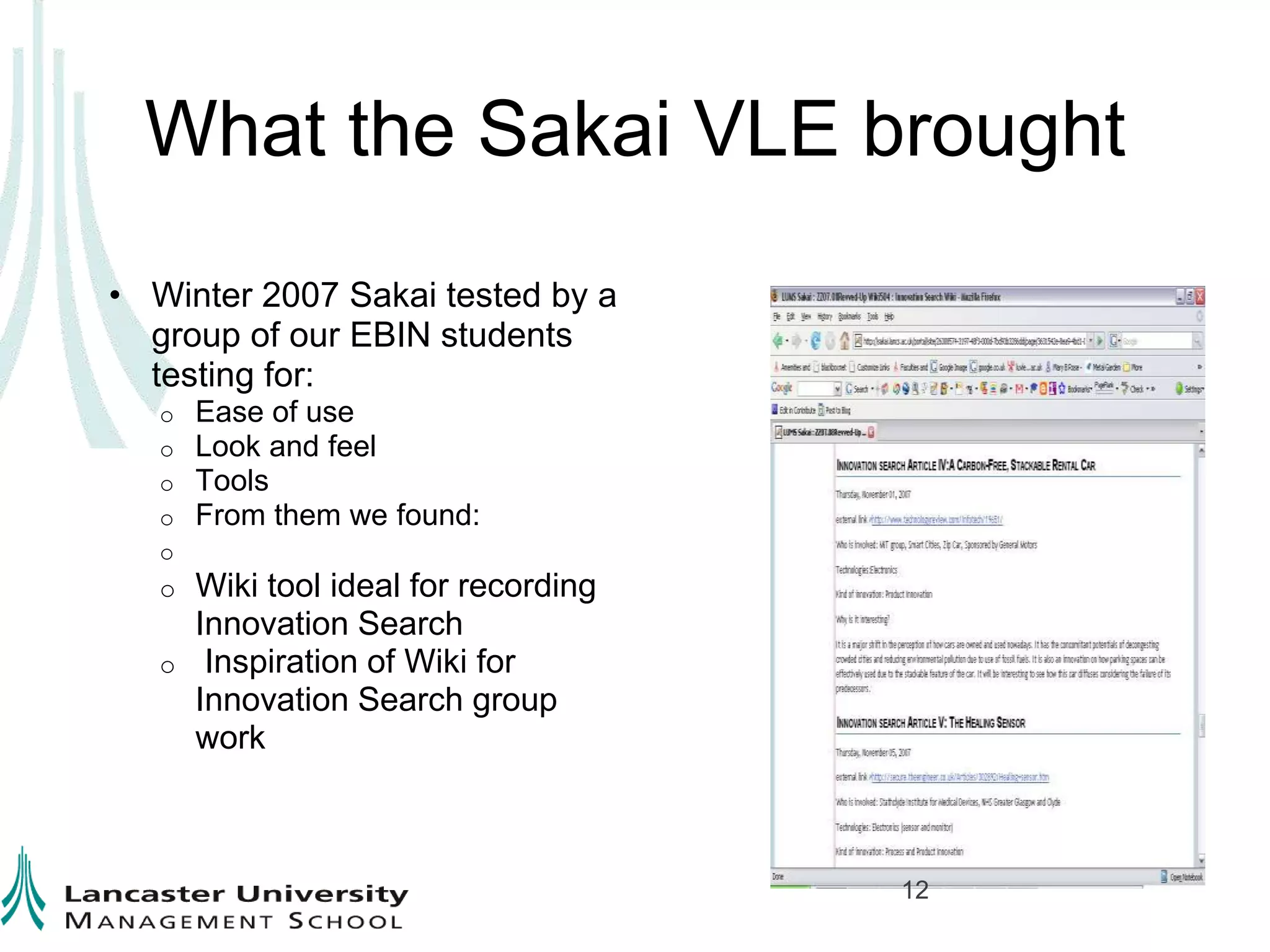
    What the SakaiVLE broughtWinter 2007 Sakai tested by a group of our EBIN students testing for: 
  • 35.
  • 36.
  • 37.
  • 38.
    From them wefound:  
  • 39.
  • 40.
    Wiki tool idealfor recording Innovation Search
  • 41.
     Inspiration of Wikifor Innovation Search group work12
  • 42.
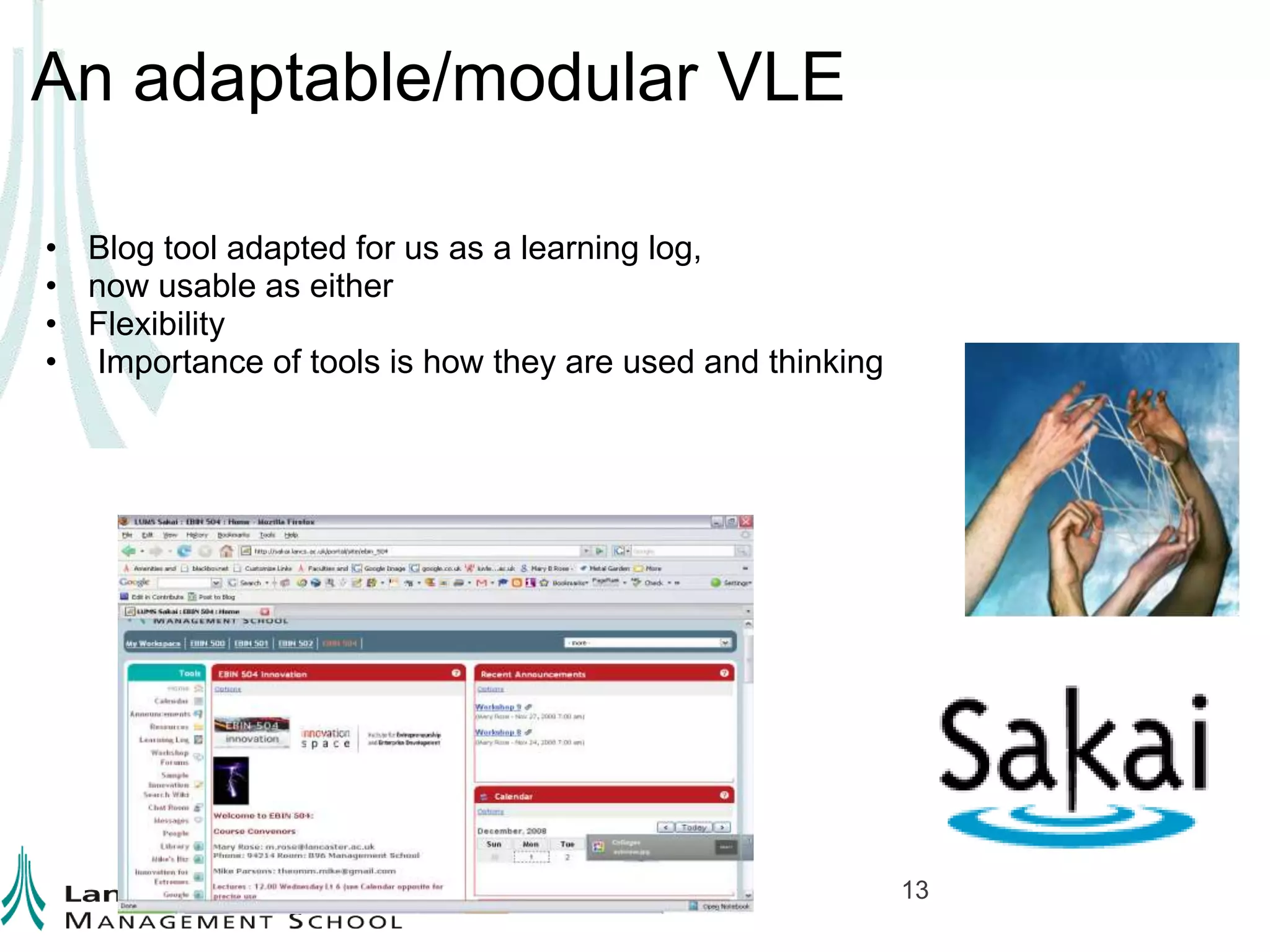
    An adaptable/modular VLEBlogtool adapted for us as a learning log,  
  • 43.
  • 44.
  • 45.
     Importance of toolsis how they are used and thinking         13
  • 46.
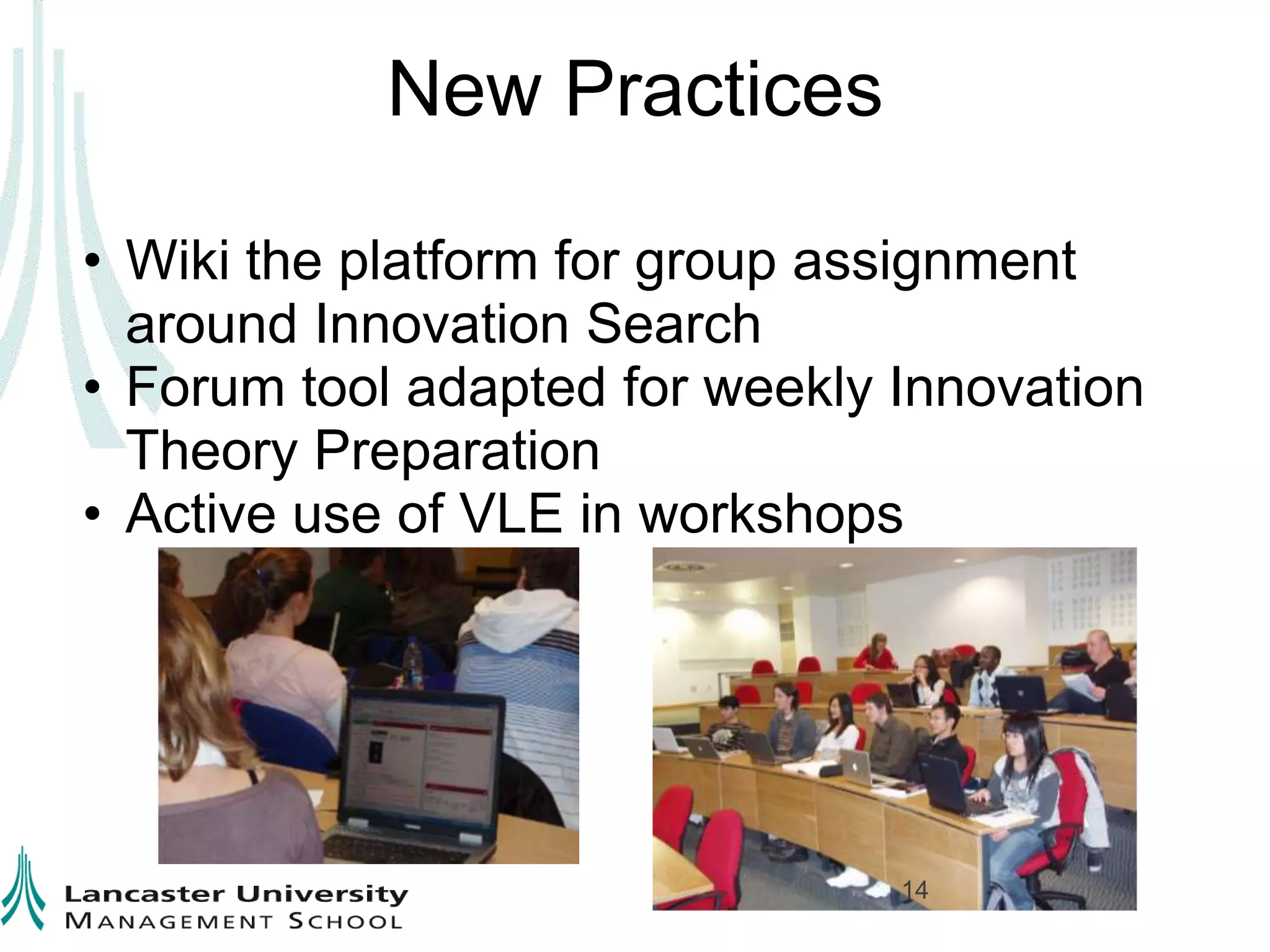
    New PracticesWiki theplatform for group assignment around Innovation Search
  • 47.
    Forum tool adaptedfor weekly Innovation Theory Preparation  
  • 48.
    Active use ofVLE in workshops14
  • 49.
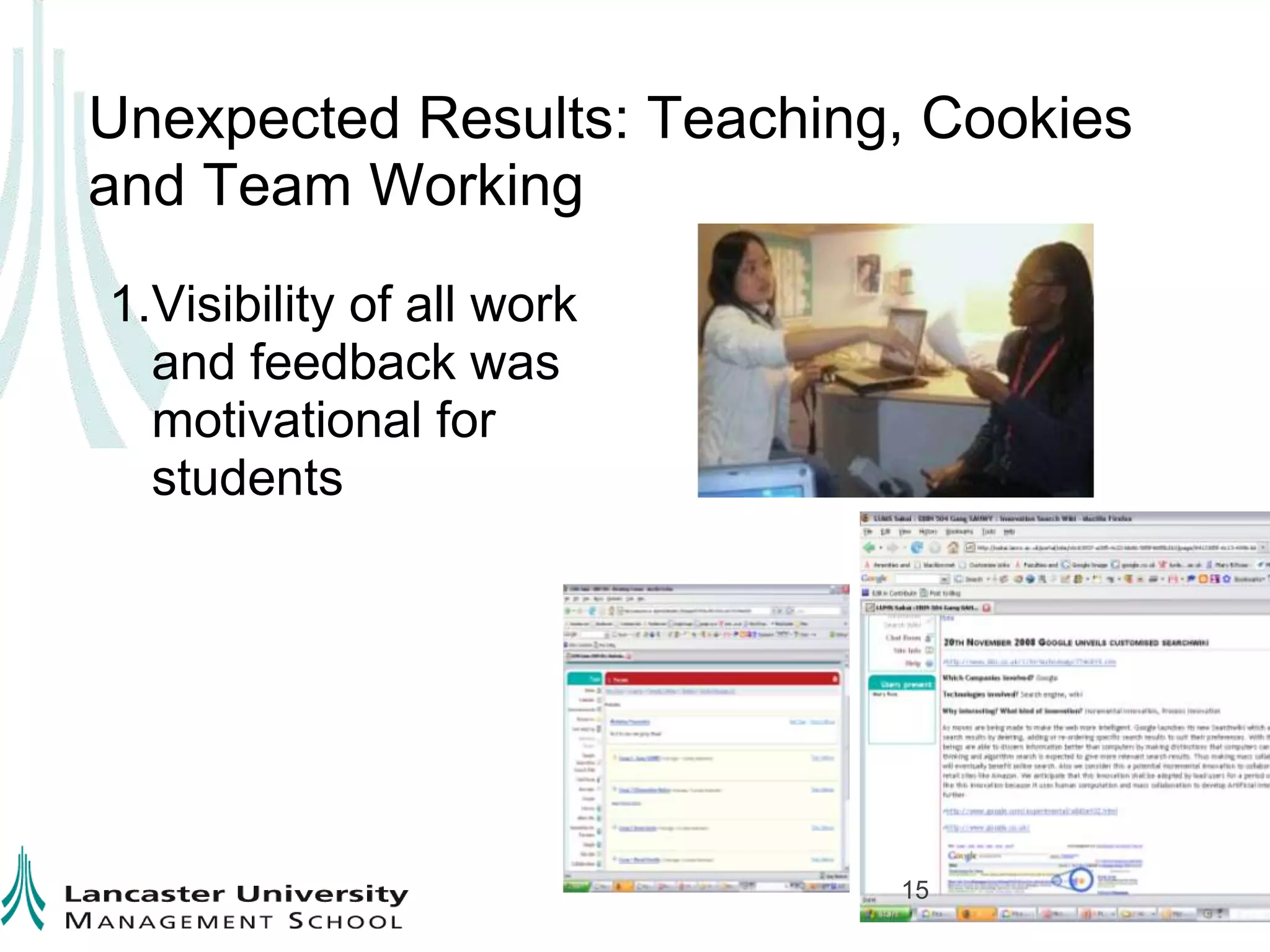
    Unexpected Results: Teaching,Cookies and Team WorkingVisibility of all work and feedback was motivational for students15
  • 50.
  • 51.
  • 52.
  • 53.
  • 54.
    Team working  3. Recognition system beyond formal assessment §The Cookies!  4. Motivational for staff    5. All core design elements remain  16
  • 55.
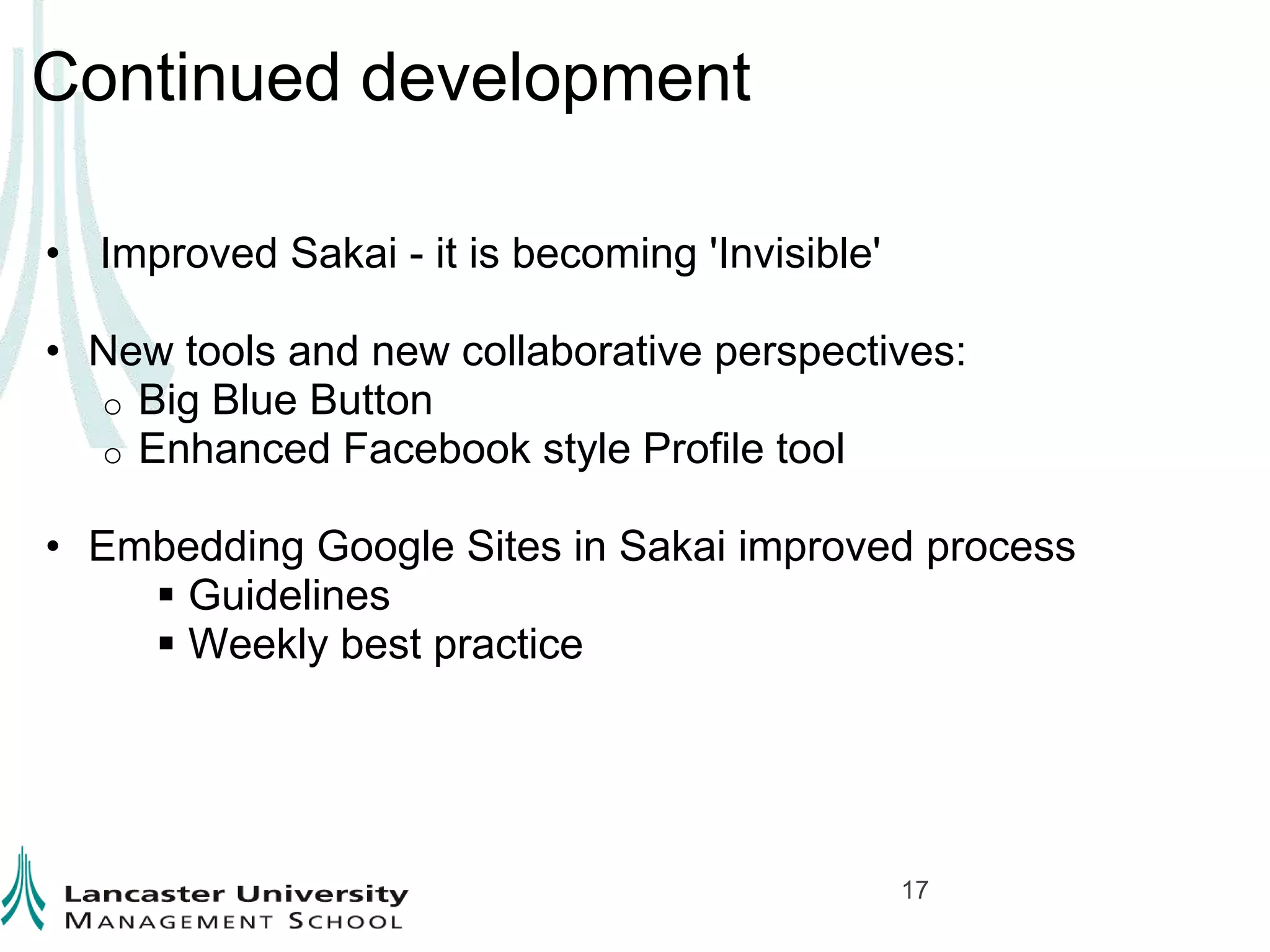
    Continued development Improved Sakai- it is becoming 'Invisible' New tools and new collaborative perspectives: 
  • 56.
  • 57.
  • 58.
    Embedding Google Sitesin Sakai improved process
  • 59.
  • 60.
  • 61.
  • 62.
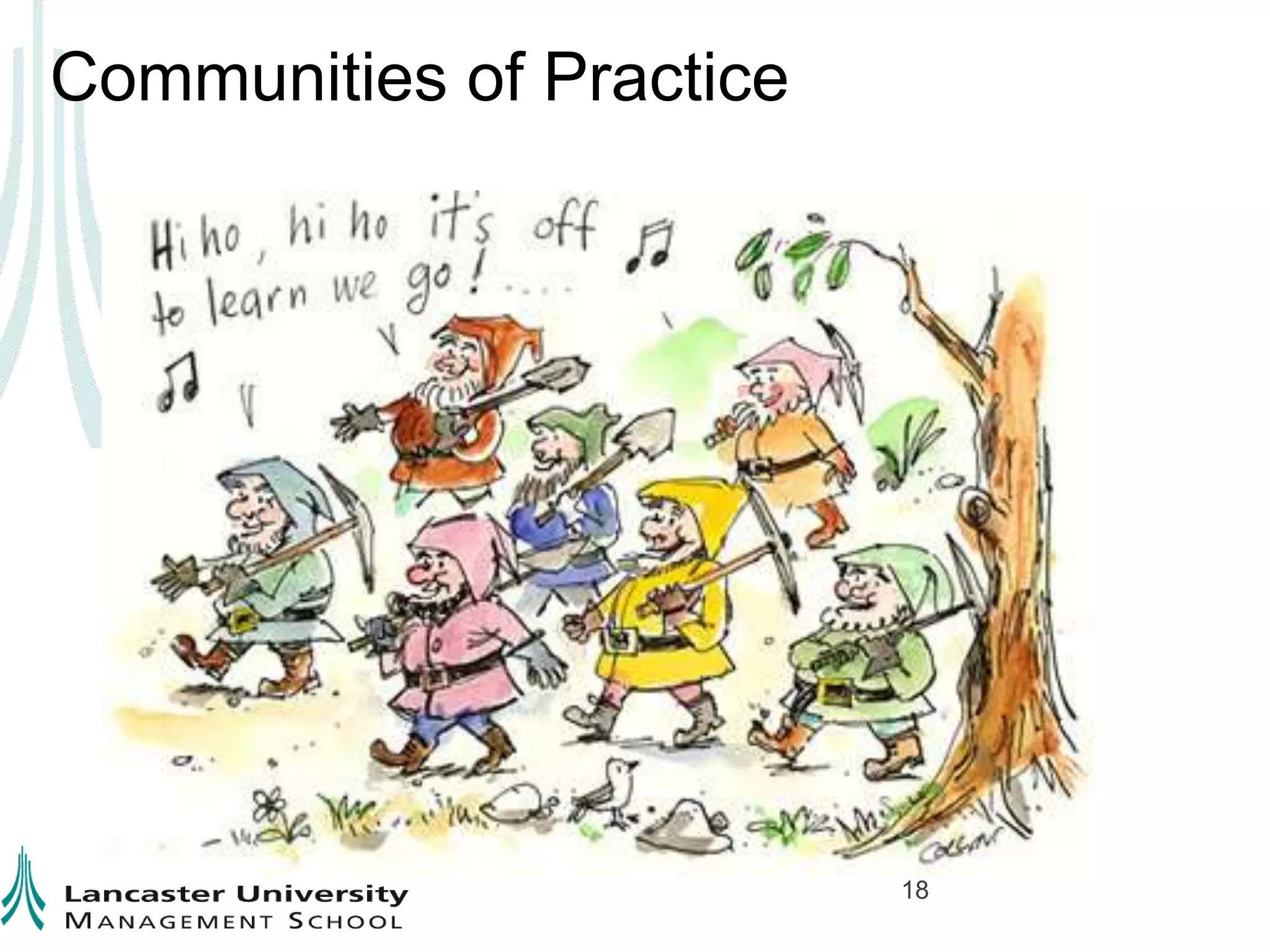
    How is thecommunity of practice built ? 1. Top Tips from past students: Film clip from 2008 students Film clip from 2009 Students about their experience  Film clip from from2010 Learning Log 2. Course alumni return3. Intensity of experience19
  • 63.
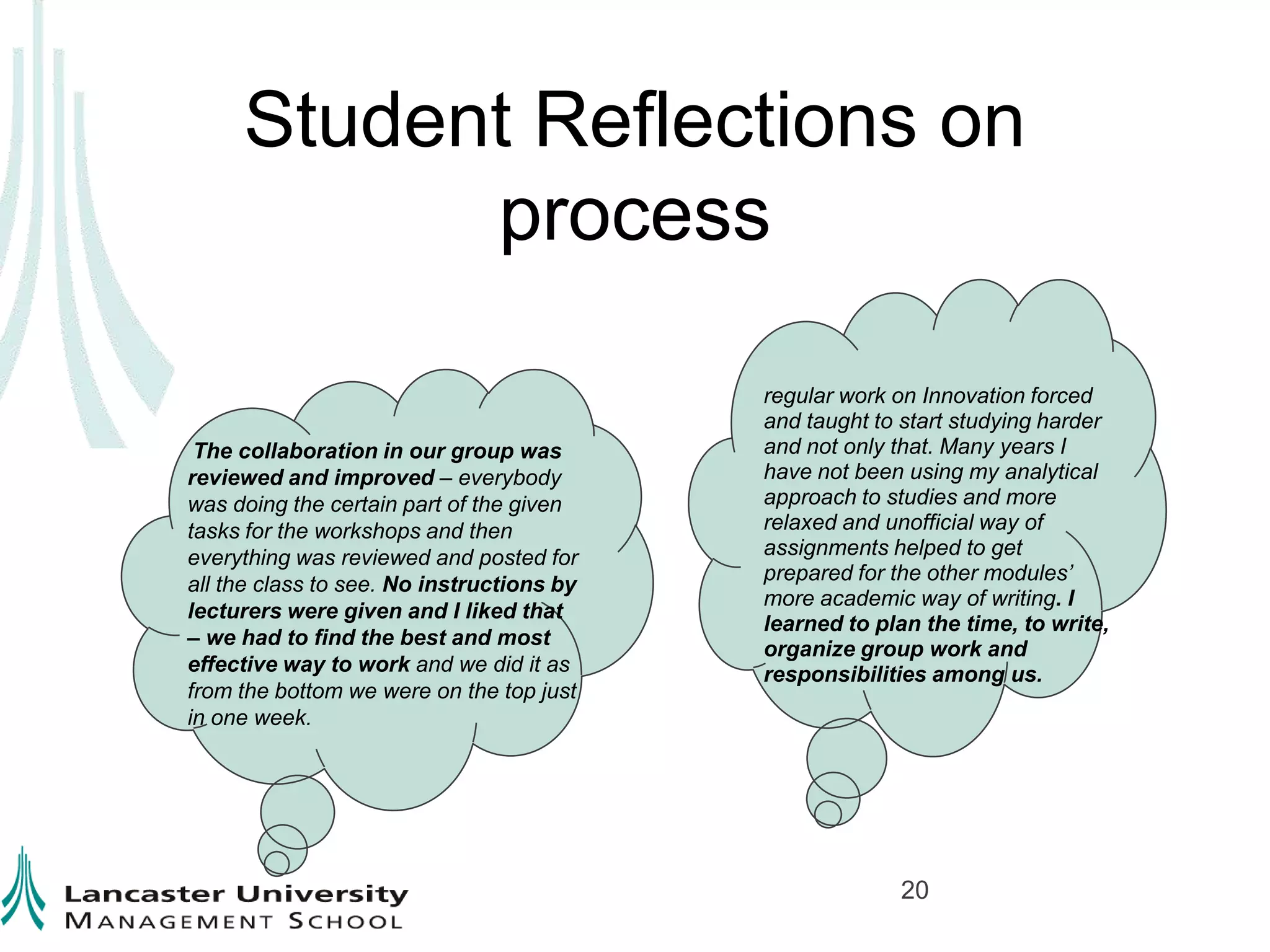
    Student Reflections onprocessregular work on Innovation forced and taught to start studying harder and not only that. Many years I have not been using my analytical approach to studies and more relaxed and unofficial way of assignments helped to get prepared for the other modules’ more academic way of writing. I learned to plan the time, to write, organize group work and responsibilities among us.The collaboration in our group was reviewed and improved – everybody was doing the certain part of the given tasks for the workshops and then everything was reviewed and posted for all the class to see. No instructions by lecturers were given and I liked that – we had to find the best and most effective way to work and we did it as from the bottom we were on the top just in one week.20
  • 64.
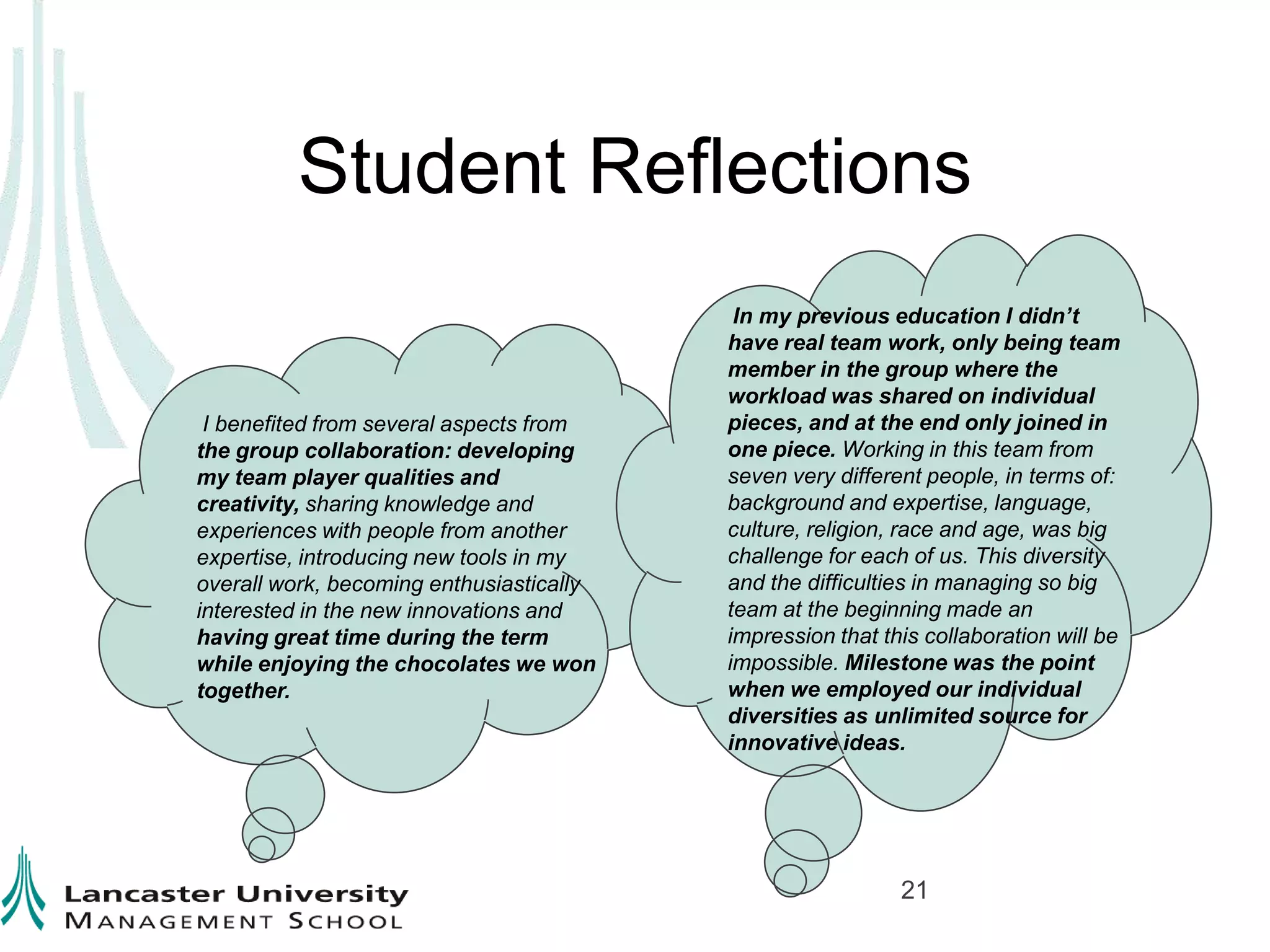
    Student ReflectionsIn myprevious education I didn’t have real team work, only being team member in the group where the workload was shared on individual pieces, and at the end only joined in one piece. Working in this team from seven very different people, in terms of: background and expertise, language, culture, religion, race and age, was big challenge for each of us. This diversity and the difficulties in managing so big team at the beginning made an impression that this collaboration will be impossible. Milestone was the point when we employed our individual diversities as unlimited source for innovative ideas.  I benefited from several aspects from the group collaboration: developing my team player qualities and creativity, sharing knowledge and experiences with people from another expertise, introducing new tools in my overall work, becoming enthusiastically interested in the new innovations and having great time during the term while enjoying the chocolates we won together.21
  • 65.
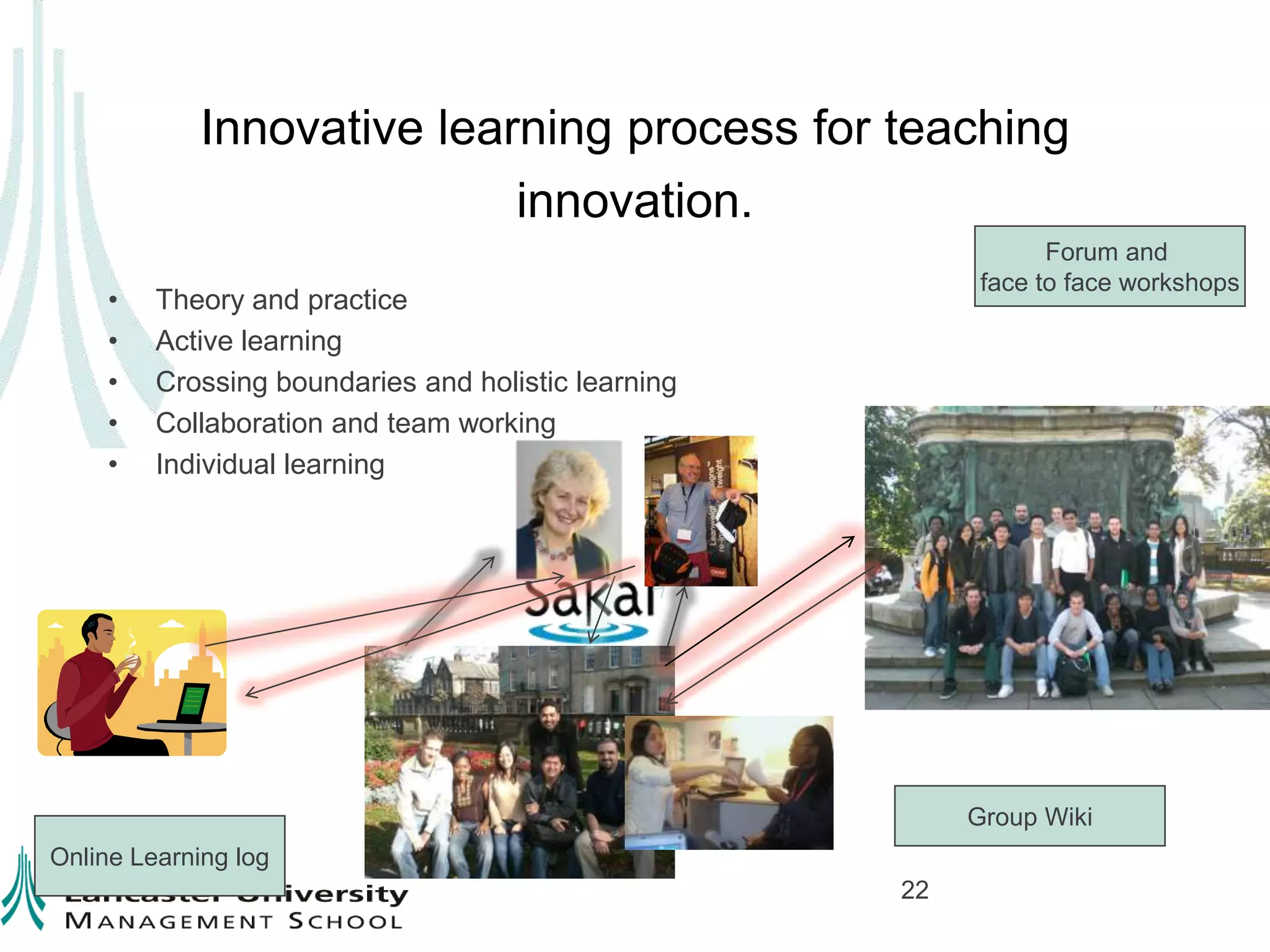
    Innovative learning processfor teaching innovation.Theory and practiceActive learningCrossing boundaries and holistic learningCollaboration and team workingIndividual learningForum and face to face workshopsGroup WikiOnline Learning log22
  • 66.
    Final reflection onour collaborationEducation has spent 150 years widening access taking motivation as givenIndustry has spent 150 years focusing on motivation and neglecting training and educationIn this course combined academic/business collaboration has helped us remedy some of these issues.23