A Pragmatic Perspective on
Lithium Ion Batteries (LIBs)
從實用的觀點評估鋰電池研究近期的契機
Bing Hsieh
November, 2015
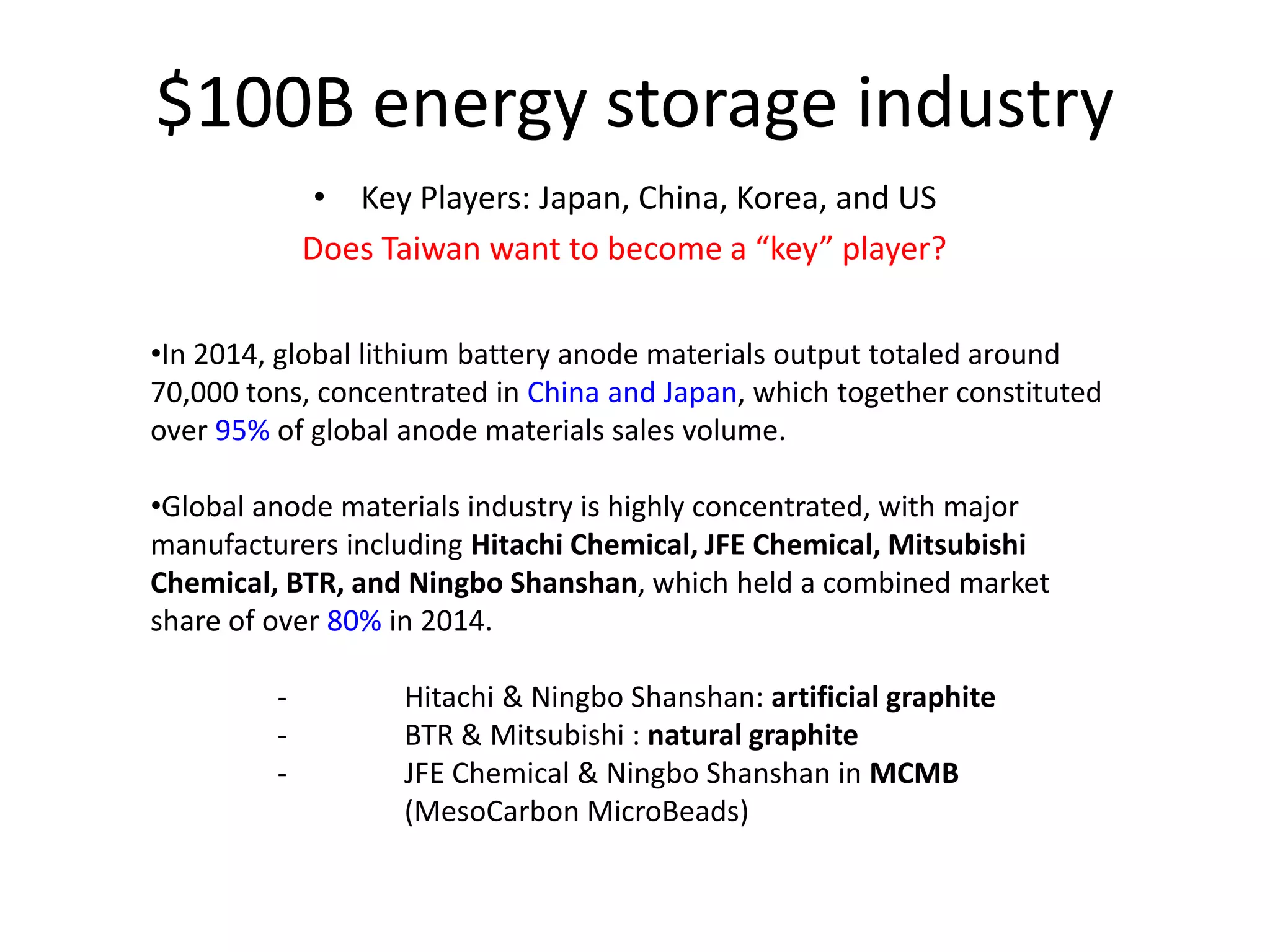
$100B energy storage industry
• Key Players: Japan, China, Korea, and US
Does Taiwan want to become a “key” player?
•In 2014, global lithium battery anode materials output totaled around
70,000 tons, concentrated in China and Japan, which together constituted
over 95% of global anode materials sales volume.
•Global anode materials industry is highly concentrated, with major
manufacturers including Hitachi Chemical, JFE Chemical, Mitsubishi
Chemical, BTR, and Ningbo Shanshan, which held a combined market
share of over 80% in 2014.
- Hitachi & Ningbo Shanshan: artificial graphite
- BTR & Mitsubishi : natural graphite
- JFE Chemical & Ningbo Shanshan in MCMB
(MesoCarbon MicroBeads)
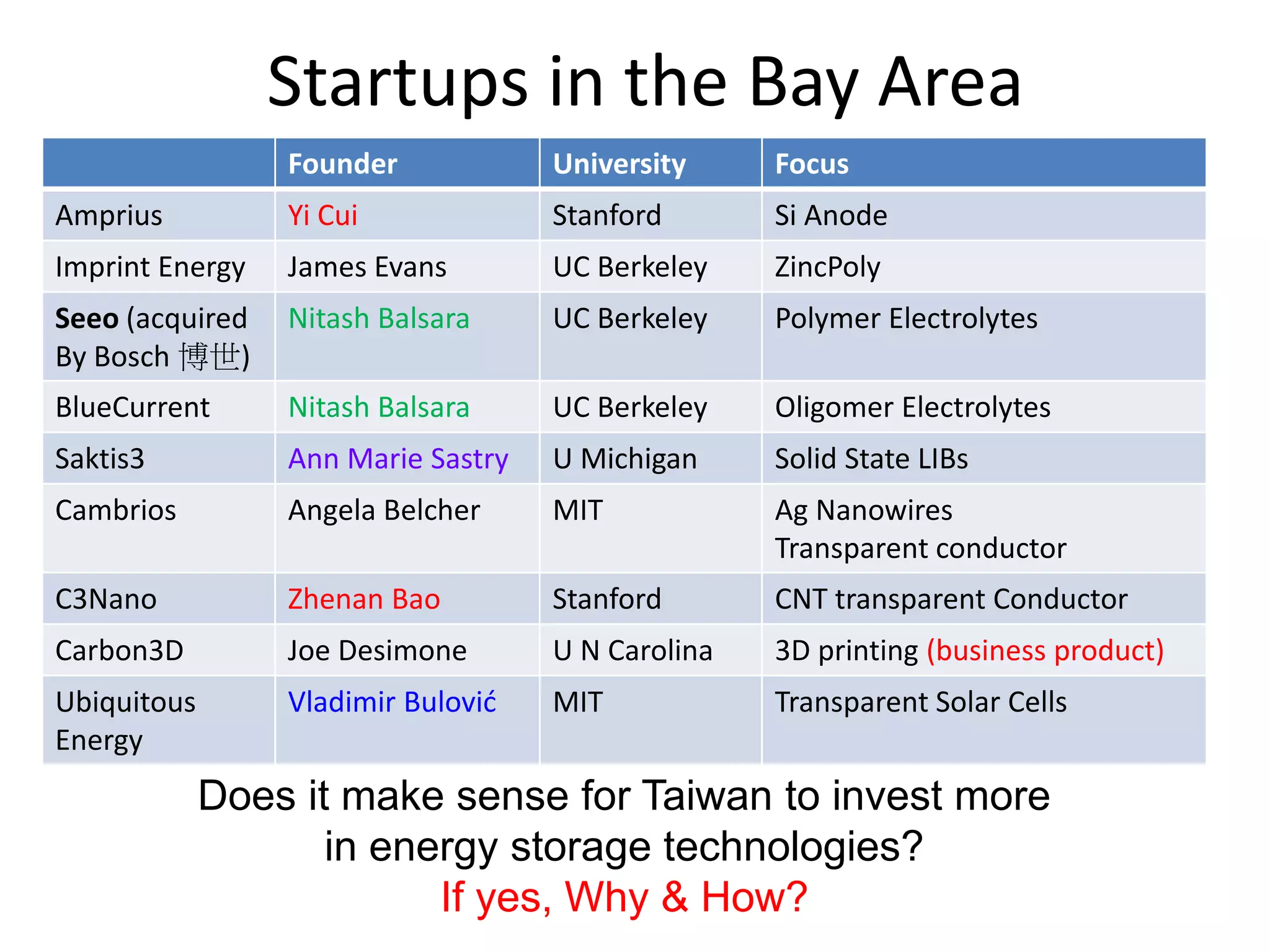
Startups in the Bay Area
Founder University Focus
Amprius Yi Cui Stanford Si Anode
Imprint Energy James Evans UC Berkeley ZincPoly
Seeo (acquired
By Bosch 博世)
Nitash Balsara UC Berkeley Polymer Electrolytes
BlueCurrent Nitash Balsara UC Berkeley Oligomer Electrolytes
Saktis3 Ann Marie Sastry U Michigan Solid State LIBs
Cambrios Angela Belcher MIT Ag Nanowires
Transparent conductor
C3Nano Zhenan Bao Stanford CNT transparent Conductor
Carbon3D Joe Desimone U N Carolina 3D printing (business product)
Ubiquitous
Energy
Vladimir Bulović MIT Transparent Solar Cells
Does it make sense for Taiwan to invest more
in energy storage technologies?
If yes, Why & How?
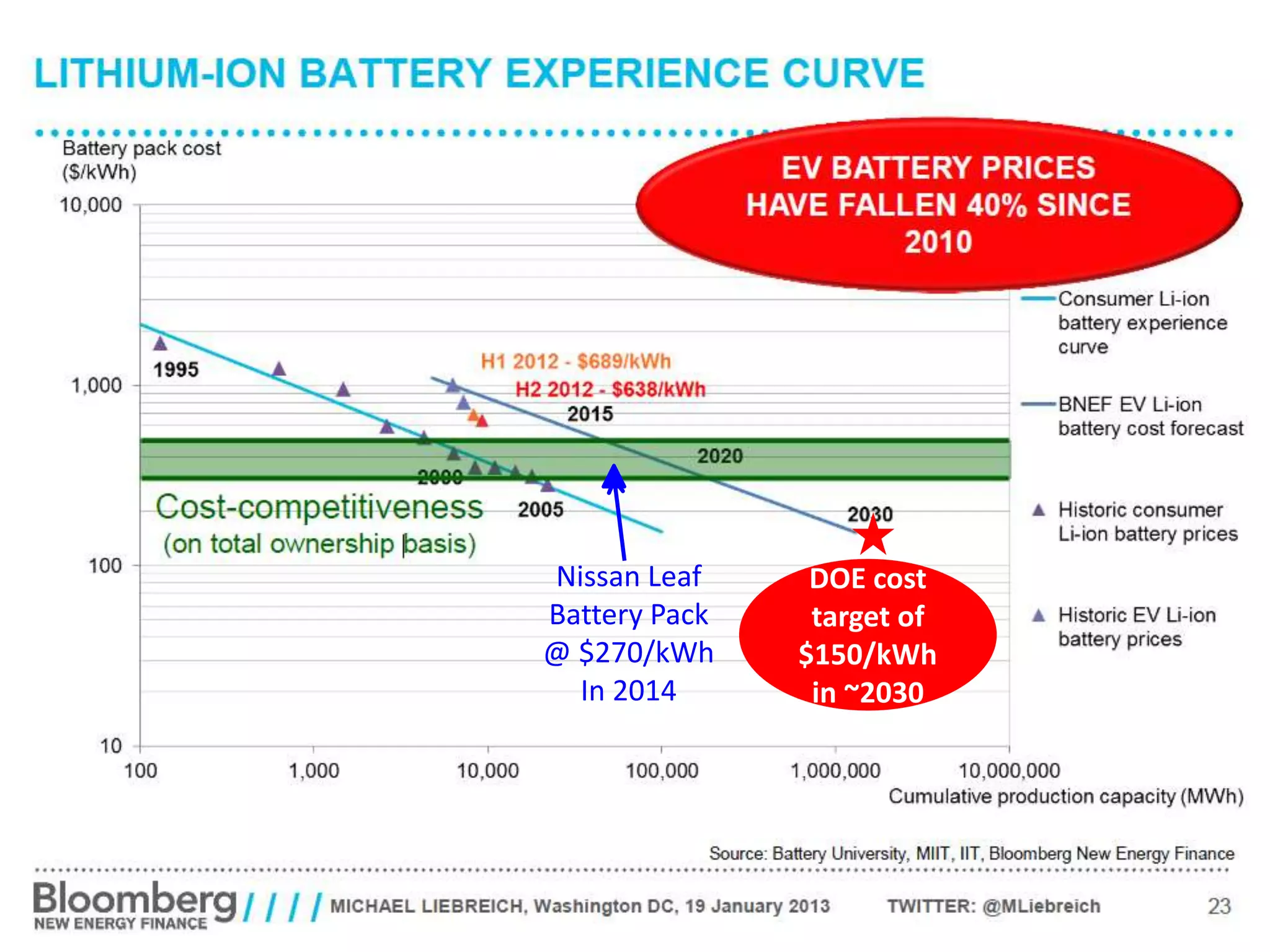
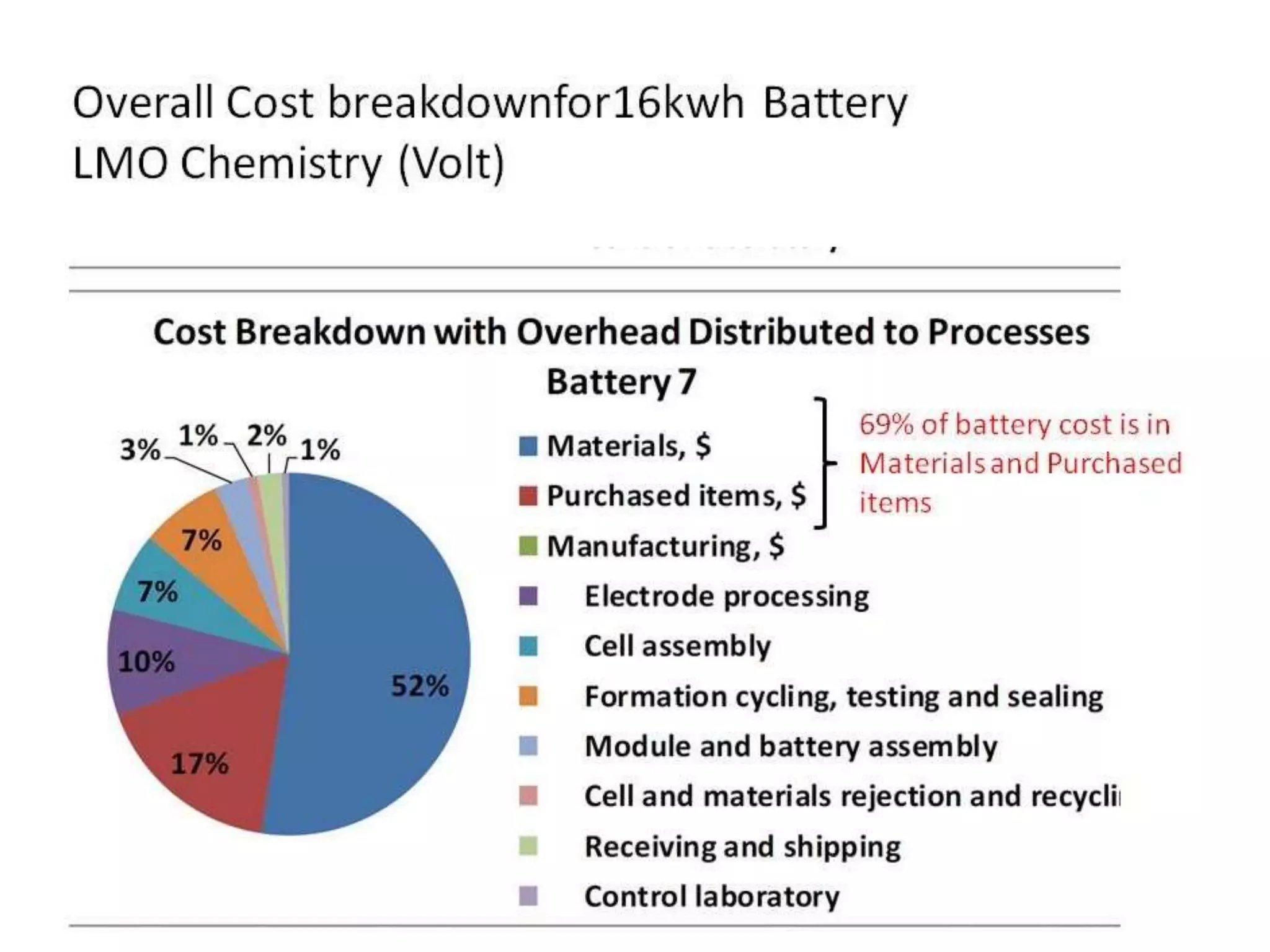
Cost of LIBs
DOE cost
target of
$150/kWh
in ~2030
Nissan Leaf
Battery Pack
@ $270/kWh
In 2014
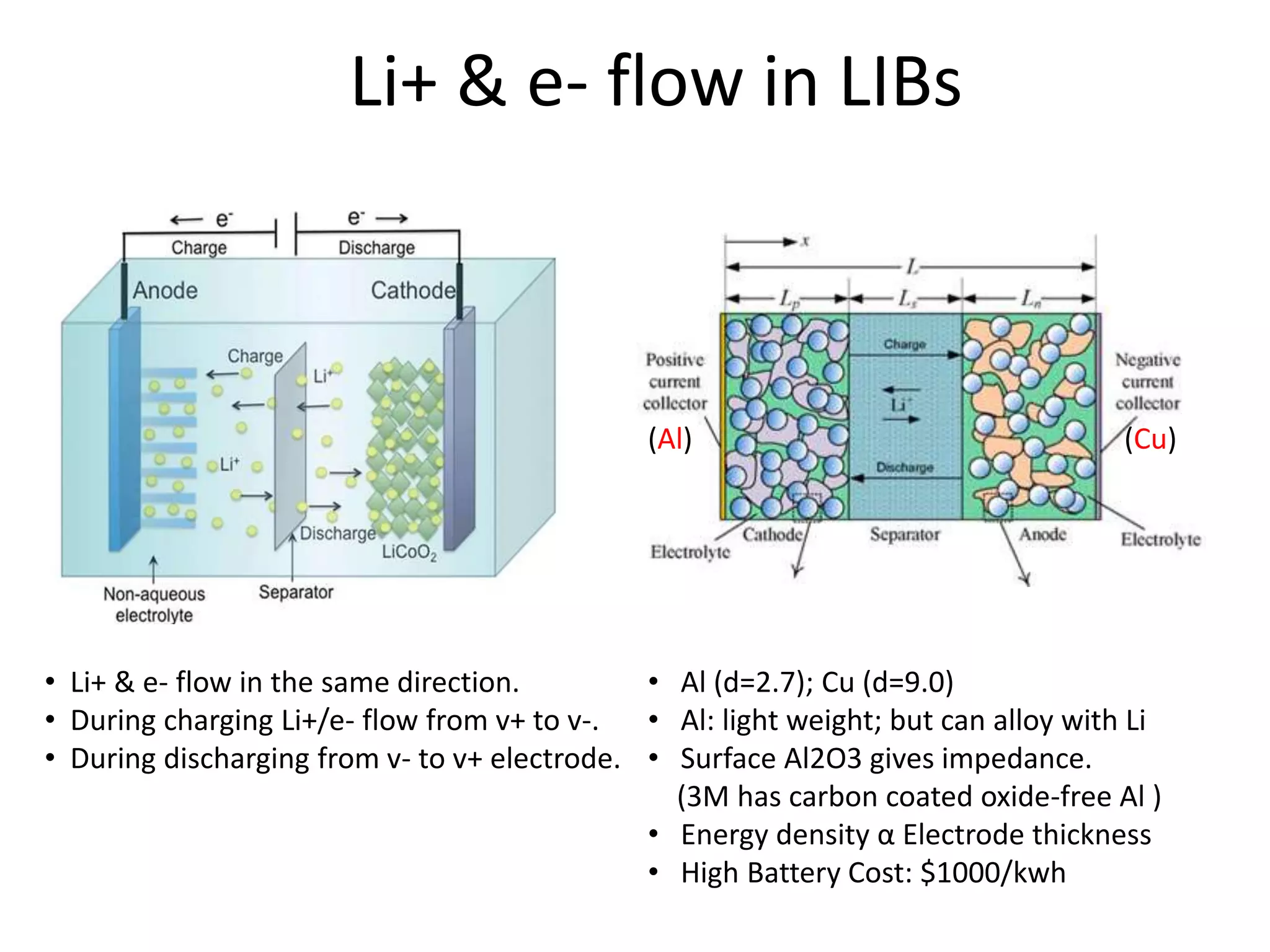
Li+ & e- flow in LIBs
• Li+ & e- flow in the same direction.
• During charging Li+/e- flow from v+ to v-.
• During discharging from v- to v+ electrode.
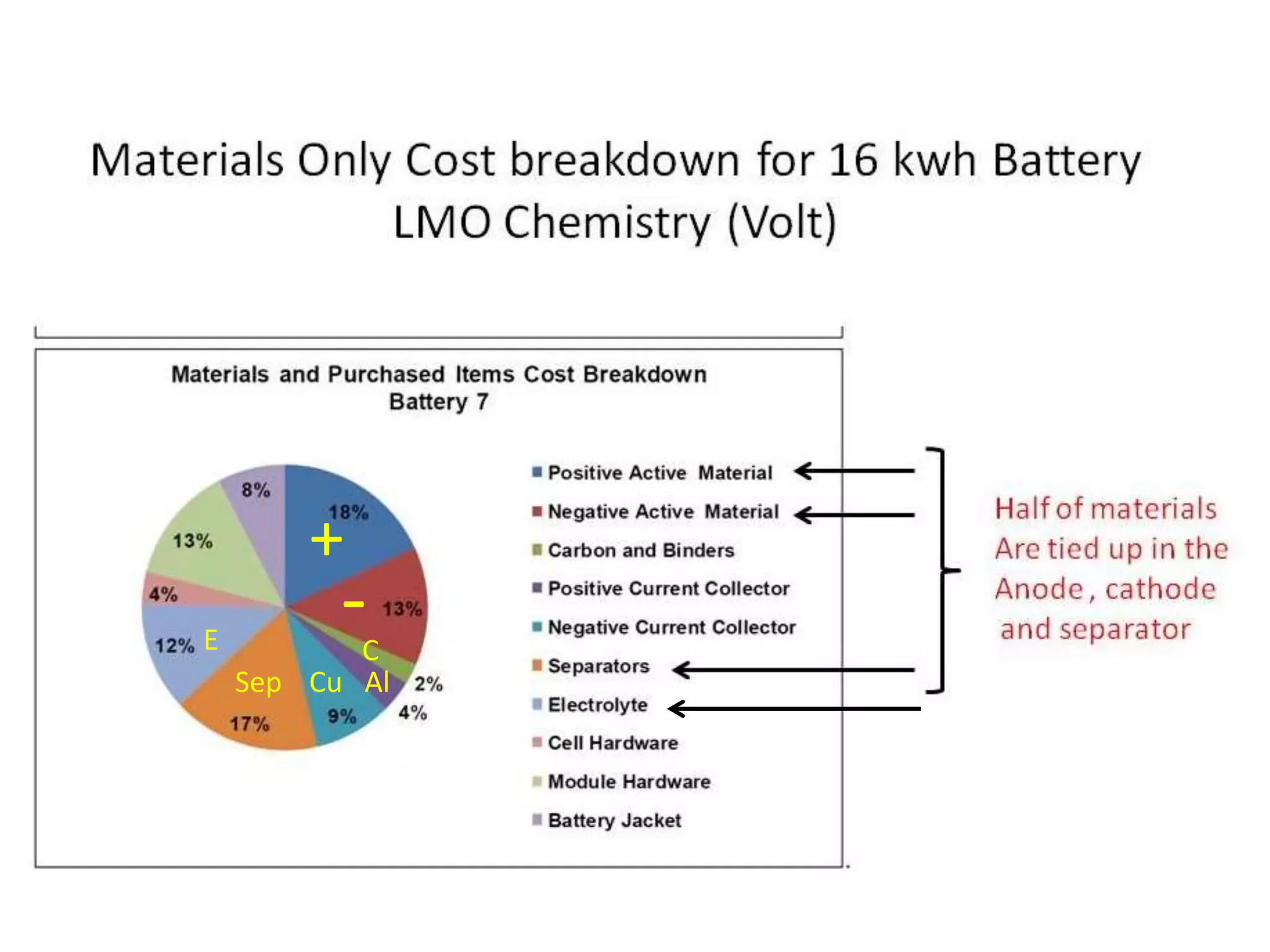
(Cu)(Al)
• Al (d=2.7); Cu (d=9.0)
• Al: light weight; but can alloy with Li
• Surface Al2O3 gives impedance.
(3M has carbon coated oxide-free Al )
• Energy density α Electrode thickness
• High Battery Cost: $1000/kwh
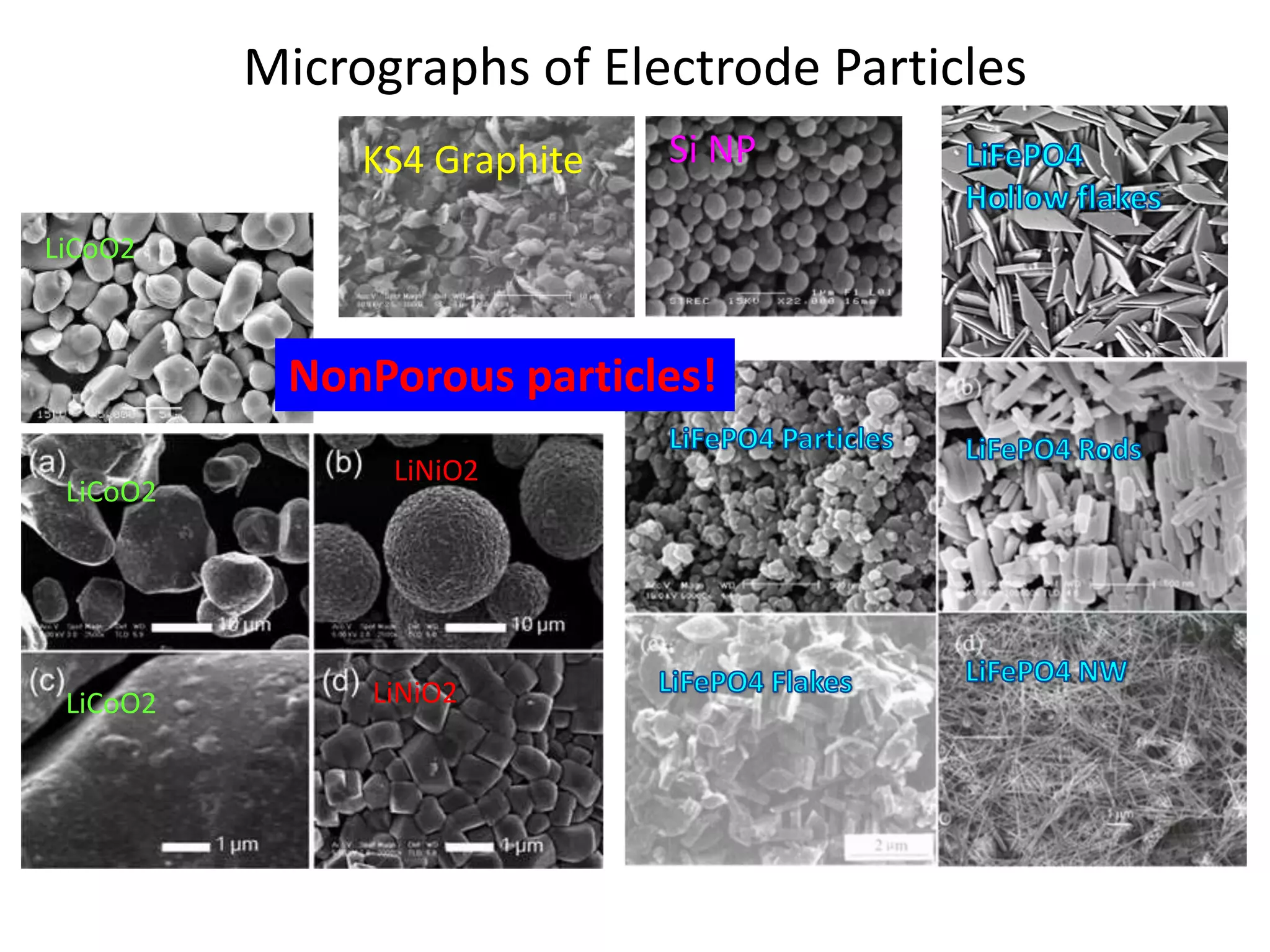
Micrographs of Electrode Particles
LiCoO2
LiCoO2
LiCoO2
LiNiO2
LiNiO2
KS4 Graphite Si NP
NonPorous particles!
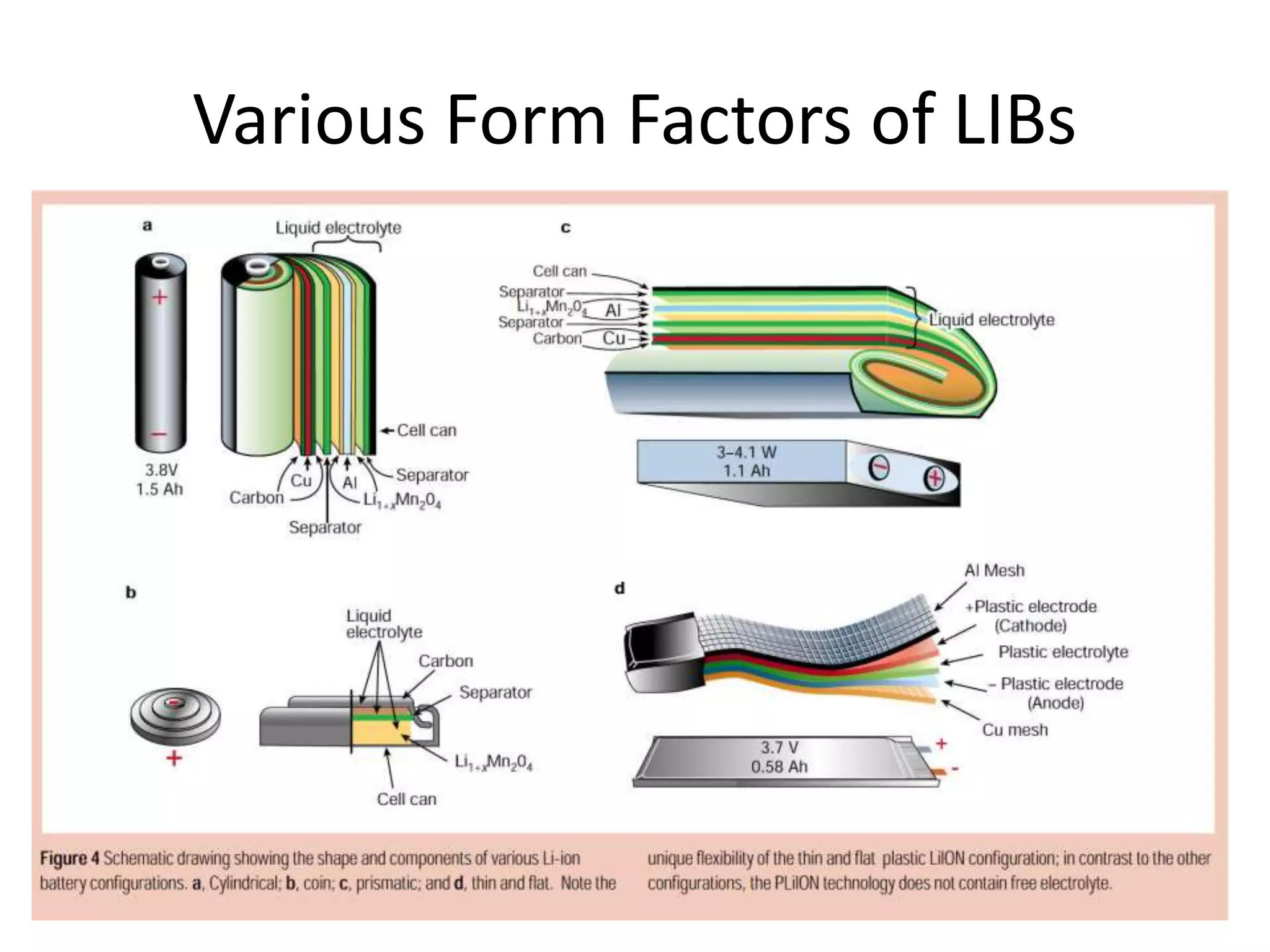
Various Form Factors of LIBs
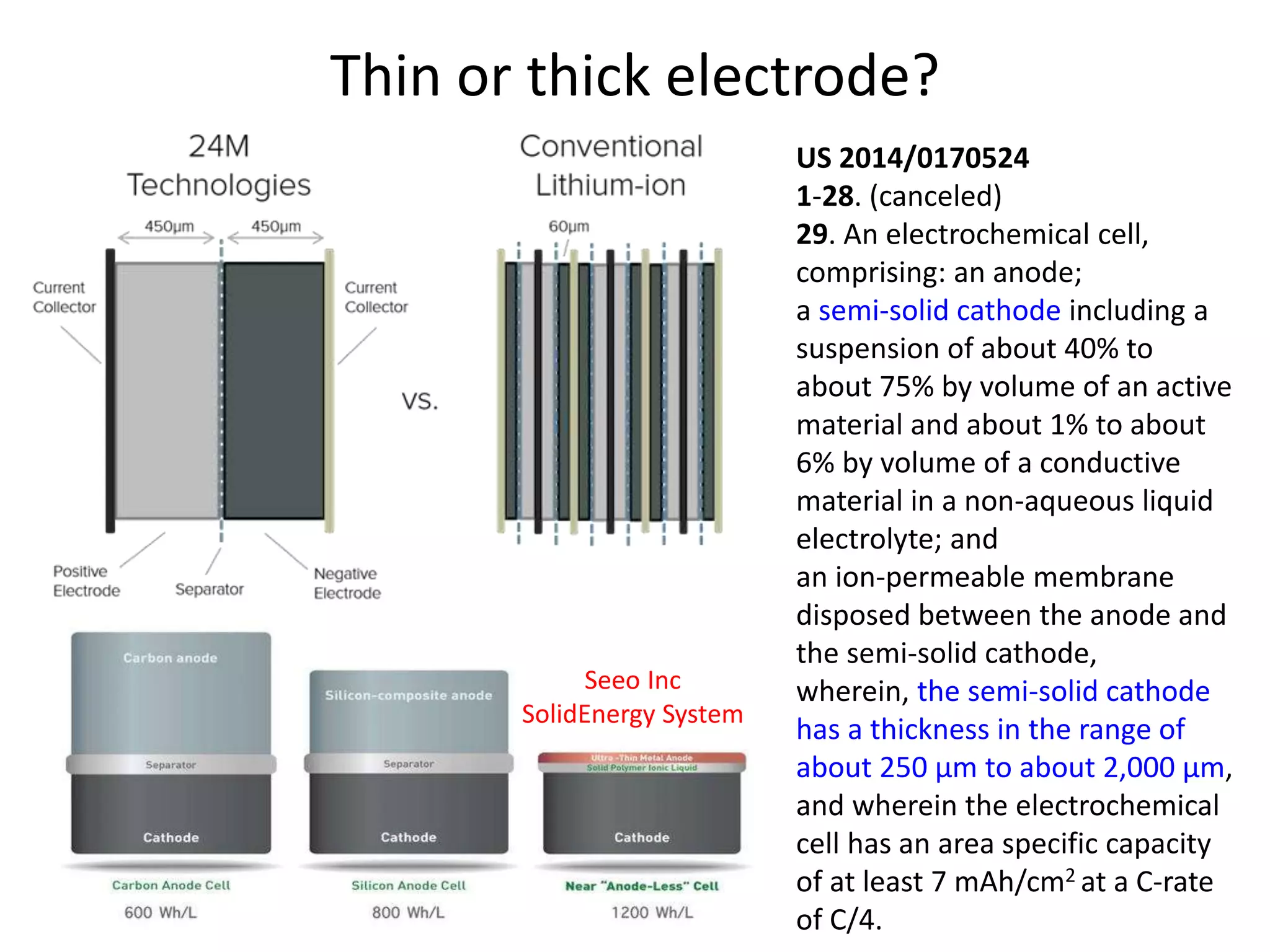
Thin or thick electrode?
Seeo Inc
SolidEnergy System
US 2014/0170524
1-28. (canceled)
29. An electrochemical cell,
comprising: an anode;
a semi-solid cathode including a
suspension of about 40% to
about 75% by volume of an active
material and about 1% to about
6% by volume of a conductive
material in a non-aqueous liquid
electrolyte; and
an ion-permeable membrane
disposed between the anode and
the semi-solid cathode,
wherein, the semi-solid cathode
has a thickness in the range of
about 250 μm to about 2,000 μm,
and wherein the electrochemical
cell has an area specific capacity
of at least 7 mAh/cm2 at a C-rate
of C/4.
+
-
Cu Al
C
Sep
E
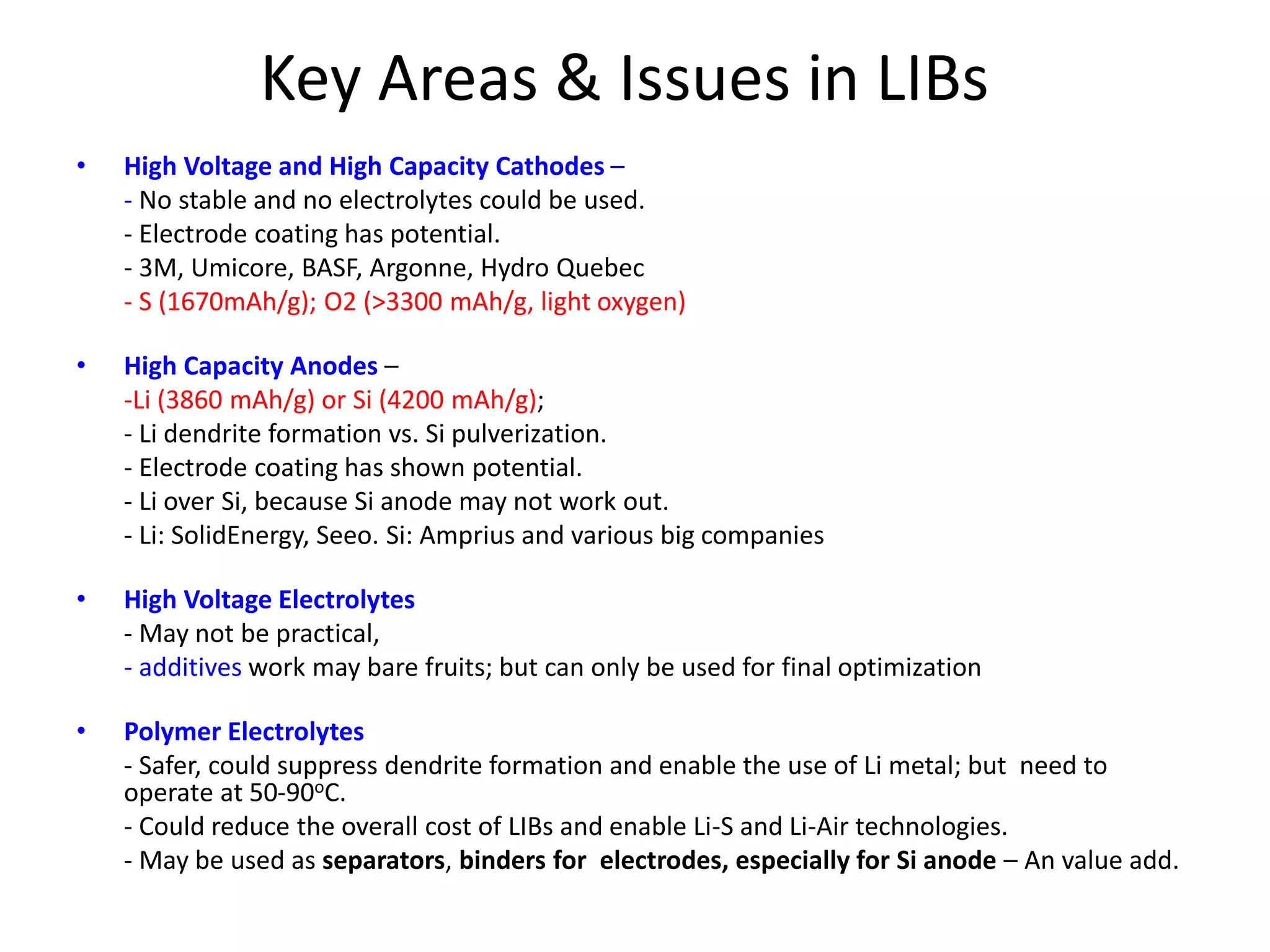
Key Areas & Issues in LIBs
• High Voltage and High Capacity Cathodes –
- No stable and no electrolytes could be used.
- Electrode coating has potential.
- 3M, Umicore, BASF, Argonne, Hydro Quebec
- S (1670mAh/g); O2 (>3300 mAh/g, light oxygen)
• High Capacity Anodes –
-Li (3860 mAh/g) or Si (4200 mAh/g);
- Li dendrite formation vs. Si pulverization.
- Electrode coating has shown potential.
- Li over Si, because Si anode may not work out.
- Li: SolidEnergy, Seeo. Si: Amprius and various big companies
• High Voltage Electrolytes
- May not be practical,
- additives work may bare fruits; but can only be used for final optimization
• Polymer Electrolytes
- Safer, could suppress dendrite formation and enable the use of Li metal; but need to
operate at 50-90oC.
- Could reduce the overall cost of LIBs and enable Li-S and Li-Air technologies.
- May be used as separators, binders for electrodes, especially for Si anode – An value add.
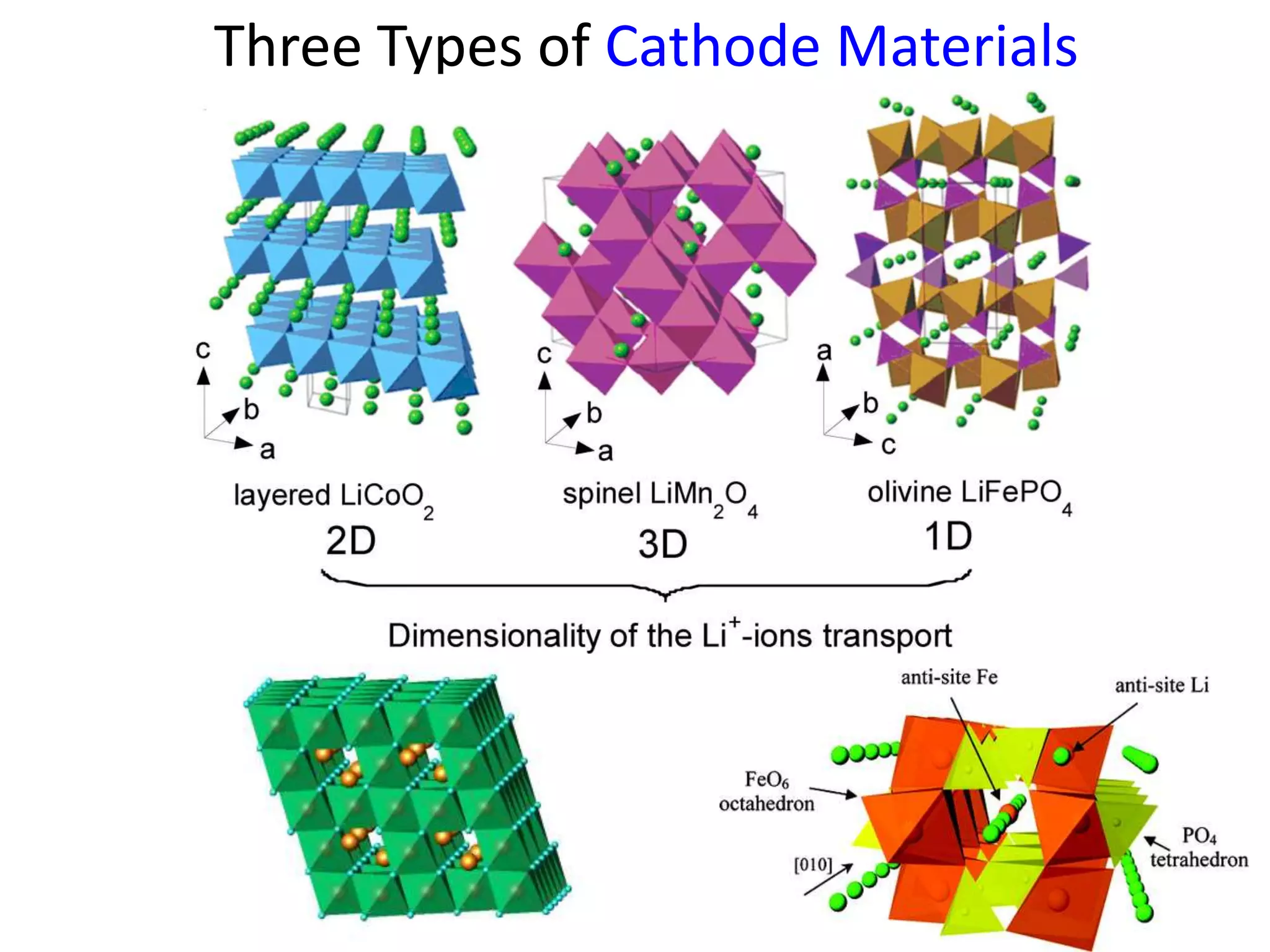
Three Types of Cathode Materials
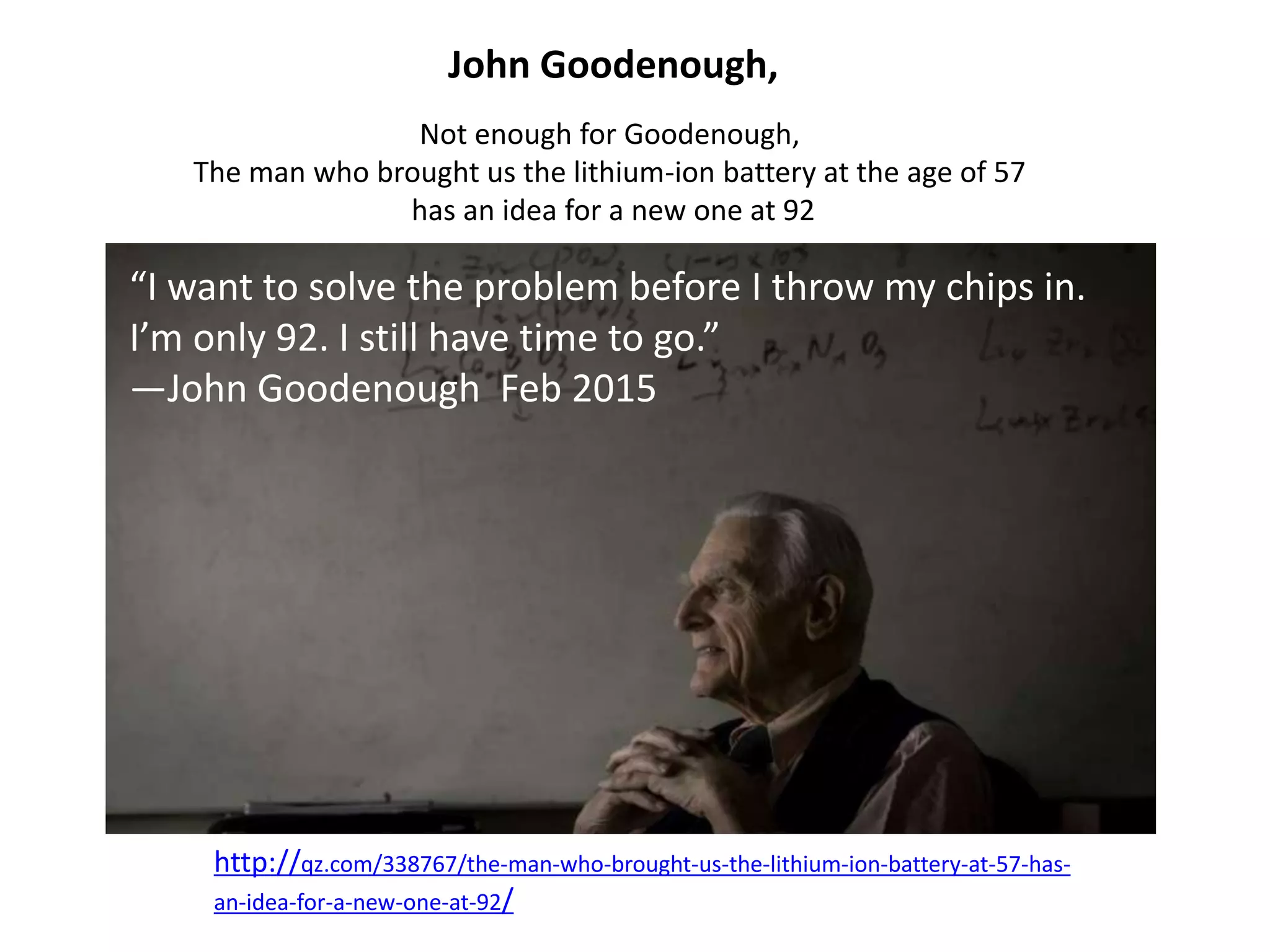
John Goodenough,
Not enough for Goodenough,
The man who brought us the lithium-ion battery at the age of 57
has an idea for a new one at 92
http://qz.com/338767/the-man-who-brought-us-the-lithium-ion-battery-at-57-has-
an-idea-for-a-new-one-at-92/
“I want to solve the problem before I throw my chips in.
I’m only 92. I still have time to go.”
—John Goodenough Feb 2015
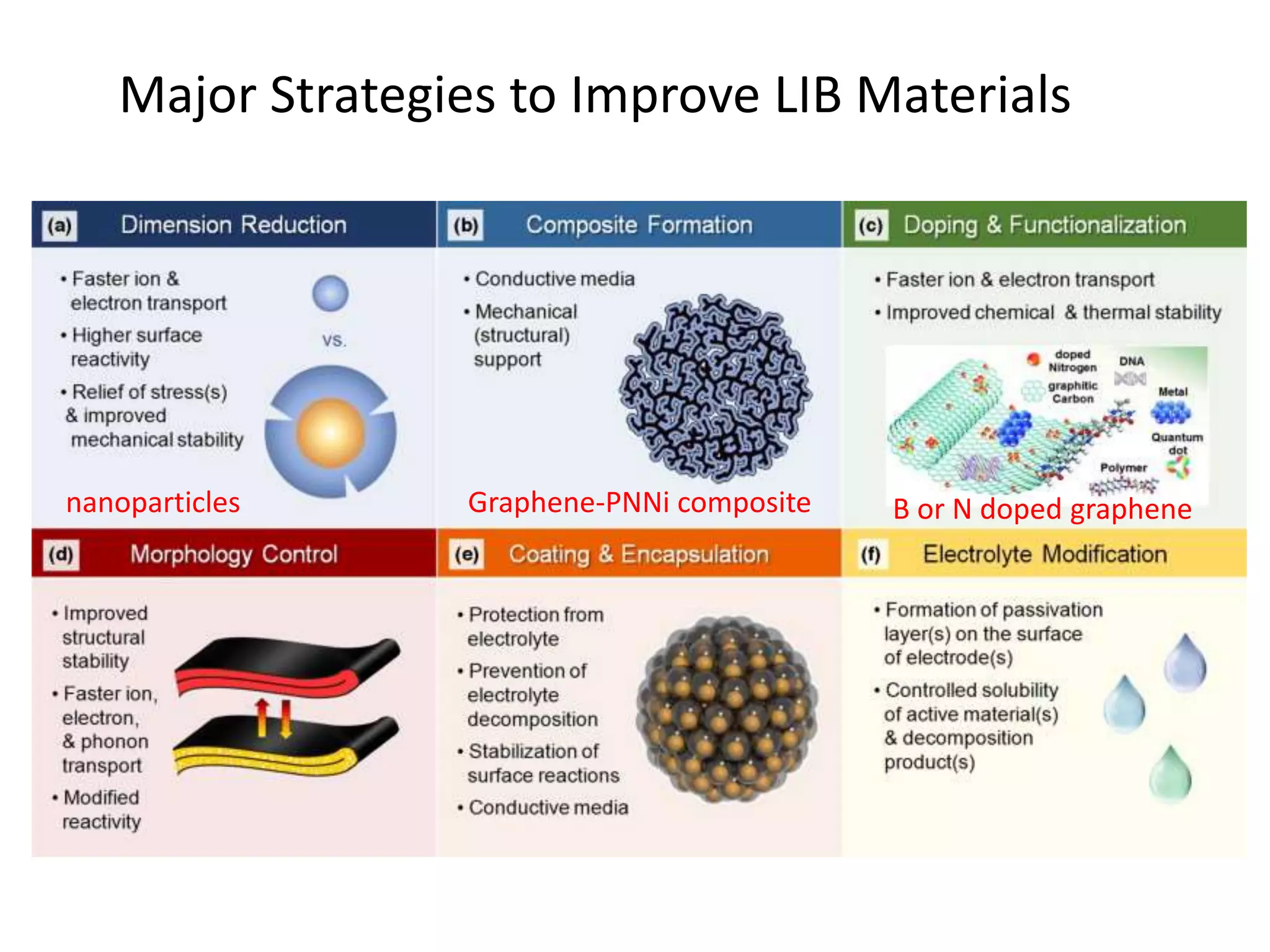
Major Strategies to Improve LIB Materials
B or N doped grapheneGraphene-PNNi compositenanoparticles
List of Important Cathode Materials
voltage specific
capacity
(mAh/g)
energy
density
(wh/kg)
Conductivi
ty
Density
(g/cm3)
[Tapped]
Surface
area
(m2/g)
Cost
($/kg)
LiFePO4 (Fiscar) LFP O 3.4 100-160
(170)
578 E-8 0.23
LiFe1/2Mn1/2PO4 O 3.4-4.1 160
(170)
LiMnPO4 O 4.1 171 701 E-10
LiCoPO4 O 4.8 167 802
LiNiPO4 O 5.1 167 852
LiCoO2 (toxic) (Tesla) LCO L 3.7 120-155
(274 )
570 E-4 25
LiMnO2 L
LiNiO2 (toxic) L 135-180
(274)
13
Li(Ni16/20Co3/20Al1/20)O2 NCA L 3.8
(3-4.2)
180-200
(??)
680-760 4.45 0.5
Li(Ni1/3Mn1/3Co1/3)O2
Nissan & GM
NMC111
BC618
L 4.2-4.6 130-150
(272)
597 4.8
[2.69]
0.26
Li(Ni1/2Mn3/10Co2/10)O2
1/5LiCoO2*4/5(LiMn3/8Ni2/8)O2
NMC532 ??
(164)
635
Li(Ni2/5Mn2/5Co1/5)O2
1/5LiCoO2*4/5(LiMn1/2Ni1/2)O2
NMC442
BC718
??
(155)
4.7
[2.29]
0.39
Li(Ni3/5Mn1/5Co1/5)O2
1/5LiCoO2*2/5(LiMn1/2Ni1/2)O2
NMC622
Li(Ni4/5Mn1/10Co1/10)O2
1/10LiCoO2*4/5(LiMn1/2Ni1/2)O2
NMC811
Lithium Rich Layer Oxide
Li(Li1/3Mn2/3)O2*Li(Mn3/8Ni3/8Co
1/4)O2 = Li(Li, Mn, Ni, Co)O2
HE-NMC
(HE-NCM)
L 4.65
(5.1)
???
(250)
986
LiMn2O4 LMO S 4.3
(3.5-4.3)
100-130
(148)
500
(585)
E-4 4.29 0.5 0.5
LiMn3/2Ni1/2O4
(Nissan, GM)
LMNO
HV-spinel
S 4.7 120
(148)
651 4.45 1.3
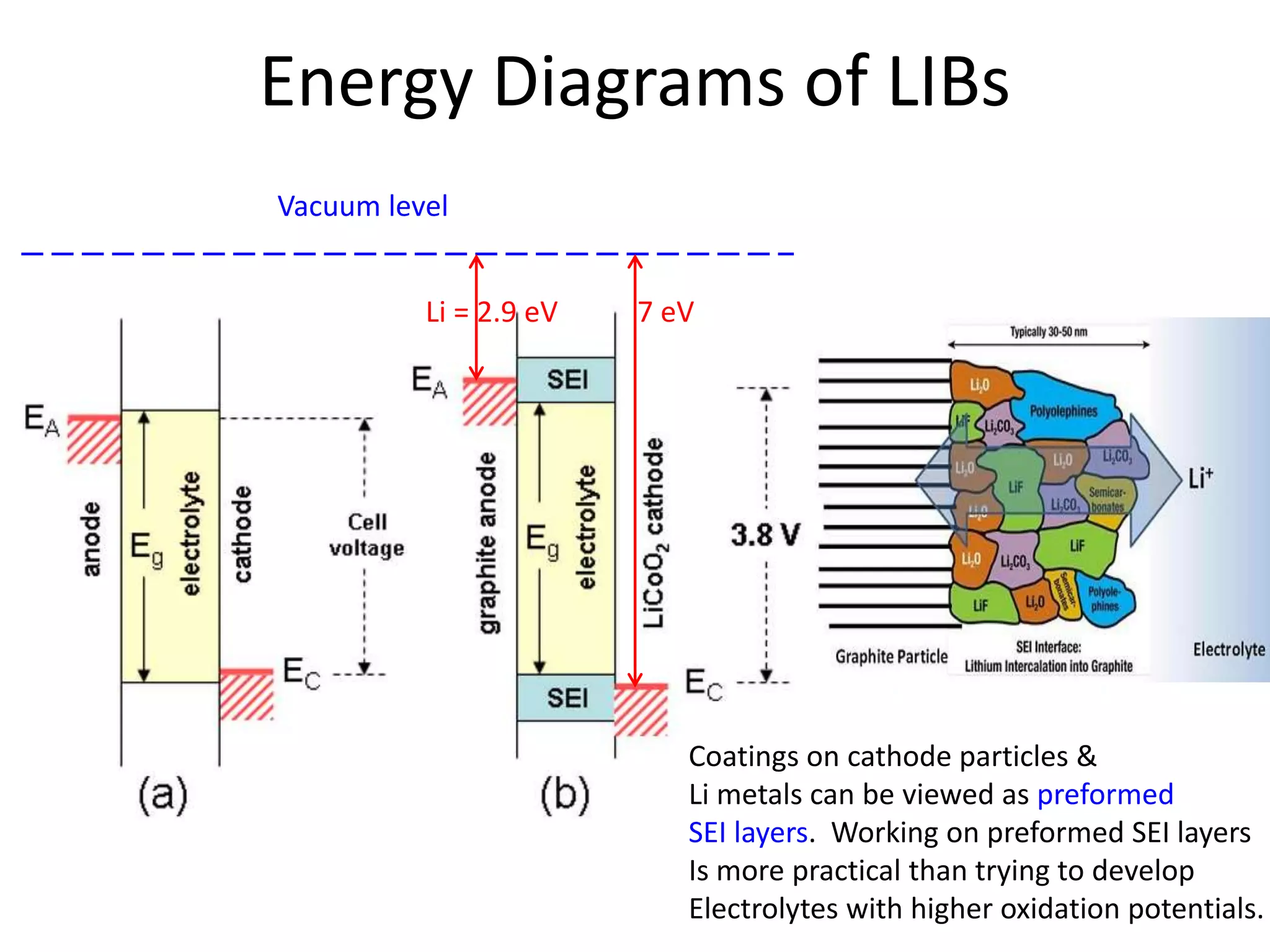
Energy Diagrams of LIBs
Vacuum level
Li = 2.9 eV 7 eV
Coatings on cathode particles &
Li metals can be viewed as preformed
SEI layers. Working on preformed SEI layers
Is more practical than trying to develop
Electrolytes with higher oxidation potentials.
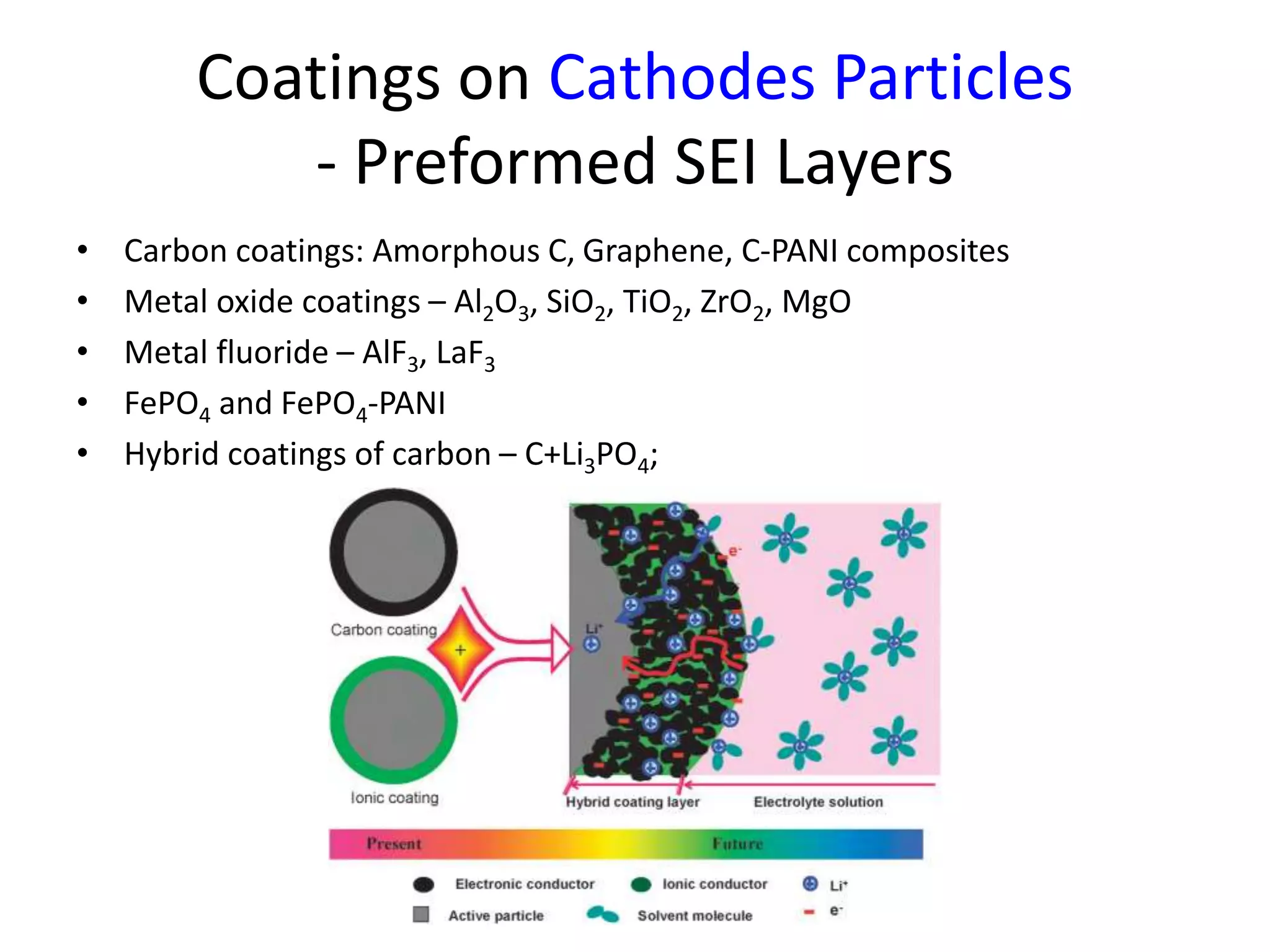
Coatings on Cathodes Particles
- Preformed SEI Layers
• Carbon coatings: Amorphous C, Graphene, C-PANI composites
• Metal oxide coatings – Al2O3, SiO2, TiO2, ZrO2, MgO
• Metal fluoride – AlF3, LaF3
• FePO4 and FePO4-PANI
• Hybrid coatings of carbon – C+Li3PO4;
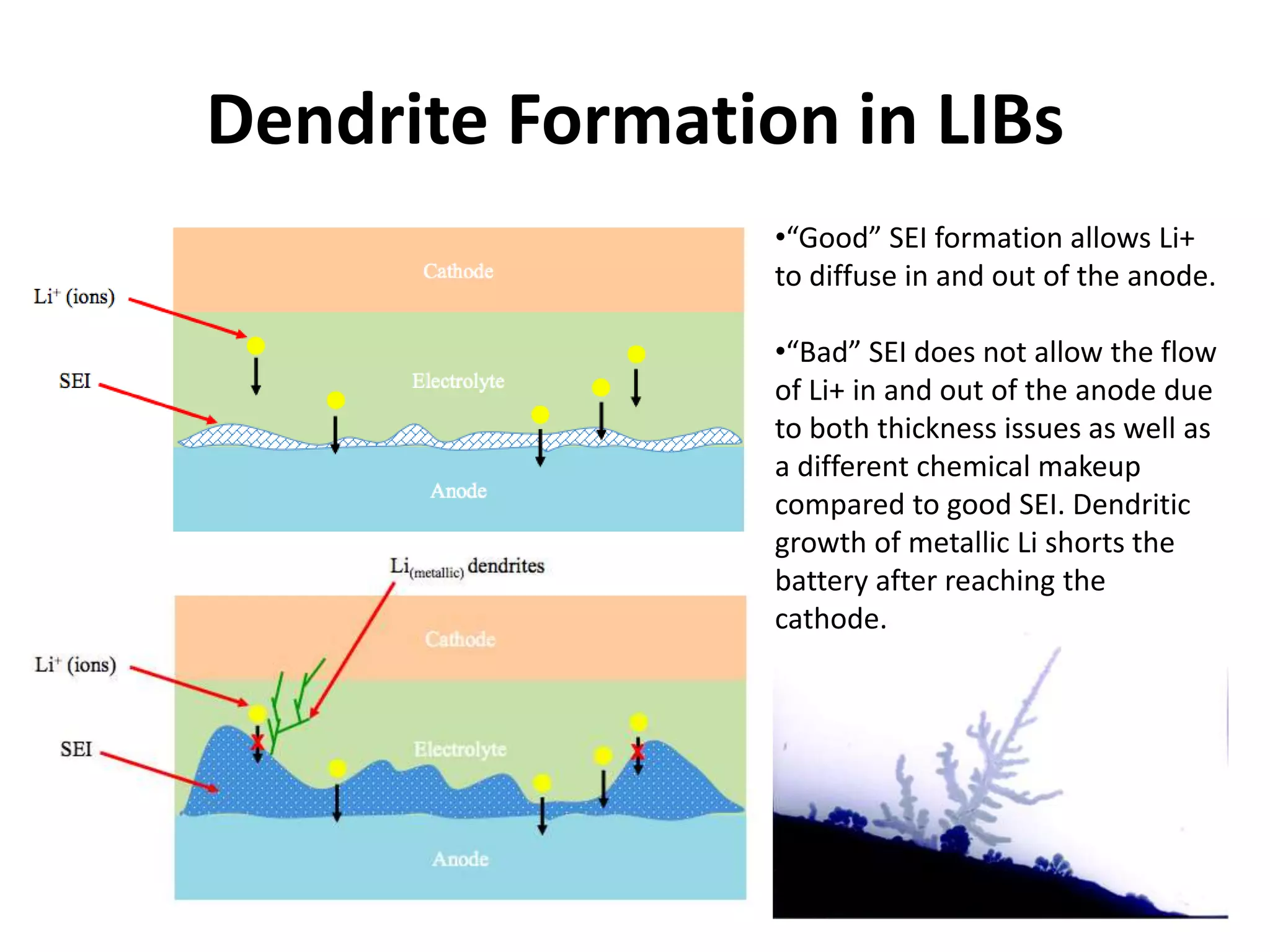
Dendrite Formation in LIBs
•“Good” SEI formation allows Li+
to diffuse in and out of the anode.
•“Bad” SEI does not allow the flow
of Li+ in and out of the anode due
to both thickness issues as well as
a different chemical makeup
compared to good SEI. Dendritic
growth of metallic Li shorts the
battery after reaching the
cathode.
Dendrite Suppressing Methods
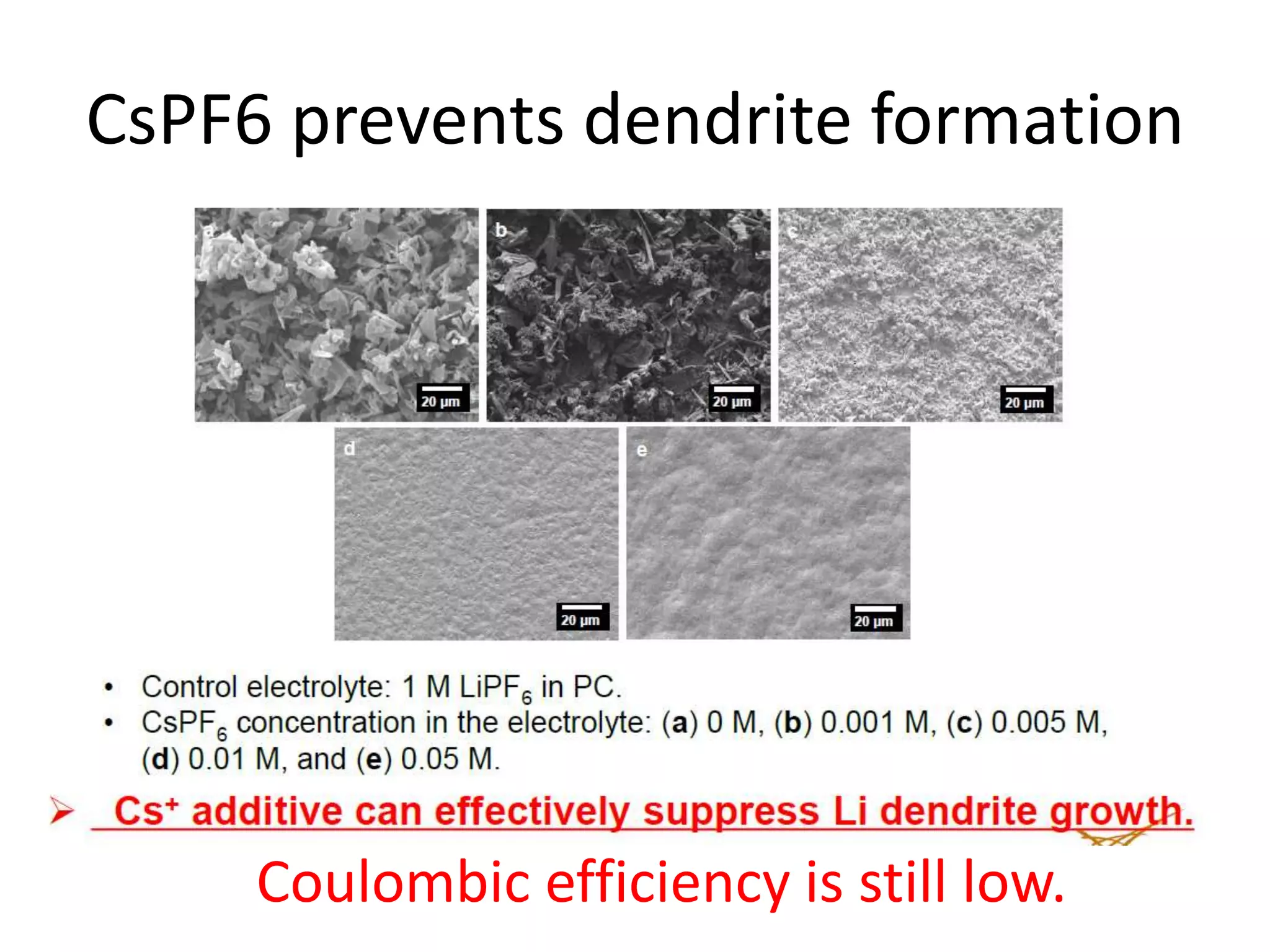
• Electrolyte additives: Alkali salts (Cs+), high LiTFSI
concentrations.
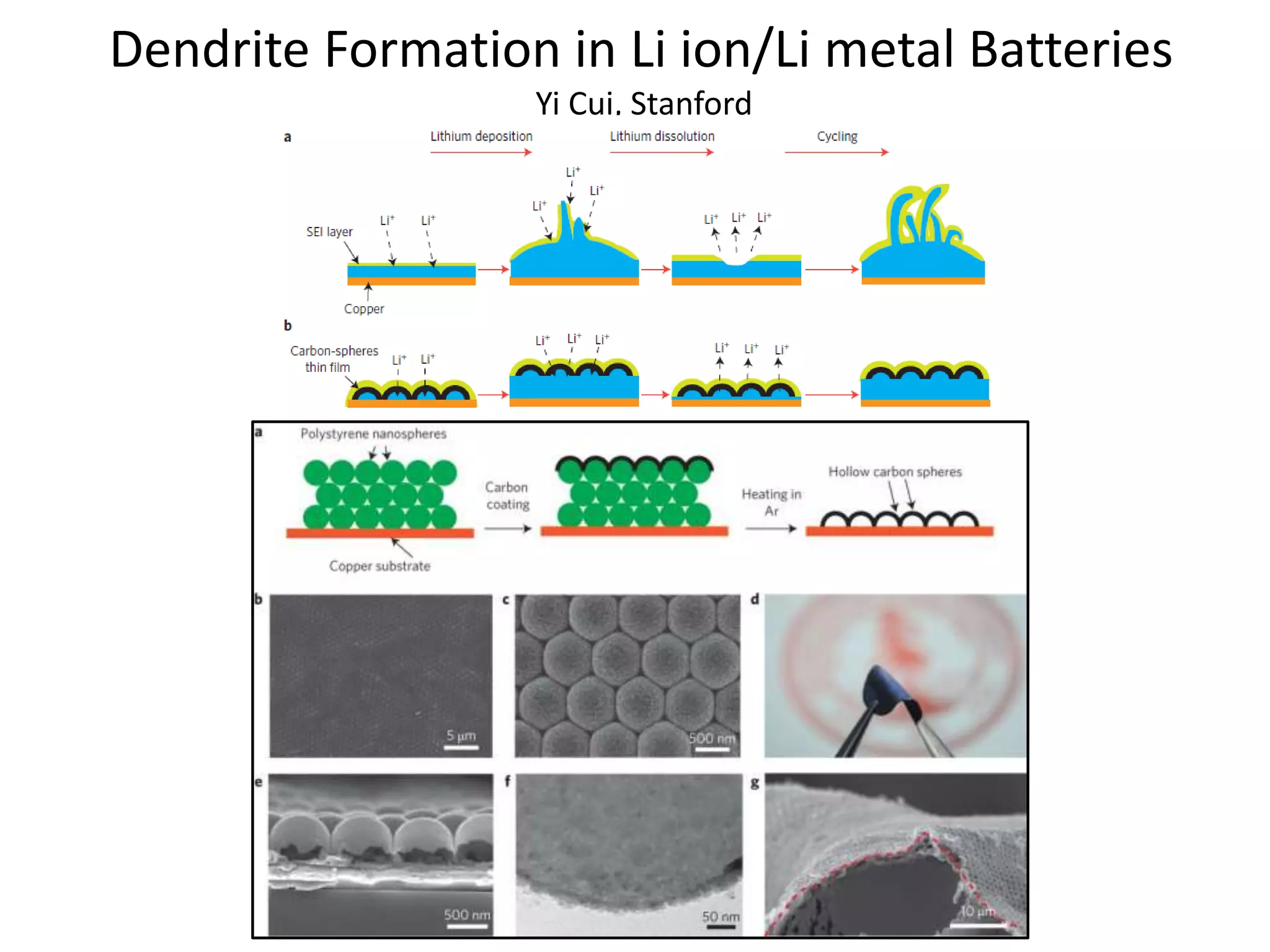
• Coatings on Li metal: Carbon coating
• Thermal conductor coatings on separator: BN
• Ionic liquids as eletrolytes.
• Polymer electrolytes: block polymers, crosslinked polymers.
• Pulse charging
• Others
Dendrite Formation in Li ion/Li metal Batteries
Yi Cui, Stanford
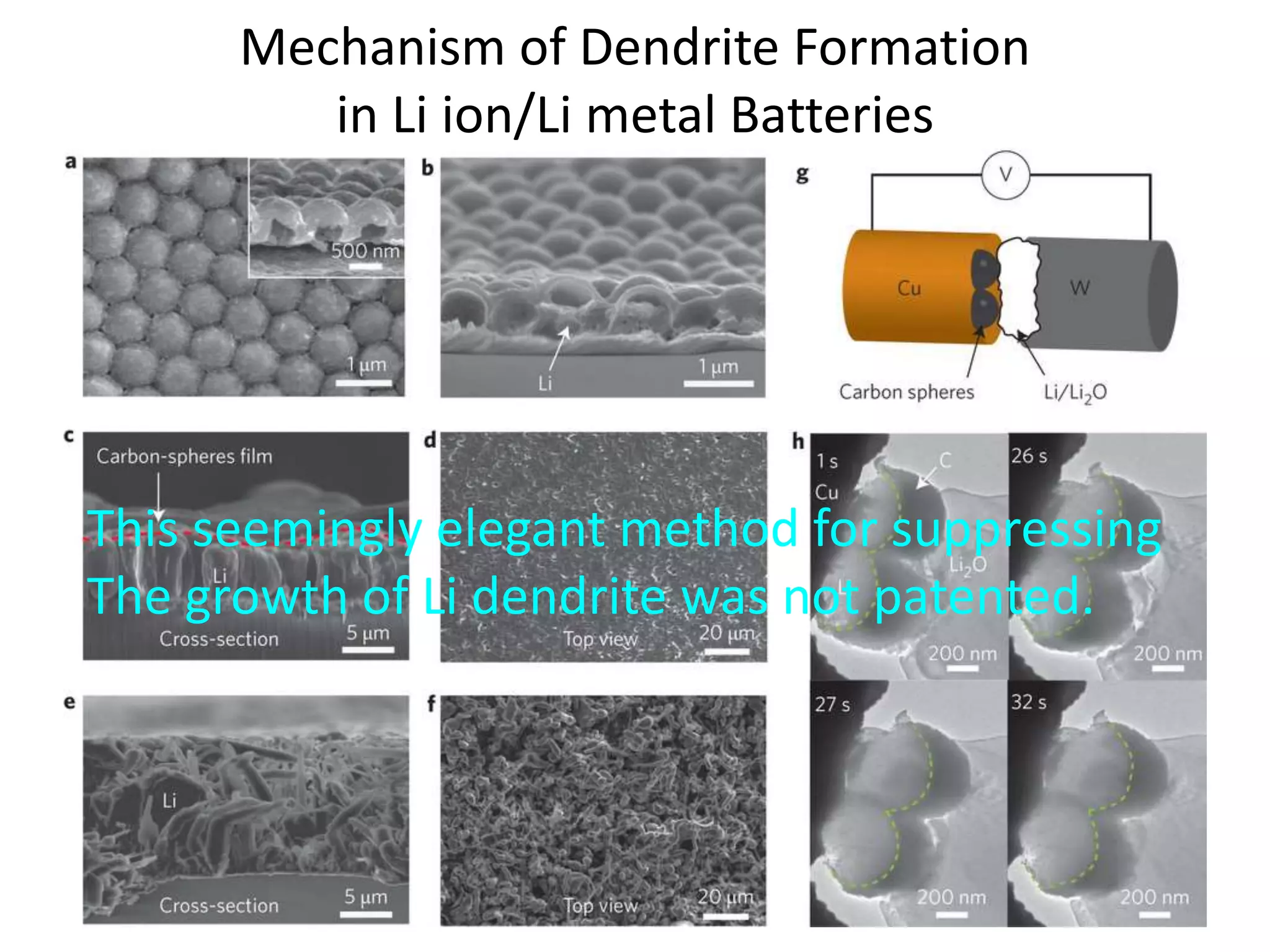
Mechanism of Dendrite Formation
in Li ion/Li metal Batteries
This seemingly elegant method for suppressing
The growth of Li dendrite was not patented.
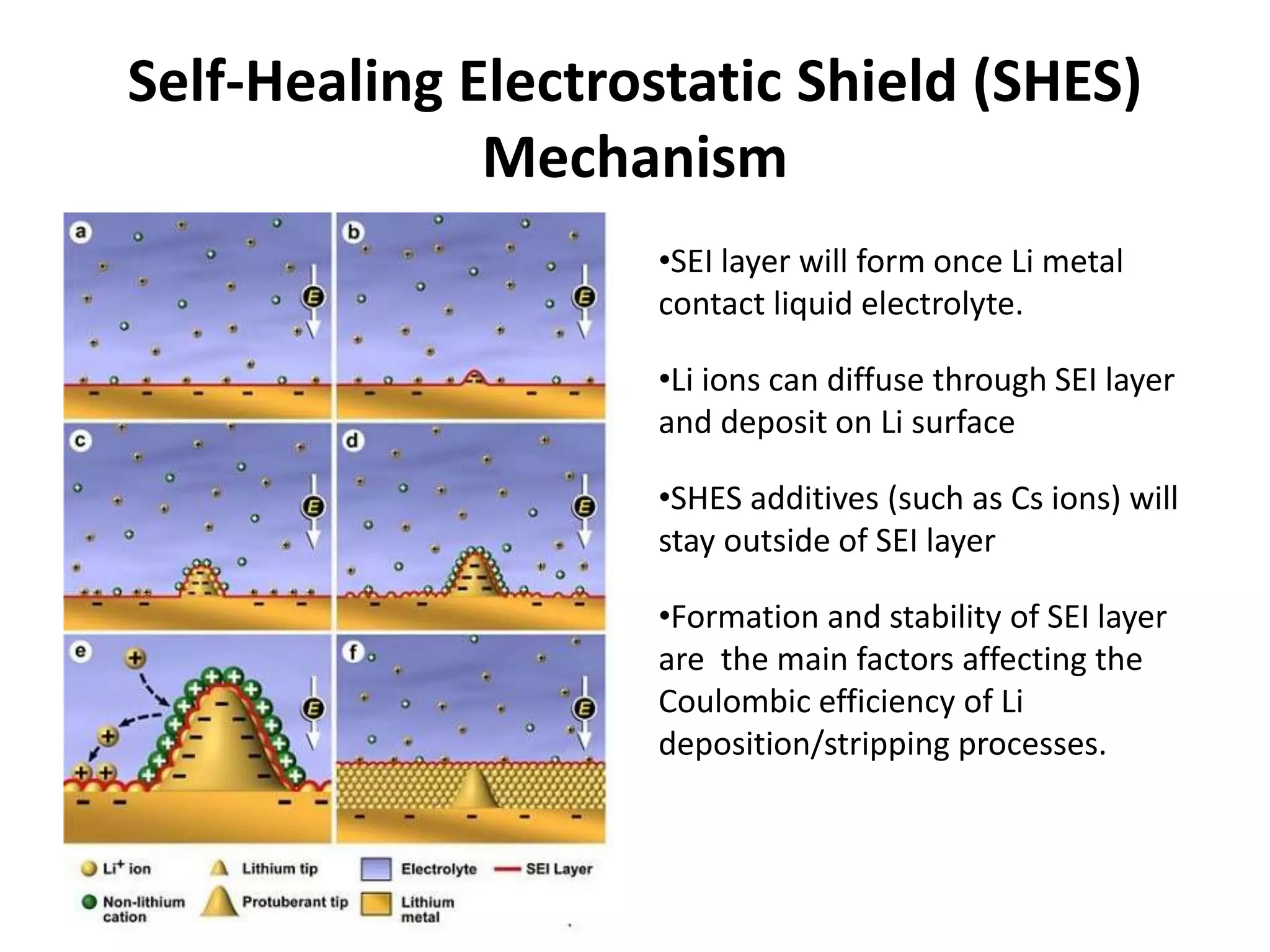
Self-Healing Electrostatic Shield (SHES)
Mechanism
•SEI layer will form once Li metal
contact liquid electrolyte.
•Li ions can diffuse through SEI layer
and deposit on Li surface
•SHES additives (such as Cs ions) will
stay outside of SEI layer
•Formation and stability of SEI layer
are the main factors affecting the
Coulombic efficiency of Li
deposition/stripping processes.
CsPF6 prevents dendrite formation
Coulombic efficiency is still low.
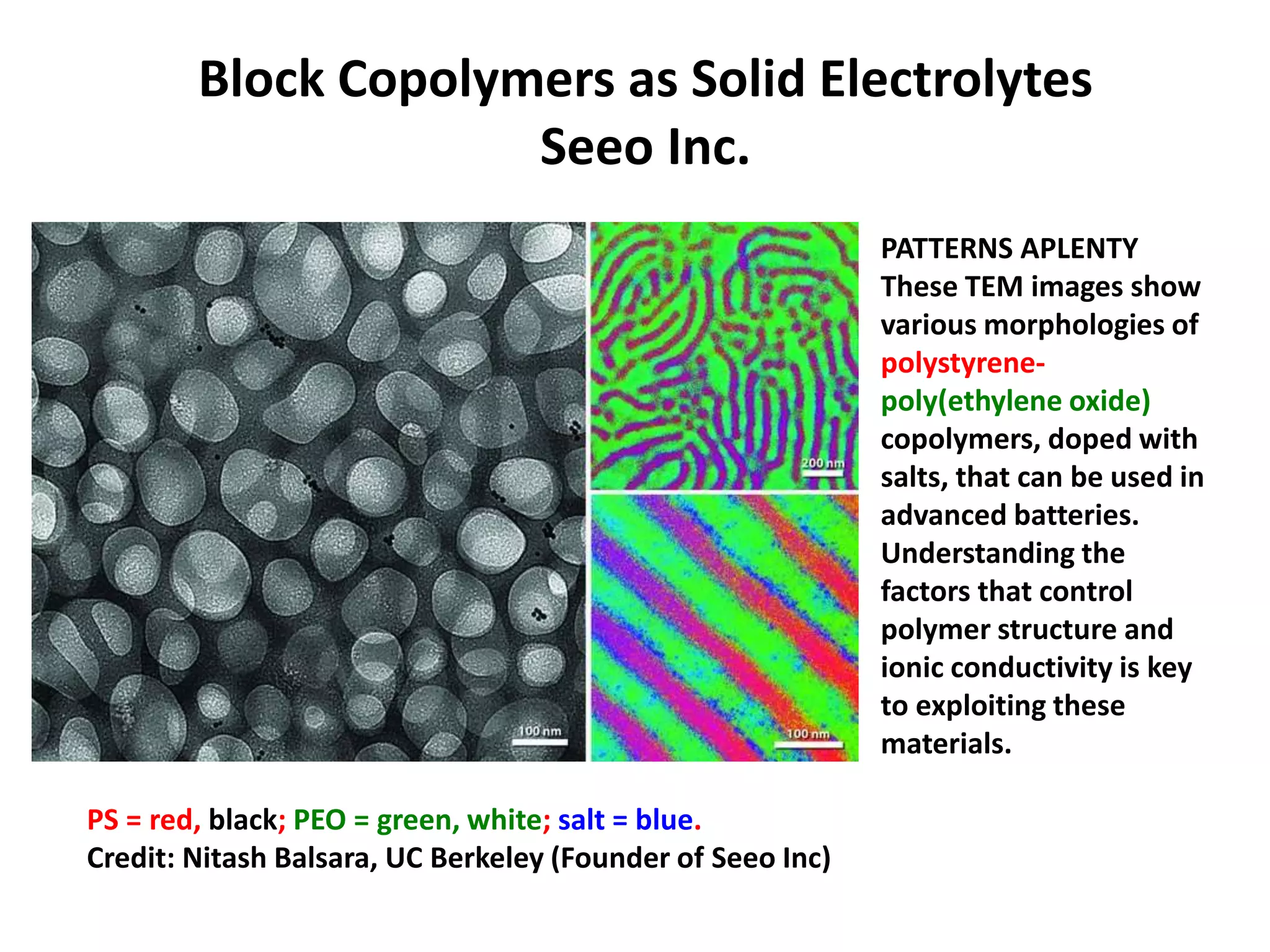
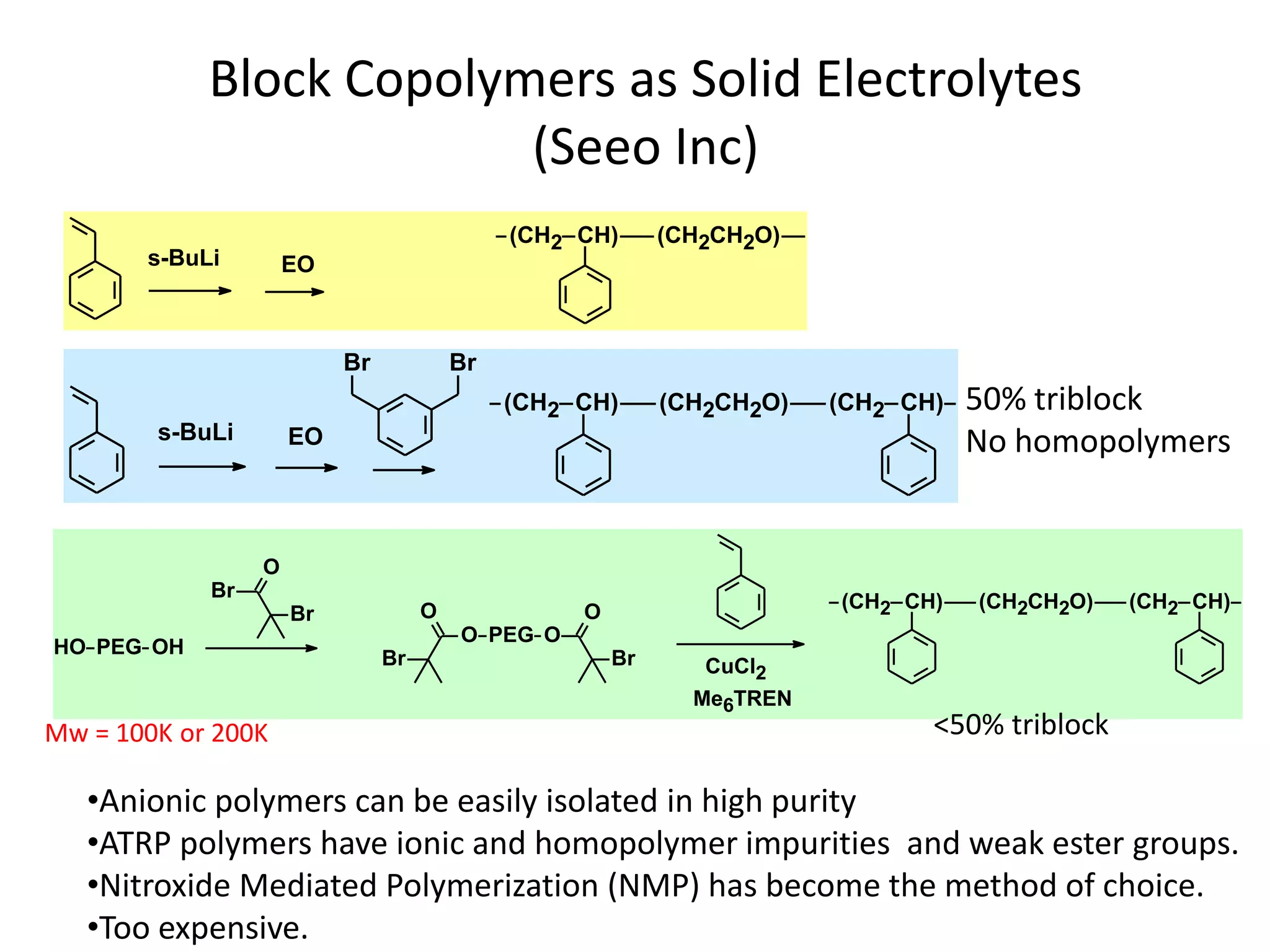
Block Copolymers as Solid Electrolytes
Seeo Inc.
PATTERNS APLENTY
These TEM images show
various morphologies of
polystyrene-
poly(ethylene oxide)
copolymers, doped with
salts, that can be used in
advanced batteries.
Understanding the
factors that control
polymer structure and
ionic conductivity is key
to exploiting these
materials.
PS = red, black; PEO = green, white; salt = blue.
Credit: Nitash Balsara, UC Berkeley (Founder of Seeo Inc)
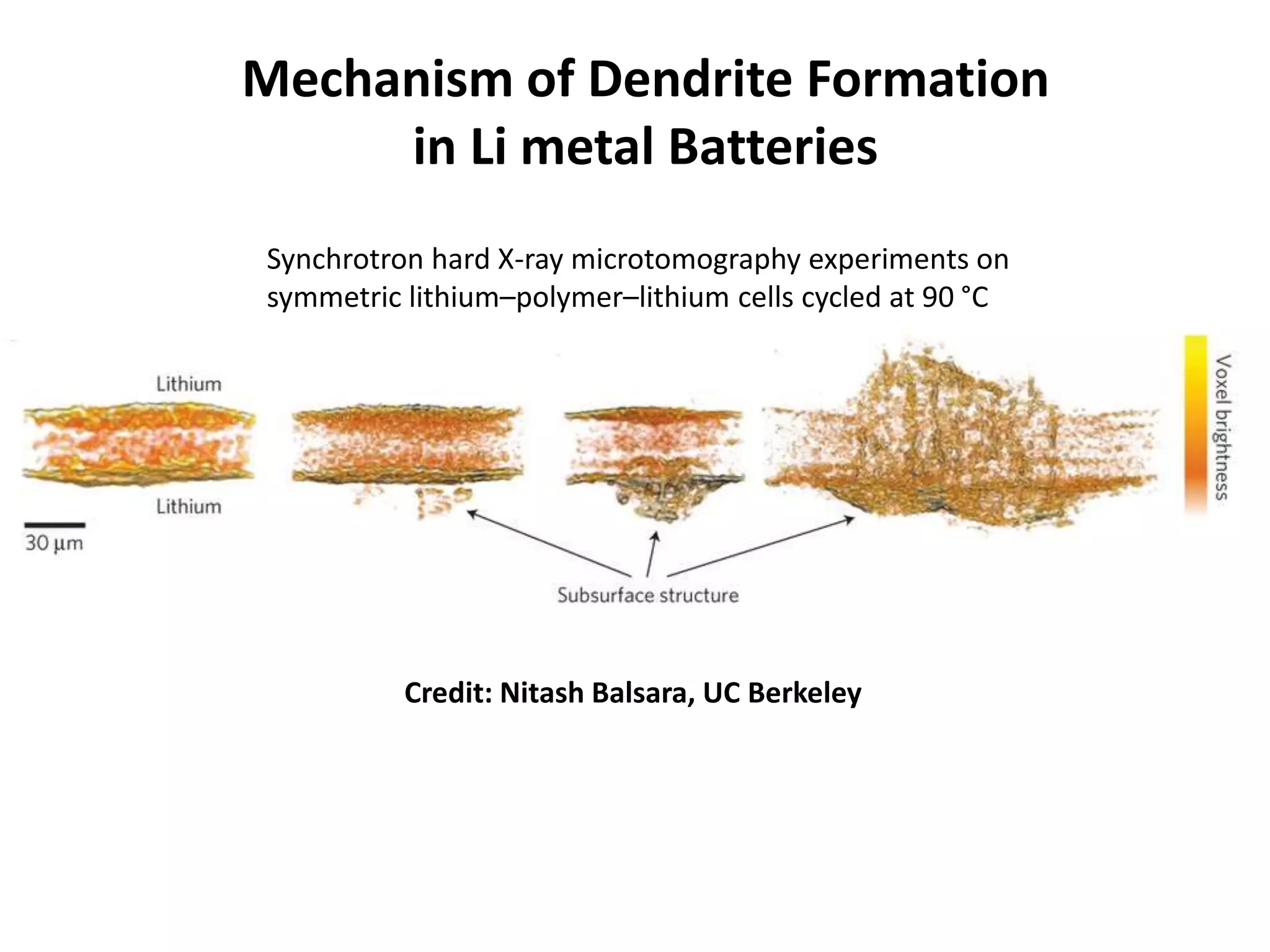
Mechanism of Dendrite Formation
in Li metal Batteries
Synchrotron hard X-ray microtomography experiments on
symmetric lithium–polymer–lithium cells cycled at 90 °C
Credit: Nitash Balsara, UC Berkeley
Block Copolymers as Solid Electrolytes
(Seeo Inc)
Mw = 100K or 200K
50% triblock
No homopolymers
•Anionic polymers can be easily isolated in high purity
•ATRP polymers have ionic and homopolymer impurities and weak ester groups.
•Nitroxide Mediated Polymerization (NMP) has become the method of choice.
•Too expensive.
s-BuLi EO
(CH2CH2O)(CH2 CH)
PEG OHHO
Br
O
Br
PEG OO
O
Br
O
Br CuCl2
Me6TREN
(CH2CH2O)(CH2 CH) (CH2 CH)
s-BuLi EO
Br Br
(CH2CH2O)(CH2 CH) (CH2 CH)
<50% triblock
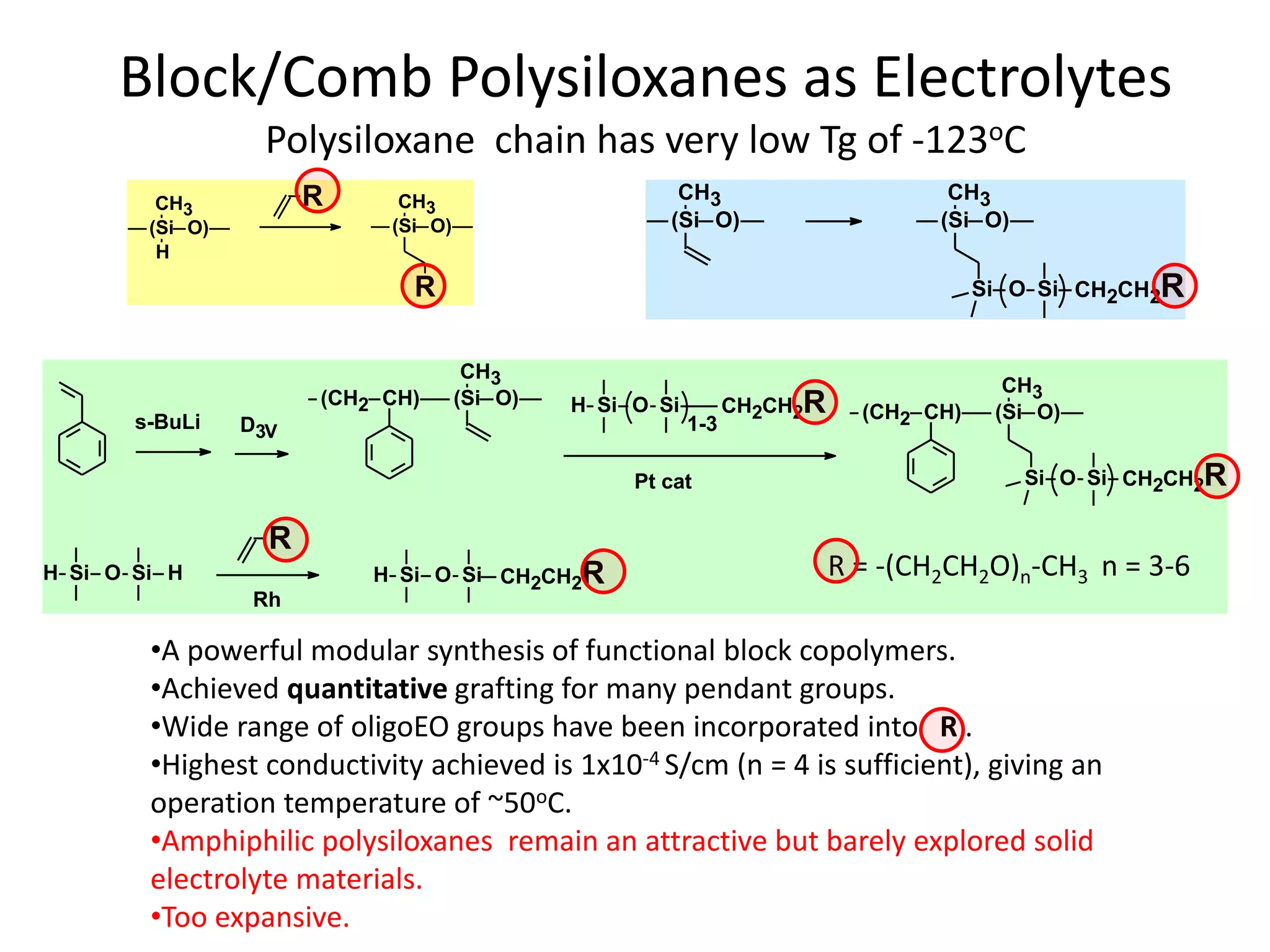
Block/Comb Polysiloxanes as Electrolytes
Polysiloxane chain has very low Tg of -123oC
D3V
(CH2 CH) (Si
CH3
O)
s-BuLi
Si O SiH CH2CH2R
1-3
(CH2 CH) (Si
CH3
O)
Si O Si CH2CH2RPt cat
Si O SiH H
R
Rh
Si O SiH CH2CH2R
•A powerful modular synthesis of functional block copolymers.
•Achieved quantitative grafting for many pendant groups.
•Wide range of oligoEO groups have been incorporated into R .
•Highest conductivity achieved is 1x10⁻⁴ S/cm (n = 4 is sufficient), giving an
operation temperature of ~50oC.
•Amphiphilic polysiloxanes remain an attractive but barely explored solid
electrolyte materials.
•Too expansive.
(Si
CH3
H
O) (Si
CH3
O)
R
R
(Si
CH3
O) (Si
CH3
O)
Si O Si CH2CH2R
R = -(CH2CH2O)n-CH3 n = 3-6
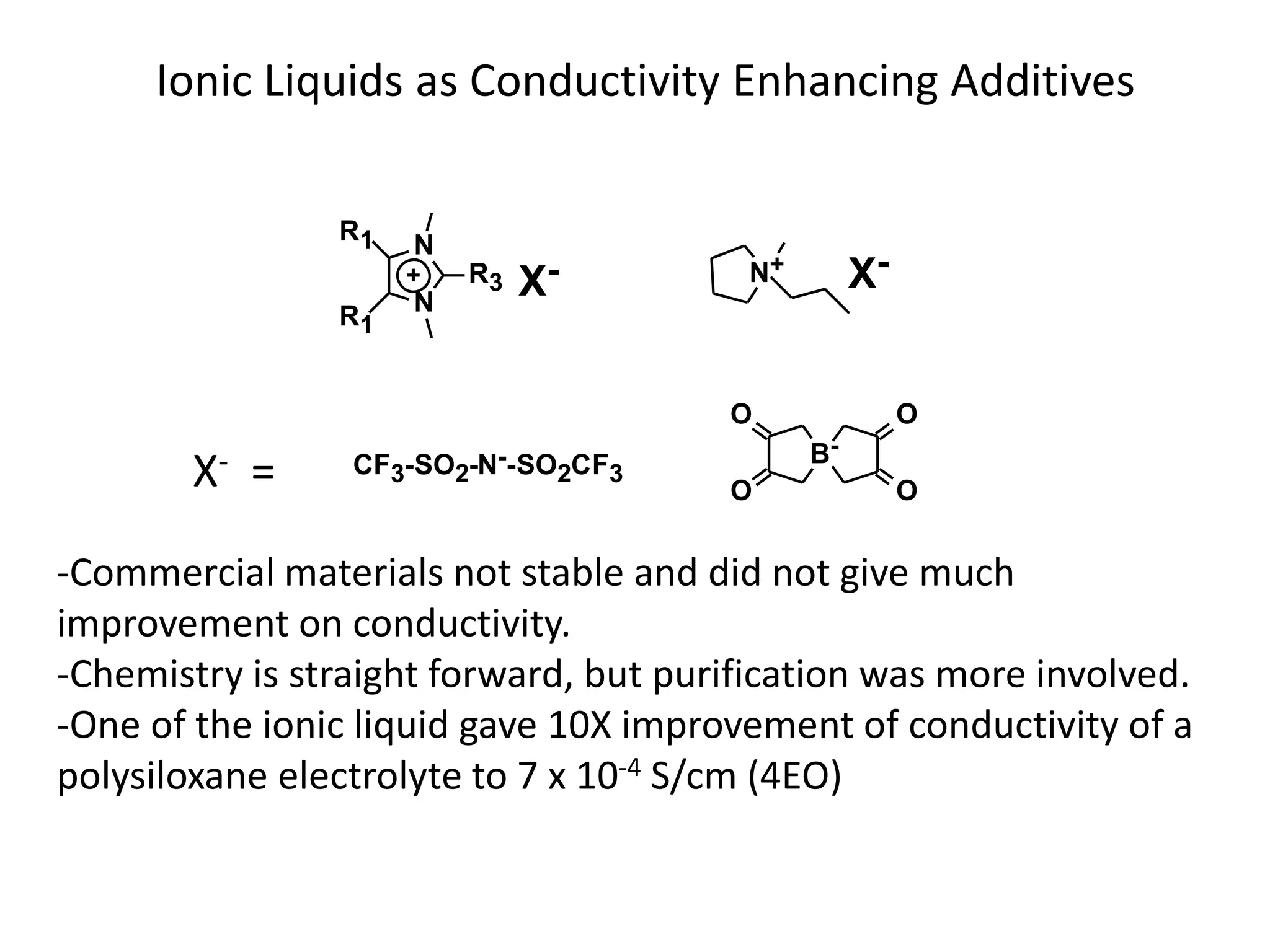
Ionic Liquids as Conductivity Enhancing Additives
N
NR1
R1
R3+
CF3-SO2-N--SO2CF3
X- N+
X-
B-
O
O
O
O
-Commercial materials not stable and did not give much
improvement on conductivity.
-Chemistry is straight forward, but purification was more involved.
-One of the ionic liquid gave 10X improvement of conductivity of a
polysiloxane electrolyte to 7 x 10⁻⁴ S/cm (4EO)
X- =
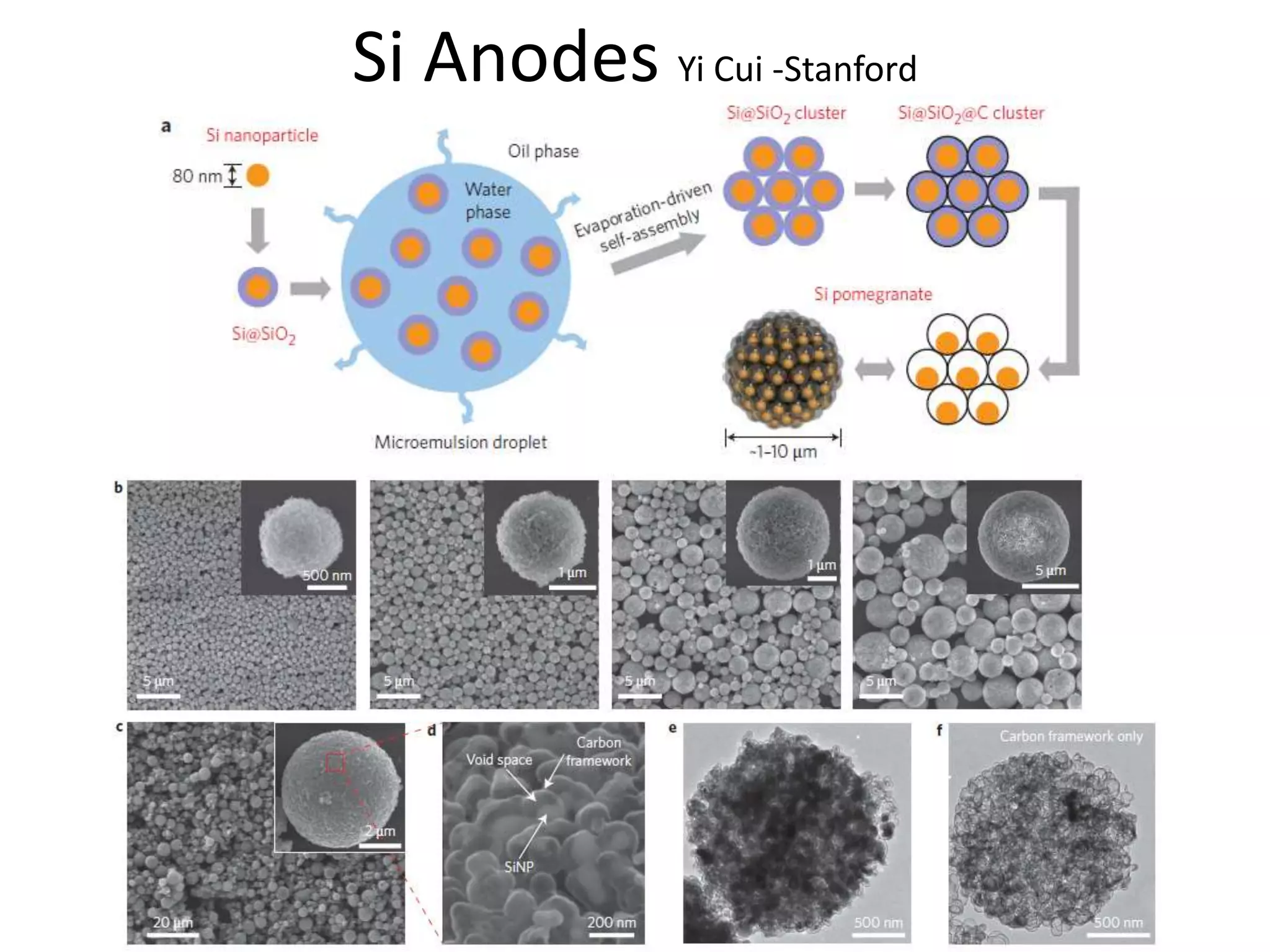
Si Anodes
• Yi Cui has a monopoly in this area. See
https://www.youtube.com/watch?v=0Z7cEWrX9U4
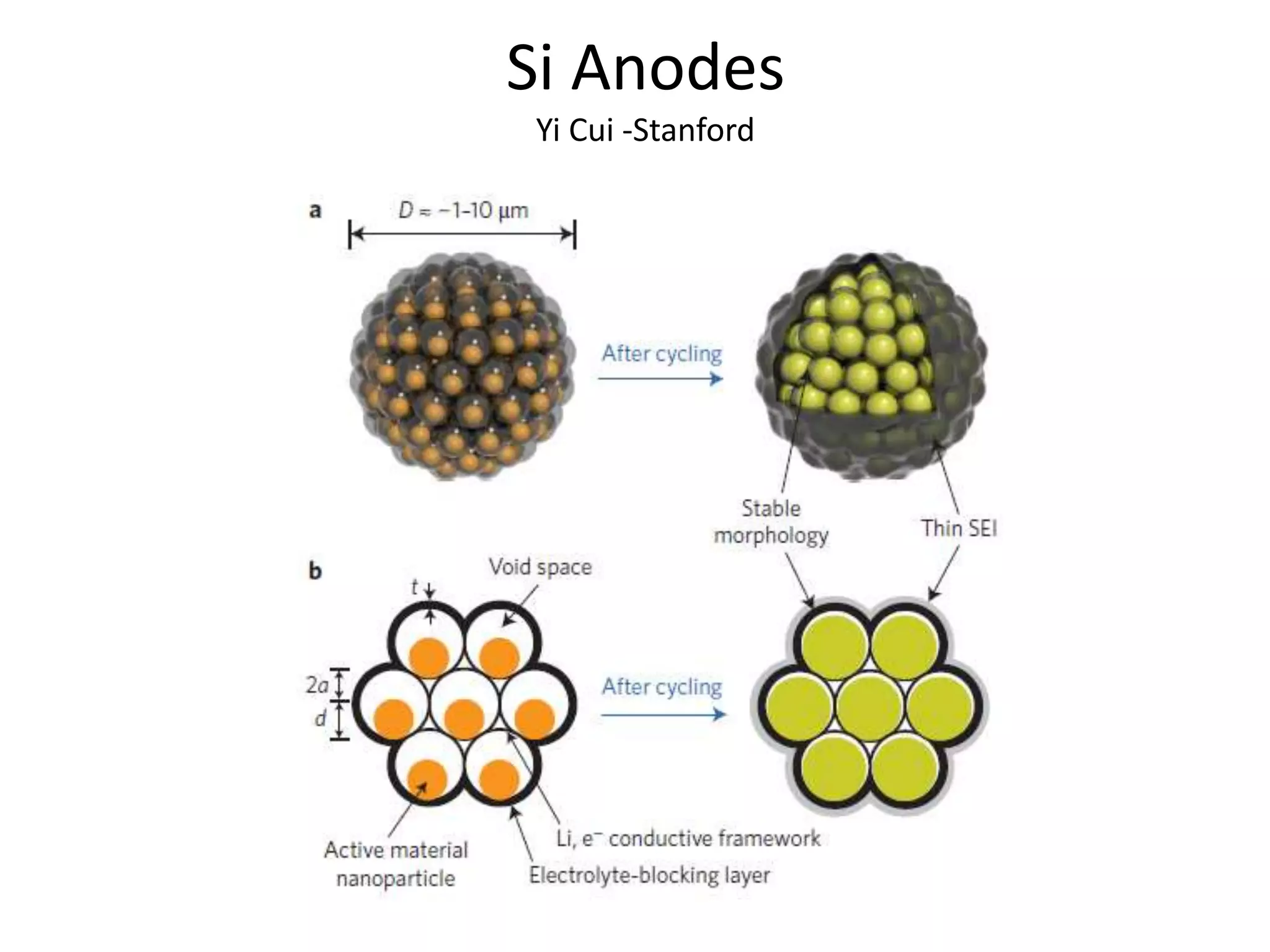
• Pomegranate Si micron particles
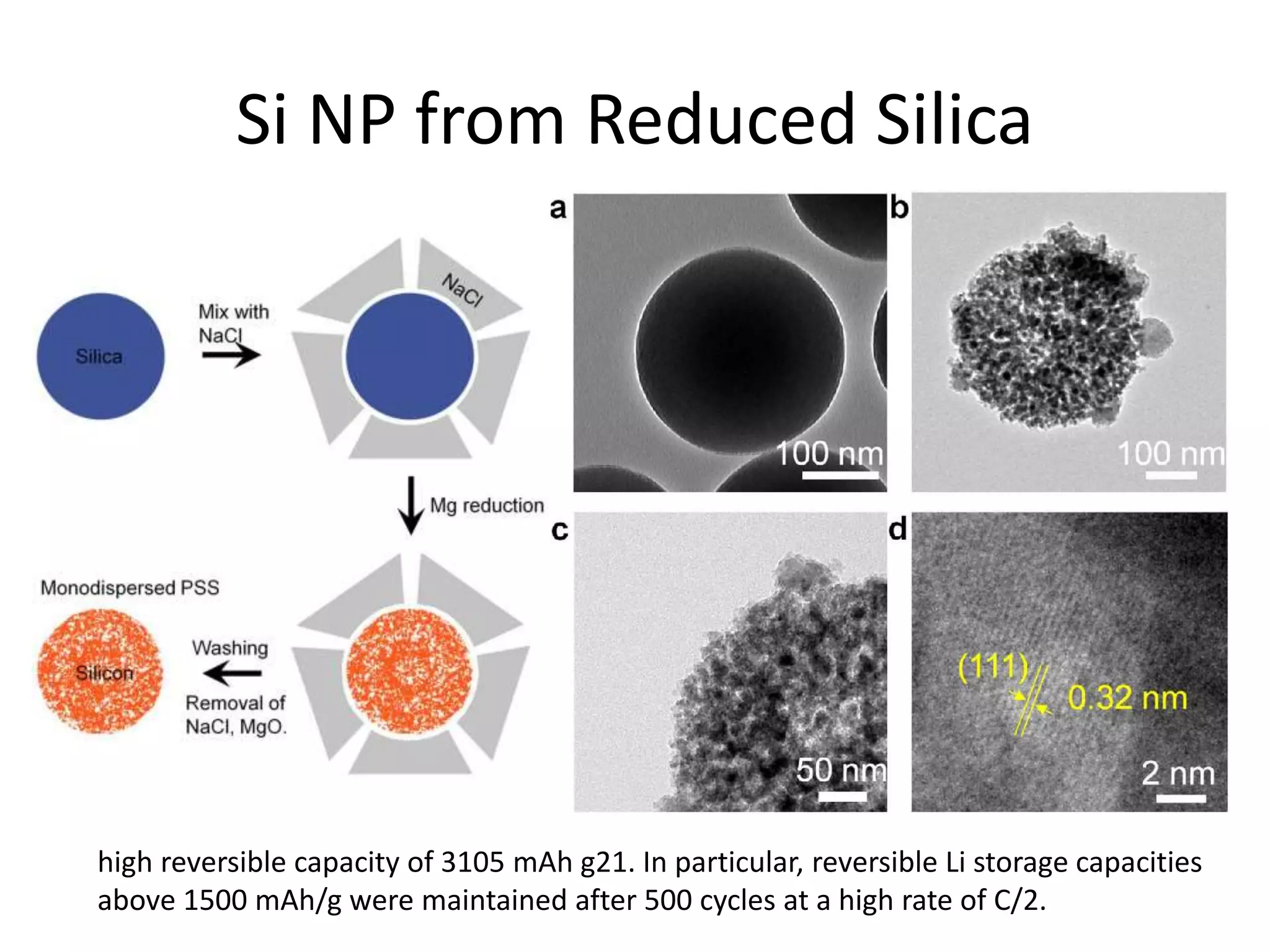
• Reduced Silica
• New polymer biners
• Others
Si Anodes Yi Cui -Stanford
Si Anodes
Yi Cui -Stanford
Si NP from Reduced Silica
high reversible capacity of 3105 mAh g21. In particular, reversible Li storage capacities
above 1500 mAh/g were maintained after 500 cycles at a high rate of C/2.
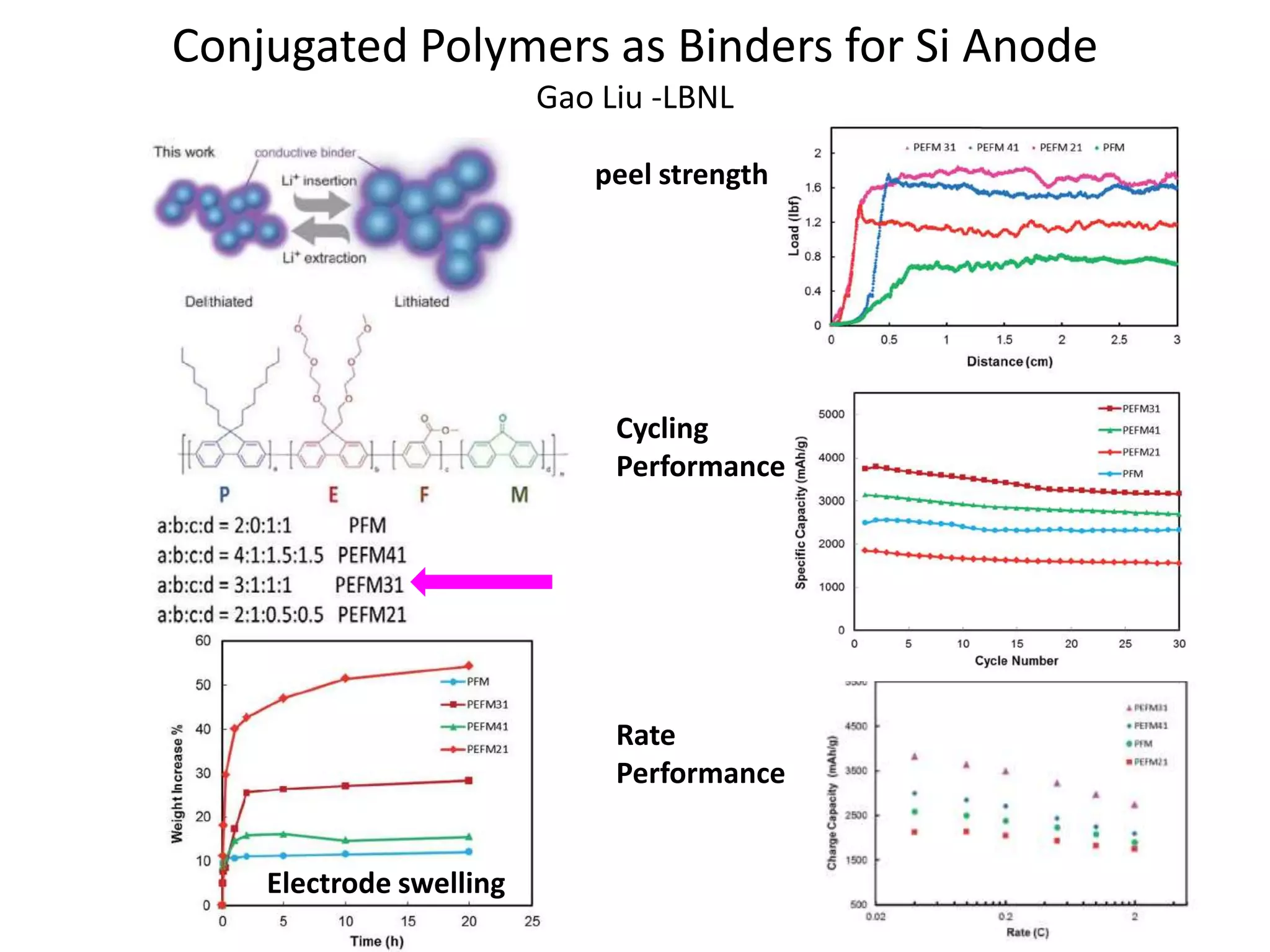
Conjugated Polymers as Binders for Si Anode
Gao Liu -LBNL
peel strength
Electrode swelling
Cycling
Performance
Rate
Performance
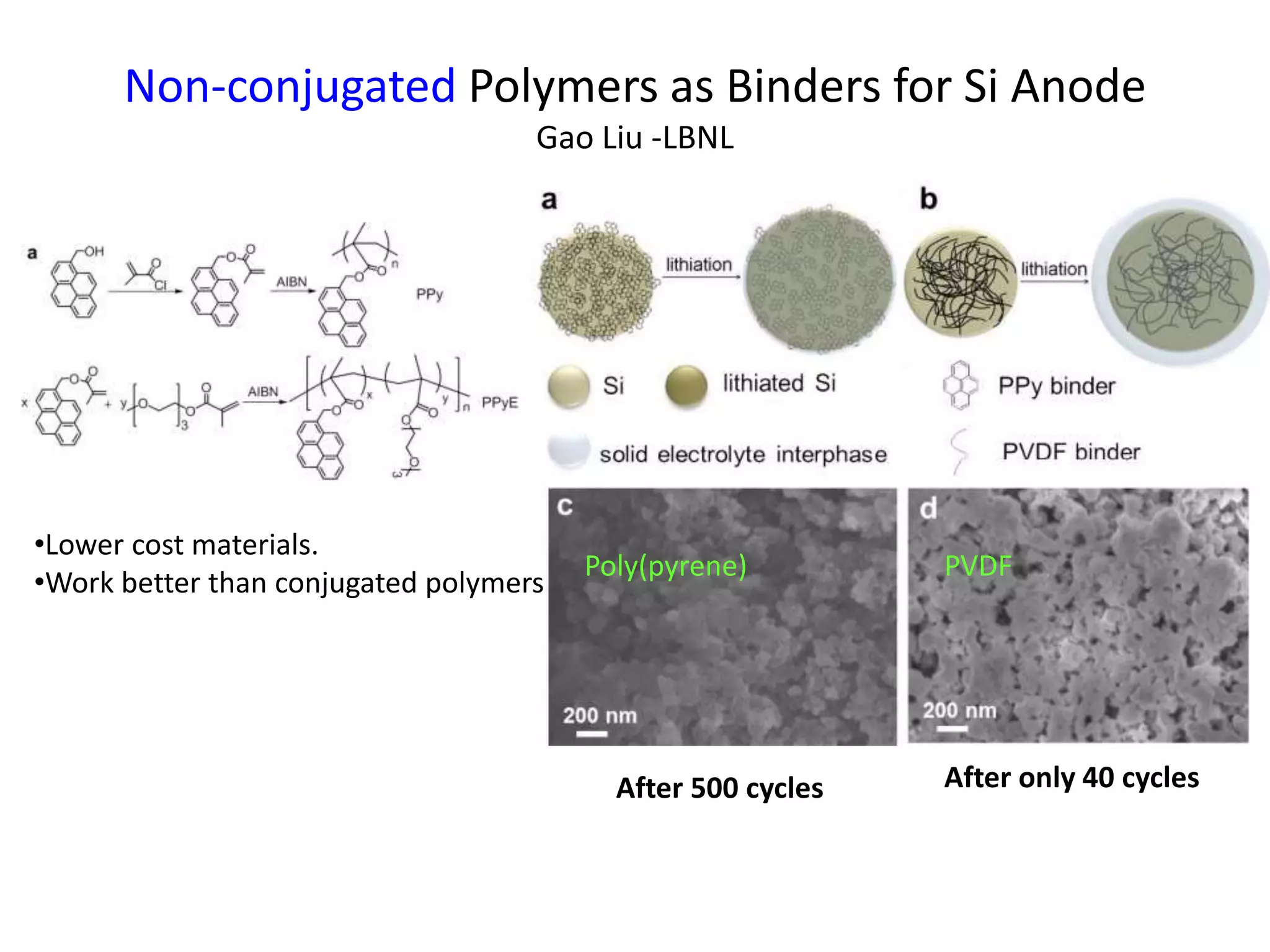
Non-conjugated Polymers as Binders for Si Anode
Gao Liu -LBNL
After 500 cycles After only 40 cycles
•Lower cost materials.
•Work better than conjugated polymers
PVDFPoly(pyrene)
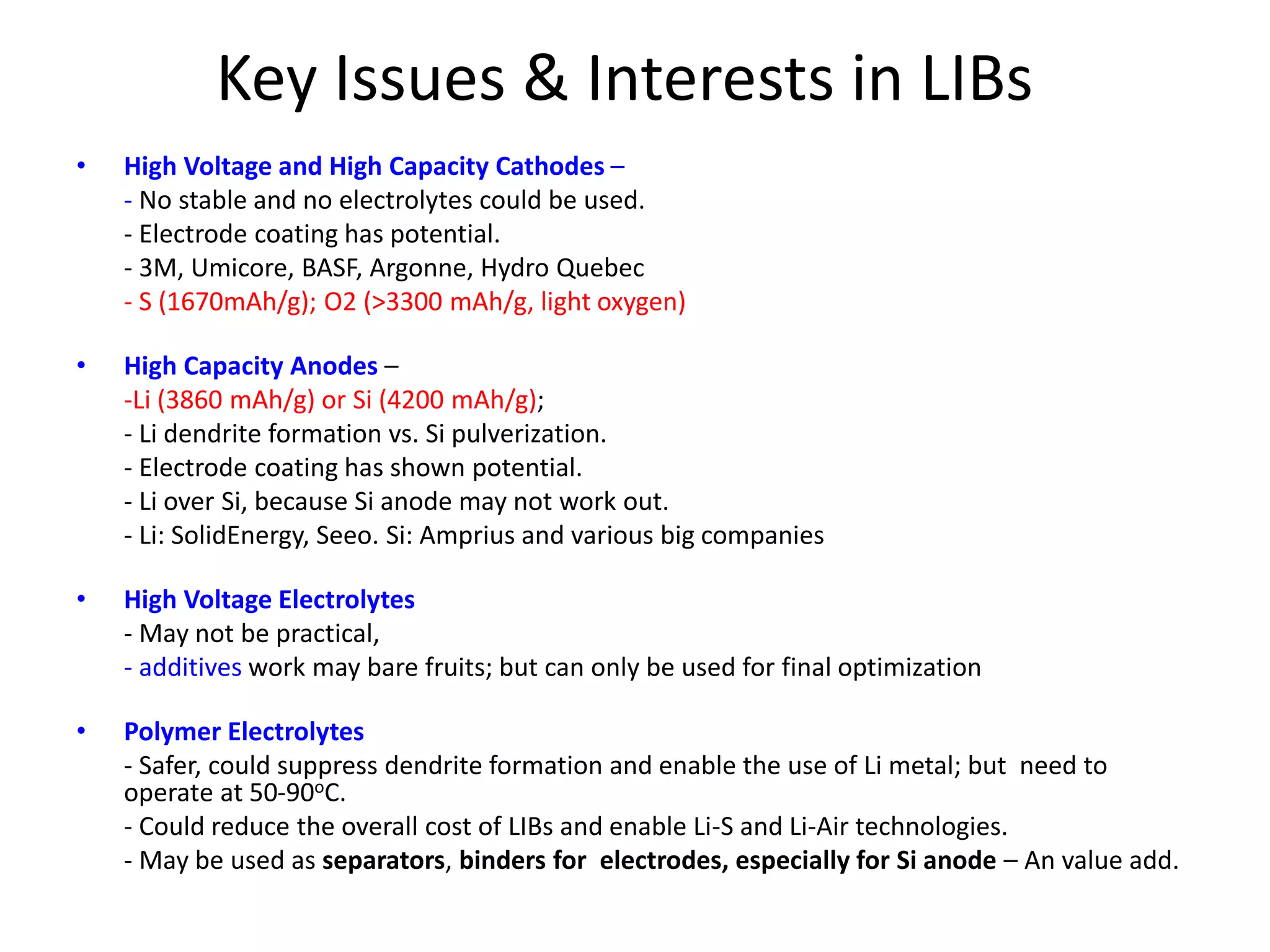
Key Issues & Interests in LIBs
• High Voltage and High Capacity Cathodes –
- No stable and no electrolytes could be used.
- Electrode coating has potential.
- 3M, Umicore, BASF, Argonne, Hydro Quebec
- S (1670mAh/g); O2 (>3300 mAh/g, light oxygen)
• High Capacity Anodes –
-Li (3860 mAh/g) or Si (4200 mAh/g);
- Li dendrite formation vs. Si pulverization.
- Electrode coating has shown potential.
- Li over Si, because Si anode may not work out.
- Li: SolidEnergy, Seeo. Si: Amprius and various big companies
• High Voltage Electrolytes
- May not be practical,
- additives work may bare fruits; but can only be used for final optimization
• Polymer Electrolytes
- Safer, could suppress dendrite formation and enable the use of Li metal; but need to
operate at 50-90oC.
- Could reduce the overall cost of LIBs and enable Li-S and Li-Air technologies.
- May be used as separators, binders for electrodes, especially for Si anode – An value add.
Summary
Solid polymer batteries with thin lithium metal
anode is one of the best paths forward

A pragmatic perspective on lithium ion batteries

  • 1.
    A Pragmatic Perspectiveon Lithium Ion Batteries (LIBs) 從實用的觀點評估鋰電池研究近期的契機 Bing Hsieh November, 2015
  • 2.
    $100B energy storageindustry • Key Players: Japan, China, Korea, and US Does Taiwan want to become a “key” player? •In 2014, global lithium battery anode materials output totaled around 70,000 tons, concentrated in China and Japan, which together constituted over 95% of global anode materials sales volume. •Global anode materials industry is highly concentrated, with major manufacturers including Hitachi Chemical, JFE Chemical, Mitsubishi Chemical, BTR, and Ningbo Shanshan, which held a combined market share of over 80% in 2014. - Hitachi & Ningbo Shanshan: artificial graphite - BTR & Mitsubishi : natural graphite - JFE Chemical & Ningbo Shanshan in MCMB (MesoCarbon MicroBeads)
  • 3.
    Startups in theBay Area Founder University Focus Amprius Yi Cui Stanford Si Anode Imprint Energy James Evans UC Berkeley ZincPoly Seeo (acquired By Bosch 博世) Nitash Balsara UC Berkeley Polymer Electrolytes BlueCurrent Nitash Balsara UC Berkeley Oligomer Electrolytes Saktis3 Ann Marie Sastry U Michigan Solid State LIBs Cambrios Angela Belcher MIT Ag Nanowires Transparent conductor C3Nano Zhenan Bao Stanford CNT transparent Conductor Carbon3D Joe Desimone U N Carolina 3D printing (business product) Ubiquitous Energy Vladimir Bulović MIT Transparent Solar Cells Does it make sense for Taiwan to invest more in energy storage technologies? If yes, Why & How?
  • 4.
    Cost of LIBs DOEcost target of $150/kWh in ~2030 Nissan Leaf Battery Pack @ $270/kWh In 2014
  • 5.
    Li+ & e-flow in LIBs • Li+ & e- flow in the same direction. • During charging Li+/e- flow from v+ to v-. • During discharging from v- to v+ electrode. (Cu)(Al) • Al (d=2.7); Cu (d=9.0) • Al: light weight; but can alloy with Li • Surface Al2O3 gives impedance. (3M has carbon coated oxide-free Al ) • Energy density α Electrode thickness • High Battery Cost: $1000/kwh
  • 6.
    Micrographs of ElectrodeParticles LiCoO2 LiCoO2 LiCoO2 LiNiO2 LiNiO2 KS4 Graphite Si NP NonPorous particles!
  • 7.
  • 8.
    Thin or thickelectrode? Seeo Inc SolidEnergy System US 2014/0170524 1-28. (canceled) 29. An electrochemical cell, comprising: an anode; a semi-solid cathode including a suspension of about 40% to about 75% by volume of an active material and about 1% to about 6% by volume of a conductive material in a non-aqueous liquid electrolyte; and an ion-permeable membrane disposed between the anode and the semi-solid cathode, wherein, the semi-solid cathode has a thickness in the range of about 250 μm to about 2,000 μm, and wherein the electrochemical cell has an area specific capacity of at least 7 mAh/cm2 at a C-rate of C/4.
  • 10.
  • 11.
    Key Areas &Issues in LIBs • High Voltage and High Capacity Cathodes – - No stable and no electrolytes could be used. - Electrode coating has potential. - 3M, Umicore, BASF, Argonne, Hydro Quebec - S (1670mAh/g); O2 (>3300 mAh/g, light oxygen) • High Capacity Anodes – -Li (3860 mAh/g) or Si (4200 mAh/g); - Li dendrite formation vs. Si pulverization. - Electrode coating has shown potential. - Li over Si, because Si anode may not work out. - Li: SolidEnergy, Seeo. Si: Amprius and various big companies • High Voltage Electrolytes - May not be practical, - additives work may bare fruits; but can only be used for final optimization • Polymer Electrolytes - Safer, could suppress dendrite formation and enable the use of Li metal; but need to operate at 50-90oC. - Could reduce the overall cost of LIBs and enable Li-S and Li-Air technologies. - May be used as separators, binders for electrodes, especially for Si anode – An value add.
  • 12.
    Three Types ofCathode Materials
  • 13.
    John Goodenough, Not enoughfor Goodenough, The man who brought us the lithium-ion battery at the age of 57 has an idea for a new one at 92 http://qz.com/338767/the-man-who-brought-us-the-lithium-ion-battery-at-57-has- an-idea-for-a-new-one-at-92/ “I want to solve the problem before I throw my chips in. I’m only 92. I still have time to go.” —John Goodenough Feb 2015
  • 14.
    Major Strategies toImprove LIB Materials B or N doped grapheneGraphene-PNNi compositenanoparticles
  • 15.
    List of ImportantCathode Materials voltage specific capacity (mAh/g) energy density (wh/kg) Conductivi ty Density (g/cm3) [Tapped] Surface area (m2/g) Cost ($/kg) LiFePO4 (Fiscar) LFP O 3.4 100-160 (170) 578 E-8 0.23 LiFe1/2Mn1/2PO4 O 3.4-4.1 160 (170) LiMnPO4 O 4.1 171 701 E-10 LiCoPO4 O 4.8 167 802 LiNiPO4 O 5.1 167 852 LiCoO2 (toxic) (Tesla) LCO L 3.7 120-155 (274 ) 570 E-4 25 LiMnO2 L LiNiO2 (toxic) L 135-180 (274) 13 Li(Ni16/20Co3/20Al1/20)O2 NCA L 3.8 (3-4.2) 180-200 (??) 680-760 4.45 0.5 Li(Ni1/3Mn1/3Co1/3)O2 Nissan & GM NMC111 BC618 L 4.2-4.6 130-150 (272) 597 4.8 [2.69] 0.26 Li(Ni1/2Mn3/10Co2/10)O2 1/5LiCoO2*4/5(LiMn3/8Ni2/8)O2 NMC532 ?? (164) 635 Li(Ni2/5Mn2/5Co1/5)O2 1/5LiCoO2*4/5(LiMn1/2Ni1/2)O2 NMC442 BC718 ?? (155) 4.7 [2.29] 0.39 Li(Ni3/5Mn1/5Co1/5)O2 1/5LiCoO2*2/5(LiMn1/2Ni1/2)O2 NMC622 Li(Ni4/5Mn1/10Co1/10)O2 1/10LiCoO2*4/5(LiMn1/2Ni1/2)O2 NMC811 Lithium Rich Layer Oxide Li(Li1/3Mn2/3)O2*Li(Mn3/8Ni3/8Co 1/4)O2 = Li(Li, Mn, Ni, Co)O2 HE-NMC (HE-NCM) L 4.65 (5.1) ??? (250) 986 LiMn2O4 LMO S 4.3 (3.5-4.3) 100-130 (148) 500 (585) E-4 4.29 0.5 0.5 LiMn3/2Ni1/2O4 (Nissan, GM) LMNO HV-spinel S 4.7 120 (148) 651 4.45 1.3
  • 16.
    Energy Diagrams ofLIBs Vacuum level Li = 2.9 eV 7 eV Coatings on cathode particles & Li metals can be viewed as preformed SEI layers. Working on preformed SEI layers Is more practical than trying to develop Electrolytes with higher oxidation potentials.
  • 17.
    Coatings on CathodesParticles - Preformed SEI Layers • Carbon coatings: Amorphous C, Graphene, C-PANI composites • Metal oxide coatings – Al2O3, SiO2, TiO2, ZrO2, MgO • Metal fluoride – AlF3, LaF3 • FePO4 and FePO4-PANI • Hybrid coatings of carbon – C+Li3PO4;
  • 18.
    Dendrite Formation inLIBs •“Good” SEI formation allows Li+ to diffuse in and out of the anode. •“Bad” SEI does not allow the flow of Li+ in and out of the anode due to both thickness issues as well as a different chemical makeup compared to good SEI. Dendritic growth of metallic Li shorts the battery after reaching the cathode.
  • 19.
    Dendrite Suppressing Methods •Electrolyte additives: Alkali salts (Cs+), high LiTFSI concentrations. • Coatings on Li metal: Carbon coating • Thermal conductor coatings on separator: BN • Ionic liquids as eletrolytes. • Polymer electrolytes: block polymers, crosslinked polymers. • Pulse charging • Others
  • 20.
    Dendrite Formation inLi ion/Li metal Batteries Yi Cui, Stanford
  • 21.
    Mechanism of DendriteFormation in Li ion/Li metal Batteries This seemingly elegant method for suppressing The growth of Li dendrite was not patented.
  • 22.
    Self-Healing Electrostatic Shield(SHES) Mechanism •SEI layer will form once Li metal contact liquid electrolyte. •Li ions can diffuse through SEI layer and deposit on Li surface •SHES additives (such as Cs ions) will stay outside of SEI layer •Formation and stability of SEI layer are the main factors affecting the Coulombic efficiency of Li deposition/stripping processes.
  • 23.
    CsPF6 prevents dendriteformation Coulombic efficiency is still low.
  • 24.
    Block Copolymers asSolid Electrolytes Seeo Inc. PATTERNS APLENTY These TEM images show various morphologies of polystyrene- poly(ethylene oxide) copolymers, doped with salts, that can be used in advanced batteries. Understanding the factors that control polymer structure and ionic conductivity is key to exploiting these materials. PS = red, black; PEO = green, white; salt = blue. Credit: Nitash Balsara, UC Berkeley (Founder of Seeo Inc)
  • 25.
    Mechanism of DendriteFormation in Li metal Batteries Synchrotron hard X-ray microtomography experiments on symmetric lithium–polymer–lithium cells cycled at 90 °C Credit: Nitash Balsara, UC Berkeley
  • 26.
    Block Copolymers asSolid Electrolytes (Seeo Inc) Mw = 100K or 200K 50% triblock No homopolymers •Anionic polymers can be easily isolated in high purity •ATRP polymers have ionic and homopolymer impurities and weak ester groups. •Nitroxide Mediated Polymerization (NMP) has become the method of choice. •Too expensive. s-BuLi EO (CH2CH2O)(CH2 CH) PEG OHHO Br O Br PEG OO O Br O Br CuCl2 Me6TREN (CH2CH2O)(CH2 CH) (CH2 CH) s-BuLi EO Br Br (CH2CH2O)(CH2 CH) (CH2 CH) <50% triblock
  • 27.
    Block/Comb Polysiloxanes asElectrolytes Polysiloxane chain has very low Tg of -123oC D3V (CH2 CH) (Si CH3 O) s-BuLi Si O SiH CH2CH2R 1-3 (CH2 CH) (Si CH3 O) Si O Si CH2CH2RPt cat Si O SiH H R Rh Si O SiH CH2CH2R •A powerful modular synthesis of functional block copolymers. •Achieved quantitative grafting for many pendant groups. •Wide range of oligoEO groups have been incorporated into R . •Highest conductivity achieved is 1x10⁻⁴ S/cm (n = 4 is sufficient), giving an operation temperature of ~50oC. •Amphiphilic polysiloxanes remain an attractive but barely explored solid electrolyte materials. •Too expansive. (Si CH3 H O) (Si CH3 O) R R (Si CH3 O) (Si CH3 O) Si O Si CH2CH2R R = -(CH2CH2O)n-CH3 n = 3-6
  • 28.
    Ionic Liquids asConductivity Enhancing Additives N NR1 R1 R3+ CF3-SO2-N--SO2CF3 X- N+ X- B- O O O O -Commercial materials not stable and did not give much improvement on conductivity. -Chemistry is straight forward, but purification was more involved. -One of the ionic liquid gave 10X improvement of conductivity of a polysiloxane electrolyte to 7 x 10⁻⁴ S/cm (4EO) X- =
  • 29.
    Si Anodes • YiCui has a monopoly in this area. See https://www.youtube.com/watch?v=0Z7cEWrX9U4 • Pomegranate Si micron particles • Reduced Silica • New polymer biners • Others
  • 30.
    Si Anodes YiCui -Stanford
  • 31.
  • 32.
    Si NP fromReduced Silica high reversible capacity of 3105 mAh g21. In particular, reversible Li storage capacities above 1500 mAh/g were maintained after 500 cycles at a high rate of C/2.
  • 33.
    Conjugated Polymers asBinders for Si Anode Gao Liu -LBNL peel strength Electrode swelling Cycling Performance Rate Performance
  • 34.
    Non-conjugated Polymers asBinders for Si Anode Gao Liu -LBNL After 500 cycles After only 40 cycles •Lower cost materials. •Work better than conjugated polymers PVDFPoly(pyrene)
  • 35.
    Key Issues &Interests in LIBs • High Voltage and High Capacity Cathodes – - No stable and no electrolytes could be used. - Electrode coating has potential. - 3M, Umicore, BASF, Argonne, Hydro Quebec - S (1670mAh/g); O2 (>3300 mAh/g, light oxygen) • High Capacity Anodes – -Li (3860 mAh/g) or Si (4200 mAh/g); - Li dendrite formation vs. Si pulverization. - Electrode coating has shown potential. - Li over Si, because Si anode may not work out. - Li: SolidEnergy, Seeo. Si: Amprius and various big companies • High Voltage Electrolytes - May not be practical, - additives work may bare fruits; but can only be used for final optimization • Polymer Electrolytes - Safer, could suppress dendrite formation and enable the use of Li metal; but need to operate at 50-90oC. - Could reduce the overall cost of LIBs and enable Li-S and Li-Air technologies. - May be used as separators, binders for electrodes, especially for Si anode – An value add.
  • 36.
    Summary Solid polymer batterieswith thin lithium metal anode is one of the best paths forward