Advance Semiconductor
Nano Materials for Energy Storage
Applications
SEMINAR TOPIC
ABHAYSINH RAJPUT [20BCH122D]
AYUSH DOSHI [20BCH124D]
BADAL PARMAR [20BCH125D]
GUIDED BY:-
DR.SWAPNIL DHARASKAR
STUDENTS NAME & ROLL NO:-
SoET
SCHOOL OF
ENERGY
TECHNOLOGY
OUTLINE
 INTRODUCTION
 WHAT ARE SEMI-CONDUCTORS
 SEMI-CONDUCTORS NANOMATERIAL FOR ENERGY STORAGE
 TYPES OF SEMI-CONDUCTORS
 SYNTHESIS OF SEMI CONDUCTORS NANO MATERIALS
 LARGEST SEMI-CONDUCTOR COMPANIES IN THE WORLD
 SEMI-CONDUCTOR IN INDIA
 CHALLENGES & FUTURE PROSPECTS
 CONCLUSION
 REFERENCES
INTRODUCTION
A semiconductor is a material which has electrical
conductivity between the conductor and insulator.
• The conductivity of a semiconductor increases with increasing
temperature, behavior opposite to metal.
• Example:-metalloids silicon (Si) and germanium (Ge) are
semiconductors.
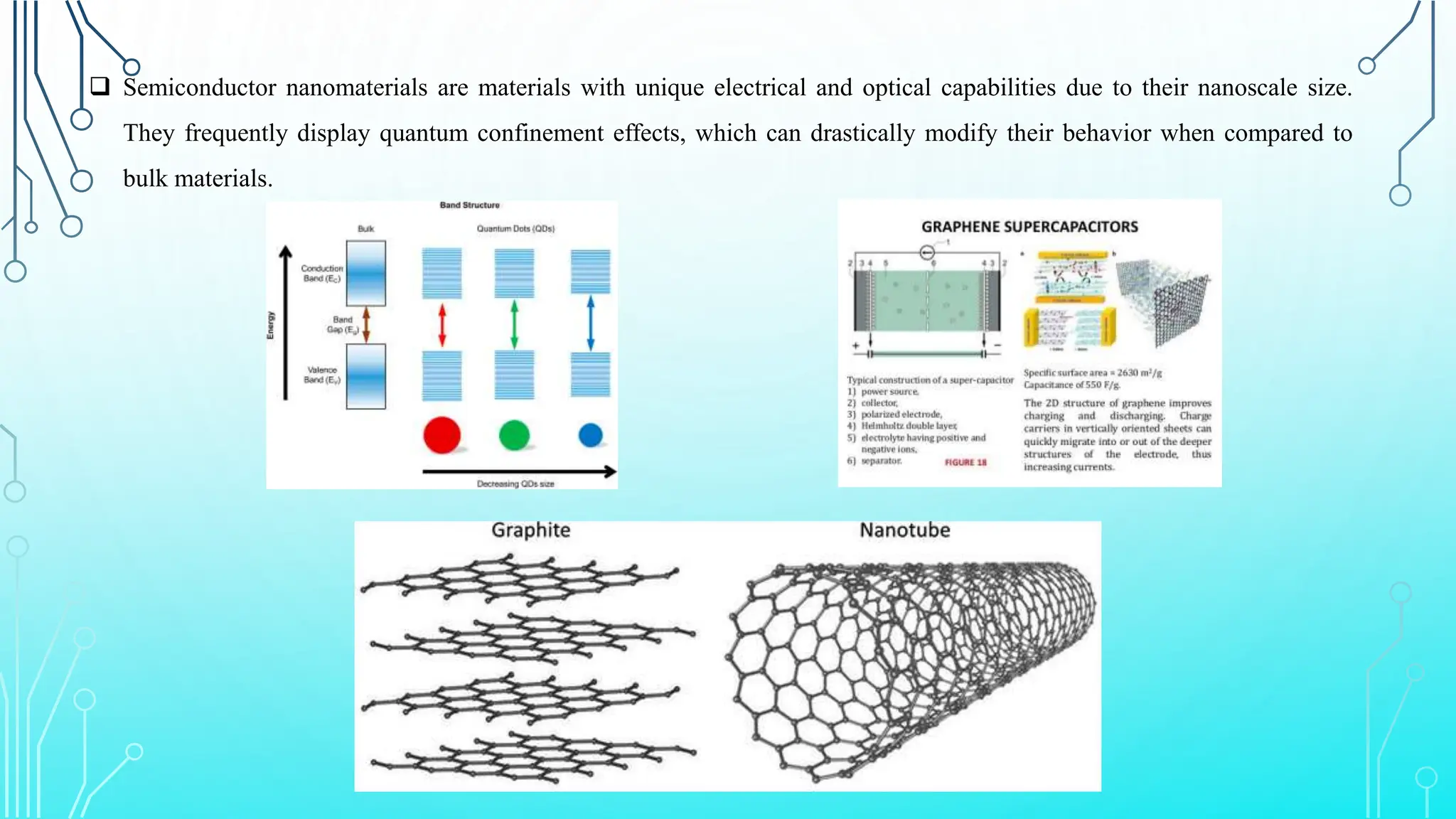
 Semiconductor nanomaterials are materials with unique electrical and optical capabilities due to their nanoscale size.
They frequently display quantum confinement effects, which can drastically modify their behavior when compared to
bulk materials.
WHAT ARE SEMI-CONDUCTORS
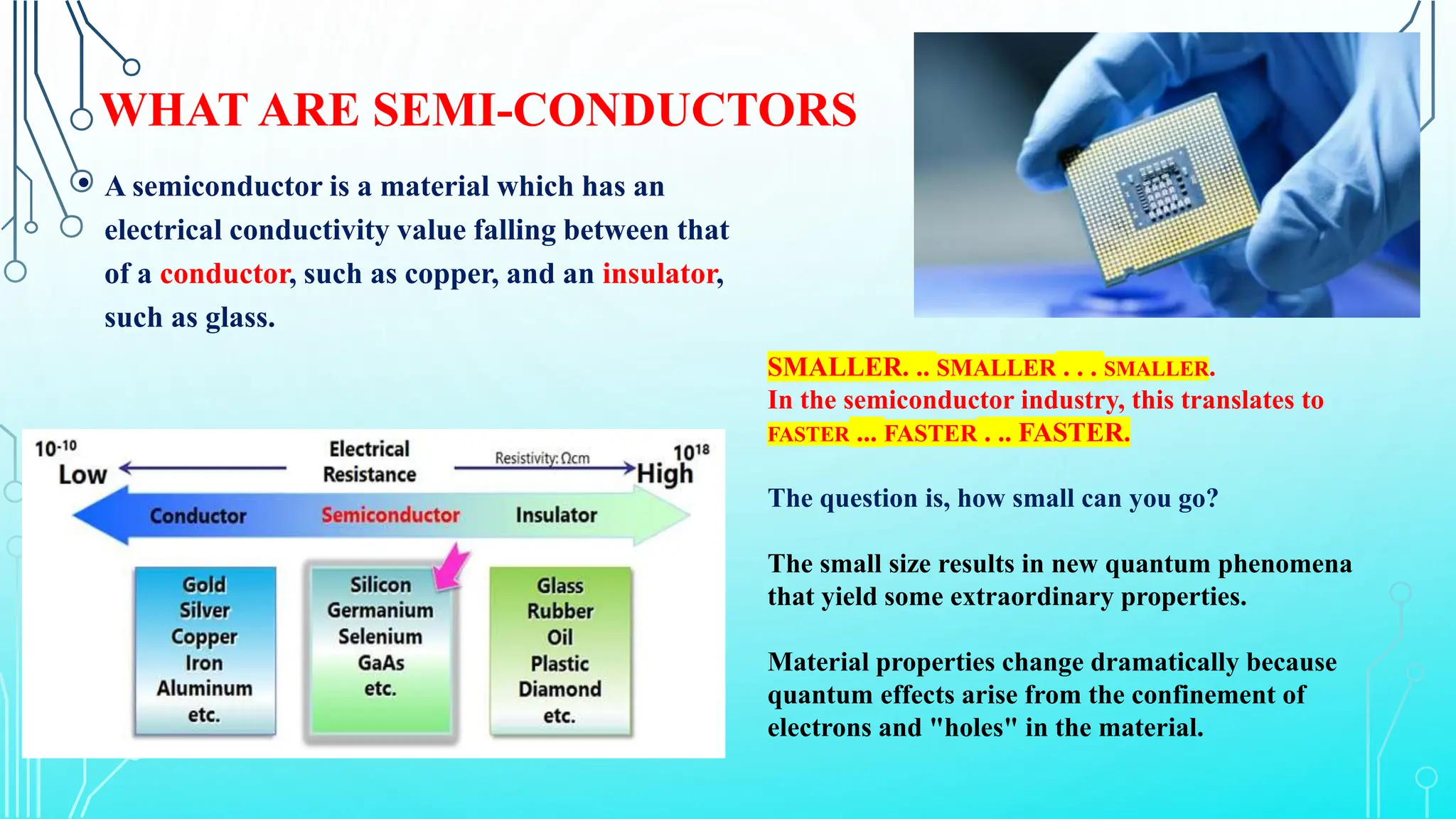
• A semiconductor is a material which has an
electrical conductivity value falling between that
of a conductor, such as copper, and an insulator,
such as glass.
SMALLER. .. SMALLER . . . SMALLER.
In the semiconductor industry, this translates to
FASTER ... FASTER . .. FASTER.
The question is, how small can you go?
The small size results in new quantum phenomena
that yield some extraordinary properties.
Material properties change dramatically because
quantum effects arise from the confinement of
electrons and "holes" in the material.
WHAT ARE SEMI-CONDUCTORS
Semiconductor devices, electronic components made of
semiconductor materials, are essential in modern
electrical devices. Examples range from computers to
cellular phones to digital audio players. Silicon is used to
create most semiconductors commercially, but dozens of
other materials are used as well.
Without the Semiconductors nothing in this world
that is built today would exist.
No communications
No Transportation
No Services
And many more
SEMICONDUCTOR MATERIALS IN ENERGY STORAGE
Carbon-Based Nanomaterials
SEMICONDUCTOR MATERIALS IN ENERGY STORAGE
Metal Oxides and Sulphides
Manganese oxide Iron oxide Ruthenium oxide
SEMICONDUCTOR MATERIALS IN ENERGY STORAGE
Conductive Polymers
DOS for PP and PP-g-GMA SnO and SnO2 at PANI nanocomposite
Polythiophene as potential
energy storage materials
SEMICONDUCTORS TYPES
Supercapacitors
SEMICONDUCTORS TYPES
CHARGING PROCESS
Li-Ion Battery
DISCHARGING PROCESS
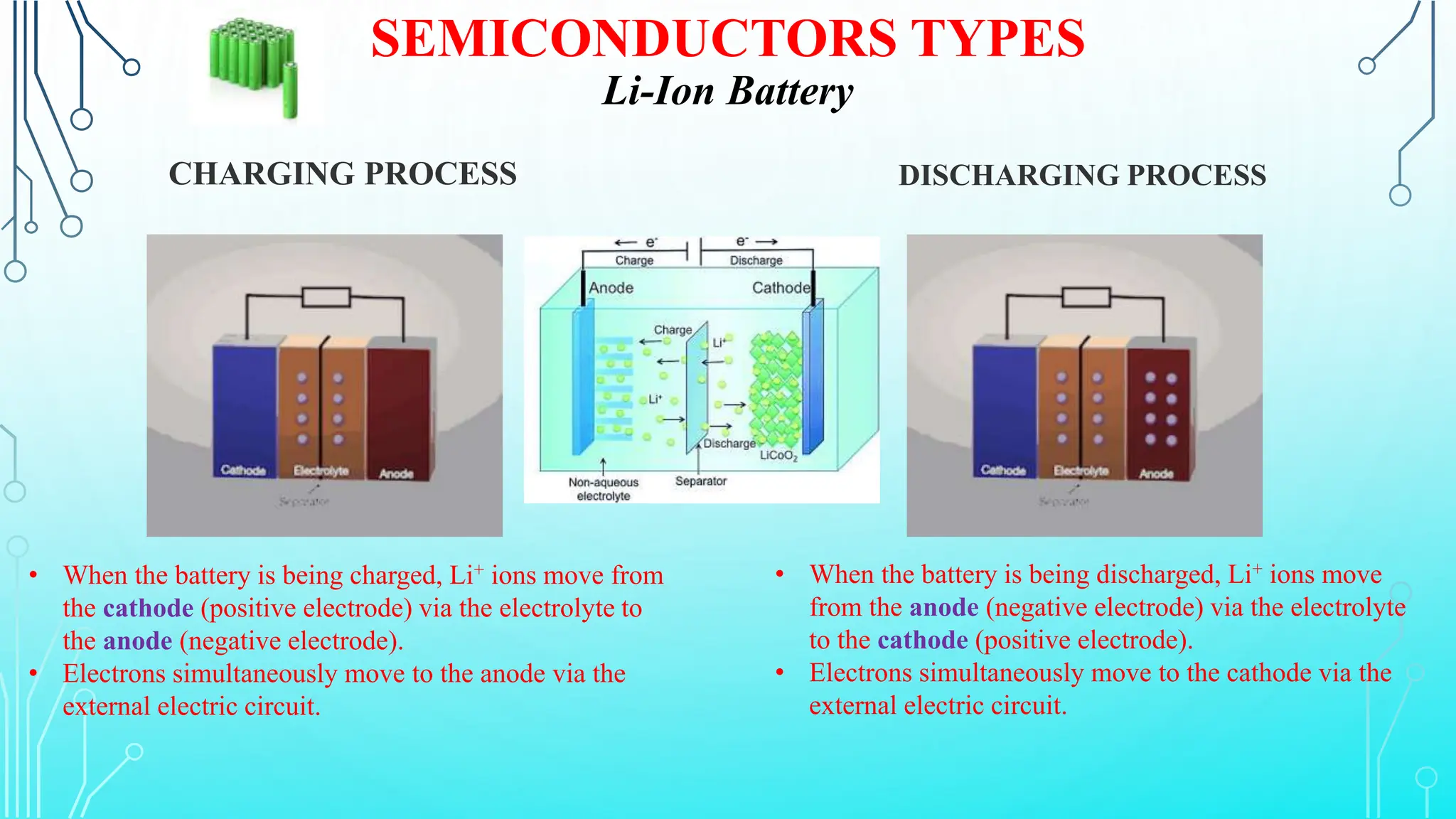
• When the battery is being charged, Li+ ions move from
the cathode (positive electrode) via the electrolyte to
the anode (negative electrode).
• Electrons simultaneously move to the anode via the
external electric circuit.
• When the battery is being discharged, Li+ ions move
from the anode (negative electrode) via the electrolyte
to the cathode (positive electrode).
• Electrons simultaneously move to the cathode via the
external electric circuit.
Sodium-Ion Battery
SEMICONDUCTORS TYPES
•They are rechargeable batteries which
require sodium ion movement between
electrodes during the charging and
discharging of the battery
Benefits:-
• Cheaper to produce
• Abundance of the raw materials
• Non-flammable
• Operate well in colder temperatures
• Store more energy per unit weight
• Less likely to experience thermal
runaway
Sodium as an alternative, sustainable battery technology
Sodium is a is low-cost and abundant
chemical element, homogeneously
distributed around the world
SIBs have clear advantages over many
current batteries - such as LIBs, lead-acid
(Pb-Acid) or nickel-cadmium (Ni-Cd)
batteries, as shown in table.
Synthesis of Semiconductor Nano Materials
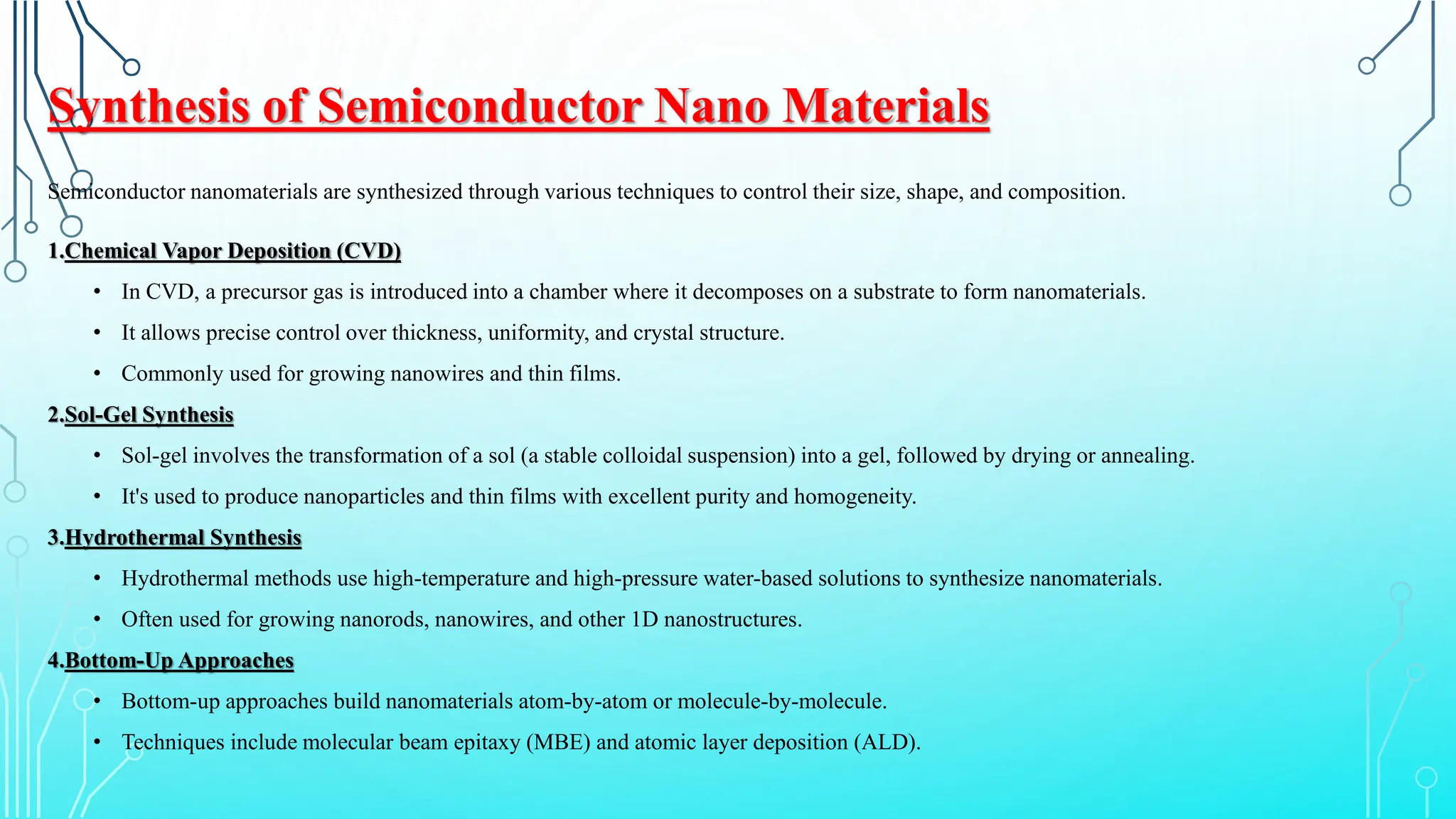
Semiconductor nanomaterials are synthesized through various techniques to control their size, shape, and composition.
1.Chemical Vapor Deposition (CVD)
• In CVD, a precursor gas is introduced into a chamber where it decomposes on a substrate to form nanomaterials.
• It allows precise control over thickness, uniformity, and crystal structure.
• Commonly used for growing nanowires and thin films.
2.Sol-Gel Synthesis
• Sol-gel involves the transformation of a sol (a stable colloidal suspension) into a gel, followed by drying or annealing.
• It's used to produce nanoparticles and thin films with excellent purity and homogeneity.
3.Hydrothermal Synthesis
• Hydrothermal methods use high-temperature and high-pressure water-based solutions to synthesize nanomaterials.
• Often used for growing nanorods, nanowires, and other 1D nanostructures.
4.Bottom-Up Approaches
• Bottom-up approaches build nanomaterials atom-by-atom or molecule-by-molecule.
• Techniques include molecular beam epitaxy (MBE) and atomic layer deposition (ALD).
CHEMICAL VAPOR DEPOSITION
(CVD)
• Chemical vapor deposition (CVD) is a process whereby a
solid material is deposited from a vapor by a chemical
reaction occurring on or in the vicinity of a normally
heated substrate surface.
• The solid material is obtained as a coating, a powder, or
as single crystals.
• By varying the experimental conditions—substrate
material, substrate temperature, composition of the
reaction gas mixture, total pressure gas flows, etc.—
materials with different properties can be grown.
• CVD is an example for Solid-Vapor Reaction.
SOL-GEL SYNTHESIS
• A sol is a stable dispersion of particles or polymers in a solvent. The particles may be amorphous or
crystalline.
• A gel consists of a three dimensional continuous network, which encloses a liquid phase.
• Sol-gel is a process in which solid nanoparticles dispersed in a liquid (a sol) agglomerate together to
form a continuous three-dimensional network extending throughout the liquid (a gel).
Network Formation
• As the sol aggregates the viscosity will
increase until a gel is formed.
• The sol-gel transition (gel-point) is
reached when a continuous network is
formed.
• The gel-time is determined as the time
when it is possible to turn the
container upside-down.
Properties of Semiconductor Nano Materials for Energy Storage
1 Large Surface To Volume Ratio
Their high surface area provides more active sites
for energy storage reactions.
2 Enhanced Charge Transfer
They facilitate faster and more efficient
movement of charges during storage and release.
3 Tunable Band Gap
The band gap can be adjusted to optimize energy
storage performance.
4 Absorption and Adsorption
Absorption and Adsorption molecules are high
and fast
LARGEST SEMICONDUCTOR COMPANIES IN THE WORLD
SEMICONDUCTORS IN INDIA
• Communications and IT minister Ashwini
Vishnaw announced the decision after the
Cabinet meeting, chaired by Prime Minister
• Proposal, which seeks to put India in the global
league of top electronics manufacturing nations
such as China, Taiwan, South Korea and
Malaysia.
• India finally took a giant leap towards
getting semiconductor and display fab
manufacturing into the country through a
Rs 76,000-crore incentive package.
• Electronics manufacturing in the country
currently stands at around $75 billion, it is
expected to grow to as much as $250 billion
over the next five years.
SEMICONDUCTORS IN INDIA
Challenges and Future Prospects
1 Environmental Impact
• Raw Material Sourcing
• Rare Earth Elements
2 Manufacturing Processes
• Energy Consumption
• Chemical Usage
• Waste Generation
3 Life Cycle Assessment (LCA)
• Comprehensive Analysis
• Input-Output Analysis
• Comparative Assessment
4 Recyclability and Reusability of Materials
• Material Design for Recyclability
• Reusability of Nanomaterials
Conclusion
 Advanced semiconductor nanomaterials present a possible route for more effective energy storage technologies. They provide
greater energy density, quicker charging, and extended cycle life in batteries and supercapacitors because of the nanoscale
characteristics and quantum effects.
 This improvement in efficiency is essential for meeting the rising need for dependable, clean energy, especially as we move
toward renewable sources.
 Current research must, however, concentrate on scalability, cost-effectiveness, and reducing possible toxicity problems in order to
fully realize their promise. These nanoparticles are a ray of hope for a cleaner, more effective energy future that promises a robust
and sustainable energy system for future generations as we develop.
REFERNECES
• Das, Santosh. 2019. “Silicon and Semiconductor - Electronics Tutorial | The Best Electronics Tutorial
Website.” Electronics Tutorial | the Best Electronics Tutorial Website. August 13, 2019.
https://www.electronicsandyou.com/blog/usa-semiconductor-companies-top-10-semiconductor-
companies-in-united-states-us.html/silicon-semiconductor.
• Owano, Nancy. 2012. “Taiwan Engineers Defeat Limits of Flash Memory.” Phys.Org, December 2,
2012. https://phys.org/news/2012-12-taiwan-defeat-limits-memory.html.
• Naik, Ramachandra, Ramyakrishna Pothu, Prashantha S. C, H. Nagabhushana, Aditya Saran,
Harisekhar Mitta, and Rajender Boddula. 2019. “Energy-Saving Synthesis of MG2SIO4:RE3+
Nanophosphors for Solid-State Lighting Applications.” In Environmental Chemistry for a Sustainable
World, 121–43. https://doi.org/10.1007/978-3-030-04500-5_5.
• Staff, Beebom, and Beebom Staff. 2021. “TSMC, Nvidia, and Intel Say That the Global Chip
Shortage Will Continue till 2023: Report.” Beebom. April 24, 2021. https://beebom.com/tsmc-nvidia-
and-intel-say-global-chip-shortage-will-continue-till-2023/.
• “What Is a Semiconductor? | Toshiba Electronic Devices & Storage Corporation | Americas – United
States.” n.d. https://toshiba.semicon-storage.com/us/semiconductor/knowledge/e-
learning/discrete/chap1/chap1-1.html.
• Dubey, Nitisha, and Nitisha Dubey. 2022. “Top 7 Supercapacitors Manufacturers in the World.”
Bisinfotech, August 24, 2022. https://www.bisinfotech.com/top-7-supercapacitors-manufacturers-in-
the-world/.
• “Mazda ‘i-ELOOP’ world’s first Capacitor-Based regenerative braking system for passenger
vehicles.” n.d. https://www.auto-press.net/a:Mazda-i-ELOOP-World-s-First-Capacitor-Based-
Regenerative-Braking-System-for-Passenger-Vehicles.
• Ramadan, Abdallah, and Wegdan Ramadan. 2023. “Carbon and Metal Doped Polyaniline (PANI) for
Energy Storage.” In Composites Science and Technology, 331–59. https://doi.org/10.1007/978-981-
99-1350-3_12.
• Ghiji, Mohammadmahdi, Vasily Novozhilov, Khalid Moinuddin, Paul Joseph, Ian Burch, Brigitta
Suendermann, and Grant Gamble. "A review of lithium-ion battery fire suppression." Energies 13, no.
19 (2020): 5117.
• News Release | PNNL. “Longer Lasting Sodium-Ion Batteries on the Horizon,” n.d.
https://www.pnnl.gov/news-media/longer-lasting-sodium-ion-batteries-horizon.
• Peters, J. “Life Cycle Assessment of Sodium-Ion Batteries,” 2016.
https://www.semanticscholar.org/paper/Life-cycle-assessment-of-sodium-ion-batteries-Peters-
Buchholz/73f9060ae30086d6eefffca0248d1395c64bc9fe.
• CIC energiGUNE. “Sodium-Ion Batteries: Towards a Sustainable, Low-Cost Energy Storage
Technology,” n.d. https://cicenergigune.com/en/blog/sodium-ion-batteries-sustainable-lowcost-energy-
storage-technology.
• Bai, Liqi, Yihe Zhang, Wangshu Tong, Li Sun, Qi An, Na Tian, and Paul K. Chu. “Graphene for
Energy Storage and Conversion: Synthesis and Interdisciplinary Applications.” Electrochemical
Energy Reviews, April 25, 2019. https://doi.org/10.1007/s41918-019-00042-6.
• Keita, K., F. Okafor, L. Nyochembeng, A. Overton, V. R. Sripathi, and J. Odutola. "Plant and
microbial growth responses to multi-walled carbon nanotubes." J Nanosci Curr Res 3, no. 123 (2018):
2572-0813.
• Majumdar, Dipanwita, Thandavarayan Maiyalagan, and Zhongqing Jiang. "Recent progress in
ruthenium oxide‐based composites for supercapacitor applications." ChemElectroChem 6, no. 17
(2019): 4343-4372.
• Lv, Linfeng, Mengdi Peng, Leixin Wu, Yixiao Dong, Gongchuan You, Yixue Duan, Wei Yang, Liang
He, and Xiaoyu Liu. “Progress in Iron Oxides Based Nanostructures for Applications in Energy
Storage.” Nanoscale Research Letters, August 31, 2021. https://doi.org/10.1186/s11671-021-03594-z.
• Reiff, Nathan. “10 Biggest Semiconductor Companies.” Investopedia, May 1, 2023.
https://www.investopedia.com/articles/markets/012216/worlds-top-10-semiconductor-companies-
tsmintc.asp.
• Das, Santosh. “Top 10 Semiconductor Manufacturing Companies in India.” Electronics Tutorial | The
Best Electronics Tutorial Website, October 6, 2023. https://www.electronicsandyou.com/blog/top-10-
Thank you

Integration of Nanomaterial with Semiconductor.pptx

  • 1.
    Advance Semiconductor Nano Materialsfor Energy Storage Applications SEMINAR TOPIC ABHAYSINH RAJPUT [20BCH122D] AYUSH DOSHI [20BCH124D] BADAL PARMAR [20BCH125D] GUIDED BY:- DR.SWAPNIL DHARASKAR STUDENTS NAME & ROLL NO:- SoET SCHOOL OF ENERGY TECHNOLOGY
  • 2.
    OUTLINE  INTRODUCTION  WHATARE SEMI-CONDUCTORS  SEMI-CONDUCTORS NANOMATERIAL FOR ENERGY STORAGE  TYPES OF SEMI-CONDUCTORS  SYNTHESIS OF SEMI CONDUCTORS NANO MATERIALS  LARGEST SEMI-CONDUCTOR COMPANIES IN THE WORLD  SEMI-CONDUCTOR IN INDIA  CHALLENGES & FUTURE PROSPECTS  CONCLUSION  REFERENCES
  • 3.
    INTRODUCTION A semiconductor isa material which has electrical conductivity between the conductor and insulator. • The conductivity of a semiconductor increases with increasing temperature, behavior opposite to metal. • Example:-metalloids silicon (Si) and germanium (Ge) are semiconductors.
  • 4.
     Semiconductor nanomaterialsare materials with unique electrical and optical capabilities due to their nanoscale size. They frequently display quantum confinement effects, which can drastically modify their behavior when compared to bulk materials.
  • 5.
    WHAT ARE SEMI-CONDUCTORS •A semiconductor is a material which has an electrical conductivity value falling between that of a conductor, such as copper, and an insulator, such as glass. SMALLER. .. SMALLER . . . SMALLER. In the semiconductor industry, this translates to FASTER ... FASTER . .. FASTER. The question is, how small can you go? The small size results in new quantum phenomena that yield some extraordinary properties. Material properties change dramatically because quantum effects arise from the confinement of electrons and "holes" in the material.
  • 6.
    WHAT ARE SEMI-CONDUCTORS Semiconductordevices, electronic components made of semiconductor materials, are essential in modern electrical devices. Examples range from computers to cellular phones to digital audio players. Silicon is used to create most semiconductors commercially, but dozens of other materials are used as well. Without the Semiconductors nothing in this world that is built today would exist. No communications No Transportation No Services And many more
  • 7.
    SEMICONDUCTOR MATERIALS INENERGY STORAGE Carbon-Based Nanomaterials
  • 8.
    SEMICONDUCTOR MATERIALS INENERGY STORAGE Metal Oxides and Sulphides Manganese oxide Iron oxide Ruthenium oxide
  • 9.
    SEMICONDUCTOR MATERIALS INENERGY STORAGE Conductive Polymers DOS for PP and PP-g-GMA SnO and SnO2 at PANI nanocomposite Polythiophene as potential energy storage materials
  • 10.
  • 11.
    SEMICONDUCTORS TYPES CHARGING PROCESS Li-IonBattery DISCHARGING PROCESS • When the battery is being charged, Li+ ions move from the cathode (positive electrode) via the electrolyte to the anode (negative electrode). • Electrons simultaneously move to the anode via the external electric circuit. • When the battery is being discharged, Li+ ions move from the anode (negative electrode) via the electrolyte to the cathode (positive electrode). • Electrons simultaneously move to the cathode via the external electric circuit.
  • 12.
    Sodium-Ion Battery SEMICONDUCTORS TYPES •Theyare rechargeable batteries which require sodium ion movement between electrodes during the charging and discharging of the battery Benefits:- • Cheaper to produce • Abundance of the raw materials • Non-flammable • Operate well in colder temperatures • Store more energy per unit weight • Less likely to experience thermal runaway
  • 13.
    Sodium as analternative, sustainable battery technology Sodium is a is low-cost and abundant chemical element, homogeneously distributed around the world SIBs have clear advantages over many current batteries - such as LIBs, lead-acid (Pb-Acid) or nickel-cadmium (Ni-Cd) batteries, as shown in table.
  • 14.
    Synthesis of SemiconductorNano Materials Semiconductor nanomaterials are synthesized through various techniques to control their size, shape, and composition. 1.Chemical Vapor Deposition (CVD) • In CVD, a precursor gas is introduced into a chamber where it decomposes on a substrate to form nanomaterials. • It allows precise control over thickness, uniformity, and crystal structure. • Commonly used for growing nanowires and thin films. 2.Sol-Gel Synthesis • Sol-gel involves the transformation of a sol (a stable colloidal suspension) into a gel, followed by drying or annealing. • It's used to produce nanoparticles and thin films with excellent purity and homogeneity. 3.Hydrothermal Synthesis • Hydrothermal methods use high-temperature and high-pressure water-based solutions to synthesize nanomaterials. • Often used for growing nanorods, nanowires, and other 1D nanostructures. 4.Bottom-Up Approaches • Bottom-up approaches build nanomaterials atom-by-atom or molecule-by-molecule. • Techniques include molecular beam epitaxy (MBE) and atomic layer deposition (ALD).
  • 15.
    CHEMICAL VAPOR DEPOSITION (CVD) •Chemical vapor deposition (CVD) is a process whereby a solid material is deposited from a vapor by a chemical reaction occurring on or in the vicinity of a normally heated substrate surface. • The solid material is obtained as a coating, a powder, or as single crystals. • By varying the experimental conditions—substrate material, substrate temperature, composition of the reaction gas mixture, total pressure gas flows, etc.— materials with different properties can be grown. • CVD is an example for Solid-Vapor Reaction.
  • 16.
    SOL-GEL SYNTHESIS • Asol is a stable dispersion of particles or polymers in a solvent. The particles may be amorphous or crystalline. • A gel consists of a three dimensional continuous network, which encloses a liquid phase. • Sol-gel is a process in which solid nanoparticles dispersed in a liquid (a sol) agglomerate together to form a continuous three-dimensional network extending throughout the liquid (a gel). Network Formation • As the sol aggregates the viscosity will increase until a gel is formed. • The sol-gel transition (gel-point) is reached when a continuous network is formed. • The gel-time is determined as the time when it is possible to turn the container upside-down.
  • 17.
    Properties of SemiconductorNano Materials for Energy Storage 1 Large Surface To Volume Ratio Their high surface area provides more active sites for energy storage reactions. 2 Enhanced Charge Transfer They facilitate faster and more efficient movement of charges during storage and release. 3 Tunable Band Gap The band gap can be adjusted to optimize energy storage performance. 4 Absorption and Adsorption Absorption and Adsorption molecules are high and fast
  • 18.
  • 19.
    SEMICONDUCTORS IN INDIA •Communications and IT minister Ashwini Vishnaw announced the decision after the Cabinet meeting, chaired by Prime Minister • Proposal, which seeks to put India in the global league of top electronics manufacturing nations such as China, Taiwan, South Korea and Malaysia. • India finally took a giant leap towards getting semiconductor and display fab manufacturing into the country through a Rs 76,000-crore incentive package. • Electronics manufacturing in the country currently stands at around $75 billion, it is expected to grow to as much as $250 billion over the next five years.
  • 20.
  • 21.
    Challenges and FutureProspects 1 Environmental Impact • Raw Material Sourcing • Rare Earth Elements 2 Manufacturing Processes • Energy Consumption • Chemical Usage • Waste Generation 3 Life Cycle Assessment (LCA) • Comprehensive Analysis • Input-Output Analysis • Comparative Assessment 4 Recyclability and Reusability of Materials • Material Design for Recyclability • Reusability of Nanomaterials
  • 22.
    Conclusion  Advanced semiconductornanomaterials present a possible route for more effective energy storage technologies. They provide greater energy density, quicker charging, and extended cycle life in batteries and supercapacitors because of the nanoscale characteristics and quantum effects.  This improvement in efficiency is essential for meeting the rising need for dependable, clean energy, especially as we move toward renewable sources.  Current research must, however, concentrate on scalability, cost-effectiveness, and reducing possible toxicity problems in order to fully realize their promise. These nanoparticles are a ray of hope for a cleaner, more effective energy future that promises a robust and sustainable energy system for future generations as we develop.
  • 23.
    REFERNECES • Das, Santosh.2019. “Silicon and Semiconductor - Electronics Tutorial | The Best Electronics Tutorial Website.” Electronics Tutorial | the Best Electronics Tutorial Website. August 13, 2019. https://www.electronicsandyou.com/blog/usa-semiconductor-companies-top-10-semiconductor- companies-in-united-states-us.html/silicon-semiconductor. • Owano, Nancy. 2012. “Taiwan Engineers Defeat Limits of Flash Memory.” Phys.Org, December 2, 2012. https://phys.org/news/2012-12-taiwan-defeat-limits-memory.html. • Naik, Ramachandra, Ramyakrishna Pothu, Prashantha S. C, H. Nagabhushana, Aditya Saran, Harisekhar Mitta, and Rajender Boddula. 2019. “Energy-Saving Synthesis of MG2SIO4:RE3+ Nanophosphors for Solid-State Lighting Applications.” In Environmental Chemistry for a Sustainable World, 121–43. https://doi.org/10.1007/978-3-030-04500-5_5. • Staff, Beebom, and Beebom Staff. 2021. “TSMC, Nvidia, and Intel Say That the Global Chip Shortage Will Continue till 2023: Report.” Beebom. April 24, 2021. https://beebom.com/tsmc-nvidia- and-intel-say-global-chip-shortage-will-continue-till-2023/. • “What Is a Semiconductor? | Toshiba Electronic Devices & Storage Corporation | Americas – United States.” n.d. https://toshiba.semicon-storage.com/us/semiconductor/knowledge/e- learning/discrete/chap1/chap1-1.html. • Dubey, Nitisha, and Nitisha Dubey. 2022. “Top 7 Supercapacitors Manufacturers in the World.” Bisinfotech, August 24, 2022. https://www.bisinfotech.com/top-7-supercapacitors-manufacturers-in- the-world/. • “Mazda ‘i-ELOOP’ world’s first Capacitor-Based regenerative braking system for passenger vehicles.” n.d. https://www.auto-press.net/a:Mazda-i-ELOOP-World-s-First-Capacitor-Based- Regenerative-Braking-System-for-Passenger-Vehicles. • Ramadan, Abdallah, and Wegdan Ramadan. 2023. “Carbon and Metal Doped Polyaniline (PANI) for Energy Storage.” In Composites Science and Technology, 331–59. https://doi.org/10.1007/978-981- 99-1350-3_12. • Ghiji, Mohammadmahdi, Vasily Novozhilov, Khalid Moinuddin, Paul Joseph, Ian Burch, Brigitta Suendermann, and Grant Gamble. "A review of lithium-ion battery fire suppression." Energies 13, no. 19 (2020): 5117. • News Release | PNNL. “Longer Lasting Sodium-Ion Batteries on the Horizon,” n.d. https://www.pnnl.gov/news-media/longer-lasting-sodium-ion-batteries-horizon. • Peters, J. “Life Cycle Assessment of Sodium-Ion Batteries,” 2016. https://www.semanticscholar.org/paper/Life-cycle-assessment-of-sodium-ion-batteries-Peters- Buchholz/73f9060ae30086d6eefffca0248d1395c64bc9fe. • CIC energiGUNE. “Sodium-Ion Batteries: Towards a Sustainable, Low-Cost Energy Storage Technology,” n.d. https://cicenergigune.com/en/blog/sodium-ion-batteries-sustainable-lowcost-energy- storage-technology. • Bai, Liqi, Yihe Zhang, Wangshu Tong, Li Sun, Qi An, Na Tian, and Paul K. Chu. “Graphene for Energy Storage and Conversion: Synthesis and Interdisciplinary Applications.” Electrochemical Energy Reviews, April 25, 2019. https://doi.org/10.1007/s41918-019-00042-6. • Keita, K., F. Okafor, L. Nyochembeng, A. Overton, V. R. Sripathi, and J. Odutola. "Plant and microbial growth responses to multi-walled carbon nanotubes." J Nanosci Curr Res 3, no. 123 (2018): 2572-0813. • Majumdar, Dipanwita, Thandavarayan Maiyalagan, and Zhongqing Jiang. "Recent progress in ruthenium oxide‐based composites for supercapacitor applications." ChemElectroChem 6, no. 17 (2019): 4343-4372. • Lv, Linfeng, Mengdi Peng, Leixin Wu, Yixiao Dong, Gongchuan You, Yixue Duan, Wei Yang, Liang He, and Xiaoyu Liu. “Progress in Iron Oxides Based Nanostructures for Applications in Energy Storage.” Nanoscale Research Letters, August 31, 2021. https://doi.org/10.1186/s11671-021-03594-z. • Reiff, Nathan. “10 Biggest Semiconductor Companies.” Investopedia, May 1, 2023. https://www.investopedia.com/articles/markets/012216/worlds-top-10-semiconductor-companies- tsmintc.asp. • Das, Santosh. “Top 10 Semiconductor Manufacturing Companies in India.” Electronics Tutorial | The Best Electronics Tutorial Website, October 6, 2023. https://www.electronicsandyou.com/blog/top-10-
  • 24.