A Pen Based Intelligent System for Educating Arabic Handwriting
A Pen Based Intelligent System
for Educating Arabic Handwriting
A Pen Based Intelligent System for Educating Arabic Handwriting
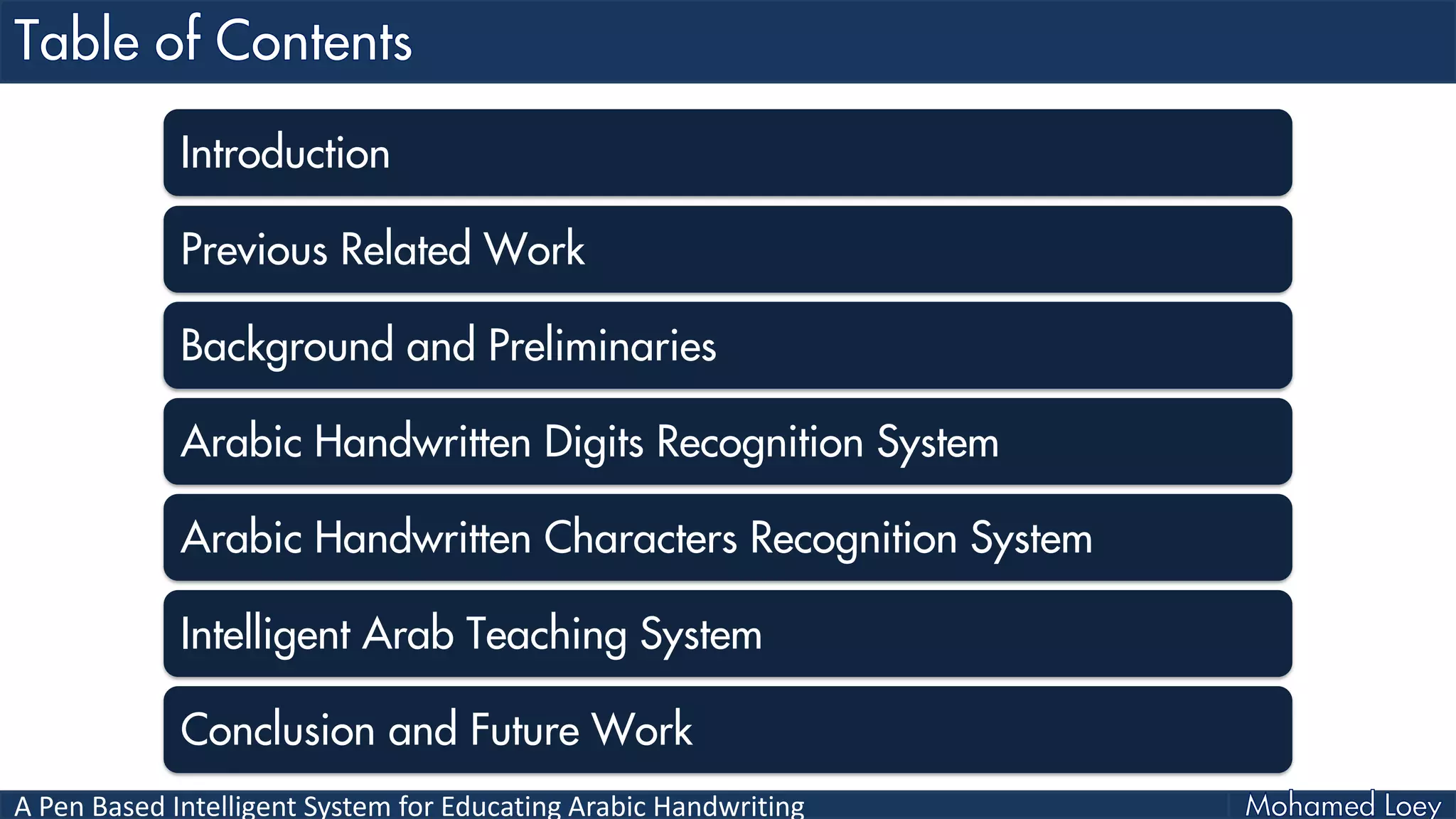
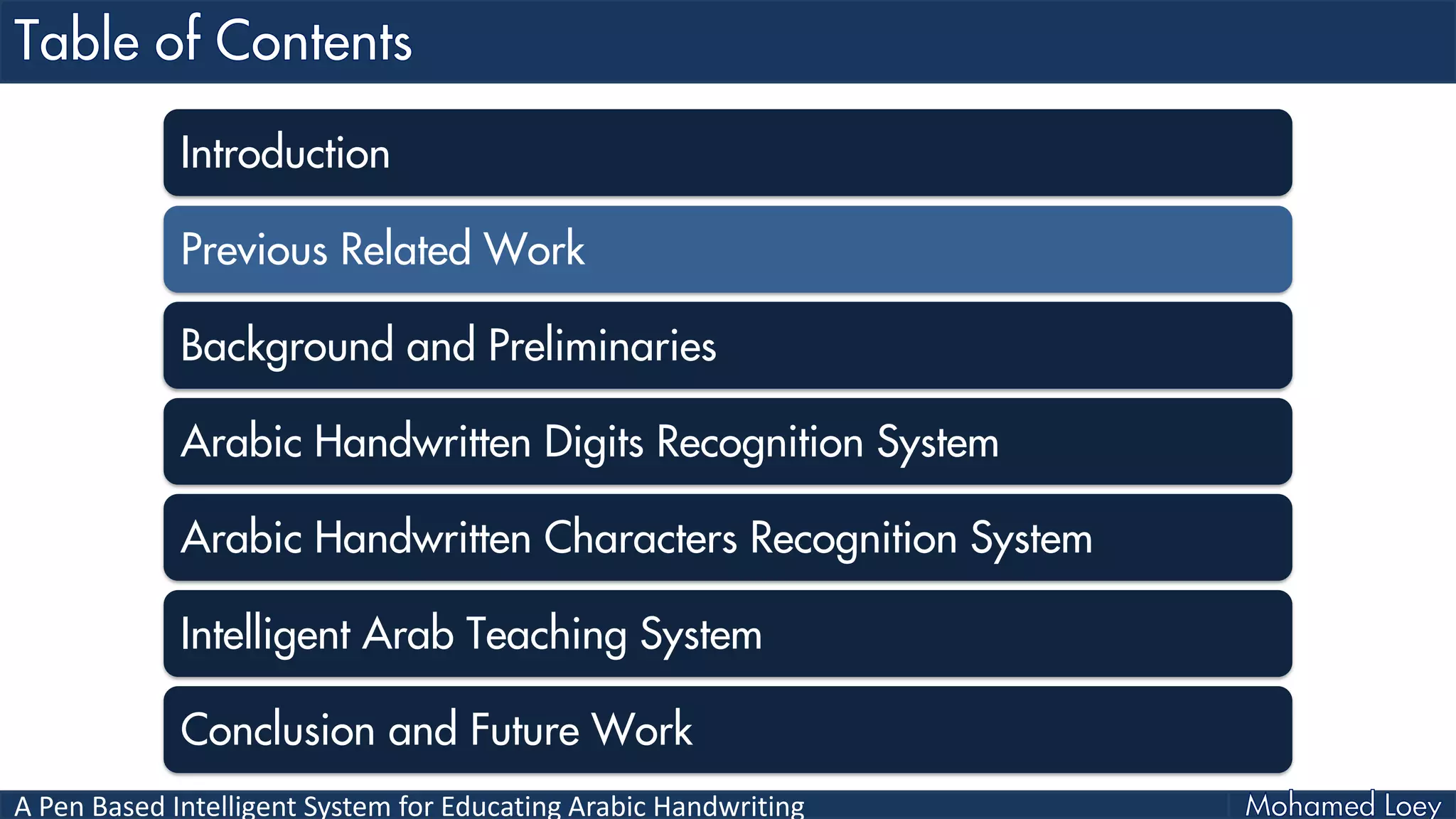
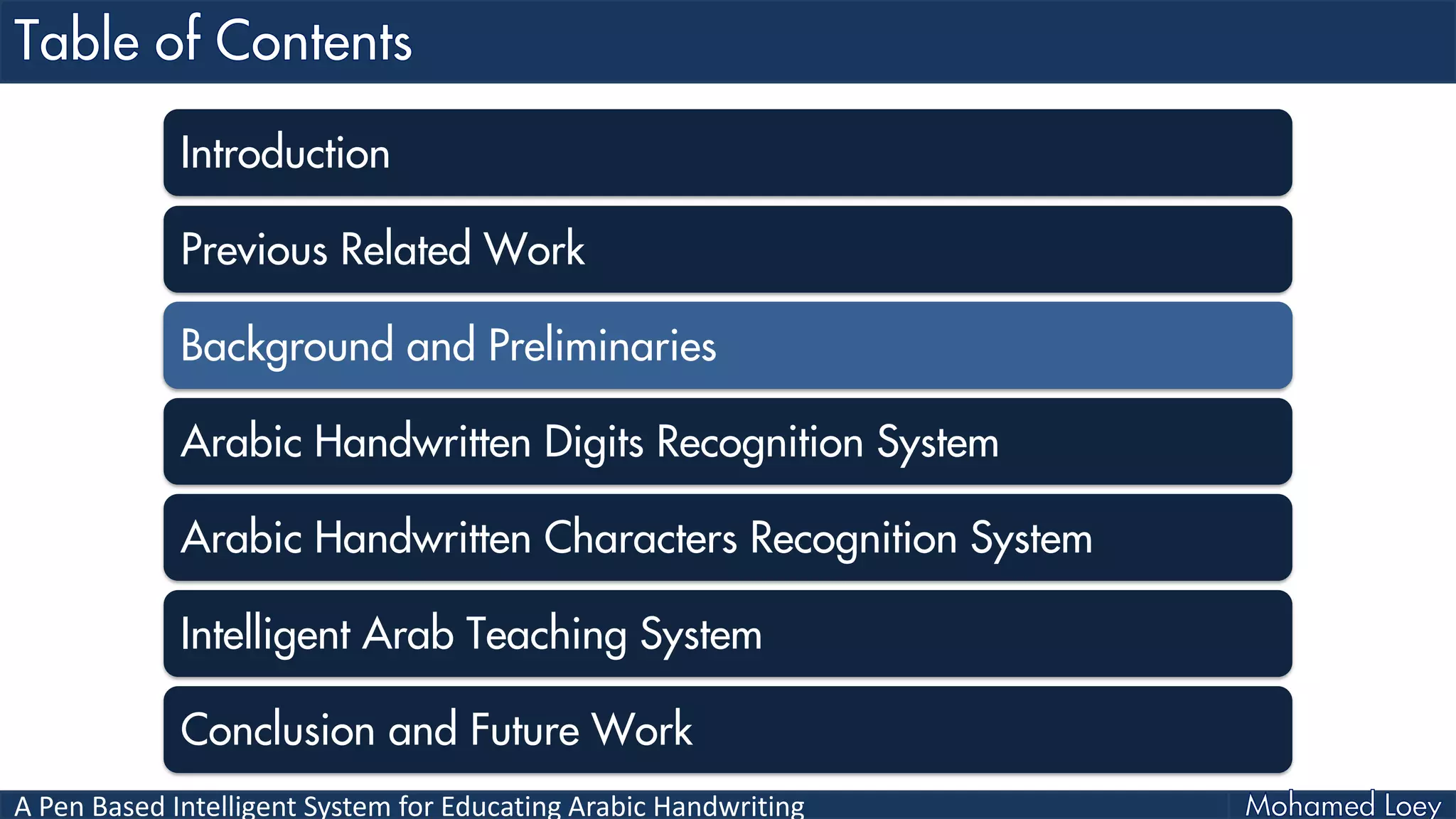
Introduction
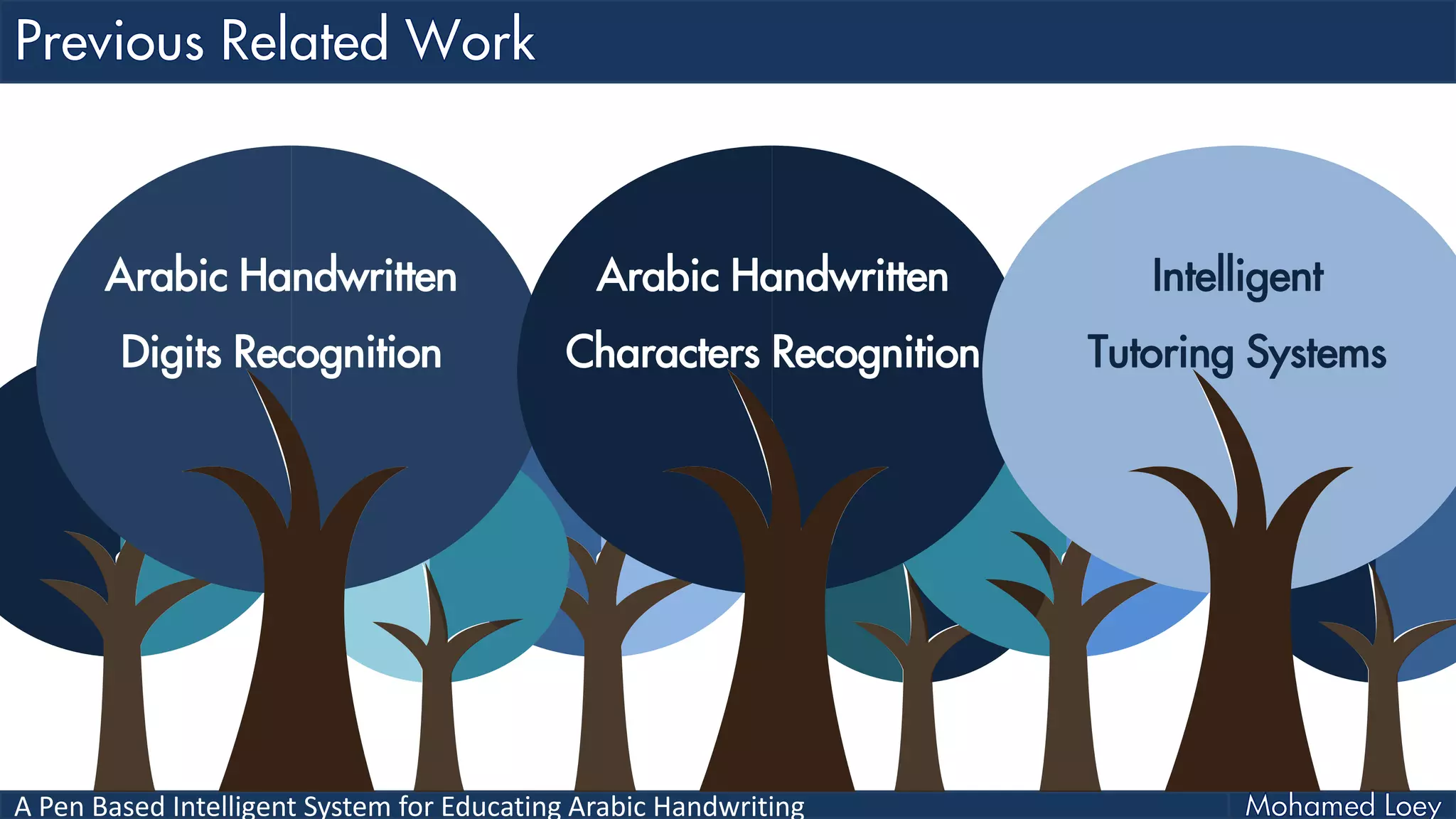
Previous Related Work
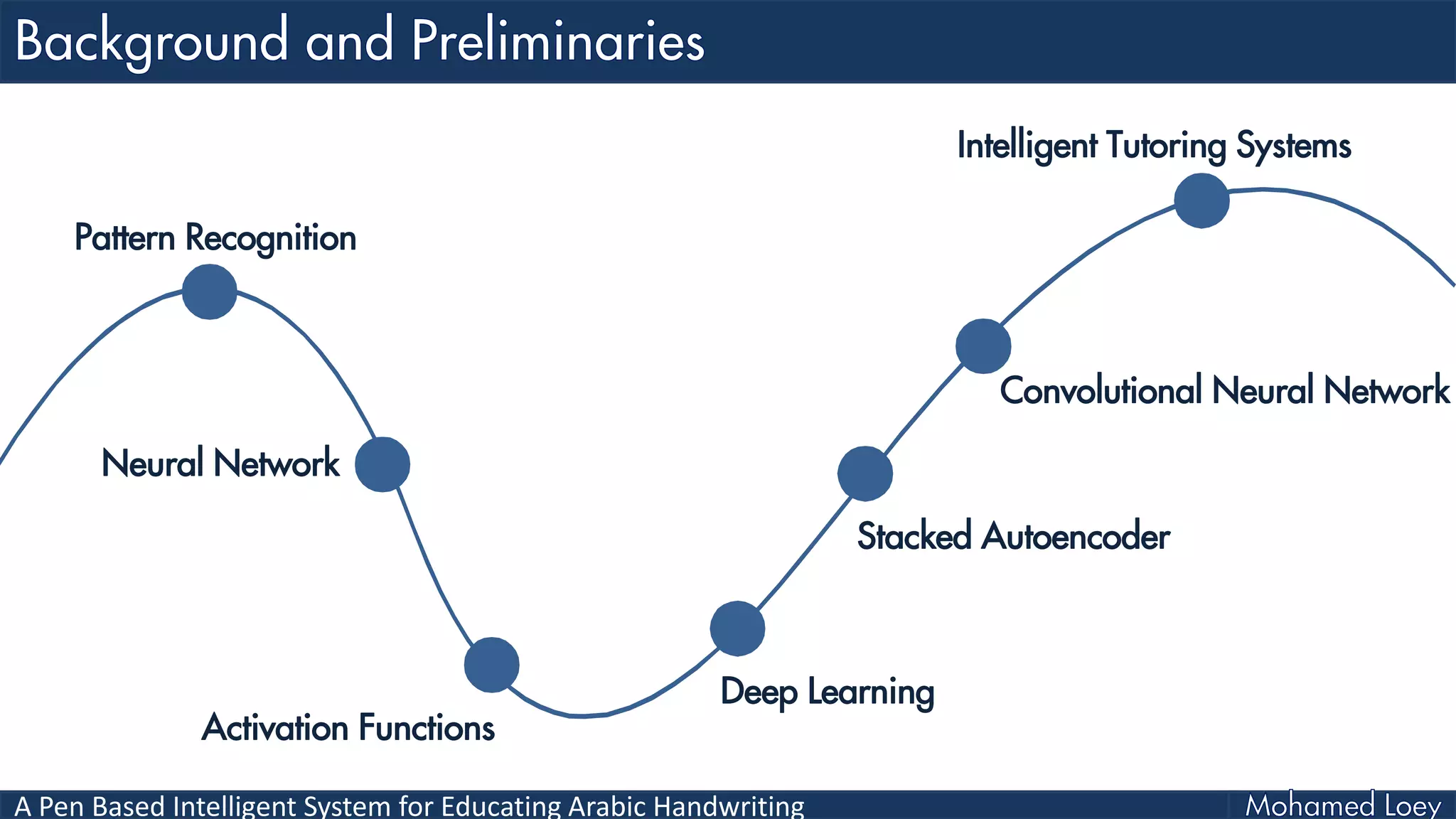
Background and Preliminaries
Arabic Handwritten Digits Recognition System
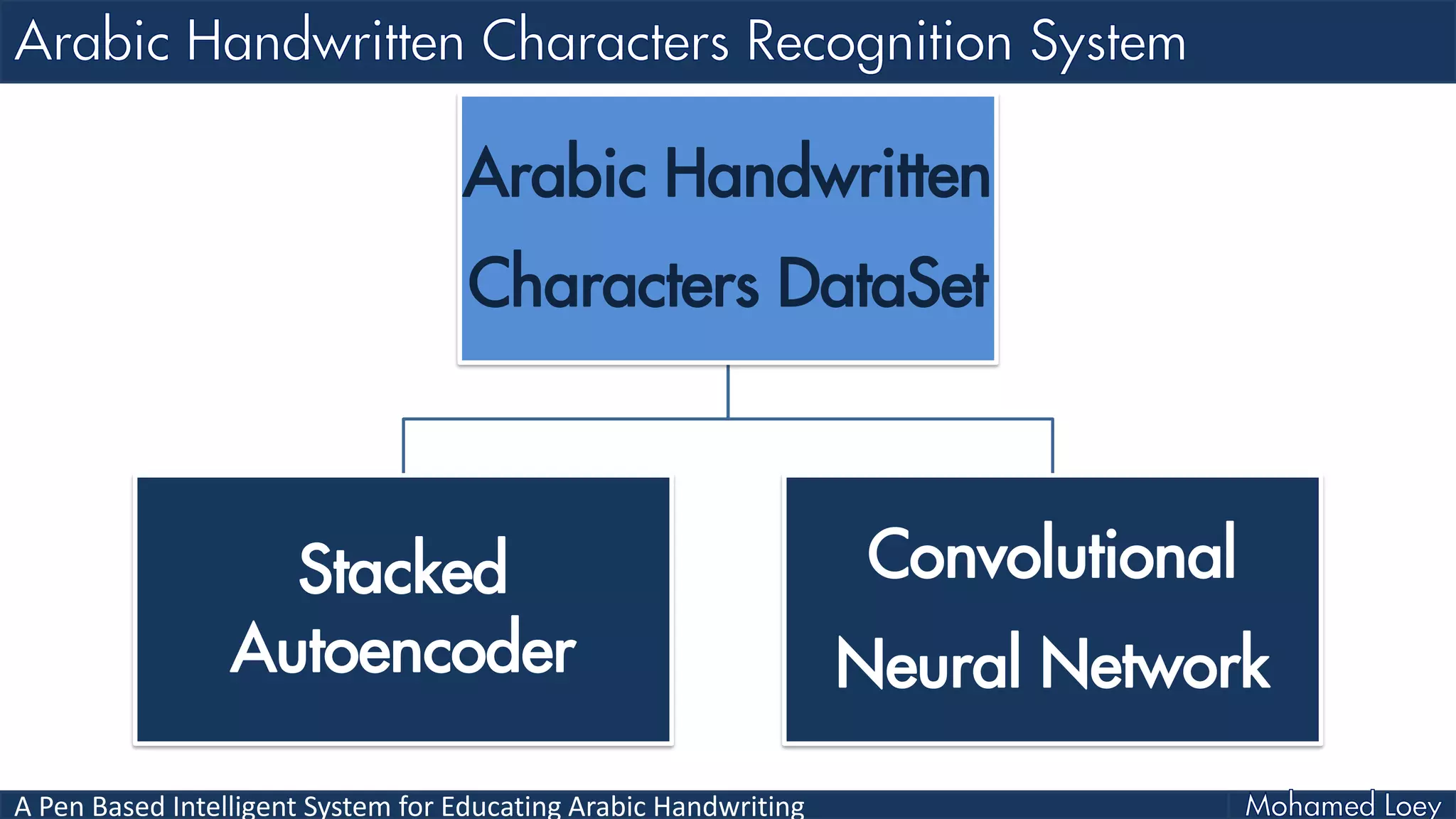
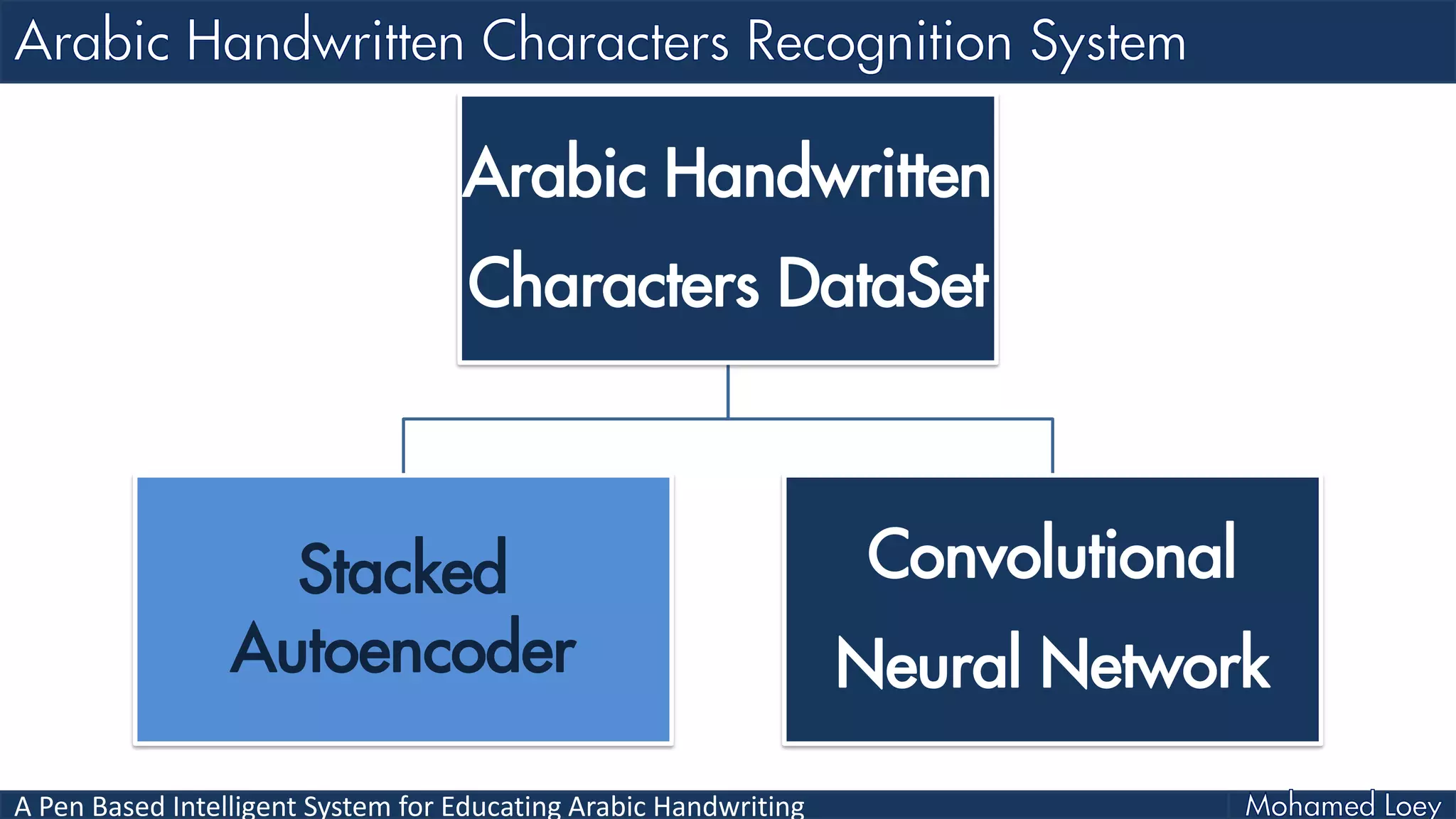
Arabic Handwritten Characters Recognition System
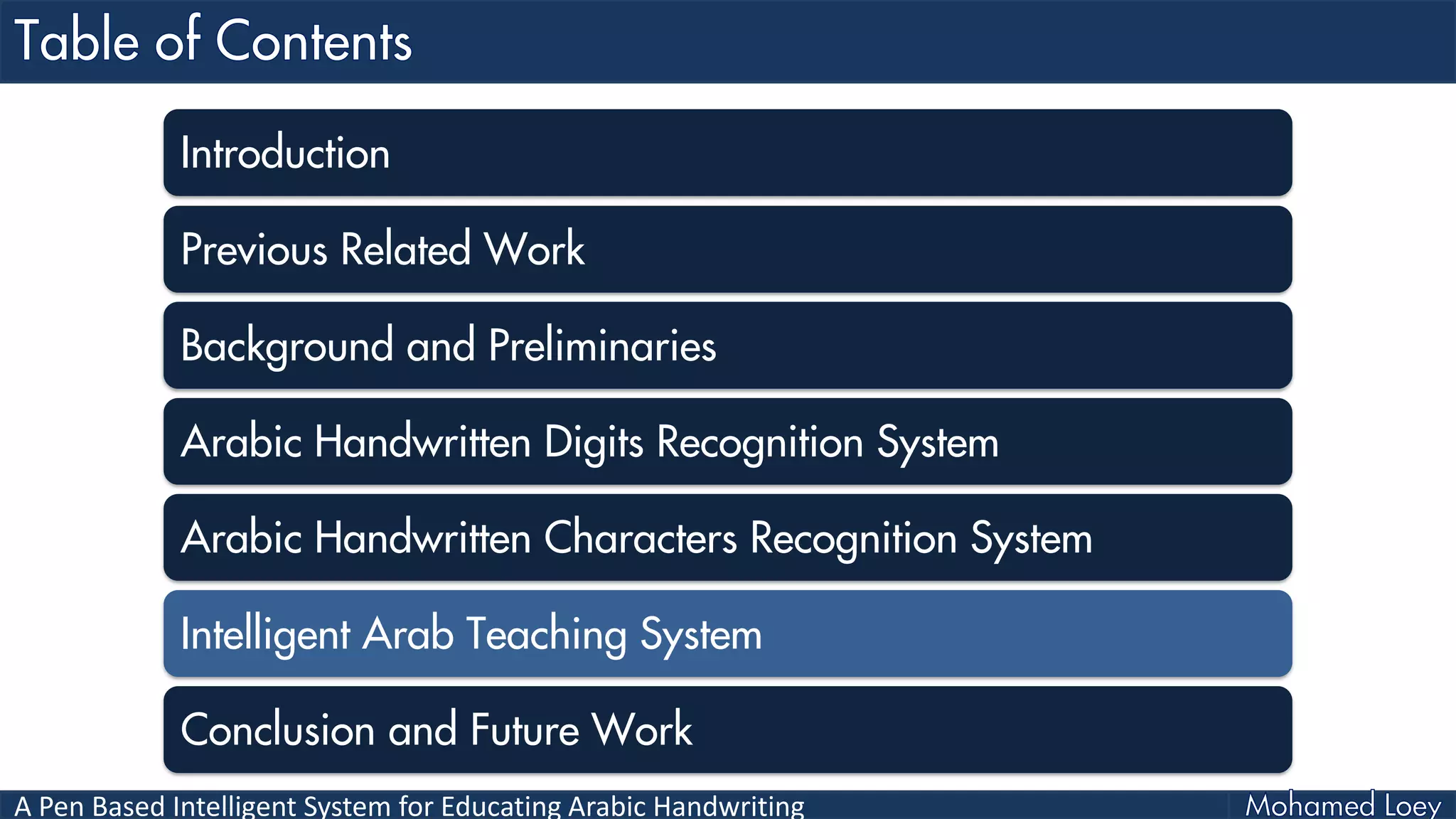
Intelligent Arab Teaching System
Conclusion and Future Work
A Pen Based Intelligent System for Educating Arabic Handwriting
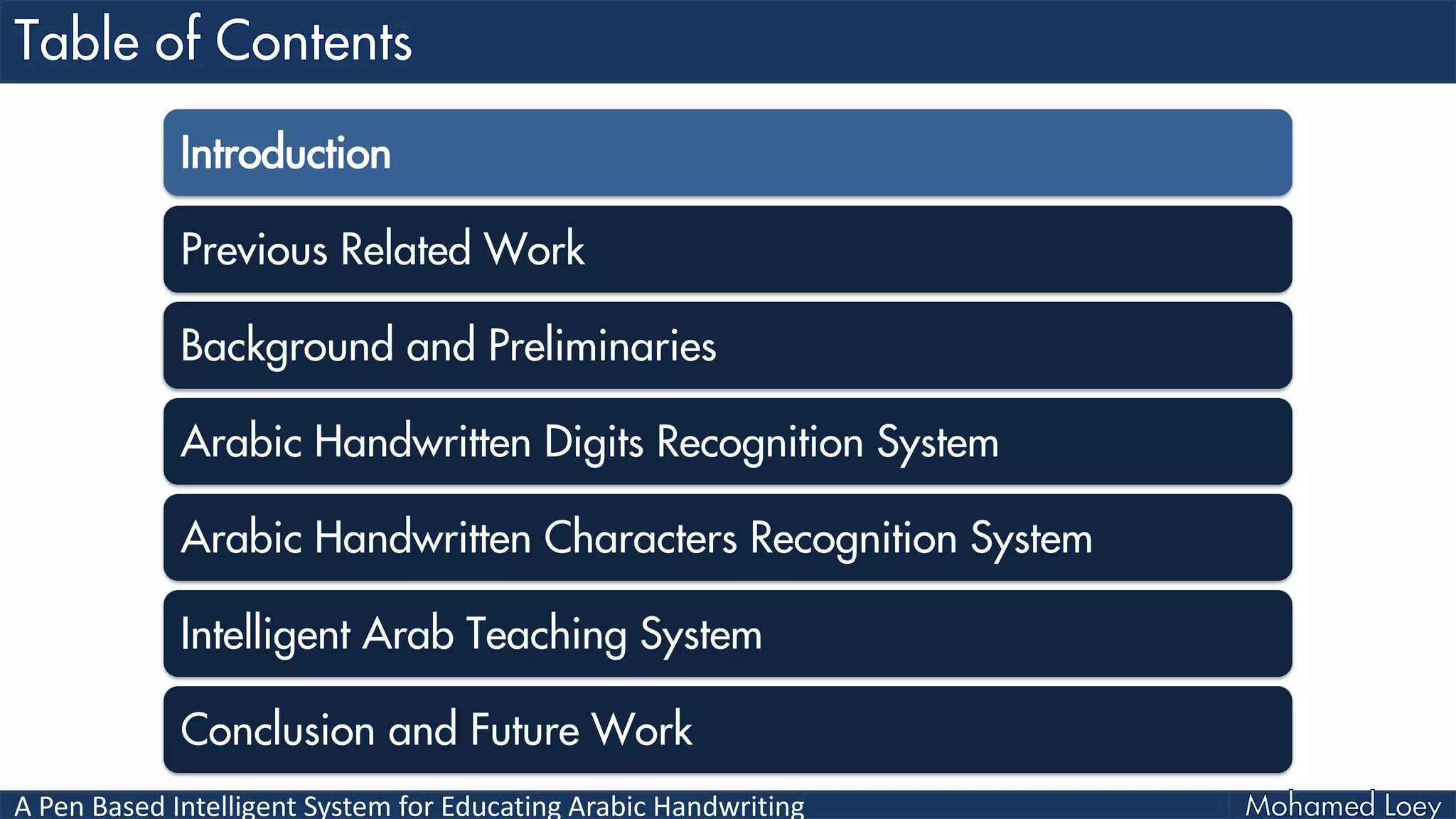
Introduction
Previous Related Work
Background and Preliminaries
Arabic Handwritten Digits Recognition System
Arabic Handwritten Characters Recognition System
Intelligent Arab Teaching System
Conclusion and Future Work
A Pen Based Intelligent System for Educating Arabic Handwriting
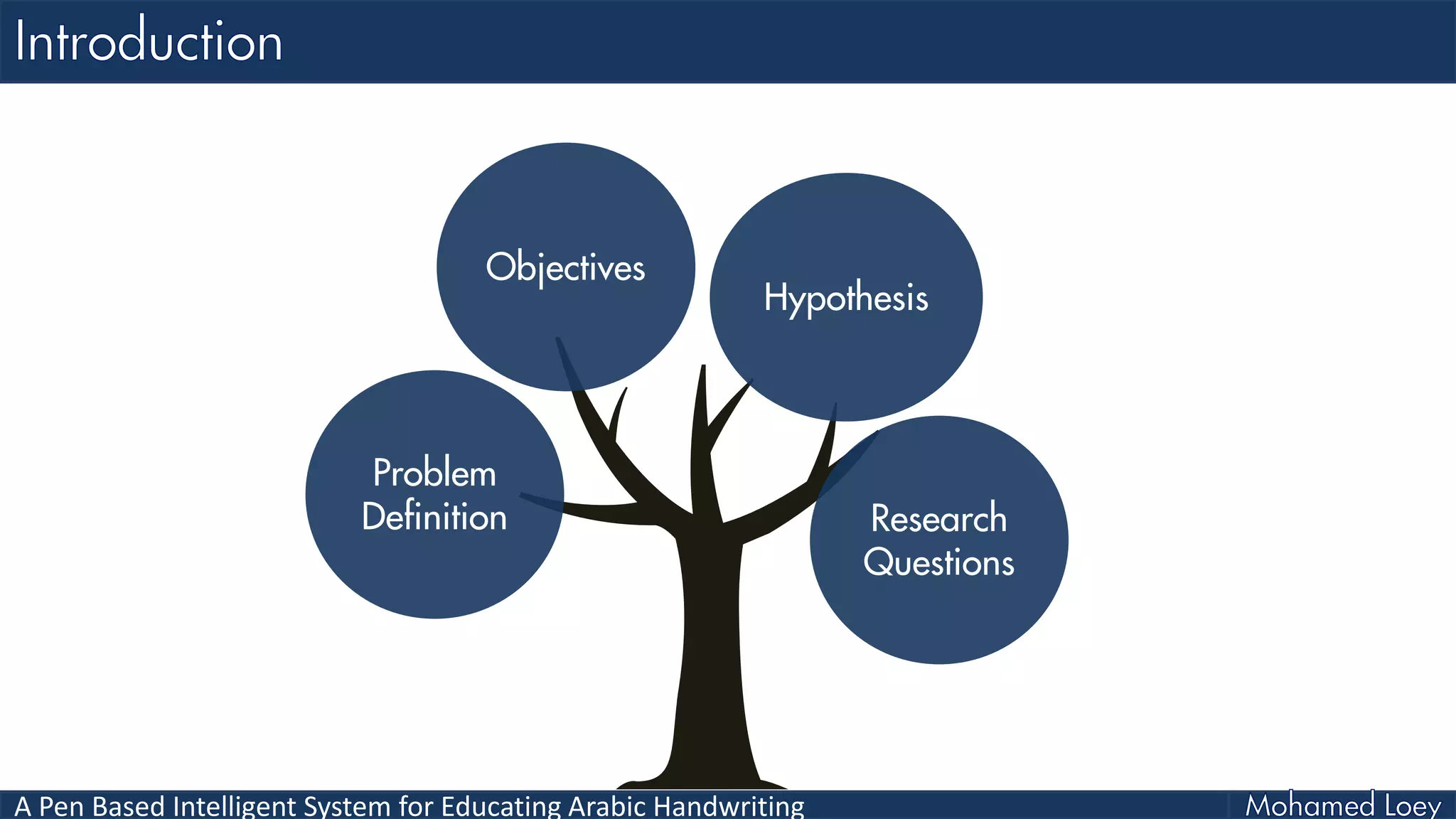
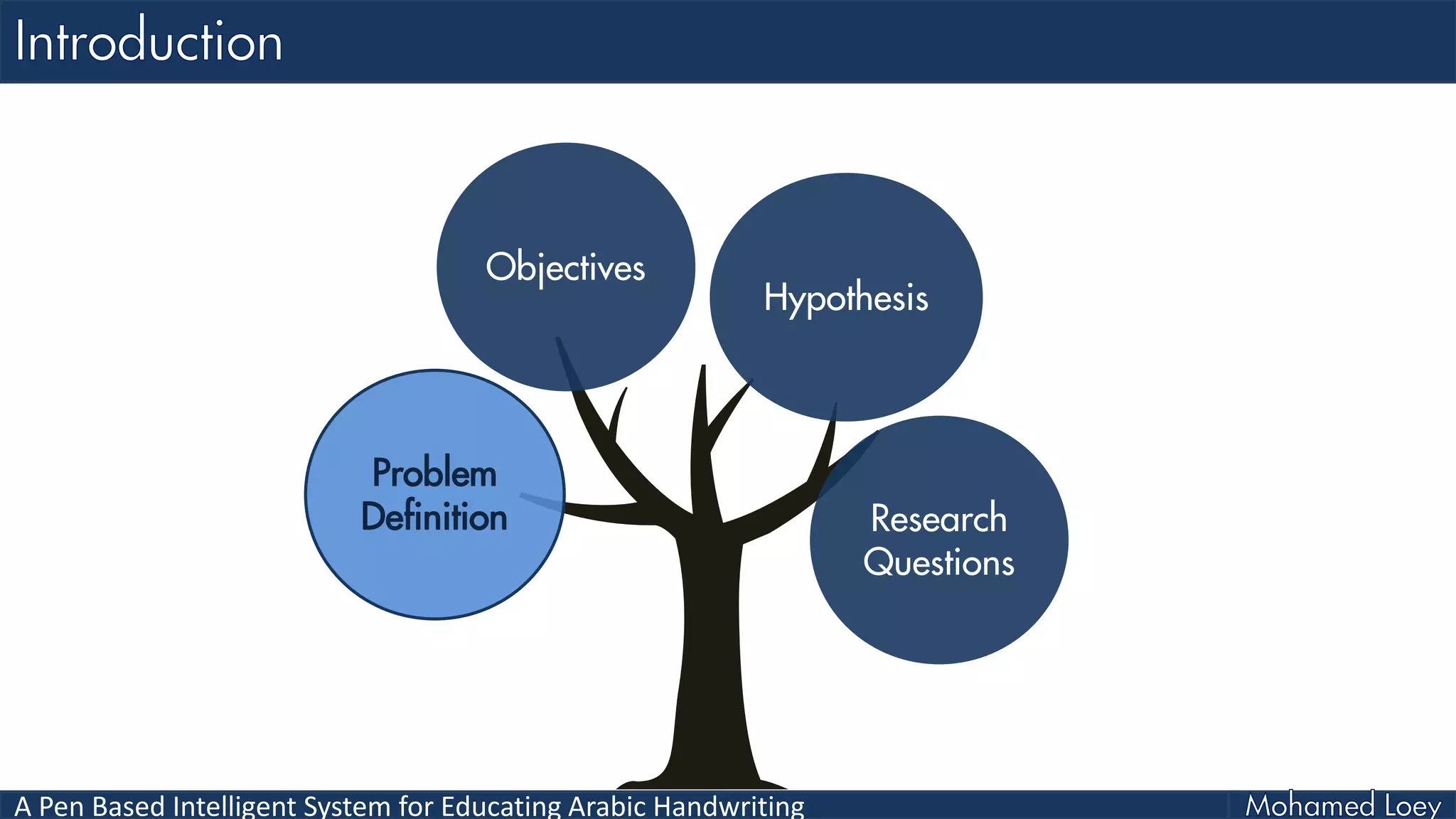
Problem
Definition
Objectives
Hypothesis
Research
Questions
A Pen Based Intelligent System for Educating Arabic Handwriting
Problem
Definition
Objectives
Hypothesis
Research
Questions
A Pen Based Intelligent System for Educating Arabic Handwriting
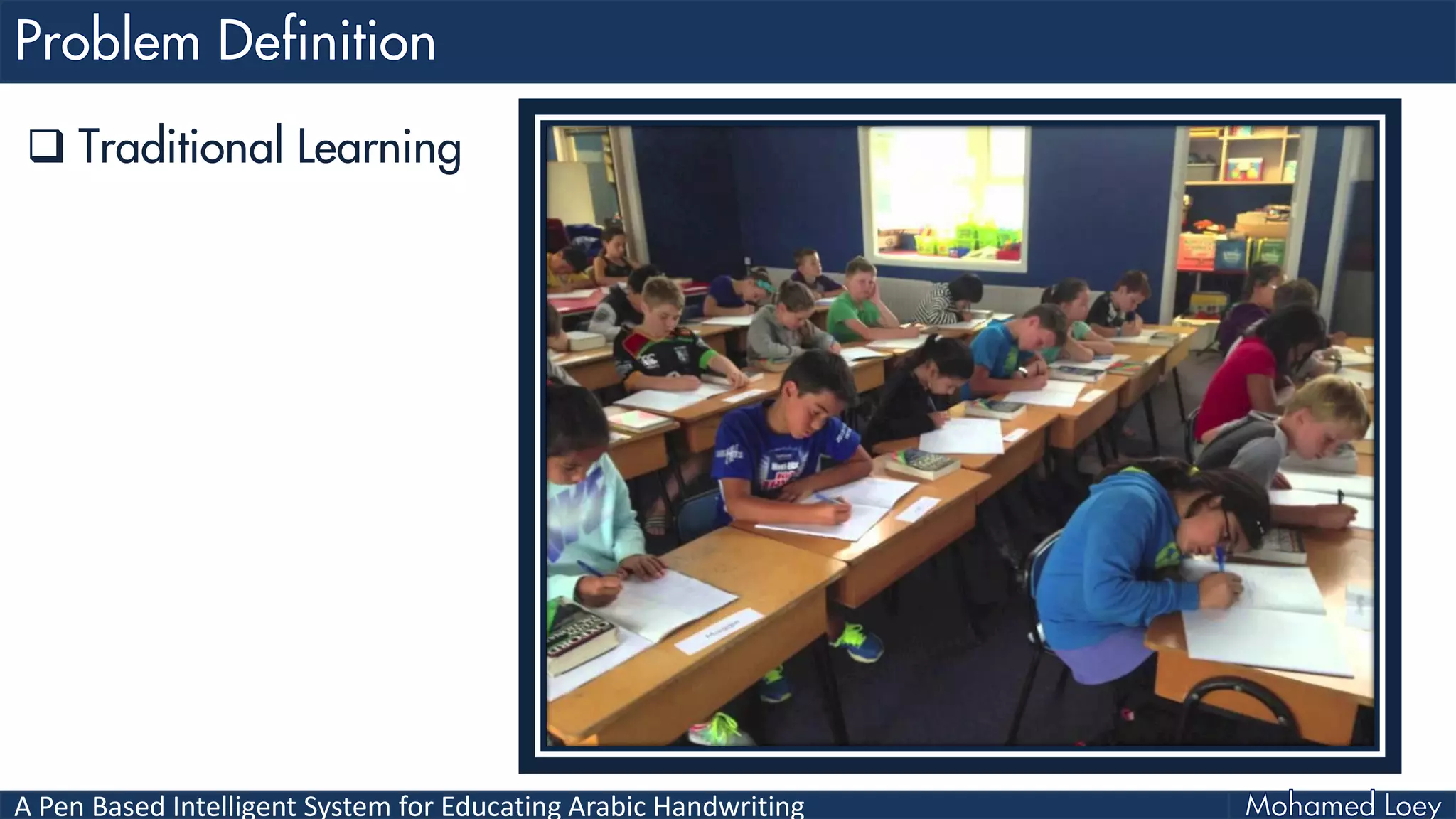
 Traditional Learning
A Pen Based Intelligent System for Educating Arabic Handwriting
 Complexity of Arabic characters.
 Expertise needs in traditional recognition systems.
 Traditional hand-crafted features.
 Arabic handwritten characters mistakes.
A Pen Based Intelligent System for Educating Arabic Handwriting
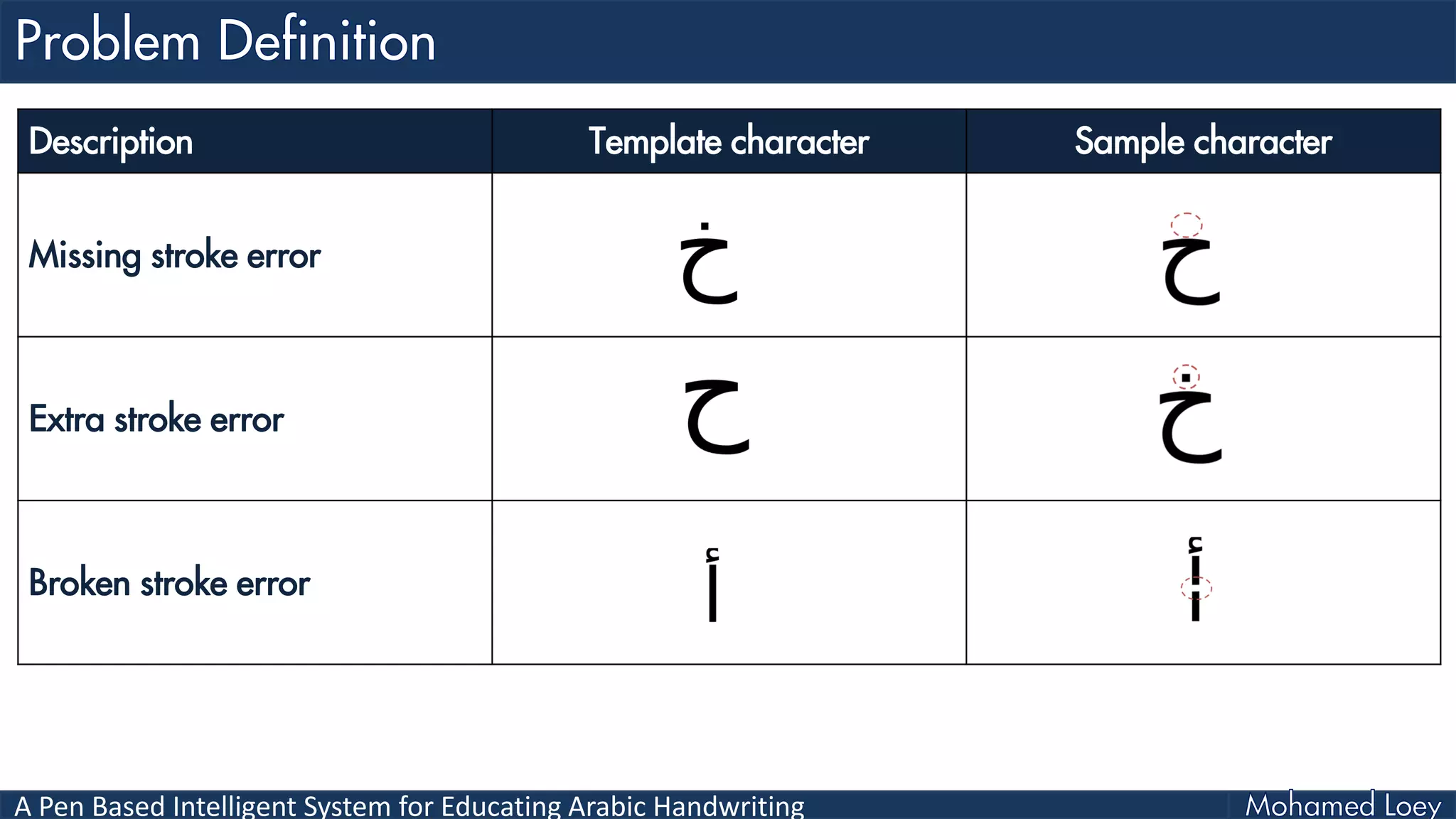
Description Template character Sample character
Missing stroke error
Extra stroke error
Broken stroke error
A Pen Based Intelligent System for Educating Arabic Handwriting
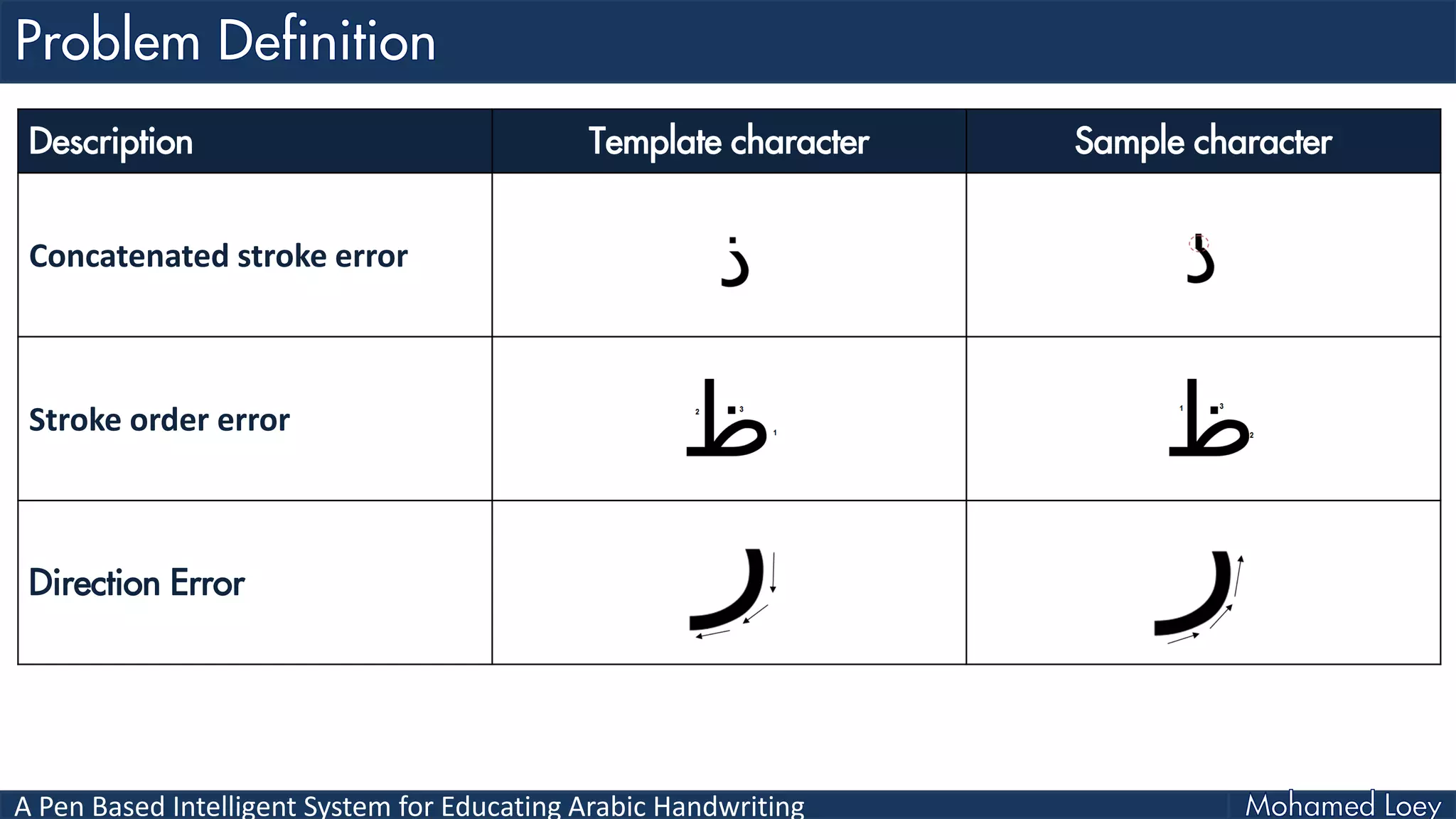
Description Template character Sample character
Concatenated stroke error
Stroke order error
Direction Error
A Pen Based Intelligent System for Educating Arabic Handwriting
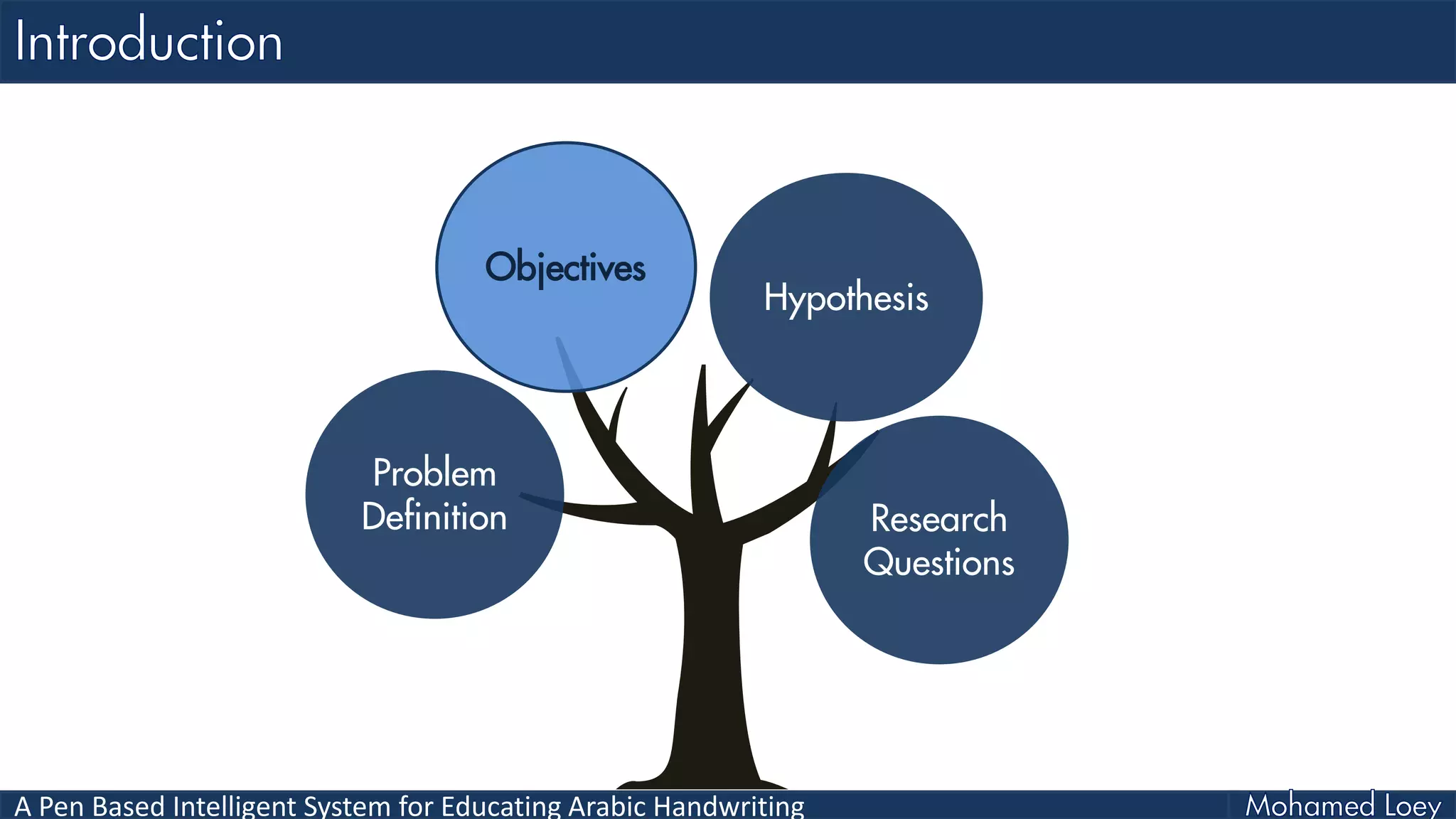
Problem
Definition
Objectives
Hypothesis
Research
Questions
A Pen Based Intelligent System for Educating Arabic Handwriting
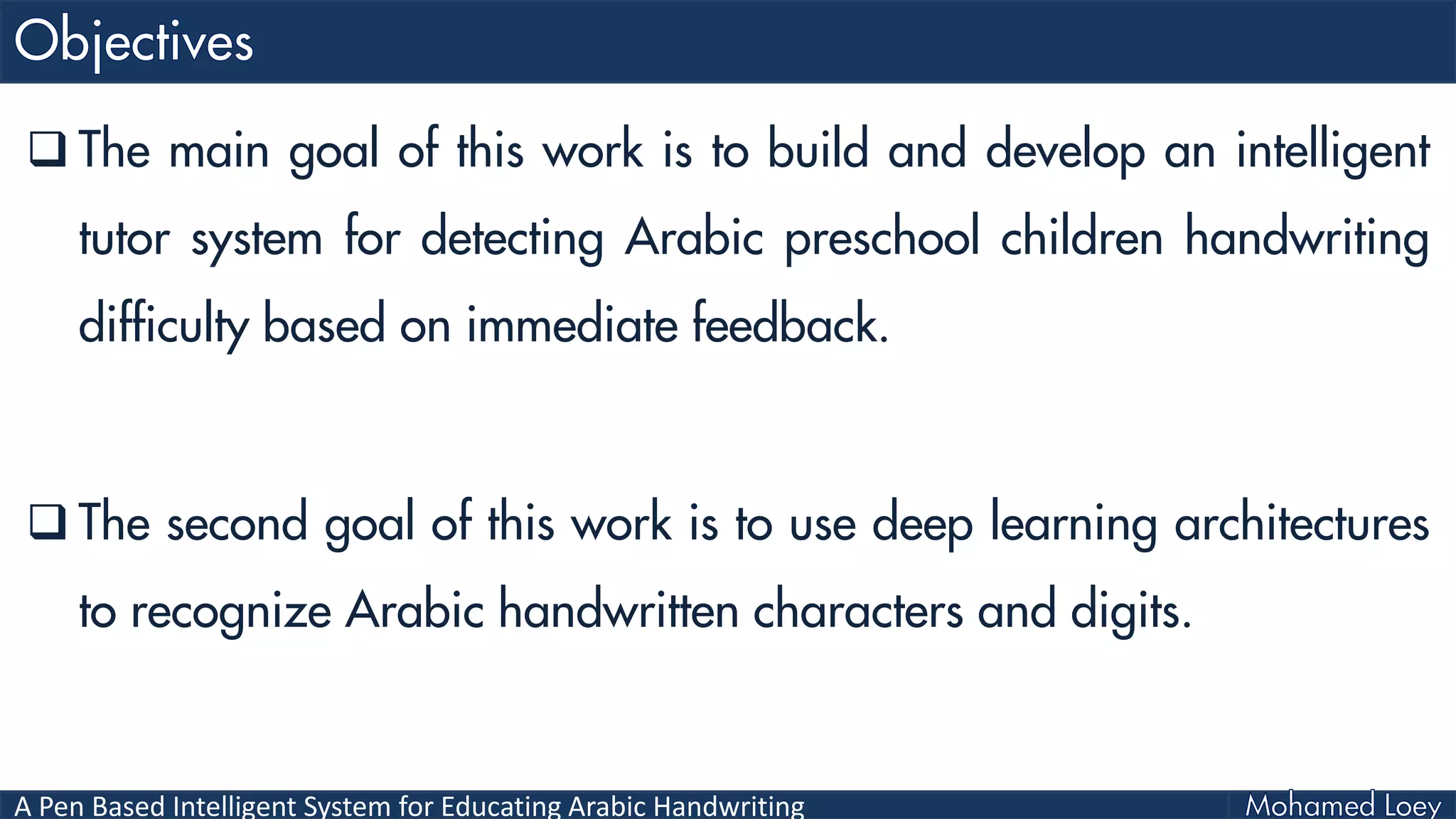
 The main goal of this work is to build and develop an intelligent
tutor system for detecting Arabic preschool children handwriting
difficulty based on immediate feedback.
 The second goal of this work is to use deep learning architectures
to recognize Arabic handwritten characters and digits.
A Pen Based Intelligent System for Educating Arabic Handwriting
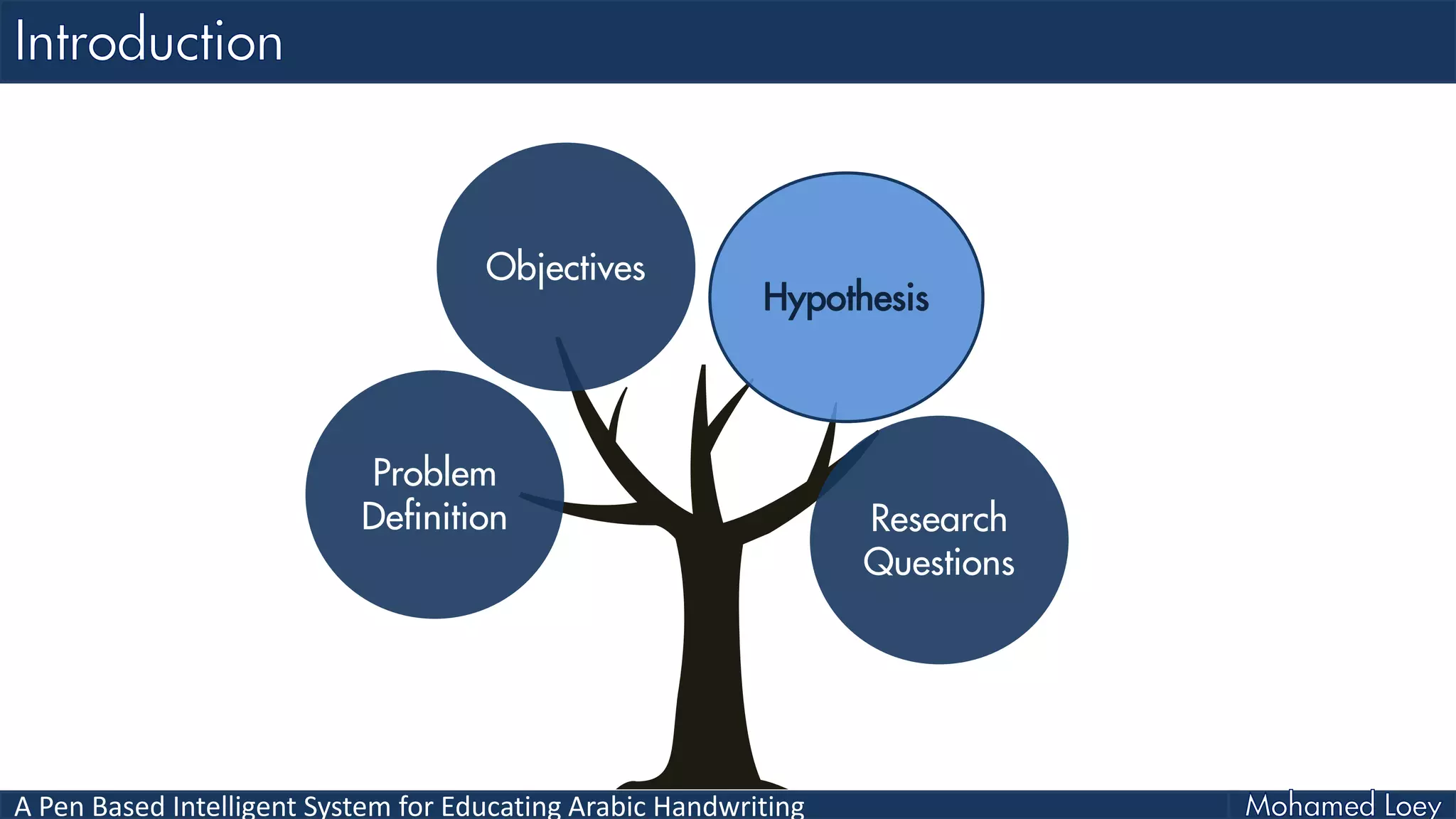
Problem
Definition
Objectives
Hypothesis
Research
Questions
A Pen Based Intelligent System for Educating Arabic Handwriting
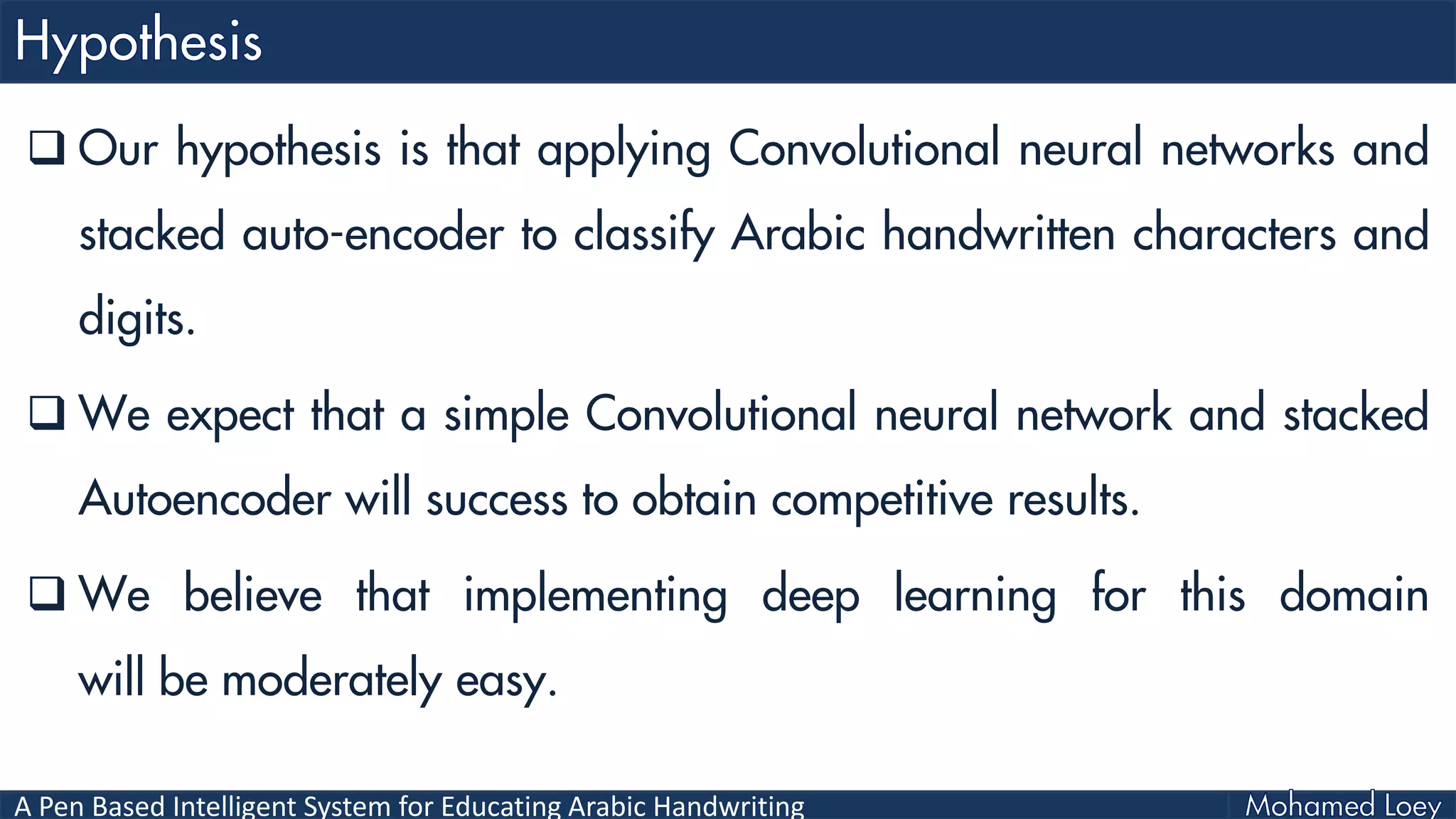
 Our hypothesis is that applying Convolutional neural networks and
stacked auto-encoder to classify Arabic handwritten characters and
digits.
 We expect that a simple Convolutional neural network and stacked
Autoencoder will success to obtain competitive results.
 We believe that implementing deep learning for this domain
will be moderately easy.
A Pen Based Intelligent System for Educating Arabic Handwriting
Problem
Definition
Objectives
Hypothesis
Research
Questions
A Pen Based Intelligent System for Educating Arabic Handwriting
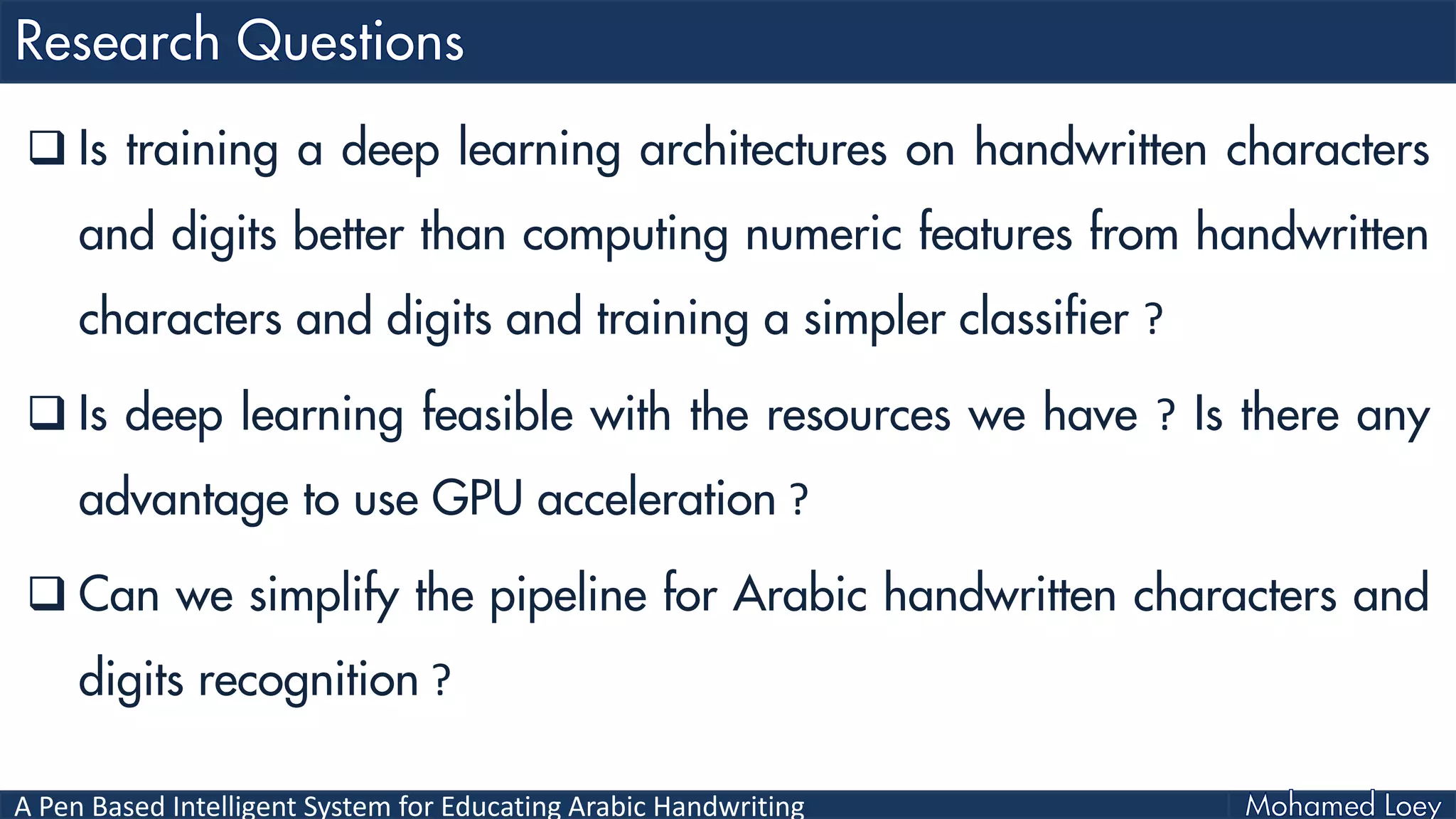
 Is training a deep learning architectures on handwritten characters
and digits better than computing numeric features from handwritten
characters and digits and training a simpler classifier ?
 Is deep learning feasible with the resources we have ? Is there any
advantage to use GPU acceleration ?
 Can we simplify the pipeline for Arabic handwritten characters and
digits recognition ?
A Pen Based Intelligent System for Educating Arabic Handwriting
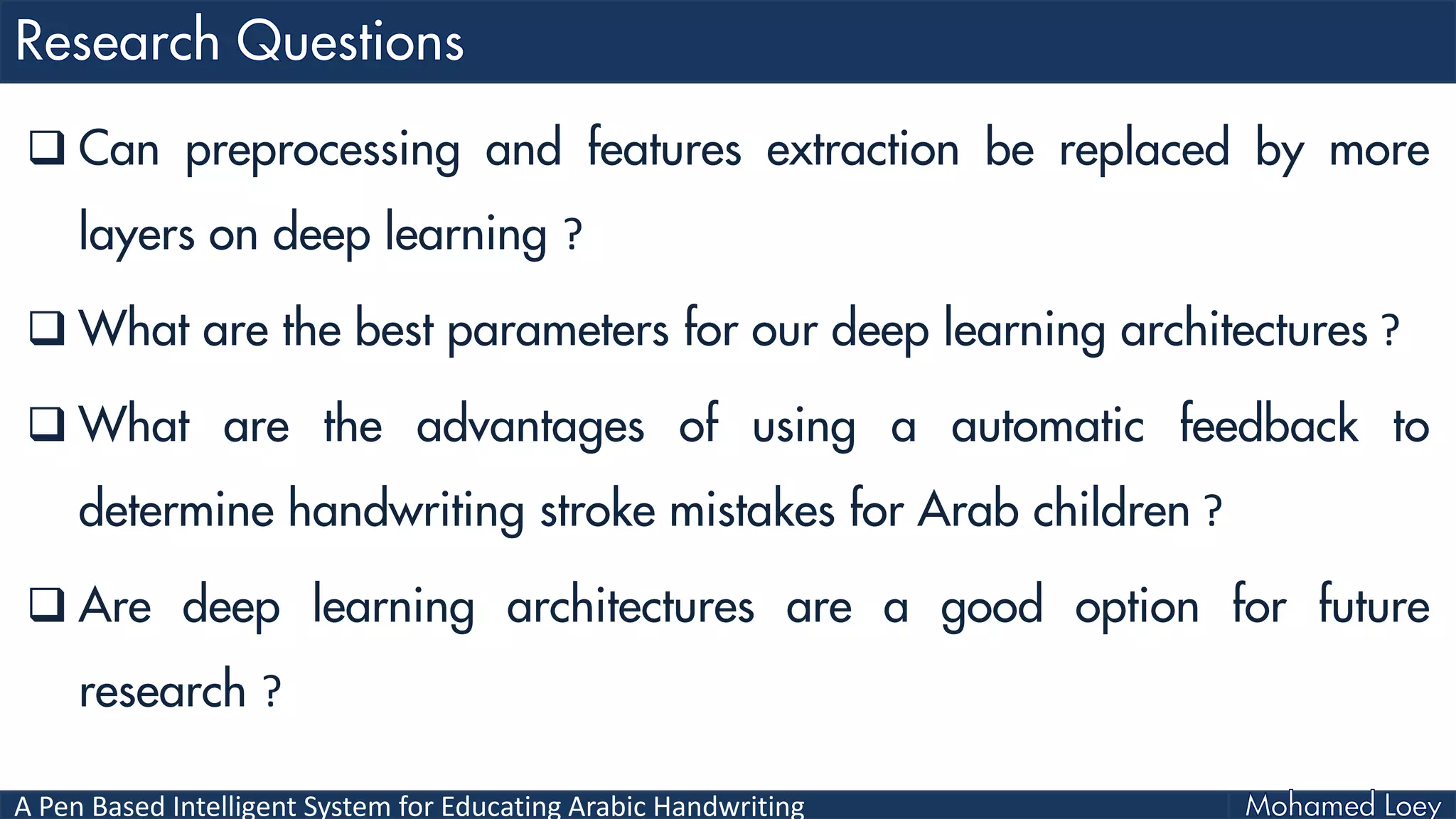
 Can preprocessing and features extraction be replaced by more
layers on deep learning ?
 What are the best parameters for our deep learning architectures ?
 What are the advantages of using a automatic feedback to
determine handwriting stroke mistakes for Arab children ?
 Are deep learning architectures are a good option for future
research ?
A Pen Based Intelligent System for Educating Arabic Handwriting
Introduction
Previous Related Work
Background and Preliminaries
Arabic Handwritten Digits Recognition System
Arabic Handwritten Characters Recognition System
Intelligent Arab Teaching System
Conclusion and Future Work
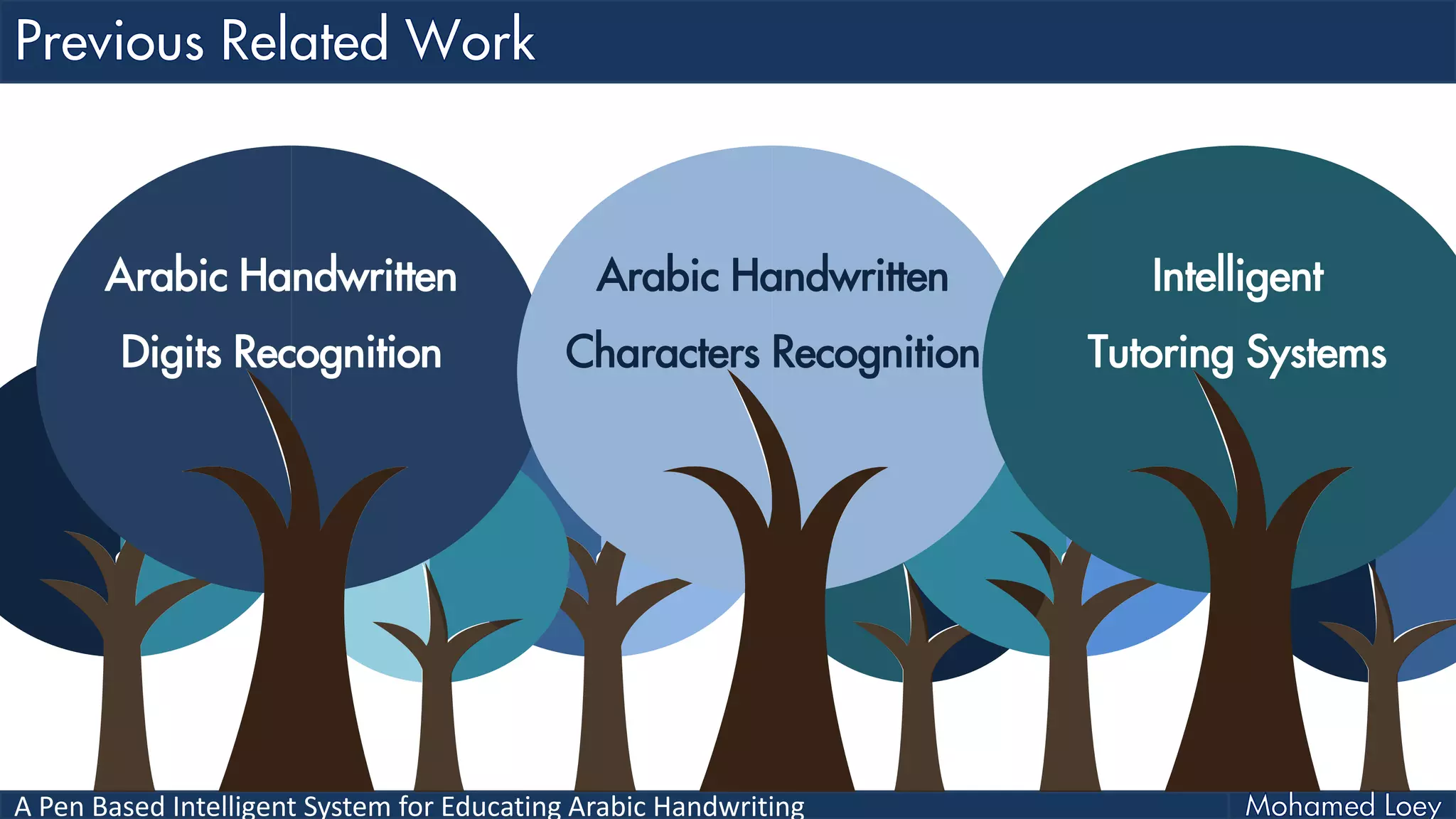
A Pen Based Intelligent System for Educating Arabic Handwriting
Arabic Handwritten
Digits Recognition
Arabic Handwritten
Characters Recognition
Intelligent
Tutoring Systems
A Pen Based Intelligent System for Educating Arabic Handwriting
Arabic Handwritten
Digits Recognition
Arabic Handwritten
Characters Recognition
Intelligent
Tutoring Systems
A Pen Based Intelligent System for Educating Arabic Handwriting
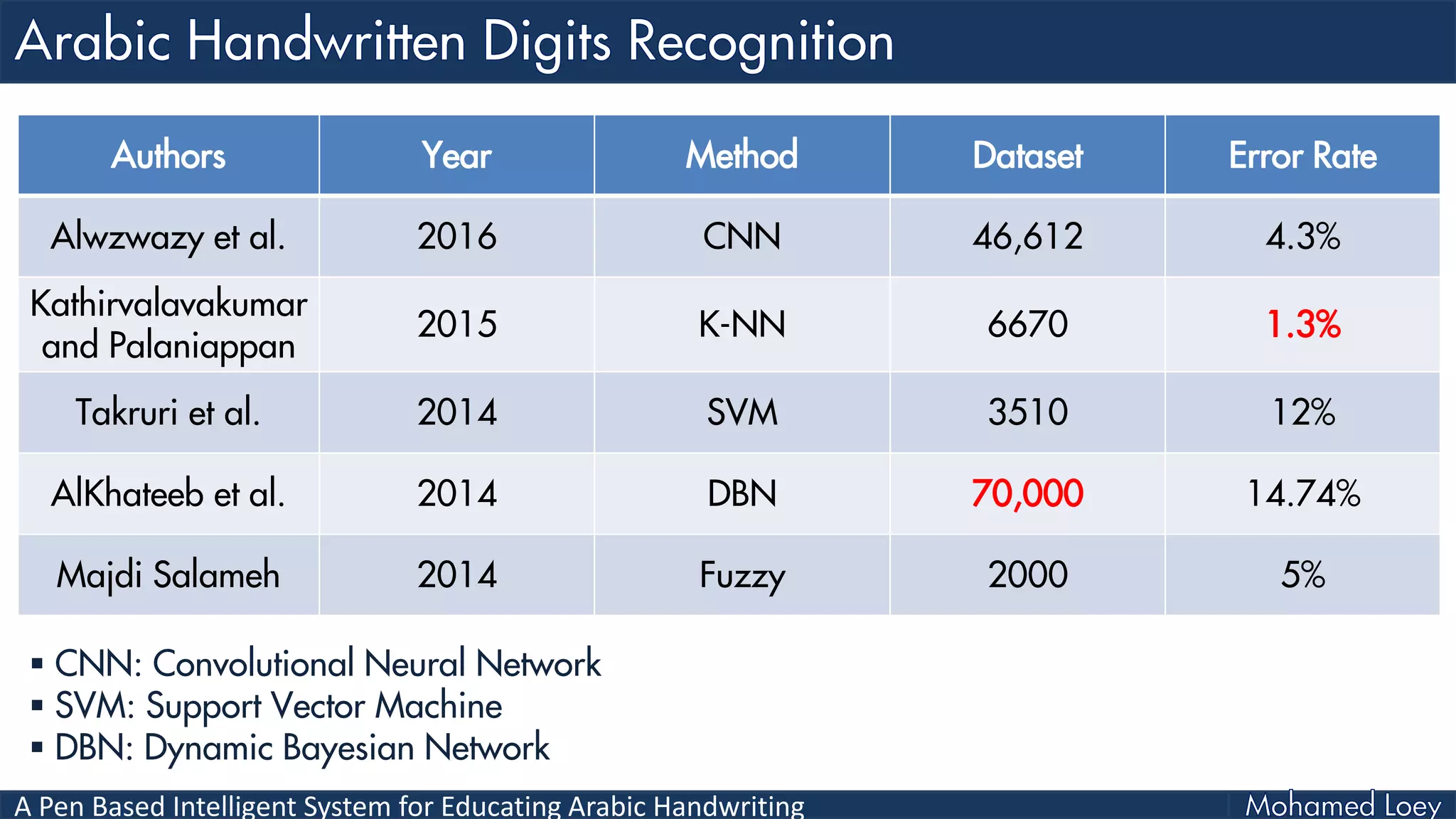
Authors Year Method Dataset Error Rate
Alwzwazy et al. 2016 CNN 46,612 4.3%
Kathirvalavakumar
and Palaniappan
2015 K-NN 6670 1.3%
Takruri et al. 2014 SVM 3510 12%
AlKhateeb et al. 2014 DBN 70,000 14.74%
Majdi Salameh 2014 Fuzzy 2000 5%
 CNN: Convolutional Neural Network
 SVM: Support Vector Machine
 DBN: Dynamic Bayesian Network
A Pen Based Intelligent System for Educating Arabic Handwriting
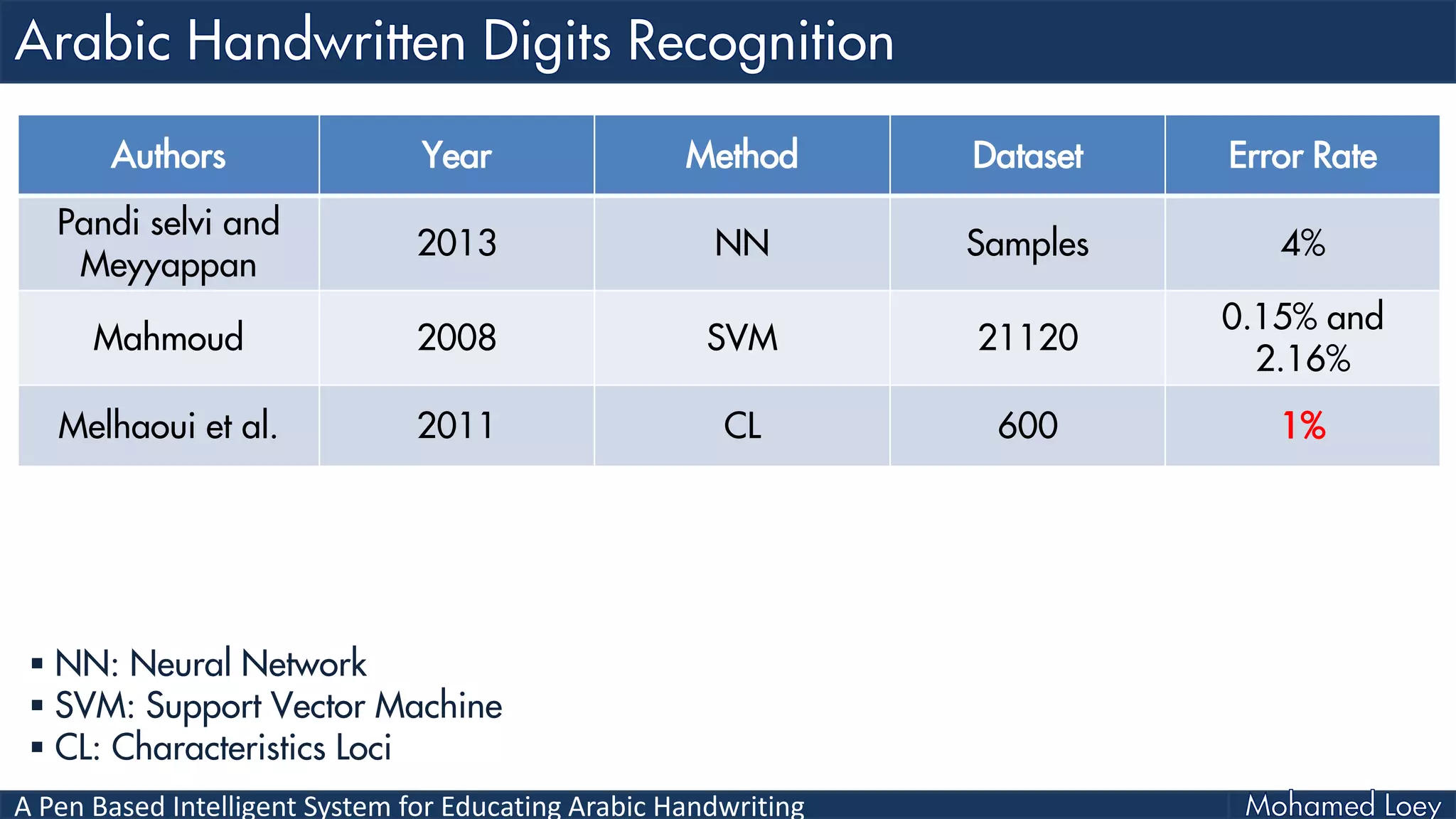
Authors Year Method Dataset Error Rate
Pandi selvi and
Meyyappan
2013 NN Samples 4%
Mahmoud 2008 SVM 21120
0.15% and
2.16%
Melhaoui et al. 2011 CL 600 1%
 NN: Neural Network
 SVM: Support Vector Machine
 CL: Characteristics Loci
A Pen Based Intelligent System for Educating Arabic Handwriting
Arabic Handwritten
Digits Recognition
Arabic Handwritten
Characters Recognition
Intelligent
Tutoring Systems
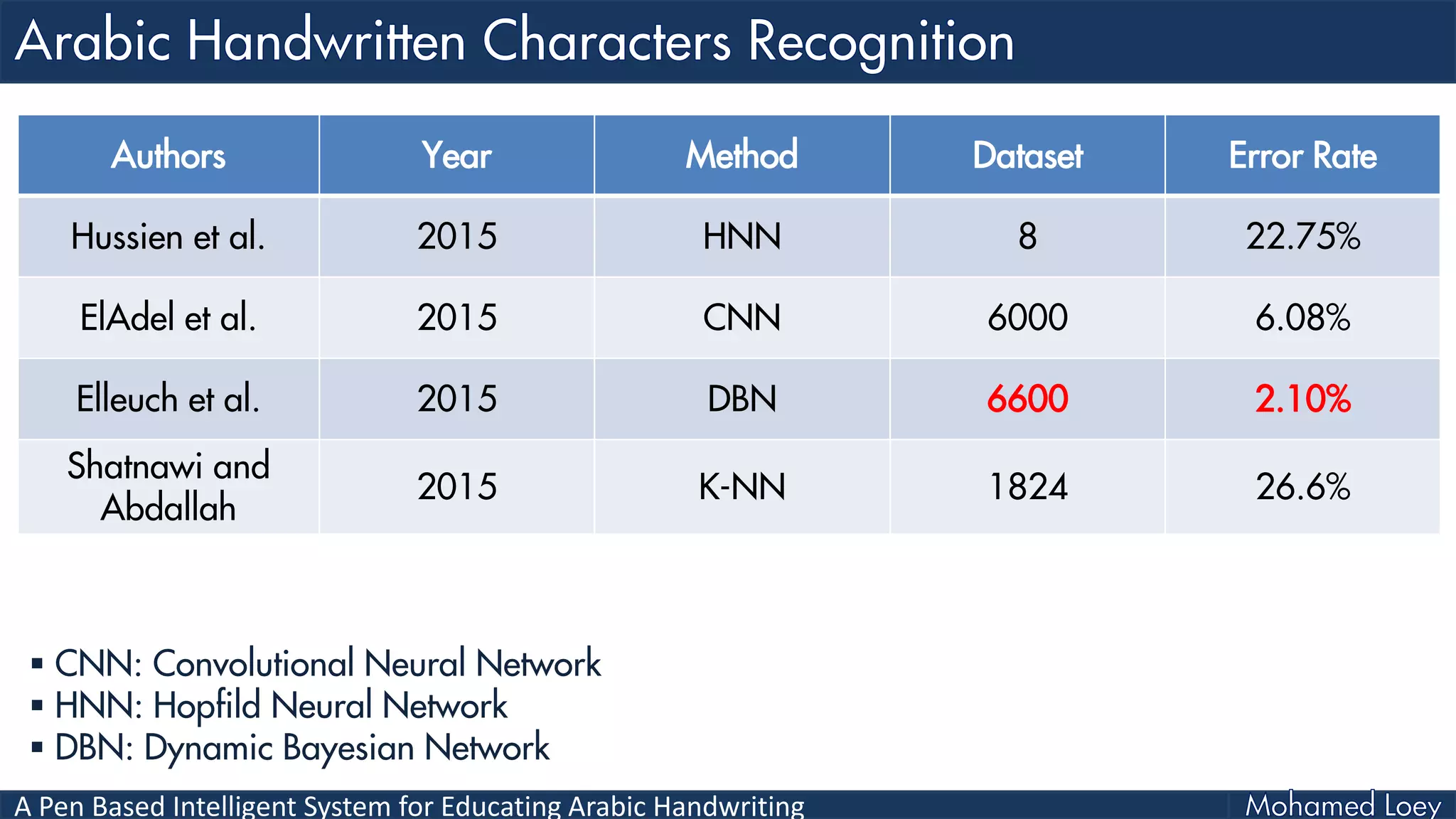
A Pen Based Intelligent System for Educating Arabic Handwriting
Authors Year Method Dataset Error Rate
Hussien et al. 2015 HNN 8 22.75%
ElAdel et al. 2015 CNN 6000 6.08%
Elleuch et al. 2015 DBN 6600 2.10%
Shatnawi and
Abdallah
2015 K-NN 1824 26.6%
 CNN: Convolutional Neural Network
 HNN: Hopfild Neural Network
 DBN: Dynamic Bayesian Network
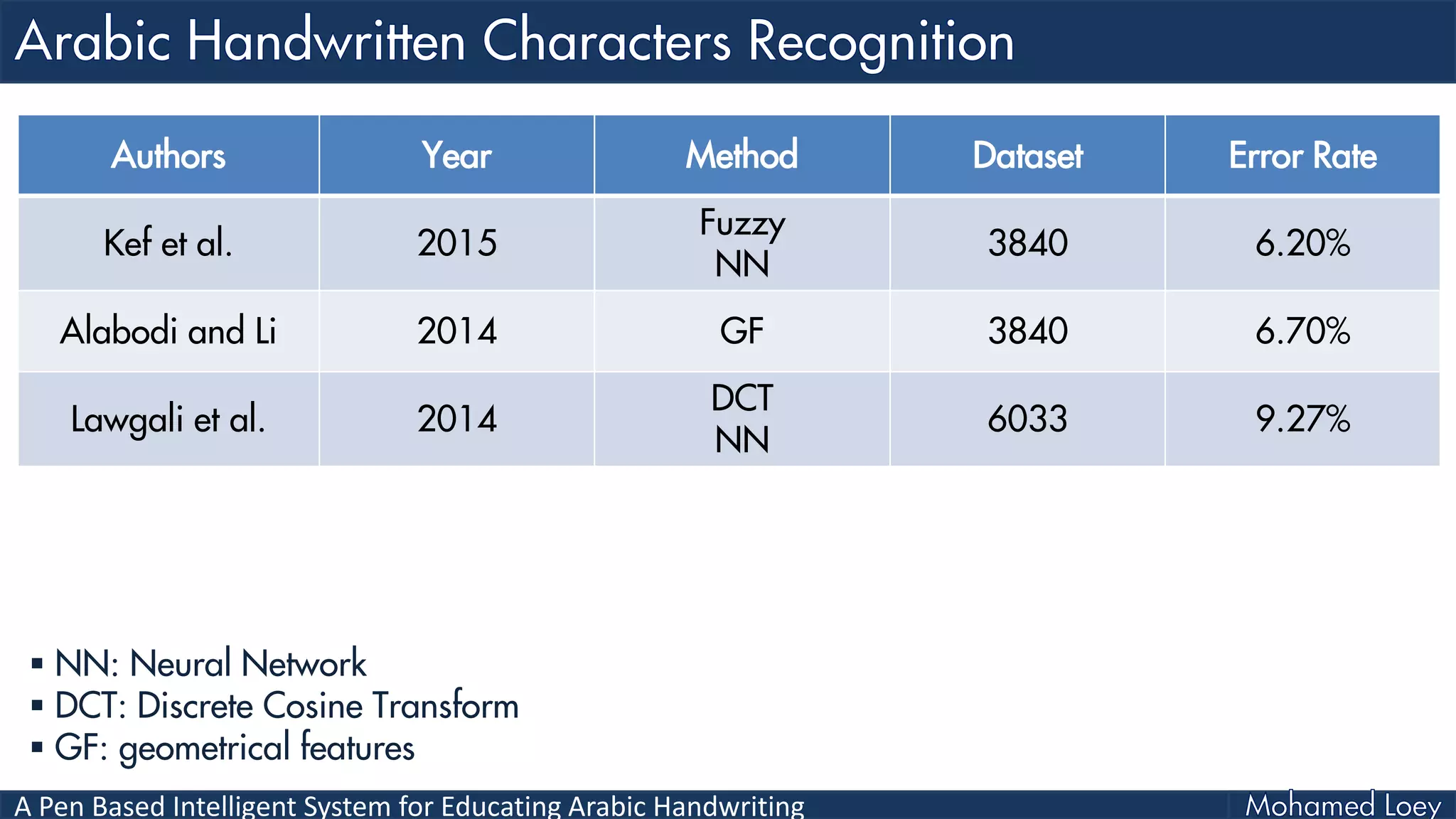
A Pen Based Intelligent System for Educating Arabic Handwriting
Authors Year Method Dataset Error Rate
Kef et al. 2015
Fuzzy
NN
3840 6.20%
Alabodi and Li 2014 GF 3840 6.70%
Lawgali et al. 2014
DCT
NN
6033 9.27%
 NN: Neural Network
 DCT: Discrete Cosine Transform
 GF: geometrical features
A Pen Based Intelligent System for Educating Arabic Handwriting
Arabic Handwritten
Digits Recognition
Arabic Handwritten
Characters Recognition
Intelligent
Tutoring Systems
A Pen Based Intelligent System for Educating Arabic Handwriting
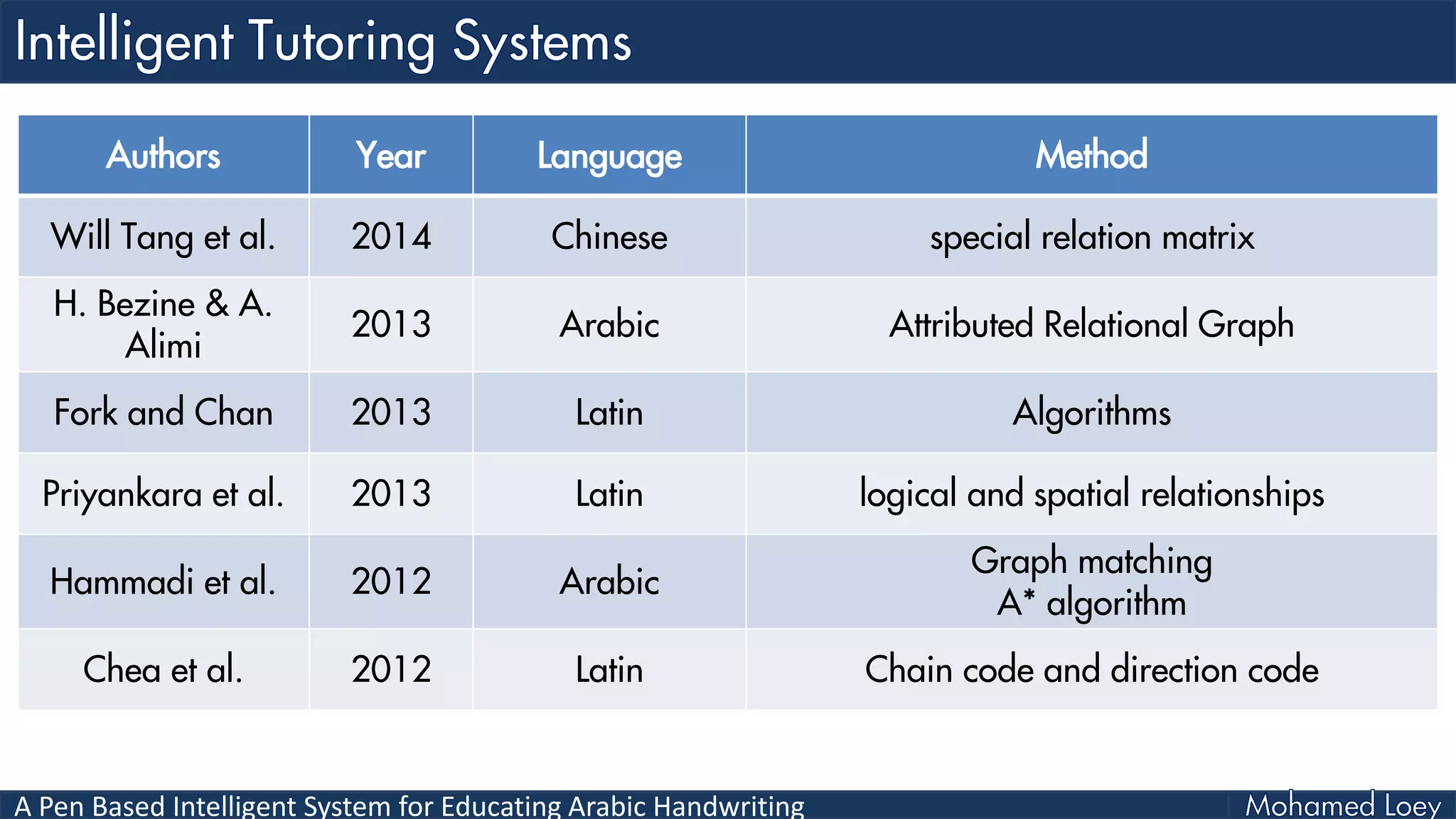
Authors Year Language Method
Will Tang et al. 2014 Chinese special relation matrix
H. Bezine & A.
Alimi
2013 Arabic Attributed Relational Graph
Fork and Chan 2013 Latin Algorithms
Priyankara et al. 2013 Latin logical and spatial relationships
Hammadi et al. 2012 Arabic
Graph matching
A* algorithm
Chea et al. 2012 Latin Chain code and direction code
A Pen Based Intelligent System for Educating Arabic Handwriting
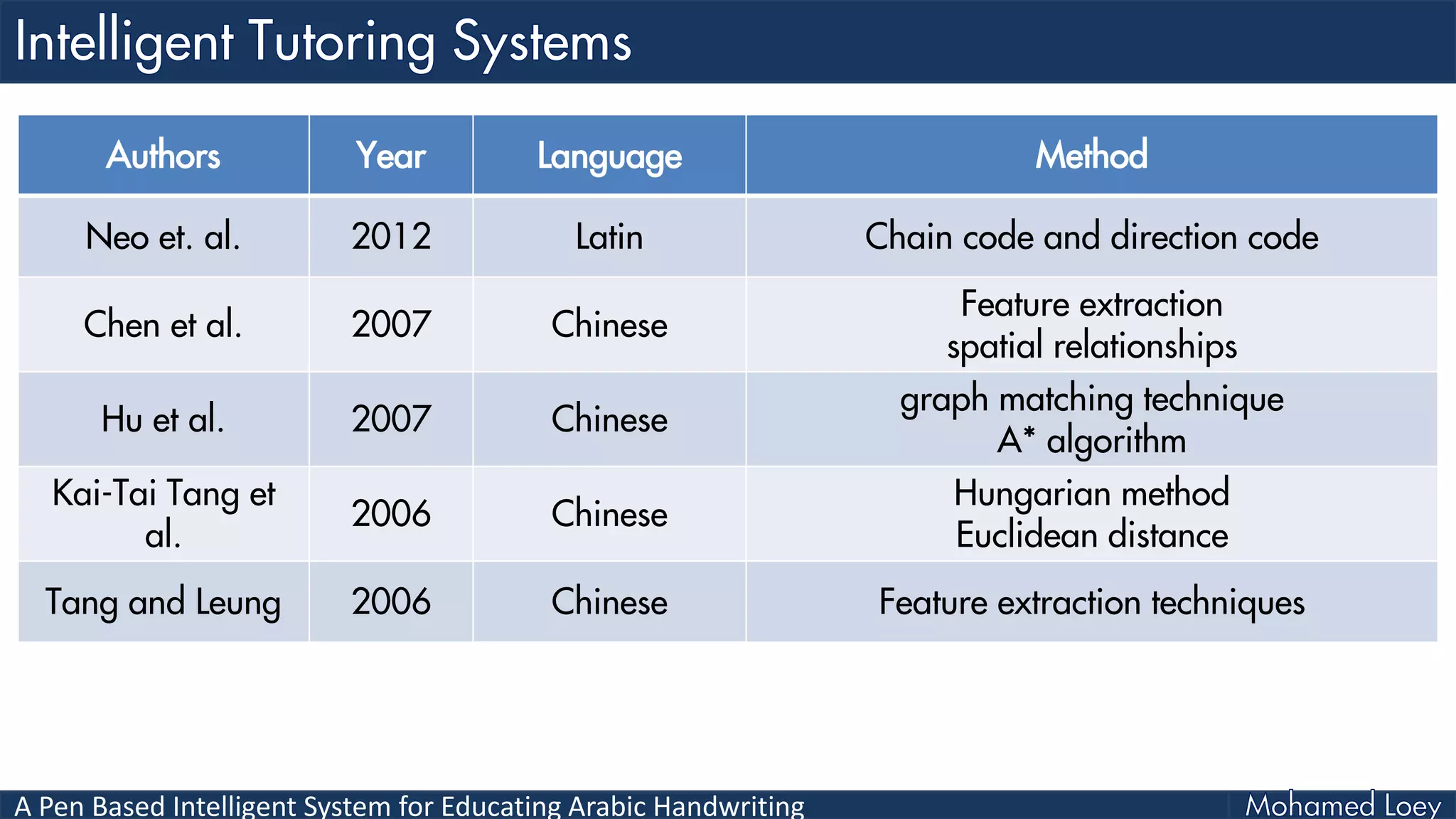
Authors Year Language Method
Neo et. al. 2012 Latin Chain code and direction code
Chen et al. 2007 Chinese
Feature extraction
spatial relationships
Hu et al. 2007 Chinese
graph matching technique
A* algorithm
Kai-Tai Tang et
al.
2006 Chinese
Hungarian method
Euclidean distance
Tang and Leung 2006 Chinese Feature extraction techniques
A Pen Based Intelligent System for Educating Arabic Handwriting
Introduction
Previous Related Work
Background and Preliminaries
Arabic Handwritten Digits Recognition System
Arabic Handwritten Characters Recognition System
Intelligent Arab Teaching System
Conclusion and Future Work
A Pen Based Intelligent System for Educating Arabic Handwriting
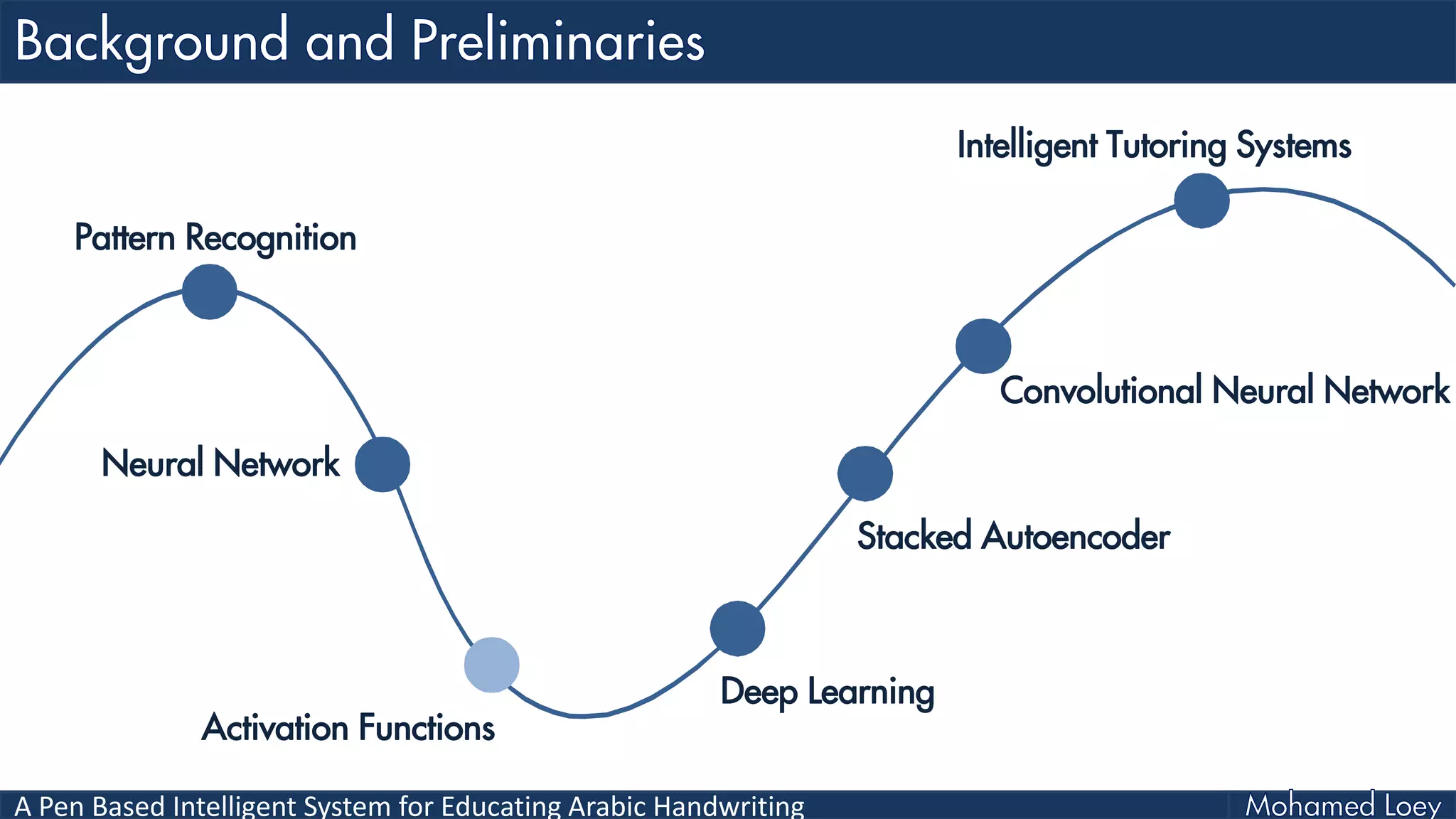
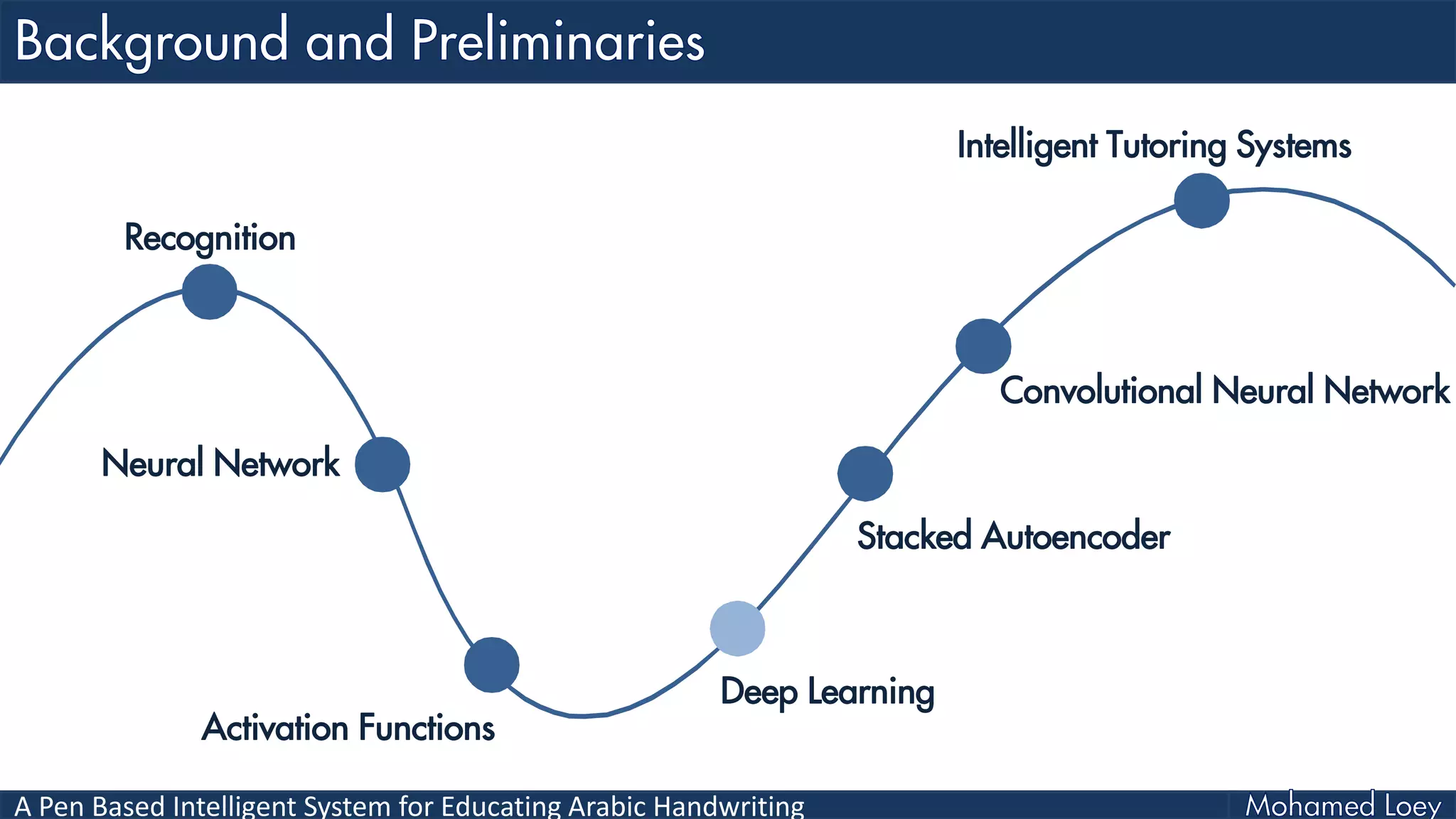
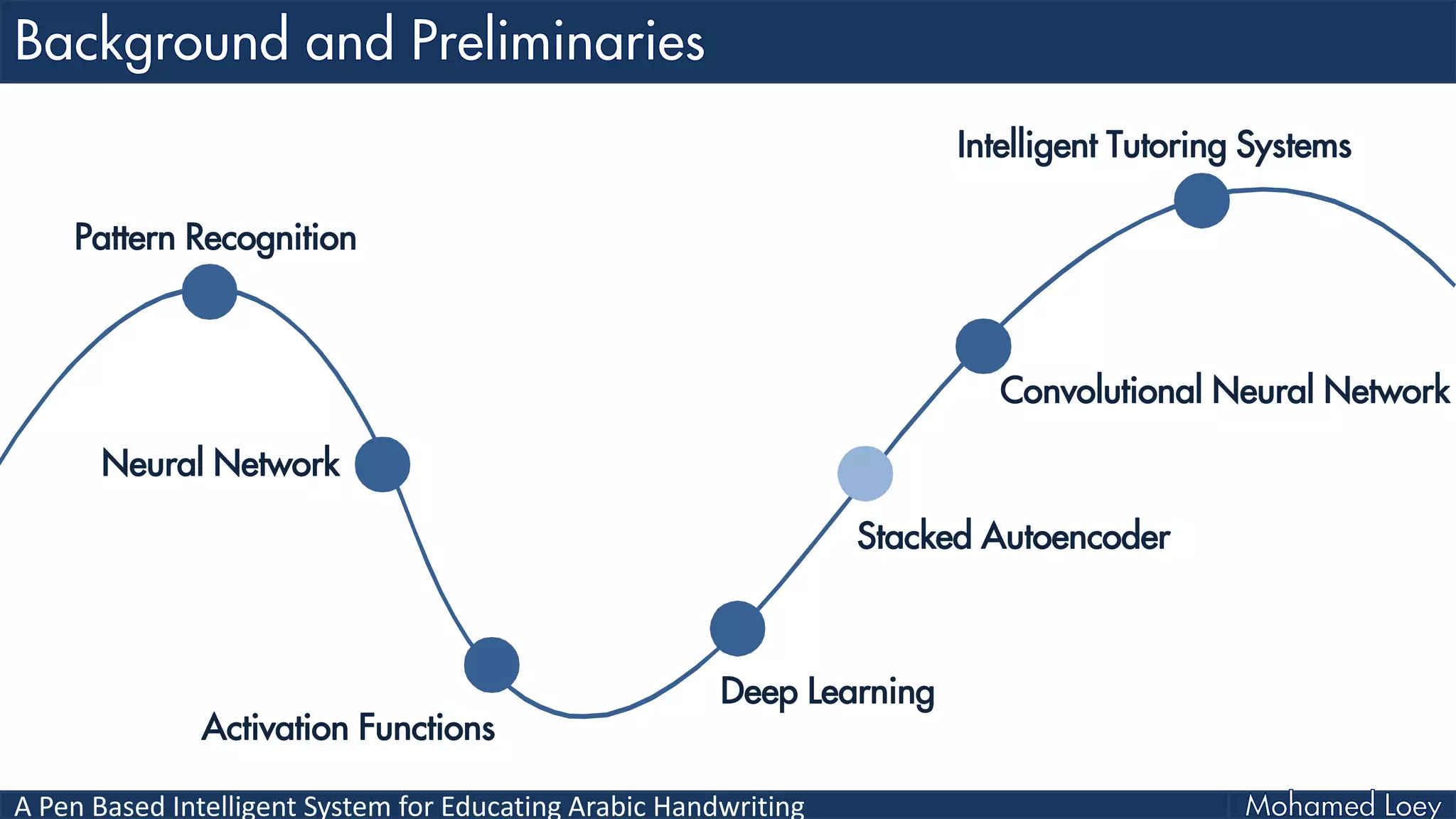
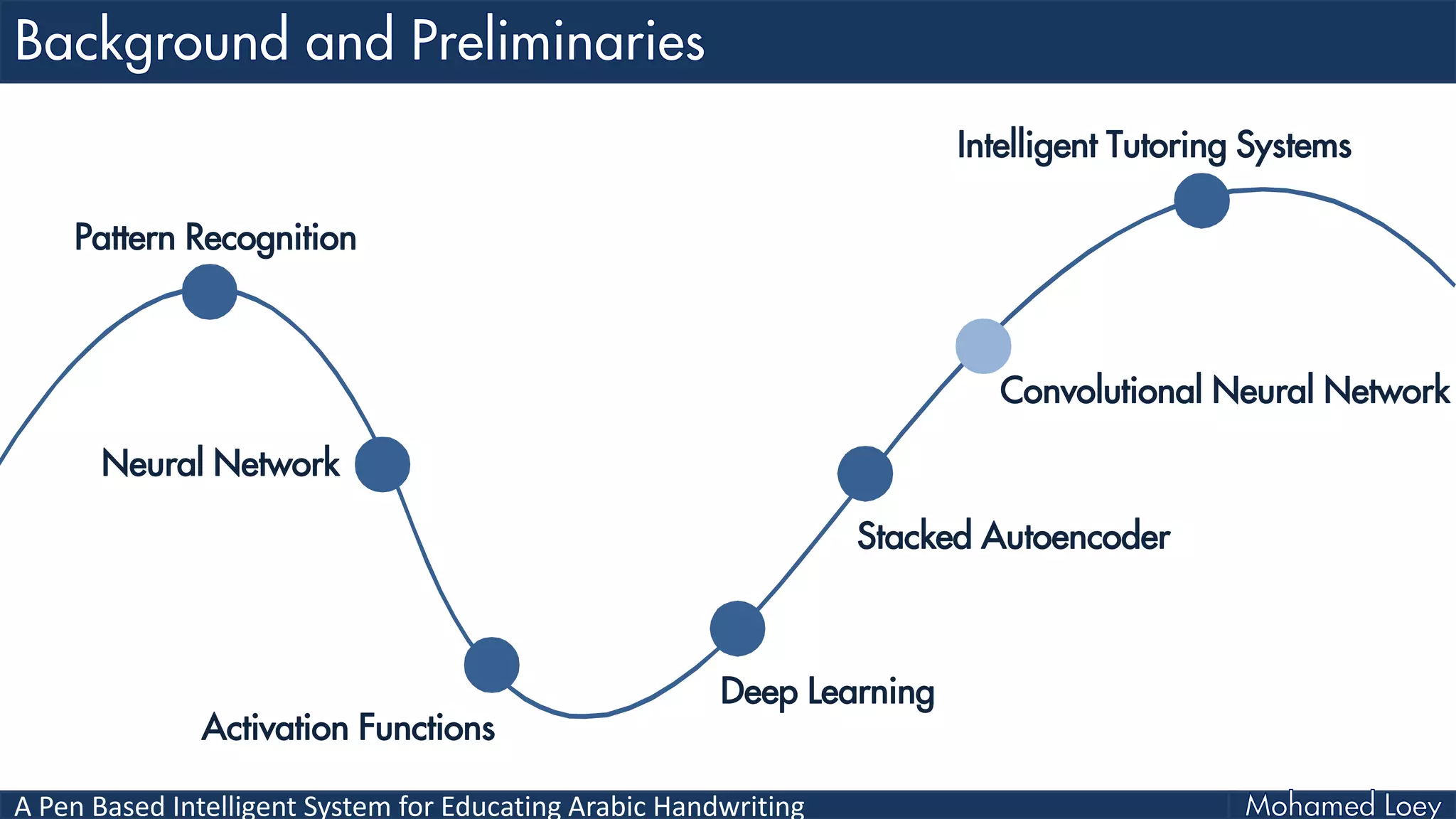
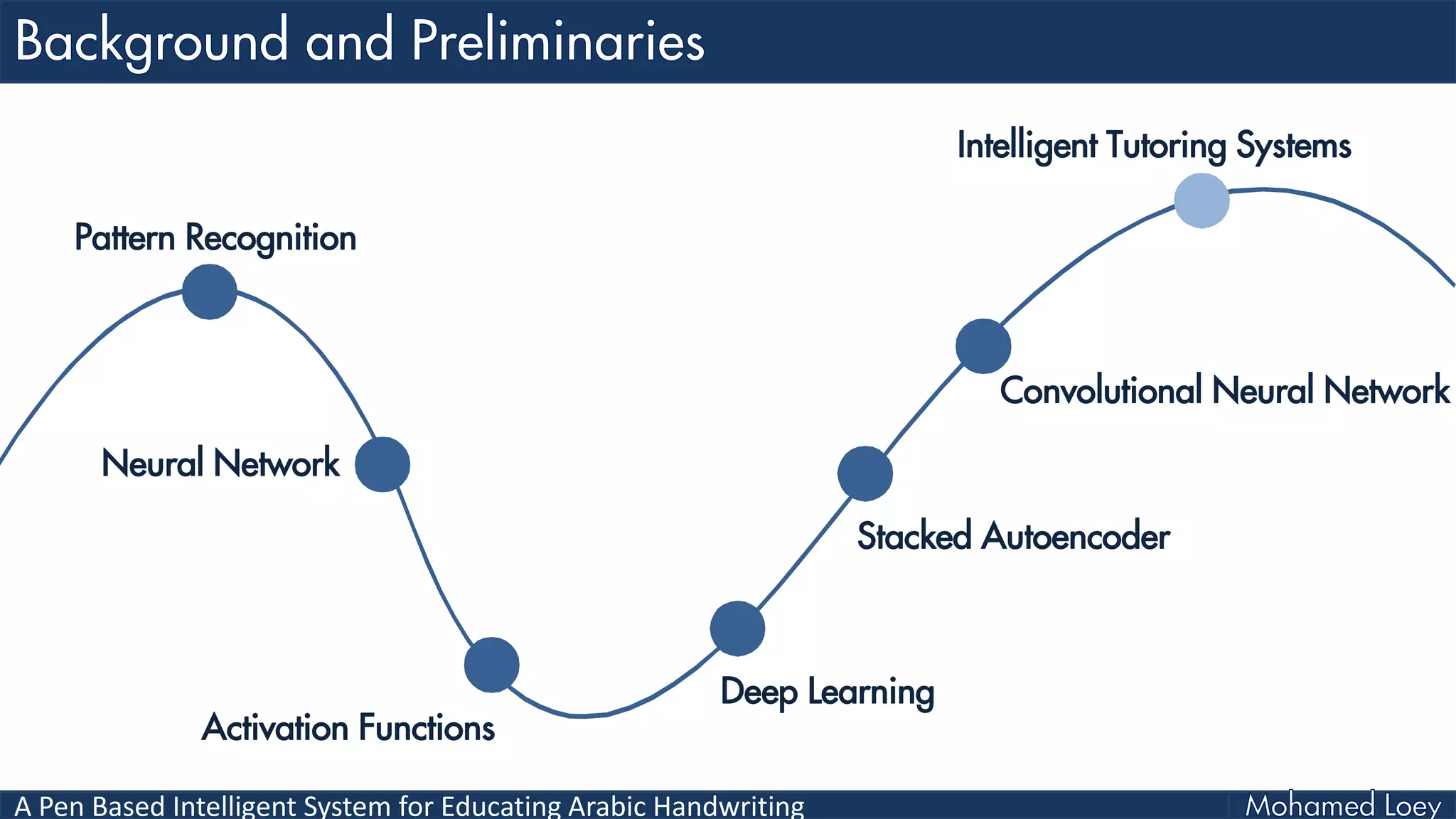
Pattern Recognition
Neural Network
Activation Functions
Deep Learning
Stacked Autoencoder
Convolutional Neural Network
Intelligent Tutoring Systems
A Pen Based Intelligent System for Educating Arabic Handwriting
Neural Network
Activation Functions
Deep Learning
Stacked Autoencoder
Convolutional Neural Network
Intelligent Tutoring Systems
Pattern Recognition
A Pen Based Intelligent System for Educating Arabic Handwriting
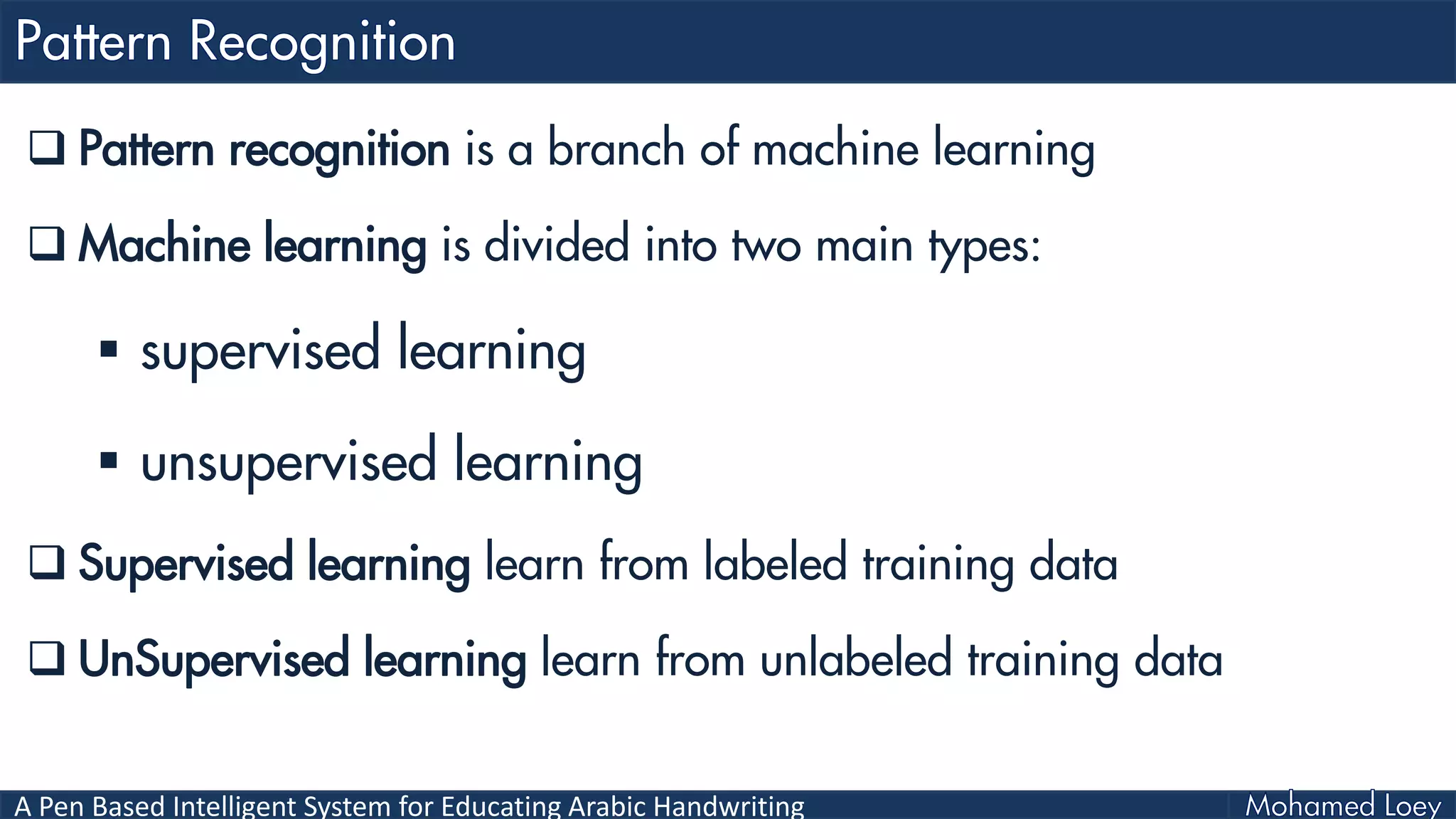
 Pattern recognition is a branch of machine learning
 Machine learning is divided into two main types:
 supervised learning
 unsupervised learning
 Supervised learning learn from labeled training data
 UnSupervised learning learn from unlabeled training data
A Pen Based Intelligent System for Educating Arabic Handwriting
Neural Network
Activation Functions
Deep Learning
Stacked Autoencoder
Convolutional Neural Network
Intelligent Tutoring Systems
Pattern Recognition
A Pen Based Intelligent System for Educating Arabic Handwriting
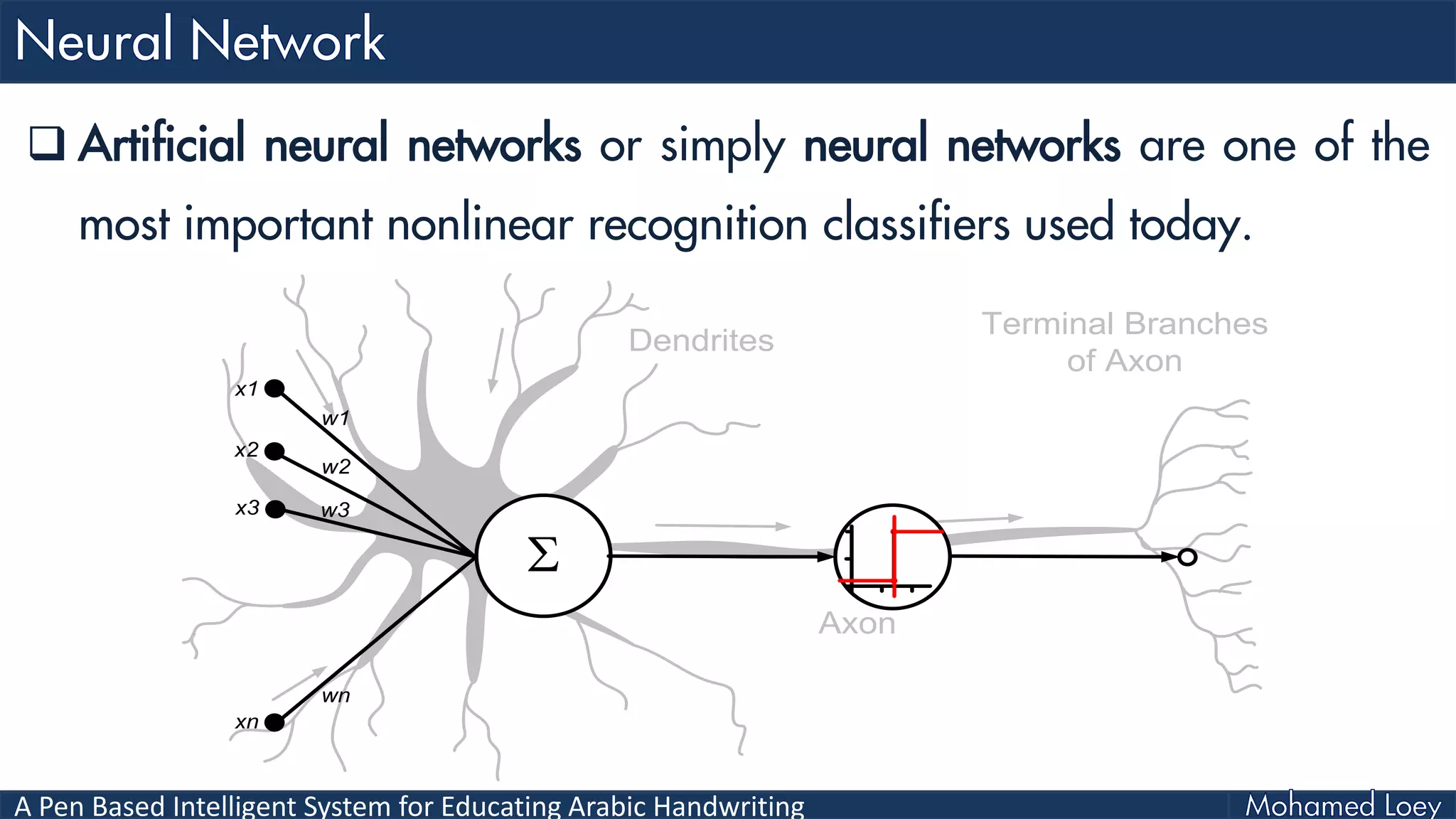
 Artificial neural networks or simply neural networks are one of the
most important nonlinear recognition classifiers used today.
Axon
Terminal Branches
of Axon
Dendrites
S
x1
x2
w1
w2
wn
xn
x3 w3
A Pen Based Intelligent System for Educating Arabic Handwriting
Neural Network
Activation Functions
Deep Learning
Stacked Autoencoder
Convolutional Neural Network
Intelligent Tutoring Systems
Pattern Recognition
A Pen Based Intelligent System for Educating Arabic Handwriting
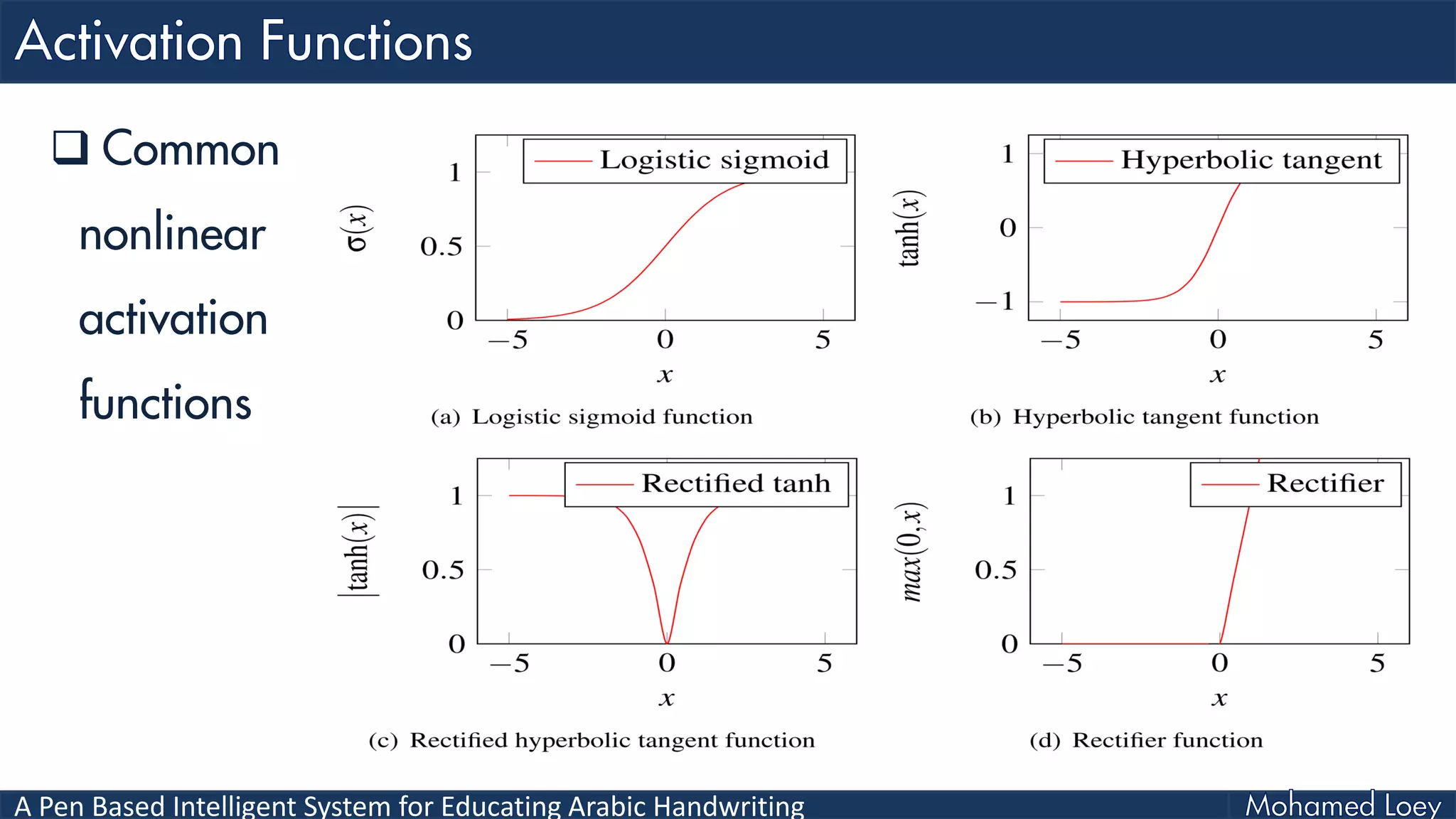
 Common
nonlinear
activation
functions
A Pen Based Intelligent System for Educating Arabic Handwriting
Most deep networks use Rectified Linear Unit (ReLU)
 ReLU trains much faster
 RelU more expressive than logistic function
 ReLU prevents the gradient vanishing problem.
A Pen Based Intelligent System for Educating Arabic Handwriting
Recognition
Neural Network
Activation Functions
Deep Learning
Stacked Autoencoder
Convolutional Neural Network
Intelligent Tutoring Systems
A Pen Based Intelligent System for Educating Arabic Handwriting
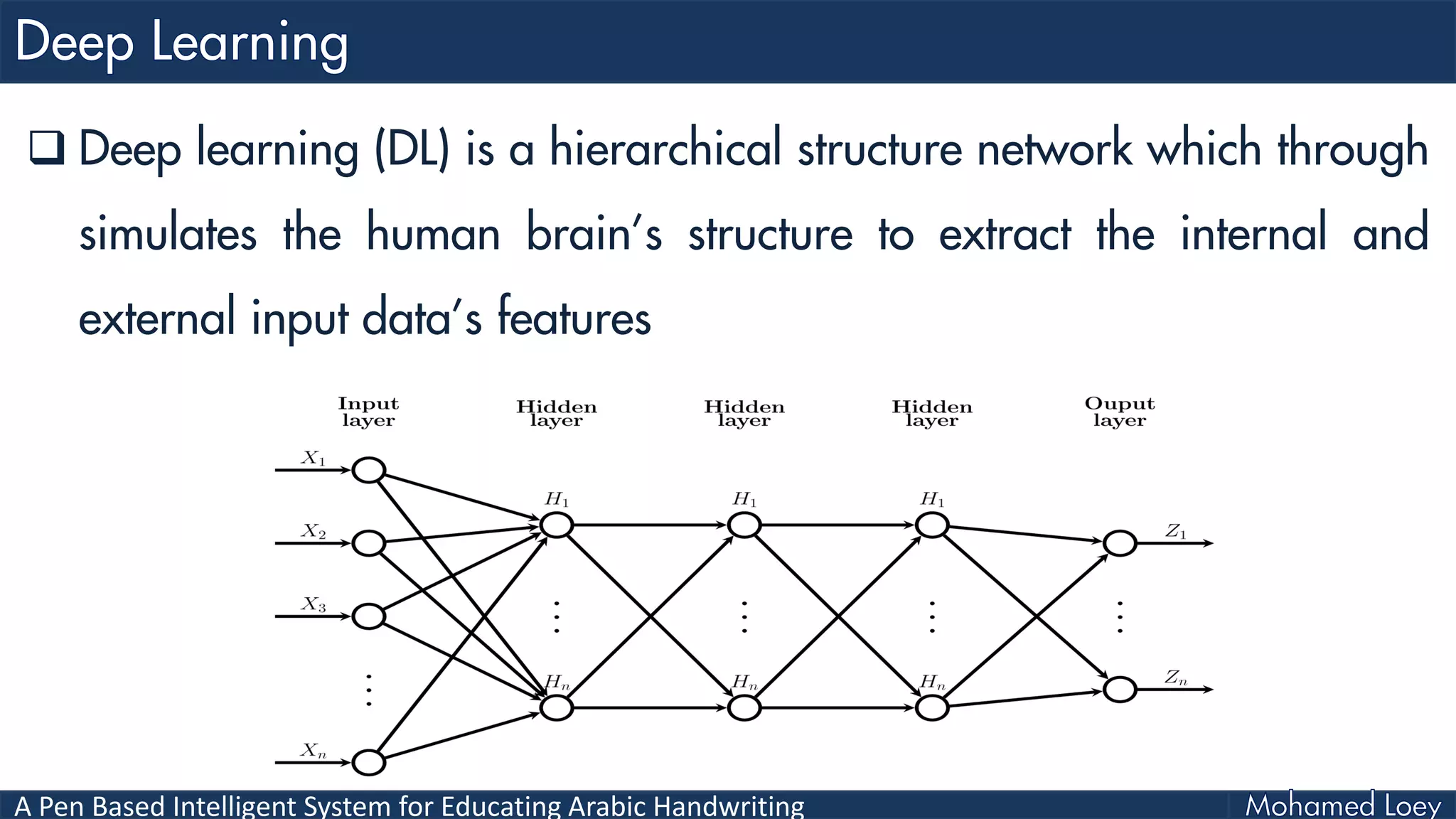
 Deep learning (DL) is a hierarchical structure network which through
simulates the human brain’s structure to extract the internal and
external input data’s features
A Pen Based Intelligent System for Educating Arabic Handwriting
Neural Network
Activation Functions
Deep Learning
Stacked Autoencoder
Convolutional Neural Network
Intelligent Tutoring Systems
Pattern Recognition
A Pen Based Intelligent System for Educating Arabic Handwriting
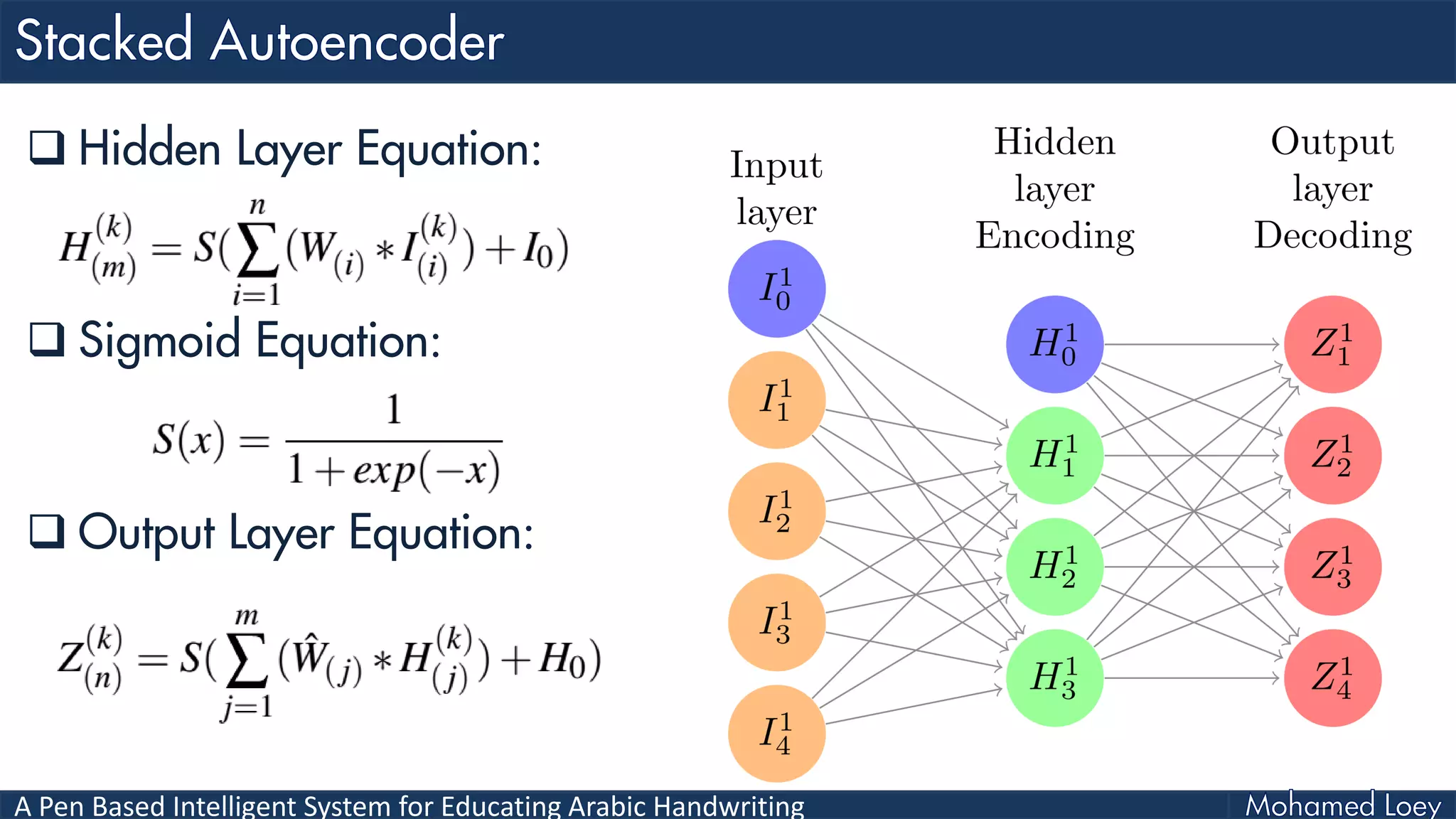
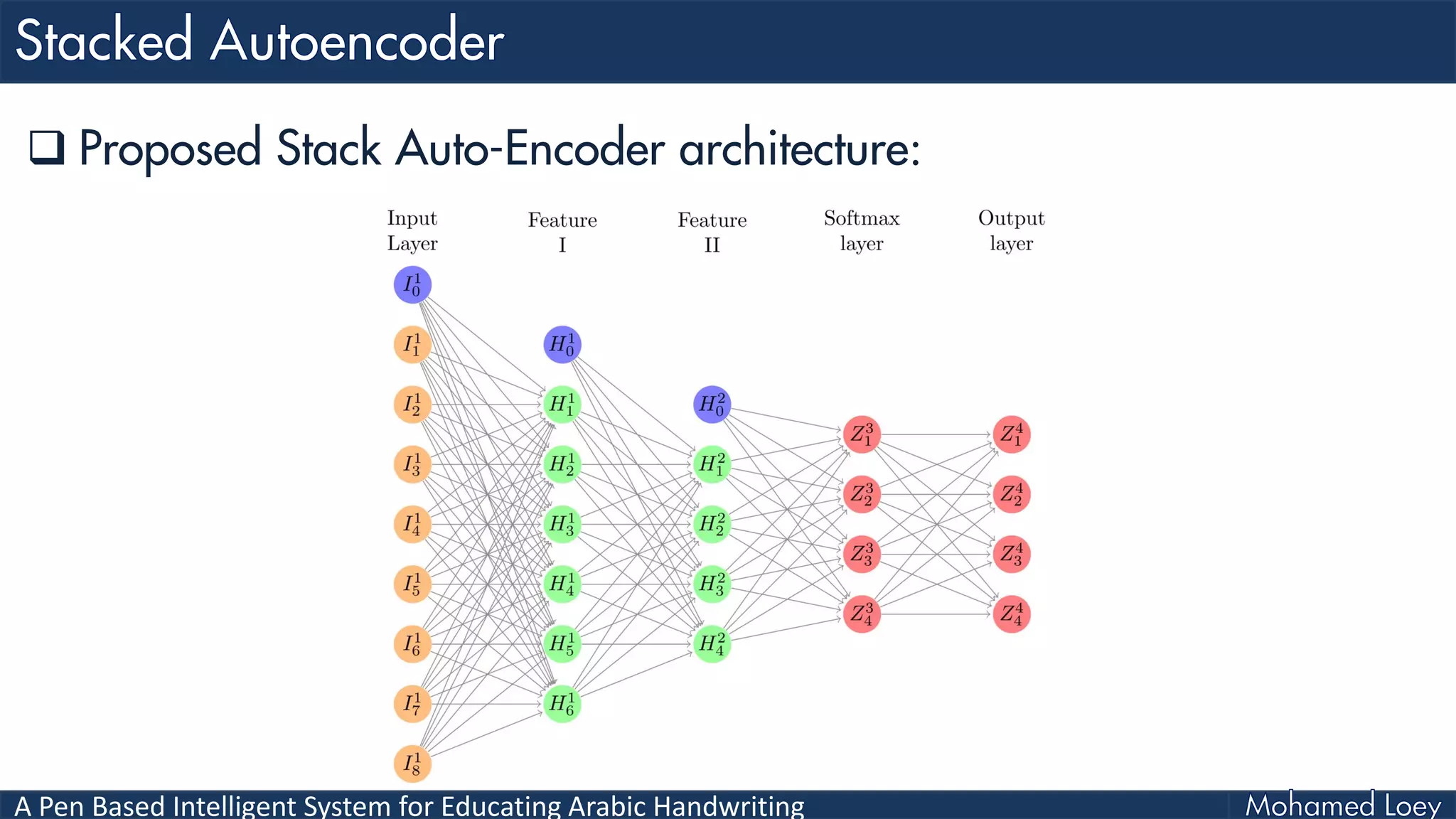
 The main component in Stacked Autoencoder is combined
Autoencoder. Autoencoder is a simple three-layer neural network
including an encoder and a decoder where output units are directly
connected back to input units.
 In Autoencoder: the number of input units equal the number of
output units.
A Pen Based Intelligent System for Educating Arabic Handwriting
 Hidden Layer Equation:
 Sigmoid Equation:
 Output Layer Equation:
A Pen Based Intelligent System for Educating Arabic Handwriting
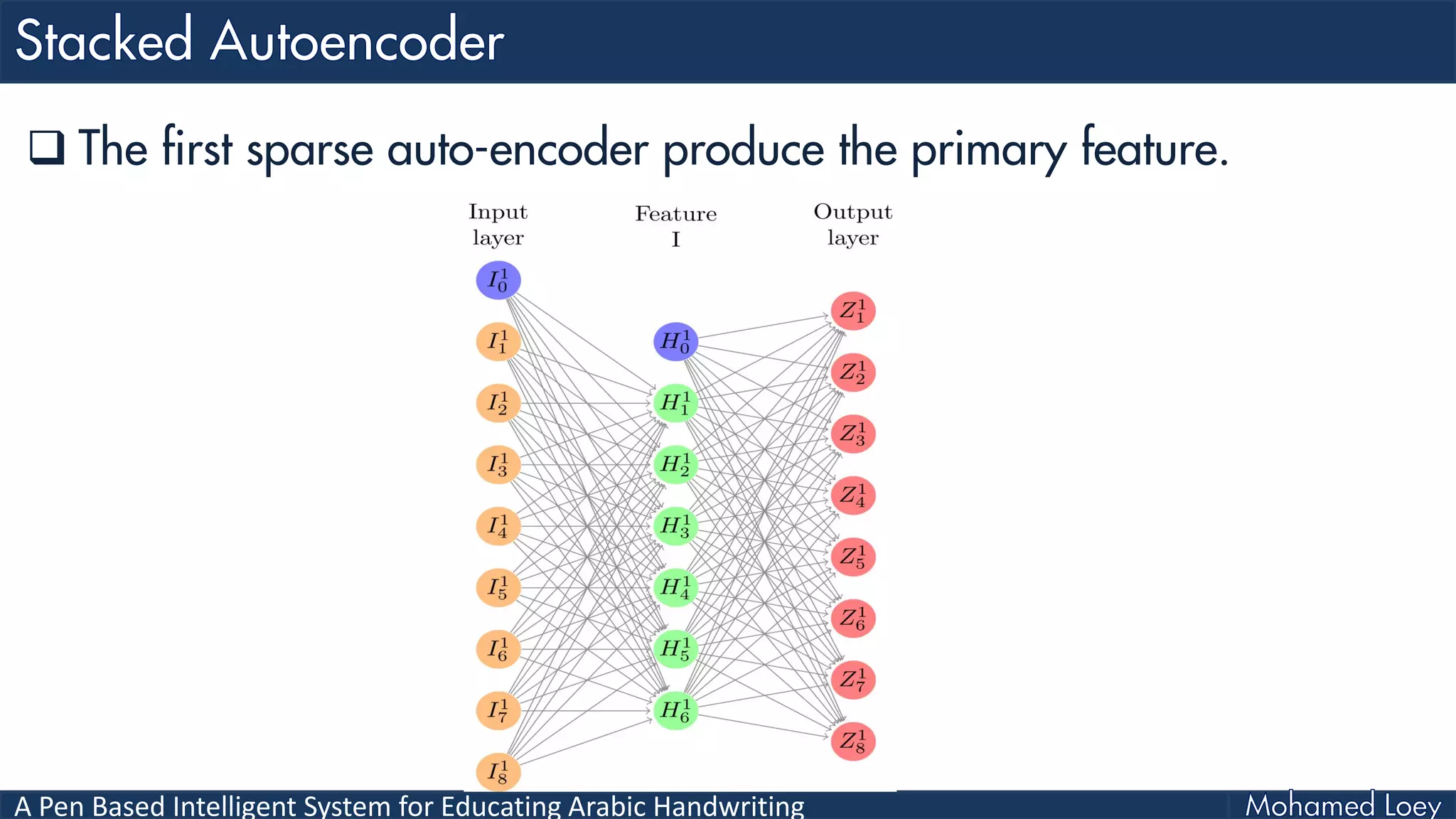
 The first sparse auto-encoder produce the primary feature.
A Pen Based Intelligent System for Educating Arabic Handwriting
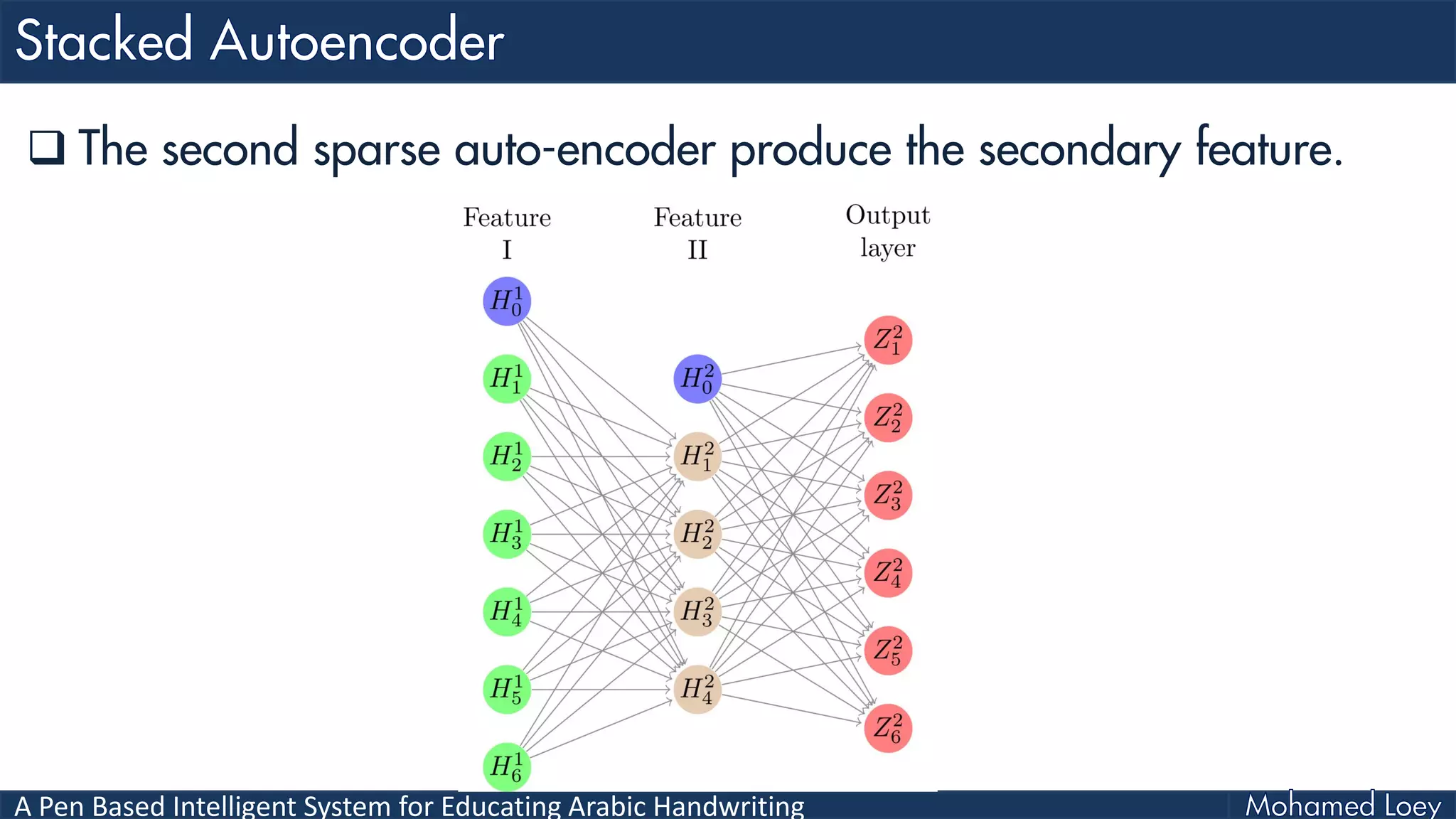
 The second sparse auto-encoder produce the secondary feature.
A Pen Based Intelligent System for Educating Arabic Handwriting
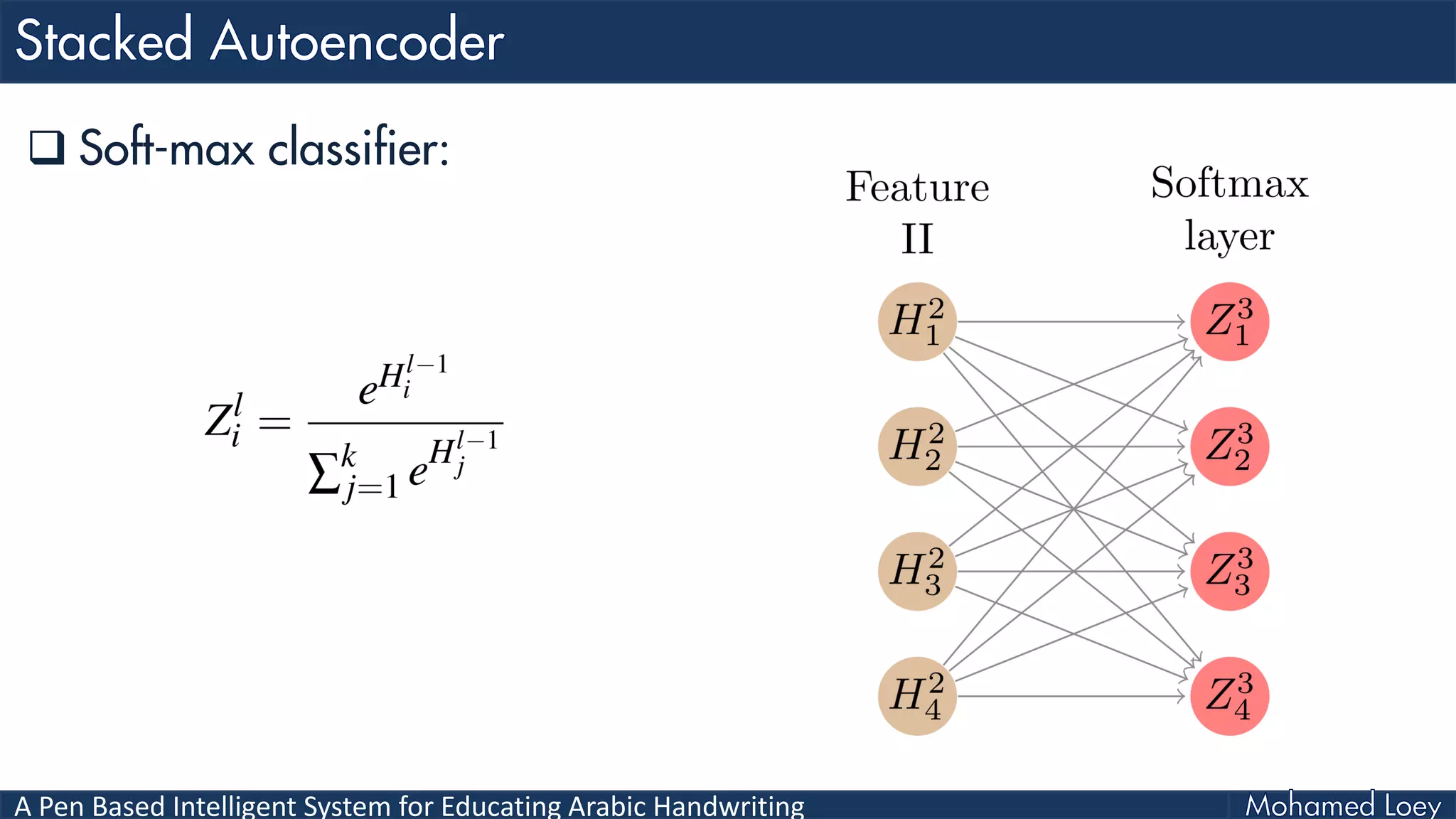
 Soft-max classifier:
A Pen Based Intelligent System for Educating Arabic Handwriting
 Proposed Stack Auto-Encoder architecture:
A Pen Based Intelligent System for Educating Arabic Handwriting
Neural Network
Activation Functions
Deep Learning
Stacked Autoencoder
Convolutional Neural Network
Intelligent Tutoring Systems
Pattern Recognition
A Pen Based Intelligent System for Educating Arabic Handwriting
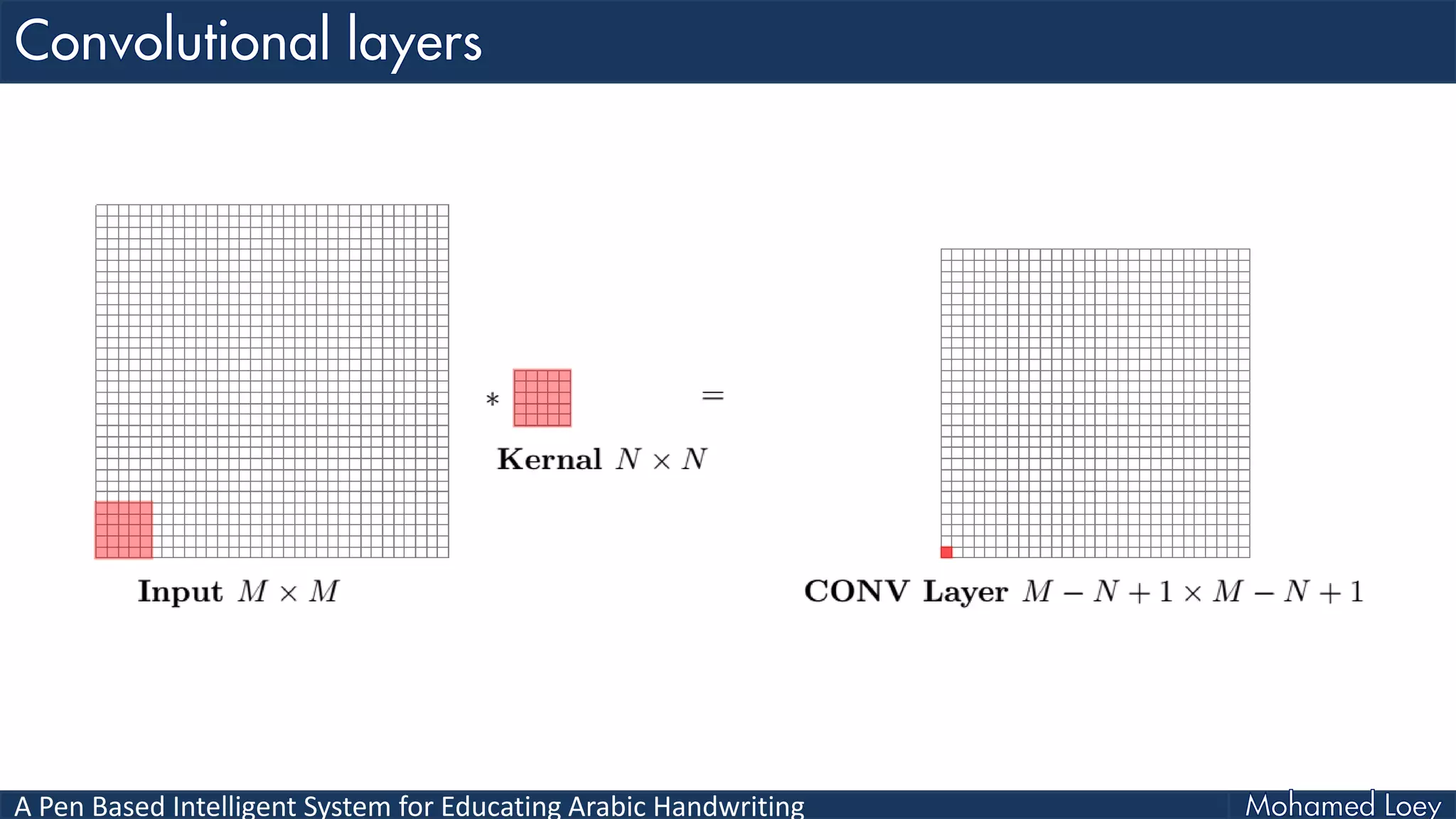
 Convolution Neural Networks (CNN) is supervised learning and a family
of multi-layer neural networks particularly designed for use on two
dimensional data, such as images and videos.
 A CNN consists of a number of layers:
 Convolutional layers.
 Pooling Layers.
 Fully-Connected Layers.
A Pen Based Intelligent System for Educating Arabic Handwriting
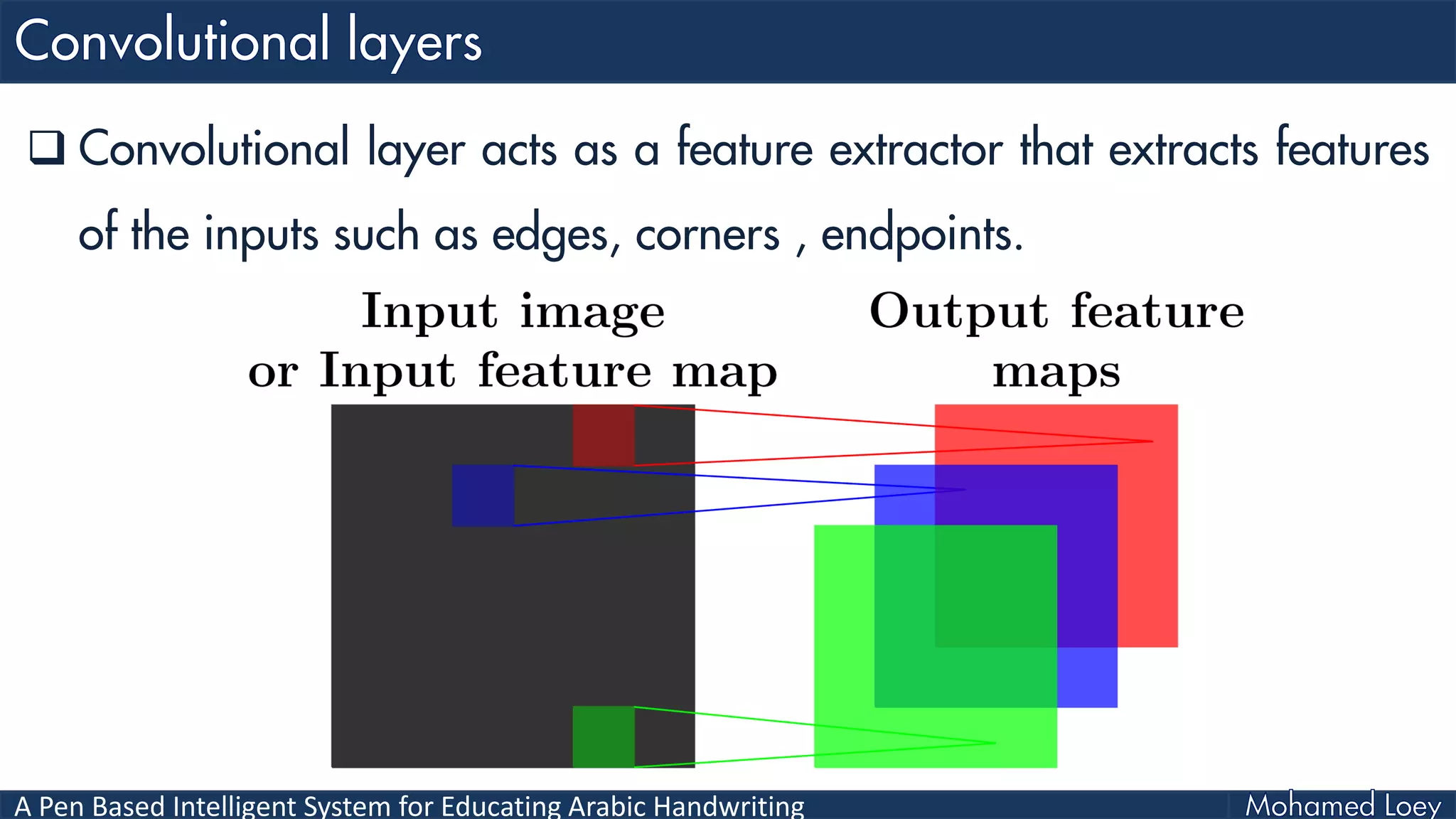
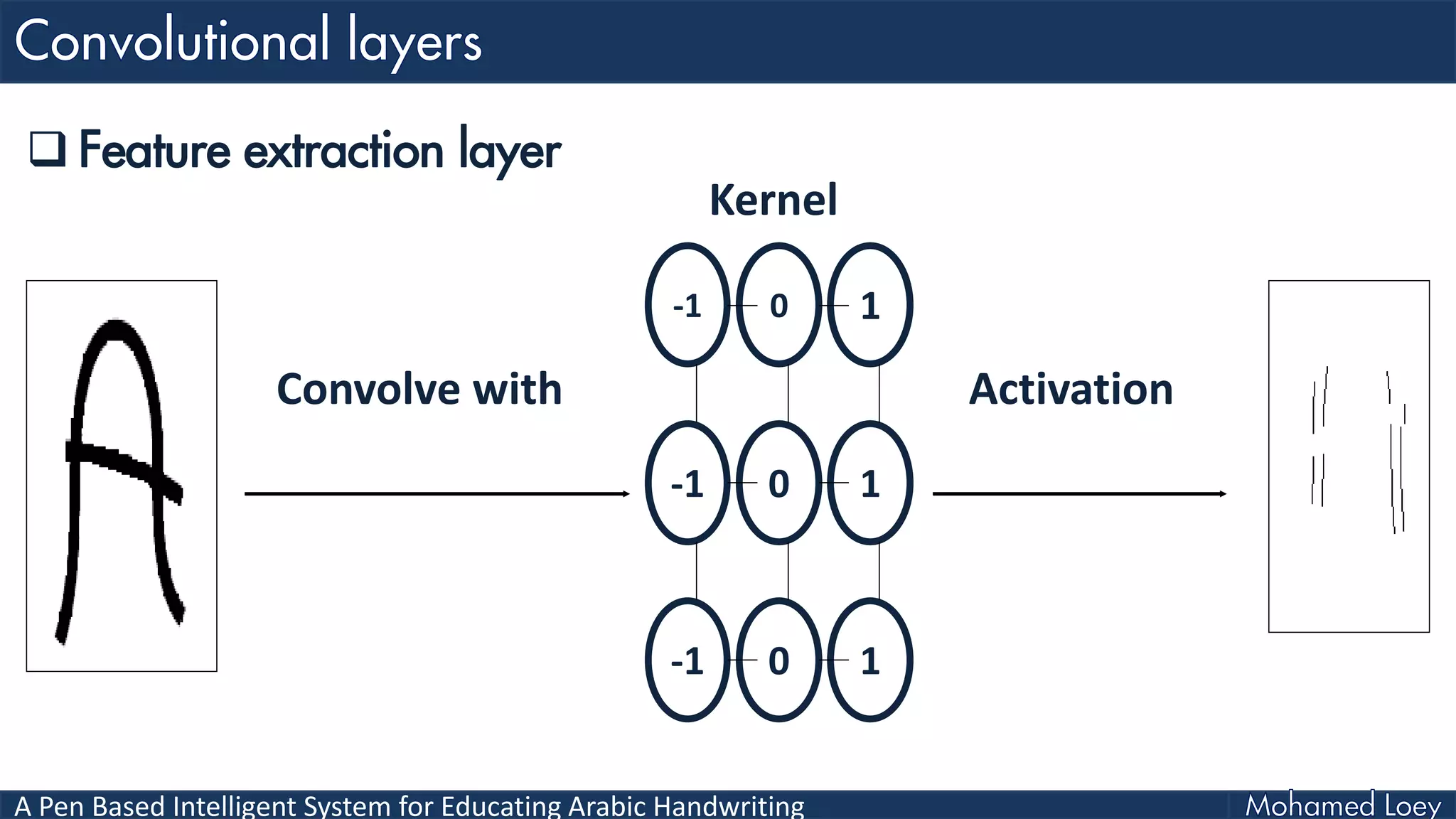
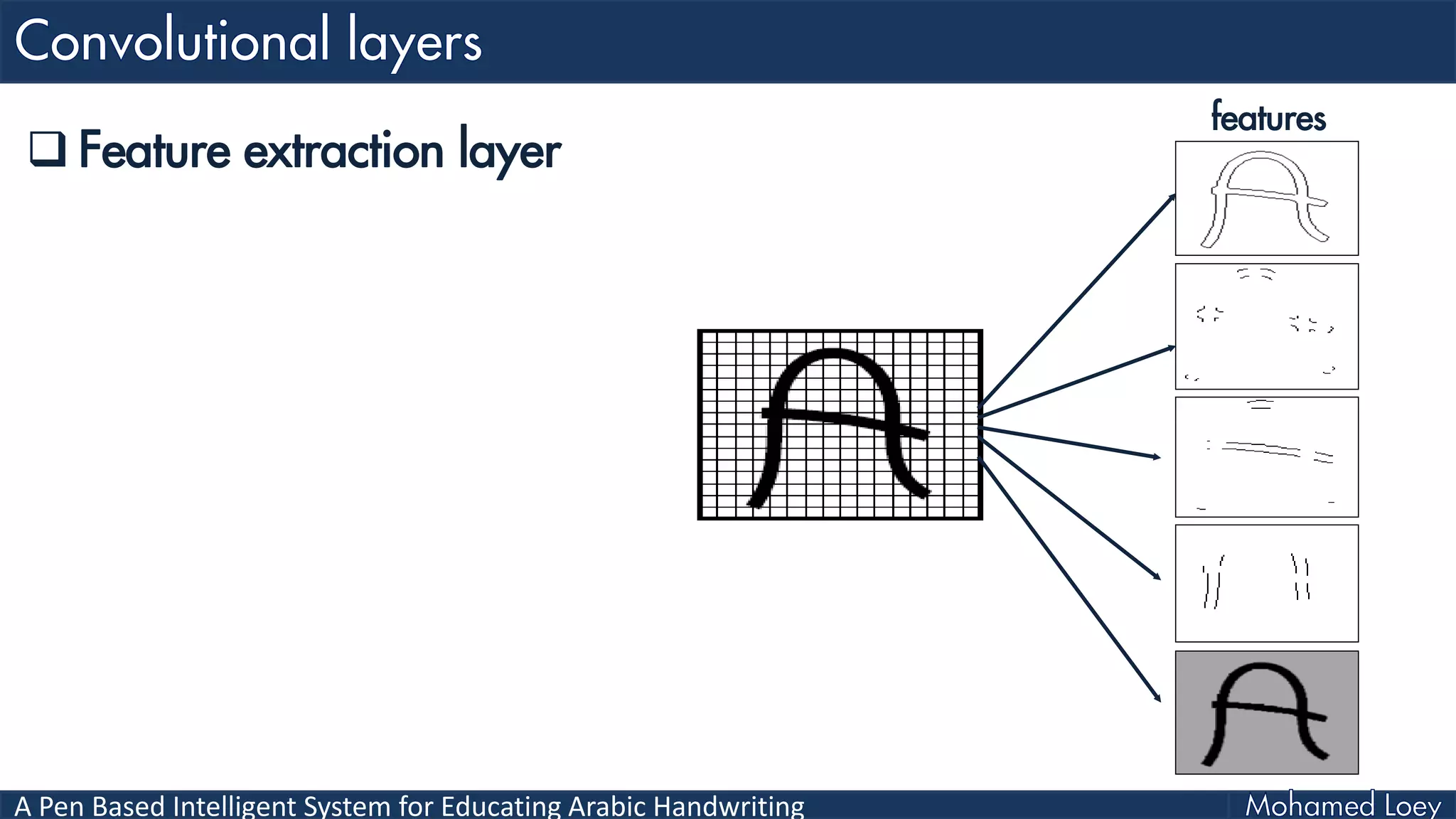
 Convolutional layer acts as a feature extractor that extracts features
of the inputs such as edges, corners , endpoints.
A Pen Based Intelligent System for Educating Arabic Handwriting
 Feature extraction layer
10-1
10-1
10-1
Convolve with Activation
Kernel
A Pen Based Intelligent System for Educating Arabic Handwriting
features
 Feature extraction layer
A Pen Based Intelligent System for Educating Arabic Handwriting
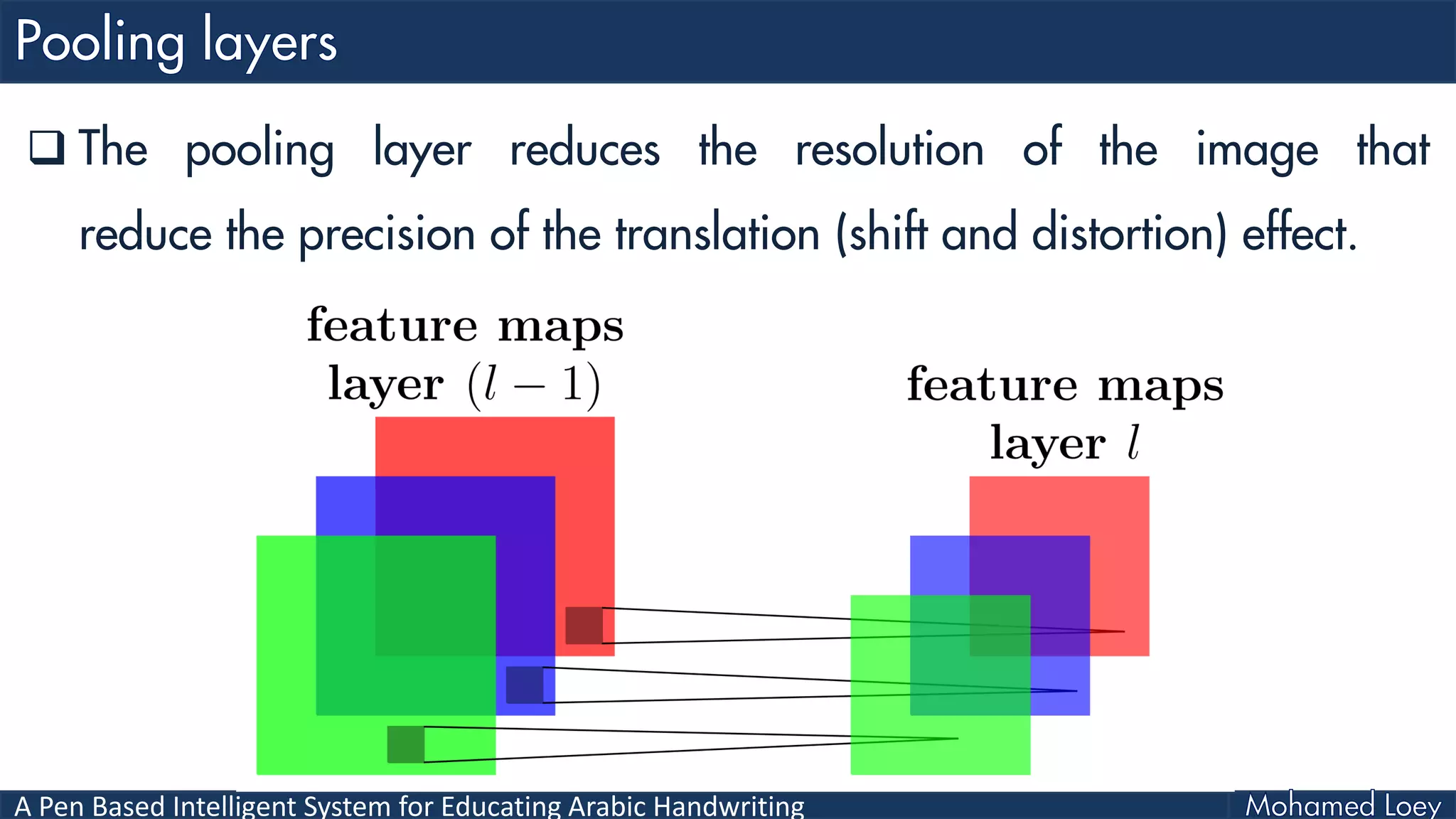
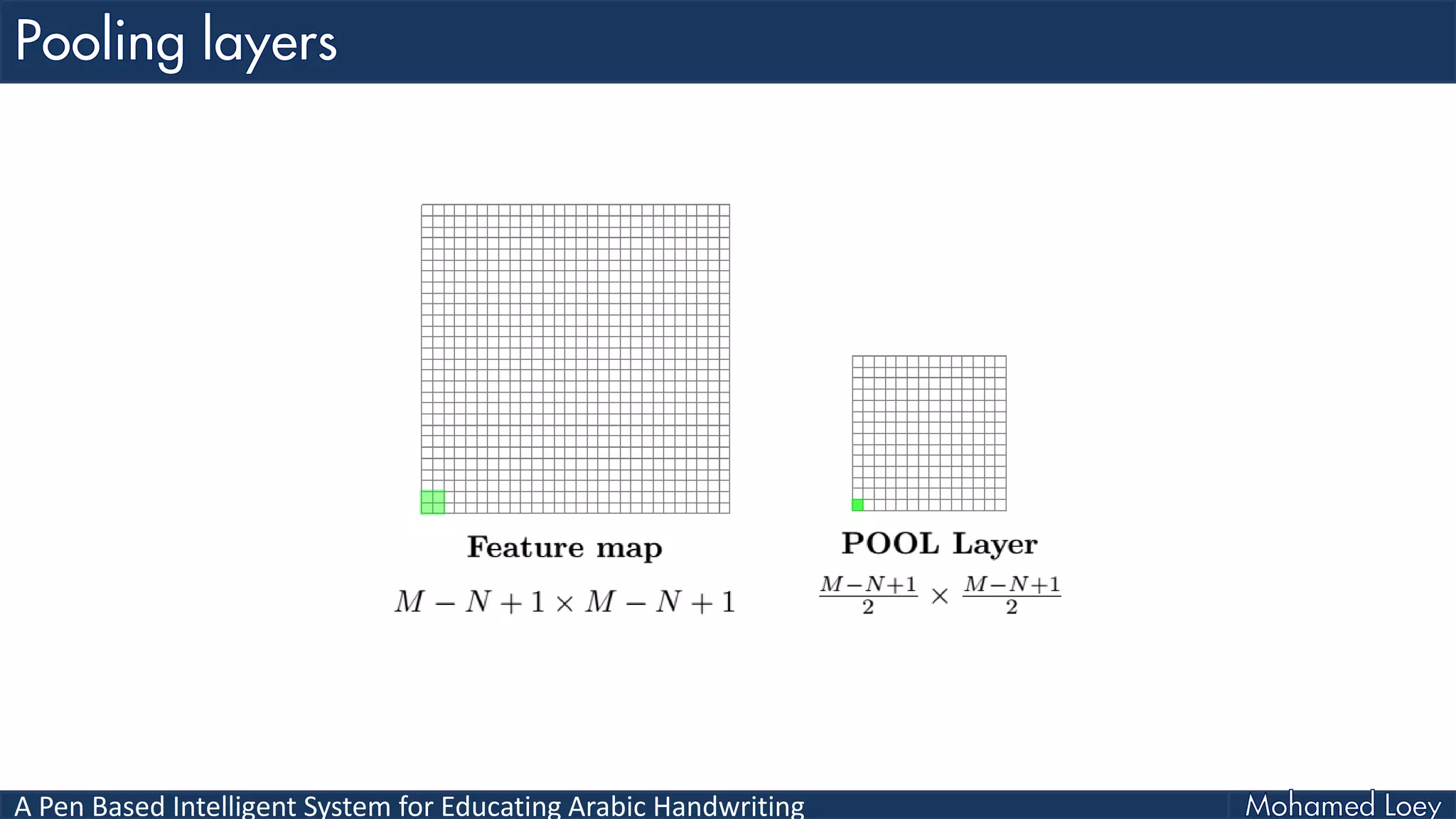
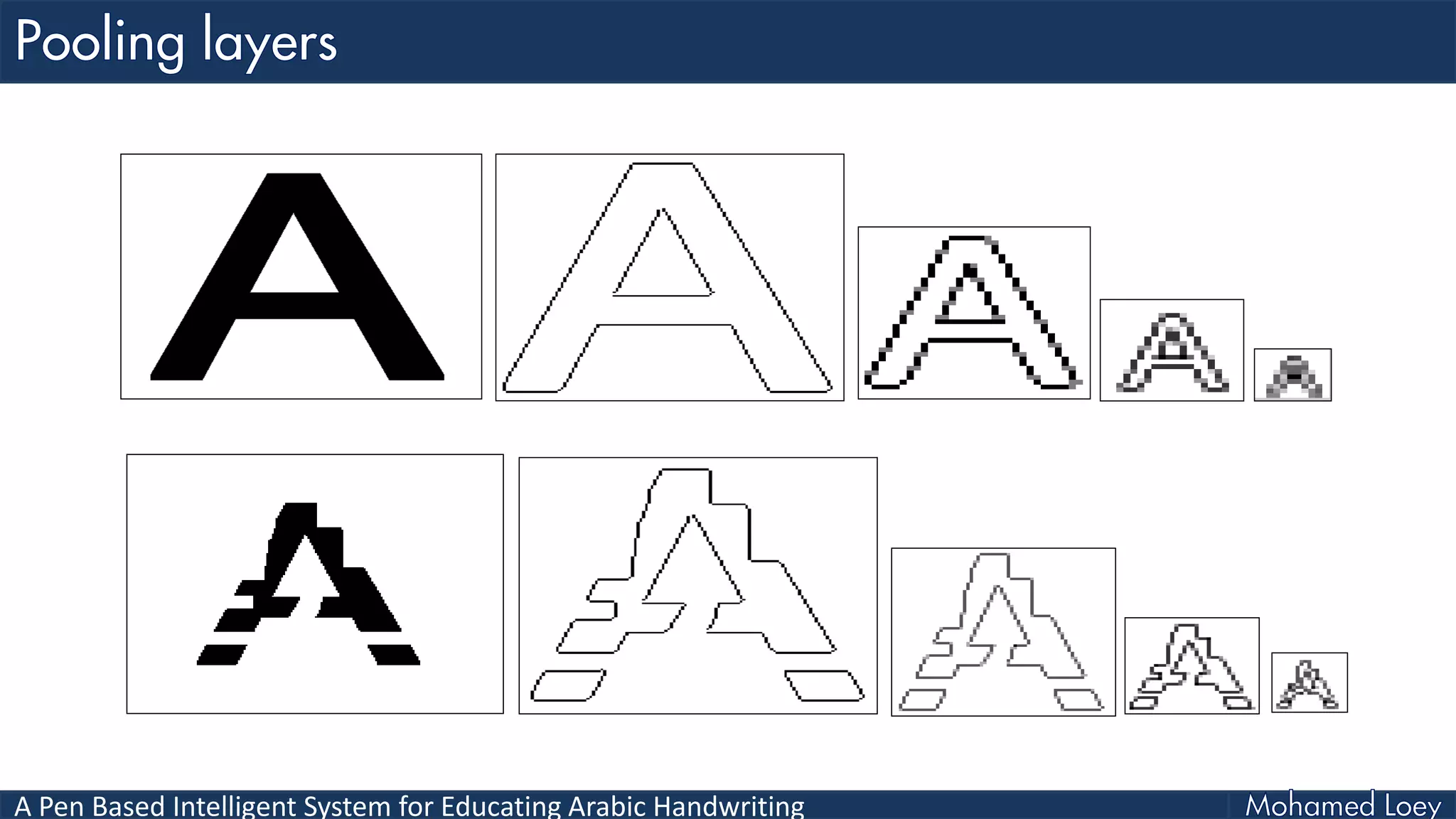
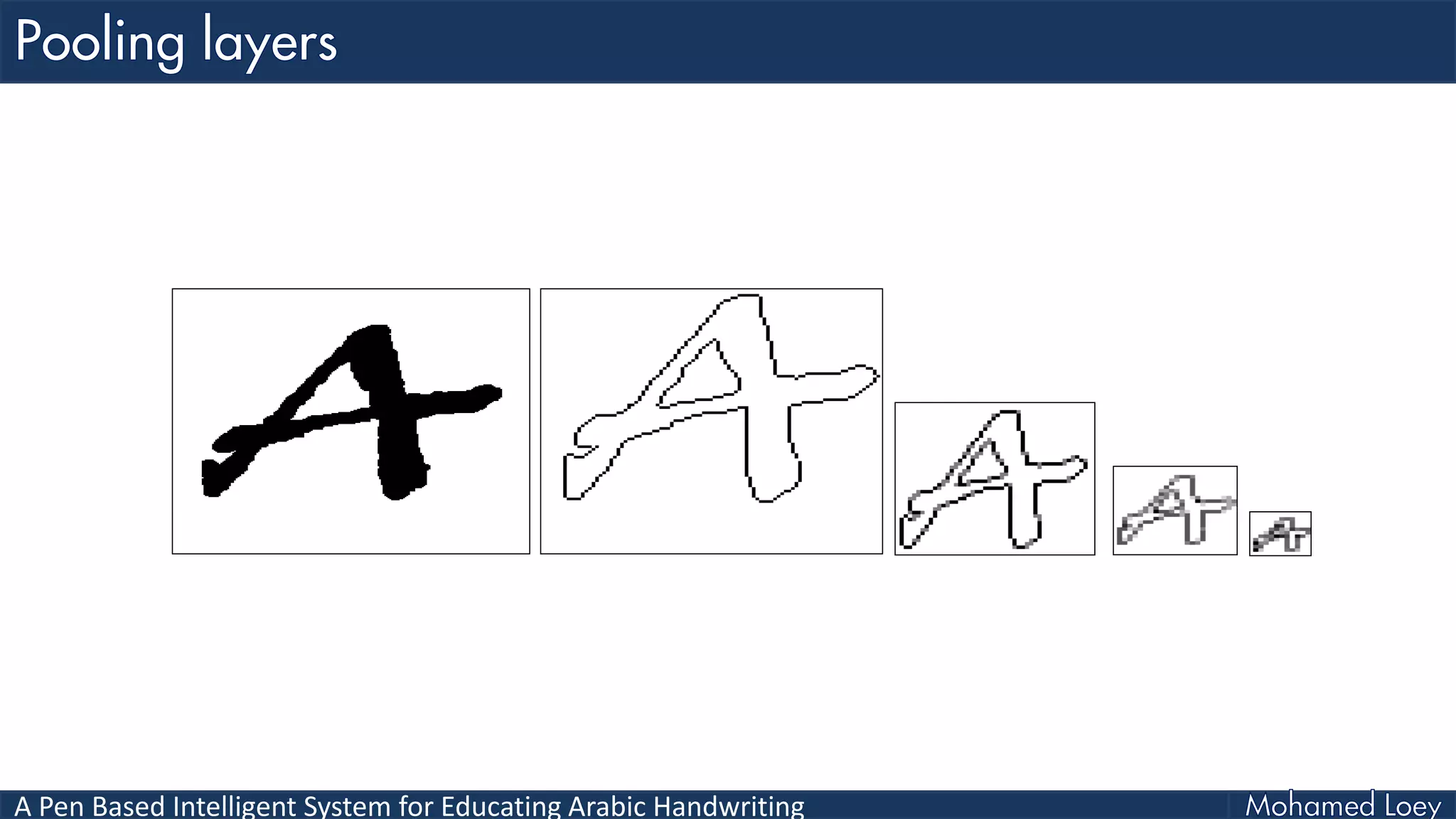
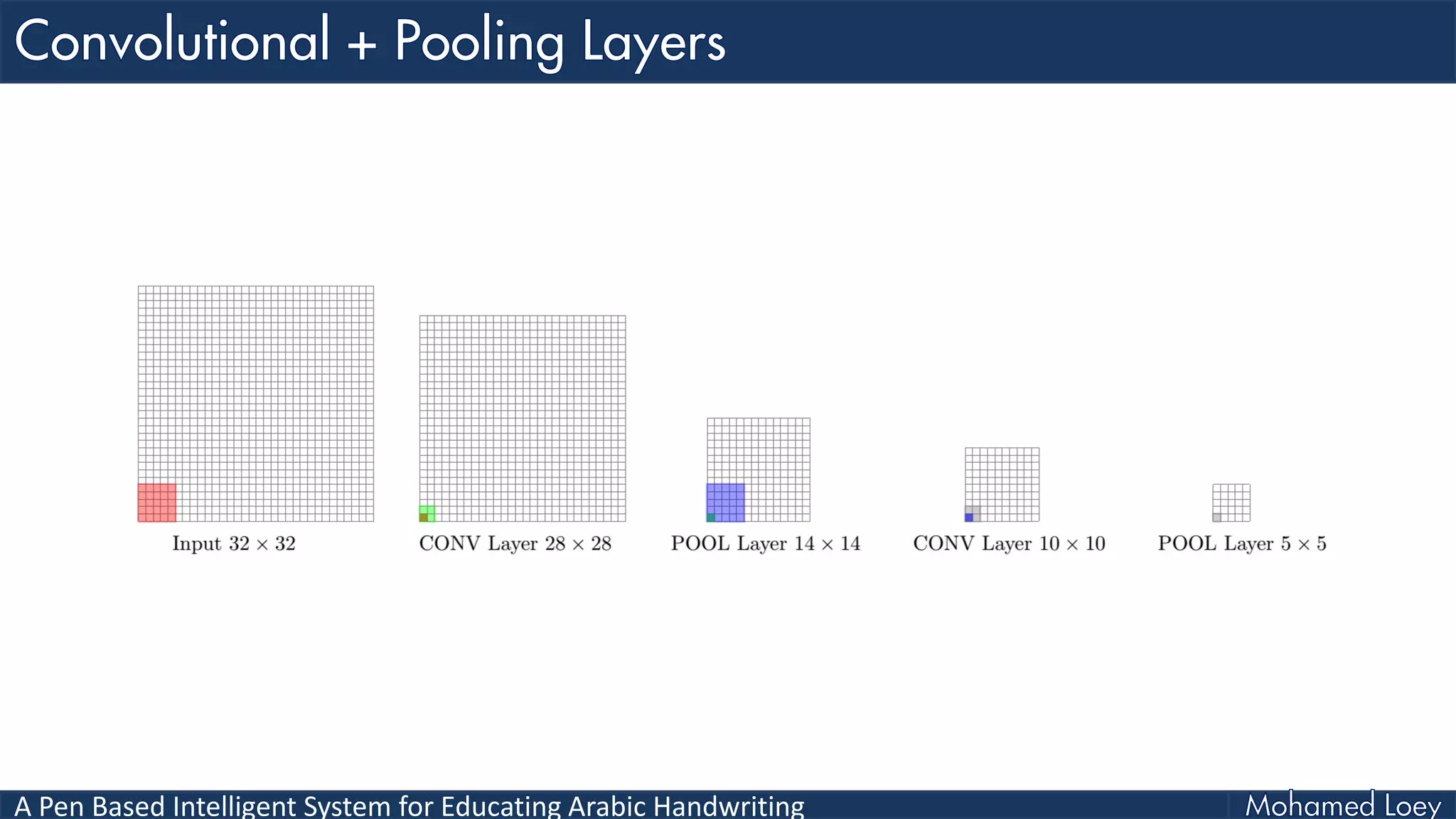
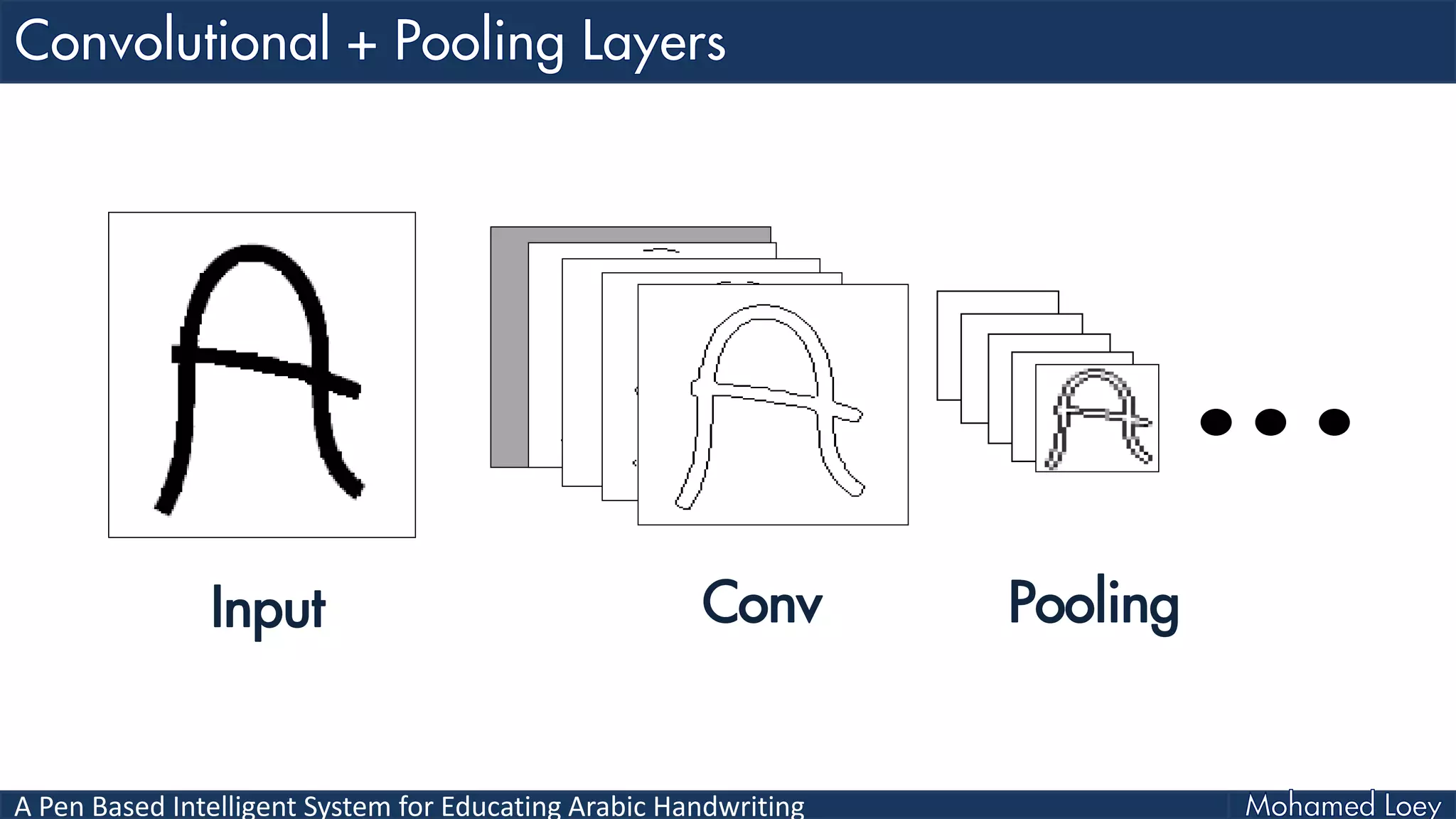
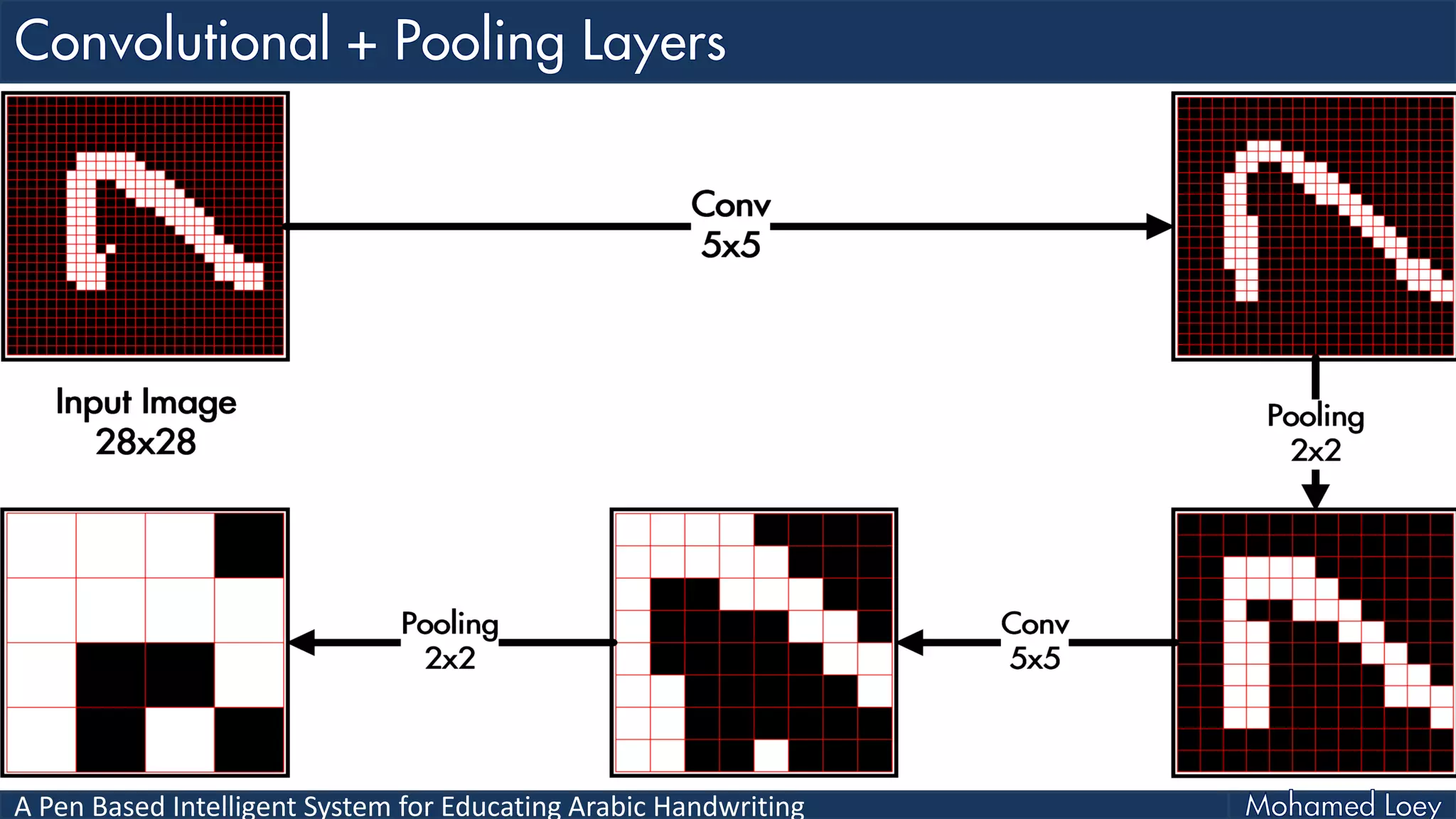
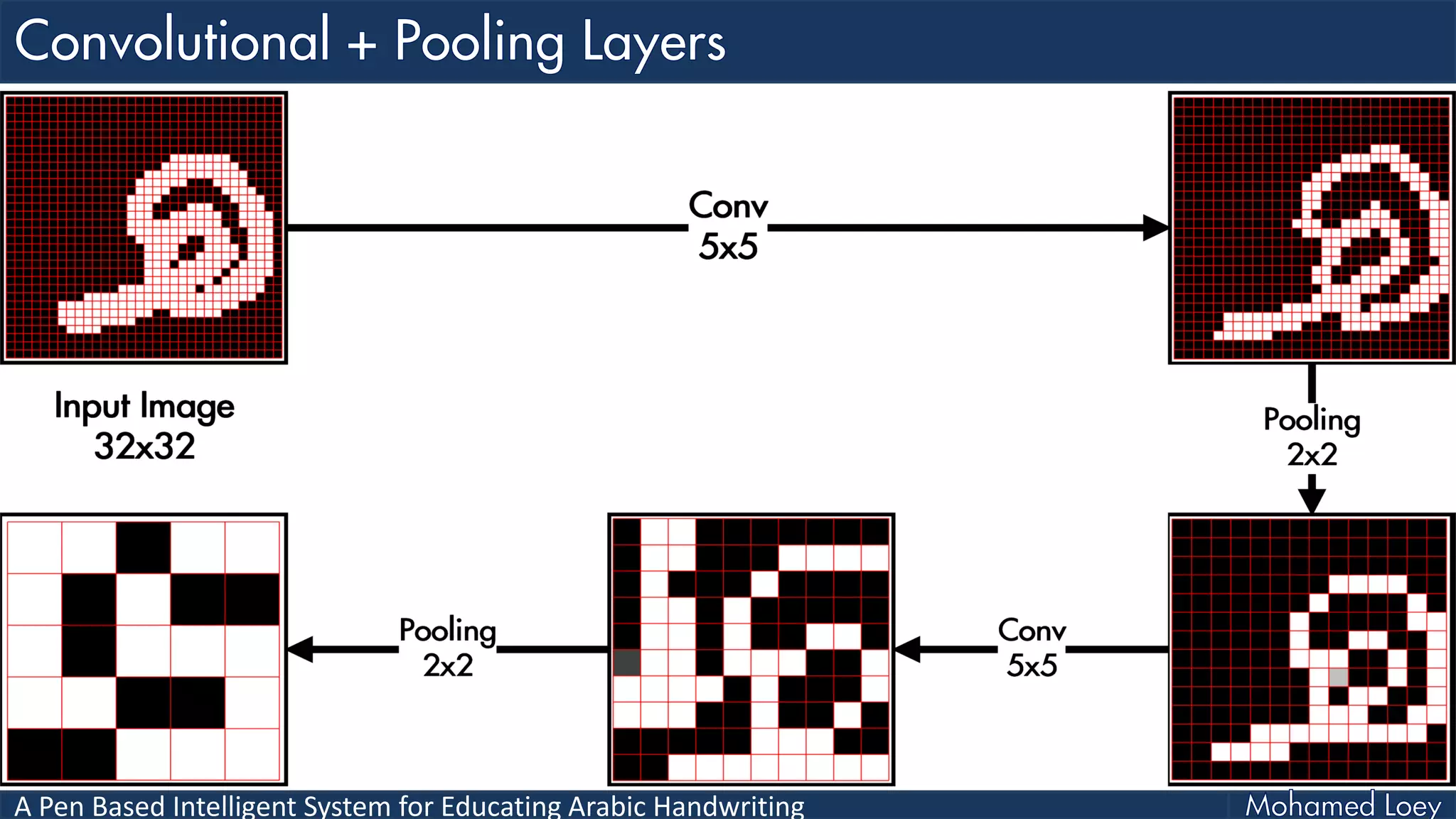
 The pooling layer reduces the resolution of the image that
reduce the precision of the translation (shift and distortion) effect.
A Pen Based Intelligent System for Educating Arabic Handwriting
ConvInput Pooling
A Pen Based Intelligent System for Educating Arabic Handwriting
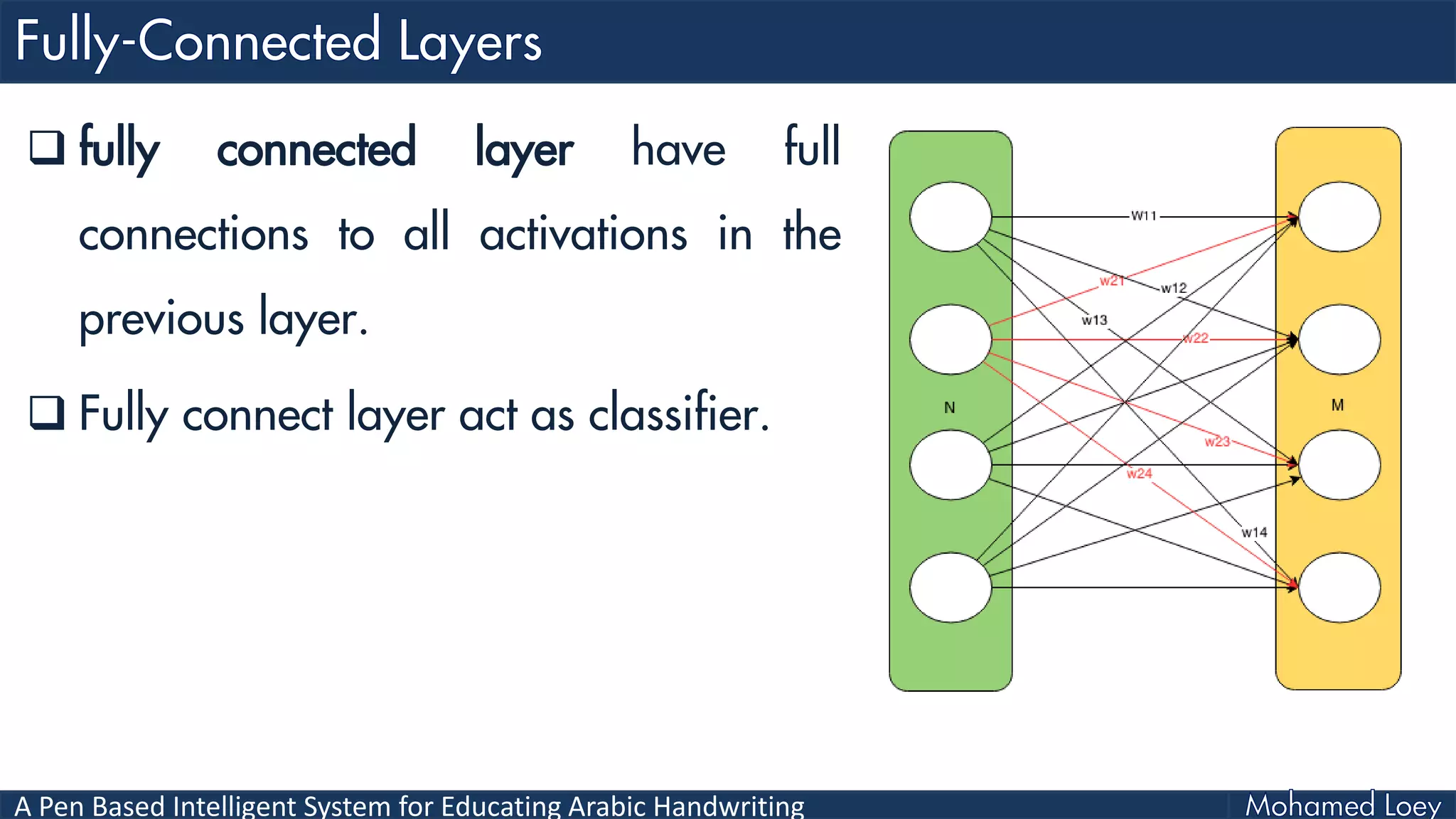
 fully connected layer have full
connections to all activations in the
previous layer.
 Fully connect layer act as classifier.
A Pen Based Intelligent System for Educating Arabic Handwriting
Neural Network
Activation Functions
Deep Learning
Stacked Autoencoder
Convolutional Neural Network
Intelligent Tutoring Systems
Pattern Recognition
A Pen Based Intelligent System for Educating Arabic Handwriting
 Intelligent tutoring systems (ITS) are computational agents whose
purpose is to facilitate learning, usually without the help of a
human teacher.
 ITS products can be organized on three categories:
 Read Systems
 Guided Systems
 Immediate Error Detection Systems
A Pen Based Intelligent System for Educating Arabic Handwriting
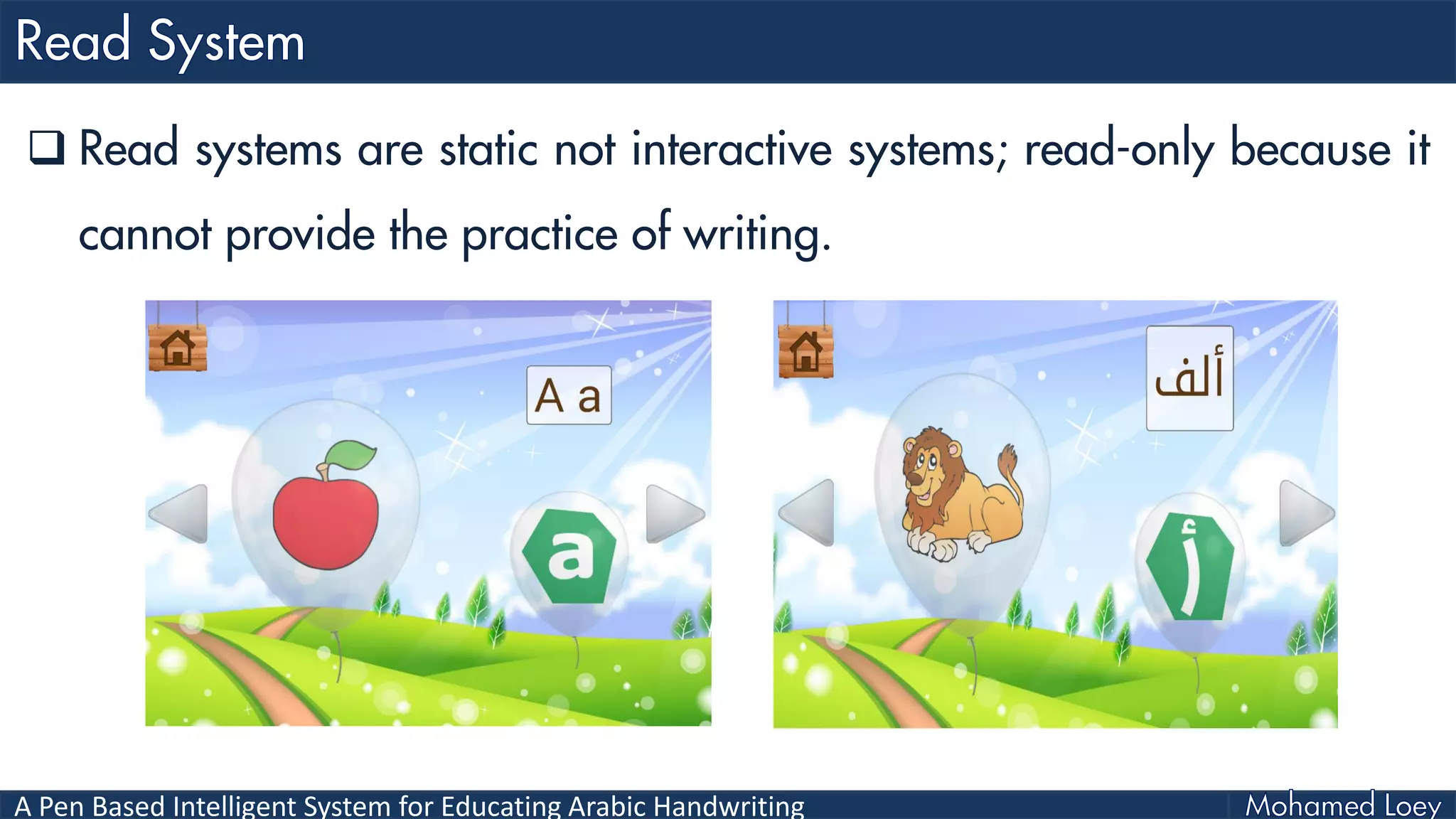
 Read systems are static not interactive systems; read-only because it
cannot provide the practice of writing.
A Pen Based Intelligent System for Educating Arabic Handwriting
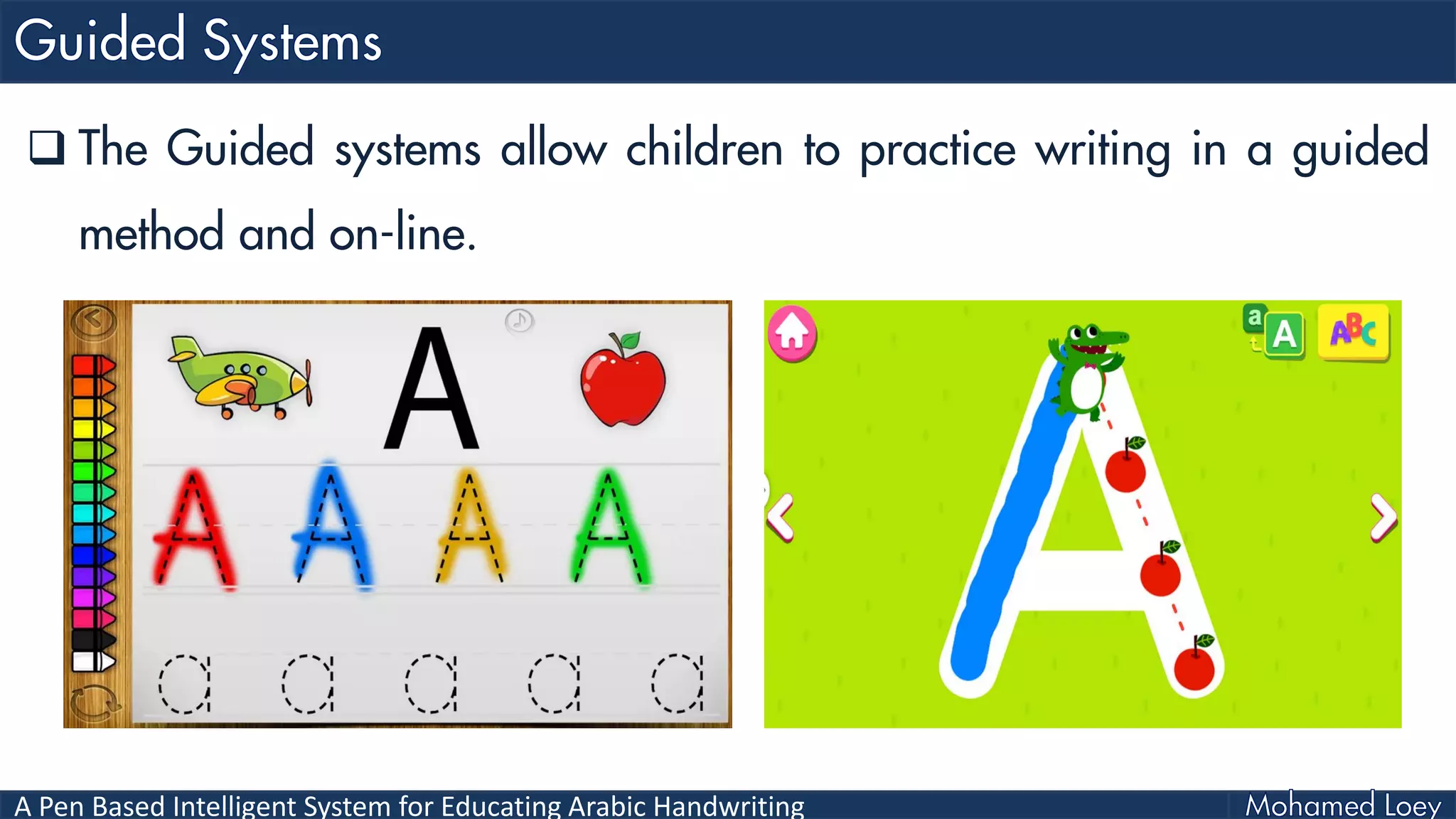
 The Guided systems allow children to practice writing in a guided
method and on-line.
A Pen Based Intelligent System for Educating Arabic Handwriting
The immediate error detection Systems gives access to the
children to practice free writing mode, and provide
immediately a feedback to indicate if there are any errors
in the writing.
A Pen Based Intelligent System for Educating Arabic Handwriting
Introduction
Previous Related Work
Background and Preliminaries
Arabic Handwritten Digits Recognition System
Arabic Handwritten Characters Recognition System
Intelligent Arab Teaching System
Conclusion and Future Work
A Pen Based Intelligent System for Educating Arabic Handwriting
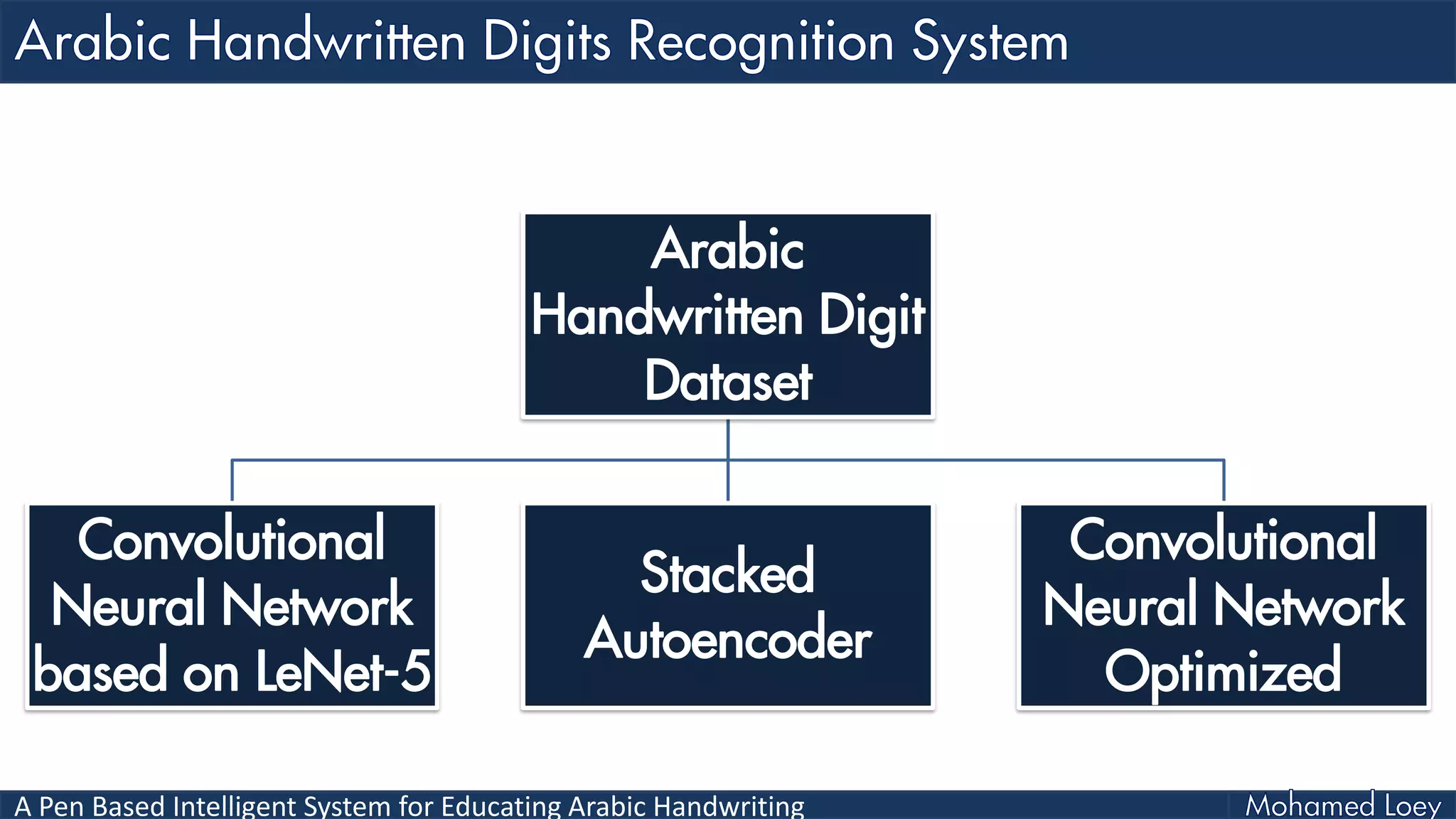
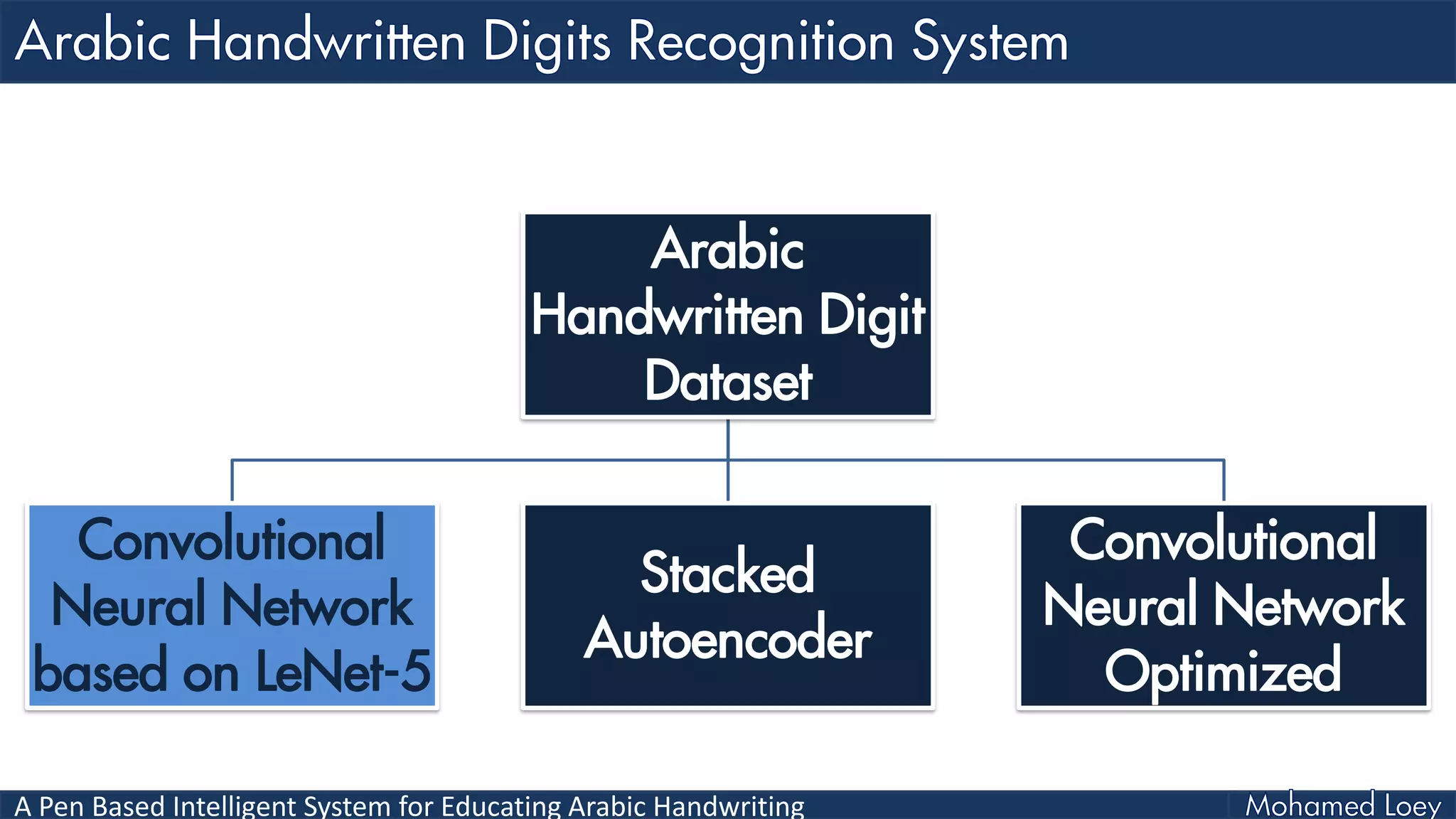
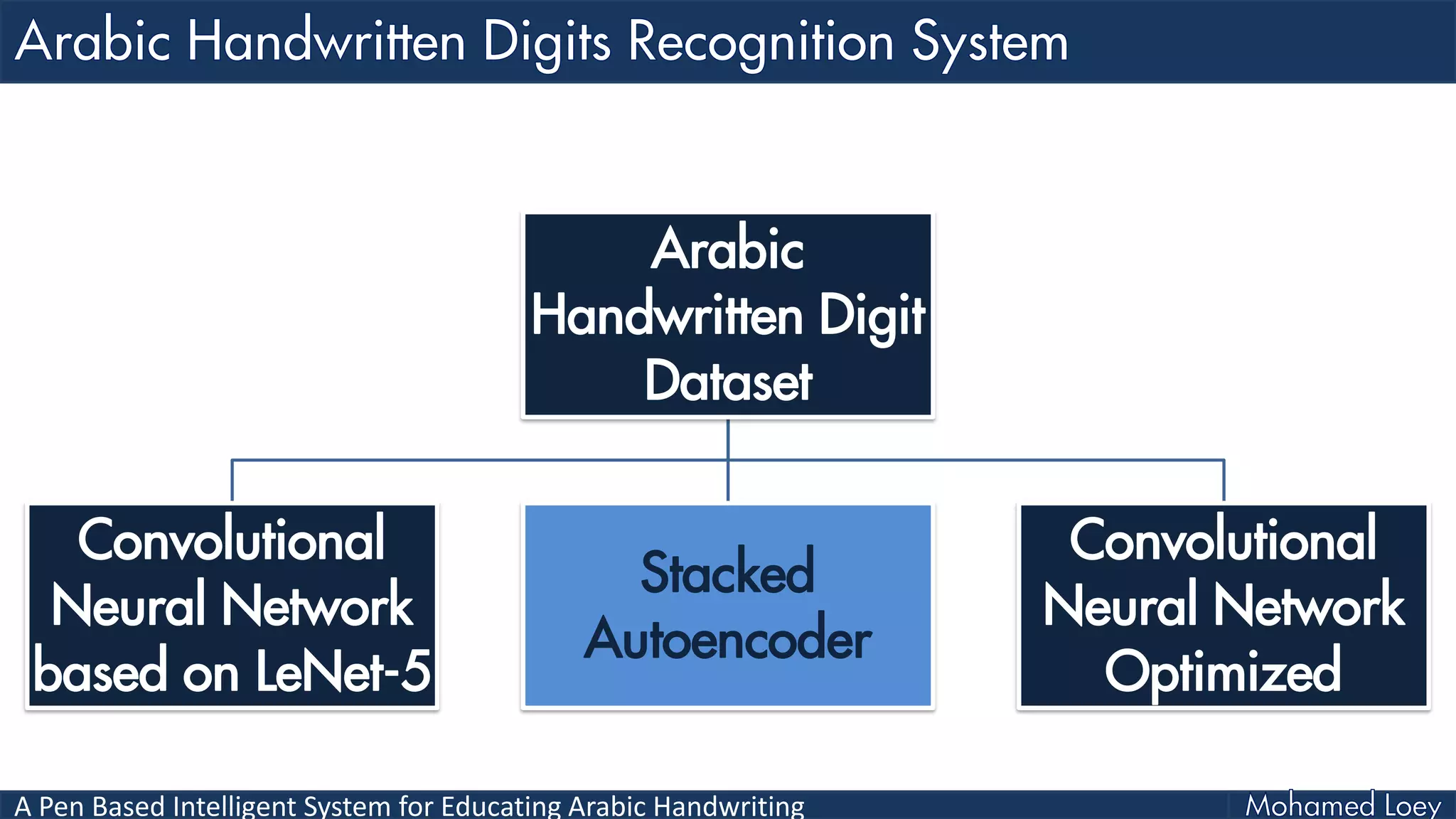
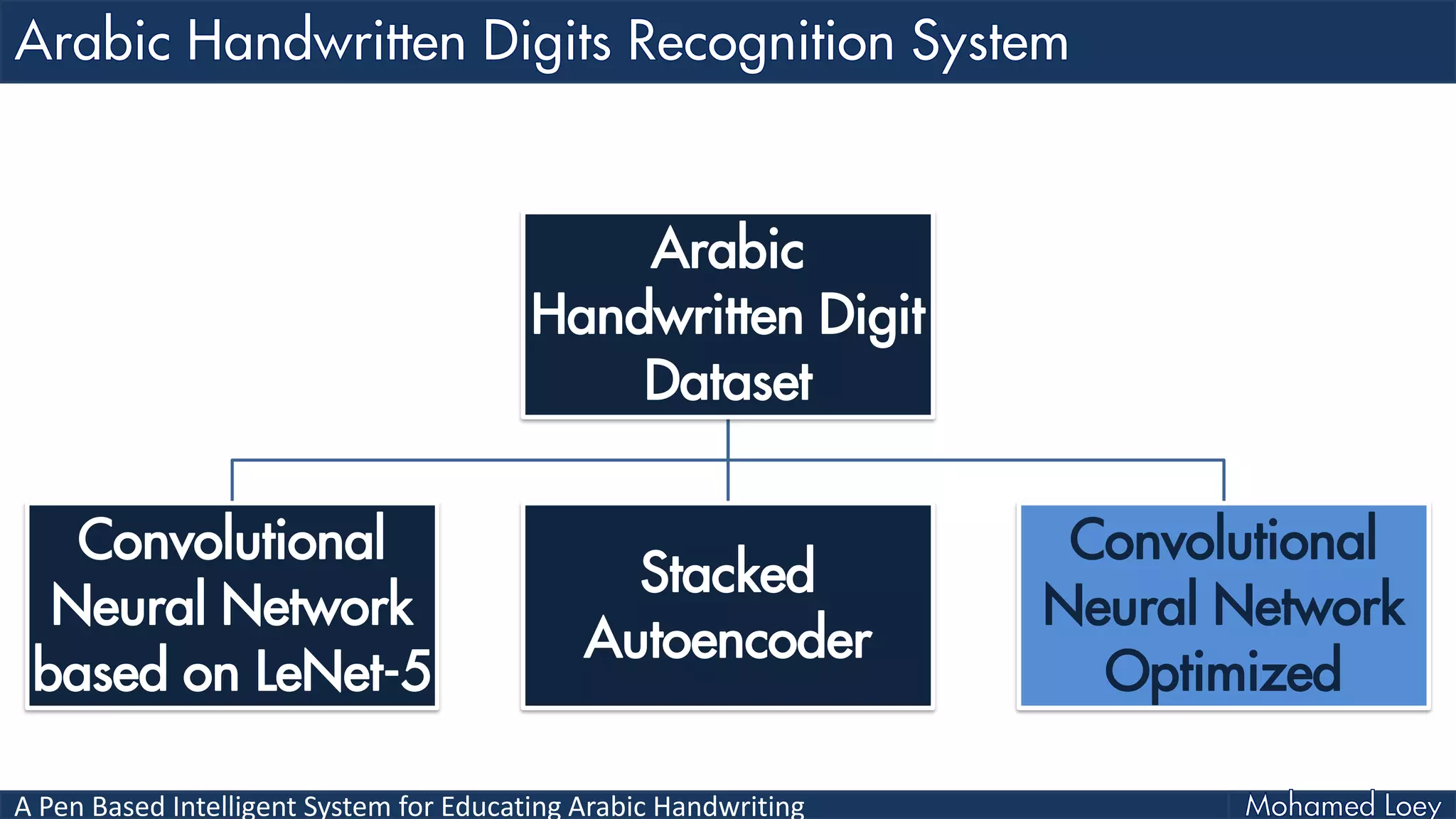
Arabic
Handwritten Digit
Dataset
Convolutional
Neural Network
based on LeNet-5
Stacked
Autoencoder
Convolutional
Neural Network
Optimized
A Pen Based Intelligent System for Educating Arabic Handwriting
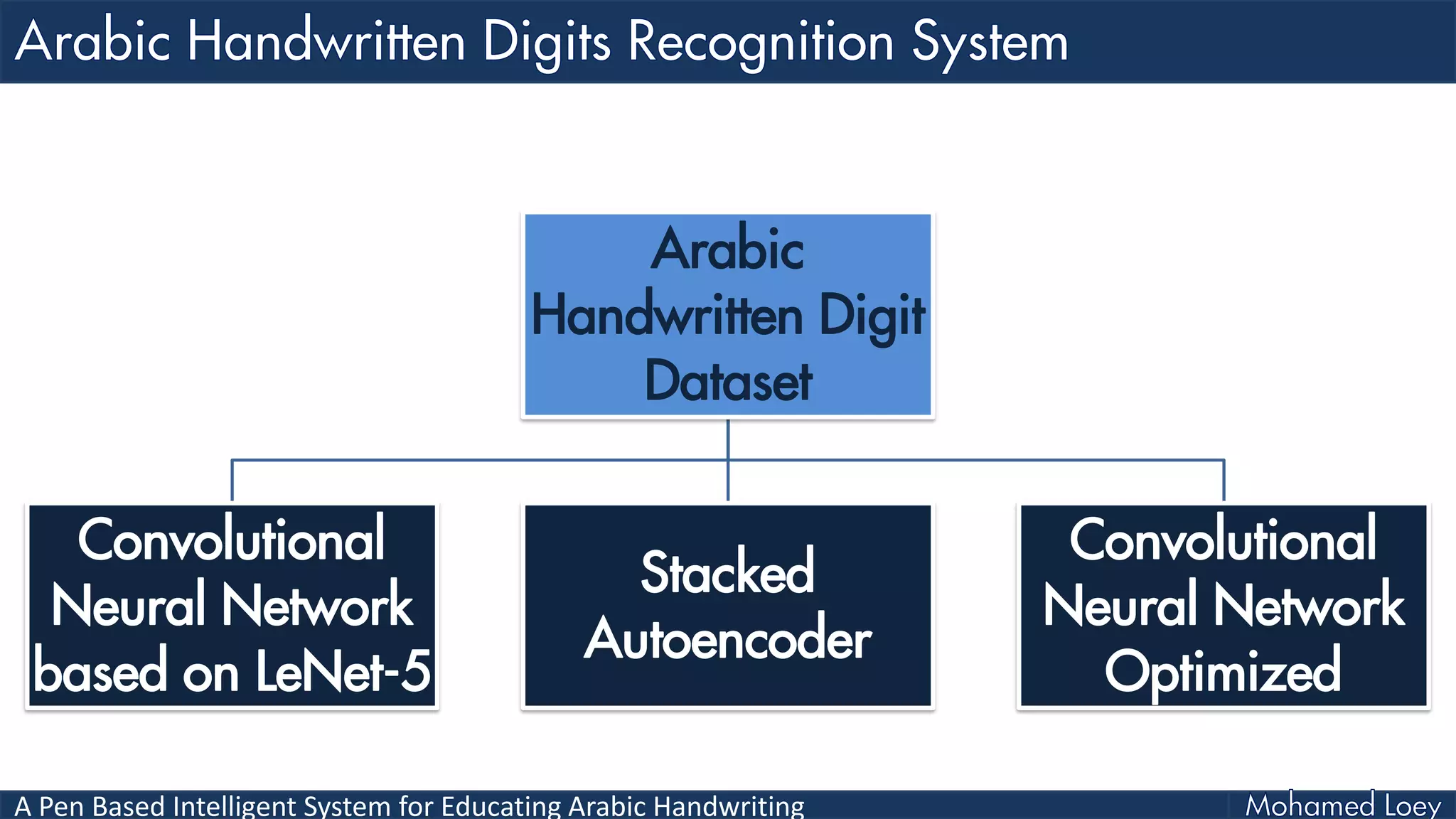
Arabic
Handwritten Digit
Dataset
Convolutional
Neural Network
based on LeNet-5
Stacked
Autoencoder
Convolutional
Neural Network
Optimized
A Pen Based Intelligent System for Educating Arabic Handwriting
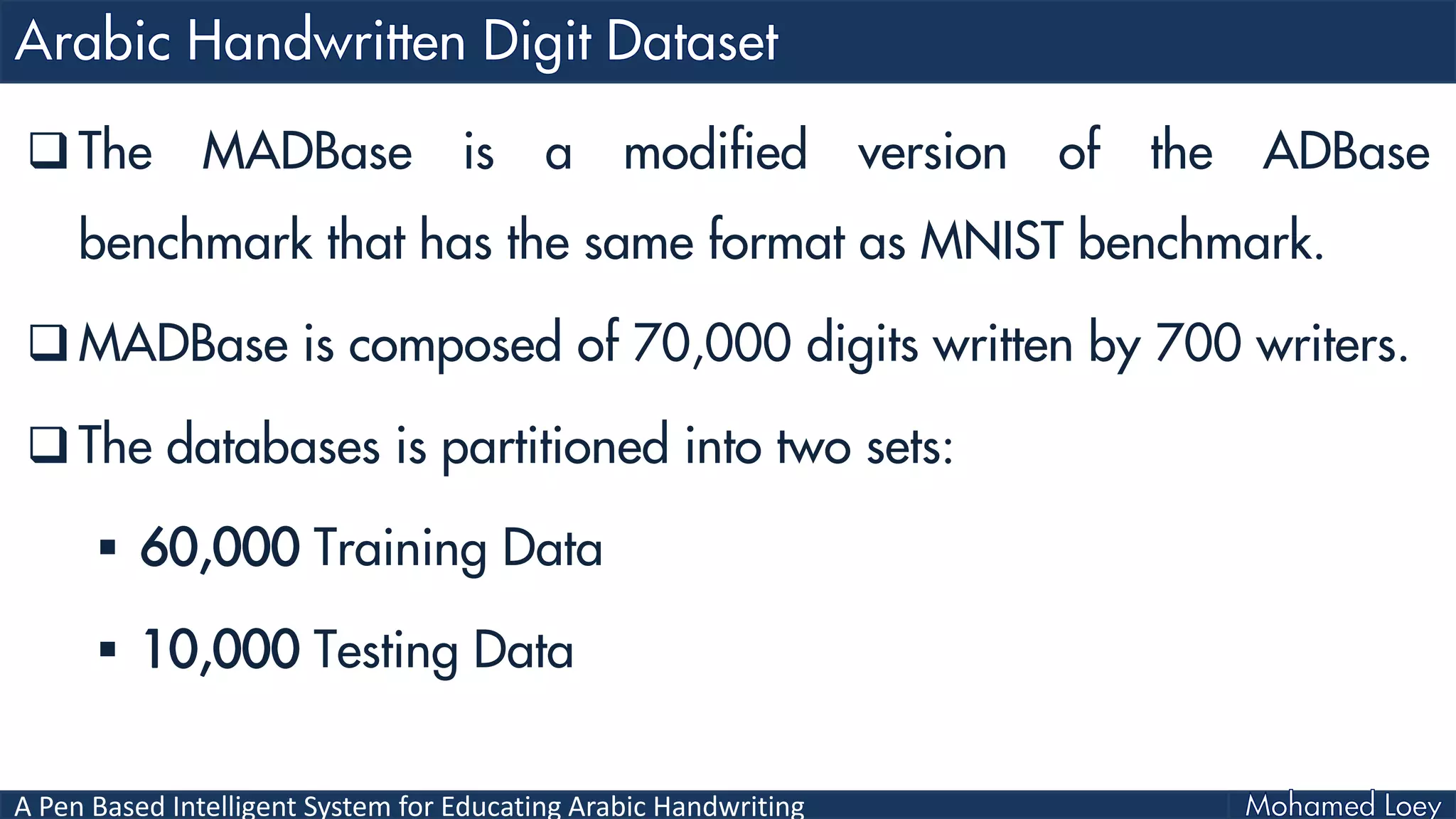
 The MADBase is a modified version of the ADBase
benchmark that has the same format as MNIST benchmark.
 MADBase is composed of 70,000 digits written by 700 writers.
 The databases is partitioned into two sets:
 60,000 Training Data
 10,000 Testing Data
A Pen Based Intelligent System for Educating Arabic Handwriting
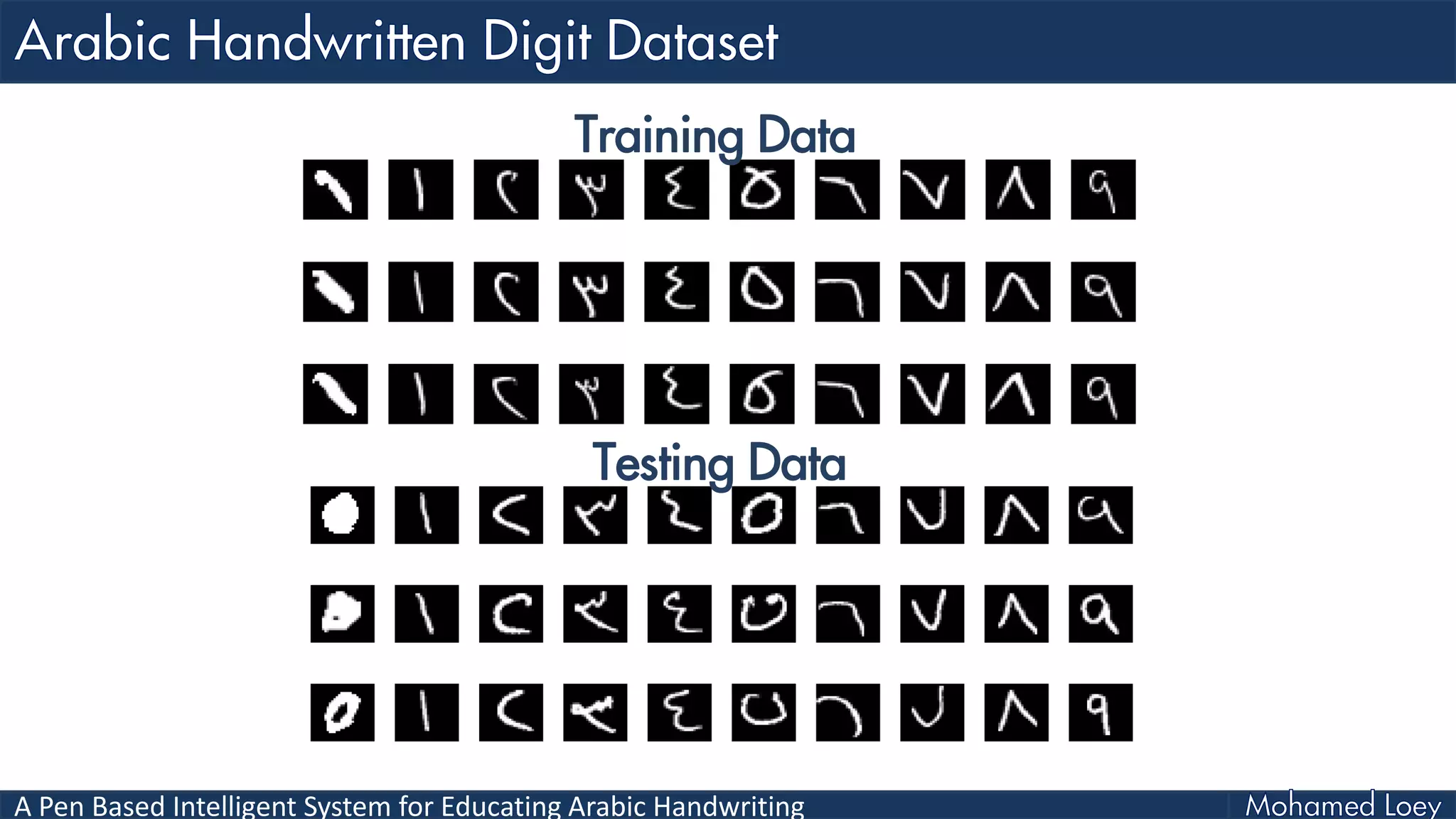
Training Data
Testing Data
A Pen Based Intelligent System for Educating Arabic Handwriting
Arabic
Handwritten Digit
Dataset
Convolutional
Neural Network
based on LeNet-5
Stacked
Autoencoder
Convolutional
Neural Network
Optimized
A Pen Based Intelligent System for Educating Arabic Handwriting
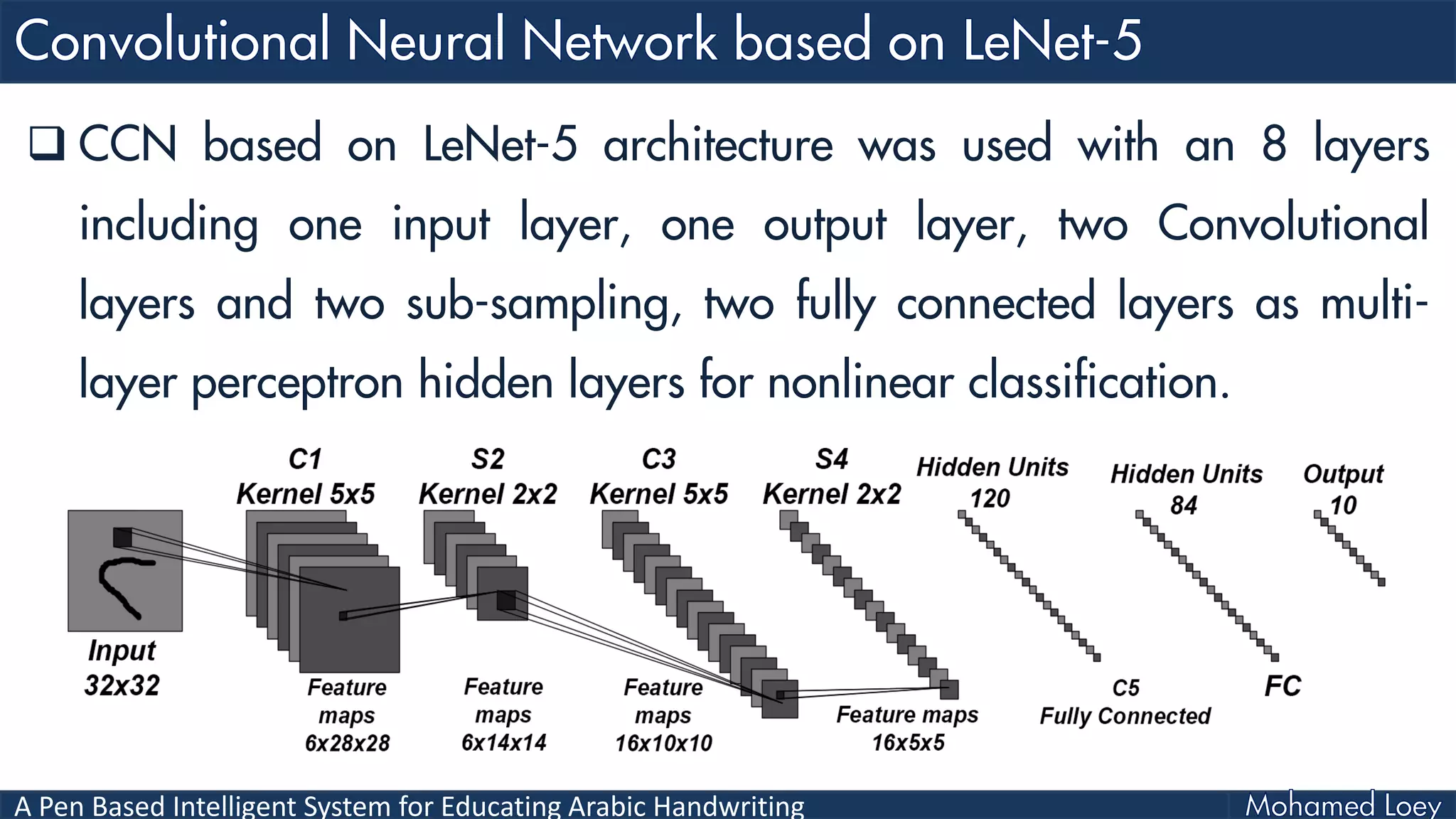
 CCN based on LeNet-5 architecture was used with an 8 layers
including one input layer, one output layer, two Convolutional
layers and two sub-sampling, two fully connected layers as multi-
layer perceptron hidden layers for nonlinear classification.
A Pen Based Intelligent System for Educating Arabic Handwriting
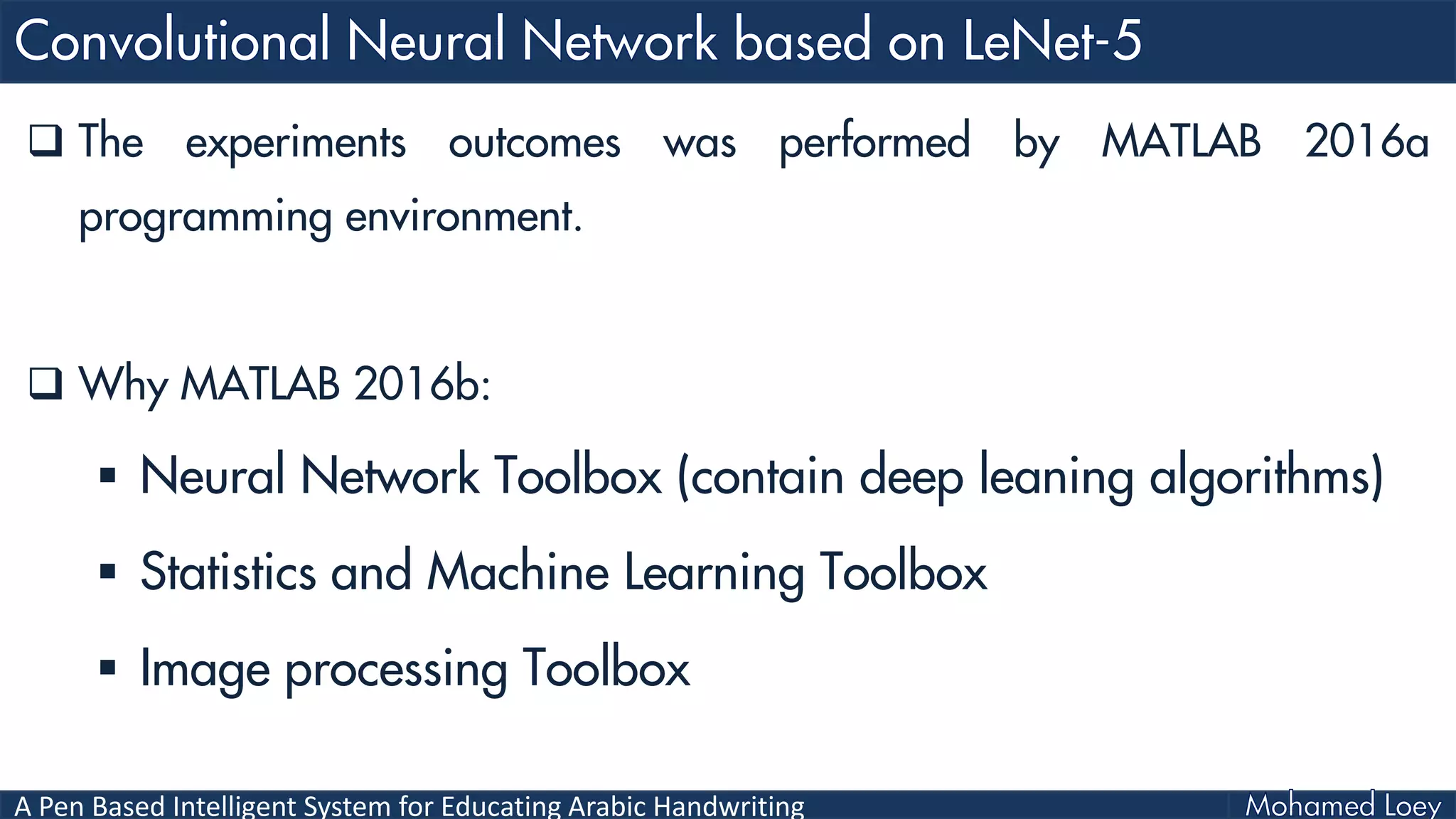
 The experiments outcomes was performed by MATLAB 2016a
programming environment.
 Why MATLAB 2016b:
 Neural Network Toolbox (contain deep leaning algorithms)
 Statistics and Machine Learning Toolbox
 Image processing Toolbox
A Pen Based Intelligent System for Educating Arabic Handwriting
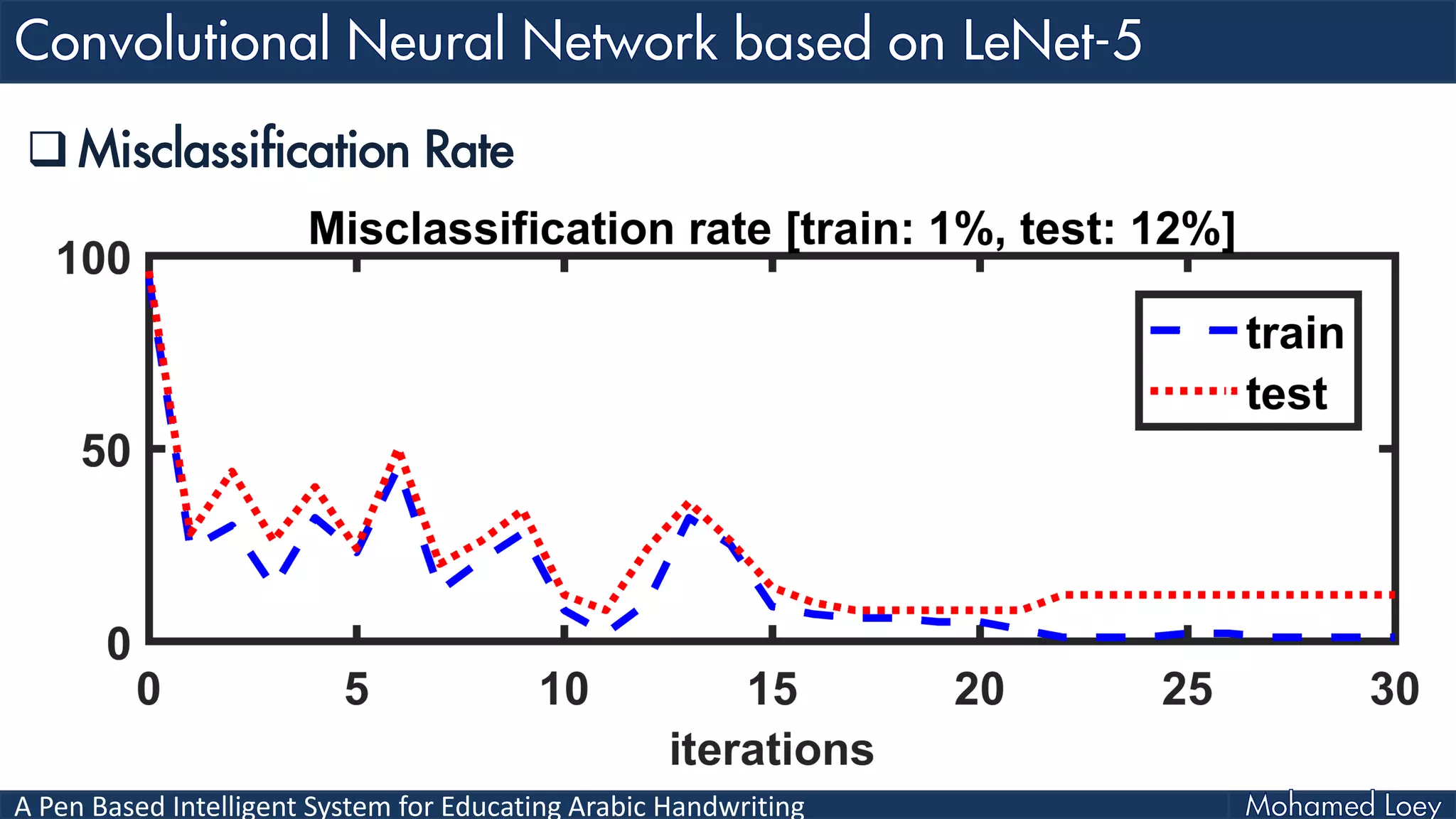
 Misclassification Rate
A Pen Based Intelligent System for Educating Arabic Handwriting
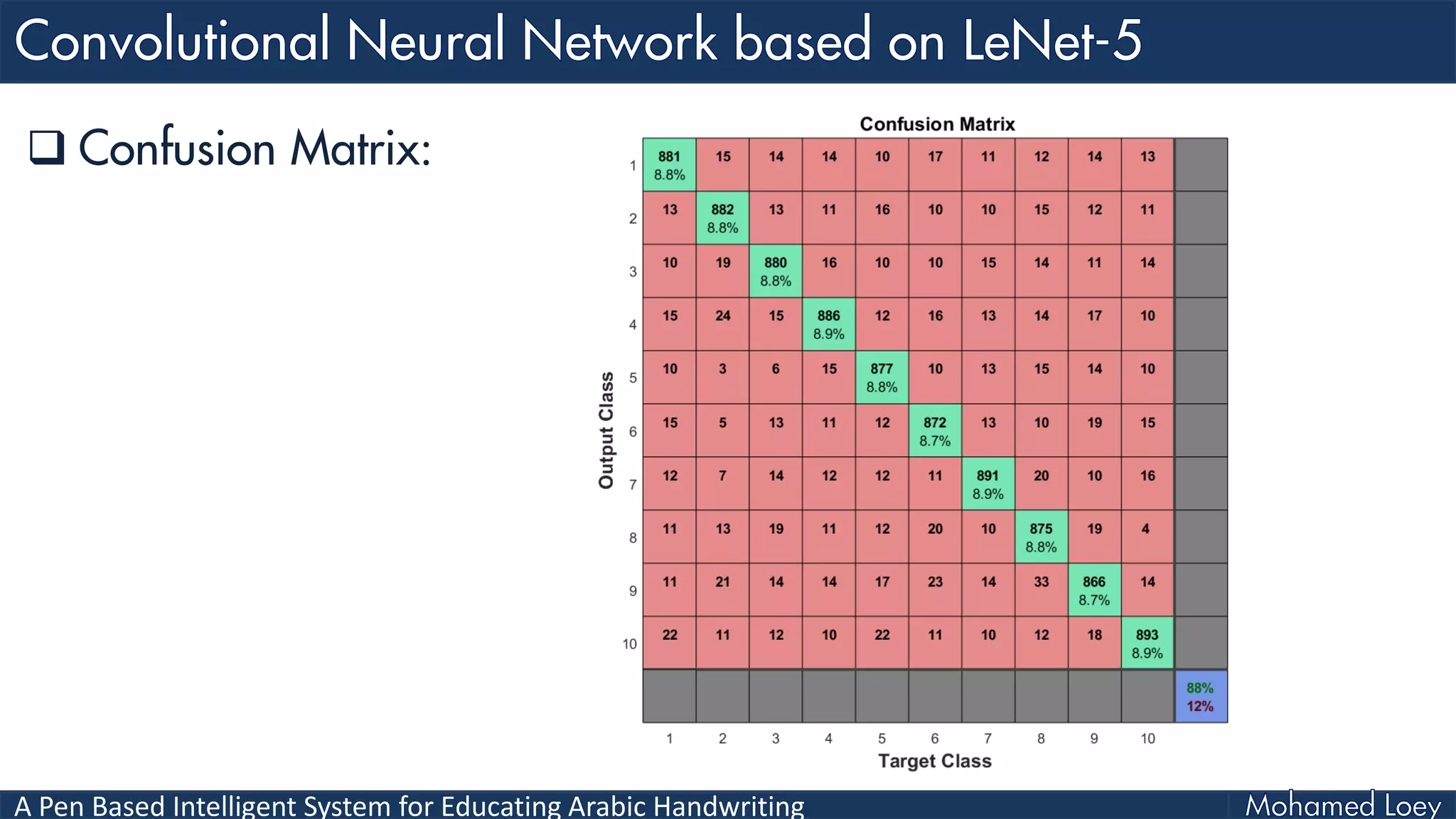
 Confusion Matrix:
A Pen Based Intelligent System for Educating Arabic Handwriting
Arabic
Handwritten Digit
Dataset
Convolutional
Neural Network
based on LeNet-5
Stacked
Autoencoder
Convolutional
Neural Network
Optimized
A Pen Based Intelligent System for Educating Arabic Handwriting
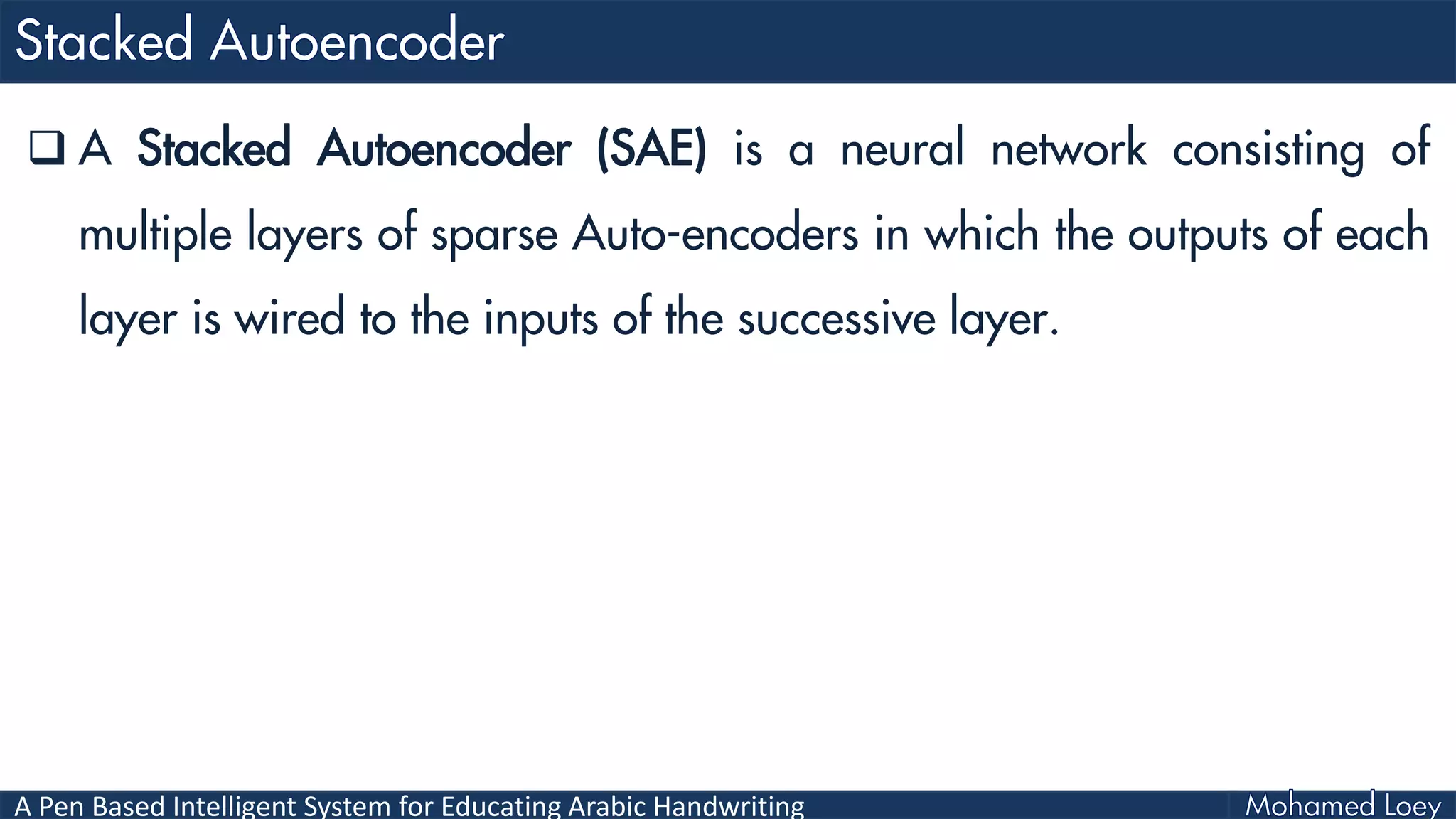
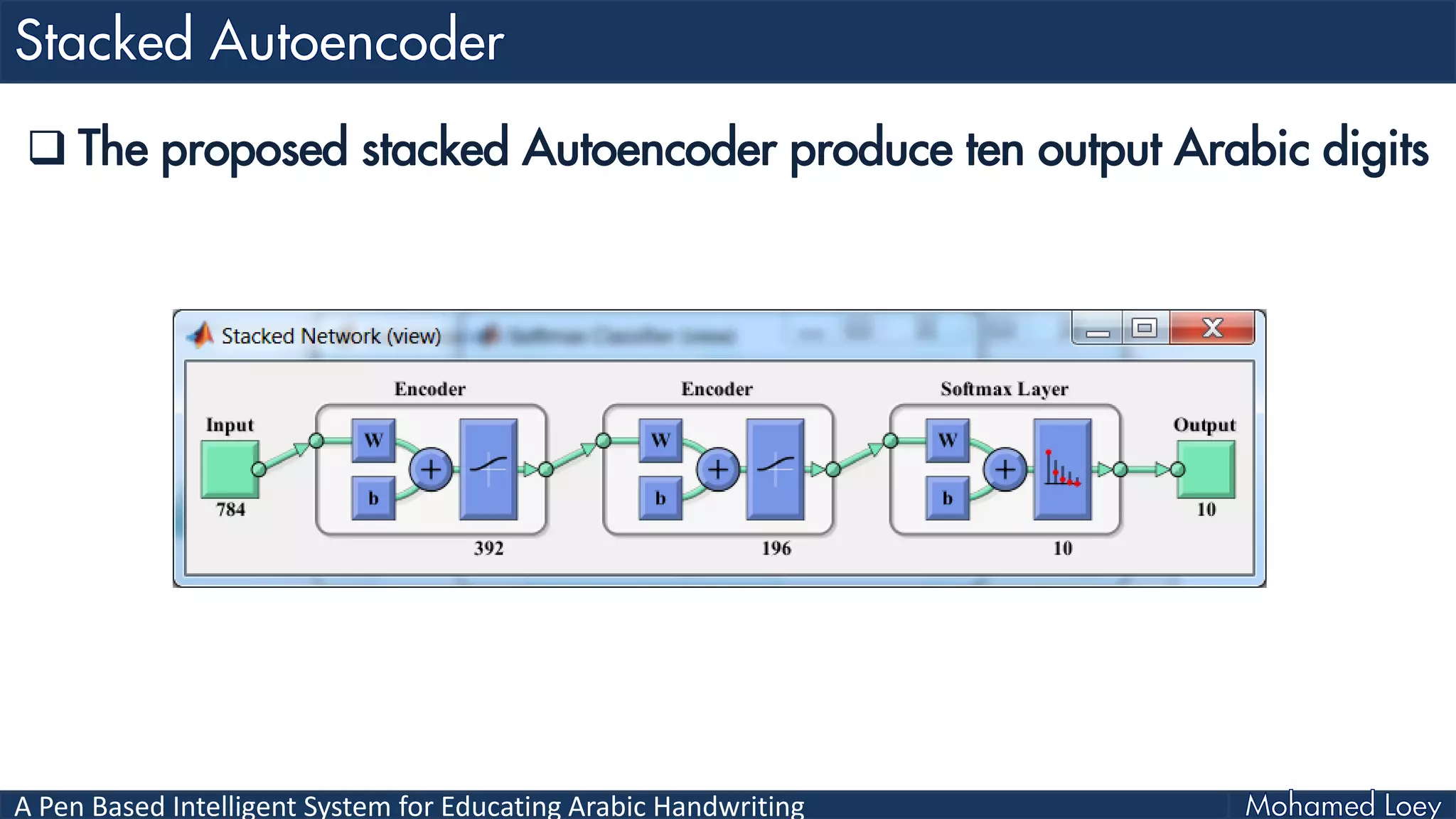
 A Stacked Autoencoder (SAE) is a neural network consisting of
multiple layers of sparse Auto-encoders in which the outputs of each
layer is wired to the inputs of the successive layer.
A Pen Based Intelligent System for Educating Arabic Handwriting
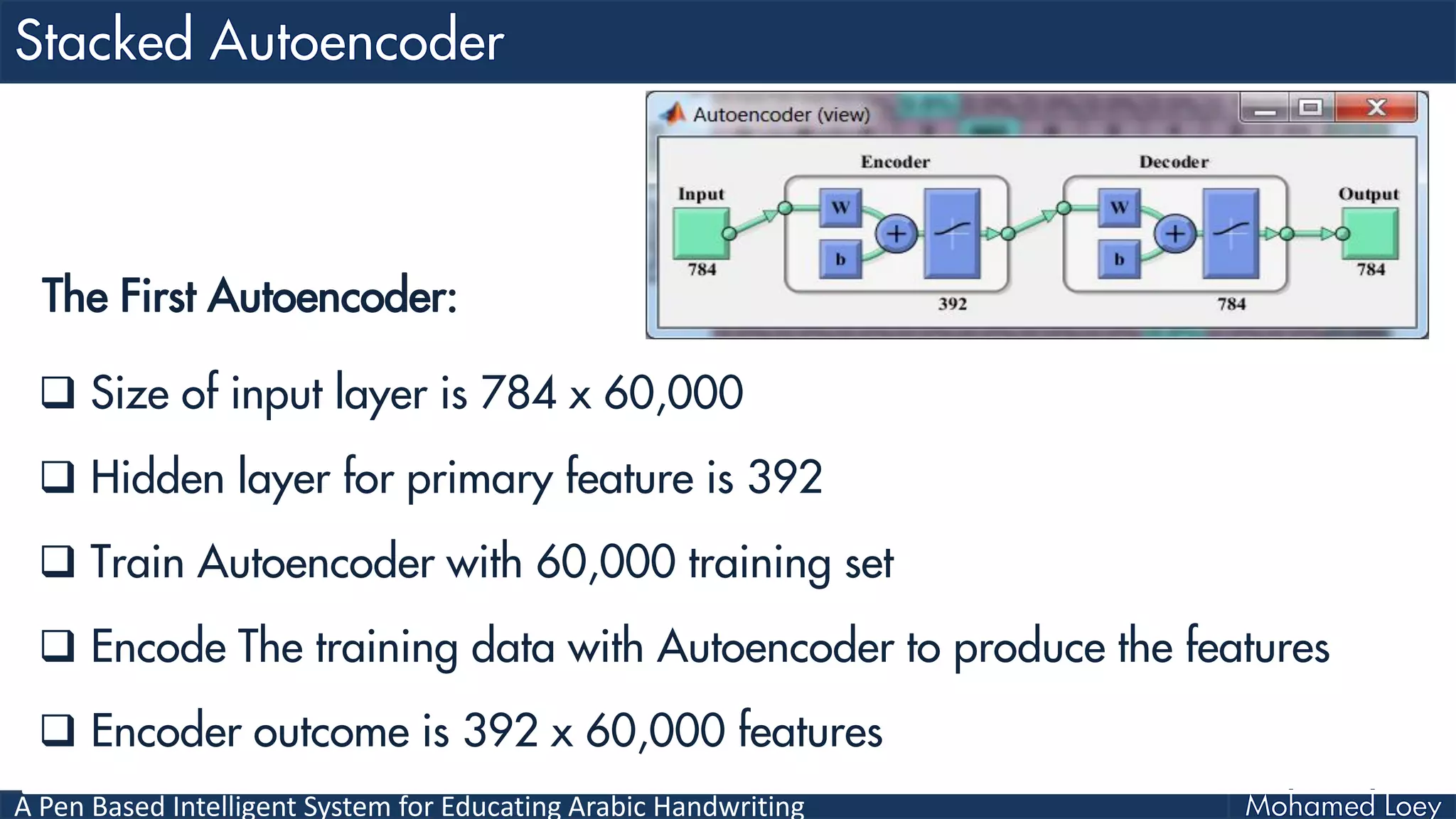
 Size of input layer is 784 x 60,000
 Hidden layer for primary feature is 392
 Train Autoencoder with 60,000 training set
 Encode The training data with Autoencoder to produce the features
 Encoder outcome is 392 x 60,000 features
The First Autoencoder:
A Pen Based Intelligent System for Educating Arabic Handwriting
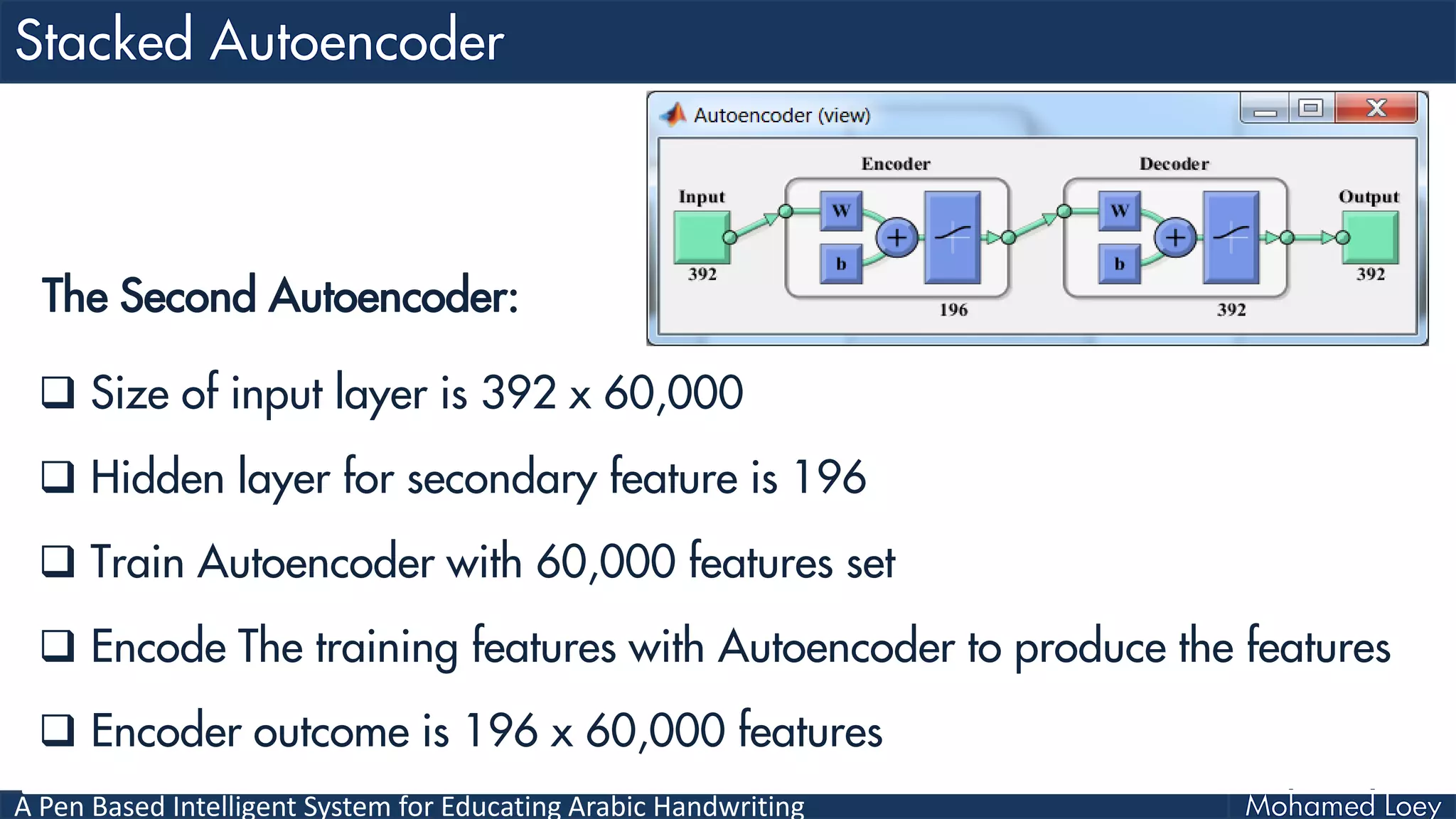
 Size of input layer is 392 x 60,000
 Hidden layer for secondary feature is 196
 Train Autoencoder with 60,000 features set
 Encode The training features with Autoencoder to produce the features
 Encoder outcome is 196 x 60,000 features
The Second Autoencoder:
A Pen Based Intelligent System for Educating Arabic Handwriting
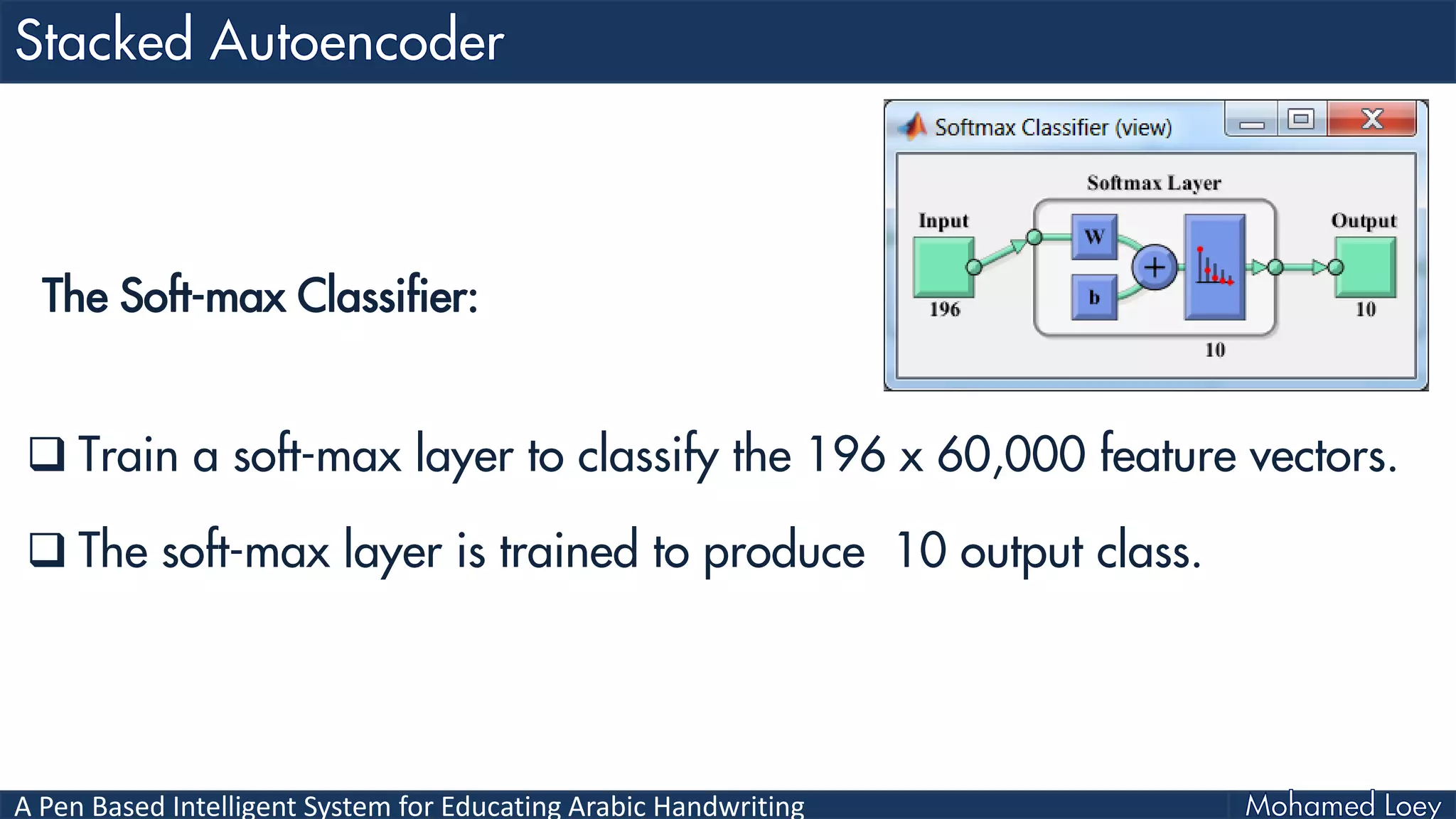
 Train a soft-max layer to classify the 196 x 60,000 feature vectors.
 The soft-max layer is trained to produce 10 output class.
The Soft-max Classifier:
A Pen Based Intelligent System for Educating Arabic Handwriting
 The proposed stacked Autoencoder produce ten output Arabic digits
A Pen Based Intelligent System for Educating Arabic Handwriting
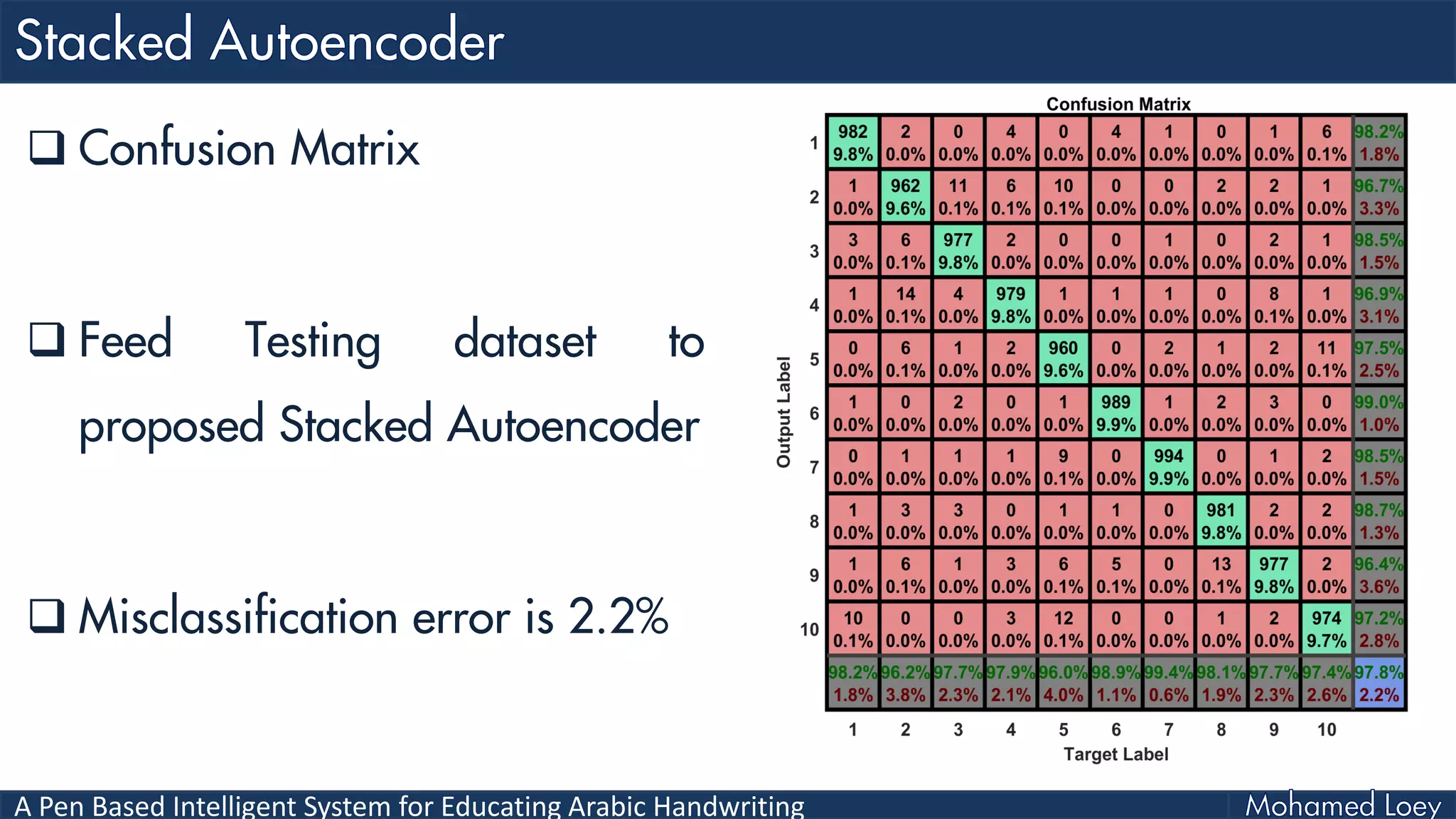
 Confusion Matrix
 Feed Testing dataset to
proposed Stacked Autoencoder
 Misclassification error is 2.2%
A Pen Based Intelligent System for Educating Arabic Handwriting
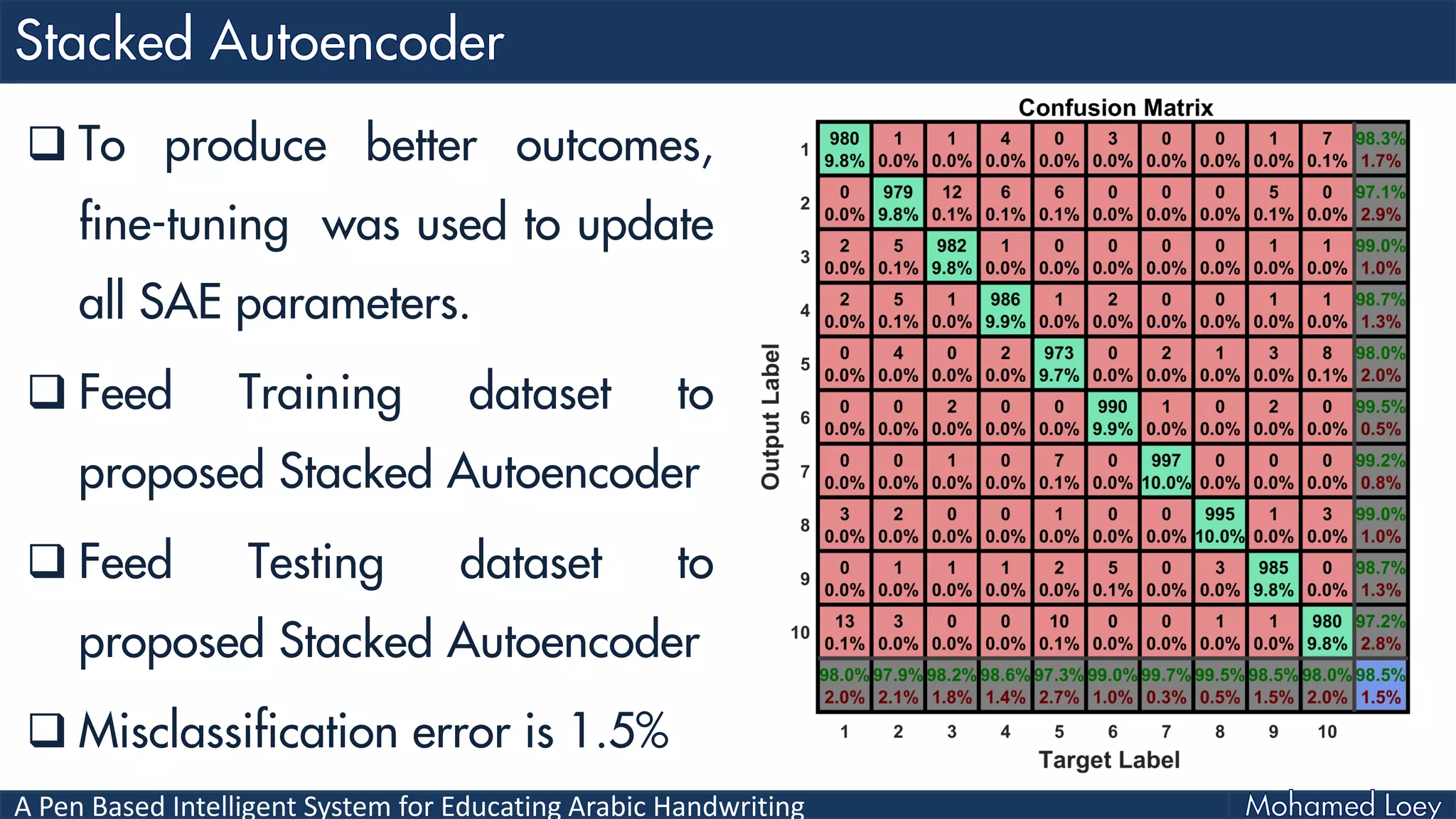
 To produce better outcomes,
fine-tuning was used to update
all SAE parameters.
 Feed Training dataset to
proposed Stacked Autoencoder
 Feed Testing dataset to
proposed Stacked Autoencoder
 Misclassification error is 1.5%
A Pen Based Intelligent System for Educating Arabic Handwriting
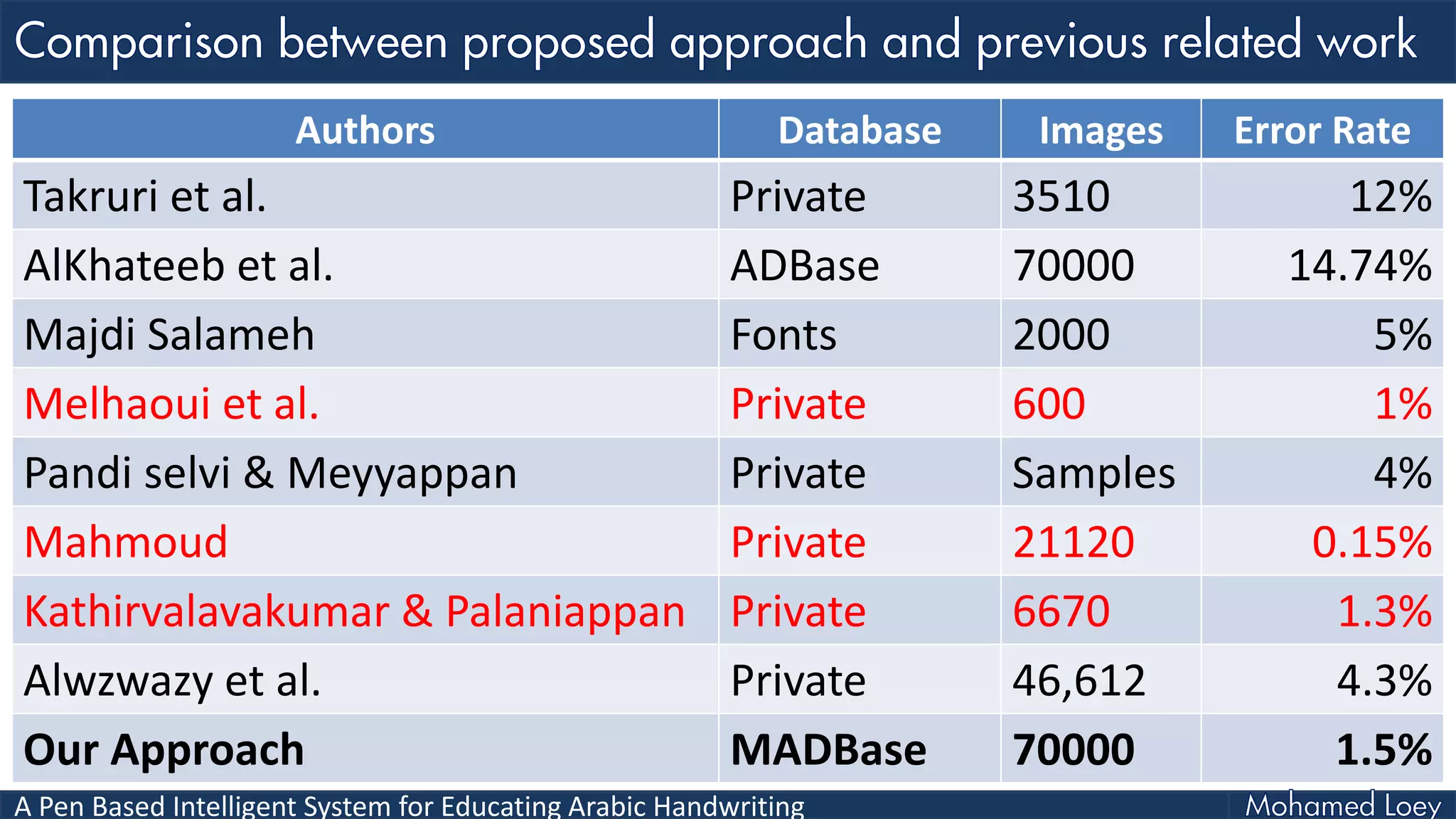
Authors Database Images Error Rate
Takruri et al. Private 3510 12%
AlKhateeb et al. ADBase 70000 14.74%
Majdi Salameh Fonts 2000 5%
Melhaoui et al. Private 600 1%
Pandi selvi & Meyyappan Private Samples 4%
Mahmoud Private 21120 0.15%
Kathirvalavakumar & Palaniappan Private 6670 1.3%
Alwzwazy et al. Private 46,612 4.3%
Our Approach MADBase 70000 1.5%
A Pen Based Intelligent System for Educating Arabic Handwriting
Arabic
Handwritten Digit
Dataset
Convolutional
Neural Network
based on LeNet-5
Stacked
Autoencoder
Convolutional
Neural Network
Optimized
A Pen Based Intelligent System for Educating Arabic Handwriting
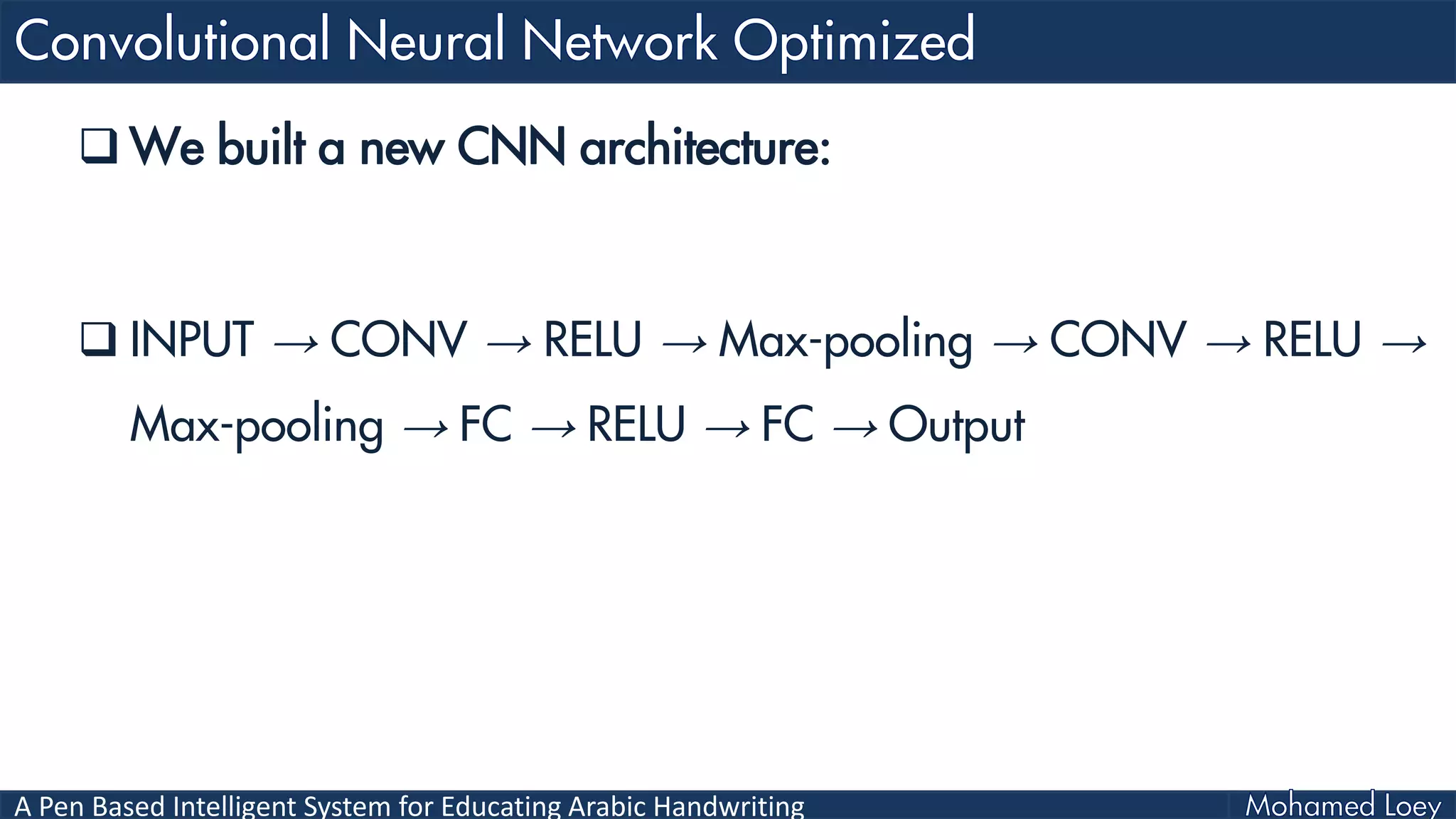
 We built a new CNN architecture:
 INPUT → CONV → RELU → Max-pooling → CONV → RELU →
Max-pooling → FC → RELU → FC → Output
A Pen Based Intelligent System for Educating Arabic Handwriting
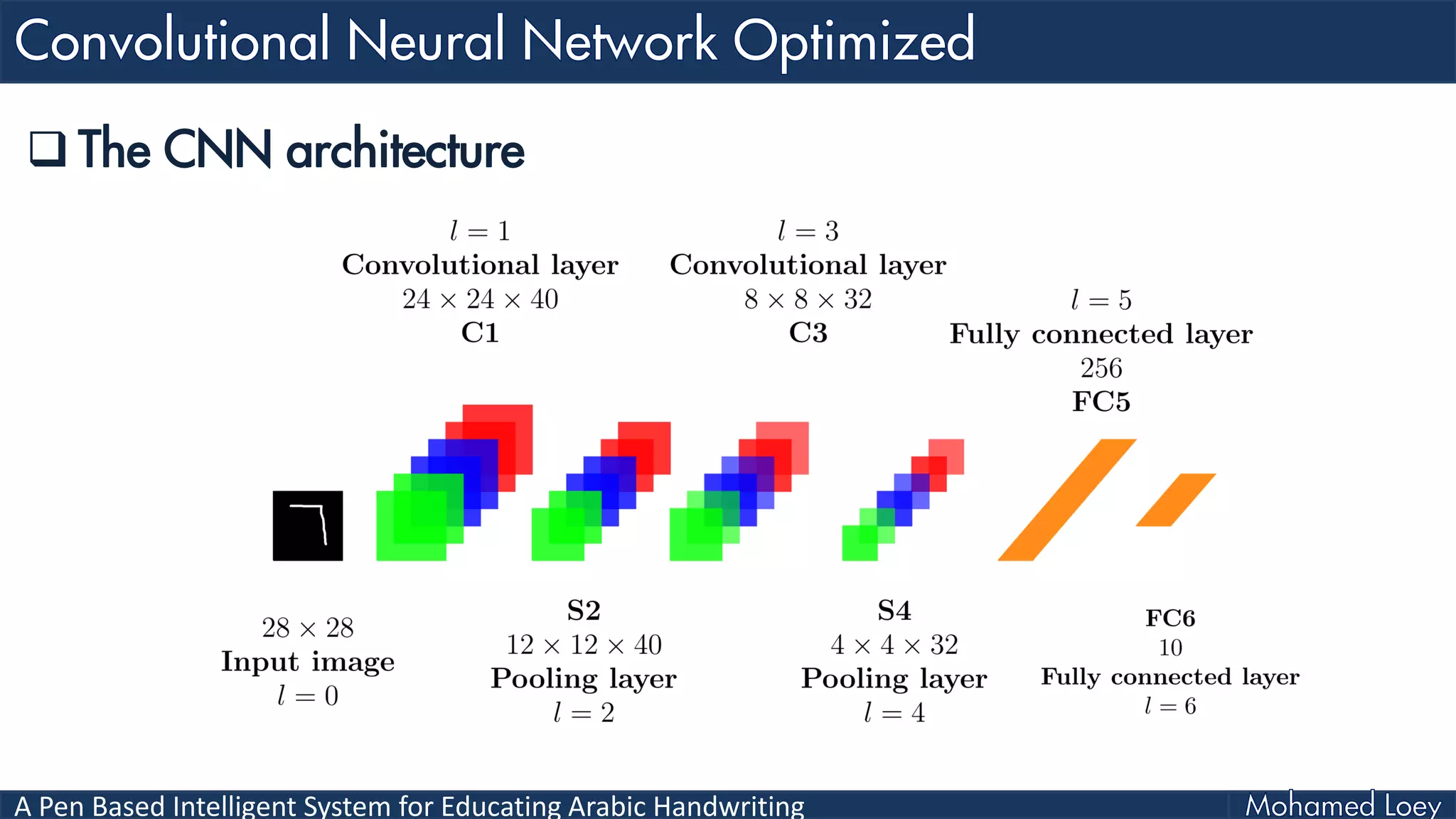
 The CNN architecture
A Pen Based Intelligent System for Educating Arabic Handwriting
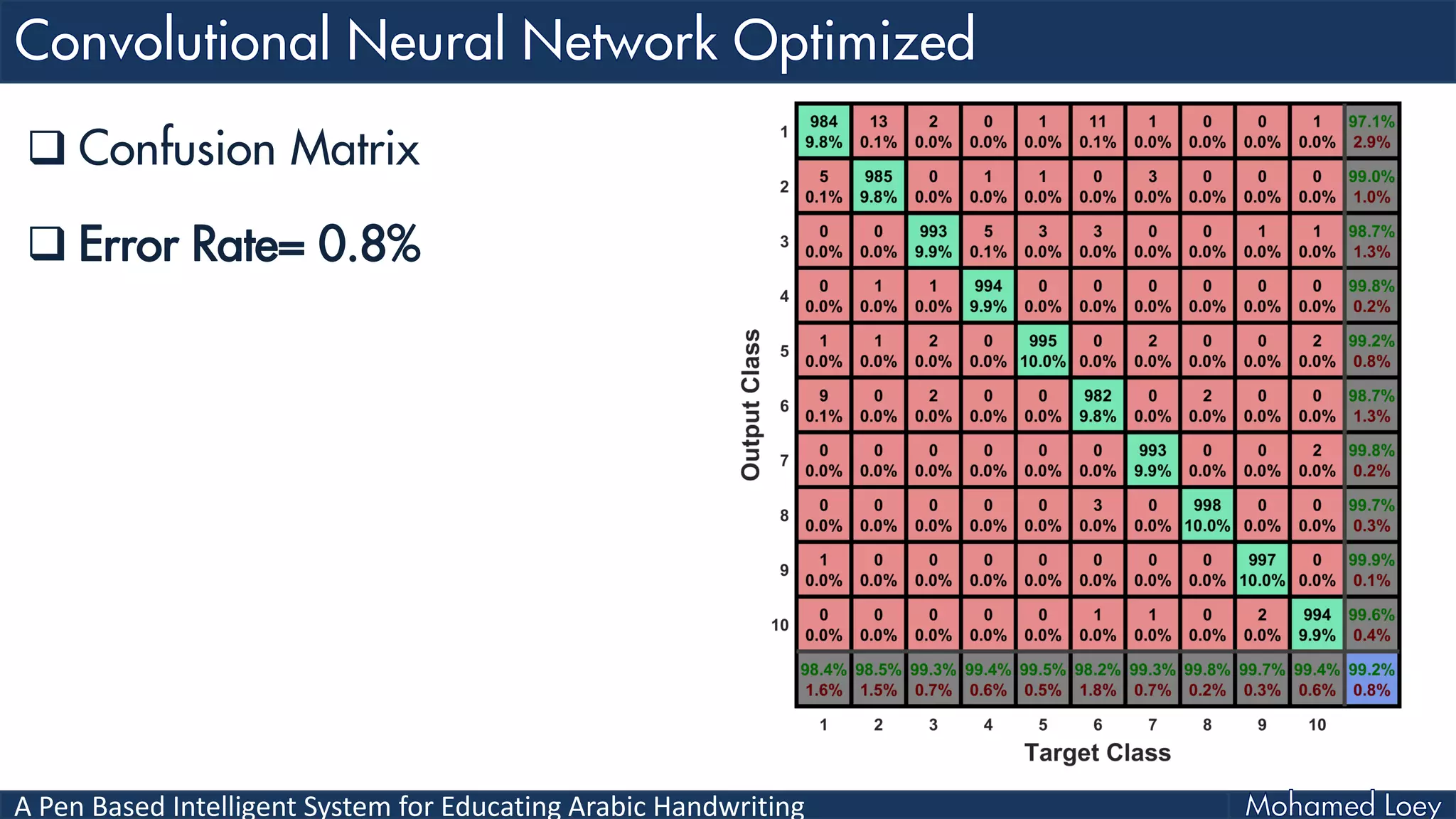
 Confusion Matrix
 Error Rate= 0.8%
A Pen Based Intelligent System for Educating Arabic Handwriting
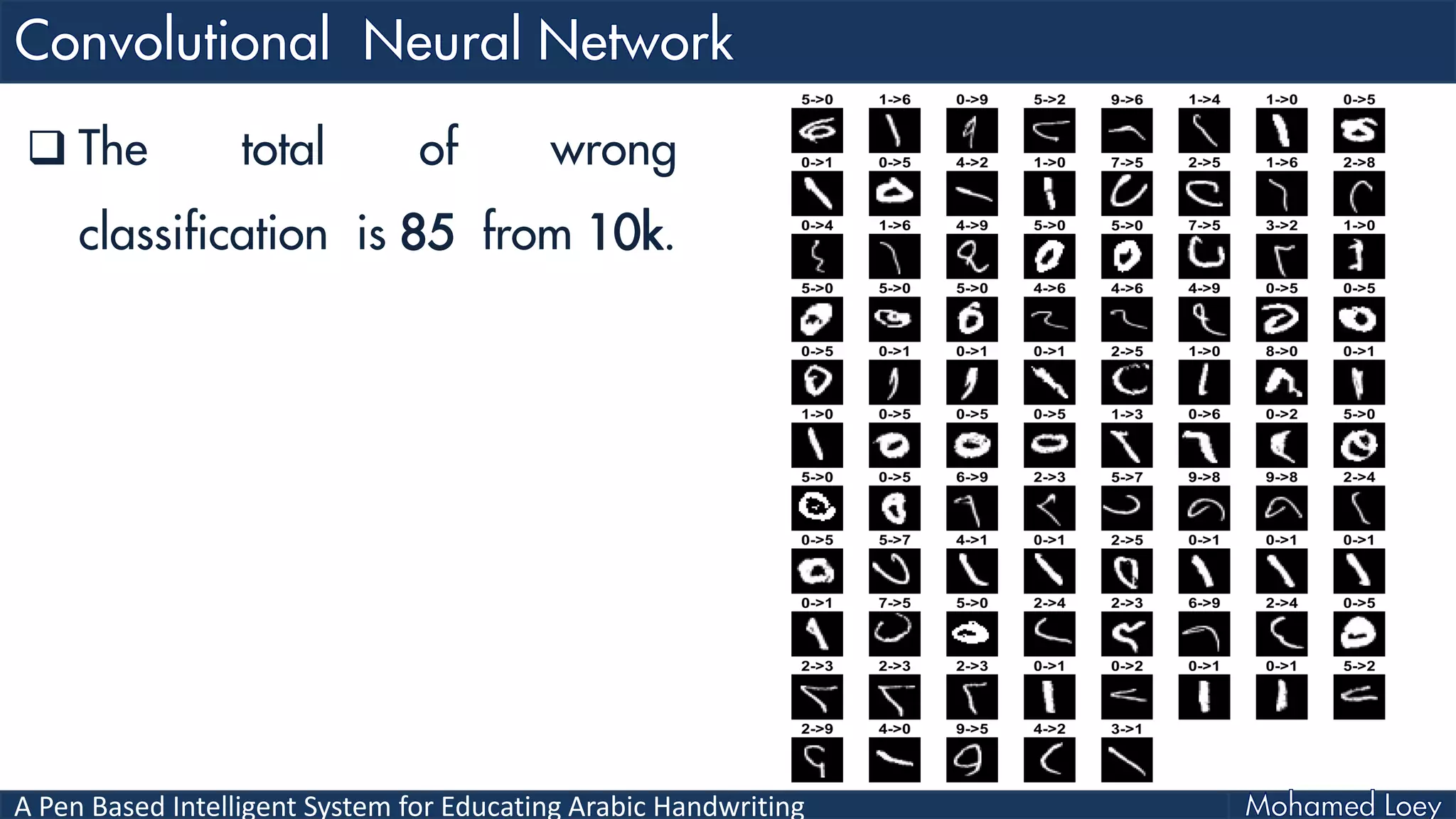
 The total of wrong
classification is 85 from 10k.
A Pen Based Intelligent System for Educating Arabic Handwriting
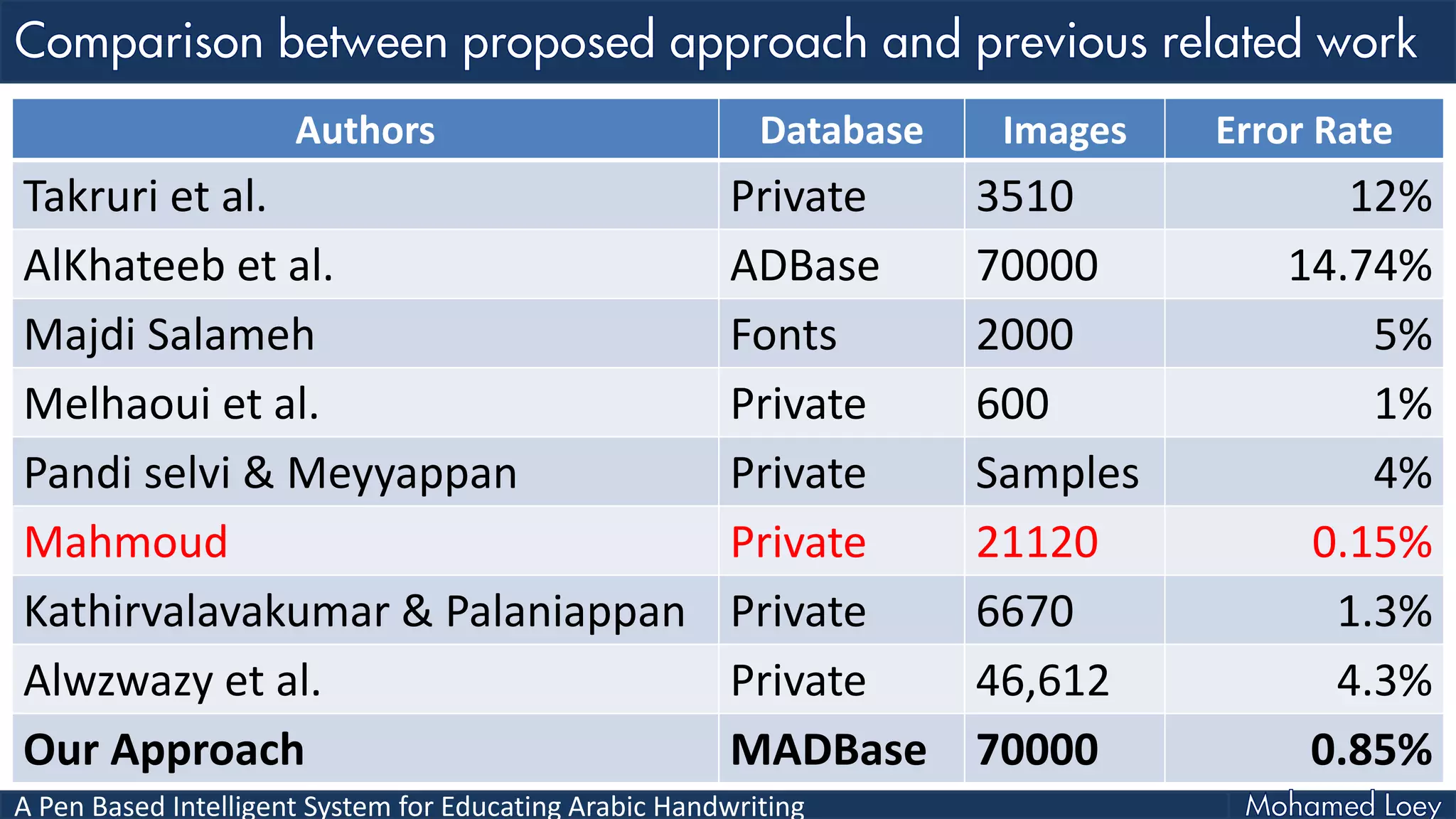
Authors Database Images Error Rate
Takruri et al. Private 3510 12%
AlKhateeb et al. ADBase 70000 14.74%
Majdi Salameh Fonts 2000 5%
Melhaoui et al. Private 600 1%
Pandi selvi & Meyyappan Private Samples 4%
Mahmoud Private 21120 0.15%
Kathirvalavakumar & Palaniappan Private 6670 1.3%
Alwzwazy et al. Private 46,612 4.3%
Our Approach MADBase 70000 0.85%
A Pen Based Intelligent System for Educating Arabic Handwriting
Introduction
Previous Related Work
Background and Preliminaries
Arabic Handwritten Digits Recognition System
Arabic Handwritten Characters Recognition System
Intelligent Arab Teaching System
Conclusion and Future Work
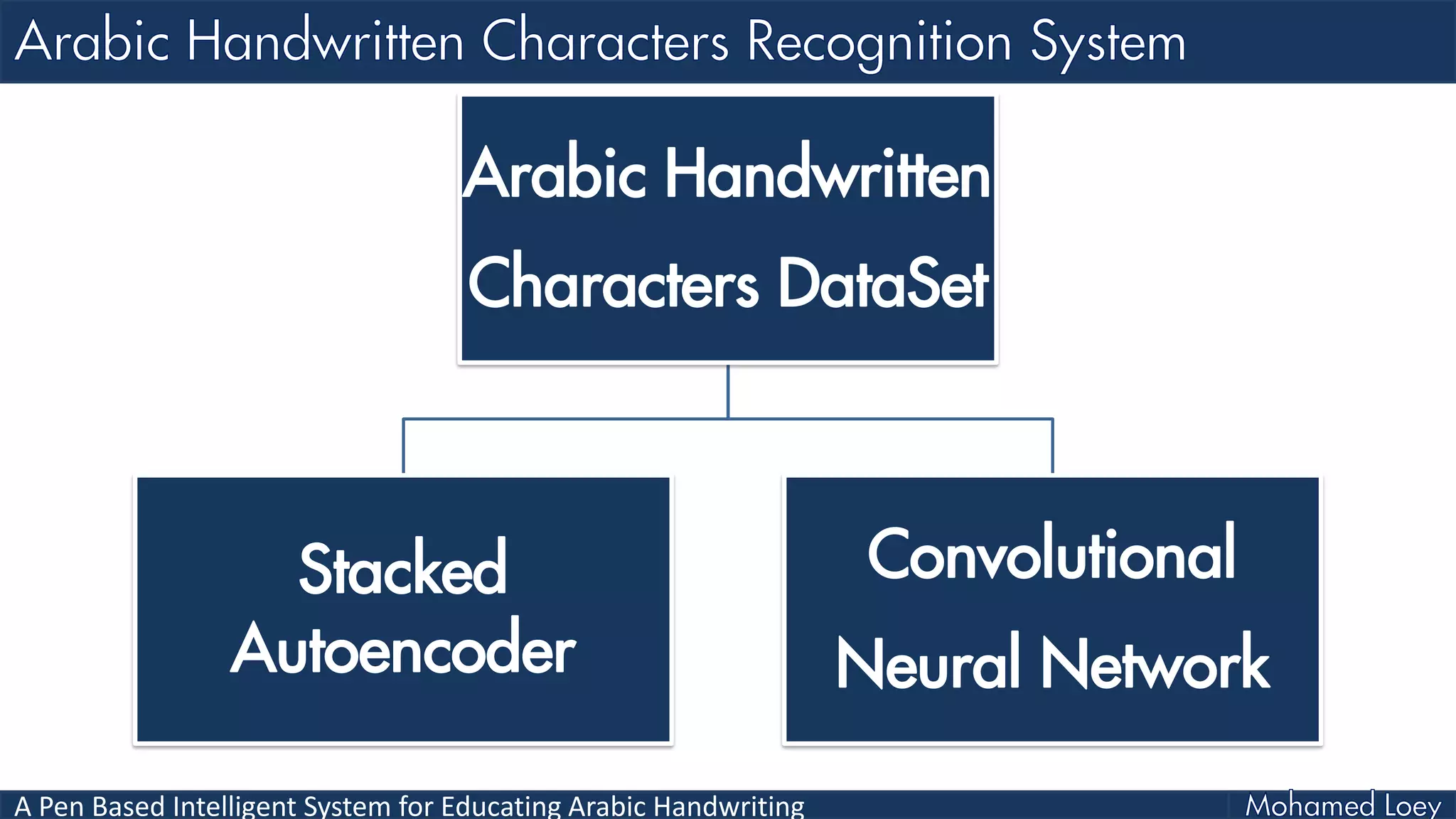
A Pen Based Intelligent System for Educating Arabic Handwriting
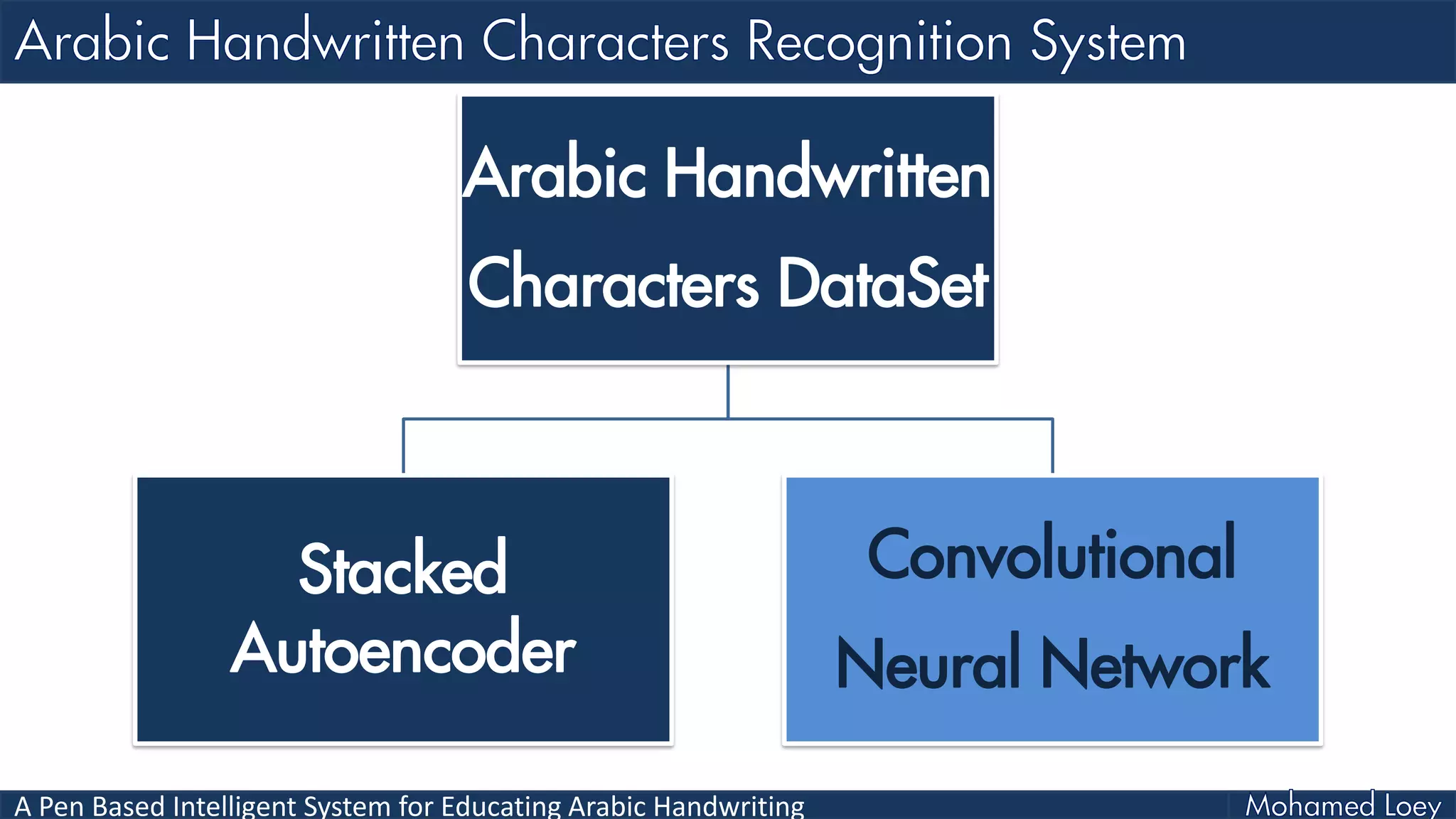
Arabic Handwritten
Characters DataSet
Stacked
Autoencoder
Convolutional
Neural Network
A Pen Based Intelligent System for Educating Arabic Handwriting
Arabic Handwritten
Characters DataSet
Stacked
Autoencoder
Convolutional
Neural Network
A Pen Based Intelligent System for Educating Arabic Handwriting
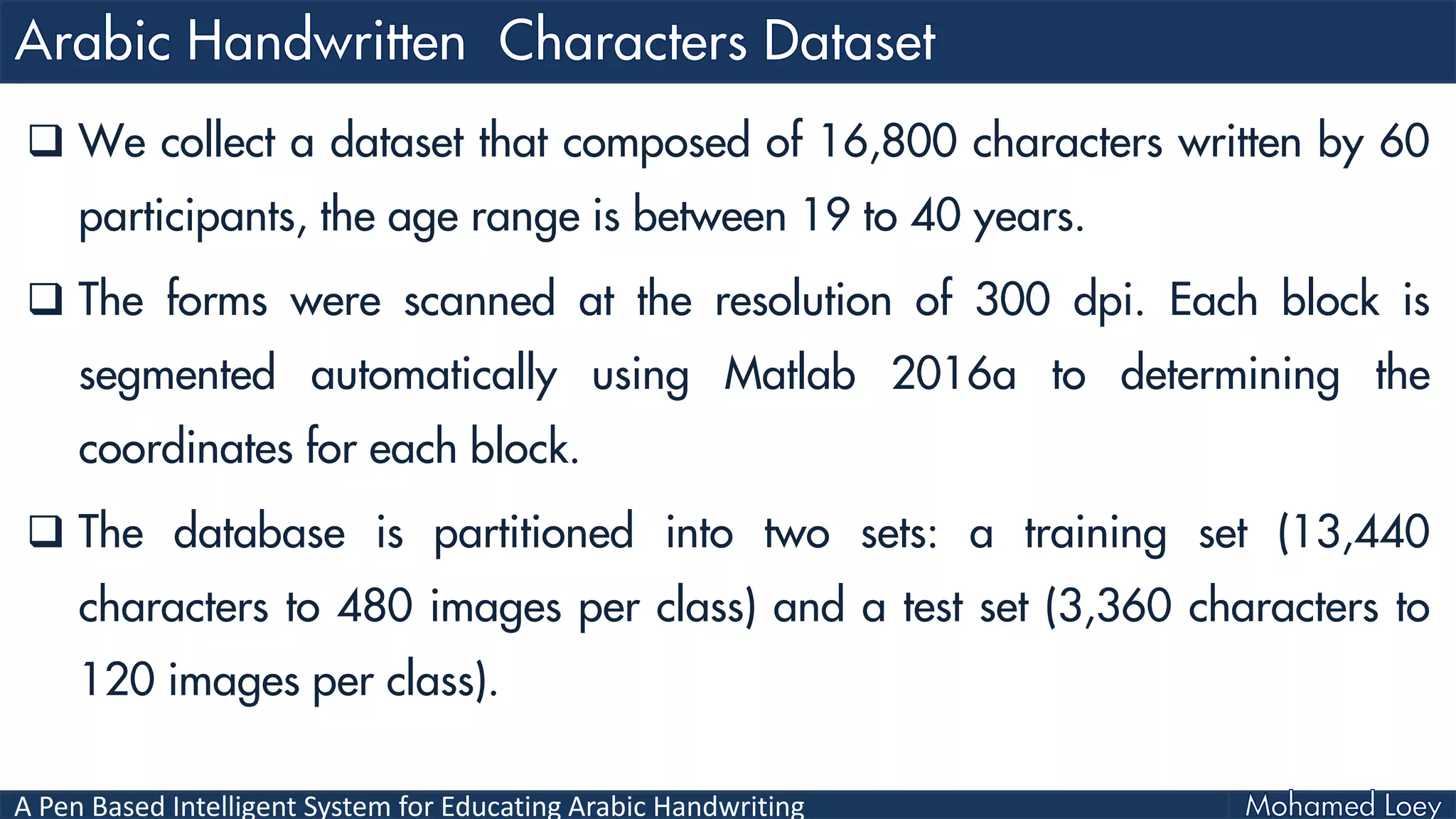
 We collect a dataset that composed of 16,800 characters written by 60
participants, the age range is between 19 to 40 years.
 The forms were scanned at the resolution of 300 dpi. Each block is
segmented automatically using Matlab 2016a to determining the
coordinates for each block.
 The database is partitioned into two sets: a training set (13,440
characters to 480 images per class) and a test set (3,360 characters to
120 images per class).
A Pen Based Intelligent System for Educating Arabic Handwriting
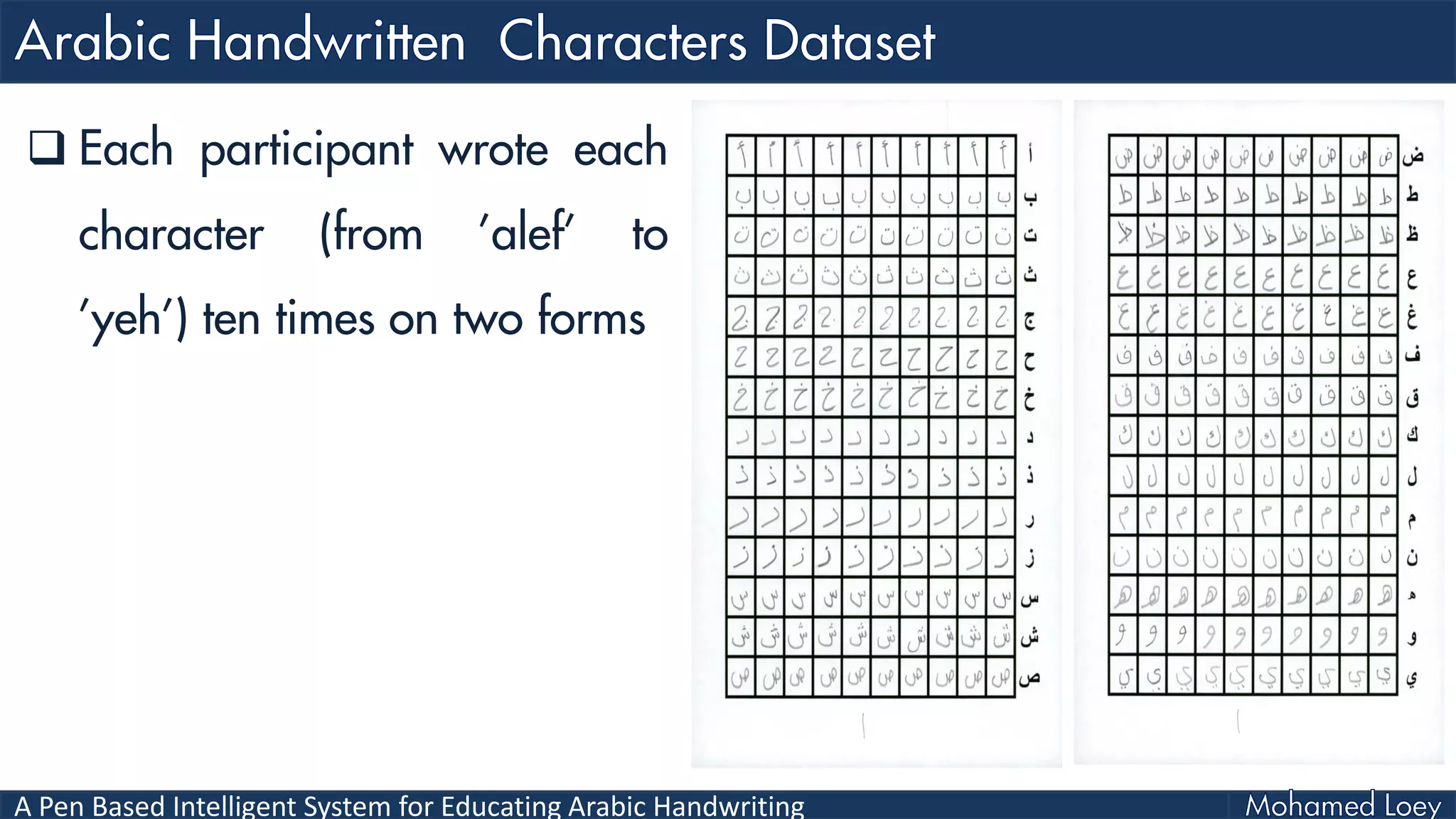
 Each participant wrote each
character (from ’alef’ to
’yeh’) ten times on two forms
A Pen Based Intelligent System for Educating Arabic Handwriting
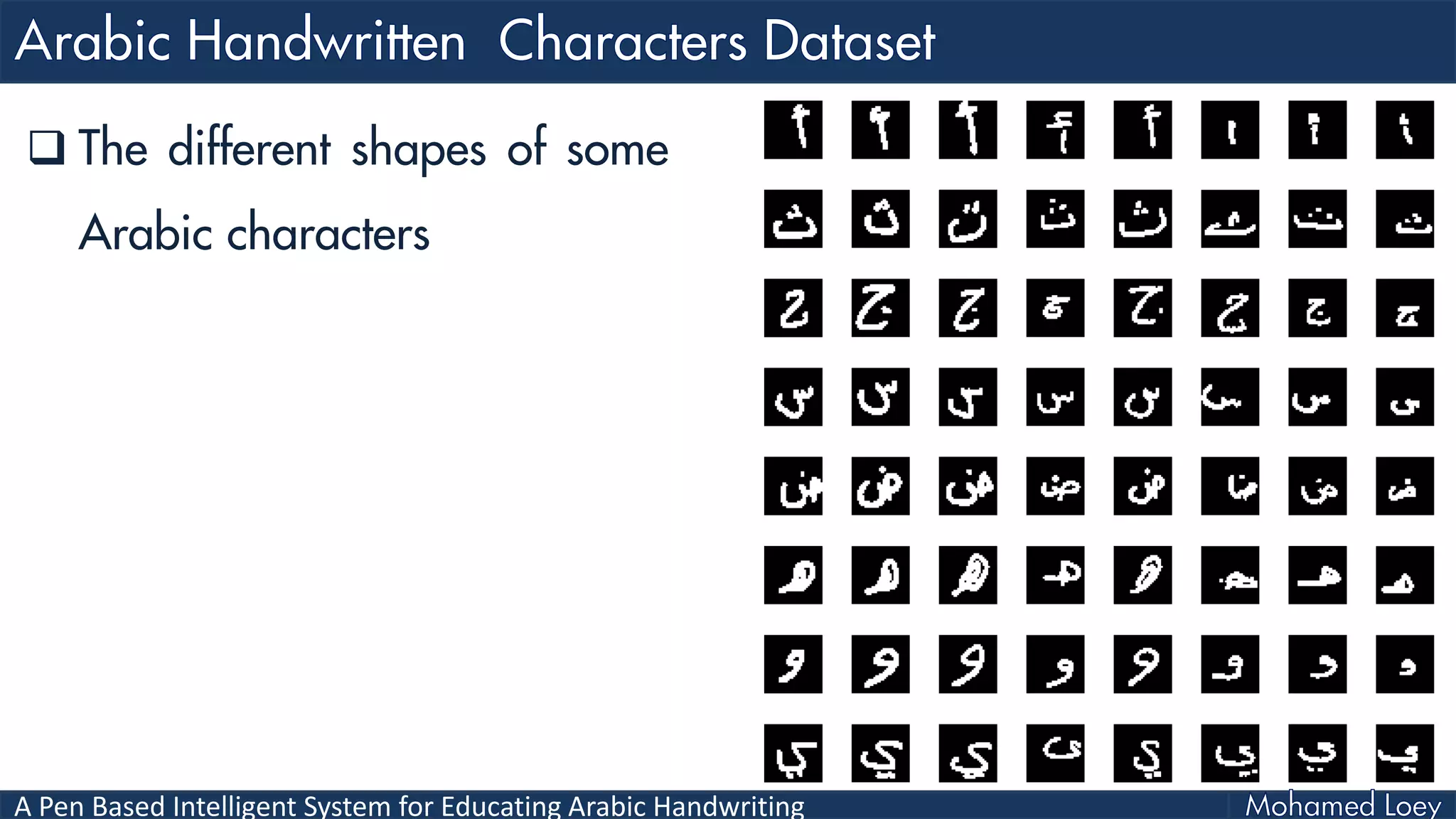
 The different shapes of some
Arabic characters
A Pen Based Intelligent System for Educating Arabic Handwriting
Arabic Handwritten
Characters DataSet
Stacked
Autoencoder
Convolutional
Neural Network
A Pen Based Intelligent System for Educating Arabic Handwriting
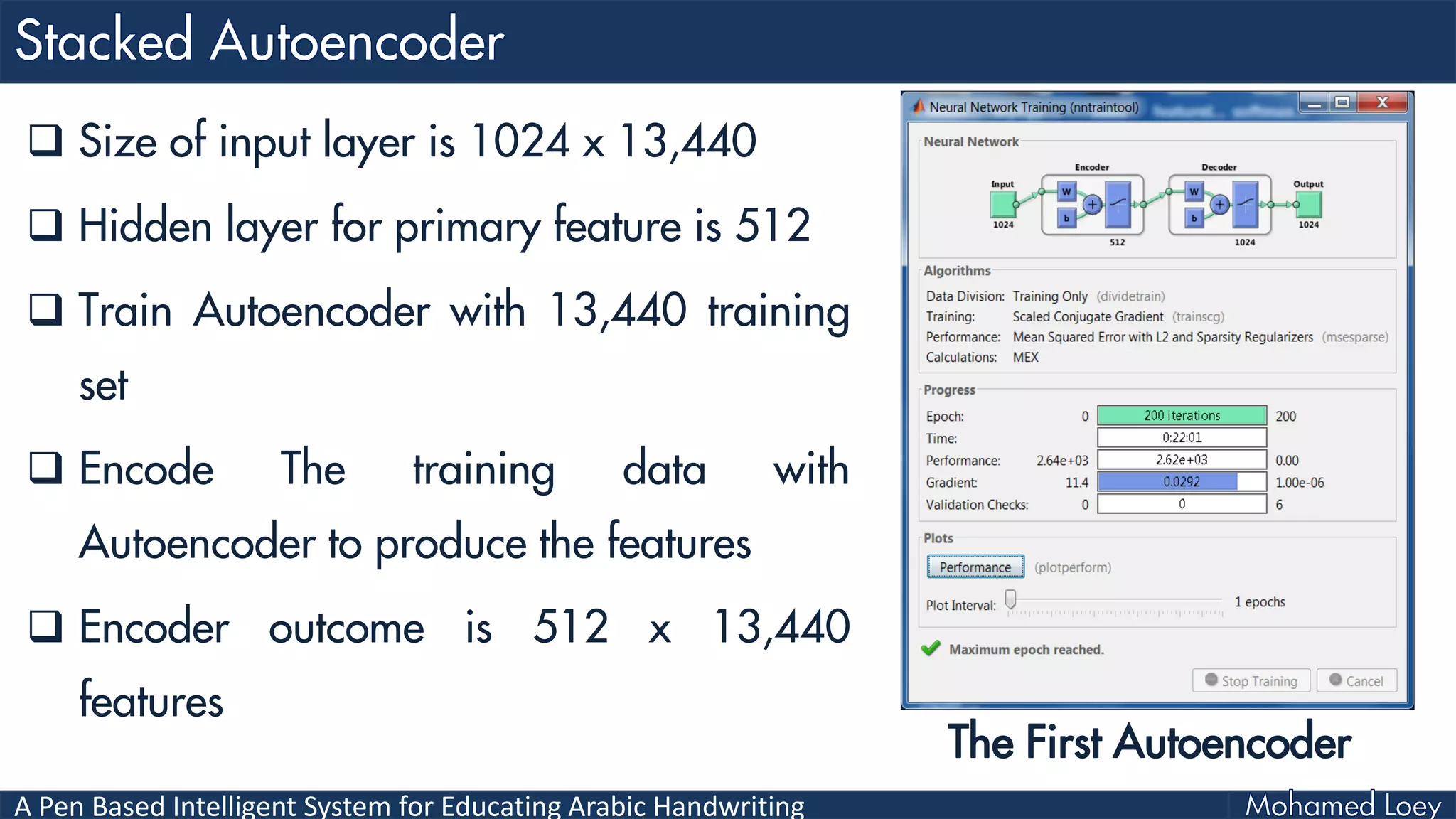
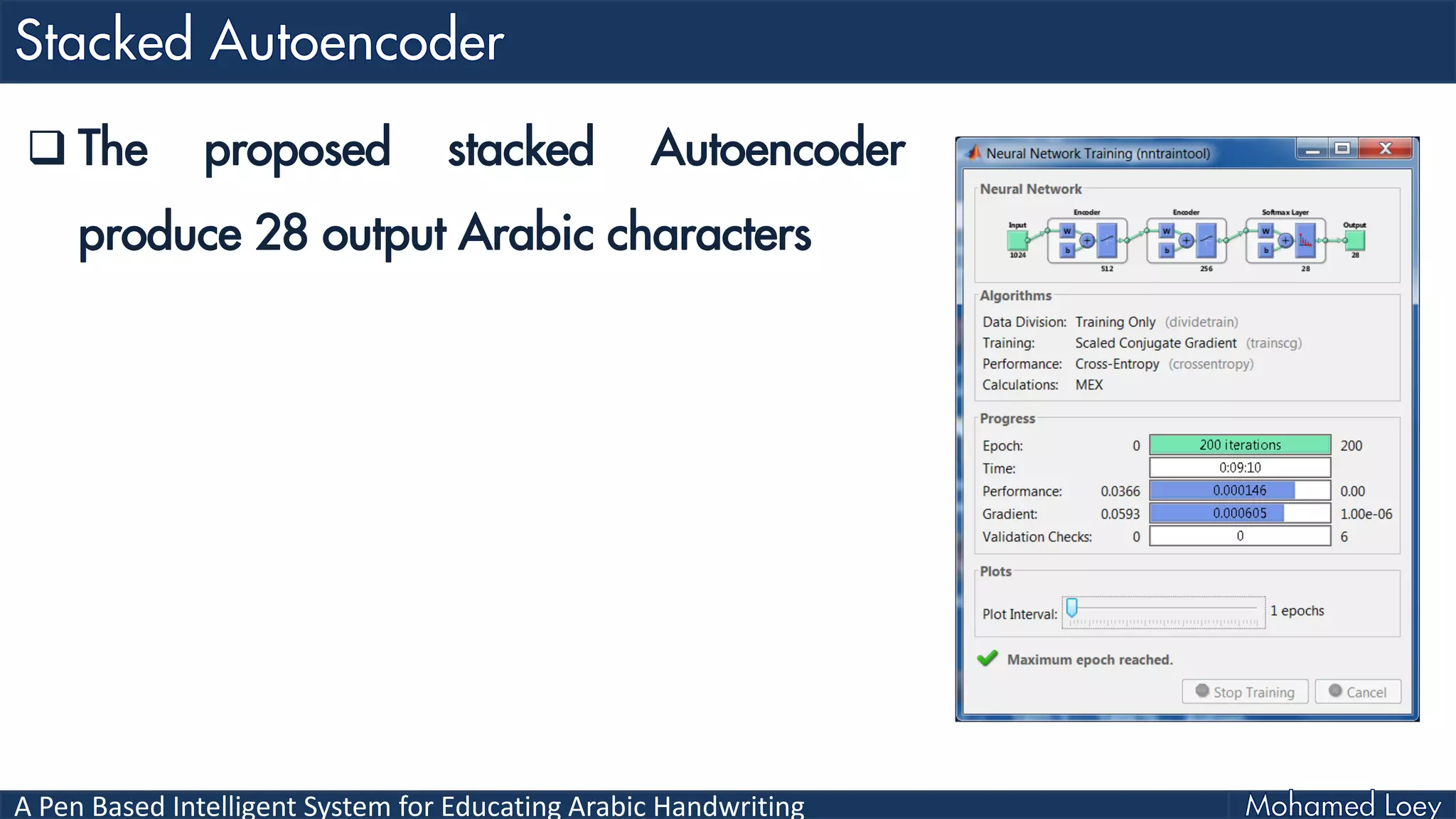
 Size of input layer is 1024 x 13,440
 Hidden layer for primary feature is 512
 Train Autoencoder with 13,440 training
set
 Encode The training data with
Autoencoder to produce the features
 Encoder outcome is 512 x 13,440
features
The First Autoencoder
A Pen Based Intelligent System for Educating Arabic Handwriting
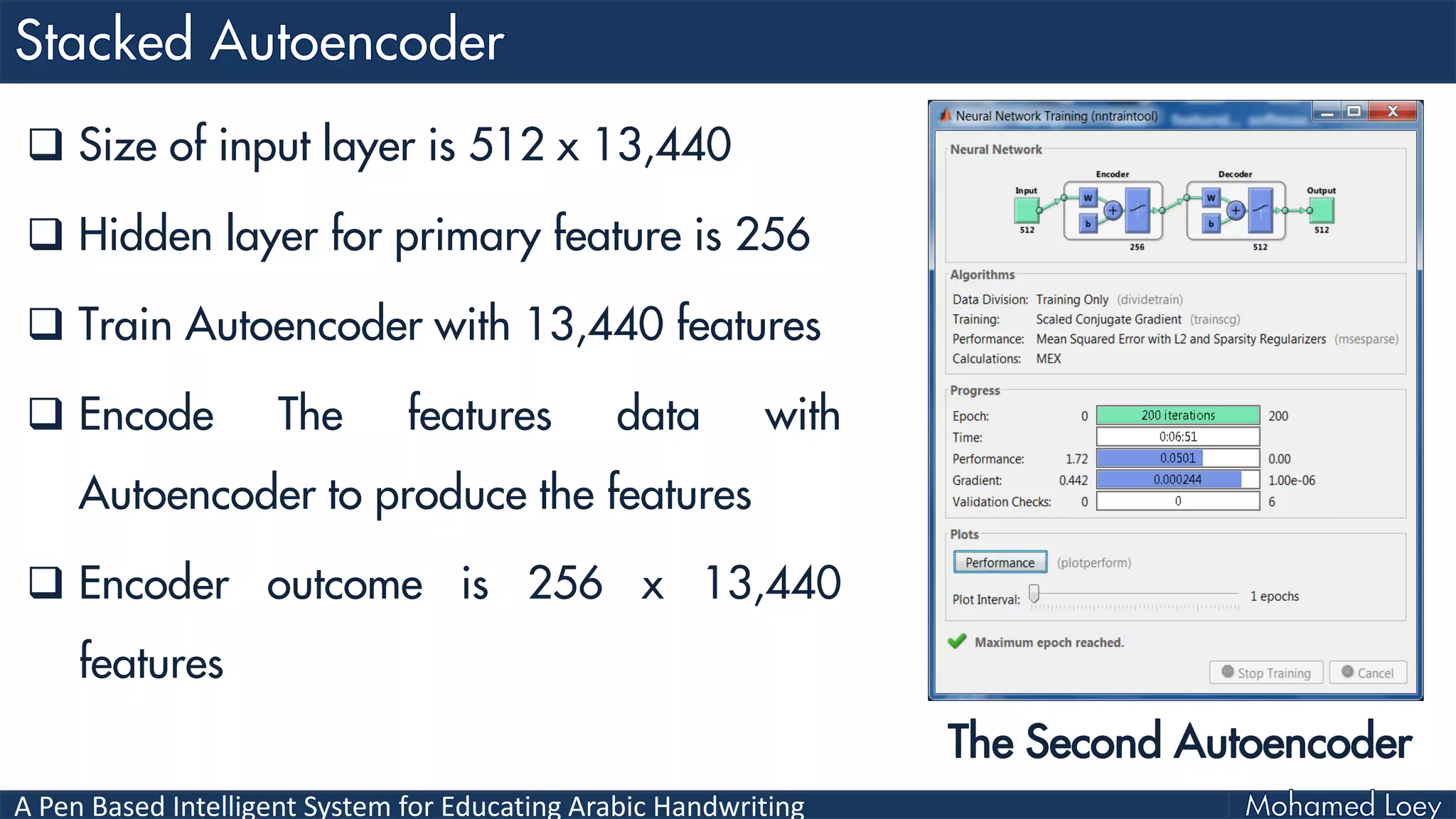
 Size of input layer is 512 x 13,440
 Hidden layer for primary feature is 256
 Train Autoencoder with 13,440 features
 Encode The features data with
Autoencoder to produce the features
 Encoder outcome is 256 x 13,440
features
The Second Autoencoder
A Pen Based Intelligent System for Educating Arabic Handwriting
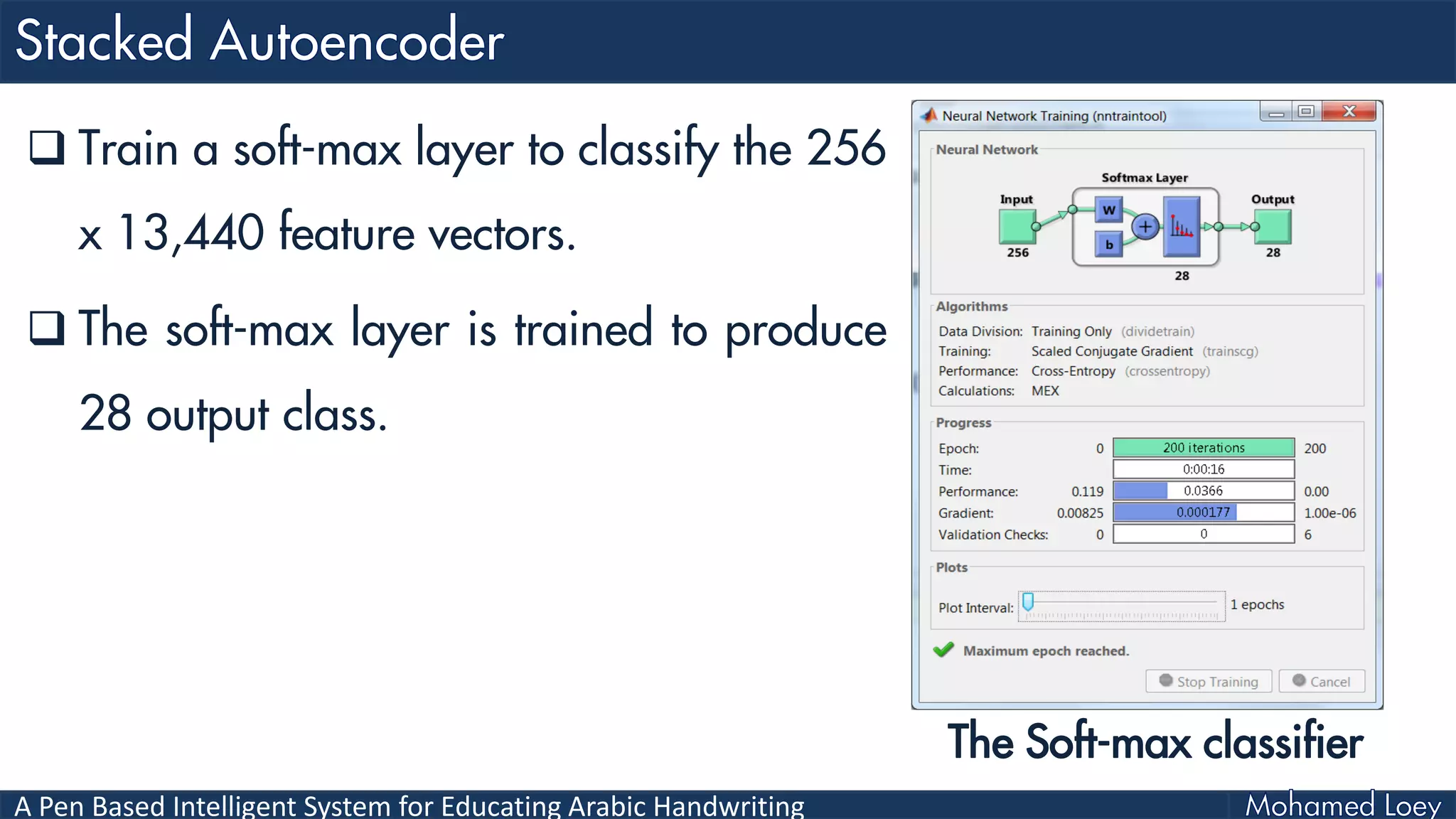
 Train a soft-max layer to classify the 256
x 13,440 feature vectors.
 The soft-max layer is trained to produce
28 output class.
The Soft-max classifier
A Pen Based Intelligent System for Educating Arabic Handwriting
 The proposed stacked Autoencoder
produce 28 output Arabic characters
A Pen Based Intelligent System for Educating Arabic Handwriting
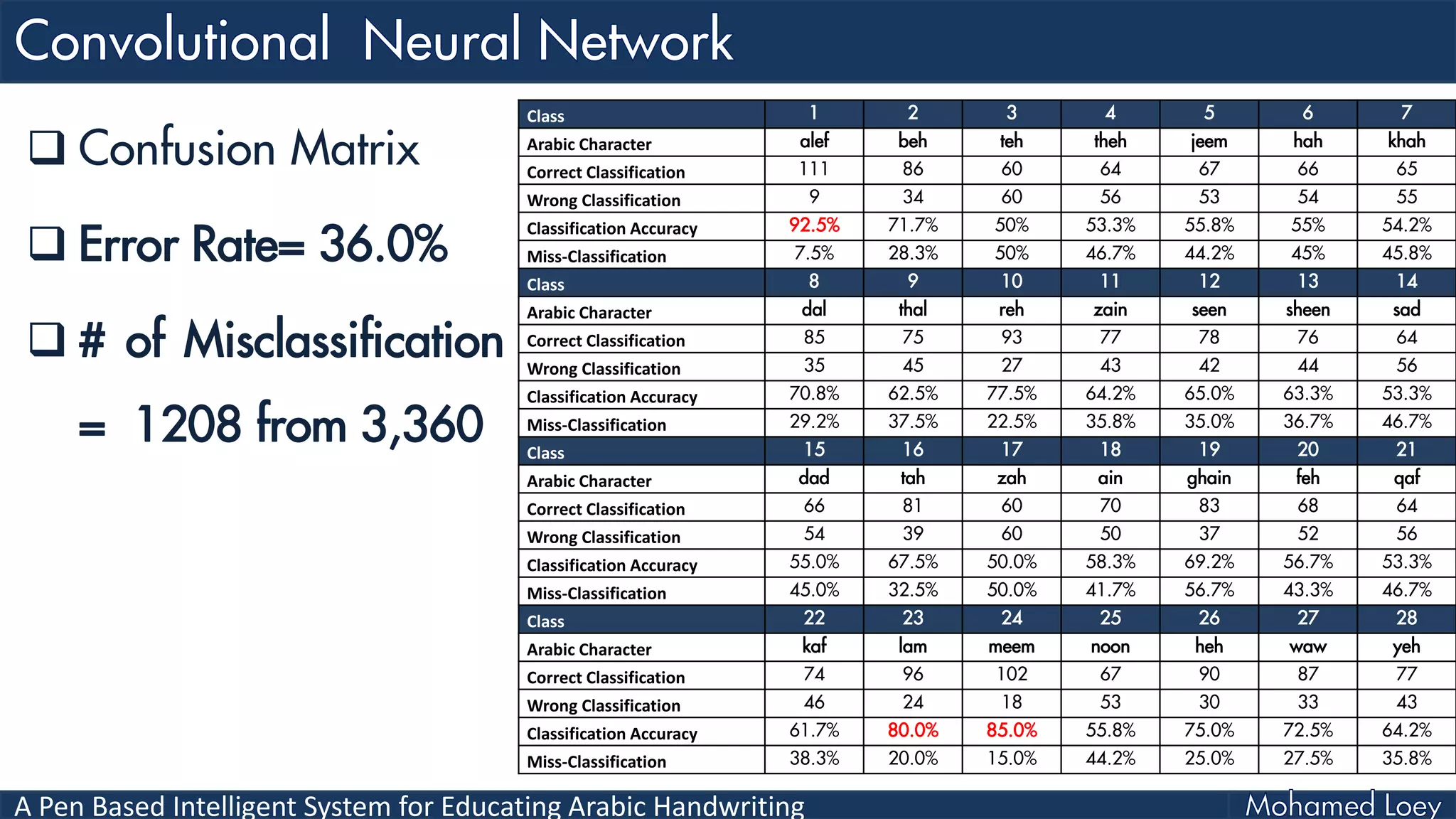
 Confusion Matrix
 Error Rate= 36.0%
 # of Misclassification
= 1208 from 3,360
Class 1 2 3 4 5 6 7
Arabic Character alef beh teh theh jeem hah khah
Correct Classification 111 86 60 64 67 66 65
Wrong Classification 9 34 60 56 53 54 55
Classification Accuracy 92.5% 71.7% 50% 53.3% 55.8% 55% 54.2%
Miss-Classification 7.5% 28.3% 50% 46.7% 44.2% 45% 45.8%
Class 8 9 10 11 12 13 14
Arabic Character dal thal reh zain seen sheen sad
Correct Classification 85 75 93 77 78 76 64
Wrong Classification 35 45 27 43 42 44 56
Classification Accuracy 70.8% 62.5% 77.5% 64.2% 65.0% 63.3% 53.3%
Miss-Classification 29.2% 37.5% 22.5% 35.8% 35.0% 36.7% 46.7%
Class 15 16 17 18 19 20 21
Arabic Character dad tah zah ain ghain feh qaf
Correct Classification 66 81 60 70 83 68 64
Wrong Classification 54 39 60 50 37 52 56
Classification Accuracy 55.0% 67.5% 50.0% 58.3% 69.2% 56.7% 53.3%
Miss-Classification 45.0% 32.5% 50.0% 41.7% 56.7% 43.3% 46.7%
Class 22 23 24 25 26 27 28
Arabic Character kaf lam meem noon heh waw yeh
Correct Classification 74 96 102 67 90 87 77
Wrong Classification 46 24 18 53 30 33 43
Classification Accuracy 61.7% 80.0% 85.0% 55.8% 75.0% 72.5% 64.2%
Miss-Classification 38.3% 20.0% 15.0% 44.2% 25.0% 27.5% 35.8%
A Pen Based Intelligent System for Educating Arabic Handwriting
Arabic Handwritten
Characters DataSet
Stacked
Autoencoder
Convolutional
Neural Network
A Pen Based Intelligent System for Educating Arabic Handwriting
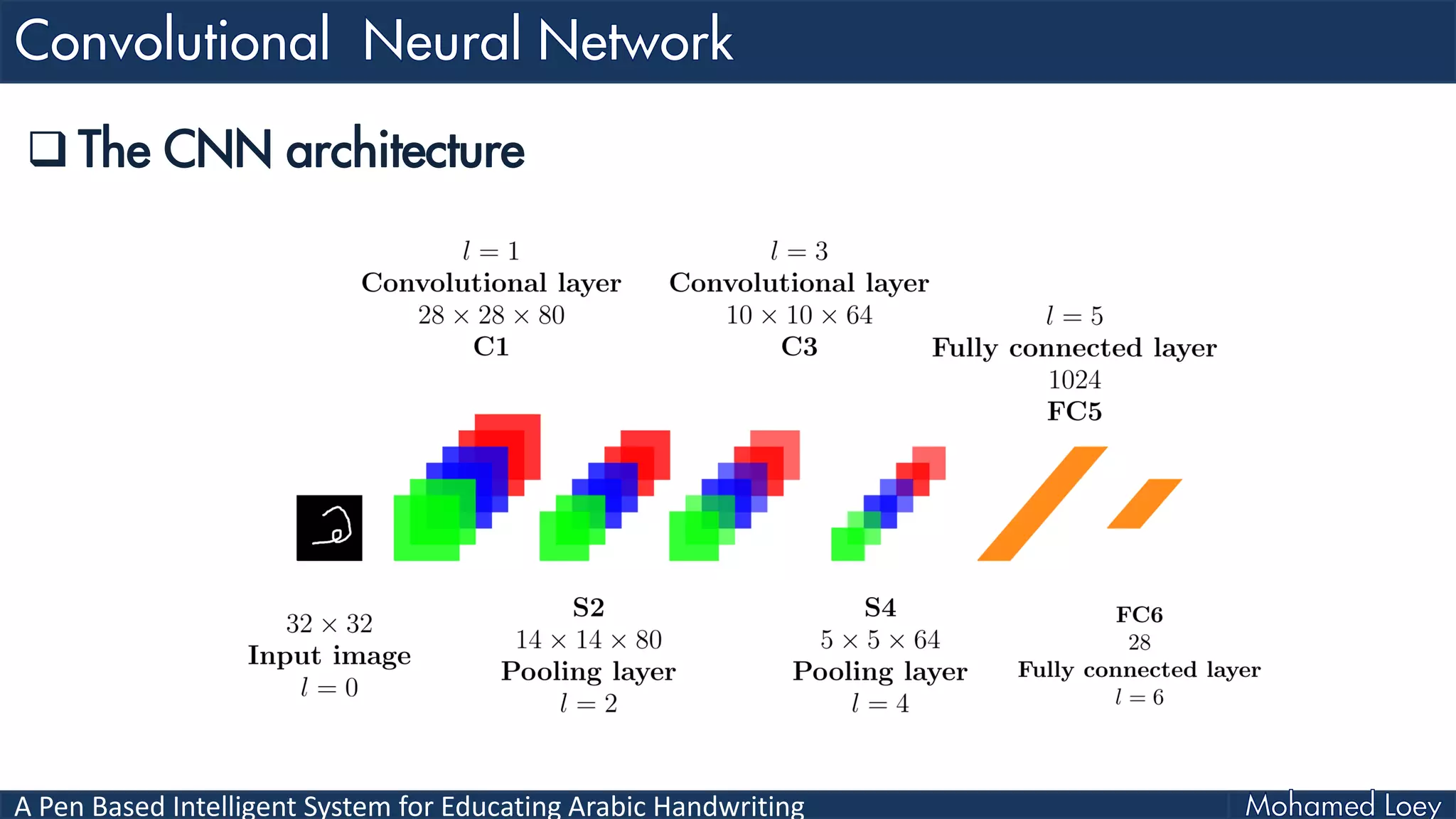
 The CNN architecture
A Pen Based Intelligent System for Educating Arabic Handwriting
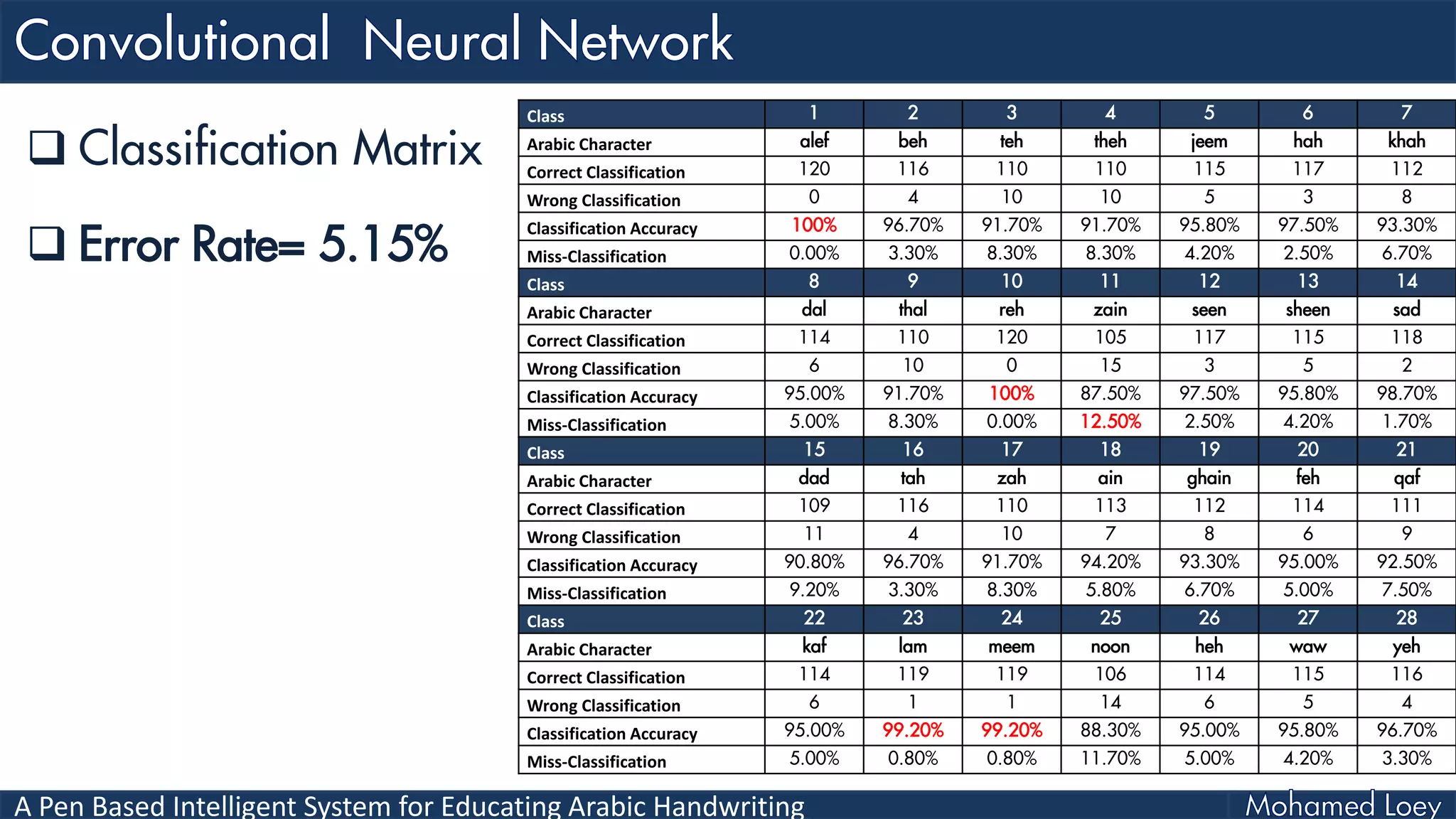
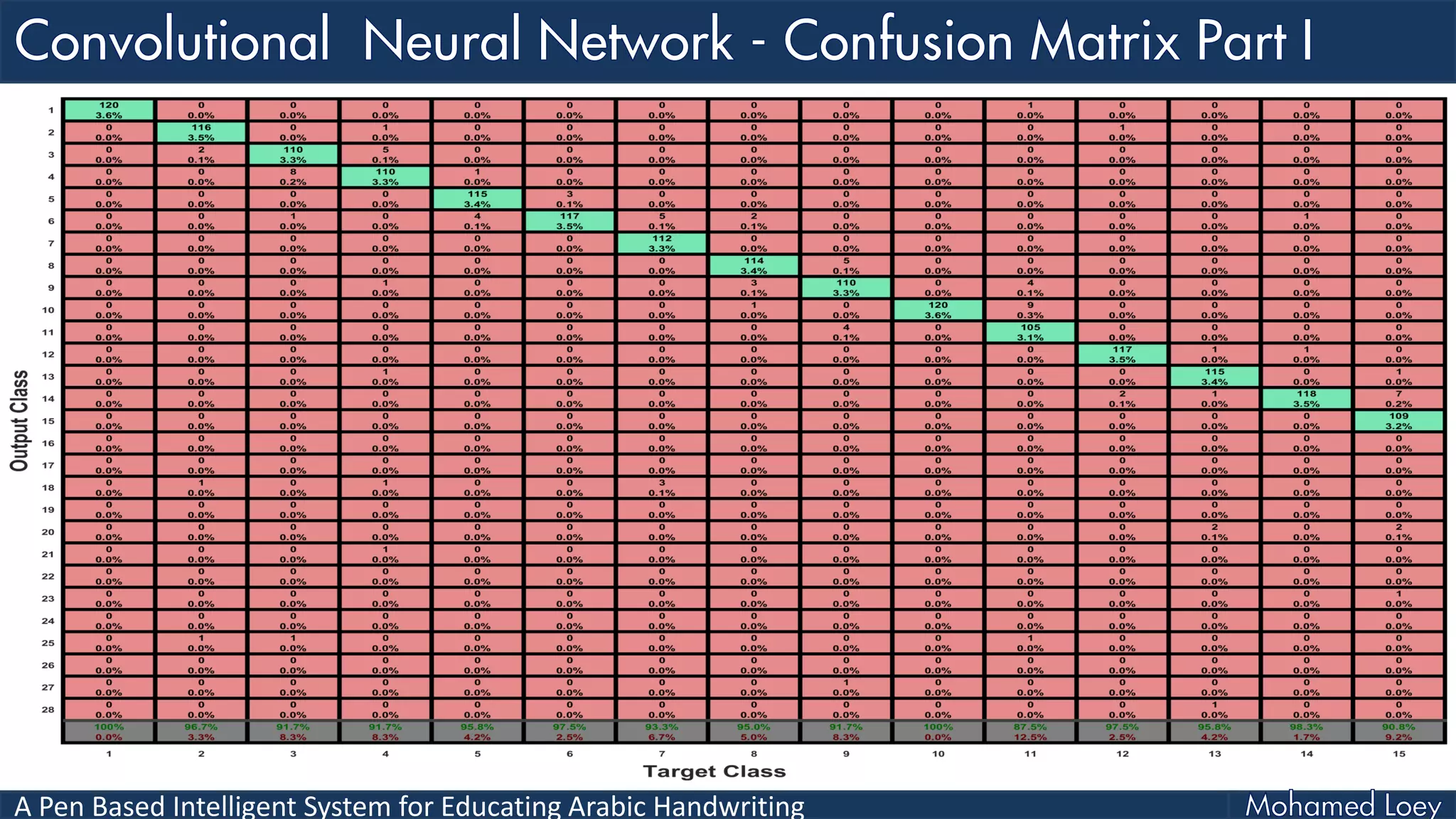
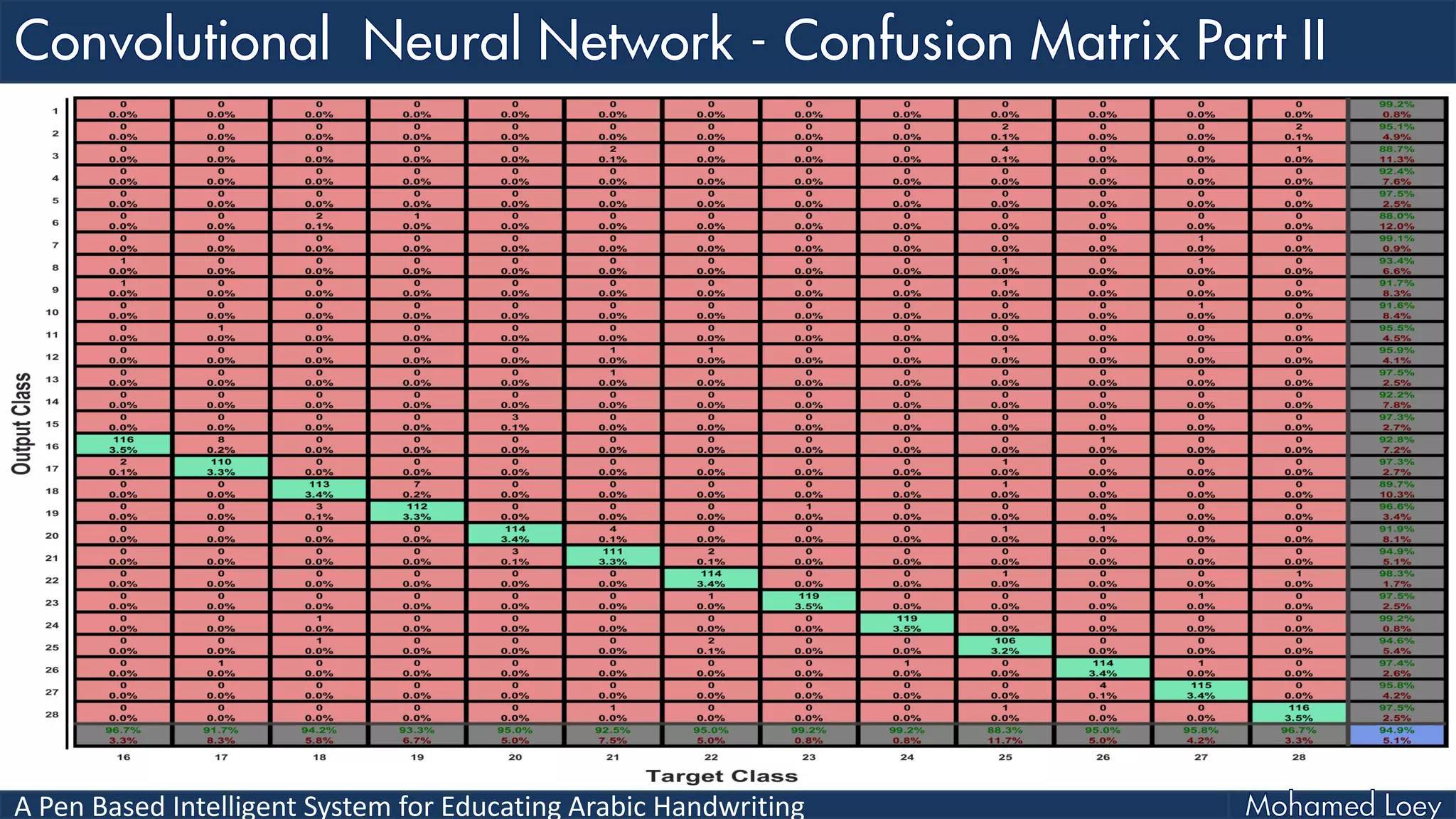
 Classification Matrix
 Error Rate= 5.15%
Class 1 2 3 4 5 6 7
Arabic Character alef beh teh theh jeem hah khah
Correct Classification 120 116 110 110 115 117 112
Wrong Classification 0 4 10 10 5 3 8
Classification Accuracy 100% 96.70% 91.70% 91.70% 95.80% 97.50% 93.30%
Miss-Classification 0.00% 3.30% 8.30% 8.30% 4.20% 2.50% 6.70%
Class 8 9 10 11 12 13 14
Arabic Character dal thal reh zain seen sheen sad
Correct Classification 114 110 120 105 117 115 118
Wrong Classification 6 10 0 15 3 5 2
Classification Accuracy 95.00% 91.70% 100% 87.50% 97.50% 95.80% 98.70%
Miss-Classification 5.00% 8.30% 0.00% 12.50% 2.50% 4.20% 1.70%
Class 15 16 17 18 19 20 21
Arabic Character dad tah zah ain ghain feh qaf
Correct Classification 109 116 110 113 112 114 111
Wrong Classification 11 4 10 7 8 6 9
Classification Accuracy 90.80% 96.70% 91.70% 94.20% 93.30% 95.00% 92.50%
Miss-Classification 9.20% 3.30% 8.30% 5.80% 6.70% 5.00% 7.50%
Class 22 23 24 25 26 27 28
Arabic Character kaf lam meem noon heh waw yeh
Correct Classification 114 119 119 106 114 115 116
Wrong Classification 6 1 1 14 6 5 4
Classification Accuracy 95.00% 99.20% 99.20% 88.30% 95.00% 95.80% 96.70%
Miss-Classification 5.00% 0.80% 0.80% 11.70% 5.00% 4.20% 3.30%
A Pen Based Intelligent System for Educating Arabic Handwriting
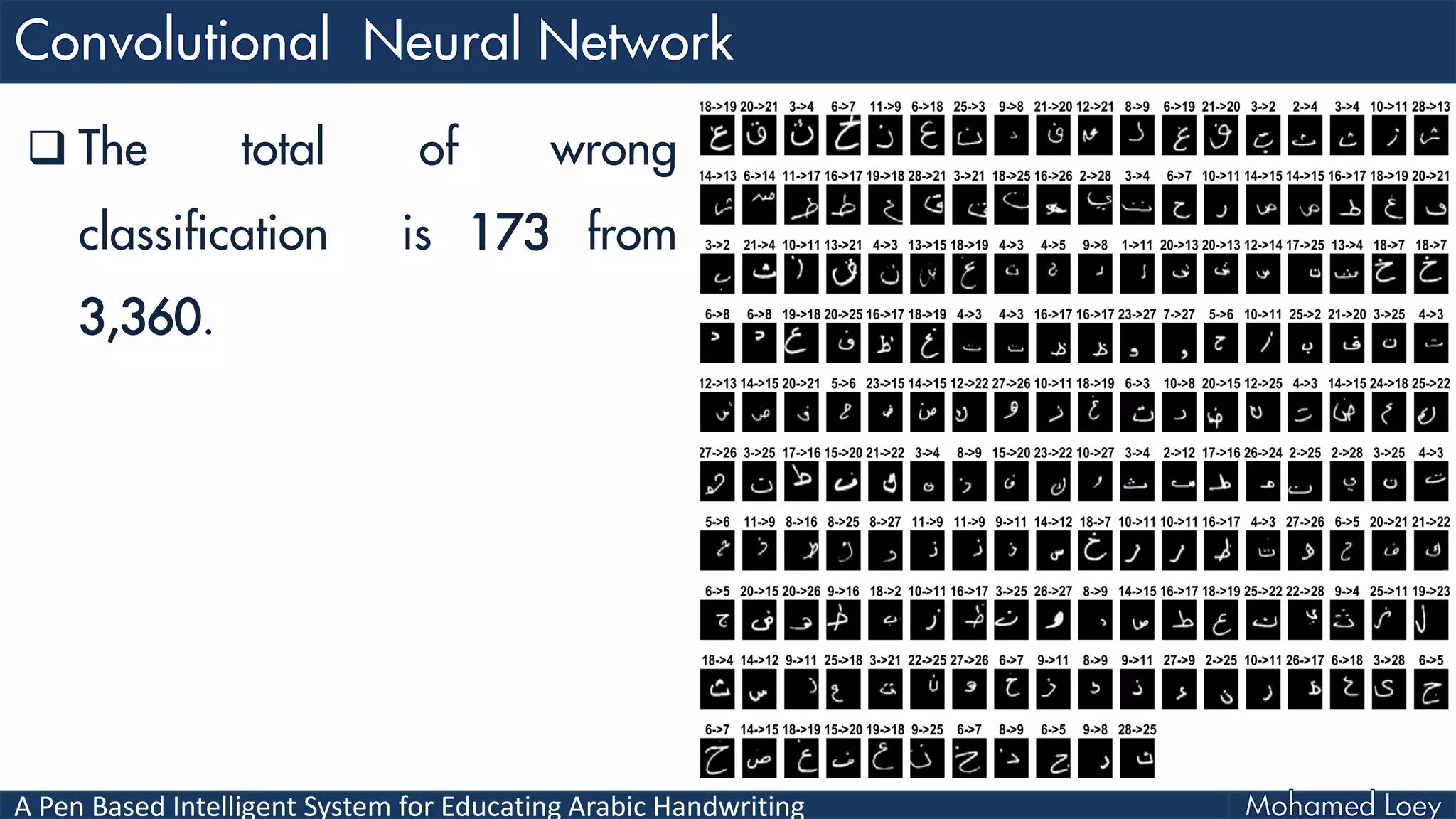
 The total of wrong
classification is 173 from
3,360.
A Pen Based Intelligent System for Educating Arabic Handwriting
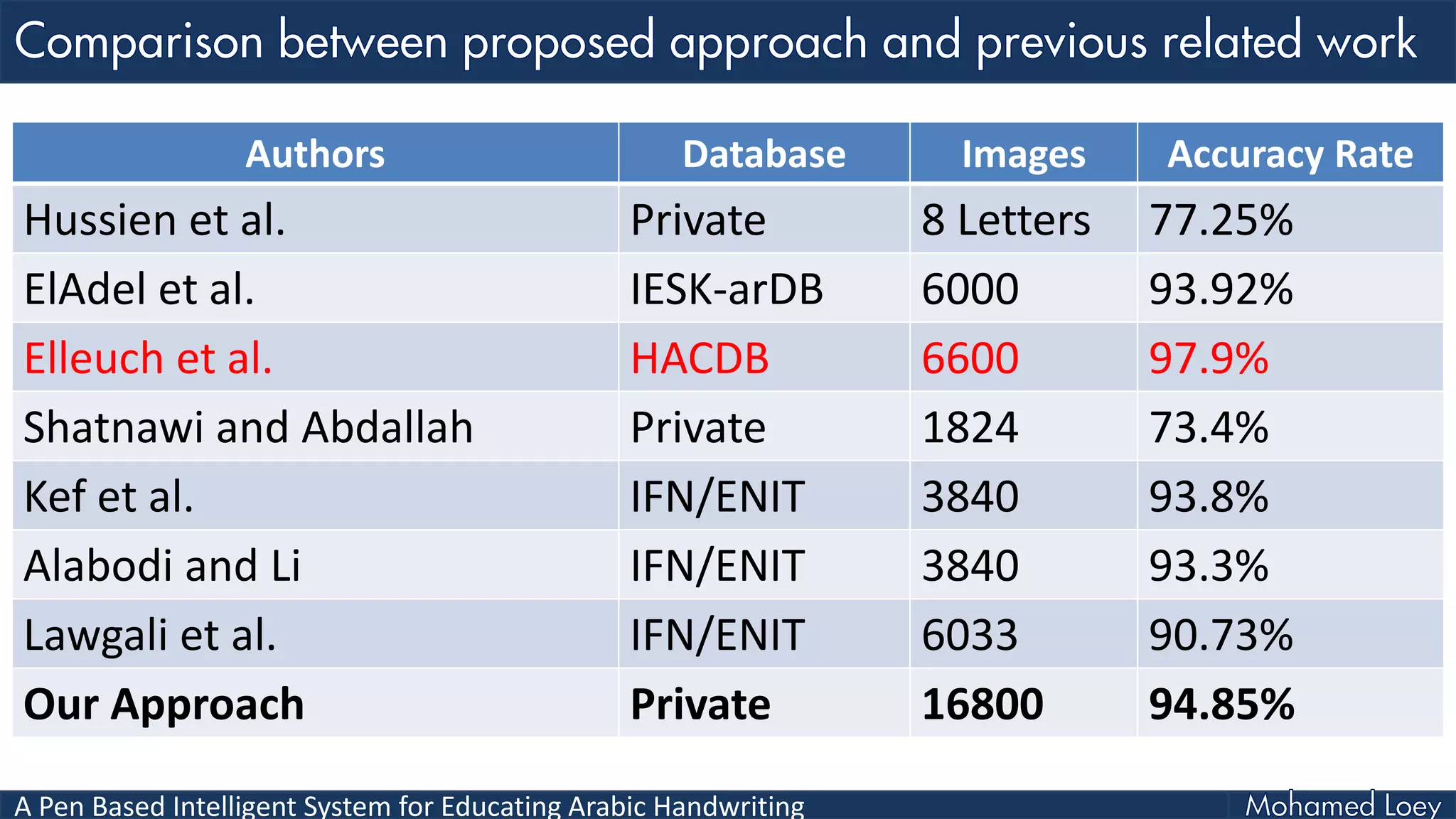
Authors Database Images Accuracy Rate
Hussien et al. Private 8 Letters 77.25%
ElAdel et al. IESK-arDB 6000 93.92%
Elleuch et al. HACDB 6600 97.9%
Shatnawi and Abdallah Private 1824 73.4%
Kef et al. IFN/ENIT 3840 93.8%
Alabodi and Li IFN/ENIT 3840 93.3%
Lawgali et al. IFN/ENIT 6033 90.73%
Our Approach Private 16800 94.85%
A Pen Based Intelligent System for Educating Arabic Handwriting
Introduction
Previous Related Work
Background and Preliminaries
Arabic Handwritten Digits Recognition System
Arabic Handwritten Characters Recognition System
Intelligent Arab Teaching System
Conclusion and Future Work
A Pen Based Intelligent System for Educating Arabic Handwriting
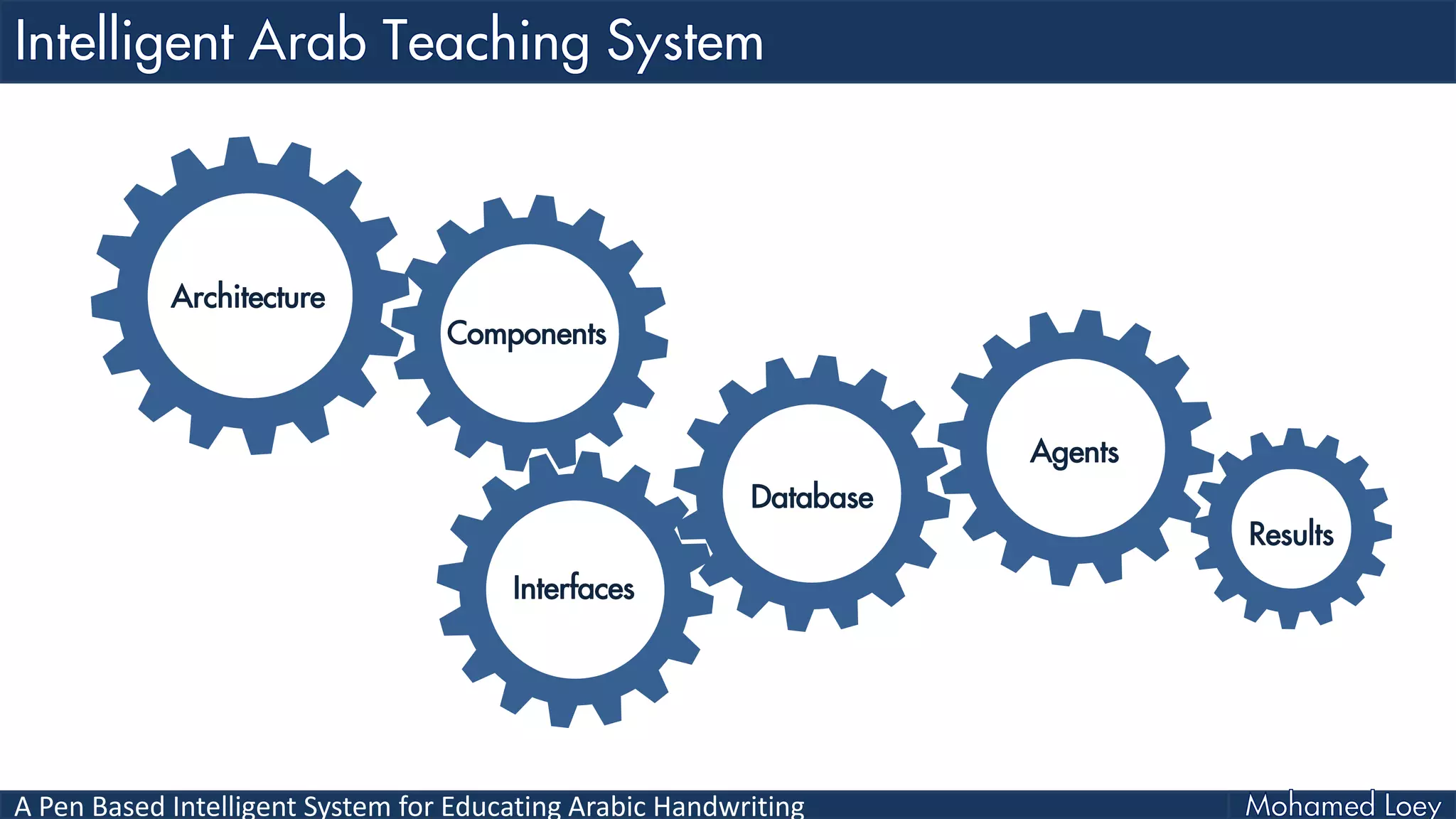
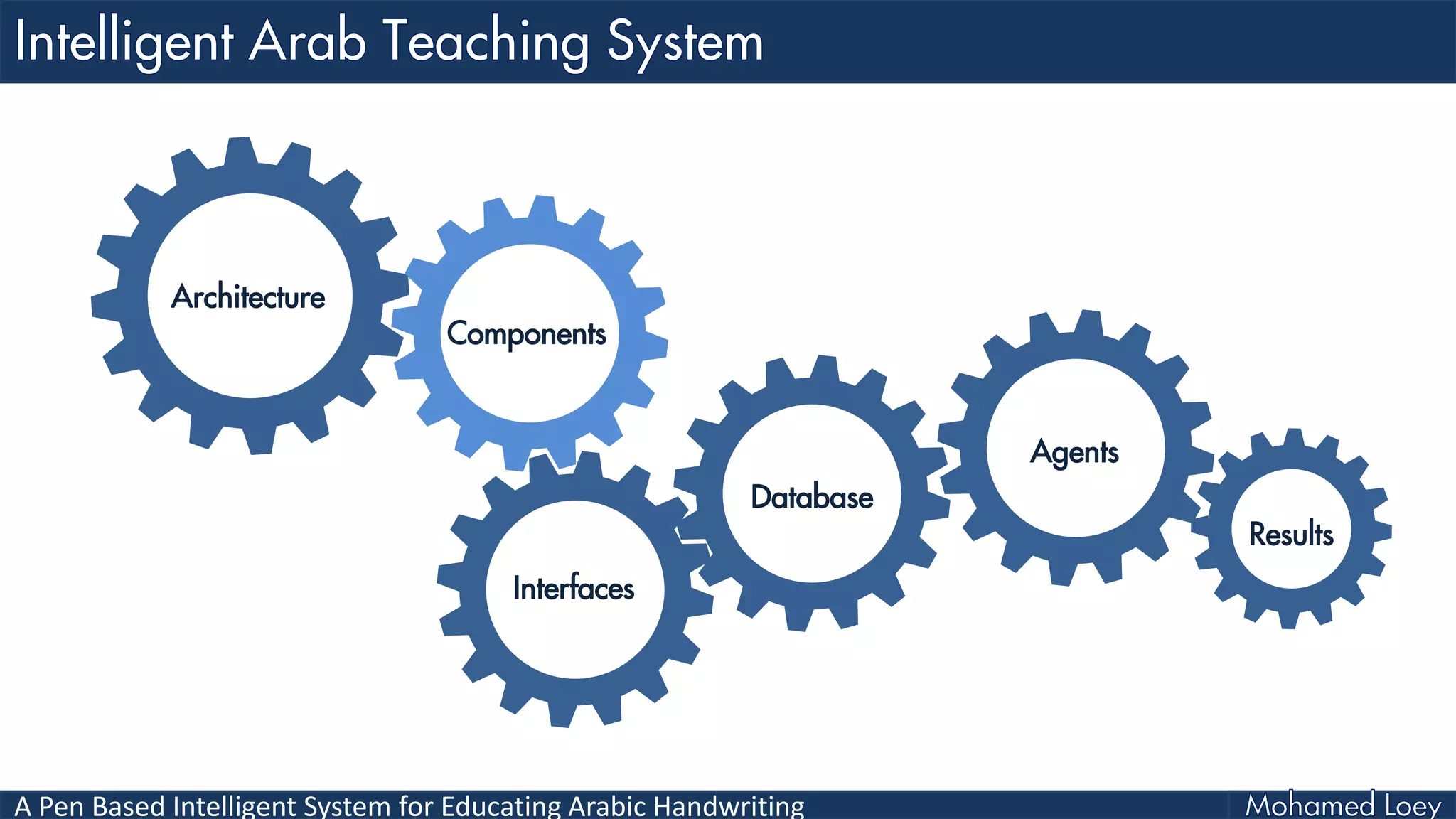
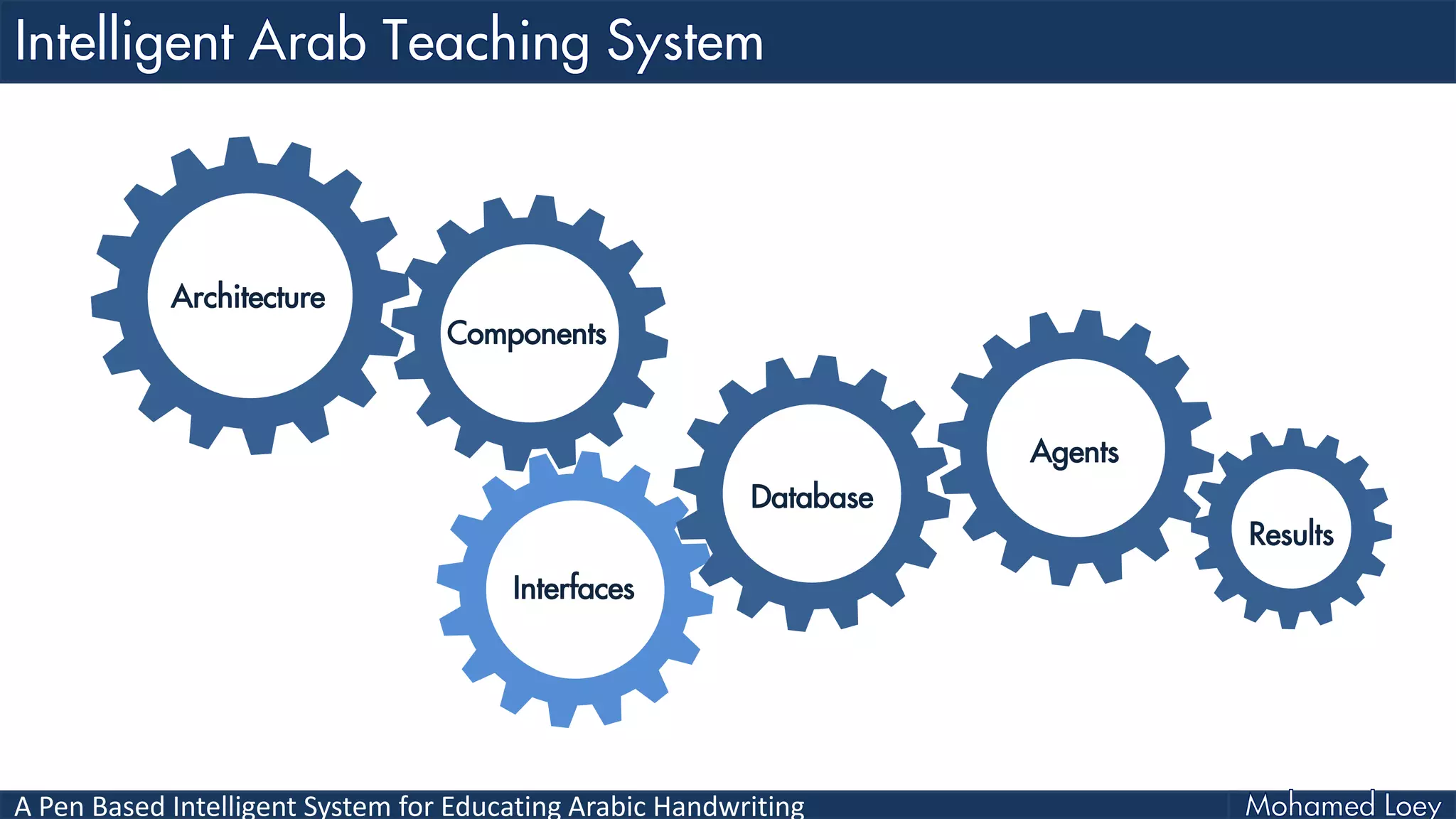
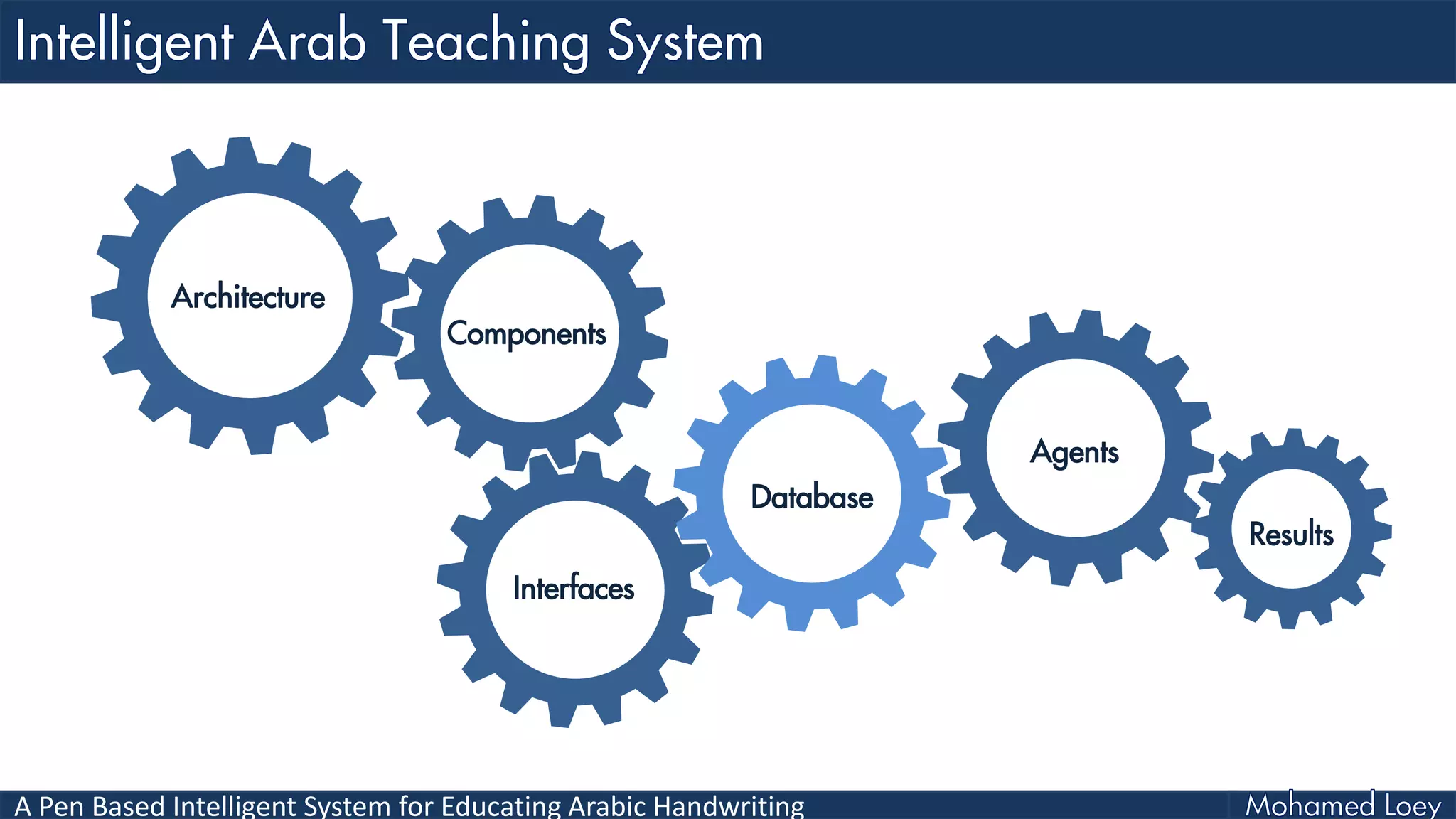
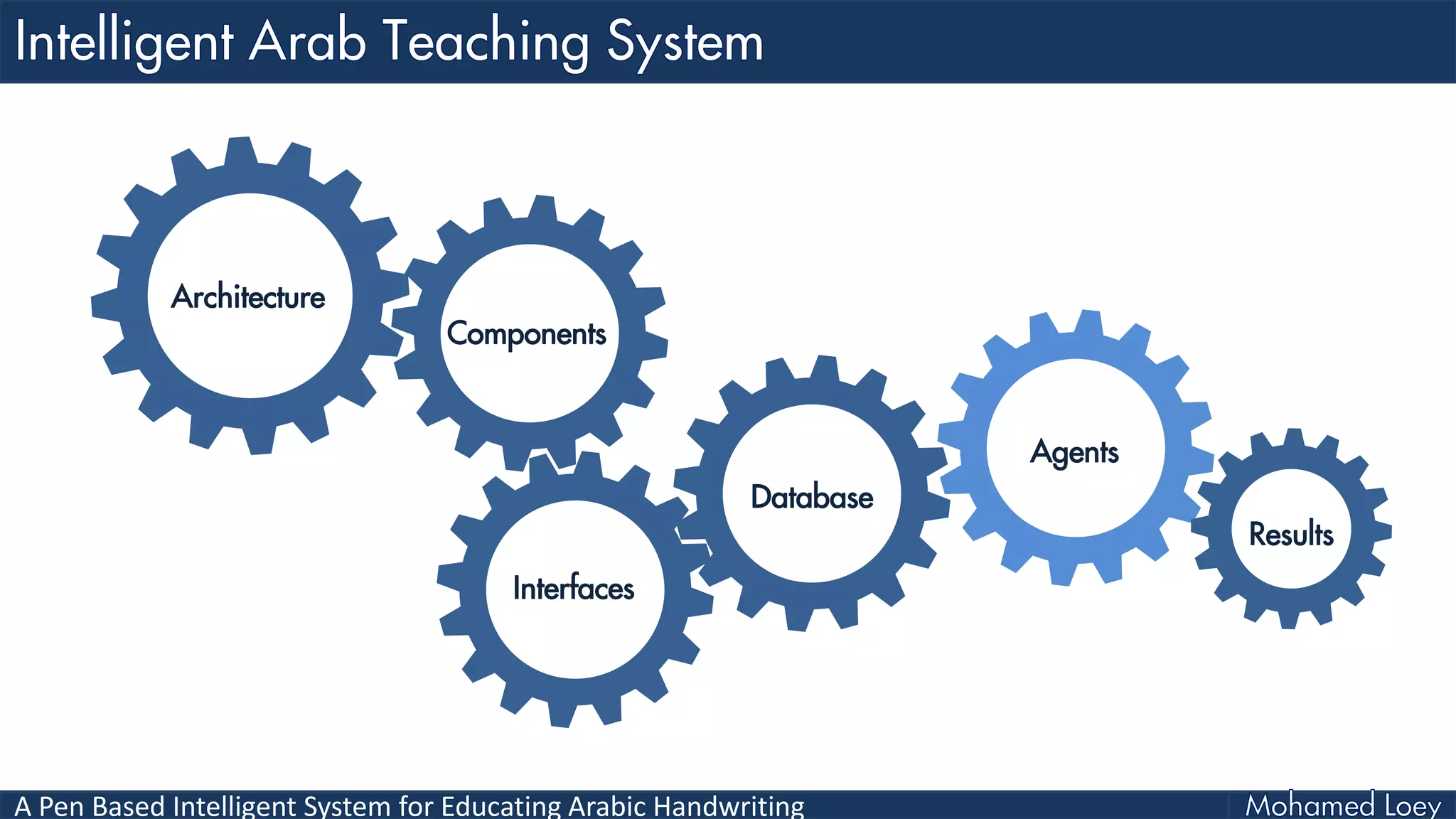
Interfaces
Architecture
Components
Database
Agents
Results
A Pen Based Intelligent System for Educating Arabic Handwriting
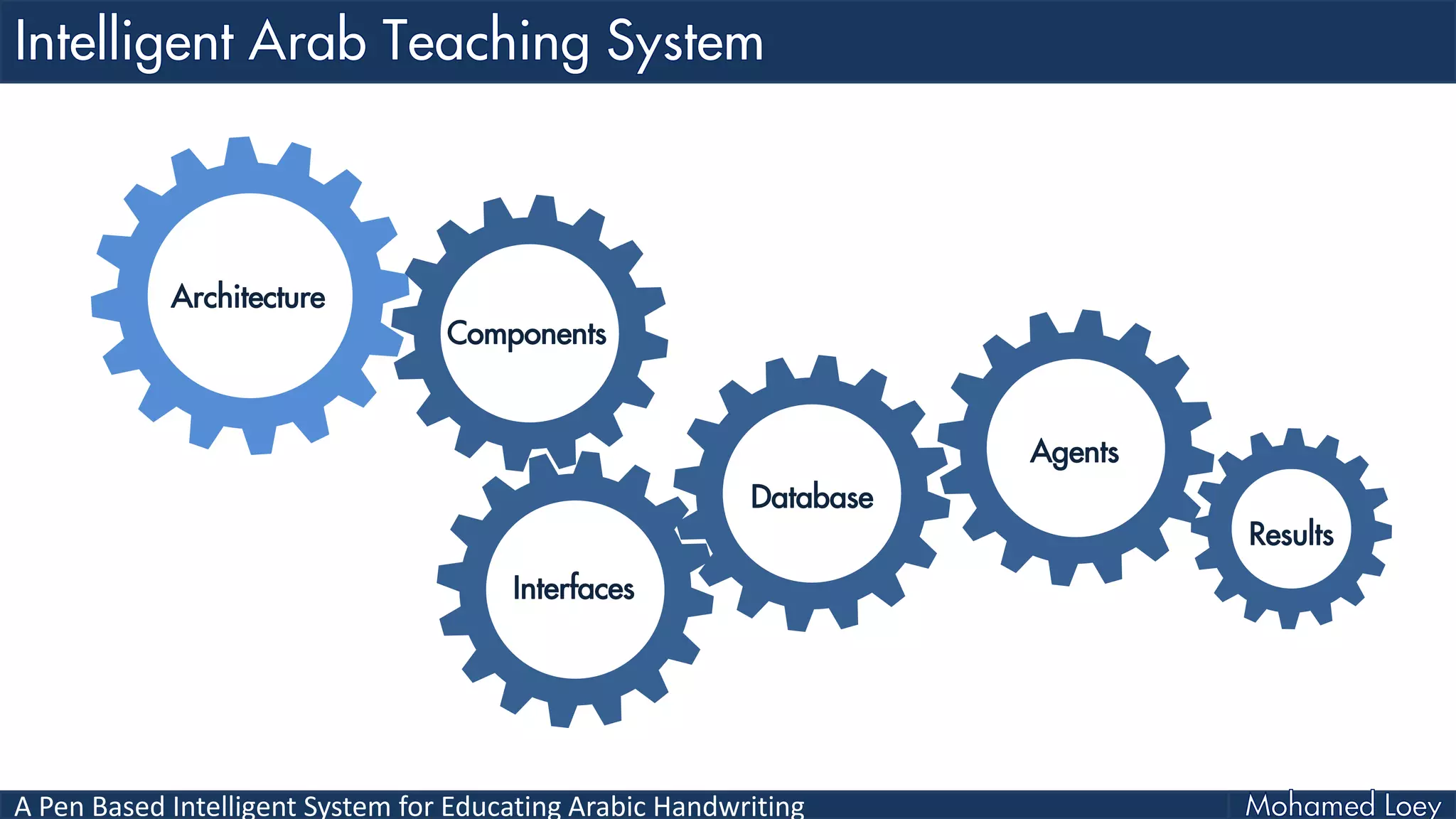
Interfaces
Architecture
Components
Database
Agents
Results
A Pen Based Intelligent System for Educating Arabic Handwriting
Interfaces
Architecture
Components
Database
Agents
Results
A Pen Based Intelligent System for Educating Arabic Handwriting
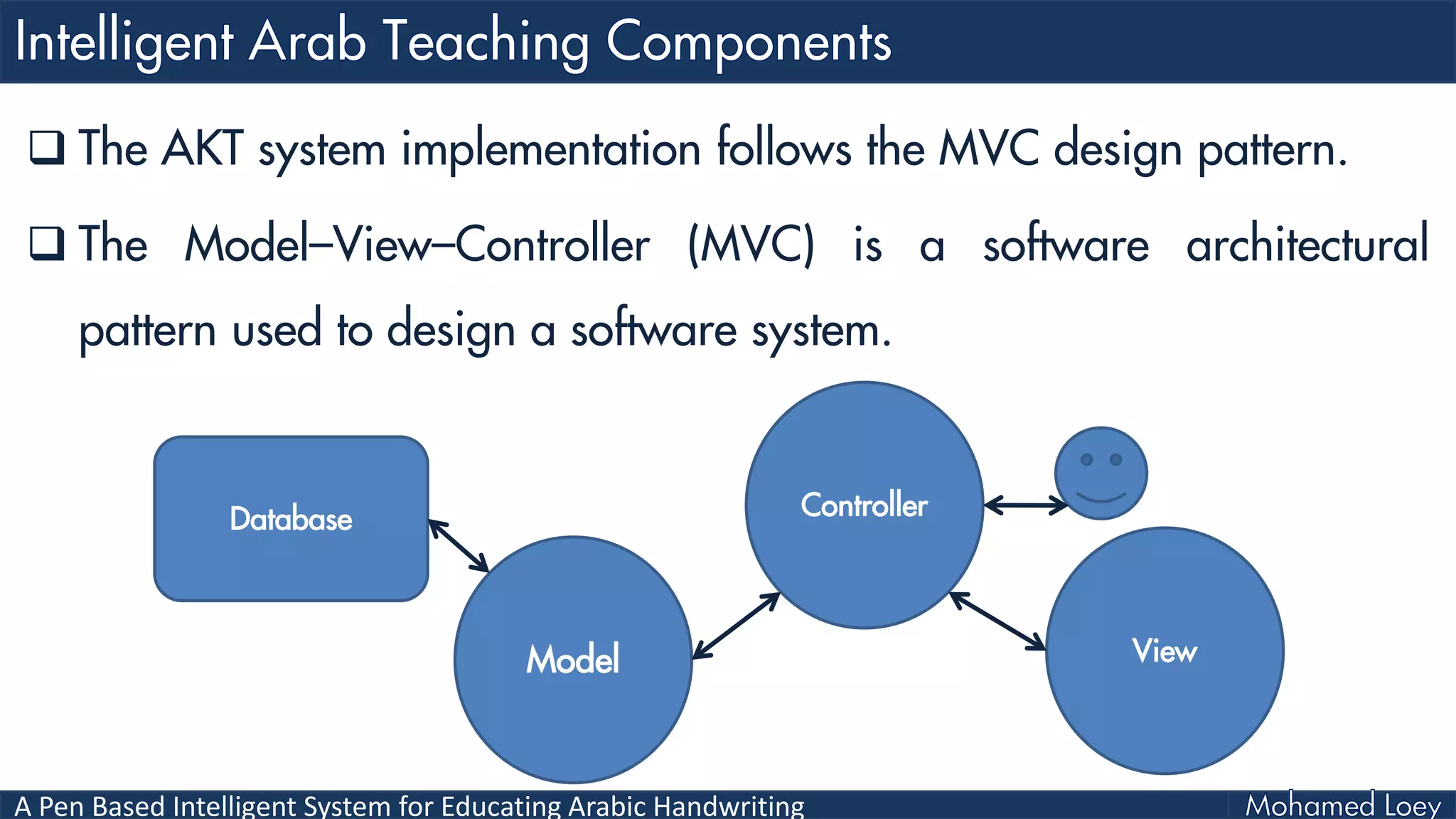
 The AKT system implementation follows the MVC design pattern.
 The Model–View–Controller (MVC) is a software architectural
pattern used to design a software system.
View
Controller
Model
Database
A Pen Based Intelligent System for Educating Arabic Handwriting
Interfaces
Architecture
Components
Database
Agents
Results
A Pen Based Intelligent System for Educating Arabic Handwriting
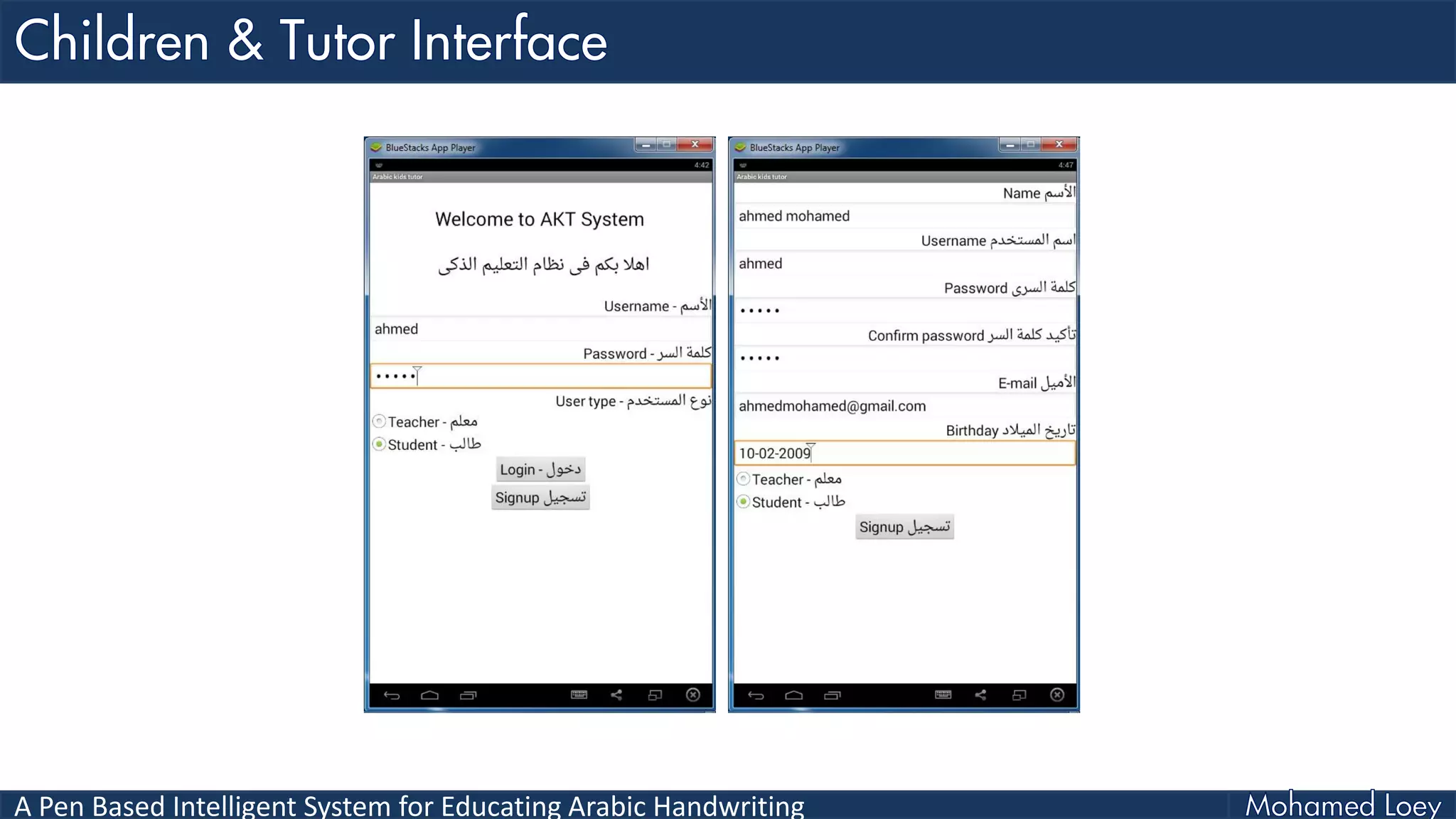
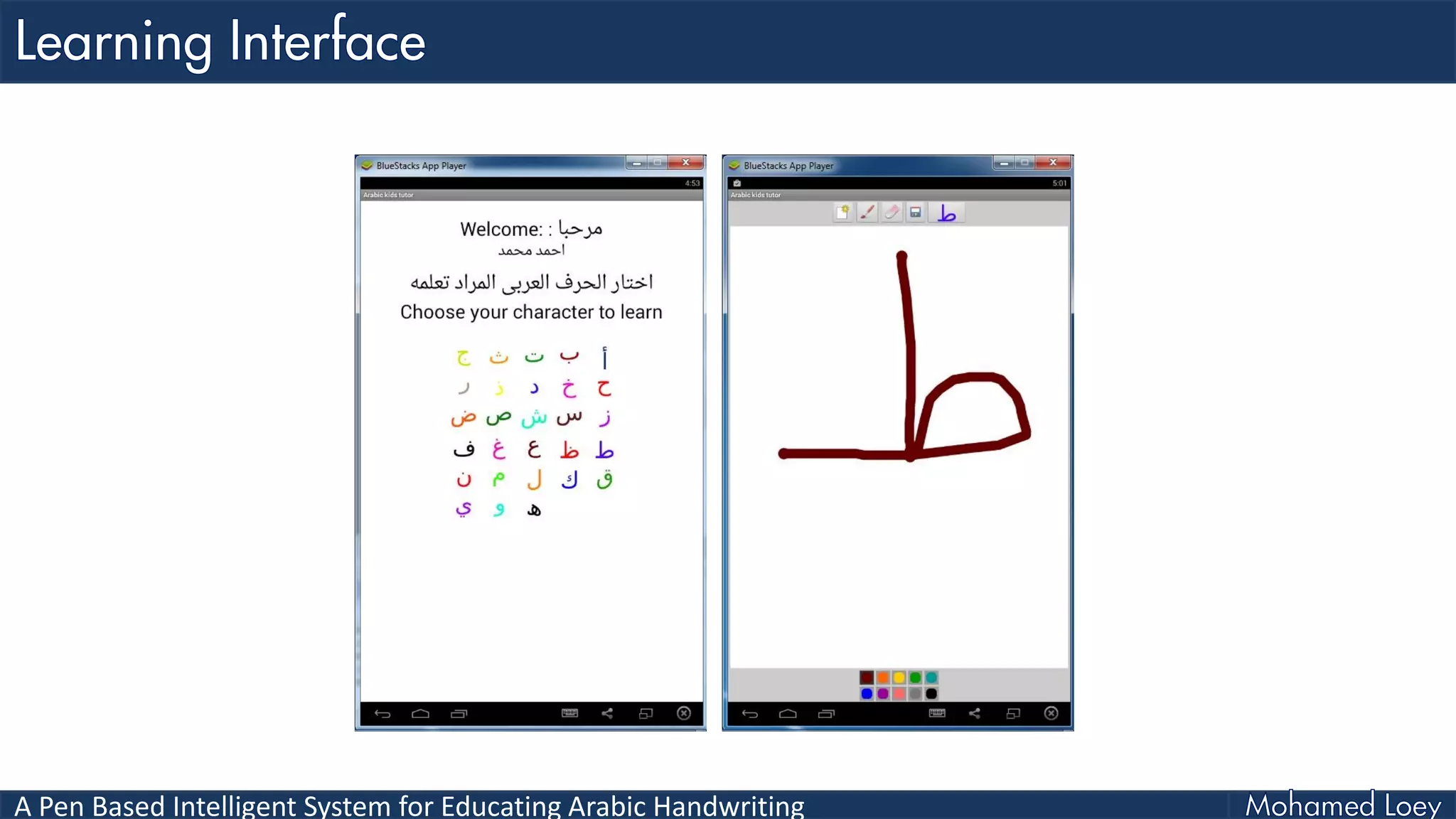
We Develop two interfaces:
 Children & Tutor Interface
 Learning Interface
A Pen Based Intelligent System for Educating Arabic Handwriting
Interfaces
Architecture
Components
Database
Agents
Results
A Pen Based Intelligent System for Educating Arabic Handwriting
Interfaces
Architecture
Components
Database
Agents
Results
A Pen Based Intelligent System for Educating Arabic Handwriting
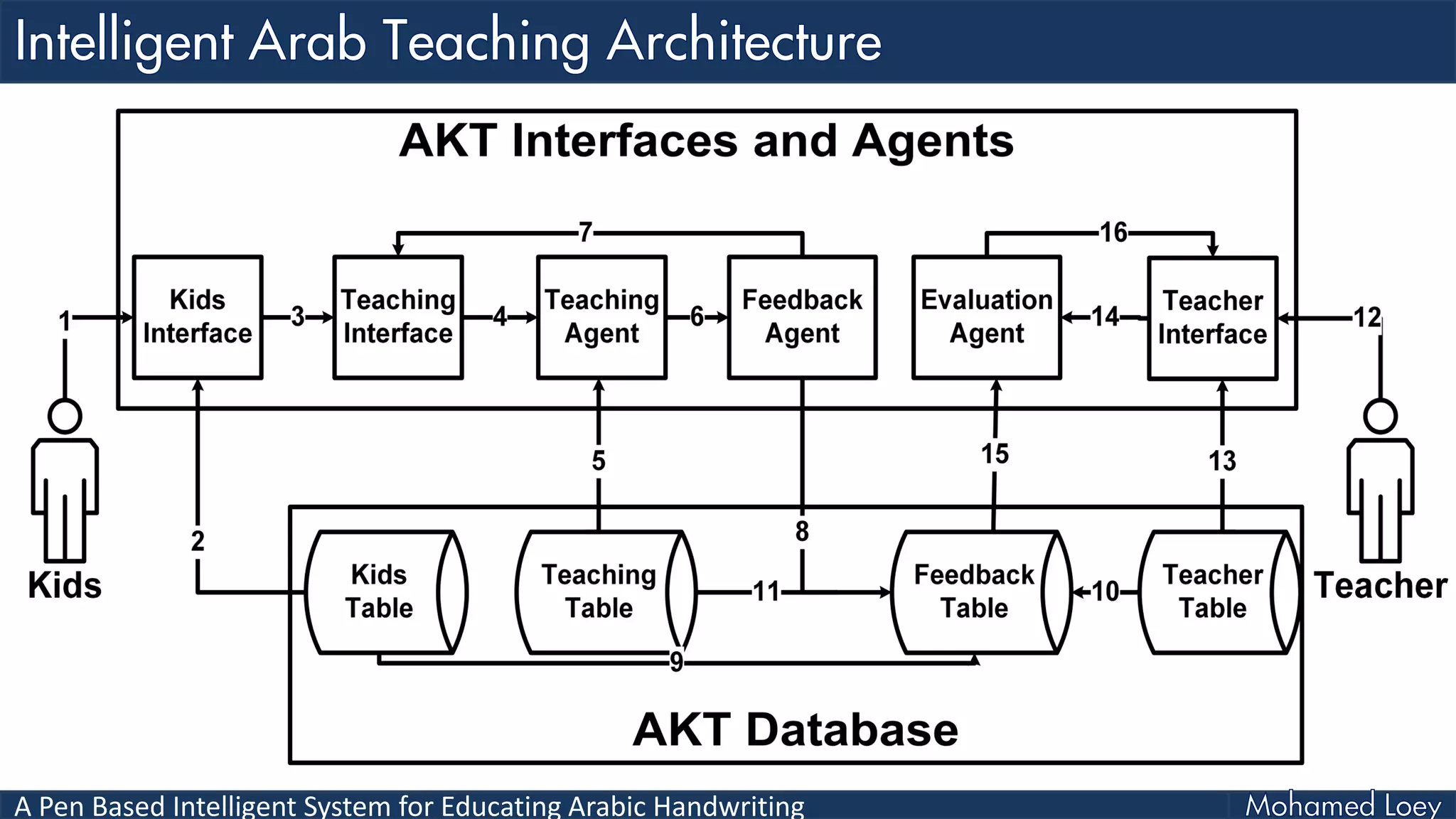
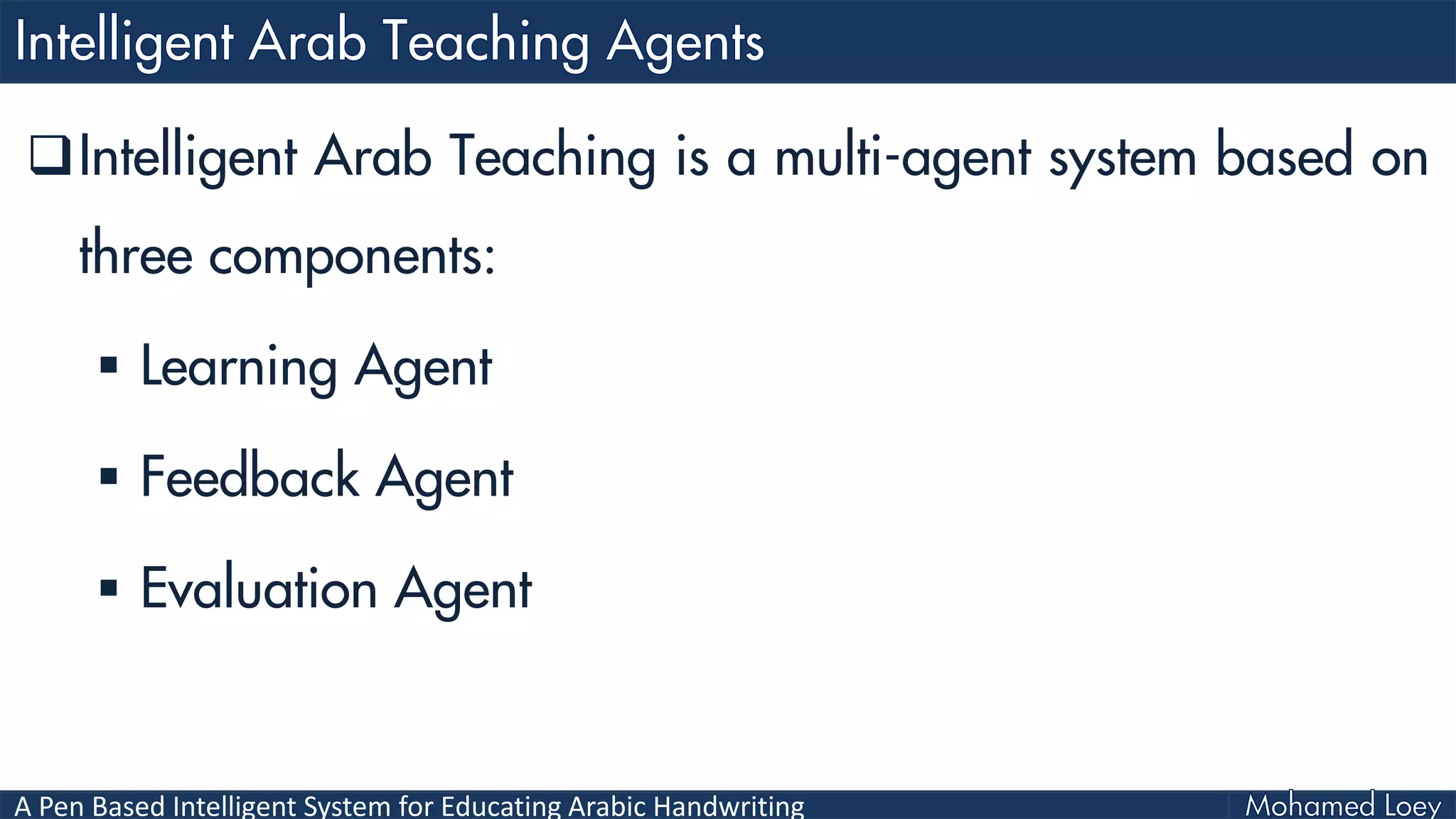
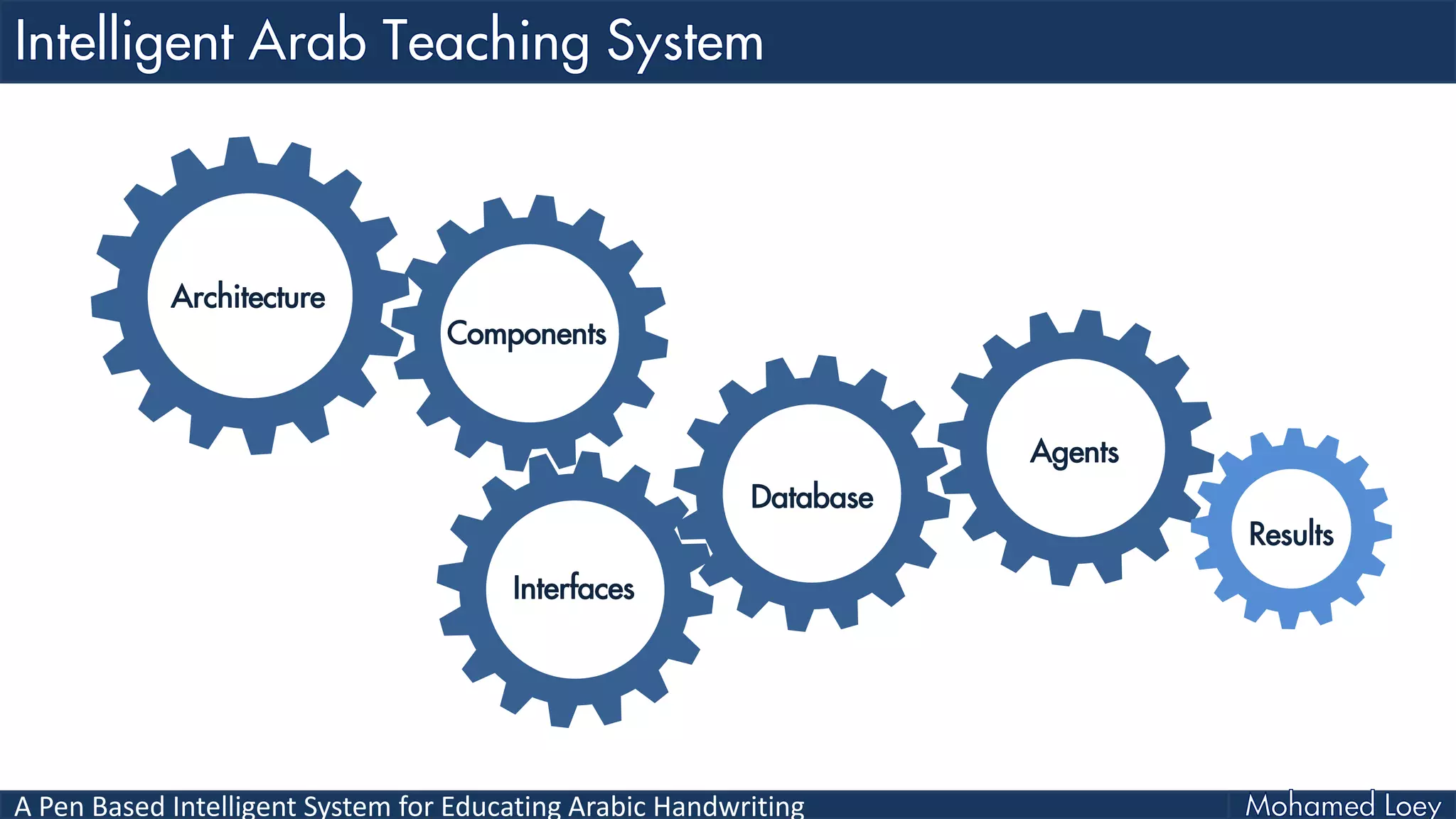
Intelligent Arab Teaching is a multi-agent system based on
three components:
 Learning Agent
 Feedback Agent
 Evaluation Agent
A Pen Based Intelligent System for Educating Arabic Handwriting
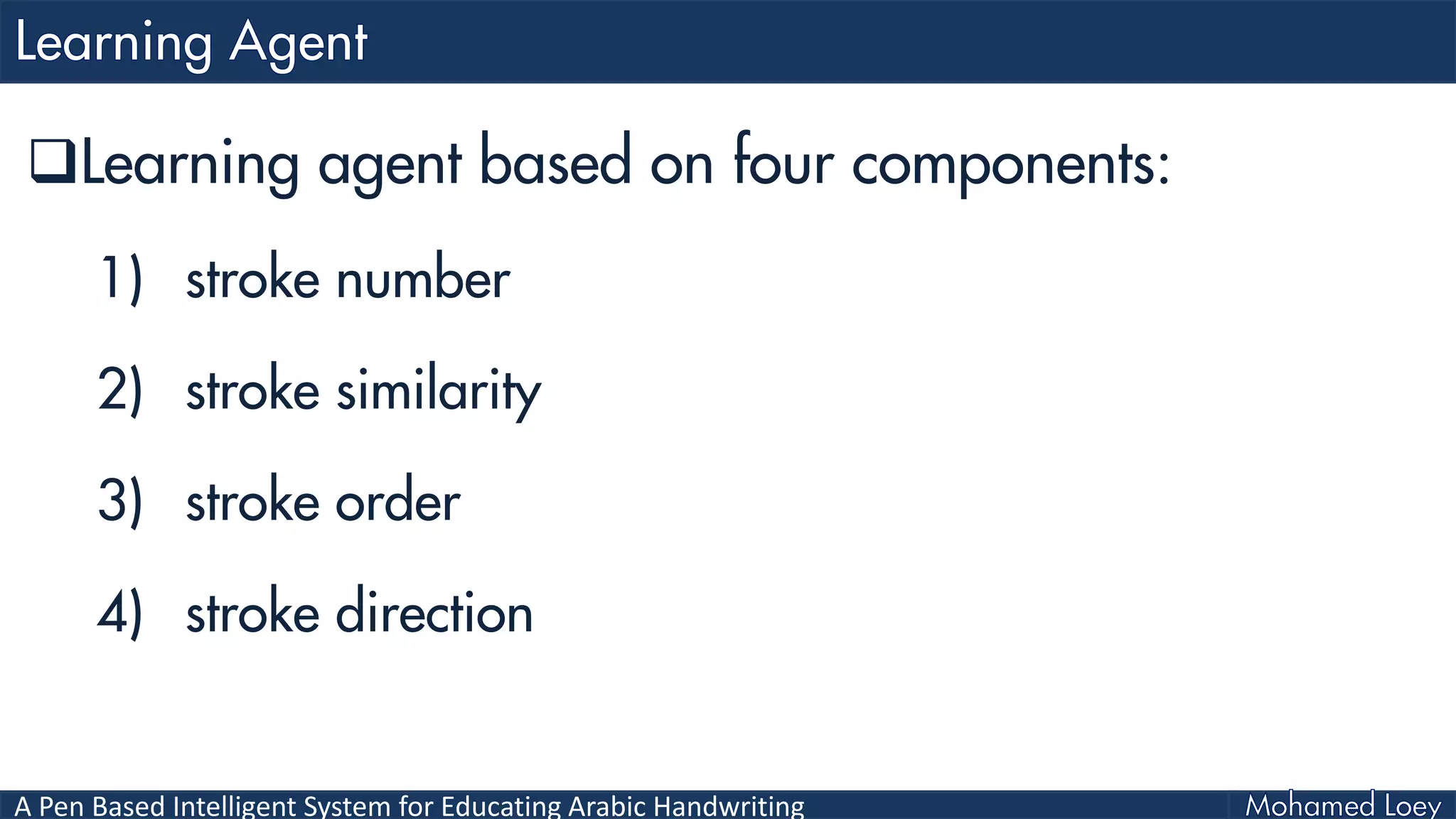
Learning agent based on four components:
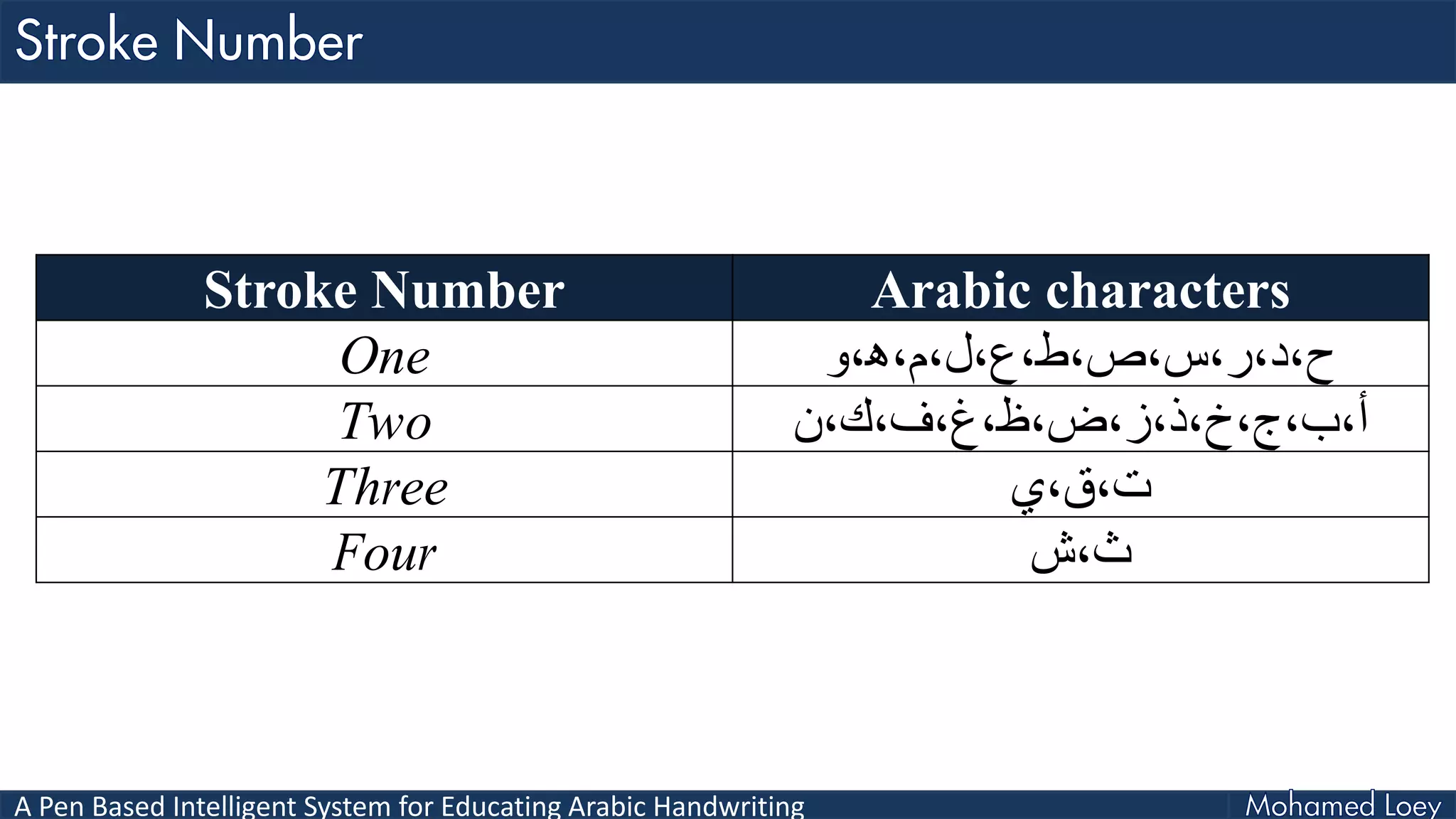
1) stroke number
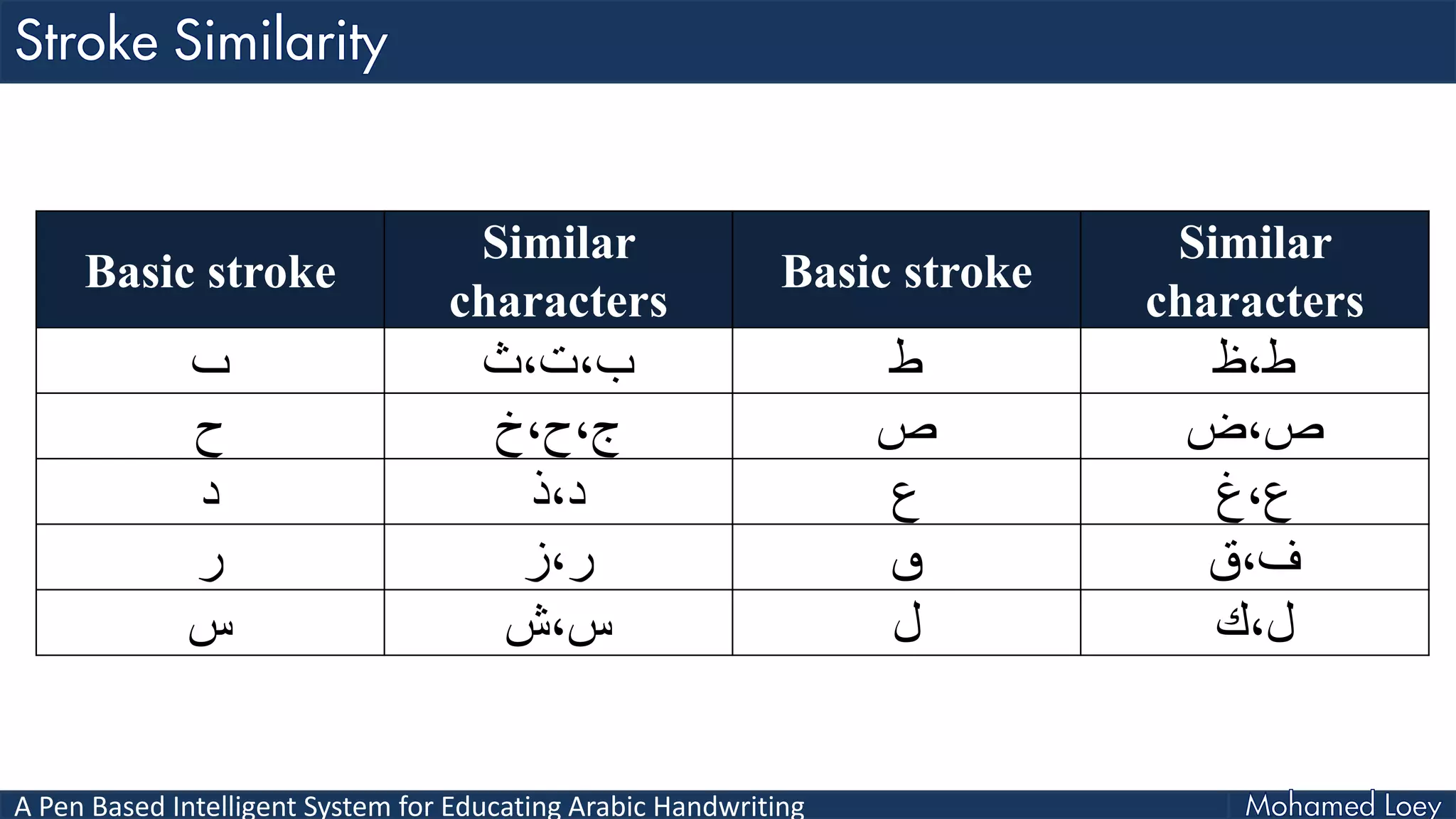
2) stroke similarity
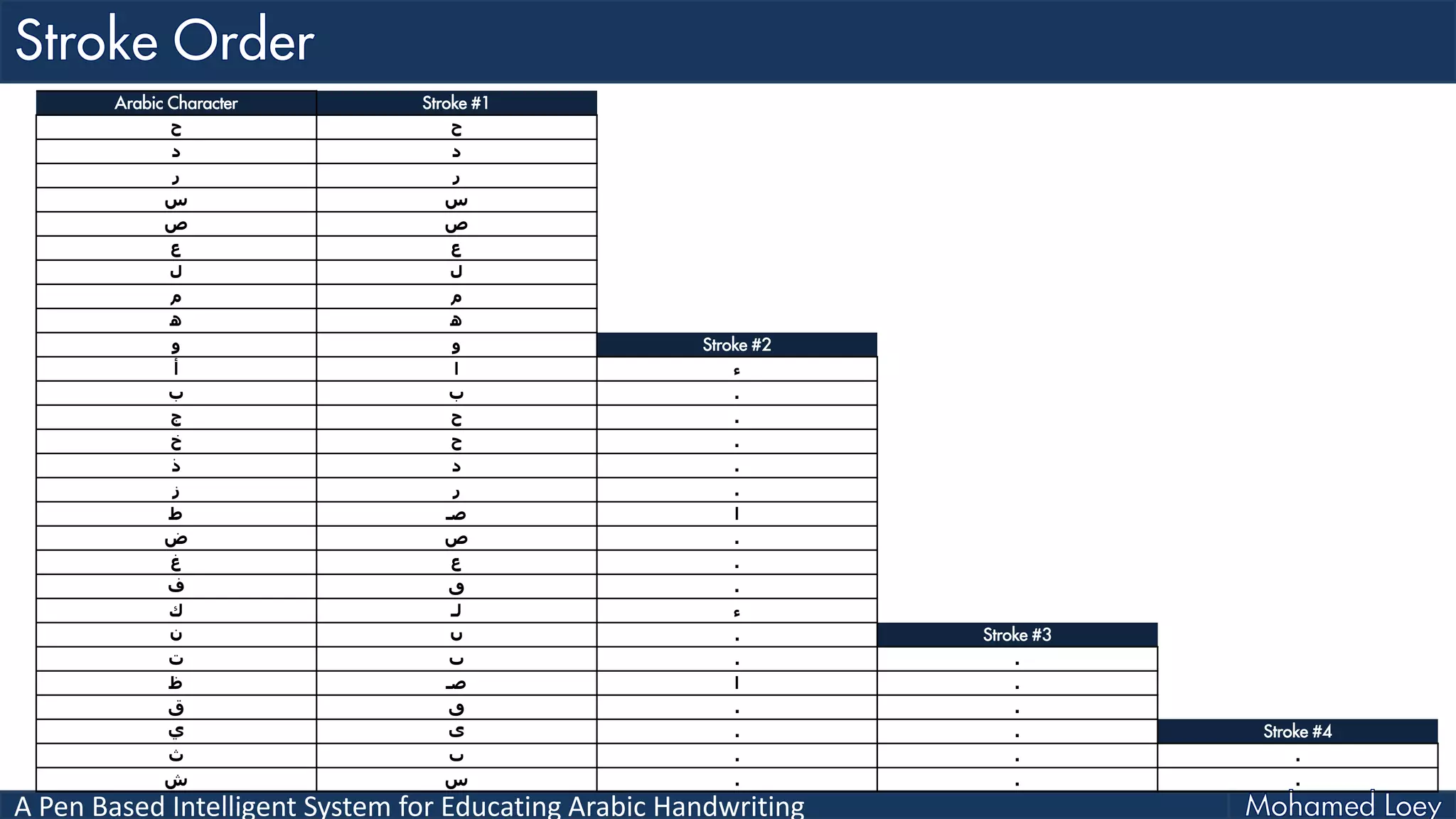
3) stroke order
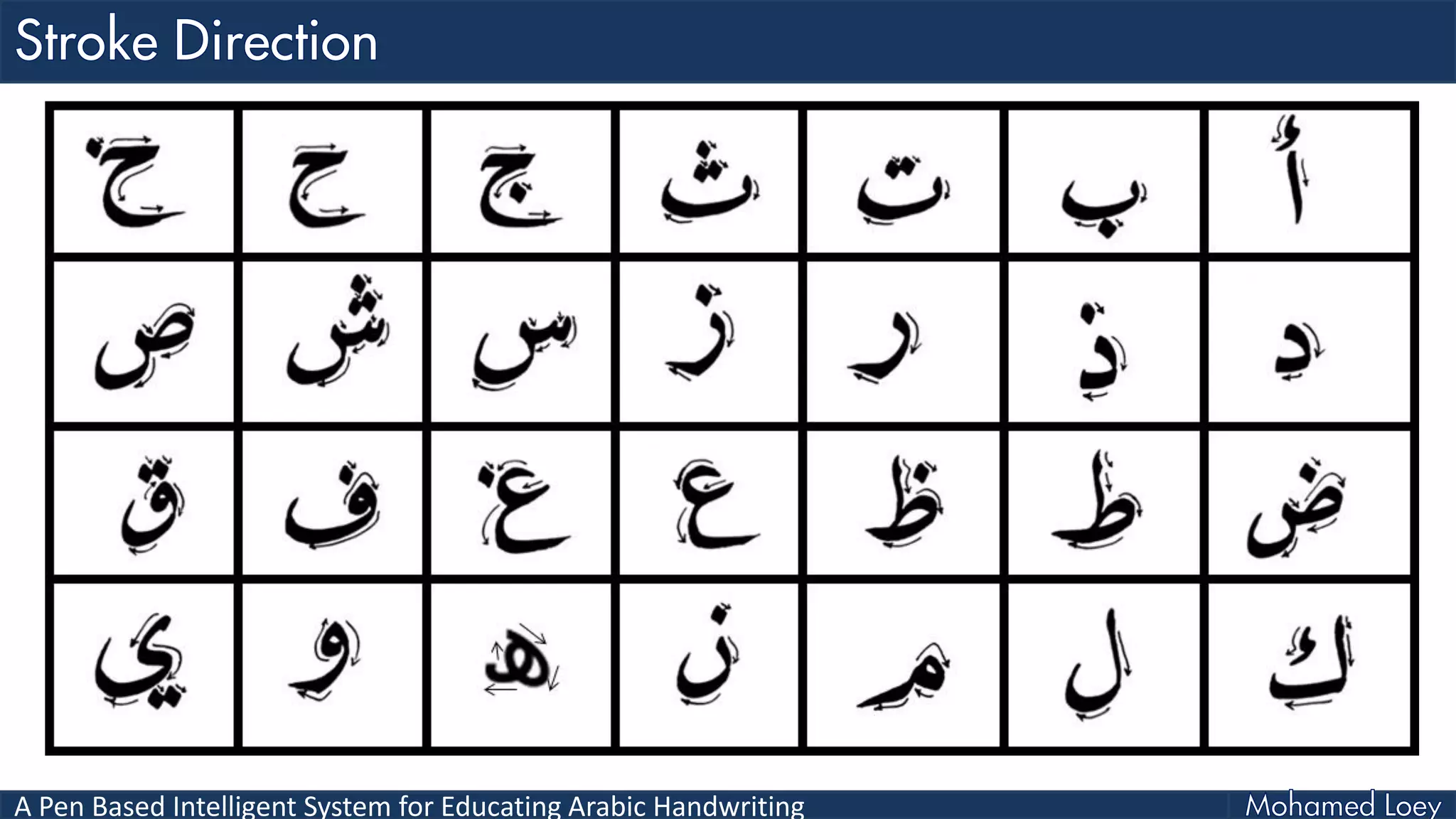
4) stroke direction
A Pen Based Intelligent System for Educating Arabic Handwriting
Stroke Number Arabic characters
One ،‫ح،د،ر،س،ص،ط،ع،ل،م‬‫ﻫ‬‫،و‬
Two ‫أ،ب،ج،خ،ذ،ز،ض،ظ،غ،ف،ك،ن‬
Three ‫ت،ق،ي‬
Four ‫ث،ش‬
A Pen Based Intelligent System for Educating Arabic Handwriting
Basic stroke
Similar
characters
Basic stroke
Similar
characters
‫ٮ‬ ‫ب،ت،ث‬ ‫ط‬ ‫ط،ظ‬
‫ح‬ ‫ج،ح،خ‬ ‫ص‬ ‫ص،ض‬
‫د‬ ‫د،ذ‬ ‫ع‬ ‫ع،غ‬
‫ر‬ ‫ر،ز‬ ‫ٯ‬ ‫ف،ق‬
‫س‬ ‫س،ش‬ ‫ل‬ ‫ل،ك‬
A Pen Based Intelligent System for Educating Arabic Handwriting
Arabic Character Stroke #1
‫ح‬ ‫ح‬
‫د‬ ‫د‬
‫ر‬ ‫ر‬
‫س‬ ‫س‬
‫ص‬ ‫ص‬
‫ع‬ ‫ع‬
‫ل‬ ‫ل‬
‫م‬ ‫م‬
‫ﻫ‬ ‫ﻫ‬
‫و‬ ‫و‬ Stroke #2
‫أ‬ ‫ا‬ ‫ء‬
‫ب‬ ‫ب‬ .
‫ج‬ ‫ح‬ .
‫خ‬ ‫ح‬ .
‫ذ‬ ‫د‬ .
‫ز‬ ‫ر‬ .
‫ط‬ ‫ﺻ‬‫ـ‬ ‫ا‬
‫ض‬ ‫ص‬ .
‫غ‬ ‫ع‬ .
‫ف‬ ‫ٯ‬ .
‫ك‬ ‫لـ‬ ‫ء‬
‫ن‬ ‫ں‬ . Stroke #3
‫ت‬ ‫ٮ‬ . .
‫ظ‬ ‫ﺻ‬‫ـ‬ ‫ا‬ .
‫ق‬ ‫ٯ‬ . .
‫ي‬ ‫ى‬ . . Stroke #4
‫ث‬ ‫ٮ‬ . . .
‫ش‬ ‫س‬ . . .
A Pen Based Intelligent System for Educating Arabic Handwriting
Feedback agent based on:
1) Stroke direction detector
2) Stroke order detector
A Pen Based Intelligent System for Educating Arabic Handwriting
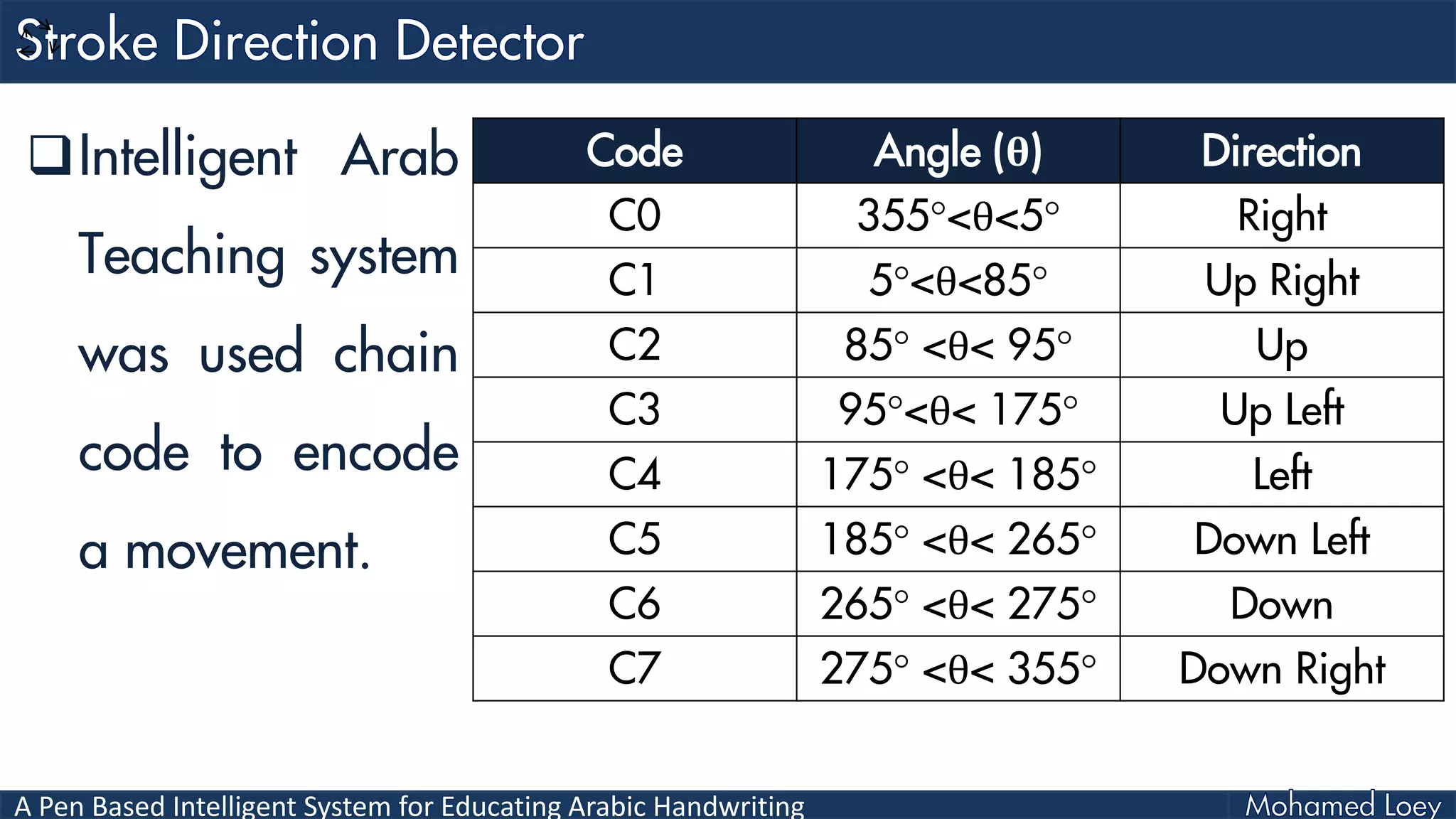
Intelligent Arab
Teaching system
was used chain
code to encode
a movement.
Code Angle (θ) Direction
C0 355°<θ<5° Right
C1 5°<θ<85° Up Right
C2 85° <θ< 95° Up
C3 95°<θ< 175° Up Left
C4 175° <θ< 185° Left
C5 185° <θ< 265° Down Left
C6 265° <θ< 275° Down
C7 275° <θ< 355° Down Right
A Pen Based Intelligent System for Educating Arabic Handwriting
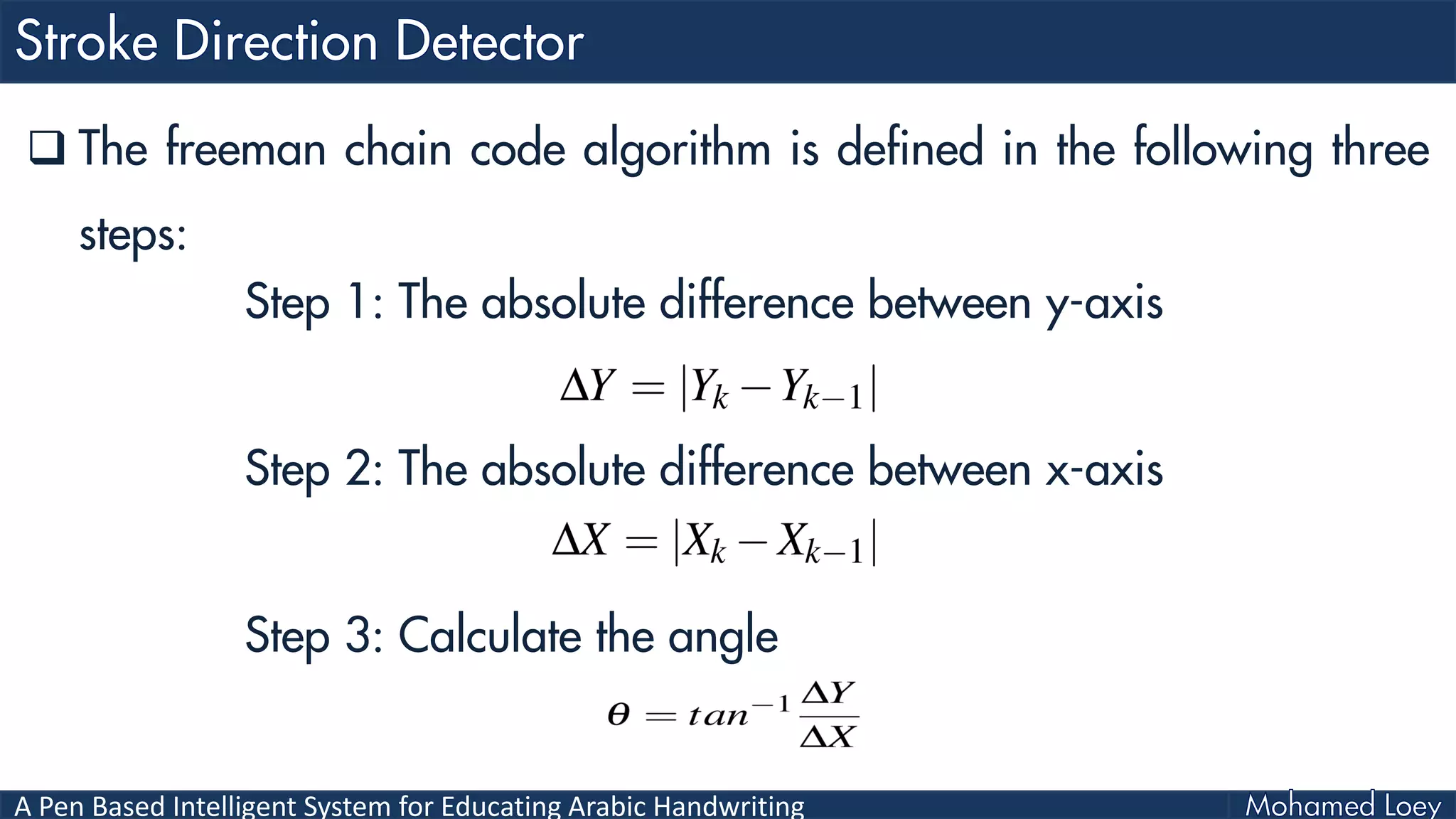
 The freeman chain code algorithm is defined in the following three
steps:
Step 1: The absolute difference between y-axis
Step 2: The absolute difference between x-axis
Step 3: Calculate the angle
A Pen Based Intelligent System for Educating Arabic Handwriting
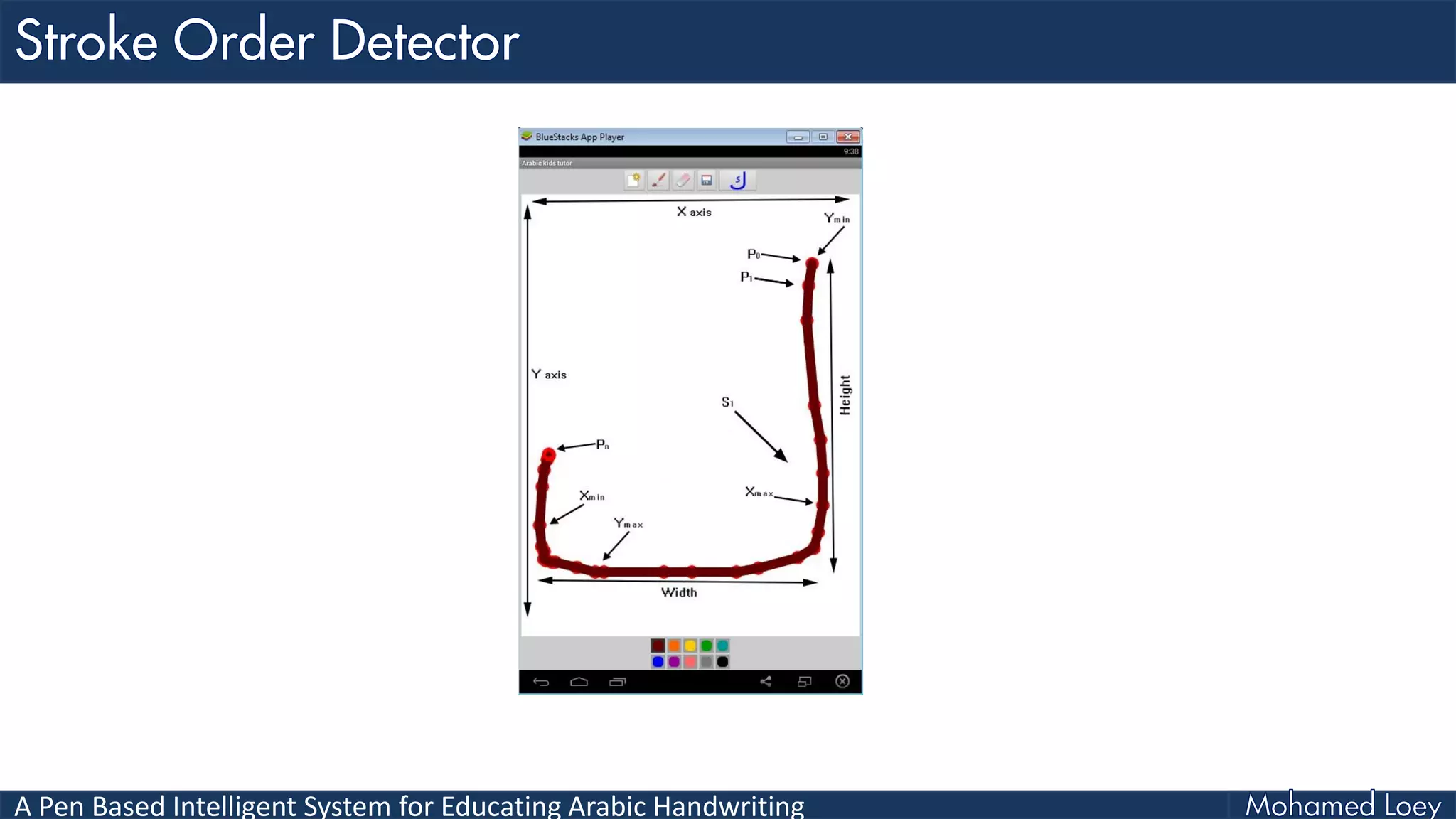
When the preschool children put his/her finger on touch
screen, the system detected the sequence of x−y point
coordinate.
When The children move his/her finger up, the system
store those sequence of points as stroke.
A Pen Based Intelligent System for Educating Arabic Handwriting
In this part, Intelligent Arab Teaching system indicates
the children level of understanding of learning
handwriting character concepts.
Intelligent Arab Teaching system use fuzzy logic to
evaluate Arabic children.
A Pen Based Intelligent System for Educating Arabic Handwriting
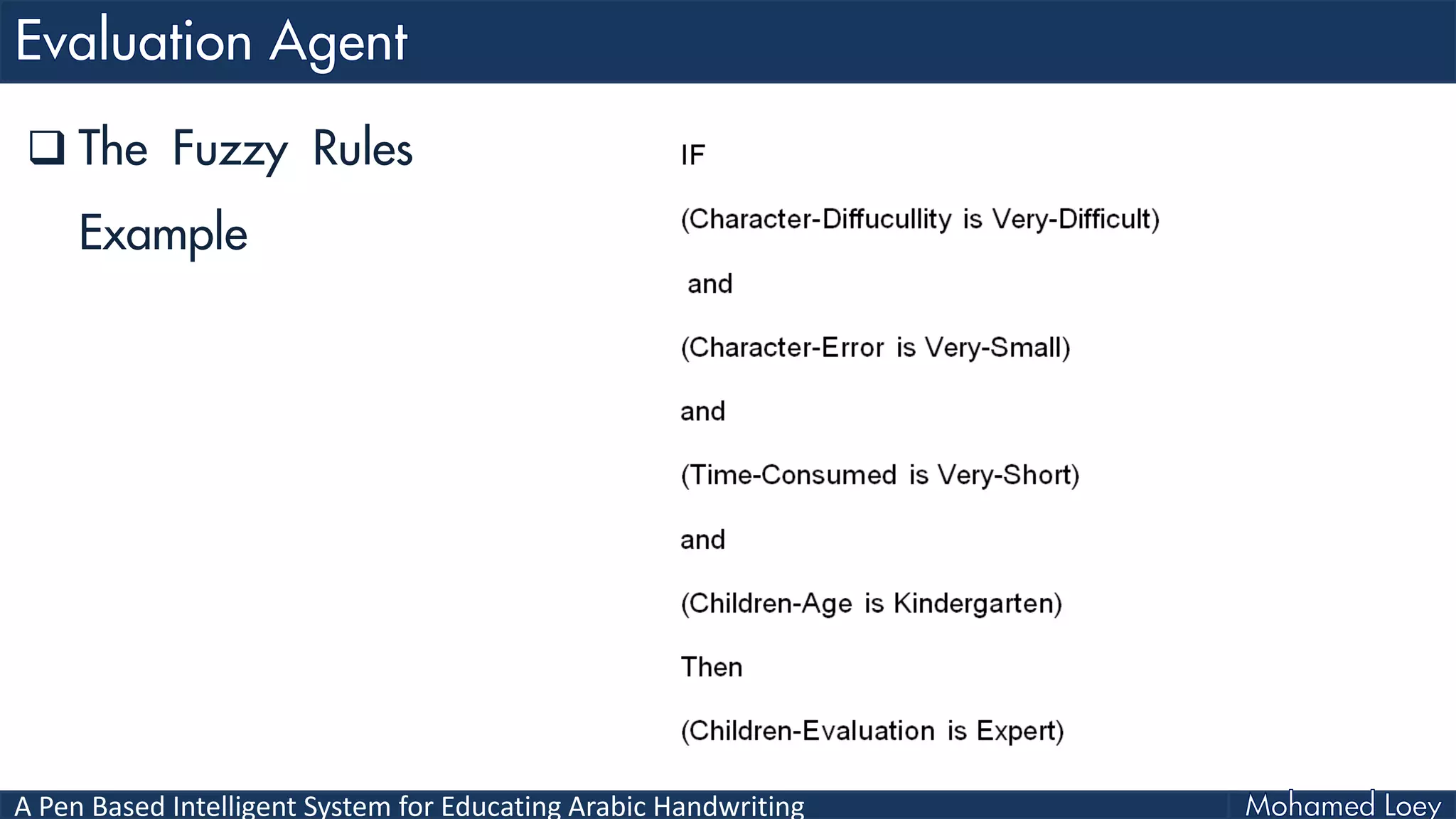
 The Fuzzy Rules
Example
A Pen Based Intelligent System for Educating Arabic Handwriting
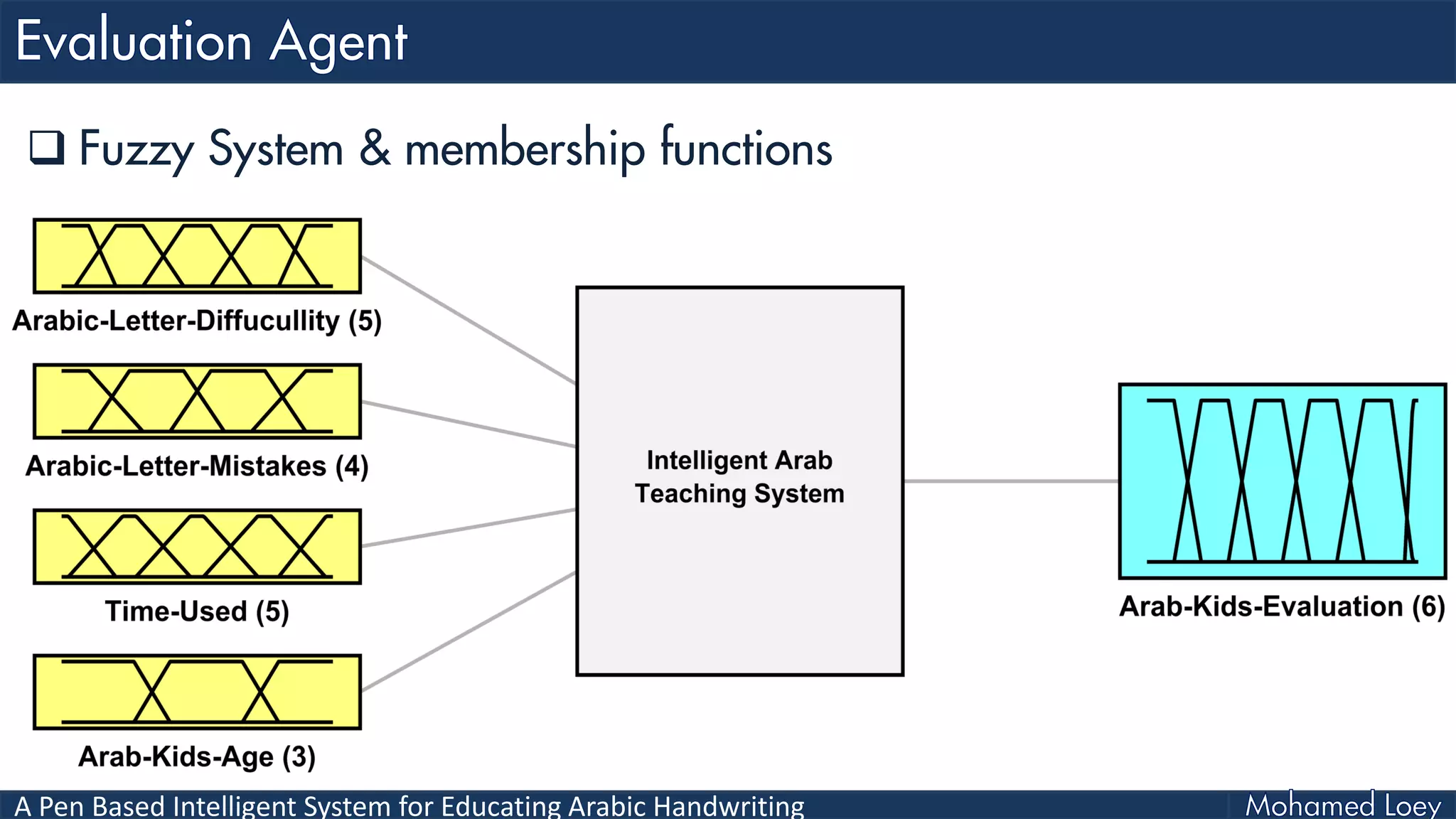
 Fuzzy System & membership functions
A Pen Based Intelligent System for Educating Arabic Handwriting
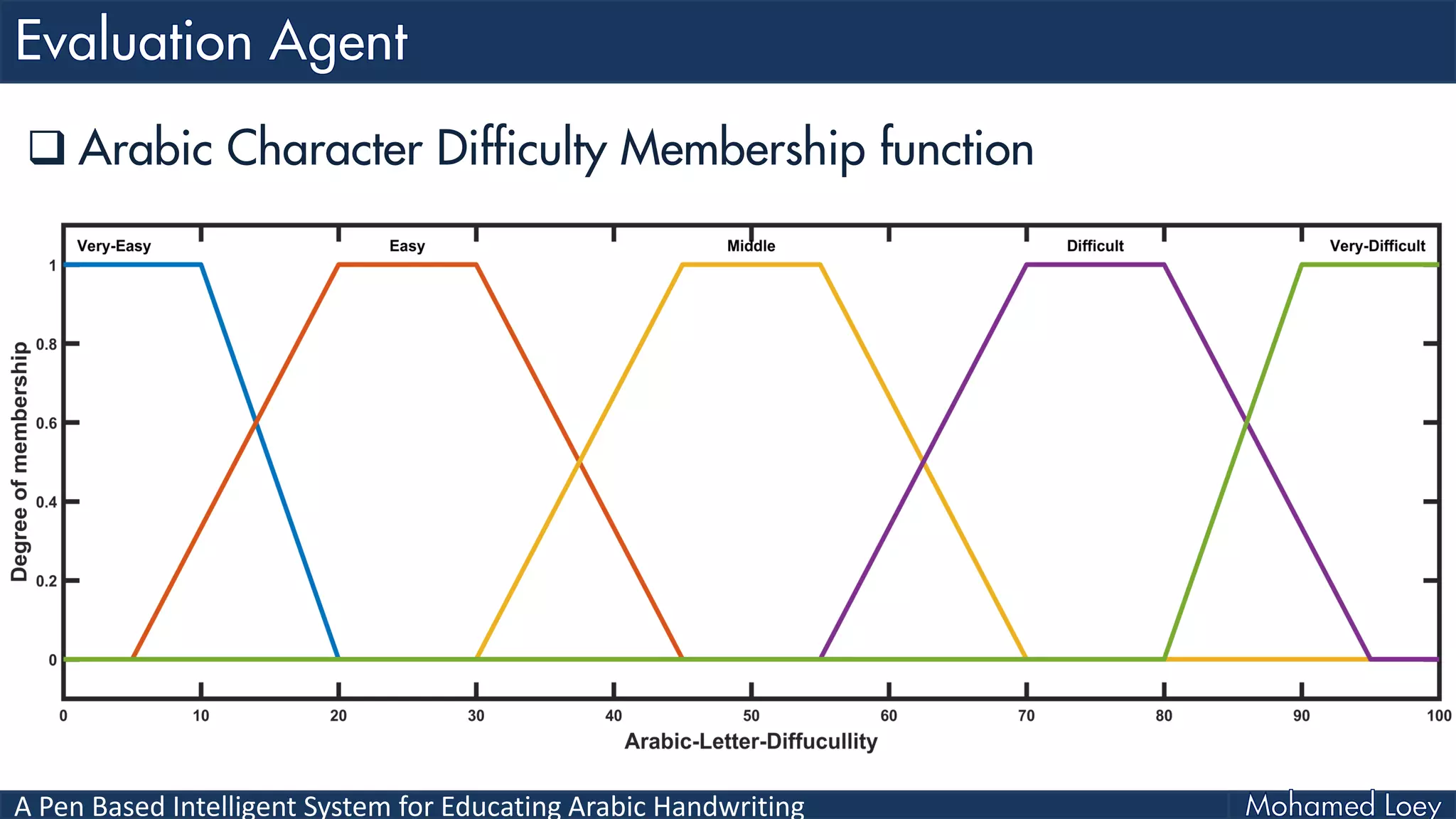
 Arabic Character Difficulty Membership function
A Pen Based Intelligent System for Educating Arabic Handwriting
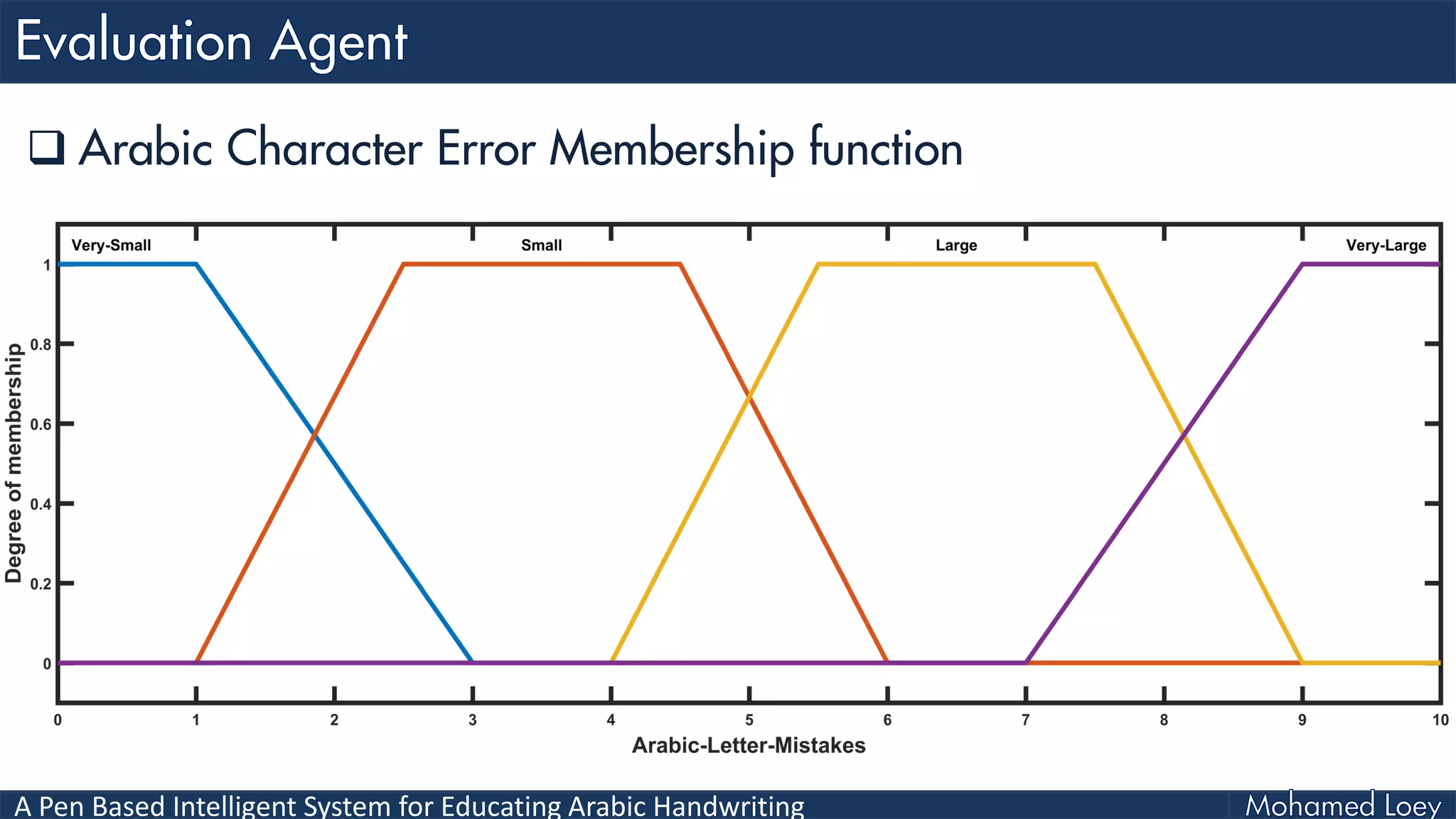
 Arabic Character Error Membership function
A Pen Based Intelligent System for Educating Arabic Handwriting
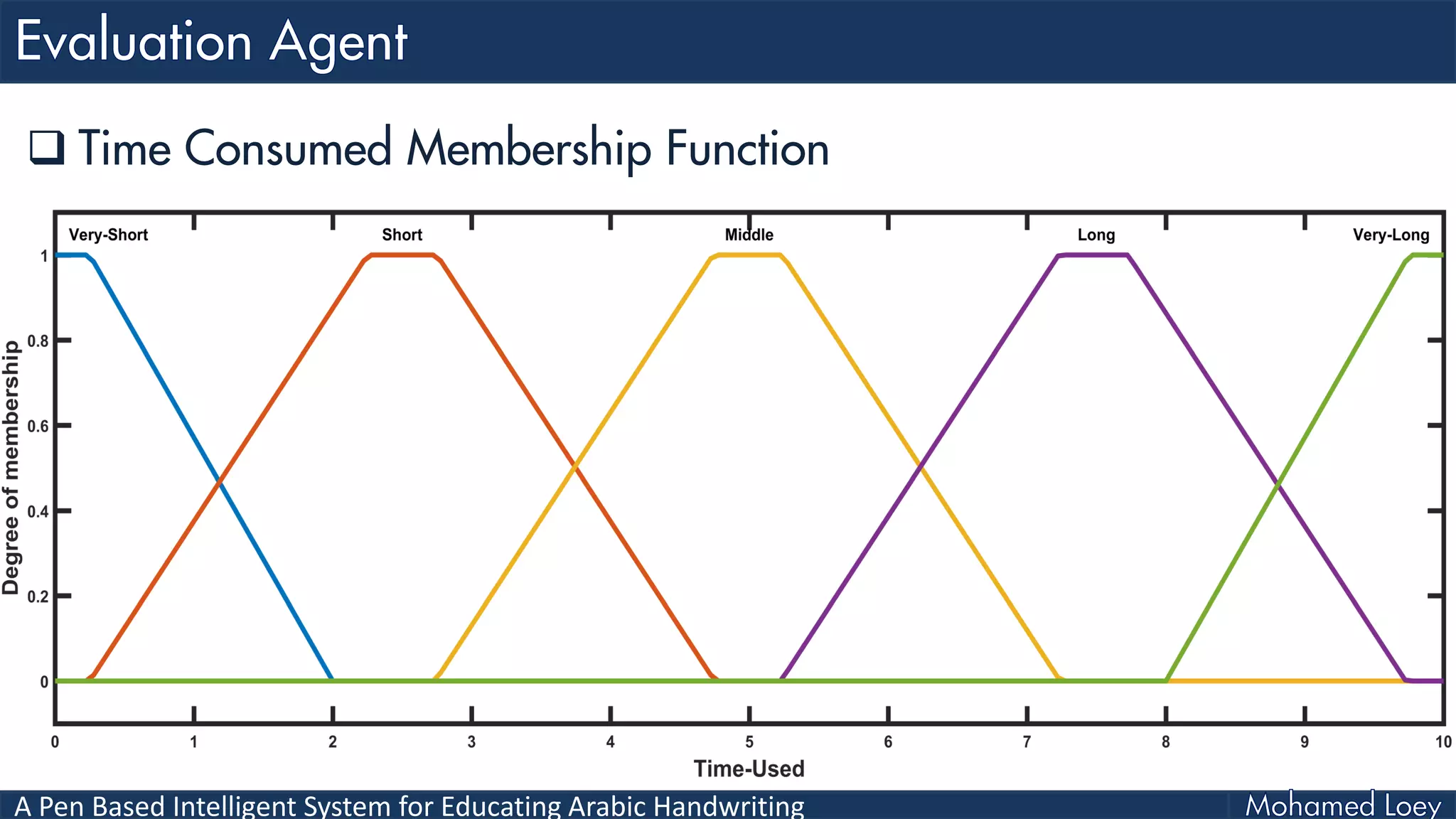
 Time Consumed Membership Function
A Pen Based Intelligent System for Educating Arabic Handwriting
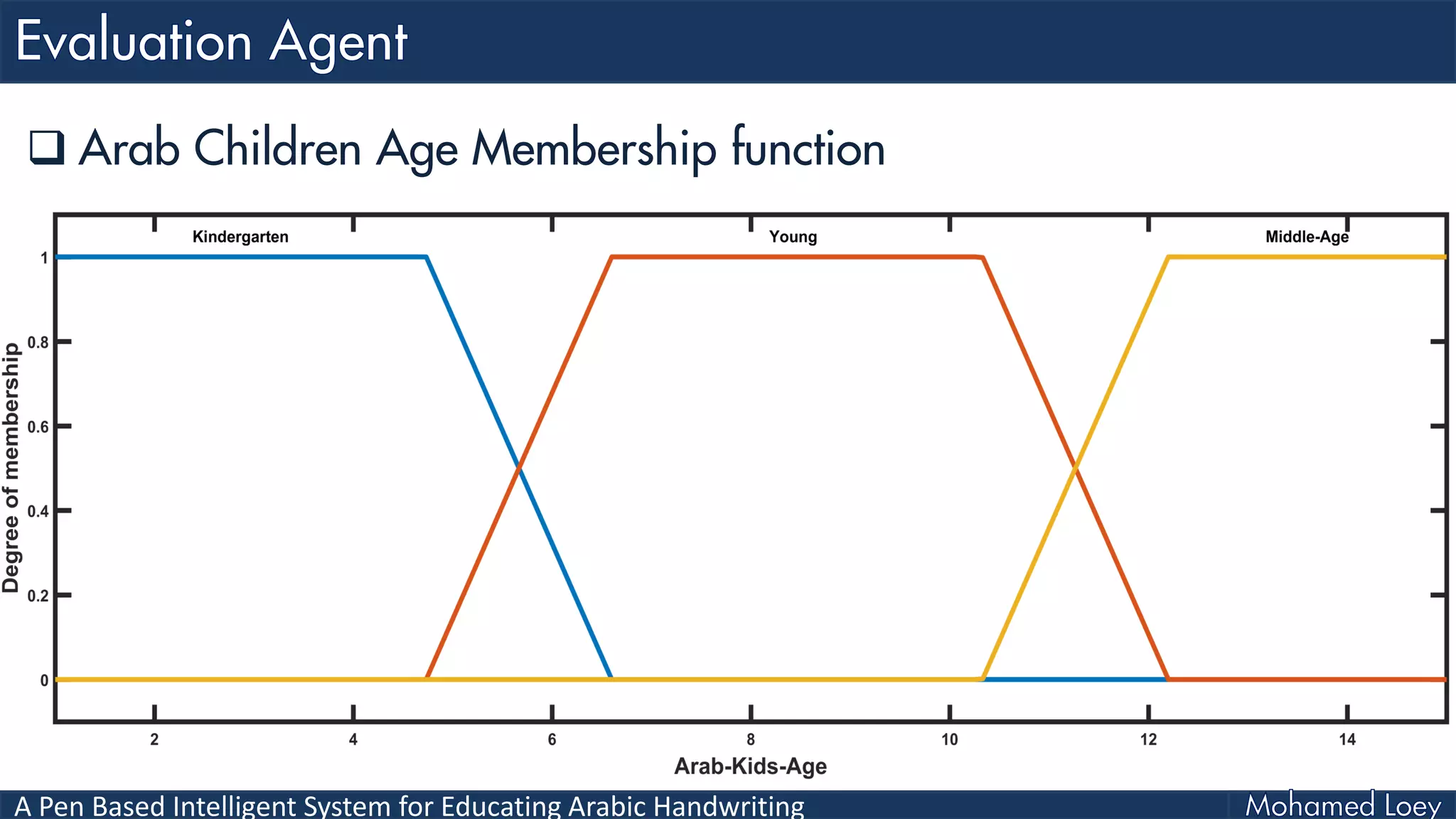
 Arab Children Age Membership function
A Pen Based Intelligent System for Educating Arabic Handwriting
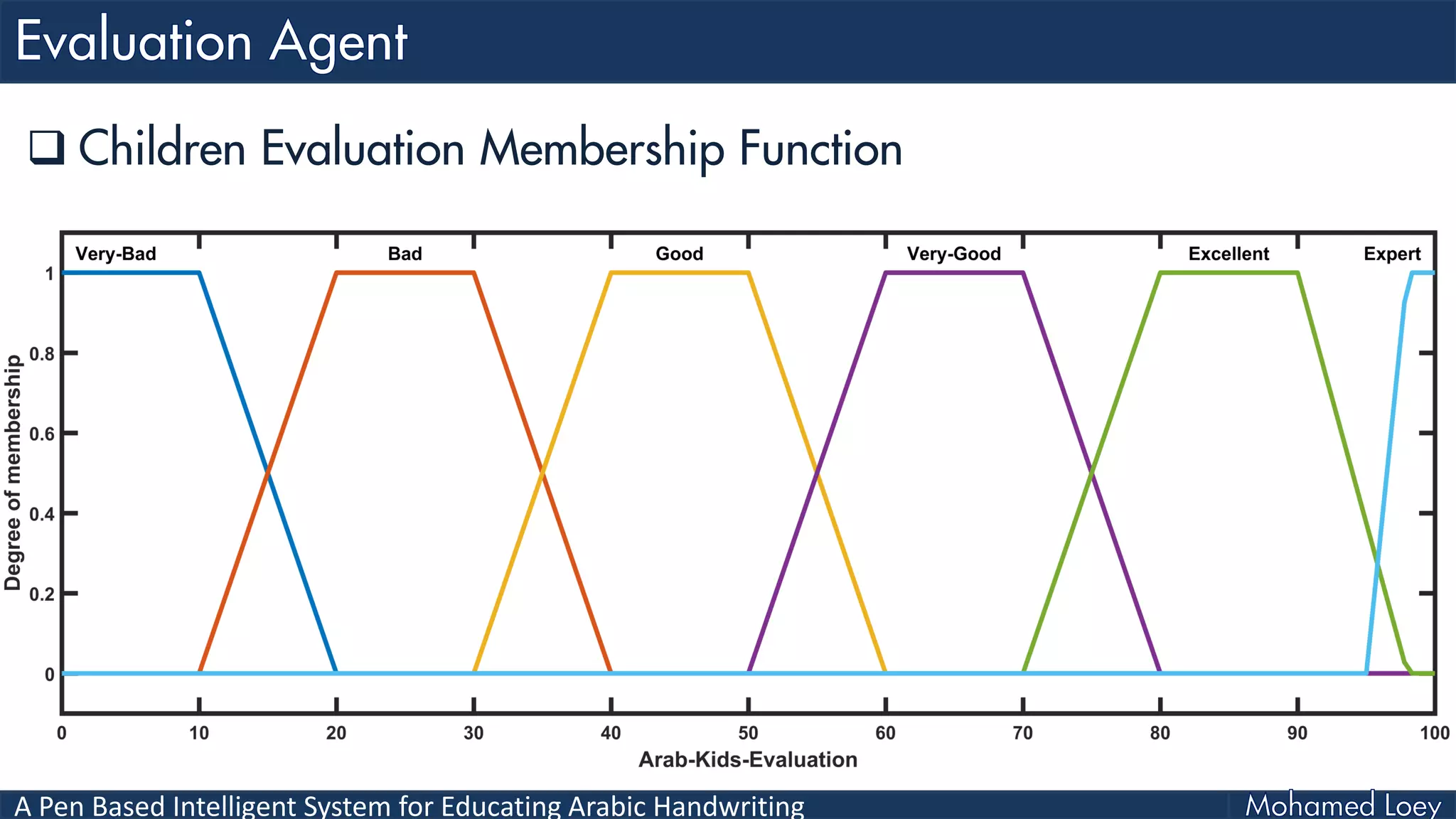
 Children Evaluation Membership Function
A Pen Based Intelligent System for Educating Arabic Handwriting
Interfaces
Architecture
Components
Database
Agents
Results
A Pen Based Intelligent System for Educating Arabic Handwriting
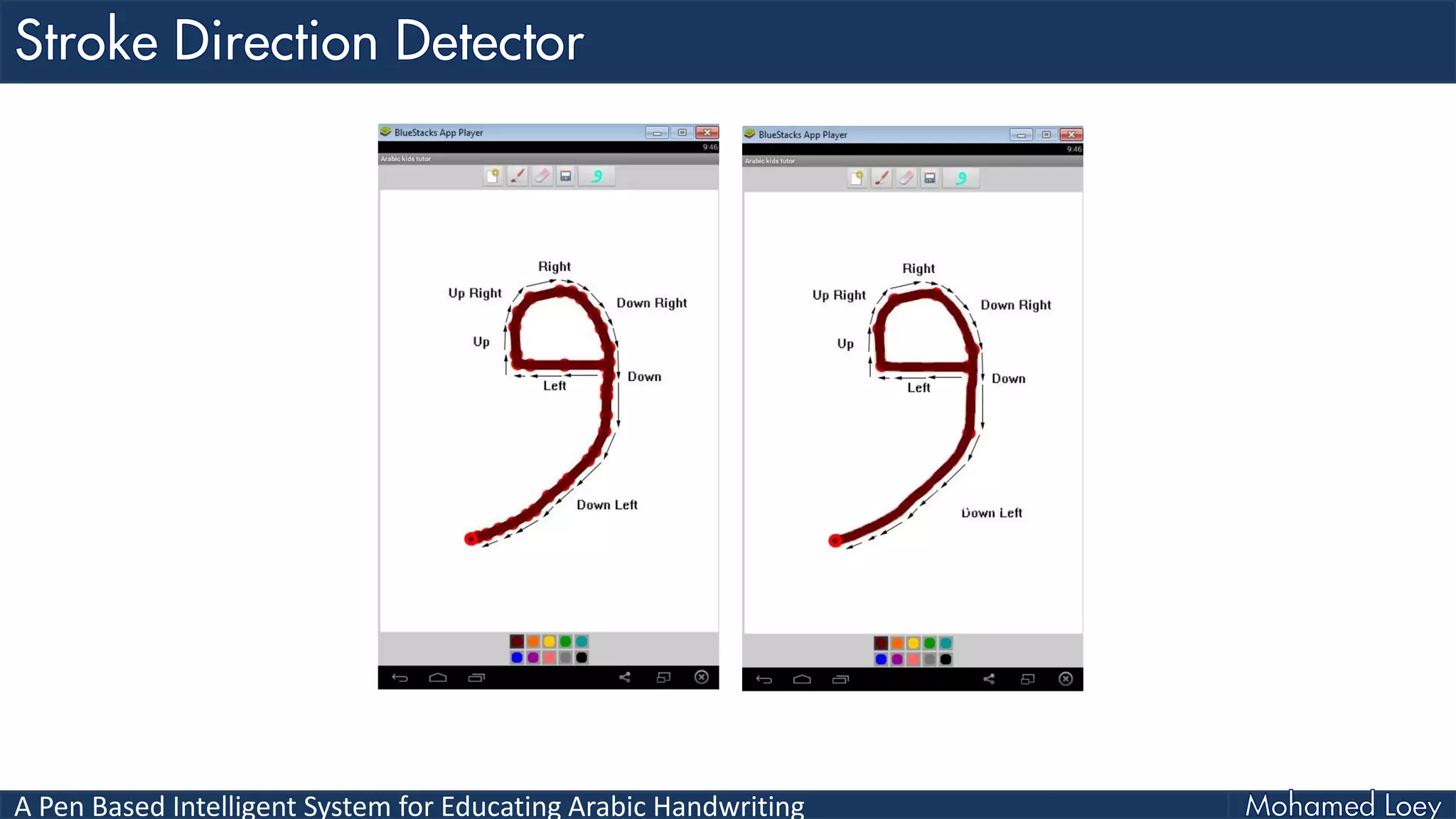
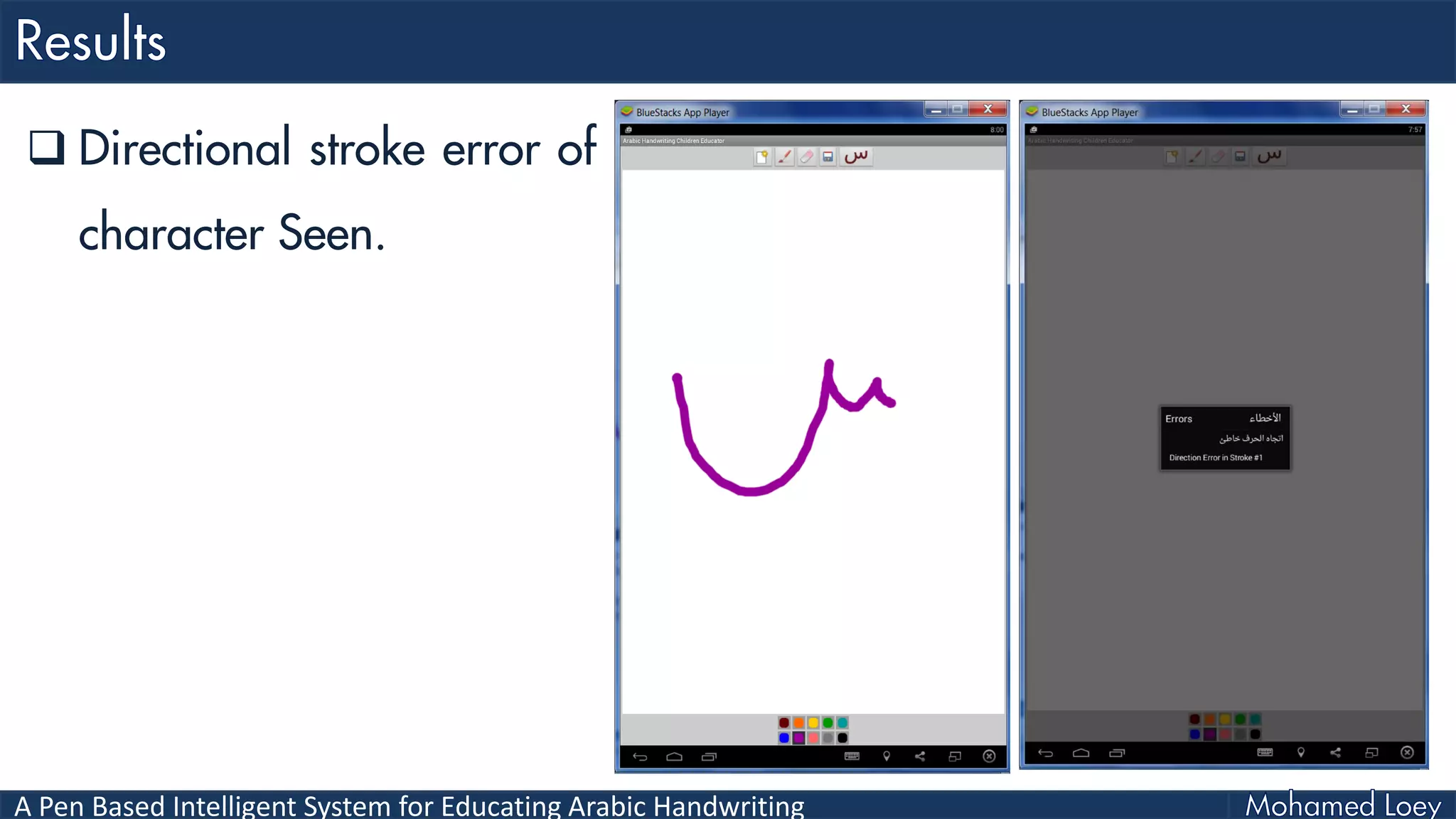
 Directional stroke error of
character Seen.
A Pen Based Intelligent System for Educating Arabic Handwriting
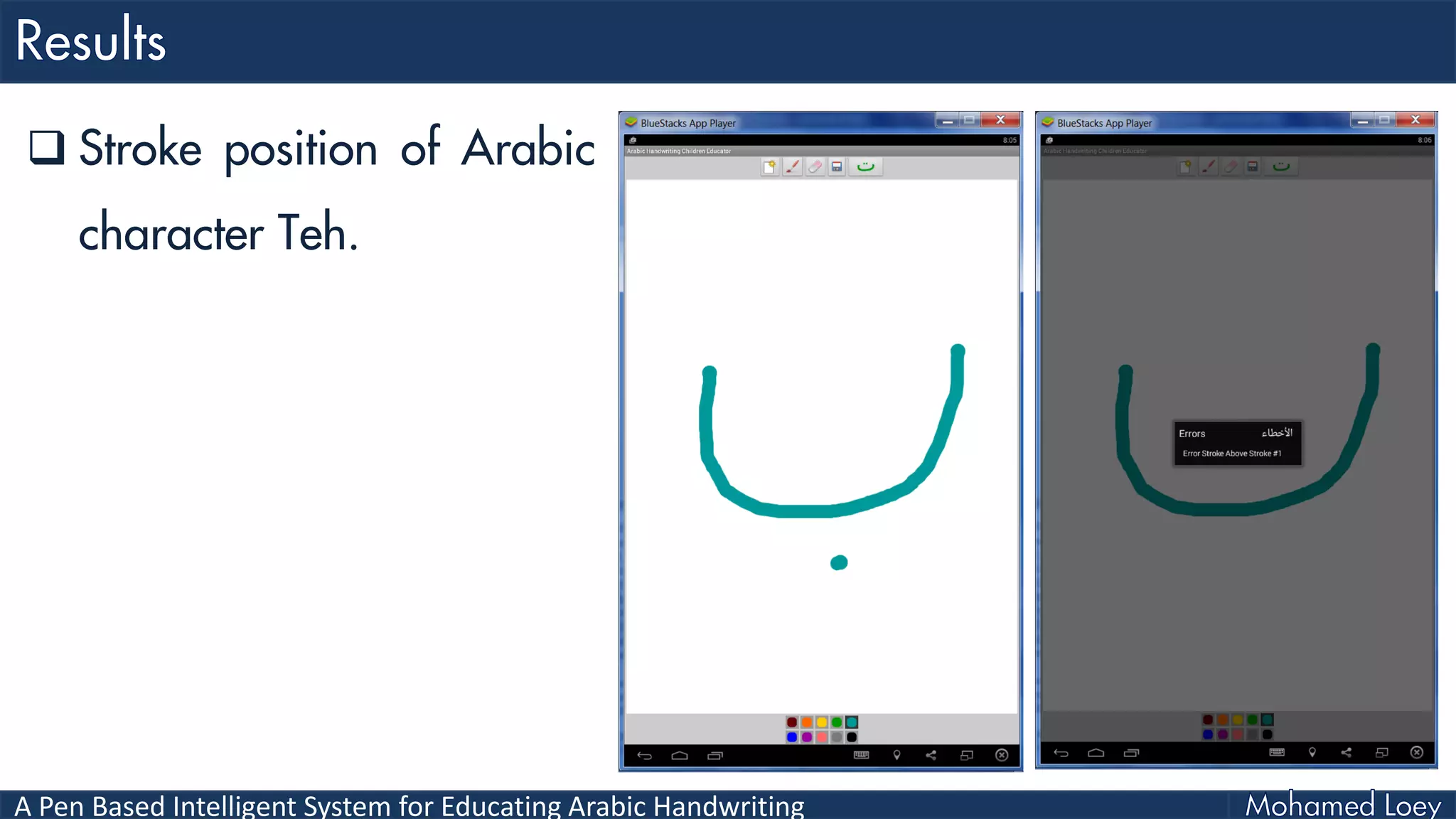
 Stroke position of Arabic
character Teh.
A Pen Based Intelligent System for Educating Arabic Handwriting
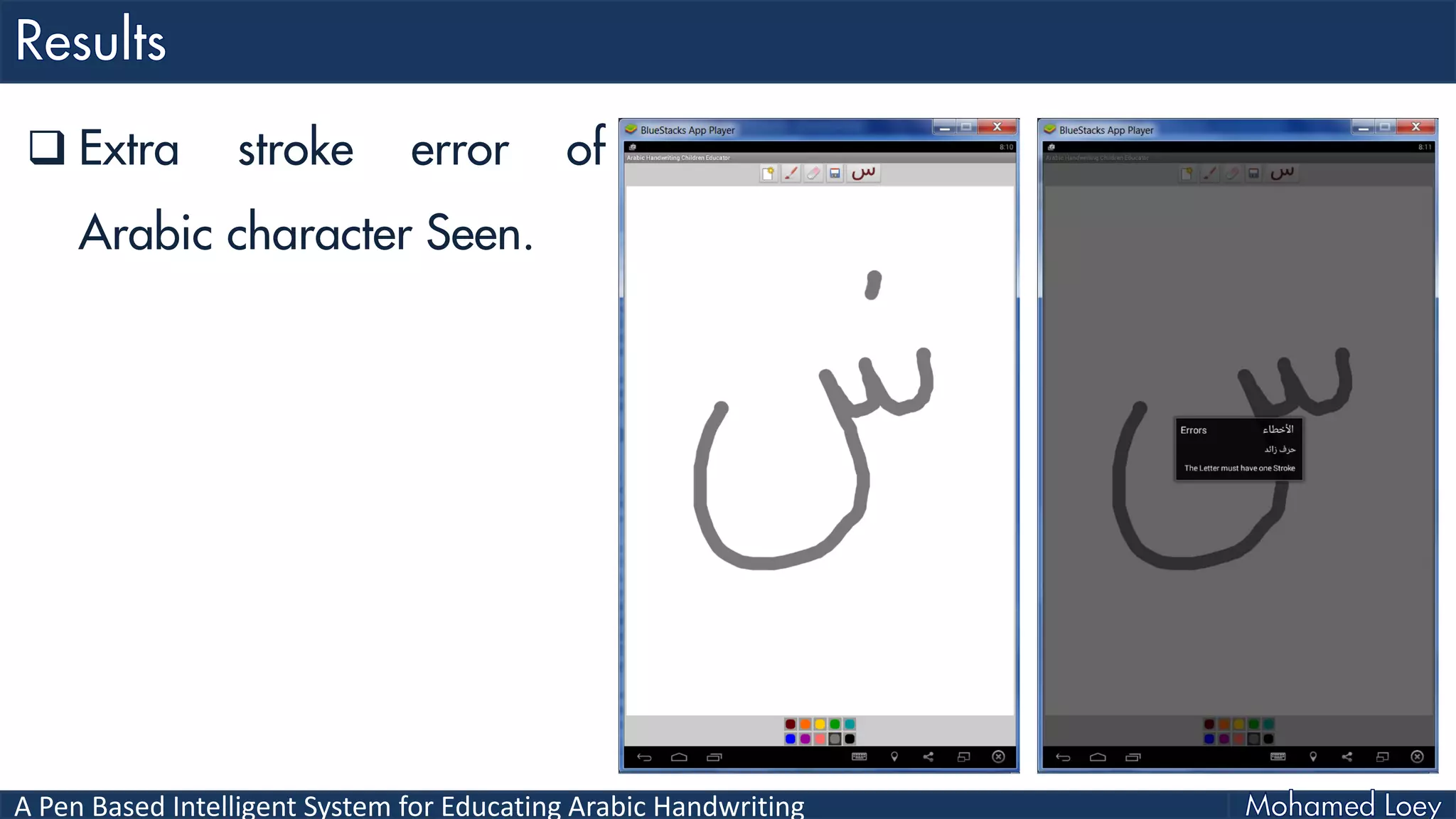
 Extra stroke error of
Arabic character Seen.
A Pen Based Intelligent System for Educating Arabic Handwriting
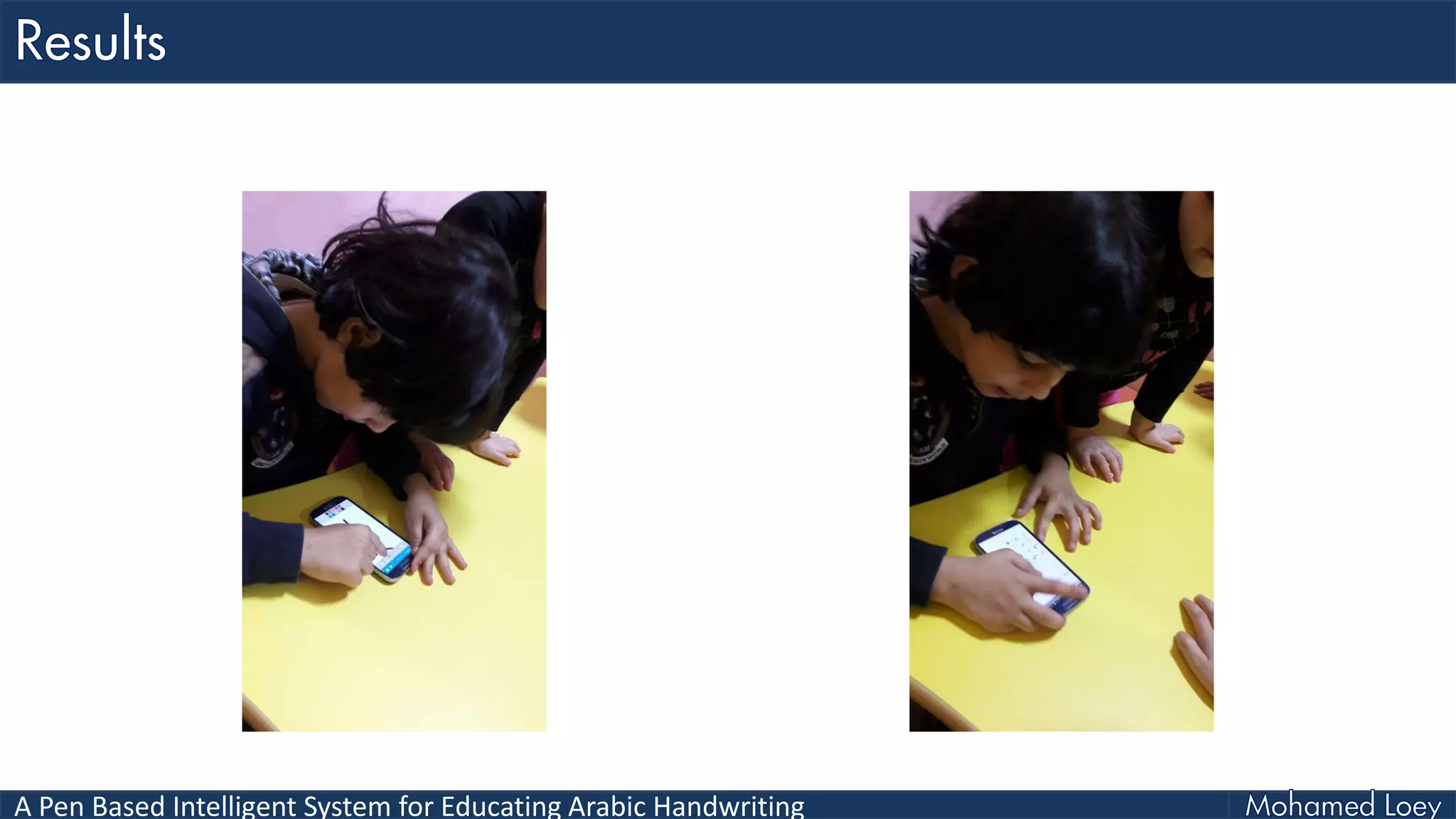
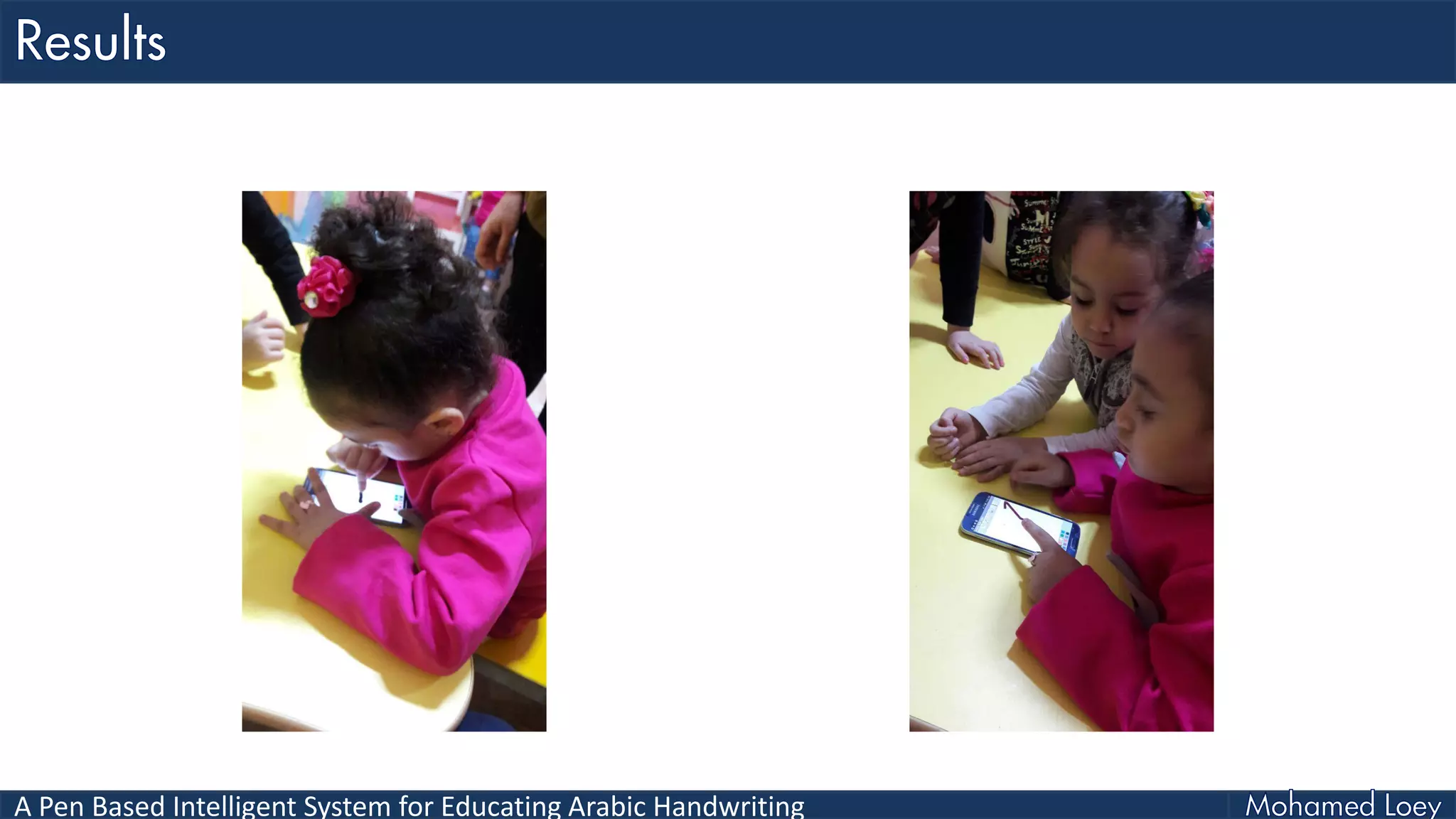
 The Egyptian preschool children and their tutors from Benha city
were asked to use the Intelligent Arab Teaching system as part of
their learning of write Arabic alphabet.
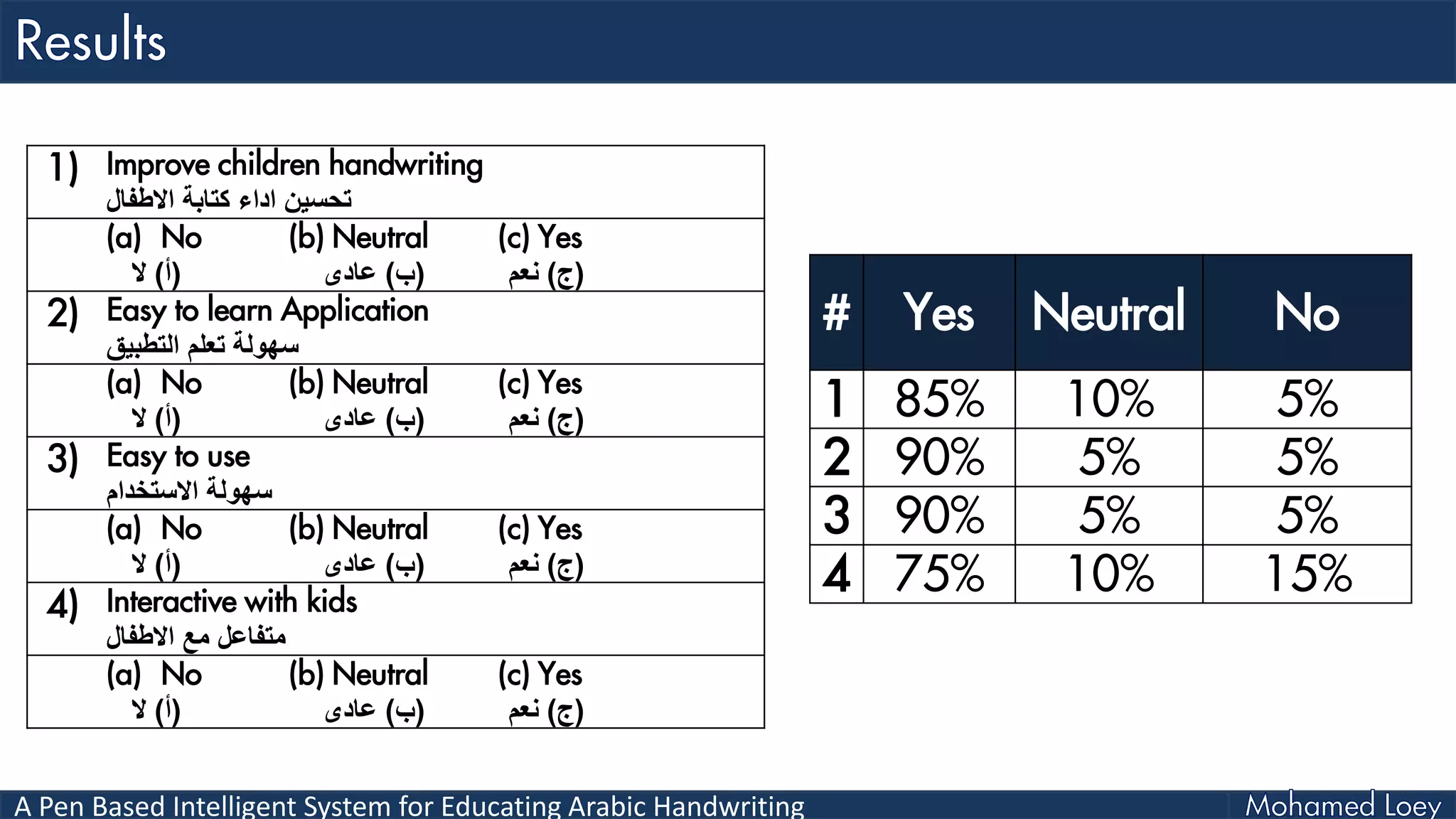
 200 questionnaires were collected from the educators & some
children in the experimental groups after the computerized training
program.
 The results specify that educators rated the Intelligent Arab Teaching
very highly on acceptability for both likeability and ease of use.
A Pen Based Intelligent System for Educating Arabic Handwriting
1) Improve children handwriting
‫تحسين‬‫اداء‬‫كتابة‬‫االطفال‬
(a) No (b) Neutral (c) Yes
(‫ج‬)‫نعم‬(‫ب‬)‫عادى‬(‫أ‬)‫ال‬
2) Easy to learn Application
‫سهولة‬‫تعلم‬‫التطبيق‬
(a) No (b) Neutral (c) Yes
(‫ج‬)‫نعم‬(‫ب‬)‫عادى‬(‫أ‬)‫ال‬
3) Easy to use
‫سهولة‬‫االستخدام‬
(a) No (b) Neutral (c) Yes
(‫ج‬)‫نعم‬(‫ب‬)‫عادى‬(‫أ‬)‫ال‬
4) Interactive with kids
‫متفاعل‬‫مع‬‫االطفال‬
(a) No (b) Neutral (c) Yes
(‫ج‬)‫نعم‬(‫ب‬)‫عادى‬(‫أ‬)‫ال‬
# Yes Neutral No
1 85% 10% 5%
2 90% 5% 5%
3 90% 5% 5%
4 75% 10% 15%
A Pen Based Intelligent System for Educating Arabic Handwriting
Introduction
Previous Related Work
Background and Preliminaries
Arabic Handwritten Digits Recognition System
Arabic Handwritten Characters Recognition System
Intelligent Arab Teaching System
Conclusion and Future Work
A Pen Based Intelligent System for Educating Arabic Handwriting
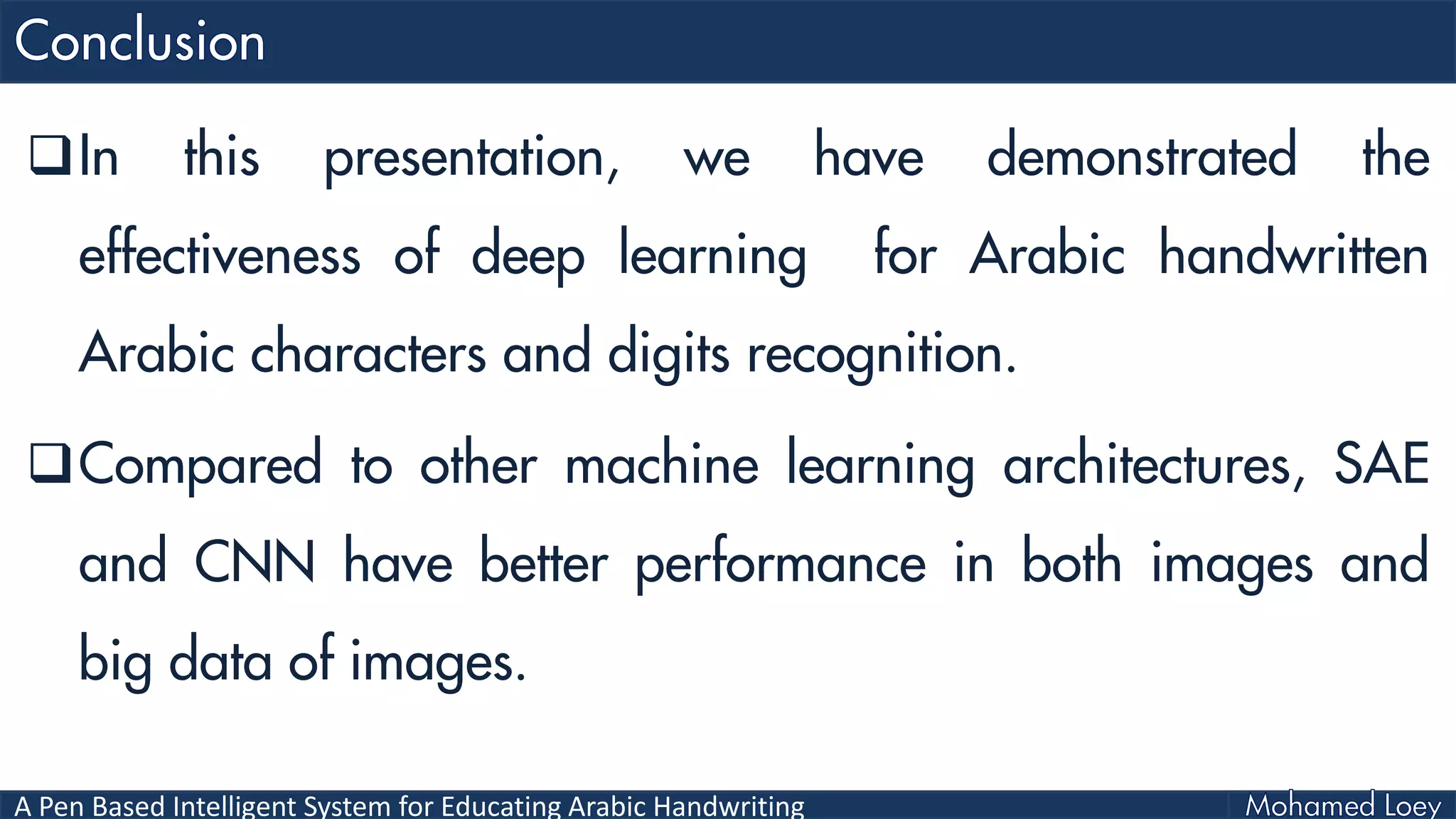
In this presentation, we have demonstrated the
effectiveness of deep learning for Arabic handwritten
Arabic characters and digits recognition.
Compared to other machine learning architectures, SAE
and CNN have better performance in both images and
big data of images.
A Pen Based Intelligent System for Educating Arabic Handwriting
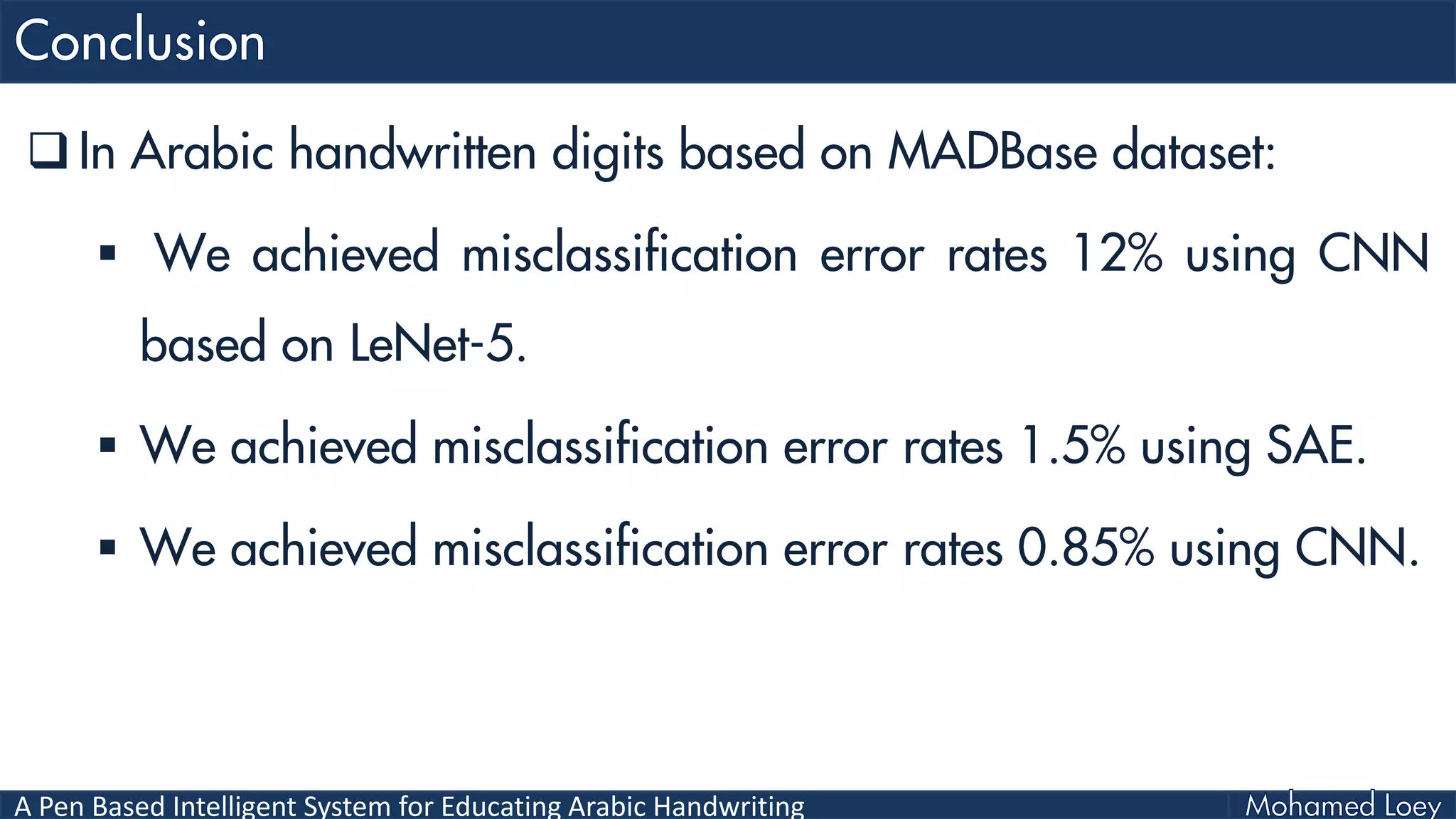
 In Arabic handwritten digits based on MADBase dataset:
 We achieved misclassification error rates 12% using CNN
based on LeNet-5.
 We achieved misclassification error rates 1.5% using SAE.
 We achieved misclassification error rates 0.85% using CNN.
A Pen Based Intelligent System for Educating Arabic Handwriting
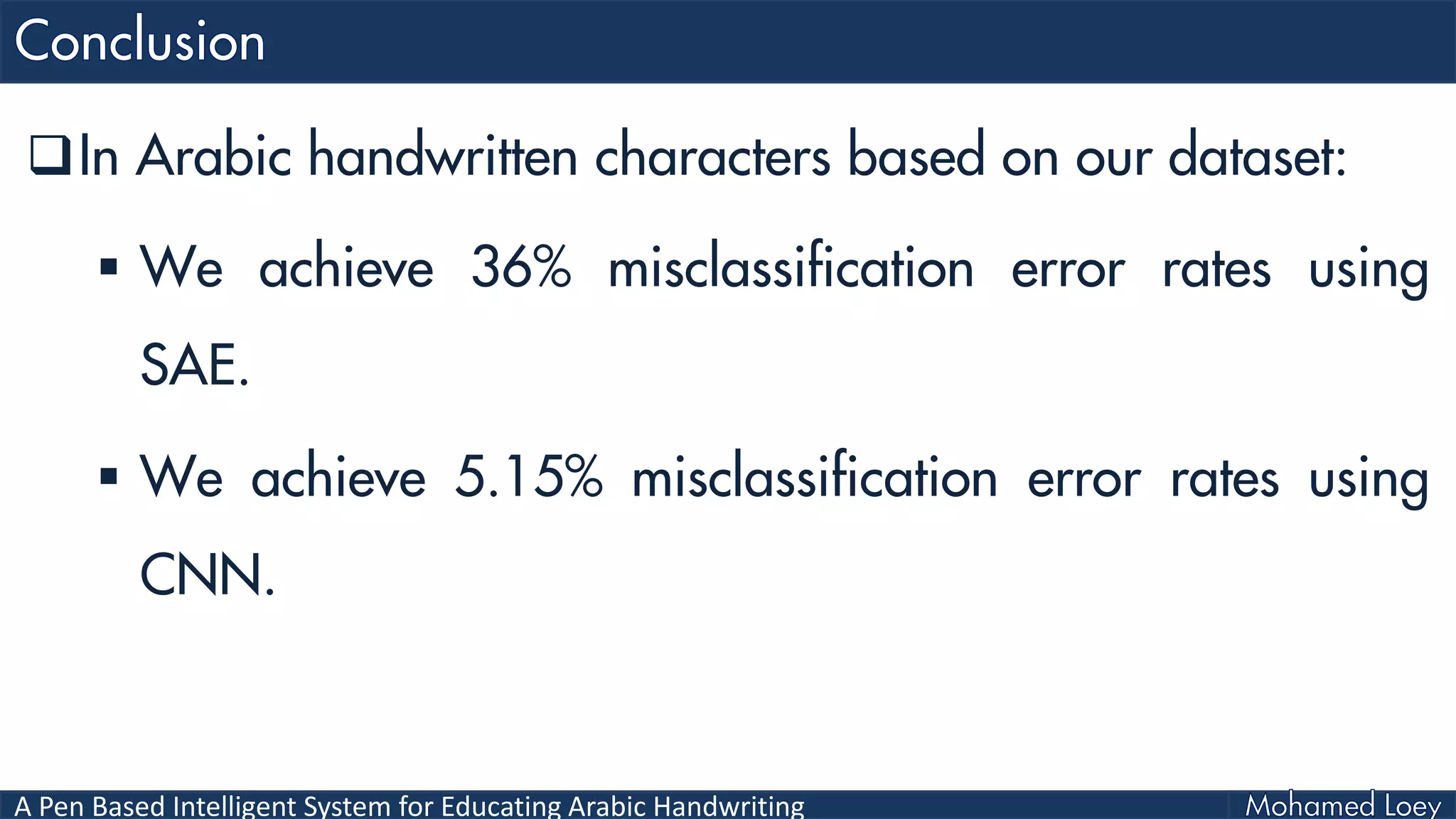
In Arabic handwritten characters based on our dataset:
 We achieve 36% misclassification error rates using
SAE.
 We achieve 5.15% misclassification error rates using
CNN.
A Pen Based Intelligent System for Educating Arabic Handwriting
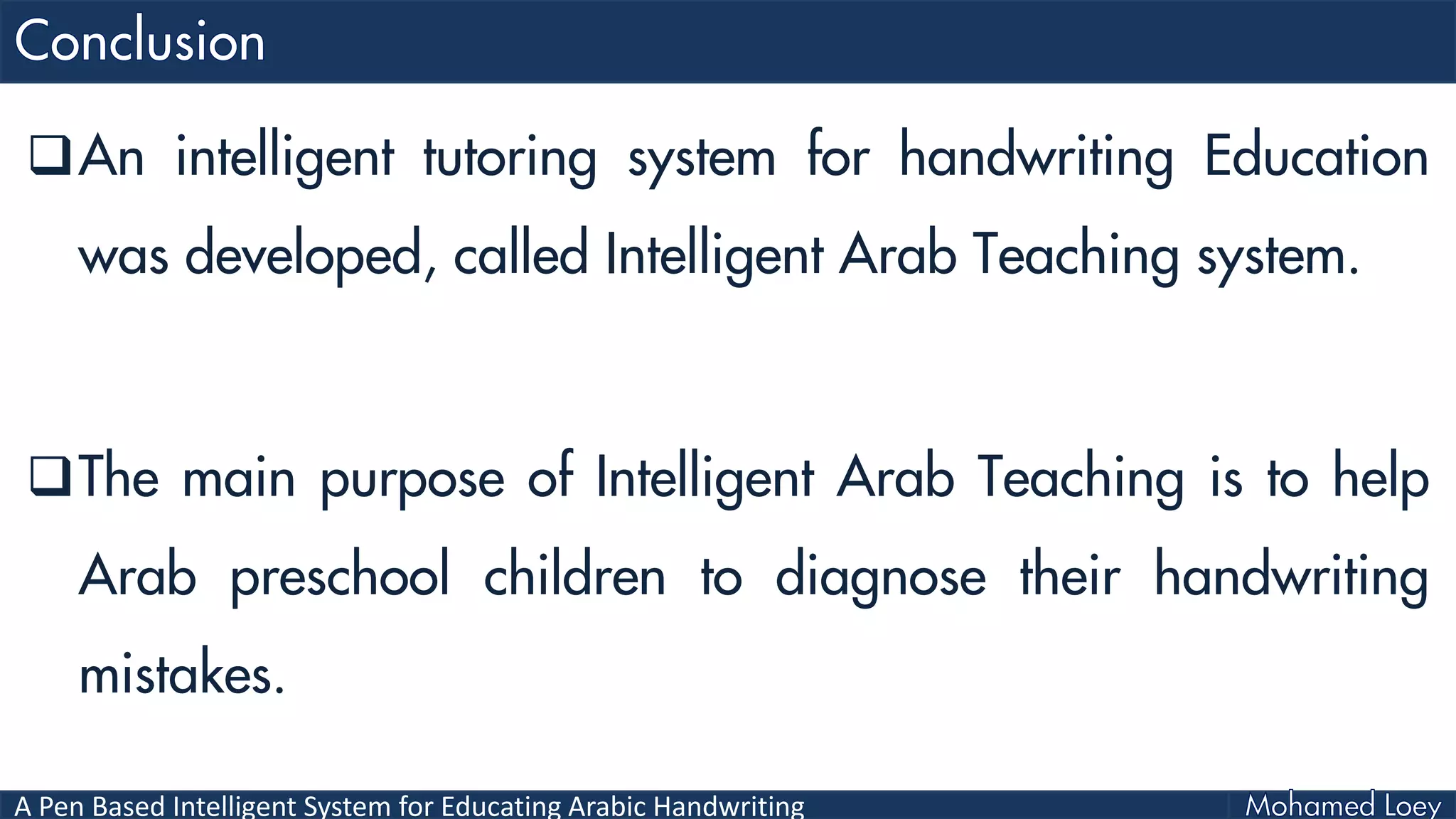
An intelligent tutoring system for handwriting Education
was developed, called Intelligent Arab Teaching system.
The main purpose of Intelligent Arab Teaching is to help
Arab preschool children to diagnose their handwriting
mistakes.
A Pen Based Intelligent System for Educating Arabic Handwriting
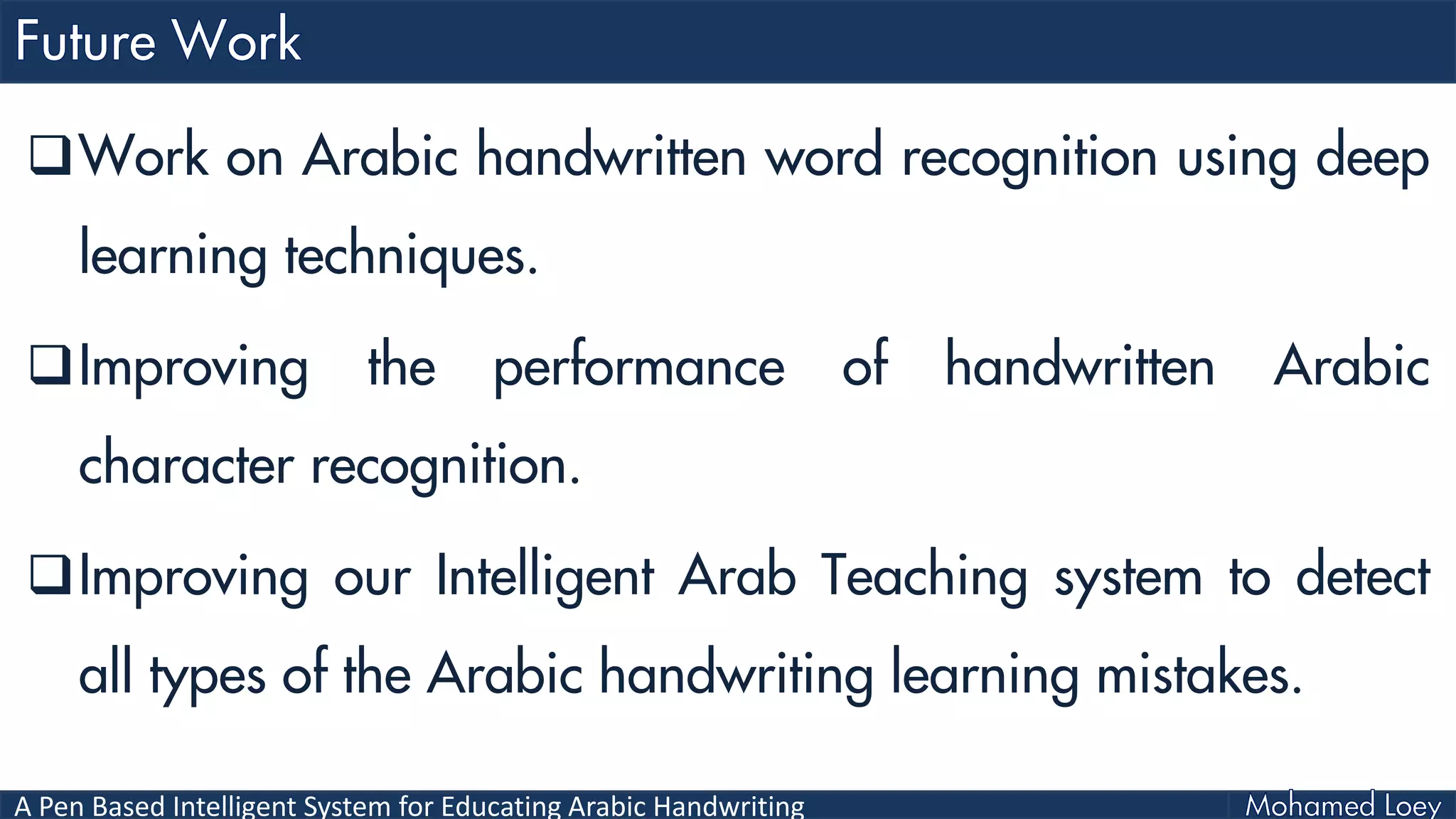
Work on Arabic handwritten word recognition using deep
learning techniques.
Improving the performance of handwritten Arabic
character recognition.
Improving our Intelligent Arab Teaching system to detect
all types of the Arabic handwriting learning mistakes.
A Pen Based Intelligent System for Educating Arabic Handwriting
facebook.com/mloey
mohamedloey@gmail.com
twitter.com/mloey
linkedin.com/in/mloey
mloey@fci.bu.edu.eg
A Pen Based Intelligent System for Educating Arabic Handwriting
www.YourCompany.com
© 2020 Companyname PowerPoint Business Theme. All Rights Reserved.
THANKS FOR
YOUR TIME

A Pen Based Intelligent System for Educating Arabic Handwriting Deep Learning

  • 1.
    A Pen BasedIntelligent System for Educating Arabic Handwriting A Pen Based Intelligent System for Educating Arabic Handwriting
  • 2.
    A Pen BasedIntelligent System for Educating Arabic Handwriting Introduction Previous Related Work Background and Preliminaries Arabic Handwritten Digits Recognition System Arabic Handwritten Characters Recognition System Intelligent Arab Teaching System Conclusion and Future Work
  • 3.
    A Pen BasedIntelligent System for Educating Arabic Handwriting Introduction Previous Related Work Background and Preliminaries Arabic Handwritten Digits Recognition System Arabic Handwritten Characters Recognition System Intelligent Arab Teaching System Conclusion and Future Work
  • 4.
    A Pen BasedIntelligent System for Educating Arabic Handwriting Problem Definition Objectives Hypothesis Research Questions
  • 5.
    A Pen BasedIntelligent System for Educating Arabic Handwriting Problem Definition Objectives Hypothesis Research Questions
  • 6.
    A Pen BasedIntelligent System for Educating Arabic Handwriting  Traditional Learning
  • 7.
    A Pen BasedIntelligent System for Educating Arabic Handwriting  Complexity of Arabic characters.  Expertise needs in traditional recognition systems.  Traditional hand-crafted features.  Arabic handwritten characters mistakes.
  • 8.
    A Pen BasedIntelligent System for Educating Arabic Handwriting Description Template character Sample character Missing stroke error Extra stroke error Broken stroke error
  • 9.
    A Pen BasedIntelligent System for Educating Arabic Handwriting Description Template character Sample character Concatenated stroke error Stroke order error Direction Error
  • 10.
    A Pen BasedIntelligent System for Educating Arabic Handwriting Problem Definition Objectives Hypothesis Research Questions
  • 11.
    A Pen BasedIntelligent System for Educating Arabic Handwriting  The main goal of this work is to build and develop an intelligent tutor system for detecting Arabic preschool children handwriting difficulty based on immediate feedback.  The second goal of this work is to use deep learning architectures to recognize Arabic handwritten characters and digits.
  • 12.
    A Pen BasedIntelligent System for Educating Arabic Handwriting Problem Definition Objectives Hypothesis Research Questions
  • 13.
    A Pen BasedIntelligent System for Educating Arabic Handwriting  Our hypothesis is that applying Convolutional neural networks and stacked auto-encoder to classify Arabic handwritten characters and digits.  We expect that a simple Convolutional neural network and stacked Autoencoder will success to obtain competitive results.  We believe that implementing deep learning for this domain will be moderately easy.
  • 14.
    A Pen BasedIntelligent System for Educating Arabic Handwriting Problem Definition Objectives Hypothesis Research Questions
  • 15.
    A Pen BasedIntelligent System for Educating Arabic Handwriting  Is training a deep learning architectures on handwritten characters and digits better than computing numeric features from handwritten characters and digits and training a simpler classifier ?  Is deep learning feasible with the resources we have ? Is there any advantage to use GPU acceleration ?  Can we simplify the pipeline for Arabic handwritten characters and digits recognition ?
  • 16.
    A Pen BasedIntelligent System for Educating Arabic Handwriting  Can preprocessing and features extraction be replaced by more layers on deep learning ?  What are the best parameters for our deep learning architectures ?  What are the advantages of using a automatic feedback to determine handwriting stroke mistakes for Arab children ?  Are deep learning architectures are a good option for future research ?
  • 17.
    A Pen BasedIntelligent System for Educating Arabic Handwriting Introduction Previous Related Work Background and Preliminaries Arabic Handwritten Digits Recognition System Arabic Handwritten Characters Recognition System Intelligent Arab Teaching System Conclusion and Future Work
  • 18.
    A Pen BasedIntelligent System for Educating Arabic Handwriting Arabic Handwritten Digits Recognition Arabic Handwritten Characters Recognition Intelligent Tutoring Systems
  • 19.
    A Pen BasedIntelligent System for Educating Arabic Handwriting Arabic Handwritten Digits Recognition Arabic Handwritten Characters Recognition Intelligent Tutoring Systems
  • 20.
    A Pen BasedIntelligent System for Educating Arabic Handwriting Authors Year Method Dataset Error Rate Alwzwazy et al. 2016 CNN 46,612 4.3% Kathirvalavakumar and Palaniappan 2015 K-NN 6670 1.3% Takruri et al. 2014 SVM 3510 12% AlKhateeb et al. 2014 DBN 70,000 14.74% Majdi Salameh 2014 Fuzzy 2000 5%  CNN: Convolutional Neural Network  SVM: Support Vector Machine  DBN: Dynamic Bayesian Network
  • 21.
    A Pen BasedIntelligent System for Educating Arabic Handwriting Authors Year Method Dataset Error Rate Pandi selvi and Meyyappan 2013 NN Samples 4% Mahmoud 2008 SVM 21120 0.15% and 2.16% Melhaoui et al. 2011 CL 600 1%  NN: Neural Network  SVM: Support Vector Machine  CL: Characteristics Loci
  • 22.
    A Pen BasedIntelligent System for Educating Arabic Handwriting Arabic Handwritten Digits Recognition Arabic Handwritten Characters Recognition Intelligent Tutoring Systems
  • 23.
    A Pen BasedIntelligent System for Educating Arabic Handwriting Authors Year Method Dataset Error Rate Hussien et al. 2015 HNN 8 22.75% ElAdel et al. 2015 CNN 6000 6.08% Elleuch et al. 2015 DBN 6600 2.10% Shatnawi and Abdallah 2015 K-NN 1824 26.6%  CNN: Convolutional Neural Network  HNN: Hopfild Neural Network  DBN: Dynamic Bayesian Network
  • 24.
    A Pen BasedIntelligent System for Educating Arabic Handwriting Authors Year Method Dataset Error Rate Kef et al. 2015 Fuzzy NN 3840 6.20% Alabodi and Li 2014 GF 3840 6.70% Lawgali et al. 2014 DCT NN 6033 9.27%  NN: Neural Network  DCT: Discrete Cosine Transform  GF: geometrical features
  • 25.
    A Pen BasedIntelligent System for Educating Arabic Handwriting Arabic Handwritten Digits Recognition Arabic Handwritten Characters Recognition Intelligent Tutoring Systems
  • 26.
    A Pen BasedIntelligent System for Educating Arabic Handwriting Authors Year Language Method Will Tang et al. 2014 Chinese special relation matrix H. Bezine & A. Alimi 2013 Arabic Attributed Relational Graph Fork and Chan 2013 Latin Algorithms Priyankara et al. 2013 Latin logical and spatial relationships Hammadi et al. 2012 Arabic Graph matching A* algorithm Chea et al. 2012 Latin Chain code and direction code
  • 27.
    A Pen BasedIntelligent System for Educating Arabic Handwriting Authors Year Language Method Neo et. al. 2012 Latin Chain code and direction code Chen et al. 2007 Chinese Feature extraction spatial relationships Hu et al. 2007 Chinese graph matching technique A* algorithm Kai-Tai Tang et al. 2006 Chinese Hungarian method Euclidean distance Tang and Leung 2006 Chinese Feature extraction techniques
  • 28.
    A Pen BasedIntelligent System for Educating Arabic Handwriting Introduction Previous Related Work Background and Preliminaries Arabic Handwritten Digits Recognition System Arabic Handwritten Characters Recognition System Intelligent Arab Teaching System Conclusion and Future Work
  • 29.
    A Pen BasedIntelligent System for Educating Arabic Handwriting Pattern Recognition Neural Network Activation Functions Deep Learning Stacked Autoencoder Convolutional Neural Network Intelligent Tutoring Systems
  • 30.
    A Pen BasedIntelligent System for Educating Arabic Handwriting Neural Network Activation Functions Deep Learning Stacked Autoencoder Convolutional Neural Network Intelligent Tutoring Systems Pattern Recognition
  • 31.
    A Pen BasedIntelligent System for Educating Arabic Handwriting  Pattern recognition is a branch of machine learning  Machine learning is divided into two main types:  supervised learning  unsupervised learning  Supervised learning learn from labeled training data  UnSupervised learning learn from unlabeled training data
  • 32.
    A Pen BasedIntelligent System for Educating Arabic Handwriting Neural Network Activation Functions Deep Learning Stacked Autoencoder Convolutional Neural Network Intelligent Tutoring Systems Pattern Recognition
  • 33.
    A Pen BasedIntelligent System for Educating Arabic Handwriting  Artificial neural networks or simply neural networks are one of the most important nonlinear recognition classifiers used today. Axon Terminal Branches of Axon Dendrites S x1 x2 w1 w2 wn xn x3 w3
  • 34.
    A Pen BasedIntelligent System for Educating Arabic Handwriting Neural Network Activation Functions Deep Learning Stacked Autoencoder Convolutional Neural Network Intelligent Tutoring Systems Pattern Recognition
  • 35.
    A Pen BasedIntelligent System for Educating Arabic Handwriting  Common nonlinear activation functions
  • 36.
    A Pen BasedIntelligent System for Educating Arabic Handwriting Most deep networks use Rectified Linear Unit (ReLU)  ReLU trains much faster  RelU more expressive than logistic function  ReLU prevents the gradient vanishing problem.
  • 37.
    A Pen BasedIntelligent System for Educating Arabic Handwriting Recognition Neural Network Activation Functions Deep Learning Stacked Autoencoder Convolutional Neural Network Intelligent Tutoring Systems
  • 38.
    A Pen BasedIntelligent System for Educating Arabic Handwriting  Deep learning (DL) is a hierarchical structure network which through simulates the human brain’s structure to extract the internal and external input data’s features
  • 39.
    A Pen BasedIntelligent System for Educating Arabic Handwriting Neural Network Activation Functions Deep Learning Stacked Autoencoder Convolutional Neural Network Intelligent Tutoring Systems Pattern Recognition
  • 40.
    A Pen BasedIntelligent System for Educating Arabic Handwriting  The main component in Stacked Autoencoder is combined Autoencoder. Autoencoder is a simple three-layer neural network including an encoder and a decoder where output units are directly connected back to input units.  In Autoencoder: the number of input units equal the number of output units.
  • 41.
    A Pen BasedIntelligent System for Educating Arabic Handwriting  Hidden Layer Equation:  Sigmoid Equation:  Output Layer Equation:
  • 42.
    A Pen BasedIntelligent System for Educating Arabic Handwriting  The first sparse auto-encoder produce the primary feature.
  • 43.
    A Pen BasedIntelligent System for Educating Arabic Handwriting  The second sparse auto-encoder produce the secondary feature.
  • 44.
    A Pen BasedIntelligent System for Educating Arabic Handwriting  Soft-max classifier:
  • 45.
    A Pen BasedIntelligent System for Educating Arabic Handwriting  Proposed Stack Auto-Encoder architecture:
  • 46.
    A Pen BasedIntelligent System for Educating Arabic Handwriting Neural Network Activation Functions Deep Learning Stacked Autoencoder Convolutional Neural Network Intelligent Tutoring Systems Pattern Recognition
  • 47.
    A Pen BasedIntelligent System for Educating Arabic Handwriting  Convolution Neural Networks (CNN) is supervised learning and a family of multi-layer neural networks particularly designed for use on two dimensional data, such as images and videos.  A CNN consists of a number of layers:  Convolutional layers.  Pooling Layers.  Fully-Connected Layers.
  • 48.
    A Pen BasedIntelligent System for Educating Arabic Handwriting  Convolutional layer acts as a feature extractor that extracts features of the inputs such as edges, corners , endpoints.
  • 49.
    A Pen BasedIntelligent System for Educating Arabic Handwriting
  • 50.
    A Pen BasedIntelligent System for Educating Arabic Handwriting  Feature extraction layer 10-1 10-1 10-1 Convolve with Activation Kernel
  • 51.
    A Pen BasedIntelligent System for Educating Arabic Handwriting features  Feature extraction layer
  • 52.
    A Pen BasedIntelligent System for Educating Arabic Handwriting  The pooling layer reduces the resolution of the image that reduce the precision of the translation (shift and distortion) effect.
  • 53.
    A Pen BasedIntelligent System for Educating Arabic Handwriting
  • 54.
    A Pen BasedIntelligent System for Educating Arabic Handwriting
  • 55.
    A Pen BasedIntelligent System for Educating Arabic Handwriting
  • 56.
    A Pen BasedIntelligent System for Educating Arabic Handwriting
  • 57.
    A Pen BasedIntelligent System for Educating Arabic Handwriting ConvInput Pooling
  • 58.
    A Pen BasedIntelligent System for Educating Arabic Handwriting
  • 59.
    A Pen BasedIntelligent System for Educating Arabic Handwriting
  • 60.
    A Pen BasedIntelligent System for Educating Arabic Handwriting  fully connected layer have full connections to all activations in the previous layer.  Fully connect layer act as classifier.
  • 61.
    A Pen BasedIntelligent System for Educating Arabic Handwriting Neural Network Activation Functions Deep Learning Stacked Autoencoder Convolutional Neural Network Intelligent Tutoring Systems Pattern Recognition
  • 62.
    A Pen BasedIntelligent System for Educating Arabic Handwriting  Intelligent tutoring systems (ITS) are computational agents whose purpose is to facilitate learning, usually without the help of a human teacher.  ITS products can be organized on three categories:  Read Systems  Guided Systems  Immediate Error Detection Systems
  • 63.
    A Pen BasedIntelligent System for Educating Arabic Handwriting  Read systems are static not interactive systems; read-only because it cannot provide the practice of writing.
  • 64.
    A Pen BasedIntelligent System for Educating Arabic Handwriting  The Guided systems allow children to practice writing in a guided method and on-line.
  • 65.
    A Pen BasedIntelligent System for Educating Arabic Handwriting The immediate error detection Systems gives access to the children to practice free writing mode, and provide immediately a feedback to indicate if there are any errors in the writing.
  • 66.
    A Pen BasedIntelligent System for Educating Arabic Handwriting Introduction Previous Related Work Background and Preliminaries Arabic Handwritten Digits Recognition System Arabic Handwritten Characters Recognition System Intelligent Arab Teaching System Conclusion and Future Work
  • 67.
    A Pen BasedIntelligent System for Educating Arabic Handwriting Arabic Handwritten Digit Dataset Convolutional Neural Network based on LeNet-5 Stacked Autoencoder Convolutional Neural Network Optimized
  • 68.
    A Pen BasedIntelligent System for Educating Arabic Handwriting Arabic Handwritten Digit Dataset Convolutional Neural Network based on LeNet-5 Stacked Autoencoder Convolutional Neural Network Optimized
  • 69.
    A Pen BasedIntelligent System for Educating Arabic Handwriting  The MADBase is a modified version of the ADBase benchmark that has the same format as MNIST benchmark.  MADBase is composed of 70,000 digits written by 700 writers.  The databases is partitioned into two sets:  60,000 Training Data  10,000 Testing Data
  • 70.
    A Pen BasedIntelligent System for Educating Arabic Handwriting Training Data Testing Data
  • 71.
    A Pen BasedIntelligent System for Educating Arabic Handwriting Arabic Handwritten Digit Dataset Convolutional Neural Network based on LeNet-5 Stacked Autoencoder Convolutional Neural Network Optimized
  • 72.
    A Pen BasedIntelligent System for Educating Arabic Handwriting  CCN based on LeNet-5 architecture was used with an 8 layers including one input layer, one output layer, two Convolutional layers and two sub-sampling, two fully connected layers as multi- layer perceptron hidden layers for nonlinear classification.
  • 73.
    A Pen BasedIntelligent System for Educating Arabic Handwriting  The experiments outcomes was performed by MATLAB 2016a programming environment.  Why MATLAB 2016b:  Neural Network Toolbox (contain deep leaning algorithms)  Statistics and Machine Learning Toolbox  Image processing Toolbox
  • 74.
    A Pen BasedIntelligent System for Educating Arabic Handwriting  Misclassification Rate
  • 75.
    A Pen BasedIntelligent System for Educating Arabic Handwriting  Confusion Matrix:
  • 76.
    A Pen BasedIntelligent System for Educating Arabic Handwriting Arabic Handwritten Digit Dataset Convolutional Neural Network based on LeNet-5 Stacked Autoencoder Convolutional Neural Network Optimized
  • 77.
    A Pen BasedIntelligent System for Educating Arabic Handwriting  A Stacked Autoencoder (SAE) is a neural network consisting of multiple layers of sparse Auto-encoders in which the outputs of each layer is wired to the inputs of the successive layer.
  • 78.
    A Pen BasedIntelligent System for Educating Arabic Handwriting  Size of input layer is 784 x 60,000  Hidden layer for primary feature is 392  Train Autoencoder with 60,000 training set  Encode The training data with Autoencoder to produce the features  Encoder outcome is 392 x 60,000 features The First Autoencoder:
  • 79.
    A Pen BasedIntelligent System for Educating Arabic Handwriting  Size of input layer is 392 x 60,000  Hidden layer for secondary feature is 196  Train Autoencoder with 60,000 features set  Encode The training features with Autoencoder to produce the features  Encoder outcome is 196 x 60,000 features The Second Autoencoder:
  • 80.
    A Pen BasedIntelligent System for Educating Arabic Handwriting  Train a soft-max layer to classify the 196 x 60,000 feature vectors.  The soft-max layer is trained to produce 10 output class. The Soft-max Classifier:
  • 81.
    A Pen BasedIntelligent System for Educating Arabic Handwriting  The proposed stacked Autoencoder produce ten output Arabic digits
  • 82.
    A Pen BasedIntelligent System for Educating Arabic Handwriting  Confusion Matrix  Feed Testing dataset to proposed Stacked Autoencoder  Misclassification error is 2.2%
  • 83.
    A Pen BasedIntelligent System for Educating Arabic Handwriting  To produce better outcomes, fine-tuning was used to update all SAE parameters.  Feed Training dataset to proposed Stacked Autoencoder  Feed Testing dataset to proposed Stacked Autoencoder  Misclassification error is 1.5%
  • 84.
    A Pen BasedIntelligent System for Educating Arabic Handwriting Authors Database Images Error Rate Takruri et al. Private 3510 12% AlKhateeb et al. ADBase 70000 14.74% Majdi Salameh Fonts 2000 5% Melhaoui et al. Private 600 1% Pandi selvi & Meyyappan Private Samples 4% Mahmoud Private 21120 0.15% Kathirvalavakumar & Palaniappan Private 6670 1.3% Alwzwazy et al. Private 46,612 4.3% Our Approach MADBase 70000 1.5%
  • 85.
    A Pen BasedIntelligent System for Educating Arabic Handwriting Arabic Handwritten Digit Dataset Convolutional Neural Network based on LeNet-5 Stacked Autoencoder Convolutional Neural Network Optimized
  • 86.
    A Pen BasedIntelligent System for Educating Arabic Handwriting  We built a new CNN architecture:  INPUT → CONV → RELU → Max-pooling → CONV → RELU → Max-pooling → FC → RELU → FC → Output
  • 87.
    A Pen BasedIntelligent System for Educating Arabic Handwriting  The CNN architecture
  • 88.
    A Pen BasedIntelligent System for Educating Arabic Handwriting  Confusion Matrix  Error Rate= 0.8%
  • 89.
    A Pen BasedIntelligent System for Educating Arabic Handwriting  The total of wrong classification is 85 from 10k.
  • 90.
    A Pen BasedIntelligent System for Educating Arabic Handwriting Authors Database Images Error Rate Takruri et al. Private 3510 12% AlKhateeb et al. ADBase 70000 14.74% Majdi Salameh Fonts 2000 5% Melhaoui et al. Private 600 1% Pandi selvi & Meyyappan Private Samples 4% Mahmoud Private 21120 0.15% Kathirvalavakumar & Palaniappan Private 6670 1.3% Alwzwazy et al. Private 46,612 4.3% Our Approach MADBase 70000 0.85%
  • 91.
    A Pen BasedIntelligent System for Educating Arabic Handwriting Introduction Previous Related Work Background and Preliminaries Arabic Handwritten Digits Recognition System Arabic Handwritten Characters Recognition System Intelligent Arab Teaching System Conclusion and Future Work
  • 92.
    A Pen BasedIntelligent System for Educating Arabic Handwriting Arabic Handwritten Characters DataSet Stacked Autoencoder Convolutional Neural Network
  • 93.
    A Pen BasedIntelligent System for Educating Arabic Handwriting Arabic Handwritten Characters DataSet Stacked Autoencoder Convolutional Neural Network
  • 94.
    A Pen BasedIntelligent System for Educating Arabic Handwriting  We collect a dataset that composed of 16,800 characters written by 60 participants, the age range is between 19 to 40 years.  The forms were scanned at the resolution of 300 dpi. Each block is segmented automatically using Matlab 2016a to determining the coordinates for each block.  The database is partitioned into two sets: a training set (13,440 characters to 480 images per class) and a test set (3,360 characters to 120 images per class).
  • 95.
    A Pen BasedIntelligent System for Educating Arabic Handwriting  Each participant wrote each character (from ’alef’ to ’yeh’) ten times on two forms
  • 96.
    A Pen BasedIntelligent System for Educating Arabic Handwriting  The different shapes of some Arabic characters
  • 97.
    A Pen BasedIntelligent System for Educating Arabic Handwriting Arabic Handwritten Characters DataSet Stacked Autoencoder Convolutional Neural Network
  • 98.
    A Pen BasedIntelligent System for Educating Arabic Handwriting  Size of input layer is 1024 x 13,440  Hidden layer for primary feature is 512  Train Autoencoder with 13,440 training set  Encode The training data with Autoencoder to produce the features  Encoder outcome is 512 x 13,440 features The First Autoencoder
  • 99.
    A Pen BasedIntelligent System for Educating Arabic Handwriting  Size of input layer is 512 x 13,440  Hidden layer for primary feature is 256  Train Autoencoder with 13,440 features  Encode The features data with Autoencoder to produce the features  Encoder outcome is 256 x 13,440 features The Second Autoencoder
  • 100.
    A Pen BasedIntelligent System for Educating Arabic Handwriting  Train a soft-max layer to classify the 256 x 13,440 feature vectors.  The soft-max layer is trained to produce 28 output class. The Soft-max classifier
  • 101.
    A Pen BasedIntelligent System for Educating Arabic Handwriting  The proposed stacked Autoencoder produce 28 output Arabic characters
  • 102.
    A Pen BasedIntelligent System for Educating Arabic Handwriting  Confusion Matrix  Error Rate= 36.0%  # of Misclassification = 1208 from 3,360 Class 1 2 3 4 5 6 7 Arabic Character alef beh teh theh jeem hah khah Correct Classification 111 86 60 64 67 66 65 Wrong Classification 9 34 60 56 53 54 55 Classification Accuracy 92.5% 71.7% 50% 53.3% 55.8% 55% 54.2% Miss-Classification 7.5% 28.3% 50% 46.7% 44.2% 45% 45.8% Class 8 9 10 11 12 13 14 Arabic Character dal thal reh zain seen sheen sad Correct Classification 85 75 93 77 78 76 64 Wrong Classification 35 45 27 43 42 44 56 Classification Accuracy 70.8% 62.5% 77.5% 64.2% 65.0% 63.3% 53.3% Miss-Classification 29.2% 37.5% 22.5% 35.8% 35.0% 36.7% 46.7% Class 15 16 17 18 19 20 21 Arabic Character dad tah zah ain ghain feh qaf Correct Classification 66 81 60 70 83 68 64 Wrong Classification 54 39 60 50 37 52 56 Classification Accuracy 55.0% 67.5% 50.0% 58.3% 69.2% 56.7% 53.3% Miss-Classification 45.0% 32.5% 50.0% 41.7% 56.7% 43.3% 46.7% Class 22 23 24 25 26 27 28 Arabic Character kaf lam meem noon heh waw yeh Correct Classification 74 96 102 67 90 87 77 Wrong Classification 46 24 18 53 30 33 43 Classification Accuracy 61.7% 80.0% 85.0% 55.8% 75.0% 72.5% 64.2% Miss-Classification 38.3% 20.0% 15.0% 44.2% 25.0% 27.5% 35.8%
  • 103.
    A Pen BasedIntelligent System for Educating Arabic Handwriting Arabic Handwritten Characters DataSet Stacked Autoencoder Convolutional Neural Network
  • 104.
    A Pen BasedIntelligent System for Educating Arabic Handwriting  The CNN architecture
  • 105.
    A Pen BasedIntelligent System for Educating Arabic Handwriting  Classification Matrix  Error Rate= 5.15% Class 1 2 3 4 5 6 7 Arabic Character alef beh teh theh jeem hah khah Correct Classification 120 116 110 110 115 117 112 Wrong Classification 0 4 10 10 5 3 8 Classification Accuracy 100% 96.70% 91.70% 91.70% 95.80% 97.50% 93.30% Miss-Classification 0.00% 3.30% 8.30% 8.30% 4.20% 2.50% 6.70% Class 8 9 10 11 12 13 14 Arabic Character dal thal reh zain seen sheen sad Correct Classification 114 110 120 105 117 115 118 Wrong Classification 6 10 0 15 3 5 2 Classification Accuracy 95.00% 91.70% 100% 87.50% 97.50% 95.80% 98.70% Miss-Classification 5.00% 8.30% 0.00% 12.50% 2.50% 4.20% 1.70% Class 15 16 17 18 19 20 21 Arabic Character dad tah zah ain ghain feh qaf Correct Classification 109 116 110 113 112 114 111 Wrong Classification 11 4 10 7 8 6 9 Classification Accuracy 90.80% 96.70% 91.70% 94.20% 93.30% 95.00% 92.50% Miss-Classification 9.20% 3.30% 8.30% 5.80% 6.70% 5.00% 7.50% Class 22 23 24 25 26 27 28 Arabic Character kaf lam meem noon heh waw yeh Correct Classification 114 119 119 106 114 115 116 Wrong Classification 6 1 1 14 6 5 4 Classification Accuracy 95.00% 99.20% 99.20% 88.30% 95.00% 95.80% 96.70% Miss-Classification 5.00% 0.80% 0.80% 11.70% 5.00% 4.20% 3.30%
  • 106.
    A Pen BasedIntelligent System for Educating Arabic Handwriting
  • 107.
    A Pen BasedIntelligent System for Educating Arabic Handwriting
  • 108.
    A Pen BasedIntelligent System for Educating Arabic Handwriting  The total of wrong classification is 173 from 3,360.
  • 109.
    A Pen BasedIntelligent System for Educating Arabic Handwriting Authors Database Images Accuracy Rate Hussien et al. Private 8 Letters 77.25% ElAdel et al. IESK-arDB 6000 93.92% Elleuch et al. HACDB 6600 97.9% Shatnawi and Abdallah Private 1824 73.4% Kef et al. IFN/ENIT 3840 93.8% Alabodi and Li IFN/ENIT 3840 93.3% Lawgali et al. IFN/ENIT 6033 90.73% Our Approach Private 16800 94.85%
  • 110.
    A Pen BasedIntelligent System for Educating Arabic Handwriting Introduction Previous Related Work Background and Preliminaries Arabic Handwritten Digits Recognition System Arabic Handwritten Characters Recognition System Intelligent Arab Teaching System Conclusion and Future Work
  • 111.
    A Pen BasedIntelligent System for Educating Arabic Handwriting Interfaces Architecture Components Database Agents Results
  • 112.
    A Pen BasedIntelligent System for Educating Arabic Handwriting Interfaces Architecture Components Database Agents Results
  • 113.
    A Pen BasedIntelligent System for Educating Arabic Handwriting
  • 114.
    A Pen BasedIntelligent System for Educating Arabic Handwriting Interfaces Architecture Components Database Agents Results
  • 115.
    A Pen BasedIntelligent System for Educating Arabic Handwriting  The AKT system implementation follows the MVC design pattern.  The Model–View–Controller (MVC) is a software architectural pattern used to design a software system. View Controller Model Database
  • 116.
    A Pen BasedIntelligent System for Educating Arabic Handwriting Interfaces Architecture Components Database Agents Results
  • 117.
    A Pen BasedIntelligent System for Educating Arabic Handwriting We Develop two interfaces:  Children & Tutor Interface  Learning Interface
  • 118.
    A Pen BasedIntelligent System for Educating Arabic Handwriting
  • 119.
    A Pen BasedIntelligent System for Educating Arabic Handwriting
  • 120.
    A Pen BasedIntelligent System for Educating Arabic Handwriting Interfaces Architecture Components Database Agents Results
  • 121.
    A Pen BasedIntelligent System for Educating Arabic Handwriting
  • 122.
    A Pen BasedIntelligent System for Educating Arabic Handwriting Interfaces Architecture Components Database Agents Results
  • 123.
    A Pen BasedIntelligent System for Educating Arabic Handwriting Intelligent Arab Teaching is a multi-agent system based on three components:  Learning Agent  Feedback Agent  Evaluation Agent
  • 124.
    A Pen BasedIntelligent System for Educating Arabic Handwriting Learning agent based on four components: 1) stroke number 2) stroke similarity 3) stroke order 4) stroke direction
  • 125.
    A Pen BasedIntelligent System for Educating Arabic Handwriting Stroke Number Arabic characters One ،‫ح،د،ر،س،ص،ط،ع،ل،م‬‫ﻫ‬‫،و‬ Two ‫أ،ب،ج،خ،ذ،ز،ض،ظ،غ،ف،ك،ن‬ Three ‫ت،ق،ي‬ Four ‫ث،ش‬
  • 126.
    A Pen BasedIntelligent System for Educating Arabic Handwriting Basic stroke Similar characters Basic stroke Similar characters ‫ٮ‬ ‫ب،ت،ث‬ ‫ط‬ ‫ط،ظ‬ ‫ح‬ ‫ج،ح،خ‬ ‫ص‬ ‫ص،ض‬ ‫د‬ ‫د،ذ‬ ‫ع‬ ‫ع،غ‬ ‫ر‬ ‫ر،ز‬ ‫ٯ‬ ‫ف،ق‬ ‫س‬ ‫س،ش‬ ‫ل‬ ‫ل،ك‬
  • 127.
    A Pen BasedIntelligent System for Educating Arabic Handwriting Arabic Character Stroke #1 ‫ح‬ ‫ح‬ ‫د‬ ‫د‬ ‫ر‬ ‫ر‬ ‫س‬ ‫س‬ ‫ص‬ ‫ص‬ ‫ع‬ ‫ع‬ ‫ل‬ ‫ل‬ ‫م‬ ‫م‬ ‫ﻫ‬ ‫ﻫ‬ ‫و‬ ‫و‬ Stroke #2 ‫أ‬ ‫ا‬ ‫ء‬ ‫ب‬ ‫ب‬ . ‫ج‬ ‫ح‬ . ‫خ‬ ‫ح‬ . ‫ذ‬ ‫د‬ . ‫ز‬ ‫ر‬ . ‫ط‬ ‫ﺻ‬‫ـ‬ ‫ا‬ ‫ض‬ ‫ص‬ . ‫غ‬ ‫ع‬ . ‫ف‬ ‫ٯ‬ . ‫ك‬ ‫لـ‬ ‫ء‬ ‫ن‬ ‫ں‬ . Stroke #3 ‫ت‬ ‫ٮ‬ . . ‫ظ‬ ‫ﺻ‬‫ـ‬ ‫ا‬ . ‫ق‬ ‫ٯ‬ . . ‫ي‬ ‫ى‬ . . Stroke #4 ‫ث‬ ‫ٮ‬ . . . ‫ش‬ ‫س‬ . . .
  • 128.
    A Pen BasedIntelligent System for Educating Arabic Handwriting
  • 129.
    A Pen BasedIntelligent System for Educating Arabic Handwriting Feedback agent based on: 1) Stroke direction detector 2) Stroke order detector
  • 130.
    A Pen BasedIntelligent System for Educating Arabic Handwriting Intelligent Arab Teaching system was used chain code to encode a movement. Code Angle (θ) Direction C0 355°<θ<5° Right C1 5°<θ<85° Up Right C2 85° <θ< 95° Up C3 95°<θ< 175° Up Left C4 175° <θ< 185° Left C5 185° <θ< 265° Down Left C6 265° <θ< 275° Down C7 275° <θ< 355° Down Right
  • 131.
    A Pen BasedIntelligent System for Educating Arabic Handwriting  The freeman chain code algorithm is defined in the following three steps: Step 1: The absolute difference between y-axis Step 2: The absolute difference between x-axis Step 3: Calculate the angle
  • 132.
    A Pen BasedIntelligent System for Educating Arabic Handwriting
  • 133.
    A Pen BasedIntelligent System for Educating Arabic Handwriting When the preschool children put his/her finger on touch screen, the system detected the sequence of x−y point coordinate. When The children move his/her finger up, the system store those sequence of points as stroke.
  • 134.
    A Pen BasedIntelligent System for Educating Arabic Handwriting
  • 135.
    A Pen BasedIntelligent System for Educating Arabic Handwriting In this part, Intelligent Arab Teaching system indicates the children level of understanding of learning handwriting character concepts. Intelligent Arab Teaching system use fuzzy logic to evaluate Arabic children.
  • 136.
    A Pen BasedIntelligent System for Educating Arabic Handwriting  The Fuzzy Rules Example
  • 137.
    A Pen BasedIntelligent System for Educating Arabic Handwriting  Fuzzy System & membership functions
  • 138.
    A Pen BasedIntelligent System for Educating Arabic Handwriting  Arabic Character Difficulty Membership function
  • 139.
    A Pen BasedIntelligent System for Educating Arabic Handwriting  Arabic Character Error Membership function
  • 140.
    A Pen BasedIntelligent System for Educating Arabic Handwriting  Time Consumed Membership Function
  • 141.
    A Pen BasedIntelligent System for Educating Arabic Handwriting  Arab Children Age Membership function
  • 142.
    A Pen BasedIntelligent System for Educating Arabic Handwriting  Children Evaluation Membership Function
  • 143.
    A Pen BasedIntelligent System for Educating Arabic Handwriting Interfaces Architecture Components Database Agents Results
  • 144.
    A Pen BasedIntelligent System for Educating Arabic Handwriting  Directional stroke error of character Seen.
  • 145.
    A Pen BasedIntelligent System for Educating Arabic Handwriting  Stroke position of Arabic character Teh.
  • 146.
    A Pen BasedIntelligent System for Educating Arabic Handwriting  Extra stroke error of Arabic character Seen.
  • 147.
    A Pen BasedIntelligent System for Educating Arabic Handwriting  The Egyptian preschool children and their tutors from Benha city were asked to use the Intelligent Arab Teaching system as part of their learning of write Arabic alphabet.  200 questionnaires were collected from the educators & some children in the experimental groups after the computerized training program.  The results specify that educators rated the Intelligent Arab Teaching very highly on acceptability for both likeability and ease of use.
  • 148.
    A Pen BasedIntelligent System for Educating Arabic Handwriting
  • 149.
    A Pen BasedIntelligent System for Educating Arabic Handwriting
  • 150.
    A Pen BasedIntelligent System for Educating Arabic Handwriting 1) Improve children handwriting ‫تحسين‬‫اداء‬‫كتابة‬‫االطفال‬ (a) No (b) Neutral (c) Yes (‫ج‬)‫نعم‬(‫ب‬)‫عادى‬(‫أ‬)‫ال‬ 2) Easy to learn Application ‫سهولة‬‫تعلم‬‫التطبيق‬ (a) No (b) Neutral (c) Yes (‫ج‬)‫نعم‬(‫ب‬)‫عادى‬(‫أ‬)‫ال‬ 3) Easy to use ‫سهولة‬‫االستخدام‬ (a) No (b) Neutral (c) Yes (‫ج‬)‫نعم‬(‫ب‬)‫عادى‬(‫أ‬)‫ال‬ 4) Interactive with kids ‫متفاعل‬‫مع‬‫االطفال‬ (a) No (b) Neutral (c) Yes (‫ج‬)‫نعم‬(‫ب‬)‫عادى‬(‫أ‬)‫ال‬ # Yes Neutral No 1 85% 10% 5% 2 90% 5% 5% 3 90% 5% 5% 4 75% 10% 15%
  • 151.
    A Pen BasedIntelligent System for Educating Arabic Handwriting Introduction Previous Related Work Background and Preliminaries Arabic Handwritten Digits Recognition System Arabic Handwritten Characters Recognition System Intelligent Arab Teaching System Conclusion and Future Work
  • 152.
    A Pen BasedIntelligent System for Educating Arabic Handwriting In this presentation, we have demonstrated the effectiveness of deep learning for Arabic handwritten Arabic characters and digits recognition. Compared to other machine learning architectures, SAE and CNN have better performance in both images and big data of images.
  • 153.
    A Pen BasedIntelligent System for Educating Arabic Handwriting  In Arabic handwritten digits based on MADBase dataset:  We achieved misclassification error rates 12% using CNN based on LeNet-5.  We achieved misclassification error rates 1.5% using SAE.  We achieved misclassification error rates 0.85% using CNN.
  • 154.
    A Pen BasedIntelligent System for Educating Arabic Handwriting In Arabic handwritten characters based on our dataset:  We achieve 36% misclassification error rates using SAE.  We achieve 5.15% misclassification error rates using CNN.
  • 155.
    A Pen BasedIntelligent System for Educating Arabic Handwriting An intelligent tutoring system for handwriting Education was developed, called Intelligent Arab Teaching system. The main purpose of Intelligent Arab Teaching is to help Arab preschool children to diagnose their handwriting mistakes.
  • 156.
    A Pen BasedIntelligent System for Educating Arabic Handwriting Work on Arabic handwritten word recognition using deep learning techniques. Improving the performance of handwritten Arabic character recognition. Improving our Intelligent Arab Teaching system to detect all types of the Arabic handwriting learning mistakes.
  • 157.
    A Pen BasedIntelligent System for Educating Arabic Handwriting facebook.com/mloey mohamedloey@gmail.com twitter.com/mloey linkedin.com/in/mloey mloey@fci.bu.edu.eg
  • 158.
    A Pen BasedIntelligent System for Educating Arabic Handwriting www.YourCompany.com © 2020 Companyname PowerPoint Business Theme. All Rights Reserved. THANKS FOR YOUR TIME