
Optical Character
Recognition (OCR)
Supervisor : Er. Bishnu Hari Poudel
Team Members:
Binay Thapa Magar (070/611)
Neeraj Neupane (070/622)
Prem Kumari Pun (070/627)
Sumit Gautam (070/642)
Overview
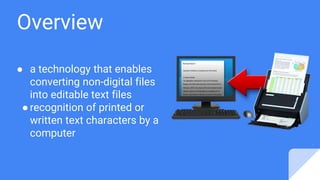
● a technology that enables
converting non-digital files
into editable text files
●recognition of printed or
written text characters by a
computer
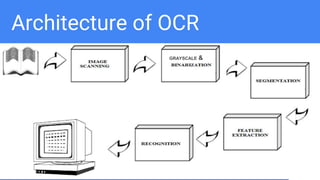
Architecture of OCR
GRAYSCALE &
Objectives
● Converting paper document into editable text
format
● Speeding up character recognition in
document processing
● Embedding to different application systems
● Creating an OCR System for uni-font and uni-
text size recognition
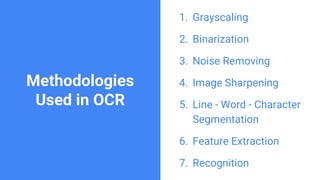
Methodologies
Used in OCR
1. Grayscaling
2. Binarization
3. Noise Removing
4. Image Sharpening
5. Line - Word - Character
Segmentation
6. Feature Extraction
7. Recognition
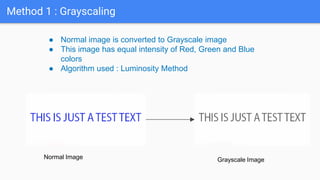
Method 1 : Grayscaling
● Normal image is converted to Grayscale image
● This image has equal intensity of Red, Green and Blue
colors
● Algorithm used : Luminosity Method
Normal Image Grayscale Image
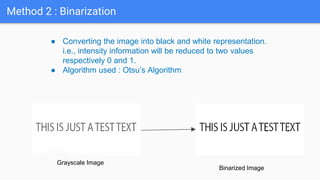
Method 2 : Binarization
● Converting the image into black and white representation.
i.e., intensity information will be reduced to two values
respectively 0 and 1.
● Algorithm used : Otsu’s Algorithm
Grayscale Image
Binarized Image
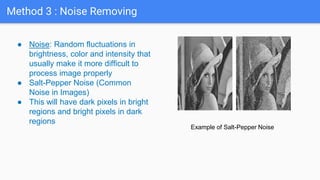
Method 3 : Noise Removing
● Noise: Random fluctuations in
brightness, color and intensity that
usually make it more difficult to
process image properly
● Salt-Pepper Noise (Common
Noise in Images)
● This will have dark pixels in bright
regions and bright pixels in dark
regions
Example of Salt-Pepper Noise
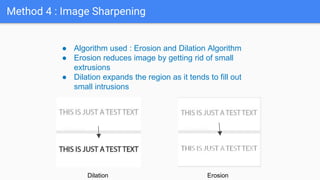
Method 4 : Image Sharpening
● Algorithm used : Erosion and Dilation Algorithm
● Erosion reduces image by getting rid of small
extrusions
● Dilation expands the region as it tends to fill out
small intrusions
Dilation Erosion
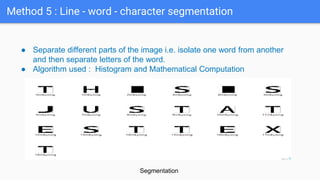
Method 5 : Line - word - character segmentation
● Separate different parts of the image i.e. isolate one word from another
and then separate letters of the word.
● Algorithm used : Histogram and Mathematical Computation
Segmentation
Method 6 : Feature Extraction
● Finding a set of features that define the shape of the
underlying character as precisely and Uniquely as
possible.
● Algorithm used : Zoning Method
Method 7 : Classification
● Use extracted features to identify character according
to preset rules.
● Determining region of feature space in which the
unknown pattern falls.
● Algorithm used : K- Nearest Neighbor Classification
Method
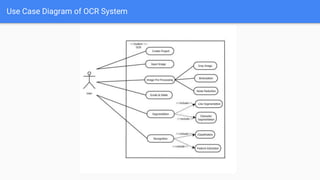
Use Case Diagram of OCR System
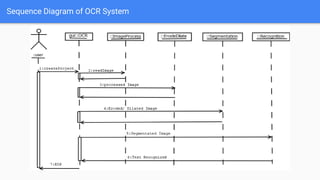
Sequence Diagram of OCR System
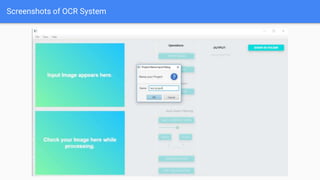
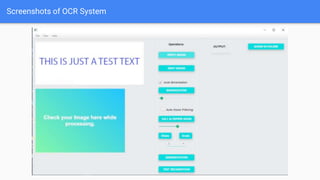
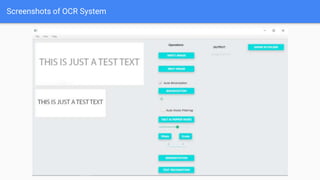
Screenshots of OCR System
Conclusion and
Future Scopes
● Automatic data entry is most
attractive and lucrative
technology
● Saving time and space with
electronic data entry procedure
● OCR can be used for Research
and Development Purposes
● Handwritten documents
recognized in future
Some References
1. https://github.com/tesseract-ocr/tesseract
2. https://www.youtube.com/watch?v=uU1LHp-wFDQ
3. https://www.scribd.com/doc/87514317/Project-Report-OCR
4. https://www.iiti.ac.in/people/~tanimad/JavaTheCompleteReference.pdf
5. https://www.robotix.in/tutorial/imageprocessing/noise.html
6. http://ksuweb.kennesaw.edu/~plaval/research/mean/noise/ocr.htm
7. http://www.felixniklas.com/imageprocessing/binarization
8. http://www.felixniklas.com/imageprocessing/segmentation
9. https://www.tutorialspoint.com/dip/grayscale_to_rgb_conversion.htm
10. Digital Image Processing Using MATLAB by R.C. Gonzalez
THANK YOU

OCR Presentation (Optical Character Recognition)

  • 1.
    Optical Character Recognition (OCR) Supervisor: Er. Bishnu Hari Poudel Team Members: Binay Thapa Magar (070/611) Neeraj Neupane (070/622) Prem Kumari Pun (070/627) Sumit Gautam (070/642)
  • 2.
    Overview ● a technologythat enables converting non-digital files into editable text files ●recognition of printed or written text characters by a computer
  • 3.
  • 4.
    Objectives ● Converting paperdocument into editable text format ● Speeding up character recognition in document processing ● Embedding to different application systems ● Creating an OCR System for uni-font and uni- text size recognition
  • 5.
    Methodologies Used in OCR 1.Grayscaling 2. Binarization 3. Noise Removing 4. Image Sharpening 5. Line - Word - Character Segmentation 6. Feature Extraction 7. Recognition
  • 6.
    Method 1 :Grayscaling ● Normal image is converted to Grayscale image ● This image has equal intensity of Red, Green and Blue colors ● Algorithm used : Luminosity Method Normal Image Grayscale Image
  • 7.
    Method 2 :Binarization ● Converting the image into black and white representation. i.e., intensity information will be reduced to two values respectively 0 and 1. ● Algorithm used : Otsu’s Algorithm Grayscale Image Binarized Image
  • 8.
    Method 3 :Noise Removing ● Noise: Random fluctuations in brightness, color and intensity that usually make it more difficult to process image properly ● Salt-Pepper Noise (Common Noise in Images) ● This will have dark pixels in bright regions and bright pixels in dark regions Example of Salt-Pepper Noise
  • 9.
    Method 4 :Image Sharpening ● Algorithm used : Erosion and Dilation Algorithm ● Erosion reduces image by getting rid of small extrusions ● Dilation expands the region as it tends to fill out small intrusions Dilation Erosion
  • 10.
    Method 5 :Line - word - character segmentation ● Separate different parts of the image i.e. isolate one word from another and then separate letters of the word. ● Algorithm used : Histogram and Mathematical Computation Segmentation
  • 11.
    Method 6 :Feature Extraction ● Finding a set of features that define the shape of the underlying character as precisely and Uniquely as possible. ● Algorithm used : Zoning Method
  • 12.
    Method 7 :Classification ● Use extracted features to identify character according to preset rules. ● Determining region of feature space in which the unknown pattern falls. ● Algorithm used : K- Nearest Neighbor Classification Method
  • 13.
    Use Case Diagramof OCR System
  • 14.
  • 15.
  • 16.
  • 17.
  • 18.
    Conclusion and Future Scopes ●Automatic data entry is most attractive and lucrative technology ● Saving time and space with electronic data entry procedure ● OCR can be used for Research and Development Purposes ● Handwritten documents recognized in future
  • 19.
    Some References 1. https://github.com/tesseract-ocr/tesseract 2.https://www.youtube.com/watch?v=uU1LHp-wFDQ 3. https://www.scribd.com/doc/87514317/Project-Report-OCR 4. https://www.iiti.ac.in/people/~tanimad/JavaTheCompleteReference.pdf 5. https://www.robotix.in/tutorial/imageprocessing/noise.html 6. http://ksuweb.kennesaw.edu/~plaval/research/mean/noise/ocr.htm 7. http://www.felixniklas.com/imageprocessing/binarization 8. http://www.felixniklas.com/imageprocessing/segmentation 9. https://www.tutorialspoint.com/dip/grayscale_to_rgb_conversion.htm 10. Digital Image Processing Using MATLAB by R.C. Gonzalez
  • 20.