University of Central Florida
STARS
STARS
Retrospective Theses and Dissertations
1973
A Nuclear Power Plant Simulator
John Jacob Adams
University of Central Florida, jjadams@cfl.rr.com
Part of the Engineering Commons
Find similar works at: https://stars.library.ucf.edu/rtd
University of Central Florida Libraries http://library.ucf.edu
This Masters Thesis (Open Access) is brought to you for free and open access by STARS. It has been accepted for
inclusion in Retrospective Theses and Dissertations by an authorized administrator of STARS. For more information,
please contact STARS@ucf.edu.
STARS Citation
STARS Citation
Adams, John Jacob, "A Nuclear Power Plant Simulator" (1973). Retrospective Theses and Dissertations.
40.
https://stars.library.ucf.edu/rtd/40
A NUCLEAR POWER PLANT SIXULATOR
JOHN JACOB ADAMS
A Research Report Presented in Partial Fulfillment
of the Requirements for the Degree
Master of Science
FURIDA TECHNOLOGICAL UNIVERSITY
May 1973
4,
1
I
F
1
4
I
:
&
B
1
,I
!
t
1 i
:
*
-
L
i
A NUCLEAR POWER PLANT SIidULATOR
JOHN JACOB ADAMS
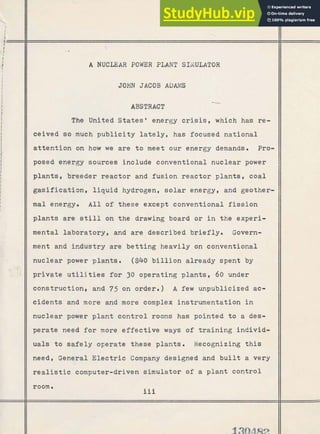
ABSTRACT
The United S t a t e s ' energy c r i s i s , which has re-
ceived so much publicity l a t e l y , has focused national
attention on how we are t o meet our energy demands. Pro-
posed energy sources include conventional nuclear power
plants, breeder reactor and fusion reactor plants, coal
gasification, liquid hydrogen, solar energy, and geother-
mal energy. A l l of these except conventional fission
plants are still on the drawing board o r i n the experi-
mental laboratory, and are described briefly. Govern-
ment and inddstry are betting heavily on conventional
nuclear power plants. ($40 b i l l i o n already spent by
private ' u t i l i t i e s for 30 operating plants, 60 under
construction, and 75 on order.) A. few unpublicized ac-
cidents and more and more complex instrumentation i n
nuclear power plant control rooms has pointed t o a des-
perate need for more effective ways of training individ-
uals t o safely operate these plants. Recognizing t h i s
need, General Electric Company designed and b u i l t a very
r e a l i s t i c computer-driven simulator of a plant control
-
room
iii
1304R2
1
I
I
1
1
1
1
I
I1
C-
I
i
iI1
I
t
1
I
I
I
I
I
.
..+* G ,
P..
1
',
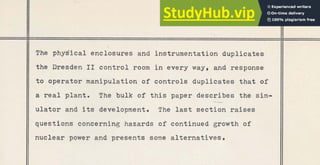
The phygical enclosures and instrumentation duplicates.
the Dresden I1 control room i n every way, and response
to operator manipulation of controls duplicates that of
a real plant, The bulk of this paper describes the sim-
--
ulator and its development. The last section raises
questions concerning hazards of continued growth of
nuclear power and presents some alternatives.
j Director-
TAB= OF CONTENTS
THE UNITED STATES' ENERGY CRISISme l l l r l l r 1
11. ENERGY THROUGH NEW TECHNOLOGYeemmmeereremme 4
----x-
Fusion Reactors
Past Breeder Reactors
Coal Gasification
Liquid Hydrogen
Solar Energy Conversion
Geothermal Energy
I IIIe NUCLEAR POWER PLANTS ARE THE WAY FOR THE
IMMEDIATE F U T U R E . m e m r m e o m o m m a m m m m o m m o m o m e m m i ) 13
Nuclear ~ d k e
r@ s Momentum 13
Need For a Nuclear Power Plant Simulator 1
4
II IVe THE NUCLEAR POWER PLANT SIMULATORmmeemrmmem 16
Program Development Cycle
Plant Description
Plant Model
Spatial Model
Dynamic Model
Logic Model
Computer and Associated Hardware
Software
Software Organization
Simulator Operation
Test and Diagnostic Programs
.Summary and Conclusions
SKULL AND C R O S S B O N E S o e . m m o a m m m m o e o o m o m m * m m m 43
Nuclear Power is Perfectly Safe if
Radioactivity is Contained Perfectly
Nuclear Waste Msposal
Conclusion
SELECTED B I B L I O G R A P H Y m m e e m r e m e m e m m o m e m m m m m o a e * m m m o 49
v
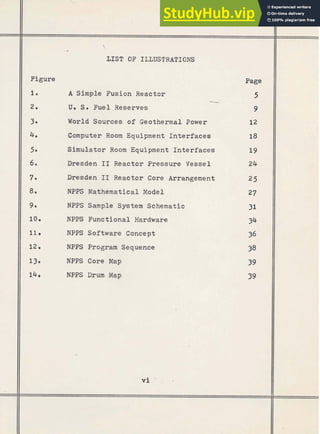
LIST OF ILLUSTRATIONS
Figure
1. A Simple Fusion Reactor
U
. S m Fuel Reserves
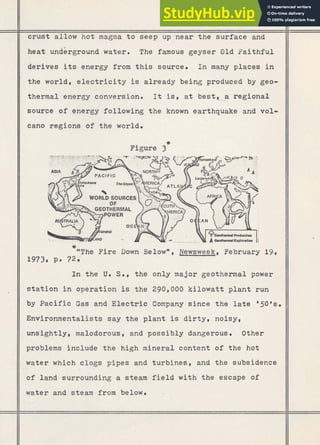
World Sources of Geothermal Power
Computer R
o
o
m Equipment Interfaces
Simulator Room Equipment Interfaces
Dresden I1 Reactor Pressure Vessel
Dresden I1 Reactor Core Arrangement
NPPS Mathematical Model
NPPS Sample System Schematic
NPPS Functional Hardware
NPPS Software Concept
NPFS Program Sequence
NPPS Core Map
NPPS Drum Map
Page
5
9
12
CHAPTER I
THE UNITED STATES' ENERGY CRISIS
The winter of 1972-1973 marked the first dra-
II matic personal awareness for many people of the United
11 States' energy crisis. In Denver. Colorado, high school
were on a three day.week to conserve dwindling fuel sup-
plies. Throughout the midwest factories were shut down
at least temporarily for lack of f u e l . O i l companies
claimed to be running t h e i r refineries at peak capacity,
and yet there were shortages i n other fuels also.
scheduled non-stop flights from New York to the west
coast had t o refuel at intermediate points for lack of
enough f u e l in the east. predictions of gas-
oline shortages for later and as of this writ-
ing, prices have already risen 10-15 per cent. Clearly,
the United States has passed from an era of cheap, plen-
t i f u l energy that made us the world's leading industrial
power, t o an era of frantic search f o r alternate ways of
$5
$9
T@ II balancing the energy-ecology-economics equation. Most
$g of the research done for t h i s paper was i n nuclear en-
* -
@,
;
143
e
2
ergy as a substitute for fossil fuels i n electric power
PJ i
y;,, 7
..,-,.
plants, and in training operators for these highly com-
plex installations. Some e f f o r t went i n t o t h e ecologi-
cal and health questions, which are at best controver-
sial# concerning the proliferation of nuclear power
plants. Suggestions f o r other energy sources are also
included, along with reports of t h e i r possi-ble feasibil-
i t y . Whatever the solutions t o our energy needs, the
price will be high.
Americans make up about six per cent of the
world's population, yet we consume one t h i r d of the
world's energy. W
e must f i n d ways of using our energy
more efficiently. Automobiles shoot about 87 per cent
of t h e i r energy intake out the exhaust pipe t o poison
our environment. The p i l o t l i g h t on a gas range con-
sumes one t h i r d of a l l the fuel the appliance burns.
Over-all, we waste more than 50 per cent of a l l t h e en-
ergy we burn, b u t we are improving t h i s somewhat. More
e f f i c i e n t air conditioners are now being designed. A
news a r t i c l e i n the Orlando Sentinel Star i n April,
1973, reported t h a t Honda Motors of Japan had designed
a new engine head f o r General Motor's Vega automobile
which increased gas mileage by 25 per cent and made the
engine capable of meeting 1976 U. S. pollution control
standards. .Ah so O O e e .
W
e w i l l inevitably f i n d ourselves w i t h ever
higher b i l l s f o r heating# e l e c t r i c i t y and gasoline, more
blackouts and brownouts# and smaller, more economical
cars. Our priorities may force us to improve relations
with the oil-rich Arab s t a t e s at the expense of our Is-
raeli friends. We are already importing 30 per cent of
our oil, and that is not enough. Interior Secretary
I
Rogers Morton feels that it w i l l take a nsuperhuman ef-
fort'' for the U. S. energy machine t o function as it is
now through 1985.l After that, nuclear energy will as-
sume much of the burden, taking the pressure off what
f o s s i l fuels we have left.
'Nuclear energy is expected t o produce 13 per
cent of a l l U. S. energy in 1985 vs. about 2 per cent
today. Nuclear energy should be supplying rn'ore than
26 per cent of our needs by 2000.
A"America's Energy Crisis," Newsweek, January
22, 1973, P. 53.
*

CHAPTER I1
ENERGY THROUGH NEY TECHNOLOGY-
Technology which may revolutionize energy pro-
duction includes fusion reactors with enough fuel from
the oceans f o r thousands of years of operation, fast
breeder reactors, liquid hydrogen and coal gasification,
solar energy conversion, and geothermal steam powered
turbines .
Present nuclear power plants use fission reac-
t o r s for heat production. This involves splitting heavy
atoms (uranium or plutonium) , hence t h e name fission.
When the fission occurs, vast quantities of energy are
released along with neutrons, which i n turn may split
other atoms. This chain reaction is relatively easy t o
control by introducing a material such as boron or cad-
mium, which absorbs neutrons, thus inhibiting new fis-
sions.
- Fusion Reactors
One of the hopes for future nuclear power
plants is the fusion reactor, Our sun ana the other hot
stars derive their energy through fusion reactions. Fu-
4
sion reactions form helium ( ~ e + )atoms by the combina-
tion (fusion) of lighter nuclei. These l i g h t nut-lei in- f
p
s
. :n,,*$-:
5- , -:<
clude heavy hydrogen (deuterium o r tritium), and l i g h t
:
&
helium ( ~ e 3 ) . This a l l sounds easy enough, but the prob-
lem is that temperatures in excess of 100,000,000 degrees
Farenheit are required for fusion to occur. No physical
container could hold material at these temperatures.
The key to a fusion reactor then, is a '@magnetic b o t t l e m ,
or containment of the fusion plasma by a precisely con-
t r o l l e d magnetic field.
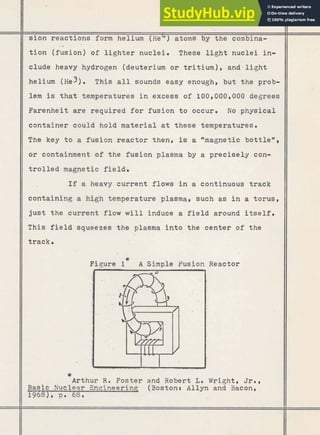
If a heavy current f l o w s in a continuous track
containing a high temperature plasma, such as in a torus,
just the current flow will induce a f i e l d around itself.
This f i e l d squeezes t h e plasma into the center of the
track.
*
Figure 1 ASimple Fusion Reactor
,
b , -:
0 '
Arthur R. Foster and Robert La Wright, Jr.,
Basic Nuclear Enaineerinq (Boston: Allyn and Bacon,
1968). p. 68.
I
-
6
A simple fusion r e a c t o r might take t h e form of
*
a t o r u s used as the secondary of a transformer. The
secondary current flase through t h e plasma itself, con-
tained within the torus. Since t h e plasma has a finite
resistance. it heats up, hopefully, t o a temperature
which w i l l support fusion. To provide a net amount of
power, plasmas must be contained f o r a s i g n i f i c a n t period
of time. The product of p a r t i c l e density, nr i n par-
ticles/cm3 and the average confinement time, t, i n sec-
onds, is a measure of the f u e l burn-up. An "nt" of 1014
(called the Lawson nmber) represents a theoretical tar-
get level f o r production of fusion power. 2
Practically, an even higher n t is necessary t o
overcome losses. Current machines can produce plasmas
16
as dense as 10 particles/cm3, but only for a few micro-
seconds, thus they f a l l s h o r t of the Lawson number by a
3
factor of 10 . The feasibility of the fusion r e a c t o r
should be determined within a decade. If it can be made
operational, it w i l l be a large f a c t o r i n our search f o r
energy sources
Suppose the fusion r e a c t o r does become a prac-
t i c a l energy source f o r the future. What is the fuel
supply and how abundant is it? isotopes of hydrogen and
*Arthur R. Foster and Robert L
. Wright, Jr.,
Basic Nuclear Engineerin5 (~ostona Allyn and Bacon,
19681, p. 67.
J
o r lithium would be the fuel. Hydrogen is the tenth
:
,
,
b ;
, .,.?$:?h? !
*
'
a
- $! .*F2
;.-
~~5+w&,.x, ,
,
m ;
.
.
J
: [;Lc279$-$
rust. The
could supply v i r t u a l l y unlimited amounts of hydrogen.
Past Breeder Reactors
Reactors can be c l a s s i f i e d i n seve<al ways.
According t o neutron speed (energy), reactors are clas-
s i f i e d as thermal (slow neutrons) o r fast reactors.
Thermal reactors are e a s i l y controlled, can use natural
uranium as fuel and are the type used f o r current burner
reactors. ( A burner reactor consumes fissionable materi-
a l , whereas a converter reactor produces some fission-
able material and a breeder reactor produces more fis-
sionable material than it consumes. ) Fast breeder reac-
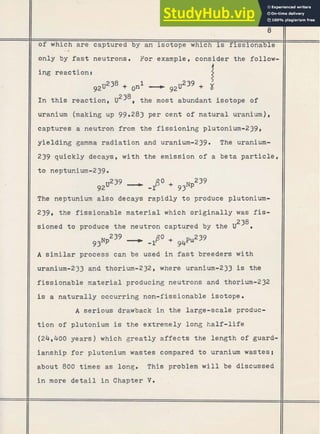
t o r s use plutonium Pu239 o r uranium u233 as f u e l and
produce more of the f u e l than is consumed.
News a r t i c l e s would have us believe we are pro-
ducing something from nothing i n breeding, but that is
not the case.
, What does happen is simple i n concept.
The new f u e l *bredMis actually the changing of a non-
fissionable isotope of uranium or thorium into a fis-
sionable isotope of plutonium o r uranium respectively.
Specifically, uranium-238 is changed t o plutonium-239,
o r thorium-232 is changed t o uranium-233.
Through normal nuclear f i s s i o n , neutrons are
released, some of which feed the chain reaction, and some
11
of which .are
< . captured by an isotope which is fissionable
* ., . .
.-
only by fast neutrons. For example, consider the -follo&
11 i n t h i s reaction, u ~ ~ ~ ,
the most abundant isotope of
II uranium (making up 99.283 per cent of natural uranium),
11 captures a neutron from the f issioning plutonium-239,
11 yielding gamma radiation and uranium-239. The uranium-
11 239 quickly decays, w i t h the emission of a beta particle,
(1 The neptunium also decays rapidly t o produce plutonium-
11 239, the fissionable material which originally was fis-
238
11 sioned t o produce t h e neutron captured by the U .
11 A similar process can be used i n fast breeders w i t h
. )I uranium-233 and thorium-232, where uranium-233 is the
(1 fissionable naterial producing neutrons and thorium-232
I is a naturally occurring non-fissionable isotope .
I
1 A serious drawback i n the large-scale produc-
1 t i o n of plutonium is the extremely long half-life
)I (24,400 years) which greatly affects the length of guard-
/I ianship for plutonium wastes compared t o uranium wastes!
11 about 800 times as long. This problem w i l l be discussed
i n more d e t a i l i n Chapter V
. -
Coal Gasification
By the next decade, dwindling supplies and
high prices will force coal gasification and liquid hy-
t .!:,p;-,?;~ ', 5;'. .
---
---- #- ,.?.A <
;
: .
drogen 'economic feasibility. The U. S . has one of
---C
.
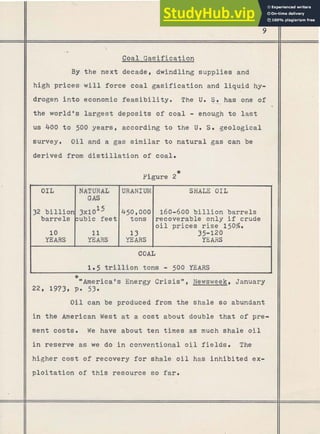
the world's largest deposits of coal - enough to last
us 400 t o 500 years, according to the U. S. seological
survey. Oil and a gas similar t o natural gas can be
derived from distillation of coal.
*
Figure 2
I OIL 1NAEZAL (URANIUM
3 x ~ ~ 1 5 450,000
ubic feet tons
10
I YEARS
SHALE OIL
1
160-600 b i l l i o n barrels
recoverable only if crude
oil prices rise 150%.
35-120
YEARS

COAL
1.5 t r i l l i o n tons - 500 YEARS
-
*"America's Energy Crisisw, Newsweek, January
22, 1973, p. 53.
O i l can be produced from the shale so abundant
in the American West at a cost about double that of pre-
.sent costs. W
e have about ten times as much shale oil
in reserve as we do in conventional o i l f i e l d s . The
higher cost o f recovery for shale o i l has inhibited ex-
ploitation of this resource so far.
-
v

Liauid Hydrogen
Anyone who has heard of the dirigible Hinden-
burg and its disasterous destruction by fire i n 1937
knows that hydrogen is combustible. Liqui-d hydrogen is
---
the fuel for the giant saturn moon rockets, Hydrogen
can be produced by the e l e c t r o l y s i s of water. In gase-
ous form, it could replace natural gas, and i n liquid
form it would be a very clean burning fuel for aircraft
and motor vehicles. One drawback f o r auto use of liquid
hydrogen stems from its lower density than gasoline. A
car with a 17 gallon gasoline tank would require a 60
gallon tank for the same mileage on liquid hydrogen.
The main drawback, however, is that electrolysis of
water requires copius amounts of e l e c t r i c i t y , a comodity
of which we are already running short.
Solar Energy Conversion
Solar energy has traditionally been thought of
as only practical f o r heating water or swimming pools.
Some of the technology to further exploit t h i s non-
polluting source of energy is at hand. A panel o f sci-
entists say that one day of sunlight gn an area the size
-
of Lake Erie is equal t o all the energy consumed by Amer-
icans in one year, and that with increased research and
development the following timetable is possible:
In five years, many homes and office build-
f m'Q
&&bgs could be heated by solar energy.
$c, Q$
In less than ten years, air conditioners
could be operated from solar energy.
In five t o t e n years, solar heat could be
used t o convert organic materials i n t o fuel
o i l and methane gas. This gas cquld supply
a t h i r d of our % a t u r a l gasN needs within
25 years.
Within 15 years, solar energy (through d i -
rect energy conversion) could be pr ducing
substantial amounts of electricity. 9
The last point would be made possible by spreading mil-
lions of reasonably efficient solar cells over thousands
of square miles of land on %olar farms." A husband and
wife scientist team a t t h e University of Arizona, Alen
and Marjorie Meinel say that a 1,000 megawatt solar farm
-usingsteam-driven turbines would require about seven
square miles land for energy collection southern
parts of the' U. S. The barriers to widespread solar en-
ergy conversion are presently more economic than techni-
cal, but with research providing increased efficiency,
the costs should go down.
:+&eotherrnal Energy
:I>
Geothermal energy can be tapped in the form of
steam under pressure in certain parts .of the world. This
steam is produced in areas where faults in the earth's
3@@~ower
From Sunc The search Picks Upsw
U. S. News and World Report, April 16, 1973. ppa 90-91.
I,
,
I
12
-
crust allow hot magma to seep up near the surface and
hea% undirground water. The famous geyser Old Faithful
derives its energy from t h i s source. In many places in
the world, electricity is already being produced by geo-
thermal energy conversion. It is* at best,-a regional
cano regions of the world.
WOULD SOURCE
--- -. __ -
-
.
.
I
_
-
-
_
he Fire Down Below*, Newsweek, February 19,
In the U
. S., the only major geothermal power
by Pacific Gas and Electric Company since the late '50's.
Environmentalists say the plant is dirty, noisy,
unsightly, malodorous, and possibly dangerous. Other
problems include the high mineral content of the hot
water which clogs pipes and turbines, and the subsidence
of land surrounding a steam f i e l d with the escape o f
water and steam from below. F-;-w
CHAPTER I11
NUCLEAR POWER PLANTS ARE THE WAY
FOR THE IMMEDIATE FUTURE
--s-
According to Interior Secretary Rogers Morton,
"The various fuels are not alternatives t o each other.
W
e need them all, including geothermal." From the fore-
going descriptions of the "non-alternatives," it seems
clear that nuclear power plants will carry the bulk of
the responsibility for new energy sources. This will
be true at least for the immediate future, and possibly
for the next generation.
Nuclear Power's Momentum
Most of the country's utilities have undertaken
expansion programs to meet the greater needs for home
and business electricity seen for the future. In the
Pacific Northwest, for example, industrial loads have
been reduced by 900 megawatts t h i s spring because of
u t i l i t i e s ' inability t o supply sufficient electricity.
Chemical plants, paper mills and aluminum smelters have
curtailed operations i n the area. The bulk of the money
being spent for new generating capacity is going i n t o
nuclear power plants nationwide. ' A t l a t e s t count, 30
1 2
nuclear power plants are operat ng the u. s., 60 are
being gilt, and 75 are.on order. To speed up the li-
censing process, the federal government is encouraging
the building o f more and more nuclear power plants of
standard design. This "standard design", incidentally,
---Z
has long been a selling point of the General Electric
Company's boiling water reactor (BWR) powered nuclear
power plant line.
Utilities are paying for full page ads in popu-
lar national magazines to promote public support of nu-
clear power. They emphasize the petroleum shortage, no
combustion-caused air pollution, and economy of opera-
tion. The last item is a subtle reminder of your cur-
rent $60.00 per month power bill. They, of course, dis-
miss environmentalist's objections as a "lack of under-
standingn.
Need for a Nuclear Power Plant Simulator
A "lack of understanding" on the part of nuclear
power plant operators has contributed to all of the
accidents occurring at plants. There have not been many
accidents, but information concerning these accidents is
practically nonexistant in published form. Requirements
for operators are becoming more stringent, and designers
are including more and more "fail safe" automatic devic-
es monitored by computers in nuclear power plant control
L.
15
systems. The bulk of this paper describes a simulator
-
which was designed to better train power plant operators
in the. complexities of a modern plant. The need f o r this
simulator has been recognized worldwide. The Japanese
government bought the design from General -Electric,
Germany is considering buying the design or a complete
system from C. E., and several large utilities and TVA
are negotiating to buy or build simulators of their
r
own.
y?
I - -
fa'.
#
- -3..
*

CHAPTER IV
THE NUCLEAR POWER PLANT SIMULATOR
General Electric Company, a major-supplier of
nuclear power plants, decided i n -1966 t h a t b e t t e r meth-
- 2 - c
rc -  :k :;?L;~i-*q?j
ods than standard classroom and l a b work were needed t o
train operators. A nuclear power plant simulator was
conceived as the major training a i d f o r a super train-
ing center t o be located i n Morris, I l l i n o i s , near Con-
solidated Edisonos Dresden site, 50 miles south of Chi-
cago. The author was a contributor t o the design and
development of the software which makes up the "brain"
of the simulator. ~ e -
also helped i n s t a l l and effect f i -
nal debug of the system on s i t e i n &layand June of 1968.
Inasmuch as man is a real time creature and
cannot be conveniently time scaled, any simulator o r
trainer designed for training humans must, of necessity,
be programmed t o operate i n r e a l time. The concept of
t h i s simulator was based on t h e r e a l time programming of
the complete functional model of the nuclear power plant.
A General Electric process computer i n conjunction with
a high-speed, solid-state, input-output system provides
a real time software simulation of the power plant, pre-
-
16
senting the operator with real time dynamic response.
The siGlator control panels and bench boards, which
duplicate the configuration of the actual plant control
II
room and the real plant instrumentation, provide the
operator with a r e a l i s t i c environment.4
An Instructor's Console allows the instructor
II
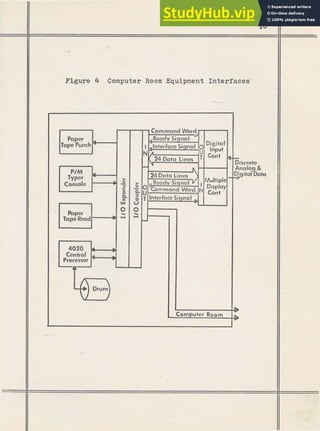
tend the realism of an operating power plant. A diagram
II
showing computer room equipment interfaces is shown in
/I
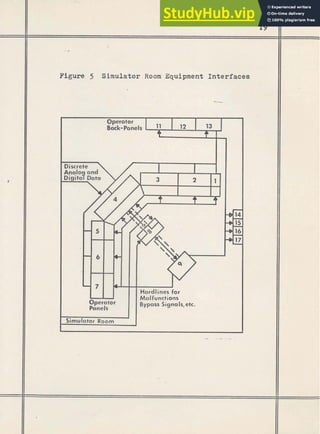
Figure 4. The simulator room equipment interfaces are
II
shown in Figure 5.
Program Development Cycle
The programming team was established under one
project leaderg eight programmers. in three teamst Spa-
tial Model, Dynamic Model, and System. The latter team
had the responsibility for the test and diagnostics and
for picking up all the loose ends and service tasks that
II
did not seem to belong to either of the other teams.
4
Much of the following descriptive material was
compiled originally by many unknown General Electric em-
ployees. Most of it has been previously published in
various forms by G. Em-employed authors listed in the
biblioqraphy. I would especially like to thank P
i
l
r
. J. L.
Katz for his permission to use portions of a previously
unpublished report he did on the nuclear power plant
simulator. -
I
+
,
I
I
Figure 4 Computer Room Equipment Interfaces
. . d . . ' . I ' .
. . . , - . . . .
. .. _ ' I
. = . . . - - - I . ,
. . ....
.. . ._ . -
.. . , ,kL;
.
)
; -' 1
; ;
,
, s , , :-.* y :2~:4.q>;:::.;,;: -,!.. ,!Ab,
;
, :r-r, <:
:
*
:
>
=
,
?
. -, , ;
> - - .
-. - . , > -
' - .* -
: .
,
8 ' .
. . . . r:., - >-- . ' ' f i ' . .L
e;ti
> *'*. ' $'
Figure 5 Simulator Room Equipment Interfaces
1
Operator
Back-Panels . l1 12 13
P
+14
-
+15
+16
+-
17
L
1
1
1 Hardlines for
Malfunctions
Operator Bypass SignaIs, etc.
Panels
, Simulator Room
6
Upon completion of the analysis and the issuance
of the gystem schematics, design specifications f o r the
computer programs were begun. The design specification
blocked out the logic and the data tables necessary for
each program. The start was made on the COMMON map.
--
From the schematics and following the outline i n the de-
sign specification, each programmer started on the detail
flow charts for the programs. A review cycle was set up
i n which the team leader and the analyst jointly reviewed
the flow c h a r t w i t h an experienced power plant engineer.
Completion of t h i s review started the coding cycle. A l l
coding was done i n the first level symbolic language of
the GE/PAC 4020, Process Automation Language (PAL). To
avoid t h e p o s s i b i l i t y of machine time conflicts between
assembly and debug e f f o r t s , a l l assemblies were performed
on a GE-415 computer using the 415 PAL assembly program.
Each programmer proceeded t o debug his unit -programs t o
the best of h i s intuitive ability. Unit programs were
then combined into subsystems tying together a group of
programs t o form an i n t e g r a l plant subsystem. These
were debugged under the direction of one of the analysts
who had prepared input data, test procedures, and predict
ed output. The contributions of the'analysts a t this
point were significant i n terms of time. While it may be
assumed that the programmers would have eventually
learned t o diaqnose the problems, it was quite evident
t h a t the analystsg experience with t h e model was a b e t t e r
guide t o sources of difficulty. System t e s t was a formal
period, with programmers and analysts i n the background.
A group known a s Test Engineering had prepared formal
t e s t procedures - which really amounted to-an operating
manual f o r the Dresden Plant. These procedures involved
the cold start of the plant and its operation throughout
its t o t a l range. All of the control conditions were ex-
ercised a t points a t which they were estimated t o be the
most visible. The most delicate p a r t of this operation
was the choice of the calibration, or tuning constants t o
bury i n the programs f o r the best overall simulation.
Experienced Power Plant Engineers operated the
simulator f o r weeks, pointing out discrepancies i n simu-
l a t o r and actual plant responses t o maneuvering. When
f i n a l tuning was complete (by decree r a t h e r than scien-
tific determination) the engineers agreed t h a t one could
forget t h a t he was not i n the control room o f a r e a l
plant while operating the simulator.
Plant Description
The simulator design is based on the Dresden 1
1
Nuclear Power Plant located near Morris, I l l i n o i s . The
plant employs a single cycle, forced circulation, boiling
water reactor w i t h a thermal rating of 2260 megawatts and
8
a gross e l e c t r i c a l power output of 850 megawatts. Plant
.
22
4 .
operating steam pressure is 1000 psig with a steam flow
6
of 8.6 x 10 pounds per hour. The turbine is a 810,000
kw, 1800{rpm, tandem-compound, six flow, non-reheat steam
turbine with 38-inch last stage buckets designed for
steam pressure of 950 psig. The generator is a direct-
-
driven, 60-cycle, 18,000-volt, 1800-rprn, conductor-
cooled, synchronous generator rated at 920 megawatts at
a 0.9 power factor. The feedwater and condensate pump-
ing develop the necessary pressure head to return the
feedwater to the reactor vessel. The feedwater is heated
to improve cycle efficiency. The recirculation system
with ten jet pumps and a'centrifugal pump in each of its
two loops controls the feedwater flow into the reactor
vessel and provides a means of power level control.
Reactor auxiliary systerns include head and shut-
down cooling, head vent, reactor water cleanup, and con-
trol rod hydraulics. Reactor safeguard systems provide
emergency.support to suppress hazardous conditions.
I
These systems are the isolation condenser, core spray,
low pressure coolant injection, high pressure coolant in-
jection, isolation valves, relief valves, and standby
liquid control.
Turbine and generator auxiliary systems provide
support functions to the turbine and the generator such
as cooling, oil pressure, and shaft sealing. The auxili-
ary power system is a local power distribution source and
.
23
supplies plant power requirements from e i t h e r the genera-

t o r orethe grid. The d i e s e l generator produces emergency
power t o non-interruptable systems.
e
The reactor is fueled by U02 p s l l e t s i n clad
rods which are assembled i n t o 724 f u e l bundles. Reactor
--
power is controlled by 177, bottom entry, axial translat-
ed, boron carSide control rods. These rods are inter-
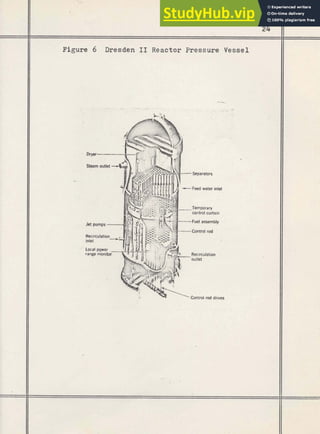
laced w i t h the fuel bundles as shown i n the cutaway dia-
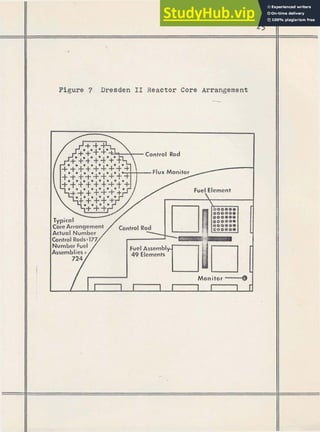
gram i n Figure 6, A reactor core arrangement diagram is
shown i n Figure 7 which i l l u s t r a t e s the control rod ar-

rangement. The location of the detectors of the three
neutron ilonitoring systems is also shown i n t h i s diagram,
The three systems are constituted by a &-detector source
range system (SRM), an 8-detector intermediate range sys-
tem (IRM). and a 164-detector (arranged i n 41 s t r i n g s )
l o c a l power range system (LPRM). A 6-channel average
power range system (APRN) provides power limiting. A
rod worth minimizer (RWM) programs the control rod pat-
tern a t low f l u x levels. A neutron protective system
monitors t h e reactor systems and i n i t i a t e s rod blocks,
alarms, and scrams according t o the condition of the re-
actor and plant.
-
;
"
P 3
Ett%t Plant Model
The simulator control panels and bench boards
and the operators console are basically duplicates of t h e
Bigure 6 Dresden I1 Reactor Pressure Vessel
Figure 7 Dresden I1 Reactor Core Arrangement
---.-_
26
%
Dresden I1 control room. The plant functions are repre-
-*
sented by a mathematical model programmed on a GE-PAC
4020 digital computer. The digital computer interfaces
with the switches, meters, recorders, and l i g h t s on the
panels and bench boards by way of an input/output
- which
includes over 3000 discrete channels and 300 analog chan-
nels. The plant model is divided from both a functional
and an organizational standpoint. The spatial model
which, except for the reactor kinetics, covers the reac-
tor functions was developed by Walt Morgan of the Atomic
Power Equipment Department (APED), San Jose, California.
The dynamic model includes those plant functions which
require dynamic representation for operator realism. The
dynamic model was developed by Dave Ahner and Richard
Mills of the Electric U t i l i t y Engineering Operation,
Schenectady. The logic model encompasses those plant
functions which can be represented adequately by logical
operations, and the logic which couples the discrete sig-
nals from the hardware input and output devices to the
spatial and dynamic models. A graphical illustration of
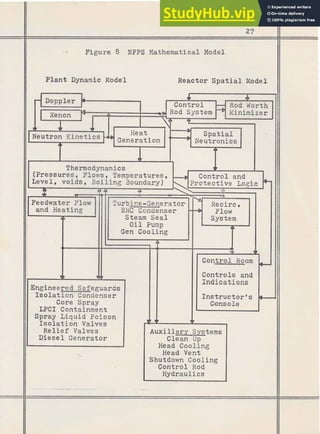
the model breakdown is shown in Figure 8
.
Spatial Model rn
The spatial model has three functionally dis-
tinct partst the control rod system, the rod worth min-
imizer, and the spatially characterized neutronics . The
Plant Dynamic Model
28
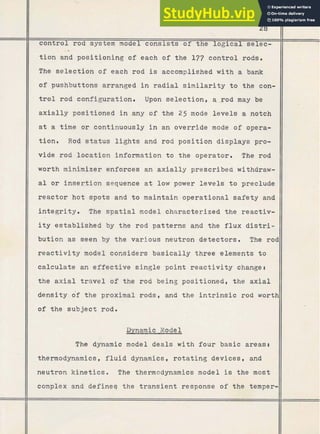
control rod system model consists of the logical' selec-
-*
tion and positioning of each of the 177 control rods.
The selection of each rod is accomplished with a bank
of pushbuttons arranged in radial s i m i l a r i t y t o the con-
t r o l rod configuration. Upon selection, a.-rod may be
axially positioned i n any of the 25 mode levels a notch
at a time o r continuously i n an override mode of opera-
tion. Rod status l i g h t s and rod position displays pro-
vide rod location information t o the operator. The rod
worth minimizer enforces an axially prescribed withdraw-
a l o r inser.tion sequence a t low power levels t o preclude
reactor hot spots and t o maintain operational safety and
integrity. The s p a t i a l model characterized the reactiv-
i t y established by the rod patterns and the flux d i s t r i -
bution as seen by the various neutron detectors. The roc
r e a c t i v i t y model considers basically three elements t o
calculate an effective single point r e a c t i v i t y changer
the axial travel of the rod being positioned, the axial
density of the proximal rods, and the i n t r i n s i c rod wortt
of t h e subject rod.
a n a m i c Model
The dynamic model deals with four basic areas,
thermodynamics, fluid dynamics, rotating devices, and
neutron kinetics. The thermodynamics model is the most
complex and defineq the transient response of the temper-
29
atures, pressures, enthalpies, voids, boiling boundary,
etc., in response to the ppc1eoni.c heating in the reactor
core and steam heating. % h h
emp oys o ventional
thermodynamic p r i n c i p l e s with simplifications here ap-
't:
propriate. Some thenodynamic modeling is--&nclbdedin
the turbine, condenser, and feedwater representations
where heating and cooling is integral to the simulation.
The turbine model is a simplified representation
derived from standard relationships of rotating inertias
with the assumption that power is a function of steam
flow. The generator model is derived from simplified
electrical representation for a synchronous generator and

assuming it is looking into an infinite bus.
Kuch of the dynamic nodel involves f l u i d dynam-
ics. In most c a s e s , simplified representations of fluid
dynamic relationships were considered sufficient to pro-
vide adequate transient response without compromising the
required degree of realism.
he neutron kinetics model is based on the sin-
gle-point neutron kinetic equation derived from the dif-
fusion equation for homogeneous, thermal reactors. Reac-
tivity feedback factors include the doppler effect ,
voids, and moderator temperature. Iodine poisoning and
xenon poisoning are also included.
-
Logic Model
The coupling logic consists primarily of memory
logic for the many spring return switches and addressing
logic to l i g h t s to register the proper mode-of operation,
or state of the system. Controllers required coupling
logic t o the controls inasmuch as the controller func-
tions were simulated. Sequential and permissive logic
also constituted a significant part of the required coup-
ling logic.
The sirnplified representation of systems requir-
ing primarily logical operations to drive output display
devices included the turbine auxiliary systems, the cir-
culating w a t e r system, off-gas system, and the radiation
monitoring system.
The auxiliary power system model was represent-
ed primarily by logic operations such as the circuit
breaker logic for the generator and auxiliary busses, the
synchroscope logic, voltage and power calculations, and
other logical operations.
The logic model contained those operations not
included in the spatial or dynamic model. It served also
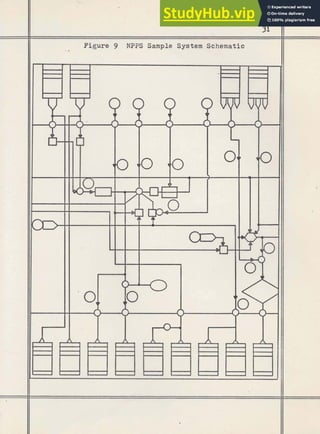
as a vehicle to integrate the total model. A sample of
the system schematic which graphically described the op-
erations of the t o t a l model is shown in Figure 9.
31
.*
Figure 9 NPPS Sample System Schematic
t P
J 1
I
r 1
I r
- I I I
I I
I L I I
1
The computer complex chosen for the NPPS consis-
ted of a General Electric Process Automation Computer
(CE/PAC) 4020, a 24-bit word, fixed-point, binary machine.
--
Core size is 32K with a 1.6~s cycle time. The add time
is 3
.
2 ys and there are seven index registers. The most
powerful features of the GE/PAC 4020 are the table input,
table output, and bit manipulation commands which made
the logical gyrations involved in the simulation feasible.
A 164K drum provided the bulk storage for all the programs
and data. The drum-to-core transfer is done in parallel
with computationl the effective rate is approximately
13,000 words per second. A standard peripheral buffer
connected the 4020 t o an input/out$ut typewriter (typer)
for prograrmer control, a paper tape reader and punch
for programs and data, and two output-only typers that
simulated the power plant computer typers . A chamel ex-
pander was used t o interface the GE-4020 with the inp-ut/
output unit which served as the buffer between the physi-
cal switches and meters on the control room panels and
the computer. To the programs, the input/output unit
looked like a block of contiguous data that could be read
i n t o sense switches and f i l l e d to drive the displays.
The input/output unit performed all sample-and-hold
functions, analog-to-digital, and digital-to-analog
Software
The software for this real time simulation con-
33
# sisted of an operating system, a s e t of functional pro-
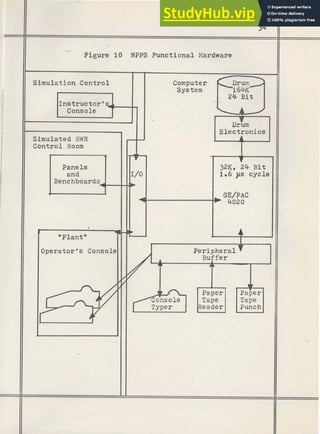
conversions. Figure 10 shows the functional hardware.
-
-
11 grams, and a t e s t and diagnostic program - totaling some-
IIwhat over 40,000 lines of code.
The operating system (0s)was derived from the
computer manufacturer's Real Time Monitor Operating Sys-
tem (RTMOS). It had the routines to handle simulator
initialization, the rolling in and initiating of func-
tional programs, the input from and output to the simu-
lated controls and instruments, and the library of math-
ematical functions. The model was broken down into a-
bout 40 programs to achieve modularity and distribute
the work load of coding. In use, the 40 programs were
grouped into six core resident blocks, s i x pages trans-
ferred into core from the drum on each simulator cycle,
and a "fast loopw of three programs executed 10 times
per simulator cycle. The Test and Diagnostic Program
was designed to aid in localizing hardware or suspected
hardware malfunctions to either the computer, i n which
case the computer diagnostics were to be used, the in-
put/output unit, or the simulated instruments.
II Software Organization
The software organization concept adopted was
.*
Figure 10 NPPS Functional Hardware
35
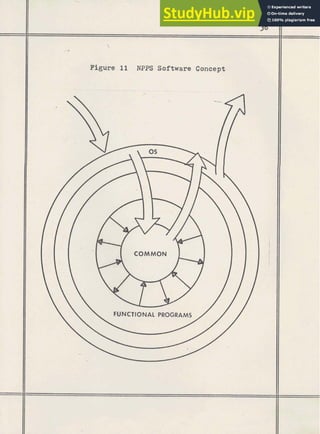
designed by J. La Katz of General Electric and was that
of a ri;;g of functional programs surrounding a common ar-
ea for communication. The ring is, in turn, surrounded
.by the operating system which provides services and a l l
external communicationse This is illustrated i n Figure
11, Software Concept. The program ring defined the basic
simulator operating cycle; once around the ring is one
cycle .
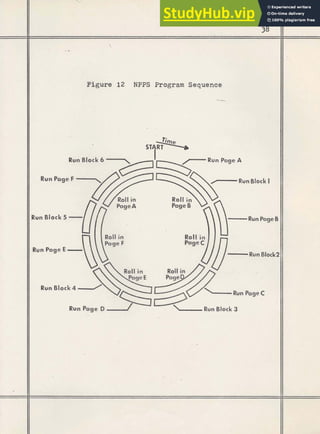
The simulator cycle starts when the operating
system reads into core memory the entire contents of the
input/output buffer and fills the output buffer from core
memory. The program blocks and pages are then executed,
one after the other in the fixed and predetermined order.
The "fast loop* operates as a special interrupt, 10 times
per cycle without disturbing the other programs except as
the result of a ''fast* computation might affect succeed-
ing computations in the normal cycle. The normal cycle
is defined as a second; when the last program in the cy-
cle has been executed, the system stalls until the tenth
'fast* interrupt has been completed. This restarts the
cycle at the beginning. It may be seen from this that
the system's average response to an operator action is,
of necessity, one-half second after the action. For
training purposes, it turns out that this delay is quite
adequate, even realistic, for a nuclear power plant. I t
may also be seen that, as the cycle is fixed, all cornpu-
- I
.
'
-
b
Figure 11 NPPS Software Concept
36

C .--<
5.iL..
, r.5
,;;,-,;;:j;. -.-,.'
, ...
. '. . ,37r ,?y
,T2!.
--.
,
. .i I
,--, ..
I,.
.., .
'
.
I
I
i
i
i
FUNCTIONAL PROGRAMS
.'.c.1-
, t : , L
.'.'.C
-..
" .:.&i?-y
:'; % <C>?.
0 -', ..L
: r
,. < - . ,
J
J
&
@
$
,
& 'J,""'.41;;+.*7T
.
-
&
-
:
>
.
.
*
.
A
.
- - -.. .-
: - 8 , .;,- ,.A:- - 1
-, 3 - -- $
: * &
.
;
1
:
.
:
c -
I
.
'
.
?
: 7 - . -.-:+
Fc.' .?:d
. .:+.
.'I*
:?!' .,..;d,--,
d
tations take effect on programs that are downstream from
the comfitation. N
o computed changes are retro-active.
Considerable thought was given t o the order of the pro-
grams i n the cycle with the r e s u l t that, i n the majority
of cases, the required most immediate effects do indeed
- = -
follow t h e i r cause. In the i n i t i a l design, the use of
execute interrupts were considered f o r operator actions
that would be defined as requiring rapid response, and
a flexible sequence of program execution was considered
rather than the predetermined cycle. As the implemen-
tation progressed, it became obvious t h a t no action
would require a response i n less than the average one-
h a l f second, and t h a t the complexity of a flexible
sequence far outweighed any advantages t o the simulation.
Further, it appeared t h a t under certain plant conditions,
a simulated reactor nscramN f o r one, all of the plant
model programs would have t o be available and operating
with realism. Thus, the design objective was modified
t o encompass a one second cycle with a l l programs loaded
and executing. This design goal was met, as was the goal
of realism i n the simulation. The sequence of events i n
a simulator cycle is shown i n Figure 12.
Once the programs had been assigned t o blocks or
pages, it was a simple matter t o complete the core and
drum space allocations as shown i n Figure 13 and Figure
14 respectively.
Figure 12 NPPS Program Sequence
38

TF*' -
I
Run Block 6 /
- Run Page A
RunBlock 1
Roll in
PageA PageB
Run Block 5 - -Run PageB
Page F PageC
Run Page E - -RunBlock2
I
I
I
I
1
I
I
I
39
Simulator Operation

" The operation of the NPPS begins by powering up
the consoles and external I/O system and i n i t i a l i z i n g
the computer (bulk load of the system from the drum),
and the i n s t r u c t o r s e l e c t s the mode i n which the power
---c
plant is t o operate. The OS brings i n the correct set
of i n i t i a l conditions. t o e s t a b l i s h that mode, checks the
consoles t o see t h a t a l l switches are s e t t o correspond
with the memorized conditions, illuminates t h e appro-
priate l i g h t s f o r the mode, loads the core resident pro-
gram blocks and the first of the r o l l i n g pages, and then,
upon release, starts the i n t e r n a l clock.
The i n s t r u c t o r has the switches, on the In-
s t r u c t o r ' s Console, t o e n t e r further "control condi-
tions" i n t o the simulation, a t i n i t i a l i z a t i o n o r a t
any time during the exercise. These "control condi-
Figure 13 Core Map
1
.
0s
0
I n i t i a l
Conditions
1 6 4 ~
Common
Figure 14 Drum Map
Sets
I n t l .
Cond.
a
Fast
Loop
Output
I
Fast
Loop
I
15 Sets
p '
a
r
e
o
Output
Buffer
o l d
Start
Intl.
Cond.
Three
Common
Test
and
Diag.
Pages
Page Buffers
S '
Blocks
Blk
A
C
E
Functional PCMS
B
D
F
Blk 91k Blk
1 2 3 4 5 6
Blk B l k
32K
40
tionsw enter the models the same way that any other

input 'does, The programs have been written to recog-
nize these control conditions as, in general, simulated
plant malfunctions. These can range from a stuck, dis-
connected~ or drifting rod to a failed pump or valve
---.--
to a persistent alarm anunciator. In this manner,
realistic training situations can be set up that would
be impossible or dangerous to duplicate in a real plant.
Test and Diagnostic Programs
Maintenance of the simulator is handled by
one technician on the site. In his work he uses the
test and diagnostic programs provided by the computer
manufacturer, a set of test and diagnostic programs .
written to exercise the conputer/panel interface, and
a maintenance panel on the input/output (I/o) unit.
The computer diagnostics are essentially the
standard set, arithmetic, input/output, core read/write,
and drum transfer.
The computer/panel interface diagnostics permit
the selection of signals to turn all lights on or off,
to drive the analog displays to one-quarter, one-
half, or three-quarter scale, and to drive the binary-
coded-decimal displays to all ones or all eights. To
test the input side, the program scans the panels and
reports any and all switches that 'change position be-
i
I I
tween scans.
-0
The maintenance panel permits the selection,
on input or output, of any specific signal to monitor
it or set it t o a specific value.
Summary and Conclusions
The Boiling Water Reactor Training Center has
been in active use since its commissioning i n June, 1968.
II
The computer-driven simulator has proven to be the use-
II
f u l tool planned. The programs have revealed no latent
I/
bugs, though detail improvements have been made. The
following points can be made as a result of careful
II
evaluation of trainees and compilation of questionaires
II
returned by trainees.
1. Training is more complete at the simulator for both
normal conditions and abnormal conditions. Training
in situations that would be impossible or dangerous on
II
the real plant gives valuable experience that cannot
be gained ,elsewhere
II
2. The trainee is removed from the pressures associated
II
with operating a power plant, so that he can concentrate
II
completely on the training activity.
3. Training time is optimized by the a b i l i t y to initial-
ize t o a given condition. I t is estimated that 40 hours
on the simulator is equivalent to over 200 hours on an
operating plant in terms of exposure to desired condi-
tione and manipulation of controls.
- * The experience in the use of the simulator
points t o the fact that operators can be more effec-
tively trained and evaluated through its use. The ap-
plication of it and a corresponding training
--- program
can do a great deal t o ensure the 'continued staffing
of our nation's nuclear power plants with high quality
CHAPTER V
SKULL AND CROSSBONES
-
This chapter will raise some questions as to
the safety of nuclear power plants and their operation.
First, some background on radiation hazards According
II t o Dr. Gofmanos research, there is a direct, proportion-
II a1 relationship between radiation dose, and incidence of
II cancer. Any radiation at all will cause some cancers.
1 The natural, ambient radiation in the United States is
probably responsible each year for about 20,000 cancers.
IIThe' insidious aspect of man-made radiation is that ir-
IIradiation now w i l l not have any effects in terms of
II leukemia or cancer for five to ten years Radiation is
also cumulative, a fact t h a t proponents of yearly X-rays
11 '~uch of the information in this section was
gleaned from an article by Jack Shepherd appearing in
t h e March, 1973 issue of Intellectual Digest in which he
interviewed Dr. John W. Gofman, who holds M. Dm and Ph.D.
1 degrees. Dr. Gofman h l s done special work in heart
disease, and cause and effect relationships between radi-
i ation and cancer. He was one of the original scientists
I on the Manhattan Project. In 1970, Dr. Gofman charged
the Atomic Energy Commission with risking *genocideM by I
I approving dangerous levels of radioactivity for peaceful I
nuclear uses. He and a colleague argued that if Ameri-
cans received the permissible "safeH dose of radiation
endorsed by the AEC, there might be 32,000 additional
cancer deaths a year. ,
- -
have only grudgingly begun t o admit.
.*
In the case of the uranium miners, it has been
a 15 year lag between radiation dose and disease. The
miners were not warned i n the 1940'8 and ' 5 0 '8 about
lung cancer. The first safety standard was-not en-
forced u n t i l 1967. It is hard t o g e t some people ex-
cited about a danger t h a t does not appear for 15 years.
They think, *Look, it doesn't hurt - no rash - I feel
finew
.
By the l a t e 1960as, it was recognized t h a t
there was an epidemic o f lung cancer i n the uranium
miners. More than 125 are dead, and another 500 t o 600
w i l l die in s p i t e of our best efforts t o save them. The
same abysmal story may be true of the nuclear power
plant operators, but it will be written in the 1980's.
Scientists a t the University of Pittsburgh are compiling
s t a t i s t i c s on operators and dose.
Nuclear Power Is Perfectly Safe If Radioactivity Is
Contained Perfectly
-
-
,
,
The word "ifwis the most significant word i n
t h e t i t l e of t h i s section. We are t o l d by the AEC,
power companies, and engineering firms who build nuclear
plants that containment is *perfectw enough t o exhibit
less radiation than nature herself. Under normal
.
45'
circumstances I believe engineering and c~nstructionare

adequate to ensure this "perfectw containment. Our
engineering cannot, however, cope with sabotage, human
misjudgments, psychotics, o r n a t u r a l events such as
earthquakes o r tornadoes. -
Containment within a plant is only p a r t of the
question. The unpublicized containment problem is f o r
t h a t of fission products (or nuclear wastes).
Every year a 1000-megawatt nuclear power plant
w i l l generate the cesium 137 and strontium 90 equiva-
lent of 1000 Hiroshima bombs - 22-megatons of atomic
f i s s i o n bomb equivalent. These two isotopes have half-
lives of about 30 years, and it takes roughly t e n half-
lives t o g e t the radioactivity down by a factor of
1,000. If a thousandth of it is not considered hamful,
then it must be contained f o r at least 300 years.
Plutonium, which w i l l be produced i n ton l o t s
by breeder reactors i n a more mature nuclear power in-
dustry, has a half-life of 24,400 years. This means
that waste plutonium guardianship w i l l be f o r a t least
240,000 years, longer than the recorded history of man.
Considering t h i s quarter-million years, every b i t of
plutonium t h a t escapes into the biosphere will be a
problem forever on a human time scale. Can we handle
tons of this s t u f f every year shipping
, it over highways
o r railways and not lose some of it?
46
 Nuclear Waste Disposal
The AEC has asked congress f o r $1.9 million t o
dig up 200 t o 400 pounds of plutonium buried a t its
Hanford, Washington f a c i l i t y since World W
a
r 1x0 They
had assumed that the s o i l would hold the pliitonium by
ion-exchange methods, but now fear t h a t water flooding
might cause the whole trench t o .explode and blast plu-
tonium into the atmosphere.
It was thought t h a t the s a l t mines i n Lyons,
Kansas would be an ideal nuclear dumping ground u n t i l
the American S a l t Company l o s t 175#000gallons of water
during an attempt t o flush salt up from the other end
of .the mine. There are few alternatives. Above-ground
tanks have leaked, b u r i a l a t sea is unthinkable, yet
has been done, and b u r i a l i n bedrock a t the Savannah
River Laboratory in South Carolina continues i n s p i t e
of the National Academy of Sciences reporting t h a t the
practice was not reasonable. It may not be reasonable,
but it is cheaper than any other method. Consideration
has even been given t o blasting the s t u f f i n t o outer
space via saturn "moon" rockets, but that is not without
risks. If t h a t is done, I personally hope it is launch-
ed from Vandenburg AFB i n California rather than Cape
Canaveral. The optimistic assumption now is t h a t a
*perfectwmethod of disposal w i l l be developed within
[
I
i
47
15 years and we should be content to contain the s t u f f
-*
temporarily f o r now. What an incredible gamble l
According to Dr. Gofman, if one per cent of
the waste located at Barnwell, South Carolina were to
be released into the atmosphere, we could expect 33,000
square
Southe
I
vania,
West V
miles of the
rn New York,
Washington,
irginia, and
U
. S
all o
D
. C .
the C
t o become
~fNew Jerse
, Maryland,
arolinas wo
y, Eastern Pennsyl- I
Delaware,
u l d have t o be evac- I
uated. One small, well placed bomb by an unfriendly
button pusher could make a lot of folks homeless.
- , Conclusion
is a situation such as this allowed to
exist? One answer is $$. There is $40 billion in
private money invested in the nuclear fission approach
to producing electricity now, with untold billions of
federal dollars involved. Many very learned and
ambitious men have staked their reputations on developing
nuclear fission as the ideal power source. However, as
has been discussed, a number of grave /problems persist.
If solar power generation or nuclear fusion,
can in fact, be made feasible, the problem will then be
replacing a working, but dangerous source of power with
an .experimental, but environmentally sound source of
power. A number of engineers think that given money,
publicity, and a redirection of governmental priorities,
we could shift our economy over t o solar energy conver-
sion in 20 years. This question of priorities should
become the most debated public issue of all for the
next several years.
SELECTED BIBLIOGRAPHY
"A/C '731 More Cool, Less Current.* Popular Science,
Maye 1973, P. 79.
Ahner, D
. 3 . 8 and M i l l s , R. J. Nuclear Simulator
Dynamic Models. Schenectady, New York t General
Electric Company T.I.S., 67-EU-2033, 1968.
"Americans Energy Crisis." Newsweek, January 22, 1973,
ppa 52-60.
Bennett, C . Michael. *Computer Representation of a
Nuclear Power Plant i n a Training Simulator."
Proceedings of the Eleventh ~ n t e r n a t i o n a lI S A
Power Instrumentation Symposium. Chicago, 111.4 1968.
"Electric Power From the Earth Popular Science,
April, 1973, pp. 32-34.
Ferguson, 3. H
.
, Peffer, H
. R
.
, and Ahner, D
. J.
Nuclear Power Plant Simulator. San Jose, California:
General Electric Companyt APED-5520, 1968.
*The Fire Down Below." Newsweek, February 19, 1973, p. 72.
Foster, Arthur, and Wright, Robert L
.
, Jr. Basic
Nuclear Engineerinq. Boston: Allyn and Bacon, 1968.
"Gas Prices Burn You? Sunm
s Turn. * Orlando Sentinel.Star
April 29, 1973, pa 12-A.
Glasstone, Samuel, and Sesonske, Alexander. Nuclear
Reactor Engineering. Princeton4 Van Nostrand
Company, 1967.
Gridley, R. Lo BWR Operator Training Using Simulators.
Morris, I l l i n o i s : General Electric BWR Training
-
Center, 1969.
Long, Justin Tt Engineering for Nuclear Fuel Reprocessinq.
New Yorkr Gorden and Breach Science Publishers, 1967.
Markus, ~ o h n(Ed. ) .Electronics and Nucleonics
Dictionary. New Yorkt McGraw-Hill, 1966.
Novick, Sheldon. The Careless Atom. Boston: Houghton
Mifflint 1969.
A Nuclear Power Plant Simulator

A Nuclear Power Plant Simulator

  • 1.
    University of CentralFlorida University of Central Florida STARS STARS Retrospective Theses and Dissertations 1973 A Nuclear Power Plant Simulator A Nuclear Power Plant Simulator John Jacob Adams University of Central Florida, jjadams@cfl.rr.com Part of the Engineering Commons Find similar works at: https://stars.library.ucf.edu/rtd University of Central Florida Libraries http://library.ucf.edu This Masters Thesis (Open Access) is brought to you for free and open access by STARS. It has been accepted for inclusion in Retrospective Theses and Dissertations by an authorized administrator of STARS. For more information, please contact STARS@ucf.edu. STARS Citation STARS Citation Adams, John Jacob, "A Nuclear Power Plant Simulator" (1973). Retrospective Theses and Dissertations. 40. https://stars.library.ucf.edu/rtd/40
  • 2.
    A NUCLEAR POWERPLANT SIXULATOR JOHN JACOB ADAMS A Research Report Presented in Partial Fulfillment of the Requirements for the Degree Master of Science FURIDA TECHNOLOGICAL UNIVERSITY May 1973
  • 3.
    4, 1 I F 1 4 I : & B 1 ,I ! t 1 i : * - L i A NUCLEARPOWER PLANT SIidULATOR JOHN JACOB ADAMS ABSTRACT The United S t a t e s ' energy c r i s i s , which has re- ceived so much publicity l a t e l y , has focused national attention on how we are t o meet our energy demands. Pro- posed energy sources include conventional nuclear power plants, breeder reactor and fusion reactor plants, coal gasification, liquid hydrogen, solar energy, and geother- mal energy. A l l of these except conventional fission plants are still on the drawing board o r i n the experi- mental laboratory, and are described briefly. Govern- ment and inddstry are betting heavily on conventional nuclear power plants. ($40 b i l l i o n already spent by private ' u t i l i t i e s for 30 operating plants, 60 under construction, and 75 on order.) A. few unpublicized ac- cidents and more and more complex instrumentation i n nuclear power plant control rooms has pointed t o a des- perate need for more effective ways of training individ- uals t o safely operate these plants. Recognizing t h i s need, General Electric Company designed and b u i l t a very r e a l i s t i c computer-driven simulator of a plant control - room iii 1304R2 1 I I 1 1 1 1 I I1 C- I i iI1 I t 1 I I I I I . ..+* G , P.. 1
  • 4.
    ', The phygical enclosuresand instrumentation duplicates. the Dresden I1 control room i n every way, and response to operator manipulation of controls duplicates that of a real plant, The bulk of this paper describes the sim- -- ulator and its development. The last section raises questions concerning hazards of continued growth of nuclear power and presents some alternatives. j Director-
  • 5.
    TAB= OF CONTENTS THEUNITED STATES' ENERGY CRISISme l l l r l l r 1 11. ENERGY THROUGH NEW TECHNOLOGYeemmmeereremme 4 ----x- Fusion Reactors Past Breeder Reactors Coal Gasification Liquid Hydrogen Solar Energy Conversion Geothermal Energy I IIIe NUCLEAR POWER PLANTS ARE THE WAY FOR THE IMMEDIATE F U T U R E . m e m r m e o m o m m a m m m m o m m o m o m e m m i ) 13 Nuclear ~ d k e r@ s Momentum 13 Need For a Nuclear Power Plant Simulator 1 4 II IVe THE NUCLEAR POWER PLANT SIMULATORmmeemrmmem 16 Program Development Cycle Plant Description Plant Model Spatial Model Dynamic Model Logic Model Computer and Associated Hardware Software Software Organization Simulator Operation Test and Diagnostic Programs .Summary and Conclusions SKULL AND C R O S S B O N E S o e . m m o a m m m m o e o o m o m m * m m m 43 Nuclear Power is Perfectly Safe if Radioactivity is Contained Perfectly Nuclear Waste Msposal Conclusion SELECTED B I B L I O G R A P H Y m m e e m r e m e m e m m o m e m m m m m o a e * m m m o 49 v
  • 6.
    LIST OF ILLUSTRATIONS Figure 1.A Simple Fusion Reactor U . S m Fuel Reserves World Sources of Geothermal Power Computer R o o m Equipment Interfaces Simulator Room Equipment Interfaces Dresden I1 Reactor Pressure Vessel Dresden I1 Reactor Core Arrangement NPPS Mathematical Model NPPS Sample System Schematic NPPS Functional Hardware NPPS Software Concept NPFS Program Sequence NPPS Core Map NPPS Drum Map Page 5 9 12
  • 7.
    CHAPTER I THE UNITEDSTATES' ENERGY CRISIS The winter of 1972-1973 marked the first dra- II matic personal awareness for many people of the United 11 States' energy crisis. In Denver. Colorado, high school were on a three day.week to conserve dwindling fuel sup- plies. Throughout the midwest factories were shut down at least temporarily for lack of f u e l . O i l companies claimed to be running t h e i r refineries at peak capacity, and yet there were shortages i n other fuels also. scheduled non-stop flights from New York to the west coast had t o refuel at intermediate points for lack of enough f u e l in the east. predictions of gas- oline shortages for later and as of this writ- ing, prices have already risen 10-15 per cent. Clearly, the United States has passed from an era of cheap, plen- t i f u l energy that made us the world's leading industrial power, t o an era of frantic search f o r alternate ways of $5 $9 T@ II balancing the energy-ecology-economics equation. Most $g of the research done for t h i s paper was i n nuclear en- * - @, ; 143 e 2 ergy as a substitute for fossil fuels i n electric power PJ i y;,, 7 ..,-,. plants, and in training operators for these highly com-
  • 8.
    plex installations. Somee f f o r t went i n t o t h e ecologi- cal and health questions, which are at best controver- sial# concerning the proliferation of nuclear power plants. Suggestions f o r other energy sources are also included, along with reports of t h e i r possi-ble feasibil- i t y . Whatever the solutions t o our energy needs, the price will be high. Americans make up about six per cent of the world's population, yet we consume one t h i r d of the world's energy. W e must f i n d ways of using our energy more efficiently. Automobiles shoot about 87 per cent of t h e i r energy intake out the exhaust pipe t o poison our environment. The p i l o t l i g h t on a gas range con- sumes one t h i r d of a l l the fuel the appliance burns. Over-all, we waste more than 50 per cent of a l l t h e en- ergy we burn, b u t we are improving t h i s somewhat. More e f f i c i e n t air conditioners are now being designed. A news a r t i c l e i n the Orlando Sentinel Star i n April, 1973, reported t h a t Honda Motors of Japan had designed a new engine head f o r General Motor's Vega automobile which increased gas mileage by 25 per cent and made the engine capable of meeting 1976 U. S. pollution control standards. .Ah so O O e e . W e w i l l inevitably f i n d ourselves w i t h ever higher b i l l s f o r heating# e l e c t r i c i t y and gasoline, more blackouts and brownouts# and smaller, more economical
  • 9.
    cars. Our prioritiesmay force us to improve relations with the oil-rich Arab s t a t e s at the expense of our Is- raeli friends. We are already importing 30 per cent of our oil, and that is not enough. Interior Secretary I Rogers Morton feels that it w i l l take a nsuperhuman ef- fort'' for the U. S. energy machine t o function as it is now through 1985.l After that, nuclear energy will as- sume much of the burden, taking the pressure off what f o s s i l fuels we have left. 'Nuclear energy is expected t o produce 13 per cent of a l l U. S. energy in 1985 vs. about 2 per cent today. Nuclear energy should be supplying rn'ore than 26 per cent of our needs by 2000. A"America's Energy Crisis," Newsweek, January 22, 1973, P. 53.
  • 10.
    * CHAPTER I1 ENERGY THROUGHNEY TECHNOLOGY- Technology which may revolutionize energy pro- duction includes fusion reactors with enough fuel from the oceans f o r thousands of years of operation, fast breeder reactors, liquid hydrogen and coal gasification, solar energy conversion, and geothermal steam powered turbines . Present nuclear power plants use fission reac- t o r s for heat production. This involves splitting heavy atoms (uranium or plutonium) , hence t h e name fission. When the fission occurs, vast quantities of energy are released along with neutrons, which i n turn may split other atoms. This chain reaction is relatively easy t o control by introducing a material such as boron or cad- mium, which absorbs neutrons, thus inhibiting new fis- sions. - Fusion Reactors One of the hopes for future nuclear power plants is the fusion reactor, Our sun ana the other hot stars derive their energy through fusion reactions. Fu- 4
  • 11.
    sion reactions formhelium ( ~ e + )atoms by the combina- tion (fusion) of lighter nuclei. These l i g h t nut-lei in- f p s . :n,,*$-: 5- , -:< clude heavy hydrogen (deuterium o r tritium), and l i g h t : & helium ( ~ e 3 ) . This a l l sounds easy enough, but the prob- lem is that temperatures in excess of 100,000,000 degrees Farenheit are required for fusion to occur. No physical container could hold material at these temperatures. The key to a fusion reactor then, is a '@magnetic b o t t l e m , or containment of the fusion plasma by a precisely con- t r o l l e d magnetic field. If a heavy current f l o w s in a continuous track containing a high temperature plasma, such as in a torus, just the current flow will induce a f i e l d around itself. This f i e l d squeezes t h e plasma into the center of the track. * Figure 1 ASimple Fusion Reactor , b , -: 0 ' Arthur R. Foster and Robert La Wright, Jr., Basic Nuclear Enaineerinq (Boston: Allyn and Bacon, 1968). p. 68.
  • 12.
    I - 6 A simple fusionr e a c t o r might take t h e form of * a t o r u s used as the secondary of a transformer. The secondary current flase through t h e plasma itself, con- tained within the torus. Since t h e plasma has a finite resistance. it heats up, hopefully, t o a temperature which w i l l support fusion. To provide a net amount of power, plasmas must be contained f o r a s i g n i f i c a n t period of time. The product of p a r t i c l e density, nr i n par- ticles/cm3 and the average confinement time, t, i n sec- onds, is a measure of the f u e l burn-up. An "nt" of 1014 (called the Lawson nmber) represents a theoretical tar- get level f o r production of fusion power. 2 Practically, an even higher n t is necessary t o overcome losses. Current machines can produce plasmas 16 as dense as 10 particles/cm3, but only for a few micro- seconds, thus they f a l l s h o r t of the Lawson number by a 3 factor of 10 . The feasibility of the fusion r e a c t o r should be determined within a decade. If it can be made operational, it w i l l be a large f a c t o r i n our search f o r energy sources Suppose the fusion r e a c t o r does become a prac- t i c a l energy source f o r the future. What is the fuel supply and how abundant is it? isotopes of hydrogen and *Arthur R. Foster and Robert L . Wright, Jr., Basic Nuclear Engineerin5 (~ostona Allyn and Bacon, 19681, p. 67. J
  • 13.
    o r lithiumwould be the fuel. Hydrogen is the tenth : , , b ; , .,.?$:?h? ! * ' a - $! .*F2 ;.- ~~5+w&,.x, , , m ; . . J : [;Lc279$-$ rust. The could supply v i r t u a l l y unlimited amounts of hydrogen. Past Breeder Reactors Reactors can be c l a s s i f i e d i n seve<al ways. According t o neutron speed (energy), reactors are clas- s i f i e d as thermal (slow neutrons) o r fast reactors. Thermal reactors are e a s i l y controlled, can use natural uranium as fuel and are the type used f o r current burner reactors. ( A burner reactor consumes fissionable materi- a l , whereas a converter reactor produces some fission- able material and a breeder reactor produces more fis- sionable material than it consumes. ) Fast breeder reac- t o r s use plutonium Pu239 o r uranium u233 as f u e l and produce more of the f u e l than is consumed. News a r t i c l e s would have us believe we are pro- ducing something from nothing i n breeding, but that is not the case. , What does happen is simple i n concept. The new f u e l *bredMis actually the changing of a non- fissionable isotope of uranium or thorium into a fis- sionable isotope of plutonium o r uranium respectively. Specifically, uranium-238 is changed t o plutonium-239, o r thorium-232 is changed t o uranium-233. Through normal nuclear f i s s i o n , neutrons are released, some of which feed the chain reaction, and some
  • 14.
    11 of which .are <. captured by an isotope which is fissionable * ., . . .- only by fast neutrons. For example, consider the -follo& 11 i n t h i s reaction, u ~ ~ ~ , the most abundant isotope of II uranium (making up 99.283 per cent of natural uranium), 11 captures a neutron from the f issioning plutonium-239, 11 yielding gamma radiation and uranium-239. The uranium- 11 239 quickly decays, w i t h the emission of a beta particle, (1 The neptunium also decays rapidly t o produce plutonium- 11 239, the fissionable material which originally was fis- 238 11 sioned t o produce t h e neutron captured by the U . 11 A similar process can be used i n fast breeders w i t h . )I uranium-233 and thorium-232, where uranium-233 is the (1 fissionable naterial producing neutrons and thorium-232 I is a naturally occurring non-fissionable isotope . I 1 A serious drawback i n the large-scale produc- 1 t i o n of plutonium is the extremely long half-life )I (24,400 years) which greatly affects the length of guard- /I ianship for plutonium wastes compared t o uranium wastes! 11 about 800 times as long. This problem w i l l be discussed i n more d e t a i l i n Chapter V . -
  • 15.
    Coal Gasification By thenext decade, dwindling supplies and high prices will force coal gasification and liquid hy- t .!:,p;-,?;~ ', 5;'. . --- ---- #- ,.?.A < ; : . drogen 'economic feasibility. The U. S . has one of ---C . the world's largest deposits of coal - enough to last us 400 t o 500 years, according to the U. S. seological survey. Oil and a gas similar t o natural gas can be derived from distillation of coal. * Figure 2 I OIL 1NAEZAL (URANIUM 3 x ~ ~ 1 5 450,000 ubic feet tons 10 I YEARS SHALE OIL 1 160-600 b i l l i o n barrels recoverable only if crude oil prices rise 150%. 35-120 YEARS COAL 1.5 t r i l l i o n tons - 500 YEARS - *"America's Energy Crisisw, Newsweek, January 22, 1973, p. 53. O i l can be produced from the shale so abundant in the American West at a cost about double that of pre- .sent costs. W e have about ten times as much shale oil in reserve as we do in conventional o i l f i e l d s . The higher cost o f recovery for shale o i l has inhibited ex- ploitation of this resource so far. -
  • 16.
    v Liauid Hydrogen Anyone whohas heard of the dirigible Hinden- burg and its disasterous destruction by fire i n 1937 knows that hydrogen is combustible. Liqui-d hydrogen is --- the fuel for the giant saturn moon rockets, Hydrogen can be produced by the e l e c t r o l y s i s of water. In gase- ous form, it could replace natural gas, and i n liquid form it would be a very clean burning fuel for aircraft and motor vehicles. One drawback f o r auto use of liquid hydrogen stems from its lower density than gasoline. A car with a 17 gallon gasoline tank would require a 60 gallon tank for the same mileage on liquid hydrogen. The main drawback, however, is that electrolysis of water requires copius amounts of e l e c t r i c i t y , a comodity of which we are already running short. Solar Energy Conversion Solar energy has traditionally been thought of as only practical f o r heating water or swimming pools. Some of the technology to further exploit t h i s non- polluting source of energy is at hand. A panel o f sci- entists say that one day of sunlight gn an area the size - of Lake Erie is equal t o all the energy consumed by Amer- icans in one year, and that with increased research and development the following timetable is possible:
  • 17.
    In five years,many homes and office build- f m'Q &&bgs could be heated by solar energy. $c, Q$ In less than ten years, air conditioners could be operated from solar energy. In five t o t e n years, solar heat could be used t o convert organic materials i n t o fuel o i l and methane gas. This gas cquld supply a t h i r d of our % a t u r a l gasN needs within 25 years. Within 15 years, solar energy (through d i - rect energy conversion) could be pr ducing substantial amounts of electricity. 9 The last point would be made possible by spreading mil- lions of reasonably efficient solar cells over thousands of square miles of land on %olar farms." A husband and wife scientist team a t t h e University of Arizona, Alen and Marjorie Meinel say that a 1,000 megawatt solar farm -usingsteam-driven turbines would require about seven square miles land for energy collection southern parts of the' U. S. The barriers to widespread solar en- ergy conversion are presently more economic than techni- cal, but with research providing increased efficiency, the costs should go down. :+&eotherrnal Energy :I> Geothermal energy can be tapped in the form of steam under pressure in certain parts .of the world. This steam is produced in areas where faults in the earth's 3@@~ower From Sunc The search Picks Upsw U. S. News and World Report, April 16, 1973. ppa 90-91.
  • 18.
    I, , I 12 - crust allow hotmagma to seep up near the surface and hea% undirground water. The famous geyser Old Faithful derives its energy from t h i s source. In many places in the world, electricity is already being produced by geo- thermal energy conversion. It is* at best,-a regional cano regions of the world. WOULD SOURCE --- -. __ - - . . I _ - - _ he Fire Down Below*, Newsweek, February 19, In the U . S., the only major geothermal power by Pacific Gas and Electric Company since the late '50's. Environmentalists say the plant is dirty, noisy, unsightly, malodorous, and possibly dangerous. Other problems include the high mineral content of the hot water which clogs pipes and turbines, and the subsidence of land surrounding a steam f i e l d with the escape o f water and steam from below. F-;-w
  • 19.
    CHAPTER I11 NUCLEAR POWERPLANTS ARE THE WAY FOR THE IMMEDIATE FUTURE --s- According to Interior Secretary Rogers Morton, "The various fuels are not alternatives t o each other. W e need them all, including geothermal." From the fore- going descriptions of the "non-alternatives," it seems clear that nuclear power plants will carry the bulk of the responsibility for new energy sources. This will be true at least for the immediate future, and possibly for the next generation. Nuclear Power's Momentum Most of the country's utilities have undertaken expansion programs to meet the greater needs for home and business electricity seen for the future. In the Pacific Northwest, for example, industrial loads have been reduced by 900 megawatts t h i s spring because of u t i l i t i e s ' inability t o supply sufficient electricity. Chemical plants, paper mills and aluminum smelters have curtailed operations i n the area. The bulk of the money being spent for new generating capacity is going i n t o nuclear power plants nationwide. ' A t l a t e s t count, 30 1 2
  • 20.
    nuclear power plantsare operat ng the u. s., 60 are being gilt, and 75 are.on order. To speed up the li- censing process, the federal government is encouraging the building o f more and more nuclear power plants of standard design. This "standard design", incidentally, ---Z has long been a selling point of the General Electric Company's boiling water reactor (BWR) powered nuclear power plant line. Utilities are paying for full page ads in popu- lar national magazines to promote public support of nu- clear power. They emphasize the petroleum shortage, no combustion-caused air pollution, and economy of opera- tion. The last item is a subtle reminder of your cur- rent $60.00 per month power bill. They, of course, dis- miss environmentalist's objections as a "lack of under- standingn. Need for a Nuclear Power Plant Simulator A "lack of understanding" on the part of nuclear power plant operators has contributed to all of the accidents occurring at plants. There have not been many accidents, but information concerning these accidents is practically nonexistant in published form. Requirements for operators are becoming more stringent, and designers are including more and more "fail safe" automatic devic- es monitored by computers in nuclear power plant control
  • 21.
    L. 15 systems. The bulkof this paper describes a simulator - which was designed to better train power plant operators in the. complexities of a modern plant. The need f o r this simulator has been recognized worldwide. The Japanese government bought the design from General -Electric, Germany is considering buying the design or a complete system from C. E., and several large utilities and TVA are negotiating to buy or build simulators of their r own. y? I - - fa'. # - -3..
  • 22.
    * CHAPTER IV THE NUCLEARPOWER PLANT SIMULATOR General Electric Company, a major-supplier of nuclear power plants, decided i n -1966 t h a t b e t t e r meth- - 2 - c rc - :k :;?L;~i-*q?j ods than standard classroom and l a b work were needed t o train operators. A nuclear power plant simulator was conceived as the major training a i d f o r a super train- ing center t o be located i n Morris, I l l i n o i s , near Con- solidated Edisonos Dresden site, 50 miles south of Chi- cago. The author was a contributor t o the design and development of the software which makes up the "brain" of the simulator. ~ e - also helped i n s t a l l and effect f i - nal debug of the system on s i t e i n &layand June of 1968. Inasmuch as man is a real time creature and cannot be conveniently time scaled, any simulator o r trainer designed for training humans must, of necessity, be programmed t o operate i n r e a l time. The concept of t h i s simulator was based on t h e r e a l time programming of the complete functional model of the nuclear power plant. A General Electric process computer i n conjunction with a high-speed, solid-state, input-output system provides a real time software simulation of the power plant, pre- - 16
  • 23.
    senting the operatorwith real time dynamic response. The siGlator control panels and bench boards, which duplicate the configuration of the actual plant control II room and the real plant instrumentation, provide the operator with a r e a l i s t i c environment.4 An Instructor's Console allows the instructor II tend the realism of an operating power plant. A diagram II showing computer room equipment interfaces is shown in /I Figure 4. The simulator room equipment interfaces are II shown in Figure 5. Program Development Cycle The programming team was established under one project leaderg eight programmers. in three teamst Spa- tial Model, Dynamic Model, and System. The latter team had the responsibility for the test and diagnostics and for picking up all the loose ends and service tasks that II did not seem to belong to either of the other teams. 4 Much of the following descriptive material was compiled originally by many unknown General Electric em- ployees. Most of it has been previously published in various forms by G. Em-employed authors listed in the biblioqraphy. I would especially like to thank P i l r . J. L. Katz for his permission to use portions of a previously unpublished report he did on the nuclear power plant simulator. - I + , I I
  • 24.
    Figure 4 ComputerRoom Equipment Interfaces
  • 25.
    . . d. . ' . I ' . . . . , - . . . . . .. _ ' I . = . . . - - - I . , . . .... .. . ._ . - .. . , ,kL; . ) ; -' 1 ; ; , , s , , :-.* y :2~:4.q>;:::.;,;: -,!.. ,!Ab, ; , :r-r, <: : * : > = , ? . -, , ; > - - . -. - . , > - ' - .* - : . , 8 ' . . . . . r:., - >-- . ' ' f i ' . .L e;ti > *'*. ' $' Figure 5 Simulator Room Equipment Interfaces 1 Operator Back-Panels . l1 12 13 P +14 - +15 +16 +- 17 L 1 1 1 Hardlines for Malfunctions Operator Bypass SignaIs, etc. Panels , Simulator Room 6
  • 26.
    Upon completion ofthe analysis and the issuance of the gystem schematics, design specifications f o r the computer programs were begun. The design specification blocked out the logic and the data tables necessary for each program. The start was made on the COMMON map. -- From the schematics and following the outline i n the de- sign specification, each programmer started on the detail flow charts for the programs. A review cycle was set up i n which the team leader and the analyst jointly reviewed the flow c h a r t w i t h an experienced power plant engineer. Completion of t h i s review started the coding cycle. A l l coding was done i n the first level symbolic language of the GE/PAC 4020, Process Automation Language (PAL). To avoid t h e p o s s i b i l i t y of machine time conflicts between assembly and debug e f f o r t s , a l l assemblies were performed on a GE-415 computer using the 415 PAL assembly program. Each programmer proceeded t o debug his unit -programs t o the best of h i s intuitive ability. Unit programs were then combined into subsystems tying together a group of programs t o form an i n t e g r a l plant subsystem. These were debugged under the direction of one of the analysts who had prepared input data, test procedures, and predict ed output. The contributions of the'analysts a t this point were significant i n terms of time. While it may be assumed that the programmers would have eventually learned t o diaqnose the problems, it was quite evident
  • 27.
    t h at the analystsg experience with t h e model was a b e t t e r guide t o sources of difficulty. System t e s t was a formal period, with programmers and analysts i n the background. A group known a s Test Engineering had prepared formal t e s t procedures - which really amounted to-an operating manual f o r the Dresden Plant. These procedures involved the cold start of the plant and its operation throughout its t o t a l range. All of the control conditions were ex- ercised a t points a t which they were estimated t o be the most visible. The most delicate p a r t of this operation was the choice of the calibration, or tuning constants t o bury i n the programs f o r the best overall simulation. Experienced Power Plant Engineers operated the simulator f o r weeks, pointing out discrepancies i n simu- l a t o r and actual plant responses t o maneuvering. When f i n a l tuning was complete (by decree r a t h e r than scien- tific determination) the engineers agreed t h a t one could forget t h a t he was not i n the control room o f a r e a l plant while operating the simulator. Plant Description The simulator design is based on the Dresden 1 1 Nuclear Power Plant located near Morris, I l l i n o i s . The plant employs a single cycle, forced circulation, boiling water reactor w i t h a thermal rating of 2260 megawatts and 8 a gross e l e c t r i c a l power output of 850 megawatts. Plant
  • 28.
    . 22 4 . operating steampressure is 1000 psig with a steam flow 6 of 8.6 x 10 pounds per hour. The turbine is a 810,000 kw, 1800{rpm, tandem-compound, six flow, non-reheat steam turbine with 38-inch last stage buckets designed for steam pressure of 950 psig. The generator is a direct- - driven, 60-cycle, 18,000-volt, 1800-rprn, conductor- cooled, synchronous generator rated at 920 megawatts at a 0.9 power factor. The feedwater and condensate pump- ing develop the necessary pressure head to return the feedwater to the reactor vessel. The feedwater is heated to improve cycle efficiency. The recirculation system with ten jet pumps and a'centrifugal pump in each of its two loops controls the feedwater flow into the reactor vessel and provides a means of power level control. Reactor auxiliary systerns include head and shut- down cooling, head vent, reactor water cleanup, and con- trol rod hydraulics. Reactor safeguard systems provide emergency.support to suppress hazardous conditions. I These systems are the isolation condenser, core spray, low pressure coolant injection, high pressure coolant in- jection, isolation valves, relief valves, and standby liquid control. Turbine and generator auxiliary systems provide support functions to the turbine and the generator such as cooling, oil pressure, and shaft sealing. The auxili- ary power system is a local power distribution source and
  • 29.
    . 23 supplies plant powerrequirements from e i t h e r the genera- t o r orethe grid. The d i e s e l generator produces emergency power t o non-interruptable systems. e The reactor is fueled by U02 p s l l e t s i n clad rods which are assembled i n t o 724 f u e l bundles. Reactor -- power is controlled by 177, bottom entry, axial translat- ed, boron carSide control rods. These rods are inter- laced w i t h the fuel bundles as shown i n the cutaway dia- gram i n Figure 6, A reactor core arrangement diagram is shown i n Figure 7 which i l l u s t r a t e s the control rod ar- rangement. The location of the detectors of the three neutron ilonitoring systems is also shown i n t h i s diagram, The three systems are constituted by a &-detector source range system (SRM), an 8-detector intermediate range sys- tem (IRM). and a 164-detector (arranged i n 41 s t r i n g s ) l o c a l power range system (LPRM). A 6-channel average power range system (APRN) provides power limiting. A rod worth minimizer (RWM) programs the control rod pat- tern a t low f l u x levels. A neutron protective system monitors t h e reactor systems and i n i t i a t e s rod blocks, alarms, and scrams according t o the condition of the re- actor and plant. - ; " P 3 Ett%t Plant Model The simulator control panels and bench boards and the operators console are basically duplicates of t h e
  • 30.
    Bigure 6 DresdenI1 Reactor Pressure Vessel
  • 31.
    Figure 7 DresdenI1 Reactor Core Arrangement ---.-_
  • 32.
    26 % Dresden I1 controlroom. The plant functions are repre- -* sented by a mathematical model programmed on a GE-PAC 4020 digital computer. The digital computer interfaces with the switches, meters, recorders, and l i g h t s on the panels and bench boards by way of an input/output - which includes over 3000 discrete channels and 300 analog chan- nels. The plant model is divided from both a functional and an organizational standpoint. The spatial model which, except for the reactor kinetics, covers the reac- tor functions was developed by Walt Morgan of the Atomic Power Equipment Department (APED), San Jose, California. The dynamic model includes those plant functions which require dynamic representation for operator realism. The dynamic model was developed by Dave Ahner and Richard Mills of the Electric U t i l i t y Engineering Operation, Schenectady. The logic model encompasses those plant functions which can be represented adequately by logical operations, and the logic which couples the discrete sig- nals from the hardware input and output devices to the spatial and dynamic models. A graphical illustration of the model breakdown is shown in Figure 8 . Spatial Model rn The spatial model has three functionally dis- tinct partst the control rod system, the rod worth min- imizer, and the spatially characterized neutronics . The
  • 33.
  • 34.
    28 control rod systemmodel consists of the logical' selec- -* tion and positioning of each of the 177 control rods. The selection of each rod is accomplished with a bank of pushbuttons arranged in radial s i m i l a r i t y t o the con- t r o l rod configuration. Upon selection, a.-rod may be axially positioned i n any of the 25 mode levels a notch at a time o r continuously i n an override mode of opera- tion. Rod status l i g h t s and rod position displays pro- vide rod location information t o the operator. The rod worth minimizer enforces an axially prescribed withdraw- a l o r inser.tion sequence a t low power levels t o preclude reactor hot spots and t o maintain operational safety and integrity. The s p a t i a l model characterized the reactiv- i t y established by the rod patterns and the flux d i s t r i - bution as seen by the various neutron detectors. The roc r e a c t i v i t y model considers basically three elements t o calculate an effective single point r e a c t i v i t y changer the axial travel of the rod being positioned, the axial density of the proximal rods, and the i n t r i n s i c rod wortt of t h e subject rod. a n a m i c Model The dynamic model deals with four basic areas, thermodynamics, fluid dynamics, rotating devices, and neutron kinetics. The thermodynamics model is the most complex and defineq the transient response of the temper-
  • 35.
    29 atures, pressures, enthalpies,voids, boiling boundary, etc., in response to the ppc1eoni.c heating in the reactor core and steam heating. % h h emp oys o ventional thermodynamic p r i n c i p l e s with simplifications here ap- 't: propriate. Some thenodynamic modeling is--&nclbdedin the turbine, condenser, and feedwater representations where heating and cooling is integral to the simulation. The turbine model is a simplified representation derived from standard relationships of rotating inertias with the assumption that power is a function of steam flow. The generator model is derived from simplified electrical representation for a synchronous generator and assuming it is looking into an infinite bus. Kuch of the dynamic nodel involves f l u i d dynam- ics. In most c a s e s , simplified representations of fluid dynamic relationships were considered sufficient to pro- vide adequate transient response without compromising the required degree of realism. he neutron kinetics model is based on the sin- gle-point neutron kinetic equation derived from the dif- fusion equation for homogeneous, thermal reactors. Reac- tivity feedback factors include the doppler effect , voids, and moderator temperature. Iodine poisoning and xenon poisoning are also included. -
  • 36.
    Logic Model The couplinglogic consists primarily of memory logic for the many spring return switches and addressing logic to l i g h t s to register the proper mode-of operation, or state of the system. Controllers required coupling logic t o the controls inasmuch as the controller func- tions were simulated. Sequential and permissive logic also constituted a significant part of the required coup- ling logic. The sirnplified representation of systems requir- ing primarily logical operations to drive output display devices included the turbine auxiliary systems, the cir- culating w a t e r system, off-gas system, and the radiation monitoring system. The auxiliary power system model was represent- ed primarily by logic operations such as the circuit breaker logic for the generator and auxiliary busses, the synchroscope logic, voltage and power calculations, and other logical operations. The logic model contained those operations not included in the spatial or dynamic model. It served also as a vehicle to integrate the total model. A sample of the system schematic which graphically described the op- erations of the t o t a l model is shown in Figure 9.
  • 37.
    31 .* Figure 9 NPPSSample System Schematic t P J 1 I r 1 I r - I I I I I I L I I 1
  • 38.
    The computer complexchosen for the NPPS consis- ted of a General Electric Process Automation Computer (CE/PAC) 4020, a 24-bit word, fixed-point, binary machine. -- Core size is 32K with a 1.6~s cycle time. The add time is 3 . 2 ys and there are seven index registers. The most powerful features of the GE/PAC 4020 are the table input, table output, and bit manipulation commands which made the logical gyrations involved in the simulation feasible. A 164K drum provided the bulk storage for all the programs and data. The drum-to-core transfer is done in parallel with computationl the effective rate is approximately 13,000 words per second. A standard peripheral buffer connected the 4020 t o an input/out$ut typewriter (typer) for prograrmer control, a paper tape reader and punch for programs and data, and two output-only typers that simulated the power plant computer typers . A chamel ex- pander was used t o interface the GE-4020 with the inp-ut/ output unit which served as the buffer between the physi- cal switches and meters on the control room panels and the computer. To the programs, the input/output unit looked like a block of contiguous data that could be read i n t o sense switches and f i l l e d to drive the displays. The input/output unit performed all sample-and-hold functions, analog-to-digital, and digital-to-analog
  • 39.
    Software The software forthis real time simulation con- 33 # sisted of an operating system, a s e t of functional pro- conversions. Figure 10 shows the functional hardware. - - 11 grams, and a t e s t and diagnostic program - totaling some- IIwhat over 40,000 lines of code. The operating system (0s)was derived from the computer manufacturer's Real Time Monitor Operating Sys- tem (RTMOS). It had the routines to handle simulator initialization, the rolling in and initiating of func- tional programs, the input from and output to the simu- lated controls and instruments, and the library of math- ematical functions. The model was broken down into a- bout 40 programs to achieve modularity and distribute the work load of coding. In use, the 40 programs were grouped into six core resident blocks, s i x pages trans- ferred into core from the drum on each simulator cycle, and a "fast loopw of three programs executed 10 times per simulator cycle. The Test and Diagnostic Program was designed to aid in localizing hardware or suspected hardware malfunctions to either the computer, i n which case the computer diagnostics were to be used, the in- put/output unit, or the simulated instruments. II Software Organization The software organization concept adopted was
  • 40.
    .* Figure 10 NPPSFunctional Hardware
  • 41.
    35 designed by J.La Katz of General Electric and was that of a ri;;g of functional programs surrounding a common ar- ea for communication. The ring is, in turn, surrounded .by the operating system which provides services and a l l external communicationse This is illustrated i n Figure 11, Software Concept. The program ring defined the basic simulator operating cycle; once around the ring is one cycle . The simulator cycle starts when the operating system reads into core memory the entire contents of the input/output buffer and fills the output buffer from core memory. The program blocks and pages are then executed, one after the other in the fixed and predetermined order. The "fast loop* operates as a special interrupt, 10 times per cycle without disturbing the other programs except as the result of a ''fast* computation might affect succeed- ing computations in the normal cycle. The normal cycle is defined as a second; when the last program in the cy- cle has been executed, the system stalls until the tenth 'fast* interrupt has been completed. This restarts the cycle at the beginning. It may be seen from this that the system's average response to an operator action is, of necessity, one-half second after the action. For training purposes, it turns out that this delay is quite adequate, even realistic, for a nuclear power plant. I t may also be seen that, as the cycle is fixed, all cornpu- - I . ' - b
  • 42.
    Figure 11 NPPSSoftware Concept 36 C .--< 5.iL.. , r.5 ,;;,-,;;:j;. -.-,.' , ... . '. . ,37r ,?y ,T2!. --. , . .i I ,--, .. I,. .., . ' . I I i i i FUNCTIONAL PROGRAMS .'.c.1- , t : , L .'.'.C -.. " .:.&i?-y :'; % <C>?. 0 -', ..L : r ,. < - . , J J & @ $ , & 'J,""'.41;;+.*7T . - & - : > . . * . A . - - -.. .- : - 8 , .;,- ,.A:- - 1 -, 3 - -- $ : * & . ; 1 : . : c - I . ' . ? : 7 - . -.-:+ Fc.' .?:d . .:+. .'I* :?!' .,..;d,--, d
  • 43.
    tations take effecton programs that are downstream from the comfitation. N o computed changes are retro-active. Considerable thought was given t o the order of the pro- grams i n the cycle with the r e s u l t that, i n the majority of cases, the required most immediate effects do indeed - = - follow t h e i r cause. In the i n i t i a l design, the use of execute interrupts were considered f o r operator actions that would be defined as requiring rapid response, and a flexible sequence of program execution was considered rather than the predetermined cycle. As the implemen- tation progressed, it became obvious t h a t no action would require a response i n less than the average one- h a l f second, and t h a t the complexity of a flexible sequence far outweighed any advantages t o the simulation. Further, it appeared t h a t under certain plant conditions, a simulated reactor nscramN f o r one, all of the plant model programs would have t o be available and operating with realism. Thus, the design objective was modified t o encompass a one second cycle with a l l programs loaded and executing. This design goal was met, as was the goal of realism i n the simulation. The sequence of events i n a simulator cycle is shown i n Figure 12. Once the programs had been assigned t o blocks or pages, it was a simple matter t o complete the core and drum space allocations as shown i n Figure 13 and Figure 14 respectively.
  • 44.
    Figure 12 NPPSProgram Sequence 38 TF*' - I Run Block 6 / - Run Page A RunBlock 1 Roll in PageA PageB Run Block 5 - -Run PageB Page F PageC Run Page E - -RunBlock2 I I
  • 45.
    I I 1 I I I 39 Simulator Operation " Theoperation of the NPPS begins by powering up the consoles and external I/O system and i n i t i a l i z i n g the computer (bulk load of the system from the drum), and the i n s t r u c t o r s e l e c t s the mode i n which the power ---c plant is t o operate. The OS brings i n the correct set of i n i t i a l conditions. t o e s t a b l i s h that mode, checks the consoles t o see t h a t a l l switches are s e t t o correspond with the memorized conditions, illuminates t h e appro- priate l i g h t s f o r the mode, loads the core resident pro- gram blocks and the first of the r o l l i n g pages, and then, upon release, starts the i n t e r n a l clock. The i n s t r u c t o r has the switches, on the In- s t r u c t o r ' s Console, t o e n t e r further "control condi- tions" i n t o the simulation, a t i n i t i a l i z a t i o n o r a t any time during the exercise. These "control condi- Figure 13 Core Map 1 . 0s 0 I n i t i a l Conditions 1 6 4 ~ Common Figure 14 Drum Map Sets I n t l . Cond. a Fast Loop Output I Fast Loop I 15 Sets p ' a r e o Output Buffer o l d Start Intl. Cond. Three Common Test and Diag. Pages Page Buffers S ' Blocks Blk A C E Functional PCMS B D F Blk 91k Blk 1 2 3 4 5 6 Blk B l k 32K
  • 46.
    40 tionsw enter themodels the same way that any other input 'does, The programs have been written to recog- nize these control conditions as, in general, simulated plant malfunctions. These can range from a stuck, dis- connected~ or drifting rod to a failed pump or valve ---.-- to a persistent alarm anunciator. In this manner, realistic training situations can be set up that would be impossible or dangerous to duplicate in a real plant. Test and Diagnostic Programs Maintenance of the simulator is handled by one technician on the site. In his work he uses the test and diagnostic programs provided by the computer manufacturer, a set of test and diagnostic programs . written to exercise the conputer/panel interface, and a maintenance panel on the input/output (I/o) unit. The computer diagnostics are essentially the standard set, arithmetic, input/output, core read/write, and drum transfer. The computer/panel interface diagnostics permit the selection of signals to turn all lights on or off, to drive the analog displays to one-quarter, one- half, or three-quarter scale, and to drive the binary- coded-decimal displays to all ones or all eights. To test the input side, the program scans the panels and reports any and all switches that 'change position be- i
  • 47.
    I I tween scans. -0 Themaintenance panel permits the selection, on input or output, of any specific signal to monitor it or set it t o a specific value. Summary and Conclusions The Boiling Water Reactor Training Center has been in active use since its commissioning i n June, 1968. II The computer-driven simulator has proven to be the use- II f u l tool planned. The programs have revealed no latent I/ bugs, though detail improvements have been made. The following points can be made as a result of careful II evaluation of trainees and compilation of questionaires II returned by trainees. 1. Training is more complete at the simulator for both normal conditions and abnormal conditions. Training in situations that would be impossible or dangerous on II the real plant gives valuable experience that cannot be gained ,elsewhere II 2. The trainee is removed from the pressures associated II with operating a power plant, so that he can concentrate II completely on the training activity. 3. Training time is optimized by the a b i l i t y to initial- ize t o a given condition. I t is estimated that 40 hours on the simulator is equivalent to over 200 hours on an operating plant in terms of exposure to desired condi-
  • 48.
    tione and manipulationof controls. - * The experience in the use of the simulator points t o the fact that operators can be more effec- tively trained and evaluated through its use. The ap- plication of it and a corresponding training --- program can do a great deal t o ensure the 'continued staffing of our nation's nuclear power plants with high quality
  • 49.
    CHAPTER V SKULL ANDCROSSBONES - This chapter will raise some questions as to the safety of nuclear power plants and their operation. First, some background on radiation hazards According II t o Dr. Gofmanos research, there is a direct, proportion- II a1 relationship between radiation dose, and incidence of II cancer. Any radiation at all will cause some cancers. 1 The natural, ambient radiation in the United States is probably responsible each year for about 20,000 cancers. IIThe' insidious aspect of man-made radiation is that ir- IIradiation now w i l l not have any effects in terms of II leukemia or cancer for five to ten years Radiation is also cumulative, a fact t h a t proponents of yearly X-rays 11 '~uch of the information in this section was gleaned from an article by Jack Shepherd appearing in t h e March, 1973 issue of Intellectual Digest in which he interviewed Dr. John W. Gofman, who holds M. Dm and Ph.D. 1 degrees. Dr. Gofman h l s done special work in heart disease, and cause and effect relationships between radi- i ation and cancer. He was one of the original scientists I on the Manhattan Project. In 1970, Dr. Gofman charged the Atomic Energy Commission with risking *genocideM by I I approving dangerous levels of radioactivity for peaceful I nuclear uses. He and a colleague argued that if Ameri- cans received the permissible "safeH dose of radiation endorsed by the AEC, there might be 32,000 additional cancer deaths a year. ,
  • 50.
    - - have onlygrudgingly begun t o admit. .* In the case of the uranium miners, it has been a 15 year lag between radiation dose and disease. The miners were not warned i n the 1940'8 and ' 5 0 '8 about lung cancer. The first safety standard was-not en- forced u n t i l 1967. It is hard t o g e t some people ex- cited about a danger t h a t does not appear for 15 years. They think, *Look, it doesn't hurt - no rash - I feel finew . By the l a t e 1960as, it was recognized t h a t there was an epidemic o f lung cancer i n the uranium miners. More than 125 are dead, and another 500 t o 600 w i l l die in s p i t e of our best efforts t o save them. The same abysmal story may be true of the nuclear power plant operators, but it will be written in the 1980's. Scientists a t the University of Pittsburgh are compiling s t a t i s t i c s on operators and dose. Nuclear Power Is Perfectly Safe If Radioactivity Is Contained Perfectly - - , , The word "ifwis the most significant word i n t h e t i t l e of t h i s section. We are t o l d by the AEC, power companies, and engineering firms who build nuclear plants that containment is *perfectw enough t o exhibit less radiation than nature herself. Under normal
  • 51.
    . 45' circumstances I believeengineering and c~nstructionare adequate to ensure this "perfectw containment. Our engineering cannot, however, cope with sabotage, human misjudgments, psychotics, o r n a t u r a l events such as earthquakes o r tornadoes. - Containment within a plant is only p a r t of the question. The unpublicized containment problem is f o r t h a t of fission products (or nuclear wastes). Every year a 1000-megawatt nuclear power plant w i l l generate the cesium 137 and strontium 90 equiva- lent of 1000 Hiroshima bombs - 22-megatons of atomic f i s s i o n bomb equivalent. These two isotopes have half- lives of about 30 years, and it takes roughly t e n half- lives t o g e t the radioactivity down by a factor of 1,000. If a thousandth of it is not considered hamful, then it must be contained f o r at least 300 years. Plutonium, which w i l l be produced i n ton l o t s by breeder reactors i n a more mature nuclear power in- dustry, has a half-life of 24,400 years. This means that waste plutonium guardianship w i l l be f o r a t least 240,000 years, longer than the recorded history of man. Considering t h i s quarter-million years, every b i t of plutonium t h a t escapes into the biosphere will be a problem forever on a human time scale. Can we handle tons of this s t u f f every year shipping , it over highways o r railways and not lose some of it?
  • 52.
    46 Nuclear WasteDisposal The AEC has asked congress f o r $1.9 million t o dig up 200 t o 400 pounds of plutonium buried a t its Hanford, Washington f a c i l i t y since World W a r 1x0 They had assumed that the s o i l would hold the pliitonium by ion-exchange methods, but now fear t h a t water flooding might cause the whole trench t o .explode and blast plu- tonium into the atmosphere. It was thought t h a t the s a l t mines i n Lyons, Kansas would be an ideal nuclear dumping ground u n t i l the American S a l t Company l o s t 175#000gallons of water during an attempt t o flush salt up from the other end of .the mine. There are few alternatives. Above-ground tanks have leaked, b u r i a l a t sea is unthinkable, yet has been done, and b u r i a l i n bedrock a t the Savannah River Laboratory in South Carolina continues i n s p i t e of the National Academy of Sciences reporting t h a t the practice was not reasonable. It may not be reasonable, but it is cheaper than any other method. Consideration has even been given t o blasting the s t u f f i n t o outer space via saturn "moon" rockets, but that is not without risks. If t h a t is done, I personally hope it is launch- ed from Vandenburg AFB i n California rather than Cape Canaveral. The optimistic assumption now is t h a t a *perfectwmethod of disposal w i l l be developed within [ I i
  • 53.
    47 15 years andwe should be content to contain the s t u f f -* temporarily f o r now. What an incredible gamble l According to Dr. Gofman, if one per cent of the waste located at Barnwell, South Carolina were to be released into the atmosphere, we could expect 33,000 square Southe I vania, West V miles of the rn New York, Washington, irginia, and U . S all o D . C . the C t o become ~fNew Jerse , Maryland, arolinas wo y, Eastern Pennsyl- I Delaware, u l d have t o be evac- I uated. One small, well placed bomb by an unfriendly button pusher could make a lot of folks homeless.
  • 54.
    - , Conclusion isa situation such as this allowed to exist? One answer is $$. There is $40 billion in private money invested in the nuclear fission approach to producing electricity now, with untold billions of federal dollars involved. Many very learned and ambitious men have staked their reputations on developing nuclear fission as the ideal power source. However, as has been discussed, a number of grave /problems persist. If solar power generation or nuclear fusion, can in fact, be made feasible, the problem will then be replacing a working, but dangerous source of power with an .experimental, but environmentally sound source of power. A number of engineers think that given money, publicity, and a redirection of governmental priorities, we could shift our economy over t o solar energy conver- sion in 20 years. This question of priorities should become the most debated public issue of all for the next several years.
  • 55.
    SELECTED BIBLIOGRAPHY "A/C '731More Cool, Less Current.* Popular Science, Maye 1973, P. 79. Ahner, D . 3 . 8 and M i l l s , R. J. Nuclear Simulator Dynamic Models. Schenectady, New York t General Electric Company T.I.S., 67-EU-2033, 1968. "Americans Energy Crisis." Newsweek, January 22, 1973, ppa 52-60. Bennett, C . Michael. *Computer Representation of a Nuclear Power Plant i n a Training Simulator." Proceedings of the Eleventh ~ n t e r n a t i o n a lI S A Power Instrumentation Symposium. Chicago, 111.4 1968. "Electric Power From the Earth Popular Science, April, 1973, pp. 32-34. Ferguson, 3. H . , Peffer, H . R . , and Ahner, D . J. Nuclear Power Plant Simulator. San Jose, California: General Electric Companyt APED-5520, 1968. *The Fire Down Below." Newsweek, February 19, 1973, p. 72. Foster, Arthur, and Wright, Robert L . , Jr. Basic Nuclear Engineerinq. Boston: Allyn and Bacon, 1968. "Gas Prices Burn You? Sunm s Turn. * Orlando Sentinel.Star April 29, 1973, pa 12-A. Glasstone, Samuel, and Sesonske, Alexander. Nuclear Reactor Engineering. Princeton4 Van Nostrand Company, 1967. Gridley, R. Lo BWR Operator Training Using Simulators. Morris, I l l i n o i s : General Electric BWR Training - Center, 1969. Long, Justin Tt Engineering for Nuclear Fuel Reprocessinq. New Yorkr Gorden and Breach Science Publishers, 1967. Markus, ~ o h n(Ed. ) .Electronics and Nucleonics Dictionary. New Yorkt McGraw-Hill, 1966. Novick, Sheldon. The Careless Atom. Boston: Houghton Mifflint 1969.