A New Nation SOL US 1.7a,b,c,d The Challenges Faced by the New Nation Created by: S. Grey
Articles of Confederation The Articles of Confederation was a constitution written during the American Revolution to establish the powers of the new national government Provided for a weak national government Gave congress no power to tax or regulate commerce among states
Articles of Confederation Gave congress no power to tax or regulate commerce among states Provided for no common currency Gave each state one vote regardless of size Provided for no executive or judicial branch
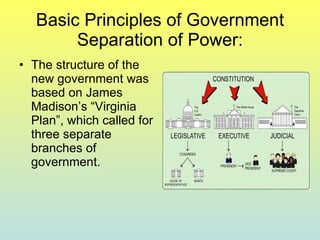
Basic Principles of Government Separation of Power: The structure of the new government was based on James Madison’s “Virginia Plan”, which called for three separate branches of government.
Legislative Branch (Congress) Makes the laws. Congress is a two-house legislature in which all states are represented equally in the Senate (two Senators per state) and people are represented in the House of Representatives (number of a state’s representatives is based on the state’s population.
Judicial Branch (Supreme Court) Determines if laws made by Congress are constitutional
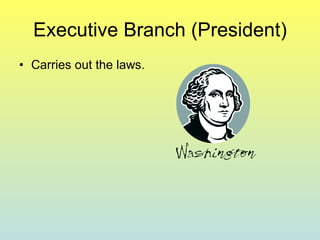
Executive Branch (President) Carries out the laws.
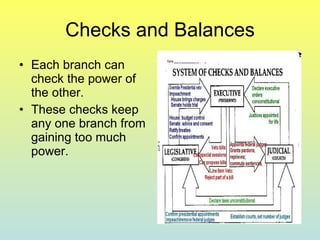
Checks and Balances Each branch can check the power of the other. These checks keep any one branch from gaining too much power.
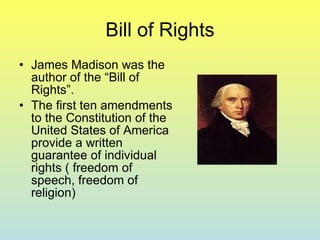
Bill of Rights James Madison was the author of the “Bill of Rights”. The first ten amendments to the Constitution of the United States of America provide a written guarantee of individual rights ( freedom of speech, freedom of religion)
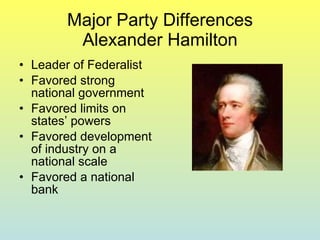
Major Party Differences Alexander Hamilton Leader of Federalist Favored strong national government Favored limits on states’ powers Favored development of industry on a national scale Favored a national bank
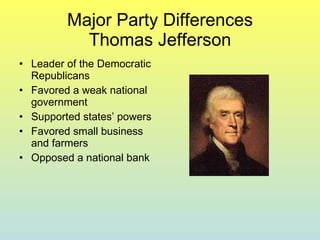
Major Party Differences Thomas Jefferson Leader of the Democratic Republicans Favored a weak national government Supported states’ powers Favored small business and farmers Opposed a national bank
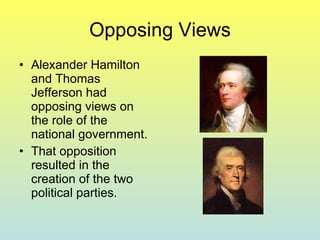
Opposing Views Alexander Hamilton and Thomas Jefferson had opposing views on the role of the national government. That opposition resulted in the creation of the two political parties.
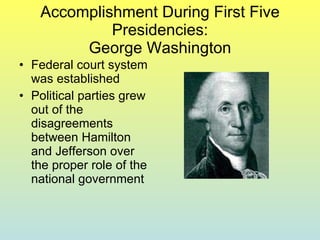
Accomplishment During First Five Presidencies: George Washington Federal court system was established Political parties grew out of the disagreements between Hamilton and Jefferson over the proper role of the national government
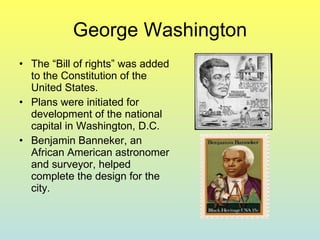
George Washington The “Bill of rights” was added to the Constitution of the United States. Plans were initiated for development of the national capital in Washington, D.C. Benjamin Banneker, an African American astronomer and surveyor, helped complete the design for the city.
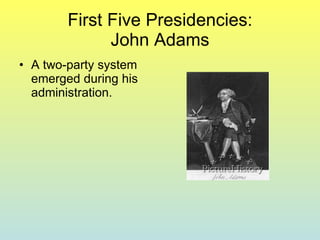
First Five Presidencies:  John Adams  A two-party system emerged during his administration.
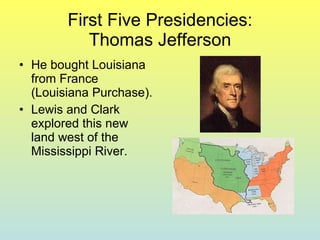
First Five Presidencies: Thomas Jefferson He bought Louisiana from France (Louisiana Purchase). Lewis and Clark explored this new land west of the Mississippi River.
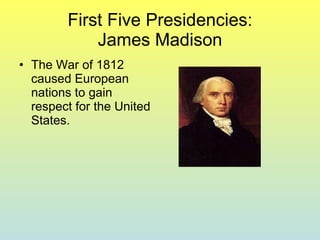
First Five Presidencies: James Madison The War of 1812 caused European nations to gain respect for the United States.
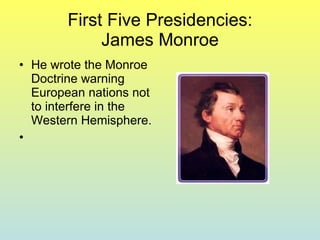
First Five Presidencies: James Monroe He wrote the Monroe Doctrine warning European nations not to interfere in the Western Hemisphere.
Things to know: All of the first presidents were Virginians except John Adams Congress and the first five presidents made decisions establishing a strong government that helped the nation grow in size and power
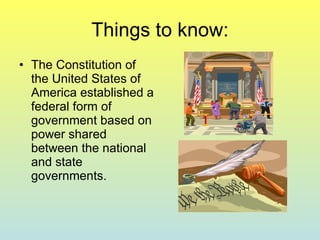
Things to know: The Constitution of the United States of America established a federal form of government based on power shared between the national and state governments.

A New Nation

  • 1.
    A New NationSOL US 1.7a,b,c,d The Challenges Faced by the New Nation Created by: S. Grey
  • 2.
    Articles of ConfederationThe Articles of Confederation was a constitution written during the American Revolution to establish the powers of the new national government Provided for a weak national government Gave congress no power to tax or regulate commerce among states
  • 3.
    Articles of ConfederationGave congress no power to tax or regulate commerce among states Provided for no common currency Gave each state one vote regardless of size Provided for no executive or judicial branch
  • 4.
    Basic Principles ofGovernment Separation of Power: The structure of the new government was based on James Madison’s “Virginia Plan”, which called for three separate branches of government.
  • 5.
    Legislative Branch (Congress)Makes the laws. Congress is a two-house legislature in which all states are represented equally in the Senate (two Senators per state) and people are represented in the House of Representatives (number of a state’s representatives is based on the state’s population.
  • 6.
    Judicial Branch (SupremeCourt) Determines if laws made by Congress are constitutional
  • 7.
    Executive Branch (President)Carries out the laws.
  • 8.
    Checks and BalancesEach branch can check the power of the other. These checks keep any one branch from gaining too much power.
  • 9.
    Bill of RightsJames Madison was the author of the “Bill of Rights”. The first ten amendments to the Constitution of the United States of America provide a written guarantee of individual rights ( freedom of speech, freedom of religion)
  • 10.
    Major Party DifferencesAlexander Hamilton Leader of Federalist Favored strong national government Favored limits on states’ powers Favored development of industry on a national scale Favored a national bank
  • 11.
    Major Party DifferencesThomas Jefferson Leader of the Democratic Republicans Favored a weak national government Supported states’ powers Favored small business and farmers Opposed a national bank
  • 12.
    Opposing Views AlexanderHamilton and Thomas Jefferson had opposing views on the role of the national government. That opposition resulted in the creation of the two political parties.
  • 13.
    Accomplishment During FirstFive Presidencies: George Washington Federal court system was established Political parties grew out of the disagreements between Hamilton and Jefferson over the proper role of the national government
  • 14.
    George Washington The“Bill of rights” was added to the Constitution of the United States. Plans were initiated for development of the national capital in Washington, D.C. Benjamin Banneker, an African American astronomer and surveyor, helped complete the design for the city.
  • 15.
    First Five Presidencies: John Adams A two-party system emerged during his administration.
  • 16.
    First Five Presidencies:Thomas Jefferson He bought Louisiana from France (Louisiana Purchase). Lewis and Clark explored this new land west of the Mississippi River.
  • 17.
    First Five Presidencies:James Madison The War of 1812 caused European nations to gain respect for the United States.
  • 18.
    First Five Presidencies:James Monroe He wrote the Monroe Doctrine warning European nations not to interfere in the Western Hemisphere.
  • 19.
    Things to know:All of the first presidents were Virginians except John Adams Congress and the first five presidents made decisions establishing a strong government that helped the nation grow in size and power
  • 20.
    Things to know:The Constitution of the United States of America established a federal form of government based on power shared between the national and state governments.