Define the following terms in your notes : 1. Northwest Ordinance 2. Shay’s Rebellion 3. Constitutional Convention 4. Virginia Plan 5. New Jersey Plan 6. Great Compromise 7. Three-fifths Compromise 8. Federalist  9. Antifederalist 10. Separation of Powers 11. Checks and Balances 12. Impeachment 13. Elastic Clause
BELL-RINGER How many years was it between the end of the Revolutionary War and the election of our first president (George Washington)? Take a guess!!! 1783-1789 = 6
CHAPTER 5: THE GROWTH OF A NEW NATION
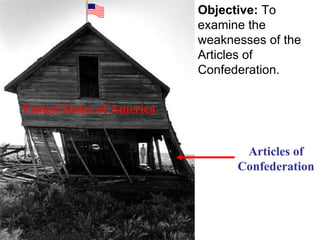
Objective:  To examine the weaknesses of the Articles of Confederation. United States of America  Articles of Confederation
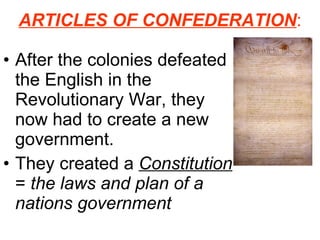
ARTICLES OF CONFEDERATION : After the colonies defeated the English in the Revolutionary War, they now had to create a new government. They created a  Constitution  =  the laws and plan of a nations government
PROBLEMS AFTER THE WAR: 1. England stopped trading with the colonies Must find new trading partners 2.  High Debt 3. Each state had their own money 4. Arguments between states 5. What to do with the western lands?
Why did the Articles of Confederation fail? 1. No national currency 2. Congress could not tax 3. Limited military / defense 4. Needed approval of 9 states for laws 5. No Supreme Court / Federal Court
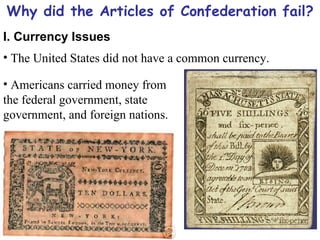
Why did the Articles of Confederation fail? I. Currency Issues The United States did not have a common currency. Americans carried money from the federal government, state government, and foreign nations.
Why did the Articles of Confederation fail? II. Debt Congress could not tax the people and depended on money from the states. Therefore, the U.S. was unable to pay its debts! Examples: - The U.S. owed money to France, Holland, and Spain for loans made during the Revolutionary War. - The U.S. had not paid many of their own soldiers!
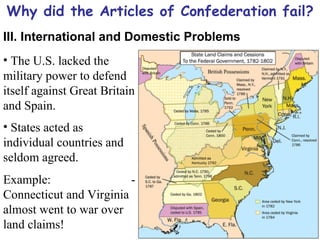
Why did the Articles of Confederation fail? III. International and Domestic Problems The U.S. lacked the military power to defend itself against Great Britain and Spain. States acted as individual countries and seldom agreed. Example:  - Connecticut and Virginia almost went to war over land claims!
Why did the Articles of Confederation fail? Courts (Judicial Branch) IV.  The nation lacked a national court system. Supreme Court
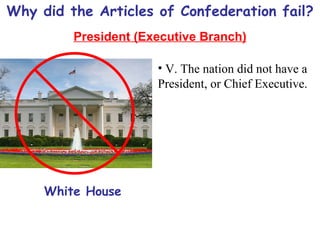
Why did the Articles of Confederation fail? President (Executive Branch) V. The nation did not have a President, or Chief Executive. White House
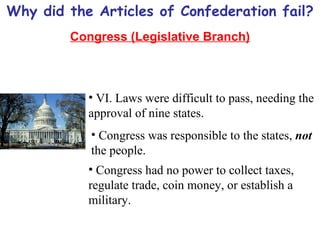
Why did the Articles of Confederation fail? Congress (Legislative Branch) VI. Laws were difficult to pass, needing the approval of nine states. Congress was responsible to the states,  not  the people. Congress had no power to collect taxes, regulate trade, coin money, or establish a military.
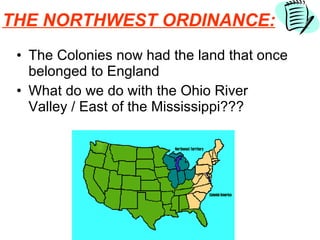
THE NORTHWEST ORDINANCE: The Colonies now had the land that once belonged to England What do we do with the Ohio River Valley / East of the Mississippi???
HOW TO BECOME A STATE: NEEDED 5,000 FREEMEN OF VOTING AGE THEN THEY COULD ELECT A CONGRESS THEY COULD ASK FOR STATEHOOD AFTER THEY HAD A POPULATION OF 60,000 PEOPLE.  NO SLAVERY WAS ALLOWED
Impact of the Confederation… 1. Economic depression Limited tax collection! (at first) 2. Loss of Great Britain as trading partner 3. Farmers really suffered… Began taxing land to pay war debts.
Ticket out the door No notes!!! Name 3 problems with the Articles of Confederation…
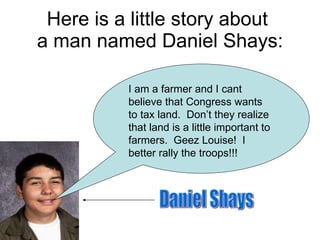
Here is a little story about  a man named Daniel Shays: I am a farmer and I cant believe that Congress wants to tax land.  Don’t they realize that land is a little important to farmers.  Geez Louise!  I better rally the troops!!! Daniel Shays
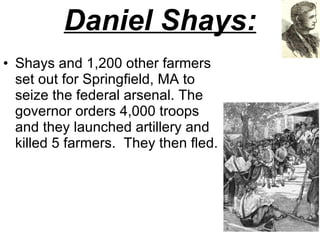
Daniel Shays: Shays and 1,200 other farmers set out for Springfield, MA to seize the federal arsenal. The governor orders 4,000 troops and they launched artillery and killed 5 farmers.  They then fled.
THE BIG PICTURE… People began to question how the Confederation could handle future rebellions. Others wanted the Confederation to have additional powers.  (increase the size of government)
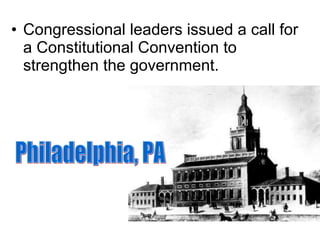
Congressional leaders issued a call for a Constitutional Convention to strengthen the government.  Philadelphia, PA
HW = Blog on Wiki: “ Federal Power Versus States’ Rights ” Use the following terms in your summary Virginia Plan Federalism Bicameral New Jersey Plan pg. 143-144 or use the  internet
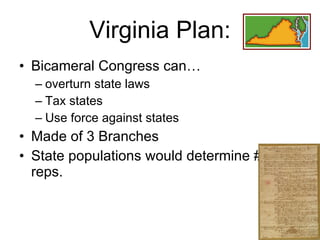
Virginia Plan: Bicameral Congress can… overturn state laws Tax states Use force against states Made of 3 Branches State populations would determine # of reps.
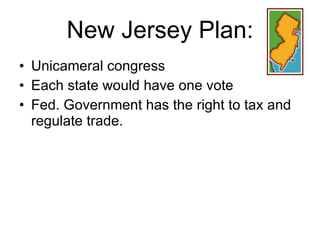
New Jersey Plan: Unicameral congress Each state would have one vote Fed. Government has the right to tax and regulate trade.
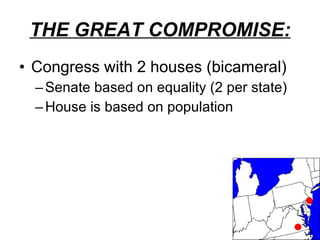
THE GREAT COMPROMISE: Congress with 2 houses (bicameral) Senate based on equality (2 per state) House is based on population
THINK OF A TIME IN YOUR LIFE WHEN YOU HAD TO MAKE A  COMPROMISE ? TAKE 1 MINUTE AND REFLECT….
How should we count slaves in terms  of population???
2 QUESTIONS: 1. What would the north want? 2. What would the south want?
Three-Fifths Compromise Slaves were counted as 3/5ths a person
FEDERALIST: I support a strong federal government and therefore support the Constitution.
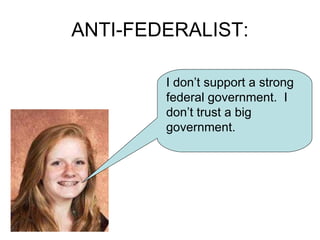
ANTI-FEDERALIST: I don’t support a strong federal government.  I don’t trust a big government.
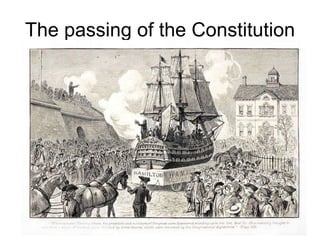
The passing of the Constitution
BILL OF RIGHTS:
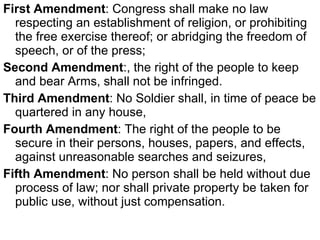
First Amendment : Congress shall make no law respecting an establishment of religion, or prohibiting the free exercise thereof; or abridging the freedom of speech, or of the press; Second Amendment :, the right of the people to keep and bear Arms, shall not be infringed.  Third Amendment : No Soldier shall, in time of peace be quartered in any house,  Fourth Amendment : The right of the people to be secure in their persons, houses, papers, and effects, against unreasonable searches and seizures,  Fifth Amendment : No person shall be held without due process of law; nor shall private property be taken for public use, without just compensation.
Sixth Amendment : In all criminal prosecutions, the accused shall enjoy the right to a speedy and public trial, and to have the Assistance of Counsel for his defense.  Seventh Amendment : right of trial by jury shall be preserved,  Eighth Amendment : Excessive bail shall not be required, nor excessive fines imposed, nor cruel and unusual punishments inflicted.  Ninth Amendment : The enumeration in the Constitution, of certain rights, shall not be construed to deny or disparage others retained by the people.  Tenth Amendment: The  powers not delegated to the United States by the Constitution, nor prohibited by it to the States, are reserved to the States respectively, or to the people.
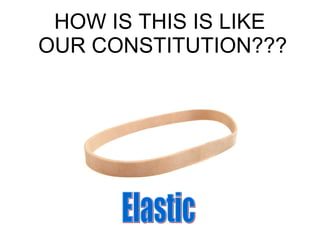
HOW IS THIS IS LIKE  OUR CONSTITUTION??? Elastic
Growth of the Constitution: - 19 th  = Women's right to vote - 18 th  = Prohibition - 21 st  = Repeal of prohibition - 26 th  = 18 years old to vote - 22 = 2 Term limit for presidents 27th Amendment - 1992
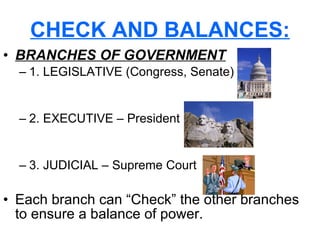
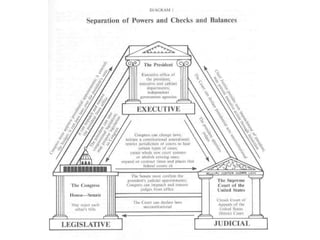
CHECK AND BALANCES: BRANCHES OF GOVERNMENT 1. LEGISLATIVE (Congress, Senate) 2. EXECUTIVE – President 3. JUDICIAL – Supreme Court Each branch can “Check” the other branches to ensure a balance of power.
 
REFLECTION… Think of a time in your life when you started something new and you knew that you were going to face some challenges? 2 minutes
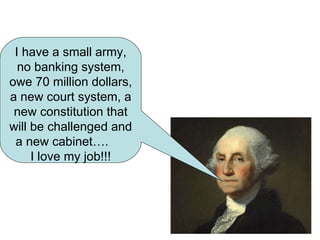
I have a small army, no banking system, owe 70 million dollars, a new court system, a new constitution that will be challenged and a new cabinet….  I love my job!!!
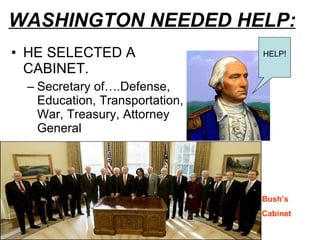
WASHINGTON NEEDED HELP: HE SELECTED A CABINET. Secretary of….Defense, Education, Transportation, War, Treasury, Attorney General HELP! Bush’s  Cabinet
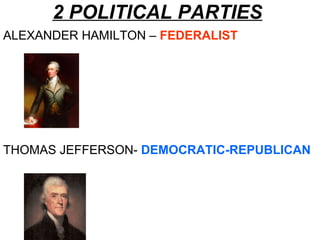
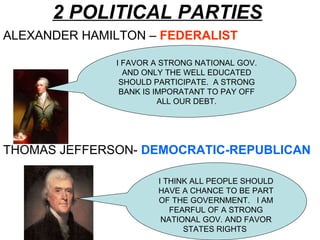
2 POLITICAL PARTIES ALEXANDER HAMILTON –  FEDERALIST THOMAS JEFFERSON-  DEMOCRATIC-REPUBLICAN
ASSIGNMENT: Using  www.hippocampus.org Find the Clip on Hamilton and Jefferson Write a blog on the wiki page 10 points, due today!
2 POLITICAL PARTIES ALEXANDER HAMILTON –  FEDERALIST THOMAS JEFFERSON-  DEMOCRATIC-REPUBLICAN   I THINK ALL PEOPLE SHOULD HAVE A CHANCE TO BE PART OF THE GOVERNMENT.  I AM FEARFUL OF A STRONG NATIONAL GOV. AND FAVOR STATES RIGHTS  I FAVOR A STRONG NATIONAL GOV. AND ONLY THE WELL EDUCATED SHOULD PARTICIPATE.  A STRONG BANK IS IMPORATANT TO PAY OFF ALL OUR DEBT.
List 5 characteristics of a good leader. 1. 2. 3. 4. 5
What does Washington do??? He invites both men to Congress to express their ideas. “A quality of a good leader is to listen to others, take their advice and then make a sound, well informed decision.” - Boyle
TRUE OR FALSE? 1. A  Constitution  means  the laws and plan of a nations government? 2.  Under the Articles of Confederation, states thought of themselves as separate countries. 3. Under the Articles of Confederation the government collected taxes. 4. After the Revolutionary War, America had to find new trading partners. 5. All of the states used the same money. 6. Land taken from England after the war, Ohio River Valley and east of the Mississippi River, could eventually become a state.
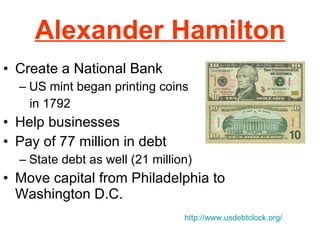
Alexander Hamilton Create a National Bank  US mint began printing coins  in 1792 Help businesses  Pay of 77 million in debt State debt as well (21 million) Move capital from Philadelphia to Washington D.C.  http://www.usdebtclock.org/
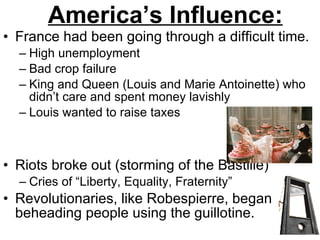
America’s Influence: France had been going through a difficult time. High unemployment Bad crop failure King and Queen (Louis and Marie Antoinette) who didn’t care and spent money lavishly Louis wanted to raise taxes Riots broke out (storming of the Bastille) Cries of “Liberty, Equality, Fraternity” Revolutionaries, like Robespierre, began beheading people using the guillotine.
AMERICA’S REACTION: Many wanted to stay out (neutral) because it was a European mess Others felt we didn’t have the money A lot of people felt the beheading was grotesque and uncivil Britain and France were enemies… The USA shouldn’t choose sides, but both countries felt the USA betrayed them for their lack of support.  Both were capturing US ships and prisoners
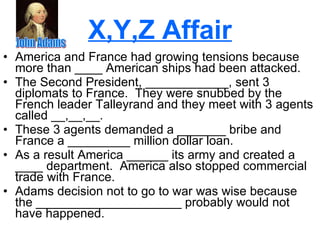
X,Y,Z Affair America and France had growing tensions because more than ____ American ships had been attacked. The Second President, ____________, sent 3 diplomats to France.  They were snubbed by the French leader Talleyrand and they meet with 3 agents called __,__,__. These 3 agents demanded a _______ bribe and France a _________ million dollar loan. As a result America ______ its army and created a ____ department.  America also stopped commercial trade with France. Adams decision not to go to war was wise because the _____________________ probably would not have happened.  John Adams
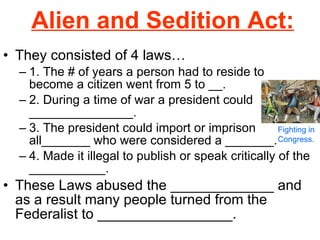
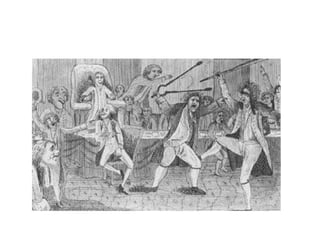
Alien and Sedition Act: They consisted of 4 laws… 1. The # of years a person had to reside to become a citizen went from 5 to __. 2. During a time of war a president could _______________. 3. The president could import or imprison all_______ who were considered a _______. 4. Made it illegal to publish or speak critically of the ___________. These Laws abused the _____________ and as a result many people turned from the Federalist to _________________. Fighting in Congress.
Election of 1800: The Federalist = _________ and ___________. The Republicans = _________ and _________. Jefferson appealed to __________ and wanted a small federal government. The Republican won, but Jefferson and Burr both had ____ votes to become president. A strong Federalist, _____________, hated Aaron Burr and therefore supported Jefferson. After a decade of rule the __________ party was finished.
 
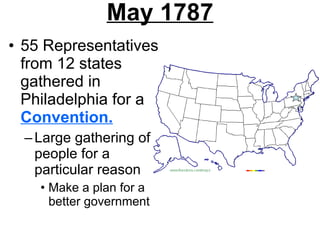
May 1787 55 Representatives from 12 states gathered in Philadelphia for a  Convention. Large gathering of people for a particular reason Make a plan for a better government
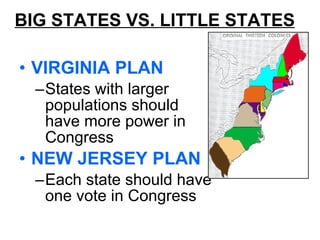
BIG STATES VS. LITTLE STATES VIRGINIA PLAN States with larger populations should have more power in Congress NEW JERSEY PLAN Each state should have one vote in Congress
SHARE WITH A NEIGHBOR… WHEN IN YOUR LIFE HAVE YOU SETTLED A DISAGREEMENT?  SETTLING AN DISAGREEMENT IS CALLED A  COMPROMISE.
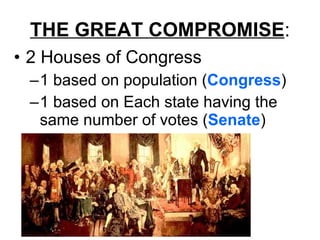
THE GREAT COMPROMISE : 2 Houses of Congress 1 based on population ( Congress ) 1 based on Each state having the same number of votes ( Senate )
THE THREE-FIFTHS COMPROMISE: Do we count slaves as part of states populations? Northerners said Southerners treated them like property, and so they shouldn’t be counted Southerners wanted to count slaves in their population – more power The delegates  compromised  and counted slaves as 3/5 of a person
REVIEW QUIZ: 1. The Virginia Plan favored big or little states? 2. The New Jersey Plan favored big or little?  3. Settling a Disagreement is called a_______. 4. How were slaves counted in terms of population? 5. Name the 3 Branches of Government.
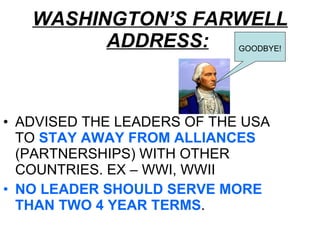
WASHINGTON’S FARWELL ADDRESS:   ADVISED THE LEADERS OF THE USA TO  STAY AWAY FROM ALLIANCES  (PARTNERSHIPS) WITH OTHER COUNTRIES. EX – WWI, WWII NO LEADER SHOULD SERVE MORE THAN TWO 4 YEAR TERMS .  GOODBYE!
QUIZ – Self Assessment: 1.Combination of the Virginia and New Jersey Plans is called ____________. 2.The Constitutions ability to grow and contract is called ______________. 3. The _____________ is the first 10 Amendments of the Constitution. 4. Slaves were counted as _____ a person for population counts. 5. The _______________ was the first constitution / government that had many failures.  6. The _____________ Plan called for small states to have a larger voice in the federal government.  7. A ________________ , like Brandi Pearson, was against the creation of a constitution and strong federal government.  8. Farmers like ___________________ revolted and raised awareness to the fact that the government needed change.

5 slideshare

  • 1.
    Define the followingterms in your notes : 1. Northwest Ordinance 2. Shay’s Rebellion 3. Constitutional Convention 4. Virginia Plan 5. New Jersey Plan 6. Great Compromise 7. Three-fifths Compromise 8. Federalist 9. Antifederalist 10. Separation of Powers 11. Checks and Balances 12. Impeachment 13. Elastic Clause
  • 2.
    BELL-RINGER How manyyears was it between the end of the Revolutionary War and the election of our first president (George Washington)? Take a guess!!! 1783-1789 = 6
  • 3.
    CHAPTER 5: THEGROWTH OF A NEW NATION
  • 4.
    Objective: Toexamine the weaknesses of the Articles of Confederation. United States of America Articles of Confederation
  • 5.
    ARTICLES OF CONFEDERATION: After the colonies defeated the English in the Revolutionary War, they now had to create a new government. They created a Constitution = the laws and plan of a nations government
  • 6.
    PROBLEMS AFTER THEWAR: 1. England stopped trading with the colonies Must find new trading partners 2. High Debt 3. Each state had their own money 4. Arguments between states 5. What to do with the western lands?
  • 7.
    Why did theArticles of Confederation fail? 1. No national currency 2. Congress could not tax 3. Limited military / defense 4. Needed approval of 9 states for laws 5. No Supreme Court / Federal Court
  • 8.
    Why did theArticles of Confederation fail? I. Currency Issues The United States did not have a common currency. Americans carried money from the federal government, state government, and foreign nations.
  • 9.
    Why did theArticles of Confederation fail? II. Debt Congress could not tax the people and depended on money from the states. Therefore, the U.S. was unable to pay its debts! Examples: - The U.S. owed money to France, Holland, and Spain for loans made during the Revolutionary War. - The U.S. had not paid many of their own soldiers!
  • 10.
    Why did theArticles of Confederation fail? III. International and Domestic Problems The U.S. lacked the military power to defend itself against Great Britain and Spain. States acted as individual countries and seldom agreed. Example: - Connecticut and Virginia almost went to war over land claims!
  • 11.
    Why did theArticles of Confederation fail? Courts (Judicial Branch) IV. The nation lacked a national court system. Supreme Court
  • 12.
    Why did theArticles of Confederation fail? President (Executive Branch) V. The nation did not have a President, or Chief Executive. White House
  • 13.
    Why did theArticles of Confederation fail? Congress (Legislative Branch) VI. Laws were difficult to pass, needing the approval of nine states. Congress was responsible to the states, not the people. Congress had no power to collect taxes, regulate trade, coin money, or establish a military.
  • 14.
    THE NORTHWEST ORDINANCE:The Colonies now had the land that once belonged to England What do we do with the Ohio River Valley / East of the Mississippi???
  • 15.
    HOW TO BECOMEA STATE: NEEDED 5,000 FREEMEN OF VOTING AGE THEN THEY COULD ELECT A CONGRESS THEY COULD ASK FOR STATEHOOD AFTER THEY HAD A POPULATION OF 60,000 PEOPLE. NO SLAVERY WAS ALLOWED
  • 16.
    Impact of theConfederation… 1. Economic depression Limited tax collection! (at first) 2. Loss of Great Britain as trading partner 3. Farmers really suffered… Began taxing land to pay war debts.
  • 17.
    Ticket out thedoor No notes!!! Name 3 problems with the Articles of Confederation…
  • 18.
    Here is alittle story about a man named Daniel Shays: I am a farmer and I cant believe that Congress wants to tax land. Don’t they realize that land is a little important to farmers. Geez Louise! I better rally the troops!!! Daniel Shays
  • 19.
    Daniel Shays: Shaysand 1,200 other farmers set out for Springfield, MA to seize the federal arsenal. The governor orders 4,000 troops and they launched artillery and killed 5 farmers. They then fled.
  • 20.
    THE BIG PICTURE…People began to question how the Confederation could handle future rebellions. Others wanted the Confederation to have additional powers. (increase the size of government)
  • 21.
    Congressional leaders issueda call for a Constitutional Convention to strengthen the government. Philadelphia, PA
  • 22.
    HW = Blogon Wiki: “ Federal Power Versus States’ Rights ” Use the following terms in your summary Virginia Plan Federalism Bicameral New Jersey Plan pg. 143-144 or use the internet
  • 23.
    Virginia Plan: BicameralCongress can… overturn state laws Tax states Use force against states Made of 3 Branches State populations would determine # of reps.
  • 24.
    New Jersey Plan:Unicameral congress Each state would have one vote Fed. Government has the right to tax and regulate trade.
  • 25.
    THE GREAT COMPROMISE:Congress with 2 houses (bicameral) Senate based on equality (2 per state) House is based on population
  • 26.
    THINK OF ATIME IN YOUR LIFE WHEN YOU HAD TO MAKE A COMPROMISE ? TAKE 1 MINUTE AND REFLECT….
  • 27.
    How should wecount slaves in terms of population???
  • 28.
    2 QUESTIONS: 1.What would the north want? 2. What would the south want?
  • 29.
    Three-Fifths Compromise Slaveswere counted as 3/5ths a person
  • 30.
    FEDERALIST: I supporta strong federal government and therefore support the Constitution.
  • 31.
    ANTI-FEDERALIST: I don’tsupport a strong federal government. I don’t trust a big government.
  • 32.
    The passing ofthe Constitution
  • 33.
  • 34.
    First Amendment :Congress shall make no law respecting an establishment of religion, or prohibiting the free exercise thereof; or abridging the freedom of speech, or of the press; Second Amendment :, the right of the people to keep and bear Arms, shall not be infringed. Third Amendment : No Soldier shall, in time of peace be quartered in any house, Fourth Amendment : The right of the people to be secure in their persons, houses, papers, and effects, against unreasonable searches and seizures, Fifth Amendment : No person shall be held without due process of law; nor shall private property be taken for public use, without just compensation.
  • 35.
    Sixth Amendment :In all criminal prosecutions, the accused shall enjoy the right to a speedy and public trial, and to have the Assistance of Counsel for his defense. Seventh Amendment : right of trial by jury shall be preserved, Eighth Amendment : Excessive bail shall not be required, nor excessive fines imposed, nor cruel and unusual punishments inflicted. Ninth Amendment : The enumeration in the Constitution, of certain rights, shall not be construed to deny or disparage others retained by the people. Tenth Amendment: The powers not delegated to the United States by the Constitution, nor prohibited by it to the States, are reserved to the States respectively, or to the people.
  • 36.
    HOW IS THISIS LIKE OUR CONSTITUTION??? Elastic
  • 37.
    Growth of theConstitution: - 19 th = Women's right to vote - 18 th = Prohibition - 21 st = Repeal of prohibition - 26 th = 18 years old to vote - 22 = 2 Term limit for presidents 27th Amendment - 1992
  • 38.
    CHECK AND BALANCES:BRANCHES OF GOVERNMENT 1. LEGISLATIVE (Congress, Senate) 2. EXECUTIVE – President 3. JUDICIAL – Supreme Court Each branch can “Check” the other branches to ensure a balance of power.
  • 39.
  • 40.
    REFLECTION… Think ofa time in your life when you started something new and you knew that you were going to face some challenges? 2 minutes
  • 41.
    I have asmall army, no banking system, owe 70 million dollars, a new court system, a new constitution that will be challenged and a new cabinet…. I love my job!!!
  • 42.
    WASHINGTON NEEDED HELP:HE SELECTED A CABINET. Secretary of….Defense, Education, Transportation, War, Treasury, Attorney General HELP! Bush’s Cabinet
  • 43.
    2 POLITICAL PARTIESALEXANDER HAMILTON – FEDERALIST THOMAS JEFFERSON- DEMOCRATIC-REPUBLICAN
  • 44.
    ASSIGNMENT: Using www.hippocampus.org Find the Clip on Hamilton and Jefferson Write a blog on the wiki page 10 points, due today!
  • 45.
    2 POLITICAL PARTIESALEXANDER HAMILTON – FEDERALIST THOMAS JEFFERSON- DEMOCRATIC-REPUBLICAN I THINK ALL PEOPLE SHOULD HAVE A CHANCE TO BE PART OF THE GOVERNMENT. I AM FEARFUL OF A STRONG NATIONAL GOV. AND FAVOR STATES RIGHTS I FAVOR A STRONG NATIONAL GOV. AND ONLY THE WELL EDUCATED SHOULD PARTICIPATE. A STRONG BANK IS IMPORATANT TO PAY OFF ALL OUR DEBT.
  • 46.
    List 5 characteristicsof a good leader. 1. 2. 3. 4. 5
  • 47.
    What does Washingtondo??? He invites both men to Congress to express their ideas. “A quality of a good leader is to listen to others, take their advice and then make a sound, well informed decision.” - Boyle
  • 48.
    TRUE OR FALSE?1. A Constitution means the laws and plan of a nations government? 2. Under the Articles of Confederation, states thought of themselves as separate countries. 3. Under the Articles of Confederation the government collected taxes. 4. After the Revolutionary War, America had to find new trading partners. 5. All of the states used the same money. 6. Land taken from England after the war, Ohio River Valley and east of the Mississippi River, could eventually become a state.
  • 49.
    Alexander Hamilton Createa National Bank US mint began printing coins in 1792 Help businesses Pay of 77 million in debt State debt as well (21 million) Move capital from Philadelphia to Washington D.C. http://www.usdebtclock.org/
  • 50.
    America’s Influence: Francehad been going through a difficult time. High unemployment Bad crop failure King and Queen (Louis and Marie Antoinette) who didn’t care and spent money lavishly Louis wanted to raise taxes Riots broke out (storming of the Bastille) Cries of “Liberty, Equality, Fraternity” Revolutionaries, like Robespierre, began beheading people using the guillotine.
  • 51.
    AMERICA’S REACTION: Manywanted to stay out (neutral) because it was a European mess Others felt we didn’t have the money A lot of people felt the beheading was grotesque and uncivil Britain and France were enemies… The USA shouldn’t choose sides, but both countries felt the USA betrayed them for their lack of support. Both were capturing US ships and prisoners
  • 52.
    X,Y,Z Affair Americaand France had growing tensions because more than ____ American ships had been attacked. The Second President, ____________, sent 3 diplomats to France. They were snubbed by the French leader Talleyrand and they meet with 3 agents called __,__,__. These 3 agents demanded a _______ bribe and France a _________ million dollar loan. As a result America ______ its army and created a ____ department. America also stopped commercial trade with France. Adams decision not to go to war was wise because the _____________________ probably would not have happened. John Adams
  • 53.
    Alien and SeditionAct: They consisted of 4 laws… 1. The # of years a person had to reside to become a citizen went from 5 to __. 2. During a time of war a president could _______________. 3. The president could import or imprison all_______ who were considered a _______. 4. Made it illegal to publish or speak critically of the ___________. These Laws abused the _____________ and as a result many people turned from the Federalist to _________________. Fighting in Congress.
  • 54.
    Election of 1800:The Federalist = _________ and ___________. The Republicans = _________ and _________. Jefferson appealed to __________ and wanted a small federal government. The Republican won, but Jefferson and Burr both had ____ votes to become president. A strong Federalist, _____________, hated Aaron Burr and therefore supported Jefferson. After a decade of rule the __________ party was finished.
  • 55.
  • 56.
    May 1787 55Representatives from 12 states gathered in Philadelphia for a Convention. Large gathering of people for a particular reason Make a plan for a better government
  • 57.
    BIG STATES VS.LITTLE STATES VIRGINIA PLAN States with larger populations should have more power in Congress NEW JERSEY PLAN Each state should have one vote in Congress
  • 58.
    SHARE WITH ANEIGHBOR… WHEN IN YOUR LIFE HAVE YOU SETTLED A DISAGREEMENT? SETTLING AN DISAGREEMENT IS CALLED A COMPROMISE.
  • 59.
    THE GREAT COMPROMISE: 2 Houses of Congress 1 based on population ( Congress ) 1 based on Each state having the same number of votes ( Senate )
  • 60.
    THE THREE-FIFTHS COMPROMISE:Do we count slaves as part of states populations? Northerners said Southerners treated them like property, and so they shouldn’t be counted Southerners wanted to count slaves in their population – more power The delegates compromised and counted slaves as 3/5 of a person
  • 61.
    REVIEW QUIZ: 1.The Virginia Plan favored big or little states? 2. The New Jersey Plan favored big or little? 3. Settling a Disagreement is called a_______. 4. How were slaves counted in terms of population? 5. Name the 3 Branches of Government.
  • 62.
    WASHINGTON’S FARWELL ADDRESS: ADVISED THE LEADERS OF THE USA TO STAY AWAY FROM ALLIANCES (PARTNERSHIPS) WITH OTHER COUNTRIES. EX – WWI, WWII NO LEADER SHOULD SERVE MORE THAN TWO 4 YEAR TERMS . GOODBYE!
  • 63.
    QUIZ – SelfAssessment: 1.Combination of the Virginia and New Jersey Plans is called ____________. 2.The Constitutions ability to grow and contract is called ______________. 3. The _____________ is the first 10 Amendments of the Constitution. 4. Slaves were counted as _____ a person for population counts. 5. The _______________ was the first constitution / government that had many failures. 6. The _____________ Plan called for small states to have a larger voice in the federal government. 7. A ________________ , like Brandi Pearson, was against the creation of a constitution and strong federal government. 8. Farmers like ___________________ revolted and raised awareness to the fact that the government needed change.