Blood Products in Critically ill Children
Shamiel Salie
Paediatric Intensive Care Unit
Red Cross Children’s Hospital,
University of Cape Town
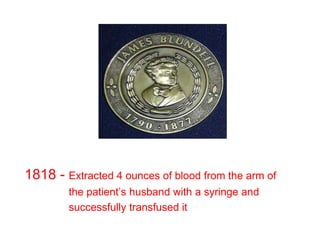
1818 - Extracted 4 ounces of blood from the arm of
the patient’s husband with a syringe and
successfully transfused it
Anaemia in critically ill children
• Causes
– Chronic anaemia
– Overt and occult blood
loss
– Bone marrow
suppression from
diseases/treatment
– Inadequate erythropoietin
response to anaemia
Red Blood Cell Transfusions
• For decades considered to be a low risk
with obvious benefits
• 10/30 rule
• Restrictive use of blood since the 1980’s
What actually happens in PICU?
• 50% of children in PICU’s transfused
Bateman: Am J Resp Crit Care Med 2008
• Large variability in clinical practise
• Bedside observational studies
Gauvin 2000 & Armano 2005
– transfusion threshold ranges from 7 - 11 g/dl
• 30 North American PICU’s
– Pretransfusion Hb 9.7 g/dl
Bateman: Am J Resp Crit Care Med 2008
Physiological benefits of RBC
transfusions
• Tissue hypoxia may be due to low Hb
concentration, cardiac output or SaO2
• Oxygen delivery exceeds requirements
• Adaptive processes as oxygen delivery
decreases with anaemia
– Increased oxygen extraction
– Increased heart rate and stroke volume
– Preferential perfusion of head and heart at
the expense of splanchnic perfusion
• Altered physiological adaptation to low Hb
in critically ill children
– Increased metabolic rate in SIRS increases
oxygen consumption and lowers reserves
– Impaired LV function and vascular tone
restricts oxygen delivery and blood
redistribution
– Infants have high resting heart rates, which
limits the ability to increase cardiac output
Microcirculatory effects of
transfused RBC
• Global increase in oxygen delivery with
potentially decreased microcirculatory flow
– Increased blood viscousity
– Cytokines my cause vasoconstriction
– Low levels of 2,3 DPG shifts curve left,
impeding oxygen availability
– Decreased RBC membrane deformability
– Free Hb may bind NO causing vasoconstriction
Immunologic effects of RBC
transfusion
• Some evidence that it may cause
– Immune suppression by altering lymphocyte
reactivity
– Pro inflammatory: cytokines in unfiltered rbc’s
might trigger SIRS or multi organ failure
When should critically ill
children be transfused?
• 637 critically ill children
• Equivalence of restrictive strategy (Hb<7) and
liberal strategy (Hb <9.5)
• No difference in MODS, death, icu stay and sepsis
• 44% reduction in blood transfusions
• 50% of study children transfused
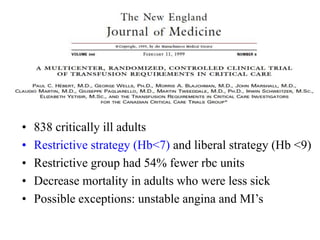
• 838 critically ill adults
• Restrictive strategy (Hb<7) and liberal strategy (Hb <9)
• Restrictive group had 54% fewer rbc units
• Decrease mortality in adults who were less sick
• Possible exceptions: unstable angina and MI’s
• 1269 Kenyan children hospitalized for malaria
English, Lancet 2002
– RBC transfusion decreased mortality in severe anaemia, <4g/dl
or if Hb < 5g/dl and dyspnoeic
- some benefits to keep Hb > 5 in hospitalized children
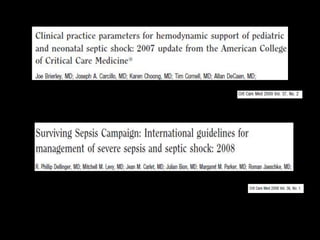
• Haemodynamically unstable children: Hb > 10
• De Oliveira et al (Intens. Care Med. 2008)
– children with severe sepsis
– significant reduction in 28 day mortality
(11% vs 39%, p=0.002) and new organ failure
– targeting SVC sats > 70% using fluids, inotropes and
blood transfusions keeping Hb > 10g/dl
• Similar outcomes in adults using goal directed
therapy Rivers et al, NEJM 2001
• Children with severe congenital heart disease and
traumatic brain injuries might need higher Hb’s
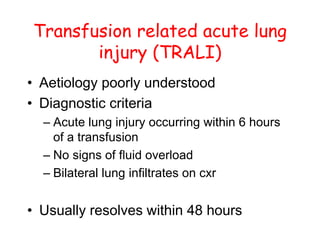
Transfusion related acute lung
injury (TRALI)
• Aetiology poorly understood
• Diagnostic criteria
– Acute lung injury occurring within 6 hours
of a transfusion
– No signs of fluid overload
– Bilateral lung infiltrates on cxr
• Usually resolves within 48 hours
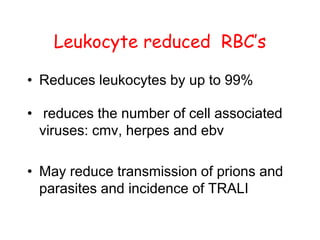
Leukocyte reduced RBC’s
• Reduces leukocytes by up to 99%
• reduces the number of cell associated
viruses: cmv, herpes and ebv
• May reduce transmission of prions and
parasites and incidence of TRALI
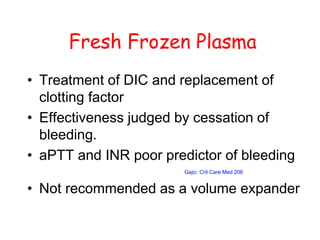
Fresh Frozen Plasma
• Treatment of DIC and replacement of
clotting factor
• Effectiveness judged by cessation of
bleeding.
• aPTT and INR poor predictor of bleeding
Gajic: Crit Care Med 206
• Not recommended as a volume expander
Platelets
• Thrombocytopenia and qualitative platelet
defects impairs ability to form platelet plugs
• Risk of massive bleeding when platelet
count < 10 and IVH when platelets <1
• No scientific basis for keeping platelets > 20
Cryoprecipitate
• Rapid increase in fibrinogen levels in
patients with DIC and active bleeding
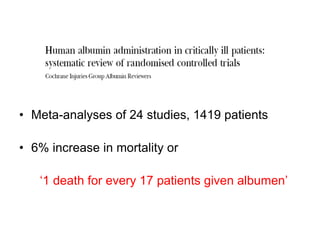
• Meta-analyses of 24 studies, 1419 patients
• 6% increase in mortality or
‘1 death for every 17 patients given albumen’
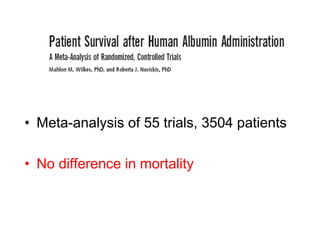
• Meta-analysis of 55 trials, 3504 patients
• No difference in mortality
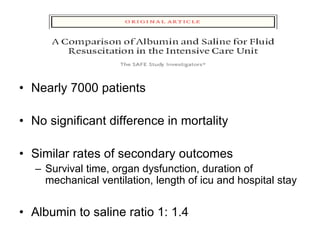
• Nearly 7000 patients
• No significant difference in mortality
• Similar rates of secondary outcomes
– Survival time, organ dysfunction, duration of
mechanical ventilation, length of icu and hospital stay
• Albumin to saline ratio 1: 1.4
Conclusions
• Stable critically ill children can support
an Hb > 7
• Maintain Hb > 10 in haemodynamically
unstable children, those with significant
cardiovascular disease and traumatic
brain injuries
Conclusions
• Advantages to using leukocyte
reduced blood
• Platelet transfusion thresholds not
evidence based
• Prophylactic use of FFP is
controversial
Questions

Blood products.ppt

  • 1.
    Blood Products inCritically ill Children Shamiel Salie Paediatric Intensive Care Unit Red Cross Children’s Hospital, University of Cape Town
  • 3.
    1818 - Extracted4 ounces of blood from the arm of the patient’s husband with a syringe and successfully transfused it
  • 4.
    Anaemia in criticallyill children • Causes – Chronic anaemia – Overt and occult blood loss – Bone marrow suppression from diseases/treatment – Inadequate erythropoietin response to anaemia
  • 5.
    Red Blood CellTransfusions • For decades considered to be a low risk with obvious benefits • 10/30 rule • Restrictive use of blood since the 1980’s
  • 6.
    What actually happensin PICU? • 50% of children in PICU’s transfused Bateman: Am J Resp Crit Care Med 2008 • Large variability in clinical practise • Bedside observational studies Gauvin 2000 & Armano 2005 – transfusion threshold ranges from 7 - 11 g/dl • 30 North American PICU’s – Pretransfusion Hb 9.7 g/dl Bateman: Am J Resp Crit Care Med 2008
  • 7.
    Physiological benefits ofRBC transfusions • Tissue hypoxia may be due to low Hb concentration, cardiac output or SaO2 • Oxygen delivery exceeds requirements • Adaptive processes as oxygen delivery decreases with anaemia – Increased oxygen extraction – Increased heart rate and stroke volume – Preferential perfusion of head and heart at the expense of splanchnic perfusion
  • 8.
    • Altered physiologicaladaptation to low Hb in critically ill children – Increased metabolic rate in SIRS increases oxygen consumption and lowers reserves – Impaired LV function and vascular tone restricts oxygen delivery and blood redistribution – Infants have high resting heart rates, which limits the ability to increase cardiac output
  • 9.
    Microcirculatory effects of transfusedRBC • Global increase in oxygen delivery with potentially decreased microcirculatory flow – Increased blood viscousity – Cytokines my cause vasoconstriction – Low levels of 2,3 DPG shifts curve left, impeding oxygen availability – Decreased RBC membrane deformability – Free Hb may bind NO causing vasoconstriction
  • 10.
    Immunologic effects ofRBC transfusion • Some evidence that it may cause – Immune suppression by altering lymphocyte reactivity – Pro inflammatory: cytokines in unfiltered rbc’s might trigger SIRS or multi organ failure
  • 11.
    When should criticallyill children be transfused?
  • 12.
    • 637 criticallyill children • Equivalence of restrictive strategy (Hb<7) and liberal strategy (Hb <9.5) • No difference in MODS, death, icu stay and sepsis • 44% reduction in blood transfusions • 50% of study children transfused
  • 13.
    • 838 criticallyill adults • Restrictive strategy (Hb<7) and liberal strategy (Hb <9) • Restrictive group had 54% fewer rbc units • Decrease mortality in adults who were less sick • Possible exceptions: unstable angina and MI’s
  • 14.
    • 1269 Kenyanchildren hospitalized for malaria English, Lancet 2002 – RBC transfusion decreased mortality in severe anaemia, <4g/dl or if Hb < 5g/dl and dyspnoeic - some benefits to keep Hb > 5 in hospitalized children
  • 16.
    • Haemodynamically unstablechildren: Hb > 10 • De Oliveira et al (Intens. Care Med. 2008) – children with severe sepsis – significant reduction in 28 day mortality (11% vs 39%, p=0.002) and new organ failure – targeting SVC sats > 70% using fluids, inotropes and blood transfusions keeping Hb > 10g/dl • Similar outcomes in adults using goal directed therapy Rivers et al, NEJM 2001 • Children with severe congenital heart disease and traumatic brain injuries might need higher Hb’s
  • 18.
    Transfusion related acutelung injury (TRALI) • Aetiology poorly understood • Diagnostic criteria – Acute lung injury occurring within 6 hours of a transfusion – No signs of fluid overload – Bilateral lung infiltrates on cxr • Usually resolves within 48 hours
  • 19.
    Leukocyte reduced RBC’s •Reduces leukocytes by up to 99% • reduces the number of cell associated viruses: cmv, herpes and ebv • May reduce transmission of prions and parasites and incidence of TRALI
  • 20.
    Fresh Frozen Plasma •Treatment of DIC and replacement of clotting factor • Effectiveness judged by cessation of bleeding. • aPTT and INR poor predictor of bleeding Gajic: Crit Care Med 206 • Not recommended as a volume expander
  • 21.
    Platelets • Thrombocytopenia andqualitative platelet defects impairs ability to form platelet plugs • Risk of massive bleeding when platelet count < 10 and IVH when platelets <1 • No scientific basis for keeping platelets > 20
  • 22.
    Cryoprecipitate • Rapid increasein fibrinogen levels in patients with DIC and active bleeding
  • 23.
    • Meta-analyses of24 studies, 1419 patients • 6% increase in mortality or ‘1 death for every 17 patients given albumen’
  • 24.
    • Meta-analysis of55 trials, 3504 patients • No difference in mortality
  • 25.
    • Nearly 7000patients • No significant difference in mortality • Similar rates of secondary outcomes – Survival time, organ dysfunction, duration of mechanical ventilation, length of icu and hospital stay • Albumin to saline ratio 1: 1.4
  • 26.
    Conclusions • Stable criticallyill children can support an Hb > 7 • Maintain Hb > 10 in haemodynamically unstable children, those with significant cardiovascular disease and traumatic brain injuries
  • 27.
    Conclusions • Advantages tousing leukocyte reduced blood • Platelet transfusion thresholds not evidence based • Prophylactic use of FFP is controversial
  • 28.