






Red Cell Transfusions in the Critically Ill
Bharath Kumar TV
Critical Care, Fortis Hospitals
Overview
• History
• Anemia in the ICU
• Physiology
• Technical Issues- Compatibility testing and Storage
• Hazards of transfusion
• The Evidence
• Guideline based approach
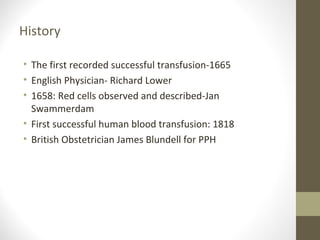
History
• The first recorded successful transfusion-1665
• English Physician- Richard Lower
• 1658: Red cells observed and described-Jan
Swammerdam
• First successful human blood transfusion: 1818
• British Obstetrician James Blundell for PPH
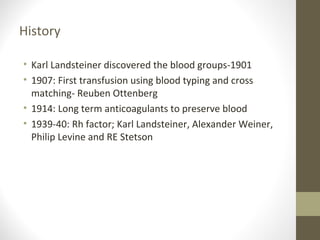
History
• Karl Landsteiner discovered the blood groups-1901
• 1907: First transfusion using blood typing and cross
matching- Reuben Ottenberg
• 1914: Long term anticoagulants to preserve blood
• 1939-40: Rh factor; Karl Landsteiner, Alexander Weiner,
Philip Levine and RE Stetson
195 years later transfusion is still
controversial
Epidemiology
• Up to 25% of patients admitted to ICU have a
Hb‹9gm/dl*
• More pronounced in septic patients
• Frequent sampling may contribute(may avg.40ml/day)
• Anemia in the critically ill is multi-factorial
• Rivers in EGDT was one of the first to advocate the PRBC
transfusion
*Walsh et al. Intensive Care Med 2006;32:100-109
Reasons for anemia in the critically ill
• Obvious/occult source of bleeding
• Sampling
• Hemodilution secondary to fluid resuscitation
• Blunted EPO production
• Abnormalities in iron metabolism
• Altered proliferation and differentiation of precursors
Physiological functions of the RBC
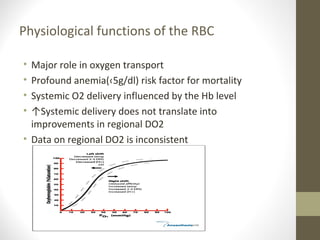
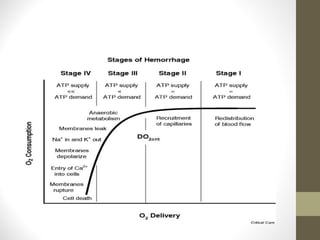
• Major role in oxygen transport
• Profound anemia(‹5g/dl) risk factor for mortality
• Systemic O2 delivery influenced by the Hb level
• ↑Systemic delivery does not translate into
improvements in regional DO2
• Data on regional DO2 is inconsistent
So what’s all the fuss about?
• RBC transfusions increase the blood viscosity
• Microcirculatory stasis and impaired tissue DO2
• Activation of WBCs and release of cytokines may have
microcirculatory effects
• Cytokines mediate vasoconstriction and thrombosis
• Many countries routinely use leukocyte-reduced PRBCs
• Evidence that transfusion can cause vasoconstriction
• Decrease in the 2,3DPG in stored blood
• Hemolysis in stored blood can also contribute to
vasoconstriction
SYSTEMIC DO2 IS NOT EQUAL TO REGIONAL DO2
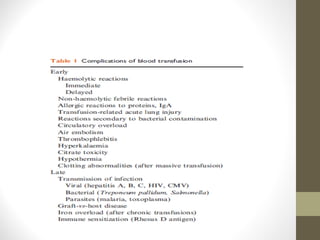
Serious Hazards
• Infectious hazards
• Non-infectious hazards
- TRALI
- TRIM
- TACO
- Hemolytic Reactions
- Incompatibility
- Anaphylaxis
Tolerance to Anemia
• Depends on volume status, physiological reserve and
dynamics of the anemia
• Normovolemic hemodilution well tolerated
• Compensatory mechanisms such as increases in CO
• Increased adrenergic drive, blood flow redistribution
• Increased oxygen extraction ratio
• These mechanisms are obtunded/exhausted
• Critical patients have very low reserves
• Myocardial demand-supply ratios are usually on the
edge
Technical Aspects- Boring, but a necessary evil!
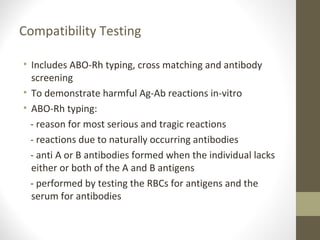
Compatibility Testing
• Includes ABO-Rh typing, cross matching and antibody
screening
• To demonstrate harmful Ag-Ab reactions in-vitro
• ABO-Rh typing:
- reason for most serious and tragic reactions
- reactions due to naturally occurring antibodies
- anti A or B antibodies formed when the individual lacks
either or both of the A and B antigens
- performed by testing the RBCs for antigens and the
serum for antibodies
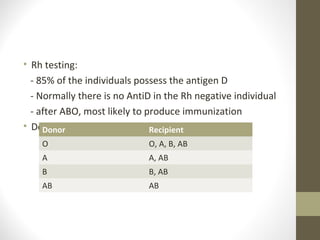
• Rh testing:
- 85% of the individuals possess the antigen D
- Normally there is no AntiD in the Rh negative individual
- after ABO, most likely to produce immunization
• Donor blood groups that patients can receive:Donor Recipient
O O, A, B, AB
A A, AB
B B, AB
AB AB
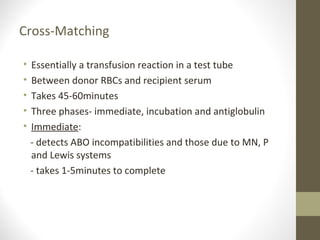
Cross-Matching
• Essentially a transfusion reaction in a test tube
• Between donor RBCs and recipient serum
• Takes 45-60minutes
• Three phases- immediate, incubation and antiglobulin
• Immediate:
- detects ABO incompatibilities and those due to MN, P
and Lewis systems
- takes 1-5minutes to complete
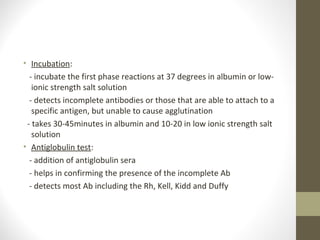
• Incubation:
- incubate the first phase reactions at 37 degrees in albumin or low-
ionic strength salt solution
- detects incomplete antibodies or those that are able to attach to a
specific antigen, but unable to cause agglutination
- takes 30-45minutes in albumin and 10-20 in low ionic strength salt
solution
• Antiglobulin test:
- addition of antiglobulin sera
- helps in confirming the presence of the incomplete Ab
- detects most Ab including the Rh, Kell, Kidd and Duffy
• Antibody Screen:
- also carried out in three phases
- trial transfusion between recipient’s serum and
commercially supplied RBCs
- screening also done in the donor serum to look for
unexpected antibodies
• Type and Screen:
- Only ABO-Rh typing and antibody screening
- Skips cross matching
- less than ideal; for emergencies
- can add the immediate phase of cross match
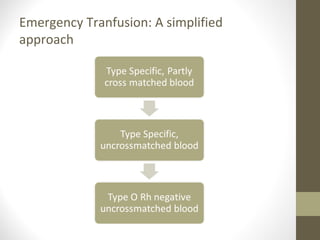
Emergency Tranfusion: A simplified
approach
Storage of Blood
• Most common preservative- CPDA-1
• Citrate for anticoagulation, phosphate as buffer,
dextrose as energy source and adenine to replenish ATP
• 35days shelf life; preserved at 1-6degrees C
• Can be extended up to 42 days with certain special
preservatives(adsol, nutricel and optisol)
• Duration of storage: based on 70% of transfused cells
surviving at least 24hrs post transfusion
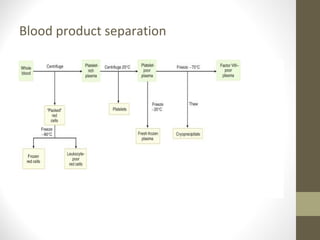
Blood product separation
What happens with storage?
• Also called the ‘Storage Lesion’
• Decreases in the 2,3DPG
• Membrane changes:
- lipid peroxidation
- decreased deformability
- membrane vesiculation
• Changes in storage medium
- decreased pH
- increased potassium
- release of proinflammatory cytokines
• Increased tendency to adhere to endothelium
• Promote vasoconstriction
• Microcirculatory dysfunction and tissue hypoxia
• Some studies have shown adverse outcomes with
increased age of RBCs
• Studies to watch out for:
- ABLE: age of blood evaluation RCT
- Date collection completed in April
- RECESS: The Red Cell Storage Duration Study
- Estimated completion date: October 2013
Should we leukoreduce?
• Many adverse effects related to co-infusion of white cells
• Process where WBCs are reduced in number by centrifugation
or filtration
• Removes 99.995% of the white cell load
• Decreases febrile non-hemolytic reactions
• Decreases transmission of EBV, CMV, parasites, prions
• Decreased TRALI
• Decreases RBC storage lesions
Does the theory translate into practice?
• Hebert and colleagues:
- Before and after study
- cardiac surgery, hip fracture repair, surgical patients
requiring intensive care
- 1% decrease in mortality following implementation of
universal leukoreduction practices in Canada
• Blumberg and colleagues:
- Meta-analysis of nine RCTs
- surgical population of 3093 patients
- reduced the odds of postoperative infection
Herbert et al. JAMA 2003;289:1941-49
Blumberg et al. Transfusion 2007;47:573-81
Hazards of transfusion
Infectious
• Previously HIV and Hepatitis were dominant concerns
• Decreased risk in the recent past due to better pathogen
detection and reduction systems
• HIV- 1 in 4million transfusions
HCV- 1 IN 2.8million transfusions
• Newer infectious agents have however emerged
• Dengue and Babesia
• Human variant of Creutzfedlt Jakob disease
• EBV in children
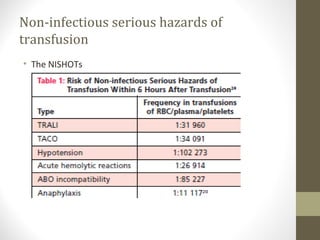
Non-infectious serious hazards of
transfusion
• The NISHOTs
NISHOTs
• TRALI:
- Conventionally a new ALI developing within 6hrs
- presence of leukocyte Ag or neutrophil Ab suggestive
- newer definitions suggest onset anytime up to 72hrs
- this form of delayed onset TRALI-25% of ICU patients
- TARD: Transfusion associated respiratory distress
- presents at hypoxemia, dyspnoea, cyanosis
- bilateral pulmonary infiltrates
- Mechanisms- Immune and Non immune
- 70% require mech.ventilation and fatality is 6-10%
• Transfusion associated GVHD:
- decreased in view of implementation of leucodepletion
- usually in immunocompromised
- 90% fatality
- donor leucocytes mount an immune response
- maculopapular rash, abdominal pain, diarrhoea
- altered LFTs
- destruction of bone marrow stem cells with
pancytopenia
- irradiation of blood
• TRIM:
- Modulation of immune system in recipients
- Evidence: prolonged survival of renal allografts
- increases post-op infections, tumor recurrences
- activates latent viral infections
- mechanism is multi-factorial
- decreased activation of NK cells, macrophages
- decreased IL-2 production and CD4/CD8 ratio
• TACO:
- underreported complication
- rapid/massive transfusion, reduced cardiac reserve
- severe anemia(Hb‹5), age
- respiratory distress, tachycardia, hypertension, hypoxemia
- slow transfusion(‹1ml/kg/hr) in at risk patients
Other Hazards
• Hypocalcemia:
- citrate binds and causes hypocalcemia
- more of a problem with FFPs and platelets
- hypotension, flat ST segments and prolonged QT
• Hyperkalemia:
- potassium concentration increases during storage
- usually not a problem unless coexistent
acidosis/hypothermia
• Hypothermia
• Acid-base abnormalities
To transfuse or not to transfuse is the question
(A walk through the maze of evidence)
• “RBC transfusion in the ICU. Is there a reason?”
• Corwin and colleagues
• Retrospective chart review in a multidisciplinary ICU
• 85% of patients with LOS›1week transfused
• In 29% of cases, no clear indication
• Most of those transfused had a phlebotomy volume of
61-70ml/day
Corwin et al. Chest 1995;108(3):767-71
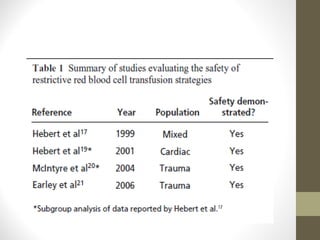
• “Transfusion requirements in Critical Care”-TRICC study
• To determine if a restrictive approach(7-9) is equivalent
to a more liberal approach(10-12) in euvolemia
• Multicentric RCT
• Primary outcome: 30day mortality
• Secondary outcome: 60day all cause mortality, ICU
mortality and hospital mortality
• Measures of organ failure and dysfunction also studied
• 838 patients; 418 R and 420 L
• Mortality: 18.7% R and 23.3%L
• ICU mortality: 13.9 R vs 16.2 L
• Similarly hospital and 60day mortality also lesser with R
• None of these differences reached significance though
• Subgroup of APACHE 2‹20 and age‹55yrs
• Here differences were significant
Hebert et al. N Eng J Med 1999;340:409-417
• “RBC transfusion does not increase oxygen consumption
in critically ill septic patients”
• Fernandes and colleagues
• Small study
• 15 septic patients on mech.ventilation
• Hb‹10
• 10 patients received PRBC and 5 albumin
• No change in O2 utilization and delivery parameters
• Increase in PVR in the PRBC group
Fernandes et al. Critical Care 2001;5:362-67
• The ‘CRIT’ study
• Corwin and colleagues
• Prospective multicentre observational cohort study
• 4892 patients enrolled from 284 ICUs
• Primary endpoint: quantify the RBC transfusions
• Secondary endpoint: clinical outcomes and
complications
• 44% of patients received one or more trasnsfusions
• Mean time to first transfusion was 2.3±1.7days
• Longer the stay, the more the transfusions
• Number of transfusions independent marker of ICU stay
• Independent marker of mortality
• 10% for those without transfusions
• 25% for those with 6 or more transfusions
• Independent marker for complications
Corwin et al. Critical Care Med 2004;32(1):39-52
• “Red cell transfusions and the risk of ARDS among
critically ill patients”
• Zilberberg and colleagues
• Cohort study within CRIT
• 67% of cases developing ARDS had exposure to RBCs
• Independent relationship noted even after adjustment
for other factors such as age, severity of illness etc
Zilberberg et al. Critical Care 2007
• “Efficacy of red cell transfusion in the critically ill: A systematic
review”
• MEDLINE, EMBASE and COCHRANE
• Cohort studies that independently assessed the effect of RBC
transfusion on outcomes
• 45 studies with 272596 patients
• Mortality, Infection, MODS and ARDS
• In 42 of 45 studies risks outweighed the benefits
• In 17 of 18 studies looking at mortality showed RBC
transfusion to be an independent predictor
• Increased risk and independent predictor of infection/MODS
and ARDS
Marik et al. Crit Care Med 2008;36:2667-74
• “Red cell transfusions and outcomes in patients with ALI,
sepsis and shock”
• Parsons et al
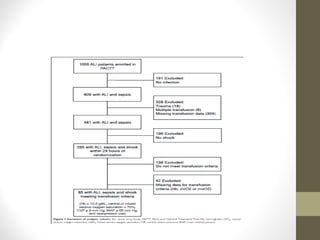
• Secondary analysis of new onset ALI patients enrolled in
the ARDS network fluid and catheter treatment
trial(FACTT)
• 285 subjects with ALI, sepsis and shock
• Patients met shock criteria(MAP‹60 or vasopressor)
• Primary end point: association between PRBC and
outcome
• Secondary end points: 90 day mortality and VFD
• Subset analysis: in subjects meeting pre-specified transfusion
criteria
• Hb‹10.2,CVP›8, ScVo2‹70%, MAP‹60 and vasopressor
• No independent association between transfusion and 28day
mortality
• No independent association to ventilator free days or 90 day
mortality
• In the subset also, no independent association to mortality or
VFDs
• No benefit or harm in conclusion
Parsons et al. Critical Care 2011;15:R221
Does transfusion improve oxygen and tissue dynamics?
• Dietrich et al
- Improved delivery
- No improvement in consumption or lactic acidosis
• Silverman and Tuma
- Looked at gastric mucosal tonometry
- Transfusion did not improve mucosal pH
• Marik et al
- No improvement in oxygen delivery
Dietrich et al. Crit Care Med 1990;18:940-44
Silverman et al. Chest 1992;102:184-88
Marik et al. JAMA 1993;269:3024-30
Does it increase infections?
• Taylor et al
- 1717patients in a mixed medical-surgical ICU
- 15.38% infection versus 2.92%
- Dose response relationship noted as well
• Claridge et al
- 1593 adult patients admitted to a level 1 trauma unit
- 33% versus 7.6%
- Also reported a strong dose response relationship
Taylor et al. Crit Care Med. 2002;30:2249-54
Claridge et al. Am Surg. 2002;68:566-72
• Shorr et al
• Prospective observational study
• 4892 patients in 284 adult ICUs
• Screened for BSI at time of admission and 48hrs later
• Total of 3.3% had ICU acquired infection
• Three variables associated with infection
• Baseline treatment with cephalosporins
• Higher sequential organ failure assessment score
• PRBC transfusions
Shorr et al. Chest 2005;127:1722-28
Red cell transfusions for patients with cardiac disease-A much
glorified myth?
• Hebert et al
- Subgroup analysis of “TRICC”
- 357 total cardiac patients; 257 with IHD
- Liberal group had higher organ dysfunction
- No difference in 30 day, 60 day or ICU mortality
• Rao and colleagues
- Metaanalysis of data collected from 3 major trials
- PURSUIT, GUSTO 2b, PARAGON
- Involved patients with ACS
- 24000 patients; 2401 received PRBCs
- 30 day mortality, MI all higher in transfused group
Rao et al. JAMA 2004;292:1555-1562
• Yang et al
- Transfusion and outcomes in patients with ACS
- NSTEMI
- 74000 patients
- After adjustment for age and comorbidities
- Transfused group had higher death rates
- Higher re-infarction rates
Yang et al. J Am Coll Cardiol. 2005;46:1490-95
• Singla et al
- Transfusion in patients with ACS
- Significant increase in 30 day mortality and recurrent
MI
- Adjusting for univariate predictors, relationship still
persisted
Singla et al. American Journal of Cardilogy. 2007;99(8):1119-21
• Silvain and colleagues
- Tried to understand the mechanisms leading on to increased
mortality and re-infarction in transfused patients
- In vitro transfusions
- Studied residual platelet aggregation and MPA
- Transfusions increased RPA and MPA
- Possibly explaining the reasons for poor outcome
Silvain et al. European Heart Journal 2010;31:2816-21
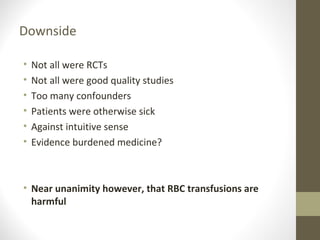
Downside
• Not all were RCTs
• Not all were good quality studies
• Too many confounders
• Patients were otherwise sick
• Against intuitive sense
• Evidence burdened medicine?
• Near unanimity however, that RBC transfusions are
harmful
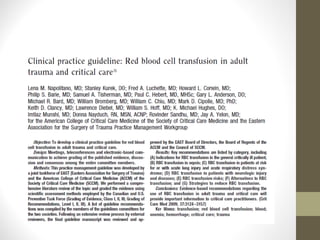
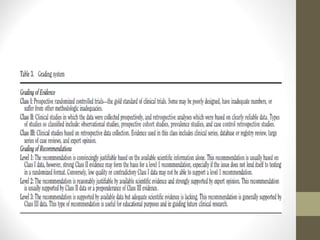
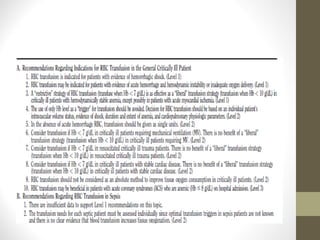
For those who would say, “ Frankly I don’t care. Just tell
me what I need to do!!”
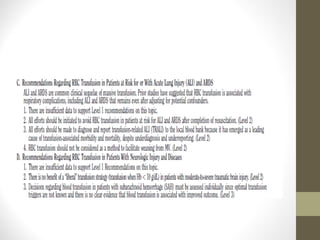
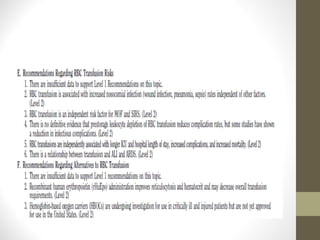
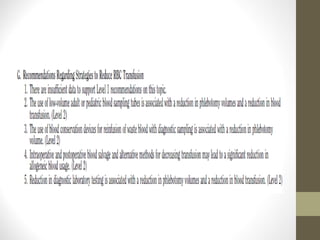
GUIDELINES
Summary
• A Hb less than 9 is very common at ICU admission
• Sampling may be one of the commonest causes
• Systemic O2 delivery is not equal to regional DO2
• More serious hazards in the ICU include TRIM, TRALI, TACO
and TRGVH
• Leucoreduction, though attractive may not be cost-effective
• Transfusions are independently associated with poor
outcomes
• Near unanimity that transfusions are bad although quality of
evidence is variable
• For every unit that you transfuse, keep asking yourself- Does
the patient really need it?
• Good clinical sense may be the only guide
THANK YOU
?

Red cell transfusions in the critically ill compatible

  • 1.
    Red Cell Transfusionsin the Critically Ill Bharath Kumar TV Critical Care, Fortis Hospitals
  • 2.
    Overview • History • Anemiain the ICU • Physiology • Technical Issues- Compatibility testing and Storage • Hazards of transfusion • The Evidence • Guideline based approach
  • 3.
    History • The firstrecorded successful transfusion-1665 • English Physician- Richard Lower • 1658: Red cells observed and described-Jan Swammerdam • First successful human blood transfusion: 1818 • British Obstetrician James Blundell for PPH
  • 4.
    History • Karl Landsteinerdiscovered the blood groups-1901 • 1907: First transfusion using blood typing and cross matching- Reuben Ottenberg • 1914: Long term anticoagulants to preserve blood • 1939-40: Rh factor; Karl Landsteiner, Alexander Weiner, Philip Levine and RE Stetson
  • 5.
    195 years latertransfusion is still controversial
  • 6.
    Epidemiology • Up to25% of patients admitted to ICU have a Hb‹9gm/dl* • More pronounced in septic patients • Frequent sampling may contribute(may avg.40ml/day) • Anemia in the critically ill is multi-factorial • Rivers in EGDT was one of the first to advocate the PRBC transfusion *Walsh et al. Intensive Care Med 2006;32:100-109
  • 7.
    Reasons for anemiain the critically ill • Obvious/occult source of bleeding • Sampling • Hemodilution secondary to fluid resuscitation • Blunted EPO production • Abnormalities in iron metabolism • Altered proliferation and differentiation of precursors
  • 8.
    Physiological functions ofthe RBC • Major role in oxygen transport • Profound anemia(‹5g/dl) risk factor for mortality • Systemic O2 delivery influenced by the Hb level • ↑Systemic delivery does not translate into improvements in regional DO2 • Data on regional DO2 is inconsistent
  • 10.
    So what’s allthe fuss about? • RBC transfusions increase the blood viscosity • Microcirculatory stasis and impaired tissue DO2 • Activation of WBCs and release of cytokines may have microcirculatory effects • Cytokines mediate vasoconstriction and thrombosis • Many countries routinely use leukocyte-reduced PRBCs • Evidence that transfusion can cause vasoconstriction • Decrease in the 2,3DPG in stored blood • Hemolysis in stored blood can also contribute to vasoconstriction
  • 11.
    SYSTEMIC DO2 ISNOT EQUAL TO REGIONAL DO2
  • 12.
    Serious Hazards • Infectioushazards • Non-infectious hazards - TRALI - TRIM - TACO - Hemolytic Reactions - Incompatibility - Anaphylaxis
  • 13.
    Tolerance to Anemia •Depends on volume status, physiological reserve and dynamics of the anemia • Normovolemic hemodilution well tolerated • Compensatory mechanisms such as increases in CO • Increased adrenergic drive, blood flow redistribution • Increased oxygen extraction ratio • These mechanisms are obtunded/exhausted • Critical patients have very low reserves • Myocardial demand-supply ratios are usually on the edge
  • 14.
    Technical Aspects- Boring,but a necessary evil!
  • 15.
    Compatibility Testing • IncludesABO-Rh typing, cross matching and antibody screening • To demonstrate harmful Ag-Ab reactions in-vitro • ABO-Rh typing: - reason for most serious and tragic reactions - reactions due to naturally occurring antibodies - anti A or B antibodies formed when the individual lacks either or both of the A and B antigens - performed by testing the RBCs for antigens and the serum for antibodies
  • 16.
    • Rh testing: -85% of the individuals possess the antigen D - Normally there is no AntiD in the Rh negative individual - after ABO, most likely to produce immunization • Donor blood groups that patients can receive:Donor Recipient O O, A, B, AB A A, AB B B, AB AB AB
  • 17.
    Cross-Matching • Essentially atransfusion reaction in a test tube • Between donor RBCs and recipient serum • Takes 45-60minutes • Three phases- immediate, incubation and antiglobulin • Immediate: - detects ABO incompatibilities and those due to MN, P and Lewis systems - takes 1-5minutes to complete
  • 18.
    • Incubation: - incubatethe first phase reactions at 37 degrees in albumin or low- ionic strength salt solution - detects incomplete antibodies or those that are able to attach to a specific antigen, but unable to cause agglutination - takes 30-45minutes in albumin and 10-20 in low ionic strength salt solution • Antiglobulin test: - addition of antiglobulin sera - helps in confirming the presence of the incomplete Ab - detects most Ab including the Rh, Kell, Kidd and Duffy
  • 19.
    • Antibody Screen: -also carried out in three phases - trial transfusion between recipient’s serum and commercially supplied RBCs - screening also done in the donor serum to look for unexpected antibodies • Type and Screen: - Only ABO-Rh typing and antibody screening - Skips cross matching - less than ideal; for emergencies - can add the immediate phase of cross match
  • 20.
    Emergency Tranfusion: Asimplified approach
  • 21.
    Storage of Blood •Most common preservative- CPDA-1 • Citrate for anticoagulation, phosphate as buffer, dextrose as energy source and adenine to replenish ATP • 35days shelf life; preserved at 1-6degrees C • Can be extended up to 42 days with certain special preservatives(adsol, nutricel and optisol) • Duration of storage: based on 70% of transfused cells surviving at least 24hrs post transfusion
  • 22.
  • 23.
    What happens withstorage? • Also called the ‘Storage Lesion’ • Decreases in the 2,3DPG • Membrane changes: - lipid peroxidation - decreased deformability - membrane vesiculation • Changes in storage medium - decreased pH - increased potassium - release of proinflammatory cytokines
  • 24.
    • Increased tendencyto adhere to endothelium • Promote vasoconstriction • Microcirculatory dysfunction and tissue hypoxia • Some studies have shown adverse outcomes with increased age of RBCs • Studies to watch out for: - ABLE: age of blood evaluation RCT - Date collection completed in April - RECESS: The Red Cell Storage Duration Study - Estimated completion date: October 2013
  • 25.
    Should we leukoreduce? •Many adverse effects related to co-infusion of white cells • Process where WBCs are reduced in number by centrifugation or filtration • Removes 99.995% of the white cell load • Decreases febrile non-hemolytic reactions • Decreases transmission of EBV, CMV, parasites, prions • Decreased TRALI • Decreases RBC storage lesions
  • 26.
    Does the theorytranslate into practice?
  • 27.
    • Hebert andcolleagues: - Before and after study - cardiac surgery, hip fracture repair, surgical patients requiring intensive care - 1% decrease in mortality following implementation of universal leukoreduction practices in Canada • Blumberg and colleagues: - Meta-analysis of nine RCTs - surgical population of 3093 patients - reduced the odds of postoperative infection Herbert et al. JAMA 2003;289:1941-49 Blumberg et al. Transfusion 2007;47:573-81
  • 28.
  • 30.
    Infectious • Previously HIVand Hepatitis were dominant concerns • Decreased risk in the recent past due to better pathogen detection and reduction systems • HIV- 1 in 4million transfusions HCV- 1 IN 2.8million transfusions • Newer infectious agents have however emerged • Dengue and Babesia • Human variant of Creutzfedlt Jakob disease • EBV in children
  • 31.
    Non-infectious serious hazardsof transfusion • The NISHOTs
  • 32.
    NISHOTs • TRALI: - Conventionallya new ALI developing within 6hrs - presence of leukocyte Ag or neutrophil Ab suggestive - newer definitions suggest onset anytime up to 72hrs - this form of delayed onset TRALI-25% of ICU patients - TARD: Transfusion associated respiratory distress - presents at hypoxemia, dyspnoea, cyanosis - bilateral pulmonary infiltrates - Mechanisms- Immune and Non immune - 70% require mech.ventilation and fatality is 6-10%
  • 33.
    • Transfusion associatedGVHD: - decreased in view of implementation of leucodepletion - usually in immunocompromised - 90% fatality - donor leucocytes mount an immune response - maculopapular rash, abdominal pain, diarrhoea - altered LFTs - destruction of bone marrow stem cells with pancytopenia - irradiation of blood
  • 34.
    • TRIM: - Modulationof immune system in recipients - Evidence: prolonged survival of renal allografts - increases post-op infections, tumor recurrences - activates latent viral infections - mechanism is multi-factorial - decreased activation of NK cells, macrophages - decreased IL-2 production and CD4/CD8 ratio
  • 35.
    • TACO: - underreportedcomplication - rapid/massive transfusion, reduced cardiac reserve - severe anemia(Hb‹5), age - respiratory distress, tachycardia, hypertension, hypoxemia - slow transfusion(‹1ml/kg/hr) in at risk patients
  • 36.
    Other Hazards • Hypocalcemia: -citrate binds and causes hypocalcemia - more of a problem with FFPs and platelets - hypotension, flat ST segments and prolonged QT • Hyperkalemia: - potassium concentration increases during storage - usually not a problem unless coexistent acidosis/hypothermia • Hypothermia • Acid-base abnormalities
  • 37.
    To transfuse ornot to transfuse is the question (A walk through the maze of evidence)
  • 38.
    • “RBC transfusionin the ICU. Is there a reason?” • Corwin and colleagues • Retrospective chart review in a multidisciplinary ICU • 85% of patients with LOS›1week transfused • In 29% of cases, no clear indication • Most of those transfused had a phlebotomy volume of 61-70ml/day Corwin et al. Chest 1995;108(3):767-71
  • 39.
    • “Transfusion requirementsin Critical Care”-TRICC study • To determine if a restrictive approach(7-9) is equivalent to a more liberal approach(10-12) in euvolemia • Multicentric RCT • Primary outcome: 30day mortality • Secondary outcome: 60day all cause mortality, ICU mortality and hospital mortality • Measures of organ failure and dysfunction also studied • 838 patients; 418 R and 420 L • Mortality: 18.7% R and 23.3%L
  • 40.
    • ICU mortality:13.9 R vs 16.2 L • Similarly hospital and 60day mortality also lesser with R • None of these differences reached significance though • Subgroup of APACHE 2‹20 and age‹55yrs • Here differences were significant Hebert et al. N Eng J Med 1999;340:409-417
  • 41.
    • “RBC transfusiondoes not increase oxygen consumption in critically ill septic patients” • Fernandes and colleagues • Small study • 15 septic patients on mech.ventilation • Hb‹10 • 10 patients received PRBC and 5 albumin • No change in O2 utilization and delivery parameters • Increase in PVR in the PRBC group Fernandes et al. Critical Care 2001;5:362-67
  • 42.
    • The ‘CRIT’study • Corwin and colleagues • Prospective multicentre observational cohort study • 4892 patients enrolled from 284 ICUs • Primary endpoint: quantify the RBC transfusions • Secondary endpoint: clinical outcomes and complications • 44% of patients received one or more trasnsfusions • Mean time to first transfusion was 2.3±1.7days • Longer the stay, the more the transfusions
  • 43.
    • Number oftransfusions independent marker of ICU stay • Independent marker of mortality • 10% for those without transfusions • 25% for those with 6 or more transfusions • Independent marker for complications Corwin et al. Critical Care Med 2004;32(1):39-52
  • 44.
    • “Red celltransfusions and the risk of ARDS among critically ill patients” • Zilberberg and colleagues • Cohort study within CRIT • 67% of cases developing ARDS had exposure to RBCs • Independent relationship noted even after adjustment for other factors such as age, severity of illness etc Zilberberg et al. Critical Care 2007
  • 45.
    • “Efficacy ofred cell transfusion in the critically ill: A systematic review” • MEDLINE, EMBASE and COCHRANE • Cohort studies that independently assessed the effect of RBC transfusion on outcomes • 45 studies with 272596 patients • Mortality, Infection, MODS and ARDS • In 42 of 45 studies risks outweighed the benefits • In 17 of 18 studies looking at mortality showed RBC transfusion to be an independent predictor • Increased risk and independent predictor of infection/MODS and ARDS Marik et al. Crit Care Med 2008;36:2667-74
  • 46.
    • “Red celltransfusions and outcomes in patients with ALI, sepsis and shock” • Parsons et al • Secondary analysis of new onset ALI patients enrolled in the ARDS network fluid and catheter treatment trial(FACTT) • 285 subjects with ALI, sepsis and shock • Patients met shock criteria(MAP‹60 or vasopressor) • Primary end point: association between PRBC and outcome • Secondary end points: 90 day mortality and VFD
  • 48.
    • Subset analysis:in subjects meeting pre-specified transfusion criteria • Hb‹10.2,CVP›8, ScVo2‹70%, MAP‹60 and vasopressor • No independent association between transfusion and 28day mortality • No independent association to ventilator free days or 90 day mortality • In the subset also, no independent association to mortality or VFDs • No benefit or harm in conclusion Parsons et al. Critical Care 2011;15:R221
  • 50.
    Does transfusion improveoxygen and tissue dynamics?
  • 51.
    • Dietrich etal - Improved delivery - No improvement in consumption or lactic acidosis • Silverman and Tuma - Looked at gastric mucosal tonometry - Transfusion did not improve mucosal pH • Marik et al - No improvement in oxygen delivery Dietrich et al. Crit Care Med 1990;18:940-44 Silverman et al. Chest 1992;102:184-88 Marik et al. JAMA 1993;269:3024-30
  • 52.
    Does it increaseinfections?
  • 53.
    • Taylor etal - 1717patients in a mixed medical-surgical ICU - 15.38% infection versus 2.92% - Dose response relationship noted as well • Claridge et al - 1593 adult patients admitted to a level 1 trauma unit - 33% versus 7.6% - Also reported a strong dose response relationship Taylor et al. Crit Care Med. 2002;30:2249-54 Claridge et al. Am Surg. 2002;68:566-72
  • 54.
    • Shorr etal • Prospective observational study • 4892 patients in 284 adult ICUs • Screened for BSI at time of admission and 48hrs later • Total of 3.3% had ICU acquired infection • Three variables associated with infection • Baseline treatment with cephalosporins • Higher sequential organ failure assessment score • PRBC transfusions Shorr et al. Chest 2005;127:1722-28
  • 55.
    Red cell transfusionsfor patients with cardiac disease-A much glorified myth?
  • 56.
    • Hebert etal - Subgroup analysis of “TRICC” - 357 total cardiac patients; 257 with IHD - Liberal group had higher organ dysfunction - No difference in 30 day, 60 day or ICU mortality • Rao and colleagues - Metaanalysis of data collected from 3 major trials - PURSUIT, GUSTO 2b, PARAGON - Involved patients with ACS - 24000 patients; 2401 received PRBCs - 30 day mortality, MI all higher in transfused group Rao et al. JAMA 2004;292:1555-1562
  • 57.
    • Yang etal - Transfusion and outcomes in patients with ACS - NSTEMI - 74000 patients - After adjustment for age and comorbidities - Transfused group had higher death rates - Higher re-infarction rates Yang et al. J Am Coll Cardiol. 2005;46:1490-95
  • 58.
    • Singla etal - Transfusion in patients with ACS - Significant increase in 30 day mortality and recurrent MI - Adjusting for univariate predictors, relationship still persisted Singla et al. American Journal of Cardilogy. 2007;99(8):1119-21
  • 59.
    • Silvain andcolleagues - Tried to understand the mechanisms leading on to increased mortality and re-infarction in transfused patients - In vitro transfusions - Studied residual platelet aggregation and MPA - Transfusions increased RPA and MPA - Possibly explaining the reasons for poor outcome Silvain et al. European Heart Journal 2010;31:2816-21
  • 61.
    Downside • Not allwere RCTs • Not all were good quality studies • Too many confounders • Patients were otherwise sick • Against intuitive sense • Evidence burdened medicine? • Near unanimity however, that RBC transfusions are harmful
  • 62.
    For those whowould say, “ Frankly I don’t care. Just tell me what I need to do!!” GUIDELINES
  • 69.
    Summary • A Hbless than 9 is very common at ICU admission • Sampling may be one of the commonest causes • Systemic O2 delivery is not equal to regional DO2 • More serious hazards in the ICU include TRIM, TRALI, TACO and TRGVH • Leucoreduction, though attractive may not be cost-effective
  • 70.
    • Transfusions areindependently associated with poor outcomes • Near unanimity that transfusions are bad although quality of evidence is variable • For every unit that you transfuse, keep asking yourself- Does the patient really need it? • Good clinical sense may be the only guide
  • 71.
  • 72.