A discussion on sampling graphs to approximate
        network classification functions
               (work in progress)

                Gemma C Garriga

                     INRIA
             gemma.garriga@inria.fr

                  22.09.2011
Outline


   Starting point


   Classification in networks


   Samples of graphs


   Some first experiments
Outline


   Starting point


   Classification in networks


   Samples of graphs


   Some first experiments
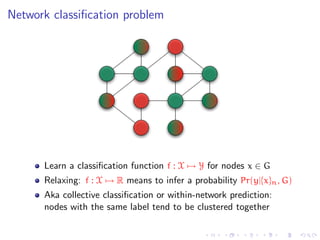
Network classification problem


      Learn a classification function f : X → Y for nodes x ∈ G
      Relaxing: f : X → R means to infer a probability Pr(y|{x}n , G)
      Aka collective classification or within-network prediction:
      nodes with the same label tend to be clustered together
Network classification problem

   Challenges
       Sparsely labeled: few labeled nodes but many unlabeled nodes

       Heterogeneous types of contents, multiple types of links

       Network structure (what edges are in the graph) affects the
       accuracy of the models

       Networks are large size

   Related to
       Semi-supervised learning based on graphs
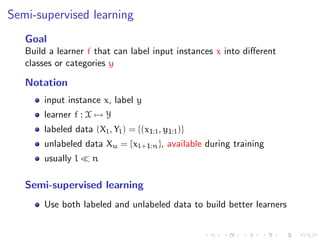
Semi-supervised learning
   Goal
   Build a learner f that can label input instances x into different
   classes or categories y

   Notation
       input instance x, label y
       learner f : X → Y
       labeled data (Xl , Yl ) = {(x1:l , y1:l )}
       unlabeled data Xu = {xl+1:n }, available during training
       usually l     n

   Semi-supervised learning
       Use both labeled and unlabeled data to build better learners
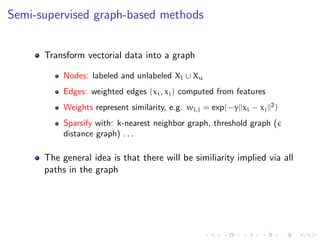
Semi-supervised graph-based methods


      Transform vectorial data into a graph

           Nodes: labeled and unlabeled Xl ∪ Xu
           Edges: weighted edges (xi , xj ) computed from features
           Weights represent similarity, e.g. wi,j = exp(−γ||xi − xj ||2 )
           Sparsify with: k-nearest neighbor graph, threshold graph (
           distance graph) . . .

      The general idea is that there will be similiarity implied via all
      paths in the graph
Semi-supervised graph-based methods
   Smoothness assumption
   In a weighted graph, nodes that are similar are connected by heavy
   edges (high density region) and therefore tend to have the same
   label. Density is not uniform


                     [From Zhu et al. ICML 2003]
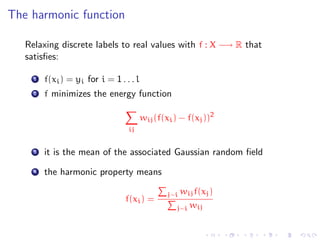
The harmonic function

   Relaxing discrete labels to real values with f : X −→ R that
   satisfies:

     1   f(xi ) = yi for i = 1 . . . l
     2   f minimizes the energy function

                                         wij (f(xi ) − f(xj ))2
                                  ij


     3   it is the mean of the associated Gaussian random field
     4   the harmonic property means

                                                 j∼i wij f(xj )
                                 f(xi ) =
                                                    j∼i wij
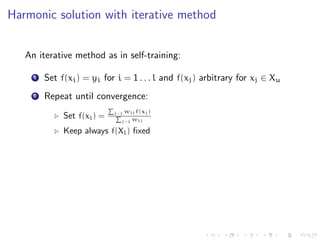
Harmonic solution with iterative method


   An iterative method as in self-training:

     1   Set f(xi ) = yi for i = 1 . . . l and f(xj ) arbitrary for xj ∈ Xu
     2   Repeat until convergence:
                             j∼i   wij f(xj )
              Set f(xi ) =           wij
                               j∼i

              Keep always f(Xl ) fixed
A random walk interpretation on directed graphs

                                                          wij
      Randomly walk from node i to j with probability
                                                          k wik


      The harmonic function tells about Pr(hit label 1 | start from i)


                   [From Zhu’s tutorial at ICML 2007]
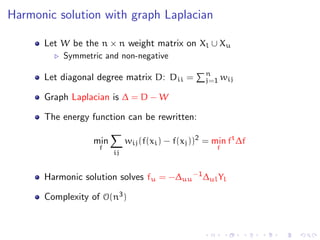
Harmonic solution with graph Laplacian

      Let W be the n × n weight matrix on Xl ∪ Xu
          Symmetric and non-negative
                                                  n
      Let diagonal degree matrix D: Dii =         j=1 wij

      Graph Laplacian is ∆ = D − W

      The energy function can be rewritten:

                 min        wij (f(xi ) − f(xj ))2 = min ft ∆f
                   f                                 f
                       ij


      Harmonic solution solves fu = −∆uu −1 ∆ul Yl

      Complexity of O(n3 )
Outline


   Starting point


   Classification in networks


   Samples of graphs


   Some first experiments
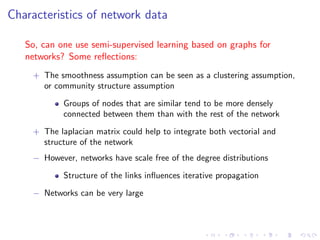
Characteristics of network data

   So, can one use semi-supervised learning based on graphs for
   networks? Some reflections:
    + The smoothness assumption can be seen as a clustering assumption,
       or community structure assumption

            Groups of nodes that are similar tend to be more densely
            connected between them than with the rest of the network
    + The laplacian matrix could help to integrate both vectorial and
       structure of the network
    − However, networks have scale free of the degree distributions

            Structure of the links influences iterative propagation

    − Networks can be very large
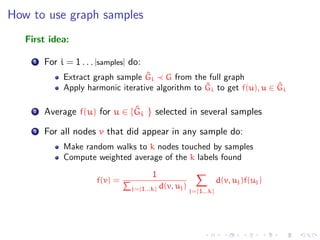
How to use graph samples
   First idea:

     1   For i = 1 . . . |samples| do:
                                    ˆ
              Extract graph sample Gi G from the full graph
                                                    ˆ                   ˆ
              Apply harmonic iterative algorithm to Gi to get f(u), u ∈ Gi

     2                         ˆ
         Average f(u) for u ∈ {Gi } selected in several samples
     3   For all nodes v that did appear in any sample do:
              Make random walks to k nodes touched by samples
              Compute weighted average of the k labels found
                                          1
                        f(v) =                                         d(v, uj )f(uj )
                                   j={1...k}   d(v, uj )
                                                           j={1...k}
How can samples help?

      Samples have less edges than the full graph, so diffusion is different
      from the full graph
      Subgraphs will be random, so maybe a good behavior on average
      The iterative algorithm (or laplacian harmonic) will be applied only
      on samples. Complexity is reduced
      The nodes not contained in any sample, will be labeled following
      the assumptions of the random walk interpretation given by the
      harmonic iterative solution


                                [From Zhu’s tutorial at ICML 2007]
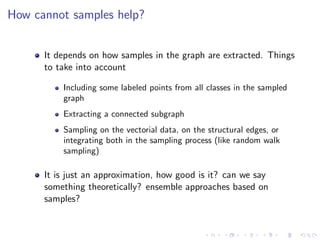
How cannot samples help?


      It depends on how samples in the graph are extracted. Things
      to take into account

          Including some labeled points from all classes in the sampled
          graph
          Extracting a connected subgraph
          Sampling on the vectorial data, on the structural edges, or
          integrating both in the sampling process (like random walk
          sampling)

      It is just an approximation, how good is it? can we say
      something theoretically? ensemble approaches based on
      samples?
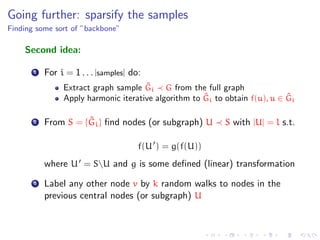
Going further: sparsify the samples
Finding some sort of ”backbone”

    Second idea:

       1   For i = 1 . . . |samples| do:
                                      ˆ
                Extract graph sample Gi G from the full graph
                                                      ˆ                      ˆ
                Apply harmonic iterative algorithm to Gi to obtain f(u), u ∈ Gi

       2             ˆ
           From S = {Gi } find nodes (or subgraph) U         S with |U| = l s.t.

                                       f(U ) = g(f(U))
           where U = SU and g is some defined (linear) transformation
       3   Label any other node v by k random walks to nodes in the
           previous central nodes (or subgraph) U
Outline


   Starting point


   Classification in networks


   Samples of graphs


   Some first experiments
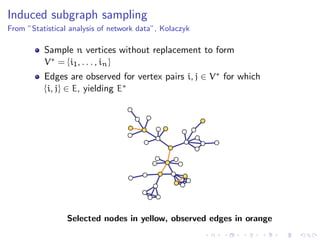
Induced subgraph sampling
From ”Statistical analysis of network data”, Kolaczyk

          Sample n vertices without replacement to form
          V ∗ = {i1 , . . . , in }
          Edges are observed for vertex pairs i, j ∈ V ∗ for which
          {i, j} ∈ E, yielding E∗


                 Selected nodes in yellow, observed edges in orange
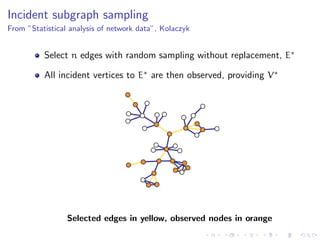
Incident subgraph sampling
From ”Statistical analysis of network data”, Kolaczyk


          Select n edges with random sampling without replacement, E∗

          All incident vertices to E∗ are then observed, providing V ∗


                 Selected edges in yellow, observed nodes in orange
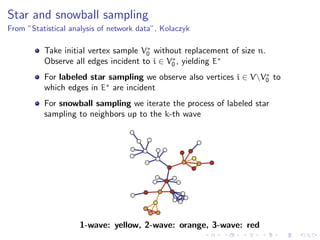
Star and snowball sampling
From ”Statistical analysis of network data”, Kolaczyk

                                      ∗
          Take initial vertex sample V0 without replacement of size n.
          Observe all edges incident to i ∈ V0 , yielding E∗
                                             ∗

                                                                    ∗
          For labeled star sampling we observe also vertices i ∈ VV0 to
                          ∗
          which edges in E are incident
          For snowball sampling we iterate the process of labeled star
          sampling to neighbors up to the k-th wave


                    1-wave: yellow, 2-wave: orange, 3-wave: red
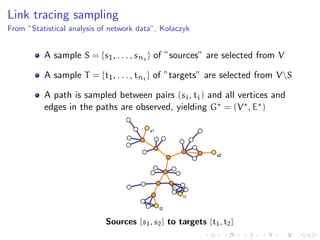
Link tracing sampling
From ”Statistical analysis of network data”, Kolaczyk


          A sample S = {s1 , . . . , sns } of ”sources” are selected from V

          A sample T = {t1 , . . . , tnt } of ”targets” are selected from VS

          A path is sampled between pairs (si , ti ) and all vertices and
          edges in the paths are observed, yielding G∗ = (V ∗ , E∗ )


                            Sources {s1 , s2 } to targets {t1 , t2 }
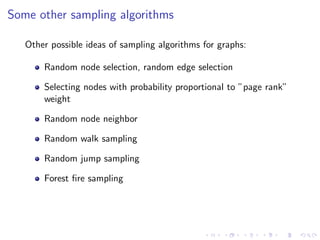
Some other sampling algorithms

   Other possible ideas of sampling algorithms for graphs:

       Random node selection, random edge selection

       Selecting nodes with probability proportional to ”page rank”
       weight

       Random node neighbor

       Random walk sampling

       Random jump sampling

       Forest fire sampling
Some challenges of sampling with labels


      Including labels in the samples

      Size of the samples

      Isolated nodes

      Edges of structure or content
Outline


   Starting point


   Classification in networks


   Samples of graphs


   Some first experiments
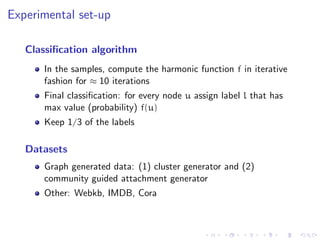
Experimental set-up

   Classification algorithm
      In the samples, compute the harmonic function f in iterative
      fashion for ≈ 10 iterations
      Final classification: for every node u assign label l that has
      max value (probability) f(u)
      Keep 1/3 of the labels

   Datasets
      Graph generated data: (1) cluster generator and (2)
      community guided attachment generator
      Other: Webkb, IMDB, Cora
What happens in one sample?

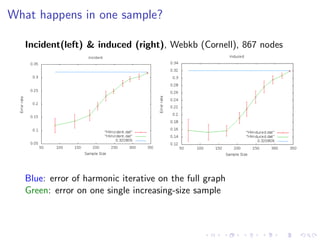
   Incident(left) & induced (right), Webkb (Cornell), 867 nodes


   Blue: error of harmonic iterative on the full graph
   Green: error on one single increasing-size sample
What happens in one sample?

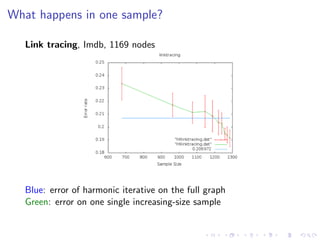
   Link tracing, Imdb, 1169 nodes


   Blue: error of harmonic iterative on the full graph
   Green: error on one single increasing-size sample
What happens in one sample?

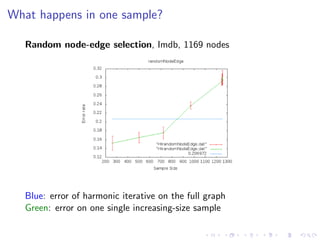
   Random node-edge selection, Imdb, 1169 nodes


   Blue: error of harmonic iterative on the full graph
   Green: error on one single increasing-size sample
Full classification vs sampling classification

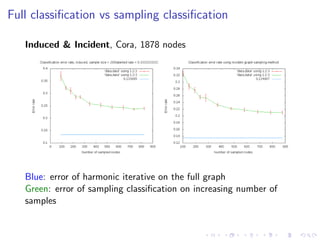
   Induced & Incident, Cora, 1878 nodes


   Blue: error of harmonic iterative on the full graph
   Green: error of sampling classification on increasing number of
   samples
Full classification vs sampling classification

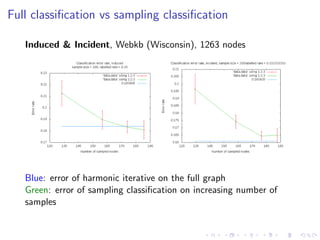
   Induced & Incident, Webkb (Wisconsin), 1263 nodes


   Blue: error of harmonic iterative on the full graph
   Green: error of sampling classification on increasing number of
   samples
Full classification vs sampling classification

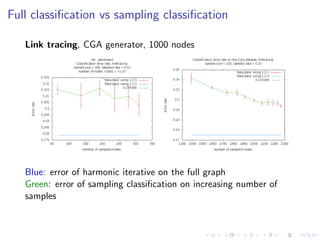
   Link tracing, CGA generator, 1000 nodes


   Blue: error of harmonic iterative on the full graph
   Green: error of sampling classification on increasing number of
   samples
Some discussion

      Samples of graphs can serve to avoid high complexity (O(n3 ))
      of applying learning algorithm in the full graph

      Choice of sampling methods (e.g. snowball is bad for highly
      connected graphs, link tracing is useful in highly clustered
      graphs)

      Approximation of accuracy is reasonable with small number of
      samples already

      Question of the I/O operations in the graph

      Samples of the graph to estimate a distribution?

      Ensemble approaches?

      Approximation in terms of shortest paths?

A discussion on sampling graphs to approximate network classification functions

  • 1.
    A discussion onsampling graphs to approximate network classification functions (work in progress) Gemma C Garriga INRIA gemma.garriga@inria.fr 22.09.2011
  • 2.
    Outline Starting point Classification in networks Samples of graphs Some first experiments
  • 3.
    Outline Starting point Classification in networks Samples of graphs Some first experiments
  • 4.
    Network classification problem Learn a classification function f : X → Y for nodes x ∈ G Relaxing: f : X → R means to infer a probability Pr(y|{x}n , G) Aka collective classification or within-network prediction: nodes with the same label tend to be clustered together
  • 5.
    Network classification problem Challenges Sparsely labeled: few labeled nodes but many unlabeled nodes Heterogeneous types of contents, multiple types of links Network structure (what edges are in the graph) affects the accuracy of the models Networks are large size Related to Semi-supervised learning based on graphs
  • 6.
    Semi-supervised learning Goal Build a learner f that can label input instances x into different classes or categories y Notation input instance x, label y learner f : X → Y labeled data (Xl , Yl ) = {(x1:l , y1:l )} unlabeled data Xu = {xl+1:n }, available during training usually l n Semi-supervised learning Use both labeled and unlabeled data to build better learners
  • 7.
    Semi-supervised graph-based methods Transform vectorial data into a graph Nodes: labeled and unlabeled Xl ∪ Xu Edges: weighted edges (xi , xj ) computed from features Weights represent similarity, e.g. wi,j = exp(−γ||xi − xj ||2 ) Sparsify with: k-nearest neighbor graph, threshold graph ( distance graph) . . . The general idea is that there will be similiarity implied via all paths in the graph
  • 8.
    Semi-supervised graph-based methods Smoothness assumption In a weighted graph, nodes that are similar are connected by heavy edges (high density region) and therefore tend to have the same label. Density is not uniform [From Zhu et al. ICML 2003]
  • 9.
    The harmonic function Relaxing discrete labels to real values with f : X −→ R that satisfies: 1 f(xi ) = yi for i = 1 . . . l 2 f minimizes the energy function wij (f(xi ) − f(xj ))2 ij 3 it is the mean of the associated Gaussian random field 4 the harmonic property means j∼i wij f(xj ) f(xi ) = j∼i wij
  • 10.
    Harmonic solution withiterative method An iterative method as in self-training: 1 Set f(xi ) = yi for i = 1 . . . l and f(xj ) arbitrary for xj ∈ Xu 2 Repeat until convergence: j∼i wij f(xj ) Set f(xi ) = wij j∼i Keep always f(Xl ) fixed
  • 11.
    A random walkinterpretation on directed graphs wij Randomly walk from node i to j with probability k wik The harmonic function tells about Pr(hit label 1 | start from i) [From Zhu’s tutorial at ICML 2007]
  • 12.
    Harmonic solution withgraph Laplacian Let W be the n × n weight matrix on Xl ∪ Xu Symmetric and non-negative n Let diagonal degree matrix D: Dii = j=1 wij Graph Laplacian is ∆ = D − W The energy function can be rewritten: min wij (f(xi ) − f(xj ))2 = min ft ∆f f f ij Harmonic solution solves fu = −∆uu −1 ∆ul Yl Complexity of O(n3 )
  • 13.
    Outline Starting point Classification in networks Samples of graphs Some first experiments
  • 14.
    Characteristics of networkdata So, can one use semi-supervised learning based on graphs for networks? Some reflections: + The smoothness assumption can be seen as a clustering assumption, or community structure assumption Groups of nodes that are similar tend to be more densely connected between them than with the rest of the network + The laplacian matrix could help to integrate both vectorial and structure of the network − However, networks have scale free of the degree distributions Structure of the links influences iterative propagation − Networks can be very large
  • 15.
    How to usegraph samples First idea: 1 For i = 1 . . . |samples| do: ˆ Extract graph sample Gi G from the full graph ˆ ˆ Apply harmonic iterative algorithm to Gi to get f(u), u ∈ Gi 2 ˆ Average f(u) for u ∈ {Gi } selected in several samples 3 For all nodes v that did appear in any sample do: Make random walks to k nodes touched by samples Compute weighted average of the k labels found 1 f(v) = d(v, uj )f(uj ) j={1...k} d(v, uj ) j={1...k}
  • 16.
    How can sampleshelp? Samples have less edges than the full graph, so diffusion is different from the full graph Subgraphs will be random, so maybe a good behavior on average The iterative algorithm (or laplacian harmonic) will be applied only on samples. Complexity is reduced The nodes not contained in any sample, will be labeled following the assumptions of the random walk interpretation given by the harmonic iterative solution [From Zhu’s tutorial at ICML 2007]
  • 17.
    How cannot sampleshelp? It depends on how samples in the graph are extracted. Things to take into account Including some labeled points from all classes in the sampled graph Extracting a connected subgraph Sampling on the vectorial data, on the structural edges, or integrating both in the sampling process (like random walk sampling) It is just an approximation, how good is it? can we say something theoretically? ensemble approaches based on samples?
  • 18.
    Going further: sparsifythe samples Finding some sort of ”backbone” Second idea: 1 For i = 1 . . . |samples| do: ˆ Extract graph sample Gi G from the full graph ˆ ˆ Apply harmonic iterative algorithm to Gi to obtain f(u), u ∈ Gi 2 ˆ From S = {Gi } find nodes (or subgraph) U S with |U| = l s.t. f(U ) = g(f(U)) where U = SU and g is some defined (linear) transformation 3 Label any other node v by k random walks to nodes in the previous central nodes (or subgraph) U
  • 19.
    Outline Starting point Classification in networks Samples of graphs Some first experiments
  • 20.
    Induced subgraph sampling From”Statistical analysis of network data”, Kolaczyk Sample n vertices without replacement to form V ∗ = {i1 , . . . , in } Edges are observed for vertex pairs i, j ∈ V ∗ for which {i, j} ∈ E, yielding E∗ Selected nodes in yellow, observed edges in orange
  • 21.
    Incident subgraph sampling From”Statistical analysis of network data”, Kolaczyk Select n edges with random sampling without replacement, E∗ All incident vertices to E∗ are then observed, providing V ∗ Selected edges in yellow, observed nodes in orange
  • 22.
    Star and snowballsampling From ”Statistical analysis of network data”, Kolaczyk ∗ Take initial vertex sample V0 without replacement of size n. Observe all edges incident to i ∈ V0 , yielding E∗ ∗ ∗ For labeled star sampling we observe also vertices i ∈ VV0 to ∗ which edges in E are incident For snowball sampling we iterate the process of labeled star sampling to neighbors up to the k-th wave 1-wave: yellow, 2-wave: orange, 3-wave: red
  • 23.
    Link tracing sampling From”Statistical analysis of network data”, Kolaczyk A sample S = {s1 , . . . , sns } of ”sources” are selected from V A sample T = {t1 , . . . , tnt } of ”targets” are selected from VS A path is sampled between pairs (si , ti ) and all vertices and edges in the paths are observed, yielding G∗ = (V ∗ , E∗ ) Sources {s1 , s2 } to targets {t1 , t2 }
  • 24.
    Some other samplingalgorithms Other possible ideas of sampling algorithms for graphs: Random node selection, random edge selection Selecting nodes with probability proportional to ”page rank” weight Random node neighbor Random walk sampling Random jump sampling Forest fire sampling
  • 25.
    Some challenges ofsampling with labels Including labels in the samples Size of the samples Isolated nodes Edges of structure or content
  • 26.
    Outline Starting point Classification in networks Samples of graphs Some first experiments
  • 27.
    Experimental set-up Classification algorithm In the samples, compute the harmonic function f in iterative fashion for ≈ 10 iterations Final classification: for every node u assign label l that has max value (probability) f(u) Keep 1/3 of the labels Datasets Graph generated data: (1) cluster generator and (2) community guided attachment generator Other: Webkb, IMDB, Cora
  • 28.
    What happens inone sample? Incident(left) & induced (right), Webkb (Cornell), 867 nodes Blue: error of harmonic iterative on the full graph Green: error on one single increasing-size sample
  • 29.
    What happens inone sample? Link tracing, Imdb, 1169 nodes Blue: error of harmonic iterative on the full graph Green: error on one single increasing-size sample
  • 30.
    What happens inone sample? Random node-edge selection, Imdb, 1169 nodes Blue: error of harmonic iterative on the full graph Green: error on one single increasing-size sample
  • 31.
    Full classification vssampling classification Induced & Incident, Cora, 1878 nodes Blue: error of harmonic iterative on the full graph Green: error of sampling classification on increasing number of samples
  • 32.
    Full classification vssampling classification Induced & Incident, Webkb (Wisconsin), 1263 nodes Blue: error of harmonic iterative on the full graph Green: error of sampling classification on increasing number of samples
  • 33.
    Full classification vssampling classification Link tracing, CGA generator, 1000 nodes Blue: error of harmonic iterative on the full graph Green: error of sampling classification on increasing number of samples
  • 34.
    Some discussion Samples of graphs can serve to avoid high complexity (O(n3 )) of applying learning algorithm in the full graph Choice of sampling methods (e.g. snowball is bad for highly connected graphs, link tracing is useful in highly clustered graphs) Approximation of accuracy is reasonable with small number of samples already Question of the I/O operations in the graph Samples of the graph to estimate a distribution? Ensemble approaches? Approximation in terms of shortest paths?