Particle Filtering
         Ph.D. Coursework: Computer Vision

                    Eric Lehmann
    Department of Telecommunications Engineering
Research School of Information Sciences and Engineering
      The Australian National University, Canberra
            Eric.Lehmann@anu.edu.au

                    June 06, 2003
Context
Tracking:

• Probabilistic inference about the motion of an object given a
  sequence of measurements
• Applications: robotics, multimedia, military, videoconferencing,
  surveillance, etc.
• Computer vision: vehicle tracking, human-computer interaction,
  robot localisation, etc.

In practice:

• Noise in measurements (images)
• Background might be heavily cluttered

É Robust tracking method: state-space approach

Page 1 — Computer Vision, Ph.D. coursework       Eric Lehmann, Tel. Eng.
State-Space Approach
Problem definitions:
• State variable X k : e.g. target position and velocity in state-space
  at time k
                          X k = [x, y, z, x, y, z]T
                                          ˙ ˙ ˙

• Observation Y k : measurements obtained from processing camera
  image data

• Set of all observations: Y 1:k = [Y 1, . . . , Y k ]

• System dynamics (transition) equation: X k = g(X k−1, v k−1)

Aim: given all data Y 1:k , compute posterior PDF p(X k |Y 1:k )
     É Bayesian filtering problem

Page 2 — Computer Vision, Ph.D. coursework               Eric Lehmann, Tel. Eng.
State-Space Approach
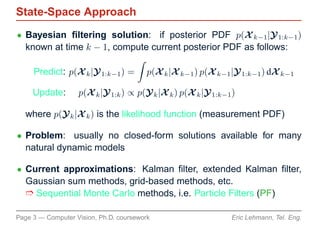
• Bayesian filtering solution: if posterior PDF p(X k−1|Y 1:k−1)
  known at time k − 1, compute current posterior PDF as follows:

     Predict: p(X k |Y 1:k−1) =          p(X k |X k−1) p(X k−1|Y 1:k−1) dX k−1

     Update:       p(X k |Y 1:k ) ∝ p(Y k |X k ) p(X k |Y 1:k−1)

  where p(Y k |X k ) is the likelihood function (measurement PDF)

• Problem: usually no closed-form solutions available for many
  natural dynamic models

• Current approximations: Kalman filter, extended Kalman filter,
  Gaussian sum methods, grid-based methods, etc.
  É Sequential Monte Carlo methods, i.e. Particle Filters (PF)

Page 3 — Computer Vision, Ph.D. coursework                    Eric Lehmann, Tel. Eng.
State-Space Approach: Symbolic Representation
Case: Gaussian noise and linear equations


From [Condensation – conditional density propagation for visual tracking, Isard and Blake, Int. J.
Computer Vision, 1998]

Page 4 — Computer Vision, Ph.D. coursework                                 Eric Lehmann, Tel. Eng.
State-Space Approach: Symbolic Representation
Case: non-Gaussian noise and/or nonlinear equations


From [Condensation – conditional density propagation for visual tracking, Isard and Blake, Int. J.
Computer Vision, 1998]

Page 5 — Computer Vision, Ph.D. coursework                                 Eric Lehmann, Tel. Eng.
Particle Filtering
• Numerical method to solve nonlinear and/or non-Gaussian
  Bayesian filtering problems
• Known variously as: bootstrap filtering, condensation algorithm,
  interacting particle approximations, survival of the fittest,
  JetStream, etc.
• Particle and weight representation of posterior density:


From [Condensation – conditional density propagation for visual tracking, Isard and Blake, Int. J.
Computer Vision, 1998]

Page 6 — Computer Vision, Ph.D. coursework                                 Eric Lehmann, Tel. Eng.
Basic PF Algorithm
From [Novel approach to nonlinear/non-Gaussian Bayesian state estimation, Gordon et al., IEE
Proc. F., 1993]


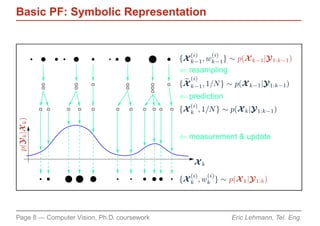
Assumption: a set of N state samples and corresponding weights
   (i)   (i)
{X k−1, wk−1, i = 1, . . . , N } represents the posterior density
p(X k−1|Y 1:k−1) at time k − 1


Procedure: update the particle set to represent the posterior density
p(X k |Y 1:k ) for current time k according to following iterations


Page 7 — Computer Vision, Ph.D. coursework                             Eric Lehmann, Tel. Eng.
Basic PF: Symbolic Representation


                                                (i)    (i)
                                             {X k−1, wk−1} ∼ p(X k−1|Y 1:k−1)
                                             ⇐ resampling
                                                (i)
                                             {X k−1, 1/N }   ∼ p(X k−1|Y 1:k−1)
                                             ⇐ prediction
                                                (i)
                                             {X k , 1/N } ∼ p(X k |Y 1:k−1)
p(Y k |X k )


                                             ⇐ measurement & update


                                                 Xk
                                                (i)   (i)
                                             {X k , wk } ∼ p(X k |Y 1:k )


Page 8 — Computer Vision, Ph.D. coursework                    Eric Lehmann, Tel. Eng.
PF Methods Overview

• Algorithm design choices:
    Source dynamics model: various models available
    Observations: camera image data
    Likelihood function: derived from observations
• Large number of enhanced PF versions to be found in literature:
  auxiliary PF, unscented PF, ICondensation, hybrid bootstrap, fast
  weighted bootstrap, annealed PF, etc.
• PF methods: special case of Sequential Importance Sampling,
  see [On sequential Monte Carlo sampling methods for Bayesian
  filtering, Doucet et al., Statist. Comput., 2000]
• Excellent review of current PF methods in [A tutorial on particle
  filters for online nonlinear/non-Gaussian Bayesian Tracking,
  Arulampalam et al., IEEE Trans. Sig. Proc., 2002]
Page 9 — Computer Vision, Ph.D. coursework        Eric Lehmann, Tel. Eng.
PF Tracking of a Head Outline
Standard head outline template (parametric spline curve) used for
tracking. Measurements are obtained by detecting maxima of
intensity gradient along lines normal to the head contour.


From [Condensation – conditional density propagation for visual tracking, Isard and Blake, Int. J.
Computer Vision, 1998] and [Sequential Monte Carlo fusion of sound and vision for speaker
tracking, Vermaak et al., Proc. Int. Conf. on Computer Vision, 2001]

Page 10 — Computer Vision, Ph.D. coursework                                Eric Lehmann, Tel. Eng.
PF Tracking of a Head Outline
Particle representation of shape distribution


From [Condensation – conditional density propagation for visual tracking, Isard and Blake, Int. J.
Computer Vision, 1998]

Page 11 — Computer Vision, Ph.D. coursework                                Eric Lehmann, Tel. Eng.
Application Example
Tracking objects in heavy clutter


              hand.mpg                  dancemv.mpg                    leafmv.mpg

From [Condensation – conditional density propagation for visual tracking, Isard and Blake, Int. J.
Computer Vision, 1998]

Page 12 — Computer Vision, Ph.D. coursework                                Eric Lehmann, Tel. Eng.
Application Example
Combining sound and vision in PF algorithm


                                    pat jacoC out.avi

From [Sequential Monte Carlo fusion of sound and vision for speaker tracking, Vermaak et al.,
Proc. Int. Conf. on Computer Vision, 2001]

Page 13 — Computer Vision, Ph.D. coursework                              Eric Lehmann, Tel. Eng.
Application Example
Tracking of more complex models


                                         walker.mpg

From [Articulated Body Motion Capture by Annealed Particle Filtering, Deutscher et al., IEEE
Conf. Computer Vision and Pattern Recognition, 2000]

Page 14 — Computer Vision, Ph.D. coursework                              Eric Lehmann, Tel. Eng.

Particle filtering in Computer Vision (2003)

  • 1.
    Particle Filtering Ph.D. Coursework: Computer Vision Eric Lehmann Department of Telecommunications Engineering Research School of Information Sciences and Engineering The Australian National University, Canberra Eric.Lehmann@anu.edu.au June 06, 2003
  • 2.
    Context Tracking: • Probabilistic inferenceabout the motion of an object given a sequence of measurements • Applications: robotics, multimedia, military, videoconferencing, surveillance, etc. • Computer vision: vehicle tracking, human-computer interaction, robot localisation, etc. In practice: • Noise in measurements (images) • Background might be heavily cluttered É Robust tracking method: state-space approach Page 1 — Computer Vision, Ph.D. coursework Eric Lehmann, Tel. Eng.
  • 3.
    State-Space Approach Problem definitions: •State variable X k : e.g. target position and velocity in state-space at time k X k = [x, y, z, x, y, z]T ˙ ˙ ˙ • Observation Y k : measurements obtained from processing camera image data • Set of all observations: Y 1:k = [Y 1, . . . , Y k ] • System dynamics (transition) equation: X k = g(X k−1, v k−1) Aim: given all data Y 1:k , compute posterior PDF p(X k |Y 1:k ) É Bayesian filtering problem Page 2 — Computer Vision, Ph.D. coursework Eric Lehmann, Tel. Eng.
  • 4.
    State-Space Approach • Bayesianfiltering solution: if posterior PDF p(X k−1|Y 1:k−1) known at time k − 1, compute current posterior PDF as follows: Predict: p(X k |Y 1:k−1) = p(X k |X k−1) p(X k−1|Y 1:k−1) dX k−1 Update: p(X k |Y 1:k ) ∝ p(Y k |X k ) p(X k |Y 1:k−1) where p(Y k |X k ) is the likelihood function (measurement PDF) • Problem: usually no closed-form solutions available for many natural dynamic models • Current approximations: Kalman filter, extended Kalman filter, Gaussian sum methods, grid-based methods, etc. É Sequential Monte Carlo methods, i.e. Particle Filters (PF) Page 3 — Computer Vision, Ph.D. coursework Eric Lehmann, Tel. Eng.
  • 5.
    State-Space Approach: SymbolicRepresentation Case: Gaussian noise and linear equations From [Condensation – conditional density propagation for visual tracking, Isard and Blake, Int. J. Computer Vision, 1998] Page 4 — Computer Vision, Ph.D. coursework Eric Lehmann, Tel. Eng.
  • 6.
    State-Space Approach: SymbolicRepresentation Case: non-Gaussian noise and/or nonlinear equations From [Condensation – conditional density propagation for visual tracking, Isard and Blake, Int. J. Computer Vision, 1998] Page 5 — Computer Vision, Ph.D. coursework Eric Lehmann, Tel. Eng.
  • 7.
    Particle Filtering • Numericalmethod to solve nonlinear and/or non-Gaussian Bayesian filtering problems • Known variously as: bootstrap filtering, condensation algorithm, interacting particle approximations, survival of the fittest, JetStream, etc. • Particle and weight representation of posterior density: From [Condensation – conditional density propagation for visual tracking, Isard and Blake, Int. J. Computer Vision, 1998] Page 6 — Computer Vision, Ph.D. coursework Eric Lehmann, Tel. Eng.
  • 8.
    Basic PF Algorithm From[Novel approach to nonlinear/non-Gaussian Bayesian state estimation, Gordon et al., IEE Proc. F., 1993] Assumption: a set of N state samples and corresponding weights (i) (i) {X k−1, wk−1, i = 1, . . . , N } represents the posterior density p(X k−1|Y 1:k−1) at time k − 1 Procedure: update the particle set to represent the posterior density p(X k |Y 1:k ) for current time k according to following iterations Page 7 — Computer Vision, Ph.D. coursework Eric Lehmann, Tel. Eng.
  • 9.
    Basic PF: SymbolicRepresentation (i) (i) {X k−1, wk−1} ∼ p(X k−1|Y 1:k−1) ⇐ resampling (i) {X k−1, 1/N } ∼ p(X k−1|Y 1:k−1) ⇐ prediction (i) {X k , 1/N } ∼ p(X k |Y 1:k−1) p(Y k |X k ) ⇐ measurement & update Xk (i) (i) {X k , wk } ∼ p(X k |Y 1:k ) Page 8 — Computer Vision, Ph.D. coursework Eric Lehmann, Tel. Eng.
  • 10.
    PF Methods Overview •Algorithm design choices: Source dynamics model: various models available Observations: camera image data Likelihood function: derived from observations • Large number of enhanced PF versions to be found in literature: auxiliary PF, unscented PF, ICondensation, hybrid bootstrap, fast weighted bootstrap, annealed PF, etc. • PF methods: special case of Sequential Importance Sampling, see [On sequential Monte Carlo sampling methods for Bayesian filtering, Doucet et al., Statist. Comput., 2000] • Excellent review of current PF methods in [A tutorial on particle filters for online nonlinear/non-Gaussian Bayesian Tracking, Arulampalam et al., IEEE Trans. Sig. Proc., 2002] Page 9 — Computer Vision, Ph.D. coursework Eric Lehmann, Tel. Eng.
  • 11.
    PF Tracking ofa Head Outline Standard head outline template (parametric spline curve) used for tracking. Measurements are obtained by detecting maxima of intensity gradient along lines normal to the head contour. From [Condensation – conditional density propagation for visual tracking, Isard and Blake, Int. J. Computer Vision, 1998] and [Sequential Monte Carlo fusion of sound and vision for speaker tracking, Vermaak et al., Proc. Int. Conf. on Computer Vision, 2001] Page 10 — Computer Vision, Ph.D. coursework Eric Lehmann, Tel. Eng.
  • 12.
    PF Tracking ofa Head Outline Particle representation of shape distribution From [Condensation – conditional density propagation for visual tracking, Isard and Blake, Int. J. Computer Vision, 1998] Page 11 — Computer Vision, Ph.D. coursework Eric Lehmann, Tel. Eng.
  • 13.
    Application Example Tracking objectsin heavy clutter hand.mpg dancemv.mpg leafmv.mpg From [Condensation – conditional density propagation for visual tracking, Isard and Blake, Int. J. Computer Vision, 1998] Page 12 — Computer Vision, Ph.D. coursework Eric Lehmann, Tel. Eng.
  • 14.
    Application Example Combining soundand vision in PF algorithm pat jacoC out.avi From [Sequential Monte Carlo fusion of sound and vision for speaker tracking, Vermaak et al., Proc. Int. Conf. on Computer Vision, 2001] Page 13 — Computer Vision, Ph.D. coursework Eric Lehmann, Tel. Eng.
  • 15.
    Application Example Tracking ofmore complex models walker.mpg From [Articulated Body Motion Capture by Annealed Particle Filtering, Deutscher et al., IEEE Conf. Computer Vision and Pattern Recognition, 2000] Page 14 — Computer Vision, Ph.D. coursework Eric Lehmann, Tel. Eng.