International Journal of Trend in Scientific Research and Development (IJTSRD)
Volume 4 Issue 2, February 2020 Available Online: www.ijtsrd.com e-ISSN: 2456 – 6470
@ IJTSRD | Unique Paper ID – IJTSRD30032 | Volume – 4 | Issue – 2 | January-February 2020 Page 620
A Deep Neural Framework for Continuous Sign
Language Recognition by Iterative Training: Survey
Jeni Moni1, Anju J Prakash2
1M. Tech Student, 2Assistant Professor,
1,2Department of Computer Science and Engineering, Sree Buddha College of Engineering, Kerala, India
ABSTRACT
Sign Language (SL) is a medium of communication for physically disabled
people. It is a gesture based language for communication of dumb and deaf
people. These people communicate by using different actions of hands,where
each different action means something. Sign language is the only way of
conversation for deaf and dumb people. It is very difficult to understand this
language for the common people.Hencesignlanguagerecognitionhasbecome
an important task. There is a necessity for a translator to communicate with
the world. Real time translator for sign language provides a medium to
communicate with others. Previous methods employs sensor gloves, hat
mounted cameras, armband etc. which has wearingdifficultiesandhavenoisy
behaviour. To alleviate this problem, a real time gesture recognition system
using Deep Learning (DL) is proposed. It enables to achieve improvementson
the gesture recognition performance.
KEYWORDS: Sign Language, Deep Learning (DL), Gesture Recognition
How to cite this paper: Jeni Moni | Anju J
Prakash "A Deep Neural Framework for
Continuous Sign LanguageRecognitionby
Iterative Training: Survey" Published in
International Journal
of Trend in Scientific
Research and
Development(ijtsrd),
ISSN: 2456-6470,
Volume-4 | Issue-2,
February 2020,
pp.620-623, URL:
www.ijtsrd.com/papers/ijtsrd30032.pdf
Copyright © 2019 by author(s) and
International Journal ofTrendinScientific
Research and Development Journal. This
is an Open Access article distributed
under the terms of
the Creative
CommonsAttribution
License (CC BY 4.0)
(http://creativecommons.org/licenses/by
/4.0)
INRODUCTION
The sign languageisaveryimportantwayforcommunication
with deaf and dumb people. Each gesture has a specific
meaning in sign language. SL is consideredbasicallyasanon-
verbal language Lots of research is going on image based
approaches only because of advantage of not need to wear
complex devices like Hand Gloves, Helmet etc. Sign
recognition is related as image understanding.Signdetection
and sign recognition are the twomajorphases.Signdetection
can be defined as the process of extracting feature of certain
object with respect to certain parameters. Sign recognitionis
the process of recognizing a certain shape that differentiates
the object from the remaining shapes.
Sign language is often considered as the most grammatically
structured gestural communications. This nature makes SL
recognition an ideal researchfieldfordevelopingmethods to
address different problems such as human motion analysis,
human-computer interaction (HCI).The problem of
communication has been addressed by several companies
and researchers,whohaveprovidedtheirsolution.However,
the problem is still under considerable attention.
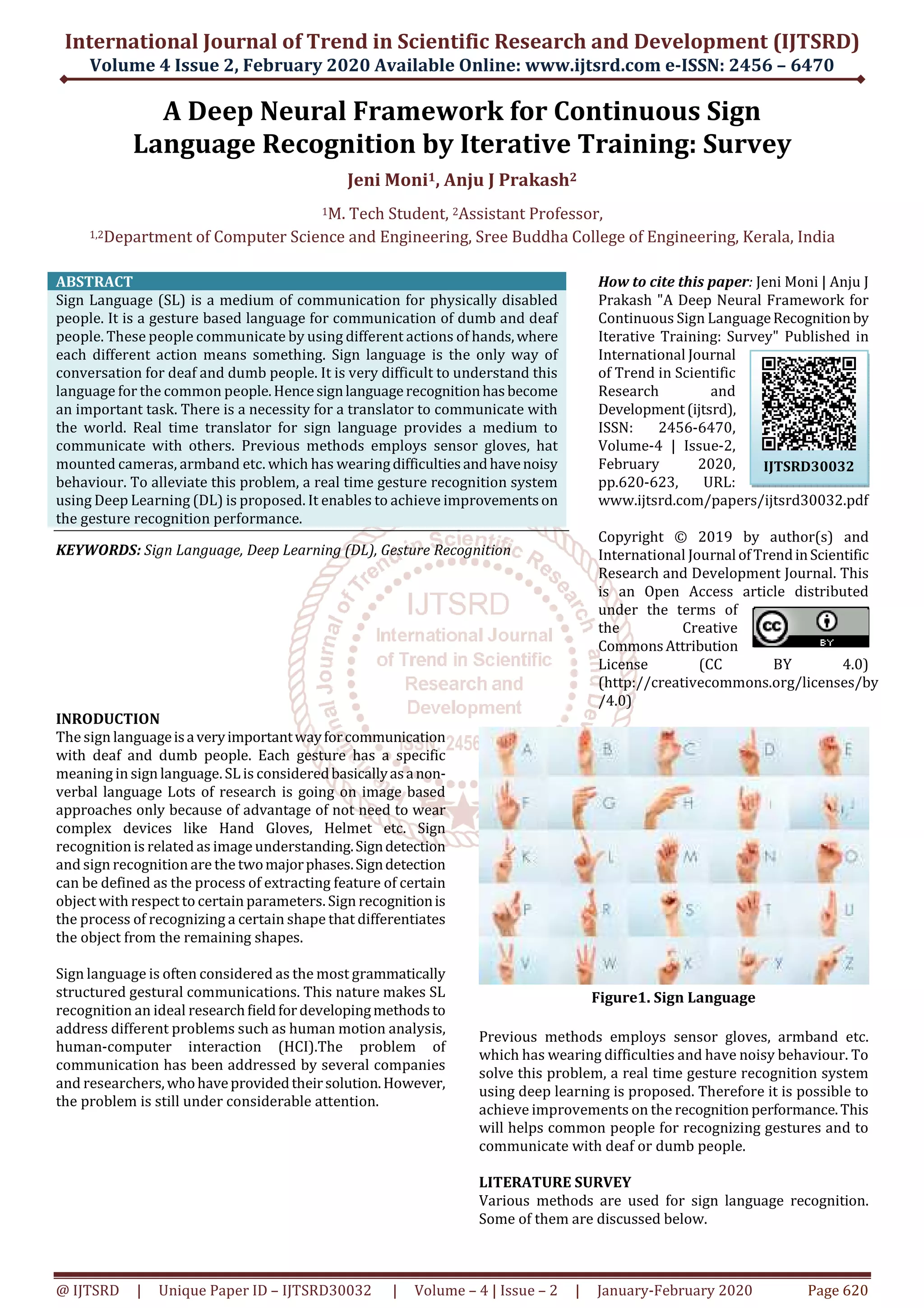
Figure1. Sign Language
Previous methods employs sensor gloves, armband etc.
which has wearing difficulties and have noisy behaviour. To
solve this problem, a real time gesture recognition system
using deep learning is proposed. Therefore it is possible to
achieve improvements on the recognition performance.This
will helps common people for recognizing gestures and to
communicate with deaf or dumb people.
LITERATURE SURVEY
Various methods are used for sign language recognition.
Some of them are discussed below.
IJTSRD30032
International Journal of Trend in Scientific Research and Development (IJTSRD) @ www.ijtsrd.com eISSN: 2456-6470
@ IJTSRD | Unique Paper ID – IJTSRD30032 | Volume – 4 | Issue – 2 | January-February 2020 Page 621
1. Sign Language Recognition Using Sensor Gloves
S. A. Mehdi et al. [2] proposed a sign language recognition
approach using sensor gloves. Sensor gloves are normally
gloves made out of cloth with sensors fitted on it. Using data
glove is a better idea over camera as the user has flexibilityof
moving around freely within a radiuslimited by the lengthof
wire connecting the glove to the computer,unlikethecamera
where the user has to stay in position beforethecamera.This
limit can be further lowered by using a wireless camera. The
effect of light, electric or magnetic fields or any other
disturbance does not affect the performance of the glove. 7-
sensor glove of 5DT Company is used. It has 7 sensors on it. 5
sensors are for each finger and thumb. One sensor is to
measure the tilt of the hand and one sensorfortherotationof
the hand. Optic fibers are mounted on the glove to measure
the flexure of fingers and thumb. Each sensor returns an
integer value between 0 and 4095. This value tells about the
bent of the sensor. 0 means fully stretched and 4095 means
fully bent. So, a range of 7 * 4096 combinations obtained as
input.
Artificial Neural Network with feed forward and back
propagation algorithms have been used. Feed forward
algorithm is used to calculate the output for a specific input
pattern. Three layers of nodeshavebeenusedinthenetwork.
First layer is the input layer that takes 7 sensor values from
the sensors on the glove. So this layer has 7 sensors. Next
layer is the hidden layer, which takes the values from the
input layer andapplies theweightsonthem.Thislayerhas52
nodes. This layer passes its output to the third layer. The
third layer is the output layer, which takes its input from the
hidden layer andapplies weightstothem.Thereare26nodes
in this layer. Each node denotes one alphabet of the sign
language subset. This layer passes out the final output. A
threshold is applied to the final output. Onlythevaluesabove
this threshold and considered.
2. A Wearable HandGlovesGestureDetectionBasedOn
Flex Sensors for Disabled People
Purohit et al. [3] introduced a wearable hand gloves gesture
detection based on flex sensors for disabled people. The data
glove is fitted with flex sensors along the length of each
finger. The flex sensors output a stream of data that varies
with degree of bend. The analog outputsfromthesensorsare
then fed to microcontroller. It processes the signals and
perform analog to digital signal conversion. The gesture is
recognized and the corresponding text information is
identified. The user need to know the signs of particular
alphabets and he need to stay with the sign for two seconds.
There are no limitations for signs it is hard to build a
standard library of signs. The new sign introduced should be
supported by the software used in the system. Thesesensors
are attached along the fingers. The degree of bending of
fingers and thumb produces the output voltage variation
which in turn on converting to analog form produces
required voice. A pair of gloves along with sensors enables
mute people or old people to interact with the public in the
required sentence which is very much helpful for them. At
server side the system takes the input from the micro
controller and based on the combination of those inputs it
will match the pattern with already fed pattern in the
database and if the pattern is not available in database, the
system will respond with “not available” value.
3. Sign Language Recognition Using Image Based Hand
Gesture Recognition Technique
A. S. Nikam et al. [4] proposed image based hand gesture
recognition technique. Image based gesture recognition
system is divided into three steps In Image-preprocessing
color to binary conversion & Noise filtering is done for
captured image. The set of operations which performsonthe
image based on shapes are known as Morphological
operations. There are two most basic morphological
operations: Erosion and Dilation, it uses for Removing noise,
Separation of individual elements and joining misaligned
elements in an image, even Finding of intensity bumps or
holes in an image. Erosion shrinks boundaries of an image
and enlarges holes. Erosion can be used to remove noises
from an image. And Dilation is used to add pixels at region of
boundaries or to fill in holes which generate during erosion
process. Dilation can also be used to connect disjoint pixels
and add pixels at edges. Trackingismainlyusedfortrackinga
hand gesture from capture image using Convexity hull
algorithm. Finally recognition is done with the help of
features like convex hull and convex defects taken from
tracking.
4. Real-TimeHandGestureRecognitionwithEMGUsing
Machine Learning
A. G. Jaramillo et al. [5] proposed hand gesture recognition
with EMG using machine learning. Myo armband is a sensor
which is used because of the following reasons: low cost,
small size and weight, software development kit (SDK) and
because the Myo is a small and open source sensor that is
easy to wear. The Myo armband has eight EMG surface dry
sensors, and an inertial measurement unit (IMU). The eight
surface sensors measure 200 samples per second of the
electrical activity of the muscles. The IMU has 9 degrees of
freedom (accelerometer, gyroscope, and orientation intheX,
Y, and Z-axes). The Myo armband uses Bluetooth technology
for transmitting the data to the computer. Finally, the Myo
armband has incorporated a proprietary system capable of
recognizing five gestures of the hand: pinch, fist, open, wave
in, and wave out. EMG is a measure of the electrical activity
produced by the muscles of the human body. The EMG signal
is a linear summation between several trains of MUAPs. The
amplitude and frequency of the EMG signals are affected by
on the muscularfatigue,theageoftheperson,neuromuscular
diseases, and the temperature and the thickness of the skin.
For feature extraction, different techniques in time,
frequency, and time-frequencydomainstoobtainmeaningful
information are applied. In the time domain, featureslikethe
mean absolute value, nth-order autoregressive coefficients,
zero crossing, length of the signal, sign of slope changes,
modified mean absolute value, simple square integral are
tested. In the frequency domain, features like the power
spectrum, mean and median frequencies, frequency
histogram, mean power, andspectral moments are tested. In
the time-frequency domain, feature like the wavelet
transform is tested. The classification stage determines to
which class (gesture) a feature vector extracted from the
EMGsignals belongs to. Themost common classifiers usedin
the hand gesture recognition with EMG are support vector
machines and neural networks.
5. Real Time Indian Sign Language Recognition System
to Aid Deaf-Dumb People
P. S. Rajam et al. [6] proposed a real-time sign language
recognition system to aid deaf and dumb people. The
International Journal of Trend in Scientific Research and Development (IJTSRD) @ www.ijtsrd.com eISSN: 2456-6470
@ IJTSRD | Unique Paper ID – IJTSRD30032 | Volume – 4 | Issue – 2 | January-February 2020 Page 622
proposed method uses 32 combinations of binary number
sign are developed by usingrighthandpalmimage,whichare
loaded at runtime. An image captured at run time is scanned
to identify fingertip positions of the five fingers namely little
fingers, ring finger, middle, index finger and thumb finger.
The tip of fingers is identifiedbymeasuringtheirheightswith
respect to a reference point at the bottom of thepalmcloseto
the wrist. The heights are determined by Euclidean distance
measurements. Number of instancesinascanarelessthanor
equal to 3 in the case of Left-Right Scan and it is less than or
equal to 2 in the case of Right- Left Scan which are
determined by the UP or DOWN positions of the fingers. The
output is obtained originally in the form of binary string of
length of five in which the most significant bit represents the
LITTLE finger and the least significant bit represents the
THUMB finger. The string is then coded into the equivalent
decimal numbers.
6. Sign Language Recognition Using Principal
Component Analysis
A. Saxena et al. [7] proposed sign language recognition using
principle component analysis. Principal component analysis
is a fast and efficient technique for recognition of sign
gestures from video stream. It is a rather general statistical
technique that can be used to reduce the dimensionality of
the feature space. Capturing of images from live video can be
done using webcam or an android device. In this proposed
technique, it is possible to capture 3 frames per second from
video stream. After thatwecomparethreecontinuousframes
to know the frame containing static posture shown by hand.
This static posture is recognized as a sign gesture. Now it is
matched with stored gesture database to know its meaning.
This system has been tested and developed successfully in a
real time environment.
7. Using Multiple Sensors for Mobile Sign Language
Recognition
H. Brashear et al. [8] proposed sign language recognition
using multiple sensors. Multiple sensor types are used for
disambiguation of noise in gesture recognition. In this case,
accelerometers with the three degrees of freedom, mounted
on the wrists and torso to increase our sensing information
are used. The accelerometers will capture information that
the vision system will have difficulty with such as rotation
(when hand shape looks similar) and vertical movement
towards or away from the camera. The camera will provide
information not gathered bytheaccelerometerssuchashand
shape and position. Both sensors collect information about
the movement of the hands through space. By adding
multiple sensor types, the accuracy of the system will be
improved in noisy or problematic conditions. It is important
to add that sensor selection is based on the amount of
information the sensor collects and its “wear- ability”.
The current system could be partially concealed by
embedding the camera inanormalhat,suchasabaseballcap,
and combining visual markers and accelerometers into a
watch or bracelet. Proposed system consists of a wearable
computer, heads–up display, hat–mounted camera, and
accelerometers. The system captures video of the user
signing along with accelerometer data from the wrists and
body. The left hand is marked by a cyan band on the wrist
and the right hand is marked by a yellow band. The HTK
component of the system has been redesigned using the
Georgia Tech Gesture Toolkit, which provides a publicly
available toolkit for developing gesture–based recognition
systems.
8. Real-Time Sign Language Recognition Based On
Neural Network Architecture
P. Mekala et al. [9] proposed real- time sign language
recognition based on neural network architecture.Thevideo
sequence of the signer, i.e. the person conveying in the sign
language, can be obtained by usinga camera.Theinitiationof
the acquisition is being done manually. Local changes due to
noise and digitization errors should not radically alter the
image scene and information. In order to satisfy the memory
requirements and the environmental scene conditions,
preprocessing of the raw video content is highly important.
Under different scene conditions, the performance of
different feature detectors will be significantly different. The
nature of the background, existence of other objects
(occlusion), and illumination must be considered to
determine what kind of features can be efficiently and
reliably detected. Usually the hand shape and the movement
are of major concern in order to guess the word/sentence.
The feature vector is a single row column matrix of N
elements. The feature vector computation involves time and
memory.
Training and generalizing are the most basic and important
properties of the neural networks. The neural network
architecture consists of three layers - an input layer, one
hidden layer and an outputlayer.Inthegestureclassification
stage, a simple neural network model is developed for the
recognition of gestures signs using the features computed
from the video captured. The features can then be extracted
from the video captured using any of the following system.
Sign language recognition using neural networksis based on
the learning of the gestures using a database set of signs.
There is necessity of universal database as the applications
grow and in that case such sequential search algorithms fail
to meet the timing and memory constraints.
9. Sign Language Recognition Using Eigen Value
Weighted Euclidean Distance Based Classification
Technique
Joyeeta et al. [10] proposed sign language sign language
recognition using Eigen value weighted Euclidean distance
basedclassificationtechnique.EigenvaluesandEigenvectors
are a part of linear transformations. Eigen vectors are the
directions along which the linear transformation acts by
stretching, compressingorflippingandEigenvaluesgivesthe
factor by which the compression or stretchingoccurs.Incase
of analysis of data, the Eigen vectors of the covariance are
being found out. Eigenvectors are set of basis function which
describes variability ofdata.AndEigenvectorsarealsoakind
of coordinate system for which the covariance matrix
becomes diagonal for which the new coordinate system is
uncorrelated. The more the Eigen vectors the better the
information obtained from the linear transformation. Eigen
values measures the variance of data of new coordinate
system. For compression of the data only few significant
Eigen values are being selected which reducesthedimension
of the data allowing the data to get compressed The first
phase for proposed system is the skin filtering of the input
image which extracts out the skin colored pixels from the
non-skin colored pixels. The input RGB image is first
converted to the HSV image. The motive of performing this
step is RGB image is very sensitive to change in illumination
International Journal of Trend in Scientific Research and Development (IJTSRD) @ www.ijtsrd.com eISSN: 2456-6470
@ IJTSRD | Unique Paper ID – IJTSRD30032 | Volume – 4 | Issue – 2 | January-February 2020 Page 623
condition. The HSV color space separates three components:
Hue which means the set of pure colors within a color space,
Saturation describing the grade of purityofacolorimageand
Value giving relative lightness or darkness of a color. Next
phase is the cropping of hand. For recognition of different
gestures, only hand portion till wrist is required, thus the
unnecessary part is clipped off using this hand cropping
technique. Classifier was needed in order to recognize
various hand gestures.
10. Vision-BasedHandGestureRecognitionSystemfora
Dynamic and Complicated Environment
C. Liao et al. [11] proposed Vision-Based Hand Gesture
Recognition System for a Dynamic and Complicated
Environment. The proposed system consists of four stages,
detection of the appearance of hands, segmentation of hand
regions, detection of full palm, and handgesturerecognition.
Detection of the appearance of hands is to find out when a
hand appears in the front of the camera. Moreover, some
morphological techniques, along with two stage skin color
detection, are employed to alleviate the effect of noise. The
proposed two-stageskincolordetectionapproachisadopted
from the idea of handling outliers to extract the palm from a
complicated background. Following that, detection of full
palm is conducted to know whether the hand reaches
beyond the field of the camera view. The concept of
ergonomics is employed to determine whether the hand is
beyond the field of the camera view.
In vision-based human-computer interface systems, the
segmentation of foreground objectssuchashands,faces,and
so on from the background is a major issue. Skin color
detection technique is to extractforegroundobjectsfromthe
background image based on color information. This method
segments foreground objects only by theircolorinformation
without considering their shapes. The user may wear wrist
artifacts or rings, and skin-color-like noises are allowed to
exist in the background as long as they are smaller than the
hand. Hence, background noises often exist after the skin
color pixels of input images are detected. After the palm
region is segmented from the backgroundandfiltered bythe
algorithm proposed, the palm is obtained and then the
system needs to know how manyfingershavebeenraised.In
order to detect the number of fingers, the hand of the binary
image will be transformed into a polarimageforrecognition.
CONCLUSION
The problem of communication has persisted for the people
who are physically disabled such hearing impairment or
physically mutes. The problem has been addressed by
various researchers. However, the problem is still under
considerable attention because of its feasibility and
availability. Previous methods employ sensor gloves,
armband, helmets etc. which has wearing difficulties and
have noisy behaviour. To alleviate this problem, a real time
gesture recognition system using deep learning is proposed.
This enables to achieve improvements on the recognition
performance.
REFERENCES
[1] R.Cui,H.LiuandC.Zhang,"ADeepNeuralFrameworkfor
Continuous Sign Language Recognition by Iterative
Training,"inIEEETransactionsonMultimedia,vol.21,no.
7, pp. 1880-1891, July 2019.
[2] S. A. Mehdi and Y. N. Khan, "Sign language recognition
using sensor gloves," Proceedings of the 9th
International Conference on Neural Information
Processing, 2002. ICONIP '02., Singapore, 2002, pp.
2204-2206 vol.5.
[3] Purohit, Kunal,” A Wearable Hand Gloves Gesture
Detection based on Flex Sensors for disabled People”,
2017 International Journal for Research in Applied
Science and Engineering Technology. V. 1825-1833.
10.22214/ijraset.2017.8261.
[4] A.S.NikamandA.G.Ambekar,"Signlanguagerecognition
using image based hand gesture recognition techniques,"
2016 Online International Conference on Green
Engineering and Technologies (IC-GET), Coimbatore,
2016, pp. 1-5.
[5] A. G. Jaramillo and M. E. Benalcázar, "Real-time hand
gesture recognition with EMG using machine learning,"
2017 IEEE Second Ecuador Technical Chapters Meeting
(ETCM), Salinas, 2017, pp. 1-5.
[6] P. S. Rajam and G. Balakrishnan, "Real time Indian Sign
Language Recognition System to aid deaf-dumb
people," 2011 IEEE 13th International Conference on
Communication Technology, Jinan, 2011, pp. 737-742.
[7] A. Saxena, D. K. Jain and A. Singhal, "Sign Language
Recognition Using Principal Component Analysis,"
2014 Fourth International Conference on
Communication Systems and Network Technologies,
Bhopal, 2014, pp. 810-813.
[8] H. Brashear, T. Starner, P. Lukowicz and H. Junker,
"Using multiple sensors for mobile sign language
recognition," Seventh IEEE International Symposium
on Wearable Computers, 2003. Proceedings., White
Plains, NY, USA, 2003, pp. 45-52.
[9] P. Mekala, Y. Gao, J. Fan and A. Davari, "Real-time sign
language recognition based on neural network
architecture," 2011 IEEE 43rd Southeastern
Symposium on System Theory, Auburn, AL, 2011, pp.
195-199.
[10] Singha, Joyeeta & Das, Karen, “Indian Sign Language
Recognition Using Eigen Value Weighted Euclidean
Distance Based Classification Technique”, 2013
International Journal of Advanced Computer Science
and Applications. 4. 10.14569/IJACSA.2013.040228.
[11] C. Liao, S. Su and M. Chen, "Vision-Based Hand Gesture
Recognition System for a Dynamic and Complicated
Environment," 2015 IEEE International Conferenceon
Systems, Man, and Cybernetics, Kowloon, 2015, pp.
2891-2895.

A Deep Neural Framework for Continuous Sign Language Recognition by Iterative Training Survey

  • 1.
    International Journal ofTrend in Scientific Research and Development (IJTSRD) Volume 4 Issue 2, February 2020 Available Online: www.ijtsrd.com e-ISSN: 2456 – 6470 @ IJTSRD | Unique Paper ID – IJTSRD30032 | Volume – 4 | Issue – 2 | January-February 2020 Page 620 A Deep Neural Framework for Continuous Sign Language Recognition by Iterative Training: Survey Jeni Moni1, Anju J Prakash2 1M. Tech Student, 2Assistant Professor, 1,2Department of Computer Science and Engineering, Sree Buddha College of Engineering, Kerala, India ABSTRACT Sign Language (SL) is a medium of communication for physically disabled people. It is a gesture based language for communication of dumb and deaf people. These people communicate by using different actions of hands,where each different action means something. Sign language is the only way of conversation for deaf and dumb people. It is very difficult to understand this language for the common people.Hencesignlanguagerecognitionhasbecome an important task. There is a necessity for a translator to communicate with the world. Real time translator for sign language provides a medium to communicate with others. Previous methods employs sensor gloves, hat mounted cameras, armband etc. which has wearingdifficultiesandhavenoisy behaviour. To alleviate this problem, a real time gesture recognition system using Deep Learning (DL) is proposed. It enables to achieve improvementson the gesture recognition performance. KEYWORDS: Sign Language, Deep Learning (DL), Gesture Recognition How to cite this paper: Jeni Moni | Anju J Prakash "A Deep Neural Framework for Continuous Sign LanguageRecognitionby Iterative Training: Survey" Published in International Journal of Trend in Scientific Research and Development(ijtsrd), ISSN: 2456-6470, Volume-4 | Issue-2, February 2020, pp.620-623, URL: www.ijtsrd.com/papers/ijtsrd30032.pdf Copyright © 2019 by author(s) and International Journal ofTrendinScientific Research and Development Journal. This is an Open Access article distributed under the terms of the Creative CommonsAttribution License (CC BY 4.0) (http://creativecommons.org/licenses/by /4.0) INRODUCTION The sign languageisaveryimportantwayforcommunication with deaf and dumb people. Each gesture has a specific meaning in sign language. SL is consideredbasicallyasanon- verbal language Lots of research is going on image based approaches only because of advantage of not need to wear complex devices like Hand Gloves, Helmet etc. Sign recognition is related as image understanding.Signdetection and sign recognition are the twomajorphases.Signdetection can be defined as the process of extracting feature of certain object with respect to certain parameters. Sign recognitionis the process of recognizing a certain shape that differentiates the object from the remaining shapes. Sign language is often considered as the most grammatically structured gestural communications. This nature makes SL recognition an ideal researchfieldfordevelopingmethods to address different problems such as human motion analysis, human-computer interaction (HCI).The problem of communication has been addressed by several companies and researchers,whohaveprovidedtheirsolution.However, the problem is still under considerable attention. Figure1. Sign Language Previous methods employs sensor gloves, armband etc. which has wearing difficulties and have noisy behaviour. To solve this problem, a real time gesture recognition system using deep learning is proposed. Therefore it is possible to achieve improvements on the recognition performance.This will helps common people for recognizing gestures and to communicate with deaf or dumb people. LITERATURE SURVEY Various methods are used for sign language recognition. Some of them are discussed below. IJTSRD30032
  • 2.
    International Journal ofTrend in Scientific Research and Development (IJTSRD) @ www.ijtsrd.com eISSN: 2456-6470 @ IJTSRD | Unique Paper ID – IJTSRD30032 | Volume – 4 | Issue – 2 | January-February 2020 Page 621 1. Sign Language Recognition Using Sensor Gloves S. A. Mehdi et al. [2] proposed a sign language recognition approach using sensor gloves. Sensor gloves are normally gloves made out of cloth with sensors fitted on it. Using data glove is a better idea over camera as the user has flexibilityof moving around freely within a radiuslimited by the lengthof wire connecting the glove to the computer,unlikethecamera where the user has to stay in position beforethecamera.This limit can be further lowered by using a wireless camera. The effect of light, electric or magnetic fields or any other disturbance does not affect the performance of the glove. 7- sensor glove of 5DT Company is used. It has 7 sensors on it. 5 sensors are for each finger and thumb. One sensor is to measure the tilt of the hand and one sensorfortherotationof the hand. Optic fibers are mounted on the glove to measure the flexure of fingers and thumb. Each sensor returns an integer value between 0 and 4095. This value tells about the bent of the sensor. 0 means fully stretched and 4095 means fully bent. So, a range of 7 * 4096 combinations obtained as input. Artificial Neural Network with feed forward and back propagation algorithms have been used. Feed forward algorithm is used to calculate the output for a specific input pattern. Three layers of nodeshavebeenusedinthenetwork. First layer is the input layer that takes 7 sensor values from the sensors on the glove. So this layer has 7 sensors. Next layer is the hidden layer, which takes the values from the input layer andapplies theweightsonthem.Thislayerhas52 nodes. This layer passes its output to the third layer. The third layer is the output layer, which takes its input from the hidden layer andapplies weightstothem.Thereare26nodes in this layer. Each node denotes one alphabet of the sign language subset. This layer passes out the final output. A threshold is applied to the final output. Onlythevaluesabove this threshold and considered. 2. A Wearable HandGlovesGestureDetectionBasedOn Flex Sensors for Disabled People Purohit et al. [3] introduced a wearable hand gloves gesture detection based on flex sensors for disabled people. The data glove is fitted with flex sensors along the length of each finger. The flex sensors output a stream of data that varies with degree of bend. The analog outputsfromthesensorsare then fed to microcontroller. It processes the signals and perform analog to digital signal conversion. The gesture is recognized and the corresponding text information is identified. The user need to know the signs of particular alphabets and he need to stay with the sign for two seconds. There are no limitations for signs it is hard to build a standard library of signs. The new sign introduced should be supported by the software used in the system. Thesesensors are attached along the fingers. The degree of bending of fingers and thumb produces the output voltage variation which in turn on converting to analog form produces required voice. A pair of gloves along with sensors enables mute people or old people to interact with the public in the required sentence which is very much helpful for them. At server side the system takes the input from the micro controller and based on the combination of those inputs it will match the pattern with already fed pattern in the database and if the pattern is not available in database, the system will respond with “not available” value. 3. Sign Language Recognition Using Image Based Hand Gesture Recognition Technique A. S. Nikam et al. [4] proposed image based hand gesture recognition technique. Image based gesture recognition system is divided into three steps In Image-preprocessing color to binary conversion & Noise filtering is done for captured image. The set of operations which performsonthe image based on shapes are known as Morphological operations. There are two most basic morphological operations: Erosion and Dilation, it uses for Removing noise, Separation of individual elements and joining misaligned elements in an image, even Finding of intensity bumps or holes in an image. Erosion shrinks boundaries of an image and enlarges holes. Erosion can be used to remove noises from an image. And Dilation is used to add pixels at region of boundaries or to fill in holes which generate during erosion process. Dilation can also be used to connect disjoint pixels and add pixels at edges. Trackingismainlyusedfortrackinga hand gesture from capture image using Convexity hull algorithm. Finally recognition is done with the help of features like convex hull and convex defects taken from tracking. 4. Real-TimeHandGestureRecognitionwithEMGUsing Machine Learning A. G. Jaramillo et al. [5] proposed hand gesture recognition with EMG using machine learning. Myo armband is a sensor which is used because of the following reasons: low cost, small size and weight, software development kit (SDK) and because the Myo is a small and open source sensor that is easy to wear. The Myo armband has eight EMG surface dry sensors, and an inertial measurement unit (IMU). The eight surface sensors measure 200 samples per second of the electrical activity of the muscles. The IMU has 9 degrees of freedom (accelerometer, gyroscope, and orientation intheX, Y, and Z-axes). The Myo armband uses Bluetooth technology for transmitting the data to the computer. Finally, the Myo armband has incorporated a proprietary system capable of recognizing five gestures of the hand: pinch, fist, open, wave in, and wave out. EMG is a measure of the electrical activity produced by the muscles of the human body. The EMG signal is a linear summation between several trains of MUAPs. The amplitude and frequency of the EMG signals are affected by on the muscularfatigue,theageoftheperson,neuromuscular diseases, and the temperature and the thickness of the skin. For feature extraction, different techniques in time, frequency, and time-frequencydomainstoobtainmeaningful information are applied. In the time domain, featureslikethe mean absolute value, nth-order autoregressive coefficients, zero crossing, length of the signal, sign of slope changes, modified mean absolute value, simple square integral are tested. In the frequency domain, features like the power spectrum, mean and median frequencies, frequency histogram, mean power, andspectral moments are tested. In the time-frequency domain, feature like the wavelet transform is tested. The classification stage determines to which class (gesture) a feature vector extracted from the EMGsignals belongs to. Themost common classifiers usedin the hand gesture recognition with EMG are support vector machines and neural networks. 5. Real Time Indian Sign Language Recognition System to Aid Deaf-Dumb People P. S. Rajam et al. [6] proposed a real-time sign language recognition system to aid deaf and dumb people. The
  • 3.
    International Journal ofTrend in Scientific Research and Development (IJTSRD) @ www.ijtsrd.com eISSN: 2456-6470 @ IJTSRD | Unique Paper ID – IJTSRD30032 | Volume – 4 | Issue – 2 | January-February 2020 Page 622 proposed method uses 32 combinations of binary number sign are developed by usingrighthandpalmimage,whichare loaded at runtime. An image captured at run time is scanned to identify fingertip positions of the five fingers namely little fingers, ring finger, middle, index finger and thumb finger. The tip of fingers is identifiedbymeasuringtheirheightswith respect to a reference point at the bottom of thepalmcloseto the wrist. The heights are determined by Euclidean distance measurements. Number of instancesinascanarelessthanor equal to 3 in the case of Left-Right Scan and it is less than or equal to 2 in the case of Right- Left Scan which are determined by the UP or DOWN positions of the fingers. The output is obtained originally in the form of binary string of length of five in which the most significant bit represents the LITTLE finger and the least significant bit represents the THUMB finger. The string is then coded into the equivalent decimal numbers. 6. Sign Language Recognition Using Principal Component Analysis A. Saxena et al. [7] proposed sign language recognition using principle component analysis. Principal component analysis is a fast and efficient technique for recognition of sign gestures from video stream. It is a rather general statistical technique that can be used to reduce the dimensionality of the feature space. Capturing of images from live video can be done using webcam or an android device. In this proposed technique, it is possible to capture 3 frames per second from video stream. After thatwecomparethreecontinuousframes to know the frame containing static posture shown by hand. This static posture is recognized as a sign gesture. Now it is matched with stored gesture database to know its meaning. This system has been tested and developed successfully in a real time environment. 7. Using Multiple Sensors for Mobile Sign Language Recognition H. Brashear et al. [8] proposed sign language recognition using multiple sensors. Multiple sensor types are used for disambiguation of noise in gesture recognition. In this case, accelerometers with the three degrees of freedom, mounted on the wrists and torso to increase our sensing information are used. The accelerometers will capture information that the vision system will have difficulty with such as rotation (when hand shape looks similar) and vertical movement towards or away from the camera. The camera will provide information not gathered bytheaccelerometerssuchashand shape and position. Both sensors collect information about the movement of the hands through space. By adding multiple sensor types, the accuracy of the system will be improved in noisy or problematic conditions. It is important to add that sensor selection is based on the amount of information the sensor collects and its “wear- ability”. The current system could be partially concealed by embedding the camera inanormalhat,suchasabaseballcap, and combining visual markers and accelerometers into a watch or bracelet. Proposed system consists of a wearable computer, heads–up display, hat–mounted camera, and accelerometers. The system captures video of the user signing along with accelerometer data from the wrists and body. The left hand is marked by a cyan band on the wrist and the right hand is marked by a yellow band. The HTK component of the system has been redesigned using the Georgia Tech Gesture Toolkit, which provides a publicly available toolkit for developing gesture–based recognition systems. 8. Real-Time Sign Language Recognition Based On Neural Network Architecture P. Mekala et al. [9] proposed real- time sign language recognition based on neural network architecture.Thevideo sequence of the signer, i.e. the person conveying in the sign language, can be obtained by usinga camera.Theinitiationof the acquisition is being done manually. Local changes due to noise and digitization errors should not radically alter the image scene and information. In order to satisfy the memory requirements and the environmental scene conditions, preprocessing of the raw video content is highly important. Under different scene conditions, the performance of different feature detectors will be significantly different. The nature of the background, existence of other objects (occlusion), and illumination must be considered to determine what kind of features can be efficiently and reliably detected. Usually the hand shape and the movement are of major concern in order to guess the word/sentence. The feature vector is a single row column matrix of N elements. The feature vector computation involves time and memory. Training and generalizing are the most basic and important properties of the neural networks. The neural network architecture consists of three layers - an input layer, one hidden layer and an outputlayer.Inthegestureclassification stage, a simple neural network model is developed for the recognition of gestures signs using the features computed from the video captured. The features can then be extracted from the video captured using any of the following system. Sign language recognition using neural networksis based on the learning of the gestures using a database set of signs. There is necessity of universal database as the applications grow and in that case such sequential search algorithms fail to meet the timing and memory constraints. 9. Sign Language Recognition Using Eigen Value Weighted Euclidean Distance Based Classification Technique Joyeeta et al. [10] proposed sign language sign language recognition using Eigen value weighted Euclidean distance basedclassificationtechnique.EigenvaluesandEigenvectors are a part of linear transformations. Eigen vectors are the directions along which the linear transformation acts by stretching, compressingorflippingandEigenvaluesgivesthe factor by which the compression or stretchingoccurs.Incase of analysis of data, the Eigen vectors of the covariance are being found out. Eigenvectors are set of basis function which describes variability ofdata.AndEigenvectorsarealsoakind of coordinate system for which the covariance matrix becomes diagonal for which the new coordinate system is uncorrelated. The more the Eigen vectors the better the information obtained from the linear transformation. Eigen values measures the variance of data of new coordinate system. For compression of the data only few significant Eigen values are being selected which reducesthedimension of the data allowing the data to get compressed The first phase for proposed system is the skin filtering of the input image which extracts out the skin colored pixels from the non-skin colored pixels. The input RGB image is first converted to the HSV image. The motive of performing this step is RGB image is very sensitive to change in illumination
  • 4.
    International Journal ofTrend in Scientific Research and Development (IJTSRD) @ www.ijtsrd.com eISSN: 2456-6470 @ IJTSRD | Unique Paper ID – IJTSRD30032 | Volume – 4 | Issue – 2 | January-February 2020 Page 623 condition. The HSV color space separates three components: Hue which means the set of pure colors within a color space, Saturation describing the grade of purityofacolorimageand Value giving relative lightness or darkness of a color. Next phase is the cropping of hand. For recognition of different gestures, only hand portion till wrist is required, thus the unnecessary part is clipped off using this hand cropping technique. Classifier was needed in order to recognize various hand gestures. 10. Vision-BasedHandGestureRecognitionSystemfora Dynamic and Complicated Environment C. Liao et al. [11] proposed Vision-Based Hand Gesture Recognition System for a Dynamic and Complicated Environment. The proposed system consists of four stages, detection of the appearance of hands, segmentation of hand regions, detection of full palm, and handgesturerecognition. Detection of the appearance of hands is to find out when a hand appears in the front of the camera. Moreover, some morphological techniques, along with two stage skin color detection, are employed to alleviate the effect of noise. The proposed two-stageskincolordetectionapproachisadopted from the idea of handling outliers to extract the palm from a complicated background. Following that, detection of full palm is conducted to know whether the hand reaches beyond the field of the camera view. The concept of ergonomics is employed to determine whether the hand is beyond the field of the camera view. In vision-based human-computer interface systems, the segmentation of foreground objectssuchashands,faces,and so on from the background is a major issue. Skin color detection technique is to extractforegroundobjectsfromthe background image based on color information. This method segments foreground objects only by theircolorinformation without considering their shapes. The user may wear wrist artifacts or rings, and skin-color-like noises are allowed to exist in the background as long as they are smaller than the hand. Hence, background noises often exist after the skin color pixels of input images are detected. After the palm region is segmented from the backgroundandfiltered bythe algorithm proposed, the palm is obtained and then the system needs to know how manyfingershavebeenraised.In order to detect the number of fingers, the hand of the binary image will be transformed into a polarimageforrecognition. CONCLUSION The problem of communication has persisted for the people who are physically disabled such hearing impairment or physically mutes. The problem has been addressed by various researchers. However, the problem is still under considerable attention because of its feasibility and availability. Previous methods employ sensor gloves, armband, helmets etc. which has wearing difficulties and have noisy behaviour. To alleviate this problem, a real time gesture recognition system using deep learning is proposed. This enables to achieve improvements on the recognition performance. REFERENCES [1] R.Cui,H.LiuandC.Zhang,"ADeepNeuralFrameworkfor Continuous Sign Language Recognition by Iterative Training,"inIEEETransactionsonMultimedia,vol.21,no. 7, pp. 1880-1891, July 2019. [2] S. A. Mehdi and Y. N. Khan, "Sign language recognition using sensor gloves," Proceedings of the 9th International Conference on Neural Information Processing, 2002. ICONIP '02., Singapore, 2002, pp. 2204-2206 vol.5. [3] Purohit, Kunal,” A Wearable Hand Gloves Gesture Detection based on Flex Sensors for disabled People”, 2017 International Journal for Research in Applied Science and Engineering Technology. V. 1825-1833. 10.22214/ijraset.2017.8261. [4] A.S.NikamandA.G.Ambekar,"Signlanguagerecognition using image based hand gesture recognition techniques," 2016 Online International Conference on Green Engineering and Technologies (IC-GET), Coimbatore, 2016, pp. 1-5. [5] A. G. Jaramillo and M. E. Benalcázar, "Real-time hand gesture recognition with EMG using machine learning," 2017 IEEE Second Ecuador Technical Chapters Meeting (ETCM), Salinas, 2017, pp. 1-5. [6] P. S. Rajam and G. Balakrishnan, "Real time Indian Sign Language Recognition System to aid deaf-dumb people," 2011 IEEE 13th International Conference on Communication Technology, Jinan, 2011, pp. 737-742. [7] A. Saxena, D. K. Jain and A. Singhal, "Sign Language Recognition Using Principal Component Analysis," 2014 Fourth International Conference on Communication Systems and Network Technologies, Bhopal, 2014, pp. 810-813. [8] H. Brashear, T. Starner, P. Lukowicz and H. Junker, "Using multiple sensors for mobile sign language recognition," Seventh IEEE International Symposium on Wearable Computers, 2003. Proceedings., White Plains, NY, USA, 2003, pp. 45-52. [9] P. Mekala, Y. Gao, J. Fan and A. Davari, "Real-time sign language recognition based on neural network architecture," 2011 IEEE 43rd Southeastern Symposium on System Theory, Auburn, AL, 2011, pp. 195-199. [10] Singha, Joyeeta & Das, Karen, “Indian Sign Language Recognition Using Eigen Value Weighted Euclidean Distance Based Classification Technique”, 2013 International Journal of Advanced Computer Science and Applications. 4. 10.14569/IJACSA.2013.040228. [11] C. Liao, S. Su and M. Chen, "Vision-Based Hand Gesture Recognition System for a Dynamic and Complicated Environment," 2015 IEEE International Conferenceon Systems, Man, and Cybernetics, Kowloon, 2015, pp. 2891-2895.