International Research Journal of Engineering and Technology (IRJET) e-ISSN: 2395 -0056
Volume: 04 Issue: 03 | Mar -2017 www.irjet.net p-ISSN: 2395-0072
© 2017, IRJET | Impact Factor value: 5.181 | ISO 9001:2008 Certified Journal | Page 1023
SIGN LANGUAGE DETECTION FOR DEAF AND DUMB USING FLEX
SENSORS
Yasmeen Raushan1, Abhishek Shirpurkar2, Vrushabh Mudholkar3, Shamal Walke4, Tejas
Makde5, Pratik Wahane6
1Professor, Dept. Of Computer Science & Engineering, PJLCE, Maharashtra, India
23456Student, Dept. Of Computer Science & Engineering, PJLCE, Maharashtra, India
---------------------------------------------------------------------***---------------------------------------------------------------------
Abstract :- Today the main problem faced by the deaf
and dumb people is the communication part, to convey their
thought with other deaf and dumb people and with other
normal people.Normal people can absorb new information
and knowledge through the daily noises, conversations and
language that is spoken around them. Deaf and hard-of-
hearing people do not have that luxury. This system will help
those people by providing a medium to communicate. It is
implemented using devices like flex sensors, and
microcontroller.
KEYWORDS: Gesture, flex sensor, microcontroller.
1. INTRODUCTION
People who are deaf and dumb often tend to feel
uncomfortable around other people, when drawing
attention to their hearing problem. Those people wants to
be like their friends with good hearing, so this drives a
thought in them to mainly keep to themselves and to not
take part in activities with those normal people. Sign
languages are used by mute people as a medium of
communication. Sign languages are used to convey
thoughts with symbols, and objects etc. They also convey
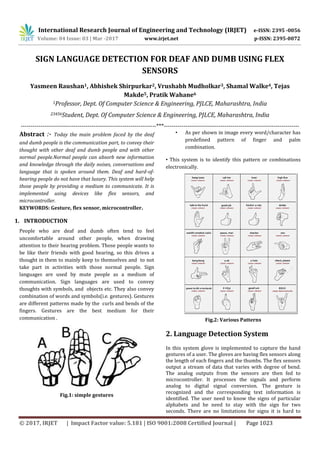
combination of words and symbols(i.e. gestures). Gestures
are different patterns made by the curls and bends of the
fingers. Gestures are the best medium for their
communication .
Fig.1: simple gestures
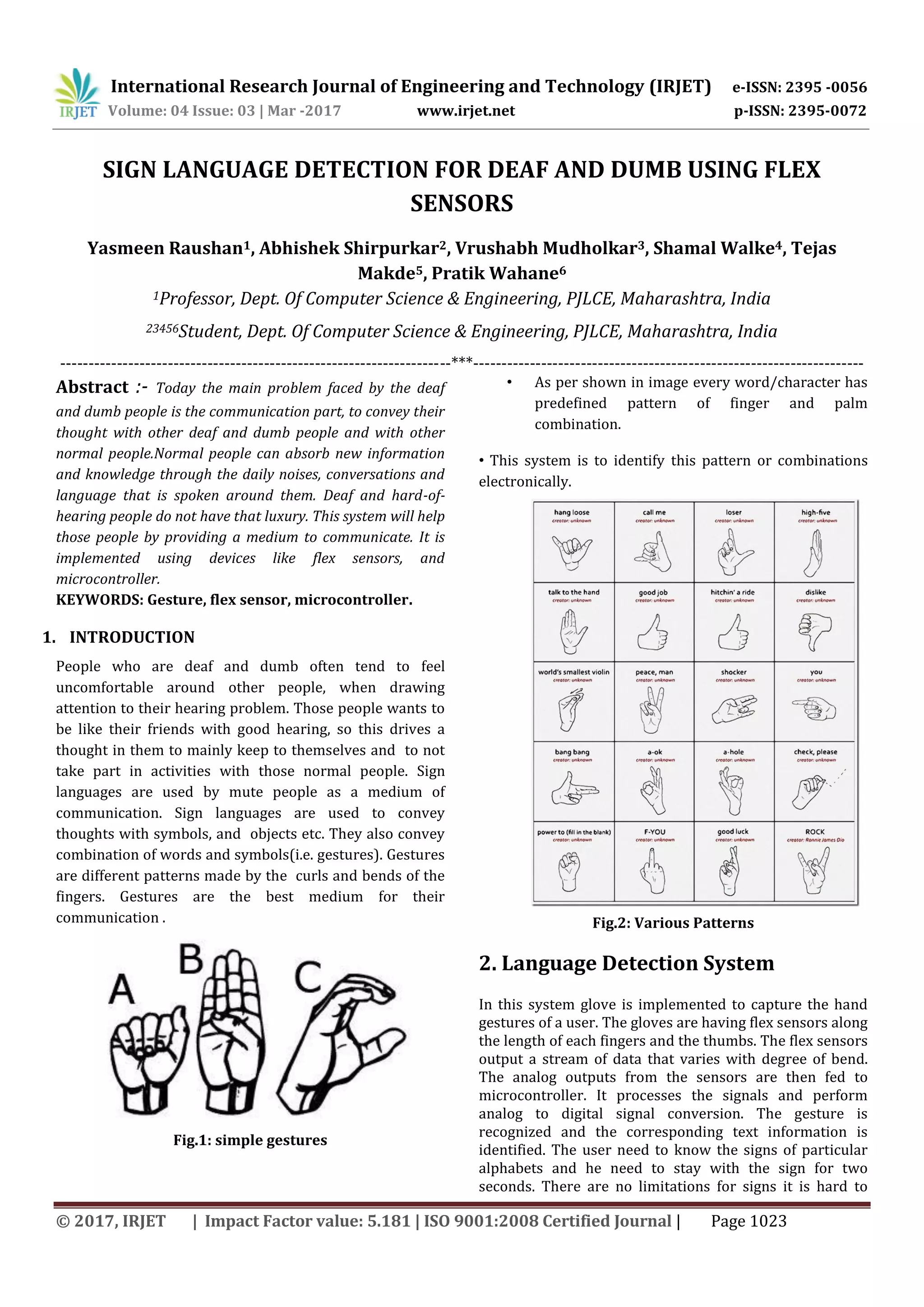
• As per shown in image every word/character has
predefined pattern of finger and palm
combination.
• This system is to identify this pattern or combinations
electronically.
Fig.2: Various Patterns
2. Language Detection System
In this system glove is implemented to capture the hand
gestures of a user. The gloves are having flex sensors along
the length of each fingers and the thumbs. The flex sensors
output a stream of data that varies with degree of bend.
The analog outputs from the sensors are then fed to
microcontroller. It processes the signals and perform
analog to digital signal conversion. The gesture is
recognized and the corresponding text information is
identified. The user need to know the signs of particular
alphabets and he need to stay with the sign for two
seconds. There are no limitations for signs it is hard to
International Research Journal of Engineering and Technology (IRJET) e-ISSN: 2395 -0056
Volume: 04 Issue: 03 | Mar -2017 www.irjet.net p-ISSN: 2395-0072
© 2017, IRJET | Impact Factor value: 5.181 | ISO 9001:2008 Certified Journal | Page 1024
build a standard library of signs. The new gesture
introduced must be supported by the system.
These sensors are attached along the fingers and thumb.
The degree of bending of fingers and thumb results in the
output
Of voltage variation, which while converting to analog
form, produces required voice.
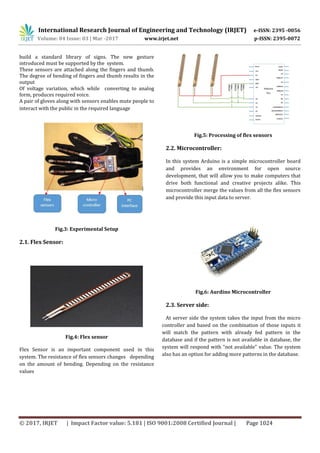
A pair of gloves along with sensors enables mute people to
interact with the public in the required language
Fig.3: Experimental Setup
2.1. Flex Sensor:
Fig.4: Flex sensor
Flex Sensor is an important component used in this
system. The resistance of flex sensors changes depending
on the amount of bending. Depending on the resistance
values
Fig.5: Processing of flex sensors
2.2. Microcontroller:
In this system Arduino is a simple microcontroller board
and provides an environment for open source
development, that will allow you to make computers that
drive both functional and creative projects alike. This
microcontroller merge the values from all the flex sensors
and provide this input data to server.
Fig.6: Aurdino Microcontroller
2.3. Server side:
At server side the system takes the input from the micro
controller and based on the combination of those inputs it
will match the pattern with already fed pattern in the
database and if the pattern is not available in database, the
system will respond with “not available” value. The system
also has an option for adding more patterns in the database.
International Research Journal of Engineering and Technology (IRJET) e-ISSN: 2395 -0056
Volume: 04 Issue: 03 | Mar -2017 www.irjet.net p-ISSN: 2395-0072
© 2017, IRJET | Impact Factor value: 5.181 | ISO 9001:2008 Certified Journal | Page 1025
Fig.7: Block Diagram
3. ADVANTAGES
 Requires fewer components so its cost is low.
 It is economical.
 It is small in size, due to the small size we can
place its hardware on our hand easily.
 The whole apparatus carries less weight. Hence
they are portable and flexible to users.
4. FUTURE WORK
 In this system, more sensors can be
embedded to recognize full sign language
with more perfection and accuracy.
 The system can also be designed such
that it can translate words from one
language to another.
5. CONCLUSION
As a sign language is a method to convey the
thoughts of Deaf and Dumb people, this system
will make that medium more reliable and
helpful. Here, the system will convert the sign
language into text as well as speech, using these
Gloves. In order to improve and facilitate the
more gesture recognition, we have added the
option to add more Gestures into the database.
REFERENCES
[1] Hand-talk Gloves with Flex Sensor: A Review
AmbikaGujrati1, Kartigya Singh2, Khushboo3, Lovika
Soral4, Mrs. Ambikapathy5
[2] L. Bretzner and T. Lindeberg(1998), ―Relative
orientation from extended sequences of sparse point and
line correspondences using the affine trifocal tensor,‖ in
Proc. 5th Eur. Conf. Computer Vision, Berlin,
Germany,1406, Lecture Notes in Computer Science,
Springer Verlag.
[3] S. S. Fels and G. E. Hinton(1993), ―Glove-talk: A neural
network interface between a data glove and a speech
synthesizer,‖ IEEE Trans. Neural Network., 4, l, pp. 2–8.
[4] W. T. Freeman and C. D. Weissman (1995) , ―TV
control by hand gestures, ‖presented at the IEEE Int.
Workshop on Automatic Face and Gesture Recognition,
Zurich, Switzerland.
[5] K. S. Fu, ―Syntactic Recognition in Character
Recognition‖. New York: Academic, 1974, 112,
Mathematics in Science and Engineering.
[6] H. Je, J. Kim, and D. Kim (2007), ―Hand gesture
recognition to understand musical conducting action,‖
presented at the IEEE Int. Conf. Robot &Human Interactive
Communication.
[7] J. S. Lipscomb (1991), ―A trainable gesture
recognizer,‖ Pattern. Recognition.
[8] W. M. Newman and R. F. Sproull (1979), Principles of
Interactive Computer Graphics. New York: McGraw-Hill.
[9] J. K. Oh, S. J. Cho, and W. C. Bang et al. (2004), ―Inertial
sensor based recognition of 3-D character gestures with
an ensemble of classifiers,‖ presented at the 9th Int.
Workshop on Frontiers in Handwriting Recognition.
[10] D. H. Rubine (1991), ―The Automatic Recognition of
Gesture,‖ Ph.D dissertation, Computer Science Dept.,
Carnegie Mellon Univ., Pittsburgh, PA.
[11] T. Schlomer, B. Poppinga, N. Henze, and S. Boll
(2008), ―Gesture recognition with a Wii controller,‖ in
Proc. 2nd Int. Conf. Tangible and Embedded Interaction
(TEI’08), Bonn, Germany.
[12] T. H. Speeter (1992), ―Transformation human hand
motion for tele manipulation,‖ Presence.

Sign Language Detection for Deaf and Dumb Using Flex Sensors

  • 1.
    International Research Journalof Engineering and Technology (IRJET) e-ISSN: 2395 -0056 Volume: 04 Issue: 03 | Mar -2017 www.irjet.net p-ISSN: 2395-0072 © 2017, IRJET | Impact Factor value: 5.181 | ISO 9001:2008 Certified Journal | Page 1023 SIGN LANGUAGE DETECTION FOR DEAF AND DUMB USING FLEX SENSORS Yasmeen Raushan1, Abhishek Shirpurkar2, Vrushabh Mudholkar3, Shamal Walke4, Tejas Makde5, Pratik Wahane6 1Professor, Dept. Of Computer Science & Engineering, PJLCE, Maharashtra, India 23456Student, Dept. Of Computer Science & Engineering, PJLCE, Maharashtra, India ---------------------------------------------------------------------***--------------------------------------------------------------------- Abstract :- Today the main problem faced by the deaf and dumb people is the communication part, to convey their thought with other deaf and dumb people and with other normal people.Normal people can absorb new information and knowledge through the daily noises, conversations and language that is spoken around them. Deaf and hard-of- hearing people do not have that luxury. This system will help those people by providing a medium to communicate. It is implemented using devices like flex sensors, and microcontroller. KEYWORDS: Gesture, flex sensor, microcontroller. 1. INTRODUCTION People who are deaf and dumb often tend to feel uncomfortable around other people, when drawing attention to their hearing problem. Those people wants to be like their friends with good hearing, so this drives a thought in them to mainly keep to themselves and to not take part in activities with those normal people. Sign languages are used by mute people as a medium of communication. Sign languages are used to convey thoughts with symbols, and objects etc. They also convey combination of words and symbols(i.e. gestures). Gestures are different patterns made by the curls and bends of the fingers. Gestures are the best medium for their communication . Fig.1: simple gestures • As per shown in image every word/character has predefined pattern of finger and palm combination. • This system is to identify this pattern or combinations electronically. Fig.2: Various Patterns 2. Language Detection System In this system glove is implemented to capture the hand gestures of a user. The gloves are having flex sensors along the length of each fingers and the thumbs. The flex sensors output a stream of data that varies with degree of bend. The analog outputs from the sensors are then fed to microcontroller. It processes the signals and perform analog to digital signal conversion. The gesture is recognized and the corresponding text information is identified. The user need to know the signs of particular alphabets and he need to stay with the sign for two seconds. There are no limitations for signs it is hard to
  • 2.
    International Research Journalof Engineering and Technology (IRJET) e-ISSN: 2395 -0056 Volume: 04 Issue: 03 | Mar -2017 www.irjet.net p-ISSN: 2395-0072 © 2017, IRJET | Impact Factor value: 5.181 | ISO 9001:2008 Certified Journal | Page 1024 build a standard library of signs. The new gesture introduced must be supported by the system. These sensors are attached along the fingers and thumb. The degree of bending of fingers and thumb results in the output Of voltage variation, which while converting to analog form, produces required voice. A pair of gloves along with sensors enables mute people to interact with the public in the required language Fig.3: Experimental Setup 2.1. Flex Sensor: Fig.4: Flex sensor Flex Sensor is an important component used in this system. The resistance of flex sensors changes depending on the amount of bending. Depending on the resistance values Fig.5: Processing of flex sensors 2.2. Microcontroller: In this system Arduino is a simple microcontroller board and provides an environment for open source development, that will allow you to make computers that drive both functional and creative projects alike. This microcontroller merge the values from all the flex sensors and provide this input data to server. Fig.6: Aurdino Microcontroller 2.3. Server side: At server side the system takes the input from the micro controller and based on the combination of those inputs it will match the pattern with already fed pattern in the database and if the pattern is not available in database, the system will respond with “not available” value. The system also has an option for adding more patterns in the database.
  • 3.
    International Research Journalof Engineering and Technology (IRJET) e-ISSN: 2395 -0056 Volume: 04 Issue: 03 | Mar -2017 www.irjet.net p-ISSN: 2395-0072 © 2017, IRJET | Impact Factor value: 5.181 | ISO 9001:2008 Certified Journal | Page 1025 Fig.7: Block Diagram 3. ADVANTAGES  Requires fewer components so its cost is low.  It is economical.  It is small in size, due to the small size we can place its hardware on our hand easily.  The whole apparatus carries less weight. Hence they are portable and flexible to users. 4. FUTURE WORK  In this system, more sensors can be embedded to recognize full sign language with more perfection and accuracy.  The system can also be designed such that it can translate words from one language to another. 5. CONCLUSION As a sign language is a method to convey the thoughts of Deaf and Dumb people, this system will make that medium more reliable and helpful. Here, the system will convert the sign language into text as well as speech, using these Gloves. In order to improve and facilitate the more gesture recognition, we have added the option to add more Gestures into the database. REFERENCES [1] Hand-talk Gloves with Flex Sensor: A Review AmbikaGujrati1, Kartigya Singh2, Khushboo3, Lovika Soral4, Mrs. Ambikapathy5 [2] L. Bretzner and T. Lindeberg(1998), ―Relative orientation from extended sequences of sparse point and line correspondences using the affine trifocal tensor,‖ in Proc. 5th Eur. Conf. Computer Vision, Berlin, Germany,1406, Lecture Notes in Computer Science, Springer Verlag. [3] S. S. Fels and G. E. Hinton(1993), ―Glove-talk: A neural network interface between a data glove and a speech synthesizer,‖ IEEE Trans. Neural Network., 4, l, pp. 2–8. [4] W. T. Freeman and C. D. Weissman (1995) , ―TV control by hand gestures, ‖presented at the IEEE Int. Workshop on Automatic Face and Gesture Recognition, Zurich, Switzerland. [5] K. S. Fu, ―Syntactic Recognition in Character Recognition‖. New York: Academic, 1974, 112, Mathematics in Science and Engineering. [6] H. Je, J. Kim, and D. Kim (2007), ―Hand gesture recognition to understand musical conducting action,‖ presented at the IEEE Int. Conf. Robot &Human Interactive Communication. [7] J. S. Lipscomb (1991), ―A trainable gesture recognizer,‖ Pattern. Recognition. [8] W. M. Newman and R. F. Sproull (1979), Principles of Interactive Computer Graphics. New York: McGraw-Hill. [9] J. K. Oh, S. J. Cho, and W. C. Bang et al. (2004), ―Inertial sensor based recognition of 3-D character gestures with an ensemble of classifiers,‖ presented at the 9th Int. Workshop on Frontiers in Handwriting Recognition. [10] D. H. Rubine (1991), ―The Automatic Recognition of Gesture,‖ Ph.D dissertation, Computer Science Dept., Carnegie Mellon Univ., Pittsburgh, PA. [11] T. Schlomer, B. Poppinga, N. Henze, and S. Boll (2008), ―Gesture recognition with a Wii controller,‖ in Proc. 2nd Int. Conf. Tangible and Embedded Interaction (TEI’08), Bonn, Germany. [12] T. H. Speeter (1992), ―Transformation human hand motion for tele manipulation,‖ Presence.