PRESENTED BY
MAJID K
 Automatic fingerprint recognition technologies
have rapidly advanced during the last forty
years.
 Still exists several challenging research
problems such as:
 recognition of low quality finger prints.
 variation of matching accuracy of same
algorithm
among different data sets.
 sensitivity of finger print matcher to image
quality.
 The consequence of low quality
fingerprints depends on the type of the
fingerprint recognition system.
 Fingerprint recognition systems can be
classified as positive and negative
recognition systems.
In a positive recognition system, user is
supposed to be cooperative and wishes to be
identified.
In a positive recognition system, low quality
will lead to false reject of legitimate users and
thus bring inconvenience.
In a negative recognition system, the user of
interest is supposed to be uncooperative and
does not wish to be identified.
The consequence of negative recognition
system, is much more serious, since malicious
users may purposely reduce fingerprint quality,
to prevent fingerprint system from finding the
true identity.
• It is very important for negative
fingerprint recognition systems to detect
low quality fingerprints and improve their
quality so that the fingerprint system is
not compromised by malicious users.
• Degradation of fingerprint quality can be
photometric or geometrical.
• For a negative fingerprint recognition
system, its security level is as weak as
the weakest point, thus it is urgent to
develop distorted fingerprint (DF)
detection and rectification algorithms to
fill the hole.
• Elastic distortion is introduced due to the
inherent flexibility of fingertips, contact-
based fingerprint acquisition procedure
etc.
• Skin distortion increases the intra-class
variations and thus leads to false non-
matches due to limited capability of
existing fingerprint matchers in
recognizing severely distorted
fingerprints.
1. Distortion Detection Based on Special
Hardware.
2. Distortion-Tolerant Matching
3. Distortion Rectification Based on Finger-
Specific Statistics
4. Distortion Rectification Based on General
Statistics
 Automatic detect distortion during fingerprint
acquisition ,distorted fingerprint can be rejected.
 Researchers have proposed specially designed
hardware to detect improper force and force
sensors for detecting excessive force and torque.
 Limitations of the above methods are :
 they require special force sensors or fingerprint
sensors with video capturing capability.
 they cannot detect distorted fingerprint images
in existing fingerprint databases.
 they cannot detect fingerprints distorted before
pressing on the sensor.
 The most popular way to handle distortion is
to make the fingerprint matcher tolerant to
distortion.
 For every pair of fingerprints to be compared
 To handle distortion three type of strategies
have been adopted :
(i) assume a global rigid transformation and
use a tolerant box of fixed size or adaptive
size to compensate for distortion;
(ii) explicitly model the spatial transformation
by thin plate spline (TPS) model; and
(iii) enforce constraint on distortion locally.
 The deformation pattern from a set of
training images of the same finger and
transform the template with the average
deformation.
 Limitations of this method:
(i) Acquiring multiple images of the same finger is
inconvenient in some applications and existing
fingerprint databases generally contain only one
image per finger; and
(ii) Even if multiple images per finger are available, it
is not necessarily sufficient to cover various skin
distortions.
 Based on the assumptions that ridges in a finger
print that constantly spaced.
 No distortion detection algorithm; Distortion by
normalizing rigid density of all finger prints
assume to a fixed value so it use distortion
rectification algorithm.
 Method shares the advantages of Senior and
Bolle method over other methods, meanwhile
overcomes some of its limitations.
 Based on statistics learnt from real distorted
fingerprints, rather than on the impractical
assumption of uniform ridge period made in.
Advantages;
 Does not require specialized h/w.
 Handle single input of finger print image.
 Does not require set of training images.
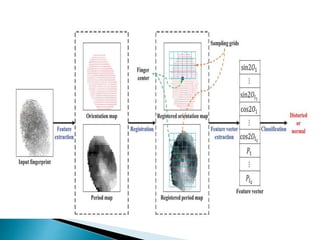
 It has two -class classification:
:Registered ridge orientation map
:Period map as feature vector
1.FINGERPRINT REGISTRATION
 Fingerprints have to be registered in a fixed
coordinate system.
 Registration has two stages offline stage
and online stage.
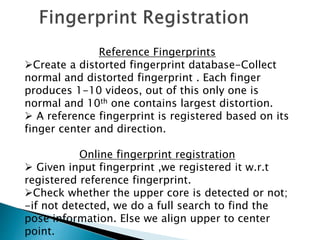
Reference Fingerprints
Create a distorted fingerprint database-Collect
normal and distorted fingerprint . Each finger
produces 1-10 videos, out of this only one is
normal and 10th one contains largest distortion.
 A reference fingerprint is registered based on its
finger center and direction.
Online fingerprint registration
 Given input fingerprint ,we registered it w.r.t
registered reference fingerprint.
Check whether the upper core is detected or not;
-if not detected, we do a full search to find the
pose information. Else we align upper to center
point.
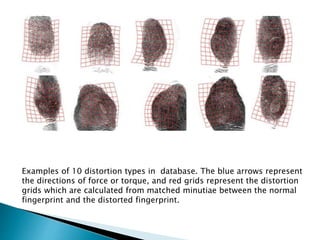
Examples of 10 distortion types in database. The blue arrows represent
the directions of force or torque, and red grids represent the distortion
grids which are calculated from matched minutiae between the normal
fingerprint and the distorted fingerprint.
Feature Vector Extraction
Feature vector extract by sampling
registered orientation map and period map.
Feature vector defined as
(sin(2O)cos(2O)P),were O denotes the
orientation vector on sampling grids, and p
denotes the period vector on sampling grids.
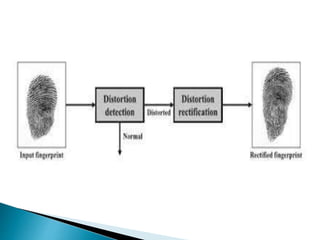
Distorted Fingerprint
Rectification
A distorted fingerprint can be thought of
being generated by applying an unknown
distortion field d.
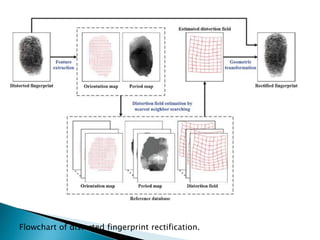
The rectification algorithm consist of an
offline stage and online stage.
Offline Stage: database of distorted reference
fingerprints is generated by transforming
several normal reference fingerprints with
various distortion fields
Online Stages: distorted input fingerprint, we
retrieval its nearest neighbor in the distorted
reference fingerprint database and then use
the inverse of the corresponding distortion
field
Statistical modeling of distortion
fields
Using distorted fields b/w pair of finger
print .
Flowchart of distorted fingerprint rectification.
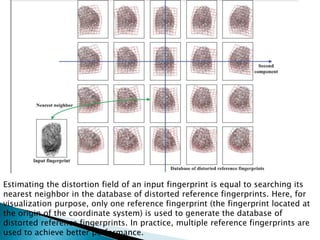
Estimating the distortion field of an input fingerprint is equal to searching its
nearest neighbor in the database of distorted reference fingerprints. Here, for
visualization purpose, only one reference fingerprint (the fingerprint located at
the origin of the coordinate system) is used to generate the database of
distorted reference fingerprints. In practice, multiple reference fingerprints are
used to achieve better performance.
Experiment
1st evaluate the detection algorithm.
Evaluate the rectification algorithm.
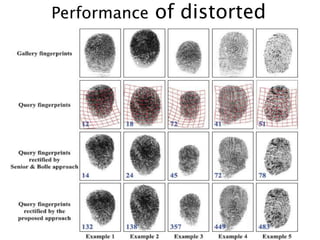
Performance of distorted delectation
Three distorted examples. Our previous algorithm [1] fails to detect their
distortion, while the current algorithm can detect their distortion
correctly. The red transformation grids estimated by the proposed
algorithm are overlaid on them. The blue numbers show the matching
scores without/with rectification.
Performance of distorted
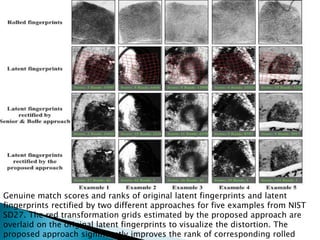
rectification
Genuine match scores and ranks of original latent fingerprints and latent
fingerprints rectified by two different approaches for five examples from NIST
SD27. The red transformation grids estimated by the proposed approach are
overlaid on the original latent fingerprints to visualize the distortion. The
proposed approach significantly improves the rank of corresponding rolled
CONCLUSION
Distortion detection, the registered ridge
orientation map and period map of a fingerprint
are used as the feature vector.
Distortion rectification the distortion field from
the
input distorted fingerprint and then the inverse of
the distortion field is used to transform the
distorted fingerprint
into a normal one.
Limitation of the current approach is efficiency.
Detection and rectification steps can be
significantly
speeded up if a robust and accurate fingerprint
registration
Another limitation is that the current
approach does not support rolled fingerprints.
It is difficult to collect many rolled fingerprints
with various distortion types and meanwhile
obtain accurate distortion fields for learning
statistical distortion model.
THANK YOU

Detection and rectification of distorted fingerprint

  • 1.
  • 2.
     Automatic fingerprintrecognition technologies have rapidly advanced during the last forty years.  Still exists several challenging research problems such as:  recognition of low quality finger prints.  variation of matching accuracy of same algorithm among different data sets.  sensitivity of finger print matcher to image quality.
  • 3.
     The consequenceof low quality fingerprints depends on the type of the fingerprint recognition system.  Fingerprint recognition systems can be classified as positive and negative recognition systems.
  • 4.
    In a positiverecognition system, user is supposed to be cooperative and wishes to be identified. In a positive recognition system, low quality will lead to false reject of legitimate users and thus bring inconvenience.
  • 5.
    In a negativerecognition system, the user of interest is supposed to be uncooperative and does not wish to be identified. The consequence of negative recognition system, is much more serious, since malicious users may purposely reduce fingerprint quality, to prevent fingerprint system from finding the true identity.
  • 6.
    • It isvery important for negative fingerprint recognition systems to detect low quality fingerprints and improve their quality so that the fingerprint system is not compromised by malicious users. • Degradation of fingerprint quality can be photometric or geometrical. • For a negative fingerprint recognition system, its security level is as weak as the weakest point, thus it is urgent to develop distorted fingerprint (DF) detection and rectification algorithms to fill the hole.
  • 7.
    • Elastic distortionis introduced due to the inherent flexibility of fingertips, contact- based fingerprint acquisition procedure etc. • Skin distortion increases the intra-class variations and thus leads to false non- matches due to limited capability of existing fingerprint matchers in recognizing severely distorted fingerprints.
  • 8.
    1. Distortion DetectionBased on Special Hardware. 2. Distortion-Tolerant Matching 3. Distortion Rectification Based on Finger- Specific Statistics 4. Distortion Rectification Based on General Statistics
  • 10.
     Automatic detectdistortion during fingerprint acquisition ,distorted fingerprint can be rejected.  Researchers have proposed specially designed hardware to detect improper force and force sensors for detecting excessive force and torque.  Limitations of the above methods are :  they require special force sensors or fingerprint sensors with video capturing capability.  they cannot detect distorted fingerprint images in existing fingerprint databases.  they cannot detect fingerprints distorted before pressing on the sensor.
  • 11.
     The mostpopular way to handle distortion is to make the fingerprint matcher tolerant to distortion.  For every pair of fingerprints to be compared  To handle distortion three type of strategies have been adopted : (i) assume a global rigid transformation and use a tolerant box of fixed size or adaptive size to compensate for distortion; (ii) explicitly model the spatial transformation by thin plate spline (TPS) model; and (iii) enforce constraint on distortion locally.
  • 12.
     The deformationpattern from a set of training images of the same finger and transform the template with the average deformation.  Limitations of this method: (i) Acquiring multiple images of the same finger is inconvenient in some applications and existing fingerprint databases generally contain only one image per finger; and (ii) Even if multiple images per finger are available, it is not necessarily sufficient to cover various skin distortions.
  • 13.
     Based onthe assumptions that ridges in a finger print that constantly spaced.  No distortion detection algorithm; Distortion by normalizing rigid density of all finger prints assume to a fixed value so it use distortion rectification algorithm.  Method shares the advantages of Senior and Bolle method over other methods, meanwhile overcomes some of its limitations.  Based on statistics learnt from real distorted fingerprints, rather than on the impractical assumption of uniform ridge period made in.
  • 14.
    Advantages;  Does notrequire specialized h/w.  Handle single input of finger print image.  Does not require set of training images.
  • 15.
     It hastwo -class classification: :Registered ridge orientation map :Period map as feature vector 1.FINGERPRINT REGISTRATION  Fingerprints have to be registered in a fixed coordinate system.  Registration has two stages offline stage and online stage.
  • 17.
    Reference Fingerprints Create adistorted fingerprint database-Collect normal and distorted fingerprint . Each finger produces 1-10 videos, out of this only one is normal and 10th one contains largest distortion.  A reference fingerprint is registered based on its finger center and direction. Online fingerprint registration  Given input fingerprint ,we registered it w.r.t registered reference fingerprint. Check whether the upper core is detected or not; -if not detected, we do a full search to find the pose information. Else we align upper to center point.
  • 18.
    Examples of 10distortion types in database. The blue arrows represent the directions of force or torque, and red grids represent the distortion grids which are calculated from matched minutiae between the normal fingerprint and the distorted fingerprint.
  • 19.
    Feature Vector Extraction Featurevector extract by sampling registered orientation map and period map. Feature vector defined as (sin(2O)cos(2O)P),were O denotes the orientation vector on sampling grids, and p denotes the period vector on sampling grids. Distorted Fingerprint Rectification A distorted fingerprint can be thought of being generated by applying an unknown distortion field d.
  • 20.
    The rectification algorithmconsist of an offline stage and online stage. Offline Stage: database of distorted reference fingerprints is generated by transforming several normal reference fingerprints with various distortion fields Online Stages: distorted input fingerprint, we retrieval its nearest neighbor in the distorted reference fingerprint database and then use the inverse of the corresponding distortion field Statistical modeling of distortion fields Using distorted fields b/w pair of finger print .
  • 21.
    Flowchart of distortedfingerprint rectification.
  • 22.
    Estimating the distortionfield of an input fingerprint is equal to searching its nearest neighbor in the database of distorted reference fingerprints. Here, for visualization purpose, only one reference fingerprint (the fingerprint located at the origin of the coordinate system) is used to generate the database of distorted reference fingerprints. In practice, multiple reference fingerprints are used to achieve better performance.
  • 23.
    Experiment 1st evaluate thedetection algorithm. Evaluate the rectification algorithm. Performance of distorted delectation Three distorted examples. Our previous algorithm [1] fails to detect their distortion, while the current algorithm can detect their distortion correctly. The red transformation grids estimated by the proposed algorithm are overlaid on them. The blue numbers show the matching scores without/with rectification.
  • 24.
  • 25.
    Genuine match scoresand ranks of original latent fingerprints and latent fingerprints rectified by two different approaches for five examples from NIST SD27. The red transformation grids estimated by the proposed approach are overlaid on the original latent fingerprints to visualize the distortion. The proposed approach significantly improves the rank of corresponding rolled
  • 26.
    CONCLUSION Distortion detection, theregistered ridge orientation map and period map of a fingerprint are used as the feature vector. Distortion rectification the distortion field from the input distorted fingerprint and then the inverse of the distortion field is used to transform the distorted fingerprint into a normal one. Limitation of the current approach is efficiency. Detection and rectification steps can be significantly speeded up if a robust and accurate fingerprint registration
  • 27.
    Another limitation isthat the current approach does not support rolled fingerprints. It is difficult to collect many rolled fingerprints with various distortion types and meanwhile obtain accurate distortion fields for learning statistical distortion model.
  • 28.