Presentation On Indian Sign
Language Enhanced Recognition
Methods For Deaf People
-Anurag Prasad (120103024)
-Takrim Ul Islam Laskar (120103006)
Presented By-
Overview
• Introduction
• Indian Sign Language
• Gesture Recognition
• Working Environment
• Implementation
• Conclusion
• Reference
Introduction
• Indian Sign language is develop for deaf community of India, which can be used as a means of
communication between friends and families of deaf people and the deaf people.
• Sign Language Recognition is one of the most growing fields of research today as well as
challenging too.
• There are Many new techniques that have been developed recently in this field. In this project ,
we are going to develop a system for conversion of Indian sign language to text using OpenCV.
• It presents a methodology which recognizes the Indian Sign Language (ISL) and translates into a
normal text.
Indian Sign Language
The following images represent the symbols for their respective English letters’ representations.
Figure 1: ISL Alphabets.
Gesture Recognition
Gesture recognition is a topic in computer science and language technology with the goal of interpreting
human gesture via mathematical algorithms.
Hardware Tools used in Gesture Recognition:
1. Wired gloves
2. Stereo cameras
3. Controller-based gestures
4. Single camera
In our project we have implemented sign language recognition on a single camera.
Algorithms
Broadly speaking there are 2 different approaches in gesture recognition:
1. 3D model-based algorithms:
• Volumetric model
• Skeletal models
2. Appearance-based models:
• Deformable 2D templates.
• Image sequences
Working Environment
• Tools
• OpenCV 3.0 , Python 2.7
• Environment
• IDLE (Integrated Development and Learning Environment) which is the basic Platform for python.
• Experiment Platform
• Linux based platform (e.g. Ubuntu 15.10 is a Debian-based Linux Operating System)
Implementation
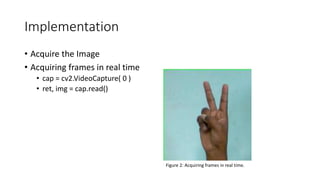
• Acquire the Image
• Acquiring frames in real time
• cap = cv2.VideoCapture( 0 )
• ret, img = cap.read()
Figure 2: Acquiring frames in real time.
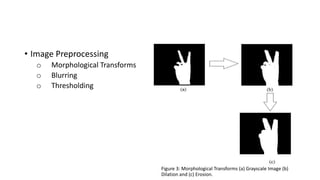
• Image Preprocessing
o Morphological Transforms
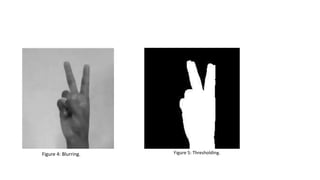
o Blurring
o Thresholding
Figure 3: Morphological Transforms (a) Grayscale Image (b)
Dilation and (c) Erosion.
Figure 4: Blurring. Figure 5: Thresholding.
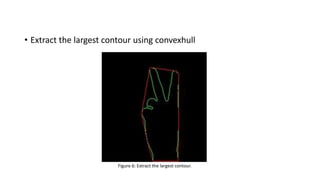
• Extract the largest contour using convexhull
Figure 6: Extract the largest contour.
• Contour shape matching
• diffvalue = cv2.MatchShapes(object1, object2, method, parameter=0)
• Performs the comparison after finding the contours.
• Extracting the Matched Sign
• if diffvalue<0.1:
print 'nmatched with ',cntname[move],'diff : ',diffvalue
cv2.putText(img,cntname[move],(100,400),cv2.FONT_HERSHEY_SIMPLEX, 4,(255,255,255),2)
Figure 7: Output.
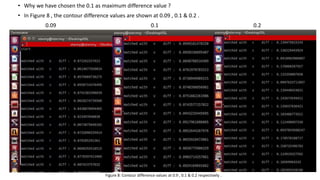
• Why we have chosen the 0.1 as maximum difference value ?
• In Figure 8 , the contour difference values are shown at 0.09 , 0.1 & 0.2 .
0.09 0.1 0.2
Figure 8: Contour difference values at 0.9 , 0.1 & 0.2 respectively .
Conclusion
• Indian Sign Language using object detection and recognition through computer vision was a partly
successful one with an accuracy rate of 82.69 %.
• The question of perfection is another quest to deal in the days to come.
• The hand gesture detection and recognition were the main topic and problem that were dealt
with.
Reference
[1] R. Gopalan and B. Dariush, “Towards a Vision Based Hand Gesture Interface for Robotic Grasping”, The IEEE/RSJ International Conference
on Intelligent Robots and Systems, October 11-15, 2009, St. Louis, USA, pp. 1452-1459.
[2] T. Kapuscinski and M. Wysocki, “Hand Gesture Recognition for Man-Machine interaction”, Second Workshop on Robot Motion and
Control, October 18-20, 2001, pp. 91-96.
[3] D. Y. Huang, W. C. Hu, and S. H. Chang, “Vision-based Hand Gesture Recognition Using PCA+Gabor Filters and SVM”, IEEE Fifth International
Conference on Intelligent Information Hiding and Multimedia Signal Processing, 2009, pp. 1-4.
[4] C. Yu, X. Wang, H. Huang, J. Shen, and K. Wu, “Vision-Based Hand Gesture Recognition Using Combinational Features”, IEEE Sixth
International Conference on Intelligent Information Hiding and Multimedia Signal Processing, 2010, pp. 543-546.
[5] J. L. Raheja, K. Das, and A. Chaudhury, “An Efficient Real Time Method of Fingertip Detection”, International Conference on Trends in
Industrial Measurements and automation (TIMA), 2011, pp. 447-450.
[6] Manigandan M. and I. M Jackin, “Wireless Vision based Mobile Robot control using Hand Gesture Recognition through Perceptual Color
Space”, IEEE International Conference on Advances in Computer Engineering, 2010, pp. 95-99.
[7] A. S. Ghotkar, R. Khatal, S. Khupase, S. Asati, and M. Hadap, “Hand Gesture Recognition for Indian Sign Language”, IEEE International
Conference on Computer Communication and Informatics (ICCCI), Jan. 10-12, 2012, Coimbatore, India.
[8] I. G. Incertis, J. G. G. Bermejo, and E.Z. Casanova, “Hand Gesture Recognition for Deaf People Interfacing”, The 18th International
Conference on Pattern Recognition (ICPR), 2006.
[9] J. Rekha, J. Bhattacharya, and S. Majumder, “Shape, Texture and Local Movement Hand Gesture Features for Indian Sign Language Recognition”, IEEE, 2011,
pp. 30-35.
[10] L. K. Lee, S. Y. An, and S. Y. Oh, “Robust Fingertip Extraction with Improved Skin Color Segmentation for Finger Gesture Recognition in Human-Robot
Interaction”, WCCI 2012 IEEE World Congress on Computational Intelligence, June, 10-15, 2012, Brisbane, Australia.
[11] S. K. Yewale and P. K. Bharne, “Hand Gesture Recognition Using Different Algorithms Based on Artificial Neural Network”, IEEE, 2011, pp. 287-292.
[12] Y. Fang, K. Wang, J. Cheng, and H. Lu, “A Real-Time Hand Gesture Recognition Method”, IEEE ICME, 2007, pp. 995-998.
[13] S. Saengsri, V. Niennattrakul, and C.A. Ratanamahatana, “TFRS: Thai Finger-Spelling Sign Language Recognition System”, IEEE, 2012, pp. 457-462.
[14] J. H. Kim, N. D. Thang, and T. S. Kim, “3-D Hand Motion Tracking and Gesture Recognition Using a Data Glove”, IEEE International Symposium on Industrial
Electronics (ISIE), July 5-8, 2009, Seoul Olympic Parktel, Seoul , Korea, pp. 1013-1018.
[15] J. Weissmann and R. Salomon, “Gesture Recognition for Virtual Reality Applications Using Data Gloves and Neural Networks”, IEEE, 1999, pp. 2043-2046.
[16] W. W. Kong and S. Ranganath, “Sign Language Phoneme Transcription with PCA-based Representation”, The 9th International Conference on Information and
Communications Security(ICICS), 2007, China.
[17] M. V. Lamar, S. Bhuiyan, and A. Iwata, “Hand Alphabet Recognition Using Morphological PCA and Neural Networks”, IEEE, 1999, pp. 2839-2844.
[18] O. B. Henia and S. Bouakaz, “3D Hand Model Animation with a New Data-Driven Method”, Workshop on Digital Media and Digital Content Management (IEEE
Computer Society), 2011, pp. 72-76.
[19] M. Pahlevanzadeh, M. Vafadoost, and M. Shahnazi, “Sign Language Recognition”, IEEE, 2007.
[20] J. B. Kim, K. H. Park, W. C. Bang, and Z. Z. Bien, “Continuous Gesture Recognition System for Korean Sign Language based on Fuzzy Logic and Hidden Markov
Model”, IEEE, 2002, pp. 1574-1579.

Indian Sign Language Recognition Method For Deaf People

  • 1.
    Presentation On IndianSign Language Enhanced Recognition Methods For Deaf People -Anurag Prasad (120103024) -Takrim Ul Islam Laskar (120103006) Presented By-
  • 2.
    Overview • Introduction • IndianSign Language • Gesture Recognition • Working Environment • Implementation • Conclusion • Reference
  • 3.
    Introduction • Indian Signlanguage is develop for deaf community of India, which can be used as a means of communication between friends and families of deaf people and the deaf people. • Sign Language Recognition is one of the most growing fields of research today as well as challenging too. • There are Many new techniques that have been developed recently in this field. In this project , we are going to develop a system for conversion of Indian sign language to text using OpenCV. • It presents a methodology which recognizes the Indian Sign Language (ISL) and translates into a normal text.
  • 4.
    Indian Sign Language Thefollowing images represent the symbols for their respective English letters’ representations. Figure 1: ISL Alphabets.
  • 5.
    Gesture Recognition Gesture recognitionis a topic in computer science and language technology with the goal of interpreting human gesture via mathematical algorithms. Hardware Tools used in Gesture Recognition: 1. Wired gloves 2. Stereo cameras 3. Controller-based gestures 4. Single camera In our project we have implemented sign language recognition on a single camera.
  • 6.
    Algorithms Broadly speaking thereare 2 different approaches in gesture recognition: 1. 3D model-based algorithms: • Volumetric model • Skeletal models 2. Appearance-based models: • Deformable 2D templates. • Image sequences
  • 7.
    Working Environment • Tools •OpenCV 3.0 , Python 2.7 • Environment • IDLE (Integrated Development and Learning Environment) which is the basic Platform for python. • Experiment Platform • Linux based platform (e.g. Ubuntu 15.10 is a Debian-based Linux Operating System)
  • 8.
    Implementation • Acquire theImage • Acquiring frames in real time • cap = cv2.VideoCapture( 0 ) • ret, img = cap.read() Figure 2: Acquiring frames in real time.
  • 9.
    • Image Preprocessing oMorphological Transforms o Blurring o Thresholding Figure 3: Morphological Transforms (a) Grayscale Image (b) Dilation and (c) Erosion.
  • 10.
    Figure 4: Blurring.Figure 5: Thresholding.
  • 11.
    • Extract thelargest contour using convexhull Figure 6: Extract the largest contour.
  • 12.
    • Contour shapematching • diffvalue = cv2.MatchShapes(object1, object2, method, parameter=0) • Performs the comparison after finding the contours. • Extracting the Matched Sign • if diffvalue<0.1: print 'nmatched with ',cntname[move],'diff : ',diffvalue cv2.putText(img,cntname[move],(100,400),cv2.FONT_HERSHEY_SIMPLEX, 4,(255,255,255),2) Figure 7: Output.
  • 13.
    • Why wehave chosen the 0.1 as maximum difference value ? • In Figure 8 , the contour difference values are shown at 0.09 , 0.1 & 0.2 . 0.09 0.1 0.2 Figure 8: Contour difference values at 0.9 , 0.1 & 0.2 respectively .
  • 14.
    Conclusion • Indian SignLanguage using object detection and recognition through computer vision was a partly successful one with an accuracy rate of 82.69 %. • The question of perfection is another quest to deal in the days to come. • The hand gesture detection and recognition were the main topic and problem that were dealt with.
  • 15.
    Reference [1] R. Gopalanand B. Dariush, “Towards a Vision Based Hand Gesture Interface for Robotic Grasping”, The IEEE/RSJ International Conference on Intelligent Robots and Systems, October 11-15, 2009, St. Louis, USA, pp. 1452-1459. [2] T. Kapuscinski and M. Wysocki, “Hand Gesture Recognition for Man-Machine interaction”, Second Workshop on Robot Motion and Control, October 18-20, 2001, pp. 91-96. [3] D. Y. Huang, W. C. Hu, and S. H. Chang, “Vision-based Hand Gesture Recognition Using PCA+Gabor Filters and SVM”, IEEE Fifth International Conference on Intelligent Information Hiding and Multimedia Signal Processing, 2009, pp. 1-4. [4] C. Yu, X. Wang, H. Huang, J. Shen, and K. Wu, “Vision-Based Hand Gesture Recognition Using Combinational Features”, IEEE Sixth International Conference on Intelligent Information Hiding and Multimedia Signal Processing, 2010, pp. 543-546. [5] J. L. Raheja, K. Das, and A. Chaudhury, “An Efficient Real Time Method of Fingertip Detection”, International Conference on Trends in Industrial Measurements and automation (TIMA), 2011, pp. 447-450. [6] Manigandan M. and I. M Jackin, “Wireless Vision based Mobile Robot control using Hand Gesture Recognition through Perceptual Color Space”, IEEE International Conference on Advances in Computer Engineering, 2010, pp. 95-99. [7] A. S. Ghotkar, R. Khatal, S. Khupase, S. Asati, and M. Hadap, “Hand Gesture Recognition for Indian Sign Language”, IEEE International Conference on Computer Communication and Informatics (ICCCI), Jan. 10-12, 2012, Coimbatore, India. [8] I. G. Incertis, J. G. G. Bermejo, and E.Z. Casanova, “Hand Gesture Recognition for Deaf People Interfacing”, The 18th International Conference on Pattern Recognition (ICPR), 2006.
  • 16.
    [9] J. Rekha,J. Bhattacharya, and S. Majumder, “Shape, Texture and Local Movement Hand Gesture Features for Indian Sign Language Recognition”, IEEE, 2011, pp. 30-35. [10] L. K. Lee, S. Y. An, and S. Y. Oh, “Robust Fingertip Extraction with Improved Skin Color Segmentation for Finger Gesture Recognition in Human-Robot Interaction”, WCCI 2012 IEEE World Congress on Computational Intelligence, June, 10-15, 2012, Brisbane, Australia. [11] S. K. Yewale and P. K. Bharne, “Hand Gesture Recognition Using Different Algorithms Based on Artificial Neural Network”, IEEE, 2011, pp. 287-292. [12] Y. Fang, K. Wang, J. Cheng, and H. Lu, “A Real-Time Hand Gesture Recognition Method”, IEEE ICME, 2007, pp. 995-998. [13] S. Saengsri, V. Niennattrakul, and C.A. Ratanamahatana, “TFRS: Thai Finger-Spelling Sign Language Recognition System”, IEEE, 2012, pp. 457-462. [14] J. H. Kim, N. D. Thang, and T. S. Kim, “3-D Hand Motion Tracking and Gesture Recognition Using a Data Glove”, IEEE International Symposium on Industrial Electronics (ISIE), July 5-8, 2009, Seoul Olympic Parktel, Seoul , Korea, pp. 1013-1018. [15] J. Weissmann and R. Salomon, “Gesture Recognition for Virtual Reality Applications Using Data Gloves and Neural Networks”, IEEE, 1999, pp. 2043-2046. [16] W. W. Kong and S. Ranganath, “Sign Language Phoneme Transcription with PCA-based Representation”, The 9th International Conference on Information and Communications Security(ICICS), 2007, China. [17] M. V. Lamar, S. Bhuiyan, and A. Iwata, “Hand Alphabet Recognition Using Morphological PCA and Neural Networks”, IEEE, 1999, pp. 2839-2844. [18] O. B. Henia and S. Bouakaz, “3D Hand Model Animation with a New Data-Driven Method”, Workshop on Digital Media and Digital Content Management (IEEE Computer Society), 2011, pp. 72-76. [19] M. Pahlevanzadeh, M. Vafadoost, and M. Shahnazi, “Sign Language Recognition”, IEEE, 2007. [20] J. B. Kim, K. H. Park, W. C. Bang, and Z. Z. Bien, “Continuous Gesture Recognition System for Korean Sign Language based on Fuzzy Logic and Hidden Markov Model”, IEEE, 2002, pp. 1574-1579.