International Research Journal of Engineering and Technology (IRJET) e-ISSN: 2395-0056
Volume: 07 Issue: 04 | Apr 2020 www.irjet.net p-ISSN: 2395-0072
© 2020, IRJET | Impact Factor value: 7.34 | ISO 9001:2008 Certified Journal | Page 583
SIGN LANGUAGE RECOGNITION USING NEURAL NETWORK
Shailesh bachani1, Shubham dixit2, Rohin chadha3, Prof. Avinash Bagul4
1,2,3Student, Department of Computer Engineering, NBN Sinhgad School of Engineering, Ambegaon, Pune,
Maharashtra, India, 411041
---------------------------------------------------------------------***----------------------------------------------------------------------
Abstract - Hand Gesture recognition system provides us
an innovative, natural, user friendly way of interaction
with the computer which is more familiar to human
beings. Gesture Recognition has a wide area of application
including human machine interaction, sign language,
immersive game technology etc. By keeping in mind the
similarities of human hand shape with four fingers and
one thumb, this paper aims to present a real time system
for hand gesture recognition on the basis of detection of
some meaningful shape based features like orientation,
center of mass (centroid), status of fingers, thumb in terms
of raised or folded fingers of hand and their respective
location in image. The approach introduced in this paper is
totally depending on the shape parameters of the hand
gesture. It does not consider any other means of hand
gesture recognition like skin color, texture because these
image based features are extremely variant to different
light conditions and other influences. To implement this
approach, we have utilized a simple web cam which is
working on 20 fps with 7 mega pixel intensity.
1. INTRODUCTION
Interface with computers using gestures of the human
body, typically hand movements. In gesture recognition
technology, a camera reads the movements of the human
body and communicates the data to a computer that uses
the gestures as input to control devices or applications.
For example, a person clapping his hands together in front
of a camera can produce the sound of cymbals being
crashed together when the gesture is fed through a
computer. One way gesture recognition is being used is to
help the physically impaired to interact with computers,
such as interpreting sign language. The technology also
has the potential to change the way users interact with
computers by eliminating input devices such as joysticks,
mice and keyboards and allowing the unencumbered body
to give signals to the computer through gestures such as
finger pointing. Unlike Haptic interfaces, gesture
recognition does not require the user to wear any special
equipment or attach any devices to the body. The gestures
of the body are read by a camera instead of sensors
attached to a device such as a data gloveIn addition to
hand and body movement, gesture recognition technology
also can be used to read facial and speech expressions (i.e.,
lip reading), and eye movements. The literature includes
ongoing work in the computer vision field on capturing
gestures or more
1.2 Objective
● Serving mankind by use of technology.
● Education will be easier through this, reaching a
larger number of people.
● The system can capture hand gestures and
navigate the words as in text format it will use for
muted persons to see these words and
understand the sentences.
● It is also usable for blind peoples because they
need to communicate with normal persons (using
speech recognition).
2. LITERATURE SURVEY
● “An Approach for Minimizing the Time Taken for
Translating Sign Language to Simple Sentence in
English”
Aradhana Kar, Pinaki Sankar
Sign Language is the language of deaf. There are different
types of sign languages spread all over the world.
American Sign Language (ASL) is one of the sign
languages. ASL is used by deaf Americans. We had created
a system that translates sign language videos to simple
sentences in English.
● “Deep Convolutional Neural Networks for Sign
Language Recognition”
G.Anantha Rao, Guntur (DT)
Extraction of complex head and hand movements along
with their constantly changing shapes for recognition of
sign language is considered a difficult problem in
computer vision
● “American Sign Language Recognition using Deep
Learning and Computer Vision”
Kshitij Bantupalli, Ying Xie
Speech impairment is a disability which affects an
individual’s ability to communicate using speech and
hearing. People who are affected by this use of other
media or communication such as sign language.
International Research Journal of Engineering and Technology (IRJET) e-ISSN: 2395-0056
Volume: 07 Issue: 04 | Apr 2020 www.irjet.net p-ISSN: 2395-0072
© 2020, IRJET | Impact Factor value: 7.34 | ISO 9001:2008 Certified Journal | Page 584
● “Recent Developments in Sign Language
Recognition Systems”
M.F. Tolba, A.S.Elons
Automated translation systems for sign languages are
important in a world that is showing a continuously
increasing interest in removing barriers faced by
physically challenged individuals in communicating and
contributing to the society and the workforce
● “Interactive Systems for Sign Language Learning”
Iurii Krak, ii Kryvonos
In the article the problems of communication of deaf
people using sign language are considered. An analysis of
sign language information transfer which includes human
hands, body, fingers movements, change of mimicry and
emotions on human face is brought.
● “Moment Based Sign Language Recognition For
Indian Languages”
Umang Patel, Aarti G. Ambekar
Communication plays a major role in day to day life. But it
is very difficult for normal people to communicate with
deaf, dumb & blind people & vice versa.
● “Hand Sign Language Recognition for Bangla
Alphabet using Support Vector Machine”
Md Azher Uddin, Shayhan Ameen Chowdhury
The sign language considered as the main language for
deaf and dumb people. So, a translator is needed when a
normal person wants to talk with a deaf or dumb person.
In this paper, we present a framework for recognizing
Bangla Sign Language (BSL) using Support Vector
Machine.
● “Sign Language Learning System with Image
Sampling and Convolutional Neural Network”
Yangho Ji, Sunmok Kim, Ki-Baek Lee
This paper proposes a novel sign language learning system
based on 2D image sampling and concatenating to solve
the problems of conventional sign recognition. The system
constructs the training data by sampling and
concatenating from a sign language demonstration video
at a certain sampling rate.
● “Machine Learning Techniques for Indian Sign
Language Recognition”
Kusumika Krori Dutta, Sunny Arokia Swamy Bellary
Sign language is the only medium through which
especially abled people can connect to the rest of the
world through different hand gestures. With the advances
in machine learning techniques, Hand gesture recognition
(HGR) became a very important research topic.
● “Gesture Recognition Using Kinect for Sign
Language Translation”
Harsh Vardhan Verma, Eshan Aggarwal, Satish Chandra
Sign Language is a widely used method of communication
among the community of deaf-mute people. It contains
some series of body gestures, which enables a person to
interact without the need of spoken words. Although the
use of sign language is very popular among the deaf-mute
people but the other communities don’t even try to learn
it, this creates a gulf of communication and hence becomes
a cause of the isolation of physically impaired people.
3. EXISTING SYSTEM APPROACH
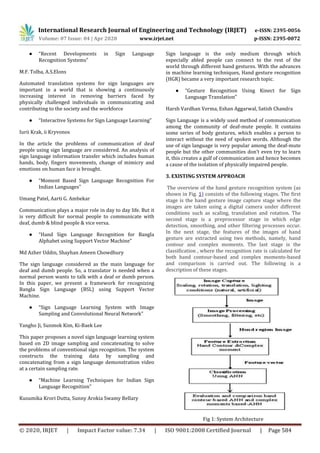
The overview of the hand gesture recognition system (as
shown in Fig. 1) consists of the following stages. The first
stage is the hand gesture image capture stage where the
images are taken using a digital camera under different
conditions such as scaling, translation and rotation. The
second stage is a preprocessor stage in which edge
detection, smoothing, and other filtering processes occur.
In the next stage, the features of the images of hand
gesture are extracted using two methods, namely, hand
contour and complex moments. The last stage is the
classification , where the recognition rate is calculated for
both hand contour-based and complex moments-based
and comparison is carried out. The following is a
description of these stages.
Fig 1: System Architecture
International Research Journal of Engineering and Technology (IRJET) e-ISSN: 2395-0056
Volume: 07 Issue: 04 | Apr 2020 www.irjet.net p-ISSN: 2395-0072
© 2020, IRJET | Impact Factor value: 7.34 | ISO 9001:2008 Certified Journal | Page 585
Disadvantages:
● It could not be accurate.
● Less stability provides.
● Time consuming for capturing images.
● It is not flexible for blind people.
4. PROPOSED SYSTEM APPROACH
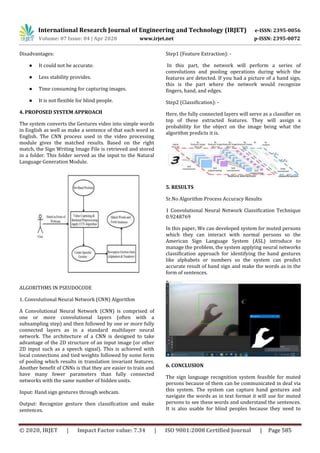
The system converts the Gestures video into simple words
in English as well as make a sentence of that each word in
English. The CNN process used in the video processing
module gives the matched results. Based on the right
match, the Sign Writing Image File is retrieved and stored
in a folder. This folder served as the input to the Natural
Language Generation Module.
ALGORITHMS IN PSEUDOCODE
1. Convolutional Neural Network (CNN) Algorithm
A Convolutional Neural Network (CNN) is comprised of
one or more convolutional layers (often with a
subsampling step) and then followed by one or more fully
connected layers as in a standard multilayer neural
network. The architecture of a CNN is designed to take
advantage of the 2D structure of an input image (or other
2D input such as a speech signal). This is achieved with
local connections and tied weights followed by some form
of pooling which results in translation invariant features.
Another benefit of CNNs is that they are easier to train and
have many fewer parameters than fully connected
networks with the same number of hidden units.
Input: Hand sign gestures through webcam.
Output: Recognize gesture then classification and make
sentences.
Step1 (Feature Extraction): -
In this part, the network will perform a series of
convolutions and pooling operations during which the
features are detected. If you had a picture of a hand sign,
this is the part where the network would recognize
fingers, hand, and edges.
Step2 (Classification): -
Here, the fully connected layers will serve as a classifier on
top of these extracted features. They will assign a
probability for the object on the image being what the
algorithm predicts it is.
5. RESULTS
Sr.No Algorithm Process Accuracy Results
1 Convolutional Neural Network Classification Technique
0.9248769
In this paper, We can developed system for muted persons
which they can interact with normal persons so the
American Sign Language System (ASL) introduce to
manage the problem, the system applying neural networks
classification approach for identifying the hand gestures
like alphabets or numbers so the system can predict
accurate result of hand sign and make the words as in the
form of sentences.
6. CONCLUSION
The sign language recognition system feasible for muted
persons because of them can be communicated in deaf via
this system. The system can capture hand gestures and
navigate the words as in text format it will use for muted
persons to see these words and understand the sentences.
It is also usable for blind peoples because they need to
International Research Journal of Engineering and Technology (IRJET) e-ISSN: 2395-0056
Volume: 07 Issue: 04 | Apr 2020 www.irjet.net p-ISSN: 2395-0072
© 2020, IRJET | Impact Factor value: 7.34 | ISO 9001:2008 Certified Journal | Page 586
communicate with normal persons (using speech
recognition).
7. REFERENCES
● Deaf Cambridge Dictionary(2018). Retrieved from
Cambridge Dictionary:
https://dictionary.cambridge.org/dictionary/engl
ish/deaf
● Deng, J., Dong, W., Socher, R., Li, L.-J., Li, K., & Fei-
Fei, L. (2009). ImageNet: A Large-Scale
Hierarchical Image Database. Computer Vision
and Pattern Recognition, 2009. CVPR 2009. IEEE
Conference on (pp. 248-255). IEEE. Miami, FL,
USA .
● Escalera, S., Baró, X., Gonzàlez, J., Bautista, M.,
Madadi, M., Reyes, M., . . Guyon, I. (2014).
ChaLearn Looking at People Challenge 2014:
Dataset and Results. Workshop at the European
Conference on Computer Vision (pp. 459-473).
Springer, . Cham.
● Feichtenhofer, C., Pinz, A., & Wildes, R. P. (2016).
Spatiotemporal Residual Networks for Video
Action Recognition. Advances in neural
information processing systems, (pp. 3468-3476)
● Huang, J., Zhou, W., & Li, H. (2015). Sign Language
Recognition using 3D convolutional neural
networks. IEEE International Conference on
Multimedia and Expo (ICME) (pp. 1-6). Turin:
IEEE.
● Jaoa Carriera, A. Z. (2018). Quo Vadis, Action
Recognition? A New Model and the Kinetics
Dataset. Computer Vision and Pattern
● Kay, W., Carriera, J., Simonyan, K., Zhang, B.,
Hillier, C., Vijayanarasimhan, S., . . . Zisserman, A.
(2017). The Kinetics Human Action Video Dataset.
Computer Vision and Pattern Recognition,
arXiv:1705.06950v1, 1-22.
● Feichtenhofer, C., Pinz, A., & Zisserman, A. (2016).
Convolutional two-stream network fusion for
video action recognition.
● Computer Vision and Pattern Recognition (pp.
1933-1941). Las Vegas Valley: IEEE
● Going Deeper with Convolutions,Szegedy et al.
CVPR 2015, IEEE Explore.Independently
Recurrent Neural Network (IndRNN): Building A
Longer and Deeper RNN, Shuai Li, Wanqing Li,
Chris Cook, Ce Zhu, Yanbo Gao, CVPR 2018
● Independently Recurrent Neural Network
(IndRNN): Building A Longer and Deeper RNN,
Shuai Li, Wanqing Li, Chris Cook, Ce Zhu, Yanbo
Gao, CVPR 2018.

IRJET - Sign Language Recognition using Neural Network

  • 1.
    International Research Journalof Engineering and Technology (IRJET) e-ISSN: 2395-0056 Volume: 07 Issue: 04 | Apr 2020 www.irjet.net p-ISSN: 2395-0072 © 2020, IRJET | Impact Factor value: 7.34 | ISO 9001:2008 Certified Journal | Page 583 SIGN LANGUAGE RECOGNITION USING NEURAL NETWORK Shailesh bachani1, Shubham dixit2, Rohin chadha3, Prof. Avinash Bagul4 1,2,3Student, Department of Computer Engineering, NBN Sinhgad School of Engineering, Ambegaon, Pune, Maharashtra, India, 411041 ---------------------------------------------------------------------***---------------------------------------------------------------------- Abstract - Hand Gesture recognition system provides us an innovative, natural, user friendly way of interaction with the computer which is more familiar to human beings. Gesture Recognition has a wide area of application including human machine interaction, sign language, immersive game technology etc. By keeping in mind the similarities of human hand shape with four fingers and one thumb, this paper aims to present a real time system for hand gesture recognition on the basis of detection of some meaningful shape based features like orientation, center of mass (centroid), status of fingers, thumb in terms of raised or folded fingers of hand and their respective location in image. The approach introduced in this paper is totally depending on the shape parameters of the hand gesture. It does not consider any other means of hand gesture recognition like skin color, texture because these image based features are extremely variant to different light conditions and other influences. To implement this approach, we have utilized a simple web cam which is working on 20 fps with 7 mega pixel intensity. 1. INTRODUCTION Interface with computers using gestures of the human body, typically hand movements. In gesture recognition technology, a camera reads the movements of the human body and communicates the data to a computer that uses the gestures as input to control devices or applications. For example, a person clapping his hands together in front of a camera can produce the sound of cymbals being crashed together when the gesture is fed through a computer. One way gesture recognition is being used is to help the physically impaired to interact with computers, such as interpreting sign language. The technology also has the potential to change the way users interact with computers by eliminating input devices such as joysticks, mice and keyboards and allowing the unencumbered body to give signals to the computer through gestures such as finger pointing. Unlike Haptic interfaces, gesture recognition does not require the user to wear any special equipment or attach any devices to the body. The gestures of the body are read by a camera instead of sensors attached to a device such as a data gloveIn addition to hand and body movement, gesture recognition technology also can be used to read facial and speech expressions (i.e., lip reading), and eye movements. The literature includes ongoing work in the computer vision field on capturing gestures or more 1.2 Objective ● Serving mankind by use of technology. ● Education will be easier through this, reaching a larger number of people. ● The system can capture hand gestures and navigate the words as in text format it will use for muted persons to see these words and understand the sentences. ● It is also usable for blind peoples because they need to communicate with normal persons (using speech recognition). 2. LITERATURE SURVEY ● “An Approach for Minimizing the Time Taken for Translating Sign Language to Simple Sentence in English” Aradhana Kar, Pinaki Sankar Sign Language is the language of deaf. There are different types of sign languages spread all over the world. American Sign Language (ASL) is one of the sign languages. ASL is used by deaf Americans. We had created a system that translates sign language videos to simple sentences in English. ● “Deep Convolutional Neural Networks for Sign Language Recognition” G.Anantha Rao, Guntur (DT) Extraction of complex head and hand movements along with their constantly changing shapes for recognition of sign language is considered a difficult problem in computer vision ● “American Sign Language Recognition using Deep Learning and Computer Vision” Kshitij Bantupalli, Ying Xie Speech impairment is a disability which affects an individual’s ability to communicate using speech and hearing. People who are affected by this use of other media or communication such as sign language.
  • 2.
    International Research Journalof Engineering and Technology (IRJET) e-ISSN: 2395-0056 Volume: 07 Issue: 04 | Apr 2020 www.irjet.net p-ISSN: 2395-0072 © 2020, IRJET | Impact Factor value: 7.34 | ISO 9001:2008 Certified Journal | Page 584 ● “Recent Developments in Sign Language Recognition Systems” M.F. Tolba, A.S.Elons Automated translation systems for sign languages are important in a world that is showing a continuously increasing interest in removing barriers faced by physically challenged individuals in communicating and contributing to the society and the workforce ● “Interactive Systems for Sign Language Learning” Iurii Krak, ii Kryvonos In the article the problems of communication of deaf people using sign language are considered. An analysis of sign language information transfer which includes human hands, body, fingers movements, change of mimicry and emotions on human face is brought. ● “Moment Based Sign Language Recognition For Indian Languages” Umang Patel, Aarti G. Ambekar Communication plays a major role in day to day life. But it is very difficult for normal people to communicate with deaf, dumb & blind people & vice versa. ● “Hand Sign Language Recognition for Bangla Alphabet using Support Vector Machine” Md Azher Uddin, Shayhan Ameen Chowdhury The sign language considered as the main language for deaf and dumb people. So, a translator is needed when a normal person wants to talk with a deaf or dumb person. In this paper, we present a framework for recognizing Bangla Sign Language (BSL) using Support Vector Machine. ● “Sign Language Learning System with Image Sampling and Convolutional Neural Network” Yangho Ji, Sunmok Kim, Ki-Baek Lee This paper proposes a novel sign language learning system based on 2D image sampling and concatenating to solve the problems of conventional sign recognition. The system constructs the training data by sampling and concatenating from a sign language demonstration video at a certain sampling rate. ● “Machine Learning Techniques for Indian Sign Language Recognition” Kusumika Krori Dutta, Sunny Arokia Swamy Bellary Sign language is the only medium through which especially abled people can connect to the rest of the world through different hand gestures. With the advances in machine learning techniques, Hand gesture recognition (HGR) became a very important research topic. ● “Gesture Recognition Using Kinect for Sign Language Translation” Harsh Vardhan Verma, Eshan Aggarwal, Satish Chandra Sign Language is a widely used method of communication among the community of deaf-mute people. It contains some series of body gestures, which enables a person to interact without the need of spoken words. Although the use of sign language is very popular among the deaf-mute people but the other communities don’t even try to learn it, this creates a gulf of communication and hence becomes a cause of the isolation of physically impaired people. 3. EXISTING SYSTEM APPROACH The overview of the hand gesture recognition system (as shown in Fig. 1) consists of the following stages. The first stage is the hand gesture image capture stage where the images are taken using a digital camera under different conditions such as scaling, translation and rotation. The second stage is a preprocessor stage in which edge detection, smoothing, and other filtering processes occur. In the next stage, the features of the images of hand gesture are extracted using two methods, namely, hand contour and complex moments. The last stage is the classification , where the recognition rate is calculated for both hand contour-based and complex moments-based and comparison is carried out. The following is a description of these stages. Fig 1: System Architecture
  • 3.
    International Research Journalof Engineering and Technology (IRJET) e-ISSN: 2395-0056 Volume: 07 Issue: 04 | Apr 2020 www.irjet.net p-ISSN: 2395-0072 © 2020, IRJET | Impact Factor value: 7.34 | ISO 9001:2008 Certified Journal | Page 585 Disadvantages: ● It could not be accurate. ● Less stability provides. ● Time consuming for capturing images. ● It is not flexible for blind people. 4. PROPOSED SYSTEM APPROACH The system converts the Gestures video into simple words in English as well as make a sentence of that each word in English. The CNN process used in the video processing module gives the matched results. Based on the right match, the Sign Writing Image File is retrieved and stored in a folder. This folder served as the input to the Natural Language Generation Module. ALGORITHMS IN PSEUDOCODE 1. Convolutional Neural Network (CNN) Algorithm A Convolutional Neural Network (CNN) is comprised of one or more convolutional layers (often with a subsampling step) and then followed by one or more fully connected layers as in a standard multilayer neural network. The architecture of a CNN is designed to take advantage of the 2D structure of an input image (or other 2D input such as a speech signal). This is achieved with local connections and tied weights followed by some form of pooling which results in translation invariant features. Another benefit of CNNs is that they are easier to train and have many fewer parameters than fully connected networks with the same number of hidden units. Input: Hand sign gestures through webcam. Output: Recognize gesture then classification and make sentences. Step1 (Feature Extraction): - In this part, the network will perform a series of convolutions and pooling operations during which the features are detected. If you had a picture of a hand sign, this is the part where the network would recognize fingers, hand, and edges. Step2 (Classification): - Here, the fully connected layers will serve as a classifier on top of these extracted features. They will assign a probability for the object on the image being what the algorithm predicts it is. 5. RESULTS Sr.No Algorithm Process Accuracy Results 1 Convolutional Neural Network Classification Technique 0.9248769 In this paper, We can developed system for muted persons which they can interact with normal persons so the American Sign Language System (ASL) introduce to manage the problem, the system applying neural networks classification approach for identifying the hand gestures like alphabets or numbers so the system can predict accurate result of hand sign and make the words as in the form of sentences. 6. CONCLUSION The sign language recognition system feasible for muted persons because of them can be communicated in deaf via this system. The system can capture hand gestures and navigate the words as in text format it will use for muted persons to see these words and understand the sentences. It is also usable for blind peoples because they need to
  • 4.
    International Research Journalof Engineering and Technology (IRJET) e-ISSN: 2395-0056 Volume: 07 Issue: 04 | Apr 2020 www.irjet.net p-ISSN: 2395-0072 © 2020, IRJET | Impact Factor value: 7.34 | ISO 9001:2008 Certified Journal | Page 586 communicate with normal persons (using speech recognition). 7. REFERENCES ● Deaf Cambridge Dictionary(2018). Retrieved from Cambridge Dictionary: https://dictionary.cambridge.org/dictionary/engl ish/deaf ● Deng, J., Dong, W., Socher, R., Li, L.-J., Li, K., & Fei- Fei, L. (2009). ImageNet: A Large-Scale Hierarchical Image Database. Computer Vision and Pattern Recognition, 2009. CVPR 2009. IEEE Conference on (pp. 248-255). IEEE. Miami, FL, USA . ● Escalera, S., Baró, X., Gonzàlez, J., Bautista, M., Madadi, M., Reyes, M., . . Guyon, I. (2014). ChaLearn Looking at People Challenge 2014: Dataset and Results. Workshop at the European Conference on Computer Vision (pp. 459-473). Springer, . Cham. ● Feichtenhofer, C., Pinz, A., & Wildes, R. P. (2016). Spatiotemporal Residual Networks for Video Action Recognition. Advances in neural information processing systems, (pp. 3468-3476) ● Huang, J., Zhou, W., & Li, H. (2015). Sign Language Recognition using 3D convolutional neural networks. IEEE International Conference on Multimedia and Expo (ICME) (pp. 1-6). Turin: IEEE. ● Jaoa Carriera, A. Z. (2018). Quo Vadis, Action Recognition? A New Model and the Kinetics Dataset. Computer Vision and Pattern ● Kay, W., Carriera, J., Simonyan, K., Zhang, B., Hillier, C., Vijayanarasimhan, S., . . . Zisserman, A. (2017). The Kinetics Human Action Video Dataset. Computer Vision and Pattern Recognition, arXiv:1705.06950v1, 1-22. ● Feichtenhofer, C., Pinz, A., & Zisserman, A. (2016). Convolutional two-stream network fusion for video action recognition. ● Computer Vision and Pattern Recognition (pp. 1933-1941). Las Vegas Valley: IEEE ● Going Deeper with Convolutions,Szegedy et al. CVPR 2015, IEEE Explore.Independently Recurrent Neural Network (IndRNN): Building A Longer and Deeper RNN, Shuai Li, Wanqing Li, Chris Cook, Ce Zhu, Yanbo Gao, CVPR 2018 ● Independently Recurrent Neural Network (IndRNN): Building A Longer and Deeper RNN, Shuai Li, Wanqing Li, Chris Cook, Ce Zhu, Yanbo Gao, CVPR 2018.