Palmprint Identification using FRIT


                                          Authors:
                        Dakshina Ranjan Kisku, Ajita Rattani, Phalguni
                       Gupta, *C. Jinshong Hwang, Jamuna Kanta Sing
25 - 29 April 2011
Orlando World
Center Marriott                         Presented By –
Resort & Convention                Prof. C. Jinshong Hwang
Center                Department of Computer Science, Texas State University,
Orlando, Florida,                San Marcos, Texas 78666, U.S.A
USA
Outline of Talk:
 Biometrics
 Palmprint Biometrics
    Hand Geometry
    Palm Characteristics
 Advantages of Palmprint Trait
 Proposed Palmprint Identification System
 ROI Extraction
 Feature Extraction using FRIT
 Classification with Bayesian Classifier
 Experimental Results
    CASIA Database
    IIT Kanpur Database
    Results
    Comparative Study
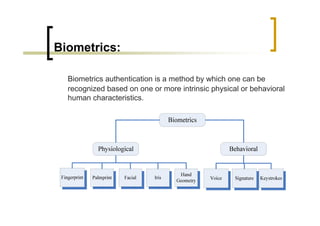
Biometrics:

  Biometrics authentication is a method by which one can be
  recognized based on one or more intrinsic physical or behavioral
  human characteristics.
Palmprint Biometrics:

Hand Geometry
   Features: Hand shape and dimensions, finger size and lengths


Palm Characteristics [2], [16]
   Features: Principal lines, wrinkles and creases
      Principal lines: Heart line, head line and life line
      Wrinkles: Weaker and irregular lines, much thinner than principal
      lines
      Creases: More like fingerprint structure, have ridges and valleys
Advantages of Palmprint System:

Advantages [2], [16]:
   High distinctiveness
   High permanence
   High performance
   Non – intrusiveness
   Low resolution imaging
   User – friendly
   Low price palmprint devices and low setup cost
   Highly stable
Proposed Palmprint Identification
System:

 ROI [25] is detected and extracted from palm image.

 FRIT [24], [26] is applied on the ROI (region of interest) to extract a
 set of distinctive features from palmprint image.

 These features are used to classify with the help of Bayesian
 classifier [30].

 The proposed system has been tested on CASIA [16], [28] and IIT
 Kanpur [31] palmprint databases.
Preprocessing: ROI Extraction
To extract the ROI of palm image the following steps are
followed:

Convert the palm image to a binary image. Gaussian smoothing is
used to enhance the image.

Apply boundary-tracking algorithm in [25] to obtain the boundaries
of the gaps between the fingers. Since the ring and the middle
fingers are not useful for processing. Therefore, boundary of the gap
between these two fingers is not extracted.
Contd…..ROI Extraction
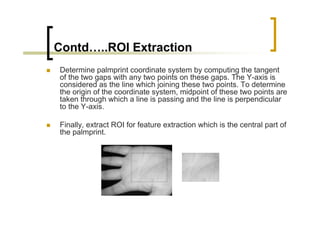
Determine palmprint coordinate system by computing the tangent
of the two gaps with any two points on these gaps. The Y-axis is
considered as the line which joining these two points. To determine
the origin of the coordinate system, midpoint of these two points are
taken through which a line is passing and the line is perpendicular
to the Y-axis.

Finally, extract ROI for feature extraction which is the central part of
the palmprint.
Feature Extraction using FRIT:
 To characterize palmprint image Finite Ridgelet Transform [24],
 [26] is used to achieve a very compact representation of linear
 singularities.

 FRIT captures the singularities along lines and edges.

 As the continuous Ridgelet transform has close relations with other
 transforms in continuous domain, the continuous Ridgelet
 Transform for a given palmprint can be defined as


where            in 2-D are defined from a wavelet function in 1-D
as
Contd……


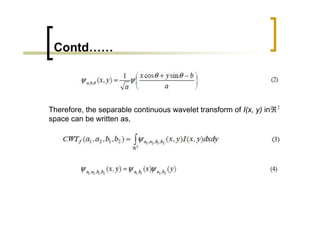
Therefore, the separable continuous wavelet transform of I(x, y) in ℜ 2
space can be written as,
Contd…..
The wavelets are functions with scale and line position and wavelets
are found to be effective in representing point singularities.

Ridgelets are found to be effective in representing singularities along
the line.

Ridgelets can be considered as concatenation of 1-D wavelets along
the line.

In particular, wavelets and Ridgelet transforms are related to Radon
transform.

Radon transform is a projection of image intensity along a radial line
oriented at a specific angle.

It extracts lines in edge dominated images while palmprint images
are considered to be an edge dominated images.
Contd….
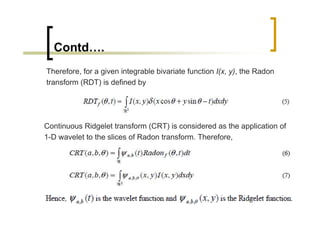
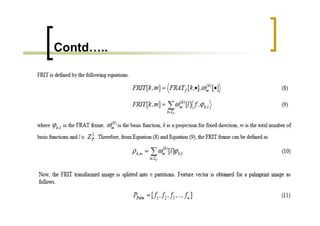
Therefore, for a given integrable bivariate function I(x, y), the Radon
transform (RDT) is defined by


Continuous Ridgelet transform (CRT) is considered as the application of
1-D wavelet to the slices of Radon transform. Therefore,
Contd…..
Contd…..
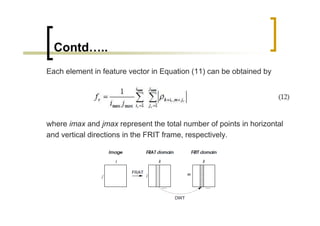
Each element in feature vector in Equation (11) can be obtained by


where imax and jmax represent the total number of points in horizontal
and vertical directions in the FRIT frame, respectively.
Classification using Bayesian
Classifier:
 In pattern recognition and classification field, Bayesian classifier
 [30] is found to be one of the best classifiers to classify the objects.

 Bayes error is the best criterion to evaluate feature sets.

 A posteriori probability functions are optimal features.

 Let x1 , x 2 , x3 ,..., x n denote the object classes and Ppalm is an
 palmprint image in feature space.

 Therefore, the posteriori probability function of xi given Ppalm is
 defined as
Contd…..
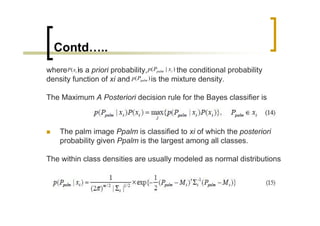
where P( xi ) a priori probability, p( Ppalm | xi ) the conditional probability
            is
density function of xi and p( Ppalm ) is the mixture density.

The Maximum A Posteriori decision rule for the Bayes classifier is


    The palm image Ppalm is classified to xi of which the posteriori
    probability given Ppalm is the largest among all classes.

The within class densities are usually modeled as normal distributions
Contd….
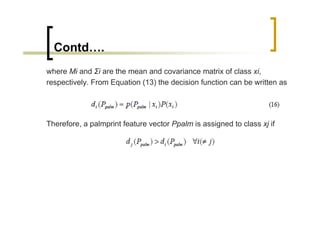
where Mi and Σi are the mean and covariance matrix of class xi,
respectively. From Equation (13) the decision function can be written as


Therefore, a palmprint feature vector Ppalm is assigned to class xj if
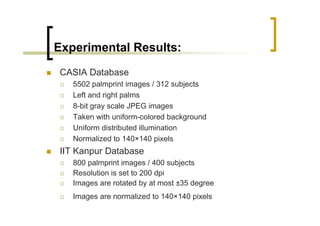
Experimental Results:
CASIA Database
   5502 palmprint images / 312 subjects
   Left and right palms
   8-bit gray scale JPEG images
   Taken with uniform-colored background
   Uniform distributed illumination
   Normalized to 140×140 pixels
IIT Kanpur Database
   800 palmprint images / 400 subjects
   Resolution is set to 200 dpi
   Images are rotated by at most ±35 degree
   Images are normalized to 140×140 pixels
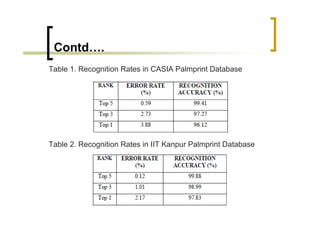
Contd….
Table 1. Recognition Rates in CASIA Palmprint Database


Table 2. Recognition Rates in IIT Kanpur Palmprint Database
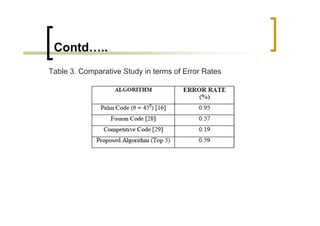
Contd…..
Table 3. Comparative Study in terms of Error Rates
Conclusion:

 An efficient palmprint identification system has been presented in
 this paper where Finite Ridgelet Transform (FRIT) and Bayesian
 classifier are used.
 Shortcomings of wavelets are handled by the Finite Ridgelet
 Transforms and they extend the functionality of wavelets to higher
 singularities.
 Palmprints are classified using Bayesian classifier.
 All intra-class and inter-class comparisons are made for
 determining the recognition rates.
 The three rank based recognition rates are presented.
 The experimental results reveal better performance of the
 proposed system when it is compared with other existing systems.
References:
1.     Zhang, L., and Zhang, D., “Characterization of palmprints by wavelet signatures via directional
       context modeling,” IEEE Transactions on Systems, Man and Cybernetics – B, 34(3), 1335 –
       1347 (2004).
2.     Han, C. C., Cheng, H. L., Lin, C. L., and Fan, K. C., “Personal authentication using
       palmprint features,” Pattern Recognition 36(2), 371 – 381 (2003).
3.     Lin, C. L., Chuang, T. C., and Fan, K. C., “Palmprint verification using hierarchical
       decomposition,” Pattern Recognition 38(12), 2639 – 2652 (2005).
4.     Wu, X. Q., Zhang, D., Wang, K. Q., and Huang, B., “Palmprint classification using principal
       lines,” Pattern Recognition 37(10), 1987 – 1998 (2004).
5.     Wu, X. Q., Zhang, D., and Wang, K. Q., “Palm line extraction and matching for personal
       authentication,” IEEE Transactions on Systems, Man and Cybernetics – A, 36(5), 978 – 987
       (2006).
6.     Liu, L., and Zhang, D., “A novel palm-line detector,” Proceedings of the 5th AVBPA, 563 – 571
       (2005).
7.     Liu, L., Zhang, D., and You, J., “Detecting wide lines using isotropic nonlinear filtering,” IEEE
       Transactions on Image Processing, 16(6), 1584 – 1595 (2007).
8.     Connie, T., Jin, A. T. B., On, M. g. K., and Ling, D. N. C., “An automated palmprint recognition
       system,” Image Vision Computing, 23(5), 501 – 515 (2005).
9.     Ribaric, S., and Fratric, I., “A biometric identification system based on eigenpalm and
       eigenfinger features,” IEEE Transactions on Pattern Analysis and Machine Intelligence,
       27(11), 1698 – 1709 (2005).
10.    Yang, J., Zhang, D., Yang, J. Y., and Niu, B., “Globally maximizing locally minimizing:
       Unsupervised Discriminant Projection with applications to face and palm Biometrics,” IEEE
       Transactions on Pattern Analysis and Machine Intelligence, 29(4), 650 – 664 (2007).
Contd…..
11.   Shang, L., Huang, D. S., Du, J. X., and Zheng, C. H., “Palmprint recognition using FastICA
      algorithm and radial basis probabilistic neural network,” Neurocomputing, 69(13), 1782 –
      1786 (2006).
12.   Han, D., Guo, Z., and Zhang, D., “Multispectral palmprint recognition using wavelet-based
      image fusion,” International Conference on Signal Processing, 2074 – 2077 (2008).
13.   Zhang, D., Guo, Z., Lu, G., Zhang, L., and Zuo, W., "An online system of multi-spectral
      palmprint verification", IEEE Transactions on Instrumentation and Measurement, 59(2), 480 –
      490 (2010).
14.   Kong, A., and Zhang, D., “Competitive coding scheme for palmprint verification”, International
      Conference on Pattern Recognition, 1, 520 – 523 (2004).
15.   Sun, Y. H. Z., Tan, T., and Ren, C., “Multi-spectral palm image fusion for accurate contact-
      free palmprint recognition,” IEEE International Conference on Image Processing, 281 – 284
      (2008).
16.   Zhang, D., Kong, W. K., You, J., and Wong, M., “On-line palmprint identification,” IEEE
      Transactions on Pattern Analysis and Machine Intelligence, 25, 1041 – 1050 (2003).
17.   Kumar, A., Shen, and H. C., “Palmprint identification using palmcodes,” International
      Conference on Image & Graphics, 258 – 261 (2004).
18.   You, J., Li, W., and Zhang, D., “Hierarchical palmprint identification via multiple feature
      extraction,” Pattern Recognition, 35, 847 – 859 (2002).
19.   Li, W., Zhang, D., and Xu, Z., “Palmprint identification by Fourier transform,” International
      Journal of Pattern Recognition & Artificial Intelligence, 16(4), 417 – 432 (2002).
20.   Kumar, A., and Shen, H. C., “Recognition of palmprints using wavelet-based features,”
      International Conference on Systems and Cybernetics (2002).
Contd…..
21.    Zhang, L., and Zhang, D., “Characterization of palmprints by wavelet signatures via directional
       context modeling,” IEEE Transactions on Systems, Man and Cybernetics – B, 1335 – 1347
       (2004).
22.    Bosnjak, A., Montilla, G., and Torrealba, V., “Medical images segmentation using Gabor filters
       applied to Echocardiographic images,” Computers in Cardiology, 25, 457 – 460 (1998).
23.    Pun, C., and Lee, M., “Log-Polar wavelet energy signatures for rotation and scale variant
       texture classification,” IEEE Transactions on Pattern Analysis and Machine Intelligence, 25(5)
       (2003).
24.    Do, M., and Vetterli, M., “The finite ridgelet transform for image representation,” IEEE
       Transactions on Image Processing, 12, 16 – 28 (2003).
25.    Zhang, D., Kong, W. K., You, J., and Wong, M., “On-line palmprint identification,” IEEE
       Transactions on Pattern Analysis and Machine Intelligence, 25, 1041 – 1050 (2003).
26.    Candµes, E. J., [Ridgelets: Theory and Applications], Ph.D. thesis, Department of
       Statistics, Stanford University, 1998.
27.    Candµes, E. J., and Donoho, and D. L., “Ridgelets: a key to higher-dimensional
       intermittency?," Philosophical Transactions of Royal Society Lond. – A, 2495 – 2509 (1999).
28.    Kong, W., and Zhang, D., “Feature-level fusion for effective palmprint authentication,”
       In: Zhang, D., Jain, A.K. (eds.) ICBA 2004 LNCS, 3072, 761 – 767 (2004).
29.    Kong, W., and Zhang, D., “Competitive coding scheme for palmprint verification,”
       International Conference Pattern Recognition, 1, 520 – 523 (2004).
30.    Moghaddam, B., Jebara, T., and Pentland, A., “Bayesian face recognition,” Pattern
       Recognition, 33(11), 1771 – 1782 (2000).
31.    Kisku, D. R., Gupta, G., Sing, J. K., "Feature level fusion of face and palmprint
       biometrics by isomorphic graph-based improved K-medoids partitioning," 4th
       International Conference on Information Security and Assurance Lecture Notes in
       Computer Science, 6059, 70 – 81 (2010).
Questions ???
Thank you !
Contact Author:
drkisku@ieee.org

Palmprint Identification Using FRIT

  • 1.
    Palmprint Identification usingFRIT Authors: Dakshina Ranjan Kisku, Ajita Rattani, Phalguni Gupta, *C. Jinshong Hwang, Jamuna Kanta Sing 25 - 29 April 2011 Orlando World Center Marriott Presented By – Resort & Convention Prof. C. Jinshong Hwang Center Department of Computer Science, Texas State University, Orlando, Florida, San Marcos, Texas 78666, U.S.A USA
  • 2.
    Outline of Talk: Biometrics Palmprint Biometrics Hand Geometry Palm Characteristics Advantages of Palmprint Trait Proposed Palmprint Identification System ROI Extraction Feature Extraction using FRIT Classification with Bayesian Classifier Experimental Results CASIA Database IIT Kanpur Database Results Comparative Study
  • 3.
    Biometrics: Biometricsauthentication is a method by which one can be recognized based on one or more intrinsic physical or behavioral human characteristics.
  • 4.
    Palmprint Biometrics: Hand Geometry Features: Hand shape and dimensions, finger size and lengths Palm Characteristics [2], [16] Features: Principal lines, wrinkles and creases Principal lines: Heart line, head line and life line Wrinkles: Weaker and irregular lines, much thinner than principal lines Creases: More like fingerprint structure, have ridges and valleys
  • 5.
    Advantages of PalmprintSystem: Advantages [2], [16]: High distinctiveness High permanence High performance Non – intrusiveness Low resolution imaging User – friendly Low price palmprint devices and low setup cost Highly stable
  • 6.
    Proposed Palmprint Identification System: ROI [25] is detected and extracted from palm image. FRIT [24], [26] is applied on the ROI (region of interest) to extract a set of distinctive features from palmprint image. These features are used to classify with the help of Bayesian classifier [30]. The proposed system has been tested on CASIA [16], [28] and IIT Kanpur [31] palmprint databases.
  • 7.
    Preprocessing: ROI Extraction Toextract the ROI of palm image the following steps are followed: Convert the palm image to a binary image. Gaussian smoothing is used to enhance the image. Apply boundary-tracking algorithm in [25] to obtain the boundaries of the gaps between the fingers. Since the ring and the middle fingers are not useful for processing. Therefore, boundary of the gap between these two fingers is not extracted.
  • 8.
    Contd…..ROI Extraction Determine palmprintcoordinate system by computing the tangent of the two gaps with any two points on these gaps. The Y-axis is considered as the line which joining these two points. To determine the origin of the coordinate system, midpoint of these two points are taken through which a line is passing and the line is perpendicular to the Y-axis. Finally, extract ROI for feature extraction which is the central part of the palmprint.
  • 9.
    Feature Extraction usingFRIT: To characterize palmprint image Finite Ridgelet Transform [24], [26] is used to achieve a very compact representation of linear singularities. FRIT captures the singularities along lines and edges. As the continuous Ridgelet transform has close relations with other transforms in continuous domain, the continuous Ridgelet Transform for a given palmprint can be defined as where in 2-D are defined from a wavelet function in 1-D as
  • 10.
    Contd…… Therefore, the separablecontinuous wavelet transform of I(x, y) in ℜ 2 space can be written as,
  • 11.
    Contd….. The wavelets arefunctions with scale and line position and wavelets are found to be effective in representing point singularities. Ridgelets are found to be effective in representing singularities along the line. Ridgelets can be considered as concatenation of 1-D wavelets along the line. In particular, wavelets and Ridgelet transforms are related to Radon transform. Radon transform is a projection of image intensity along a radial line oriented at a specific angle. It extracts lines in edge dominated images while palmprint images are considered to be an edge dominated images.
  • 12.
    Contd…. Therefore, for agiven integrable bivariate function I(x, y), the Radon transform (RDT) is defined by Continuous Ridgelet transform (CRT) is considered as the application of 1-D wavelet to the slices of Radon transform. Therefore,
  • 13.
  • 14.
    Contd….. Each element infeature vector in Equation (11) can be obtained by where imax and jmax represent the total number of points in horizontal and vertical directions in the FRIT frame, respectively.
  • 15.
    Classification using Bayesian Classifier: In pattern recognition and classification field, Bayesian classifier [30] is found to be one of the best classifiers to classify the objects. Bayes error is the best criterion to evaluate feature sets. A posteriori probability functions are optimal features. Let x1 , x 2 , x3 ,..., x n denote the object classes and Ppalm is an palmprint image in feature space. Therefore, the posteriori probability function of xi given Ppalm is defined as
  • 16.
    Contd….. where P( xi) a priori probability, p( Ppalm | xi ) the conditional probability is density function of xi and p( Ppalm ) is the mixture density. The Maximum A Posteriori decision rule for the Bayes classifier is The palm image Ppalm is classified to xi of which the posteriori probability given Ppalm is the largest among all classes. The within class densities are usually modeled as normal distributions
  • 17.
    Contd…. where Mi andΣi are the mean and covariance matrix of class xi, respectively. From Equation (13) the decision function can be written as Therefore, a palmprint feature vector Ppalm is assigned to class xj if
  • 18.
    Experimental Results: CASIA Database 5502 palmprint images / 312 subjects Left and right palms 8-bit gray scale JPEG images Taken with uniform-colored background Uniform distributed illumination Normalized to 140×140 pixels IIT Kanpur Database 800 palmprint images / 400 subjects Resolution is set to 200 dpi Images are rotated by at most ±35 degree Images are normalized to 140×140 pixels
  • 19.
    Contd…. Table 1. RecognitionRates in CASIA Palmprint Database Table 2. Recognition Rates in IIT Kanpur Palmprint Database
  • 20.
    Contd….. Table 3. ComparativeStudy in terms of Error Rates
  • 21.
    Conclusion: An efficientpalmprint identification system has been presented in this paper where Finite Ridgelet Transform (FRIT) and Bayesian classifier are used. Shortcomings of wavelets are handled by the Finite Ridgelet Transforms and they extend the functionality of wavelets to higher singularities. Palmprints are classified using Bayesian classifier. All intra-class and inter-class comparisons are made for determining the recognition rates. The three rank based recognition rates are presented. The experimental results reveal better performance of the proposed system when it is compared with other existing systems.
  • 22.
    References: 1. Zhang, L., and Zhang, D., “Characterization of palmprints by wavelet signatures via directional context modeling,” IEEE Transactions on Systems, Man and Cybernetics – B, 34(3), 1335 – 1347 (2004). 2. Han, C. C., Cheng, H. L., Lin, C. L., and Fan, K. C., “Personal authentication using palmprint features,” Pattern Recognition 36(2), 371 – 381 (2003). 3. Lin, C. L., Chuang, T. C., and Fan, K. C., “Palmprint verification using hierarchical decomposition,” Pattern Recognition 38(12), 2639 – 2652 (2005). 4. Wu, X. Q., Zhang, D., Wang, K. Q., and Huang, B., “Palmprint classification using principal lines,” Pattern Recognition 37(10), 1987 – 1998 (2004). 5. Wu, X. Q., Zhang, D., and Wang, K. Q., “Palm line extraction and matching for personal authentication,” IEEE Transactions on Systems, Man and Cybernetics – A, 36(5), 978 – 987 (2006). 6. Liu, L., and Zhang, D., “A novel palm-line detector,” Proceedings of the 5th AVBPA, 563 – 571 (2005). 7. Liu, L., Zhang, D., and You, J., “Detecting wide lines using isotropic nonlinear filtering,” IEEE Transactions on Image Processing, 16(6), 1584 – 1595 (2007). 8. Connie, T., Jin, A. T. B., On, M. g. K., and Ling, D. N. C., “An automated palmprint recognition system,” Image Vision Computing, 23(5), 501 – 515 (2005). 9. Ribaric, S., and Fratric, I., “A biometric identification system based on eigenpalm and eigenfinger features,” IEEE Transactions on Pattern Analysis and Machine Intelligence, 27(11), 1698 – 1709 (2005). 10. Yang, J., Zhang, D., Yang, J. Y., and Niu, B., “Globally maximizing locally minimizing: Unsupervised Discriminant Projection with applications to face and palm Biometrics,” IEEE Transactions on Pattern Analysis and Machine Intelligence, 29(4), 650 – 664 (2007).
  • 23.
    Contd….. 11. Shang, L., Huang, D. S., Du, J. X., and Zheng, C. H., “Palmprint recognition using FastICA algorithm and radial basis probabilistic neural network,” Neurocomputing, 69(13), 1782 – 1786 (2006). 12. Han, D., Guo, Z., and Zhang, D., “Multispectral palmprint recognition using wavelet-based image fusion,” International Conference on Signal Processing, 2074 – 2077 (2008). 13. Zhang, D., Guo, Z., Lu, G., Zhang, L., and Zuo, W., "An online system of multi-spectral palmprint verification", IEEE Transactions on Instrumentation and Measurement, 59(2), 480 – 490 (2010). 14. Kong, A., and Zhang, D., “Competitive coding scheme for palmprint verification”, International Conference on Pattern Recognition, 1, 520 – 523 (2004). 15. Sun, Y. H. Z., Tan, T., and Ren, C., “Multi-spectral palm image fusion for accurate contact- free palmprint recognition,” IEEE International Conference on Image Processing, 281 – 284 (2008). 16. Zhang, D., Kong, W. K., You, J., and Wong, M., “On-line palmprint identification,” IEEE Transactions on Pattern Analysis and Machine Intelligence, 25, 1041 – 1050 (2003). 17. Kumar, A., Shen, and H. C., “Palmprint identification using palmcodes,” International Conference on Image & Graphics, 258 – 261 (2004). 18. You, J., Li, W., and Zhang, D., “Hierarchical palmprint identification via multiple feature extraction,” Pattern Recognition, 35, 847 – 859 (2002). 19. Li, W., Zhang, D., and Xu, Z., “Palmprint identification by Fourier transform,” International Journal of Pattern Recognition & Artificial Intelligence, 16(4), 417 – 432 (2002). 20. Kumar, A., and Shen, H. C., “Recognition of palmprints using wavelet-based features,” International Conference on Systems and Cybernetics (2002).
  • 24.
    Contd….. 21. Zhang, L., and Zhang, D., “Characterization of palmprints by wavelet signatures via directional context modeling,” IEEE Transactions on Systems, Man and Cybernetics – B, 1335 – 1347 (2004). 22. Bosnjak, A., Montilla, G., and Torrealba, V., “Medical images segmentation using Gabor filters applied to Echocardiographic images,” Computers in Cardiology, 25, 457 – 460 (1998). 23. Pun, C., and Lee, M., “Log-Polar wavelet energy signatures for rotation and scale variant texture classification,” IEEE Transactions on Pattern Analysis and Machine Intelligence, 25(5) (2003). 24. Do, M., and Vetterli, M., “The finite ridgelet transform for image representation,” IEEE Transactions on Image Processing, 12, 16 – 28 (2003). 25. Zhang, D., Kong, W. K., You, J., and Wong, M., “On-line palmprint identification,” IEEE Transactions on Pattern Analysis and Machine Intelligence, 25, 1041 – 1050 (2003). 26. Candµes, E. J., [Ridgelets: Theory and Applications], Ph.D. thesis, Department of Statistics, Stanford University, 1998. 27. Candµes, E. J., and Donoho, and D. L., “Ridgelets: a key to higher-dimensional intermittency?," Philosophical Transactions of Royal Society Lond. – A, 2495 – 2509 (1999). 28. Kong, W., and Zhang, D., “Feature-level fusion for effective palmprint authentication,” In: Zhang, D., Jain, A.K. (eds.) ICBA 2004 LNCS, 3072, 761 – 767 (2004). 29. Kong, W., and Zhang, D., “Competitive coding scheme for palmprint verification,” International Conference Pattern Recognition, 1, 520 – 523 (2004). 30. Moghaddam, B., Jebara, T., and Pentland, A., “Bayesian face recognition,” Pattern Recognition, 33(11), 1771 – 1782 (2000). 31. Kisku, D. R., Gupta, G., Sing, J. K., "Feature level fusion of face and palmprint biometrics by isomorphic graph-based improved K-medoids partitioning," 4th International Conference on Information Security and Assurance Lecture Notes in Computer Science, 6059, 70 – 81 (2010).
  • 25.
  • 26.
    Thank you ! ContactAuthor: drkisku@ieee.org