A Completed Modeling of Local Binary
Pattern Operator for Texture Classification
Zhenhua Guo,
Lei Zhang,
David Zhang

2012 IEEE Transactions on Image Processing

NTNU-CSIE Chen-Lin Yu , Total page:23
Outline






Introduction
Brief Review of LBP
Completed LBP (CLBP)
Experiments
Conclusion

2
INTRODUCTION

3
Texture Classification
 Texture classification is an active research topic in
computer vision and pattern recognition.
 In texture classification, the goal is to assign an
unknown sample image to one of a set of known texture
classes.

 Texture classification process involves two phases:
(1) learning phase and (2) the recognition phase

4
Divided texture analysis methods into
four categories:
Statistical
Geometrical
Model-based
Signal processing

http://homepages.inf.ed.ac.uk/rbf/CVonline/LOCAL_COPIES/OJALA1/texclas.htm
Goal:
 Proposing a new local feature extractor to generalize
and complete LBP(CLBP).
 Some information is missed in LBP code. We
attempts to address that how to effectively represent
the missing information in the LBP so that better
texture classification.
 In CLBP, a local region is represented by its center
pixel and a local difference sign-magnitude transform
(LDSMT).
6
BRIEF REVIEW OF LBP

7
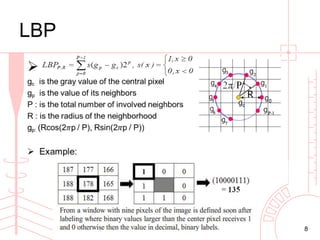
LBP

8
Rotation variance
 We define formula U which value of an LBP pattern
is defined as the number of spatial transitions
(bitwise 0/1 changes) in that pattern.

0

1

1
0

1
0

0

0

01110000
U(LBPP,R) = 2

1

1

1
1

1
0

0

1

11110101
U(LBPP,R) = 4

9
 The uniform LBP patterns refer to the patterns
which have limited transition or discontinuities
(U<=2) in the circular binary presentation [13].

 (superscript “riu2” means rotation invariant “uniform”
patterns with U<=2)

[13] Multiresolution gray-scale and rotation invariant texture classification with Local Binary Pattern

10
COMPLETED LBP (CLBP)

11
CLBP Framework
S

M

Local
Difference

CLBP_S

CLBP_M

LDSMT

Original
Image
Center Gray
Level

Classifier

CLBP_C

CLBP
Histogram

CLBP Map

(nearest neighborhood)

12
I. Local Difference Sign-Magnitude
Transform (LDSMT)

a 3*3 sample block

sign components

local differences

magnitude components

13
 Fig(b) local differences vector

 Fig(c) sign vector
 Fig(d) magnitude vector
 Ex: different vector is [3,9,-13,-16,-15,74,39,31]
after LDMST sign vector is [1,1,-1,-1,-1,1,1,1]
and magnitude vector is [3,9,13,16,15,74,39,31]
14
II. CLBP Map
 By the LDSMT ,three operators, namely CLBP_C,
CLBP_S and CLBP_M, are proposed to code the C,
S and M features, respectively
 Combine CLBP_S and CLBP_M
• 1. Concatenation (CLBP_S_M)
• 2. Joint (CLBP_S/M)

 Combine three operators
• 1. Joint (CLBP_S/M/C)
• 2. Hybrid (CLBP_M_S/C or CLBP_S_M/C)

15
Dissimilarity Metric and Multi-scale CLBP
 There are various metrics to evaluate between two
histograms, such as histogram intersection, loglikelihood ratio, and chi-square statistic [13].

 The nearest neighborhood classifier with the chisquare distance is used to measure the dissimilarity
between two histograms

16
EXPERIMENTS

17
Outex Database
 Includes 24 classes of textures , each texture available at the
site is captured using three different simulated illuminants provided in the light source:
– H : 2300K (陽光 左下)
– Inca : 2856K (日光燈 右下)
– TL84 : 4000K(螢光燈 右上)

and nine rotation angles
(0o,5º,10º,15º,30º,45º,60º,75º and 90º)

18
19
CONCLUSION

20
 We analyzed LBP from a viewpoint of local
difference sign-magnitude transform (LDSMT), and
consequently a new scheme, namely completed
LBP (CLBP)
 By fusing CLBP_C、CLBP_S、CLBP_M codes, it
will much better texture classification accuracy than
the state-of-the-arts LBP.

21
Thank you.

END

22

A completed modeling of local binary pattern operator

  • 1.
    A Completed Modelingof Local Binary Pattern Operator for Texture Classification Zhenhua Guo, Lei Zhang, David Zhang 2012 IEEE Transactions on Image Processing NTNU-CSIE Chen-Lin Yu , Total page:23
  • 2.
    Outline      Introduction Brief Review ofLBP Completed LBP (CLBP) Experiments Conclusion 2
  • 3.
  • 4.
    Texture Classification  Textureclassification is an active research topic in computer vision and pattern recognition.  In texture classification, the goal is to assign an unknown sample image to one of a set of known texture classes.  Texture classification process involves two phases: (1) learning phase and (2) the recognition phase 4
  • 5.
    Divided texture analysismethods into four categories: Statistical Geometrical Model-based Signal processing http://homepages.inf.ed.ac.uk/rbf/CVonline/LOCAL_COPIES/OJALA1/texclas.htm
  • 6.
    Goal:  Proposing anew local feature extractor to generalize and complete LBP(CLBP).  Some information is missed in LBP code. We attempts to address that how to effectively represent the missing information in the LBP so that better texture classification.  In CLBP, a local region is represented by its center pixel and a local difference sign-magnitude transform (LDSMT). 6
  • 7.
  • 8.
  • 9.
    Rotation variance  Wedefine formula U which value of an LBP pattern is defined as the number of spatial transitions (bitwise 0/1 changes) in that pattern. 0 1 1 0 1 0 0 0 01110000 U(LBPP,R) = 2 1 1 1 1 1 0 0 1 11110101 U(LBPP,R) = 4 9
  • 10.
     The uniformLBP patterns refer to the patterns which have limited transition or discontinuities (U<=2) in the circular binary presentation [13].  (superscript “riu2” means rotation invariant “uniform” patterns with U<=2) [13] Multiresolution gray-scale and rotation invariant texture classification with Local Binary Pattern 10
  • 11.
  • 12.
  • 13.
    I. Local DifferenceSign-Magnitude Transform (LDSMT) a 3*3 sample block sign components local differences magnitude components 13
  • 14.
     Fig(b) localdifferences vector  Fig(c) sign vector  Fig(d) magnitude vector  Ex: different vector is [3,9,-13,-16,-15,74,39,31] after LDMST sign vector is [1,1,-1,-1,-1,1,1,1] and magnitude vector is [3,9,13,16,15,74,39,31] 14
  • 15.
    II. CLBP Map By the LDSMT ,three operators, namely CLBP_C, CLBP_S and CLBP_M, are proposed to code the C, S and M features, respectively  Combine CLBP_S and CLBP_M • 1. Concatenation (CLBP_S_M) • 2. Joint (CLBP_S/M)  Combine three operators • 1. Joint (CLBP_S/M/C) • 2. Hybrid (CLBP_M_S/C or CLBP_S_M/C) 15
  • 16.
    Dissimilarity Metric andMulti-scale CLBP  There are various metrics to evaluate between two histograms, such as histogram intersection, loglikelihood ratio, and chi-square statistic [13].  The nearest neighborhood classifier with the chisquare distance is used to measure the dissimilarity between two histograms 16
  • 17.
  • 18.
    Outex Database  Includes24 classes of textures , each texture available at the site is captured using three different simulated illuminants provided in the light source: – H : 2300K (陽光 左下) – Inca : 2856K (日光燈 右下) – TL84 : 4000K(螢光燈 右上) and nine rotation angles (0o,5º,10º,15º,30º,45º,60º,75º and 90º) 18
  • 19.
  • 20.
  • 21.
     We analyzedLBP from a viewpoint of local difference sign-magnitude transform (LDSMT), and consequently a new scheme, namely completed LBP (CLBP)  By fusing CLBP_C、CLBP_S、CLBP_M codes, it will much better texture classification accuracy than the state-of-the-arts LBP. 21
  • 22.