Multiple Disabilities Ian Jacobs Colleen Morris Kevin Wilkes
1.  Terminology
Severe Disabilities Multiple Disabilities Deaf- Blindness Physical Disabilities Traumatic Brain Injury
2.  Definitions
Severe Disabilities No widely accepted definition Definitions are based on tests of  Intellectual functioning Developmental progress Extent of educational needs Usually accompanied with a diagnoses of Mental Retardation Consists of students with disabilities in: Intellectual, social or physical functioning
Multiple Disabilities IDEA defines multiple disabilities as: “ concomitant impairments (such as mental retardation- blindness, mental-retardation- orthopedic impairments, etc) the combination of which causes such severe educational problems that they cannot be accommodated in special education programs solely for one of the impairment.  The term does not include deaf-blindness.”  (p. 473)
Deaf-Blindness IDEA defines Deaf- Blindness as:  “ a combination of both auditory and visual disabilities that causes such a severe communication and other  developmental and learning needs that the persons  can not be appropriately educated in special education programs solely for children and youth with hearing impairments, visual impairments, or severe disabilities, without supplementary assistance to address their educational needs due to these dual, concurrent disabilities.” (p. 473)
Physical Disabilities #1.  Orthopedic Impairment: IDEA defines SEVERE ORTHOPEDIC IMPAIRMENT: “ Included impairments caused by congenital anomaly (club foot) impairments caused by disease (bone tuberculosis) and impairments from other causes (cerebral palsy).” (p.424) #2 Other Health Impairments IDEA defines Other Health Impairments as: “ limited strength, vitality or alertness due to chronic or acute health problems such as a heart condition, tuberculosis, rheumatic fever, nephritis, asthma, sickle cell anemia, hemophilia, epilepsy, lead poisoning, leukemia, or diabetes that adversely affects a child’s educational performance.”  (p.424)
Traumatic Brain Injury IDEA defines Traumatic Brain Injury as: “ an acquired injury to the brain caused by an external physical force, resulting in total or partial functioning disability or psychosocial impairments, or both, that adversely affects a child’s educational performance.”  The term applied to open or closed injuries resulting in one or more areas, such as Cognition; language; memory; attention; reasoning; abstract thinking; judgment; problem solving; sensory; perceptual and motor abilities; psychosocial behavior; physical functions; information processing and speech. The term does not apply to brain injuries that are congenital or generative or brain injuries caused by birth trauma.” (p. 477)
3.  Classification
Severe Disabilities: Includes many individuals in the moderate retardation level (40-55 IQ Score) This population benefits from basic skills training: Getting from one place to another, communication and self help skills
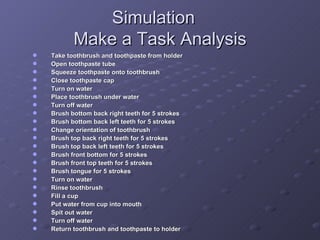
Simulation Make a Task Analysis Take toothbrush and toothpaste from holder Open toothpaste tube Squeeze toothpaste onto toothbrush Close toothpaste cap Turn on water Place toothbrush under water  Turn off water Brush bottom back right teeth for 5 strokes Brush bottom back left teeth for 5 strokes Change orientation of toothbrush Brush top back right teeth for 5 strokes Brush top back left teeth for 5 strokes Brush front bottom for 5 strokes Brush front top teeth for 5 strokes Brush tongue for 5 strokes Turn on water Rinse toothbrush Fill a cup Put water from cup into mouth Spit out water Turn off water Return toothbrush and toothpaste to holder
Physical Disabilities Orthopedic Impairments include: orthopedic impairments: involves the skeletal system (bones, limbs, muscles, and joints) neuro-motor impairments: involves the central nervous system affecting movement, feeling, use and control of body parts.
4.  Prevalence
In 2001-2002 school year there was an estimate of 0.1% to 1% of school aged population with  Severe Disabilities. In 2003-2004 school year there was  131,225  school aged students receiving special education under  Multiple Disabilities.
In the 2003-2004 school year there was 1,603 school aged students receiving special education under  Deaf-Blind. In the 2003-2004 school year there was 67,772 school aged children receiving special education under  Orthopedic Impairments.  There was 449,093 children under  Other Health Impairments Together there was 8.6% of school aged children receiving special education under physically disabilities.
Traumatic Brain Injury (TBI) In the 2003- 2004 school year there was 22,459 school aged students who received special education under Traumatic Brain Injury EACH YEAR: 1 in 500 school aged children will be hospitalized because of a head injury 1 in 30 will sustain a significant head injury by age 15 1 in 10,000 children will die as a result of a head injury.
#5     Causes
Severe Intellectual Disabilities Caused by a wide variety of conditions, largely biological, may occur before (prenatal), during (perinatal), or after birth (postnatal). A brain disorder is involved in almost every case Brain disorders are a result of: Brain dysgenesis (abnormal brain development) Brain damage (caused by influences that alter the structure/function of a previously normally developing brain) (p. 476)
Coulter  (1994) Reviewed 10 epidemiological studies… Estimated that prenatal brain dysgenesis accounts for most cases of severe cognitive limitations  Prenatal & postnatal brain damage accounts for minority of cases (p. 476)
Chromosomal Abnormalities   A significant percentage of children with sever disabilities are born with  chromosomal abnormalities . Down’s Syndrome Genetic/metabolic disorders Such disorders can cause serious problems in physical & intellectual development. (p. 476)
Other Contributors to Severe Intellectual Disabilities
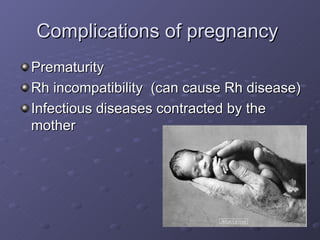
Complications of pregnancy  Prematurity Rh incompatibility  (can cause Rh disease) Infectious diseases contracted by the mother
Causes for greater risk  of severe disabilities   Mother uses excessive drugs or alcohol Mother is poorly nourished Disabilities may develop later in life from head trauma in a car or bike accident, falls, assaults, or abuse.
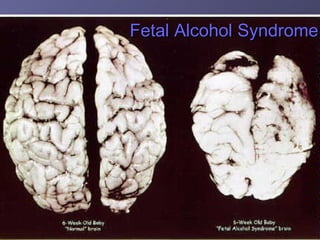
Fetal Alcohol Syndrome
Other Causes  Malnutrition Neglect Ingestion of poisonous substances Certain diseases effecting the brain such as: Meningitis Encephalitis In about 1/6 of all cases, there is no clearly determined cause. (p. 476)                                                  
Causes of Traumatic  Brain Injuries
Open Head Injury  Result of a penetration of the skull Causes specific deficits or problems with particular behavioral and sensory functions controlled by the part of the brain where the injury occurred.
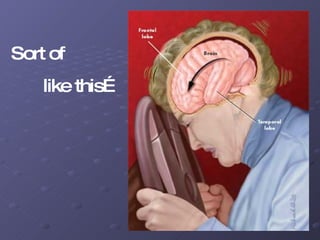
Closed Head Injury  (most common)  Occurs when the head hits a stationary object with such force that the brain slams against the inside of the cranium. The stress of this rapid movement and impact pulls part and tears nerve fibers or axons, breaking connections between different parts of the brain.
Sort of  like this…
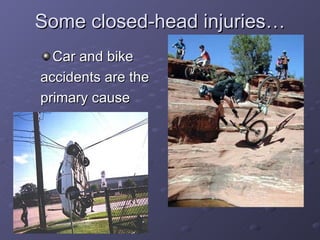
Some closed-head injuries… Car and bike  accidents are the  primary cause
Severe Head Trauma  Almost always results in a coma. (a state of prolonged unconsciousness lasting for days, weeks, or longer) Anoxia (loss of blood to the brain for a period of time. Many with severe brain injuries make significant recovery improvements in the first year after the injury and gradually decrease the pace of recovery. Most will have permanent physical, behavioral, and/or cognitive impairments. (p. 476)
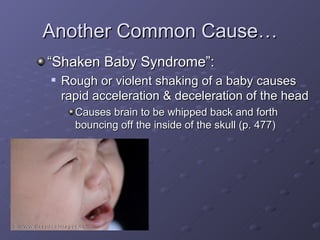
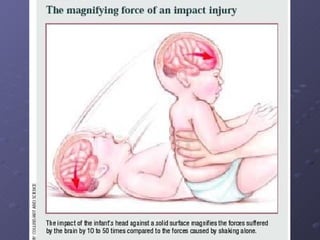
Another Common Cause… “Shaken Baby Syndrome”: Rough or violent shaking of a baby causes rapid acceleration & deceleration of the head Causes brain to be whipped back and forth bouncing off the inside of the skull (p. 477)
 
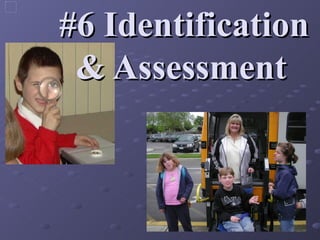
#6 Identification & Assessment
What is Identification &  Assessment based on? Definitions based on tests of  intellectual functioning, developmental progress , or  extent of educational need ... The term “severe disabilities” often includes many who score moderate IQ (40-50) Persons w/ IQ score of 35-40 and below = severe MR (based on American Association on Mental Retardation (AAMR) system) (pp. 469-470 of textbook)
With brain damage, Identification and assessment is determined by the severity of the injury and the part of the brain that sustained the damage.
IDEA states:  “…‘ children with severe disabilities’ refers to children with disabilities who, because of the intensity of their physical, mental, or emotional problems, need highly specialized education, social, psychological and medical services…autism, severe and profound mental retardation, and those who have two or more serious disabilities such as deaf-blindness, mental retardation and blindness, and cerebral palsy and deafness. They may also have…“severe speech, language, and/or perceptual-cognitive deprivations and evidence of abnormal behavior such as failure to respond to pronounced social stimuli, self-mutilation, self-stimulation, manifestation of intense and prolonged temper tantrums, and the absence of rudimentary forms of verbal control; and may also have extremely fragile psychological conditions.” (34 C.F.R., Sec. 315.4[d]) (pp. 470 of textbook)
The Association for Persons with Severe Handicaps (TASH) states:  “Support may be required for life activities such as mobility, communication, self-care, and learning, as necessary for independent living, employment and self-sufficiency.” (Lindley, 1990, pp. 1) in (pp. 471 of textbook)
We’ve got problems. Even with the best available methods of diagnosis and assessment, it is often difficult to identify the nature and intensity of a child’s multiple disabilities, or to determine how combinations of disabilities affect a child’s behavior. Some children don’t respond in any observable way to visual stimuli, such as bright lights or moving objects. (p. 474)
But wait, there’s more! Because severe disabilities tend to be more extreme and readily observable, children with severe disabilities are more frequently identified at or shortly after birth more often than with mild disabilities. (p. 476)
#7 Psychological & Behavioral Characteristics
Individuals with  Severe Disabilities… Need instruction in basic skills:  Getting from place to place independently Communicating w/ others  Controlling bladder & bowel functions Self feeding  (Most people learn these skills by age 5) Most do not exhibit behaviors such as self-mutilation and self-stimulation
Anything else? The one defining characteristic of students with severe disabilities is that they exhibit significant and obvious deficits in multiple life skill and development areas. No specific set of behaviors is common to all individuals with severe disabilities. (p. 475)
Behavior and Skill Deficits Frequently Observed in Students with Severe Disabilities:
Slow acquisition rates for learning skills Poor generalization and maintenance of newly learned skills Limited communication skills Impaired physical and motor development Deficits in self-help skills Infrequent constructive behavior and interaction Stereotypic and challenging behavior Many students with severe disabilities also exhibit warmth, persistence, determination, a sense of humor, sociability, and various other desirable traits. (p. 475)
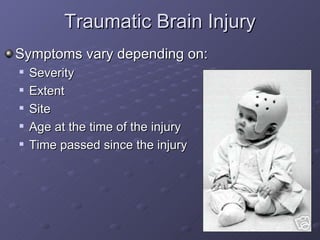
Traumatic Brain Injury  Symptoms vary depending on: Severity Extent Site Age at the time of the injury  Time passed since the injury
Impairments:  (Temporary or lasting) Physical and sensory changes (lack of coordination, spasticity of the muscles) Cognitive impairments (short/long-term memory deficits, difficulty maintaining attention and concentration Social, behavioral, and emotional problems, or emotional lability (mood swings), self-centeredness, lack of motivation
Students with head injuries are likely to require comprehensive programs in many areas  Academic Psychological Family Support
Recovery is inconsistent  May make progress, then regress to an earlier stage, and then make rapid gains. Sometimes progress plateaus, and no recovery is made for a long while This does not signal the end of progress (p. 479)
Possible Signs  & Effects of  Traumatic  Brain Injury
Physical & Sensory Changes  Chronic headaches, dizziness, light-headedness, nausea Vision impairments (double vision, visual field defects, blurring, light sensitivity) Hearing impairment (increased sound sensitivity) Alterations in sense of taste, touch, & smell
More Physical/Sensory Changes Sleep problems (insomnia, day and night confusion) Stress-related disorders (depression) Poor body temperature regulation Recurrent seizure activity Poor coordination & balance Reduced speed of motor performance & precision of movement (p. 480)
Cognitive Changes  & Academic Problems  Difficulty keeping up with discussions, instruction, note-taking Difficulty concentrating/attending to task at hand (distractible/confused) Difficulty making transitions (home to school, class to class, different instructions on the same worksheet) Inability to organize work and environment (keeping track of books, assignments, lunch box, etc.)
More Cognitive Changes & Academic problems Problems planning, organizing, pacing tasks and activities Extremely sensitive to distraction (can’t take a test with other students in the room) Tendency to perseverate; inflexible in thinking Impairments in receptive oral language  (difficulty with instructions, misunderstanding) Inability to perceive voice inflection or verbal cues Impairments in expressive oral or written language (aphasia, word-retrieval, articulation, slow speech, difficulty spelling or with punctuation)
Social, Emotional  & Behavioral Problems  Chronically agitated, irritable, restless or anxious Increased aggressiveness Impaired ability to self-manage; lowered impulse control; poor anger control Difficulty with change (rigidity), poor coping strategies Overestimating own ability (bragging?)
More social, emotional & behavioral problems Decreased insight into self and others, reduced judgment Decreased frustration tolerance, frequent temper outburst, and overreactions Compulsive or excessive talking Inability to take cues from environment (leads to socially inappropriate behavior)
8.  Educational Considerations
 
9.  Service Delivery
 
10.  Issues of Early Intervention
 
11. Issues of Transition to Adult Life
Video Clips Miracle League http://www.youtube.com/watch?v=OToryAOPtvM Louisiana State University http://www.youtube.com/watch?v=VuOyBFEAylU
12. Resources
13. References

Group Draft Multiple Disabilities Presentation

  • 1.
    Multiple Disabilities IanJacobs Colleen Morris Kevin Wilkes
  • 2.
  • 3.
    Severe Disabilities MultipleDisabilities Deaf- Blindness Physical Disabilities Traumatic Brain Injury
  • 4.
  • 5.
    Severe Disabilities Nowidely accepted definition Definitions are based on tests of Intellectual functioning Developmental progress Extent of educational needs Usually accompanied with a diagnoses of Mental Retardation Consists of students with disabilities in: Intellectual, social or physical functioning
  • 6.
    Multiple Disabilities IDEAdefines multiple disabilities as: “ concomitant impairments (such as mental retardation- blindness, mental-retardation- orthopedic impairments, etc) the combination of which causes such severe educational problems that they cannot be accommodated in special education programs solely for one of the impairment. The term does not include deaf-blindness.” (p. 473)
  • 7.
    Deaf-Blindness IDEA definesDeaf- Blindness as: “ a combination of both auditory and visual disabilities that causes such a severe communication and other developmental and learning needs that the persons can not be appropriately educated in special education programs solely for children and youth with hearing impairments, visual impairments, or severe disabilities, without supplementary assistance to address their educational needs due to these dual, concurrent disabilities.” (p. 473)
  • 8.
    Physical Disabilities #1. Orthopedic Impairment: IDEA defines SEVERE ORTHOPEDIC IMPAIRMENT: “ Included impairments caused by congenital anomaly (club foot) impairments caused by disease (bone tuberculosis) and impairments from other causes (cerebral palsy).” (p.424) #2 Other Health Impairments IDEA defines Other Health Impairments as: “ limited strength, vitality or alertness due to chronic or acute health problems such as a heart condition, tuberculosis, rheumatic fever, nephritis, asthma, sickle cell anemia, hemophilia, epilepsy, lead poisoning, leukemia, or diabetes that adversely affects a child’s educational performance.” (p.424)
  • 9.
    Traumatic Brain InjuryIDEA defines Traumatic Brain Injury as: “ an acquired injury to the brain caused by an external physical force, resulting in total or partial functioning disability or psychosocial impairments, or both, that adversely affects a child’s educational performance.” The term applied to open or closed injuries resulting in one or more areas, such as Cognition; language; memory; attention; reasoning; abstract thinking; judgment; problem solving; sensory; perceptual and motor abilities; psychosocial behavior; physical functions; information processing and speech. The term does not apply to brain injuries that are congenital or generative or brain injuries caused by birth trauma.” (p. 477)
  • 10.
  • 11.
    Severe Disabilities: Includesmany individuals in the moderate retardation level (40-55 IQ Score) This population benefits from basic skills training: Getting from one place to another, communication and self help skills
  • 12.
    Simulation Make aTask Analysis Take toothbrush and toothpaste from holder Open toothpaste tube Squeeze toothpaste onto toothbrush Close toothpaste cap Turn on water Place toothbrush under water Turn off water Brush bottom back right teeth for 5 strokes Brush bottom back left teeth for 5 strokes Change orientation of toothbrush Brush top back right teeth for 5 strokes Brush top back left teeth for 5 strokes Brush front bottom for 5 strokes Brush front top teeth for 5 strokes Brush tongue for 5 strokes Turn on water Rinse toothbrush Fill a cup Put water from cup into mouth Spit out water Turn off water Return toothbrush and toothpaste to holder
  • 13.
    Physical Disabilities OrthopedicImpairments include: orthopedic impairments: involves the skeletal system (bones, limbs, muscles, and joints) neuro-motor impairments: involves the central nervous system affecting movement, feeling, use and control of body parts.
  • 14.
  • 15.
    In 2001-2002 schoolyear there was an estimate of 0.1% to 1% of school aged population with Severe Disabilities. In 2003-2004 school year there was 131,225 school aged students receiving special education under Multiple Disabilities.
  • 16.
    In the 2003-2004school year there was 1,603 school aged students receiving special education under Deaf-Blind. In the 2003-2004 school year there was 67,772 school aged children receiving special education under Orthopedic Impairments. There was 449,093 children under Other Health Impairments Together there was 8.6% of school aged children receiving special education under physically disabilities.
  • 17.
    Traumatic Brain Injury(TBI) In the 2003- 2004 school year there was 22,459 school aged students who received special education under Traumatic Brain Injury EACH YEAR: 1 in 500 school aged children will be hospitalized because of a head injury 1 in 30 will sustain a significant head injury by age 15 1 in 10,000 children will die as a result of a head injury.
  • 18.
    #5 Causes
  • 19.
    Severe Intellectual DisabilitiesCaused by a wide variety of conditions, largely biological, may occur before (prenatal), during (perinatal), or after birth (postnatal). A brain disorder is involved in almost every case Brain disorders are a result of: Brain dysgenesis (abnormal brain development) Brain damage (caused by influences that alter the structure/function of a previously normally developing brain) (p. 476)
  • 20.
    Coulter (1994)Reviewed 10 epidemiological studies… Estimated that prenatal brain dysgenesis accounts for most cases of severe cognitive limitations Prenatal & postnatal brain damage accounts for minority of cases (p. 476)
  • 21.
    Chromosomal Abnormalities A significant percentage of children with sever disabilities are born with chromosomal abnormalities . Down’s Syndrome Genetic/metabolic disorders Such disorders can cause serious problems in physical & intellectual development. (p. 476)
  • 22.
    Other Contributors toSevere Intellectual Disabilities
  • 23.
    Complications of pregnancy Prematurity Rh incompatibility (can cause Rh disease) Infectious diseases contracted by the mother
  • 24.
    Causes for greaterrisk of severe disabilities Mother uses excessive drugs or alcohol Mother is poorly nourished Disabilities may develop later in life from head trauma in a car or bike accident, falls, assaults, or abuse.
  • 25.
  • 26.
    Other Causes Malnutrition Neglect Ingestion of poisonous substances Certain diseases effecting the brain such as: Meningitis Encephalitis In about 1/6 of all cases, there is no clearly determined cause. (p. 476)                                                  
  • 27.
    Causes of Traumatic Brain Injuries
  • 28.
    Open Head Injury Result of a penetration of the skull Causes specific deficits or problems with particular behavioral and sensory functions controlled by the part of the brain where the injury occurred.
  • 29.
    Closed Head Injury (most common) Occurs when the head hits a stationary object with such force that the brain slams against the inside of the cranium. The stress of this rapid movement and impact pulls part and tears nerve fibers or axons, breaking connections between different parts of the brain.
  • 30.
    Sort of like this…
  • 31.
    Some closed-head injuries…Car and bike accidents are the primary cause
  • 32.
    Severe Head Trauma Almost always results in a coma. (a state of prolonged unconsciousness lasting for days, weeks, or longer) Anoxia (loss of blood to the brain for a period of time. Many with severe brain injuries make significant recovery improvements in the first year after the injury and gradually decrease the pace of recovery. Most will have permanent physical, behavioral, and/or cognitive impairments. (p. 476)
  • 33.
    Another Common Cause…“Shaken Baby Syndrome”: Rough or violent shaking of a baby causes rapid acceleration & deceleration of the head Causes brain to be whipped back and forth bouncing off the inside of the skull (p. 477)
  • 34.
  • 35.
  • 36.
    What is Identification& Assessment based on? Definitions based on tests of intellectual functioning, developmental progress , or extent of educational need ... The term “severe disabilities” often includes many who score moderate IQ (40-50) Persons w/ IQ score of 35-40 and below = severe MR (based on American Association on Mental Retardation (AAMR) system) (pp. 469-470 of textbook)
  • 37.
    With brain damage,Identification and assessment is determined by the severity of the injury and the part of the brain that sustained the damage.
  • 38.
    IDEA states: “…‘ children with severe disabilities’ refers to children with disabilities who, because of the intensity of their physical, mental, or emotional problems, need highly specialized education, social, psychological and medical services…autism, severe and profound mental retardation, and those who have two or more serious disabilities such as deaf-blindness, mental retardation and blindness, and cerebral palsy and deafness. They may also have…“severe speech, language, and/or perceptual-cognitive deprivations and evidence of abnormal behavior such as failure to respond to pronounced social stimuli, self-mutilation, self-stimulation, manifestation of intense and prolonged temper tantrums, and the absence of rudimentary forms of verbal control; and may also have extremely fragile psychological conditions.” (34 C.F.R., Sec. 315.4[d]) (pp. 470 of textbook)
  • 39.
    The Association forPersons with Severe Handicaps (TASH) states: “Support may be required for life activities such as mobility, communication, self-care, and learning, as necessary for independent living, employment and self-sufficiency.” (Lindley, 1990, pp. 1) in (pp. 471 of textbook)
  • 40.
    We’ve got problems.Even with the best available methods of diagnosis and assessment, it is often difficult to identify the nature and intensity of a child’s multiple disabilities, or to determine how combinations of disabilities affect a child’s behavior. Some children don’t respond in any observable way to visual stimuli, such as bright lights or moving objects. (p. 474)
  • 41.
    But wait, there’smore! Because severe disabilities tend to be more extreme and readily observable, children with severe disabilities are more frequently identified at or shortly after birth more often than with mild disabilities. (p. 476)
  • 42.
    #7 Psychological &Behavioral Characteristics
  • 43.
    Individuals with Severe Disabilities… Need instruction in basic skills: Getting from place to place independently Communicating w/ others Controlling bladder & bowel functions Self feeding (Most people learn these skills by age 5) Most do not exhibit behaviors such as self-mutilation and self-stimulation
  • 44.
    Anything else? Theone defining characteristic of students with severe disabilities is that they exhibit significant and obvious deficits in multiple life skill and development areas. No specific set of behaviors is common to all individuals with severe disabilities. (p. 475)
  • 45.
    Behavior and SkillDeficits Frequently Observed in Students with Severe Disabilities:
  • 46.
    Slow acquisition ratesfor learning skills Poor generalization and maintenance of newly learned skills Limited communication skills Impaired physical and motor development Deficits in self-help skills Infrequent constructive behavior and interaction Stereotypic and challenging behavior Many students with severe disabilities also exhibit warmth, persistence, determination, a sense of humor, sociability, and various other desirable traits. (p. 475)
  • 47.
    Traumatic Brain Injury Symptoms vary depending on: Severity Extent Site Age at the time of the injury Time passed since the injury
  • 48.
    Impairments: (Temporaryor lasting) Physical and sensory changes (lack of coordination, spasticity of the muscles) Cognitive impairments (short/long-term memory deficits, difficulty maintaining attention and concentration Social, behavioral, and emotional problems, or emotional lability (mood swings), self-centeredness, lack of motivation
  • 49.
    Students with headinjuries are likely to require comprehensive programs in many areas Academic Psychological Family Support
  • 50.
    Recovery is inconsistent May make progress, then regress to an earlier stage, and then make rapid gains. Sometimes progress plateaus, and no recovery is made for a long while This does not signal the end of progress (p. 479)
  • 51.
    Possible Signs & Effects of Traumatic Brain Injury
  • 52.
    Physical & SensoryChanges Chronic headaches, dizziness, light-headedness, nausea Vision impairments (double vision, visual field defects, blurring, light sensitivity) Hearing impairment (increased sound sensitivity) Alterations in sense of taste, touch, & smell
  • 53.
    More Physical/Sensory ChangesSleep problems (insomnia, day and night confusion) Stress-related disorders (depression) Poor body temperature regulation Recurrent seizure activity Poor coordination & balance Reduced speed of motor performance & precision of movement (p. 480)
  • 54.
    Cognitive Changes & Academic Problems Difficulty keeping up with discussions, instruction, note-taking Difficulty concentrating/attending to task at hand (distractible/confused) Difficulty making transitions (home to school, class to class, different instructions on the same worksheet) Inability to organize work and environment (keeping track of books, assignments, lunch box, etc.)
  • 55.
    More Cognitive Changes& Academic problems Problems planning, organizing, pacing tasks and activities Extremely sensitive to distraction (can’t take a test with other students in the room) Tendency to perseverate; inflexible in thinking Impairments in receptive oral language (difficulty with instructions, misunderstanding) Inability to perceive voice inflection or verbal cues Impairments in expressive oral or written language (aphasia, word-retrieval, articulation, slow speech, difficulty spelling or with punctuation)
  • 56.
    Social, Emotional & Behavioral Problems Chronically agitated, irritable, restless or anxious Increased aggressiveness Impaired ability to self-manage; lowered impulse control; poor anger control Difficulty with change (rigidity), poor coping strategies Overestimating own ability (bragging?)
  • 57.
    More social, emotional& behavioral problems Decreased insight into self and others, reduced judgment Decreased frustration tolerance, frequent temper outburst, and overreactions Compulsive or excessive talking Inability to take cues from environment (leads to socially inappropriate behavior)
  • 58.
    8. EducationalConsiderations
  • 59.
  • 60.
    9. ServiceDelivery
  • 61.
  • 62.
    10. Issuesof Early Intervention
  • 63.
  • 64.
    11. Issues ofTransition to Adult Life
  • 65.
    Video Clips MiracleLeague http://www.youtube.com/watch?v=OToryAOPtvM Louisiana State University http://www.youtube.com/watch?v=VuOyBFEAylU
  • 66.
  • 67.