Wolaita Sodo University
Course Title : Inclusiveness
Credit hours: 2
Course code: SNIE 1012
Chapter 1: Understanding Disabilities
and Vulnerabilities
Chapter Contents
1.1. Definitions of disability and vulnerability
1.2. Types of disabilities and vulnerabilities
1.3. Causes of disability and vulnerability
1.4 . Historical movements from segregation to inclusion
1.5. The effects of attitude on the move towards inclusion
1.6 . Models of disability
1.1. Definitions of Basic Terms (Impairment, Disability
and Handicap)
Impairment
• means a lack/abnormality of an anatomic, physiological or
psychological structure or function or deviation on a person.
• refers to any loss or abnormality of physiological, psychological or
anatomical structure or function.
• is the absence of particular body part or organ.
• also a condition in which the body exists but doesn‘t function.
Disability
• The term disability is ambiguous as there is no single agreement on the concept
(Mitra, 2006)
• It is not synonymous with AKAL-GUDATENGA
• (የአካል ጉዳተኛ) meaning impairment
• The concept of disability is complex, dynamic, multidimensional, and contested
(WHO and World Bank, 2011).
• The full inclusion of people with impairments in society can be inhibited by:
1. Attitudinal (societal barriers, such as stigma)
2. Physical barriers (environmental barriers, such as absence of stairs), and
3. Policy barriers (systemic barriers)
• Where all together can create a disabling effect and inhibit disability inclusive
development
• If these problems addressed, impairment may not lead to disability
• What is disability?
 Medical Approach
 Social Approach
Medical Approach
• Disability is pathology (physiological, biological and intellectual).
• Disability means functional limitations due to physical, intellectual
or psychic impairment, health or psychic disorders on a person
(WHO,1996).
• The medical definition views the disabled person as needing to ―”fit in ”
rather than thinking about how society itself should change.
The social definition of disability:
• Disability is a highly varied and complex condition with a
range of implications for social identity and behaviour.
• Disability largely depends on the context and is a
consequence of discrimination, prejudice and exclusion.
• Emphasizes the shortcomings in the environment and in
many organized activities in society, for example on
information, communication and education, which prevent
persons with disabilities from participating on equal terms.
Causes of disability
1. Genetic Causes
• Abnormalities in genes and genetic inheritance can
cause intellectual disability in children.
• In some countries, Down syndrome is the most
common genetic condition.
• Sometimes, diseases, illnesses, and over-exposure
to x-rays can cause a genetic disorder.
2. Environmental
• Poverty and malnutrition in pregnant mothers can cause a deficiency in vital
minerals and result in deformation issues in the unborn child.
• After birth, poverty and malnutrition can also cause poor development of vital
organs in the child, which can eventually lead to disability.
• The use of drugs, alcohol, tobacco, the exposure to certain toxic chemicals and
illnesses, toxoplasmosis, cytomegalovirus, rubella and syphilis by a pregnant mother
can cause intellectual disability to the child.
• Childhood diseases such as a whooping cough, measles, and chicken pox may lead
to meningitis and encephalitis.
• This can cause damage to the brain of the child.
• Toxic material such as lead and mercury can damage the brain too.
• Unfortunate life events such as drowning, automobile accidents, falls and so on can result
in people losing their sight, hearing, limbs and other vital parts of their body and cause
disability
3. Unknown Causes
• The human body is a phenomenal thing.
• Scientists have still not figured out what and how some things in
the body, cells, brain, and genes come about.
• Humans have still not found all the answers to all the defects in the
human body
4. Inaccessible environments
• Sometimes society makes it difficult for people with some impairment to
function freely.
• When society develops infrastructure such as houses, roads, parks and other
public places without consideration to people with impairment, the basically
make it impossible for them to take care of themselves
•
Some type of disabilities:
• Some nine major disabilities are:
A. Visual impairment:- Visual impairment in general designates two sub-
classifications. These are
 blindness and
 low vision
 Blindness :-total or partial inability to see because of disease or disorder of
the eye, optic nerve, or brain
 The term blindness typically refers to vision loss that is not
correctable with eyeglasses or contact lenses.
 Blindness may not mean a total absence of sight, however. Some people who
are considered blind may be able to perceive slowly moving lights or colours.
• The term low vision is used for moderately
impaired vision.
• People with low vision may have a visual
impairment that affects only
central vision— the area directly in front of the
eyes—or
 peripheral vision— the area to either side of
and slightly behind the eyes.
B. Hearing Impairment
• Different people define the term hearing impairment
differently.
• Differ to different countries and people
• Pasonella and Carat from legal point of view, define
hearing impairment as a generic term indicating a
continuum of hearing loss from mild to profound,
which includes the sub classifications of
the hard of hearing and
deaf.
• Hard of Hearing: "A hearing impairment, whether
permanent of fluctuating, which adversely affects a child's
educational performance but which is not included under the
definition of 'deaf'." Whelan, R. J. (1988).
• Deaf: Those who have difficulty understanding speech, even
with hearing aids but can successfully communicate in sign
language.
• Cultural definitions of deafness, on the other hand,
emphasize an individual‘s various abilities, use of sign
language, and connections with the culturally deaf community.
C. Specific learning disability
• means a disorder in one or more of the basic
psychological processes involved in understanding or in
using language, spoken or written, that may manifest
itself in the imperfect ability to
listen,
think,
speak,
read,
 write,
spell, or
 to do mathematical calculations
Specific learning disability
• The term includes such conditions as
 perceptual disabilities,
 brain injury,
 minimal brain dysfunction,
 Dyslexia (difficulty in reading and spelling), and
 developmental aphasia (loss of the ability to understand or produce speech b/c
of brain damage).
• The term does not include learning problems that are primarily the
result of
 visual, hearing, or motor disabilities;
 intellectual disability;
 emotional disturbance; or
 environmental, cultural, or economic disadvantage.
• Learning disabilities should not be confused with
learning problems which are primarily the result of
visual, hearing, or motor handicaps; of intellectual
disability; of emotional disturbance; or of
environmental, cultural or economic disadvantages.
• Generally speaking, people with learning disabilities
are of average or above average intelligence.
• There often appears to be a gap between the
individual‘s potential and actual achievement.
• This is why learning disabilities are referred to as hidden
disabilities:
the person looks perfectly
normal and seems to be a very bright and intelligent
person,
 yet may be unable to demonstrate the skill level expected
from someone of a similar age.
• A learning disability cannot be cured or fixed; it is a lifelong
challenge.
• However, with appropriate support and intervention, people with
learning disabilities can achieve success in school, at work, in
relationships, and in the community.
Types of Specific Learning Disabilities
1. Auditory Processing Disorder (APD)
• Also known as Central Auditory Processing Disorder
• Adversely affects how sound that travels unimpeded through the ear is
processed or interpreted by the brain
• Individuals with APD do not recognize subtle differences between sounds in
words, even when the sounds are loud and clear enough to be heard.
• They can also find it difficult
 to tell where sounds are coming from,
to make sense of the order of sounds, or
to block out competing background noises.
2. Dyscalculia
• is a specific learning disability that affects a
person‘s ability to understand numbers and
learn math.
• Individuals with this type of LD may also
have poor comprehension of math symbols,
may struggle with memorizing and organizing numbers,
 have difficulty telling time, or
 have trouble with counting.
3. Dysgraphia
• Dysgraphia is a specific learning disability that
affects a person‘s handwriting ability and fine
motor skills.
• Problems may include:
 illegible handwriting,
inconsistent spacing,
poor spatial planning on paper,
poor spelling, and
 difficulty composing writing as well as thinking and writing
at the same time.
4. Dyslexia
• Dyslexia is a specific learning disability that affects
reading and related language-based processing skills.
• The severity can differ in each individual but can affect
reading fluency;
decoding,
reading comprehension,
recall, writing, spelling, and sometimes speech and can exist along with
other related disorders.
• Dyslexia is sometimes referred to as a Language Based
Learning Disability.
5. Language Processing Disorder
• Language Processing Disorder is a specific type of Auditory
Processing Disorder (APD) in which there is difficulty
attaching meaning to sound groups that form words,
sentences and
stories.
• While an APD affects the interpretation of all sounds coming
into the brain, a Language Processing Disorder (LPD) relates
only to the processing of language.
• LPD can affect expressive language and/or receptive
language.
6. Non-Verbal Learning Disabilities
• Non-Verbal Learning Disabilities is a disorder which
is usually characterized by
a significant discrepancy between higher verbal skills and
weaker motor, visual-spatial and social skills.
• Typically, an individual with NLD (or NVLD) has
 trouble interpreting nonverbal cues like facial expressions
or body language, and
may have poor coordination.
7. Visual Perceptual/Visual Motor Deficit
• Visual Perceptual/Visual Motor Deficit is a disorder that
affects the understanding of information that a person sees,
or the ability to draw or copy.
• A characteristic seen in people with learning disabilities
such as
Dysgraphia or Non-verbal LD,
 it can result in missing subtle differences in shapes or printed letters,
losing place frequently,
struggles with cutting,
holding pencil too tightly,
or poor eye/hand coordination.
D. Speech and Language Impairments
• Speech and language impairment means a communication
disorder such as
stutter,
impaired articulation,
 language impairment, or
 a voice impairment that adversely affects a child‘s educational
performance.
• It is disorder that adversely affects the child's ability to
talk, understand, read, and write.
• This disability category can be divided into two groups:
1. speech impairments and
1. Speech Impairments
• There are three basic types of speech impairments:
I. articulation disorders,
II. fluency disorders, and
III. voice disorders.
I. Articulation disorders are errors in the production of speech sounds
that
may be related to anatomical or physiological limitations in the
skeletal, muscular, or neuromuscular support for speech production.
• These disorders include:
Omissions: (bo for boat)
 Substitutions: (wabbit for rabbit)
 Distortions: (shlip for sip)
II. Fluency disorders are difficulties with the rhythm
and timing of speech characterized by
 hesitation,
repetitions, or
 prolongations of sounds, syllables, words, or phrases.
• Common fluency disorders include:
Stuttering: rapid-fire repetitions of consonant or vowel sounds
especially at the beginning of words, prolongations, hesitations,
interjections, and complete verbal blocks
Cluttering: excessively fast and jerky speech
III. Voice disorders are problems with the quality or
use of one's voice resulting from disorders
in the larynx.
• Voice disorders are characterized by
 abnormal production and/or
absences of vocal quality, pitch, loudness, resonance, and/or
duration.
2. Language Impairments
• There are five basic areas of language
impairments:
1. phonological disorders,
2. morphological disorders,
3. semantic disorders,
4. syntactical deficits, and
5. pragmatic difficulties.
• Phonological disorders are defined as the abnormal
organization of the phonological system, or a significant
deficit in speech production or perception.
• Apraxia of speech is a specific phonological disorder where
the student may want to speak but has difficulty planning
what to say and the motor movements to use.
• Morphological disorders are defined as difficulties with
morphological inflections (inflections on nouns, verbs, and
adjectives that signal different kinds of meanings).
• Semantic disorders are characterized by poor vocabulary
development, inappropriate use of word meanings,
and/or inability to comprehend word meanings.
• Syntactic deficits are characterized by difficulty in acquiring
the rules that govern word order and others aspects of
grammar such as subject-verb agreement.
• Typically, these students produce shorter and less
elaborate sentences with fewer cohesive conjunctions than
their peers.
• Pragmatic difficulties are characterized as problems in
understanding and using language in different social
contexts.
• These students may lack an understanding of the rules for
making eye contact, respecting personal space, requesting
information, and introducing topics.
E. Autism
• Autism means a developmental disability
significantly affecting
verbal and nonverbal communication and
social interaction,
generally evident before age three that adversely affects a
child‘s educational performance.
• Other characteristics often associated with autism
are
engaging in repetitive activities and stereotyped movements,
 resistance to environmental change or change in daily
routines, and
unusual responses to sensory experiences.
• Autism is pervasive developmental disorder
characterized by
lack of normal sociability,
 impaired communication and
 repetitive obsessive behaviour such as politeness, turn-taking
(speak one at a time in alternating turns) (Young & Nettlebeck
, 2005).
• Linked to Profound Learning Disability (PLDs) are
further impairments in the production of speech.
• Among these are
i. personal pronouns reversal for instance the use of ―(I)
instead of ―(you) and vice-versa,
ii. the misuse of such prepositions as ―(in), ―(on), ―(under),
―(next to) (...), and
iii. the prevalence, in speech, of echolalia (formal repetition of
other‘s utterances )(Arron and Gittens, 1999)
F. Emotional and Behavioural Disorders
• According to Individuals with Disabilities Education Act (IDEA), the
term Emotional and Behavioural Disorders means a condition
exhibiting one or more of the following characteristics over a long
period of time and to a marked degree that adversely affects
educational performance
1. An inability to learn that cannot be explained by intellectual, sensory, or
health factors;
2. An inability to build or maintain satisfactory interpersonal relationships
with peers and teachers;
3. Inappropriate types of behaviour or feelings under normal circumstances;
4. A general pervasive mood of unhappiness or depression;
5. A tendency to develop physical symptoms or fears associated with personal or
school problems.
Classification of behavioural and emotional disorders
• Conduct disorder: individuals may seek attention, are disruptive and
act out. The disorder is classified by type: overt (with violence or
tantrums) versus covert (with lying, stealing, and/or drug use).
• Socialized aggression: individuals join subculture group of peers
who are openly disrespectful to their peers, teachers, and parents.
Common are delinquency and dropping out of school.
• Attention problems- These individuals may have attention deficit,
are easily destructible and have poor concentration. They are
frequently impulsive and may not think the consequence of their
actions.
• Anxiety/Withdrawn- These individuals are self-conscious,
reserved, and unsure of themselves. They typically have low
self-esteem and withdraw from immediate activities.
• They are also anxious and frequently depressed.
• Psychotic behaviour: These individuals show more bizarre
(strange, odd) behaviour.
• They may hallucinate, deal in a fantasy world and may even talk
in gibberish (non sense)
• Motor excess: These students are hyperactive. They cannot sit
nor listen to others nor keep their attention focused.
• Kauffman (1993) conclude that emotion or behavioural
disorders fall into two broad classifications:
1. Externalizing Behaviour: also called under controlled
disorder, include such problems disobedience, disruptiveness,
fighting, tempers tantrums, irresponsibility, jealous, anger,
attention seeking etc…
2. Internalizing Behaviour: also known as over controlled
disorders, include such problems anxiety, immaturity, shyness,
social withdrawal, feeling of inadequacy (inferiority), guilt,
depression and worries a great deal
Causes of behavioural and emotional disorders
Behavioural and emotion disorders result from many causes, these includes the
following.
• Biological- includes genetic disorders, brain damage, and malnutrition,
allergies, temperament and damage to the central nervous system.
• Family factors- include family interactions, family influence, child abuse,
neglect, and poor disciplinary practices at home.
• Cultural factors- include some traditional and cultural negative practices,
for example watching violence and sexually oriented movies and TV
programs
• Environmental factors- include peer pressure, living in impoverished
areas, and schooling practices that are unresponsive to individual needs.
G. Intellectual Disability
• Intellectual disability is a disability characterized
by significant limitations in both
intellectual functioning and
in adaptive behaviour, which covers many everyday
social and practical skills.
• This disability originates before the age of 18.
• An individual is considered to have an intellectual
disability based on the following three criteria:
1. Sub average intellectual functioning: It refers to
general mental capacity, such as learning,
reasoning, problem solving, and so on.
• One way to measure intellectual functioning is an
IQ test.
• Generally, an IQ test score of around 70 or as high
as 75 indicates a limitation in intellectual
functioning
2. Significant limitations exist in two or more adaptive skill areas:
• It is the collection of conceptual, social, and practical skills that are
learned and performed by people in their everyday lives.
• Conceptual skills- language and literacy; money, time, and number
concepts; and self-direction.
• Social skills- interpersonal skills, social responsibility, self-esteem,
gullibility, innocence (i.e., suspicion), social problem solving, and the
ability to follow rules/obey laws and to avoid being victimized.
• Practical skills- activities of daily living (personal care), occupational
skills, healthcare, travel/transportation, schedules/routines, safety, use of
money, use of the telephone.
• People with intellectual disabilities academic learning can be
affected, as well as their ability to adapt to home, school, and
community environments are presented under the following
sub-headings:
 General Cognition: People with intellectual disabilities vary
physically and emotionally, as well as by personality,
disposition, and beliefs.
 Learning and Memory: The learning and memory capabilities
of people with intellectual disabilities are significantly below
average in comparison to peers without disabilities.
• Attention: Children with intellectual disabilities may have
difficulty distinguishing and attending to relevant questions in
both learning and social situations
• Adaptive Skills: The adaptive skills of people with
intellectual disabilities are often not comparable to those of
their peers without disabilities.
• Speech and Language: People with intellectual disabilities
may have delayed speech, language comprehension and
formulation difficulties.
• Language problems are generally associated with delays in
language development rather than with a bizarre use of
• Motivation: People with intellectual disabilities are often
described as lacking motivation, or outer-directed behaviour.
• Academic Achievement: The cognitive difficulties of
children with mild to moderate intellectual disabilities lead to
persistent problems in academic achievement
• Physical characteristics: Children with intellectual
disabilities with differing biological etiologies, may exhibit
coexisting problems, such as physical, motor, orthopedic,
visual and auditory impairments, and health problems
Levels of support for individuals with intellectu
disabilities
• Levels of support range from intermittent (ju
occasional or “as needed” for specific activitie
to pervasive (continuous in all realms of living).
See on your module
H. Physical disability/Orthopedic Impairment and Health
impairment
• Physical disability is a condition that interferes with the
individual‘s ability to use his or her body.
• Many but not all, physical disabilities are orthopedic
impairments.
• The term orthopedic impairment generally refers to conditions of
muscular or skeletal system and sometimes to physical disabling
conditions of the nervous system.
• Health impairment is a condition that requires ongoing medical
attention. It includes asthma, heart defects, cancer, diabetes,
hemophilia. HIV/AIDS, etc.
Classification and Characteristics
• Physical disabilities:- based on the impact of physical disability on
mobility and motor skills, it is divided into three. These are:-
A. Mild physical disability:- these individuals are able to walk without
aids and may make normal developmental progress.
B. Moderate physical disability:- individuals can walk with braces and
crutches and may have difficulty with fine-motor skills and speech
production.
C. Severe physical disability:-these are individuals who are wheel-chair
dependent and may need special help to achieve regular development.
• The physical disability could be broadly classified
in to two :
I. The neurological system (the brain ,spinal cord & nerve)
related problems.
II. Musculo skeletal system ( the muscles, bones and joints)
are deficient due to various causes.
I. Neurological system:-with a neurological condition like cerebral palsy or
a traumatic brain injury, the brain either sends the wrong instructions or
interprets feedback incorrectly.
• These individuals may have motor skill deficits that can range from mild
in coordination to paralysis of the entire body.
• Additional problems that can be associated with cerebral palsy include
learning disabilities, mental retardation. Seizures, speech
impairments, eating problems, sensory impairments, and joint and
bone deformities such as spinal curvatures and contractures
(permanently fixed, tight muscles and joints).
• Approximately 40 percent of those with cerebral palsy have normal
intelligence; the remainders have from mild to severe retardation.
• Epilepsy:-is disorder that occurs when the brain cells are not working
properly and is often called a seizure disorder.
• Some children and youth will epilepsy have only a momentary loss of
attention (petit mal seizures); others fall to the floor and then move
uncontrollably
• Fortunately, once epilepsy is diagnosed, it can usually be controlled with
medication and does not interfere with performance in school.
• Most individuals with epilepsy have normal intelligence.
• Epilepsy is a condition that affects 1 to 2 percent of the population.
• It is characterized by recurring seizures, which are spontaneous
abnormal discharge of electrical impulses of the brain.
• Spinal bifida and spinal cord injury:- damage to
the spinal cord leads to paralysis and loss of
sensation in the affected areas of the body.
• The spinal bifida is a birth defect of the
backbone (spinal column).
• The cause is unknown but it usually occurs in the
first twenty-six days of pregnancy.
II. Musculoskeletal system: - it includes
 the muscles and their supporting framework and the skeleton.
 Progressive muscle weakness (muscular dystrophy);
 Inflammation of the joints (arthritis), or
 Loss of various parts of the body (amputation)
The list of the impairment and associated with musculoskeletal malformation are the
following:
A. Muscular dystrophy:- is an inherited condition occurring mainly in males, in which
the muscles weaken and deteriorate.
• The weakness usually appears around 3 to 4years of age and worsens progressively.
• By age 11 most victims can to longer walk.
• Death usually comes between the ages of 25 and 35 from respiratory failure or
cardiac arrest
B. Arthritis:-is an inflammation (irritation) of the joints.
• Symptoms include swollen and stiff joints, fever, and pain in
the joints during acute periods.
• Prolonged inflammation can lead joint deformities that can
eventually affect mobility.
C. Amputation:- a small number of children have missing limbs
because of congenital abnormalities or injury or disease
(malignant bone tumours in the limbs).
• These children can use customized prosthetic devices (artificial
hands, arms, or legs) to replace limp functions and increase
independence in daily activities.
D. Marfan syndrome is a genetic disorder in which the muscles are poorly
developed and the spine is curved.
• Individuals with marfan syndrome may have either long, thin limbs,
prominent shoulder blades, spinal curvature, flat feet, or long fingers &
thumbs.
E. Achondroplasis:- is a genetic disorder that affects 1 in 10,000 births.
• Children with this disorder usually develop a normal torso but have a straight
upper back and a curved lower back (sway back).
• These children are at risk of sudden death during sleep from compression of
the spinal cord interfering with their breathing.
• The disability may be lessened through the use of the back braces or by
surgery.
• Polio:- is viral disease that invade the brain and cause severe
paralysis of the total body system.
• In its mild form results in partial paralysis.
• Club foot:- is a major orthopedic problem affecting about 9,000
infants each year. This term is used to describe various ankle or
foot deformities, i.e
Twisting inward (equino varus), the most severe form
Sharply angled at the heel (calcanel vaigus), most common
 The front part of the foot turned inward.
 These conditions can be treated with physical therapy, and a cast
on the foot can solve the problem in most instances.
 In more severe cases, surgery is necessary.
• Cleft lip and cleft palate:- are openings in the lip or roof of the mouth,
respectively, that fail to close before birth, the cause is unknown. Most cleft
problems can be repaired through surgery.
Health Impairments
• Any disease that interferes with learning can make students eligible for special
services.
• These disease caused problems are as follow.
1. Heart disease:- this is common among young people.
• It is caused by improper circulation of blood by the heart some of the disorders
are congenital )present at birth);others are the product of inflammatory heart
disease.
• Some students have heart value disorders; others have disorders of the blood
vessels. This time heart implantation helps children to get cured.
2. Cystic fibrosis:- is a hereditary disease that affects
the lungs and pancreas.
• It leads to recurrent respiratory and digestive
problems including abnormal amounts of
 thick mucus,
sweet and
saliva.
• The disease is so progressive and few who have it
survive beyond age 20.
• Children with such disease often spend significant
3. Acquired immune deficiency syndrome (AIDS):- is a very
severe disease caused by human immunodeficiency virus
(HIV) infection and transmitted primarily through
exchange of bodily fluids in transfusions or unprotected
sex, and by contaminated needles in addictive drug use.
4. Hemophilia:- is a hereditary disease in which the blood
clot very slowly or not all.
• The disorder is transmitted by sex-linked recessive gene and
nearly always occurs in males.
5. Asthma: is a chronic respiratory condition characterized by
repeared eplosde of breathing difficulties especially while
exhaling.
6. Diabetes: Developmental or hereditary disorder characterized by
inadequate secretion or use of insulin
7. Nephrosis & Nephritis Kidney disorders or diseases caused by
infections, poisoning, burns, accidents or other diseases
8. Sickle-cell anaemia: Hereditary and chronic blood disease
(occurring primarily in African Americans) characterized by red
blood cells that are distorted and that do not circulate properly
9. Leukaemia: Disease characterized by excessive production of
white blood Cells
10. Lead poisoning Disorder: caused by ingesting lead-based
paint chips or other substances containing lead
11. Rheumatic fever Disease: characterized by painful swelling
and inflammation of the joints that can spread to the hear and
central nervous system.
12. Tuberculosis: Infectious disease that commonly affects the
lungs and may affect other tissues of the body.
13. Cancer: Abnormal growth of cells that can affect any organ
system
I. Vulnerability
• Vulnerable means being at risk of being harmed.
• Everyone can be harmed, so being vulnerable is part of being human.
• In principle, everyone is vulnerable to some adverse event or circumstance,
but some people are more vulnerable than others.
• Based on the existing literature, vulnerability can be generally defined as a
complex phenomenon that refers to the following dimensions:
1. Economic difficulties/lack of financial resources: poverty, low living
standards, housing problems (e.g. too damp, too expensive, too cold or
difficult to heat) etc.;
2. Social exclusion: limited access to facilities such as transporatation,
schools, libraries or medical services;
3. Lack of social support from social networks: no assistance from
family members, friends, neighbours or colleagues (referring to
practical help as well as emotional support) like highly gifted
individuals;
4. Stigmatization: being a victim of stereotype, being devalued,
confronted with disgraceful behaviour because of belonging to a
particular social or ethnic group;
5. Health difficulties: disadvantages resulting from poor mental
health, physical health or disabilities;
6. Being a victim of crime: in family context especially of violence.
Causes of Vulnerability
• Vulnerability may be caused by
rapid population growth,
 poverty and hunger,
 poor health,
low levels of education,
gender inequality,
fragile and hazardous location,
lack of access to resources and services, including knowledge
and technological means,
disintegration of social patterns (social vulnerability).
• Other causes includes; lack of access to
information and knowledge, lack of public
awareness, limited access to political power and
representation (political vulnerability),
(Aysan,1993).
• When people are socially disadvantaged or lack political voice,
their vulnerability is exacerbated (aggravated) further.
• The economic vulnerability is related to a number of interacting
elements, including its importance in the overall national economy,
trade and foreign-exchange earnings, aid and investments,
international prices of commodities and inputs, and production and
consumption patterns.
• Environmental vulnerability concerns land degradation,
earthquake, flood, hurricane, drought, storms (Monsoon rain, El
Niño), water scarcity, deforestation, and the other threats to
biodiversity.
Characteristics of Vulnerable People
• The following are thought to be characteristics of vulnerable
people (with examples of groups of potentially vulnerable
people):
1. Less physically or mentally capable (infants, older adults,
people with disabilities)
2. Fewer material and/or financial resources (low-income
households, homeless)
3. Less knowledge or experience (children, illiterate, foreigners,
tourists)
4. Restricted by society to grow and develop according to their
needs and potentials
• People who are helped by others (who are then restricted by
commitments) are still vulnerable people, which includes
the following extracted from various researches.
 women
Children
Minorities (ethnic ,cultural and linguistic minority, religious minority )
Poverty (poor)
Disabilities
Age (old and very young children)
Illiteracy and less education
Sickness
Gifted and Talentedness (vulnerable for socio-emotional developments )
Chapter 2: Concept of Inclusion
• The specific contents addressed in the chapter include:
 definition of inclusion,
 concept of inclusion,
inclusion shift from special education and integrated education,
 rationale for inclusion,
 factors that influenced development of inclusion,
benefits of inclusion to students, teachers‘ parents and society,
 inclusive school and classroom environment,
 strategies to implement inclusion in teaching and learning processes and
barriers to inclusion.
Definition of Inclusion
• Inclusion in education/service refers to an
ongoing process aimed at offering quality
education/services for all while
respecting diversity and the different needs and abilities,
 respecting characteristics and learning expectations of the
students and communities and
eliminating all forms of discrimination (UNESCO, 2008,
P.3, as cited in EADSNE, 2010, p.11).
• Inclusion is seen as a process of addressing and responding to
the diversity of needs of all persons through increasing
participation in learning, employment, services, cultures and
communities, and reducing exclusion at all social contexts.
• It involves changes and modifications in content, approaches,
structures and strategies, with a common vision which covers all
people
• inclusion is defined as having a wide range of strategies,
activities and processes that seek to make a reality of the
universal right to quality, relevant and appropriate education and
services.
• The definition has the following components:
1) Concepts about learners
Education is a fundamental human right for all people
Learning begins at birth and continues throughout life
All children have a right to education within their own
community
 Everyone can learn, and any child can experience difficulties
in learning
 All learners need their learning supported child-focused
teaching benefits all children.
2) Concepts about the education system and
schools
It is broader than formal schooling
 It is flexible, responsive educational systems
 It creates enabling and welcoming educational
environments
 It promotes school improvement – makes effective school
 It involves whole school approach and collaboration
between partners.
3) Concepts about diversity and discrimination
It promotes combating discrimination and exclusionary
pressures at any social sectors
 It enables responding to/embracing diversity as a resource
not as a problem
 It prepares learners for an inclusive society that respects and
values difference.
4) Concepts about processes to promote inclusion
 It helps to identifying and overcoming barriers to
participation and exclusionary pressures
 It increases real participation of all collaboration,
partnership between all stakeholders
 It promotes participatory methodology, action research,
collaborative enquiry and other related activities
5) Concepts about resources
 Promotes unlocking and fully using local resources
redistributing existing resources
 It helps to perceive people (children, parents, teachers,
members of marginalized groups, etc) as key resources
 It helps to use appropriate resources and support within
schools and at local levels for the needs of different
children, e.g. mother tongue tuition, Braille, assistive
devices.
• McLeskey and Waldron (2000) have identified inclusion and
non-inclusive practices.
• According to them inclusion includes the following
components:
 Students with disabilities and vulnerability attend their neighbourhood
schools
 Each student is in an age-appropriate general education classroom
 Every student is accepted and regarded as a full and valued member
of the class and the school community.
 Special education supports are provided to each student with a
disability within the context of the general education classroom.
 All students receive an education that addresses their individual need
 No student is excluded based on type or degree of disability.
 All members of the school (e.g., administration, staff, students, and
parents) promote cooperative/collaborative teaching arrangement
 There is school-based planning, problem-solving, and ownership of
all students and programs
 Employed according to their capacities without discriminations
• On the other hand, they argue that inclusion does not mean:
 Placing students with disabilities into general education
classrooms without careful planning and adequate support.
 Reducing services or funding for special education services.
 Placing all students who have disabilities or who are at risk in
one or a few designated classrooms.
 Teachers spending a disproportionate amount of time teaching or
adapting the curriculum for students with disabilities.
 Isolating students with disabilities socially, physically, or
academically within the general education school or classroom.
 Endangering the achievement of general education students
through slower instruction or a less challenging curriculum
 Relegating special education teachers to the role of assistants in
the general education classroom.
 Requiring general and special education teachers to team
together without careful
 planning and well-defined responsibilities.
2. Principles of Inclusion
• The fundamental principle of inclusion is that all persons should learn, work and live together
• UNESCO (2005) has provided four major inclusion principles that support inclusive practice. These
include:
1. Inclusion is a process. It has to be seen as a never-ending search to find better ways of responding
to diversity.
2. Inclusion is concerned with the identification and removal of barriers that hinders the development.
3. Inclusion is about the presence, participation and achievement of all persons.
A)Presence‘ is concerned with where persons are provided and how reliably and
punctually they attend;
B)participation‘ relates to the quality of their experiences and must incorporate the views of learners/and
or workers and
C)achievement‘ is about the outcomes of learning across the curriculum, not just test and exam results.
4. Inclusion invokes a particular emphasis on those who may be at risk of marginalization, exclusion or
underachievement.
Rationale for Inclusion
• Implementation of inclusion has number of rationales. The major ones include:
educational, social, legal, economic and inclusive society building foundations
• Rationales for Inclusion and Their Respective Descriptions
• Educational Foundations
 Children do better academically, psychologically and socially in inclusive settings.
 A more efficient use of education resources.
 Decreases dropouts and repetitions
 Teachers competency( knowledge, skills, collaboration, satisfaction
• Social Foundation
 Segregation teaches individuals to be fearful, ignorant and breeds prejudice.
 All individuals need an education that will help them develop relationships and prepare them for life in
the wider community.
 Only inclusion has the potential to reduce fear and to build friendship, respect and understanding
• Legal Foundations
 All individuals have the right to learn and live together.
 Human being shouldn‘t be devalued or discriminated against by being excluded or sent away
because of their disability.
 There are no legitimate reasons to separate children for their education
• Economic Foundation
 Inclusive education has economic benefit, both for individual and for society.
 Inclusive education is more cost-effective than the creation of special schools across the country.
 Children with disabilities go to local schools
 Reduce wastage of repetition and dropout
 Children with disabilities live with their family use community infrastructure
 Better employment and job creation opportunities for people with disabilities
• Foundations for Building Inclusive Society
 Formation of mutual understanding and appreciation of diversity
 Building up empathy, tolerance and cooperation Promotion of sustainable development
Factors that Influenced Development of Inclusion
• Inclusiveness originated from three major ideas.
These include:
1. inclusive education is a basic human right;
2. quality education results from inclusion of students
with diverse needs and ability differences, and
3. there is no clear demarcation between the
characteristics of students with and without
disabilities and vulnerabilities.
• Inclusive education is facilitated by many influencing actors. Some of the major drivers
include:
1. Communities: pre-colonial and indigenous approaches to education and community-based programs
movement that favour inclusion of their community members.
2. Activists and advocates: the combined voices of primary stakeholders – representatives of groups of
learners often excluded and marginalized from education (e.g. disabled activists; parents advocating
for their children; child rights advocates; and those advocating for women/girls and minority ethnic
groups).
3. The quality education and school improvement movement: in both North and South, the issues of
quality, access and inclusion are strongly linked, and contribute to the understanding and practice of
inclusive education as being the responsibility of education systems and schools.
4. Special educational needs movement: the ‘new thinking’ of the special needs education movement –
as demonstrated in the Salamanca Statement – has been a positive influence on inclusive education,
enabling schools and systems to really respond to a wide range of diversity
5. Involvement of International agencies: the UN is a major influence on
the development of inclusive education policy and practice.
• Major donors have formed a partnership – the Fast Track Initiative – to
speed progress towards the EFA goals. E.g. UNESCO, etc.
6. Involvement of NGOs movements, networks and campaigns: a wide
range of civil society initiatives, such as the Global Campaign for
Education, seek to bring policy and practice together and involve all
stakeholders based on different situations
7. Other factors: the current world situation and practical experiences in
education.
Benefits of Inclusion
• It is now understood that inclusion benefits communities,
families, teachers, and students by ensuring that children with
disabilities attend school with their peers and providing them
with adequate support to succeed both academically and socially.
1. Benefits for Students with Special Needs Education
• In inclusive settings people will develop:
 Appropriate models of behaviour. They can observe and imitate socially
acceptable behaviours of the students without special needs
 Improved friendships with the social environment
 Increased social initiations, interactions, relationships and networks
 Gain peer role models for academic, social and behaviour skills
 Increased achievement of individualized educational
program (IEP) goals
 Greater access to general curriculum
 Enhanced skill acquisition and generalization in their
learning
 improved academic achievement which leads to quality
education service
 Attending inclusive schools increases the probability that
students with SEN will continue to participate in a variety
of integrated settings throughout their lives (increased
inclusion in future environments that contribute building of
inclusive society).
 Improved school staff collaboration to meet these students‘
needs and ability differences
 Increased parental participation to meet these students‘
needs and ability differences
 Enhanced families integration into the community
2. Benefits for persons without Special Needs Education
Students without special educational needs (SEN) will:
 Have a variety of opportunities for interacting with their age peers who
experience SEN in inclusive school settings.
 serve as peer tutors during instructional activities
 Play the role of a special ‘buddy’ during lunch, in the bus or playground.
 Gain knowledge of a good deal about tolerance, individual difference, and
human exceptionality.
 Learn that students with SEN have many positive characteristics and abilities.
 Have chance to learn about many of the human service profession such as special
education, speech therapy, physical therapy, recreation therapy, and vocational
rehabilitation. For some, exposure to these areas may lead to career choices.
 Have increased appreciation, acceptance and respect of individual differences
among human beings that leads to increased understanding and acceptance of
diversity
 Get greater opportunities to master activities by practicing and teaching others
 Have increased academic outcomes
 have opportunity to learn to communicate, and deal effectively with a wide range
of individuals; this prepares them to fully participate in society when they are
adults that make them build an inclusive society
Benefits for Teachers
• They have more opportunities to learn new ways to teach
different kinds of students.
• They gain new knowledge, such as the different ways children
learn and can be taught.
• They develop more positive attitudes and approaches towards
different people with diverse needs.
• They have greater opportunities to explore new ideas by
communicating more often with others from within and outside
their school, such as in school clusters or teacher networks, or
with parents and community members.
• They can encourage their students to be more interested, more
creative and more attentive
• They can experience greater job satisfaction and a higher sense
of accomplishment when ALL children are succeeding in school
to the best of their abilities.
• They get opportunities to exchange information about
instructional activities and teaching
Benefits for Parents/Family
• Learn more about how their children
• are being educated in schools with their peers in an
inclusive environment
• Become personally involved and feel a greater sense of
accomplishment in helping their children to learn.
• Feel valued and consider themselves as equal partners in
providing quality learning opportunities for children.
• Learn how to deal better with their children at home by
using techniques that the teachers use in school.
• Find out ways to interact with others in
the community, as well as to understand and help solve each
other‘s problems.
• Know that their children—and ALL children—are
receiving a quality education.
Benefits for Society
• Communities become more accepting of difference, and everyone
benefits from a friendlier, open environment that values and appreciates
differences in human beings.
Ultimate Goal of Inclusion
• The goal of inclusive education is to create schools where everyone
belongs.
• By creating inclusive schools, we ensure that there‘s a welcoming place
in the community for everyone after their school year‘s end.
• Inclusive growth which is equitable that offers equality of opportunity to
all as well as protection in market and employment transitions results
from inclusive society
Features of Inclusive Environment
• An inclusive environment is one in which members feel
respected by and connected to one another.
• An inclusive environment is an environment that welcomes all
people, regardless of their disability and other vulnerabilities.
• It has the following major characteristics:
 it ensures the respect and dignity of individuals with disabilities
 it meets current accessibility standards to the greatest extent possible
to all people with special needs
 provides accommodations willingly and proactively
Inclusive Environments
• It develops whole-school/environment processes that promote
inclusiveness and quality provisions
• It recognizes and responds to the diverse needs of their
individuals
• It is committed to serve all individuals together regardless of
differences.
• It involves restructuring environment, culture, policy, and
practice.
• It promoting pro-social activities
• It makes provides services and facilities equally accessible to all
people
• It involves mobilizing resources within the community
• It is alert to and uses a range of multi-skilled personnel to assist
people in their learning and working environment.
• It strives to create strong links with others
• It develops social relationships as an equal member of the class.
Barriers to Inclusion
• the policy-practice gap
• the community and policy makers negative attitude towards students with
disability and vulnerabilities
• Economic factors- this is mainly related with poverty of family, community and
society at large
• Lack of taking measures to ensure conformity of implementation of inclusion
practice with policies
• Lack of stakeholders taking responsibility in their cooperation as well as
collaboration for inclusion
• Conservative traditions among the community members about inclusion
• Lack of knowledge and skills among teachers regarding inclusive education
• Rigid curricula, teaching method and examination systems that do not consider
students with dives needs and ability differences.
• Fragile democratic institutions that could not promote inclusion
• Inadequate resources and inaccessibility of social and physical environments
• Large class sizes that make teachers and stakeholders meet students‘ diverse
needs
• Globalization and free market policy that make students engage in fierce
completion, individualism and individuals‘ excellence rather than teaching
through cooperation, collaboration and group excellence.
• Using inclusive models that may be imported from other countries
Chapter 3: Identification and
Differentiated services
Impact of Disability and Vulnerability on daily life
Factors related to the person
• People respond to disabilities in different ways.
• Some react negatively and thus their quality of life is
negatively affected.
• Others choose to focus on their abilities as opposed to
their disabilities and continue to live a productive life.
• There are several factors that affect the impact a disability has on an
individual.
• The following are often considered the most significant factors in
determining a disability's impact on an individual.
1. The Nature of the Disability: Disability can be acquired (a result of an
accident, or acquired disease) or congenital (present at birth).
• If the disability is acquired, it is more likely to cause a negative reaction
than a congenital disability.
• Congenital disabilities are disabilities that have always been present, thus
requiring less of an adjustment than an acquired disability.
2. The Individual’s Personality - the individual personality can be typically
positive or negative, dependent or independent, goal-oriented or laissez-
faire.
3. The Meaning of the Disability to the Individual - Does the
individual define himself/herself by his/her looks or physical
characteristics?
• If so, he/she is more likely to feel defined by his/her disability
and thus it will have a negative impact.
4. The Individual’s Current Life Circumstances - The
individual‘s independence or dependence on others (parents).
• The economic status of the individual or the individual's
caregivers, the individual's education level.
5. The Individual's Support System - The individual‘s support
from family, a significant other, friends, or social groups.
• Common effects of a disability may include but not limited to
 health conditions of the person;
 mental health issues including anxiety and depression;
 loss of freedom and independence;
 frustration and anger at having to rely on other people;
 practical problems including transport, choice of activities,
accessing buildings;
 unemployment;
 problems with learning and academic study;
 loss of self-esteem and confidence, especially in social situations.
• But all these negative effects are due to restricted
environments, not due to impairments.
Economic Factors and Disability
• There is clear evidence that people with few economic
assets are more likely to acquire pathologies that may be
disabling.
• This is true even in advanced economies and in
economies with greater levels of income equality.
• The individual also may not be able to access the
appropriate rehabilitation services to reduce the degree of
potential disability either because they cannot afford the
services themselves or cannot afford the cost of specialized
transportation services.
• wealthy communities are more able to provide environmental
supports such as accessible public transportation and public
buildings or support payments for personal assistance benefits
• Community can be defined in terms of the
 micro system (the local area of the person with the disabling
conditions),
 the mesosystem (the area beyond the immediate
neighbourhood, perhaps encompassing the town), and
 the macro system (a region or nation).
• Finally, economic factors also can affect disability by creating
incentives (compensation) to define oneself as disabled.
Political Factors and Disability
• The political system, through its role in designing public policy, can and does
have a profound impact
• If the political system is well enforced it will profoundly improve the prospects of
people with disabling conditions for achieving a much fuller participation in
society
Psychological Factors of Disability- constructs
• how disability and disabling conditions are perceived and experienced
• Four psychological constructs (three cognitive processes &personality
disposition(optimism))
1. Social Cognitive Processes
• Cognition consists of thoughts, feelings, beliefs, and ways of viewing the
world, others, and ourselves.
• Three interrelated cognitive processes have been
selected to illustrate the direct and interactive
effects of cognition on disability.
• These are
self-efficacy beliefs (concerned with whether or not a
person believes that he or she can accomplish a desired
outcome )
psychological control (or control beliefs, is akin to self-
efficacy beliefs in that they are thoughts, feelings, and beliefs
regarding one's ability to exert control or change a
situation) and
coping patterns (refer to behavioural and cognitive efforts to
manage specific internal or external demands that tax or
exceed a person's resources to adjust)
• which all these are socially constructed
Personality Disposition
• Optimism is a personality disposition that is a
personality disposition or trait that can mediate how
disabling conditions are experienced.
• People with an optimistic orientation rather than a
pessimistic orientation are far better across several
dimensions.
• Optimists tend to have better self-esteem and less
hostility toward others and tend to use more adaptive
coping strategies than pessimists.
The Family and Disability
• The family can be either an enabling or a disabling
factor for a person with a disabling condition.
• Families can be enabling to people with functional
limitations by providing :
tangible services as housekeeping and transportation
personal assistance in activities of daily living
economic support to help with the purchase of assistive
technologies
emotional support which is positively related to well-
being across a number of conditions
Needs of Persons with Disabilities and Vulnerabilities
• Needs of persons with disabilities and vulnerabilities depends on different
factors.
• People with disabilities do not all share a single experience, even of the
same impairment;
• Analyzing the human beings, Maslow has identified five categories of
needs, with different priority levels
• 1).survival (physiological), 2).safety, 3).social needs, 4).esteem, and
5).self-actualization (fulfilment).
• Maslow‘s model is also valid for persons with disabilities and
vulnerabilities, whose needs are similar to those of ordinary persons.
Self –
actualization
Achievingone;spotential
, including creative
activities
Esteem needs:
Prestige and feeling of
accomplishment
Belongingness & love needs:
Intimate relationships, friends
Safety needs:
Security , safety
Physiological needs:
Food, water, warmth, rest
Self actualization-
self fulfilment needs
Esteem needs
&belongingness and
love- psychological
needs
Safety
&physiological
needs- basic needs
• persons with disabilities and vulnerabilities have socio-
emotional, psychological, physical and social
environmental and economic needs in general.
• The following list but not last are basic needs of
persons with disabilities and vulnerabilities to ensure
equality for all within our society :
a) Full access to the Environment (towns, countryside & buildings)
b) An accessible Transport system
c) Technical aids and equipment
d) Accessible/adapted housing
e). Personal Assistance and support
f). Inclusive Education and Training
g) An adequate Income
h) Equal opportunities for Employment
i) Appropriate and accessible Information
j) Advocacy (towards self-advocacy)
k) Counselling
l) Appropriate and Accessible Health Care
Social Needs of Persons with Disabilities and Vulnerabilities
• Social protection plays a key role in realizing the rights of persons
with disabilities and vulnerabilities of all ages:
 providing them with an adequate standard of living,
a basic level of income security;
thus reducing levels of poverty and vulnerability.
• Moreover, mainstream and/or specific social protection schemes
concerning persons with disabilities can have a
major role in promoting their independence and inclusion by
meeting their specific needs and supporting their social
participation in a non-discriminatory manner.
• These social protection measures may include poverty
reduction schemes; cash transfer programs, social and health
insurance, public work programs, housing programs,
disability pensions and mobility grants
• Social protection from a rights-based approach must
accommodate the needs of persons with disabilities and
vulnerabilities.
• Traditional disability-related social welfare schemes have
mainly focused on poverty rather than taking into account
specific challenges faced by persons with disabilities and
vulnerabilities; particularly active participation in education,
access to health and employment
• The right of persons with disabilities to social protection is recognized by
 the 1948 Universal Declaration of Human Rights (UDHR),
 the 1966 International Covenant on Economic, Social and Cultural Rights
(ICESCR) and,
 more specifically, the 2006 UN Convention on the Rights of Persons with
Disabilities (CRPD).
• Article 28 of the CRPD in particular recognizes the right of persons with
disabilities to an adequate standard of living and to social protection, ensuring the
enjoyment of both rights without discrimination on the basis of ability.
• Furthermore, the Social Protection Floors Recommendation (No. 202)
recognizes the importance of national social protection floors to provide basic
social security guarantees to all persons, including persons with disabilities and
vulnerabilities, across the life cycle (with priority given to poverty, vulnerability,
and social exclusion).
Gender and disability
• The importance of work and the daily activities required
of living in the country are paramount in considering
gender.
• For the male and female with disabilities and vulnerable
groups, work is universally seen as important, whether
paid work or voluntary.
• However, there are issues around how masculinity in rural
areas is constituted.
• Work, particularly paid work, is also important for many of
the female contributors
Identity and disability
• People with disabilities are not primarily clients or
service users but rather are known members of their
communities with a shared and, at times, intergenerational
history.
• Identity marked by disability is complex and multilayered;
relationships, outside of paid, formalized service settings.
• New technologies, determination and interests shape
differing identities for people who are active agents in their
own lives.
• Disability as part of an individual‘s identity is seen by some
as a struggle.
• This is often two fold:
1. Internally to individuals and their sense of self and, too
often, in the way they are perceived and constructed by
those around them. pre-established identity
2. An acquired disability is experienced as challenging the
nature of one‘s internal pre-established identity and as a
struggle to change the perceptions and attitudes of
others and the physical environment in which a person
lives
Belongingness and disability
• Belonging is a complex concept involving an attachment to place,
relationships with others, a sense of safety, common values and a shared
and/or developing history.
• Belonging is also an internal sense of being at home in one‘s own body
and mind.
• Persons with disabilities and vulnerable groups have struggled to come
to terms with a body and mind which seem unfamiliar to them, in
which they have to make adjustments or accommodations both for
themselves and in terms of their relationships with others.
• This internal negotiation and navigation shape their engagement with
their social worlds, particularly in rural communities.
Intersectionality
• Social structures and norms surrounding age are particularly significant,
shaping the kind of lives people have and their experience of gender and
identity.
• They have particular implications for people‘s attachment to place and
their aspirations and desires for the future.
• The following matters, too, in terms of the support that family and
services can offer in a rural environment
 Age
 The wider contextual values and economic and social changes
 Religious values
 Gender roles
 Economic changes, poverty
The Health Care Needs of Persons with Disabilities and
Vulnerabilities
• People with disabilities report seeking more health care than
people without disabilities and have greater unmet needs.
• For example, a recent survey of people with serious mental
disorders, showed that between 35% and 50% of people in
developed countries, and between 76% and 85% in
developing countries, received no treatment in the year
prior to the study.
• People with disabilities are particularly vulnerable to
deficiencies in health care services.
• Depending on the group and setting, persons with
disabilities may experience greater vulnerability to :
secondary conditions,
co-morbid conditions,
 age-related conditions,
 engaging in health risk behaviours and
 higher rates of premature death.
A) Secondary conditions: conditions occur in addition to (and are related to) a primary
health condition, and are both predictable and therefore preventable. Examples
include pressure, ulcers, urinary tract infections, osteoporosis (the bones become
weak & are easily broken) and pain.
B) Co-morbid conditions: conditions occur in addition to (and are unrelated to) a
primary health condition associated with disability. For example the prevalence of
diabetes in people with schizophrenia is around 15% compared to a rate of 2-3% for
the general population.
C) Age-related conditions: The ageing process for some groups of people with
disabilities begins earlier than usual. For example some people with developmental
disabilities show signs of premature ageing in their 40s and 50s.
D) Engaging in health risk behaviours: Some studies have indicated that people with
disabilities have higher rates of risky behaviours such as smoking, poor diet and
physical inactivity.
Barriers to Health Care for Persons with Disabilities and Vulnerable Groups
• People with disabilities encounter a range of barriers when they attempt to access health
care including the following.
a) Prohibitive costs: Affordability of health services and transportation are two main
reasons why people with disabilities do not receive needed health care in low-income
countries - 32-33% of non-disabled people are unable to afford health care compared
to 51-53% of people with disabilities.
b) Limited availability of services: The lack of appropriate services for people with
disabilities is a significant barrier to health care. Eg. In rural areas
c) Physical barriers: Uneven access to buildings (hospitals, health centres),
inaccessible medical equipment, poor signage, narrow doorways, internal steps,
inadequate bathroom facilities, and inaccessible parking areas create barriers to health
care facilities.
d) Inadequate skills and knowledge of health workers : they reported twice inadequate
skill, four times badly treated, three times being denied care
Addressing for Inclusive Barriers to Health Care
• Governments and professionals can improve health outcomes for people with
disabilities by improving access to quality, affordable health care services, which
make the best use of available resources.
• As several factors interact to inhibit access to health care, reforms in all the
interacting components of the health care system are required.
a) Policy and legislation: Assess existing policies and services, identify priorities
to reduce health inequalities and plan improvements for access and inclusion.
• Make changes to comply with the CRPD. Establish health care standards related
to care of persons with disabilities with enforcement mechanisms
b) Financing: Where private health insurance dominates health care
financing, ensure that people with disabilities are covered and consider
measures to make the premiums affordable.
• Use financial incentives to encourage health-care providers to make
services accessible and provide comprehensive assessments, treatment,
and follow ups.
c) Service delivery: Provide a broad range of modifications and adjustments
(reasonable accommodation) to facilitate access to health care services.
• Empower people with disabilities to maximize their health by providing
information, training, and peer support.
• Promote community-based rehabilitation (CBR) to facilitate access for
disabled people to existing services.
d) Human resources: Integrate disability inclusion
education into undergraduate and continuing
education for all health-care professionals.
• Train community workers so that they can play a
role in preventive health care services.
• Provide evidence-based guidelines for assessment
and treatment.
Disability, vulnerability and the Environment
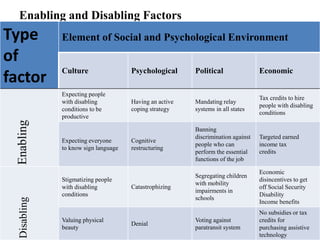
• Cultural norms affect the way that the physical and social
environments of the individual are constituted
• Disability is not inherent in an individual but is, rather, a
relational concept—a function of the interaction of the
person with the social and physical environments.
• The amount of disability that a person experiences,
depends on both
1. the existence of a potentially disabling condition (or limitation)
and
2. the environment in which the person lives.
• For any given limitation (i.e., potential disability), the
amount of actual disability experienced by a
person will depend on the nature of the environment,
that is, whether the environment is
1. positive and enabling (and serves to compensate for the
condition, ameliorate (to make sth better) the limitation,
or facilitate one's functional activities) or
2. negative and disabling (and serves to worsen the
condition, enhance the limitation, or restrict one's
functional activities).
• The physical and social environments comprise factors external to the
individual, including family, institutions, community, geography, and the
political climate.
• psychological environment is conceptualization of environment ( one's
intrapersonal), which includes internal states, beliefs, cognition,
expectancies and other mental states.
• Thus, environmental factors must be seen to include
 the natural environment,
 the human made environment,
 culture,
 the economic system,
 the political system, and
 psychological factors.
Some Enabling and Disabling Factors in the Physical
Environment
Type of
Factor
Type of Environment
Natural Environment Built Environment
Enabling
Dry climate Ramps (path, building, road)
Flat terrain (flat area of land) Adequate lighting
Clear paths Braille signage
Disabling
Snow Steps
Rocky terrain Low-wattage lighting
High humidity (amount of water
in the air)
Absence of flashing light
alerting systems
• The environmental matters may be conceived of as having two major
parts: the physical environment and the social and psychological
environments.
• The physical environment may be further subdivided conceptually into
1/ the natural environment and 2/ the built environment.
• Three types of attributes of the physical environment need to be in place
to support human performance:
1. object availability- objects must be on location to use
2. accessibility- the ability of people to get to a place or to use a
device
3. availability of sensory stimulation -include visual, tactile, or
auditory cues, serves as a signal to promote responses
A) The Natural Environment
• The natural environment may have a major impact on whether a
limitation is disabling.
• The natural environment, including topography and climate, affect
whether or to what degree a functional limitation will be disabling
B) The human made Environment
• Built objects are created and constructed by humans and vary
widely in terms of their complexity, size, and purpose.
• Built objects are created for utilitarian reasons and also for an outlet
for creativity.
Rural environment, Disability and Vulnerability
• People with disabilities, vulnerabilities and marginalized groups have no voices
about their lives and what rural living means to them.
• Physical landscapes are infused with social meaning and that the feelings we
have for particular places are built up through an accumulation of experiences
that invoke strong emotional responses.
• Rurality must be considered as more than an issue of context or setting.
• Persons with disabilities, vulnerable and marginalized groups living in rural areas
have
double disadvantaged due to their impairments and
vulnerabilities and unfavourable physical and social
environment.
Creating Welcoming (Inclusive) Environment
• External environmental modifications can take many forms.
• These can include:
 assistive devices,
alterations of a physical structure,
object modification, and
task modification.
• These environmental modifications may well be an effort at primary
prevention because the equipment may provide a safety net and
prevent disabling conditions that can occur through lifting and transfer
of individuals who may not be able to do it by themselves.
• Rehabilitation must place emphasis on addressing
the environmental needs of people with disabling
conditions.
• Environmental strategies can be effective in
helping people function independently and not be
limited in their social participation, in work,
leisure or social interactions as a spouse, parent,
friend, or co-worker.
• Examples of Environmental Modification
1. Mobility aids
• Hand Orthosis
• Mouth stick
• Prosthetic limb
• Wheelchair (manual and/or motorized)
• Canes (kezera)
• Crutches (one or two long sticks that you put under your
arms to help you walk)
• Braces (medagafiya)
2. Communication aids
• Telephone amplifier or TDD
• Voice-activated computer
• Closed or real-time captioning
• Computer-assisted note taker
• Print enlarger
• Reading machines
• Books on tape
• Sign language or oral interpreters
• Braille writer
• Cochlear implant
• Communication boards FM, audio-induction loop, or infrared systems
3. Accessible structural elements
• Ramps Elevators
• Wide doors
• Safety bars
• Nonskid floors
• Sound-reflective building materials
• Enhanced lighting
• Electrical sockets that meet appropriate reach ranges
• Hardwired flashing alerting systems Increased textural
contrast
4. Accessible features
• Built up handles
• Voice-activated computer
• Automobile hand controls
5. Job accommodations
• Simplification of task
• Flexible work hours
• Rest breaks
• Splitting job into parts
• Relegate nonessential functions to others
6. Differential use of personnel
• Personal care assistants
• Note takers
• Secretaries Editors
• Sign language interpreters
Impact of the Social and Psychological Environments on
the Enabling-Disabling Process
• The social environment is conceptualized to include cultural,
political, and economic factors.
• The psychological environment is the intrapersonal environment.
• This section examines how both affect the disabling process.
Culture and the Disabling Process
• Culture affects the enabling-disabling process at each stage;
• it also affects the transition from one stage to another.
Definition of Culture
• Definition of culture includes both material culture (things and the rules
for producing them) and nonmaterial culture (norms or rules, values,
symbols, language, ideational systems such
as science or religion, and arts such as dance, crafts, and humour).
• Nonmaterial culture is so comprehensive that it includes everything from
conceptions of how many days a week has or how one should react to
pain to when one should seek medical care or whether a hermaphroditic
(have both male & female organs or chrxs.) person is an abomination
(hatred, dislike), a saint, or a mistake.
• Both the material and nonmaterial aspects of cultures and subcultures are
relevant to the enabling-disabling process.
Enabling and Disabling Factors
Type
of
factor
Element of Social and Psychological Environment
Culture Psychological Political Economic
Enabling
Expecting people
with disabling
conditions to be
productive
Having an active
coping strategy
Mandating relay
systems in all states
Tax credits to hire
people with disabling
conditions
Expecting everyone
to know sign language
Cognitive
restructuring
Banning
discrimination against
people who can
perform the essential
functions of the job
Targeted earned
income tax
credits
Disabling
Stigmatizing people
with disabling
conditions
Catastrophizing
Segregating children
with mobility
impairments in
schools
Economic
disincentives to get
off Social Security
Disability
Income benefits
Valuing physical
beauty
Denial
Voting against
paratransit system
No subsidies or tax
credits for
purchasing assistive
technology
Disability Inclusive Intervention and Rehabilitation Services
• A “One-size-fits-all” approach to provide services for persons
with disabilities and vulnerability groups is no longer enough.
• Including people with disabilities in everyday activities and
encouraging them to have roles similar to peoples who do not
have a disability is
 disability inclusion
• This involves more than simply encouraging people;
• it requires making sure that adequate policies and practices
are in effect in a community or organization.
• Inclusion should lead to increased participation
in socially expected life roles and activities—such as being a student,
worker, friend, community member, patient, spouse, partner, or parent.
• Disability inclusion means provision of differentiated services for
persons with disabilities and vulnerabilities
• Differentiated service means a multiple service delivery model that can
satisfy the most needs of persons with disabilities and vulnerabilities.
• Persons with disabilities and vulnerabilities are often excluded (either
directly or indirectly) from development processes and humanitarian
action because of physical, attitudinal and institutional barriers.
• The effects of this exclusion are increased inequality, discrimination and
marginalization
Strategies to Disability inclusive intervention and
rehabilitation
Prevention
• Prevention of conditions associated with disability
and vulnerability is a development issue.
• Attention to environmental factors – including
nutrition, preventable diseases, safe water and
sanitation, safety on roads and in workplaces – can
greatly reduce the incidence of health conditions
leading to disability.
• A public health approach distinguishes:
i) Primary prevention – actions to avoid or remove the cause of a health
problem in an individual or a population before it arises.
• It includes health promotion and specific protection (for example, HIV
education).
ii) Secondary prevention (early intervention) – actions to detect a health and
disabling conditions at an early stage in an individual or a population,
facilitating cure, or reducing or preventing spread, or reducing or
preventing its long-term effects (for example, supporting women with
intellectual disability to access breast cancer screening).
iii) Tertiary prevention (rehabilitation) – actions to reduce the
impact of an already established disease by restoring function
and reducing disease related complications (for example,
rehabilitation for children with musculoskeletal impairment).
• Primary prevention issues are consider as crucial to improved
overall health of countries‘ populations.
• Preventing disability and vulnerability should be regarded as a
multidimensional strategy that includes prevention of
disabling barriers as well as prevention and treatment of
underlying health conditions.
Implementing the Twin-track Approach
• Implementing the twin-track approach involves:
Track 1: Mainstreaming disability as a cross-cutting issue within all key
programs and services (education, health, relief and social services, microfinance,
infrastructure and camp improvement, protection, and emergency response) to
ensure these programs and services are inclusive, equitable, non-discriminatory,
and do not create or reinforce barriers.
Track 2: Supporting the specific needs of vulnerable groups with disabilities to
ensure they have equal opportunities to participate in society.
Implement Disability Inclusive Project/ Program
• The following tips will help to overcome the challenges as a key considerations
for including persons with disabilities in all program and project cycle
management stages of Assessment, Planning, Implementation and Monitoring,
and Reporting/Evaluation.
A) Education and vocational training :-Inclusive Education realize the universal
right to education for all, meaning all mainstream education services need to be
supporting children and persons with disabilities.
B) Health – vulnerable groups and persons with disabilities have the same health-
care needs as all other peoples and health sector services can also play an
important prevention and early identification role to ensure children and
persons with impairments have timely access to health services and referral
rehabilitation support
C) Relief and social services :-the two-way link between poverty and
disability means that vulnerable group and peoples with disabilities and
their families need to be able to access relief (aid) support.
D) Infrastructure and camp improvement, shelter, water and sanitation
and environmental health :-universal design concepts must be
considered in all infrastructure and construction programs and projects.
E) Livelihoods, employment and microfinance :-vulnerable groups and
people with disabilities face numerous barriers to achieving an
independent livelihood, it is crucial that specific sectors responsible for
livelihood programs and projects to make accessible to all vulnerable and
people with disabilities.
F) Protection :-marginalized groups and people with
disabilities may face risks and vulnerabilities to
experiencing violence, exploitation, abuse, neglect and
violation of rights and therefore need to be specifically
considered and included in protection programs and
projects.
G) Humanitarian and emergency response :-the
disproportionate effect of emergency and humanitarian
situations on vulnerable groups and people with disabilities
should be reflected in the design and implementation of the
humanitarian projects.
Implement effective Intervention and Rehabilitation
• Rehabilitation interventions promote a comprehensive process to
facilitate
attainment of the optimal physical, psychological, cognitive,
behavioural, social, vocational, and educational status
• Consumers/patients, families, and professionals work together as
a team
to identify realistic goals and develop strategies to achieve
the highest possible functional outcome, in some cases in the
face of a permanent disability, impairment, or pathologic
process.
• Although rehabilitation interventions are developed within medical
and health care models, treatments are not typically curative.
• Professionals have the knowledge and background to anticipate
outcomes from the interventions, with a certain degree of both
optimism and cynicism, drawn from past experiences.
• Rehabilitation requires
goal-based activities and,
more recently, measurement of outcomes.
• The professionals, usually with the patient/ consumer and/or
family, develop goals of the interventions to help mark progress or
identify the need to reassess the treatment plan.
• There are general underlying concepts and theories of rehabilitation interventions.
• Examples of these theories and concepts include
 movement and motor control,
 human occupation models,
 education and learning,
 health promotion and prevention of additional and secondary health conditions,
 neural control and central nervous system plasticity,
 pain modulation,
 development and maturation,
 coping and adjustment,
 biomechanics,
 linguistics and pragmatics,
 resiliency and self-reliance,
 auditory processing,
 and behaviour modification.
• Medical rehabilitation is often considered separately, and is
focused on:
 recognition, diagnosis, and treatment of health conditions (e.g.,
medication for treatment of fatigue in multiple sclerosis, botulinum
injections for spasticity management in brain injury);
 reducing further impairment (e.g., treatment of ongoing shoulder
adhesive capsulitis in stroke, management of osteoarthritis of the
remaining knee in above-knee amputation); and
 preventing or treating associated, secondary, or complicating
conditions (e.g., neurogenic bladder management with intermittent
catheterization in spinal cord injury, diagnosis of cervical spinal
stenosis in an adult with cerebral palsy).
• Assistive technology is often used in conjunction with rehabilitation
interventions
• Rehabilitation interventions are associated with social participation (e.g., access
to education using rehabilitation interventions) and career planning and
employment (e.g., long term goal of rehabilitation interventions).
• Rehabilitation was conceived within the more traditional model of medical
care, but it is increasingly obvious that disability issues are more than medically
driven.
• The social justice and civil rights model of disability is important to
understand, and elements must be incorporated into rehabilitation interventions,
especially as they relate to accessibility of environments and services.
Components of Rehabilitation Interventions
• Rehabilitation is a process designed to optimize function and improve the
quality of life of those with disabilities.
• Consequently, it is not a simple process.
• It involves multiple participants, and it can take on many forms.
Multiple Disciplines
• Rehabilitation interventions usually involve multiple disciplines.
• sole service does not engender the rehabilitation concept of a team
approach, and it is often differentiated as therapy or medical service
rather than rehabilitation.
• There are a variety of professionals who participate in and contribute to the
rehabilitation process within a team approach.
• Physicians :-to manage the medical and health conditions
• Occupational Therapists :-in order to increase their ability to participate in
activities of daily living (ADLs) and instrumental activities of daily living
(IADLs), in school and work environments, using a variety of techniques.
• Typical techniques include functional training, exercise, splinting, cognitive
strategies, vision activities, computer programs and activities,
recommendation of specially designed or commercially available adaptive
equipment, and home/education/work site assessments and
recommendations.
• Physical Therapists :-assess movement dysfunction and use
treatment interventions such as exercise, functional training,
manual therapy techniques, gait and balance training, assistive
and adaptive devices and equipment, and physical agents,
including electrotherapy, massage, and manual traction.
• Speech and Language Therapist:-assess, treat, and help to
prevent disorders related to speech, language, cognition, voice,
communication, swallowing, and fluency.
• Audiologists:- identify, assess, manage, and interpret test results
related to disorders of hearing, balance, and other systems
related to hearing.
• Rehabilitation Nurses:-usually takes the role of educator and taskmaster
throughout rehabilitation, but these professionals have most prominence
within inpatient rehabilitation programs
• Social Workers:- may provide case management or coordination for
persons with complex medical conditions and needs; help patients
navigate the paths between different levels of care;
• refer patients to legal, financial, housing, or employment services; assist
patients with access to entitlement benefits, transportation assistance, or
community based services;
• identify, assess, refer, or offer treatment for such problems as depression,
anxiety, or substance abuse; or provide education or support programming
for health or related social problems.
• Case Managers:-Case management is a relatively new concept that has
come about with the survival of patients/consumers with complex medical
problems and disabilities, and with the development of a more complex
health care system.
• Case managers possess skills and credentials within other health
professions, such as nursing, counselling, or therapies, although they
usually have a nursing background.
• Rehabilitation Psychologists:- Rehabilitation psychology is a
specialized area of psychology that assists the individual (and family)
with any injury, illness, or disability that may be chronic, traumatic,
and/or congenital in achieving optimal physical, psychological, and
interpersonal functioning (Scherer et al.,2004).
• Neuropsychologists
• Neuropsychology is another specialized area within psychology, and it is of
particular importance in the care of individuals who have sustained brain injuries.
• These professionals possess specialized skills in testing procedures and methods
that assess various aspects of cognition (e.g., memory, attention, language),
emotions, behaviours, personality, effort, motivation, and symptom validity.
• Therapeutic Recreation Specialists
• Recreational therapists, also referred to as therapeutic recreation specialists,
provide treatment services and recreation activities for individuals with
disabilities or illnesses.
• Therapists promote community-based leisure activities as a complement
to other therapeutic interventions, and as a means to practice those clinic- or
hospital-based activities within a real-world context.
• Rehabilitation Counsellors
• Rehabilitation counsellors (previously known as vocational counsellors) assist persons
with both physical and mental disabilities, and cover the vocational, psychological,
social, and medical aspects of disability, through a partnership with the individuals served
• Orthotists and Prosthetists
• These professionals practice within a unique area of rehabilitation, combining technical
and some clinical skills.
• The orthotist fabricates and designs custom braces or orthotics to improve the function
of those with neuromuscular or musculoskeletal impairments, or to stabilize an injury or
impairment through the healing process.
• The prosthetist works with individuals with partial or total limb absence or amputation
to enhance their function by use of a prosthesis (i.e., artificial limb, prosthetic device).
• Additional Rehabilitation Professionals
• Other rehabilitation professionals who might be considered members of the team
include nutritionist, spiritual care, rehabilitation engineer, music therapist,
dance therapist, child-life specialist, hospital-based school teacher, massage
therapist, kinesiologist, and trainer, among others.
• Person with the Disability and His or Her Family
• The person with the disability and his or her family members are partners in this
team process.
• In fact, they are key members of the team.
• Personal and family/support system goals, family/friend support, and community
resources are driving forces regarding goals and discharge planning within the
rehabilitation process
Community-Based Rehabilitation
• CBR was originally designed for developing countries where disability estimates were
very high and the countries were under severe economic constraints.
• It promotes collaboration among community leaders, peoples with disabilities and
their families and other concerned citizens to provide equal opportunities for all
peoples with disabilities in the community and to strengthen the role of their organization
• According to the view of World Health Organization (WHO) and United Nations
Education, Scientific and Cultural Organization (UNESCO), CBR is a strategy that can
address the need of peoples with disabilities
 within their community
• Community based rehabilitation is a combination of two
important words; community and rehabilitation.
1. Community:- consists of people living together in some
form of social organization sharing political, economic,
social and cultural characteristics in varying degrees.
2. Rehabilitation:- includes all measures aimed at reducing
the impact of disability for an individual enabling him or
her to achieve independence, social integration, a better
quality of life and self actualization or measures which aim
to enable persons with disabilities to attain-
• two important definitions :-
1. Community based rehabilitation is a strategy that can address the needs of
peoples with disabilities with in their communities (WHO, UNESCO, 2004).
2. Community based rehabilitation is a common sense strategy for enhancing the
quality of life of peoples with disabilities by improving services delivery in
order to reach all in need by providing more equitable opportunities and by
promoting and protecting their rights .
3. The joint position paper by WHO, ILO, UNICEF and UNESCO of the 2004
define CBR in a rather flexible and broad manner in the following way:
 Community based rehabilitation is a strategy within general community
development for rehabilitation, equalization of opportunities and social inclusion of
all children and adults with disabilities
• This definition particularly advocates a broad approach for developing programs that
involves the following elements:
A. The participation of people with disabilities and their representatives at all stages of the
development of the program
B. The formulation and implementation of national policies to support the equal participation
of people with disabilities
C. The establishment of a system for program management
D. The multi-sectoral collaboration of governmental and nongovernmental sectors to support
communities as they assume responsibility for the inclusion of their members who
experience disabilities.
E. CBR focuses on strengthening the capacity of peoples with disabilities, and their families.
F. CBR focuses on challenging negative views and barriers in society to enable equal rights
and opportunities.
• Currently, three main meanings are attached to the notion of CBR:
1. People taking care of themselves:-is the "real" CBR: all the
activities that people with disability, their family members and
other community members do in their own community for persons
with disability
2. a concept and an ideology :-it promotes a decentralized
approach to rehabilitation service-delivery
3. community based rehabilitation :-is mostly in a form of Non-
Governmental Organizations (NGOs) -such CBR programs often
consider 'local culture' as an obstacle, not condition to progress
Major Objectives of Community Based Rehabilitation
• Empowerment to maximize their physical and mental abilities,
have access to regular services and opportunities and become
active, contributing members of their communities and then
societies.
• promotes the human rights of people with disabilities through
attitude changes within the community.
• include people who have disabilities from all types of
impairments,
• includes all age groups: children, youth, adults and older people.
Implement Technologies for Disability Inclusion
• Inclusiveness and Information Technology (ICT)
• Effective access to information is crucial in facilitating the participation of citizens in civil
society.
• For persons with disabilities and vulnerabilities, technological developments such as the
proliferation of the Internet and the provision of services for accessing digital television
such as audio description (video description), closed signing, and the availability of
subtitles (captions) in live broadcasts enabled by speech-to text technologies can make an
important contribution to facilitating independent living.
• Unfortunately, persons with disabilities and vulnerabilities still face significant barriers in
accessing ICTs. (eg. inter alia, poorly designed Web sites , limited availability of subtitles
on webcasts, the use of multiple remote controls for digital television, and difficult to
navigate on-screen displays)
Inclusiveness and Assistive Technology
• Worldwide the number of persons with disabilities,
vulnerabilities and marginalized groups is increasing alarmingly
because of
 population aging, accident, global warming and climate change,
medical advancement, humanitarian crises, natural disaster, conflict
and increases in chronic health conditions, among other causes.
• Over a billion people, about 15% of the world's population, have
some form of disability.
• Between 110 million and 190 million adults have significant
difficulties in functioning.
• Technologies promote independence for people with disabilities
and vulnerability.
• The use of devices, computers, robots, and other established
assistive technology (AT) can potentially
 increase the autonomy of people with disabilities and vulnerability,
by compensating for physical limitations and circumventing
difficulties with normal activities of daily living (ADL)
• In modern societies, persons with disabilities, vulnerabilities
and marginalized groups can attain some components of
wellbeing such as access to services using assistive technology
(AT).
Assistive Technologies (AT)
• Surgery, genetic therapy, rehabilitation, human assistance, and the use of assistive
technology (AT) help disabled people cope with their disabilities.
• Surgery (medical intervention) helps decrease deficiency and, in some cases,
restores capability.
• Genetic therapy attempts to remediate genes responsible for a given disease or
disorder.
• Rehabilitation develops and adapts residual capabilities, while human assistance
aids Persons with disabilities and vulnerabilities in their daily living activities.
• AT can increase the autonomy, independence, and quality of life for Persons with
disabilities and vulnerabilities and can also enable the integration of social,
professional, and environmental aspects of life for Persons with disabilities and
vulnerabilities populations.
AT and Daily Living of Persons with disabilities and Vulnerabilities
• Assistive technology affords Persons with disabilities and vulnerabilities
greater equality of opportunity, by
enhancing and expanding their communication, learning, participation,
and achievement with higher levels of independence, wellbeing, and
quality of life.
• Such assistive technologies are essential for helping Persons with
disabilities and vulnerabilities with severe physical, sensorial, or mental
limitations to become more independent, and to improve their quality of
life.
• Typically, AT works by compensating for absent or non functional
skills, by maintaining or enhancing existing abilities.
AT Definitions
• Assistive technology encompasses all systems that are
designed for Persons with disabilities and Vulnerabilities,
and that attempt to compensate the handicapped.
• This includes robotic tele manipulators, wheelchairs, or
navigation systems for the blind.
• AT also includes systems that restore personal
functionality, such as external prostheses and ortheses.
• Reading assignment
• from your module (page 89-93)
• AT and User Needs: A Classification Scheme
Examples of AT user needs and classification
• Persons with disabilities and Vulnerabilities and AT in the
marketplace follows one of two strategies:
• (1) trivialization- for all persons
• (2) specialization – in special case
Implement Inclusive Job Opportunities and
Employment
• The right to work is fundamental to being a full
and equal member of society, and
• It applies to all persons, regardless of whether or
not they have a disability.
• It also enables people to build self-esteem, form
social relationships, and to gain skills and
knowledge.
Barriers of employment
A) Attitudes and Discrimination
B) Accessibility (the physical environment; transportation; information and
communications; and other facilities open to the public )
C) Education and Training
D) Social Networks ( more limited social networks)
E) Women Disabilities
F) Legal Barriers (some countries impose legal restrictions on their participation in certain
types of employment or processes)
G) Inflexible Work Arrangements
H) Dismissal on the Basis of Disability (employers to dismiss staff on the basis of
disability with impunity )
I) The Benefit Trap (choosing not to do in order to continue receiving disability benefits )
Strategies to Improve Employment for Persons with Disabilities and Vulnerabilities
A) Anti-Discrimination Legislation
B) Vocational Education And Training
C) Wage Subsidies (a way to lessen the risk perceived by employers of hiring persons with
disabilities )
D) Supported Employment
E) Workplace Accommodation Schemes (making workplaces more accessible to persons
with disabilities. There are two ways Government programs can decrease or even
eliminate those costs. 1. offering tax breaks or tax credits for expenditures undertaken
to make such adjustments 2. provide full or partial funds for reasonable
accommodations for employees with disabilities )
F) Workers’ Compensation ( address the issue of occupational injuries and illnesses )
G) Quota Systems (firms hire a certain percentage of persons with disabilities )
H) Sheltered Workshops (only hire persons with disabilities, and structure jobs around
the perceived abilities of each employee)
I). Private Sector Initiatives
J). Employer Networks
K).Support Disability-Inclusive Business
L). Social Enterprises
M). Support Persons with Disabilities in the Workplace
N). Building a More Inclusive Society
O). Boost Education and Training Opportunities
P). Break Down Attitudinal Barriers and Challenge
Discrimination
Q). Improve Data Collection on Disability and Employment
Chapter 4: Promoting Inclusive
Culture
 An inclusive culture starts from the premise that
 everyone in the school, industry, community and society should feel
that they belong,
 realize their potential, and
 contribute to the life of people with disability and vulnerabilities.
 An inclusive culture involves the full and successful
integration of diverse people into a workplace or industry.
 It indicates a climate in which respect, equity, and positive
recognition of differences are all cultivated.
Definition of Inclusive Culture
 Inclusion is a sense of belonging & connection among
community at work.
 Culture is the ideas, customs, and social behaviour of a particular
people or society.
 And inclusive organizations help people feel welcomed, known,
valued and encouraged to bring their whole, unique selves to work
 An organization’s culture is the culmination of the priorities,
values and behaviours, which support their employees in how
they work singularly, in teams and with clients/customers.
 An inclusive culture involves the full and
successful integration of diverse people into a
workplace or industry.
 Inclusive cultures extend beyond token presence
of workers who have disabilities.
 Rather it encompasses both formal and informal
policies and practices.
 It involves several core values:
a. Representation: The presence of people with
disabilities across a range of employee roles and
leadership positions.
b. Receptivity: Respect for differences in working
styles and flexibility
c. Fairness: Equitable access to all resources,
opportunities, networks and decision making
processes.
Dimensions of Inclusive culture
 There are three dimensions/elements of an
inclusive culture:
1. Universal Design
2. Recruitment, Training and Advancement
Opportunities
3. Workplace Accommodations and Accessibility:
Policy & Practice
1. Universal Design
 Is the construction of structures, spaces,
services, communications and resources that are
organically accessible to a range of people with
and without disabilities, without further need
for modification or accommodation.
2. Recruitment, Training, & Advancement
Opportunities
A. Recruitment: Effective recruitment of people
with disabilities involves two components:
1. Accessible outreach and hiring practices
2.Targeted recruitment of workers with
disabilities
B. Training: Training plays a dual role in the
creation of inclusive workplace culture.
 1st role involves the degree to which people with
disabilities have equitable access to training
sites, events, and materials.
 2nd role relates to the training of managers and
human resources staff, to work effectively with
all people.
C. Advancement: to have equitable opportunities
for promotion and professional development,
workers with disabilities particularly require
access to mentoring.
3. Workplace Accommodations and Accessibility: Policy &
Practice
 The effectiveness of existing accommodation policies can be
described based on two measures of equity.
1. The perception of procedural justice: employees with
disabilities perceive the accommodations policy as fair,
accessible and functional
2. Generating an experience of interactional justice: feeling
that the managers or colleagues with whom one is
interacting are behaving fairly, reasonably and respectfully
Benefits of an Inclusive organization
Higher Job Satisfaction
 Lower Turnover.
 Higher Productivity
 Higher Employee Morale
 Improved Creativity and Innovation
 Improved Problem-Solving
 Increased Organizational Flexibility
4.3. Building inclusive community
 What is an inclusive community?
 An inclusive community:
respect all its citizens, gives them full access to resources,
and promotes equal treatment and opportunity.
Works to eliminate all forms of discrimination.
Engages all its citizens in decision-making processes.
 Values diversity
 Responds quickly to discriminating incidents.
 Things an organization can do to create a more inclusive
workplace and a more appealing place to work:
 Appropriately Connect with Employees
 Interact with Different People
 Create Employee Resource Groups
 Place Importance on Inclusion
 Invest in Diversity Training
Facilitating opportunities to experience a variety of social
roles i.e., friendships, volunteering and gaining new skills.
Characteristics of an Inclusive Community
 Integrative and cooperative – bring people together
 Interactive – promotes social interaction, celebrating community life
 Invested – both public and private sectors commit resources for well-being of the
whole community.
 Diverse – welcomes diverse people.
 Equitable – ensure every one has the means to live in decent conditions.
 Accessible and Sensitive - have a readily available and accessible supports.
 Participatory – encourages the involvement of all members.
 Safe - ensure individual and community safety and security
Means of establish inclusive culture
 To create an inclusive culture, there are four key inclusive leadership
behaviours:
1. Empowerment: Enable team members to grow and excel by encouraging them.
2. Accountability: Show confidence in team members by holding them
responsible for aspects of their performance.
3. Courage: Stand up for what you believe is right, even when it is taking a risk.
4. Humility: Admit mistakes, learn from criticism and different points of view,
and overcome your limitations.
Ten Characteristics of an Inclusive Organization
1. It accepts diversity and inclusion as a way of life
2. It evaluates individual and group performance on the basis of observable
and measurable behaviours and competencies.
3. It operates under transparent policies and procedures
4. It is consistent in its interactions with everyone
5. It creates and maintains a learning culture.
6. It has a comprehensive and easily accessible system of conflict
resolution at all levels.
7. It recognizes that it is part of the community that it serves
8. It lives its mission and core values.
9. It values earned privilege over unearned privilege.
10. It accepts and embraces change.
Inclusive values
 The seven Pillars of Inclusion:
1. Access: explores the importance of a welcoming environment.
2. Attitude: looks at how willing people are to embrace inclusion
and diversity and to take meaningful action.
3. Choice,
4. partnership,
5. communication,
6. policy and
7. opportunity
Principles Inclusive practices in education
 Inclusive practices in education are based on seven principles:
 Diversity enriches and strengthens all communities
 All learners’ different learning styles and achievements are equally valued,
respected and celebrated by society
 All learners are enabled to fulfil their potential by taking into account
individual requirements and needs
 Support is guaranteed and fully resourced across the whole learning
experience
 All learners need friendship and support from people of their own age
 All children and young people are educated together as equals in their local
communities
Chapter 5: Inclusion for Peace, Democracy
and Development
 Inclusive education is at the heart of any strategy: peace
building, democracy and development.
 It is through inclusive education
 that values skills and knowledge
 which form the basis of respect for human rights and democratic
principles can be developed.
 that the rejection of violence, and a spirit of tolerance,
understanding and mutual appreciation among individuals,
groups and nations can be enhanced.
1. Inclusion for Peace
 Peace is defined as creating mutual understanding &
positive relationship between individuals and groups.
 These groups may include culturally, linguistically,
economically and biologically heterogeneous groups.
 They develop interpersonal peace through deep respect,
justice, tolerance and cooperation.
 Peace
 make the mind quiet and calm, prevents anxieties, worries,
stress and fears.
 awakens inner strength and confidence.
 develops freedom, happiness, love, joy, justice and gratitude.
 achieved through formal and informal inclusive education.
 Inclusive education is a foundation for inclusiveness in all
aspects of life.
 It creates equality and equity among diverse population.
 Hence inclusive education is crucial for:
Fostering education
Promoting sustainable development
Promoting respect for the Universal Declaration of Human Rights
Promoting gender equality
Fostering democratic participation and citizenship.
Advancing understanding & respect for cultural diversity, and
human solidarity.
Supporting participatory communication and the free flow and
sharing of information and knowledge
Promoting international peace and security
 Contrary to inclusive education, exclusion in
education create undesirable result for a nation:
 cut people off from full involvement in d/t sectors
 underpin grievances that can mobilize groups for conflict
 undermines social cohesion
 Increase disparities in wealth and income
 Increase social inequalities
 Dominant ethnic groups control state resources
 Increase discrimination against minority
 Conflict
Sources of Conflict
 Spiritual sources: - Result of ancestor’s separation
from God and negative influence from evil
spirit.
 Individual sources: - Disunity within the individual and
confusion of values.
 Family sources: - Family dysfunctions affect offspring.
 National/international sources: - National policies affect
generations & lead to conflict within/between nations.
Historical Sources of Conflict
National crimes burden future generations
Ethnic/religious resentments accumulate
Individual Choice: To resolve or repeat past conflicts-
rethinking.
Sustaining Peace
 It is important to expand formal and informal inclusive
education to create inclusive society through developing:
 Skills of sifting the truth from propaganda or bias
 Respect for the wise use of resources
 Respect for different points of view and the ability to see the world
through the eyes of others
 Skills to resolve conflict in non-violent ways
 The desire and ability to participate in shaping society.
 Building the peace requires taking the following steps:
 Fostering inclusion
 Reaffirm a commitment to human rights.
 Foster social resilience by strengthening inclusion
 Think globally and act locally
 Protect and support civil society in fostering sustainable peace
2. Inclusion for Democracy
 Democracy is a great philosophy of inclusion that
born and grown in inclusive schools.
 It means the rule of the people, by the people, for
the people; and where “people” is to mean all
human being, regardless of the differences.
Democratic principles for inclusive practices
 Inclusive education is based on seven principles:
 Diversity enriches and strengthens all communities.
 All persons with disabilities different in their needs,
potentials, learning and working styles;
their achievements according to their potentials are
equally valued, respected and celebrated by society
All learners are enabled to fulfil their potential by
taking into account individual requirements and needs.
3. Inclusion for Development
 Development is a change in economical, social,
psychological and political aspects of a
people/country.
 Inclusive development is a process that occurs
when social and material benefits are equitably
distributed across divides in society.
Diversity in the workplace
 is vital for employees because
 it manifests itself in building a great reputation (standing) for the
company,
 leading to increased profitability and
 opportunities for workers quality services.
 It is important to value diversity because;
 people build a stronger sense of identity and wellbeing, and
 have better education and career outcomes when their diverse
strengths, abilities, interests and perspectives are understood and
supported.
Ethnic diversity
 The terms "race" and "ethnicity" used
interchangeably, but, generally speaking, the
meanings are distinct.
 Race is a biological, physical characteristics of a
person,
 Ethnicity is a social construct that describes a
person's cultural identity.
Benefits of Cultural Diversity for dev’t
 The following are some of the benefit of cultural diversities
 Increased productivity
 Improved creativity
 Increased profits
 Improved employee engagement
 Reduced employee turnover
 Improved company reputation
 Wider range of skills
 Improves cultural insights
 Reduced Fear,
 Improved Performance
Chapter 6: Resources Management for
Inclusion
 Inclusion demands resources to meet the need of all members of
communities and to facilitate equal participants in all sphere of
life.
 Our environment, now more so than before, need to be ready
to include people from different backgrounds, with differing
needs and abilities.
 For such a situation we need to adapt and modify our
environment to all people be accessible.
Conti…
Resources for school children
 All concerned bodies should be inclusive in
planning, budgeting and taking action for
the education of persons with disabilities.
 In the school settings, resource rooms are
very important.
School based resource room
 is a classroom where a special education
program can be delivered to a student with a
disability and learning difficulty.
 It is for those students who belong to a regular
class but need some special instructions in an
individualized or small group setting for a portion
of the day.
Resources for Inclusive Education
1. Human resources
Sign language interpreter
 Braille specialist
 Mobility and orientation expert
 Special needs educators
 Speech and language therapist
 Physiotherapist
 Behavioural therapists…etc.
Conti…
2. Material resources
 Various magnifying lenses
 Slate and styles
 Perkins Braille writer
 White Cane
 Hearing aids
 Sign language books and videos
 Braille atlases
 Braille rulers
 Signature guide
 Talking calculator
 Talking mobile
 Closed-circuit television
 Computer software for various students with special needs
 for example, Jawse for blind and sign language software for deaf
 Orthosis
 Prosthosis
 Environmental accessibilities ( Ramps, Elevators, Wheel chairs)
 And others additional resources.
Chapter 7: Collaborative (Cooperative)
Partnerships with stakeholders
 An individual or an institute cannot do everything they want for the
success of inclusiveness.
 They require collaboration and partnership.
 Collaboration is becoming an effective team player for the intended
success.
 Collaboration includes:
 collaborative consultation,
 cooperative planning, implementation & assessment,
 co-teaching, and
 any kind of team-based services.
 It has potential to create synergy – where the
whole is greater than the sum of the parts.
 Collaboration should be with all human being for
the success of inclusiveness through avoiding
stereotype thinking and discriminate.
Definition of collaboration, partnership and stack holder
 Collaboration is the act of working together to produce
something according to the capacities and abilities of
individuals.
 Collaboration means working with others to achieve
intended goals.
Key elements of successful collaboration
 Four most important elements of teamwork to
build a team that will lead company to success:
Respect
Communication
Delegation
 Support
A few qualities that a successful team possesses
1. They communicate well with each other.
2. They focus on goals and results.
3. Everyone contributes their fair share.
4. They offer each other support.
5. Team members are diverse.
6. Good leadership.
7. They're organized.
8. They have fun.
General principles of collaboration
 Establish clear common goals for the collaboration:
 accountability
 problem-solving approach
 trust and mutual respect
 consensus decision-making
 immediate and objective feedback
 Give credit to others for their ideas and accomplishments
 resolving and manage conflicts skilfully
 Anticipate/expect possible conflicts and take steps to avoid
Benefits of collaboration
 Higher employee productivity
 Creating a sense of teamwork and building bonds
encourages team members to work collectively.
 Greater efficiency and less duplicated effort.
 Lower costs through sharing resources
 Improved service coordination.
Challenges to Team Collaboration
Indecisive (uncertain, unsure) decision-makers.
Miscommunication
 Process sinking vs. process syncing.
 Too many cooks - too many people involved
 Negative Nancy - person who is excessively
pessimistic
Cooperativeness
 Cooperation is one of the components of
collaboration.
 Cooperation is working together agreeably for a
common goal.
 Cooperativeness helps individuals to willing
learn from each other
 It requires interdependence, that help to create
inclusiveness:
1. Goal interdependence: the group has a single goal.
2. Reward interdependence: the whole group receives
acknowledgement for achieving the goal
3. Resource interdependence: each group member has
different resources (knowledge or materials) that must be
combined to complete a task
4. Role interdependence: each group member is assigned a
different role (e.g, leader, reporter, time-keeper)
 The following steps will help you and your group to
work effectively together:
1. Have clear objectives
2. At each stage you should try to agree on goals
3. Set ground rules
4. Communicate efficiently
5. Build consensus
6. Define roles
7. Clarify your plans, process and achievements all the time
8. Keep good records
9. Stick to the plan
Stakeholder
 A stakeholder is any person, group, organization, or society that
has a stake/share in the business, project, program, service...
 Stakeholders can be internal or external
 E.g., examples of key stakeholders are creditors, directors,
employees, government (and its agencies), owners (shareholders),
suppliers, unions, and the community from which the business
draws its resources.
 Stakeholders can affect or be affected by the organization's actions,
objectives and policies.
 Characteristics of successful stockholders
partnerships
Existence of an agreement
Fusion (union, combination) of ownership and control
 Non-transferability of interest
 Trust
 Common values
Defined expectations
 Mutual respect
 Synergy
 Great two-way communications
 Good qualities of a great business partner
 Passion
 Reliability
 Compatibility (the ability of people to live together)
 The Ability to Build Strong Relationships
 Fiscal/financial Responsibility
 Creativity
Open-Mindedness
 Comfort with Risk
 Strategies for community involvement in inclusive development
 Commit to participation of all persons with diversities
 Establish non-discriminative effective communication with all
people with divers back ground
 Expect to do most of the work yourself following the inclusive
principle
 Tap into local networks, culture and indigenous experiences of
inclusiveness
 Use all possible communication channel including sign
language for deaf people
Inculusivness pp wsu!!!!!!.pptx

Inculusivness pp wsu!!!!!!.pptx

  • 1.
    Wolaita Sodo University CourseTitle : Inclusiveness Credit hours: 2 Course code: SNIE 1012
  • 2.
    Chapter 1: UnderstandingDisabilities and Vulnerabilities Chapter Contents 1.1. Definitions of disability and vulnerability 1.2. Types of disabilities and vulnerabilities 1.3. Causes of disability and vulnerability 1.4 . Historical movements from segregation to inclusion 1.5. The effects of attitude on the move towards inclusion 1.6 . Models of disability
  • 3.
    1.1. Definitions ofBasic Terms (Impairment, Disability and Handicap) Impairment • means a lack/abnormality of an anatomic, physiological or psychological structure or function or deviation on a person. • refers to any loss or abnormality of physiological, psychological or anatomical structure or function. • is the absence of particular body part or organ. • also a condition in which the body exists but doesn‘t function.
  • 4.
    Disability • The termdisability is ambiguous as there is no single agreement on the concept (Mitra, 2006) • It is not synonymous with AKAL-GUDATENGA • (የአካል ጉዳተኛ) meaning impairment • The concept of disability is complex, dynamic, multidimensional, and contested (WHO and World Bank, 2011). • The full inclusion of people with impairments in society can be inhibited by: 1. Attitudinal (societal barriers, such as stigma) 2. Physical barriers (environmental barriers, such as absence of stairs), and 3. Policy barriers (systemic barriers) • Where all together can create a disabling effect and inhibit disability inclusive development • If these problems addressed, impairment may not lead to disability
  • 5.
    • What isdisability?  Medical Approach  Social Approach Medical Approach • Disability is pathology (physiological, biological and intellectual). • Disability means functional limitations due to physical, intellectual or psychic impairment, health or psychic disorders on a person (WHO,1996). • The medical definition views the disabled person as needing to ―”fit in ” rather than thinking about how society itself should change.
  • 6.
    The social definitionof disability: • Disability is a highly varied and complex condition with a range of implications for social identity and behaviour. • Disability largely depends on the context and is a consequence of discrimination, prejudice and exclusion. • Emphasizes the shortcomings in the environment and in many organized activities in society, for example on information, communication and education, which prevent persons with disabilities from participating on equal terms.
  • 7.
    Causes of disability 1.Genetic Causes • Abnormalities in genes and genetic inheritance can cause intellectual disability in children. • In some countries, Down syndrome is the most common genetic condition. • Sometimes, diseases, illnesses, and over-exposure to x-rays can cause a genetic disorder.
  • 8.
    2. Environmental • Povertyand malnutrition in pregnant mothers can cause a deficiency in vital minerals and result in deformation issues in the unborn child. • After birth, poverty and malnutrition can also cause poor development of vital organs in the child, which can eventually lead to disability. • The use of drugs, alcohol, tobacco, the exposure to certain toxic chemicals and illnesses, toxoplasmosis, cytomegalovirus, rubella and syphilis by a pregnant mother can cause intellectual disability to the child. • Childhood diseases such as a whooping cough, measles, and chicken pox may lead to meningitis and encephalitis. • This can cause damage to the brain of the child. • Toxic material such as lead and mercury can damage the brain too. • Unfortunate life events such as drowning, automobile accidents, falls and so on can result in people losing their sight, hearing, limbs and other vital parts of their body and cause disability
  • 9.
    3. Unknown Causes •The human body is a phenomenal thing. • Scientists have still not figured out what and how some things in the body, cells, brain, and genes come about. • Humans have still not found all the answers to all the defects in the human body 4. Inaccessible environments • Sometimes society makes it difficult for people with some impairment to function freely. • When society develops infrastructure such as houses, roads, parks and other public places without consideration to people with impairment, the basically make it impossible for them to take care of themselves •
  • 10.
    Some type ofdisabilities: • Some nine major disabilities are: A. Visual impairment:- Visual impairment in general designates two sub- classifications. These are  blindness and  low vision  Blindness :-total or partial inability to see because of disease or disorder of the eye, optic nerve, or brain  The term blindness typically refers to vision loss that is not correctable with eyeglasses or contact lenses.  Blindness may not mean a total absence of sight, however. Some people who are considered blind may be able to perceive slowly moving lights or colours.
  • 11.
    • The termlow vision is used for moderately impaired vision. • People with low vision may have a visual impairment that affects only central vision— the area directly in front of the eyes—or  peripheral vision— the area to either side of and slightly behind the eyes.
  • 12.
    B. Hearing Impairment •Different people define the term hearing impairment differently. • Differ to different countries and people • Pasonella and Carat from legal point of view, define hearing impairment as a generic term indicating a continuum of hearing loss from mild to profound, which includes the sub classifications of the hard of hearing and deaf.
  • 13.
    • Hard ofHearing: "A hearing impairment, whether permanent of fluctuating, which adversely affects a child's educational performance but which is not included under the definition of 'deaf'." Whelan, R. J. (1988). • Deaf: Those who have difficulty understanding speech, even with hearing aids but can successfully communicate in sign language. • Cultural definitions of deafness, on the other hand, emphasize an individual‘s various abilities, use of sign language, and connections with the culturally deaf community.
  • 14.
    C. Specific learningdisability • means a disorder in one or more of the basic psychological processes involved in understanding or in using language, spoken or written, that may manifest itself in the imperfect ability to listen, think, speak, read,  write, spell, or  to do mathematical calculations
  • 15.
    Specific learning disability •The term includes such conditions as  perceptual disabilities,  brain injury,  minimal brain dysfunction,  Dyslexia (difficulty in reading and spelling), and  developmental aphasia (loss of the ability to understand or produce speech b/c of brain damage). • The term does not include learning problems that are primarily the result of  visual, hearing, or motor disabilities;  intellectual disability;  emotional disturbance; or  environmental, cultural, or economic disadvantage.
  • 16.
    • Learning disabilitiesshould not be confused with learning problems which are primarily the result of visual, hearing, or motor handicaps; of intellectual disability; of emotional disturbance; or of environmental, cultural or economic disadvantages. • Generally speaking, people with learning disabilities are of average or above average intelligence. • There often appears to be a gap between the individual‘s potential and actual achievement.
  • 17.
    • This iswhy learning disabilities are referred to as hidden disabilities: the person looks perfectly normal and seems to be a very bright and intelligent person,  yet may be unable to demonstrate the skill level expected from someone of a similar age. • A learning disability cannot be cured or fixed; it is a lifelong challenge. • However, with appropriate support and intervention, people with learning disabilities can achieve success in school, at work, in relationships, and in the community.
  • 18.
    Types of SpecificLearning Disabilities 1. Auditory Processing Disorder (APD) • Also known as Central Auditory Processing Disorder • Adversely affects how sound that travels unimpeded through the ear is processed or interpreted by the brain • Individuals with APD do not recognize subtle differences between sounds in words, even when the sounds are loud and clear enough to be heard. • They can also find it difficult  to tell where sounds are coming from, to make sense of the order of sounds, or to block out competing background noises.
  • 19.
    2. Dyscalculia • isa specific learning disability that affects a person‘s ability to understand numbers and learn math. • Individuals with this type of LD may also have poor comprehension of math symbols, may struggle with memorizing and organizing numbers,  have difficulty telling time, or  have trouble with counting.
  • 20.
    3. Dysgraphia • Dysgraphiais a specific learning disability that affects a person‘s handwriting ability and fine motor skills. • Problems may include:  illegible handwriting, inconsistent spacing, poor spatial planning on paper, poor spelling, and  difficulty composing writing as well as thinking and writing at the same time.
  • 21.
    4. Dyslexia • Dyslexiais a specific learning disability that affects reading and related language-based processing skills. • The severity can differ in each individual but can affect reading fluency; decoding, reading comprehension, recall, writing, spelling, and sometimes speech and can exist along with other related disorders. • Dyslexia is sometimes referred to as a Language Based Learning Disability.
  • 22.
    5. Language ProcessingDisorder • Language Processing Disorder is a specific type of Auditory Processing Disorder (APD) in which there is difficulty attaching meaning to sound groups that form words, sentences and stories. • While an APD affects the interpretation of all sounds coming into the brain, a Language Processing Disorder (LPD) relates only to the processing of language. • LPD can affect expressive language and/or receptive language.
  • 23.
    6. Non-Verbal LearningDisabilities • Non-Verbal Learning Disabilities is a disorder which is usually characterized by a significant discrepancy between higher verbal skills and weaker motor, visual-spatial and social skills. • Typically, an individual with NLD (or NVLD) has  trouble interpreting nonverbal cues like facial expressions or body language, and may have poor coordination.
  • 24.
    7. Visual Perceptual/VisualMotor Deficit • Visual Perceptual/Visual Motor Deficit is a disorder that affects the understanding of information that a person sees, or the ability to draw or copy. • A characteristic seen in people with learning disabilities such as Dysgraphia or Non-verbal LD,  it can result in missing subtle differences in shapes or printed letters, losing place frequently, struggles with cutting, holding pencil too tightly, or poor eye/hand coordination.
  • 25.
    D. Speech andLanguage Impairments • Speech and language impairment means a communication disorder such as stutter, impaired articulation,  language impairment, or  a voice impairment that adversely affects a child‘s educational performance. • It is disorder that adversely affects the child's ability to talk, understand, read, and write. • This disability category can be divided into two groups: 1. speech impairments and
  • 26.
    1. Speech Impairments •There are three basic types of speech impairments: I. articulation disorders, II. fluency disorders, and III. voice disorders. I. Articulation disorders are errors in the production of speech sounds that may be related to anatomical or physiological limitations in the skeletal, muscular, or neuromuscular support for speech production. • These disorders include: Omissions: (bo for boat)  Substitutions: (wabbit for rabbit)  Distortions: (shlip for sip)
  • 27.
    II. Fluency disordersare difficulties with the rhythm and timing of speech characterized by  hesitation, repetitions, or  prolongations of sounds, syllables, words, or phrases. • Common fluency disorders include: Stuttering: rapid-fire repetitions of consonant or vowel sounds especially at the beginning of words, prolongations, hesitations, interjections, and complete verbal blocks Cluttering: excessively fast and jerky speech
  • 28.
    III. Voice disordersare problems with the quality or use of one's voice resulting from disorders in the larynx. • Voice disorders are characterized by  abnormal production and/or absences of vocal quality, pitch, loudness, resonance, and/or duration.
  • 29.
    2. Language Impairments •There are five basic areas of language impairments: 1. phonological disorders, 2. morphological disorders, 3. semantic disorders, 4. syntactical deficits, and 5. pragmatic difficulties.
  • 30.
    • Phonological disordersare defined as the abnormal organization of the phonological system, or a significant deficit in speech production or perception. • Apraxia of speech is a specific phonological disorder where the student may want to speak but has difficulty planning what to say and the motor movements to use. • Morphological disorders are defined as difficulties with morphological inflections (inflections on nouns, verbs, and adjectives that signal different kinds of meanings).
  • 31.
    • Semantic disordersare characterized by poor vocabulary development, inappropriate use of word meanings, and/or inability to comprehend word meanings. • Syntactic deficits are characterized by difficulty in acquiring the rules that govern word order and others aspects of grammar such as subject-verb agreement. • Typically, these students produce shorter and less elaborate sentences with fewer cohesive conjunctions than their peers. • Pragmatic difficulties are characterized as problems in understanding and using language in different social contexts. • These students may lack an understanding of the rules for making eye contact, respecting personal space, requesting information, and introducing topics.
  • 32.
    E. Autism • Autismmeans a developmental disability significantly affecting verbal and nonverbal communication and social interaction, generally evident before age three that adversely affects a child‘s educational performance. • Other characteristics often associated with autism are engaging in repetitive activities and stereotyped movements,  resistance to environmental change or change in daily routines, and unusual responses to sensory experiences.
  • 33.
    • Autism ispervasive developmental disorder characterized by lack of normal sociability,  impaired communication and  repetitive obsessive behaviour such as politeness, turn-taking (speak one at a time in alternating turns) (Young & Nettlebeck , 2005). • Linked to Profound Learning Disability (PLDs) are further impairments in the production of speech. • Among these are i. personal pronouns reversal for instance the use of ―(I) instead of ―(you) and vice-versa, ii. the misuse of such prepositions as ―(in), ―(on), ―(under), ―(next to) (...), and iii. the prevalence, in speech, of echolalia (formal repetition of other‘s utterances )(Arron and Gittens, 1999)
  • 34.
    F. Emotional andBehavioural Disorders • According to Individuals with Disabilities Education Act (IDEA), the term Emotional and Behavioural Disorders means a condition exhibiting one or more of the following characteristics over a long period of time and to a marked degree that adversely affects educational performance 1. An inability to learn that cannot be explained by intellectual, sensory, or health factors; 2. An inability to build or maintain satisfactory interpersonal relationships with peers and teachers; 3. Inappropriate types of behaviour or feelings under normal circumstances; 4. A general pervasive mood of unhappiness or depression; 5. A tendency to develop physical symptoms or fears associated with personal or school problems.
  • 35.
    Classification of behaviouraland emotional disorders • Conduct disorder: individuals may seek attention, are disruptive and act out. The disorder is classified by type: overt (with violence or tantrums) versus covert (with lying, stealing, and/or drug use). • Socialized aggression: individuals join subculture group of peers who are openly disrespectful to their peers, teachers, and parents. Common are delinquency and dropping out of school. • Attention problems- These individuals may have attention deficit, are easily destructible and have poor concentration. They are frequently impulsive and may not think the consequence of their actions.
  • 36.
    • Anxiety/Withdrawn- Theseindividuals are self-conscious, reserved, and unsure of themselves. They typically have low self-esteem and withdraw from immediate activities. • They are also anxious and frequently depressed. • Psychotic behaviour: These individuals show more bizarre (strange, odd) behaviour. • They may hallucinate, deal in a fantasy world and may even talk in gibberish (non sense) • Motor excess: These students are hyperactive. They cannot sit nor listen to others nor keep their attention focused.
  • 37.
    • Kauffman (1993)conclude that emotion or behavioural disorders fall into two broad classifications: 1. Externalizing Behaviour: also called under controlled disorder, include such problems disobedience, disruptiveness, fighting, tempers tantrums, irresponsibility, jealous, anger, attention seeking etc… 2. Internalizing Behaviour: also known as over controlled disorders, include such problems anxiety, immaturity, shyness, social withdrawal, feeling of inadequacy (inferiority), guilt, depression and worries a great deal
  • 38.
    Causes of behaviouraland emotional disorders Behavioural and emotion disorders result from many causes, these includes the following. • Biological- includes genetic disorders, brain damage, and malnutrition, allergies, temperament and damage to the central nervous system. • Family factors- include family interactions, family influence, child abuse, neglect, and poor disciplinary practices at home. • Cultural factors- include some traditional and cultural negative practices, for example watching violence and sexually oriented movies and TV programs • Environmental factors- include peer pressure, living in impoverished areas, and schooling practices that are unresponsive to individual needs.
  • 39.
    G. Intellectual Disability •Intellectual disability is a disability characterized by significant limitations in both intellectual functioning and in adaptive behaviour, which covers many everyday social and practical skills. • This disability originates before the age of 18.
  • 40.
    • An individualis considered to have an intellectual disability based on the following three criteria: 1. Sub average intellectual functioning: It refers to general mental capacity, such as learning, reasoning, problem solving, and so on. • One way to measure intellectual functioning is an IQ test. • Generally, an IQ test score of around 70 or as high as 75 indicates a limitation in intellectual functioning
  • 41.
    2. Significant limitationsexist in two or more adaptive skill areas: • It is the collection of conceptual, social, and practical skills that are learned and performed by people in their everyday lives. • Conceptual skills- language and literacy; money, time, and number concepts; and self-direction. • Social skills- interpersonal skills, social responsibility, self-esteem, gullibility, innocence (i.e., suspicion), social problem solving, and the ability to follow rules/obey laws and to avoid being victimized. • Practical skills- activities of daily living (personal care), occupational skills, healthcare, travel/transportation, schedules/routines, safety, use of money, use of the telephone.
  • 42.
    • People withintellectual disabilities academic learning can be affected, as well as their ability to adapt to home, school, and community environments are presented under the following sub-headings:  General Cognition: People with intellectual disabilities vary physically and emotionally, as well as by personality, disposition, and beliefs.  Learning and Memory: The learning and memory capabilities of people with intellectual disabilities are significantly below average in comparison to peers without disabilities.
  • 43.
    • Attention: Childrenwith intellectual disabilities may have difficulty distinguishing and attending to relevant questions in both learning and social situations • Adaptive Skills: The adaptive skills of people with intellectual disabilities are often not comparable to those of their peers without disabilities. • Speech and Language: People with intellectual disabilities may have delayed speech, language comprehension and formulation difficulties. • Language problems are generally associated with delays in language development rather than with a bizarre use of
  • 44.
    • Motivation: Peoplewith intellectual disabilities are often described as lacking motivation, or outer-directed behaviour. • Academic Achievement: The cognitive difficulties of children with mild to moderate intellectual disabilities lead to persistent problems in academic achievement • Physical characteristics: Children with intellectual disabilities with differing biological etiologies, may exhibit coexisting problems, such as physical, motor, orthopedic, visual and auditory impairments, and health problems
  • 45.
    Levels of supportfor individuals with intellectu disabilities • Levels of support range from intermittent (ju occasional or “as needed” for specific activitie to pervasive (continuous in all realms of living). See on your module
  • 46.
    H. Physical disability/OrthopedicImpairment and Health impairment • Physical disability is a condition that interferes with the individual‘s ability to use his or her body. • Many but not all, physical disabilities are orthopedic impairments. • The term orthopedic impairment generally refers to conditions of muscular or skeletal system and sometimes to physical disabling conditions of the nervous system. • Health impairment is a condition that requires ongoing medical attention. It includes asthma, heart defects, cancer, diabetes, hemophilia. HIV/AIDS, etc.
  • 47.
    Classification and Characteristics •Physical disabilities:- based on the impact of physical disability on mobility and motor skills, it is divided into three. These are:- A. Mild physical disability:- these individuals are able to walk without aids and may make normal developmental progress. B. Moderate physical disability:- individuals can walk with braces and crutches and may have difficulty with fine-motor skills and speech production. C. Severe physical disability:-these are individuals who are wheel-chair dependent and may need special help to achieve regular development.
  • 48.
    • The physicaldisability could be broadly classified in to two : I. The neurological system (the brain ,spinal cord & nerve) related problems. II. Musculo skeletal system ( the muscles, bones and joints) are deficient due to various causes.
  • 49.
    I. Neurological system:-witha neurological condition like cerebral palsy or a traumatic brain injury, the brain either sends the wrong instructions or interprets feedback incorrectly. • These individuals may have motor skill deficits that can range from mild in coordination to paralysis of the entire body. • Additional problems that can be associated with cerebral palsy include learning disabilities, mental retardation. Seizures, speech impairments, eating problems, sensory impairments, and joint and bone deformities such as spinal curvatures and contractures (permanently fixed, tight muscles and joints). • Approximately 40 percent of those with cerebral palsy have normal intelligence; the remainders have from mild to severe retardation.
  • 50.
    • Epilepsy:-is disorderthat occurs when the brain cells are not working properly and is often called a seizure disorder. • Some children and youth will epilepsy have only a momentary loss of attention (petit mal seizures); others fall to the floor and then move uncontrollably • Fortunately, once epilepsy is diagnosed, it can usually be controlled with medication and does not interfere with performance in school. • Most individuals with epilepsy have normal intelligence. • Epilepsy is a condition that affects 1 to 2 percent of the population. • It is characterized by recurring seizures, which are spontaneous abnormal discharge of electrical impulses of the brain.
  • 51.
    • Spinal bifidaand spinal cord injury:- damage to the spinal cord leads to paralysis and loss of sensation in the affected areas of the body. • The spinal bifida is a birth defect of the backbone (spinal column). • The cause is unknown but it usually occurs in the first twenty-six days of pregnancy.
  • 52.
    II. Musculoskeletal system:- it includes  the muscles and their supporting framework and the skeleton.  Progressive muscle weakness (muscular dystrophy);  Inflammation of the joints (arthritis), or  Loss of various parts of the body (amputation) The list of the impairment and associated with musculoskeletal malformation are the following: A. Muscular dystrophy:- is an inherited condition occurring mainly in males, in which the muscles weaken and deteriorate. • The weakness usually appears around 3 to 4years of age and worsens progressively. • By age 11 most victims can to longer walk. • Death usually comes between the ages of 25 and 35 from respiratory failure or cardiac arrest
  • 53.
    B. Arthritis:-is aninflammation (irritation) of the joints. • Symptoms include swollen and stiff joints, fever, and pain in the joints during acute periods. • Prolonged inflammation can lead joint deformities that can eventually affect mobility. C. Amputation:- a small number of children have missing limbs because of congenital abnormalities or injury or disease (malignant bone tumours in the limbs). • These children can use customized prosthetic devices (artificial hands, arms, or legs) to replace limp functions and increase independence in daily activities.
  • 54.
    D. Marfan syndromeis a genetic disorder in which the muscles are poorly developed and the spine is curved. • Individuals with marfan syndrome may have either long, thin limbs, prominent shoulder blades, spinal curvature, flat feet, or long fingers & thumbs. E. Achondroplasis:- is a genetic disorder that affects 1 in 10,000 births. • Children with this disorder usually develop a normal torso but have a straight upper back and a curved lower back (sway back). • These children are at risk of sudden death during sleep from compression of the spinal cord interfering with their breathing. • The disability may be lessened through the use of the back braces or by surgery.
  • 55.
    • Polio:- isviral disease that invade the brain and cause severe paralysis of the total body system. • In its mild form results in partial paralysis. • Club foot:- is a major orthopedic problem affecting about 9,000 infants each year. This term is used to describe various ankle or foot deformities, i.e Twisting inward (equino varus), the most severe form Sharply angled at the heel (calcanel vaigus), most common  The front part of the foot turned inward.  These conditions can be treated with physical therapy, and a cast on the foot can solve the problem in most instances.  In more severe cases, surgery is necessary.
  • 56.
    • Cleft lipand cleft palate:- are openings in the lip or roof of the mouth, respectively, that fail to close before birth, the cause is unknown. Most cleft problems can be repaired through surgery. Health Impairments • Any disease that interferes with learning can make students eligible for special services. • These disease caused problems are as follow. 1. Heart disease:- this is common among young people. • It is caused by improper circulation of blood by the heart some of the disorders are congenital )present at birth);others are the product of inflammatory heart disease. • Some students have heart value disorders; others have disorders of the blood vessels. This time heart implantation helps children to get cured.
  • 57.
    2. Cystic fibrosis:-is a hereditary disease that affects the lungs and pancreas. • It leads to recurrent respiratory and digestive problems including abnormal amounts of  thick mucus, sweet and saliva. • The disease is so progressive and few who have it survive beyond age 20. • Children with such disease often spend significant
  • 58.
    3. Acquired immunedeficiency syndrome (AIDS):- is a very severe disease caused by human immunodeficiency virus (HIV) infection and transmitted primarily through exchange of bodily fluids in transfusions or unprotected sex, and by contaminated needles in addictive drug use. 4. Hemophilia:- is a hereditary disease in which the blood clot very slowly or not all. • The disorder is transmitted by sex-linked recessive gene and nearly always occurs in males.
  • 59.
    5. Asthma: isa chronic respiratory condition characterized by repeared eplosde of breathing difficulties especially while exhaling. 6. Diabetes: Developmental or hereditary disorder characterized by inadequate secretion or use of insulin 7. Nephrosis & Nephritis Kidney disorders or diseases caused by infections, poisoning, burns, accidents or other diseases 8. Sickle-cell anaemia: Hereditary and chronic blood disease (occurring primarily in African Americans) characterized by red blood cells that are distorted and that do not circulate properly
  • 60.
    9. Leukaemia: Diseasecharacterized by excessive production of white blood Cells 10. Lead poisoning Disorder: caused by ingesting lead-based paint chips or other substances containing lead 11. Rheumatic fever Disease: characterized by painful swelling and inflammation of the joints that can spread to the hear and central nervous system. 12. Tuberculosis: Infectious disease that commonly affects the lungs and may affect other tissues of the body. 13. Cancer: Abnormal growth of cells that can affect any organ system
  • 61.
    I. Vulnerability • Vulnerablemeans being at risk of being harmed. • Everyone can be harmed, so being vulnerable is part of being human. • In principle, everyone is vulnerable to some adverse event or circumstance, but some people are more vulnerable than others. • Based on the existing literature, vulnerability can be generally defined as a complex phenomenon that refers to the following dimensions: 1. Economic difficulties/lack of financial resources: poverty, low living standards, housing problems (e.g. too damp, too expensive, too cold or difficult to heat) etc.; 2. Social exclusion: limited access to facilities such as transporatation, schools, libraries or medical services;
  • 62.
    3. Lack ofsocial support from social networks: no assistance from family members, friends, neighbours or colleagues (referring to practical help as well as emotional support) like highly gifted individuals; 4. Stigmatization: being a victim of stereotype, being devalued, confronted with disgraceful behaviour because of belonging to a particular social or ethnic group; 5. Health difficulties: disadvantages resulting from poor mental health, physical health or disabilities; 6. Being a victim of crime: in family context especially of violence.
  • 63.
    Causes of Vulnerability •Vulnerability may be caused by rapid population growth,  poverty and hunger,  poor health, low levels of education, gender inequality, fragile and hazardous location, lack of access to resources and services, including knowledge and technological means, disintegration of social patterns (social vulnerability). • Other causes includes; lack of access to information and knowledge, lack of public awareness, limited access to political power and representation (political vulnerability), (Aysan,1993).
  • 64.
    • When peopleare socially disadvantaged or lack political voice, their vulnerability is exacerbated (aggravated) further. • The economic vulnerability is related to a number of interacting elements, including its importance in the overall national economy, trade and foreign-exchange earnings, aid and investments, international prices of commodities and inputs, and production and consumption patterns. • Environmental vulnerability concerns land degradation, earthquake, flood, hurricane, drought, storms (Monsoon rain, El Niño), water scarcity, deforestation, and the other threats to biodiversity.
  • 65.
    Characteristics of VulnerablePeople • The following are thought to be characteristics of vulnerable people (with examples of groups of potentially vulnerable people): 1. Less physically or mentally capable (infants, older adults, people with disabilities) 2. Fewer material and/or financial resources (low-income households, homeless) 3. Less knowledge or experience (children, illiterate, foreigners, tourists) 4. Restricted by society to grow and develop according to their needs and potentials
  • 66.
    • People whoare helped by others (who are then restricted by commitments) are still vulnerable people, which includes the following extracted from various researches.  women Children Minorities (ethnic ,cultural and linguistic minority, religious minority ) Poverty (poor) Disabilities Age (old and very young children) Illiteracy and less education Sickness Gifted and Talentedness (vulnerable for socio-emotional developments )
  • 67.
    Chapter 2: Conceptof Inclusion • The specific contents addressed in the chapter include:  definition of inclusion,  concept of inclusion, inclusion shift from special education and integrated education,  rationale for inclusion,  factors that influenced development of inclusion, benefits of inclusion to students, teachers‘ parents and society,  inclusive school and classroom environment,  strategies to implement inclusion in teaching and learning processes and barriers to inclusion.
  • 68.
    Definition of Inclusion •Inclusion in education/service refers to an ongoing process aimed at offering quality education/services for all while respecting diversity and the different needs and abilities,  respecting characteristics and learning expectations of the students and communities and eliminating all forms of discrimination (UNESCO, 2008, P.3, as cited in EADSNE, 2010, p.11).
  • 69.
    • Inclusion isseen as a process of addressing and responding to the diversity of needs of all persons through increasing participation in learning, employment, services, cultures and communities, and reducing exclusion at all social contexts. • It involves changes and modifications in content, approaches, structures and strategies, with a common vision which covers all people • inclusion is defined as having a wide range of strategies, activities and processes that seek to make a reality of the universal right to quality, relevant and appropriate education and services.
  • 70.
    • The definitionhas the following components: 1) Concepts about learners Education is a fundamental human right for all people Learning begins at birth and continues throughout life All children have a right to education within their own community  Everyone can learn, and any child can experience difficulties in learning  All learners need their learning supported child-focused teaching benefits all children.
  • 71.
    2) Concepts aboutthe education system and schools It is broader than formal schooling  It is flexible, responsive educational systems  It creates enabling and welcoming educational environments  It promotes school improvement – makes effective school  It involves whole school approach and collaboration between partners.
  • 72.
    3) Concepts aboutdiversity and discrimination It promotes combating discrimination and exclusionary pressures at any social sectors  It enables responding to/embracing diversity as a resource not as a problem  It prepares learners for an inclusive society that respects and values difference.
  • 73.
    4) Concepts aboutprocesses to promote inclusion  It helps to identifying and overcoming barriers to participation and exclusionary pressures  It increases real participation of all collaboration, partnership between all stakeholders  It promotes participatory methodology, action research, collaborative enquiry and other related activities 5) Concepts about resources  Promotes unlocking and fully using local resources redistributing existing resources  It helps to perceive people (children, parents, teachers, members of marginalized groups, etc) as key resources  It helps to use appropriate resources and support within schools and at local levels for the needs of different children, e.g. mother tongue tuition, Braille, assistive devices.
  • 74.
    • McLeskey andWaldron (2000) have identified inclusion and non-inclusive practices. • According to them inclusion includes the following components:  Students with disabilities and vulnerability attend their neighbourhood schools  Each student is in an age-appropriate general education classroom  Every student is accepted and regarded as a full and valued member of the class and the school community.  Special education supports are provided to each student with a disability within the context of the general education classroom.  All students receive an education that addresses their individual need  No student is excluded based on type or degree of disability.  All members of the school (e.g., administration, staff, students, and parents) promote cooperative/collaborative teaching arrangement  There is school-based planning, problem-solving, and ownership of all students and programs  Employed according to their capacities without discriminations
  • 75.
    • On theother hand, they argue that inclusion does not mean:  Placing students with disabilities into general education classrooms without careful planning and adequate support.  Reducing services or funding for special education services.  Placing all students who have disabilities or who are at risk in one or a few designated classrooms.  Teachers spending a disproportionate amount of time teaching or adapting the curriculum for students with disabilities.  Isolating students with disabilities socially, physically, or academically within the general education school or classroom.  Endangering the achievement of general education students through slower instruction or a less challenging curriculum  Relegating special education teachers to the role of assistants in the general education classroom.  Requiring general and special education teachers to team together without careful  planning and well-defined responsibilities.
  • 76.
    2. Principles ofInclusion • The fundamental principle of inclusion is that all persons should learn, work and live together • UNESCO (2005) has provided four major inclusion principles that support inclusive practice. These include: 1. Inclusion is a process. It has to be seen as a never-ending search to find better ways of responding to diversity. 2. Inclusion is concerned with the identification and removal of barriers that hinders the development. 3. Inclusion is about the presence, participation and achievement of all persons. A)Presence‘ is concerned with where persons are provided and how reliably and punctually they attend; B)participation‘ relates to the quality of their experiences and must incorporate the views of learners/and or workers and C)achievement‘ is about the outcomes of learning across the curriculum, not just test and exam results. 4. Inclusion invokes a particular emphasis on those who may be at risk of marginalization, exclusion or underachievement.
  • 77.
    Rationale for Inclusion •Implementation of inclusion has number of rationales. The major ones include: educational, social, legal, economic and inclusive society building foundations • Rationales for Inclusion and Their Respective Descriptions • Educational Foundations  Children do better academically, psychologically and socially in inclusive settings.  A more efficient use of education resources.  Decreases dropouts and repetitions  Teachers competency( knowledge, skills, collaboration, satisfaction • Social Foundation  Segregation teaches individuals to be fearful, ignorant and breeds prejudice.  All individuals need an education that will help them develop relationships and prepare them for life in the wider community.  Only inclusion has the potential to reduce fear and to build friendship, respect and understanding
  • 78.
    • Legal Foundations All individuals have the right to learn and live together.  Human being shouldn‘t be devalued or discriminated against by being excluded or sent away because of their disability.  There are no legitimate reasons to separate children for their education • Economic Foundation  Inclusive education has economic benefit, both for individual and for society.  Inclusive education is more cost-effective than the creation of special schools across the country.  Children with disabilities go to local schools  Reduce wastage of repetition and dropout  Children with disabilities live with their family use community infrastructure  Better employment and job creation opportunities for people with disabilities • Foundations for Building Inclusive Society  Formation of mutual understanding and appreciation of diversity  Building up empathy, tolerance and cooperation Promotion of sustainable development
  • 79.
    Factors that InfluencedDevelopment of Inclusion • Inclusiveness originated from three major ideas. These include: 1. inclusive education is a basic human right; 2. quality education results from inclusion of students with diverse needs and ability differences, and 3. there is no clear demarcation between the characteristics of students with and without disabilities and vulnerabilities.
  • 80.
    • Inclusive educationis facilitated by many influencing actors. Some of the major drivers include: 1. Communities: pre-colonial and indigenous approaches to education and community-based programs movement that favour inclusion of their community members. 2. Activists and advocates: the combined voices of primary stakeholders – representatives of groups of learners often excluded and marginalized from education (e.g. disabled activists; parents advocating for their children; child rights advocates; and those advocating for women/girls and minority ethnic groups). 3. The quality education and school improvement movement: in both North and South, the issues of quality, access and inclusion are strongly linked, and contribute to the understanding and practice of inclusive education as being the responsibility of education systems and schools. 4. Special educational needs movement: the ‘new thinking’ of the special needs education movement – as demonstrated in the Salamanca Statement – has been a positive influence on inclusive education, enabling schools and systems to really respond to a wide range of diversity
  • 81.
    5. Involvement ofInternational agencies: the UN is a major influence on the development of inclusive education policy and practice. • Major donors have formed a partnership – the Fast Track Initiative – to speed progress towards the EFA goals. E.g. UNESCO, etc. 6. Involvement of NGOs movements, networks and campaigns: a wide range of civil society initiatives, such as the Global Campaign for Education, seek to bring policy and practice together and involve all stakeholders based on different situations 7. Other factors: the current world situation and practical experiences in education.
  • 82.
    Benefits of Inclusion •It is now understood that inclusion benefits communities, families, teachers, and students by ensuring that children with disabilities attend school with their peers and providing them with adequate support to succeed both academically and socially. 1. Benefits for Students with Special Needs Education • In inclusive settings people will develop:  Appropriate models of behaviour. They can observe and imitate socially acceptable behaviours of the students without special needs  Improved friendships with the social environment  Increased social initiations, interactions, relationships and networks  Gain peer role models for academic, social and behaviour skills
  • 83.
     Increased achievementof individualized educational program (IEP) goals  Greater access to general curriculum  Enhanced skill acquisition and generalization in their learning  improved academic achievement which leads to quality education service  Attending inclusive schools increases the probability that students with SEN will continue to participate in a variety of integrated settings throughout their lives (increased inclusion in future environments that contribute building of inclusive society).  Improved school staff collaboration to meet these students‘ needs and ability differences  Increased parental participation to meet these students‘ needs and ability differences  Enhanced families integration into the community
  • 84.
    2. Benefits forpersons without Special Needs Education Students without special educational needs (SEN) will:  Have a variety of opportunities for interacting with their age peers who experience SEN in inclusive school settings.  serve as peer tutors during instructional activities  Play the role of a special ‘buddy’ during lunch, in the bus or playground.  Gain knowledge of a good deal about tolerance, individual difference, and human exceptionality.  Learn that students with SEN have many positive characteristics and abilities.  Have chance to learn about many of the human service profession such as special education, speech therapy, physical therapy, recreation therapy, and vocational rehabilitation. For some, exposure to these areas may lead to career choices.  Have increased appreciation, acceptance and respect of individual differences among human beings that leads to increased understanding and acceptance of diversity  Get greater opportunities to master activities by practicing and teaching others  Have increased academic outcomes  have opportunity to learn to communicate, and deal effectively with a wide range of individuals; this prepares them to fully participate in society when they are adults that make them build an inclusive society
  • 85.
    Benefits for Teachers •They have more opportunities to learn new ways to teach different kinds of students. • They gain new knowledge, such as the different ways children learn and can be taught. • They develop more positive attitudes and approaches towards different people with diverse needs. • They have greater opportunities to explore new ideas by communicating more often with others from within and outside their school, such as in school clusters or teacher networks, or with parents and community members. • They can encourage their students to be more interested, more creative and more attentive • They can experience greater job satisfaction and a higher sense of accomplishment when ALL children are succeeding in school to the best of their abilities. • They get opportunities to exchange information about instructional activities and teaching
  • 86.
    Benefits for Parents/Family •Learn more about how their children • are being educated in schools with their peers in an inclusive environment • Become personally involved and feel a greater sense of accomplishment in helping their children to learn. • Feel valued and consider themselves as equal partners in providing quality learning opportunities for children. • Learn how to deal better with their children at home by using techniques that the teachers use in school. • Find out ways to interact with others in the community, as well as to understand and help solve each other‘s problems. • Know that their children—and ALL children—are receiving a quality education.
  • 87.
    Benefits for Society •Communities become more accepting of difference, and everyone benefits from a friendlier, open environment that values and appreciates differences in human beings. Ultimate Goal of Inclusion • The goal of inclusive education is to create schools where everyone belongs. • By creating inclusive schools, we ensure that there‘s a welcoming place in the community for everyone after their school year‘s end. • Inclusive growth which is equitable that offers equality of opportunity to all as well as protection in market and employment transitions results from inclusive society
  • 88.
    Features of InclusiveEnvironment • An inclusive environment is one in which members feel respected by and connected to one another. • An inclusive environment is an environment that welcomes all people, regardless of their disability and other vulnerabilities. • It has the following major characteristics:  it ensures the respect and dignity of individuals with disabilities  it meets current accessibility standards to the greatest extent possible to all people with special needs  provides accommodations willingly and proactively
  • 89.
    Inclusive Environments • Itdevelops whole-school/environment processes that promote inclusiveness and quality provisions • It recognizes and responds to the diverse needs of their individuals • It is committed to serve all individuals together regardless of differences. • It involves restructuring environment, culture, policy, and practice. • It promoting pro-social activities • It makes provides services and facilities equally accessible to all people • It involves mobilizing resources within the community • It is alert to and uses a range of multi-skilled personnel to assist people in their learning and working environment. • It strives to create strong links with others • It develops social relationships as an equal member of the class.
  • 90.
    Barriers to Inclusion •the policy-practice gap • the community and policy makers negative attitude towards students with disability and vulnerabilities • Economic factors- this is mainly related with poverty of family, community and society at large • Lack of taking measures to ensure conformity of implementation of inclusion practice with policies • Lack of stakeholders taking responsibility in their cooperation as well as collaboration for inclusion • Conservative traditions among the community members about inclusion • Lack of knowledge and skills among teachers regarding inclusive education • Rigid curricula, teaching method and examination systems that do not consider students with dives needs and ability differences. • Fragile democratic institutions that could not promote inclusion • Inadequate resources and inaccessibility of social and physical environments • Large class sizes that make teachers and stakeholders meet students‘ diverse needs • Globalization and free market policy that make students engage in fierce completion, individualism and individuals‘ excellence rather than teaching through cooperation, collaboration and group excellence. • Using inclusive models that may be imported from other countries
  • 91.
    Chapter 3: Identificationand Differentiated services Impact of Disability and Vulnerability on daily life Factors related to the person • People respond to disabilities in different ways. • Some react negatively and thus their quality of life is negatively affected. • Others choose to focus on their abilities as opposed to their disabilities and continue to live a productive life.
  • 92.
    • There areseveral factors that affect the impact a disability has on an individual. • The following are often considered the most significant factors in determining a disability's impact on an individual. 1. The Nature of the Disability: Disability can be acquired (a result of an accident, or acquired disease) or congenital (present at birth). • If the disability is acquired, it is more likely to cause a negative reaction than a congenital disability. • Congenital disabilities are disabilities that have always been present, thus requiring less of an adjustment than an acquired disability. 2. The Individual’s Personality - the individual personality can be typically positive or negative, dependent or independent, goal-oriented or laissez- faire.
  • 93.
    3. The Meaningof the Disability to the Individual - Does the individual define himself/herself by his/her looks or physical characteristics? • If so, he/she is more likely to feel defined by his/her disability and thus it will have a negative impact. 4. The Individual’s Current Life Circumstances - The individual‘s independence or dependence on others (parents). • The economic status of the individual or the individual's caregivers, the individual's education level. 5. The Individual's Support System - The individual‘s support from family, a significant other, friends, or social groups.
  • 94.
    • Common effectsof a disability may include but not limited to  health conditions of the person;  mental health issues including anxiety and depression;  loss of freedom and independence;  frustration and anger at having to rely on other people;  practical problems including transport, choice of activities, accessing buildings;  unemployment;  problems with learning and academic study;  loss of self-esteem and confidence, especially in social situations. • But all these negative effects are due to restricted environments, not due to impairments.
  • 95.
    Economic Factors andDisability • There is clear evidence that people with few economic assets are more likely to acquire pathologies that may be disabling. • This is true even in advanced economies and in economies with greater levels of income equality. • The individual also may not be able to access the appropriate rehabilitation services to reduce the degree of potential disability either because they cannot afford the services themselves or cannot afford the cost of specialized transportation services.
  • 96.
    • wealthy communitiesare more able to provide environmental supports such as accessible public transportation and public buildings or support payments for personal assistance benefits • Community can be defined in terms of the  micro system (the local area of the person with the disabling conditions),  the mesosystem (the area beyond the immediate neighbourhood, perhaps encompassing the town), and  the macro system (a region or nation). • Finally, economic factors also can affect disability by creating incentives (compensation) to define oneself as disabled.
  • 97.
    Political Factors andDisability • The political system, through its role in designing public policy, can and does have a profound impact • If the political system is well enforced it will profoundly improve the prospects of people with disabling conditions for achieving a much fuller participation in society Psychological Factors of Disability- constructs • how disability and disabling conditions are perceived and experienced • Four psychological constructs (three cognitive processes &personality disposition(optimism)) 1. Social Cognitive Processes • Cognition consists of thoughts, feelings, beliefs, and ways of viewing the world, others, and ourselves.
  • 98.
    • Three interrelatedcognitive processes have been selected to illustrate the direct and interactive effects of cognition on disability. • These are self-efficacy beliefs (concerned with whether or not a person believes that he or she can accomplish a desired outcome ) psychological control (or control beliefs, is akin to self- efficacy beliefs in that they are thoughts, feelings, and beliefs regarding one's ability to exert control or change a situation) and coping patterns (refer to behavioural and cognitive efforts to manage specific internal or external demands that tax or exceed a person's resources to adjust) • which all these are socially constructed
  • 99.
    Personality Disposition • Optimismis a personality disposition that is a personality disposition or trait that can mediate how disabling conditions are experienced. • People with an optimistic orientation rather than a pessimistic orientation are far better across several dimensions. • Optimists tend to have better self-esteem and less hostility toward others and tend to use more adaptive coping strategies than pessimists.
  • 100.
    The Family andDisability • The family can be either an enabling or a disabling factor for a person with a disabling condition. • Families can be enabling to people with functional limitations by providing : tangible services as housekeeping and transportation personal assistance in activities of daily living economic support to help with the purchase of assistive technologies emotional support which is positively related to well- being across a number of conditions
  • 101.
    Needs of Personswith Disabilities and Vulnerabilities • Needs of persons with disabilities and vulnerabilities depends on different factors. • People with disabilities do not all share a single experience, even of the same impairment; • Analyzing the human beings, Maslow has identified five categories of needs, with different priority levels • 1).survival (physiological), 2).safety, 3).social needs, 4).esteem, and 5).self-actualization (fulfilment). • Maslow‘s model is also valid for persons with disabilities and vulnerabilities, whose needs are similar to those of ordinary persons.
  • 102.
    Self – actualization Achievingone;spotential , includingcreative activities Esteem needs: Prestige and feeling of accomplishment Belongingness & love needs: Intimate relationships, friends Safety needs: Security , safety Physiological needs: Food, water, warmth, rest Self actualization- self fulfilment needs Esteem needs &belongingness and love- psychological needs Safety &physiological needs- basic needs
  • 103.
    • persons withdisabilities and vulnerabilities have socio- emotional, psychological, physical and social environmental and economic needs in general. • The following list but not last are basic needs of persons with disabilities and vulnerabilities to ensure equality for all within our society : a) Full access to the Environment (towns, countryside & buildings) b) An accessible Transport system c) Technical aids and equipment d) Accessible/adapted housing
  • 104.
    e). Personal Assistanceand support f). Inclusive Education and Training g) An adequate Income h) Equal opportunities for Employment i) Appropriate and accessible Information j) Advocacy (towards self-advocacy) k) Counselling l) Appropriate and Accessible Health Care
  • 105.
    Social Needs ofPersons with Disabilities and Vulnerabilities • Social protection plays a key role in realizing the rights of persons with disabilities and vulnerabilities of all ages:  providing them with an adequate standard of living, a basic level of income security; thus reducing levels of poverty and vulnerability. • Moreover, mainstream and/or specific social protection schemes concerning persons with disabilities can have a major role in promoting their independence and inclusion by meeting their specific needs and supporting their social participation in a non-discriminatory manner.
  • 106.
    • These socialprotection measures may include poverty reduction schemes; cash transfer programs, social and health insurance, public work programs, housing programs, disability pensions and mobility grants • Social protection from a rights-based approach must accommodate the needs of persons with disabilities and vulnerabilities. • Traditional disability-related social welfare schemes have mainly focused on poverty rather than taking into account specific challenges faced by persons with disabilities and vulnerabilities; particularly active participation in education, access to health and employment
  • 107.
    • The rightof persons with disabilities to social protection is recognized by  the 1948 Universal Declaration of Human Rights (UDHR),  the 1966 International Covenant on Economic, Social and Cultural Rights (ICESCR) and,  more specifically, the 2006 UN Convention on the Rights of Persons with Disabilities (CRPD). • Article 28 of the CRPD in particular recognizes the right of persons with disabilities to an adequate standard of living and to social protection, ensuring the enjoyment of both rights without discrimination on the basis of ability. • Furthermore, the Social Protection Floors Recommendation (No. 202) recognizes the importance of national social protection floors to provide basic social security guarantees to all persons, including persons with disabilities and vulnerabilities, across the life cycle (with priority given to poverty, vulnerability, and social exclusion).
  • 108.
    Gender and disability •The importance of work and the daily activities required of living in the country are paramount in considering gender. • For the male and female with disabilities and vulnerable groups, work is universally seen as important, whether paid work or voluntary. • However, there are issues around how masculinity in rural areas is constituted. • Work, particularly paid work, is also important for many of the female contributors
  • 109.
    Identity and disability •People with disabilities are not primarily clients or service users but rather are known members of their communities with a shared and, at times, intergenerational history. • Identity marked by disability is complex and multilayered; relationships, outside of paid, formalized service settings. • New technologies, determination and interests shape differing identities for people who are active agents in their own lives.
  • 110.
    • Disability aspart of an individual‘s identity is seen by some as a struggle. • This is often two fold: 1. Internally to individuals and their sense of self and, too often, in the way they are perceived and constructed by those around them. pre-established identity 2. An acquired disability is experienced as challenging the nature of one‘s internal pre-established identity and as a struggle to change the perceptions and attitudes of others and the physical environment in which a person lives
  • 111.
    Belongingness and disability •Belonging is a complex concept involving an attachment to place, relationships with others, a sense of safety, common values and a shared and/or developing history. • Belonging is also an internal sense of being at home in one‘s own body and mind. • Persons with disabilities and vulnerable groups have struggled to come to terms with a body and mind which seem unfamiliar to them, in which they have to make adjustments or accommodations both for themselves and in terms of their relationships with others. • This internal negotiation and navigation shape their engagement with their social worlds, particularly in rural communities.
  • 112.
    Intersectionality • Social structuresand norms surrounding age are particularly significant, shaping the kind of lives people have and their experience of gender and identity. • They have particular implications for people‘s attachment to place and their aspirations and desires for the future. • The following matters, too, in terms of the support that family and services can offer in a rural environment  Age  The wider contextual values and economic and social changes  Religious values  Gender roles  Economic changes, poverty
  • 113.
    The Health CareNeeds of Persons with Disabilities and Vulnerabilities • People with disabilities report seeking more health care than people without disabilities and have greater unmet needs. • For example, a recent survey of people with serious mental disorders, showed that between 35% and 50% of people in developed countries, and between 76% and 85% in developing countries, received no treatment in the year prior to the study.
  • 114.
    • People withdisabilities are particularly vulnerable to deficiencies in health care services. • Depending on the group and setting, persons with disabilities may experience greater vulnerability to : secondary conditions, co-morbid conditions,  age-related conditions,  engaging in health risk behaviours and  higher rates of premature death.
  • 115.
    A) Secondary conditions:conditions occur in addition to (and are related to) a primary health condition, and are both predictable and therefore preventable. Examples include pressure, ulcers, urinary tract infections, osteoporosis (the bones become weak & are easily broken) and pain. B) Co-morbid conditions: conditions occur in addition to (and are unrelated to) a primary health condition associated with disability. For example the prevalence of diabetes in people with schizophrenia is around 15% compared to a rate of 2-3% for the general population. C) Age-related conditions: The ageing process for some groups of people with disabilities begins earlier than usual. For example some people with developmental disabilities show signs of premature ageing in their 40s and 50s. D) Engaging in health risk behaviours: Some studies have indicated that people with disabilities have higher rates of risky behaviours such as smoking, poor diet and physical inactivity.
  • 116.
    Barriers to HealthCare for Persons with Disabilities and Vulnerable Groups • People with disabilities encounter a range of barriers when they attempt to access health care including the following. a) Prohibitive costs: Affordability of health services and transportation are two main reasons why people with disabilities do not receive needed health care in low-income countries - 32-33% of non-disabled people are unable to afford health care compared to 51-53% of people with disabilities. b) Limited availability of services: The lack of appropriate services for people with disabilities is a significant barrier to health care. Eg. In rural areas c) Physical barriers: Uneven access to buildings (hospitals, health centres), inaccessible medical equipment, poor signage, narrow doorways, internal steps, inadequate bathroom facilities, and inaccessible parking areas create barriers to health care facilities. d) Inadequate skills and knowledge of health workers : they reported twice inadequate skill, four times badly treated, three times being denied care
  • 117.
    Addressing for InclusiveBarriers to Health Care • Governments and professionals can improve health outcomes for people with disabilities by improving access to quality, affordable health care services, which make the best use of available resources. • As several factors interact to inhibit access to health care, reforms in all the interacting components of the health care system are required. a) Policy and legislation: Assess existing policies and services, identify priorities to reduce health inequalities and plan improvements for access and inclusion. • Make changes to comply with the CRPD. Establish health care standards related to care of persons with disabilities with enforcement mechanisms
  • 118.
    b) Financing: Whereprivate health insurance dominates health care financing, ensure that people with disabilities are covered and consider measures to make the premiums affordable. • Use financial incentives to encourage health-care providers to make services accessible and provide comprehensive assessments, treatment, and follow ups. c) Service delivery: Provide a broad range of modifications and adjustments (reasonable accommodation) to facilitate access to health care services. • Empower people with disabilities to maximize their health by providing information, training, and peer support. • Promote community-based rehabilitation (CBR) to facilitate access for disabled people to existing services.
  • 119.
    d) Human resources:Integrate disability inclusion education into undergraduate and continuing education for all health-care professionals. • Train community workers so that they can play a role in preventive health care services. • Provide evidence-based guidelines for assessment and treatment.
  • 120.
    Disability, vulnerability andthe Environment • Cultural norms affect the way that the physical and social environments of the individual are constituted • Disability is not inherent in an individual but is, rather, a relational concept—a function of the interaction of the person with the social and physical environments. • The amount of disability that a person experiences, depends on both 1. the existence of a potentially disabling condition (or limitation) and 2. the environment in which the person lives.
  • 121.
    • For anygiven limitation (i.e., potential disability), the amount of actual disability experienced by a person will depend on the nature of the environment, that is, whether the environment is 1. positive and enabling (and serves to compensate for the condition, ameliorate (to make sth better) the limitation, or facilitate one's functional activities) or 2. negative and disabling (and serves to worsen the condition, enhance the limitation, or restrict one's functional activities).
  • 122.
    • The physicaland social environments comprise factors external to the individual, including family, institutions, community, geography, and the political climate. • psychological environment is conceptualization of environment ( one's intrapersonal), which includes internal states, beliefs, cognition, expectancies and other mental states. • Thus, environmental factors must be seen to include  the natural environment,  the human made environment,  culture,  the economic system,  the political system, and  psychological factors.
  • 123.
    Some Enabling andDisabling Factors in the Physical Environment Type of Factor Type of Environment Natural Environment Built Environment Enabling Dry climate Ramps (path, building, road) Flat terrain (flat area of land) Adequate lighting Clear paths Braille signage Disabling Snow Steps Rocky terrain Low-wattage lighting High humidity (amount of water in the air) Absence of flashing light alerting systems
  • 124.
    • The environmentalmatters may be conceived of as having two major parts: the physical environment and the social and psychological environments. • The physical environment may be further subdivided conceptually into 1/ the natural environment and 2/ the built environment. • Three types of attributes of the physical environment need to be in place to support human performance: 1. object availability- objects must be on location to use 2. accessibility- the ability of people to get to a place or to use a device 3. availability of sensory stimulation -include visual, tactile, or auditory cues, serves as a signal to promote responses
  • 125.
    A) The NaturalEnvironment • The natural environment may have a major impact on whether a limitation is disabling. • The natural environment, including topography and climate, affect whether or to what degree a functional limitation will be disabling B) The human made Environment • Built objects are created and constructed by humans and vary widely in terms of their complexity, size, and purpose. • Built objects are created for utilitarian reasons and also for an outlet for creativity.
  • 126.
    Rural environment, Disabilityand Vulnerability • People with disabilities, vulnerabilities and marginalized groups have no voices about their lives and what rural living means to them. • Physical landscapes are infused with social meaning and that the feelings we have for particular places are built up through an accumulation of experiences that invoke strong emotional responses. • Rurality must be considered as more than an issue of context or setting. • Persons with disabilities, vulnerable and marginalized groups living in rural areas have double disadvantaged due to their impairments and vulnerabilities and unfavourable physical and social environment.
  • 127.
    Creating Welcoming (Inclusive)Environment • External environmental modifications can take many forms. • These can include:  assistive devices, alterations of a physical structure, object modification, and task modification. • These environmental modifications may well be an effort at primary prevention because the equipment may provide a safety net and prevent disabling conditions that can occur through lifting and transfer of individuals who may not be able to do it by themselves.
  • 128.
    • Rehabilitation mustplace emphasis on addressing the environmental needs of people with disabling conditions. • Environmental strategies can be effective in helping people function independently and not be limited in their social participation, in work, leisure or social interactions as a spouse, parent, friend, or co-worker.
  • 129.
    • Examples ofEnvironmental Modification 1. Mobility aids • Hand Orthosis • Mouth stick • Prosthetic limb • Wheelchair (manual and/or motorized) • Canes (kezera) • Crutches (one or two long sticks that you put under your arms to help you walk) • Braces (medagafiya)
  • 130.
    2. Communication aids •Telephone amplifier or TDD • Voice-activated computer • Closed or real-time captioning • Computer-assisted note taker • Print enlarger • Reading machines • Books on tape • Sign language or oral interpreters • Braille writer • Cochlear implant • Communication boards FM, audio-induction loop, or infrared systems
  • 131.
    3. Accessible structuralelements • Ramps Elevators • Wide doors • Safety bars • Nonskid floors • Sound-reflective building materials • Enhanced lighting • Electrical sockets that meet appropriate reach ranges • Hardwired flashing alerting systems Increased textural contrast
  • 132.
    4. Accessible features •Built up handles • Voice-activated computer • Automobile hand controls 5. Job accommodations • Simplification of task • Flexible work hours • Rest breaks • Splitting job into parts • Relegate nonessential functions to others
  • 133.
    6. Differential useof personnel • Personal care assistants • Note takers • Secretaries Editors • Sign language interpreters
  • 134.
    Impact of theSocial and Psychological Environments on the Enabling-Disabling Process • The social environment is conceptualized to include cultural, political, and economic factors. • The psychological environment is the intrapersonal environment. • This section examines how both affect the disabling process. Culture and the Disabling Process • Culture affects the enabling-disabling process at each stage; • it also affects the transition from one stage to another.
  • 135.
    Definition of Culture •Definition of culture includes both material culture (things and the rules for producing them) and nonmaterial culture (norms or rules, values, symbols, language, ideational systems such as science or religion, and arts such as dance, crafts, and humour). • Nonmaterial culture is so comprehensive that it includes everything from conceptions of how many days a week has or how one should react to pain to when one should seek medical care or whether a hermaphroditic (have both male & female organs or chrxs.) person is an abomination (hatred, dislike), a saint, or a mistake. • Both the material and nonmaterial aspects of cultures and subcultures are relevant to the enabling-disabling process.
  • 136.
    Enabling and DisablingFactors Type of factor Element of Social and Psychological Environment Culture Psychological Political Economic Enabling Expecting people with disabling conditions to be productive Having an active coping strategy Mandating relay systems in all states Tax credits to hire people with disabling conditions Expecting everyone to know sign language Cognitive restructuring Banning discrimination against people who can perform the essential functions of the job Targeted earned income tax credits Disabling Stigmatizing people with disabling conditions Catastrophizing Segregating children with mobility impairments in schools Economic disincentives to get off Social Security Disability Income benefits Valuing physical beauty Denial Voting against paratransit system No subsidies or tax credits for purchasing assistive technology
  • 137.
    Disability Inclusive Interventionand Rehabilitation Services • A “One-size-fits-all” approach to provide services for persons with disabilities and vulnerability groups is no longer enough. • Including people with disabilities in everyday activities and encouraging them to have roles similar to peoples who do not have a disability is  disability inclusion • This involves more than simply encouraging people; • it requires making sure that adequate policies and practices are in effect in a community or organization.
  • 138.
    • Inclusion shouldlead to increased participation in socially expected life roles and activities—such as being a student, worker, friend, community member, patient, spouse, partner, or parent. • Disability inclusion means provision of differentiated services for persons with disabilities and vulnerabilities • Differentiated service means a multiple service delivery model that can satisfy the most needs of persons with disabilities and vulnerabilities. • Persons with disabilities and vulnerabilities are often excluded (either directly or indirectly) from development processes and humanitarian action because of physical, attitudinal and institutional barriers. • The effects of this exclusion are increased inequality, discrimination and marginalization
  • 139.
    Strategies to Disabilityinclusive intervention and rehabilitation Prevention • Prevention of conditions associated with disability and vulnerability is a development issue. • Attention to environmental factors – including nutrition, preventable diseases, safe water and sanitation, safety on roads and in workplaces – can greatly reduce the incidence of health conditions leading to disability.
  • 140.
    • A publichealth approach distinguishes: i) Primary prevention – actions to avoid or remove the cause of a health problem in an individual or a population before it arises. • It includes health promotion and specific protection (for example, HIV education). ii) Secondary prevention (early intervention) – actions to detect a health and disabling conditions at an early stage in an individual or a population, facilitating cure, or reducing or preventing spread, or reducing or preventing its long-term effects (for example, supporting women with intellectual disability to access breast cancer screening).
  • 141.
    iii) Tertiary prevention(rehabilitation) – actions to reduce the impact of an already established disease by restoring function and reducing disease related complications (for example, rehabilitation for children with musculoskeletal impairment). • Primary prevention issues are consider as crucial to improved overall health of countries‘ populations. • Preventing disability and vulnerability should be regarded as a multidimensional strategy that includes prevention of disabling barriers as well as prevention and treatment of underlying health conditions.
  • 142.
    Implementing the Twin-trackApproach • Implementing the twin-track approach involves: Track 1: Mainstreaming disability as a cross-cutting issue within all key programs and services (education, health, relief and social services, microfinance, infrastructure and camp improvement, protection, and emergency response) to ensure these programs and services are inclusive, equitable, non-discriminatory, and do not create or reinforce barriers. Track 2: Supporting the specific needs of vulnerable groups with disabilities to ensure they have equal opportunities to participate in society.
  • 143.
    Implement Disability InclusiveProject/ Program • The following tips will help to overcome the challenges as a key considerations for including persons with disabilities in all program and project cycle management stages of Assessment, Planning, Implementation and Monitoring, and Reporting/Evaluation. A) Education and vocational training :-Inclusive Education realize the universal right to education for all, meaning all mainstream education services need to be supporting children and persons with disabilities. B) Health – vulnerable groups and persons with disabilities have the same health- care needs as all other peoples and health sector services can also play an important prevention and early identification role to ensure children and persons with impairments have timely access to health services and referral rehabilitation support
  • 144.
    C) Relief andsocial services :-the two-way link between poverty and disability means that vulnerable group and peoples with disabilities and their families need to be able to access relief (aid) support. D) Infrastructure and camp improvement, shelter, water and sanitation and environmental health :-universal design concepts must be considered in all infrastructure and construction programs and projects. E) Livelihoods, employment and microfinance :-vulnerable groups and people with disabilities face numerous barriers to achieving an independent livelihood, it is crucial that specific sectors responsible for livelihood programs and projects to make accessible to all vulnerable and people with disabilities.
  • 145.
    F) Protection :-marginalizedgroups and people with disabilities may face risks and vulnerabilities to experiencing violence, exploitation, abuse, neglect and violation of rights and therefore need to be specifically considered and included in protection programs and projects. G) Humanitarian and emergency response :-the disproportionate effect of emergency and humanitarian situations on vulnerable groups and people with disabilities should be reflected in the design and implementation of the humanitarian projects.
  • 146.
    Implement effective Interventionand Rehabilitation • Rehabilitation interventions promote a comprehensive process to facilitate attainment of the optimal physical, psychological, cognitive, behavioural, social, vocational, and educational status • Consumers/patients, families, and professionals work together as a team to identify realistic goals and develop strategies to achieve the highest possible functional outcome, in some cases in the face of a permanent disability, impairment, or pathologic process.
  • 147.
    • Although rehabilitationinterventions are developed within medical and health care models, treatments are not typically curative. • Professionals have the knowledge and background to anticipate outcomes from the interventions, with a certain degree of both optimism and cynicism, drawn from past experiences. • Rehabilitation requires goal-based activities and, more recently, measurement of outcomes. • The professionals, usually with the patient/ consumer and/or family, develop goals of the interventions to help mark progress or identify the need to reassess the treatment plan.
  • 148.
    • There aregeneral underlying concepts and theories of rehabilitation interventions. • Examples of these theories and concepts include  movement and motor control,  human occupation models,  education and learning,  health promotion and prevention of additional and secondary health conditions,  neural control and central nervous system plasticity,  pain modulation,  development and maturation,  coping and adjustment,  biomechanics,  linguistics and pragmatics,  resiliency and self-reliance,  auditory processing,  and behaviour modification.
  • 149.
    • Medical rehabilitationis often considered separately, and is focused on:  recognition, diagnosis, and treatment of health conditions (e.g., medication for treatment of fatigue in multiple sclerosis, botulinum injections for spasticity management in brain injury);  reducing further impairment (e.g., treatment of ongoing shoulder adhesive capsulitis in stroke, management of osteoarthritis of the remaining knee in above-knee amputation); and  preventing or treating associated, secondary, or complicating conditions (e.g., neurogenic bladder management with intermittent catheterization in spinal cord injury, diagnosis of cervical spinal stenosis in an adult with cerebral palsy).
  • 150.
    • Assistive technologyis often used in conjunction with rehabilitation interventions • Rehabilitation interventions are associated with social participation (e.g., access to education using rehabilitation interventions) and career planning and employment (e.g., long term goal of rehabilitation interventions). • Rehabilitation was conceived within the more traditional model of medical care, but it is increasingly obvious that disability issues are more than medically driven. • The social justice and civil rights model of disability is important to understand, and elements must be incorporated into rehabilitation interventions, especially as they relate to accessibility of environments and services.
  • 151.
    Components of RehabilitationInterventions • Rehabilitation is a process designed to optimize function and improve the quality of life of those with disabilities. • Consequently, it is not a simple process. • It involves multiple participants, and it can take on many forms. Multiple Disciplines • Rehabilitation interventions usually involve multiple disciplines. • sole service does not engender the rehabilitation concept of a team approach, and it is often differentiated as therapy or medical service rather than rehabilitation.
  • 152.
    • There area variety of professionals who participate in and contribute to the rehabilitation process within a team approach. • Physicians :-to manage the medical and health conditions • Occupational Therapists :-in order to increase their ability to participate in activities of daily living (ADLs) and instrumental activities of daily living (IADLs), in school and work environments, using a variety of techniques. • Typical techniques include functional training, exercise, splinting, cognitive strategies, vision activities, computer programs and activities, recommendation of specially designed or commercially available adaptive equipment, and home/education/work site assessments and recommendations.
  • 153.
    • Physical Therapists:-assess movement dysfunction and use treatment interventions such as exercise, functional training, manual therapy techniques, gait and balance training, assistive and adaptive devices and equipment, and physical agents, including electrotherapy, massage, and manual traction. • Speech and Language Therapist:-assess, treat, and help to prevent disorders related to speech, language, cognition, voice, communication, swallowing, and fluency. • Audiologists:- identify, assess, manage, and interpret test results related to disorders of hearing, balance, and other systems related to hearing.
  • 154.
    • Rehabilitation Nurses:-usuallytakes the role of educator and taskmaster throughout rehabilitation, but these professionals have most prominence within inpatient rehabilitation programs • Social Workers:- may provide case management or coordination for persons with complex medical conditions and needs; help patients navigate the paths between different levels of care; • refer patients to legal, financial, housing, or employment services; assist patients with access to entitlement benefits, transportation assistance, or community based services; • identify, assess, refer, or offer treatment for such problems as depression, anxiety, or substance abuse; or provide education or support programming for health or related social problems.
  • 155.
    • Case Managers:-Casemanagement is a relatively new concept that has come about with the survival of patients/consumers with complex medical problems and disabilities, and with the development of a more complex health care system. • Case managers possess skills and credentials within other health professions, such as nursing, counselling, or therapies, although they usually have a nursing background. • Rehabilitation Psychologists:- Rehabilitation psychology is a specialized area of psychology that assists the individual (and family) with any injury, illness, or disability that may be chronic, traumatic, and/or congenital in achieving optimal physical, psychological, and interpersonal functioning (Scherer et al.,2004).
  • 156.
    • Neuropsychologists • Neuropsychologyis another specialized area within psychology, and it is of particular importance in the care of individuals who have sustained brain injuries. • These professionals possess specialized skills in testing procedures and methods that assess various aspects of cognition (e.g., memory, attention, language), emotions, behaviours, personality, effort, motivation, and symptom validity. • Therapeutic Recreation Specialists • Recreational therapists, also referred to as therapeutic recreation specialists, provide treatment services and recreation activities for individuals with disabilities or illnesses. • Therapists promote community-based leisure activities as a complement to other therapeutic interventions, and as a means to practice those clinic- or hospital-based activities within a real-world context.
  • 157.
    • Rehabilitation Counsellors •Rehabilitation counsellors (previously known as vocational counsellors) assist persons with both physical and mental disabilities, and cover the vocational, psychological, social, and medical aspects of disability, through a partnership with the individuals served • Orthotists and Prosthetists • These professionals practice within a unique area of rehabilitation, combining technical and some clinical skills. • The orthotist fabricates and designs custom braces or orthotics to improve the function of those with neuromuscular or musculoskeletal impairments, or to stabilize an injury or impairment through the healing process. • The prosthetist works with individuals with partial or total limb absence or amputation to enhance their function by use of a prosthesis (i.e., artificial limb, prosthetic device).
  • 158.
    • Additional RehabilitationProfessionals • Other rehabilitation professionals who might be considered members of the team include nutritionist, spiritual care, rehabilitation engineer, music therapist, dance therapist, child-life specialist, hospital-based school teacher, massage therapist, kinesiologist, and trainer, among others. • Person with the Disability and His or Her Family • The person with the disability and his or her family members are partners in this team process. • In fact, they are key members of the team. • Personal and family/support system goals, family/friend support, and community resources are driving forces regarding goals and discharge planning within the rehabilitation process
  • 159.
    Community-Based Rehabilitation • CBRwas originally designed for developing countries where disability estimates were very high and the countries were under severe economic constraints. • It promotes collaboration among community leaders, peoples with disabilities and their families and other concerned citizens to provide equal opportunities for all peoples with disabilities in the community and to strengthen the role of their organization • According to the view of World Health Organization (WHO) and United Nations Education, Scientific and Cultural Organization (UNESCO), CBR is a strategy that can address the need of peoples with disabilities  within their community
  • 160.
    • Community basedrehabilitation is a combination of two important words; community and rehabilitation. 1. Community:- consists of people living together in some form of social organization sharing political, economic, social and cultural characteristics in varying degrees. 2. Rehabilitation:- includes all measures aimed at reducing the impact of disability for an individual enabling him or her to achieve independence, social integration, a better quality of life and self actualization or measures which aim to enable persons with disabilities to attain-
  • 161.
    • two importantdefinitions :- 1. Community based rehabilitation is a strategy that can address the needs of peoples with disabilities with in their communities (WHO, UNESCO, 2004). 2. Community based rehabilitation is a common sense strategy for enhancing the quality of life of peoples with disabilities by improving services delivery in order to reach all in need by providing more equitable opportunities and by promoting and protecting their rights . 3. The joint position paper by WHO, ILO, UNICEF and UNESCO of the 2004 define CBR in a rather flexible and broad manner in the following way:  Community based rehabilitation is a strategy within general community development for rehabilitation, equalization of opportunities and social inclusion of all children and adults with disabilities
  • 162.
    • This definitionparticularly advocates a broad approach for developing programs that involves the following elements: A. The participation of people with disabilities and their representatives at all stages of the development of the program B. The formulation and implementation of national policies to support the equal participation of people with disabilities C. The establishment of a system for program management D. The multi-sectoral collaboration of governmental and nongovernmental sectors to support communities as they assume responsibility for the inclusion of their members who experience disabilities. E. CBR focuses on strengthening the capacity of peoples with disabilities, and their families. F. CBR focuses on challenging negative views and barriers in society to enable equal rights and opportunities.
  • 163.
    • Currently, threemain meanings are attached to the notion of CBR: 1. People taking care of themselves:-is the "real" CBR: all the activities that people with disability, their family members and other community members do in their own community for persons with disability 2. a concept and an ideology :-it promotes a decentralized approach to rehabilitation service-delivery 3. community based rehabilitation :-is mostly in a form of Non- Governmental Organizations (NGOs) -such CBR programs often consider 'local culture' as an obstacle, not condition to progress
  • 164.
    Major Objectives ofCommunity Based Rehabilitation • Empowerment to maximize their physical and mental abilities, have access to regular services and opportunities and become active, contributing members of their communities and then societies. • promotes the human rights of people with disabilities through attitude changes within the community. • include people who have disabilities from all types of impairments, • includes all age groups: children, youth, adults and older people.
  • 165.
    Implement Technologies forDisability Inclusion • Inclusiveness and Information Technology (ICT) • Effective access to information is crucial in facilitating the participation of citizens in civil society. • For persons with disabilities and vulnerabilities, technological developments such as the proliferation of the Internet and the provision of services for accessing digital television such as audio description (video description), closed signing, and the availability of subtitles (captions) in live broadcasts enabled by speech-to text technologies can make an important contribution to facilitating independent living. • Unfortunately, persons with disabilities and vulnerabilities still face significant barriers in accessing ICTs. (eg. inter alia, poorly designed Web sites , limited availability of subtitles on webcasts, the use of multiple remote controls for digital television, and difficult to navigate on-screen displays)
  • 166.
    Inclusiveness and AssistiveTechnology • Worldwide the number of persons with disabilities, vulnerabilities and marginalized groups is increasing alarmingly because of  population aging, accident, global warming and climate change, medical advancement, humanitarian crises, natural disaster, conflict and increases in chronic health conditions, among other causes. • Over a billion people, about 15% of the world's population, have some form of disability. • Between 110 million and 190 million adults have significant difficulties in functioning.
  • 167.
    • Technologies promoteindependence for people with disabilities and vulnerability. • The use of devices, computers, robots, and other established assistive technology (AT) can potentially  increase the autonomy of people with disabilities and vulnerability, by compensating for physical limitations and circumventing difficulties with normal activities of daily living (ADL) • In modern societies, persons with disabilities, vulnerabilities and marginalized groups can attain some components of wellbeing such as access to services using assistive technology (AT).
  • 168.
    Assistive Technologies (AT) •Surgery, genetic therapy, rehabilitation, human assistance, and the use of assistive technology (AT) help disabled people cope with their disabilities. • Surgery (medical intervention) helps decrease deficiency and, in some cases, restores capability. • Genetic therapy attempts to remediate genes responsible for a given disease or disorder. • Rehabilitation develops and adapts residual capabilities, while human assistance aids Persons with disabilities and vulnerabilities in their daily living activities. • AT can increase the autonomy, independence, and quality of life for Persons with disabilities and vulnerabilities and can also enable the integration of social, professional, and environmental aspects of life for Persons with disabilities and vulnerabilities populations.
  • 169.
    AT and DailyLiving of Persons with disabilities and Vulnerabilities • Assistive technology affords Persons with disabilities and vulnerabilities greater equality of opportunity, by enhancing and expanding their communication, learning, participation, and achievement with higher levels of independence, wellbeing, and quality of life. • Such assistive technologies are essential for helping Persons with disabilities and vulnerabilities with severe physical, sensorial, or mental limitations to become more independent, and to improve their quality of life. • Typically, AT works by compensating for absent or non functional skills, by maintaining or enhancing existing abilities.
  • 170.
    AT Definitions • Assistivetechnology encompasses all systems that are designed for Persons with disabilities and Vulnerabilities, and that attempt to compensate the handicapped. • This includes robotic tele manipulators, wheelchairs, or navigation systems for the blind. • AT also includes systems that restore personal functionality, such as external prostheses and ortheses.
  • 171.
    • Reading assignment •from your module (page 89-93) • AT and User Needs: A Classification Scheme Examples of AT user needs and classification • Persons with disabilities and Vulnerabilities and AT in the marketplace follows one of two strategies: • (1) trivialization- for all persons • (2) specialization – in special case
  • 172.
    Implement Inclusive JobOpportunities and Employment • The right to work is fundamental to being a full and equal member of society, and • It applies to all persons, regardless of whether or not they have a disability. • It also enables people to build self-esteem, form social relationships, and to gain skills and knowledge.
  • 173.
    Barriers of employment A)Attitudes and Discrimination B) Accessibility (the physical environment; transportation; information and communications; and other facilities open to the public ) C) Education and Training D) Social Networks ( more limited social networks) E) Women Disabilities F) Legal Barriers (some countries impose legal restrictions on their participation in certain types of employment or processes) G) Inflexible Work Arrangements H) Dismissal on the Basis of Disability (employers to dismiss staff on the basis of disability with impunity ) I) The Benefit Trap (choosing not to do in order to continue receiving disability benefits )
  • 174.
    Strategies to ImproveEmployment for Persons with Disabilities and Vulnerabilities A) Anti-Discrimination Legislation B) Vocational Education And Training C) Wage Subsidies (a way to lessen the risk perceived by employers of hiring persons with disabilities ) D) Supported Employment E) Workplace Accommodation Schemes (making workplaces more accessible to persons with disabilities. There are two ways Government programs can decrease or even eliminate those costs. 1. offering tax breaks or tax credits for expenditures undertaken to make such adjustments 2. provide full or partial funds for reasonable accommodations for employees with disabilities ) F) Workers’ Compensation ( address the issue of occupational injuries and illnesses ) G) Quota Systems (firms hire a certain percentage of persons with disabilities ) H) Sheltered Workshops (only hire persons with disabilities, and structure jobs around the perceived abilities of each employee)
  • 175.
    I). Private SectorInitiatives J). Employer Networks K).Support Disability-Inclusive Business L). Social Enterprises M). Support Persons with Disabilities in the Workplace N). Building a More Inclusive Society O). Boost Education and Training Opportunities P). Break Down Attitudinal Barriers and Challenge Discrimination Q). Improve Data Collection on Disability and Employment
  • 176.
    Chapter 4: PromotingInclusive Culture  An inclusive culture starts from the premise that  everyone in the school, industry, community and society should feel that they belong,  realize their potential, and  contribute to the life of people with disability and vulnerabilities.  An inclusive culture involves the full and successful integration of diverse people into a workplace or industry.  It indicates a climate in which respect, equity, and positive recognition of differences are all cultivated.
  • 177.
    Definition of InclusiveCulture  Inclusion is a sense of belonging & connection among community at work.  Culture is the ideas, customs, and social behaviour of a particular people or society.  And inclusive organizations help people feel welcomed, known, valued and encouraged to bring their whole, unique selves to work  An organization’s culture is the culmination of the priorities, values and behaviours, which support their employees in how they work singularly, in teams and with clients/customers.
  • 178.
     An inclusiveculture involves the full and successful integration of diverse people into a workplace or industry.  Inclusive cultures extend beyond token presence of workers who have disabilities.  Rather it encompasses both formal and informal policies and practices.
  • 179.
     It involvesseveral core values: a. Representation: The presence of people with disabilities across a range of employee roles and leadership positions. b. Receptivity: Respect for differences in working styles and flexibility c. Fairness: Equitable access to all resources, opportunities, networks and decision making processes.
  • 180.
    Dimensions of Inclusiveculture  There are three dimensions/elements of an inclusive culture: 1. Universal Design 2. Recruitment, Training and Advancement Opportunities 3. Workplace Accommodations and Accessibility: Policy & Practice
  • 181.
    1. Universal Design Is the construction of structures, spaces, services, communications and resources that are organically accessible to a range of people with and without disabilities, without further need for modification or accommodation.
  • 182.
    2. Recruitment, Training,& Advancement Opportunities A. Recruitment: Effective recruitment of people with disabilities involves two components: 1. Accessible outreach and hiring practices 2.Targeted recruitment of workers with disabilities
  • 183.
    B. Training: Trainingplays a dual role in the creation of inclusive workplace culture.  1st role involves the degree to which people with disabilities have equitable access to training sites, events, and materials.  2nd role relates to the training of managers and human resources staff, to work effectively with all people.
  • 184.
    C. Advancement: tohave equitable opportunities for promotion and professional development, workers with disabilities particularly require access to mentoring.
  • 185.
    3. Workplace Accommodationsand Accessibility: Policy & Practice  The effectiveness of existing accommodation policies can be described based on two measures of equity. 1. The perception of procedural justice: employees with disabilities perceive the accommodations policy as fair, accessible and functional 2. Generating an experience of interactional justice: feeling that the managers or colleagues with whom one is interacting are behaving fairly, reasonably and respectfully
  • 186.
    Benefits of anInclusive organization Higher Job Satisfaction  Lower Turnover.  Higher Productivity  Higher Employee Morale  Improved Creativity and Innovation  Improved Problem-Solving  Increased Organizational Flexibility
  • 187.
    4.3. Building inclusivecommunity  What is an inclusive community?  An inclusive community: respect all its citizens, gives them full access to resources, and promotes equal treatment and opportunity. Works to eliminate all forms of discrimination. Engages all its citizens in decision-making processes.  Values diversity  Responds quickly to discriminating incidents.
  • 188.
     Things anorganization can do to create a more inclusive workplace and a more appealing place to work:  Appropriately Connect with Employees  Interact with Different People  Create Employee Resource Groups  Place Importance on Inclusion  Invest in Diversity Training Facilitating opportunities to experience a variety of social roles i.e., friendships, volunteering and gaining new skills.
  • 189.
    Characteristics of anInclusive Community  Integrative and cooperative – bring people together  Interactive – promotes social interaction, celebrating community life  Invested – both public and private sectors commit resources for well-being of the whole community.  Diverse – welcomes diverse people.  Equitable – ensure every one has the means to live in decent conditions.  Accessible and Sensitive - have a readily available and accessible supports.  Participatory – encourages the involvement of all members.  Safe - ensure individual and community safety and security
  • 190.
    Means of establishinclusive culture  To create an inclusive culture, there are four key inclusive leadership behaviours: 1. Empowerment: Enable team members to grow and excel by encouraging them. 2. Accountability: Show confidence in team members by holding them responsible for aspects of their performance. 3. Courage: Stand up for what you believe is right, even when it is taking a risk. 4. Humility: Admit mistakes, learn from criticism and different points of view, and overcome your limitations.
  • 191.
    Ten Characteristics ofan Inclusive Organization 1. It accepts diversity and inclusion as a way of life 2. It evaluates individual and group performance on the basis of observable and measurable behaviours and competencies. 3. It operates under transparent policies and procedures 4. It is consistent in its interactions with everyone 5. It creates and maintains a learning culture. 6. It has a comprehensive and easily accessible system of conflict resolution at all levels. 7. It recognizes that it is part of the community that it serves 8. It lives its mission and core values. 9. It values earned privilege over unearned privilege. 10. It accepts and embraces change.
  • 192.
    Inclusive values  Theseven Pillars of Inclusion: 1. Access: explores the importance of a welcoming environment. 2. Attitude: looks at how willing people are to embrace inclusion and diversity and to take meaningful action. 3. Choice, 4. partnership, 5. communication, 6. policy and 7. opportunity
  • 193.
    Principles Inclusive practicesin education  Inclusive practices in education are based on seven principles:  Diversity enriches and strengthens all communities  All learners’ different learning styles and achievements are equally valued, respected and celebrated by society  All learners are enabled to fulfil their potential by taking into account individual requirements and needs  Support is guaranteed and fully resourced across the whole learning experience  All learners need friendship and support from people of their own age  All children and young people are educated together as equals in their local communities
  • 194.
    Chapter 5: Inclusionfor Peace, Democracy and Development  Inclusive education is at the heart of any strategy: peace building, democracy and development.  It is through inclusive education  that values skills and knowledge  which form the basis of respect for human rights and democratic principles can be developed.  that the rejection of violence, and a spirit of tolerance, understanding and mutual appreciation among individuals, groups and nations can be enhanced.
  • 195.
    1. Inclusion forPeace  Peace is defined as creating mutual understanding & positive relationship between individuals and groups.  These groups may include culturally, linguistically, economically and biologically heterogeneous groups.  They develop interpersonal peace through deep respect, justice, tolerance and cooperation.
  • 196.
     Peace  makethe mind quiet and calm, prevents anxieties, worries, stress and fears.  awakens inner strength and confidence.  develops freedom, happiness, love, joy, justice and gratitude.  achieved through formal and informal inclusive education.  Inclusive education is a foundation for inclusiveness in all aspects of life.  It creates equality and equity among diverse population.
  • 197.
     Hence inclusiveeducation is crucial for: Fostering education Promoting sustainable development Promoting respect for the Universal Declaration of Human Rights Promoting gender equality Fostering democratic participation and citizenship. Advancing understanding & respect for cultural diversity, and human solidarity. Supporting participatory communication and the free flow and sharing of information and knowledge Promoting international peace and security
  • 198.
     Contrary toinclusive education, exclusion in education create undesirable result for a nation:  cut people off from full involvement in d/t sectors  underpin grievances that can mobilize groups for conflict  undermines social cohesion  Increase disparities in wealth and income  Increase social inequalities  Dominant ethnic groups control state resources  Increase discrimination against minority  Conflict
  • 199.
    Sources of Conflict Spiritual sources: - Result of ancestor’s separation from God and negative influence from evil spirit.  Individual sources: - Disunity within the individual and confusion of values.  Family sources: - Family dysfunctions affect offspring.  National/international sources: - National policies affect generations & lead to conflict within/between nations.
  • 200.
    Historical Sources ofConflict National crimes burden future generations Ethnic/religious resentments accumulate Individual Choice: To resolve or repeat past conflicts- rethinking.
  • 201.
    Sustaining Peace  Itis important to expand formal and informal inclusive education to create inclusive society through developing:  Skills of sifting the truth from propaganda or bias  Respect for the wise use of resources  Respect for different points of view and the ability to see the world through the eyes of others  Skills to resolve conflict in non-violent ways  The desire and ability to participate in shaping society.
  • 202.
     Building thepeace requires taking the following steps:  Fostering inclusion  Reaffirm a commitment to human rights.  Foster social resilience by strengthening inclusion  Think globally and act locally  Protect and support civil society in fostering sustainable peace
  • 203.
    2. Inclusion forDemocracy  Democracy is a great philosophy of inclusion that born and grown in inclusive schools.  It means the rule of the people, by the people, for the people; and where “people” is to mean all human being, regardless of the differences.
  • 204.
    Democratic principles forinclusive practices  Inclusive education is based on seven principles:  Diversity enriches and strengthens all communities.  All persons with disabilities different in their needs, potentials, learning and working styles; their achievements according to their potentials are equally valued, respected and celebrated by society All learners are enabled to fulfil their potential by taking into account individual requirements and needs.
  • 205.
    3. Inclusion forDevelopment  Development is a change in economical, social, psychological and political aspects of a people/country.  Inclusive development is a process that occurs when social and material benefits are equitably distributed across divides in society.
  • 206.
    Diversity in theworkplace  is vital for employees because  it manifests itself in building a great reputation (standing) for the company,  leading to increased profitability and  opportunities for workers quality services.  It is important to value diversity because;  people build a stronger sense of identity and wellbeing, and  have better education and career outcomes when their diverse strengths, abilities, interests and perspectives are understood and supported.
  • 207.
    Ethnic diversity  Theterms "race" and "ethnicity" used interchangeably, but, generally speaking, the meanings are distinct.  Race is a biological, physical characteristics of a person,  Ethnicity is a social construct that describes a person's cultural identity.
  • 208.
    Benefits of CulturalDiversity for dev’t  The following are some of the benefit of cultural diversities  Increased productivity  Improved creativity  Increased profits  Improved employee engagement  Reduced employee turnover  Improved company reputation  Wider range of skills  Improves cultural insights  Reduced Fear,  Improved Performance
  • 209.
    Chapter 6: ResourcesManagement for Inclusion  Inclusion demands resources to meet the need of all members of communities and to facilitate equal participants in all sphere of life.  Our environment, now more so than before, need to be ready to include people from different backgrounds, with differing needs and abilities.  For such a situation we need to adapt and modify our environment to all people be accessible.
  • 210.
    Conti… Resources for schoolchildren  All concerned bodies should be inclusive in planning, budgeting and taking action for the education of persons with disabilities.  In the school settings, resource rooms are very important.
  • 211.
    School based resourceroom  is a classroom where a special education program can be delivered to a student with a disability and learning difficulty.  It is for those students who belong to a regular class but need some special instructions in an individualized or small group setting for a portion of the day.
  • 212.
    Resources for InclusiveEducation 1. Human resources Sign language interpreter  Braille specialist  Mobility and orientation expert  Special needs educators  Speech and language therapist  Physiotherapist  Behavioural therapists…etc.
  • 213.
    Conti… 2. Material resources Various magnifying lenses  Slate and styles  Perkins Braille writer  White Cane  Hearing aids  Sign language books and videos  Braille atlases  Braille rulers
  • 214.
     Signature guide Talking calculator  Talking mobile  Closed-circuit television  Computer software for various students with special needs  for example, Jawse for blind and sign language software for deaf  Orthosis  Prosthosis  Environmental accessibilities ( Ramps, Elevators, Wheel chairs)  And others additional resources.
  • 215.
    Chapter 7: Collaborative(Cooperative) Partnerships with stakeholders  An individual or an institute cannot do everything they want for the success of inclusiveness.  They require collaboration and partnership.  Collaboration is becoming an effective team player for the intended success.  Collaboration includes:  collaborative consultation,  cooperative planning, implementation & assessment,  co-teaching, and  any kind of team-based services.
  • 216.
     It haspotential to create synergy – where the whole is greater than the sum of the parts.  Collaboration should be with all human being for the success of inclusiveness through avoiding stereotype thinking and discriminate.
  • 217.
    Definition of collaboration,partnership and stack holder  Collaboration is the act of working together to produce something according to the capacities and abilities of individuals.  Collaboration means working with others to achieve intended goals.
  • 218.
    Key elements ofsuccessful collaboration  Four most important elements of teamwork to build a team that will lead company to success: Respect Communication Delegation  Support
  • 219.
    A few qualitiesthat a successful team possesses 1. They communicate well with each other. 2. They focus on goals and results. 3. Everyone contributes their fair share. 4. They offer each other support. 5. Team members are diverse. 6. Good leadership. 7. They're organized. 8. They have fun.
  • 220.
    General principles ofcollaboration  Establish clear common goals for the collaboration:  accountability  problem-solving approach  trust and mutual respect  consensus decision-making  immediate and objective feedback  Give credit to others for their ideas and accomplishments  resolving and manage conflicts skilfully  Anticipate/expect possible conflicts and take steps to avoid
  • 221.
    Benefits of collaboration Higher employee productivity  Creating a sense of teamwork and building bonds encourages team members to work collectively.  Greater efficiency and less duplicated effort.  Lower costs through sharing resources  Improved service coordination.
  • 222.
    Challenges to TeamCollaboration Indecisive (uncertain, unsure) decision-makers. Miscommunication  Process sinking vs. process syncing.  Too many cooks - too many people involved  Negative Nancy - person who is excessively pessimistic
  • 223.
    Cooperativeness  Cooperation isone of the components of collaboration.  Cooperation is working together agreeably for a common goal.  Cooperativeness helps individuals to willing learn from each other
  • 224.
     It requiresinterdependence, that help to create inclusiveness: 1. Goal interdependence: the group has a single goal. 2. Reward interdependence: the whole group receives acknowledgement for achieving the goal 3. Resource interdependence: each group member has different resources (knowledge or materials) that must be combined to complete a task 4. Role interdependence: each group member is assigned a different role (e.g, leader, reporter, time-keeper)
  • 225.
     The followingsteps will help you and your group to work effectively together: 1. Have clear objectives 2. At each stage you should try to agree on goals 3. Set ground rules 4. Communicate efficiently 5. Build consensus 6. Define roles 7. Clarify your plans, process and achievements all the time 8. Keep good records 9. Stick to the plan
  • 226.
    Stakeholder  A stakeholderis any person, group, organization, or society that has a stake/share in the business, project, program, service...  Stakeholders can be internal or external  E.g., examples of key stakeholders are creditors, directors, employees, government (and its agencies), owners (shareholders), suppliers, unions, and the community from which the business draws its resources.  Stakeholders can affect or be affected by the organization's actions, objectives and policies.
  • 227.
     Characteristics ofsuccessful stockholders partnerships Existence of an agreement Fusion (union, combination) of ownership and control  Non-transferability of interest  Trust  Common values Defined expectations  Mutual respect  Synergy  Great two-way communications
  • 228.
     Good qualitiesof a great business partner  Passion  Reliability  Compatibility (the ability of people to live together)  The Ability to Build Strong Relationships  Fiscal/financial Responsibility  Creativity Open-Mindedness  Comfort with Risk
  • 229.
     Strategies forcommunity involvement in inclusive development  Commit to participation of all persons with diversities  Establish non-discriminative effective communication with all people with divers back ground  Expect to do most of the work yourself following the inclusive principle  Tap into local networks, culture and indigenous experiences of inclusiveness  Use all possible communication channel including sign language for deaf people