Patricia Lima PereiraStudent of Master in Public Health and Social ProtectionInstitute of Public Health- Jagiellonian University Medical College15th, January 2010Causes of disability: A challenge forresearch in Latin America
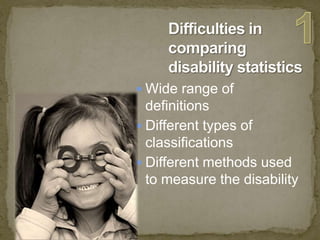
1Difficulties in comparing disability statisticsWide range of definitionsDifferent types of classifications  Different methods used to measure the disability
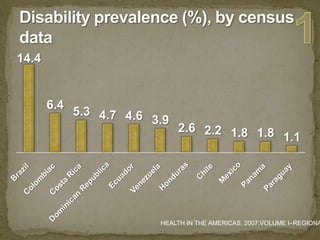
Disability prevalence (%), by census data 1HEALTH IN THE AMERICAS, 2007.VOLUME I–REGIONAL
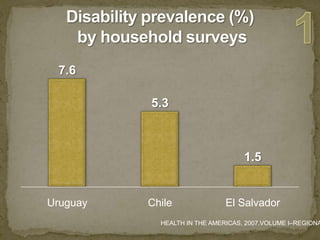
Disabilityprevalence (%)byhouseholdsurveys1HEALTH IN THE AMERICAS, 2007.VOLUME I–REGIONAL
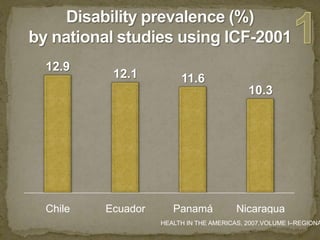
Disability prevalence (%)by national studies using ICF-20011HEALTH IN THE AMERICAS, 2007.VOLUME I–REGIONAL
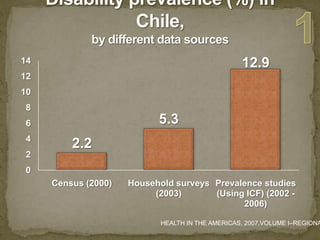
Disability prevalence (%) in Chile,by different data sources1HEALTH IN THE AMERICAS, 2007.VOLUME I–REGIONAL
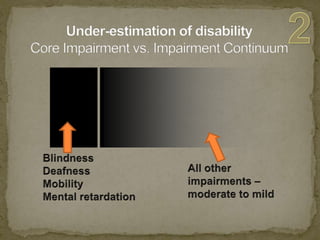
2Under-estimation of disability Core Impairment vs. Impairment ContinuumBlindnessDeafnessMobilityMental retardationAllotherimpairments – moderatetomild
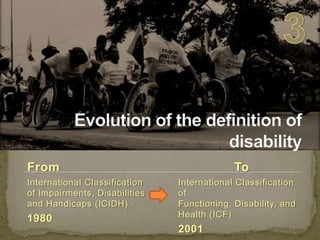
3Evolution of the definition of disabilityFrom International Classification of Impairments, Disabilities and Handicaps (ICIDH)1980To International Classification of Functioning, Disability, and Health (ICF) 2001
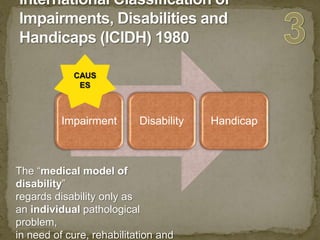
International Classification of Impairments, Disabilities and Handicaps (ICIDH) 19803CAUSESThe “medical model of disability” regards disability only as an individual pathological problem, in need of cure, rehabilitation and adaptation to society.
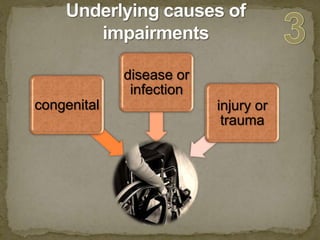
3Underlying causes of impairments
3
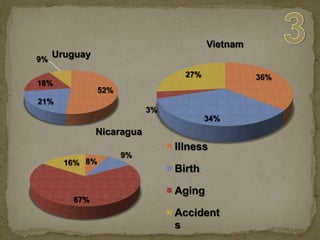
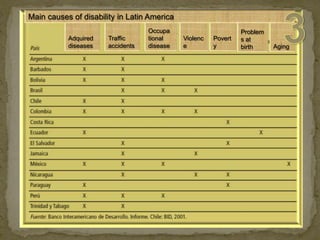
3Main causes of disability in Latin AmericaTraffic accidentsAdquired diseasesOccupationaldiseaseViolencePovertyProblems at birthAging
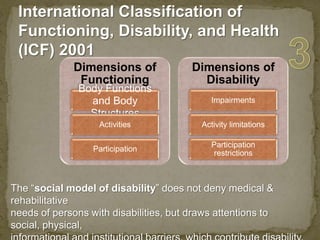
International Classification of Functioning, Disability, and Health (ICF) 20013The “social model of disability” does not deny medical & rehabilitativeneeds of persons with disabilities, but draws attentions to social, physical,informational and institutional barriers, which contribute disability.
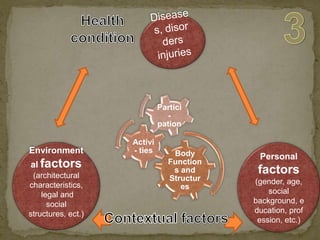
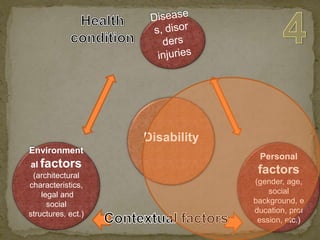
3HealthconditionDiseases, disordersinjuriesPersonal factors(gender, age, socialbackground, education, profession, etc.)Environmentalfactors (architectural characteristics, legal and social structures, ect.) Contextualfactors
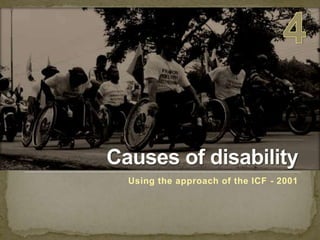
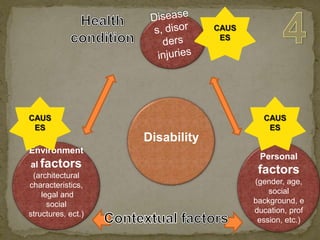
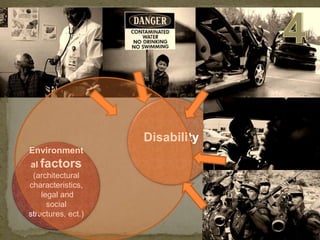
Causes of disabilityUsing the approach of the ICF - 20014
4CAUSESHealthconditionDiseases, disordersinjuriesDisability CAUSESCAUSESPersonal factors(gender, age, socialbackground, education, profession, etc.)Environmentalfactors (architectural characteristics, legal and social structures, ect.) Contextualfactors
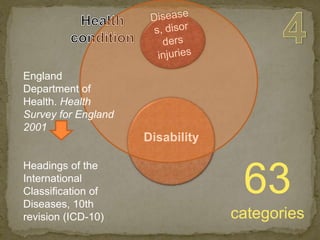
4HealthconditionDiseases, disordersinjuriesEngland Department of Health. Health Survey for England 2001Headings of the International Classification of Diseases, 10th revision (ICD-10)Disability 63 categories
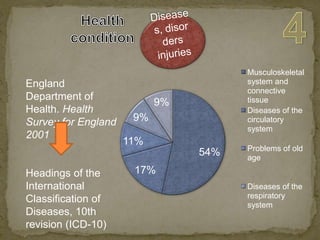
4HealthconditionDiseases, disordersinjuriesEngland Department of Health. Health Survey for England 2001Headings of the International Classification of Diseases, 10th revision (ICD-10)
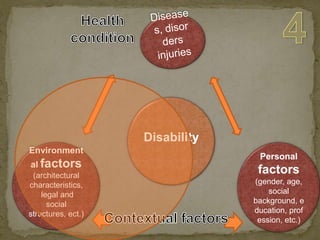
4HealthconditionDiseases, disordersinjuriesDisability Personal factors(gender, age, socialbackground, education, profession, etc.)Environmentalfactors (architectural characteristics, legal and social structures, ect.) Contextualfactors
4Disability Environmentalfactors (architectural characteristics, legal and social structures, ect.) 
4HealthconditionDiseases, disordersinjuriesDisability Environmentalfactors (architectural characteristics, legal and social structures, ect.) Personal factors(gender, age, socialbackground, education, profession, etc.)Contextualfactors
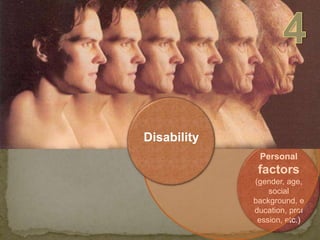
4Disability Personal factors(gender, age, socialbackground, education, profession, etc.)
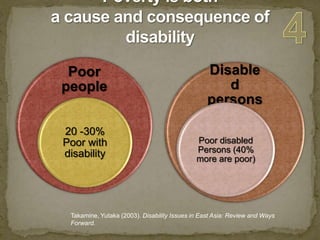
Poverty is both a cause and consequence of disability 4Takamine, Yutaka (2003). Disability Issues in East Asia: Review and WaysForward.
Limitations of the ICF approach5
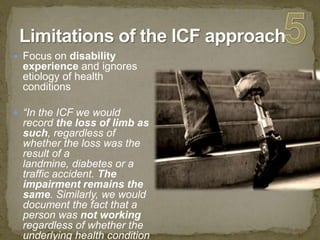
Limitations of the ICF approach5Focus on disability experience and ignores etiology of health conditions“In the ICF we would record the loss of limb as such, regardless of whether the loss was the result of a landmine, diabetes or a traffic accident. The impairment remains the same. Similarly, we would document the fact that a person was not working regardless of whether the underlying health condition was ‘flu, depression, or back pain”. Training Manual on Disability Statistics (WHO/ ESCAP 2008)
Limitations of the ICF approach5Focus on disability experience and ignores etiology of health conditionsItmaybeconsideratea limitation?
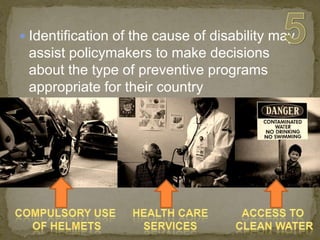
5Identification of the cause of disability may assist policymakers to make decisions about the type of preventive programs appropriate for their countrycompulsory use of HelmetsHealth careservicesAccess to Clean water
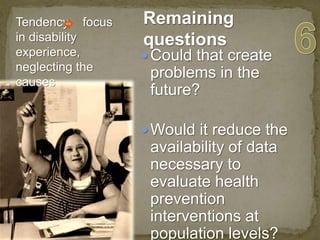
Remaining questions6Tendency    focus in disability experience, neglecting the causesCould that create problems in the future?Would it reduce the availability of data necessary to evaluate health prevention interventions at population levels?
CDC. Prevalence and Most Common Causes of Disability Among Adults in the United States. Morbidity and Mortility Weekly Report (MMWR), available on http://www.cdc.gov/mmwr/preview/mmwrhtml/mm5816a2.htm#tab2. Retrievedon 04/01/10. 18:02, 2005.DANE Colombia. Censo Nacional de Población. Informe preliminar cifras de población con discapacidad. Bogotá: Departamento Administrativo Nacional de Estadística, 2006.DCDGRD Colombia. Información estadística de la discapacidad. Dirección de Censos y Demografía Grupo de Registros Demográficos. Colombia , 2004.England Department of Health. Health Survey for England 2001. Available on: http://www.archive2.official-documents.co.uk/document/deps/doh/survey01/disa/disa01.htm. Retrieved on 03/01/2008. 21:20, 2001.Hernandez Collado, Héctor. «Encuesta Nicaragüense para Personas con Discapacidad (ENDIS).» 2003.Murray, Christopher, and Alan López. The Global Burden of Diseases, Global Burden of Disease and Injury Series. World Health Organization, Harvard School of Public Health, World Health, 1996.PAHO. La discapacidad en Nicaragua: situación actual y perspectivas.Panamerican Health Organization, 2005.Sánchez, S, M Sanabria, and N Medina. "Nutritional profile of indigenous children under five years old in Paraguay. Indigenous Household Survey 2008." Pediatric Research, 2009: 65:4 (479).Takamine, Yutaka. «Disability Issues in East Asia: Review and Ways.» 2003.Vásquez, Armando. «La discapacidad en América Latina.» En Discapacidad: lo que todos debemos saber, de Alicia Amate y Armando Vásquez, 9-24. Washington: OPS, 2006.WHO. «Health in the Americas 2007. Volume I Regional.» avalaible on www.who.int, 2007.WHO. International Classification of Functioning, Disability and Health. Geneva: World Health Organization, 2001.WHO/ ESCAP. Training Manual on Disability Statistics. World Health Organization / United Nations Economic and Social Commission for Asia and the Pacific Region, 2008.Bibliography

Causes of Disability

  • 1.
    Patricia Lima PereiraStudentof Master in Public Health and Social ProtectionInstitute of Public Health- Jagiellonian University Medical College15th, January 2010Causes of disability: A challenge forresearch in Latin America
  • 2.
    1Difficulties in comparingdisability statisticsWide range of definitionsDifferent types of classifications Different methods used to measure the disability
  • 3.
    Disability prevalence (%),by census data 1HEALTH IN THE AMERICAS, 2007.VOLUME I–REGIONAL
  • 4.
    Disabilityprevalence (%)byhouseholdsurveys1HEALTH INTHE AMERICAS, 2007.VOLUME I–REGIONAL
  • 5.
    Disability prevalence (%)bynational studies using ICF-20011HEALTH IN THE AMERICAS, 2007.VOLUME I–REGIONAL
  • 6.
    Disability prevalence (%)in Chile,by different data sources1HEALTH IN THE AMERICAS, 2007.VOLUME I–REGIONAL
  • 7.
    2Under-estimation of disabilityCore Impairment vs. Impairment ContinuumBlindnessDeafnessMobilityMental retardationAllotherimpairments – moderatetomild
  • 8.
    3Evolution of thedefinition of disabilityFrom International Classification of Impairments, Disabilities and Handicaps (ICIDH)1980To International Classification of Functioning, Disability, and Health (ICF) 2001
  • 9.
    International Classification ofImpairments, Disabilities and Handicaps (ICIDH) 19803CAUSESThe “medical model of disability” regards disability only as an individual pathological problem, in need of cure, rehabilitation and adaptation to society.
  • 10.
  • 11.
  • 12.
    3Main causes ofdisability in Latin AmericaTraffic accidentsAdquired diseasesOccupationaldiseaseViolencePovertyProblems at birthAging
  • 13.
    International Classification ofFunctioning, Disability, and Health (ICF) 20013The “social model of disability” does not deny medical & rehabilitativeneeds of persons with disabilities, but draws attentions to social, physical,informational and institutional barriers, which contribute disability.
  • 14.
    3HealthconditionDiseases, disordersinjuriesPersonal factors(gender,age, socialbackground, education, profession, etc.)Environmentalfactors (architectural characteristics, legal and social structures, ect.) Contextualfactors
  • 15.
    Causes of disabilityUsingthe approach of the ICF - 20014
  • 16.
    4CAUSESHealthconditionDiseases, disordersinjuriesDisability CAUSESCAUSESPersonal factors(gender,age, socialbackground, education, profession, etc.)Environmentalfactors (architectural characteristics, legal and social structures, ect.) Contextualfactors
  • 17.
    4HealthconditionDiseases, disordersinjuriesEngland Departmentof Health. Health Survey for England 2001Headings of the International Classification of Diseases, 10th revision (ICD-10)Disability 63 categories
  • 18.
    4HealthconditionDiseases, disordersinjuriesEngland Departmentof Health. Health Survey for England 2001Headings of the International Classification of Diseases, 10th revision (ICD-10)
  • 19.
    4HealthconditionDiseases, disordersinjuriesDisability Personal factors(gender,age, socialbackground, education, profession, etc.)Environmentalfactors (architectural characteristics, legal and social structures, ect.) Contextualfactors
  • 20.
  • 21.
    4HealthconditionDiseases, disordersinjuriesDisability Environmentalfactors (architecturalcharacteristics, legal and social structures, ect.) Personal factors(gender, age, socialbackground, education, profession, etc.)Contextualfactors
  • 22.
    4Disability Personal factors(gender, age,socialbackground, education, profession, etc.)
  • 23.
    Poverty is botha cause and consequence of disability 4Takamine, Yutaka (2003). Disability Issues in East Asia: Review and WaysForward.
  • 24.
    Limitations of theICF approach5
  • 25.
    Limitations of theICF approach5Focus on disability experience and ignores etiology of health conditions“In the ICF we would record the loss of limb as such, regardless of whether the loss was the result of a landmine, diabetes or a traffic accident. The impairment remains the same. Similarly, we would document the fact that a person was not working regardless of whether the underlying health condition was ‘flu, depression, or back pain”. Training Manual on Disability Statistics (WHO/ ESCAP 2008)
  • 26.
    Limitations of theICF approach5Focus on disability experience and ignores etiology of health conditionsItmaybeconsideratea limitation?
  • 27.
    5Identification of thecause of disability may assist policymakers to make decisions about the type of preventive programs appropriate for their countrycompulsory use of HelmetsHealth careservicesAccess to Clean water
  • 28.
    Remaining questions6Tendency focus in disability experience, neglecting the causesCould that create problems in the future?Would it reduce the availability of data necessary to evaluate health prevention interventions at population levels?
  • 29.
    CDC. Prevalence andMost Common Causes of Disability Among Adults in the United States. Morbidity and Mortility Weekly Report (MMWR), available on http://www.cdc.gov/mmwr/preview/mmwrhtml/mm5816a2.htm#tab2. Retrievedon 04/01/10. 18:02, 2005.DANE Colombia. Censo Nacional de Población. Informe preliminar cifras de población con discapacidad. Bogotá: Departamento Administrativo Nacional de Estadística, 2006.DCDGRD Colombia. Información estadística de la discapacidad. Dirección de Censos y Demografía Grupo de Registros Demográficos. Colombia , 2004.England Department of Health. Health Survey for England 2001. Available on: http://www.archive2.official-documents.co.uk/document/deps/doh/survey01/disa/disa01.htm. Retrieved on 03/01/2008. 21:20, 2001.Hernandez Collado, Héctor. «Encuesta Nicaragüense para Personas con Discapacidad (ENDIS).» 2003.Murray, Christopher, and Alan López. The Global Burden of Diseases, Global Burden of Disease and Injury Series. World Health Organization, Harvard School of Public Health, World Health, 1996.PAHO. La discapacidad en Nicaragua: situación actual y perspectivas.Panamerican Health Organization, 2005.Sánchez, S, M Sanabria, and N Medina. "Nutritional profile of indigenous children under five years old in Paraguay. Indigenous Household Survey 2008." Pediatric Research, 2009: 65:4 (479).Takamine, Yutaka. «Disability Issues in East Asia: Review and Ways.» 2003.Vásquez, Armando. «La discapacidad en América Latina.» En Discapacidad: lo que todos debemos saber, de Alicia Amate y Armando Vásquez, 9-24. Washington: OPS, 2006.WHO. «Health in the Americas 2007. Volume I Regional.» avalaible on www.who.int, 2007.WHO. International Classification of Functioning, Disability and Health. Geneva: World Health Organization, 2001.WHO/ ESCAP. Training Manual on Disability Statistics. World Health Organization / United Nations Economic and Social Commission for Asia and the Pacific Region, 2008.Bibliography