HEALTH SAFETY AND ENVIRONMENT Author: Approved:
RISK ASSESSMENT: ACT/HSE/RA 001 Lifting Operations with Tower crane
Issued: Rev. Date:
Revision: 0
Page 1 of 2 HSEQ -Rev-01(Aug-2018)
Project Name: xxx
RA Ref No.: xxx
RA compilation
Date:
Review date:
Date:
Compiled by:
Reviewed by:
Approved by:
Overall Task Details
Lifting operations using Tower crane within site boundary
Relevant Applicable MAS:
 01412 – Lifting Operations;
 00941 – Lifting equipment
Additional Training required:
Riggers /Slingers
NOC’s Required for task:
As applicable
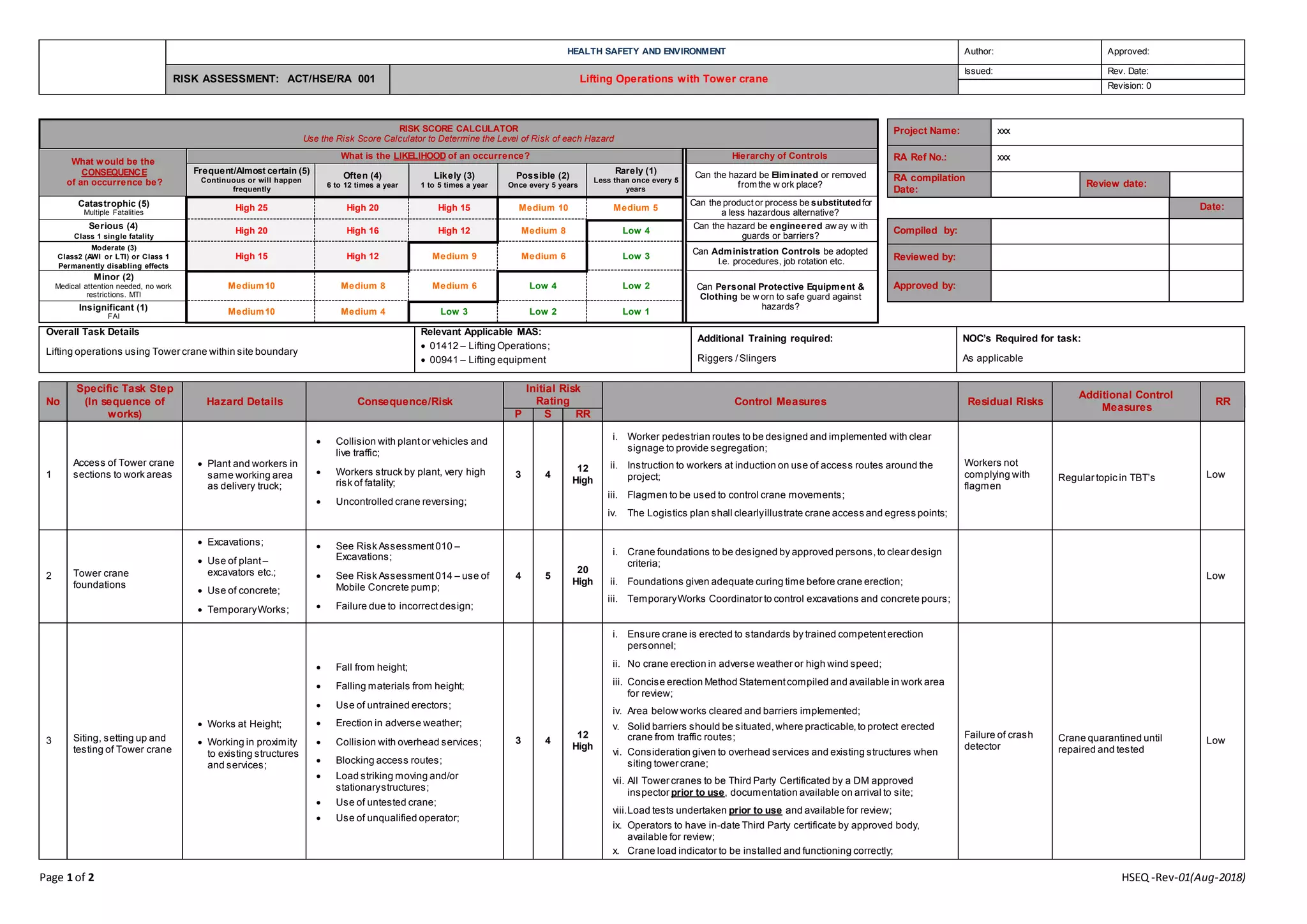
RISK SCORE CALCULATOR
Use the Risk Score Calculator to Determine the Level of Risk of each Hazard
What would be the
CONSEQUENCE
of an occurrence be?
What is the LIKELIHOOD of an occurrence? Hierarchy of Controls
Frequent/Almost certain (5)
Continuous or will happen
frequently
Often (4)
6 to 12 times a year
Likely (3)
1 to 5 times a year
Possible (2)
Once every 5 years
Rarely (1)
Less than once every 5
years
Can the hazard be Eliminated or removed
from the w ork place?
Catastrophic (5)
Multiple Fatalities
High 25 High 20 High 15 Medium 10 Medium 5
Can the product or process be substitutedfor
a less hazardous alternative?
Serious (4)
Class 1 single fatality
High 20 High 16 High 12 Medium 8 Low 4
Can the hazard be engineered aw ay w ith
guards or barriers?
Moderate (3)
Class2 (AWI or LTI) or Class 1
Permanently disabling effects
High 15 High 12 Medium 9 Medium 6 Low 3
Can Administration Controls be adopted
I.e. procedures, job rotation etc.
Minor (2)
Medical attention needed, no work
restrictions. MTI
Medium10 Medium 8 Medium 6 Low 4 Low 2 Can Personal Protective Equipment &
Clothing be w orn to safe guard against
hazards?Insignificant (1)
FAI
Medium10 Medium 4 Low 3 Low 2 Low 1
No
Specific Task Step
(In sequence of
works)
Hazard Details Consequence/Risk
Initial Risk
Rating Control Measures Residual Risks
Additional Control
Measures
RR
P S RR
1
Access of Tower crane
sections to work areas
 Plant and workers in
same working area
as delivery truck;
 Collision with plantor vehicles and
live traffic;
 Workers struck by plant, very high
risk of fatality;
 Uncontrolled crane reversing;
3 4
12
High
i. Worker pedestrian routes to be designed and implemented with clear
signage to provide segregation;
ii. Instruction to workers at induction on use of access routes around the
project;
iii. Flagmen to be used to control crane movements;
iv. The Logistics plan shall clearlyillustrate crane access and egress points;
Workers not
complying with
flagmen
Regular topic in TBT’s Low
2 Tower crane
foundations
 Excavations;
 Use of plant –
excavators etc.;
 Use of concrete;
 TemporaryWorks;
 See Risk Assessment010 –
Excavations;
 See Risk Assessment014 – use of
Mobile Concrete pump;
 Failure due to incorrectdesign;
4 5
20
High
i. Crane foundations to be designed by approved persons,to clear design
criteria;
ii. Foundations given adequate curing time before crane erection;
iii. TemporaryWorks Coordinator to control excavations and concrete pours;
Low
3 Siting, setting up and
testing of Tower crane
 Works at Height;
 Working in proximity
to existing structures
and services;
 Fall from height;
 Falling materials from height;
 Use of untrained erectors;
 Erection in adverse weather;
 Collision with overhead services;
 Blocking access routes;
 Load striking moving and/or
stationarystructures;
 Use of untested crane;
 Use of unqualified operator;
3 4
12
High
i. Ensure crane is erected to standards by trained competenterection
personnel;
ii. No crane erection in adverse weather or high wind speed;
iii. Concise erection Method Statementcompiled and available in work area
for review;
iv. Area below works cleared and barriers implemented;
v. Solid barriers should be situated,where practicable,to protect erected
crane from traffic routes;
vi. Consideration given to overhead services and existing structures when
siting tower crane;
vii. All Tower cranes to be Third Party Certificated by a DM approved
inspector prior to use, documentation available on arrival to site;
viii.Load tests undertaken prior to use and available for review;
ix. Operators to have in-date Third Party certificate by approved body,
available for review;
x. Crane load indicator to be installed and functioning correctly;
Failure of crash
detector
Crane quarantined until
repaired and tested
Low
HEALTH SAFETY AND ENVIRONMENT Author: Approved:
RISK ASSESSMENT: ACT/HSE/RA 001 Lifting Operations with Tower crane
Issued: Rev. Date:
Revision: 0
Page 2 of 2 HSEQ -Rev-01(Aug-2018)
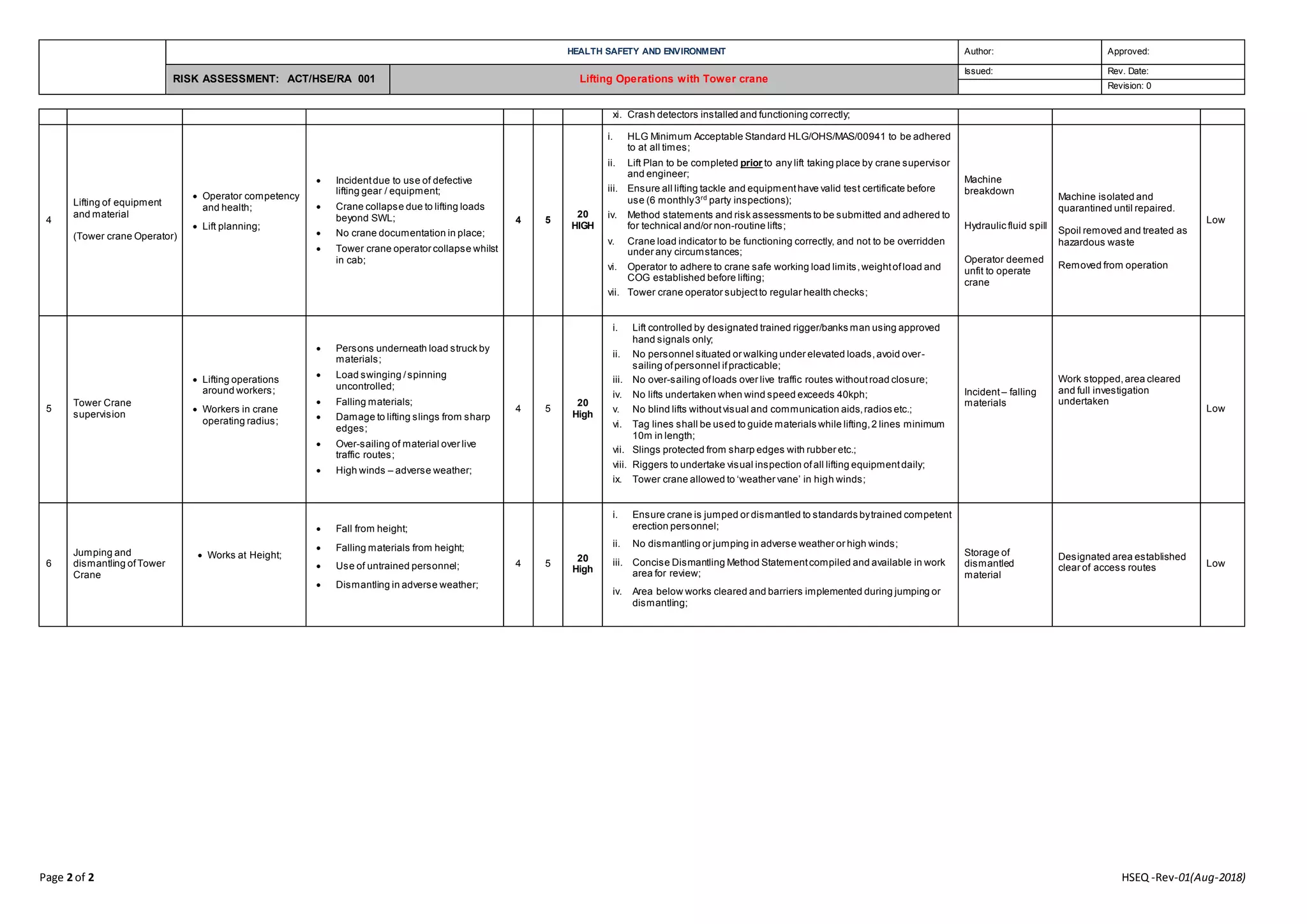
xi. Crash detectors installed and functioning correctly;
4
Lifting of equipment
and material
(Tower crane Operator)
 Operator competency
and health;
 Lift planning;
 Incidentdue to use of defective
lifting gear / equipment;
 Crane collapse due to lifting loads
beyond SWL;
 No crane documentation in place;
 Tower crane operator collapse whilst
in cab;
4 5
20
HIGH
i. HLG Minimum Acceptable Standard HLG/OHS/MAS/00941 to be adhered
to at all times;
ii. Lift Plan to be completed prior to any lift taking place by crane supervisor
and engineer;
iii. Ensure all lifting tackle and equipmenthave valid test certificate before
use (6 monthly3rd
party inspections);
iv. Method statements and risk assessments to be submitted and adhered to
for technical and/or non-routine lifts;
v. Crane load indicator to be functioning correctly, and not to be overridden
under any circumstances;
vi. Operator to adhere to crane safe working load limits,weightofload and
COG established before lifting;
vii. Tower crane operator subjectto regular health checks;
Machine
breakdown
Hydraulic fluid spill
Operator deemed
unfit to operate
crane
Machine isolated and
quarantined until repaired.
Spoil removed and treated as
hazardous waste
Removed from operation
Low
5
Tower Crane
supervision
 Lifting operations
around workers;
 Workers in crane
operating radius;
 Persons underneath load struck by
materials;
 Load swinging /spinning
uncontrolled;
 Falling materials;
 Damage to lifting slings from sharp
edges;
 Over-sailing of material over live
traffic routes;
 High winds – adverse weather;
4 5
20
High
i. Lift controlled by designated trained rigger/banks man using approved
hand signals only;
ii. No personnel situated or walking under elevated loads,avoid over-
sailing ofpersonnel ifpracticable;
iii. No over-sailing ofloads over live traffic routes withoutroad closure;
iv. No lifts undertaken when wind speed exceeds 40kph;
v. No blind lifts withoutvisual and communication aids,radios etc.;
vi. Tag lines shall be used to guide materials while lifting,2 lines minimum
10m in length;
vii. Slings protected from sharp edges with rubber etc.;
viii. Riggers to undertake visual inspection ofall lifting equipmentdaily;
ix. Tower crane allowed to ‘weather vane’ in high winds;
Incident– falling
materials
Work stopped,area cleared
and full investigation
undertaken
Low
6
Jumping and
dismantling ofTower
Crane
 Works at Height;
 Fall from height;
 Falling materials from height;
 Use of untrained personnel;
 Dismantling in adverse weather;
4 5
20
High
i. Ensure crane is jumped or dismantled to standards bytrained competent
erection personnel;
ii. No dismantling or jumping in adverse weather or high winds;
iii. Concise Dismantling Method Statementcompiled and available in work
area for review;
iv. Area below works cleared and barriers implemented during jumping or
dismantling;
Storage of
dismantled
material
Designated area established
clear of access routes Low

9 lifting operations with tower crane risk assessment templates

  • 1.
    HEALTH SAFETY ANDENVIRONMENT Author: Approved: RISK ASSESSMENT: ACT/HSE/RA 001 Lifting Operations with Tower crane Issued: Rev. Date: Revision: 0 Page 1 of 2 HSEQ -Rev-01(Aug-2018) Project Name: xxx RA Ref No.: xxx RA compilation Date: Review date: Date: Compiled by: Reviewed by: Approved by: Overall Task Details Lifting operations using Tower crane within site boundary Relevant Applicable MAS:  01412 – Lifting Operations;  00941 – Lifting equipment Additional Training required: Riggers /Slingers NOC’s Required for task: As applicable RISK SCORE CALCULATOR Use the Risk Score Calculator to Determine the Level of Risk of each Hazard What would be the CONSEQUENCE of an occurrence be? What is the LIKELIHOOD of an occurrence? Hierarchy of Controls Frequent/Almost certain (5) Continuous or will happen frequently Often (4) 6 to 12 times a year Likely (3) 1 to 5 times a year Possible (2) Once every 5 years Rarely (1) Less than once every 5 years Can the hazard be Eliminated or removed from the w ork place? Catastrophic (5) Multiple Fatalities High 25 High 20 High 15 Medium 10 Medium 5 Can the product or process be substitutedfor a less hazardous alternative? Serious (4) Class 1 single fatality High 20 High 16 High 12 Medium 8 Low 4 Can the hazard be engineered aw ay w ith guards or barriers? Moderate (3) Class2 (AWI or LTI) or Class 1 Permanently disabling effects High 15 High 12 Medium 9 Medium 6 Low 3 Can Administration Controls be adopted I.e. procedures, job rotation etc. Minor (2) Medical attention needed, no work restrictions. MTI Medium10 Medium 8 Medium 6 Low 4 Low 2 Can Personal Protective Equipment & Clothing be w orn to safe guard against hazards?Insignificant (1) FAI Medium10 Medium 4 Low 3 Low 2 Low 1 No Specific Task Step (In sequence of works) Hazard Details Consequence/Risk Initial Risk Rating Control Measures Residual Risks Additional Control Measures RR P S RR 1 Access of Tower crane sections to work areas  Plant and workers in same working area as delivery truck;  Collision with plantor vehicles and live traffic;  Workers struck by plant, very high risk of fatality;  Uncontrolled crane reversing; 3 4 12 High i. Worker pedestrian routes to be designed and implemented with clear signage to provide segregation; ii. Instruction to workers at induction on use of access routes around the project; iii. Flagmen to be used to control crane movements; iv. The Logistics plan shall clearlyillustrate crane access and egress points; Workers not complying with flagmen Regular topic in TBT’s Low 2 Tower crane foundations  Excavations;  Use of plant – excavators etc.;  Use of concrete;  TemporaryWorks;  See Risk Assessment010 – Excavations;  See Risk Assessment014 – use of Mobile Concrete pump;  Failure due to incorrectdesign; 4 5 20 High i. Crane foundations to be designed by approved persons,to clear design criteria; ii. Foundations given adequate curing time before crane erection; iii. TemporaryWorks Coordinator to control excavations and concrete pours; Low 3 Siting, setting up and testing of Tower crane  Works at Height;  Working in proximity to existing structures and services;  Fall from height;  Falling materials from height;  Use of untrained erectors;  Erection in adverse weather;  Collision with overhead services;  Blocking access routes;  Load striking moving and/or stationarystructures;  Use of untested crane;  Use of unqualified operator; 3 4 12 High i. Ensure crane is erected to standards by trained competenterection personnel; ii. No crane erection in adverse weather or high wind speed; iii. Concise erection Method Statementcompiled and available in work area for review; iv. Area below works cleared and barriers implemented; v. Solid barriers should be situated,where practicable,to protect erected crane from traffic routes; vi. Consideration given to overhead services and existing structures when siting tower crane; vii. All Tower cranes to be Third Party Certificated by a DM approved inspector prior to use, documentation available on arrival to site; viii.Load tests undertaken prior to use and available for review; ix. Operators to have in-date Third Party certificate by approved body, available for review; x. Crane load indicator to be installed and functioning correctly; Failure of crash detector Crane quarantined until repaired and tested Low
  • 2.
    HEALTH SAFETY ANDENVIRONMENT Author: Approved: RISK ASSESSMENT: ACT/HSE/RA 001 Lifting Operations with Tower crane Issued: Rev. Date: Revision: 0 Page 2 of 2 HSEQ -Rev-01(Aug-2018) xi. Crash detectors installed and functioning correctly; 4 Lifting of equipment and material (Tower crane Operator)  Operator competency and health;  Lift planning;  Incidentdue to use of defective lifting gear / equipment;  Crane collapse due to lifting loads beyond SWL;  No crane documentation in place;  Tower crane operator collapse whilst in cab; 4 5 20 HIGH i. HLG Minimum Acceptable Standard HLG/OHS/MAS/00941 to be adhered to at all times; ii. Lift Plan to be completed prior to any lift taking place by crane supervisor and engineer; iii. Ensure all lifting tackle and equipmenthave valid test certificate before use (6 monthly3rd party inspections); iv. Method statements and risk assessments to be submitted and adhered to for technical and/or non-routine lifts; v. Crane load indicator to be functioning correctly, and not to be overridden under any circumstances; vi. Operator to adhere to crane safe working load limits,weightofload and COG established before lifting; vii. Tower crane operator subjectto regular health checks; Machine breakdown Hydraulic fluid spill Operator deemed unfit to operate crane Machine isolated and quarantined until repaired. Spoil removed and treated as hazardous waste Removed from operation Low 5 Tower Crane supervision  Lifting operations around workers;  Workers in crane operating radius;  Persons underneath load struck by materials;  Load swinging /spinning uncontrolled;  Falling materials;  Damage to lifting slings from sharp edges;  Over-sailing of material over live traffic routes;  High winds – adverse weather; 4 5 20 High i. Lift controlled by designated trained rigger/banks man using approved hand signals only; ii. No personnel situated or walking under elevated loads,avoid over- sailing ofpersonnel ifpracticable; iii. No over-sailing ofloads over live traffic routes withoutroad closure; iv. No lifts undertaken when wind speed exceeds 40kph; v. No blind lifts withoutvisual and communication aids,radios etc.; vi. Tag lines shall be used to guide materials while lifting,2 lines minimum 10m in length; vii. Slings protected from sharp edges with rubber etc.; viii. Riggers to undertake visual inspection ofall lifting equipmentdaily; ix. Tower crane allowed to ‘weather vane’ in high winds; Incident– falling materials Work stopped,area cleared and full investigation undertaken Low 6 Jumping and dismantling ofTower Crane  Works at Height;  Fall from height;  Falling materials from height;  Use of untrained personnel;  Dismantling in adverse weather; 4 5 20 High i. Ensure crane is jumped or dismantled to standards bytrained competent erection personnel; ii. No dismantling or jumping in adverse weather or high winds; iii. Concise Dismantling Method Statementcompiled and available in work area for review; iv. Area below works cleared and barriers implemented during jumping or dismantling; Storage of dismantled material Designated area established clear of access routes Low