• Legal Requirements,
• OEM Maintenance,
• Tower Crane Specs
• ACD
• Wire Ropes
Prepared & Presented by
Shiva K, ME(ISE),ASP®
Indian Rules & Regulation Indian Standard International Standard
Karnataka BOCWR 2006- Chapter 2,
Lifting appliances & gears
IS 6521- Tower Crane
IS 12735- Wire Rope Slings
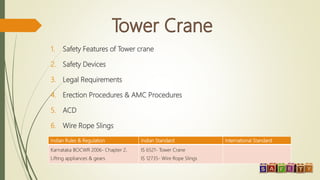
1. Safety Features of Tower crane
2. Safety Devices
3. Legal Requirements
4. Erection Procedures & AMC Procedures
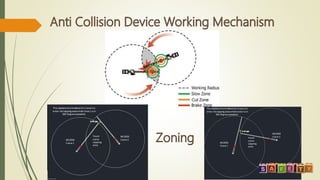
5. ACD
6. Wire Rope Slings
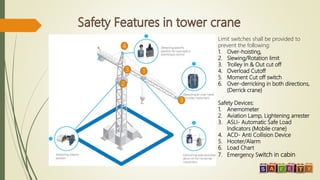
Limit switches shall be provided to
prevent the following:
1. Over-hoisting,
2. Slewing/Rotation limit
3. Trolley In & Out cut off
4. Overload Cutoff
5. Moment Cut off switch
6. Over-derricking in both directions,
(Derrick crane)
Safety Devices:
1. Anemometer
2. Aviation Lamp, Lightening arrester
3. ASLI- Automatic Safe Load
Indicators (Mobile crane)
4. ACD- Anti Collision Device
5. Hooter/Alarm
6. Load Chart
7. Emergency Switch in cabin
1
3
3
2
4
1. Weight or Over Load limit: - This limit is to safe guard the tower crane from over loading of
the materials.
2. Slewing Limit: - This limit controls the rotation of Main Jib towards one direction [it is set to
trips 11/2 rounds i.e. 360+180 degrees] It prevents the Main supply cable to get twisted/cut
3. Trolley outer Limit/Trolley inner Limit: This limit prevents the trolley travel to the maximum
reach in the main jib.
4. Hook upper Limit: - Restrict the hook Crumple with the trolley.
5. Aviation Lamp: - As per the statutory requirement.
6. Lightning Arrestor: - Fixed to avoid Lightning and a separate earthing will be provided.
7. Anemometer: - This shows the wind speed and can restrict the tower crane operation if
any increase in the wind speed.
FORM 32 (TEST CERTIFICATE )ISSUED BY COMPETENT PERSON
Karnataka BOCWR 2006
Vertigo test/ Acrophobia
SBC of Soil for foundation
Restriction of tower crane
swing in public areas
Communication system
OEM Manual
Operator Requirement
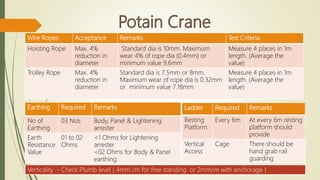
Earthing Required Remarks
No of
Earthing
03 No’s Body, Panel & Lightening
arrester
Earth
Resistance
Value
01 to 02
Ohms
<1 Ohms for Lightening
arrester
<02 Ohms for Body & Panel
earthing
Wire Ropes Acceptance Remarks Test Criteria
Hoisting Rope Max. 4%
reduction in
diameter
Standard dia is 10mm. Maximum
wear 4% of rope dia (0.4mm) or
minimum value 9.6mm
Measure 4 places in 1m
length. (Average the
value)
Trolley Rope Max. 4%
reduction in
diameter
Standard dia is 7.5mm or 8mm.
Maximum wear of rope dia is 0.32mm
or minimum value 7.18mm
Measure 4 places in 1m
length. (Average the
value)
Ladder Required Remarks
Resting
Platform
Every 6m At every 6m resting
platform should
provide
Vertical
Access
Cage There should be
hand grab rail
guarding
Verticality - Check Plumb level ( 4mm /m for free standing or 2mm/m with anchorage )
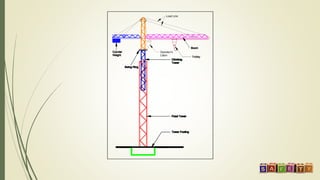
Tower FootingTower Footing
Tower Footing
Fixed Tower
Tower Footing
Fixed Tower
Climbing
Tower
Tower Footing
Fixed Tower
Climbing
Tower
Swing Ring
Tower Footing
Fixed Tower
Climbing
Tower
Swing Ring
Tower Footing
Fixed Tower
Climbing
Tower
Counter
Weight
Swing Ring
Tower Footing
Fixed Tower
Climbing
Tower
Boom
Counter
Weight
Swing Ring
Tower Footing
Fixed Tower
Climbing
Tower
Boom
Counter
Weight
Swing Ring
Trolley
Tower Footing
Fixed Tower
Climbing
Tower
Operator's
Cabin
Boom
Load Line
Counter
Weight
Swing Ring
Trolley
Tower FootingTower FootingTower FootingTower Footing
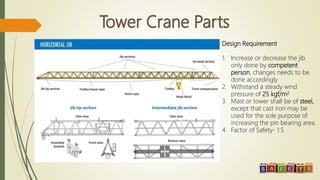
Design Requirement
1. Increase or decrease the jib
only done by competent
person, changes needs to be
done accordingly
2. Withstand a steady wind
pressure of 25 kgf/m2
3. Mast or tower shall be of steel,
except that cast iron may be
used for the sole purpose of
increasing the pin bearing area.
4. Factor of Safety- 1:5
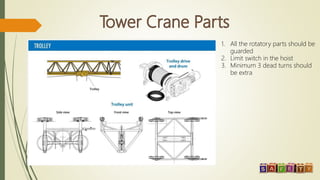
1. All the rotatory parts should be
guarded
2. Limit switch in the hoist
3. Minimum 3 dead turns should
be extra
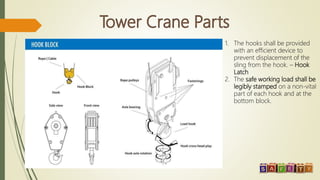
1. The hooks shall be provided
with an efficient device to
prevent displacement of the
sling from the hook. – Hook
Latch
2. The safe working load shall be
legibly stamped on a non-vital
part of each hook and at the
bottom block.
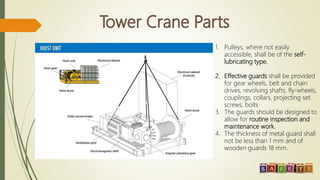
1. Pulleys, where not easily
accessible, shall be of the self-
lubricating type.
2. Effective guards shall be provided
for gear wheels, belt and chain
drives, revolving shafts, fly-wheels,
couplings, collars, projecting set
screws, bolts
3. The guards should be designed to
allow for routine inspection and
maintenance work.
4. The thickness of metal guard shall
not be less than 1 mm and of
wooden guards 18 mm.
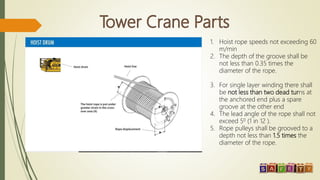
1. Hoist rope speeds not exceeding 60
m/min
2. The depth of the groove shall be
not less than 0.35 times the
diameter of the rope.
3. For single layer winding there shall
be not less than two dead turns at
the anchored end plus a spare
groove at the other end
4. The lead angle of the rope shall not
exceed 50 (1 in 12 ).
5. Rope pulleys shall be grooved to a
depth not less than 1.5 times the
diameter of the rope.
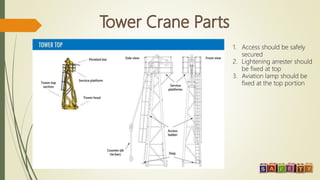
1. Access should be safely
secured
2. Lightening arrester should
be fixed at top
3. Aviation lamp should be
fixed at the top portion
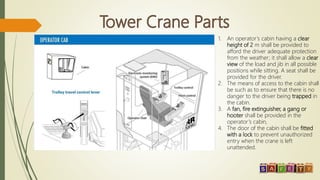
1. An operator’s cabin having a clear
height of 2 m shall be provided to
afford the driver adequate protection
from the weather; it shall allow a clear
view of the load and jib in all possible
positions while sitting. A seat shall be
provided for the driver.
2. The means of access to the cabin shall
be such as to ensure that there is no
danger to the driver being trapped in
the cabin.
3. A fan, fire extinguisher, a gang or
hooter shall be provided in the
operator’s cabin,
4. The door of the cabin shall be fitted
with a lock to prevent unauthorized
entry when the crane is left
unattended.
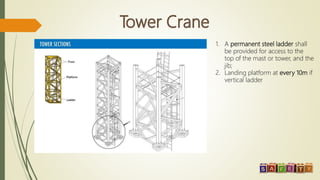
1. A permanent steel ladder shall
be provided for access to the
top of the mast or tower, and the
jib;
2. Landing platform at every 10m if
vertical ladder
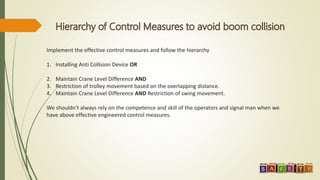
Implement the effective control measures and follow the hierarchy
1. Installing Anti Collision Device OR
2. Maintain Crane Level Difference AND
3. Restriction of trolley movement based on the overlapping distance.
4. Maintain Crane Level Difference AND Restriction of swing movement.
We shouldn't always rely on the competence and skill of the operators and signal man when we
have above effective engineered control measures.
Factor affecting tower crane stability
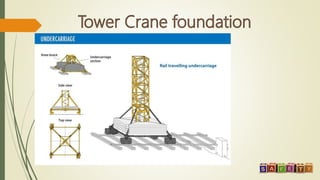
1. Foundation:
I. Water logging near the foundation
II. Undetermined SBC of soil
III. Settlement of foundation due to soil effect
2. Support/Ties:
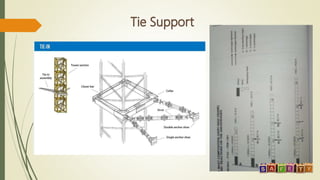
I. Proper design of column according to stress/strain details given by crane’s
manufacture(OEM)
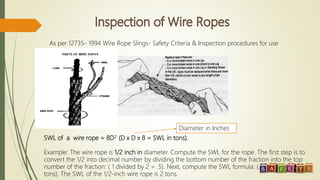
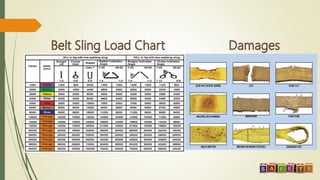
As per 12735- 1994 Wire Rope Slings- Safety Criteria & Inspection procedures for use
Discarding procedure of Broken Wires Ropes
1. Random distributed breaks-visible broken wires in any length of six rope diameters exceeds
5 % of the number of wires in the rope,
2. Localized Breaks- If there are three or more broken wires closely grouped, the sling shall be
discarded.
3. Excessive Wear- If surface wear reduces the measured diameter of the rope at any point to
less than 90 % of the nominal diameter, the sling shall be discarded.
4. Corrosion- loss of flexibility and roughness to the touch. While slight surface rusting is
unlikely to affect the rope strength, it may be indicative of internal corrosion, the effect of
which is not predictable.
5. Significant Distortion- kinking, crushing, core collapse, or knotting is identified.
6. Heat Damage- Discoloration of the wires and other evidence of overheating, such as loss of
lubrication or pitting of the wires caused by electrical arcing, etc.
7. Damaged or defective fittings, ferrules or splices
As per 12735- 1994 Wire Rope Slings- Safety Criteria & Inspection procedures for use
SWL of a wire rope = 8D2 (D x D x 8 = SWL in tons).
Example: The wire rope is 1/2 inch in diameter. Compute the SWL for the rope. The first step is to
convert the 1/2 into decimal number by dividing the bottom number of the fraction into the top
number of the fraction: ( 1 divided by 2 = .5). Next, compute the SWL formula: (.5 x .5 x 8 = 2
tons). The SWL of the 1/2-inch wire rope is 2 tons.
Diameter in Inches
LEGAL REQUIREMENTS
1.FORM 32 (TEST CERTIFICATE )ISSUED BY COMPETENT PERSON
2.OPERATOR LICENSE
3.INSURANCE COPY
4. TPI for tools & tackles
EARTHINGS
1.BODY EARTH
2.LIGHTNING ARRESTOR
3.PANEL BOARD EARTHING.
32
ADVANTAGES TO PROJECT
Time saving machine
Multipurpose in use
Heavy duty
High performance
Ease even in critical situation
Can be transferred from one project to another
When idle , no overheads
Optimum utilisation of resources
33
DISADVANTAGES
Cumbersome to erect & dismantle.
High initial cost for erection as well as
dismantling.
Skilled operators are required.
If in defective session , hampers the schedule.
Maintenance is difficult.
Sometimes create safety problems.
Limited to projects with large areas.
34
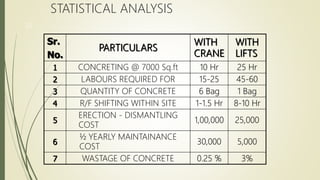
STATISTICAL ANALYSIS
Sr.
No.
PARTICULARS
WITH
CRANE
WITH
LIFTS
1 CONCRETING @ 7000 Sq.ft 10 Hr 25 Hr
2 LABOURS REQUIRED FOR 15-25 45-60
3 QUANTITY OF CONCRETE 6 Bag 1 Bag
4 R/F SHIFTING WITHIN SITE 1-1.5 Hr 8-10 Hr
5
ERECTION - DISMANTLING
COST
1,00,000 25,000
6
½ YEARLY MAINTAINANCE
COST
30,000 5,000
7 WASTAGE OF CONCRETE 0.25 % 3%
35
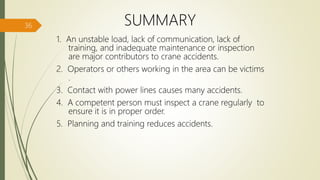
SUMMARY
1. An unstable load, lack of communication, lack of
training, and inadequate maintenance or inspection
are major contributors to crane accidents.
2. Operators or others working in the area can be victims
.
3. Contact with power lines causes many accidents.
4. A competent person must inspect a crane regularly to
ensure it is in proper order.
5. Planning and training reduces accidents.
36

Tower crane safety

  • 1.
    • Legal Requirements, •OEM Maintenance, • Tower Crane Specs • ACD • Wire Ropes Prepared & Presented by Shiva K, ME(ISE),ASP®
  • 2.
    Indian Rules &Regulation Indian Standard International Standard Karnataka BOCWR 2006- Chapter 2, Lifting appliances & gears IS 6521- Tower Crane IS 12735- Wire Rope Slings 1. Safety Features of Tower crane 2. Safety Devices 3. Legal Requirements 4. Erection Procedures & AMC Procedures 5. ACD 6. Wire Rope Slings
  • 3.
    Limit switches shallbe provided to prevent the following: 1. Over-hoisting, 2. Slewing/Rotation limit 3. Trolley In & Out cut off 4. Overload Cutoff 5. Moment Cut off switch 6. Over-derricking in both directions, (Derrick crane) Safety Devices: 1. Anemometer 2. Aviation Lamp, Lightening arrester 3. ASLI- Automatic Safe Load Indicators (Mobile crane) 4. ACD- Anti Collision Device 5. Hooter/Alarm 6. Load Chart 7. Emergency Switch in cabin 1 3 3 2 4
  • 4.
    1. Weight orOver Load limit: - This limit is to safe guard the tower crane from over loading of the materials. 2. Slewing Limit: - This limit controls the rotation of Main Jib towards one direction [it is set to trips 11/2 rounds i.e. 360+180 degrees] It prevents the Main supply cable to get twisted/cut 3. Trolley outer Limit/Trolley inner Limit: This limit prevents the trolley travel to the maximum reach in the main jib. 4. Hook upper Limit: - Restrict the hook Crumple with the trolley. 5. Aviation Lamp: - As per the statutory requirement. 6. Lightning Arrestor: - Fixed to avoid Lightning and a separate earthing will be provided. 7. Anemometer: - This shows the wind speed and can restrict the tower crane operation if any increase in the wind speed.
  • 5.
    FORM 32 (TESTCERTIFICATE )ISSUED BY COMPETENT PERSON
  • 6.
    Karnataka BOCWR 2006 Vertigotest/ Acrophobia SBC of Soil for foundation Restriction of tower crane swing in public areas Communication system OEM Manual Operator Requirement
  • 7.
    Earthing Required Remarks Noof Earthing 03 No’s Body, Panel & Lightening arrester Earth Resistance Value 01 to 02 Ohms <1 Ohms for Lightening arrester <02 Ohms for Body & Panel earthing Wire Ropes Acceptance Remarks Test Criteria Hoisting Rope Max. 4% reduction in diameter Standard dia is 10mm. Maximum wear 4% of rope dia (0.4mm) or minimum value 9.6mm Measure 4 places in 1m length. (Average the value) Trolley Rope Max. 4% reduction in diameter Standard dia is 7.5mm or 8mm. Maximum wear of rope dia is 0.32mm or minimum value 7.18mm Measure 4 places in 1m length. (Average the value) Ladder Required Remarks Resting Platform Every 6m At every 6m resting platform should provide Vertical Access Cage There should be hand grab rail guarding Verticality - Check Plumb level ( 4mm /m for free standing or 2mm/m with anchorage )
  • 8.
  • 9.
    Tower Footing Fixed Tower TowerFooting Fixed Tower Climbing Tower Tower Footing Fixed Tower Climbing Tower Swing Ring Tower Footing Fixed Tower Climbing Tower Swing Ring Tower Footing Fixed Tower Climbing Tower Counter Weight Swing Ring Tower Footing Fixed Tower Climbing Tower Boom Counter Weight Swing Ring Tower Footing Fixed Tower Climbing Tower Boom Counter Weight Swing Ring Trolley Tower Footing Fixed Tower Climbing Tower Operator's Cabin Boom Load Line Counter Weight Swing Ring Trolley Tower FootingTower FootingTower FootingTower Footing
  • 10.
    Design Requirement 1. Increaseor decrease the jib only done by competent person, changes needs to be done accordingly 2. Withstand a steady wind pressure of 25 kgf/m2 3. Mast or tower shall be of steel, except that cast iron may be used for the sole purpose of increasing the pin bearing area. 4. Factor of Safety- 1:5
  • 11.
    1. All therotatory parts should be guarded 2. Limit switch in the hoist 3. Minimum 3 dead turns should be extra
  • 13.
    1. The hooksshall be provided with an efficient device to prevent displacement of the sling from the hook. – Hook Latch 2. The safe working load shall be legibly stamped on a non-vital part of each hook and at the bottom block.
  • 14.
    1. Pulleys, wherenot easily accessible, shall be of the self- lubricating type. 2. Effective guards shall be provided for gear wheels, belt and chain drives, revolving shafts, fly-wheels, couplings, collars, projecting set screws, bolts 3. The guards should be designed to allow for routine inspection and maintenance work. 4. The thickness of metal guard shall not be less than 1 mm and of wooden guards 18 mm.
  • 15.
    1. Hoist ropespeeds not exceeding 60 m/min 2. The depth of the groove shall be not less than 0.35 times the diameter of the rope. 3. For single layer winding there shall be not less than two dead turns at the anchored end plus a spare groove at the other end 4. The lead angle of the rope shall not exceed 50 (1 in 12 ). 5. Rope pulleys shall be grooved to a depth not less than 1.5 times the diameter of the rope.
  • 16.
    1. Access shouldbe safely secured 2. Lightening arrester should be fixed at top 3. Aviation lamp should be fixed at the top portion
  • 18.
    1. An operator’scabin having a clear height of 2 m shall be provided to afford the driver adequate protection from the weather; it shall allow a clear view of the load and jib in all possible positions while sitting. A seat shall be provided for the driver. 2. The means of access to the cabin shall be such as to ensure that there is no danger to the driver being trapped in the cabin. 3. A fan, fire extinguisher, a gang or hooter shall be provided in the operator’s cabin, 4. The door of the cabin shall be fitted with a lock to prevent unauthorized entry when the crane is left unattended.
  • 23.
    1. A permanentsteel ladder shall be provided for access to the top of the mast or tower, and the jib; 2. Landing platform at every 10m if vertical ladder
  • 26.
    Implement the effectivecontrol measures and follow the hierarchy 1. Installing Anti Collision Device OR 2. Maintain Crane Level Difference AND 3. Restriction of trolley movement based on the overlapping distance. 4. Maintain Crane Level Difference AND Restriction of swing movement. We shouldn't always rely on the competence and skill of the operators and signal man when we have above effective engineered control measures.
  • 28.
    Factor affecting towercrane stability 1. Foundation: I. Water logging near the foundation II. Undetermined SBC of soil III. Settlement of foundation due to soil effect 2. Support/Ties: I. Proper design of column according to stress/strain details given by crane’s manufacture(OEM)
  • 29.
    As per 12735-1994 Wire Rope Slings- Safety Criteria & Inspection procedures for use Discarding procedure of Broken Wires Ropes 1. Random distributed breaks-visible broken wires in any length of six rope diameters exceeds 5 % of the number of wires in the rope, 2. Localized Breaks- If there are three or more broken wires closely grouped, the sling shall be discarded. 3. Excessive Wear- If surface wear reduces the measured diameter of the rope at any point to less than 90 % of the nominal diameter, the sling shall be discarded. 4. Corrosion- loss of flexibility and roughness to the touch. While slight surface rusting is unlikely to affect the rope strength, it may be indicative of internal corrosion, the effect of which is not predictable. 5. Significant Distortion- kinking, crushing, core collapse, or knotting is identified. 6. Heat Damage- Discoloration of the wires and other evidence of overheating, such as loss of lubrication or pitting of the wires caused by electrical arcing, etc. 7. Damaged or defective fittings, ferrules or splices
  • 30.
    As per 12735-1994 Wire Rope Slings- Safety Criteria & Inspection procedures for use SWL of a wire rope = 8D2 (D x D x 8 = SWL in tons). Example: The wire rope is 1/2 inch in diameter. Compute the SWL for the rope. The first step is to convert the 1/2 into decimal number by dividing the bottom number of the fraction into the top number of the fraction: ( 1 divided by 2 = .5). Next, compute the SWL formula: (.5 x .5 x 8 = 2 tons). The SWL of the 1/2-inch wire rope is 2 tons. Diameter in Inches
  • 32.
    LEGAL REQUIREMENTS 1.FORM 32(TEST CERTIFICATE )ISSUED BY COMPETENT PERSON 2.OPERATOR LICENSE 3.INSURANCE COPY 4. TPI for tools & tackles EARTHINGS 1.BODY EARTH 2.LIGHTNING ARRESTOR 3.PANEL BOARD EARTHING. 32
  • 33.
    ADVANTAGES TO PROJECT Timesaving machine Multipurpose in use Heavy duty High performance Ease even in critical situation Can be transferred from one project to another When idle , no overheads Optimum utilisation of resources 33
  • 34.
    DISADVANTAGES Cumbersome to erect& dismantle. High initial cost for erection as well as dismantling. Skilled operators are required. If in defective session , hampers the schedule. Maintenance is difficult. Sometimes create safety problems. Limited to projects with large areas. 34
  • 35.
    STATISTICAL ANALYSIS Sr. No. PARTICULARS WITH CRANE WITH LIFTS 1 CONCRETING@ 7000 Sq.ft 10 Hr 25 Hr 2 LABOURS REQUIRED FOR 15-25 45-60 3 QUANTITY OF CONCRETE 6 Bag 1 Bag 4 R/F SHIFTING WITHIN SITE 1-1.5 Hr 8-10 Hr 5 ERECTION - DISMANTLING COST 1,00,000 25,000 6 ½ YEARLY MAINTAINANCE COST 30,000 5,000 7 WASTAGE OF CONCRETE 0.25 % 3% 35
  • 36.
    SUMMARY 1. An unstableload, lack of communication, lack of training, and inadequate maintenance or inspection are major contributors to crane accidents. 2. Operators or others working in the area can be victims . 3. Contact with power lines causes many accidents. 4. A competent person must inspect a crane regularly to ensure it is in proper order. 5. Planning and training reduces accidents. 36