Click to edit Master title style
SAFETY IN LIFTING OPERATIONS
Click to edit Master title style
Safety Devices in Tower Crane
Authorized Operator & signalmen with
green card pass
Soil bearing strength, straightness of
rail.
Availing Fall Arrestor
Only one signalmen, Walkie talkie for
communication
Multiple body earthing, lighting arrestor
& Aviation lamp.
Release Swing brake after work
Don’t Operate crane if wind speed is
more than 72kmph
Standardization of Rigging gang
Click to edit Master title style
Level ground - before lifting Loads
Trenches, edges - soil collapse – Crane
Topple
No High tension lines
No Traveling - loose soil, marshy land
Signals should be taken from only one
signalmen, hand signals should be clear
No Sudden stopping or sudden movement
Tagline – Load control
out-riggers fully extended - before lifting
heavy Loads
Heavy Loads shouldn’t be lifted crane on
Tyres
Slings should be protected from sharp edges
of load
Click to edit Master title style
4
Preventing Crane Accidents
• Proper outrigger use
– Level (Even ground)
– Fully extended
– Stable compacted base
– Use cribbing to
distribute the load
– Check the oil leakage
around outrigger
(hydraulic jacks, knuckle
joints etc.)
Click to edit Master title style
You must plan lifting operations carefully to ensure they are carried out safely. Your plan should result
in a safe system of work which may need to be written down if it is a complex lift. This record is
sometimes known as a method statement, and you must ensure that everyone involved understands it.
Key elements include:
 planning – including site preparation, crane erection and dismantling;
 selection, provision and use of a suitable crane and work equipment
 Including safe slinging and signalling arrangements.
 maintenance and examination of the crane and equipment;
 provision of properly trained and competent personnel;
 supervision of operations by personnel having the necessary authority;
 thorough examinations, reports and other documents;
 preventing unauthorised movement or use of the crane; and
 measures to secure safety of persons not involved in the lifting.
Safe systems of Lifting work
Click to edit Master title style
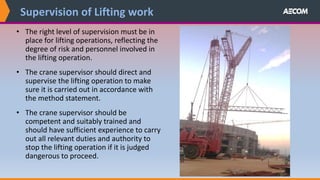
Supervision of Lifting work
• The right level of supervision must be in
place for lifting operations, reflecting the
degree of risk and personnel involved in
the lifting operation.
• The crane supervisor should direct and
supervise the lifting operation to make
sure it is carried out in accordance with
the method statement.
• The crane supervisor should be
competent and suitably trained and
should have sufficient experience to carry
out all relevant duties and authority to
stop the lifting operation if it is judged
dangerous to proceed.
Click to edit Master title style
Safety features in Hydra Crane
• Over Load Limit Switch
• Over Hoist Limit Switch
• Reverse Horn
• Hook Latch
• Large Size rear View Mirror
• Extended Front & Rear
wheel guards
Click to edit Master title style
Safety Precautions while traveling
• Always use Tag line for controlling the load
• Use low gears while traveling with load.
• Don’t travel beyond 8 kmph with load and 15
kmph without load
• Don’t drive close to pits or excavated land
• Keep Boom as low as possible, check for proximity
of over head electric lines.
• Don’t drive down slopes in neutral gear.
• Avoid Sudden stopping or jerking movements
Click to edit Master title style
To prevent the booms of cranes coming in contact with
overhead cables, goal posts should be erected.
Click to edit Master title style
Rated Voltage
kV Ph To Ph rms
Safe clearance-
Distacnce
METRE FEET
>6.6 kV 2.57 8.50
>6.6 KV <=11KV 2.59 8.50
>11 KV <=22 KV 2.64 8.75
>22 KV <=33 KV 2.75 9.00
>33 KV <=66 KV 3.00 9.75
>66 KV <=132 KV 3.43 11.25
>132 KV <=245 KV 4.57 15.00
>245 KV <=400 KV 5.48 18.00
Click to edit Master title style
Launching girder tandem lifting
Tandem Lifting Operation
LG Weight 97 MT
2. Traffic safety
 To be ensured that work area is properly barricaded and free from third party entry
 Trained watchman / Traffic Marshal provided
 Required warning board, blinkers are arranged
 Diversion board, rope light, reflection tape, are properly and distinctly provided
 Barricade boards are properly aligned and anchored
3. Access egress& working platform
 Safe access tower is erected and having “Green Tag”
 Incase height of tower is more than 6 m, suitable support is tied with pier structure
 Ladder is made of good material, free from damage, properly secured
 Working plank is properly tied, and free from any damage
 It is ensured that there is no gap left between the planks
 H – 16 beams are not used as working platform or plank
Safety precautions need to follow during “Erection”
Rigging precautions
 Lifting plan to be prepared before start of any erection and Lifting Data is checked and
found “OK”
I. Position of crane,
II. Working radius,
III. The load to be lifted Vs SWL (safe working load) of crane at that particular
working radius is checked and decided in advance.
IV. Suitable packing materials should be provided while slinging to reduce the
pressure.
 Location of front support / mid support & crane over ground marked with line.
All tools & tackles are selected as per required SWL
The crane is third party tested and having valid “GREEN CARD”
Slings, D shackle, all such lifting tools and tackle are having “Color Code” and certified
by a third party
All tools and tackles are free from any damage
Safety precautions need to follow during “Erection”
Safety precautions need to follow during
“Erection”
• Sling anchoring locations are proper for CG (Centre of gravity) balancing and properly
secured
• Lifting item is free from obstruction and any loose material kept over it
• Signalman position is such that there is no vision obstruction between him and crane
operator
• No person shall be allowed to be present below lifted load during any time
• To facilitate de hooking, person allow to go to top of pier must wear proper safety gear,
and duly anchor his full body safety harness till the time he is at top.
• Sufficient illumination to be ensured if job is to be done in dark hours
• No erection work to be done in case adverse weather condition
Rigging
Hazard
Awareness
Between the
trolley hook
and the load is
RIGGING
Ropes, Slings,
Chains
Slings
inspected daily
Proper storage
when not in
use
Suitable
protection of
rigging when
in use (items
with sharp
corners, etc..)
Rules for
Rigging
Safety
KNOW THE WEIGHT OF THE
LOAD
KNOW THE CENTER OF
GRAVITY OF THE LOAD.
MAKE LOAD ATTACHMENT
ABOVE THE CENTER OF
GRAVITY OF THE LOAD.
SELECT HITCH THAT WILL
HOLD AND CONTROL.
KNOW THE RATED CAPACITY
OF SLINGS AND HARDWARE.
Rules for Rigging
Safety
Select sling best suited for load.
Inspect all rigging before the lift.
Protect sling from sharp surfaces
Proper calculation of increased tension caused
by sling angles (on all rigging components!).
Rules for
Rigging
Safety
Lift Lift slowly and stop slowly
Know Know limitations of all lifting devices used.
Lift Lift load a few inches then check rigging
Keep Keep personnel clear from lift area.
Calculate Calculate reductions when using choker hitch.
Allow Allow for D/d ratio on all wire rope slings.
Rigging
equipment for
material handling
Rigging equipment
for material
handling
• Custom design grabs, hooks,
clamps, or other lifting
accessories, for such units as
modular panels, prefabricated
structures and similar materials
• Marked to indicate the safe
working loads
• Be proof-tested prior to use to
125 percent of their rated load
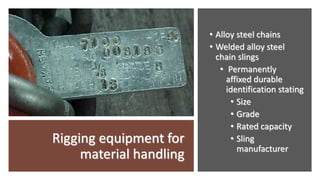
Rigging equipment for
material handling
• Alloy steel chains
• Welded alloy steel
chain slings
• Permanently
affixed durable
identification stating
• Size
• Grade
• Rated capacity
• Sling
manufacturer
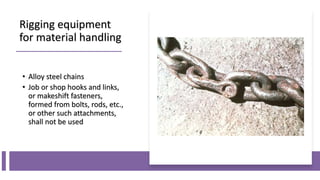
Rigging equipment
for material handling
• Alloy steel chains
• Job or shop hooks and links,
or makeshift fasteners,
formed from bolts, rods, etc.,
or other such attachments,
shall not be used
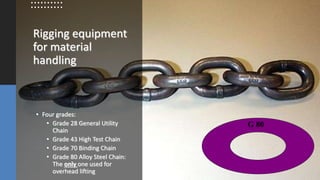
Rigging equipment
for material
handling
• Four grades:
• Grade 28 General Utility
Chain
• Grade 43 High Test Chain
• Grade 70 Binding Chain
• Grade 80 Alloy Steel Chain:
The only one used for
overhead lifting
G 80
Rigging
equipment
for
material
handling
Alloy steel chains
• Frequent
• Visual examination by the user
Inspections
• Complete link by link inspection of the
entire sling and all attachments.
• Documented
Periodic
Rigging
equipment
for material
handling
• Alloy steel chains
• CP inspections made & based on
• Frequency of sling use;
• Severity of service conditions;
• Nature of lifts being made; and
• Experience gained on the service life of
slings used in similar circumstances.
• Such inspections at least once a year
• Documented & available
Rigging equipment for material handling
• Wire rope slings
• Protruding ends of strands in splices on slings and bridles covered or
blunted
• Wire rope shall not be secured by knots
• Except for eye splices in the ends of wires and for endless rope slings,
each wire rope used in hoisting or lowering, or in pulling loads, shall
consist of one continuous piece without knot or splice
Rigging
equipment
for material
handling
Mechanical Splice
Rigging
equipment
for material
handling
Hand Tucked Eye Splice
Rigging
equipment
for material
handling
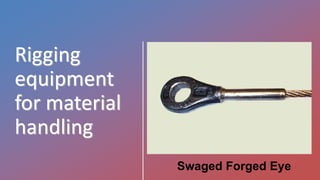
Swaged Forged Eye
Rigging
equipment for
material handling
Mechanical Splice
• Wire rope slings
• Shall not be shortened with knots or bolts or other makeshift
devices.
• Legs shall not be kinked
• Basket hitch shall have the loads balanced to prevent slippage
• Padded or protected from the sharp edges
Rigging equipment for material handling
Rigging
equipment for
material
handling
• Wire rope
• Hands or fingers shall not be
placed between the sling and
its load while the sling is being
tightened around the load
• A sling shall not be pulled from
under a load when the load is
resting on the sling
Rigging
equipment for
material handling
D
d
D/d Ratio
• D - is diameter around which sling is bent.
• d - is diameter of the sling.
Rigging equipment for
material handling
• When U-bolt wire
rope clips used to
form eyes
• U-bolt shall be
applied so that the
"U" section is in
contact with the
dead end of the rope
“Never saddle a dead horse”
Rigging equipment for
material handling
• Synthetic webbing (nylon, polyester, and polypropylene).
• The employer shall have each synthetic web sling marked
or coded to show
• Name or trademark of manufacturer
• Rated capacities for the type of hitch
• Type of material
• Rated capacity shall not be exceeded
Rigging
equipment for
material handling
• Synthetic webbing (nylon,
polyester, and polypropylene)
• Remove from service
immediately if:
• Acid or caustic burns
• Melting or charring of any
• part of the sling surface
• Snags, punctures, tears
• or cuts
• Broken or worn stitches
• Distortion of fittings
Rigging
equipment for
material
handling
• Shackles and hooks
• Manufacturers’ identification
• Never weld on hooks or shackles
• Working safety latch on hooks
Rigging equipment for material handling
Recommended
Screw Pin Anchor
Shackle
Round Pin Anchor
Shackle
Bolt Type Anchor
Shackle
Recommended
Not
Recommended
The load will bend the bolt.
Rigging
equipment for
material
handling
Never replace a shackle pin with a bolt.
Rigging equipment for material handling
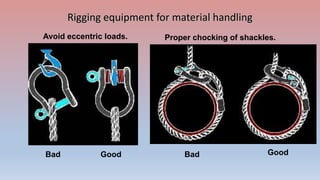
Bad Good
Avoid eccentric loads.
Good
Bad
Proper chocking of shackles.
Rigging equipment for material handling
Check wear
Check cracks, bending
and twisting
Check wear and
straightness
Pin always seated
Check opening width
Rigging equipment for material handling
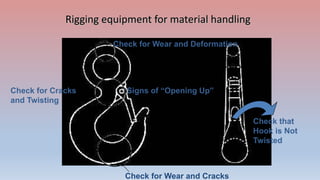
Check for Cracks
and Twisting
Check for Wear and Cracks
Check for Wear and Deformation
Signs of “Opening Up”
Check that
Hook is Not
Twisted
15% 10º
Rigging
equipment for
material
handling
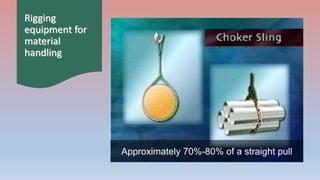
Approximately 70%-80% of a straight pull
Rigging
equipment for
material
handling
Rigging
equipment
for material
handling
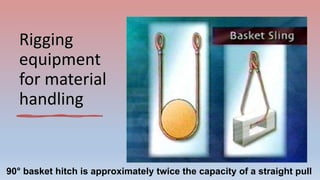
90° basket hitch is approximately twice the capacity of a straight pull
Rigging
equipment
for material
handling
LOAD
L
H
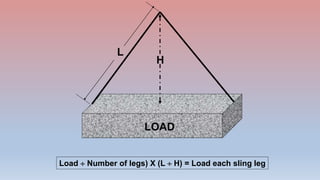
Load  Number of legs) X (L  H) = Load each sling leg
Example
Load = 120,000 pounds
4 load legs ÷ 120,000 equals
30,000 pounds each leg if vertical
hitch
Sling legs are 20 feet
Height from top of load to lifting
device is 15 feet
20 ÷ 15 = 1.33
Load on each leg is 1.33 x 30,000
= 40,000 pounds
120,000 lb.
Center of Gravity
A load is stable when:
– The hook is directly above the center of
gravity of the load
Estimate the center of gravity
Lift the load just enough to clear the
ground
If the hook is not over the center of gravity
the hook will travel to the center of gravity
CG?
Center of Gravity
If necessary, set the load down and adjust the rigging
If the load tips more than 3°, the rigging should be adjusted
The longer the sling legs, the more stable the load will be
The longer set of sling
legs (B) will improve
load stability
B
A
PREVENTIVE MEASURES TO CONTROL THE SPREAD OF CORONAVIRUS
INFECTION
 Stay home if you can and avoid gatherings of more than ten people.
 Practice social distancing by keeping a distance of about six feet from
others if you must go out in public.
 Wash your hands often with soap and water for at least 20 seconds,
especially after being in a public place, or after blowing your nose,
coughing or sneezing. If soap and water are not readily available, use
a hand sanitizer with at least 70% alcohol.
 Avoid touching your eyes, nose or mouth with unwashed hands.
 Avoid close contact with people who are sick.
 Stay home if you are sick, except to get medical care.
 Cover your nose and mouth with a tissue when coughing or sneezing;
throw used tissues in the trash. If a tissue isn’t available, cough or
sneeze into your elbow or sleeve, not your hands.
 Clean and disinfect frequently touched surfaces daily. This includes
tables, doorknobs, light switches, handles, desks, computers,
phones, keyboards, sinks, toilets, faucets and countertops.
 If surfaces are dirty, clean them - use detergent or soap and water
prior to disinfection.
 Wear a facemask if you are sick. You should wear a facemask when
you are around other people (e.g., sharing a room or vehicle) and
before you enter a healthcare provider’s office.
 Rapidly mutating pathogen and since
“Vaccination is compulsory to prevent
the severity of infection.
 Deadly animal virus after SARS and
MERS syndrome
COVID-19 CONCERNS
Agreat place to grow
Questions?
Click to edit Master title style

Lifting & Rigging Safety.pptx

  • 1.
    Click to editMaster title style SAFETY IN LIFTING OPERATIONS
  • 2.
    Click to editMaster title style Safety Devices in Tower Crane Authorized Operator & signalmen with green card pass Soil bearing strength, straightness of rail. Availing Fall Arrestor Only one signalmen, Walkie talkie for communication Multiple body earthing, lighting arrestor & Aviation lamp. Release Swing brake after work Don’t Operate crane if wind speed is more than 72kmph Standardization of Rigging gang
  • 3.
    Click to editMaster title style Level ground - before lifting Loads Trenches, edges - soil collapse – Crane Topple No High tension lines No Traveling - loose soil, marshy land Signals should be taken from only one signalmen, hand signals should be clear No Sudden stopping or sudden movement Tagline – Load control out-riggers fully extended - before lifting heavy Loads Heavy Loads shouldn’t be lifted crane on Tyres Slings should be protected from sharp edges of load
  • 4.
    Click to editMaster title style 4 Preventing Crane Accidents • Proper outrigger use – Level (Even ground) – Fully extended – Stable compacted base – Use cribbing to distribute the load – Check the oil leakage around outrigger (hydraulic jacks, knuckle joints etc.)
  • 5.
    Click to editMaster title style You must plan lifting operations carefully to ensure they are carried out safely. Your plan should result in a safe system of work which may need to be written down if it is a complex lift. This record is sometimes known as a method statement, and you must ensure that everyone involved understands it. Key elements include:  planning – including site preparation, crane erection and dismantling;  selection, provision and use of a suitable crane and work equipment  Including safe slinging and signalling arrangements.  maintenance and examination of the crane and equipment;  provision of properly trained and competent personnel;  supervision of operations by personnel having the necessary authority;  thorough examinations, reports and other documents;  preventing unauthorised movement or use of the crane; and  measures to secure safety of persons not involved in the lifting. Safe systems of Lifting work
  • 6.
    Click to editMaster title style Supervision of Lifting work • The right level of supervision must be in place for lifting operations, reflecting the degree of risk and personnel involved in the lifting operation. • The crane supervisor should direct and supervise the lifting operation to make sure it is carried out in accordance with the method statement. • The crane supervisor should be competent and suitably trained and should have sufficient experience to carry out all relevant duties and authority to stop the lifting operation if it is judged dangerous to proceed.
  • 7.
    Click to editMaster title style Safety features in Hydra Crane • Over Load Limit Switch • Over Hoist Limit Switch • Reverse Horn • Hook Latch • Large Size rear View Mirror • Extended Front & Rear wheel guards
  • 8.
    Click to editMaster title style Safety Precautions while traveling • Always use Tag line for controlling the load • Use low gears while traveling with load. • Don’t travel beyond 8 kmph with load and 15 kmph without load • Don’t drive close to pits or excavated land • Keep Boom as low as possible, check for proximity of over head electric lines. • Don’t drive down slopes in neutral gear. • Avoid Sudden stopping or jerking movements
  • 9.
    Click to editMaster title style To prevent the booms of cranes coming in contact with overhead cables, goal posts should be erected.
  • 10.
    Click to editMaster title style Rated Voltage kV Ph To Ph rms Safe clearance- Distacnce METRE FEET >6.6 kV 2.57 8.50 >6.6 KV <=11KV 2.59 8.50 >11 KV <=22 KV 2.64 8.75 >22 KV <=33 KV 2.75 9.00 >33 KV <=66 KV 3.00 9.75 >66 KV <=132 KV 3.43 11.25 >132 KV <=245 KV 4.57 15.00 >245 KV <=400 KV 5.48 18.00
  • 11.
    Click to editMaster title style Launching girder tandem lifting Tandem Lifting Operation LG Weight 97 MT
  • 12.
    2. Traffic safety To be ensured that work area is properly barricaded and free from third party entry  Trained watchman / Traffic Marshal provided  Required warning board, blinkers are arranged  Diversion board, rope light, reflection tape, are properly and distinctly provided  Barricade boards are properly aligned and anchored 3. Access egress& working platform  Safe access tower is erected and having “Green Tag”  Incase height of tower is more than 6 m, suitable support is tied with pier structure  Ladder is made of good material, free from damage, properly secured  Working plank is properly tied, and free from any damage  It is ensured that there is no gap left between the planks  H – 16 beams are not used as working platform or plank Safety precautions need to follow during “Erection”
  • 13.
    Rigging precautions  Liftingplan to be prepared before start of any erection and Lifting Data is checked and found “OK” I. Position of crane, II. Working radius, III. The load to be lifted Vs SWL (safe working load) of crane at that particular working radius is checked and decided in advance. IV. Suitable packing materials should be provided while slinging to reduce the pressure.  Location of front support / mid support & crane over ground marked with line. All tools & tackles are selected as per required SWL The crane is third party tested and having valid “GREEN CARD” Slings, D shackle, all such lifting tools and tackle are having “Color Code” and certified by a third party All tools and tackles are free from any damage Safety precautions need to follow during “Erection”
  • 14.
    Safety precautions needto follow during “Erection” • Sling anchoring locations are proper for CG (Centre of gravity) balancing and properly secured • Lifting item is free from obstruction and any loose material kept over it • Signalman position is such that there is no vision obstruction between him and crane operator • No person shall be allowed to be present below lifted load during any time • To facilitate de hooking, person allow to go to top of pier must wear proper safety gear, and duly anchor his full body safety harness till the time he is at top. • Sufficient illumination to be ensured if job is to be done in dark hours • No erection work to be done in case adverse weather condition
  • 15.
    Rigging Hazard Awareness Between the trolley hook andthe load is RIGGING Ropes, Slings, Chains Slings inspected daily Proper storage when not in use Suitable protection of rigging when in use (items with sharp corners, etc..)
  • 16.
    Rules for Rigging Safety KNOW THEWEIGHT OF THE LOAD KNOW THE CENTER OF GRAVITY OF THE LOAD. MAKE LOAD ATTACHMENT ABOVE THE CENTER OF GRAVITY OF THE LOAD. SELECT HITCH THAT WILL HOLD AND CONTROL. KNOW THE RATED CAPACITY OF SLINGS AND HARDWARE.
  • 17.
    Rules for Rigging Safety Selectsling best suited for load. Inspect all rigging before the lift. Protect sling from sharp surfaces Proper calculation of increased tension caused by sling angles (on all rigging components!).
  • 18.
    Rules for Rigging Safety Lift Liftslowly and stop slowly Know Know limitations of all lifting devices used. Lift Lift load a few inches then check rigging Keep Keep personnel clear from lift area. Calculate Calculate reductions when using choker hitch. Allow Allow for D/d ratio on all wire rope slings.
  • 19.
  • 20.
    Rigging equipment for material handling •Custom design grabs, hooks, clamps, or other lifting accessories, for such units as modular panels, prefabricated structures and similar materials • Marked to indicate the safe working loads • Be proof-tested prior to use to 125 percent of their rated load
  • 21.
    Rigging equipment for materialhandling • Alloy steel chains • Welded alloy steel chain slings • Permanently affixed durable identification stating • Size • Grade • Rated capacity • Sling manufacturer
  • 22.
    Rigging equipment for materialhandling • Alloy steel chains • Job or shop hooks and links, or makeshift fasteners, formed from bolts, rods, etc., or other such attachments, shall not be used
  • 23.
    Rigging equipment for material handling •Four grades: • Grade 28 General Utility Chain • Grade 43 High Test Chain • Grade 70 Binding Chain • Grade 80 Alloy Steel Chain: The only one used for overhead lifting G 80
  • 24.
    Rigging equipment for material handling Alloy steel chains •Frequent • Visual examination by the user Inspections • Complete link by link inspection of the entire sling and all attachments. • Documented Periodic
  • 25.
    Rigging equipment for material handling • Alloysteel chains • CP inspections made & based on • Frequency of sling use; • Severity of service conditions; • Nature of lifts being made; and • Experience gained on the service life of slings used in similar circumstances. • Such inspections at least once a year • Documented & available
  • 26.
    Rigging equipment formaterial handling • Wire rope slings • Protruding ends of strands in splices on slings and bridles covered or blunted • Wire rope shall not be secured by knots • Except for eye splices in the ends of wires and for endless rope slings, each wire rope used in hoisting or lowering, or in pulling loads, shall consist of one continuous piece without knot or splice
  • 27.
  • 28.
  • 29.
  • 30.
  • 31.
    • Wire ropeslings • Shall not be shortened with knots or bolts or other makeshift devices. • Legs shall not be kinked • Basket hitch shall have the loads balanced to prevent slippage • Padded or protected from the sharp edges Rigging equipment for material handling
  • 32.
    Rigging equipment for material handling • Wirerope • Hands or fingers shall not be placed between the sling and its load while the sling is being tightened around the load • A sling shall not be pulled from under a load when the load is resting on the sling
  • 33.
    Rigging equipment for material handling D d D/dRatio • D - is diameter around which sling is bent. • d - is diameter of the sling.
  • 34.
    Rigging equipment for materialhandling • When U-bolt wire rope clips used to form eyes • U-bolt shall be applied so that the "U" section is in contact with the dead end of the rope “Never saddle a dead horse”
  • 35.
    Rigging equipment for materialhandling • Synthetic webbing (nylon, polyester, and polypropylene). • The employer shall have each synthetic web sling marked or coded to show • Name or trademark of manufacturer • Rated capacities for the type of hitch • Type of material • Rated capacity shall not be exceeded
  • 36.
    Rigging equipment for material handling •Synthetic webbing (nylon, polyester, and polypropylene) • Remove from service immediately if: • Acid or caustic burns • Melting or charring of any • part of the sling surface • Snags, punctures, tears • or cuts • Broken or worn stitches • Distortion of fittings
  • 37.
    Rigging equipment for material handling • Shacklesand hooks • Manufacturers’ identification • Never weld on hooks or shackles • Working safety latch on hooks
  • 38.
    Rigging equipment formaterial handling Recommended Screw Pin Anchor Shackle Round Pin Anchor Shackle Bolt Type Anchor Shackle Recommended Not Recommended
  • 39.
    The load willbend the bolt. Rigging equipment for material handling Never replace a shackle pin with a bolt.
  • 40.
    Rigging equipment formaterial handling Bad Good Avoid eccentric loads. Good Bad Proper chocking of shackles.
  • 41.
    Rigging equipment formaterial handling Check wear Check cracks, bending and twisting Check wear and straightness Pin always seated Check opening width
  • 42.
    Rigging equipment formaterial handling Check for Cracks and Twisting Check for Wear and Cracks Check for Wear and Deformation Signs of “Opening Up” Check that Hook is Not Twisted 15% 10º
  • 43.
  • 44.
    Approximately 70%-80% ofa straight pull Rigging equipment for material handling
  • 45.
    Rigging equipment for material handling 90° baskethitch is approximately twice the capacity of a straight pull
  • 46.
  • 47.
    LOAD L H Load  Numberof legs) X (L  H) = Load each sling leg
  • 48.
    Example Load = 120,000pounds 4 load legs ÷ 120,000 equals 30,000 pounds each leg if vertical hitch Sling legs are 20 feet Height from top of load to lifting device is 15 feet 20 ÷ 15 = 1.33 Load on each leg is 1.33 x 30,000 = 40,000 pounds 120,000 lb.
  • 49.
    Center of Gravity Aload is stable when: – The hook is directly above the center of gravity of the load Estimate the center of gravity Lift the load just enough to clear the ground If the hook is not over the center of gravity the hook will travel to the center of gravity CG?
  • 50.
    Center of Gravity Ifnecessary, set the load down and adjust the rigging If the load tips more than 3°, the rigging should be adjusted The longer the sling legs, the more stable the load will be The longer set of sling legs (B) will improve load stability B A
  • 51.
    PREVENTIVE MEASURES TOCONTROL THE SPREAD OF CORONAVIRUS INFECTION  Stay home if you can and avoid gatherings of more than ten people.  Practice social distancing by keeping a distance of about six feet from others if you must go out in public.  Wash your hands often with soap and water for at least 20 seconds, especially after being in a public place, or after blowing your nose, coughing or sneezing. If soap and water are not readily available, use a hand sanitizer with at least 70% alcohol.  Avoid touching your eyes, nose or mouth with unwashed hands.  Avoid close contact with people who are sick.  Stay home if you are sick, except to get medical care.  Cover your nose and mouth with a tissue when coughing or sneezing; throw used tissues in the trash. If a tissue isn’t available, cough or sneeze into your elbow or sleeve, not your hands.  Clean and disinfect frequently touched surfaces daily. This includes tables, doorknobs, light switches, handles, desks, computers, phones, keyboards, sinks, toilets, faucets and countertops.  If surfaces are dirty, clean them - use detergent or soap and water prior to disinfection.  Wear a facemask if you are sick. You should wear a facemask when you are around other people (e.g., sharing a room or vehicle) and before you enter a healthcare provider’s office.  Rapidly mutating pathogen and since “Vaccination is compulsory to prevent the severity of infection.  Deadly animal virus after SARS and MERS syndrome COVID-19 CONCERNS
  • 52.
    Agreat place togrow Questions?
  • 53.
    Click to editMaster title style