HEALTH SAFETY AND ENVIRONMENT Author: Approved:
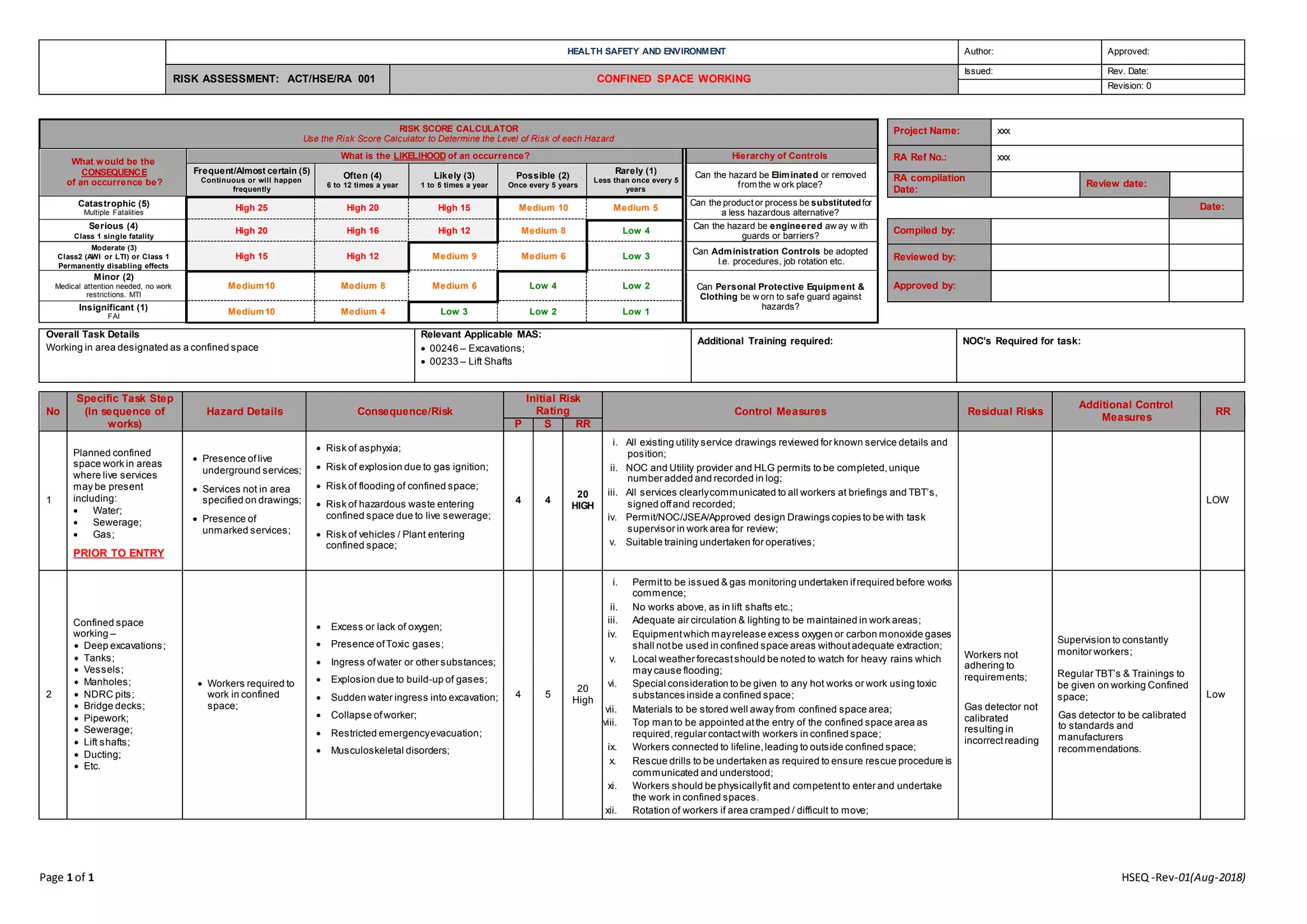
RISK ASSESSMENT: ACT/HSE/RA 001 CONFINED SPACE WORKING
Issued: Rev. Date:
Revision: 0
Page 1 of 1 HSEQ -Rev-01(Aug-2018)
No
Specific Task Step
(In sequence of
works)
Hazard Details Consequence/Risk
Initial Risk
Rating Control Measures Residual Risks
Additional Control
Measures
RR
P S RR
1
Planned confined
space work in areas
where live services
may be present
including:
 Water;
 Sewerage;
 Gas;
PRIOR TO ENTRY
 Presence oflive
underground services;
 Services not in area
specified on drawings;
 Presence of
unmarked services;
 Risk of asphyxia;
 Risk of explosion due to gas ignition;
 Risk of flooding of confined space;
 Risk of hazardous waste entering
confined space due to live sewerage;
 Risk of vehicles / Plant entering
confined space;
4 4
20
HIGH
i. All existing utility service drawings reviewed for known service details and
position;
ii. NOC and Utility provider and HLG permits to be completed,unique
number added and recorded in log;
iii. All services clearlycommunicated to all workers at briefings and TBT’s,
signed offand recorded;
iv. Permit/NOC/JSEA/Approved design Drawings copies to be with task
supervisor in work area for review;
v. Suitable training undertaken for operatives;
LOW
2
Confined space
working –
 Deep excavations;
 Tanks;
 Vessels;
 Manholes;
 NDRC pits;
 Bridge decks;
 Pipework;
 Sewerage;
 Lift shafts;
 Ducting;
 Etc.
 Workers required to
work in confined
space;
 Excess or lack of oxygen;
 Presence ofToxic gases;
 Ingress ofwater or other substances;
 Explosion due to build-up of gases;
 Sudden water ingress into excavation;
 Collapse ofworker;
 Restricted emergencyevacuation;
 Musculoskeletal disorders;
4 5
20
High
i. Permitto be issued & gas monitoring undertaken ifrequired before works
commence;
ii. No works above, as in lift shafts etc.;
iii. Adequate air circulation & lighting to be maintained in work areas;
iv. Equipmentwhich mayrelease excess oxygen or carbon monoxide gases
shall notbe used in confined space areas withoutadequate extraction;
v. Local weather forecastshould be noted to watch for heavy rains which
may cause flooding;
vi. Special consideration to be given to any hot works or work using toxic
substances inside a confined space;
vii. Materials to be stored well away from confined space area;
viii. Top man to be appointed atthe entry of the confined space area as
required,regular contactwith workers in confined space;
ix. Workers connected to lifeline,leading to outside confined space;
x. Rescue drills to be undertaken as required to ensure rescue procedure is
communicated and understood;
xi. Workers should be physicallyfit and competentto enter and undertake
the work in confined spaces.
xii. Rotation of workers if area cramped / difficult to move;
Workers not
adhering to
requirements;
Gas detector not
calibrated
resulting in
incorrectreading
Supervision to constantly
monitor workers;
Regular TBT’s & Trainings to
be given on working Confined
space;
Gas detector to be calibrated
to standards and
manufacturers
recommendations.
Low
RISK SCORE CALCULATOR
Use the Risk Score Calculator to Determine the Level of Risk of each Hazard
What would be the
CONSEQUENCE
of an occurrence be?
What is the LIKELIHOOD of an occurrence? Hierarchy of Controls
Frequent/Almost certain (5)
Continuous or will happen
frequently
Often (4)
6 to 12 times a year
Likely (3)
1 to 5 times a year
Possible (2)
Once every 5 years
Rarely (1)
Less than once every 5
years
Can the hazard be Eliminated or removed
from the w ork place?
Catastrophic (5)
Multiple Fatalities
High 25 High 20 High 15 Medium 10 Medium 5
Can the product or process be substitutedfor
a less hazardous alternative?
Serious (4)
Class 1 single fatality
High 20 High 16 High 12 Medium 8 Low 4
Can the hazard be engineered aw ay w ith
guards or barriers?
Moderate (3)
Class2 (AWI or LTI) or Class 1
Permanently disabling effects
High 15 High 12 Medium 9 Medium 6 Low 3
Can Administration Controls be adopted
I.e. procedures, job rotation etc.
Minor (2)
Medical attention needed, no work
restrictions. MTI
Medium10 Medium 8 Medium 6 Low 4 Low 2 Can Personal Protective Equipment &
Clothing be w orn to safe guard against
hazards?Insignificant (1)
FAI
Medium10 Medium 4 Low 3 Low 2 Low 1
Project Name: xxx
RA Ref No.: xxx
RA compilation
Date:
Review date:
Date:
Compiled by:
Reviewed by:
Approved by:
Overall Task Details
Working in area designated as a confined space
Relevant Applicable MAS:
 00246 – Excavations;
 00233 – Lift Shafts
Additional Training required: NOC’s Required for task:

21 confined space working risk assessment templates

  • 1.
    HEALTH SAFETY ANDENVIRONMENT Author: Approved: RISK ASSESSMENT: ACT/HSE/RA 001 CONFINED SPACE WORKING Issued: Rev. Date: Revision: 0 Page 1 of 1 HSEQ -Rev-01(Aug-2018) No Specific Task Step (In sequence of works) Hazard Details Consequence/Risk Initial Risk Rating Control Measures Residual Risks Additional Control Measures RR P S RR 1 Planned confined space work in areas where live services may be present including:  Water;  Sewerage;  Gas; PRIOR TO ENTRY  Presence oflive underground services;  Services not in area specified on drawings;  Presence of unmarked services;  Risk of asphyxia;  Risk of explosion due to gas ignition;  Risk of flooding of confined space;  Risk of hazardous waste entering confined space due to live sewerage;  Risk of vehicles / Plant entering confined space; 4 4 20 HIGH i. All existing utility service drawings reviewed for known service details and position; ii. NOC and Utility provider and HLG permits to be completed,unique number added and recorded in log; iii. All services clearlycommunicated to all workers at briefings and TBT’s, signed offand recorded; iv. Permit/NOC/JSEA/Approved design Drawings copies to be with task supervisor in work area for review; v. Suitable training undertaken for operatives; LOW 2 Confined space working –  Deep excavations;  Tanks;  Vessels;  Manholes;  NDRC pits;  Bridge decks;  Pipework;  Sewerage;  Lift shafts;  Ducting;  Etc.  Workers required to work in confined space;  Excess or lack of oxygen;  Presence ofToxic gases;  Ingress ofwater or other substances;  Explosion due to build-up of gases;  Sudden water ingress into excavation;  Collapse ofworker;  Restricted emergencyevacuation;  Musculoskeletal disorders; 4 5 20 High i. Permitto be issued & gas monitoring undertaken ifrequired before works commence; ii. No works above, as in lift shafts etc.; iii. Adequate air circulation & lighting to be maintained in work areas; iv. Equipmentwhich mayrelease excess oxygen or carbon monoxide gases shall notbe used in confined space areas withoutadequate extraction; v. Local weather forecastshould be noted to watch for heavy rains which may cause flooding; vi. Special consideration to be given to any hot works or work using toxic substances inside a confined space; vii. Materials to be stored well away from confined space area; viii. Top man to be appointed atthe entry of the confined space area as required,regular contactwith workers in confined space; ix. Workers connected to lifeline,leading to outside confined space; x. Rescue drills to be undertaken as required to ensure rescue procedure is communicated and understood; xi. Workers should be physicallyfit and competentto enter and undertake the work in confined spaces. xii. Rotation of workers if area cramped / difficult to move; Workers not adhering to requirements; Gas detector not calibrated resulting in incorrectreading Supervision to constantly monitor workers; Regular TBT’s & Trainings to be given on working Confined space; Gas detector to be calibrated to standards and manufacturers recommendations. Low RISK SCORE CALCULATOR Use the Risk Score Calculator to Determine the Level of Risk of each Hazard What would be the CONSEQUENCE of an occurrence be? What is the LIKELIHOOD of an occurrence? Hierarchy of Controls Frequent/Almost certain (5) Continuous or will happen frequently Often (4) 6 to 12 times a year Likely (3) 1 to 5 times a year Possible (2) Once every 5 years Rarely (1) Less than once every 5 years Can the hazard be Eliminated or removed from the w ork place? Catastrophic (5) Multiple Fatalities High 25 High 20 High 15 Medium 10 Medium 5 Can the product or process be substitutedfor a less hazardous alternative? Serious (4) Class 1 single fatality High 20 High 16 High 12 Medium 8 Low 4 Can the hazard be engineered aw ay w ith guards or barriers? Moderate (3) Class2 (AWI or LTI) or Class 1 Permanently disabling effects High 15 High 12 Medium 9 Medium 6 Low 3 Can Administration Controls be adopted I.e. procedures, job rotation etc. Minor (2) Medical attention needed, no work restrictions. MTI Medium10 Medium 8 Medium 6 Low 4 Low 2 Can Personal Protective Equipment & Clothing be w orn to safe guard against hazards?Insignificant (1) FAI Medium10 Medium 4 Low 3 Low 2 Low 1 Project Name: xxx RA Ref No.: xxx RA compilation Date: Review date: Date: Compiled by: Reviewed by: Approved by: Overall Task Details Working in area designated as a confined space Relevant Applicable MAS:  00246 – Excavations;  00233 – Lift Shafts Additional Training required: NOC’s Required for task: