KNOWLEDGE INSTITUTE OF TECHNOLOGY
AN AUTONOMOUS INSTITUTION
DEPARTMENT OF MECHANICAL ENGINEERING
M.E. (INDUSTIAL SAFETY ENGINEERING)
TECHNICAL SEMINAR
CRANE AND HOIST SAFETY
REVIEW - I
Presented by
Magesh Varmha K S
611223423009
PG INCHARGE:
Dr.V.SIVAKUMAR, M.E, Ph.D
Assistant Professor ,
Knowledge Institute of Technology,
Salem
FACULTY INCHARGE:
Mr.G.THANGARAJ M.E,
Assistant Professor ,
Knowledge Institute of Technology,
Salem
CONTENT
• INTRODUCTION
• TYPES OF CRANES AND HOIST
• LITERATURE REVIEW
• HAZARD IN USING CRANE
• CRANE / HOIST OPERATION
• INSPECTIONS
• LIFTING OPERATION STANDERD
• LIFTING PRINCIPLE
• HAND SIGNELS
• CRANE INSPECTION FORM
• SAFE WORK LOAD LIMIT(SWL)
• SIMPLE RULE FOR LIFTING
• CONCLUSION
• REFERENCE
2
29-01-2024
INTRODUCTION
29-01-2024 3
Myself Magesh Varmha K S, pursuing M.E in Industrial safety Engineering in
Knowledge Institute of Technology.
I am doing this Technical seminar as a part of First semester, I have chosen the topic
as “Crane and Hoist Safety”. The seminar is based on the Crane Hazards and Risk
associated in Lifting, Safe Working Procedure During Lifting, Rigging.
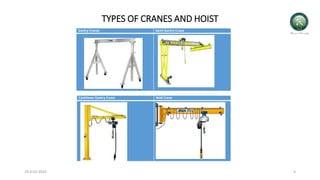
TYPES OF CRANES AND HOIST
Gantry Cranes Semi-Gantry Crane
29-0-01-2024 4
Cantilever Gantry Crane Wall Crane
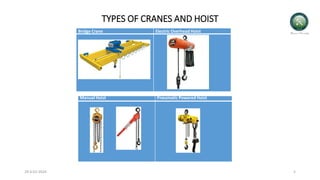
TYPES OF CRANES AND HOIST
Bridge Crane Electric Overhead Hoist
29-0-01-2024 5
Manual Hoist Pneumatic Powered Hoist
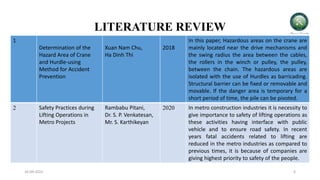
LITERATURE REVIEW
1
Determination of the
Hazard Area of Crane
and Hurdle-using
Method for Accident
Prevention
Xuan Nam Chu,
Ha Dinh Thi
2018
In this paper, Hazardous areas on the crane are
mainly located near the drive mechanisms and
the swing radius the area between the cables,
the rollers in the winch or pulley, the pulley,
between the chain. The hazardous areas are
isolated with the use of Hurdles as barricading.
Structural barrier can be fixed or removable and
movable. If the danger area is temporary for a
short period of time, the pile can be pivoted.
2 Safety Practices during
Lifting Operations in
Metro Projects
Rambabu Pitani,
Dr. S. P. Venkatesan,
Mr. S. Karthikeyan
2020 In metro construction industries it is necessity to
give importance to safety of lifting operations as
these activities having interface with public
vehicle and to ensure road safety. In recent
years fatal accidents related to lifting are
reduced in the metro industries as compared to
previous times, it is because of companies are
giving highest priority to safety of the people.
16-09-2022 6
HAZARD IN USING CRANE
• The operation of cranes and hoists in industrial settings introduces
various hazards that necessitate careful consideration and adherence
to strict safety protocols. One primary concern is the risk of falling
objects, where inadequately secured loads can pose a serious threat
to workers below.
• Overloading, unsafe lifting practices, and inadequate communication
between operators and ground personnel further contribute to the
list of potential dangers. Weather conditions, like high winds, can
compromise the stability of cranes, adding another layer of risk.
• Electrical hazards are also prevalent, as cranes and hoists frequently
rely on electrical power, making malfunctioning components a risk for
electric shocks or fires
29-0-01-2024 7
Crane / Hoist Operators
• Attend training on the requirements of the Crane and Hoist Safety
Program.
• Work only on equipment for which they have received training.
• Follow all crane operating procedures.
• Conduct the appropriate inspections when they are required and complete
the required documentation when necessary.
• Notify their supervisor of any deficiencies identified during inspections.
• Report all incidents involving cranes and hoists to supervisors immediately.
29-0-01-2024 8
INSPECTIONS
• Cranes must be consistently inspected to prevent equipment failure and incidents
and to determine whether cranes and crane components can be expected to
perform as intended. Crane and Hoist inspections are divided into five general
classifications:
• Initial Inspection
• Functional Inspection – Pre-use Inspection
• Frequent Inspection – After 750 hours of use between periodic
inspections
• Periodic Inspection – Quarterly
• Inspection of equipment not in regular use
29-0-01-2024 9
LIFTING OPERATION
29-0-01-2024 10
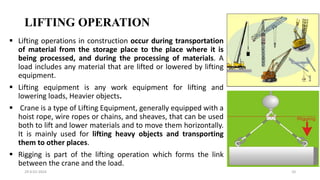
 Lifting operations in construction occur during transportation
of material from the storage place to the place where it is
being processed, and during the processing of materials. A
load includes any material that are lifted or lowered by lifting
equipment.
 Lifting equipment is any work equipment for lifting and
lowering loads, Heavier objects.
 Crane is a type of Lifting Equipment, generally equipped with a
hoist rope, wire ropes or chains, and sheaves, that can be used
both to lift and lower materials and to move them horizontally.
It is mainly used for lifting heavy objects and transporting
them to other places.
 Rigging is part of the lifting operation which forms the link
between the crane and the load.
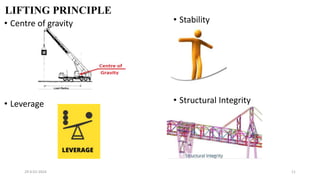
LIFTING PRINCIPLE
29-0-01-2024 11
• Centre of gravity
• Leverage
• Stability
• Structural Integrity
Hand Signals
29-0-01-2024 10
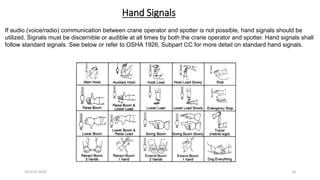
If audio (voice/radio) communication between crane operator and spotter is not possible, hand signals should be
utilized. Signals must be discernible or audible at all times by both the crane operator and spotter. Hand signals shall
follow standard signals. See below or refer to OSHA 1926, Subpart CC for more detail on standard hand signals.
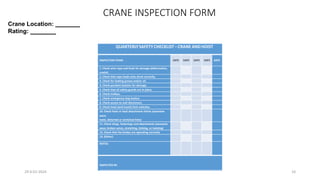
CRANE INSPECTION FORM
29-0-01-2024 10
Crane Location:
Rating:
QUARTERLYSAFETYCHECKLIST –CRANE AND HOIST
INSPECTION ITEMS DATE DATE DATE DATE DATE
1. Check wire rope and hook for damage (deformation,
cracks).
2. Check that rope loads onto drum correctly.
3. Check for leaking grease and/or oil.
4. Check pendant buttons for damage.
5. Check that all safety guards are in place.
6. Check trolleys.
7. Check emergency stop button.
8. Check access to wall disconnect.
9. Check hoist (and travel) limit switches.
10. Check hoist or load attachment chains (excessive
wear,
twist, distorted or stretched links)
11. Check slings, fastenings and attachments (excessive
wear, broken wires, stretching, kinking, or twisting)
12. Check that the brakes are operating correctly
13. (Other)
NOTES:
INSPECTED BY:
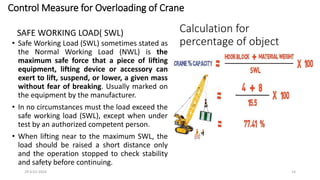
SAFE WORKING LOAD( SWL)
• Safe Working Load (SWL) sometimes stated as
the Normal Working Load (NWL) is the
maximum safe force that a piece of lifting
equipment, lifting device or accessory can
exert to lift, suspend, or lower, a given mass
without fear of breaking. Usually marked on
the equipment by the manufacturer.
• In no circumstances must the load exceed the
safe working load (SWL), except when under
test by an authorized competent person.
• When lifting near to the maximum SWL, the
load should be raised a short distance only
and the operation stopped to check stability
and safety before continuing.
29-0-01-2024 14
Calculation for
percentage of object
Control Measure for Overloading of Crane
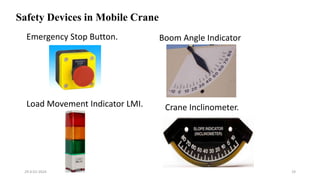
Safety Devices in Mobile Crane
Emergency Stop Button.
Load Movement Indicator LMI.
Boom Angle Indicator
Crane Inclinometer.
29-0-01-2024 19
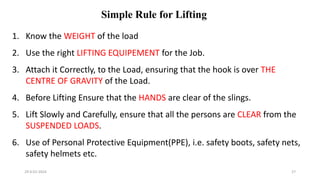
1. Know the WEIGHT of the load
2. Use the right LIFTING EQUIPEMENT for the Job.
3. Attach it Correctly, to the Load, ensuring that the hook is over THE
CENTRE OF GRAVITY of the Load.
4. Before Lifting Ensure that the HANDS are clear of the slings.
5. Lift Slowly and Carefully, ensure that all the persons are CLEAR from the
SUSPENDED LOADS.
6. Use of Personal Protective Equipment(PPE), i.e. safety boots, safety nets,
safety helmets etc.
Simple Rule for Lifting
29-0-01-2024 27
CONCLUSION
29-0-01-2024 28
In conclusion, the collective integration of regulatory compliance,
technological advancements, human factors considerations, and proactive
maintenance practices forms a holistic approach to crane and hoist safety. By
embracing these principles, organizations can foster a safer work environment,
protect the well-being of personnel, and contribute to the overall productivity
and sustainability of operations in the field of crane and hoist systems.
Accidents involving cranes can severely damage people and
companies. Unfortunately these show a constant trend in term of number of
fatalities over the years. By analysing the causes of accidents, major number of
accidents are caused by Electrical hazards, Crane Collapsing and Struck by
Loads.
For the above major accidents, the Control Measures and Safety Precautions
were discussed in this presentation.
REFERENCES
29-0-01-2024 29
• The Tamil Nadu Building and other Construction Workers (Regulation of
Employment and Conditions of Service) Rules, 2006
• National Safety Council, Lifting Operations books and films.
• RRTS Metro Project Lifting Operation Requirements
• Metro Projects - Safety Health & Environment condition of contract.
• OSHA (Occupational Safety , Health Administration); Cranes and Derricks in
Construction
• OSHA (Occupational Safety and Health Administration); Qualifications of
machinery operators and supervisory training.
• General Requirements of Mechanical Handling – KU Mistry Book.

TS-1 - PPT MAGESH.ppt

  • 1.
    KNOWLEDGE INSTITUTE OFTECHNOLOGY AN AUTONOMOUS INSTITUTION DEPARTMENT OF MECHANICAL ENGINEERING M.E. (INDUSTIAL SAFETY ENGINEERING) TECHNICAL SEMINAR CRANE AND HOIST SAFETY REVIEW - I Presented by Magesh Varmha K S 611223423009 PG INCHARGE: Dr.V.SIVAKUMAR, M.E, Ph.D Assistant Professor , Knowledge Institute of Technology, Salem FACULTY INCHARGE: Mr.G.THANGARAJ M.E, Assistant Professor , Knowledge Institute of Technology, Salem
  • 2.
    CONTENT • INTRODUCTION • TYPESOF CRANES AND HOIST • LITERATURE REVIEW • HAZARD IN USING CRANE • CRANE / HOIST OPERATION • INSPECTIONS • LIFTING OPERATION STANDERD • LIFTING PRINCIPLE • HAND SIGNELS • CRANE INSPECTION FORM • SAFE WORK LOAD LIMIT(SWL) • SIMPLE RULE FOR LIFTING • CONCLUSION • REFERENCE 2 29-01-2024
  • 3.
    INTRODUCTION 29-01-2024 3 Myself MageshVarmha K S, pursuing M.E in Industrial safety Engineering in Knowledge Institute of Technology. I am doing this Technical seminar as a part of First semester, I have chosen the topic as “Crane and Hoist Safety”. The seminar is based on the Crane Hazards and Risk associated in Lifting, Safe Working Procedure During Lifting, Rigging.
  • 4.
    TYPES OF CRANESAND HOIST Gantry Cranes Semi-Gantry Crane 29-0-01-2024 4 Cantilever Gantry Crane Wall Crane
  • 5.
    TYPES OF CRANESAND HOIST Bridge Crane Electric Overhead Hoist 29-0-01-2024 5 Manual Hoist Pneumatic Powered Hoist
  • 6.
    LITERATURE REVIEW 1 Determination ofthe Hazard Area of Crane and Hurdle-using Method for Accident Prevention Xuan Nam Chu, Ha Dinh Thi 2018 In this paper, Hazardous areas on the crane are mainly located near the drive mechanisms and the swing radius the area between the cables, the rollers in the winch or pulley, the pulley, between the chain. The hazardous areas are isolated with the use of Hurdles as barricading. Structural barrier can be fixed or removable and movable. If the danger area is temporary for a short period of time, the pile can be pivoted. 2 Safety Practices during Lifting Operations in Metro Projects Rambabu Pitani, Dr. S. P. Venkatesan, Mr. S. Karthikeyan 2020 In metro construction industries it is necessity to give importance to safety of lifting operations as these activities having interface with public vehicle and to ensure road safety. In recent years fatal accidents related to lifting are reduced in the metro industries as compared to previous times, it is because of companies are giving highest priority to safety of the people. 16-09-2022 6
  • 7.
    HAZARD IN USINGCRANE • The operation of cranes and hoists in industrial settings introduces various hazards that necessitate careful consideration and adherence to strict safety protocols. One primary concern is the risk of falling objects, where inadequately secured loads can pose a serious threat to workers below. • Overloading, unsafe lifting practices, and inadequate communication between operators and ground personnel further contribute to the list of potential dangers. Weather conditions, like high winds, can compromise the stability of cranes, adding another layer of risk. • Electrical hazards are also prevalent, as cranes and hoists frequently rely on electrical power, making malfunctioning components a risk for electric shocks or fires 29-0-01-2024 7
  • 8.
    Crane / HoistOperators • Attend training on the requirements of the Crane and Hoist Safety Program. • Work only on equipment for which they have received training. • Follow all crane operating procedures. • Conduct the appropriate inspections when they are required and complete the required documentation when necessary. • Notify their supervisor of any deficiencies identified during inspections. • Report all incidents involving cranes and hoists to supervisors immediately. 29-0-01-2024 8
  • 9.
    INSPECTIONS • Cranes mustbe consistently inspected to prevent equipment failure and incidents and to determine whether cranes and crane components can be expected to perform as intended. Crane and Hoist inspections are divided into five general classifications: • Initial Inspection • Functional Inspection – Pre-use Inspection • Frequent Inspection – After 750 hours of use between periodic inspections • Periodic Inspection – Quarterly • Inspection of equipment not in regular use 29-0-01-2024 9
  • 10.
    LIFTING OPERATION 29-0-01-2024 10 Lifting operations in construction occur during transportation of material from the storage place to the place where it is being processed, and during the processing of materials. A load includes any material that are lifted or lowered by lifting equipment.  Lifting equipment is any work equipment for lifting and lowering loads, Heavier objects.  Crane is a type of Lifting Equipment, generally equipped with a hoist rope, wire ropes or chains, and sheaves, that can be used both to lift and lower materials and to move them horizontally. It is mainly used for lifting heavy objects and transporting them to other places.  Rigging is part of the lifting operation which forms the link between the crane and the load.
  • 11.
    LIFTING PRINCIPLE 29-0-01-2024 11 •Centre of gravity • Leverage • Stability • Structural Integrity
  • 12.
    Hand Signals 29-0-01-2024 10 Ifaudio (voice/radio) communication between crane operator and spotter is not possible, hand signals should be utilized. Signals must be discernible or audible at all times by both the crane operator and spotter. Hand signals shall follow standard signals. See below or refer to OSHA 1926, Subpart CC for more detail on standard hand signals.
  • 13.
    CRANE INSPECTION FORM 29-0-01-202410 Crane Location: Rating: QUARTERLYSAFETYCHECKLIST –CRANE AND HOIST INSPECTION ITEMS DATE DATE DATE DATE DATE 1. Check wire rope and hook for damage (deformation, cracks). 2. Check that rope loads onto drum correctly. 3. Check for leaking grease and/or oil. 4. Check pendant buttons for damage. 5. Check that all safety guards are in place. 6. Check trolleys. 7. Check emergency stop button. 8. Check access to wall disconnect. 9. Check hoist (and travel) limit switches. 10. Check hoist or load attachment chains (excessive wear, twist, distorted or stretched links) 11. Check slings, fastenings and attachments (excessive wear, broken wires, stretching, kinking, or twisting) 12. Check that the brakes are operating correctly 13. (Other) NOTES: INSPECTED BY:
  • 14.
    SAFE WORKING LOAD(SWL) • Safe Working Load (SWL) sometimes stated as the Normal Working Load (NWL) is the maximum safe force that a piece of lifting equipment, lifting device or accessory can exert to lift, suspend, or lower, a given mass without fear of breaking. Usually marked on the equipment by the manufacturer. • In no circumstances must the load exceed the safe working load (SWL), except when under test by an authorized competent person. • When lifting near to the maximum SWL, the load should be raised a short distance only and the operation stopped to check stability and safety before continuing. 29-0-01-2024 14 Calculation for percentage of object Control Measure for Overloading of Crane
  • 15.
    Safety Devices inMobile Crane Emergency Stop Button. Load Movement Indicator LMI. Boom Angle Indicator Crane Inclinometer. 29-0-01-2024 19
  • 16.
    1. Know theWEIGHT of the load 2. Use the right LIFTING EQUIPEMENT for the Job. 3. Attach it Correctly, to the Load, ensuring that the hook is over THE CENTRE OF GRAVITY of the Load. 4. Before Lifting Ensure that the HANDS are clear of the slings. 5. Lift Slowly and Carefully, ensure that all the persons are CLEAR from the SUSPENDED LOADS. 6. Use of Personal Protective Equipment(PPE), i.e. safety boots, safety nets, safety helmets etc. Simple Rule for Lifting 29-0-01-2024 27
  • 17.
    CONCLUSION 29-0-01-2024 28 In conclusion,the collective integration of regulatory compliance, technological advancements, human factors considerations, and proactive maintenance practices forms a holistic approach to crane and hoist safety. By embracing these principles, organizations can foster a safer work environment, protect the well-being of personnel, and contribute to the overall productivity and sustainability of operations in the field of crane and hoist systems. Accidents involving cranes can severely damage people and companies. Unfortunately these show a constant trend in term of number of fatalities over the years. By analysing the causes of accidents, major number of accidents are caused by Electrical hazards, Crane Collapsing and Struck by Loads. For the above major accidents, the Control Measures and Safety Precautions were discussed in this presentation.
  • 18.
    REFERENCES 29-0-01-2024 29 • TheTamil Nadu Building and other Construction Workers (Regulation of Employment and Conditions of Service) Rules, 2006 • National Safety Council, Lifting Operations books and films. • RRTS Metro Project Lifting Operation Requirements • Metro Projects - Safety Health & Environment condition of contract. • OSHA (Occupational Safety , Health Administration); Cranes and Derricks in Construction • OSHA (Occupational Safety and Health Administration); Qualifications of machinery operators and supervisory training. • General Requirements of Mechanical Handling – KU Mistry Book.

Editor's Notes

  • #3 Section 28 / calculation of percentage – lifting plan risk assessment, job site consideration
  • #17 2
  • #18 2
  • #19 2