HEALTH SAFETY AND ENVIRONMENT Author: Approved:
RISK ASSESSMENT: ACT/HSE/RA 001 DEEP EXCAVATIONS TO MAS STANDARD
Issued: Rev. Date:
Revision: 0
Page 1 of 3 HSEQ -Rev-01(Aug-2018)
RISK SCORE CALCULATOR
Use the Risk Score Calculator to Determine the Level of Risk of each Hazard
What would be the
CONSEQUENCE
of an occurrence be?
What is the LIKELIHOOD of an occurrence? Hierarchy of Controls
Frequent/Almost certain (5)
Continuous or will happen
frequently
Often (4)
6 to 12 times a year
Likely (3)
1 to 5 times a year
Possible (2)
Once every 5 years
Rarely (1)
Less than once every 5
years
Can the hazard be Eliminated or removed
from the w ork place?
Catastrophic (5)
Multiple Fatalities
High 25 High 20 High 15 Medium 10 Medium 5
Can the product or process be substitutedfor
a less hazardous alternative?
Serious (4)
Class 1 single fatality
High 20 High 16 High 12 Medium 8 Low 4
Can the hazard be engineered aw ay w ith
guards or barriers?
Moderate (3)
Class2 (AWI or LTI) or Class 1
Permanently disabling effects
High 15 High 12 Medium 9 Medium 6 Low 3
Can Administration Controls be adopted
I.e. procedures, job rotation etc.
Minor (2)
Medical attention needed, no work
restrictions. MTI
Medium10 Medium 8 Medium 6 Low 4 Low 2 Can Personal Protective Equipment &
Clothing be w orn to safe guard against
hazards?Insignificant (1)
FAI
Medium10 Medium 4 Low 3 Low 2 Low 1
Project Name: xxx
RA Ref No.: xxx
RA compilation
Date:
Review date:
Date:
Compiled by:
Reviewed by:
Approved by:
Overall Task Details
Excavation on site greater than 1.2 depth. Use of excavator
Note: Not under RTA Rail restrictions. Classed as TemporaryWorks
Relevant Applicable MAS:
 00246 – Excavations;
 01413 – Underground services;
 00940 – PlantOperators.
Additional Training required:
TemporaryWorks Coordinator to be designated
NOC’s Required for task:
Dubai Municipality
No
Specific Task Step
(In sequence of
works)
Hazard Details Consequence/Risk
Initial Risk
Rating Control Measures Residual Risks
Additional Control
Measures
RR
P S RR
1
Planned Excavation in
areas where live
services maybe
presentincluding:
 Electrical;
 Water;
 Sewerage;
 Gas;
 Telecoms;
PRIOR TO
WORKS
 Presence oflive
underground services;
 Services not in area
specified on drawings;
 Heavy plant or
vehicles accessing
work area;
 Presence of
unmarked services;
 Risk of explosion due to gas line
rupture;
 Risk of flooding of excavation and
adjacentareas due to water main
damage;
 Risk of electrocution or fire due to
cable strike;
 Risk of hazardous waste entering
excavation or water systems due to
live sewerage damage;
 Risk of damage to low depth
underground services from heavy
vehicles;
 Risk of vehicles / Plant entering open
excavation;
4 5
20
HIGH
i. All existing utility service drawings reviewed for known service details and
position;
ii. NOC and Utility provider and ATC Excavation permits to be completed,
unique number added and recorded in log;
iii. Work Area, including access route for plant, to be CAT scanned to locate
exact position ofservice by competentpersons;
iv. Service clearly marked on ground, using posts,tags etc.;
v. Plant access route to be indicated;
vi. Any unidentified services marked on ground and drawing by Temporary
Works Coordinator or Temporary Works Supervisor;
vii. All services clearlycommunicated to all workers at briefings and TBT’s,
signed offand recorded;
viii. Permit/NOC/JSEA/Approved design Drawings copies to be with task
supervisor in work area for review;
ix. Supervision and PlantOperators instructed to stay within designated area
and access route;
x. All excavation barriers to be planned and to RTA Traffic Management
Manual if adjacentto live roads;
Workers not
complying with
controls
All supervision to monitor
operation;
Regular topic in TBT’s
LOW
2
Use of Excavator for
excavating and
backfilling
 Working with plant in
vicinity of workers;
 Working in vicinity of
underground services;
 Untrained operator;
 Excavator used for
lifting operations;
 Workers struck by operating plant;
 Worker struck by reversing plant;
 Underground service strike;
 Material falling into excavation;
 Damage to machine;
 Collapse ofexcavation due to
incorrectdesign/digging;
 Use of incorrectlifting points;
4 4
16
HIGH
i. Supervision and Plantoperators instructed notto machine excavate within
1.5m of marked service;
ii. Hand digging onlyto expose services communicated,onlyuse shovels
marked at 1.2m for guidance;
iii. All operators to be Third Party approved for the type of machine,licence
available for review at all times;
iv. Machine in – Men out mantra to be adhered to. No personnel shall be
inside the excavation when the excavator is working,when personnel are
inside the excavation the excavator shall rotate away and be isolated;
v. No personnel in excavation when pipes etc. are being lowered into
position,to stand outside of excavation;
vi. Banksman to control excavator movements; Spotter to assistoperator to
observe and warn of any unidentified services;
vii. All lifting points used on excavators for lifting pipes etc.into position shall
be specified and designated lifting points only;
viii. Daily checks on machine undertaken prior to commencing work;
Damage to
undetected
underground
services
Machine
breakdown
Hydraulic fluid spill
ATC Engineer shall
immediatelycontact
DEWA/Etisalat/Du as required
for action.
Area isolated.
Machine isolated and
quarantined until repaired.
Spoil removed and treated as
hazardous waste
LOW
HEALTH SAFETY AND ENVIRONMENT Author: Approved:
RISK ASSESSMENT: ACT/HSE/RA 001 DEEP EXCAVATIONS TO MAS STANDARD
Issued: Rev. Date:
Revision: 0
Page 2 of 3 HSEQ -Rev-01(Aug-2018)
3
Excavation open in site
area
 Excavation in
working areas with
live traffic
movements and
pedestrians;
 Unprotected
excavation area;
 Excavation not to
approved design;
 Damage to exposed existing live
underground services;
 Trench/excavation collapse;
 Falling/slipping into trenches;
 Overturning of Truck / machineryinto
excavation;
 Incidentdue to poor illumination;
 Incidentdue to hazardous gas/fumes
entering excavation;
 Collapse/damage ofstructures due to
undermining;
 Difficulty rescuing injured or collapsed
worker from deep excavation;
4 4
16
High
i. TemporaryWorks Coordinator / Construction Team to ensure Permitto
Excavate has been issued,communicated and signed bypersonnel prior
to any excavation work;
ii. Excavation safety buffer, protection,design and traffic signs to be to ATC
Minimum Acceptable Standard,RTA Manual Chapter 3 requirements (as
applicable) and DM Code of Practice -Section 9;
iii. Any exposed services to be protected and adequatelysupported to avoid
damage;
iv. Any unidentified services discovered to be immediatelycommunicated to
management and work stopped;
v. All spoil to be maintained atleast2m from excavation;
vi. Trench boxes to be used where practicable,backfilled behind;
vii. All shoring, trench sheetsupports etc.to be as per approved design,
following correctworking procedures;
viii. TemporaryWorks Coordinator to ensure excavation design adhered to at
all times;
ix. On deep excavations where a suitable ramp cannotbe created,a
platform with winch to be established to facilitate emergencyrescue of
workers;
x. Provide access ladders or ramps thatsuitable to the size and location of
excavation. Access and egress ladders/steps to be secured,every 20m
on long runs,or steps dug into soil,suitablysupported;
xi. All excavations below 1.2m depth to be benched/battered back to MAS
standards;
xii. Excavation to be inspected dailywith written inspection reportweekly by
TemporaryWorks Supervisor;
xiii. Daily briefings to workers on working in excavations requirements by
supervision;
xiv. Use of stop blocks,barriers and other suitable means ofprotection used
to prevent vehicles entering excavations,warning tape is not to be used
as primaryprotection;
xv. Where practicable,access roads and pedestrian walkways to be
established awayfrom excavations;
xvi. Suitable and sufficientsignage introduced to excavations;
xvii. Backfilling of trenches/excavations to be undertaken as soon as possible
after verification or completion ofworks;
xviii. Excavation to be suitablyilluminated during nighttimes;
xix. No changes to excavations without re-submittal ofdesign reviewed by
the TWC, NOC and Permits;
Vehicle entering
excavation
Excavation
collapse
Incidentdue to
barrier removal
Emergencyservices called,
area cleared
Secure area
No removal of protection
barriers withoutprior approval
from management.
LOW
4
Confined space
working – deep
excavations
 Workers required to
work in confined
space;
 Excess or lack of oxygen;
 Presence ofToxic gases;
 Ingress ofwater or other substances;
 Explosion due to build-up of gases;
 Sudden water ingress into excavation;
 Restricted emergencyevacuation.
4 4
16
High
i. Permitto be issued & gas monitoring undertaken ifrequired before works
commence;
ii. Adequate air circulation & lighting to be maintained in work areas;
iii. Equipmentwhich mayrelease excess oxygen or carbon monoxide gases
shall notbe used in confined space areas withoutadequate extraction;
iv. Local weather forecastshould be noted to watch for heavy rains which
may cause flooding;
v. Special consideration to be given to any hot works or work using toxic
substances inside a confined space;
vi. Materials to be stored well away from confined space area;
vii. Top man to be appointed atthe entry of the confined space area as
required;
viii. Workers should be physicallyfit and competentto enter and undertake
the work in confined spaces.
Workers not
adhering to
requirements;
Gas detector not
calibrated
resulting in
incorrectreading
Supervision to constantly
monitor workers;
Regular TBT’s & Trainings to
be given on working Confined
space;
Gas detector to be calibrated
to standards and
manufacturers
recommendations.
Low
HEALTH SAFETY AND ENVIRONMENT Author: Approved:
RISK ASSESSMENT: ACT/HSE/RA 001 DEEP EXCAVATIONS TO MAS STANDARD
Issued: Rev. Date:
Revision: 0
Page 3 of 3 HSEQ -Rev-01(Aug-2018)
5
Maintenance of
Excavations
 Adverse weather;
 Excavations open for
long periods;
 Unapproved
amendments to
design;
 Collapse ofexcavation due to
alterations;
 Damage to excavations due to
incidentor adverse weather;
 Incidentdue to removal of barriers
3 3
9
Med
i. Excavation checked after heavy rains,severe winds etc., stand by
pumps to be available as required;
ii. Weekly recorded inspections undertaken;
iii. Implemented warning signage maintained;
iv. Housekeeping inside excavation to be maintained,all rubbish and waste
material to be removed daily;
Low
6
Worker exposure to
direct sun
(as applicable)
 Workers exposed to
high summer
temperatures;
Worker ill health due to:
 Heat exhaustion,
 Heat stroke;
 Heat Stress.
3 4
12
High
i. Summer Hour Working plan to be designed and implemented;
ii. Municipality summer working hours observed and implemented
(12.30pm to 3.00pm restricted in direct sunlight);
iii. Workers instructed regarding working in the heat and signs ofheat
exhaustion etc. at Induction;
iv. Recovery cool rooms established on site;
v. Cool welfare areas established in all locations;
vi. Cool fresh water and electrolyte supplements to be maintained in all
areas;
vii. Pipe welders etc. provided with localised shelters;
New workers
boughtonto site
Regular topic in Toolbox Talks Low

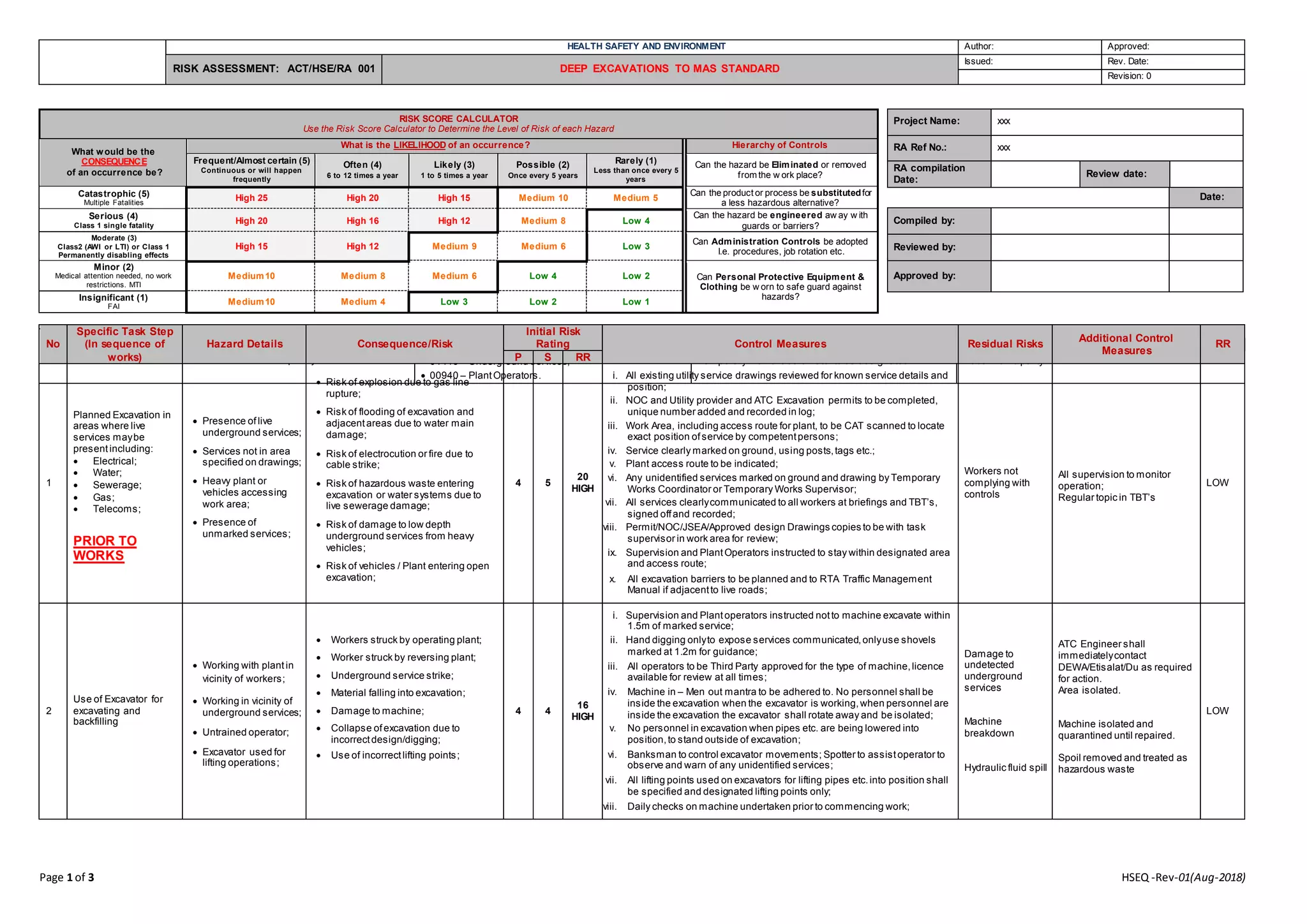
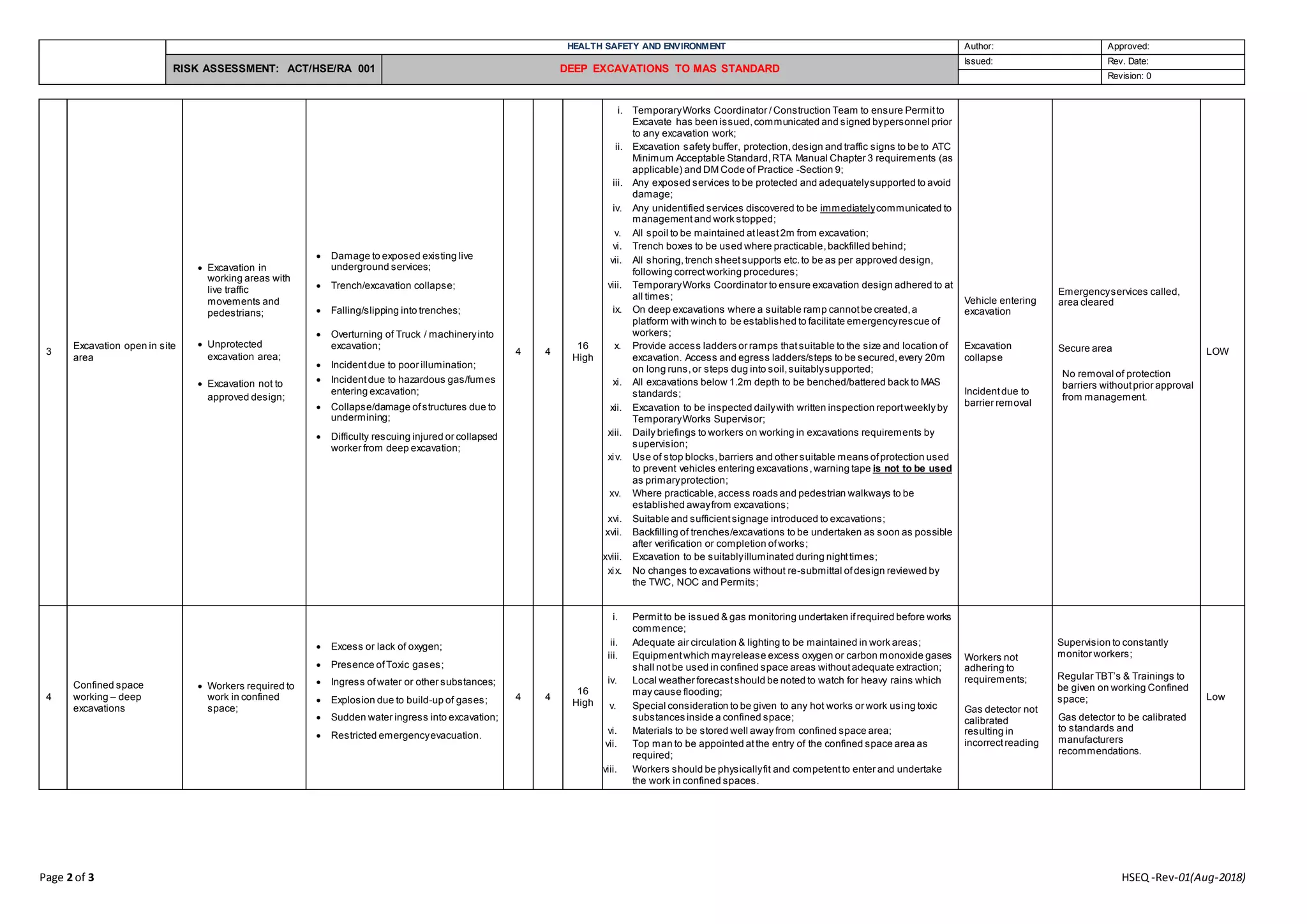
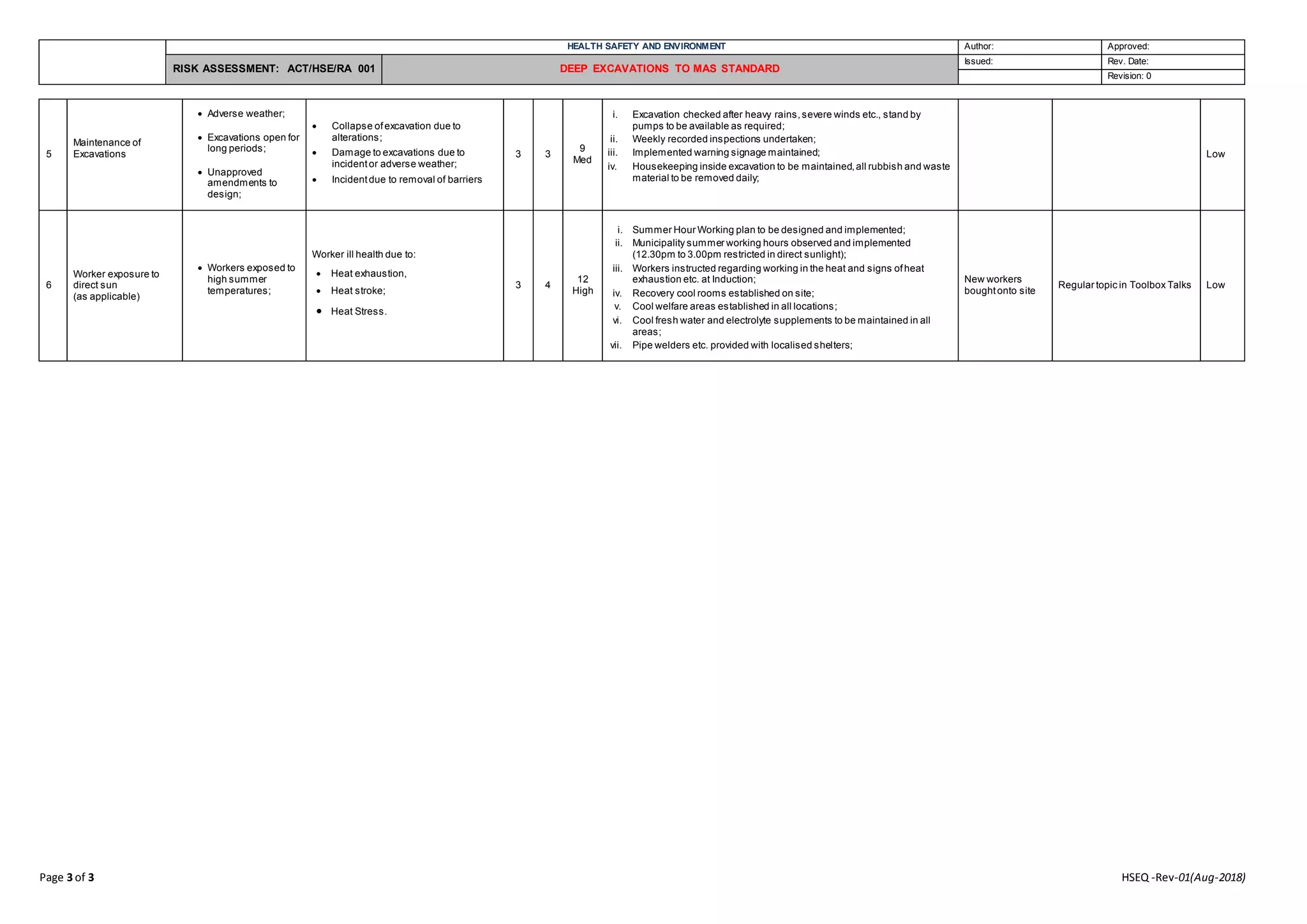
6 excavations (temporary works) risk assessment templates

  • 1.
    HEALTH SAFETY ANDENVIRONMENT Author: Approved: RISK ASSESSMENT: ACT/HSE/RA 001 DEEP EXCAVATIONS TO MAS STANDARD Issued: Rev. Date: Revision: 0 Page 1 of 3 HSEQ -Rev-01(Aug-2018) RISK SCORE CALCULATOR Use the Risk Score Calculator to Determine the Level of Risk of each Hazard What would be the CONSEQUENCE of an occurrence be? What is the LIKELIHOOD of an occurrence? Hierarchy of Controls Frequent/Almost certain (5) Continuous or will happen frequently Often (4) 6 to 12 times a year Likely (3) 1 to 5 times a year Possible (2) Once every 5 years Rarely (1) Less than once every 5 years Can the hazard be Eliminated or removed from the w ork place? Catastrophic (5) Multiple Fatalities High 25 High 20 High 15 Medium 10 Medium 5 Can the product or process be substitutedfor a less hazardous alternative? Serious (4) Class 1 single fatality High 20 High 16 High 12 Medium 8 Low 4 Can the hazard be engineered aw ay w ith guards or barriers? Moderate (3) Class2 (AWI or LTI) or Class 1 Permanently disabling effects High 15 High 12 Medium 9 Medium 6 Low 3 Can Administration Controls be adopted I.e. procedures, job rotation etc. Minor (2) Medical attention needed, no work restrictions. MTI Medium10 Medium 8 Medium 6 Low 4 Low 2 Can Personal Protective Equipment & Clothing be w orn to safe guard against hazards?Insignificant (1) FAI Medium10 Medium 4 Low 3 Low 2 Low 1 Project Name: xxx RA Ref No.: xxx RA compilation Date: Review date: Date: Compiled by: Reviewed by: Approved by: Overall Task Details Excavation on site greater than 1.2 depth. Use of excavator Note: Not under RTA Rail restrictions. Classed as TemporaryWorks Relevant Applicable MAS:  00246 – Excavations;  01413 – Underground services;  00940 – PlantOperators. Additional Training required: TemporaryWorks Coordinator to be designated NOC’s Required for task: Dubai Municipality No Specific Task Step (In sequence of works) Hazard Details Consequence/Risk Initial Risk Rating Control Measures Residual Risks Additional Control Measures RR P S RR 1 Planned Excavation in areas where live services maybe presentincluding:  Electrical;  Water;  Sewerage;  Gas;  Telecoms; PRIOR TO WORKS  Presence oflive underground services;  Services not in area specified on drawings;  Heavy plant or vehicles accessing work area;  Presence of unmarked services;  Risk of explosion due to gas line rupture;  Risk of flooding of excavation and adjacentareas due to water main damage;  Risk of electrocution or fire due to cable strike;  Risk of hazardous waste entering excavation or water systems due to live sewerage damage;  Risk of damage to low depth underground services from heavy vehicles;  Risk of vehicles / Plant entering open excavation; 4 5 20 HIGH i. All existing utility service drawings reviewed for known service details and position; ii. NOC and Utility provider and ATC Excavation permits to be completed, unique number added and recorded in log; iii. Work Area, including access route for plant, to be CAT scanned to locate exact position ofservice by competentpersons; iv. Service clearly marked on ground, using posts,tags etc.; v. Plant access route to be indicated; vi. Any unidentified services marked on ground and drawing by Temporary Works Coordinator or Temporary Works Supervisor; vii. All services clearlycommunicated to all workers at briefings and TBT’s, signed offand recorded; viii. Permit/NOC/JSEA/Approved design Drawings copies to be with task supervisor in work area for review; ix. Supervision and PlantOperators instructed to stay within designated area and access route; x. All excavation barriers to be planned and to RTA Traffic Management Manual if adjacentto live roads; Workers not complying with controls All supervision to monitor operation; Regular topic in TBT’s LOW 2 Use of Excavator for excavating and backfilling  Working with plant in vicinity of workers;  Working in vicinity of underground services;  Untrained operator;  Excavator used for lifting operations;  Workers struck by operating plant;  Worker struck by reversing plant;  Underground service strike;  Material falling into excavation;  Damage to machine;  Collapse ofexcavation due to incorrectdesign/digging;  Use of incorrectlifting points; 4 4 16 HIGH i. Supervision and Plantoperators instructed notto machine excavate within 1.5m of marked service; ii. Hand digging onlyto expose services communicated,onlyuse shovels marked at 1.2m for guidance; iii. All operators to be Third Party approved for the type of machine,licence available for review at all times; iv. Machine in – Men out mantra to be adhered to. No personnel shall be inside the excavation when the excavator is working,when personnel are inside the excavation the excavator shall rotate away and be isolated; v. No personnel in excavation when pipes etc. are being lowered into position,to stand outside of excavation; vi. Banksman to control excavator movements; Spotter to assistoperator to observe and warn of any unidentified services; vii. All lifting points used on excavators for lifting pipes etc.into position shall be specified and designated lifting points only; viii. Daily checks on machine undertaken prior to commencing work; Damage to undetected underground services Machine breakdown Hydraulic fluid spill ATC Engineer shall immediatelycontact DEWA/Etisalat/Du as required for action. Area isolated. Machine isolated and quarantined until repaired. Spoil removed and treated as hazardous waste LOW
  • 2.
    HEALTH SAFETY ANDENVIRONMENT Author: Approved: RISK ASSESSMENT: ACT/HSE/RA 001 DEEP EXCAVATIONS TO MAS STANDARD Issued: Rev. Date: Revision: 0 Page 2 of 3 HSEQ -Rev-01(Aug-2018) 3 Excavation open in site area  Excavation in working areas with live traffic movements and pedestrians;  Unprotected excavation area;  Excavation not to approved design;  Damage to exposed existing live underground services;  Trench/excavation collapse;  Falling/slipping into trenches;  Overturning of Truck / machineryinto excavation;  Incidentdue to poor illumination;  Incidentdue to hazardous gas/fumes entering excavation;  Collapse/damage ofstructures due to undermining;  Difficulty rescuing injured or collapsed worker from deep excavation; 4 4 16 High i. TemporaryWorks Coordinator / Construction Team to ensure Permitto Excavate has been issued,communicated and signed bypersonnel prior to any excavation work; ii. Excavation safety buffer, protection,design and traffic signs to be to ATC Minimum Acceptable Standard,RTA Manual Chapter 3 requirements (as applicable) and DM Code of Practice -Section 9; iii. Any exposed services to be protected and adequatelysupported to avoid damage; iv. Any unidentified services discovered to be immediatelycommunicated to management and work stopped; v. All spoil to be maintained atleast2m from excavation; vi. Trench boxes to be used where practicable,backfilled behind; vii. All shoring, trench sheetsupports etc.to be as per approved design, following correctworking procedures; viii. TemporaryWorks Coordinator to ensure excavation design adhered to at all times; ix. On deep excavations where a suitable ramp cannotbe created,a platform with winch to be established to facilitate emergencyrescue of workers; x. Provide access ladders or ramps thatsuitable to the size and location of excavation. Access and egress ladders/steps to be secured,every 20m on long runs,or steps dug into soil,suitablysupported; xi. All excavations below 1.2m depth to be benched/battered back to MAS standards; xii. Excavation to be inspected dailywith written inspection reportweekly by TemporaryWorks Supervisor; xiii. Daily briefings to workers on working in excavations requirements by supervision; xiv. Use of stop blocks,barriers and other suitable means ofprotection used to prevent vehicles entering excavations,warning tape is not to be used as primaryprotection; xv. Where practicable,access roads and pedestrian walkways to be established awayfrom excavations; xvi. Suitable and sufficientsignage introduced to excavations; xvii. Backfilling of trenches/excavations to be undertaken as soon as possible after verification or completion ofworks; xviii. Excavation to be suitablyilluminated during nighttimes; xix. No changes to excavations without re-submittal ofdesign reviewed by the TWC, NOC and Permits; Vehicle entering excavation Excavation collapse Incidentdue to barrier removal Emergencyservices called, area cleared Secure area No removal of protection barriers withoutprior approval from management. LOW 4 Confined space working – deep excavations  Workers required to work in confined space;  Excess or lack of oxygen;  Presence ofToxic gases;  Ingress ofwater or other substances;  Explosion due to build-up of gases;  Sudden water ingress into excavation;  Restricted emergencyevacuation. 4 4 16 High i. Permitto be issued & gas monitoring undertaken ifrequired before works commence; ii. Adequate air circulation & lighting to be maintained in work areas; iii. Equipmentwhich mayrelease excess oxygen or carbon monoxide gases shall notbe used in confined space areas withoutadequate extraction; iv. Local weather forecastshould be noted to watch for heavy rains which may cause flooding; v. Special consideration to be given to any hot works or work using toxic substances inside a confined space; vi. Materials to be stored well away from confined space area; vii. Top man to be appointed atthe entry of the confined space area as required; viii. Workers should be physicallyfit and competentto enter and undertake the work in confined spaces. Workers not adhering to requirements; Gas detector not calibrated resulting in incorrectreading Supervision to constantly monitor workers; Regular TBT’s & Trainings to be given on working Confined space; Gas detector to be calibrated to standards and manufacturers recommendations. Low
  • 3.
    HEALTH SAFETY ANDENVIRONMENT Author: Approved: RISK ASSESSMENT: ACT/HSE/RA 001 DEEP EXCAVATIONS TO MAS STANDARD Issued: Rev. Date: Revision: 0 Page 3 of 3 HSEQ -Rev-01(Aug-2018) 5 Maintenance of Excavations  Adverse weather;  Excavations open for long periods;  Unapproved amendments to design;  Collapse ofexcavation due to alterations;  Damage to excavations due to incidentor adverse weather;  Incidentdue to removal of barriers 3 3 9 Med i. Excavation checked after heavy rains,severe winds etc., stand by pumps to be available as required; ii. Weekly recorded inspections undertaken; iii. Implemented warning signage maintained; iv. Housekeeping inside excavation to be maintained,all rubbish and waste material to be removed daily; Low 6 Worker exposure to direct sun (as applicable)  Workers exposed to high summer temperatures; Worker ill health due to:  Heat exhaustion,  Heat stroke;  Heat Stress. 3 4 12 High i. Summer Hour Working plan to be designed and implemented; ii. Municipality summer working hours observed and implemented (12.30pm to 3.00pm restricted in direct sunlight); iii. Workers instructed regarding working in the heat and signs ofheat exhaustion etc. at Induction; iv. Recovery cool rooms established on site; v. Cool welfare areas established in all locations; vi. Cool fresh water and electrolyte supplements to be maintained in all areas; vii. Pipe welders etc. provided with localised shelters; New workers boughtonto site Regular topic in Toolbox Talks Low