CentOS 7 VM for DPDK training
20 May 2015
16:26
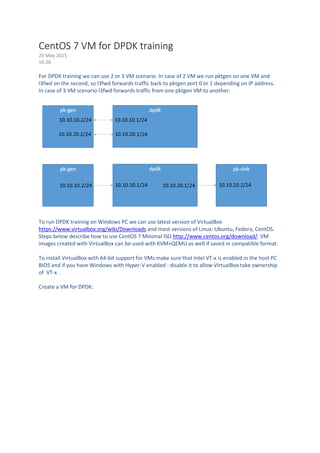
For DPDK training we can use 2 or 3 VM scenario. In case of 2 VM we run pktgen on one VM and
l3fwd on the second, so l3fwd forwards traffic back to pktgen port 0 or 1 depending on IP address.
In case of 3 VM scenario l3fwd forwards traffic from one pktgen VM to another:
To run DPDK training on Windows PC we can use latest version of VirtualBox
https://www.virtualbox.org/wiki/Downloads and most versions of Linux: Ubuntu, Fedora, CentOS.
Steps below describe how to use CentOS 7 Minimal ISO http://www.centos.org/download/. VM
images created with VirtualBox can be used with KVM+QEMU as well if saved in compatible format.
To install VirtualBox with 64-bit support for VMs make sure that Intel VT-x is enabled in the host PC
BIOS and if you have Windows with Hyper-V enabled - disable it to allow VirtualBox take ownership
of VT-x .
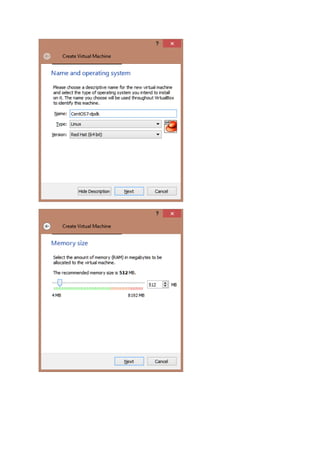
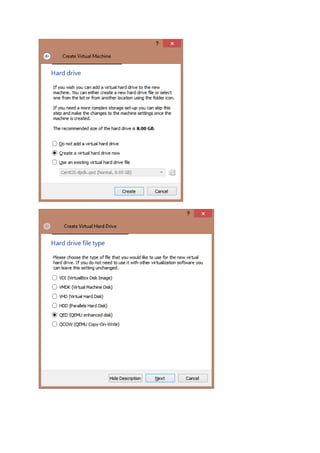
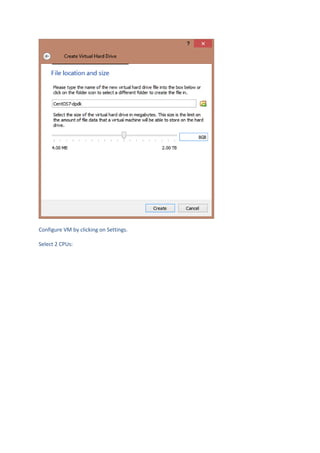
Create a VM for DPDK:
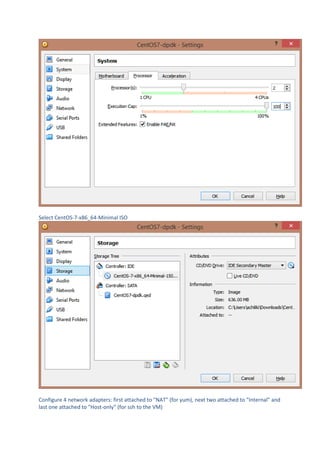
Configure VM by clicking on Settings.
Select 2 CPUs:
Select CentOS-7-x86_64-Minimal ISO
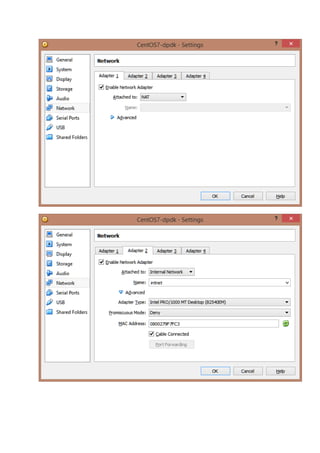
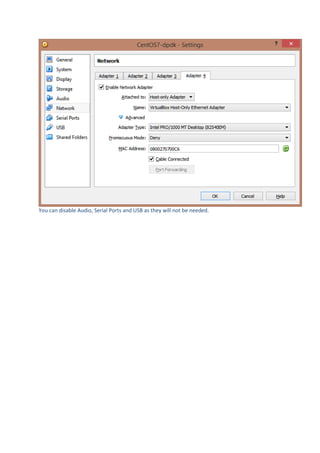
Configure 4 network adapters: first attached to "NAT" (for yum), next two attached to "Internal" and
last one attached to "Host-only" (for ssh to the VM)
You can disable Audio, Serial Ports and USB as they will not be needed.
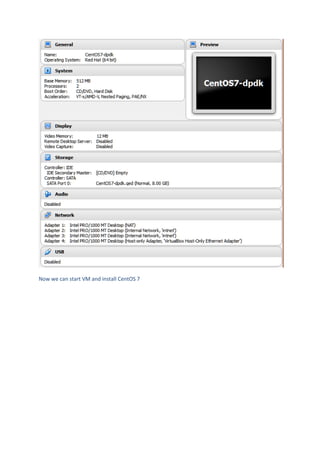
Now we can start VM and install CentOS 7
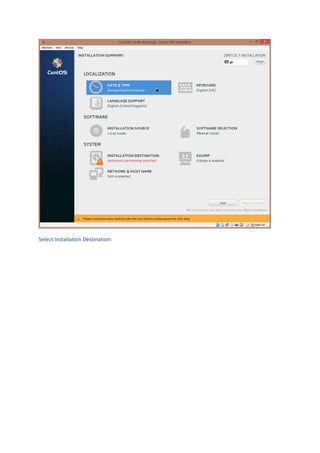
Select Installation Destination:
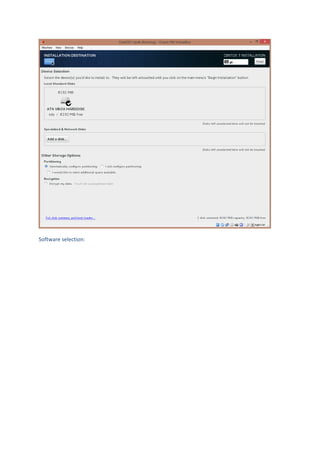
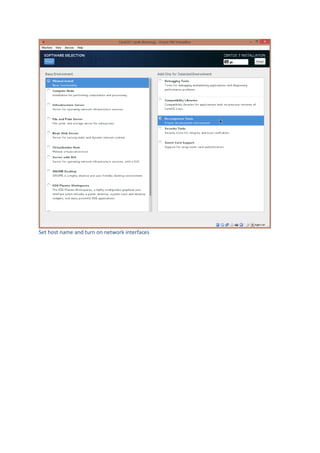
Software selection:
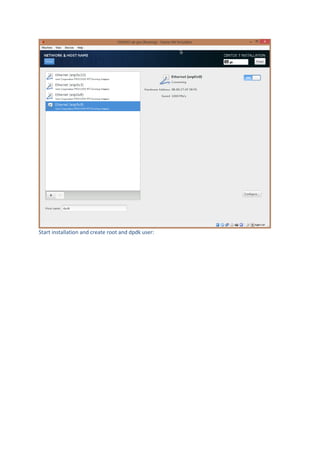
Set host name and turn on network interfaces
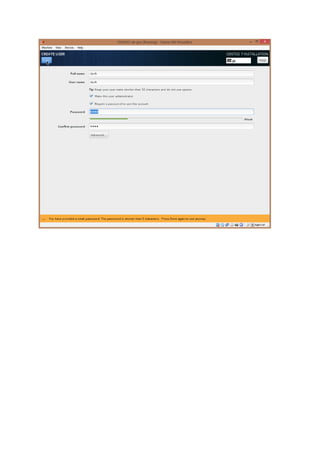
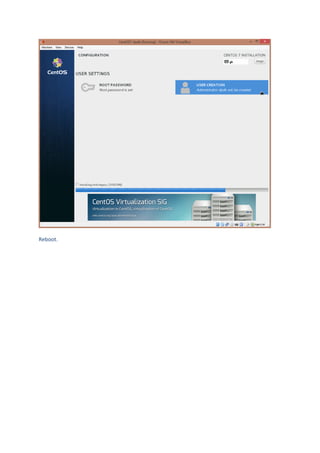
Start installation and create root and dpdk user:
Reboot.
To make life easier add NOPASSWD for sudo:
$sudo visudo
## Same thing without a password
# %wheel ALL=(ALL) NOPASSWD: ALL
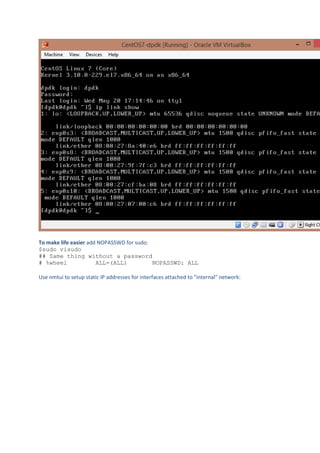
Use nmtui to setup static IP addresses for interfaces attached to "internal" network:
We will need these addresses for MAC address discovery.
You can use "nmcli d" command to check networks:
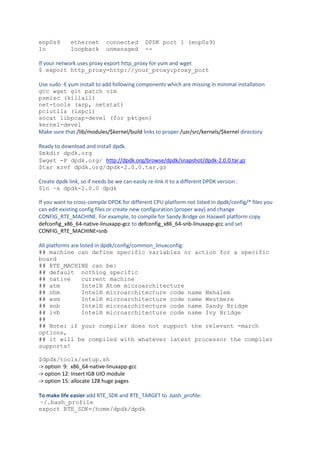
[dpdk@dpdk ~]$ nmcli d
DEVICE TYPE STATE CONNECTION
enp0s10 ethernet connected Host-only (enp0s10)
enp0s3 ethernet connected NAT (enp0s3)
enp0s8 ethernet connected DPDK port 0 (enp0s8)
enp0s9 ethernet connected DPDK port 1 (enp0s9)
lo loopback unmanaged --
If your network uses proxy export http_proxy for yum and wget
$ export http_proxy=http://your_proxy:proxy_port
Use sudo -E yum install to add following components which are missing in minimal installation
gcc wget git patch vim
psmisc (killall)
net-tools (arp, netstat)
pciutils (lspci)
socat libpcap-devel (for pktgen)
kernel-devel
Make sure that /lib/modules/$kernel/build links to proper /usr/src/kernels/$kernel directory
Ready to download and install dpdk.
$mkdir dpdk.org
$wget -P dpdk.org/ http://dpdk.org/browse/dpdk/snapshot/dpdk-2.0.0.tar.gz
$tar xzvf dpdk.org/dpdk-2.0.0.tar.gz
Create dpdk link, so if needs be we can easily re-link it to a different DPDK version :
$ln –s dpdk-2.0.0 dpdk
If you want to cross-compile DPDK for different CPU platform not listed in dpdk/config/* files you
can edit existing config files or create new configuration (proper way) and change
CONFIG_RTE_MACHINE. For example, to compile for Sandy Bridge on Haswell platform copy
defconfig_x86_64-native-linuxapp-gcc to defconfig_x86_64-snb-linuxapp-gcc and set
CONFIG_RTE_MACHINE=snb
All platforms are listed in dpdk/config/common_linuxconfig:
## machine can define specific variables or action for a specific
board
## RTE_MACHINE can be:
## default nothing specific
## native current machine
## atm Intel® Atom microarchitecture
## nhm Intel® microarchitecture code name Nehalem
## wsm Intel® microarchitecture code name Westmere
## snb Intel® microarchitecture code name Sandy Bridge
## ivb Intel® microarchitecture code name Ivy Bridge
##
## Note: if your compiler does not support the relevant -march
options,
## it will be compiled with whatever latest processor the compiler
supports!
$dpdk/tools/setup.sh
-> option 9: x86_64-native-linuxapp-gcc
-> option 12: Insert IGB UIO module
-> option 15: allocate 128 huge pages
To make life easier add RTE_SDK and RTE_TARGET to .bash_profile:
~/.bash_profile
export RTE_SDK=/home/dpdk/dpdk
export RTE_TARGET=x86_64-native-linuxapp-gcc
You also can add export http_proxy here if you need Internet access
Add to ~/.bashrc
# User specific aliases and functions
if [ -f ~/.bash_aliases ]; then
. ~/.bash_aliases
fi
And create ~/.bash_aliases file with the following lines:
alias dpstat='~/dpdk/tools/dpdk_nic_bind.py --status'
alias dpbind='sudo -E ~/dpdk/tools/dpdk_nic_bind.py --force --
bind=igb_uio'
alias dpunbind='sudo -E ~/dpdk/tools/dpdk_nic_bind.py -u'
Re-login. Now we can list/bind/unbind interfaces to DPDK by dpstat/dpbind/dpunbind commands:
[dpdk@dpdk ~]$ dpstat
Network devices using DPDK-compatible driver
============================================
<none>
Network devices using kernel driver
===================================
0000:00:03.0 '82540EM Gigabit Ethernet Controller' if=enp0s3
drv=e1000 unused=igb_uio *Active*
0000:00:08.0 '82540EM Gigabit Ethernet Controller' if=enp0s8
drv=e1000 unused=igb_uio *Active*
0000:00:09.0 '82540EM Gigabit Ethernet Controller' if=enp0s9
drv=e1000 unused=igb_uio *Active*
0000:00:0a.0 '82540EM Gigabit Ethernet Controller' if=enp0s10
drv=e1000 unused=igb_uio *Active*
Other network devices
=====================
<none>
Compile l3fwd. For DPDK 2.0 we need to patch it, so download patches first from DPDK Patchwork
http://dpdk.org/dev/patchwork/project/dpdk/list/
Patch 4752 [dpdk-dev] examples: add ip version check for l3fwd app
$wget http://dpdk.org/dev/patchwork/patch/4752/raw/ -O
dpdk.org/4752.patch
Patch 4774 [dpdk-dev,v2] l3fwd: make destination mac address configurable
$wget http://dpdk.org/dev/patchwork/patch/4774/raw/ -O
dpdk.org/4774.patch
Apply downloaded patches:
[dpdk@dpdk ~]$ cd dpdk
[dpdk@dpdk dpdk]$ patch -p 1 -i ../dpdk.org/4752.patch
patching file examples/l3fwd/main.c
[dpdk@dpdk dpdk]$ patch -p 1 -i ../dpdk.org/4774.patch
patching file examples/l3fwd/main.c
Edit examples/l3fwd/main.c and set to 1:
#define DO_IP_VERSION_CHECK 1
To enable SW classification of IP packets for emulated devices.
Make l3fwd:
$cd examples/l3fwd
$make
Now we need a VM with pktgen to generate some traffic…
Instead of re-doing all steps above clone VM image we just created and after boot use nmtui to
change static IP addresses and host name to pk-gen.
Download pktgen from dpdk.org:
$wget -P dpdk.org http://dpdk.org/browse/apps/pktgen-
dpdk/snapshot/pktgen-2.9.0.tar.gz
$tar xzvf pktgen-2.9.0.tar.gz
$ln –s pktgen-2.9.0 pktgen
$cd pktgen
$make
Starting pktgen and l3fwd manually
First we need to bind our interfaces to igb_uio. (We already mounted hugepages and inserted
igb_uio above using dpdk/tools/setup.sh)
$sudo -E ~/dpdk/tools/dpdk_nic_bind.py --force --bind=igb_uio
00:08.0 00:09.0
Or, using dpdk/tools/setup.sh select option
[18] Bind Ethernet device to IGB UIO module
Or, with dpbind alias:
$dpbind 00:08.0 00:09.0
$ sudo ./app/app/$RTE_TARGET/pktgen -c 3 -n 2 -m 128 -- -T -p 0x03 -
m "[1:1].0, [1:1].1"
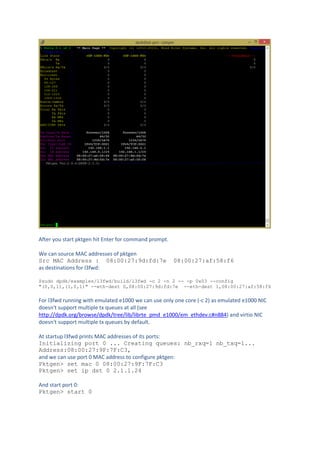
After you start pktgen hit Enter for command prompt.
We can source MAC addresses of pktgen
Src MAC Address : 08:00:27:9d:fd:7e 08:00:27:af:58:f6
as destinations for l3fwd:
$sudo dpdk/examples/l3fwd/build/l3fwd -c 2 -n 2 -- -p 0x03 --config
"(0,0,1),(1,0,1)" --eth-dest 0,08:00:27:9d:fd:7e --eth-dest 1,08:00:27:af:58:f6
For l3fwd running with emulated e1000 we can use only one core (-c 2) as emulated e1000 NIC
doesn't support multiple tx queues at all (see
http://dpdk.org/browse/dpdk/tree/lib/librte_pmd_e1000/em_ethdev.c#n884) and virtio NIC
doesn't support multiple tx queues by default.
At startup l3fwd prints MAC addresses of its ports:
Initializing port 0 ... Creating queues: nb_rxq=1 nb_txq=1...
Address:08:00:27:9F:7F:C3,
and we can use port 0 MAC address to configure pktgen:
Pktgen> set mac 0 08:00:27:9F:7F:C3
Pktgen> set ip dst 0 2.1.1.24
And start port 0:
Pktgen> start 0
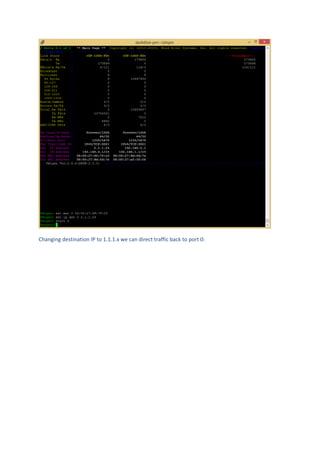
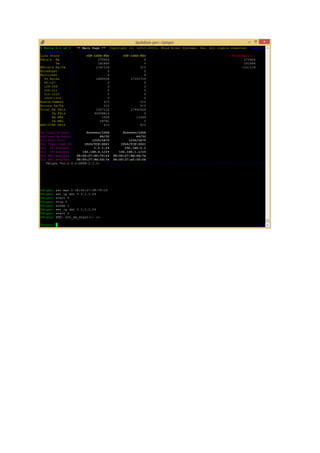
Changing destination IP to 1.1.1.x we can direct traffic back to port 0:
9 creating cent_os 7_mages_for_dpdk_training

9 creating cent_os 7_mages_for_dpdk_training

  • 1.
    CentOS 7 VMfor DPDK training 20 May 2015 16:26 For DPDK training we can use 2 or 3 VM scenario. In case of 2 VM we run pktgen on one VM and l3fwd on the second, so l3fwd forwards traffic back to pktgen port 0 or 1 depending on IP address. In case of 3 VM scenario l3fwd forwards traffic from one pktgen VM to another: To run DPDK training on Windows PC we can use latest version of VirtualBox https://www.virtualbox.org/wiki/Downloads and most versions of Linux: Ubuntu, Fedora, CentOS. Steps below describe how to use CentOS 7 Minimal ISO http://www.centos.org/download/. VM images created with VirtualBox can be used with KVM+QEMU as well if saved in compatible format. To install VirtualBox with 64-bit support for VMs make sure that Intel VT-x is enabled in the host PC BIOS and if you have Windows with Hyper-V enabled - disable it to allow VirtualBox take ownership of VT-x . Create a VM for DPDK:
  • 4.
    Configure VM byclicking on Settings. Select 2 CPUs:
  • 5.
    Select CentOS-7-x86_64-Minimal ISO Configure4 network adapters: first attached to "NAT" (for yum), next two attached to "Internal" and last one attached to "Host-only" (for ssh to the VM)
  • 7.
    You can disableAudio, Serial Ports and USB as they will not be needed.
  • 8.
    Now we canstart VM and install CentOS 7
  • 9.
  • 10.
  • 11.
    Set host nameand turn on network interfaces
  • 12.
    Start installation andcreate root and dpdk user:
  • 14.
  • 15.
    To make lifeeasier add NOPASSWD for sudo: $sudo visudo ## Same thing without a password # %wheel ALL=(ALL) NOPASSWD: ALL Use nmtui to setup static IP addresses for interfaces attached to "internal" network:
  • 16.
    We will needthese addresses for MAC address discovery. You can use "nmcli d" command to check networks: [dpdk@dpdk ~]$ nmcli d DEVICE TYPE STATE CONNECTION enp0s10 ethernet connected Host-only (enp0s10) enp0s3 ethernet connected NAT (enp0s3) enp0s8 ethernet connected DPDK port 0 (enp0s8)
  • 17.
    enp0s9 ethernet connectedDPDK port 1 (enp0s9) lo loopback unmanaged -- If your network uses proxy export http_proxy for yum and wget $ export http_proxy=http://your_proxy:proxy_port Use sudo -E yum install to add following components which are missing in minimal installation gcc wget git patch vim psmisc (killall) net-tools (arp, netstat) pciutils (lspci) socat libpcap-devel (for pktgen) kernel-devel Make sure that /lib/modules/$kernel/build links to proper /usr/src/kernels/$kernel directory Ready to download and install dpdk. $mkdir dpdk.org $wget -P dpdk.org/ http://dpdk.org/browse/dpdk/snapshot/dpdk-2.0.0.tar.gz $tar xzvf dpdk.org/dpdk-2.0.0.tar.gz Create dpdk link, so if needs be we can easily re-link it to a different DPDK version : $ln –s dpdk-2.0.0 dpdk If you want to cross-compile DPDK for different CPU platform not listed in dpdk/config/* files you can edit existing config files or create new configuration (proper way) and change CONFIG_RTE_MACHINE. For example, to compile for Sandy Bridge on Haswell platform copy defconfig_x86_64-native-linuxapp-gcc to defconfig_x86_64-snb-linuxapp-gcc and set CONFIG_RTE_MACHINE=snb All platforms are listed in dpdk/config/common_linuxconfig: ## machine can define specific variables or action for a specific board ## RTE_MACHINE can be: ## default nothing specific ## native current machine ## atm Intel® Atom microarchitecture ## nhm Intel® microarchitecture code name Nehalem ## wsm Intel® microarchitecture code name Westmere ## snb Intel® microarchitecture code name Sandy Bridge ## ivb Intel® microarchitecture code name Ivy Bridge ## ## Note: if your compiler does not support the relevant -march options, ## it will be compiled with whatever latest processor the compiler supports! $dpdk/tools/setup.sh -> option 9: x86_64-native-linuxapp-gcc -> option 12: Insert IGB UIO module -> option 15: allocate 128 huge pages To make life easier add RTE_SDK and RTE_TARGET to .bash_profile: ~/.bash_profile export RTE_SDK=/home/dpdk/dpdk
  • 18.
    export RTE_TARGET=x86_64-native-linuxapp-gcc You alsocan add export http_proxy here if you need Internet access Add to ~/.bashrc # User specific aliases and functions if [ -f ~/.bash_aliases ]; then . ~/.bash_aliases fi And create ~/.bash_aliases file with the following lines: alias dpstat='~/dpdk/tools/dpdk_nic_bind.py --status' alias dpbind='sudo -E ~/dpdk/tools/dpdk_nic_bind.py --force -- bind=igb_uio' alias dpunbind='sudo -E ~/dpdk/tools/dpdk_nic_bind.py -u' Re-login. Now we can list/bind/unbind interfaces to DPDK by dpstat/dpbind/dpunbind commands: [dpdk@dpdk ~]$ dpstat Network devices using DPDK-compatible driver ============================================ <none> Network devices using kernel driver =================================== 0000:00:03.0 '82540EM Gigabit Ethernet Controller' if=enp0s3 drv=e1000 unused=igb_uio *Active* 0000:00:08.0 '82540EM Gigabit Ethernet Controller' if=enp0s8 drv=e1000 unused=igb_uio *Active* 0000:00:09.0 '82540EM Gigabit Ethernet Controller' if=enp0s9 drv=e1000 unused=igb_uio *Active* 0000:00:0a.0 '82540EM Gigabit Ethernet Controller' if=enp0s10 drv=e1000 unused=igb_uio *Active* Other network devices ===================== <none> Compile l3fwd. For DPDK 2.0 we need to patch it, so download patches first from DPDK Patchwork http://dpdk.org/dev/patchwork/project/dpdk/list/ Patch 4752 [dpdk-dev] examples: add ip version check for l3fwd app $wget http://dpdk.org/dev/patchwork/patch/4752/raw/ -O dpdk.org/4752.patch Patch 4774 [dpdk-dev,v2] l3fwd: make destination mac address configurable $wget http://dpdk.org/dev/patchwork/patch/4774/raw/ -O dpdk.org/4774.patch Apply downloaded patches: [dpdk@dpdk ~]$ cd dpdk [dpdk@dpdk dpdk]$ patch -p 1 -i ../dpdk.org/4752.patch patching file examples/l3fwd/main.c [dpdk@dpdk dpdk]$ patch -p 1 -i ../dpdk.org/4774.patch patching file examples/l3fwd/main.c
  • 19.
    Edit examples/l3fwd/main.c andset to 1: #define DO_IP_VERSION_CHECK 1 To enable SW classification of IP packets for emulated devices. Make l3fwd: $cd examples/l3fwd $make Now we need a VM with pktgen to generate some traffic… Instead of re-doing all steps above clone VM image we just created and after boot use nmtui to change static IP addresses and host name to pk-gen. Download pktgen from dpdk.org: $wget -P dpdk.org http://dpdk.org/browse/apps/pktgen- dpdk/snapshot/pktgen-2.9.0.tar.gz $tar xzvf pktgen-2.9.0.tar.gz $ln –s pktgen-2.9.0 pktgen $cd pktgen $make Starting pktgen and l3fwd manually First we need to bind our interfaces to igb_uio. (We already mounted hugepages and inserted igb_uio above using dpdk/tools/setup.sh) $sudo -E ~/dpdk/tools/dpdk_nic_bind.py --force --bind=igb_uio 00:08.0 00:09.0 Or, using dpdk/tools/setup.sh select option [18] Bind Ethernet device to IGB UIO module Or, with dpbind alias: $dpbind 00:08.0 00:09.0 $ sudo ./app/app/$RTE_TARGET/pktgen -c 3 -n 2 -m 128 -- -T -p 0x03 - m "[1:1].0, [1:1].1"
  • 20.
    After you startpktgen hit Enter for command prompt. We can source MAC addresses of pktgen Src MAC Address : 08:00:27:9d:fd:7e 08:00:27:af:58:f6 as destinations for l3fwd: $sudo dpdk/examples/l3fwd/build/l3fwd -c 2 -n 2 -- -p 0x03 --config "(0,0,1),(1,0,1)" --eth-dest 0,08:00:27:9d:fd:7e --eth-dest 1,08:00:27:af:58:f6 For l3fwd running with emulated e1000 we can use only one core (-c 2) as emulated e1000 NIC doesn't support multiple tx queues at all (see http://dpdk.org/browse/dpdk/tree/lib/librte_pmd_e1000/em_ethdev.c#n884) and virtio NIC doesn't support multiple tx queues by default. At startup l3fwd prints MAC addresses of its ports: Initializing port 0 ... Creating queues: nb_rxq=1 nb_txq=1... Address:08:00:27:9F:7F:C3, and we can use port 0 MAC address to configure pktgen: Pktgen> set mac 0 08:00:27:9F:7F:C3 Pktgen> set ip dst 0 2.1.1.24 And start port 0: Pktgen> start 0
  • 21.
    Changing destination IPto 1.1.1.x we can direct traffic back to port 0: