Linking Verbs
and
Action Verbs
Verbs


A verb is a word used to express action or a
state of being.

Categories:
1) Helping or main verbs
2) Main verbs are either action or linking verbs
3) Action verbs are either transitive or
intransitive

Helping Verbs
 Helping verbs exist ONLY in a verb
phrase and are ANY and ALL of the
verbs that come BEFORE the main verb
and “help” the main verb to make sense.
Transitive and
Intransitive Verbs
 Only an action verb can be labeled
transitive or intransitive.
 An action verb is transitive only if it has a
direct object after it: Tim sang a song.
 An action verb is intransitive if it has no
direct object after it: Tim sang loudly.
Linking Verbs
 A linking verb
connects the
subject to a word
or word group that
renames or
describes the
subject.
Examples
 The apple looks rotten.
 “Looks” links the subject (apple) to the adjective
(rotten): rotten = apple
 John is one of the great scientists in our area.
 “Is” links the subject (John) to the adjective (one):
John = one
 The flowers smell good.
 “Smell” links the subject (flowers) to the adjective
(good): flowers = good
Linking Verbs

 To find out if a verb is an action or linking verb
substitute a form of be in for the verb. If the sentence
still makes sense, it is usually a linking verb. If the
sentence doesn’t make sense, it is usually an action
verb.
 Example: The ice cream tastes delicious.
 Substitute a form of be: The ice cream is delicious.
 Example: She tasted the ice cream.
 Substitute a form of be: She is the ice cream.
*

{Forms of be and seem are always linking verbs.}
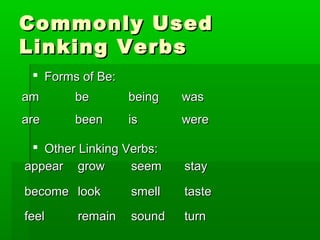
Commonly Used
Linking Verbs
 Forms of Be:
am

be

being

was

are

been

is

were

 Other Linking Verbs:
appear grow
seem

stay

become look

smell

taste

feel

sound

turn

remain
Action vs. Linking
Verbs
 An action verb is a verb that
expresses either physical or mental
activity.
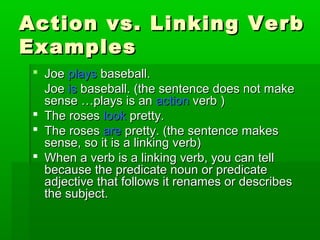
Action vs. Linking Verb
Examples
 Joe plays baseball.
Joe is baseball. (the sentence does not make
sense …plays is an action verb )
 The roses look pretty.
 The roses are pretty. (the sentence makes
sense, so it is a linking verb)
 When a verb is a linking verb, you can tell
because the predicate noun or predicate
adjective that follows it renames or describes
the subject.
Practice

What are the linking verbs in the
following sentences and what do
they connect?
 The spectacular ocean appears
calm today.
 The Wright Brothers are famous for
inventing the plane.
More Practice
 The music sounds catchy.
 The park seems crowded.
Even More Practice
 Jerry tasted the banana split.
 Action verb
 The banana split is tasty.
 Linking verb
 Jerry then traveled to the park.
 Action verb
 The park looks pretty.
 Linking verb

Linking and action verbs (Mariam)

  • 1.
  • 2.
    Verbs  A verb isa word used to express action or a state of being. Categories: 1) Helping or main verbs 2) Main verbs are either action or linking verbs 3) Action verbs are either transitive or intransitive 
  • 3.
    Helping Verbs  Helpingverbs exist ONLY in a verb phrase and are ANY and ALL of the verbs that come BEFORE the main verb and “help” the main verb to make sense.
  • 4.
    Transitive and Intransitive Verbs Only an action verb can be labeled transitive or intransitive.  An action verb is transitive only if it has a direct object after it: Tim sang a song.  An action verb is intransitive if it has no direct object after it: Tim sang loudly.
  • 5.
    Linking Verbs  Alinking verb connects the subject to a word or word group that renames or describes the subject.
  • 6.
    Examples  The applelooks rotten.  “Looks” links the subject (apple) to the adjective (rotten): rotten = apple  John is one of the great scientists in our area.  “Is” links the subject (John) to the adjective (one): John = one  The flowers smell good.  “Smell” links the subject (flowers) to the adjective (good): flowers = good
  • 7.
    Linking Verbs  Tofind out if a verb is an action or linking verb substitute a form of be in for the verb. If the sentence still makes sense, it is usually a linking verb. If the sentence doesn’t make sense, it is usually an action verb.  Example: The ice cream tastes delicious.  Substitute a form of be: The ice cream is delicious.  Example: She tasted the ice cream.  Substitute a form of be: She is the ice cream. * {Forms of be and seem are always linking verbs.}
  • 8.
    Commonly Used Linking Verbs Forms of Be: am be being was are been is were  Other Linking Verbs: appear grow seem stay become look smell taste feel sound turn remain
  • 9.
    Action vs. Linking Verbs An action verb is a verb that expresses either physical or mental activity.
  • 10.
    Action vs. LinkingVerb Examples  Joe plays baseball. Joe is baseball. (the sentence does not make sense …plays is an action verb )  The roses look pretty.  The roses are pretty. (the sentence makes sense, so it is a linking verb)  When a verb is a linking verb, you can tell because the predicate noun or predicate adjective that follows it renames or describes the subject.
  • 11.
    Practice What are thelinking verbs in the following sentences and what do they connect?  The spectacular ocean appears calm today.  The Wright Brothers are famous for inventing the plane.
  • 12.
    More Practice  Themusic sounds catchy.  The music sounds catchy.  The park seems crowded.  The park seems crowded.
  • 13.
    Even More Practice Jerry tasted the banana split.  Action verb  The banana split is tasty.  Linking verb  Jerry then traveled to the park.  Action verb  The park looks pretty.  Linking verb