Classifications of Verbs
Classifications of Verbs in English: Finite, Infinite,
Auxiliary, Gerund, Participle, Adjective, and Linking Verbs
Introduction
• Verbs are the action words or "doing words" in a sentence, but their roles
can be much more complex than just representing actions.
1. Finite Verbs
•Key Features:
•Shows tense (past, present, future).
•Changes form based on the subject (number and person).
•Can stand alone as the main verb in a clause.
•Examples:
•She runs every morning. ("runs" is finite; shows present tense and
agrees with the subject "she")
•They ran to the store. ("ran" is finite; shows past tense and agrees with
the subject "they")
Cont…
• Examples:
• She writes beautifully. (Present tense; the verb "writes" agrees with the
subject "she")
• They played soccer yesterday. (Past tense; the verb "played" shows past
tense)
• He will travel to Spain next week. (Future tense; "will travel" indicates a
future action)
2. Non-Finite Verbs (Infinite Verbs)
• Definition: Non-finite verbs (or infinitive verbs) are not marked by
tense, number, or person. They do not change form to show when an
action takes place or who is performing it.
• Key Features:
• Not influenced by subject or tense.
• Often used in combination with auxiliary verbs or after certain
verbs (like "to").
Cont…
• Types:
• Bare Infinitive: The verb without "to". Example: Let him go.
• Full Infinitive: The base form of the verb with "to". Example: She wants to eat.
• Examples:
• To swim is good exercise. (The verb "to swim" is in its non-finite form, used as a
subject of the sentence.)
• They asked him to leave. ("to leave" is non-finite, and does not change with the
subject "he" or tense)
Cont…
• Examples:
• I want to learn Spanish. (The verb "to learn" does not change form based
on the subject or tense)
• She decided to study medicine. (Non-finite verb "to study" used as an
object)
• He can run fast. (Bare infinitive "run" after the modal verb "can")
3. Auxiliary Verbs (Helping Verbs)
• Definition: Auxiliary verbs help the main verb by forming tenses,
moods, or voices. They modify the main verb and give it a specific
meaning related to time, possibility, obligation, or necessity.
• Key Features:
• Cannot stand alone.
• Help in forming continuous tenses, perfect tenses, questions, and
negatives.
Cont…
• Common Auxiliary Verbs:
• Be, have, do: Used to form tenses.
• Can, could, may, might, must, shall, will, would: Modals that express possibility, ability,
permission, or obligation.
• Examples:
• He is running. (The auxiliary "is" helps form the present continuous tense)
• They have finished the work. (The auxiliary "have" helps form the present perfect tense)
• She can swim. (The modal auxiliary "can" expresses ability)
Cont…
• Examples:
• She is cooking dinner. (The auxiliary verb "is" helps form the present continuous
tense)
• They were playing basketball when it started to rain. (The auxiliary "were" forms
the past continuous)
• She has finished her assignment. (The auxiliary "has" forms the present perfect
tense)
• You should study for the exam. ("Should" expresses a recommendation)
4. Gerunds
A gerund is a verb that ends in -ing and functions as a noun in a sentence.
Key Features:
• Always acts as a noun, though formed from a verb.
• Can serve as a subject, object, or complement in a sentence.
• Examples:
• Swimming is my favorite hobby. (Gerund as subject)
• I enjoy reading. (Gerund as object)
• Her passion is dancing. (Gerund as complement)
5. Participles (Present and Past)
Participles are verb forms that function as adjectives, describing or modifying nouns.
There are two types: present participles and past participles.
• Present Participle: The -ing form of the verb, used as
an adjective or to form continuous tenses.
• Example: The crying baby kept everyone awake.
(Describes the baby)
Cont..
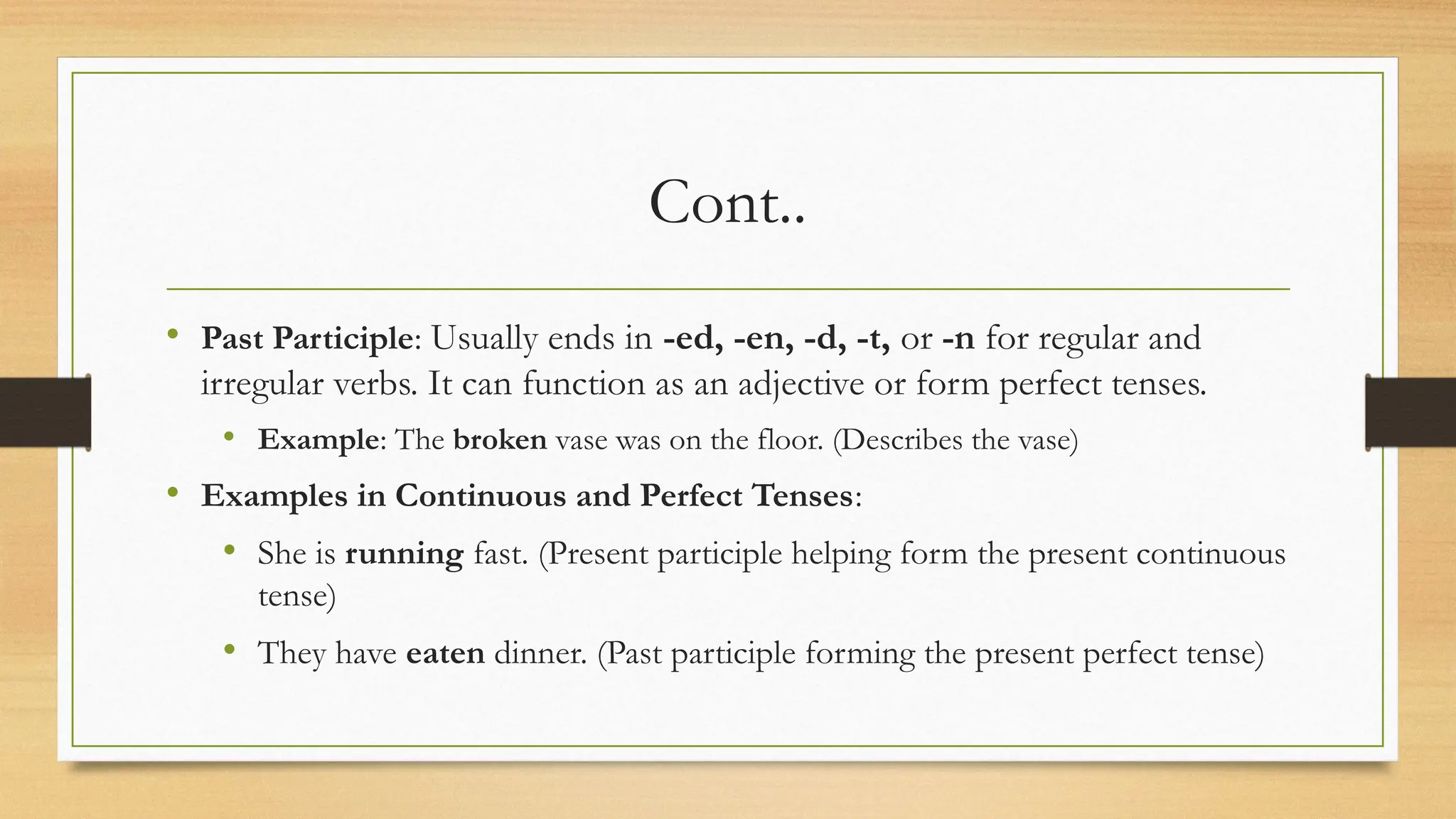
• Past Participle: Usually ends in -ed, -en, -d, -t, or -n for regular and
irregular verbs. It can function as an adjective or form perfect tenses.
• Example: The broken vase was on the floor. (Describes the vase)
• Examples in Continuous and Perfect Tenses:
• She is running fast. (Present participle helping form the present continuous
tense)
• They have eaten dinner. (Past participle forming the present perfect tense)
Cont…
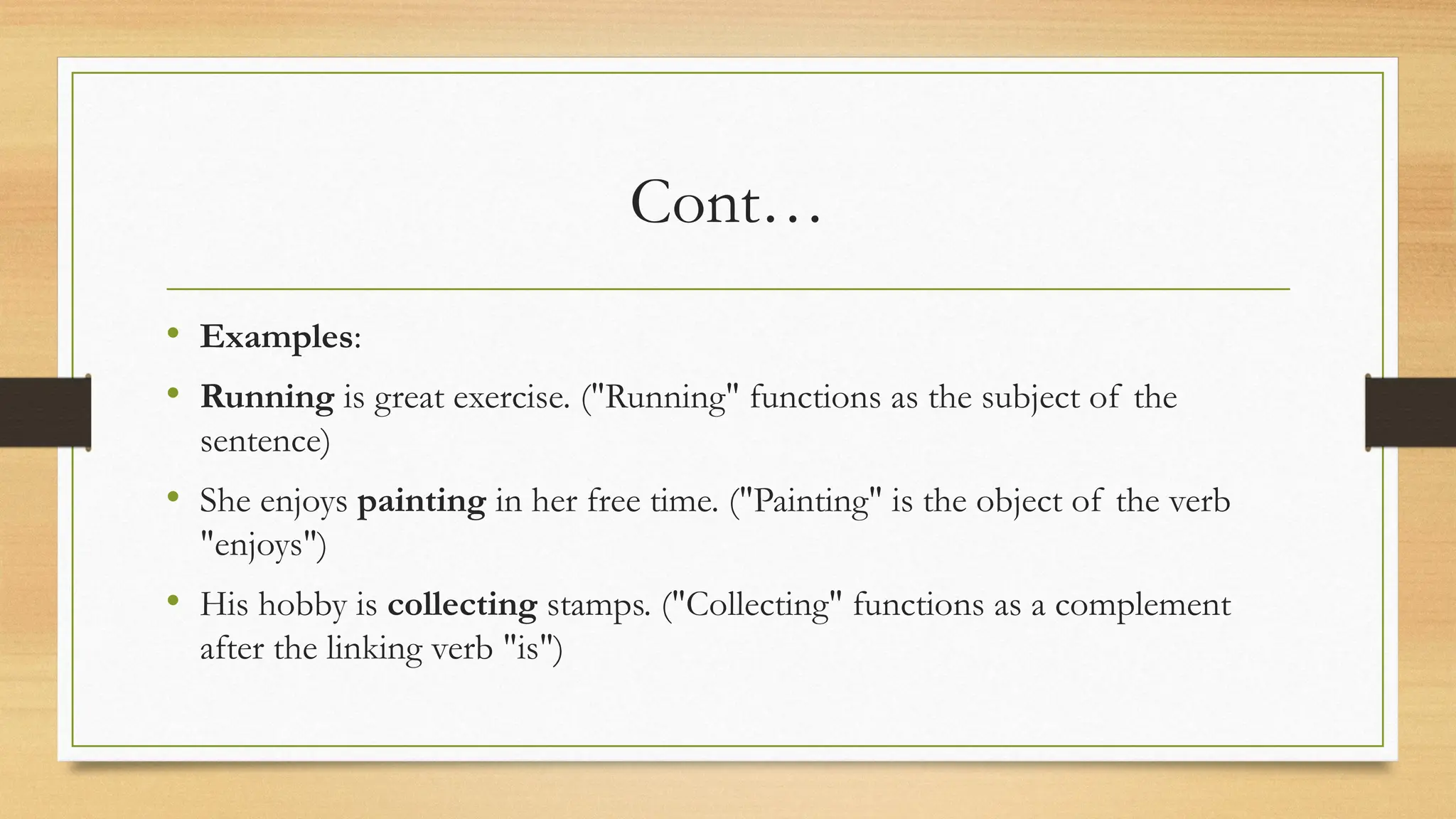
• Examples:
• Running is great exercise. ("Running" functions as the subject of the
sentence)
• She enjoys painting in her free time. ("Painting" is the object of the verb
"enjoys")
• His hobby is collecting stamps. ("Collecting" functions as a complement
after the linking verb "is")
Cont…
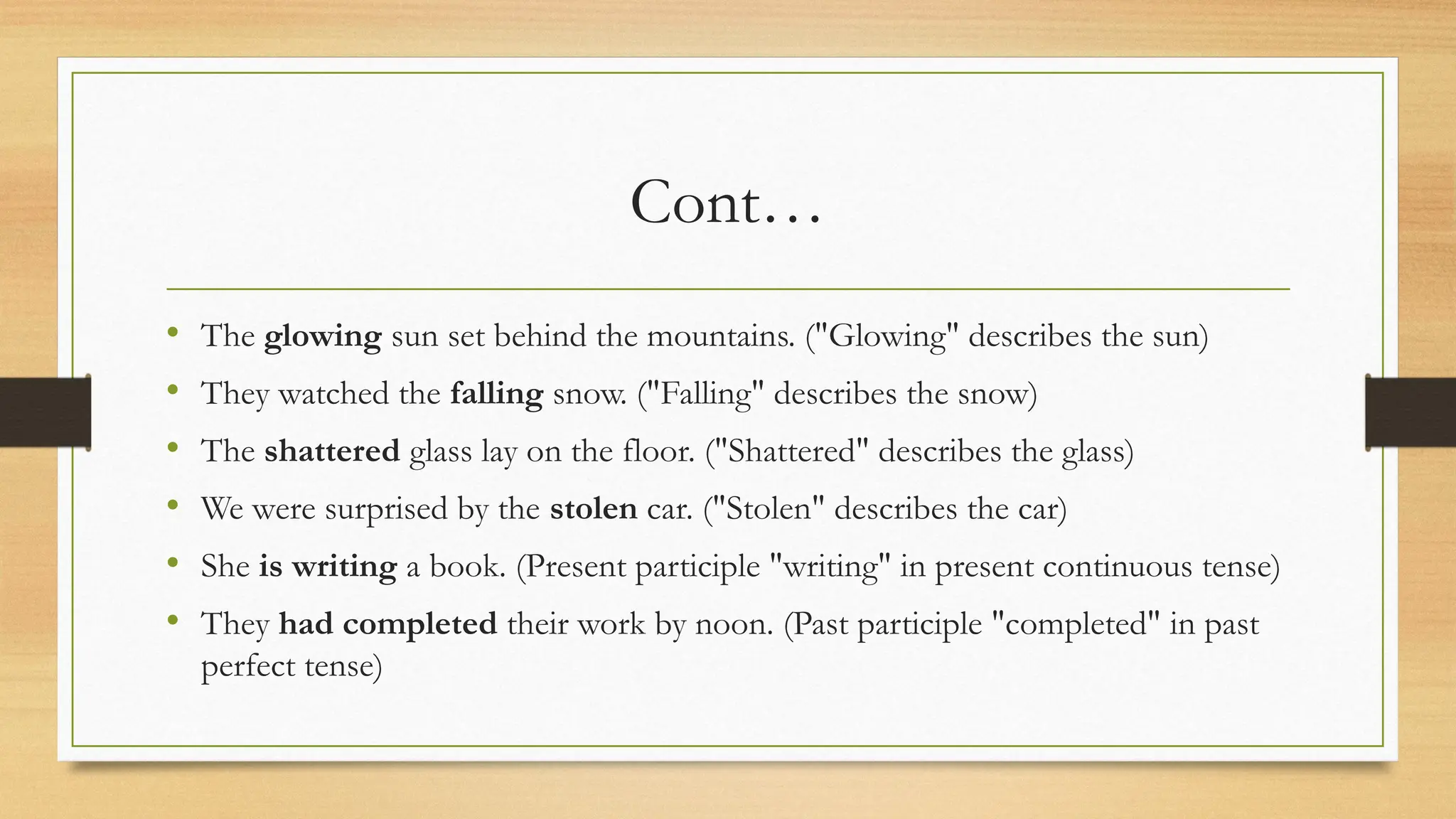
• The glowing sun set behind the mountains. ("Glowing" describes the sun)
• They watched the falling snow. ("Falling" describes the snow)
• The shattered glass lay on the floor. ("Shattered" describes the glass)
• We were surprised by the stolen car. ("Stolen" describes the car)
• She is writing a book. (Present participle "writing" in present continuous tense)
• They had completed their work by noon. (Past participle "completed" in past
perfect tense)
Cont..
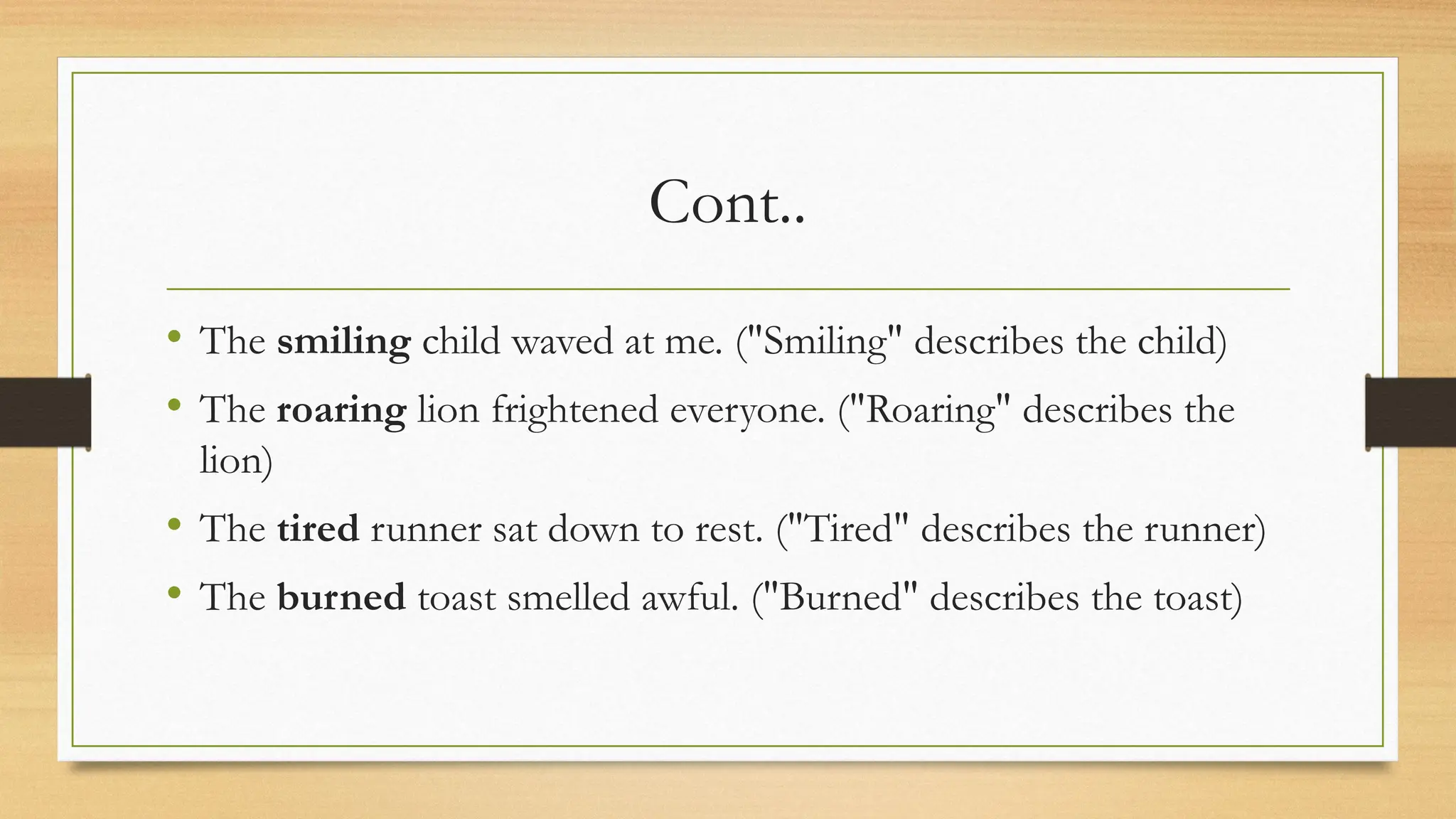
• The smiling child waved at me. ("Smiling" describes the child)
• The roaring lion frightened everyone. ("Roaring" describes the
lion)
• The tired runner sat down to rest. ("Tired" describes the runner)
• The burned toast smelled awful. ("Burned" describes the toast)
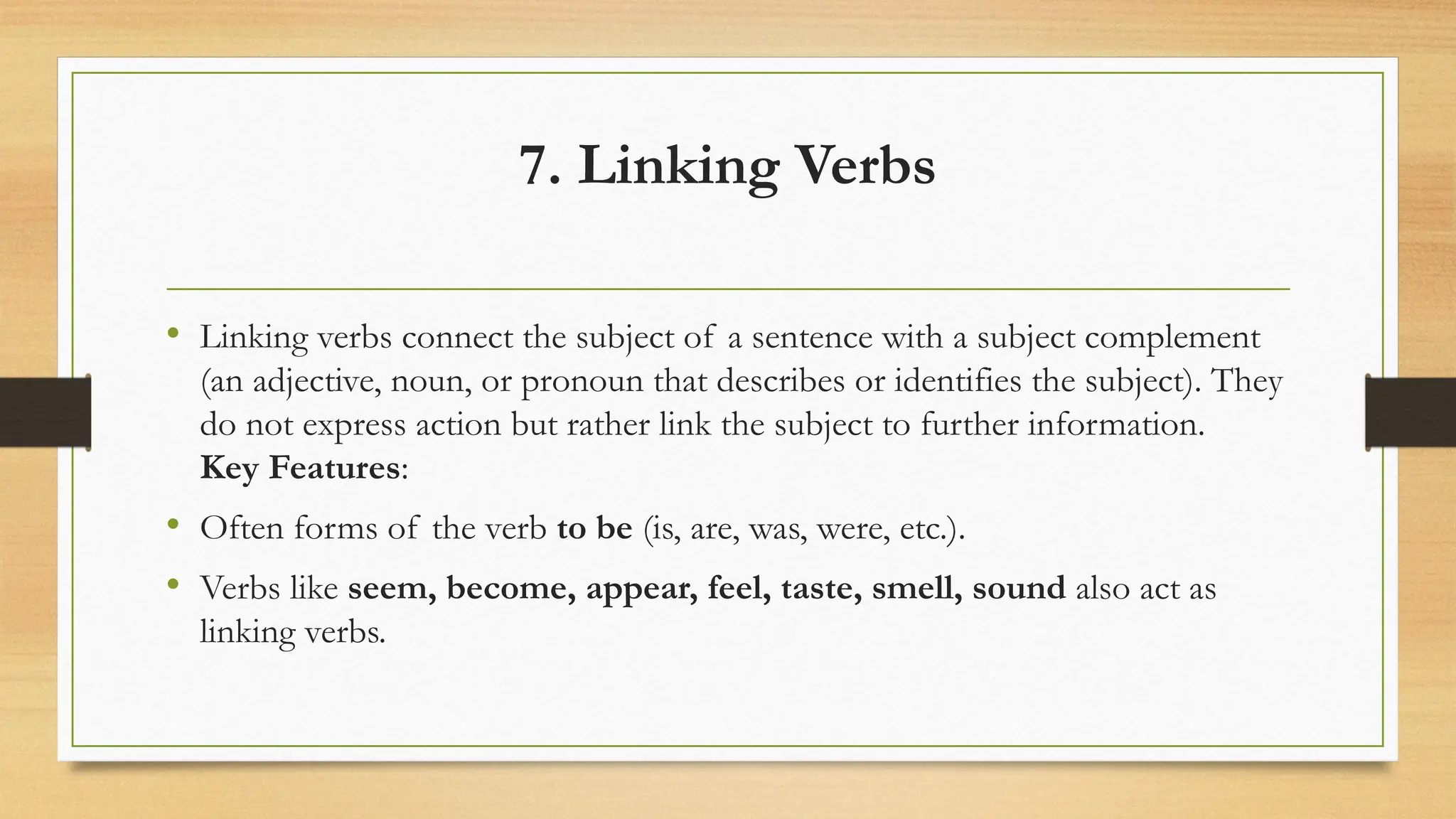
7. Linking Verbs
• Linking verbs connect the subject of a sentence with a subject complement
(an adjective, noun, or pronoun that describes or identifies the subject). They
do not express action but rather link the subject to further information.
Key Features:
• Often forms of the verb to be (is, are, was, were, etc.).
• Verbs like seem, become, appear, feel, taste, smell, sound also act as
linking verbs.
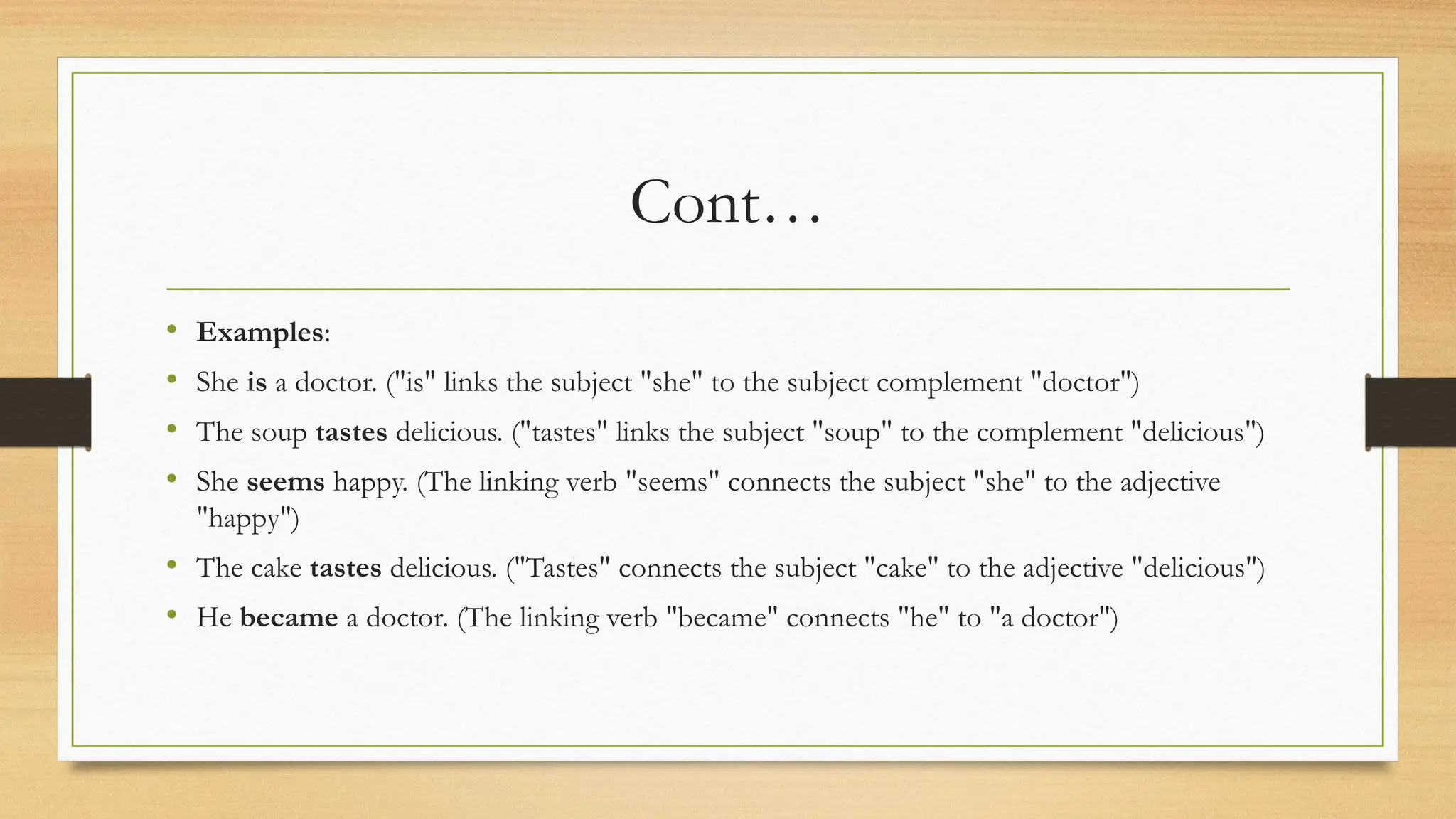
Cont…
• Examples:
• She is a doctor. ("is" links the subject "she" to the subject complement "doctor")
• The soup tastes delicious. ("tastes" links the subject "soup" to the complement "delicious")
• She seems happy. (The linking verb "seems" connects the subject "she" to the adjective
"happy")
• The cake tastes delicious. ("Tastes" connects the subject "cake" to the adjective "delicious")
• He became a doctor. (The linking verb "became" connects "he" to "a doctor")
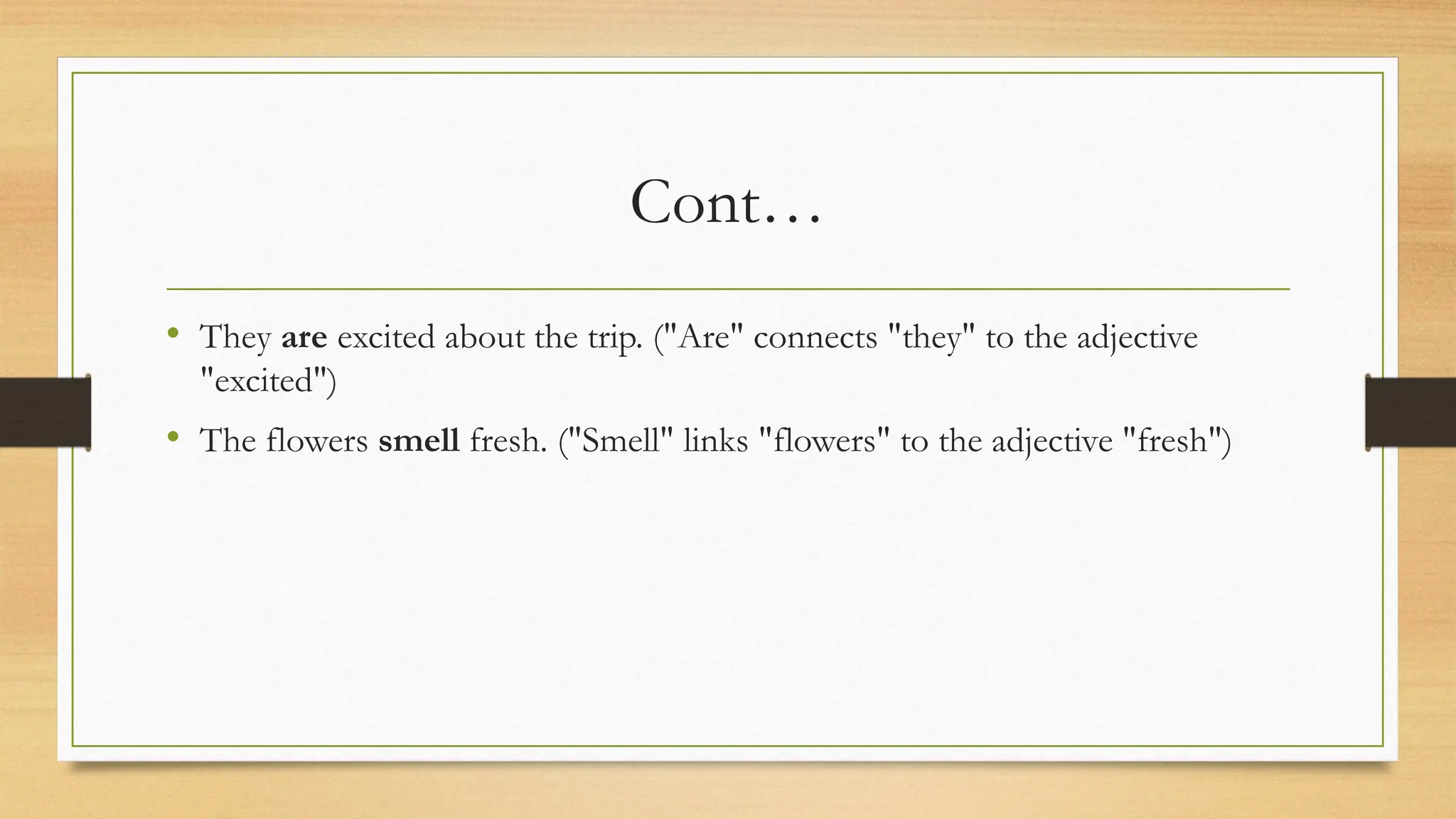
Cont…
• They are excited about the trip. ("Are" connects "they" to the adjective
"excited")
• The flowers smell fresh. ("Smell" links "flowers" to the adjective "fresh")
Worksheet

Classifications of Verbs Lecture no. 2.pptx

  • 1.
    Classifications of Verbs Classificationsof Verbs in English: Finite, Infinite, Auxiliary, Gerund, Participle, Adjective, and Linking Verbs
  • 2.
    Introduction • Verbs arethe action words or "doing words" in a sentence, but their roles can be much more complex than just representing actions.
  • 3.
    1. Finite Verbs •KeyFeatures: •Shows tense (past, present, future). •Changes form based on the subject (number and person). •Can stand alone as the main verb in a clause. •Examples: •She runs every morning. ("runs" is finite; shows present tense and agrees with the subject "she") •They ran to the store. ("ran" is finite; shows past tense and agrees with the subject "they")
  • 4.
    Cont… • Examples: • Shewrites beautifully. (Present tense; the verb "writes" agrees with the subject "she") • They played soccer yesterday. (Past tense; the verb "played" shows past tense) • He will travel to Spain next week. (Future tense; "will travel" indicates a future action)
  • 5.
    2. Non-Finite Verbs(Infinite Verbs) • Definition: Non-finite verbs (or infinitive verbs) are not marked by tense, number, or person. They do not change form to show when an action takes place or who is performing it. • Key Features: • Not influenced by subject or tense. • Often used in combination with auxiliary verbs or after certain verbs (like "to").
  • 6.
    Cont… • Types: • BareInfinitive: The verb without "to". Example: Let him go. • Full Infinitive: The base form of the verb with "to". Example: She wants to eat. • Examples: • To swim is good exercise. (The verb "to swim" is in its non-finite form, used as a subject of the sentence.) • They asked him to leave. ("to leave" is non-finite, and does not change with the subject "he" or tense)
  • 7.
    Cont… • Examples: • Iwant to learn Spanish. (The verb "to learn" does not change form based on the subject or tense) • She decided to study medicine. (Non-finite verb "to study" used as an object) • He can run fast. (Bare infinitive "run" after the modal verb "can")
  • 8.
    3. Auxiliary Verbs(Helping Verbs) • Definition: Auxiliary verbs help the main verb by forming tenses, moods, or voices. They modify the main verb and give it a specific meaning related to time, possibility, obligation, or necessity. • Key Features: • Cannot stand alone. • Help in forming continuous tenses, perfect tenses, questions, and negatives.
  • 9.
    Cont… • Common AuxiliaryVerbs: • Be, have, do: Used to form tenses. • Can, could, may, might, must, shall, will, would: Modals that express possibility, ability, permission, or obligation. • Examples: • He is running. (The auxiliary "is" helps form the present continuous tense) • They have finished the work. (The auxiliary "have" helps form the present perfect tense) • She can swim. (The modal auxiliary "can" expresses ability)
  • 10.
    Cont… • Examples: • Sheis cooking dinner. (The auxiliary verb "is" helps form the present continuous tense) • They were playing basketball when it started to rain. (The auxiliary "were" forms the past continuous) • She has finished her assignment. (The auxiliary "has" forms the present perfect tense) • You should study for the exam. ("Should" expresses a recommendation)
  • 11.
    4. Gerunds A gerundis a verb that ends in -ing and functions as a noun in a sentence. Key Features: • Always acts as a noun, though formed from a verb. • Can serve as a subject, object, or complement in a sentence. • Examples: • Swimming is my favorite hobby. (Gerund as subject) • I enjoy reading. (Gerund as object) • Her passion is dancing. (Gerund as complement)
  • 12.
    5. Participles (Presentand Past) Participles are verb forms that function as adjectives, describing or modifying nouns. There are two types: present participles and past participles. • Present Participle: The -ing form of the verb, used as an adjective or to form continuous tenses. • Example: The crying baby kept everyone awake. (Describes the baby)
  • 13.
    Cont.. • Past Participle:Usually ends in -ed, -en, -d, -t, or -n for regular and irregular verbs. It can function as an adjective or form perfect tenses. • Example: The broken vase was on the floor. (Describes the vase) • Examples in Continuous and Perfect Tenses: • She is running fast. (Present participle helping form the present continuous tense) • They have eaten dinner. (Past participle forming the present perfect tense)
  • 14.
    Cont… • Examples: • Runningis great exercise. ("Running" functions as the subject of the sentence) • She enjoys painting in her free time. ("Painting" is the object of the verb "enjoys") • His hobby is collecting stamps. ("Collecting" functions as a complement after the linking verb "is")
  • 15.
    Cont… • The glowingsun set behind the mountains. ("Glowing" describes the sun) • They watched the falling snow. ("Falling" describes the snow) • The shattered glass lay on the floor. ("Shattered" describes the glass) • We were surprised by the stolen car. ("Stolen" describes the car) • She is writing a book. (Present participle "writing" in present continuous tense) • They had completed their work by noon. (Past participle "completed" in past perfect tense)
  • 16.
    Cont.. • The smilingchild waved at me. ("Smiling" describes the child) • The roaring lion frightened everyone. ("Roaring" describes the lion) • The tired runner sat down to rest. ("Tired" describes the runner) • The burned toast smelled awful. ("Burned" describes the toast)
  • 17.
    7. Linking Verbs •Linking verbs connect the subject of a sentence with a subject complement (an adjective, noun, or pronoun that describes or identifies the subject). They do not express action but rather link the subject to further information. Key Features: • Often forms of the verb to be (is, are, was, were, etc.). • Verbs like seem, become, appear, feel, taste, smell, sound also act as linking verbs.
  • 18.
    Cont… • Examples: • Sheis a doctor. ("is" links the subject "she" to the subject complement "doctor") • The soup tastes delicious. ("tastes" links the subject "soup" to the complement "delicious") • She seems happy. (The linking verb "seems" connects the subject "she" to the adjective "happy") • The cake tastes delicious. ("Tastes" connects the subject "cake" to the adjective "delicious") • He became a doctor. (The linking verb "became" connects "he" to "a doctor")
  • 19.
    Cont… • They areexcited about the trip. ("Are" connects "they" to the adjective "excited") • The flowers smell fresh. ("Smell" links "flowers" to the adjective "fresh")
  • 20.