Rajeev Kumar, M.S.W., M.Phil., UGC-JRF
Senior Research Fellow
Indian Institute of Technology
Kharagpur
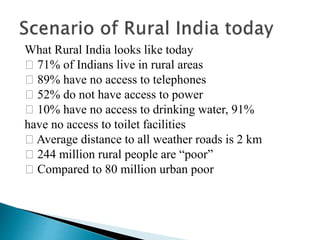
What Rural India looks like today
􀂄 71% of Indians live in rural areas
􀂄 89% have no access to telephones
􀂄 52% do not have access to power
􀂄 10% have no access to drinking water, 91%
have no access to toilet facilities
􀂄 Average distance to all weather roads is 2 km
􀂄 244 million rural people are “poor”
􀂄 Compared to 80 million urban poor
 Infrastructure is basic physical
and organizational structures needed for the operation of
a society or enterprise or reproductive system , or the
services and facilities necessary for an economy to
function.
 It can be generally defined as the set of interconnected
structural elements that provide framework supporting an
entire structure of development. It is an important term
for judging a country or region's development.
 Infrastructure plays an important role in the economic
development of an economy . It can quicken or impede the
development of an economy .
 infrastructure is indeed correlated to
economic growth in rural areas also.
 low per capita income correlates with lack of
infrastructure
 Infrastructure is essential for rural growth
 Findings from a survey in Nigeria indicate the
 infrastructure in rural areas can Increase
employment and income
 Increase efficiency and productivity (For
instance time saved due to improved
transportation)
 infrastructure can be used on other activities
 Increase access to resources
 Improve health and therefore productivity
 (For instance, if water supply is augmented,
water-related health diseases can be reduced)
 Provision of power and irrigation
 infrastructure in rural areas of India and
Bangladesh has improved productivity,
increased income and savings
 Water and Sanitation infrastructure in rural
Thailand has led to more jobs, better health,
increased school attendance, tourism benefits
Roads in rural Vietnam, Ghana and Morocco
have led to:
 Increased income as middlemen are cut out
 And farmers can transport the produce directly to
the market
 Change in crop patterns leading to more income.
 Earlier, perishable crops could not be grown as
the transportation time was large.
 Now these crops could also be added
 Lots of secondary benefits such as health,
national pride, growth in secondary industries
 India is the fourth largest economy in the world.
However, one factor which is a drag on its
development is the lack of world class infrastructure.
 Estimates suggest that the lack of proper
infrastructure pulls down India’s GDP growth by 1-2
per cent every year.
 Physical infrastructure has a direct impact on the
growth and overall development of an economy.
 But, the fast growth of the Indian economy in recent
years has placed increasing stress on physical
infrastructure,
 such as electricity, railways, roads, ports, airports,
irrigation, urban and rural water supply, and
sanitation, all of which already suffer from a
substantial deficit
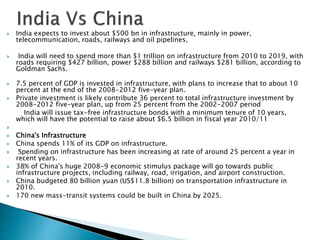
 India expects to invest about $500 bn in infrastructure, mainly in power,
telecommunication, roads, railways and oil pipelines,
 India will need to spend more than $1 trillion on infrastructure from 2010 to 2019, with
roads requiring $427 billion, power $288 billion and railways $281 billion, according to
Goldman Sachs.
 7.5 percent of GDP is invested in infrastructure, with plans to increase that to about 10
percent at the end of the 2008-2012 five-year plan.
 Private investment is likely contribute 36 percent to total infrastructure investment by
2008-2012 five-year plan, up from 25 percent from the 2002-2007 period
India will issue tax-free infrastructure bonds with a minimum tenure of 10 years,
which will have the potential to raise about $6.5 billion in fiscal year 2010/11

 China's Infrastructure
 China spends 11% of its GDP on infrastructure.
 Spending on infrastructure has been increasing at rate of around 25 percent a year in
recent years.
 38% of China's huge 2008-9 economic stimulus package will go towards public
infrastructure projects, including railway, road, irrigation, and airport construction.
 China budgeted 80 billion yuan (US$11.8 billion) on transportation infrastructure in
2010.
 170 new mass-transit systems could be built in China by 2025.
 We need to look for “Local Solutions” in rural areas and
 not large “Network Based” solutions
 􀂅 Septic tanks, Mobile Phones, local power generators etc will
 work better in rural areas give the scale of investment and
use
 􀂅 Sanitation and Treatment plants, phone lines and power
grids
 might not work since the costs might outweigh the demand
 􀂅 Subsidies are needed to achieve break-even for
 investments in rural areas due to lack of economies of
 scale and reduce consumption power
 􀂅 Micro-finance and micro-lending can play a part in
 generating finances for small scale projects that will
 make a difference in rural areas
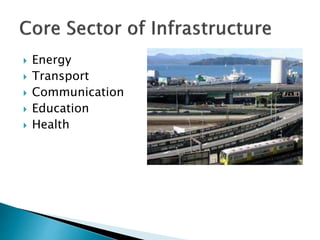
 Energy
 Transport
 Communication
 Education
 Health
 73rd Constitutional Amendment Act has been
 enacted to empower panchayats
 􀂅 Bharat Nirman Program has been introduced
 to provide infrastructure in rural areas
 􀂅 Other schemes such as the Pradhan Mantri
Gram Sadhak Yojana for rural roads, the
Accelerated Rural Water Supply Program for
rural water and sanitation, the Rajiv Gandhi
Vidyukranthi Yojana for rural electrification etc
have been introduced.
 Universal Service Obligations (USO) exists in the
 Telecom sector to raise funds for rural phone
 connectivity
 􀂅 Target for rural Tele-density is 15% or greater. An
8000Cr outlay
 has been proposed for this.
 􀂅 NREGS (National Rural Employment Guarantee
 Scheme) has been floated to provide at least 100 days
 of guaranteed employment to improve the economic
 conditions of some people in rural areas
 􀂅 PURA scheme has been floated to Provide Urban
 Amenities in Rural Areas
 􀂅 Rural Infrastructure Development Fund (RIDF) has been
 set up by NABARD to the tune of 60,000Cr
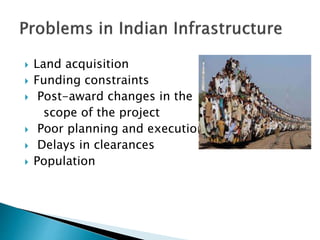
 Land acquisition
 Funding constraints
 Post-award changes in the
scope of the project
 Poor planning and execution
 Delays in clearances
 Population
 Bharat Nirman is a time-bound business plan
for action in rural infrastructure.
 Under Bharat Nirman, action is proposed in
the areas of irrigation, rural housing, rural
water supply, rural electrification and rural
telecommunication connectivity.
 To upgrade rural infrastructure, the Government has
formulated a proposal for providing the road
connections to more than 38,484 villages above 1000
population and all 20,867 habitations above 500
populations in hilly and tribal areas.
 To achieve the targets of Bharat Nirman, 1,46,185
kms. of road length is proposed to be constructed by
2009.
 This will benefit 66,802 unconnected eligible
habitations in the country.
 To ensure full farm to market connectivity, it is also
proposed to upgrade 1,94,132 kms. of the existing
Associated Through Routes.
 A sum of approximately Rs.48,000 crore is proposed
to be invested to achieve this.
 Housing is one of basic requirements for human
survival.
 For a shelterless person, possession of a house
brings about a profound social change in his
existence, endowing him with an identity,
 thus integrating him with his immediate social
milieu.
 The Ministry of Rural Development is
implementing Indira Awaas Yojana (IAY) with a
view to providing financial assistance to the rural
poor living below poverty line for construction of
pucca house.
 The Government of India is implementing Indira Awaas Yojana
(IAY) since the year 1985-86 to provide financial assistance for
construction / upgradation of dwelling units to the below
poverty line (BPL) rural households belonging to the scheduled
castes, scheduled Tribes and freed bonded labourers categories.
 From the year 1993-94, the scope of the scheme was extended
to cover non-Scheduled Castes and Scheduled Tribes rural BPL
poor, subject to the condition that the benefits to non-SC/ST
would not be more than 40% of the total IAY allocation.
 The benefits of the Scheme have also been extended to the
families of ex-servicemen of the armed and paramilitary forces
killed in action,
 3% of the Houses are reserved for the rural Below Poverty Line
physically and mentally challenged persons, from 2006-07
onward, funds and physical targets under IAY are also being
earmarked for BPL minorities in each state.
 Under the Irrigation Component of Bharat Nirman, the
target of creation of additional irrigation potential of 1
crore hectare in 4 years (2005-06 to 2008-09) is planned
to be met largely through expeditious completion of
identified ongoing major and medium irrigation projects.
Irrigation potential of 42 lakh hectare is planned to be
created by expeditiously completing such ongoing major
and medium projects.
 There is a definite gap between irrigation potential created
and the potential utilized.
 Under Bharat Nirman it is planned to restore and utilize
irrigation potential of 10 lakh hectare through
implementation of extension, renovation and
modernization of schemes alongwith command area
development and water management practices.
 Telecom connectivity constitutes an important part of
the effort to upgrade the rural infrastructure.
 Under the Bharat Nirman Programme, it will be
ensured that 66,822 revenue villages in the country,
 which have not yet been provided with a Village
Public Telephone (VPT), shall be covered.
 Out of the above villages, connectivity in 14,183
remote and far flung villages will be provided through
digital satellite phone terminals.
 Assistance for both capital as well as operational
expenditure for these VPTs will be met out of the
Universal Services Obligation Fund (USOF).
 To build rural infrastructure, Bharat Nirman has
been launched by the Government of India in
2005 to be implemented in a period of four years
from 2005-06 to 2008-09.
 Rural drinking water is one of the six
components of Bharat Nirman.
 During Bharat Nirman period, 55,067 un-covered
and about 3.31 lakh slipped-back habitations are
to be covered with provisions of drinking water
facilities
 and 2.17 lakh quality-affected habitations are to
be addressed for water quality problem.
 Ministry of Power has introduced the scheme Rajiv
Gandhi Grameen Vidhyutikaran Yojana (RGGVY) in
April 2005,
 which aims at providing electricity in all villages and
habitations in four years and provides access to
electricity to all rural households.
 This programme has been brought under the ambit
of Bharat Nirman.
 Under RGGVY, electricity distribution infrastructure is
envisaged to establish Rural Electricity Distribution
Backbone (REDB) with at least a 33/11KV sub-station,
 Village Electrification Infrastructure (VEI) with at least
a Distribution Transformer in a village or hamlet, and
standalone grids with generation where grid supply is
not feasible.
8.cl 10 13 rural infrastructure-2

8.cl 10 13 rural infrastructure-2

  • 1.
    Rajeev Kumar, M.S.W.,M.Phil., UGC-JRF Senior Research Fellow Indian Institute of Technology Kharagpur
  • 2.
    What Rural Indialooks like today 􀂄 71% of Indians live in rural areas 􀂄 89% have no access to telephones 􀂄 52% do not have access to power 􀂄 10% have no access to drinking water, 91% have no access to toilet facilities 􀂄 Average distance to all weather roads is 2 km 􀂄 244 million rural people are “poor” 􀂄 Compared to 80 million urban poor
  • 3.
     Infrastructure isbasic physical and organizational structures needed for the operation of a society or enterprise or reproductive system , or the services and facilities necessary for an economy to function.  It can be generally defined as the set of interconnected structural elements that provide framework supporting an entire structure of development. It is an important term for judging a country or region's development.  Infrastructure plays an important role in the economic development of an economy . It can quicken or impede the development of an economy .
  • 4.
     infrastructure isindeed correlated to economic growth in rural areas also.  low per capita income correlates with lack of infrastructure  Infrastructure is essential for rural growth
  • 5.
     Findings froma survey in Nigeria indicate the  infrastructure in rural areas can Increase employment and income  Increase efficiency and productivity (For instance time saved due to improved transportation)  infrastructure can be used on other activities  Increase access to resources  Improve health and therefore productivity  (For instance, if water supply is augmented, water-related health diseases can be reduced)
  • 6.
     Provision ofpower and irrigation  infrastructure in rural areas of India and Bangladesh has improved productivity, increased income and savings  Water and Sanitation infrastructure in rural Thailand has led to more jobs, better health, increased school attendance, tourism benefits
  • 7.
    Roads in ruralVietnam, Ghana and Morocco have led to:  Increased income as middlemen are cut out  And farmers can transport the produce directly to the market  Change in crop patterns leading to more income.  Earlier, perishable crops could not be grown as the transportation time was large.  Now these crops could also be added  Lots of secondary benefits such as health, national pride, growth in secondary industries
  • 8.
     India isthe fourth largest economy in the world. However, one factor which is a drag on its development is the lack of world class infrastructure.  Estimates suggest that the lack of proper infrastructure pulls down India’s GDP growth by 1-2 per cent every year.  Physical infrastructure has a direct impact on the growth and overall development of an economy.  But, the fast growth of the Indian economy in recent years has placed increasing stress on physical infrastructure,  such as electricity, railways, roads, ports, airports, irrigation, urban and rural water supply, and sanitation, all of which already suffer from a substantial deficit
  • 10.
     India expectsto invest about $500 bn in infrastructure, mainly in power, telecommunication, roads, railways and oil pipelines,  India will need to spend more than $1 trillion on infrastructure from 2010 to 2019, with roads requiring $427 billion, power $288 billion and railways $281 billion, according to Goldman Sachs.  7.5 percent of GDP is invested in infrastructure, with plans to increase that to about 10 percent at the end of the 2008-2012 five-year plan.  Private investment is likely contribute 36 percent to total infrastructure investment by 2008-2012 five-year plan, up from 25 percent from the 2002-2007 period India will issue tax-free infrastructure bonds with a minimum tenure of 10 years, which will have the potential to raise about $6.5 billion in fiscal year 2010/11   China's Infrastructure  China spends 11% of its GDP on infrastructure.  Spending on infrastructure has been increasing at rate of around 25 percent a year in recent years.  38% of China's huge 2008-9 economic stimulus package will go towards public infrastructure projects, including railway, road, irrigation, and airport construction.  China budgeted 80 billion yuan (US$11.8 billion) on transportation infrastructure in 2010.  170 new mass-transit systems could be built in China by 2025.
  • 11.
     We needto look for “Local Solutions” in rural areas and  not large “Network Based” solutions  􀂅 Septic tanks, Mobile Phones, local power generators etc will  work better in rural areas give the scale of investment and use  􀂅 Sanitation and Treatment plants, phone lines and power grids  might not work since the costs might outweigh the demand  􀂅 Subsidies are needed to achieve break-even for  investments in rural areas due to lack of economies of  scale and reduce consumption power  􀂅 Micro-finance and micro-lending can play a part in  generating finances for small scale projects that will  make a difference in rural areas
  • 13.
     Energy  Transport Communication  Education  Health
  • 14.
     73rd ConstitutionalAmendment Act has been  enacted to empower panchayats  􀂅 Bharat Nirman Program has been introduced  to provide infrastructure in rural areas  􀂅 Other schemes such as the Pradhan Mantri Gram Sadhak Yojana for rural roads, the Accelerated Rural Water Supply Program for rural water and sanitation, the Rajiv Gandhi Vidyukranthi Yojana for rural electrification etc have been introduced.
  • 15.
     Universal ServiceObligations (USO) exists in the  Telecom sector to raise funds for rural phone  connectivity  􀂅 Target for rural Tele-density is 15% or greater. An 8000Cr outlay  has been proposed for this.  􀂅 NREGS (National Rural Employment Guarantee  Scheme) has been floated to provide at least 100 days  of guaranteed employment to improve the economic  conditions of some people in rural areas  􀂅 PURA scheme has been floated to Provide Urban  Amenities in Rural Areas  􀂅 Rural Infrastructure Development Fund (RIDF) has been  set up by NABARD to the tune of 60,000Cr
  • 16.
     Land acquisition Funding constraints  Post-award changes in the scope of the project  Poor planning and execution  Delays in clearances  Population
  • 18.
     Bharat Nirmanis a time-bound business plan for action in rural infrastructure.  Under Bharat Nirman, action is proposed in the areas of irrigation, rural housing, rural water supply, rural electrification and rural telecommunication connectivity.
  • 19.
     To upgraderural infrastructure, the Government has formulated a proposal for providing the road connections to more than 38,484 villages above 1000 population and all 20,867 habitations above 500 populations in hilly and tribal areas.  To achieve the targets of Bharat Nirman, 1,46,185 kms. of road length is proposed to be constructed by 2009.  This will benefit 66,802 unconnected eligible habitations in the country.  To ensure full farm to market connectivity, it is also proposed to upgrade 1,94,132 kms. of the existing Associated Through Routes.  A sum of approximately Rs.48,000 crore is proposed to be invested to achieve this.
  • 20.
     Housing isone of basic requirements for human survival.  For a shelterless person, possession of a house brings about a profound social change in his existence, endowing him with an identity,  thus integrating him with his immediate social milieu.  The Ministry of Rural Development is implementing Indira Awaas Yojana (IAY) with a view to providing financial assistance to the rural poor living below poverty line for construction of pucca house.
  • 21.
     The Governmentof India is implementing Indira Awaas Yojana (IAY) since the year 1985-86 to provide financial assistance for construction / upgradation of dwelling units to the below poverty line (BPL) rural households belonging to the scheduled castes, scheduled Tribes and freed bonded labourers categories.  From the year 1993-94, the scope of the scheme was extended to cover non-Scheduled Castes and Scheduled Tribes rural BPL poor, subject to the condition that the benefits to non-SC/ST would not be more than 40% of the total IAY allocation.  The benefits of the Scheme have also been extended to the families of ex-servicemen of the armed and paramilitary forces killed in action,  3% of the Houses are reserved for the rural Below Poverty Line physically and mentally challenged persons, from 2006-07 onward, funds and physical targets under IAY are also being earmarked for BPL minorities in each state.
  • 22.
     Under theIrrigation Component of Bharat Nirman, the target of creation of additional irrigation potential of 1 crore hectare in 4 years (2005-06 to 2008-09) is planned to be met largely through expeditious completion of identified ongoing major and medium irrigation projects. Irrigation potential of 42 lakh hectare is planned to be created by expeditiously completing such ongoing major and medium projects.  There is a definite gap between irrigation potential created and the potential utilized.  Under Bharat Nirman it is planned to restore and utilize irrigation potential of 10 lakh hectare through implementation of extension, renovation and modernization of schemes alongwith command area development and water management practices.
  • 23.
     Telecom connectivityconstitutes an important part of the effort to upgrade the rural infrastructure.  Under the Bharat Nirman Programme, it will be ensured that 66,822 revenue villages in the country,  which have not yet been provided with a Village Public Telephone (VPT), shall be covered.  Out of the above villages, connectivity in 14,183 remote and far flung villages will be provided through digital satellite phone terminals.  Assistance for both capital as well as operational expenditure for these VPTs will be met out of the Universal Services Obligation Fund (USOF).
  • 24.
     To buildrural infrastructure, Bharat Nirman has been launched by the Government of India in 2005 to be implemented in a period of four years from 2005-06 to 2008-09.  Rural drinking water is one of the six components of Bharat Nirman.  During Bharat Nirman period, 55,067 un-covered and about 3.31 lakh slipped-back habitations are to be covered with provisions of drinking water facilities  and 2.17 lakh quality-affected habitations are to be addressed for water quality problem.
  • 25.
     Ministry ofPower has introduced the scheme Rajiv Gandhi Grameen Vidhyutikaran Yojana (RGGVY) in April 2005,  which aims at providing electricity in all villages and habitations in four years and provides access to electricity to all rural households.  This programme has been brought under the ambit of Bharat Nirman.  Under RGGVY, electricity distribution infrastructure is envisaged to establish Rural Electricity Distribution Backbone (REDB) with at least a 33/11KV sub-station,  Village Electrification Infrastructure (VEI) with at least a Distribution Transformer in a village or hamlet, and standalone grids with generation where grid supply is not feasible.