POWER SENERIO :
BHUTAN AND NEPAL
Presented By :
Ashish Singh
MBA – PM
500033217
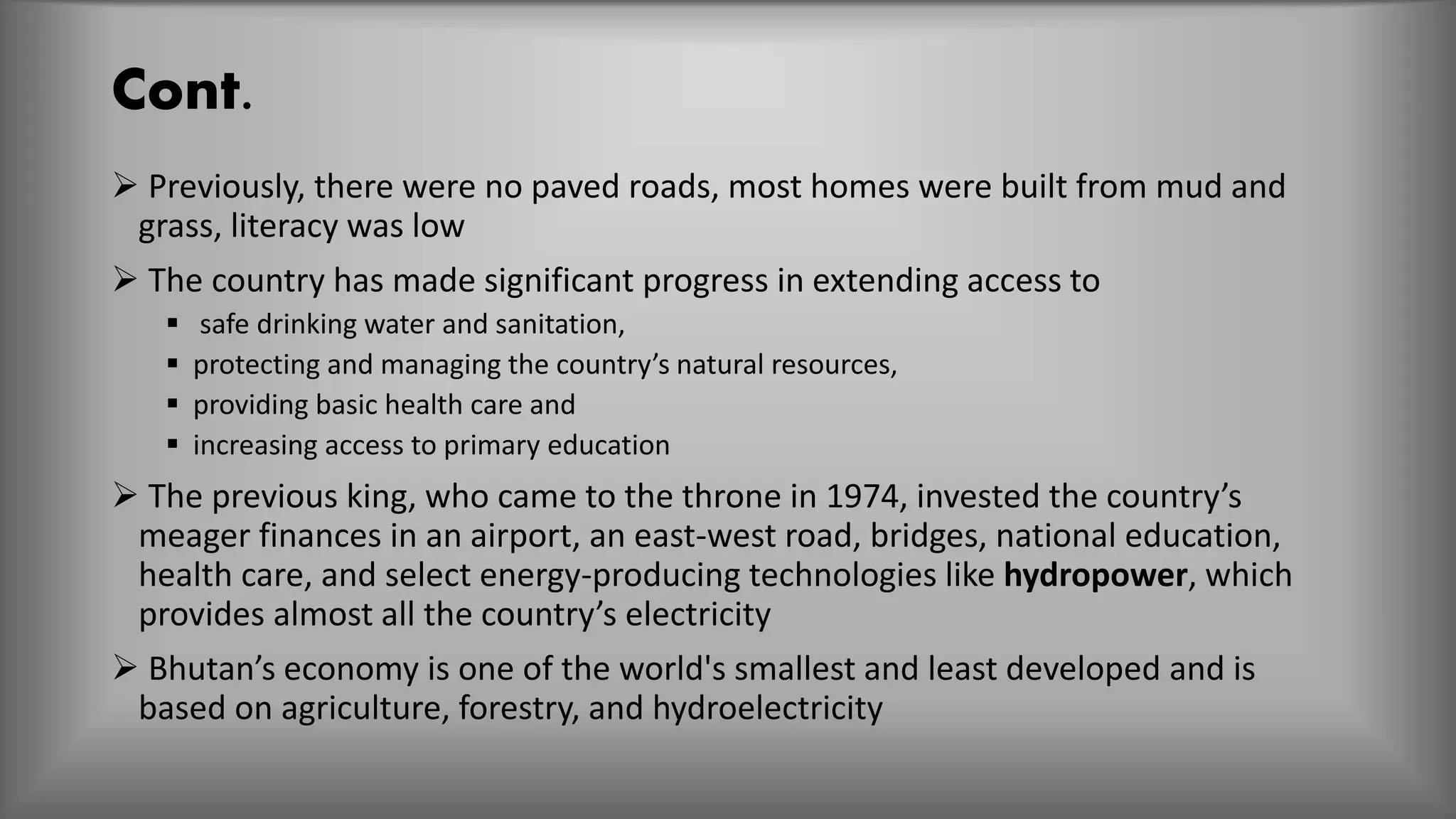
BHUTAN
BHUTAN
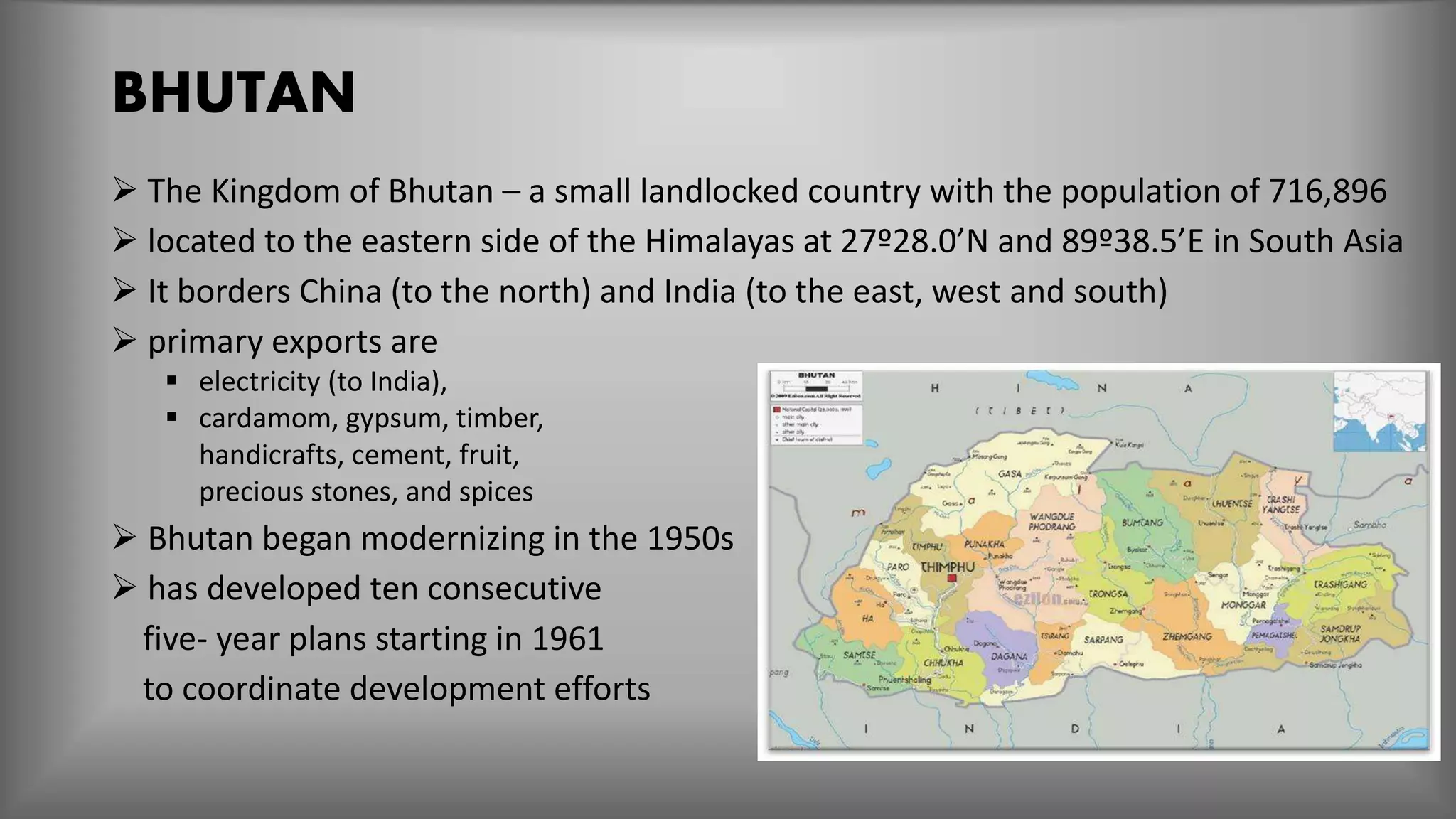
 The Kingdom of Bhutan – a small landlocked country with the population of 716,896
 located to the eastern side of the Himalayas at 27º28.0’N and 89º38.5’E in South Asia
 It borders China (to the north) and India (to the east, west and south)
 primary exports are
 electricity (to India),
 cardamom, gypsum, timber,
handicrafts, cement, fruit,
precious stones, and spices
 Bhutan began modernizing in the 1950s
 has developed ten consecutive
five- year plans starting in 1961
to coordinate development efforts
Cont.
 Previously, there were no paved roads, most homes were built from mud and
grass, literacy was low
 The country has made significant progress in extending access to
 safe drinking water and sanitation,
 protecting and managing the country’s natural resources,
 providing basic health care and
 increasing access to primary education
 The previous king, who came to the throne in 1974, invested the country’s
meager finances in an airport, an east-west road, bridges, national education,
health care, and select energy-producing technologies like hydropower, which
provides almost all the country’s electricity
 Bhutan’s economy is one of the world's smallest and least developed and is
based on agriculture, forestry, and hydroelectricity
Cont.
 Despite this constraint, hydroelectricity and construction continue to be the two
major industries of growth for the country
 Bhutan Government has undertaken a number of measures to ensure a diverse
economy and prosperity for the rural dwellers in remote areas
 One such measure is the Rural Electrification (RE) program which aims at
achieving 100% rural electrification by end of 2013
 In 2010 Bhutan was ranked by the Transparency International Corruption
Perception as the least corrupt country in South Asia (The World Bank Group
(WBG), 2010)
Cont.
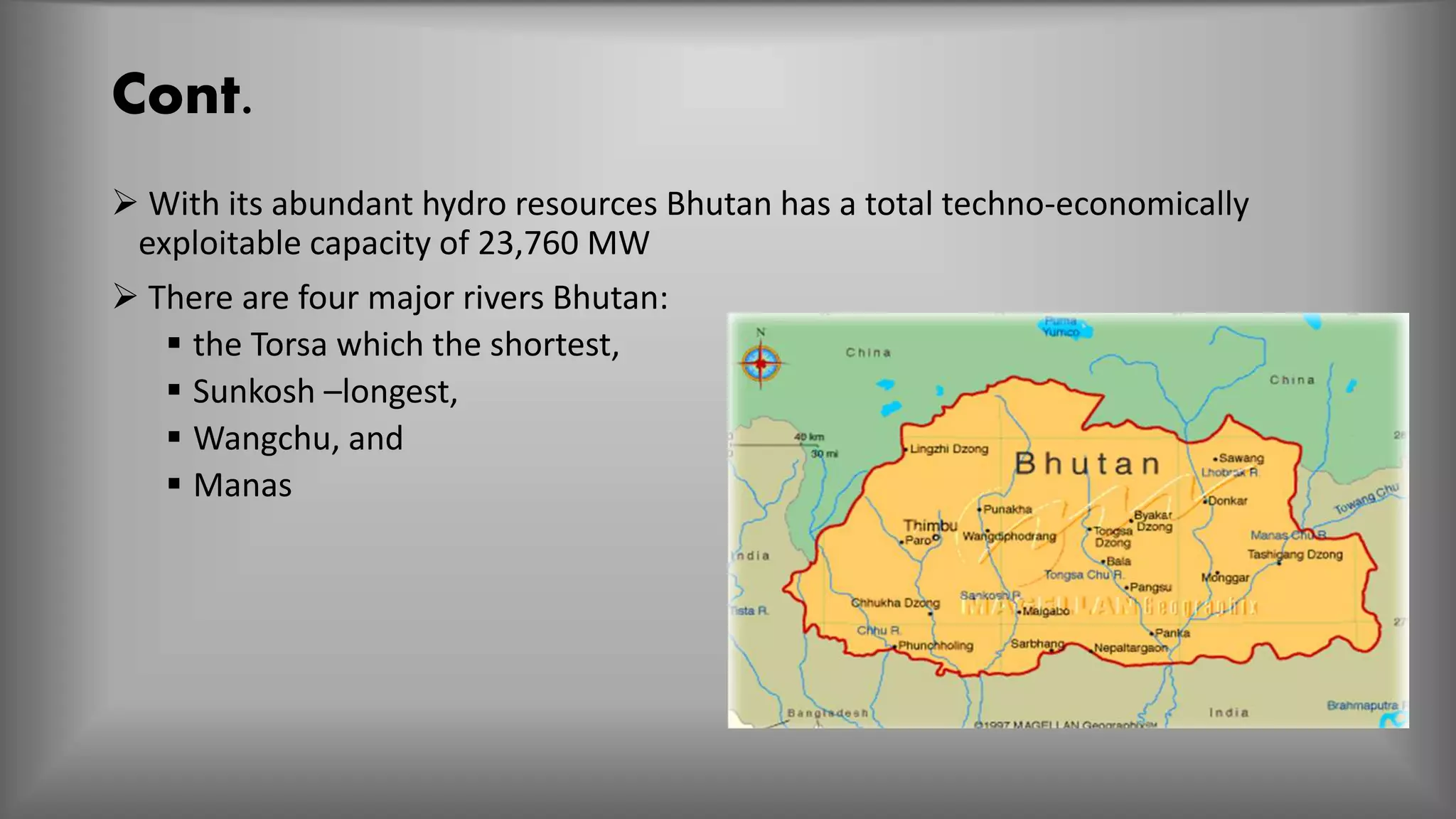
 With its abundant hydro resources Bhutan has a total techno-economically
exploitable capacity of 23,760 MW
 There are four major rivers Bhutan:
 the Torsa which the shortest,
 Sunkosh –longest,
 Wangchu, and
 Manas
Brief of Bhutan Economy
 Statistics
 GDP : $ 5.036 billion (2012 est.)
 GDP Growth : 9.7 % (2012 est.)
 GDP per capita : $ 6,800 (2012 est.)
 GDP by sector : agriculture – 23 %, industry – 37.9 %, services – 39.8 % (2009)
 Population below : 31.7 % (2003)
Poverty line
 Labor force : agriculture – 63 %, industry – 6 %, services – 31 % (2004 est.)
by occupation
 Unemployment : 2.5 % (2004)
 Exports Goods : Electricity (to India), cardamom, gypsum, timber, handicrafts, cement
fruit, precious stone, spices
 Main Exports : India – 58.6 %, Hong Kong – 30.1 %, Bangladesh – 7.3 %
Partners
Objective And Scope
 Objective is to examine
 electricity sector in the Kingdom of Bhutan,
 analyze the historical evolution of electricity demand and supply,
 export and import,
 the energy load profiles of high-voltage and medium-voltage industries
 Scopes
 review previous energy studies in Bhutan and understand the current developments in the
energy sector and hydropower;
 analyze the annual and quarterly reports of the National Load Dispatch Center of the Bhutan
Power Corporation, as well as the industry load profiles for the period 2010-2012;
 determine from the published literature the implications of energy efficiency and demand
side management on industrial peak load and consumption; and
 provide recommendations on the implementation of renewable energy and/or energy
efficiency projects to address the problem of seasonal energy shortages and to sustain
energy sales during winter
Sector Development Context
 The main development challenges faced by Bhutan’s power sector in the
mid-1990s were identified as
 the institutional weakness of the sector,
 its inability to assume the role of key growth driver in promoting the country’s economic
development through power exports
 providing access to electricity for rural consumers
 The sector also suffered from poor cost recovery and dependence on donor
financing for new investments
 Institutional reforms undertaken during 1999–2002, with the assistance of
the Asian Development Bank (ADB) and other development partners,
addressed some of these challenges
 The newly established power sector entities in 2002 faced the challenge of
 transforming Bhutan’s power sector from a state department dependent to financially
sustainable utilities
 mobilizing investments for expanding access to rural communities,
 mobilizing financing for export-oriented hydropower projects, and
 improving cost recovery through tariff adjustments
 By 2009, power sector entities in Bhutan had achieved an adequate level of
institutional maturity with the exception of the power sector regulatory agencies :
 Bhutan Electricity Authority (BEA)
 Bhutan Power Corporation (BPC)
• responsible for domestic power supply
 Druk Green Power Company (DGPC)
• responsible for operating the export – oriented hydropower projects
 power sector has contributed to over 40% of the fiscal revenues in 2009
 domestic power supply continues to receive an implicit subsidy from power exports
Government Policy Response
The government’s development strategy during 1994–2009 recognized that
development of country’s hydropower plant will enhance the central role of the
power sector in promoting
 Fiscal revenues from power exports
 economic development and poverty alleviation by exploiting the abundant hydropower potential
for Increasing the government’s fiscal revenues from power exports
 balanced regional growth with the electrification of rural communities, and
 industrial investments based on cheap and reliable supply of electricity
The government followed a consistent policy framework during Five Year Plan
(1994–2009) to achieve these strategic objectives by :
• establishing a transparent governance framework for the sector by separating the policy
making, sector regulation, and utility operation functions;
• increasing the commercial orientation and operational efficiency of the utility function of the
power sector for expanding the power transmission and distribution network to facilitate the
evacuation of power from export-oriented hydropower plants (HPPs) and to increase access
to electricity for people in rural areas;
• improving the financial performance and cost recovery of the sector through tariff
adjustments while maintaining the government’s objective of providing affordable electricity
to low-income households; and
• establishing a competent agency to consolidate government ownership in export-oriented
hydropower projects and to act as a strategic partner in developing new export-oriented
HPPs.
Government’s Five Year Plan
 Government's 7th Five Year Plan focused on
 scaling up the rural electrification program to electrify 5,500 households,
 completing the master plan for hydropower development and the feasibility
study for Tala HPP project,
 initiating the construction of two medium hydropower projects (Basochhu
HPP and Kurichhu HPP), and
 strengthening power transmission to Thimphu and load centers in southern
Bhutan
 Government's 8th Five Year Plan focused on
 prioritized construction of the Basochhu HPP and Kurichhu HPPs,
 commencing construction of Tala HPP, and providing 10,000 households with access to
electricity
 preparation of detailed feasibility studies for other large hydropower projects
 the construction of other mini hydropower projects for domestic supply
 the government also decided to decentralize the implementation and operation of power
distribution to district units
 Government's 9th Five Year Plan focused on
 rural electrification (100% by 2020)
 economic self-reliance through hydropower exports
 The following strategy was adopted to meet these objectives:
 strengthening the institutional capacity of the sector following the provisions of the
Electricity Act by empowering BEA as the regulatory body
 transparent tariff setting for domestic and export power sales based on economic
considerations—this involves establishing a multiyear tariff setting formula to provide an
adequate rate of return on investments to power sector entities
 prioritizing rural electrification as a means of equitably distributing the benefits of Bhutan’s
hydropower resources—the 9th plan targeted 15,000 connections compared to 10,000
connections provided under the 8th plan
 formulating policy guidelines to encourage private sector participation in the hydropower
sector as well as community participation in the implementation of rural electrification
 preparing an energy and water resource master plan for developing the hydropower sector
in a sustainable manner
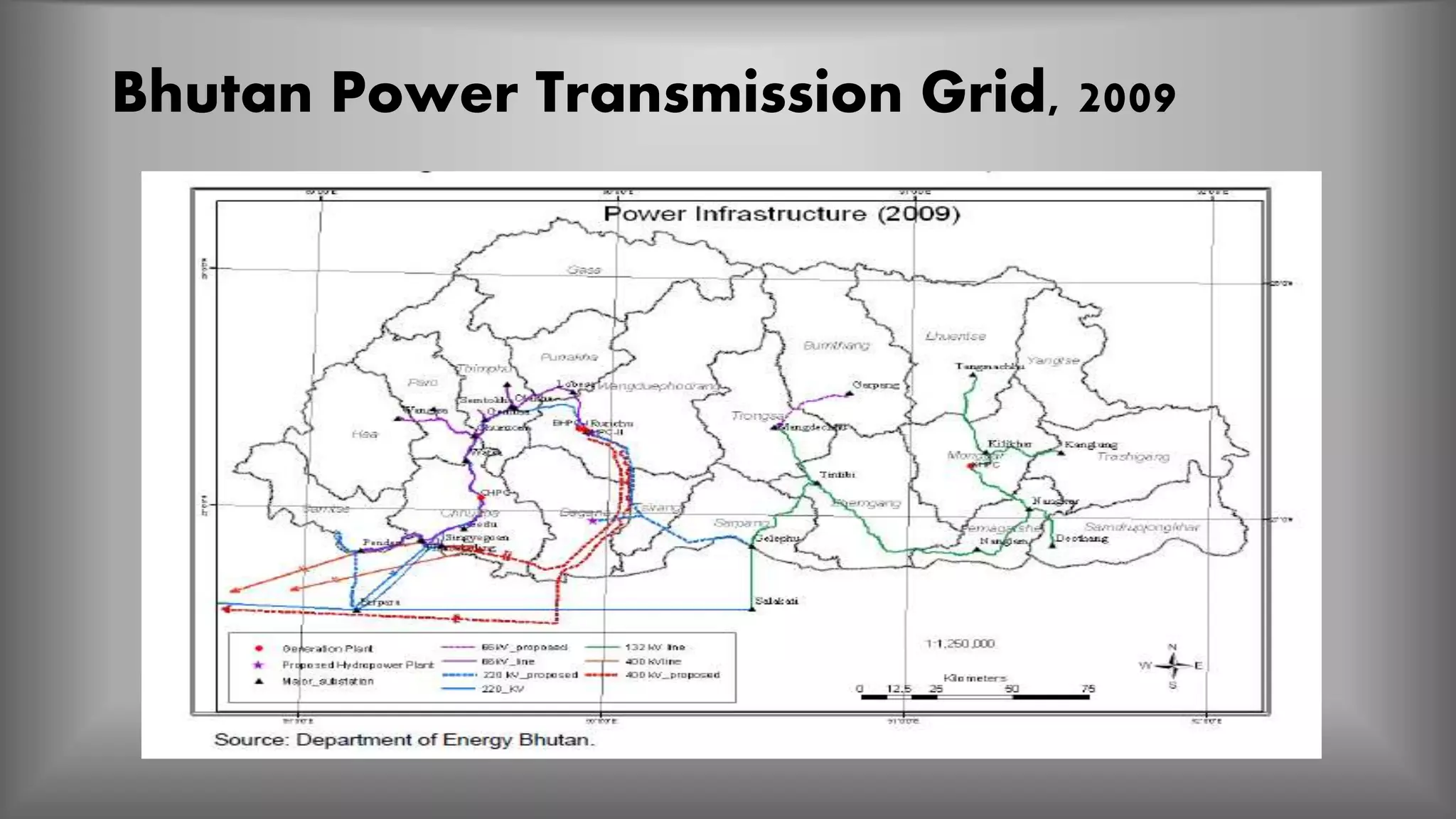
 establishing an interconnected transmission grid by integrating the western and eastern grid,
and extending the power transmission grid to remote parts of the country
 installing a Supervisory Control and Data Acquisition (SCADA) system
 Government's 10th Five Year Plan focused on
 100% electrification by 2013
 developing 10,000 MW of hydropower generation capacity with the assistance of the
Government of India
 The 10th plan identified critical challenges associated with achieving these
targets:
 addressing the environmental impacts associated with hydropower development
 the high up-front investment cost of hydropower and the difficulty of mobilizing the
requisite financial requirements;
 developing access and transport infrastructure to hydropower sites;
 high dependence of Bhutan’s economy on the hydropower sector (by 2020, the hydropower
sector is expected to contribute 50% of GDP and over 75% of fiscal revenues); and
 financial constraints faced by the rural electrification program and the continued availability
of subsidies in the form of avoided power exports, which command a higher price than the
price charged for rural consumers
Objective And Goals
 Bhutan is the only country in South Asia with surplus power generation capacity
 power sector contributes a significant share to its national economy in 2009
 40% of government revenues,
 45% of export earnings, and
 25% of gross domestic product (GDP)
 The Asian Development Bank (ADB) has been a major development partner in
Bhutan’s power sector
 ADB played a catalytic role in structuring and financing Bhutan’s first public–private
partnership (PPP) transaction in the export-oriented hydropower sector
 Bhutan has committed to an ambitious agenda of developing over 10,000
megawatts (MW) of hydropower capacity by 2020 with assistance from the
Government of India, and achieving 100% electrification by 2013
Institutional Context
 Electricity supply in Bhutan in the 1990s (including the operation of mini HPPs
and diesel power plants) was the responsibility of the DOP, which was part of the
Ministry of Trade and Investment
 A major turning point in the overall development of the power sector was the
commissioning of the 336 megawatt (MW) Chhukha Hydro Power Plant together
with transmission links to connect the power station to both Bhutan’s domestic
network and the Indian grid in 1988
 The project was implemented as a joint venture between the Government of
India and the Government of Bhutan, and then incorporated in July 1991 under
the Companies Act, 1989 as Chhukha Hydro Power Company (CHPC), a
government-owned company
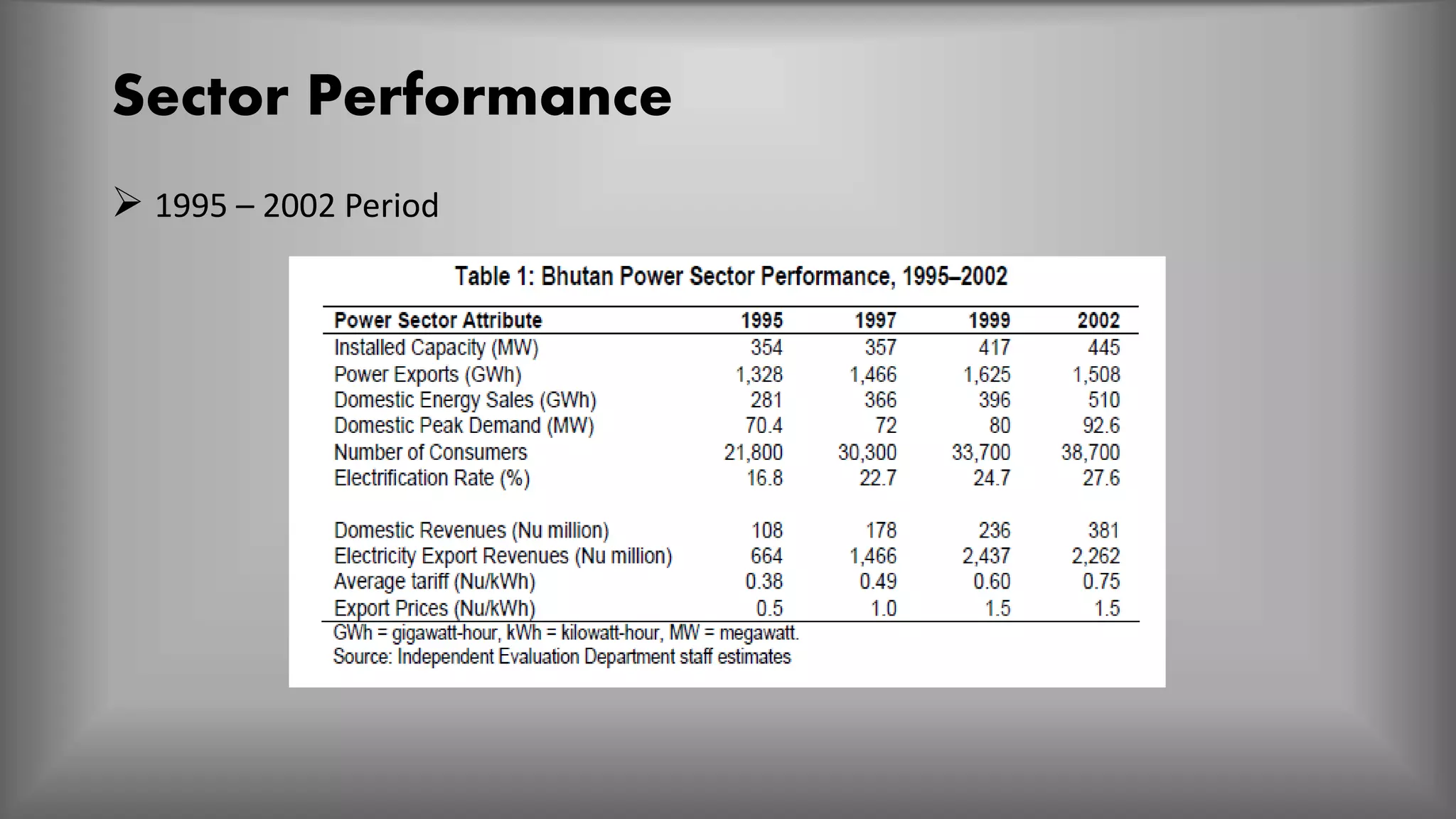
Sector Performance
 1995 – 2002 Period
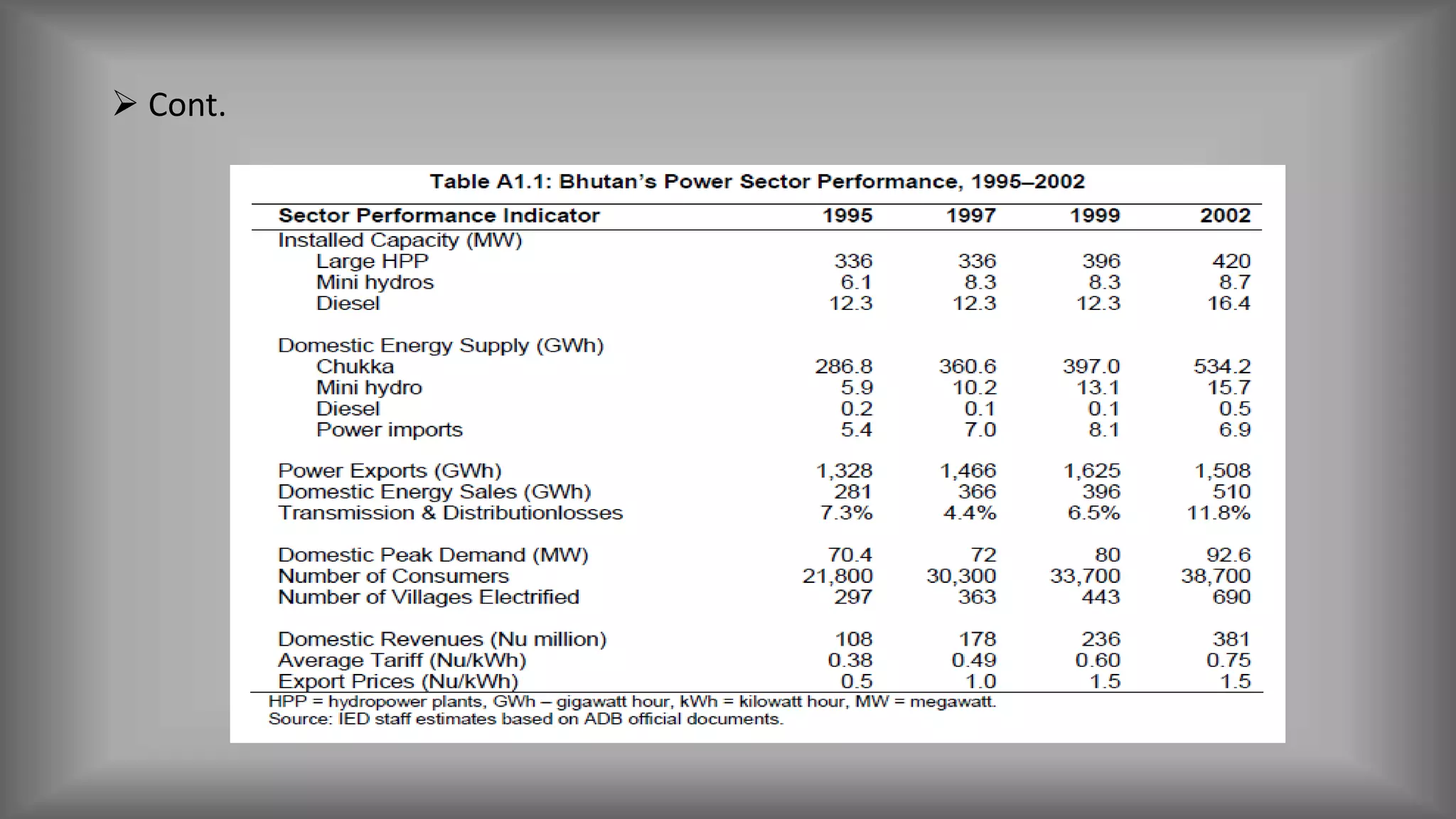
 Cont.
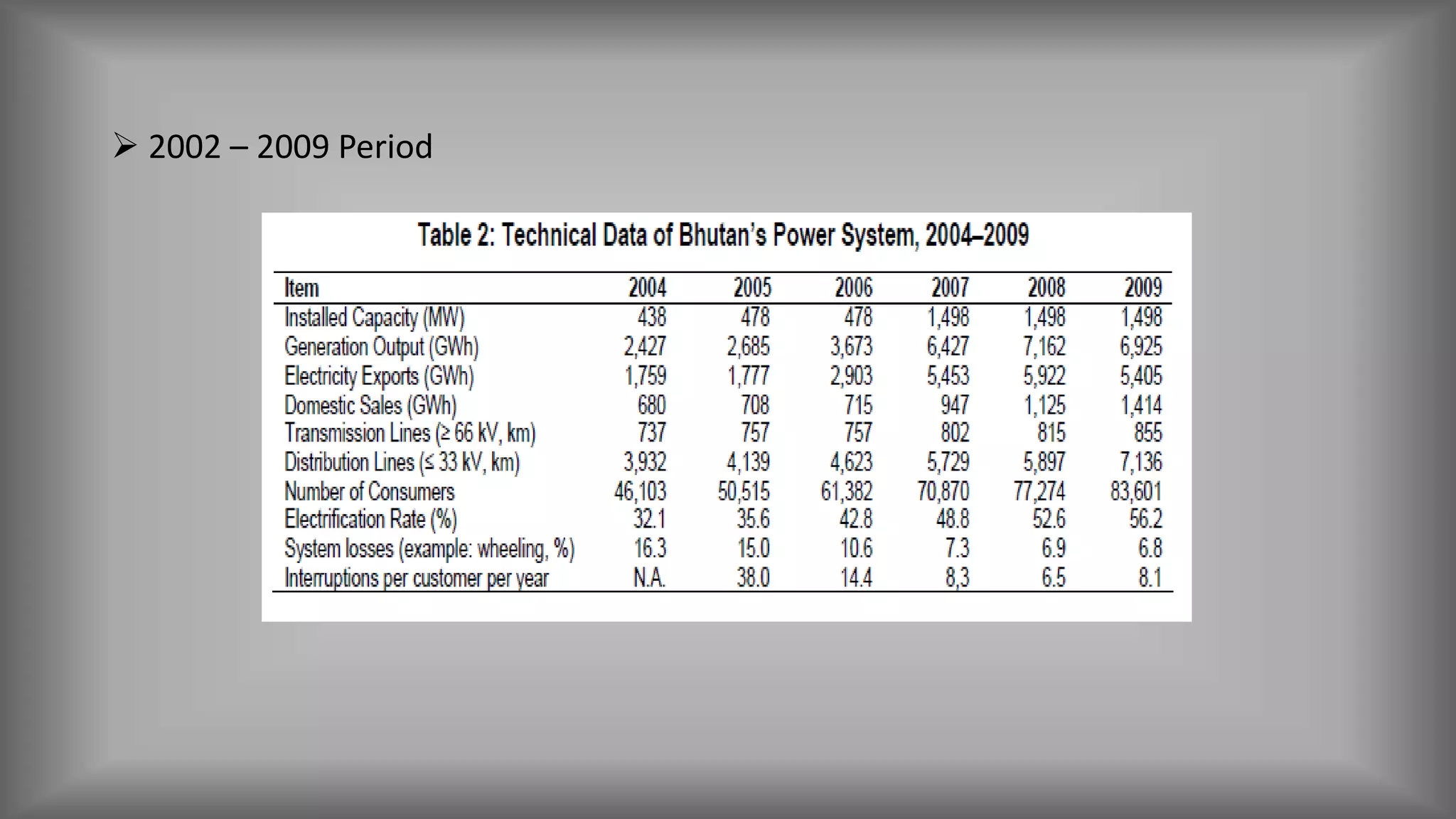
 2002 – 2009 Period
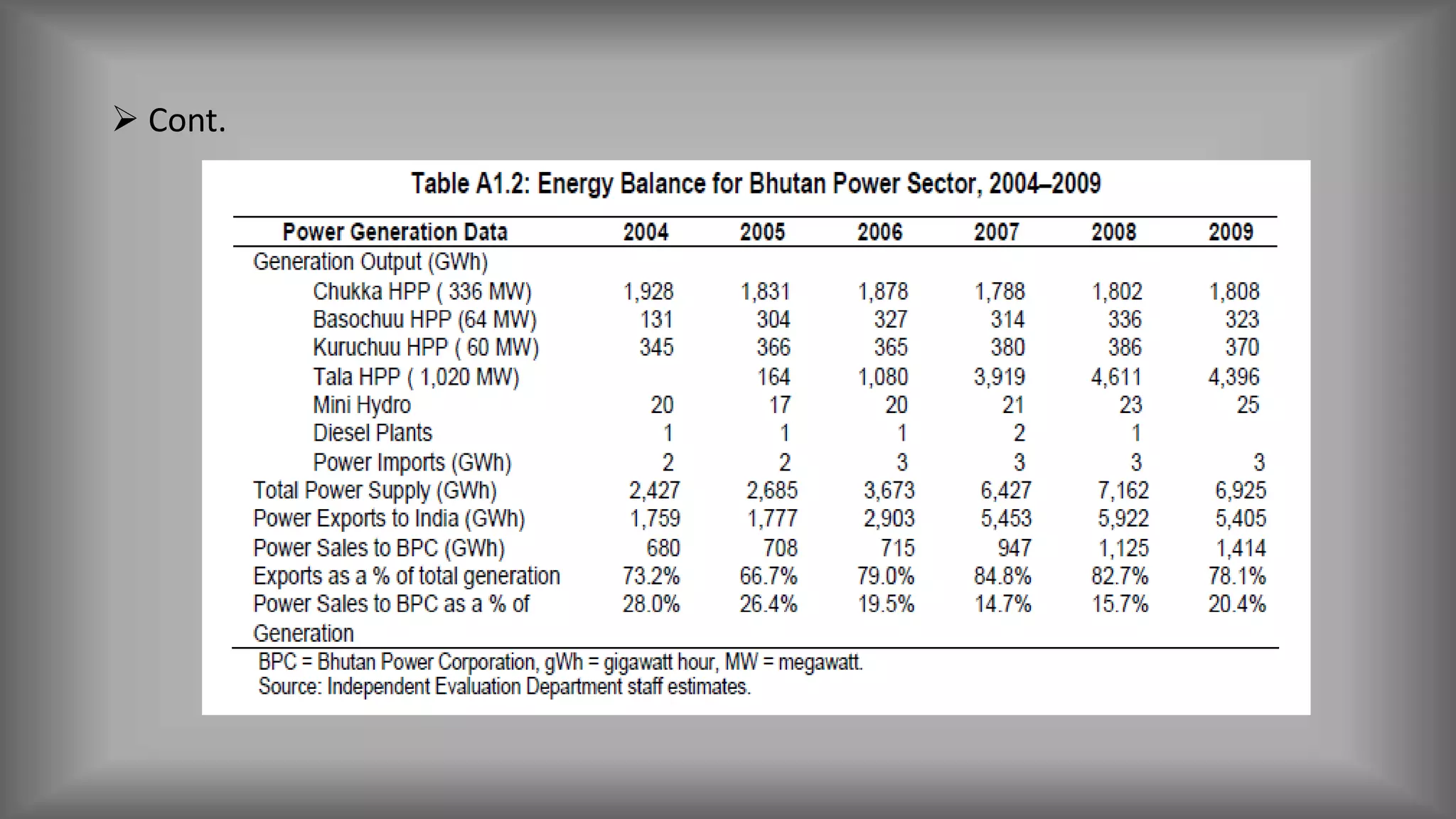
 Cont.
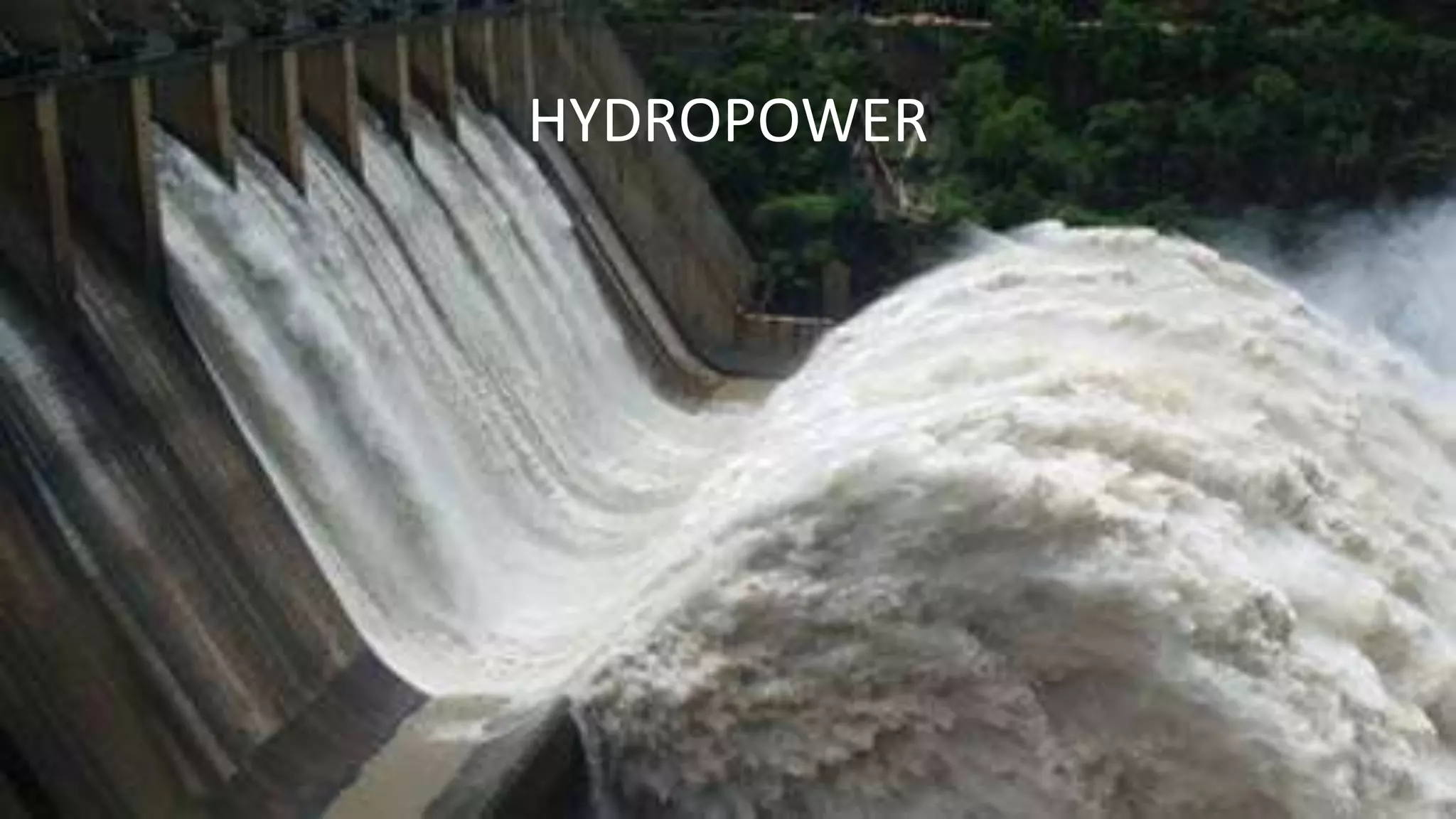
HYDROPOWER
Hydropower and Economic Growth
 There are five major hydroelectric facilities in Bhutan, and
 several small and mini hydroelectric generators that serve remotely located
households and communities, both off- and on-grid
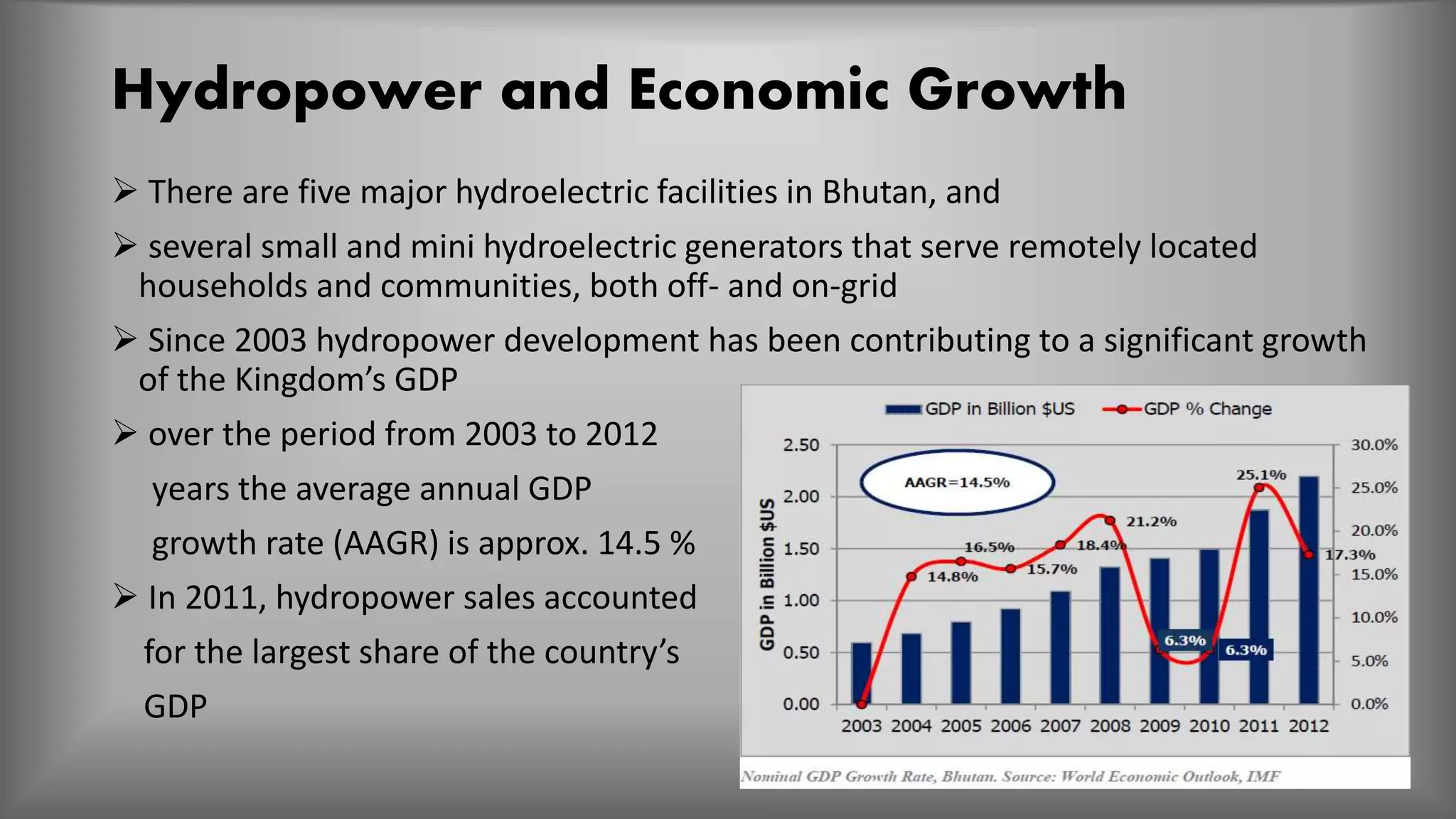
 Since 2003 hydropower development has been contributing to a significant growth
of the Kingdom’s GDP
 over the period from 2003 to 2012
years the average annual GDP
growth rate (AAGR) is approx. 14.5 %
 In 2011, hydropower sales accounted
for the largest share of the country’s
GDP
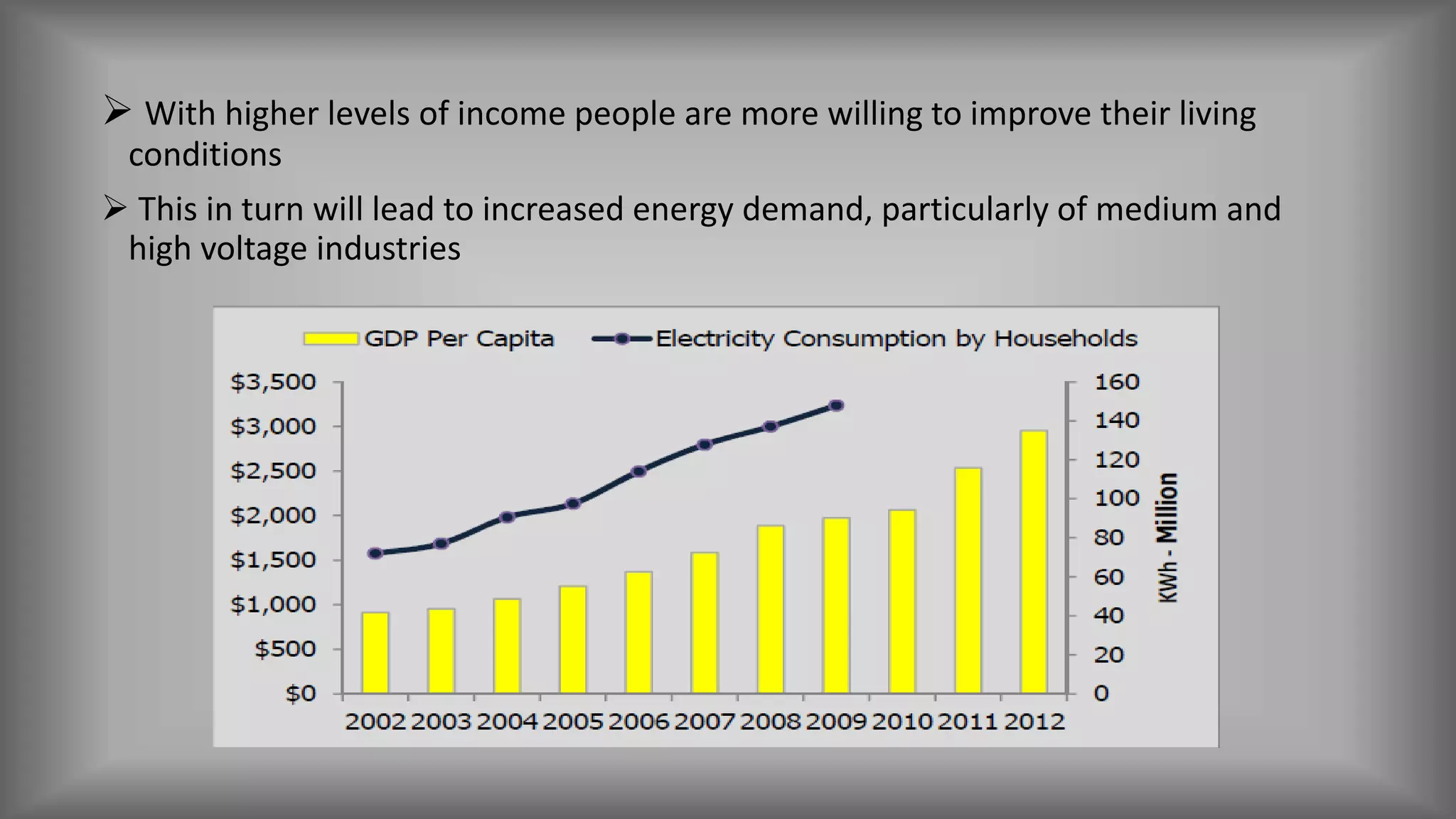
 With higher levels of income people are more willing to improve their living
conditions
 This in turn will lead to increased energy demand, particularly of medium and
high voltage industries
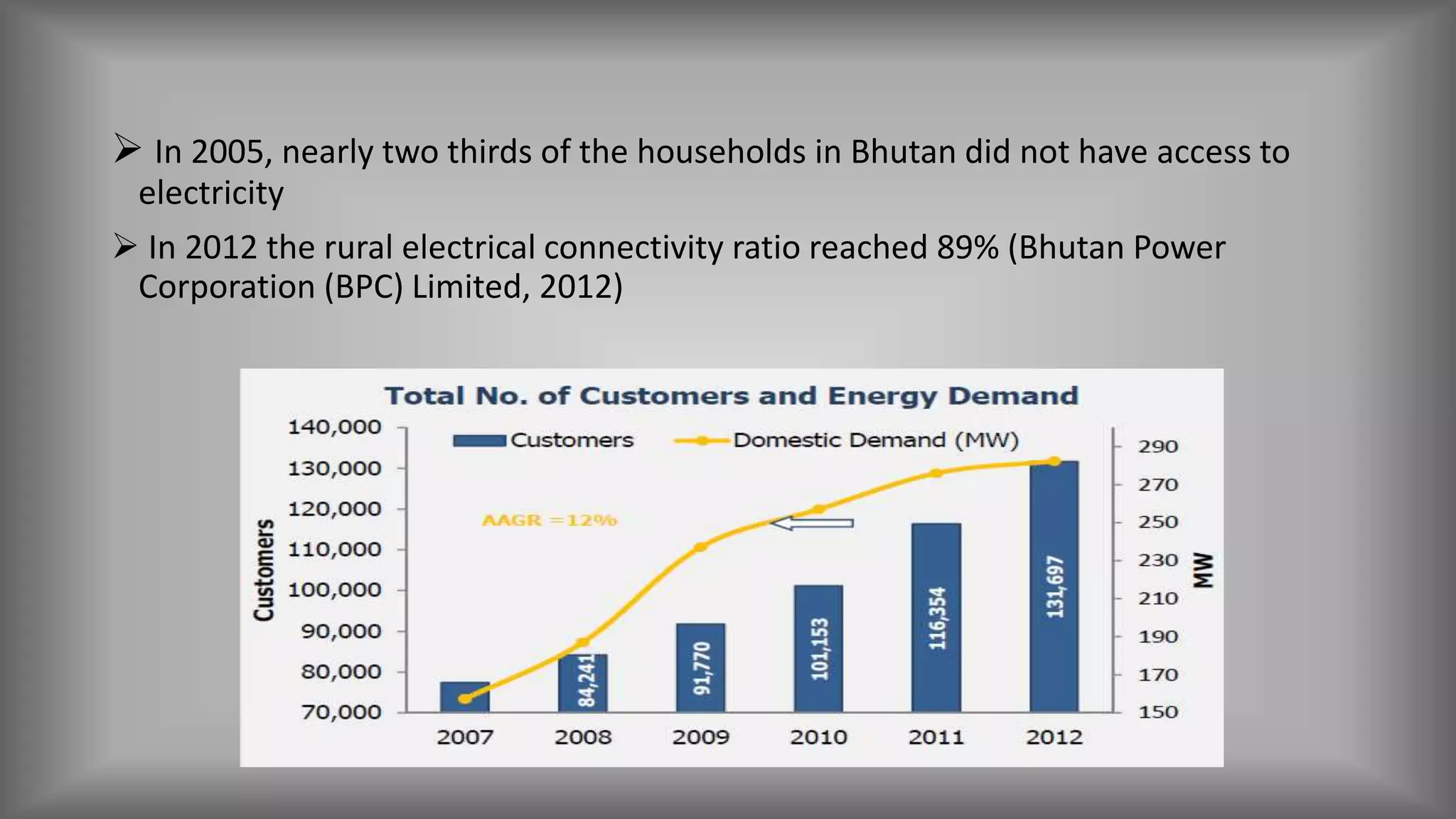
 In 2005, nearly two thirds of the households in Bhutan did not have access to
electricity
 In 2012 the rural electrical connectivity ratio reached 89% (Bhutan Power
Corporation (BPC) Limited, 2012)
Supply And Demand
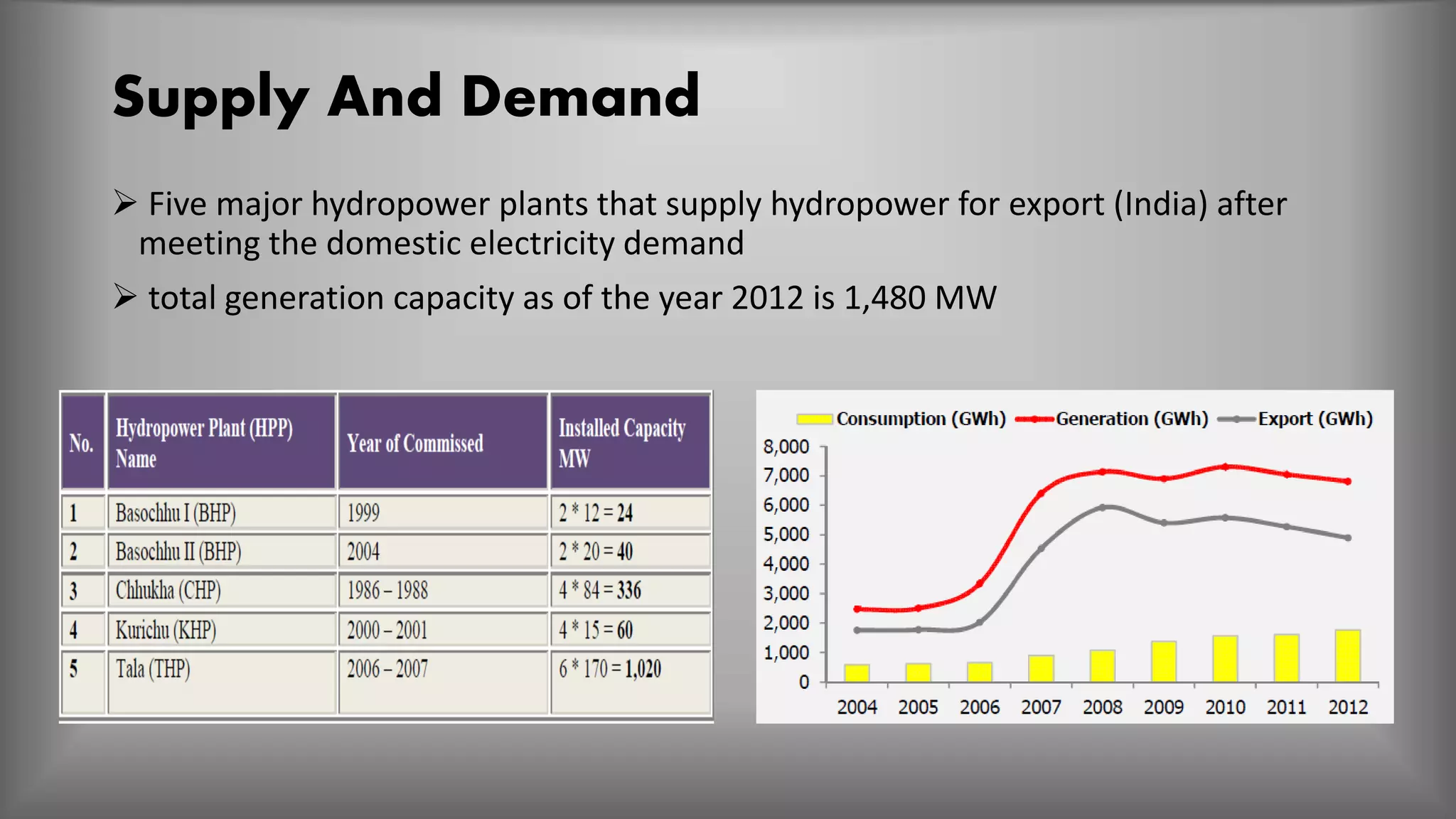
 Five major hydropower plants that supply hydropower for export (India) after
meeting the domestic electricity demand
 total generation capacity as of the year 2012 is 1,480 MW
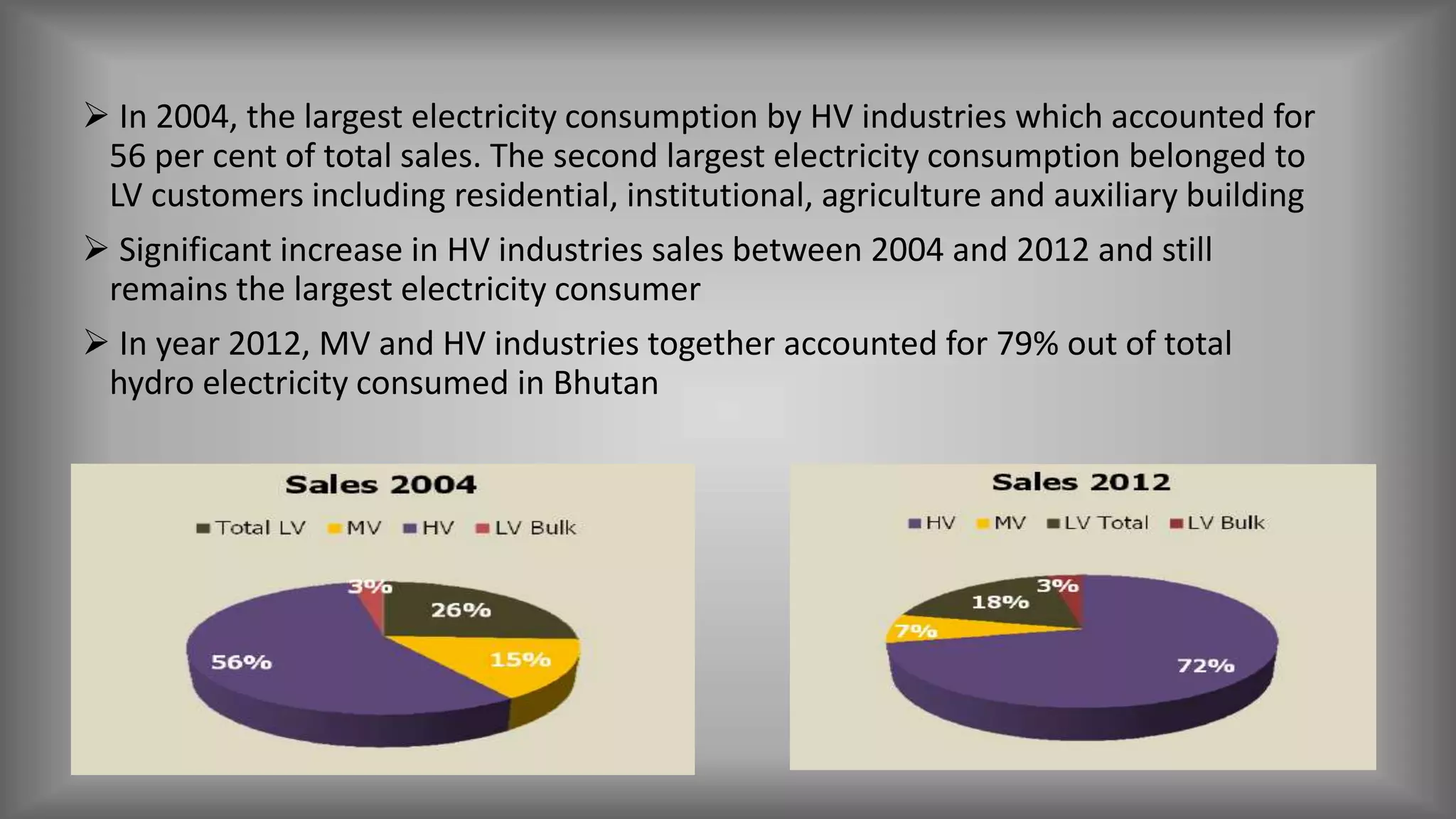
 In 2004, the largest electricity consumption by HV industries which accounted for
56 per cent of total sales. The second largest electricity consumption belonged to
LV customers including residential, institutional, agriculture and auxiliary building
 Significant increase in HV industries sales between 2004 and 2012 and still
remains the largest electricity consumer
 In year 2012, MV and HV industries together accounted for 79% out of total
hydro electricity consumed in Bhutan
Climate Change & Hydropower
 Currently, hydropower accounts for nearly 16% of the world’s total power supply
 World’s most dominant (86%) source of renewable electrical energy (2012)
 Asia alone possesses a technically feasible potential of 6,800 TWh/y
 Total capacity potential of 1,928,286 MW (2012)
 A feasible potential for global hydropower is 2 to 3 times higher than the current
generation
 However, there is an uncertainty brought by global climate change which poses
some risk for the hydropower generation sector
 Climatic changes are causing changes in runoff and increasing retreat/melting of
glaciers
 The Himalayan region is in a very active seismic zone, thus it is possible that
earthquakes may trigger outburst of glacial lakes
 Bhutan has been experiencing reduced and volatile hydropower generation from
run-of-the-river facilities due to changed monsoon patterns and the consequent
low river flows
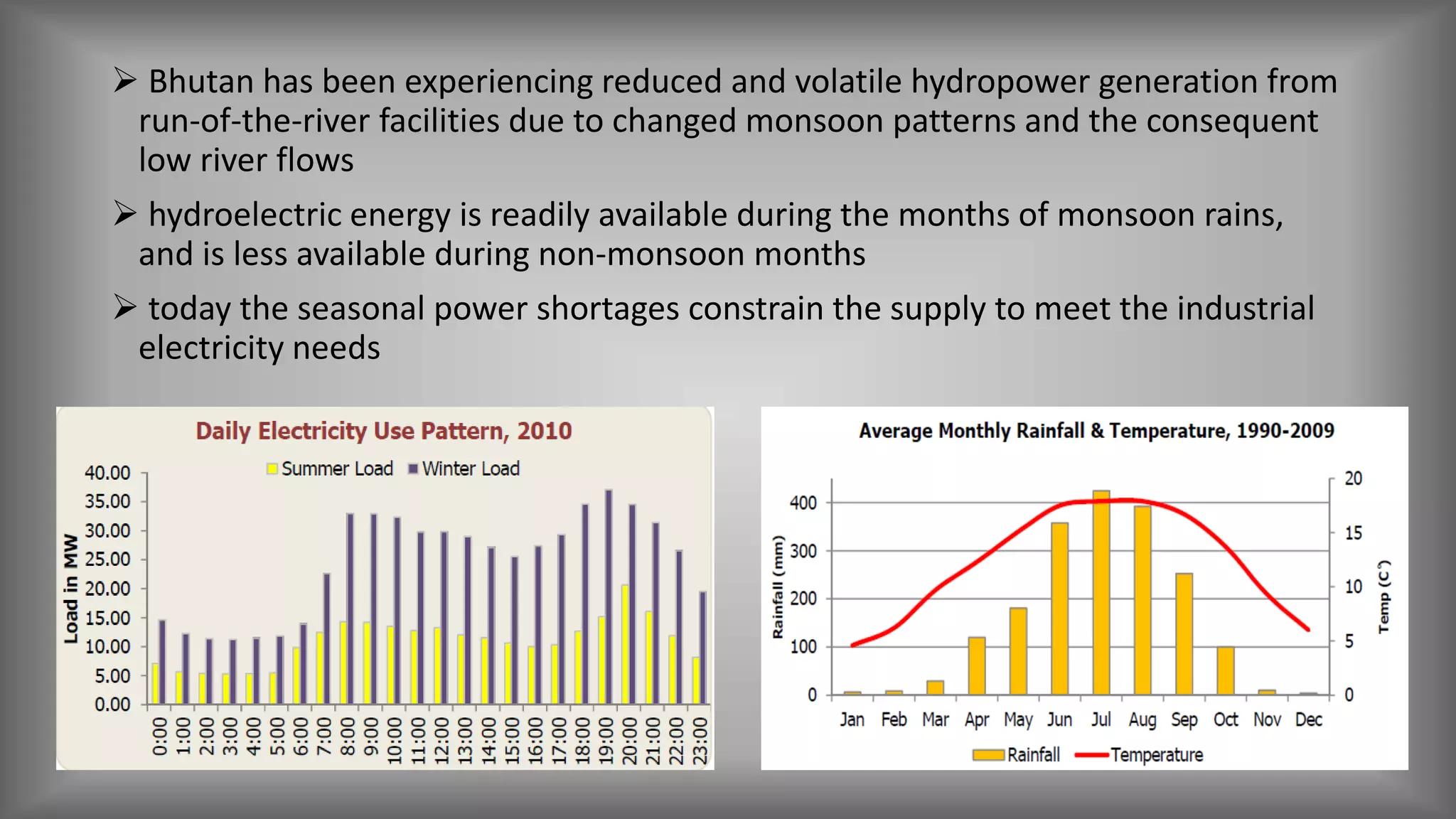
 hydroelectric energy is readily available during the months of monsoon rains,
and is less available during non-monsoon months
 today the seasonal power shortages constrain the supply to meet the industrial
electricity needs
Projects to be Commissioned, 2010 - 2020
 After the commissioning of Tala HPP in 2006, with the assistance of ADB, the
government prepared the sustainable hydropower policy to attract private
investments to export-oriented hydropower projects
 The projects to be commissioned are :
 The 114 MW Dagachhu HPP was structured as a public–private partnership (PPP) is expected
to be commissioned in 2014
 The government has also entered into a memorandum of understanding with the
Government of India to develop 10,000 MW of hydropower capacity consisting of 11 mega-
projects
 1,200 MW Punatsangchhu-I HPP under the 10,000 MW program is under construction with
Government of India financing, and it is expected to be commissioned in 2016;
 the 990 MW Punatsangchhu-II HPP and the 720 MW Mangdechhu HPP) are expected to
begin construction in 2011 with Government of India financing and be commissioned in 2019
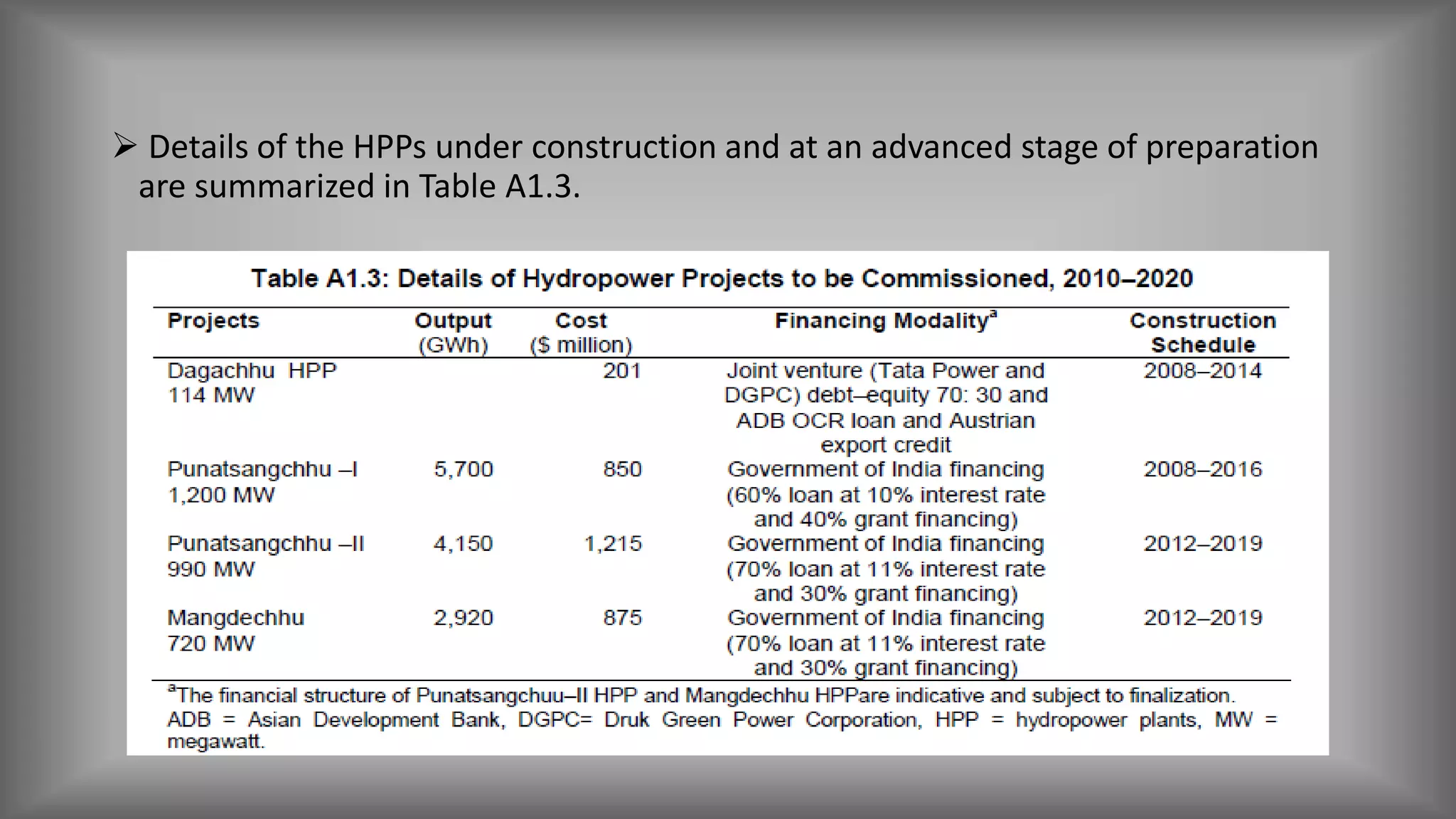
 Details of the HPPs under construction and at an advanced stage of preparation
are summarized in Table A1.3.
Bhutan Power Transmission Grid, 2009
Macroeconomic Impacts of Export –
Oriented Hydropower Development
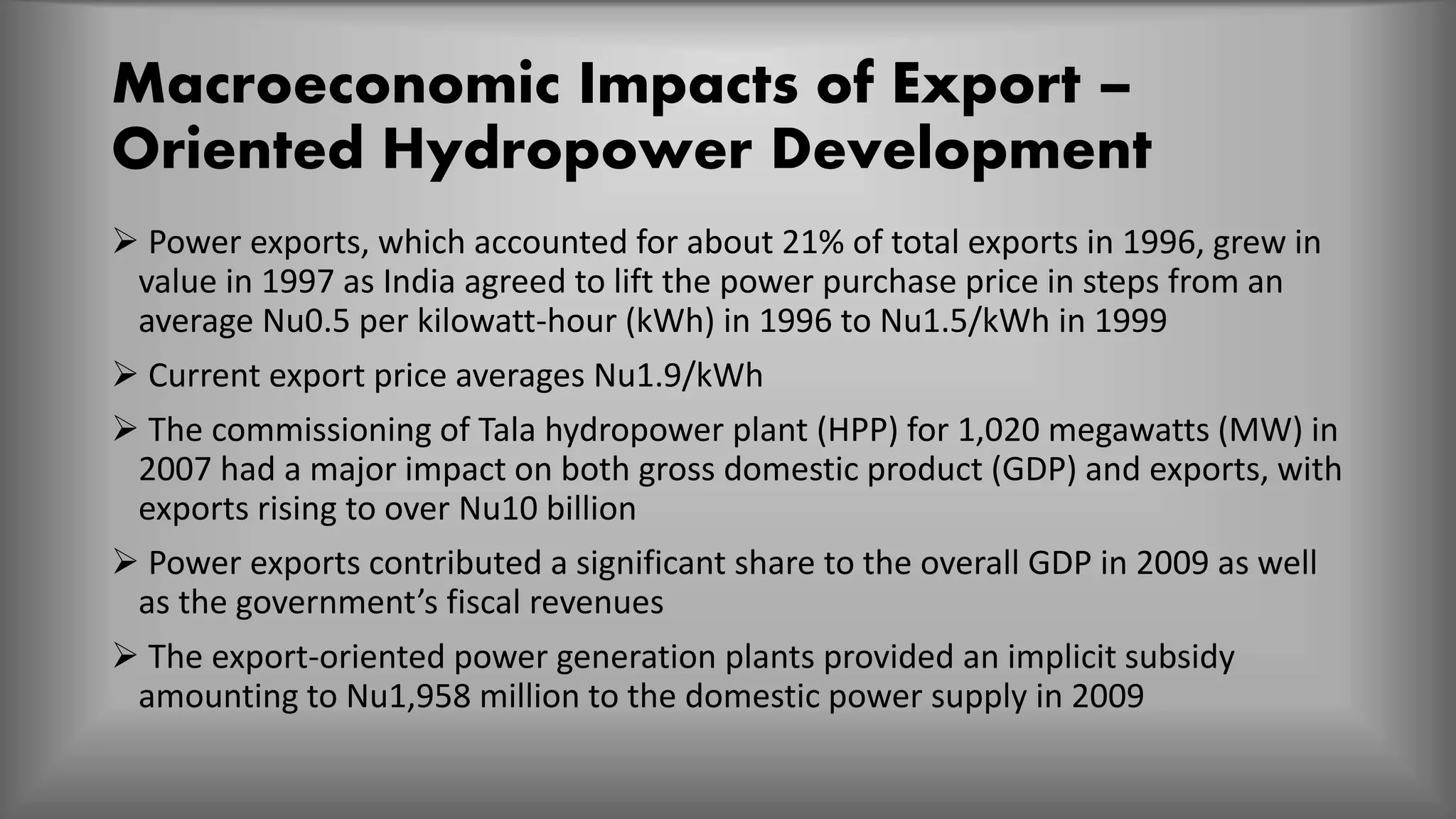
 Power exports, which accounted for about 21% of total exports in 1996, grew in
value in 1997 as India agreed to lift the power purchase price in steps from an
average Nu0.5 per kilowatt-hour (kWh) in 1996 to Nu1.5/kWh in 1999
 Current export price averages Nu1.9/kWh
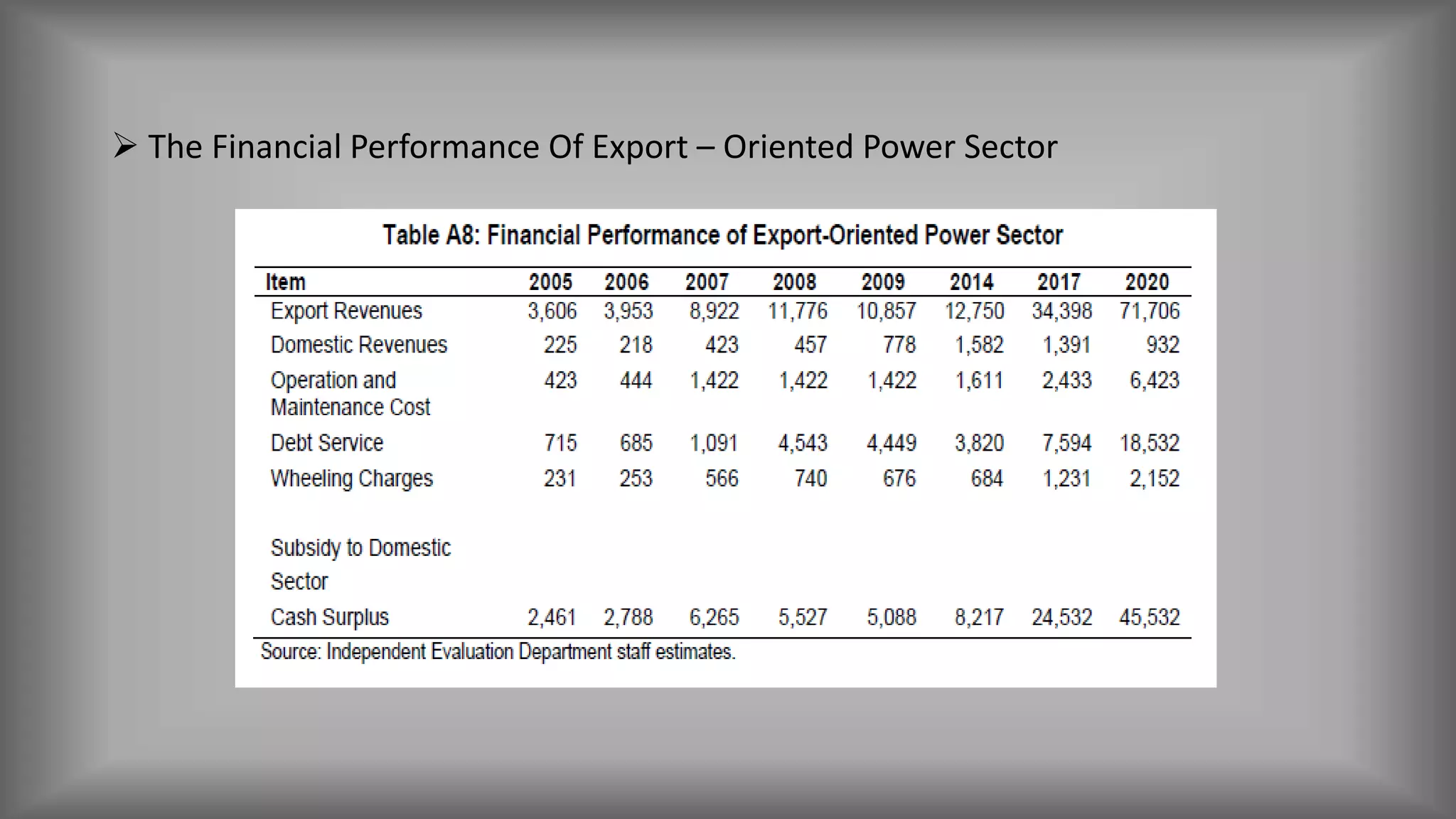
 The commissioning of Tala hydropower plant (HPP) for 1,020 megawatts (MW) in
2007 had a major impact on both gross domestic product (GDP) and exports, with
exports rising to over Nu10 billion
 Power exports contributed a significant share to the overall GDP in 2009 as well
as the government’s fiscal revenues
 The export-oriented power generation plants provided an implicit subsidy
amounting to Nu1,958 million to the domestic power supply in 2009
 Electricity Exports
 The Financial Performance Of Export – Oriented Power Sector
Bhutan Energy Sector Institutions and
Current Energy Policies
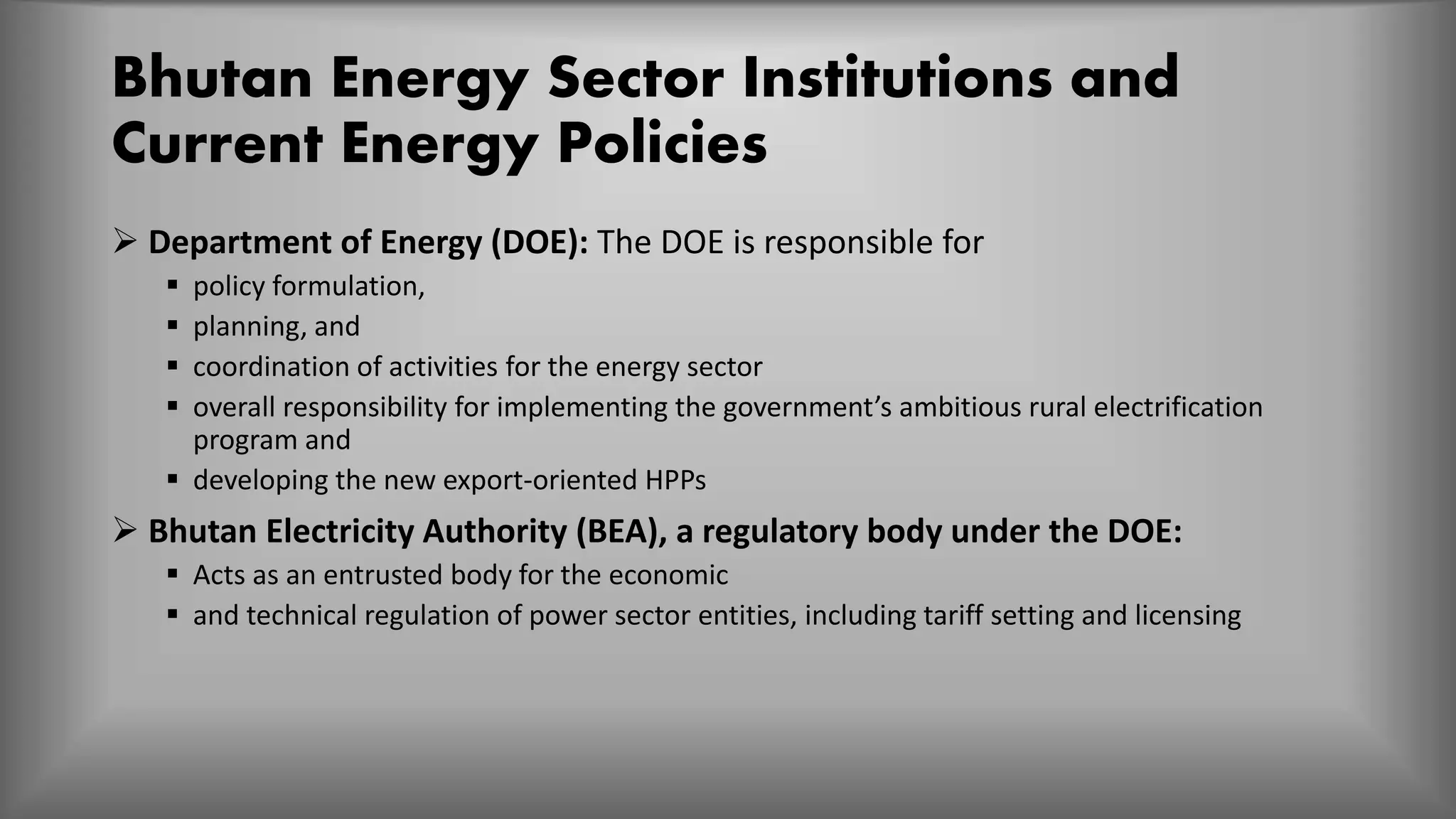
 Department of Energy (DOE): The DOE is responsible for
 policy formulation,
 planning, and
 coordination of activities for the energy sector
 overall responsibility for implementing the government’s ambitious rural electrification
program and
 developing the new export-oriented HPPs
 Bhutan Electricity Authority (BEA), a regulatory body under the DOE:
 Acts as an entrusted body for the economic
 and technical regulation of power sector entities, including tariff setting and licensing
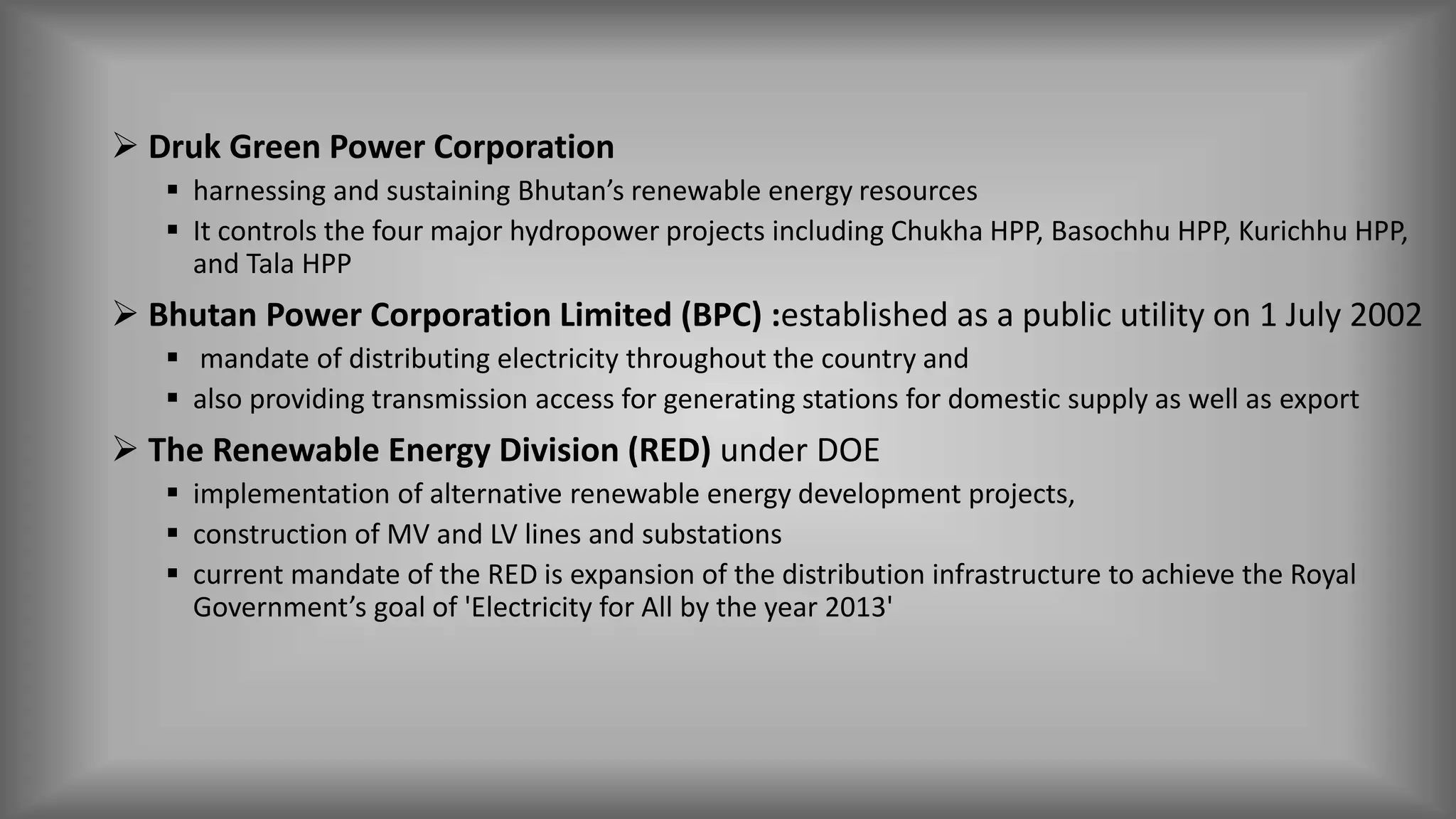
 Druk Green Power Corporation
 harnessing and sustaining Bhutan’s renewable energy resources
 It controls the four major hydropower projects including Chukha HPP, Basochhu HPP, Kurichhu HPP,
and Tala HPP
 Bhutan Power Corporation Limited (BPC) :established as a public utility on 1 July 2002
 mandate of distributing electricity throughout the country and
 also providing transmission access for generating stations for domestic supply as well as export
 The Renewable Energy Division (RED) under DOE
 implementation of alternative renewable energy development projects,
 construction of MV and LV lines and substations
 current mandate of the RED is expansion of the distribution infrastructure to achieve the Royal
Government’s goal of 'Electricity for All by the year 2013'
Smart Grid and DSM
 Smart Grid is based on the application of digital technology in the electricity
network in order to supply electricity consumers via two-way communication
 monitor and analyze the energy use and help improve energy efficiency,
ensure transparency and reliability of the energy supply chain
 Smart energy enabled by 'information and communication technologies' (ICTs)
can allow consumers to closely monitor their consumption and energy suppliers
to more efficiently meet the demand
 Smart energy response and management technologies provide utilities with
tools to streamline and target Demand Side Management (DSM) and potential
reduction opportunities
Conclusion
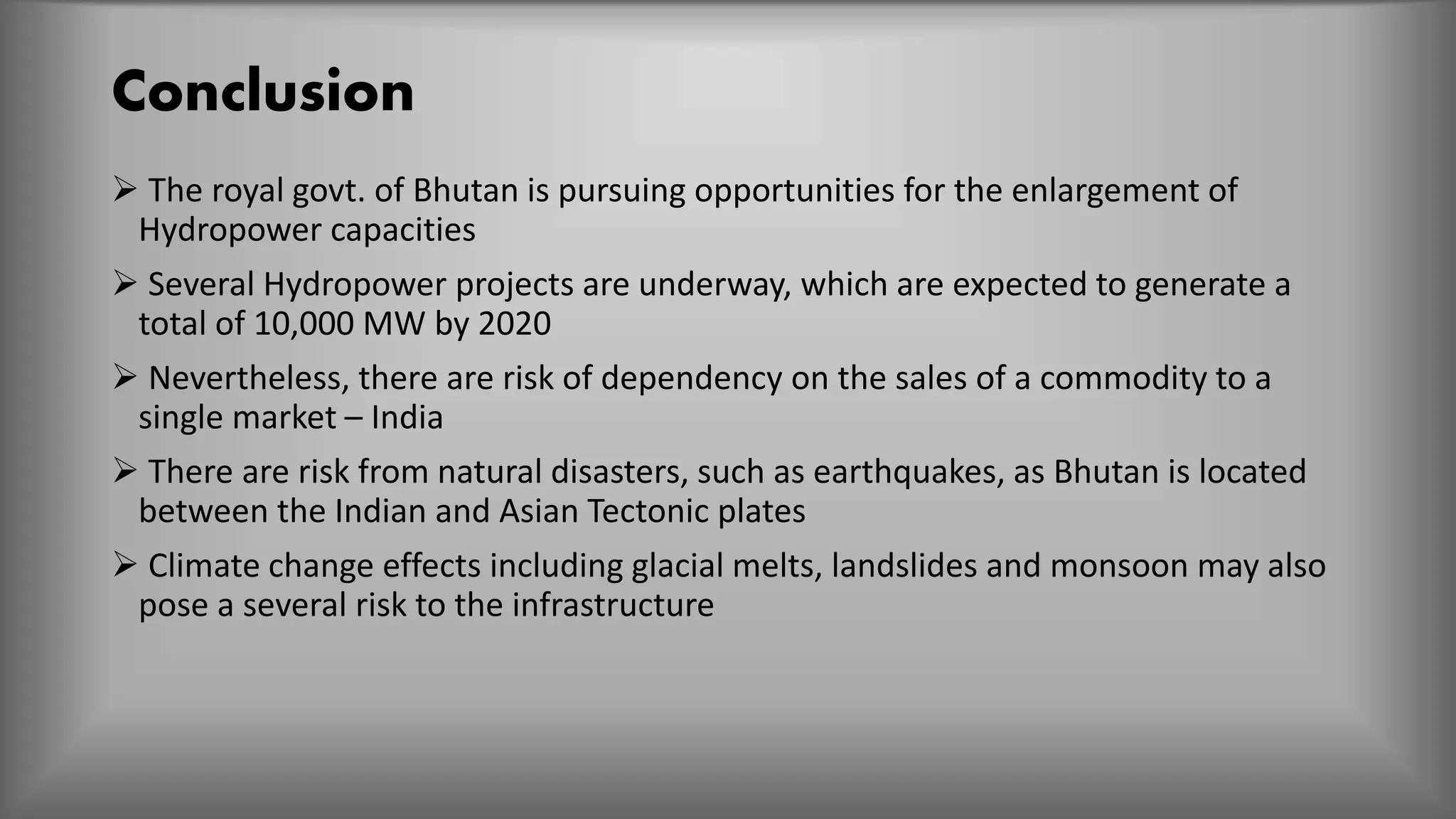
 The royal govt. of Bhutan is pursuing opportunities for the enlargement of
Hydropower capacities
 Several Hydropower projects are underway, which are expected to generate a
total of 10,000 MW by 2020
 Nevertheless, there are risk of dependency on the sales of a commodity to a
single market – India
 There are risk from natural disasters, such as earthquakes, as Bhutan is located
between the Indian and Asian Tectonic plates
 Climate change effects including glacial melts, landslides and monsoon may also
pose a several risk to the infrastructure
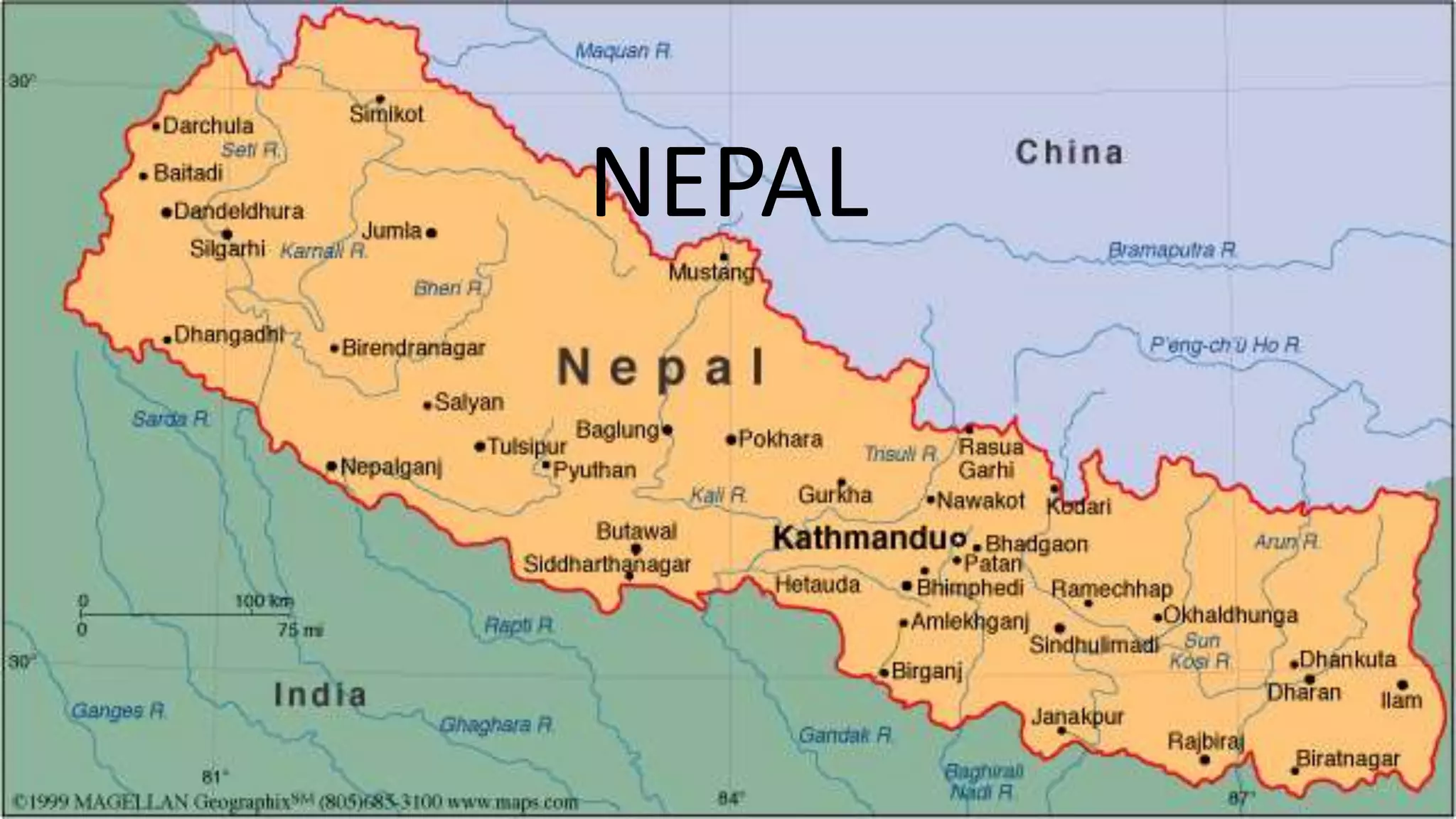
NEPAL
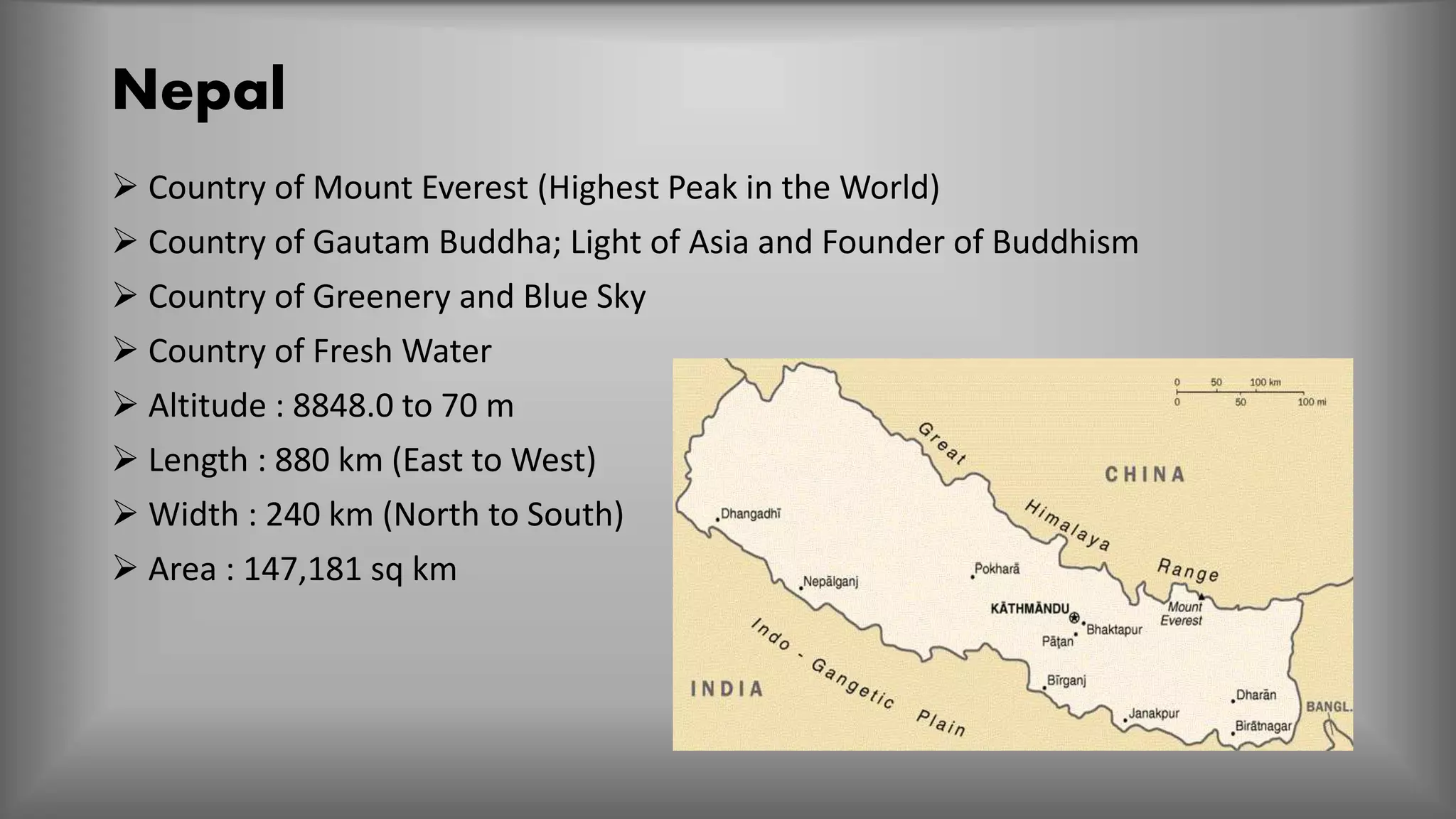
Nepal
 Country of Mount Everest (Highest Peak in the World)
 Country of Gautam Buddha; Light of Asia and Founder of Buddhism
 Country of Greenery and Blue Sky
 Country of Fresh Water
 Altitude : 8848.0 to 70 m
 Length : 880 km (East to West)
 Width : 240 km (North to South)
 Area : 147,181 sq km
Brief History of Nepal
 Nepal had many Small Kingdoms before 1768
 The Modern State was formed with the Unification of Nepal. United by the King
Prithvi Narayan Shah on December 21, 1768
 Until 2006, Nepal was a kingdom ruled by Royal Family.
 On December 28, 2007, the Interim Parliament passed a bill and declared Nepal
to be a Federal Democratic Republic
 The First Meeting of the Constituent Assembly on May 28, 2008
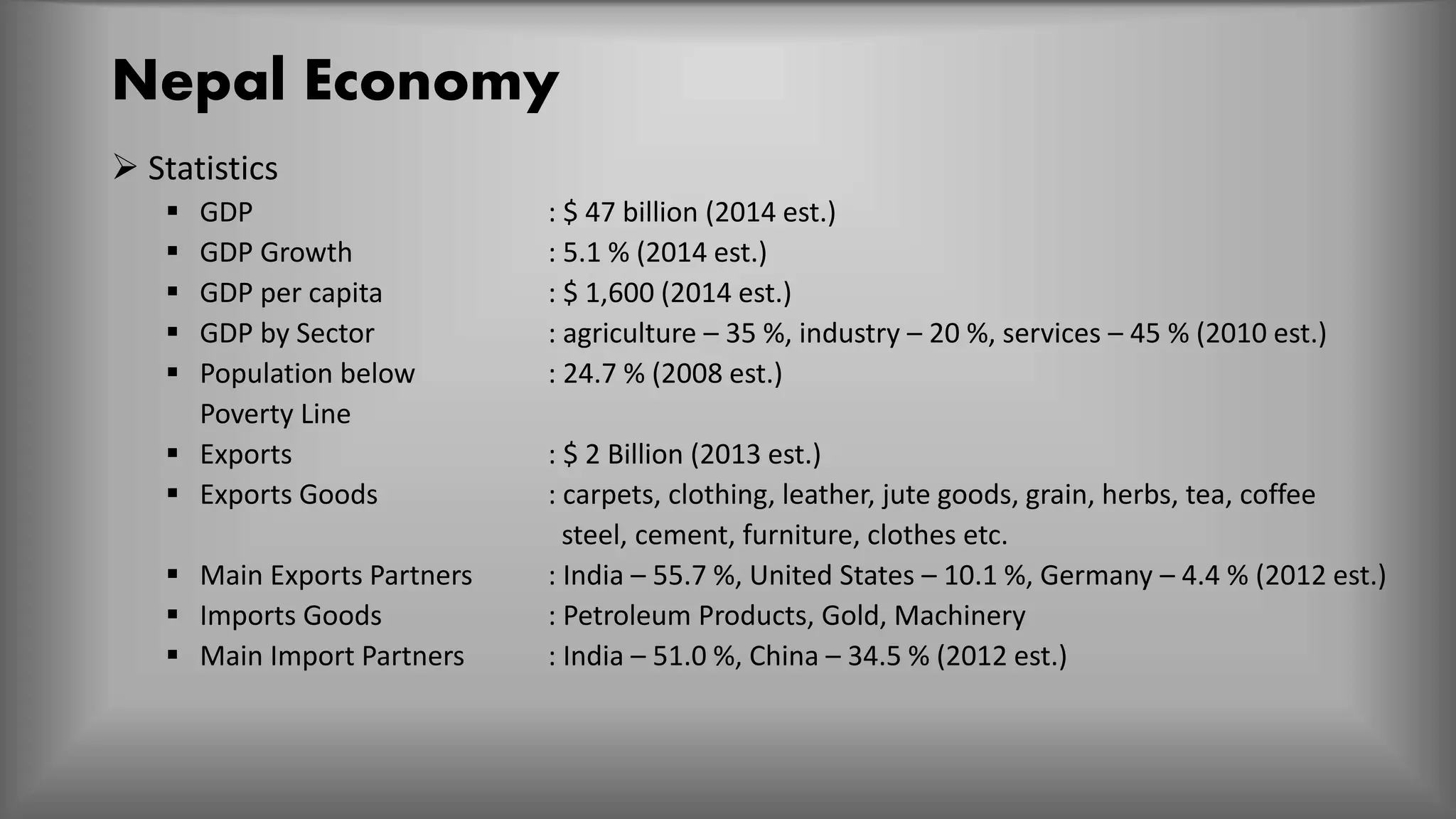
Nepal Economy
 Statistics
 GDP : $ 47 billion (2014 est.)
 GDP Growth : 5.1 % (2014 est.)
 GDP per capita : $ 1,600 (2014 est.)
 GDP by Sector : agriculture – 35 %, industry – 20 %, services – 45 % (2010 est.)
 Population below : 24.7 % (2008 est.)
Poverty Line
 Exports : $ 2 Billion (2013 est.)
 Exports Goods : carpets, clothing, leather, jute goods, grain, herbs, tea, coffee
steel, cement, furniture, clothes etc.
 Main Exports Partners : India – 55.7 %, United States – 10.1 %, Germany – 4.4 % (2012 est.)
 Imports Goods : Petroleum Products, Gold, Machinery
 Main Import Partners : India – 51.0 %, China – 34.5 % (2012 est.)
Sources of Electricity in Nepal
 Water is an important resource of Nepal which represents a source of potential wealth
 Nepal is endowed with immense water resources.
 The annual precipitation is approximately 1700 mm (80% of which occurs during the
monsoon season)
 The Total annual average run off from the nation’s 600 perennial rivers flowing from
high mountains is over 200 billion cu m.
 Nepal’s storage potential is estimated at 88 billion cu m
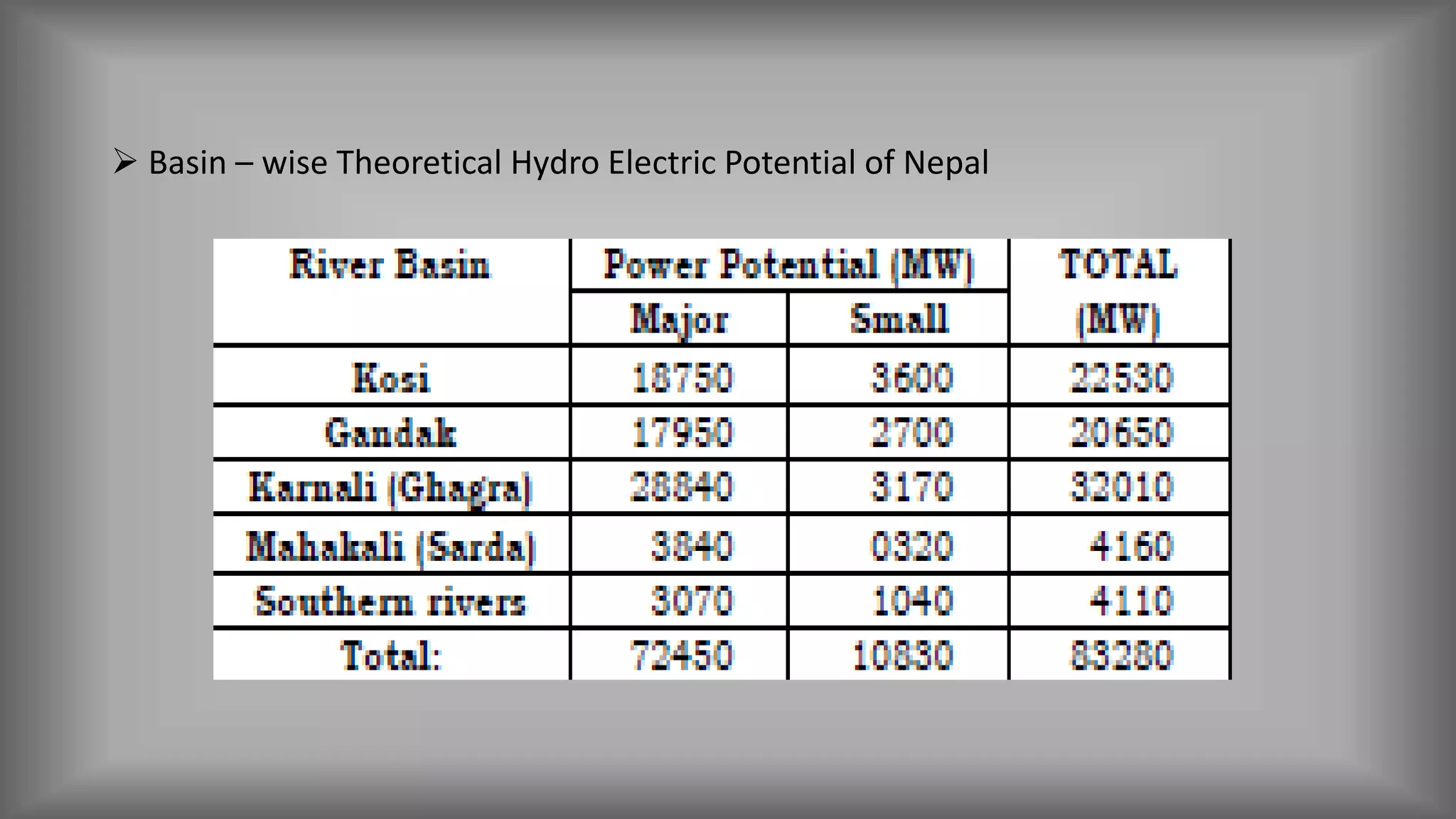
 The estimated theoretical power potential is approximately 83,000 MW
 The economical feasible potential has been evaluated at approximately 43,000 MW, of
which only 698 MW have been harnessed
Nepal Power Scenario
 Nepal is bestowed with tremendous hydropower resources
 Only about 40% of Nepal's population has access to electricity
 Nepal's electricity generation is dominated by hydropower
 Though in the entire scenario of energy use of the country, the electricity is a
tiny fraction, only 1% energy need is fulfilled by electricity
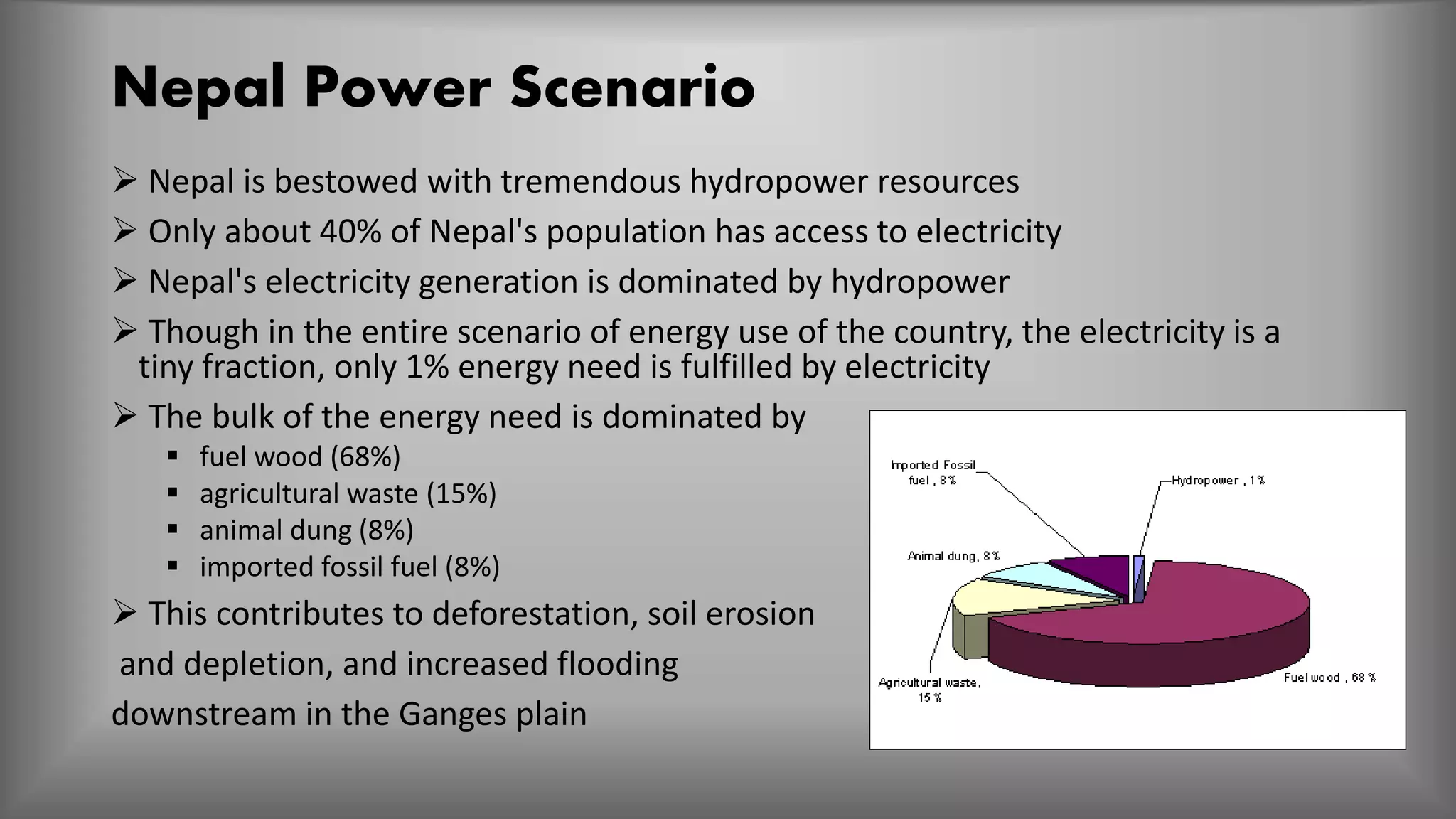
 The bulk of the energy need is dominated by
 fuel wood (68%)
 agricultural waste (15%)
 animal dung (8%)
 imported fossil fuel (8%)
 This contributes to deforestation, soil erosion
and depletion, and increased flooding
downstream in the Ganges plain
Hydropower in Nepal
 Nepal has a huge hydropower potential
 Perennial nature of Nepali rivers and the steep gradient of the country's
topography provide ideal conditions for the development of some of the world's
largest hydroelectric projects in Nepal
 Current estimates are that Nepal has approximately 40,000 MW of economically
feasible hydropower potential
 The present situation is that Nepal has developed only approximately 600 MW of
hydropower
 Although bestowed with tremendous hydropower resources, only about 40% of
Nepal's population has access to electricity
 Most of the power plants in Nepal are run-of-river type with energy available in
excess during the monsoon season and deficit during the dry season
 The electricity demand in Nepal is increasing by about 7-9% per year
 About 40 % of population in Nepal has access to electricity through the grid and
off grid system
 Nepal's Tenth Five Year Plan (2002– 2007) aims to extend the electrification
within country and export to India for mutual benefit
 The new Hydropower Policy 2001 seeks to promote private sector investment
and aims to expand the electrification within the country and export
 Only one seasonal storage project in the system
 The load factor is quite low as the majority of the consumption is dominated by
household use
 The system loss is one of the major issues to be addressed to improve the power
system which accounts to be 25 % including technical and non-technical losses
Power Generation and Transmission
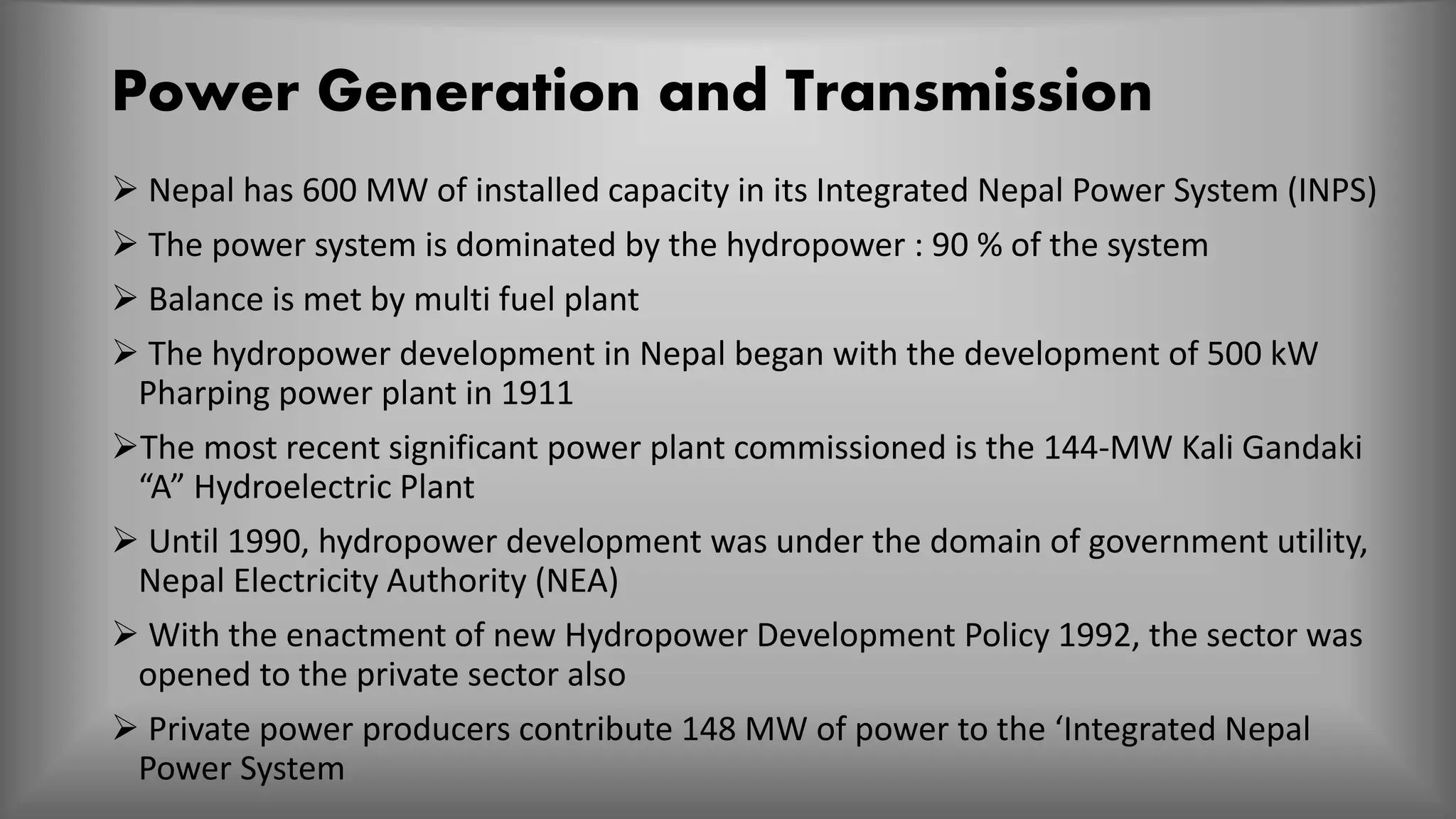
 Nepal has 600 MW of installed capacity in its Integrated Nepal Power System (INPS)
 The power system is dominated by the hydropower : 90 % of the system
 Balance is met by multi fuel plant
 The hydropower development in Nepal began with the development of 500 kW
Pharping power plant in 1911
The most recent significant power plant commissioned is the 144-MW Kali Gandaki
“A” Hydroelectric Plant
 Until 1990, hydropower development was under the domain of government utility,
Nepal Electricity Authority (NEA)
 With the enactment of new Hydropower Development Policy 1992, the sector was
opened to the private sector also
 Private power producers contribute 148 MW of power to the ‘Integrated Nepal
Power System
Organization For Electricity in Nepal
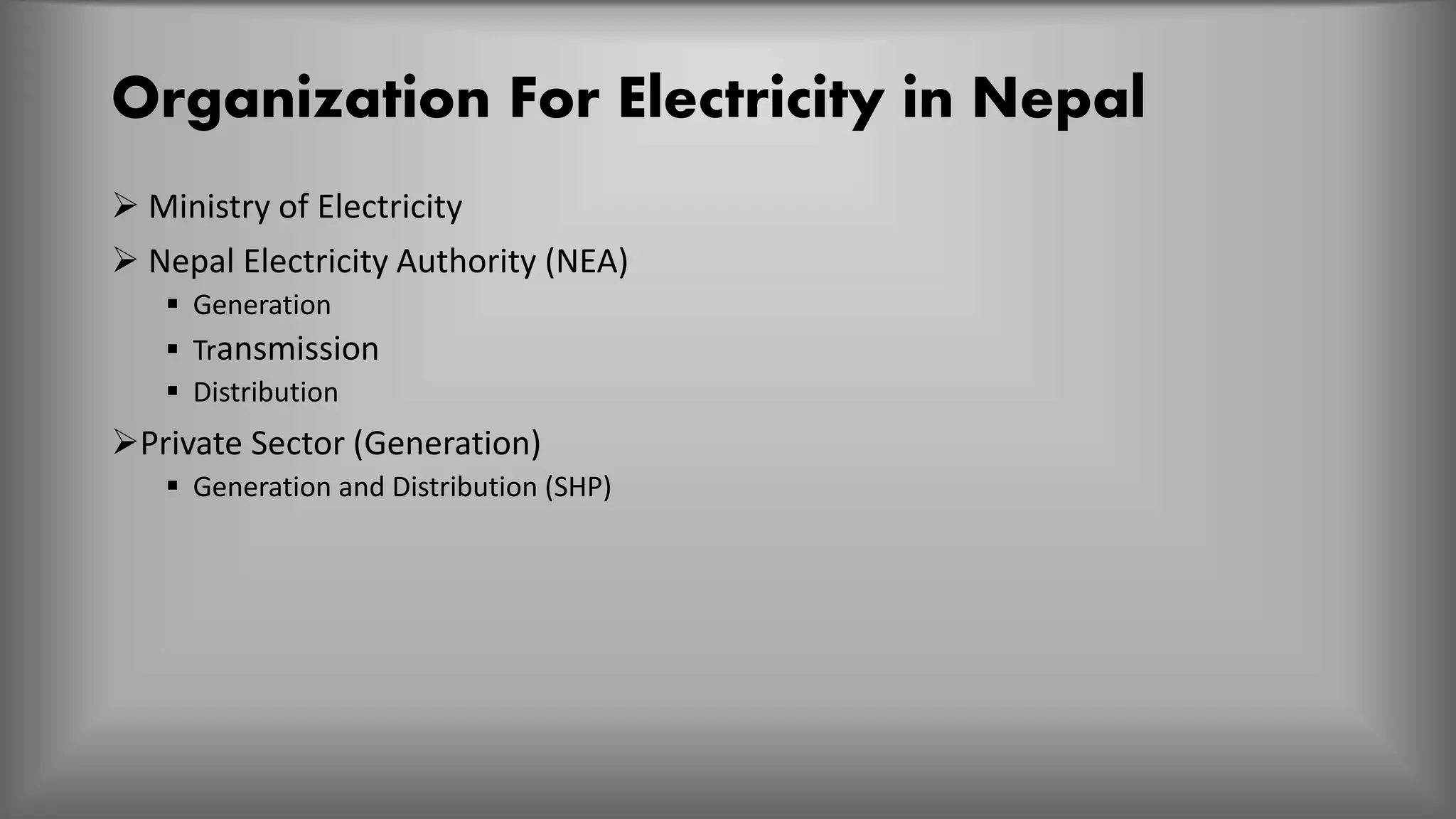
 Ministry of Electricity
 Nepal Electricity Authority (NEA)
 Generation
 Transmission
 Distribution
Private Sector (Generation)
 Generation and Distribution (SHP)
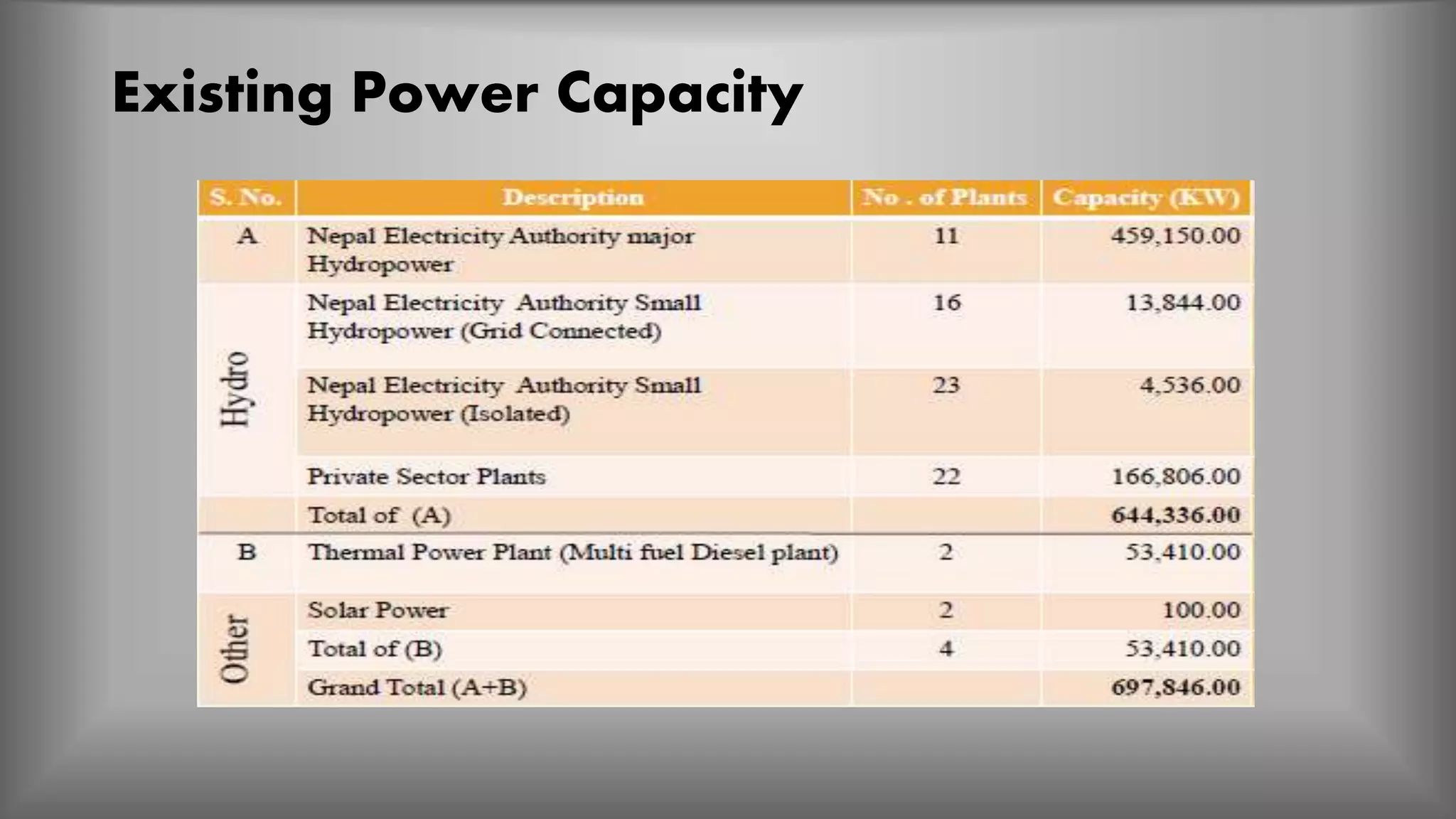
Existing Power Capacity
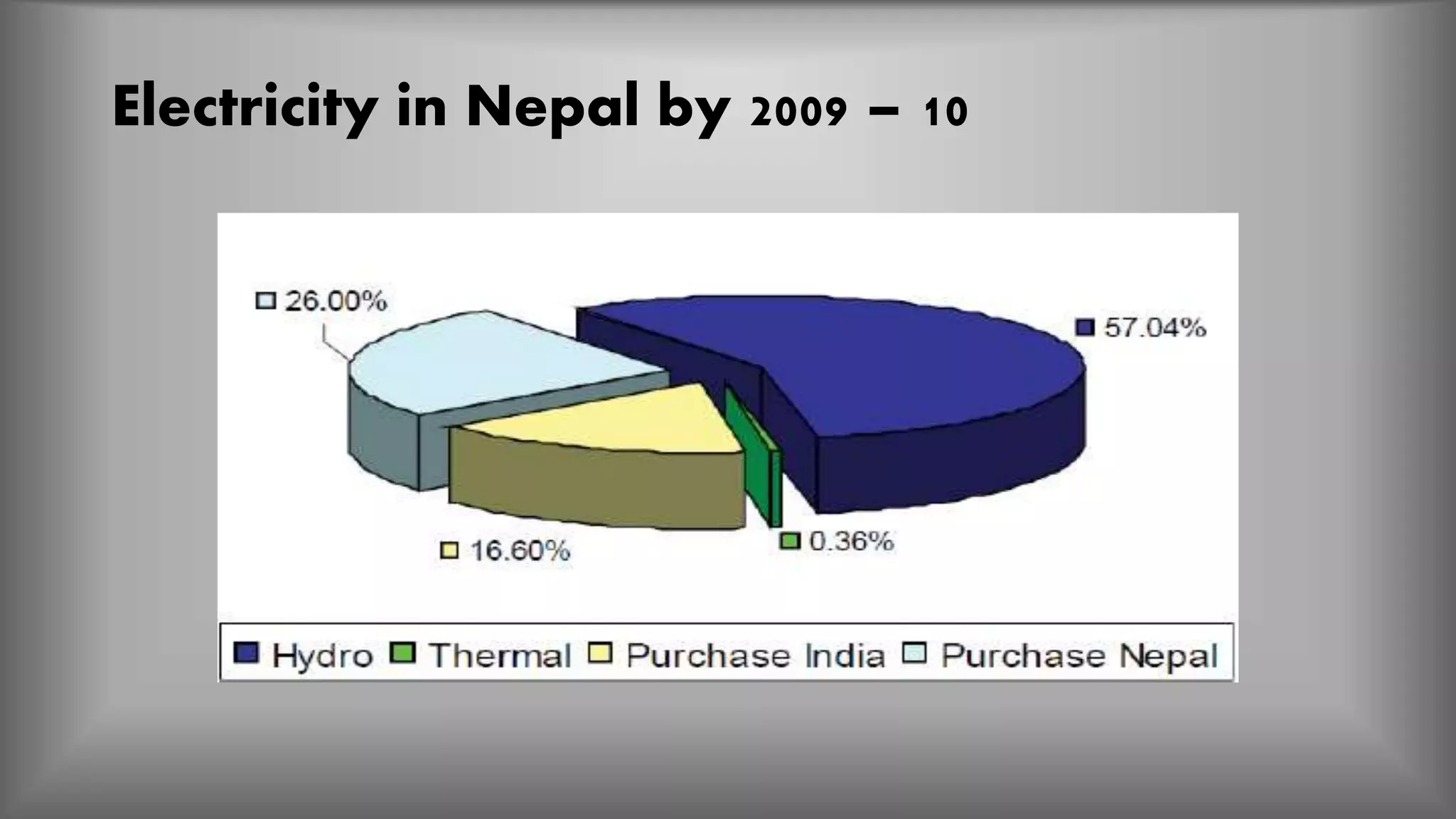
Electricity in Nepal by 2009 – 10
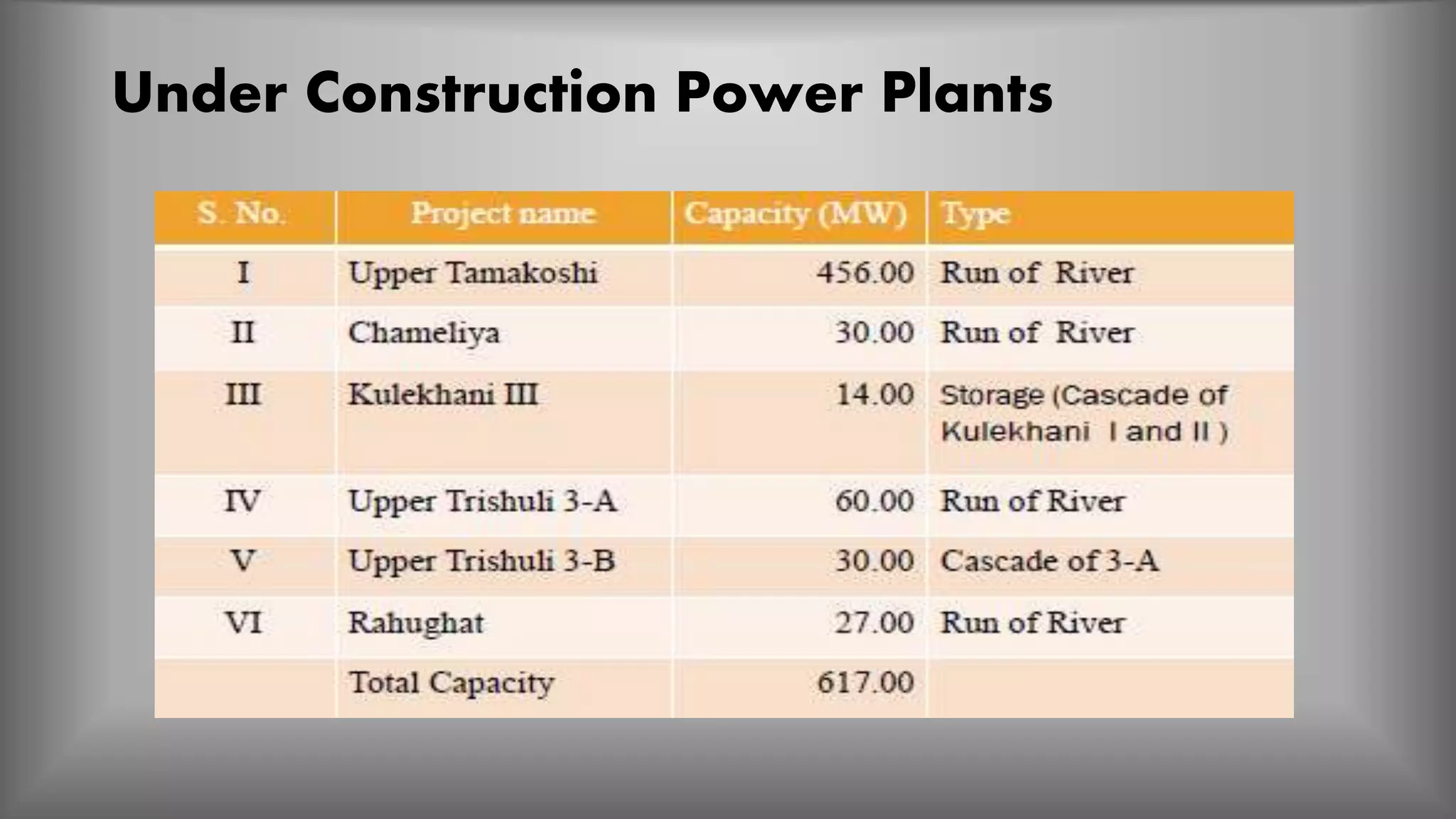
Under Construction Power Plants
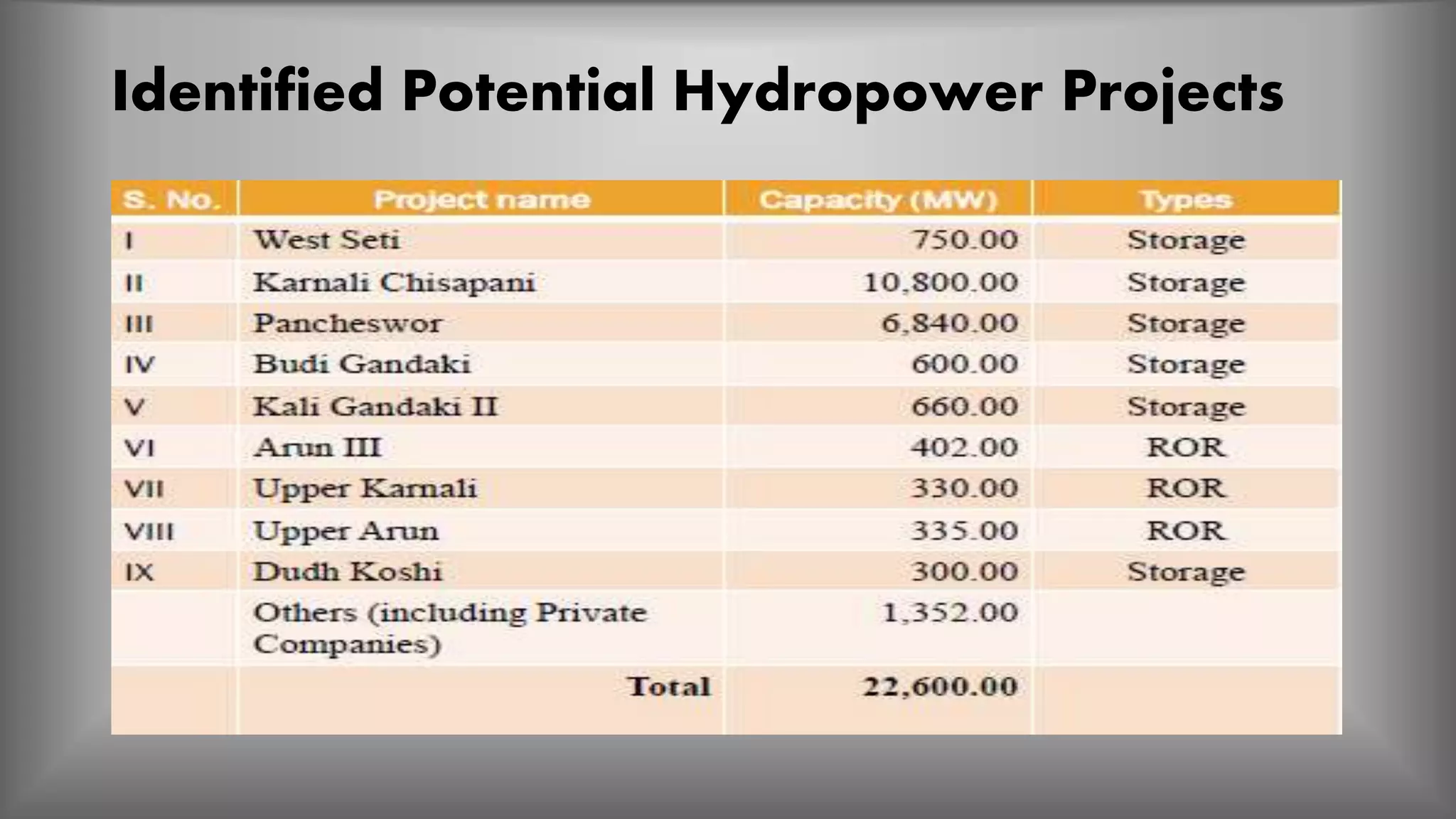
Identified Potential Hydropower Projects
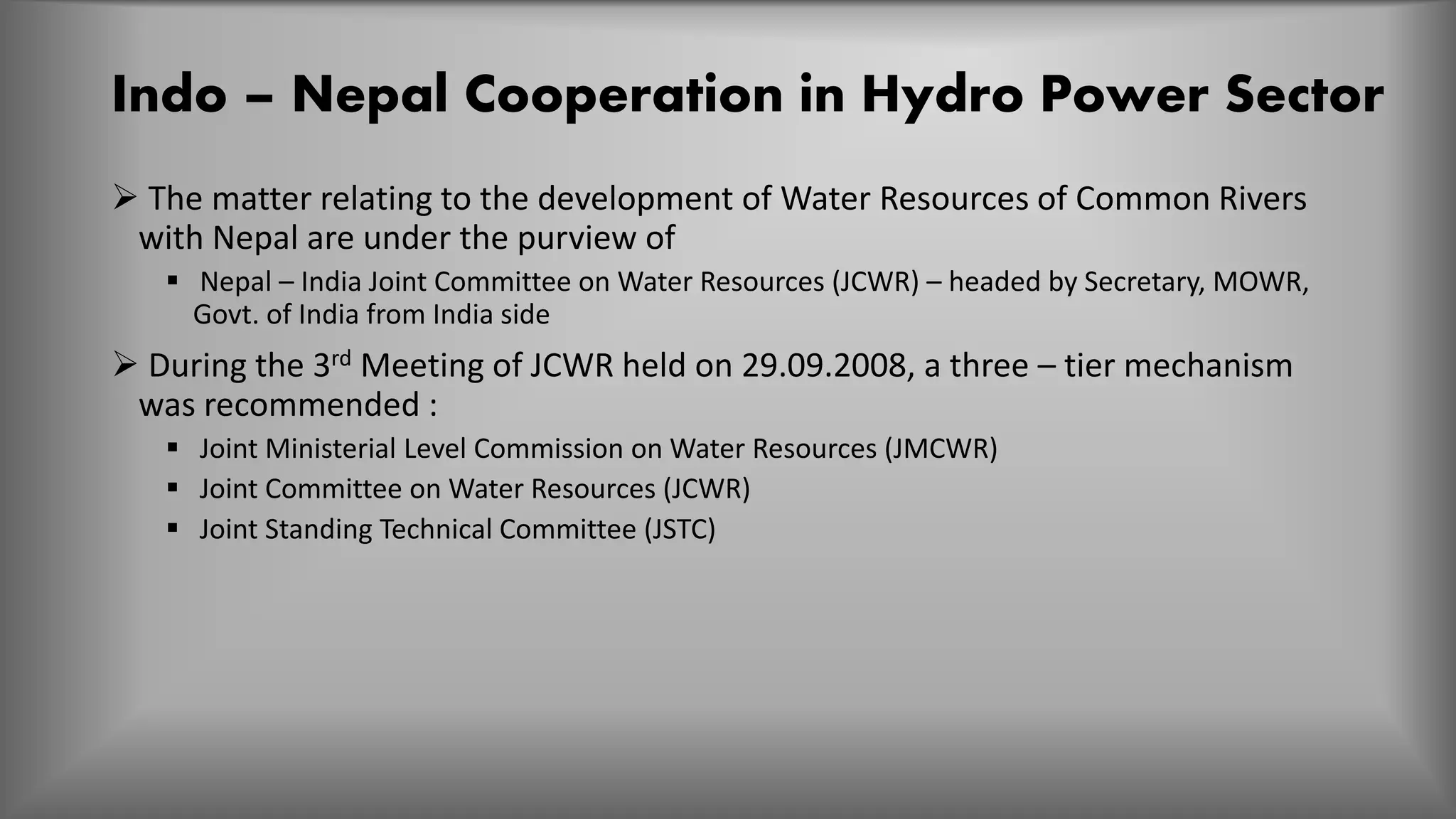
Indo – Nepal Cooperation in Hydro Power Sector
 The matter relating to the development of Water Resources of Common Rivers
with Nepal are under the purview of
 Nepal – India Joint Committee on Water Resources (JCWR) – headed by Secretary, MOWR,
Govt. of India from India side
 During the 3rd Meeting of JCWR held on 29.09.2008, a three – tier mechanism
was recommended :
 Joint Ministerial Level Commission on Water Resources (JMCWR)
 Joint Committee on Water Resources (JCWR)
 Joint Standing Technical Committee (JSTC)
 Basin – wise Theoretical Hydro Electric Potential of Nepal
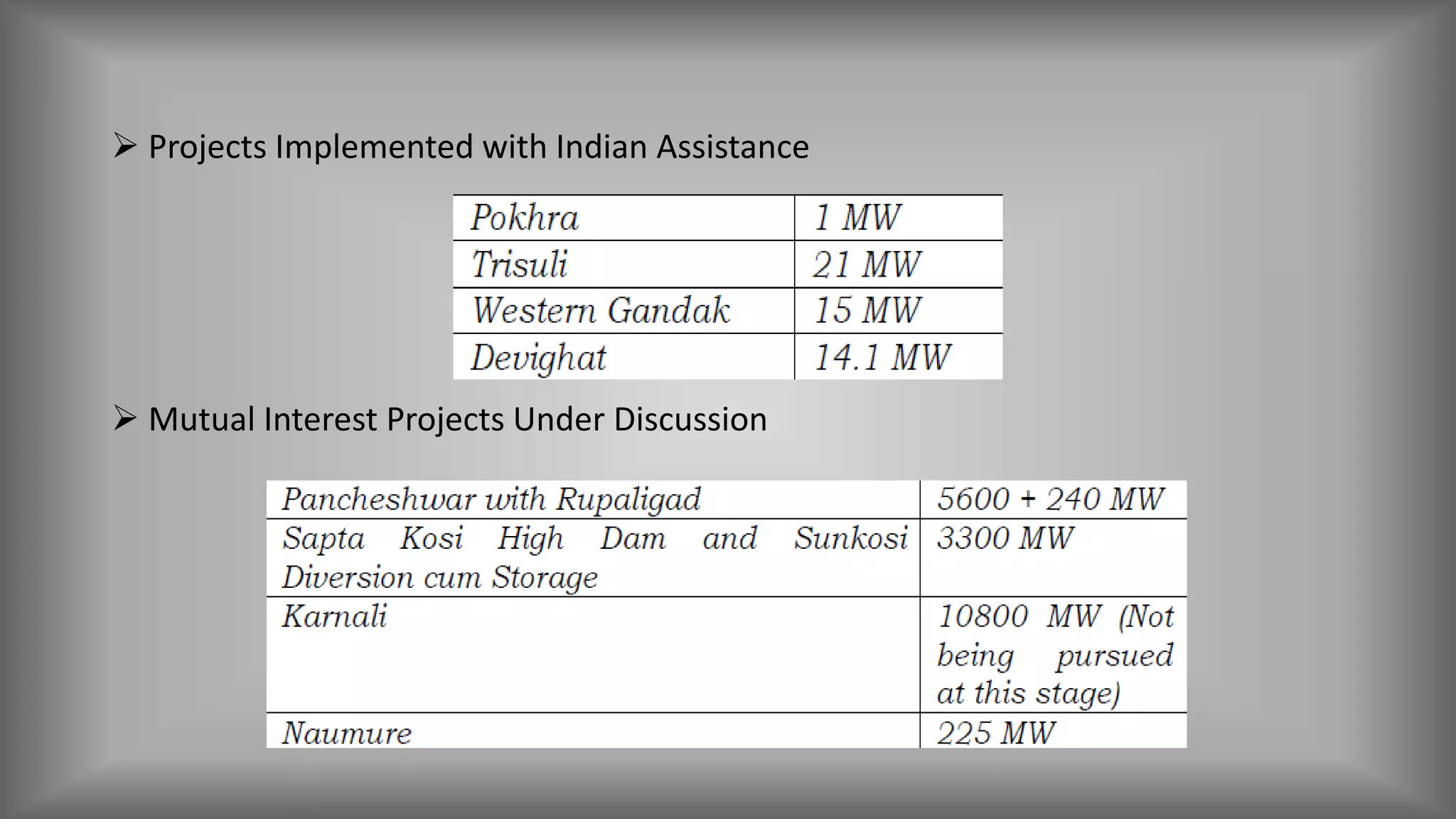
 Projects Implemented with Indian Assistance
 Mutual Interest Projects Under Discussion
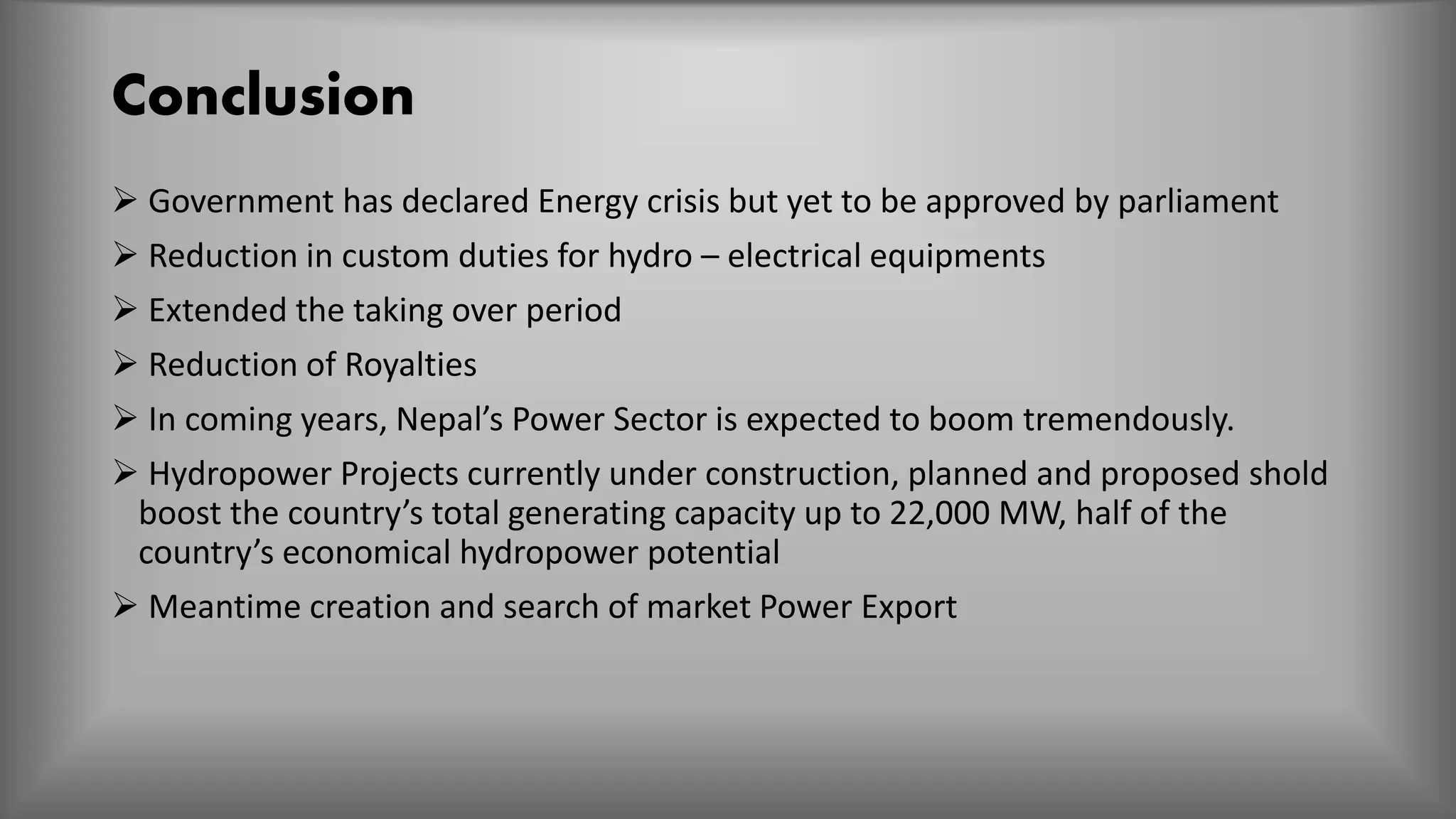
Conclusion
 Government has declared Energy crisis but yet to be approved by parliament
 Reduction in custom duties for hydro – electrical equipments
 Extended the taking over period
 Reduction of Royalties
 In coming years, Nepal’s Power Sector is expected to boom tremendously.
 Hydropower Projects currently under construction, planned and proposed shold
boost the country’s total generating capacity up to 22,000 MW, half of the
country’s economical hydropower potential
 Meantime creation and search of market Power Export
THANK YOU

Power Scenario of Bhutan and Nepal

  • 1.
    POWER SENERIO : BHUTANAND NEPAL Presented By : Ashish Singh MBA – PM 500033217
  • 2.
  • 3.
    BHUTAN  The Kingdomof Bhutan – a small landlocked country with the population of 716,896  located to the eastern side of the Himalayas at 27º28.0’N and 89º38.5’E in South Asia  It borders China (to the north) and India (to the east, west and south)  primary exports are  electricity (to India),  cardamom, gypsum, timber, handicrafts, cement, fruit, precious stones, and spices  Bhutan began modernizing in the 1950s  has developed ten consecutive five- year plans starting in 1961 to coordinate development efforts
  • 4.
    Cont.  Previously, therewere no paved roads, most homes were built from mud and grass, literacy was low  The country has made significant progress in extending access to  safe drinking water and sanitation,  protecting and managing the country’s natural resources,  providing basic health care and  increasing access to primary education  The previous king, who came to the throne in 1974, invested the country’s meager finances in an airport, an east-west road, bridges, national education, health care, and select energy-producing technologies like hydropower, which provides almost all the country’s electricity  Bhutan’s economy is one of the world's smallest and least developed and is based on agriculture, forestry, and hydroelectricity
  • 5.
    Cont.  Despite thisconstraint, hydroelectricity and construction continue to be the two major industries of growth for the country  Bhutan Government has undertaken a number of measures to ensure a diverse economy and prosperity for the rural dwellers in remote areas  One such measure is the Rural Electrification (RE) program which aims at achieving 100% rural electrification by end of 2013  In 2010 Bhutan was ranked by the Transparency International Corruption Perception as the least corrupt country in South Asia (The World Bank Group (WBG), 2010)
  • 6.
    Cont.  With itsabundant hydro resources Bhutan has a total techno-economically exploitable capacity of 23,760 MW  There are four major rivers Bhutan:  the Torsa which the shortest,  Sunkosh –longest,  Wangchu, and  Manas
  • 7.
    Brief of BhutanEconomy  Statistics  GDP : $ 5.036 billion (2012 est.)  GDP Growth : 9.7 % (2012 est.)  GDP per capita : $ 6,800 (2012 est.)  GDP by sector : agriculture – 23 %, industry – 37.9 %, services – 39.8 % (2009)  Population below : 31.7 % (2003) Poverty line  Labor force : agriculture – 63 %, industry – 6 %, services – 31 % (2004 est.) by occupation  Unemployment : 2.5 % (2004)  Exports Goods : Electricity (to India), cardamom, gypsum, timber, handicrafts, cement fruit, precious stone, spices  Main Exports : India – 58.6 %, Hong Kong – 30.1 %, Bangladesh – 7.3 % Partners
  • 8.
    Objective And Scope Objective is to examine  electricity sector in the Kingdom of Bhutan,  analyze the historical evolution of electricity demand and supply,  export and import,  the energy load profiles of high-voltage and medium-voltage industries  Scopes  review previous energy studies in Bhutan and understand the current developments in the energy sector and hydropower;  analyze the annual and quarterly reports of the National Load Dispatch Center of the Bhutan Power Corporation, as well as the industry load profiles for the period 2010-2012;  determine from the published literature the implications of energy efficiency and demand side management on industrial peak load and consumption; and  provide recommendations on the implementation of renewable energy and/or energy efficiency projects to address the problem of seasonal energy shortages and to sustain energy sales during winter
  • 9.
    Sector Development Context The main development challenges faced by Bhutan’s power sector in the mid-1990s were identified as  the institutional weakness of the sector,  its inability to assume the role of key growth driver in promoting the country’s economic development through power exports  providing access to electricity for rural consumers  The sector also suffered from poor cost recovery and dependence on donor financing for new investments  Institutional reforms undertaken during 1999–2002, with the assistance of the Asian Development Bank (ADB) and other development partners, addressed some of these challenges
  • 10.
     The newlyestablished power sector entities in 2002 faced the challenge of  transforming Bhutan’s power sector from a state department dependent to financially sustainable utilities  mobilizing investments for expanding access to rural communities,  mobilizing financing for export-oriented hydropower projects, and  improving cost recovery through tariff adjustments  By 2009, power sector entities in Bhutan had achieved an adequate level of institutional maturity with the exception of the power sector regulatory agencies :  Bhutan Electricity Authority (BEA)  Bhutan Power Corporation (BPC) • responsible for domestic power supply  Druk Green Power Company (DGPC) • responsible for operating the export – oriented hydropower projects  power sector has contributed to over 40% of the fiscal revenues in 2009  domestic power supply continues to receive an implicit subsidy from power exports
  • 11.
    Government Policy Response Thegovernment’s development strategy during 1994–2009 recognized that development of country’s hydropower plant will enhance the central role of the power sector in promoting  Fiscal revenues from power exports  economic development and poverty alleviation by exploiting the abundant hydropower potential for Increasing the government’s fiscal revenues from power exports  balanced regional growth with the electrification of rural communities, and  industrial investments based on cheap and reliable supply of electricity
  • 12.
    The government followeda consistent policy framework during Five Year Plan (1994–2009) to achieve these strategic objectives by : • establishing a transparent governance framework for the sector by separating the policy making, sector regulation, and utility operation functions; • increasing the commercial orientation and operational efficiency of the utility function of the power sector for expanding the power transmission and distribution network to facilitate the evacuation of power from export-oriented hydropower plants (HPPs) and to increase access to electricity for people in rural areas; • improving the financial performance and cost recovery of the sector through tariff adjustments while maintaining the government’s objective of providing affordable electricity to low-income households; and • establishing a competent agency to consolidate government ownership in export-oriented hydropower projects and to act as a strategic partner in developing new export-oriented HPPs.
  • 13.
    Government’s Five YearPlan  Government's 7th Five Year Plan focused on  scaling up the rural electrification program to electrify 5,500 households,  completing the master plan for hydropower development and the feasibility study for Tala HPP project,  initiating the construction of two medium hydropower projects (Basochhu HPP and Kurichhu HPP), and  strengthening power transmission to Thimphu and load centers in southern Bhutan
  • 14.
     Government's 8thFive Year Plan focused on  prioritized construction of the Basochhu HPP and Kurichhu HPPs,  commencing construction of Tala HPP, and providing 10,000 households with access to electricity  preparation of detailed feasibility studies for other large hydropower projects  the construction of other mini hydropower projects for domestic supply  the government also decided to decentralize the implementation and operation of power distribution to district units
  • 15.
     Government's 9thFive Year Plan focused on  rural electrification (100% by 2020)  economic self-reliance through hydropower exports  The following strategy was adopted to meet these objectives:  strengthening the institutional capacity of the sector following the provisions of the Electricity Act by empowering BEA as the regulatory body  transparent tariff setting for domestic and export power sales based on economic considerations—this involves establishing a multiyear tariff setting formula to provide an adequate rate of return on investments to power sector entities  prioritizing rural electrification as a means of equitably distributing the benefits of Bhutan’s hydropower resources—the 9th plan targeted 15,000 connections compared to 10,000 connections provided under the 8th plan  formulating policy guidelines to encourage private sector participation in the hydropower sector as well as community participation in the implementation of rural electrification  preparing an energy and water resource master plan for developing the hydropower sector in a sustainable manner  establishing an interconnected transmission grid by integrating the western and eastern grid, and extending the power transmission grid to remote parts of the country  installing a Supervisory Control and Data Acquisition (SCADA) system
  • 16.
     Government's 10thFive Year Plan focused on  100% electrification by 2013  developing 10,000 MW of hydropower generation capacity with the assistance of the Government of India  The 10th plan identified critical challenges associated with achieving these targets:  addressing the environmental impacts associated with hydropower development  the high up-front investment cost of hydropower and the difficulty of mobilizing the requisite financial requirements;  developing access and transport infrastructure to hydropower sites;  high dependence of Bhutan’s economy on the hydropower sector (by 2020, the hydropower sector is expected to contribute 50% of GDP and over 75% of fiscal revenues); and  financial constraints faced by the rural electrification program and the continued availability of subsidies in the form of avoided power exports, which command a higher price than the price charged for rural consumers
  • 17.
    Objective And Goals Bhutan is the only country in South Asia with surplus power generation capacity  power sector contributes a significant share to its national economy in 2009  40% of government revenues,  45% of export earnings, and  25% of gross domestic product (GDP)  The Asian Development Bank (ADB) has been a major development partner in Bhutan’s power sector  ADB played a catalytic role in structuring and financing Bhutan’s first public–private partnership (PPP) transaction in the export-oriented hydropower sector  Bhutan has committed to an ambitious agenda of developing over 10,000 megawatts (MW) of hydropower capacity by 2020 with assistance from the Government of India, and achieving 100% electrification by 2013
  • 18.
    Institutional Context  Electricitysupply in Bhutan in the 1990s (including the operation of mini HPPs and diesel power plants) was the responsibility of the DOP, which was part of the Ministry of Trade and Investment  A major turning point in the overall development of the power sector was the commissioning of the 336 megawatt (MW) Chhukha Hydro Power Plant together with transmission links to connect the power station to both Bhutan’s domestic network and the Indian grid in 1988  The project was implemented as a joint venture between the Government of India and the Government of Bhutan, and then incorporated in July 1991 under the Companies Act, 1989 as Chhukha Hydro Power Company (CHPC), a government-owned company
  • 19.
  • 20.
  • 21.
     2002 –2009 Period
  • 22.
  • 23.
  • 24.
    Hydropower and EconomicGrowth  There are five major hydroelectric facilities in Bhutan, and  several small and mini hydroelectric generators that serve remotely located households and communities, both off- and on-grid  Since 2003 hydropower development has been contributing to a significant growth of the Kingdom’s GDP  over the period from 2003 to 2012 years the average annual GDP growth rate (AAGR) is approx. 14.5 %  In 2011, hydropower sales accounted for the largest share of the country’s GDP
  • 25.
     With higherlevels of income people are more willing to improve their living conditions  This in turn will lead to increased energy demand, particularly of medium and high voltage industries
  • 26.
     In 2005,nearly two thirds of the households in Bhutan did not have access to electricity  In 2012 the rural electrical connectivity ratio reached 89% (Bhutan Power Corporation (BPC) Limited, 2012)
  • 27.
    Supply And Demand Five major hydropower plants that supply hydropower for export (India) after meeting the domestic electricity demand  total generation capacity as of the year 2012 is 1,480 MW
  • 28.
     In 2004,the largest electricity consumption by HV industries which accounted for 56 per cent of total sales. The second largest electricity consumption belonged to LV customers including residential, institutional, agriculture and auxiliary building  Significant increase in HV industries sales between 2004 and 2012 and still remains the largest electricity consumer  In year 2012, MV and HV industries together accounted for 79% out of total hydro electricity consumed in Bhutan
  • 29.
    Climate Change &Hydropower  Currently, hydropower accounts for nearly 16% of the world’s total power supply  World’s most dominant (86%) source of renewable electrical energy (2012)  Asia alone possesses a technically feasible potential of 6,800 TWh/y  Total capacity potential of 1,928,286 MW (2012)  A feasible potential for global hydropower is 2 to 3 times higher than the current generation  However, there is an uncertainty brought by global climate change which poses some risk for the hydropower generation sector  Climatic changes are causing changes in runoff and increasing retreat/melting of glaciers  The Himalayan region is in a very active seismic zone, thus it is possible that earthquakes may trigger outburst of glacial lakes
  • 30.
     Bhutan hasbeen experiencing reduced and volatile hydropower generation from run-of-the-river facilities due to changed monsoon patterns and the consequent low river flows  hydroelectric energy is readily available during the months of monsoon rains, and is less available during non-monsoon months  today the seasonal power shortages constrain the supply to meet the industrial electricity needs
  • 31.
    Projects to beCommissioned, 2010 - 2020  After the commissioning of Tala HPP in 2006, with the assistance of ADB, the government prepared the sustainable hydropower policy to attract private investments to export-oriented hydropower projects  The projects to be commissioned are :  The 114 MW Dagachhu HPP was structured as a public–private partnership (PPP) is expected to be commissioned in 2014  The government has also entered into a memorandum of understanding with the Government of India to develop 10,000 MW of hydropower capacity consisting of 11 mega- projects  1,200 MW Punatsangchhu-I HPP under the 10,000 MW program is under construction with Government of India financing, and it is expected to be commissioned in 2016;  the 990 MW Punatsangchhu-II HPP and the 720 MW Mangdechhu HPP) are expected to begin construction in 2011 with Government of India financing and be commissioned in 2019
  • 32.
     Details ofthe HPPs under construction and at an advanced stage of preparation are summarized in Table A1.3.
  • 33.
  • 34.
    Macroeconomic Impacts ofExport – Oriented Hydropower Development  Power exports, which accounted for about 21% of total exports in 1996, grew in value in 1997 as India agreed to lift the power purchase price in steps from an average Nu0.5 per kilowatt-hour (kWh) in 1996 to Nu1.5/kWh in 1999  Current export price averages Nu1.9/kWh  The commissioning of Tala hydropower plant (HPP) for 1,020 megawatts (MW) in 2007 had a major impact on both gross domestic product (GDP) and exports, with exports rising to over Nu10 billion  Power exports contributed a significant share to the overall GDP in 2009 as well as the government’s fiscal revenues  The export-oriented power generation plants provided an implicit subsidy amounting to Nu1,958 million to the domestic power supply in 2009
  • 35.
  • 36.
     The FinancialPerformance Of Export – Oriented Power Sector
  • 37.
    Bhutan Energy SectorInstitutions and Current Energy Policies  Department of Energy (DOE): The DOE is responsible for  policy formulation,  planning, and  coordination of activities for the energy sector  overall responsibility for implementing the government’s ambitious rural electrification program and  developing the new export-oriented HPPs  Bhutan Electricity Authority (BEA), a regulatory body under the DOE:  Acts as an entrusted body for the economic  and technical regulation of power sector entities, including tariff setting and licensing
  • 38.
     Druk GreenPower Corporation  harnessing and sustaining Bhutan’s renewable energy resources  It controls the four major hydropower projects including Chukha HPP, Basochhu HPP, Kurichhu HPP, and Tala HPP  Bhutan Power Corporation Limited (BPC) :established as a public utility on 1 July 2002  mandate of distributing electricity throughout the country and  also providing transmission access for generating stations for domestic supply as well as export  The Renewable Energy Division (RED) under DOE  implementation of alternative renewable energy development projects,  construction of MV and LV lines and substations  current mandate of the RED is expansion of the distribution infrastructure to achieve the Royal Government’s goal of 'Electricity for All by the year 2013'
  • 39.
    Smart Grid andDSM  Smart Grid is based on the application of digital technology in the electricity network in order to supply electricity consumers via two-way communication  monitor and analyze the energy use and help improve energy efficiency, ensure transparency and reliability of the energy supply chain  Smart energy enabled by 'information and communication technologies' (ICTs) can allow consumers to closely monitor their consumption and energy suppliers to more efficiently meet the demand  Smart energy response and management technologies provide utilities with tools to streamline and target Demand Side Management (DSM) and potential reduction opportunities
  • 40.
    Conclusion  The royalgovt. of Bhutan is pursuing opportunities for the enlargement of Hydropower capacities  Several Hydropower projects are underway, which are expected to generate a total of 10,000 MW by 2020  Nevertheless, there are risk of dependency on the sales of a commodity to a single market – India  There are risk from natural disasters, such as earthquakes, as Bhutan is located between the Indian and Asian Tectonic plates  Climate change effects including glacial melts, landslides and monsoon may also pose a several risk to the infrastructure
  • 41.
  • 42.
    Nepal  Country ofMount Everest (Highest Peak in the World)  Country of Gautam Buddha; Light of Asia and Founder of Buddhism  Country of Greenery and Blue Sky  Country of Fresh Water  Altitude : 8848.0 to 70 m  Length : 880 km (East to West)  Width : 240 km (North to South)  Area : 147,181 sq km
  • 43.
    Brief History ofNepal  Nepal had many Small Kingdoms before 1768  The Modern State was formed with the Unification of Nepal. United by the King Prithvi Narayan Shah on December 21, 1768  Until 2006, Nepal was a kingdom ruled by Royal Family.  On December 28, 2007, the Interim Parliament passed a bill and declared Nepal to be a Federal Democratic Republic  The First Meeting of the Constituent Assembly on May 28, 2008
  • 44.
    Nepal Economy  Statistics GDP : $ 47 billion (2014 est.)  GDP Growth : 5.1 % (2014 est.)  GDP per capita : $ 1,600 (2014 est.)  GDP by Sector : agriculture – 35 %, industry – 20 %, services – 45 % (2010 est.)  Population below : 24.7 % (2008 est.) Poverty Line  Exports : $ 2 Billion (2013 est.)  Exports Goods : carpets, clothing, leather, jute goods, grain, herbs, tea, coffee steel, cement, furniture, clothes etc.  Main Exports Partners : India – 55.7 %, United States – 10.1 %, Germany – 4.4 % (2012 est.)  Imports Goods : Petroleum Products, Gold, Machinery  Main Import Partners : India – 51.0 %, China – 34.5 % (2012 est.)
  • 45.
    Sources of Electricityin Nepal  Water is an important resource of Nepal which represents a source of potential wealth  Nepal is endowed with immense water resources.  The annual precipitation is approximately 1700 mm (80% of which occurs during the monsoon season)  The Total annual average run off from the nation’s 600 perennial rivers flowing from high mountains is over 200 billion cu m.  Nepal’s storage potential is estimated at 88 billion cu m  The estimated theoretical power potential is approximately 83,000 MW  The economical feasible potential has been evaluated at approximately 43,000 MW, of which only 698 MW have been harnessed
  • 46.
    Nepal Power Scenario Nepal is bestowed with tremendous hydropower resources  Only about 40% of Nepal's population has access to electricity  Nepal's electricity generation is dominated by hydropower  Though in the entire scenario of energy use of the country, the electricity is a tiny fraction, only 1% energy need is fulfilled by electricity  The bulk of the energy need is dominated by  fuel wood (68%)  agricultural waste (15%)  animal dung (8%)  imported fossil fuel (8%)  This contributes to deforestation, soil erosion and depletion, and increased flooding downstream in the Ganges plain
  • 47.
    Hydropower in Nepal Nepal has a huge hydropower potential  Perennial nature of Nepali rivers and the steep gradient of the country's topography provide ideal conditions for the development of some of the world's largest hydroelectric projects in Nepal  Current estimates are that Nepal has approximately 40,000 MW of economically feasible hydropower potential  The present situation is that Nepal has developed only approximately 600 MW of hydropower  Although bestowed with tremendous hydropower resources, only about 40% of Nepal's population has access to electricity  Most of the power plants in Nepal are run-of-river type with energy available in excess during the monsoon season and deficit during the dry season
  • 48.
     The electricitydemand in Nepal is increasing by about 7-9% per year  About 40 % of population in Nepal has access to electricity through the grid and off grid system  Nepal's Tenth Five Year Plan (2002– 2007) aims to extend the electrification within country and export to India for mutual benefit  The new Hydropower Policy 2001 seeks to promote private sector investment and aims to expand the electrification within the country and export  Only one seasonal storage project in the system  The load factor is quite low as the majority of the consumption is dominated by household use  The system loss is one of the major issues to be addressed to improve the power system which accounts to be 25 % including technical and non-technical losses
  • 49.
    Power Generation andTransmission  Nepal has 600 MW of installed capacity in its Integrated Nepal Power System (INPS)  The power system is dominated by the hydropower : 90 % of the system  Balance is met by multi fuel plant  The hydropower development in Nepal began with the development of 500 kW Pharping power plant in 1911 The most recent significant power plant commissioned is the 144-MW Kali Gandaki “A” Hydroelectric Plant  Until 1990, hydropower development was under the domain of government utility, Nepal Electricity Authority (NEA)  With the enactment of new Hydropower Development Policy 1992, the sector was opened to the private sector also  Private power producers contribute 148 MW of power to the ‘Integrated Nepal Power System
  • 50.
    Organization For Electricityin Nepal  Ministry of Electricity  Nepal Electricity Authority (NEA)  Generation  Transmission  Distribution Private Sector (Generation)  Generation and Distribution (SHP)
  • 51.
  • 52.
    Electricity in Nepalby 2009 – 10
  • 53.
  • 54.
  • 55.
    Indo – NepalCooperation in Hydro Power Sector  The matter relating to the development of Water Resources of Common Rivers with Nepal are under the purview of  Nepal – India Joint Committee on Water Resources (JCWR) – headed by Secretary, MOWR, Govt. of India from India side  During the 3rd Meeting of JCWR held on 29.09.2008, a three – tier mechanism was recommended :  Joint Ministerial Level Commission on Water Resources (JMCWR)  Joint Committee on Water Resources (JCWR)  Joint Standing Technical Committee (JSTC)
  • 56.
     Basin –wise Theoretical Hydro Electric Potential of Nepal
  • 57.
     Projects Implementedwith Indian Assistance  Mutual Interest Projects Under Discussion
  • 58.
    Conclusion  Government hasdeclared Energy crisis but yet to be approved by parliament  Reduction in custom duties for hydro – electrical equipments  Extended the taking over period  Reduction of Royalties  In coming years, Nepal’s Power Sector is expected to boom tremendously.  Hydropower Projects currently under construction, planned and proposed shold boost the country’s total generating capacity up to 22,000 MW, half of the country’s economical hydropower potential  Meantime creation and search of market Power Export
  • 59.