8.4 TESTS INVOLVING
PAIRED DIFFERENCES
   (DEPENDENT SAMPLES)
Paired Data

• Many statistical applications use paired data
  samples to draw conclusions about the difference
  between two population means.
• Data pairs occur very naturally in “before and
  after” situations, where the same object or item is
  measured both before and after a treatment.
  • Other situations: identical twins, a person’s left and right foot
Paired Data

• When a test involves comparing two populations for
  which the data occur in pairs, the proper
  procedure is to run a one-sample test on a single
  variable consisting of the differences from the
  paired data.
 • Note: we did one-sample testing in 8.1 – 8.3
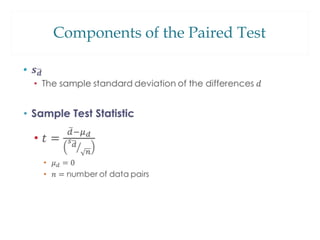
Components of the Paired Test
•
Components of the Paired Test
•
Components of the Paired Test

•
Components of the Paired Test

•
Calculating the P-Value
•
•
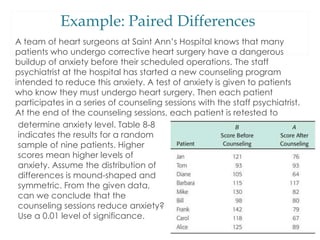
Example: Paired Differences
A team of heart surgeons at Saint Ann’s Hospital knows that many
patients who undergo corrective heart surgery have a dangerous
buildup of anxiety before their scheduled operations. The staff
psychiatrist at the hospital has started a new counseling program
intended to reduce this anxiety. A test of anxiety is given to patients
who know they must undergo heart surgery. Then each patient
participates in a series of counseling sessions with the staff psychiatrist.
At the end of the counseling sessions, each patient is retested to
 determine anxiety level. Table 8-8
 indicates the results for a random
 sample of nine patients. Higher
 scores mean higher levels of
 anxiety. Assume the distribution of
 differences is mound-shaped and
 symmetric. From the given data,
 can we conclude that the
 counseling sessions reduce anxiety?
 Use a 0.01 level of significance.
Example: Paired Differences
SOLUTION
•
Example: Paired Differences
SOLUTION
•


                              L2   L1
      L3
Example: Paired Differences
SOLUTION
•
Example: Paired Differences
SOLUTION
•

8.4

  • 1.
    8.4 TESTS INVOLVING PAIREDDIFFERENCES (DEPENDENT SAMPLES)
  • 2.
    Paired Data • Manystatistical applications use paired data samples to draw conclusions about the difference between two population means. • Data pairs occur very naturally in “before and after” situations, where the same object or item is measured both before and after a treatment. • Other situations: identical twins, a person’s left and right foot
  • 3.
    Paired Data • Whena test involves comparing two populations for which the data occur in pairs, the proper procedure is to run a one-sample test on a single variable consisting of the differences from the paired data. • Note: we did one-sample testing in 8.1 – 8.3
  • 4.
    Components of thePaired Test •
  • 5.
    Components of thePaired Test •
  • 6.
    Components of thePaired Test •
  • 7.
    Components of thePaired Test •
  • 8.
  • 9.
  • 10.
    Example: Paired Differences Ateam of heart surgeons at Saint Ann’s Hospital knows that many patients who undergo corrective heart surgery have a dangerous buildup of anxiety before their scheduled operations. The staff psychiatrist at the hospital has started a new counseling program intended to reduce this anxiety. A test of anxiety is given to patients who know they must undergo heart surgery. Then each patient participates in a series of counseling sessions with the staff psychiatrist. At the end of the counseling sessions, each patient is retested to determine anxiety level. Table 8-8 indicates the results for a random sample of nine patients. Higher scores mean higher levels of anxiety. Assume the distribution of differences is mound-shaped and symmetric. From the given data, can we conclude that the counseling sessions reduce anxiety? Use a 0.01 level of significance.
  • 11.
  • 12.
  • 13.
  • 14.