8085 ASSEMBLY LANGUAGE PROGRAMMING
Prof. K. Adisesha, MSc., MTech(Ph.D), NET Page 1
Functional Pin Diagram of 8085
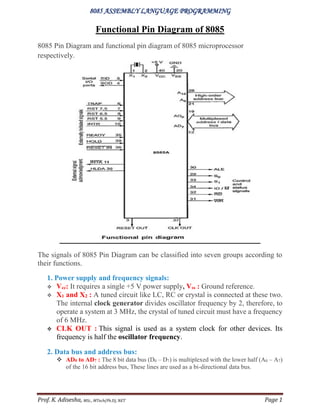
8085 Pin Diagram and functional pin diagram of 8085 microprocessor
respectively.
The signals of 8085 Pin Diagram can be classified into seven groups according to
their functions.
1. Power supply and frequency signals:
❖ Vcc: It requires a single +5 V power supply, Vss : Ground reference.
❖ X1 and X2 : A tuned circuit like LC, RC or crystal is connected at these two.
The internal clock generator divides oscillator frequency by 2, therefore, to
operate a system at 3 MHz, the crystal of tuned circuit must have a frequency
of 6 MHz.
❖ CLK OUT : This signal is used as a system clock for other devices. Its
frequency is half the oscillator frequency.
2. Data bus and address bus:
❖ AD0 to AD7 : The 8 bit data bus (D0 – D7) is multiplexed with the lower half (A0 – A7)
of the 16 bit address bus, These lines are used as a bi-directional data bus.
8085 ASSEMBLY LANGUAGE PROGRAMMING
Prof. K. Adisesha, MSc., MTech(Ph.D), NET Page 2
❖ A8 to A15 : The upper half of the 16 bit address appears on the address lines A8 to A15.
These lines are exclusively used for the most significant 8 bits of the 16 bit address
lines.
3. Control bus
❖ A) ALE (Address Latch Enable): We, know that AD0 to AD7 lines are multiplexed and
the lower half of address (A0 – A7) is available only during T1 of the machine cycle. This
lower half of address is also necessary during T2 and T3 of machine cycle to access specific
location in memory or I/O port.
❖ B) RD and WR: These signals are basically used to control the direction of the data flow
between processor and memory or I/O device/port. A low on RD indicates that the data
must be read from the selected memory location or I/O port via data bus. A low on WR
indicates that the data must be written into the selected memory location or I/O port via
data bus.
❖ C) IO/M, S0 and S1: IO/M indicates whether I/O operation or memory operation is being
carried out. S1 and S0 indicate the type of machine cycle in progress.
❖ D) READY: It is used by the microprocessor to sense whether a peripheral is ready or not
for data transfer. If not, the processor waits. It is thus used to synchronize slower
peripherals to the microprocessor.
4. Interrupt signals
❖ The 8085 Pin Diagram has five hardware interrupt signals: RST 5.5, RST 6.5, RST
7.5, TRAP and INTR. The microprocessor recognises interrupt requests on these lines
at the end of the current instruction execution.
❖ The INTA (Interrupt Acknowledge) signal is used to indicate that the processor has
acknowledged an INTR interrupt.
5. Serial I/O signals
❖ SID (Serial I/P Data): This input signal is used to accept serial data bit by bit from the
external device.
❖ SOD (Serial O/P Data) : This is an output signal which enables the transmission of
serial data bit by bit to the external device.
6. DMA signals
❖ A) HOLD: This signal indicates that another master is requesting for the use of address
bus, data bus and control bus.
❖ B) HLDA: This active high signal is used to acknowledge HOLD request.
7. Reset signals: A low on this pin
❖ Sets the program counter to zero (0000H).
❖ Tri-states the data bus, address bus and control bus.
On reset, the PC sets to 0000H which causes the 8085 Pin Diagram to execute the first instruction
from address 0000H. The power-on reset circuit can be used to ensure execution of first instruction
from address 0000H.
RESET OUT: This active high signal indicates that processor is being reset. This signal is
synchronized to the processor clock and it can be used to reset other devices connected in the
system.
8085 ASSEMBLY LANGUAGE PROGRAMMING
Prof. K. Adisesha, MSc., MTech(Ph.D), NET Page 3
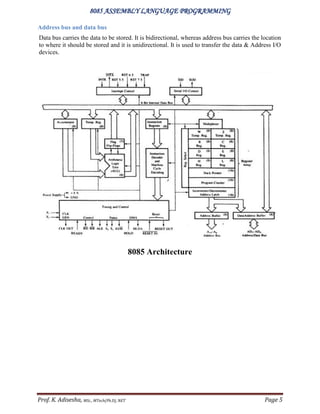
8085 Architecture
8085 is an 8-bit microprocessor designed by Intel in 1977 using NMOS technology.
It has the following configuration −
• 8-bit data bus
• 16-bit address bus, which can address upto 64KB
• A 16-bit program counter
• A 16-bit stack pointer
• Six 8-bit registers arranged in pairs: BC, DE, HL
• Requires +5V supply to operate at 3.2 MHZ single phase clock
It is used in washing machines, microwave ovens, mobile phones, etc.
8085 Microprocessor – Functional Units
8085 consists of the following functional units −
Accumulator
It is an 8-bit register used to perform arithmetic, logical, I/O & LOAD/STORE operations. It is
connected to internal data bus & ALU.
Arithmetic and logic unit
As the name suggests, it performs arithmetic and logical operations like Addition, Subtraction,
AND, OR, etc. on 8-bit data.
General purpose register
There are 6 general purpose registers in 8085 processor, i.e. B, C, D, E, H & L. Each register can
hold 8-bit data.
These registers can work in pair to hold 16-bit data and their pairing combination is like B-C, D-
E & H-L.
Program counter
It is a 16-bit register used to store the memory address location of the next instruction to be
executed. Microprocessor increments the program whenever an instruction is being executed, so
that the program counter points to the memory address of the next instruction that is going to be
executed.
Stack pointer
It is also a 16-bit register works like stack, which is always incremented/decremented by 2 during
push & pop operations.
Temporary register
It is an 8-bit register, which holds the temporary data of arithmetic and logical operations.
8085 ASSEMBLY LANGUAGE PROGRAMMING
Prof. K. Adisesha, MSc., MTech(Ph.D), NET Page 4
Flag register
It is an 8-bit register having five 1-bit flip-flops, which holds either 0 or 1 depending upon the
result stored in the accumulator.
These are the set of 5 flip-flops −
• Sign (S)
• Zero (Z)
• Auxiliary Carry (AC)
• Parity (P)
• Carry (C)
Its bit position is shown in the following table −
D7 D6 D5 D4 D3 D2 D1 D0
S Z AC P CY
Instruction register and decoder
It is an 8-bit register. When an instruction is fetched from memory then it is stored in the
Instruction register. Instruction decoder decodes the information present in the Instruction
register.
Timing and control unit
It provides timing and control signal to the microprocessor to perform operations. Following are
the timing and control signals, which control external and internal circuits −
• Control Signals: READY, RD’, WR’, ALE
• Status Signals: S0, S1, IO/M’
• DMA Signals: HOLD, HLDA
• RESET Signals: RESET IN, RESET OUT
Interrupt control
As the name suggests it controls the interrupts during a process. When a microprocessor is
executing a main program and whenever an interrupt occurs, the microprocessor shifts the control
from the main program to process the incoming request. After the request is completed, the
control goes back to the main program.
There are 5 interrupt signals in 8085 microprocessors: INTR, RST 7.5, RST 6.5, RST 5.5, TRAP.
Serial Input/output control
It controls the serial data communication by using these two instructions: SID (Serial input data)
and SOD (Serial output data).
Address buffer and address-data buffer
The content stored in the stack pointer and program counter is loaded into the address buffer and
address-data buffer to communicate with the CPU. The memory and I/O chips are connected to
these buses; the CPU can exchange the desired data with the memory and I/O chips.
8085 ASSEMBLY LANGUAGE PROGRAMMING
Prof. K. Adisesha, MSc., MTech(Ph.D), NET Page 5
Address bus and data bus
Data bus carries the data to be stored. It is bidirectional, whereas address bus carries the location
to where it should be stored and it is unidirectional. It is used to transfer the data & Address I/O
devices.
8085 Architecture
8085 ASSEMBLY LANGUAGE PROGRAMMING
Prof. K. Adisesha, MSc., MTech(Ph.D), NET Page 6
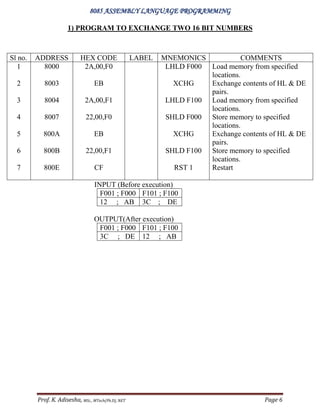
1) PROGRAM TO EXCHANGE TWO 16 BIT NUMBERS
INPUT (Before execution)
F001 ; F000 F101 ; F100
12 ; AB 3C ; DE
OUTPUT(After execution)
F001 ; F000 F101 ; F100
3C ; DE 12 ; AB
Sl no. ADDRESS HEX CODE LABEL MNEMONICS COMMENTS
1
2
3
4
5
6
7
8000
8003
8004
8007
800A
800B
800E
2A,00,F0
EB
2A,00,F1
22,00,F0
EB
22,00,F1
CF
LHLD F000
XCHG
LHLD F100
SHLD F000
XCHG
SHLD F100
RST 1
Load memory from specified
locations.
Exchange contents of HL & DE
pairs.
Load memory from specified
locations.
Store memory to specified
locations.
Exchange contents of HL & DE
pairs.
Store memory to specified
locations.
Restart
8085 ASSEMBLY LANGUAGE PROGRAMMING
Prof. K. Adisesha, MSc., MTech(Ph.D), NET Page 7
2) PROGRAM TO ADDITION TWO 8 BIT NUMBERS
INPUT : XX, YY
1) 20, 10
2) 2B, FA
OUTPUT
TRIAL Addition (XX+YY) Addition (XX+YY)
ADDRESS F001: F000 F001: F000
1 00 : 30 01 : 25
Sl no. ADDRESS HEX CODE LABEL MNEMONICS COMMENTS
1
2
3
4
5
6
7
8
9
10
8000
8002
8004
8005
8008
800B
800D
8010
8012
8015
3E, XX
06, YY
80
32,00,F0
D2,10,80
3E,01
C3,12,80
3E,00
32,01,F0
CF
Ahead 1
Ahead 2
MVI A, XX
MVI B, YY
ADD B
STA F000
JNC (Ahead 1)
MVIA, 01
JMP(Ahead 2)
MVIA, 00
STA F001
RST1
Move immediately to [A] the
data XX
Move immediately to [B] the
data YY
Add [B] with [A]
Store contents of [A] in specified
location
Jump on no carry to specified
location
Move immediately to [A] the
data(01)H
Jump unconditionally ahead
Move immediately to [A] the
data(00)H
Store contents of [A] in specified
location
Restart
8085 ASSEMBLY LANGUAGE PROGRAMMING
Prof. K. Adisesha, MSc., MTech(Ph.D), NET Page 8
3) PROGRAM TO SUBTRACT TWO 8 BIT NUMBERS
INPUT : XX, YY
1) 20, 10
2) 2B, FA
OUTPUT
TRIAL Subtraction (XX-YY) Subtraction (XX-YY)
ADDRESS F001: F000 F001: F000
1 00 : 10 01 : 31
Sl no. ADDRESS HEX CODE LABEL MNEMONICS COMMENTS
1
2
3
4
5
6
7
8
9
10
8000
8002
8004
8005
8008
800B
800D
8010
8012
8015
3E, XX
06, YY
90
32,00,F0
D2,10,80
3E,01
C3,12,80
3E,00
32,01,F0
CF
Ahead 1
Ahead 2
MVI A, XX
MVI B, YY
SUB B
STA F000
JNC (Ahead 1)
MVIA, 01
JMP(Ahead 2)
MVIA, 00
STA F001
RST1
Move immediately to [A] the
data XX
Move immediately to [B] the
data YY
Subtract [B] with [A]
Store contents of [A] in specified
location
Jump on no carry to specified
location
Move immediately to [A] the
data(01)H
Jump unconditionally ahead
Move immediately to [A] the
data(00)H
Store contents of [A] in specified
location
Restart
8085 ASSEMBLY LANGUAGE PROGRAMMING
Prof. K. Adisesha, MSc., MTech(Ph.D), NET Page 9
4) PROGRAM TO ADDITION TWO 16 BIT NUMBERS
F001: F000 (X) 4A : 2C
F101: F100 (Y) ED : 5B
F202:F201: F200 (X+Y) 01 : 37 : 87
Sl no. ADDRESS HEX CODE LABEL MNEMONICS COMMENTS
1
2
3
4
5
6
7
8
9
10
8000
8001
8004
8005
8008
8009
800C
800F
8010
8013
AF
2A, 00, F0
EB
2A,00,F1
19
22,00,F2
D2,10,80
3C
32,02,F2
CF
Ahead
XRA A
LHLD F000
XCHG
LHLD F100
DAD D
SHLD F200
JNC (Ahead)
INR A
STA F202
RST1
Clear accumulator and Flag
Load memory from specified
locations
Exchange contents of HL & DE
pairs
Load memory from specified
locations
Add HL & DE pairs
Store memory to specified
locations
Jump on no carry to ahead
address
Increment contents of
accumulator by one
Store contents of [A] in specified
location
Restart
8085 ASSEMBLY LANGUAGE PROGRAMMING
Prof. K. Adisesha, MSc., MTech(Ph.D), NET Page 10
5) PROGRAM TO SUBTRACT TWO 16 BIT NUMBERS (X>Y)
Sl no. ADDRESS HEX CODE LABEL MNEMONICS COMMENTS
1
2
3
4
5
6
7
8
9
10
8000
8003
8004
8007
8008
8009
800C
800D
800E
8011
2A,00,F0
EB
2A,00,F1
7D
93
32,00,F2
7C
9A
32,01,F2
CF
LHLD F000
XCHG
LHLD F100
MOV A, L
SUB E
STA F200
MOV A, H
SBB D
STA F201
RST 1
Load memory from specified
locations
Exchange contents of HL & DE
pairs
Load memory from specified
locations
Move contents of [L] to [A]
Subtract [E] from [A]
Store result in specified location
Move contents of [H] to [A]
Subtract [D] from [A] with
borrow
Store result in specified location
Restart
F001: F000 (X) FA : 2C
F101: F100 (Y) BD : 5B
F202:F201: F200 (X-Y) 3C : D1
8085 ASSEMBLY LANGUAGE PROGRAMMING
Prof. K. Adisesha, MSc., MTech(Ph.D), NET Page 11
6) PROGRAM TO ADD TWO N BYTE NUMBERS
INPUT(X) F103 : F102 : F101 : F100 A4 : E6 : F3 : D7
INPUT(Y) F003 : F002 : F001 : F000 C3 : 54 : A2 : 1B
OUTPUT(X+Y) F204:F203 : F202 : F201 : F200 01: 68 : 3B: 95: F2
Sl no. ADDRESS HEX CODE LABEL MNEMONICS COMMENTS
1
2
3
4
5
6
7
8
9
10
11
12
13
14
15
16
17
18
19
20
21
8000
8003
8006
8009
800B
800E
800F
8010
8011
8012
8013
8014
8015
8018
8019
801C
801F
8021
8024
8026
8027
21,00,F0
01,00,F1
11,00,F2
3E,(NN)
32,00,81
AF
0A
8E
12
23
03
13
3A,00,81
3D
C2,0B,80
D2,24,80
3E,01
C3,26,80
3E,00
12
CF
LOOP
Ahead 1
Ahead 2
LXIH F000
LXIB F100
LXID F200
MVI A, (NN)
STA 8100
XRA A
LDAX B
ADC M
STAX D
INX H
INX B
INX D
LDA 8100
DCR A
JNZ (LOOP)
JNC (Ahead 1)
MVI A, 01
JMP (Ahead 2)
MVI A, 00
STAX D
RST 1
Load HL pair with specified data
Load BC pair with specified data
Load DE pair with specified data
Specify the number of bytes
Save the count
Clear accumulator and flags
Load [A] indirectly from address
specified by BC pair
Add memory to [A] with carry
Store contents of [A] indirectly in
location specified by DE pair
Update memory
Update BC register pair
Update DE register pair
Load [A] from specified location
Decrement count
Jump on no zero to perform loop
Jump on no carry to ahead address
Move immediately to [A] the
data(01)H
Jump unconditionally to ahead
address
Move immediately to [A] the
data(00)H
Store contents of [A] indirectly in
address specified by DE pair
Restart
8085 ASSEMBLY LANGUAGE PROGRAMMING
Prof. K. Adisesha, MSc., MTech(Ph.D), NET Page 12
7) PROGRAM FOR BLOCK TRANSFER
INPUT
8100:810:8102:8103:8104:8105:8106:8107:8108:8109:810A:810B:810C:810D:810E:810F
00 : 01: 02 : 03 : 04 : 05 : 06 : 07 : 08 : 09 : 0A : 0B : 0C : 0D : 0E : 0F
OUTPUT
8200:8201:8202:8203:8204:8205:8206:8207:8208:8209:820A:820B:820C:820D:820E:820F
00 : 01: 02 : 03 : 04 : 05 : 06 : 07 : 08 : 09 : 0A : 0B : 0C : 0D : 0E : 0F
Sl no. ADDRESS HEX CODE LABEL MNEMONICS COMMENTS
1
2
3
4
5
6
7
8
9
10
8000
8002
8005
8008
8009
800A
800B
800C
800D
8010
16,10
21,00,81
01,00,82
7E
02
23
03
15
C2,08,80
CF
LOOP
MVI D, (10)H
LXIH 8100
LXIB 8200
MOV A,M
STAX B
INX H
INX B
DCR D
JNZ (LOOP)
RST1
Set count in [D]
Load HL pair with specified
address
Load BC pair with specified
address
Move contents of memory to [A]
Store contents of [A] indirectly
to location specified by BC pair
Update memory
Update BC pair
Decrement count in [D]
Jump on no zero to perform the
loop
Restart
8085 ASSEMBLY LANGUAGE PROGRAMMING
Prof. K. Adisesha, MSc., MTech(Ph.D), NET Page 13
8) PROGRAM TO BLOCK TRANSFER IN REVERSE ORDER
INPUT
8100:810:8102:8103:8104:8105:8106:8107:8108:8109:810A:810B:810C:810D:810E:810F
00 : 01: 02 : 03 : 04 : 05 : 06 : 07 : 08 : 09 : 0A : 0B : 0C : 0D : 0E : 0F
OUTPUT
820F:820E:820D:820C:820B:820A:8209:8208:8207:8206:8205:8204:8203:8202:8201:8200
0F : 0E : 0D : 0C : 0B : 0A : 09 : 08 : 07 : 06 : 05 : 04 : 03 : 02 : 01 : 00
Sl no. ADDRESS HEX CODE LABEL MNEMONICS COMMENTS
1
2
3
4
5
6
7
8
9
10
8000
8002
8005
8008
8009
800A
800B
800C
800D
8010
16,10
21,00,81
01,0F,82
7E
02
23
0B
15
C2,08,80
CF
LOOP
MVI D, (10)H
LXIH 8100
LXIB 820F
MOV A,M
STAX B
INX H
DCX B
DCR D
JNZ (LOOP)
RST1
Set count in [D]
Load HL pair with specified
address
Load BC pair with specified
address
Move contents of memory to [A]
Store contents of [A] indirectly
to location specified by BC pair
Update memory
Decrement BC pair by one
Decrement count in [D]
Jump on no zero to perform the
loop
Restart
8085 ASSEMBLY LANGUAGE PROGRAMMING
Prof. K. Adisesha, MSc., MTech(Ph.D), NET Page 14
9) PROGRAM TO ADD N DECIMAL NUMBERS (N= 10)
INPUT OUTPUT
8100:810:8102:8103:8104:8105:8106:8107:8108:8109 F201 F200
00 : 01: 02 : 03 : 04 : 05 : 06 : 07 : 08 : 09 00 45
Sl no. ADDRESS HEX CODE LABEL MNEMONICS COMMENTS
1
2
3
4
5
6
7
8
9
10
11
12
13
14
15
8000
8001
8003
8005
8008
8009
800A
800D
800E
800F
8010
8013
8014
8015
8018
AF
0E,0A
16,00
21,00,81
86
27
D2,0E,80
14
23
0D
C2,08,80
6F
62
22,00,F2
CF
LOOP
Ahead
XRA A
MVI C, (0A)H
MVI D , 00
LXIH 8100
ADD M
DAA
JNC(Ahead)
INR D
INX H
DCR C
JNZ(LOOP)
MOV L,A
MOV H,D
SHLD F200
RST 1
Clear accumulator and flags
Set N count in [C]
Clear [D]
Load HL pair with specified data
Add memory to [A]
Decimal adjust accumulator
Jump on no carry to ahead
address
Increment [D] by one
Update memory
Decrement count
Jump on no zero to perform loop
Move [A] to [L]
Move [D] to [H]
Store contents of HL pair to
specified consecutive locations
Restart
8085 ASSEMBLY LANGUAGE PROGRAMMING
Prof. K. Adisesha, MSc., MTech(Ph.D), NET Page 15
10) PROGRAM FOR ADDITION OF HEXA-DECIMAL NUMBERS
UNTILL ‘FF’ IS ENCOUNTERED
OUTPUT: ‘00’ up to ‘FF’ is displayed in data field.
Slno. ADDRESS HEX CODE LABEL MNEMONICS COMMENTS
1
2
3
4
5
6
7
8
9
10
8000
8001
8004
8005
8008
800B
800E
800F
8010
8013
AF
32,F9,FF
F5
CD,D3,06
11,FF,FF
CD,BE,04
F1
3C
C2,01,80
76
LOOP
XRA A
STA FFF9
PUSH PSW
CALL(UPDDT)
LXID FFFF
CALL(DELAY)
POP PSW
INR A
JNZ (LOOP)
HLT
Clear accumulator and flags
Store contents of accumulator in
specified location
Push [A] and flags to stack
Call display subroutine for data
field
Implement a delay of 0.5 s using
monitor delay subroutine
Pop[A] and flags off stack
Increment contents of [A] by one
Perform the loop until [A]
becomes zero
Halt
8085 ASSEMBLY LANGUAGE PROGRAMMING
Prof. K. Adisesha, MSc., MTech(Ph.D), NET Page 16
11) PROGRAM FOR FOUR DIGIT BCD ADDITION
INPUT(X) F101 : F100 57 : 93
INPUT(Y) F001 : F000 64 : 21
OUTPUT(X+Y) F202 : F201 : F200 01: 22 : 14
Slno ADDRESS HEX CODE LABEL MNEMONICS COMMENTS
1
2
3
4
5
6
7
8
9
10
11
12
13
14
15
16
17
18
19
20
21
8000
8003
8006
8009
800B
800E
800F
8010
8011
8012
8013
8014
8015
8018
8019
801C
801F
8021
8024
8026
8027
21,00,F0
01,00,F1
11,00,F2
3E,02
32,00,81
0A
8E
27
12
23
03
13
3A,00,81
3D
C2,0B,80
D2,24,80
3E,01
C3,26,80
3E,00
12
CF
LOOP
Ahead 1
Ahead 2
LXIH F000
LXIB F100
LXID F200
MVI A, (02)
STA 8100
LDAX B
ADC M
DAA
STAX D
INX H
INX B
INX D
LDA 8100
DCR A
JNZ (LOOP)
JNC (Ahead 1)
MVI A, 01
JMP (Ahead 2)
MVI A, 00
STAX D
RST 1
Load HL pair with specified data
Load BC pair with specified data
Load DE pair with specified data
Specify the number of bytes
Save the count
Load [A] indirectly from address
specified by BC pair
Add memory to [A] with carry
Decimal adjust accumulator
Store contents of [A] indirectly in
location specified by DE pair
Update memory
Update BC register pair
Update DE register pair
Load [A] from specified location
Decrement count
Jump on no zero to perform loop
Jump on no carry to ahead address
Move immediately to [A] the data(01)H
Jump unconditionally to ahead address
Move immediately to [A] the data(00)H
Store contents of [A] indirectly in
address specified by DE pair
Restart
8085 ASSEMBLY LANGUAGE PROGRAMMING
Prof. K. Adisesha, MSc., MTech(Ph.D), NET Page 17
12) PROGRAM TO FIND 2`S COMPLEMENT OF 8 BIT/ 16 BIT
NUMBER
DATA INPUT OUTPUT(2`s complement)
8-Bit F000 : 7A F100 : 87
16-Bit F001 : F000 :: 1A: 26 F101 : F100 :: E5: DA
Slno ADDRESS HEX CODE LABEL MNEMONICS COMMENTS
1
2
3
4
5
6
7
8
9
10
11
12
13
14
8000
8002
8005
8008
8009
800A
800B
800C
800F
8010
8013
8016
8017
801A
06,01/(02)
11,01,00
21,00,F0
7E
2F
77
05
CA, 13,80
23
C3,08,80
2A,00,F0
19
22,00,F1
CF
LOOP
Ahead
MVI B,01/(02)
LXID 0001
LXIH F000
MOV A,M
CMA
MOV M,A
DCR B
JZ (Ahead)
INX H
JMP(Loop)
LHLD F000
DAD D
SHLD F100
RST 1
Move to [B] (01) for 8-bit & (02)
for 16-bit complement of data
Load DE pair with specified data
Load HL pair with specified data
Copy contents of memory to [A]
Complement contents of [A]
Copy contents of [A] to memory
Decrement [B] by one
Jump on zero to ahead address
Update memory
Jump unconditionally to perform
loop
Load contents of HL pair from
specified locations
Add HL and DE pair of registers
Store contents of HL pair to
specified locations
Restart
8085 ASSEMBLY LANGUAGE PROGRAMMING
Prof. K. Adisesha, MSc., MTech(Ph.D), NET Page 18
13) PROGRAM FOR BLOCK EXCHANGE
INPUT
F000:F001:F002:F003:F004:F005:F006:F007:F008:F009:F00A:F00B:F00C:F00D:F00E:F00F
00 : 01 : 02 : 03 : 04 : 05 : 06 : 07 : 08 : 09 : 0A : 0B : 0C : 0D : 0E : 0F
F100:F101:F102:F103:F104:F105:F106:F107:F108:F109:F10A:F10B:F10C:F10D:F10E:F10F
10 : 11 : 12 : 13 : 14 : 15 : 16 : 17 : 18 : 19 : 1A : 1B : 1C : 1D : 1E : 1F
F000:F001:F002:F003:F004:F005:F006:F007:F008:F009:F00A:F00B:F00C:F00D:F00E:F00F
10 : 11 : 12 : 13 : 14 : 15 : 16 : 17 : 18 : 19 : 1A : 1B : 1C : 1D : 1E : 1F
F100:F101:F102:F103:F104:F105:F106:F107:F108:F109:F10A:F10B:F10C:F10D:F10E:F10F
00 : 01 : 02 : 03 : 04 : 05 : 06 : 07 : 08 : 09 : 0A : 0B : 0C : 0D : 0E : 0F
OUTPUT
Sl no. ADDRESS HEX CODE LABEL MNEMONICS COMMENTS
1
2
3
4
5
6
7
8
9
10
11
12
13
8000
8003
8006
8008
8009
800A
800B
800C
800D
800E
800F
8010
8013
21,00,F0
11,00,F1
0E,10
1A
46
77
78
12
23
13
0D
C2,08,80
CF
LOOP
LXIH F000
LXID F100
MVI C,(10)H
LDAX D
MOV B,M
MOV M,A
MOV A,B
STAX D
INX H
INX D
DCR C
JNZ(Loop)
RST 1
Load HL pair with specified
address
Load HL pair with specified
address
Set counter in [C] for N counts
Load [A] indirectly from address
indicated by DE pair
Copy contents of memory to[B]
Copy contents of [A] to memory
Copy contents of [B] to [A]
Store contents of [A] indirectly
onto address in DE pair
Update memory
Update DE register pair
Decrement [C] by 1
Perform the loop until [C]
becomes zero
Restart
8085 ASSEMBLY LANGUAGE PROGRAMMING
Prof. K. Adisesha, MSc., MTech(Ph.D), NET Page 19
14) PROGRAM FOR SORTING AN ARRAY OF ‘N-NUMBERS’ IN ASCENDING
ORDER
INPUT F100:F101:F102:F103:F104:F105:F106:F107:F108:F109
01 : 02 : 03 : 04 : 05 : 06 : 07 : 08 : 09 : 0A
OUTPUT F100:F101:F102:F103:F104:F105:F106:F107:F108:F109
0A : 01 : 09 : 05 : 03 : 06 : 08 : 07 : 04 : 02
Sl no. ADDRESS HEX CODE LABEL MNEMONICS COMMENTS
1
2
3
4
5
6
7
8
9
10
11
12
13
14
15
16
17
18
19
8000
8001
8003
8004
8005
8008
8009
800A
800B
800E
800F
8010
8011
8012
8013
8014
8017
8018
801B
AF
06,0B
48
0D
21,00,F1
7E
23
BE
DA,13,80
56
77
2B
72
23
0D
C2,08,80
05
C2,03,80
CF
START
LOOP
AHEAD
XRA A
MVI B,0B
MOV C,B
DCR C
LXIH F100
MOV A,M
INX H
CMP M
JC (AHEAD)
MOV D,M
MOV M,A
DCX H
MOV M,D
INX H
DCR C
JNZ (LOOP)
DCR B
JNZ (START)
RST 1
Clear accumulator & flags
Move a count (N+1) in [B]
Copy contents of [B] to [C]
Decrement contents of [C] by one
Load the specified address in HL pair
Copy contents of [M] to [A]
Update memory
Compare memory with accumulator
Jump on carry to ahead address
Copy contents of [M] to [D]
Copy contents of [A] to [M]
Decrement HL pair by one
Copy contents of [D] to [M]
Increment contents of HL pair by one
Decrement contents of [C] by one
Jump on no zero to perform the loop
Decrement count in [B]
Jump on no zero to specified address
Restart
8085 ASSEMBLY LANGUAGE PROGRAMMING
Prof. K. Adisesha, MSc., MTech(Ph.D), NET Page 20
15) PROGRAM TO CHECK 2-OUT-OF-5 CODE
Sl no. ADDRESS HEX CODE LABEL MNEMONICS COMMENTS
1
2
3
4
5
6
7
8
9
10
11
12
13
14
15
16
17
18
19
8000
8003
8005
8007
8009
800C
800F
8010
8013
8014
80015
8018
8019
801B
801E
8020
8023
8025
8028
3A,00,F0
0E,05
16,00
E6,E0
C2,23,80
3A,00,F0
0F
D2,14,80
14
0D
C2,0F,80
7A
FE,02
C2,23,80
3E,FF
C2,25,80
3E,00
32,00,F1
CF
LOOP
AHEAD 2
AHEAD 1
AHEAD 3
LDA F000
MVI C,05
MVI D,00
ANI E0
JNZ (AHEAD 1)
LDA F000
RRC
JNC(AHEAD 2)
INR D
DCR C
JNZ(LOOP)
MOV A,D
CPI ,02
JNZ(AHEAD 1)
MVI A, FF
JMP(AHEAD 3)
MVI A, 00
STA F100
RST 1
Load data into accumulator from
specified location
Move a count (05)H in [C]
Clear contents of [D]
Logical AND (E0) H with [A]
Jump on no zero to specified address
Load data into accumulator from
specified location
Rotate contents of [A] to right
Jump on no carry to ahead address
Increment count in [D]
Decrement contents of [C] by one
Jump on no zero to perform the loop
Copy contents of [D] to [A]
Compare (02) H immediately with [A]
Jump on no zero to specified address
Move ‘FF’ to [A] immediately
Jump to specified location
unconditionally
Move ‘00’ to [A] immediately
Store data from accumulator into
specified location
Restart
INPUT OUTPUT
F000: 11 F100: FF
F000: 13 F100: 00
8085 ASSEMBLY LANGUAGE PROGRAMMING
Prof. K. Adisesha, MSc., MTech(Ph.D), NET Page 21
16) PROGRAM TO MULTIPLY TWO DIGIT BCD
INPUT OUTPUT
F001: F000 F101: F100
11 : 12 01 : 32
Sl no. ADDRESS HEX CODE LABEL MNEMONICS COMMENTS
1
2
3
4
5
6
7
8
9
10
11
12
13
14
15
16
17
18
19
20
8000
8003
8006
8007
800A
800B
800C
800D
800E
800F
80011
8012
8013
8014
8015
8017
8018
8019
801C
801F
21,00,00
3A,00,F0
47
3A,01,F0
4F
79
85
27
6F
3E,00
8C
27
67
78
C6,99
27
47
C2,0B,80
22,00,F1
CF
START
LXIH (0000 )H
LDA F000
MOV B,A
LDA F001
MOV C,A
MOV A,C
ADD L
DAA
MOV L,A
MVI A,00
ADC H
DAA
MOV H,A
MOV A,B
ADI ,99
DAA
MOV B,A
JNZ(START)
SHLD(F100)
RST 1
Move a count (0000)H in HL pair
Load data into accumulator from
specified location
Copy contents of [A] to [B]
Load data into accumulator from
specified location
Copy contents of [A] to [C]
Copy contents of [C] to [A]
Add [L] to accumulator
Decimal adjust [A]
Copy contents of [A] to [L]
Clear contents of [A]
Add contents of [H] to [A]
Decimal adjust [A]
Copy contents of [A] to [H]
Copy contents of [B] to [A]
Add immediately to accumulator 99
Decimal adjust [A]
Copy contents of [A] to [B]
Jump on no zero to specified
address
Store data from HL pair onto
specified location
Restart

8085 alp programs

  • 1.
    8085 ASSEMBLY LANGUAGEPROGRAMMING Prof. K. Adisesha, MSc., MTech(Ph.D), NET Page 1 Functional Pin Diagram of 8085 8085 Pin Diagram and functional pin diagram of 8085 microprocessor respectively. The signals of 8085 Pin Diagram can be classified into seven groups according to their functions. 1. Power supply and frequency signals: ❖ Vcc: It requires a single +5 V power supply, Vss : Ground reference. ❖ X1 and X2 : A tuned circuit like LC, RC or crystal is connected at these two. The internal clock generator divides oscillator frequency by 2, therefore, to operate a system at 3 MHz, the crystal of tuned circuit must have a frequency of 6 MHz. ❖ CLK OUT : This signal is used as a system clock for other devices. Its frequency is half the oscillator frequency. 2. Data bus and address bus: ❖ AD0 to AD7 : The 8 bit data bus (D0 – D7) is multiplexed with the lower half (A0 – A7) of the 16 bit address bus, These lines are used as a bi-directional data bus.
  • 2.
    8085 ASSEMBLY LANGUAGEPROGRAMMING Prof. K. Adisesha, MSc., MTech(Ph.D), NET Page 2 ❖ A8 to A15 : The upper half of the 16 bit address appears on the address lines A8 to A15. These lines are exclusively used for the most significant 8 bits of the 16 bit address lines. 3. Control bus ❖ A) ALE (Address Latch Enable): We, know that AD0 to AD7 lines are multiplexed and the lower half of address (A0 – A7) is available only during T1 of the machine cycle. This lower half of address is also necessary during T2 and T3 of machine cycle to access specific location in memory or I/O port. ❖ B) RD and WR: These signals are basically used to control the direction of the data flow between processor and memory or I/O device/port. A low on RD indicates that the data must be read from the selected memory location or I/O port via data bus. A low on WR indicates that the data must be written into the selected memory location or I/O port via data bus. ❖ C) IO/M, S0 and S1: IO/M indicates whether I/O operation or memory operation is being carried out. S1 and S0 indicate the type of machine cycle in progress. ❖ D) READY: It is used by the microprocessor to sense whether a peripheral is ready or not for data transfer. If not, the processor waits. It is thus used to synchronize slower peripherals to the microprocessor. 4. Interrupt signals ❖ The 8085 Pin Diagram has five hardware interrupt signals: RST 5.5, RST 6.5, RST 7.5, TRAP and INTR. The microprocessor recognises interrupt requests on these lines at the end of the current instruction execution. ❖ The INTA (Interrupt Acknowledge) signal is used to indicate that the processor has acknowledged an INTR interrupt. 5. Serial I/O signals ❖ SID (Serial I/P Data): This input signal is used to accept serial data bit by bit from the external device. ❖ SOD (Serial O/P Data) : This is an output signal which enables the transmission of serial data bit by bit to the external device. 6. DMA signals ❖ A) HOLD: This signal indicates that another master is requesting for the use of address bus, data bus and control bus. ❖ B) HLDA: This active high signal is used to acknowledge HOLD request. 7. Reset signals: A low on this pin ❖ Sets the program counter to zero (0000H). ❖ Tri-states the data bus, address bus and control bus. On reset, the PC sets to 0000H which causes the 8085 Pin Diagram to execute the first instruction from address 0000H. The power-on reset circuit can be used to ensure execution of first instruction from address 0000H. RESET OUT: This active high signal indicates that processor is being reset. This signal is synchronized to the processor clock and it can be used to reset other devices connected in the system.
  • 3.
    8085 ASSEMBLY LANGUAGEPROGRAMMING Prof. K. Adisesha, MSc., MTech(Ph.D), NET Page 3 8085 Architecture 8085 is an 8-bit microprocessor designed by Intel in 1977 using NMOS technology. It has the following configuration − • 8-bit data bus • 16-bit address bus, which can address upto 64KB • A 16-bit program counter • A 16-bit stack pointer • Six 8-bit registers arranged in pairs: BC, DE, HL • Requires +5V supply to operate at 3.2 MHZ single phase clock It is used in washing machines, microwave ovens, mobile phones, etc. 8085 Microprocessor – Functional Units 8085 consists of the following functional units − Accumulator It is an 8-bit register used to perform arithmetic, logical, I/O & LOAD/STORE operations. It is connected to internal data bus & ALU. Arithmetic and logic unit As the name suggests, it performs arithmetic and logical operations like Addition, Subtraction, AND, OR, etc. on 8-bit data. General purpose register There are 6 general purpose registers in 8085 processor, i.e. B, C, D, E, H & L. Each register can hold 8-bit data. These registers can work in pair to hold 16-bit data and their pairing combination is like B-C, D- E & H-L. Program counter It is a 16-bit register used to store the memory address location of the next instruction to be executed. Microprocessor increments the program whenever an instruction is being executed, so that the program counter points to the memory address of the next instruction that is going to be executed. Stack pointer It is also a 16-bit register works like stack, which is always incremented/decremented by 2 during push & pop operations. Temporary register It is an 8-bit register, which holds the temporary data of arithmetic and logical operations.
  • 4.
    8085 ASSEMBLY LANGUAGEPROGRAMMING Prof. K. Adisesha, MSc., MTech(Ph.D), NET Page 4 Flag register It is an 8-bit register having five 1-bit flip-flops, which holds either 0 or 1 depending upon the result stored in the accumulator. These are the set of 5 flip-flops − • Sign (S) • Zero (Z) • Auxiliary Carry (AC) • Parity (P) • Carry (C) Its bit position is shown in the following table − D7 D6 D5 D4 D3 D2 D1 D0 S Z AC P CY Instruction register and decoder It is an 8-bit register. When an instruction is fetched from memory then it is stored in the Instruction register. Instruction decoder decodes the information present in the Instruction register. Timing and control unit It provides timing and control signal to the microprocessor to perform operations. Following are the timing and control signals, which control external and internal circuits − • Control Signals: READY, RD’, WR’, ALE • Status Signals: S0, S1, IO/M’ • DMA Signals: HOLD, HLDA • RESET Signals: RESET IN, RESET OUT Interrupt control As the name suggests it controls the interrupts during a process. When a microprocessor is executing a main program and whenever an interrupt occurs, the microprocessor shifts the control from the main program to process the incoming request. After the request is completed, the control goes back to the main program. There are 5 interrupt signals in 8085 microprocessors: INTR, RST 7.5, RST 6.5, RST 5.5, TRAP. Serial Input/output control It controls the serial data communication by using these two instructions: SID (Serial input data) and SOD (Serial output data). Address buffer and address-data buffer The content stored in the stack pointer and program counter is loaded into the address buffer and address-data buffer to communicate with the CPU. The memory and I/O chips are connected to these buses; the CPU can exchange the desired data with the memory and I/O chips.
  • 5.
    8085 ASSEMBLY LANGUAGEPROGRAMMING Prof. K. Adisesha, MSc., MTech(Ph.D), NET Page 5 Address bus and data bus Data bus carries the data to be stored. It is bidirectional, whereas address bus carries the location to where it should be stored and it is unidirectional. It is used to transfer the data & Address I/O devices. 8085 Architecture
  • 6.
    8085 ASSEMBLY LANGUAGEPROGRAMMING Prof. K. Adisesha, MSc., MTech(Ph.D), NET Page 6 1) PROGRAM TO EXCHANGE TWO 16 BIT NUMBERS INPUT (Before execution) F001 ; F000 F101 ; F100 12 ; AB 3C ; DE OUTPUT(After execution) F001 ; F000 F101 ; F100 3C ; DE 12 ; AB Sl no. ADDRESS HEX CODE LABEL MNEMONICS COMMENTS 1 2 3 4 5 6 7 8000 8003 8004 8007 800A 800B 800E 2A,00,F0 EB 2A,00,F1 22,00,F0 EB 22,00,F1 CF LHLD F000 XCHG LHLD F100 SHLD F000 XCHG SHLD F100 RST 1 Load memory from specified locations. Exchange contents of HL & DE pairs. Load memory from specified locations. Store memory to specified locations. Exchange contents of HL & DE pairs. Store memory to specified locations. Restart
  • 7.
    8085 ASSEMBLY LANGUAGEPROGRAMMING Prof. K. Adisesha, MSc., MTech(Ph.D), NET Page 7 2) PROGRAM TO ADDITION TWO 8 BIT NUMBERS INPUT : XX, YY 1) 20, 10 2) 2B, FA OUTPUT TRIAL Addition (XX+YY) Addition (XX+YY) ADDRESS F001: F000 F001: F000 1 00 : 30 01 : 25 Sl no. ADDRESS HEX CODE LABEL MNEMONICS COMMENTS 1 2 3 4 5 6 7 8 9 10 8000 8002 8004 8005 8008 800B 800D 8010 8012 8015 3E, XX 06, YY 80 32,00,F0 D2,10,80 3E,01 C3,12,80 3E,00 32,01,F0 CF Ahead 1 Ahead 2 MVI A, XX MVI B, YY ADD B STA F000 JNC (Ahead 1) MVIA, 01 JMP(Ahead 2) MVIA, 00 STA F001 RST1 Move immediately to [A] the data XX Move immediately to [B] the data YY Add [B] with [A] Store contents of [A] in specified location Jump on no carry to specified location Move immediately to [A] the data(01)H Jump unconditionally ahead Move immediately to [A] the data(00)H Store contents of [A] in specified location Restart
  • 8.
    8085 ASSEMBLY LANGUAGEPROGRAMMING Prof. K. Adisesha, MSc., MTech(Ph.D), NET Page 8 3) PROGRAM TO SUBTRACT TWO 8 BIT NUMBERS INPUT : XX, YY 1) 20, 10 2) 2B, FA OUTPUT TRIAL Subtraction (XX-YY) Subtraction (XX-YY) ADDRESS F001: F000 F001: F000 1 00 : 10 01 : 31 Sl no. ADDRESS HEX CODE LABEL MNEMONICS COMMENTS 1 2 3 4 5 6 7 8 9 10 8000 8002 8004 8005 8008 800B 800D 8010 8012 8015 3E, XX 06, YY 90 32,00,F0 D2,10,80 3E,01 C3,12,80 3E,00 32,01,F0 CF Ahead 1 Ahead 2 MVI A, XX MVI B, YY SUB B STA F000 JNC (Ahead 1) MVIA, 01 JMP(Ahead 2) MVIA, 00 STA F001 RST1 Move immediately to [A] the data XX Move immediately to [B] the data YY Subtract [B] with [A] Store contents of [A] in specified location Jump on no carry to specified location Move immediately to [A] the data(01)H Jump unconditionally ahead Move immediately to [A] the data(00)H Store contents of [A] in specified location Restart
  • 9.
    8085 ASSEMBLY LANGUAGEPROGRAMMING Prof. K. Adisesha, MSc., MTech(Ph.D), NET Page 9 4) PROGRAM TO ADDITION TWO 16 BIT NUMBERS F001: F000 (X) 4A : 2C F101: F100 (Y) ED : 5B F202:F201: F200 (X+Y) 01 : 37 : 87 Sl no. ADDRESS HEX CODE LABEL MNEMONICS COMMENTS 1 2 3 4 5 6 7 8 9 10 8000 8001 8004 8005 8008 8009 800C 800F 8010 8013 AF 2A, 00, F0 EB 2A,00,F1 19 22,00,F2 D2,10,80 3C 32,02,F2 CF Ahead XRA A LHLD F000 XCHG LHLD F100 DAD D SHLD F200 JNC (Ahead) INR A STA F202 RST1 Clear accumulator and Flag Load memory from specified locations Exchange contents of HL & DE pairs Load memory from specified locations Add HL & DE pairs Store memory to specified locations Jump on no carry to ahead address Increment contents of accumulator by one Store contents of [A] in specified location Restart
  • 10.
    8085 ASSEMBLY LANGUAGEPROGRAMMING Prof. K. Adisesha, MSc., MTech(Ph.D), NET Page 10 5) PROGRAM TO SUBTRACT TWO 16 BIT NUMBERS (X>Y) Sl no. ADDRESS HEX CODE LABEL MNEMONICS COMMENTS 1 2 3 4 5 6 7 8 9 10 8000 8003 8004 8007 8008 8009 800C 800D 800E 8011 2A,00,F0 EB 2A,00,F1 7D 93 32,00,F2 7C 9A 32,01,F2 CF LHLD F000 XCHG LHLD F100 MOV A, L SUB E STA F200 MOV A, H SBB D STA F201 RST 1 Load memory from specified locations Exchange contents of HL & DE pairs Load memory from specified locations Move contents of [L] to [A] Subtract [E] from [A] Store result in specified location Move contents of [H] to [A] Subtract [D] from [A] with borrow Store result in specified location Restart F001: F000 (X) FA : 2C F101: F100 (Y) BD : 5B F202:F201: F200 (X-Y) 3C : D1
  • 11.
    8085 ASSEMBLY LANGUAGEPROGRAMMING Prof. K. Adisesha, MSc., MTech(Ph.D), NET Page 11 6) PROGRAM TO ADD TWO N BYTE NUMBERS INPUT(X) F103 : F102 : F101 : F100 A4 : E6 : F3 : D7 INPUT(Y) F003 : F002 : F001 : F000 C3 : 54 : A2 : 1B OUTPUT(X+Y) F204:F203 : F202 : F201 : F200 01: 68 : 3B: 95: F2 Sl no. ADDRESS HEX CODE LABEL MNEMONICS COMMENTS 1 2 3 4 5 6 7 8 9 10 11 12 13 14 15 16 17 18 19 20 21 8000 8003 8006 8009 800B 800E 800F 8010 8011 8012 8013 8014 8015 8018 8019 801C 801F 8021 8024 8026 8027 21,00,F0 01,00,F1 11,00,F2 3E,(NN) 32,00,81 AF 0A 8E 12 23 03 13 3A,00,81 3D C2,0B,80 D2,24,80 3E,01 C3,26,80 3E,00 12 CF LOOP Ahead 1 Ahead 2 LXIH F000 LXIB F100 LXID F200 MVI A, (NN) STA 8100 XRA A LDAX B ADC M STAX D INX H INX B INX D LDA 8100 DCR A JNZ (LOOP) JNC (Ahead 1) MVI A, 01 JMP (Ahead 2) MVI A, 00 STAX D RST 1 Load HL pair with specified data Load BC pair with specified data Load DE pair with specified data Specify the number of bytes Save the count Clear accumulator and flags Load [A] indirectly from address specified by BC pair Add memory to [A] with carry Store contents of [A] indirectly in location specified by DE pair Update memory Update BC register pair Update DE register pair Load [A] from specified location Decrement count Jump on no zero to perform loop Jump on no carry to ahead address Move immediately to [A] the data(01)H Jump unconditionally to ahead address Move immediately to [A] the data(00)H Store contents of [A] indirectly in address specified by DE pair Restart
  • 12.
    8085 ASSEMBLY LANGUAGEPROGRAMMING Prof. K. Adisesha, MSc., MTech(Ph.D), NET Page 12 7) PROGRAM FOR BLOCK TRANSFER INPUT 8100:810:8102:8103:8104:8105:8106:8107:8108:8109:810A:810B:810C:810D:810E:810F 00 : 01: 02 : 03 : 04 : 05 : 06 : 07 : 08 : 09 : 0A : 0B : 0C : 0D : 0E : 0F OUTPUT 8200:8201:8202:8203:8204:8205:8206:8207:8208:8209:820A:820B:820C:820D:820E:820F 00 : 01: 02 : 03 : 04 : 05 : 06 : 07 : 08 : 09 : 0A : 0B : 0C : 0D : 0E : 0F Sl no. ADDRESS HEX CODE LABEL MNEMONICS COMMENTS 1 2 3 4 5 6 7 8 9 10 8000 8002 8005 8008 8009 800A 800B 800C 800D 8010 16,10 21,00,81 01,00,82 7E 02 23 03 15 C2,08,80 CF LOOP MVI D, (10)H LXIH 8100 LXIB 8200 MOV A,M STAX B INX H INX B DCR D JNZ (LOOP) RST1 Set count in [D] Load HL pair with specified address Load BC pair with specified address Move contents of memory to [A] Store contents of [A] indirectly to location specified by BC pair Update memory Update BC pair Decrement count in [D] Jump on no zero to perform the loop Restart
  • 13.
    8085 ASSEMBLY LANGUAGEPROGRAMMING Prof. K. Adisesha, MSc., MTech(Ph.D), NET Page 13 8) PROGRAM TO BLOCK TRANSFER IN REVERSE ORDER INPUT 8100:810:8102:8103:8104:8105:8106:8107:8108:8109:810A:810B:810C:810D:810E:810F 00 : 01: 02 : 03 : 04 : 05 : 06 : 07 : 08 : 09 : 0A : 0B : 0C : 0D : 0E : 0F OUTPUT 820F:820E:820D:820C:820B:820A:8209:8208:8207:8206:8205:8204:8203:8202:8201:8200 0F : 0E : 0D : 0C : 0B : 0A : 09 : 08 : 07 : 06 : 05 : 04 : 03 : 02 : 01 : 00 Sl no. ADDRESS HEX CODE LABEL MNEMONICS COMMENTS 1 2 3 4 5 6 7 8 9 10 8000 8002 8005 8008 8009 800A 800B 800C 800D 8010 16,10 21,00,81 01,0F,82 7E 02 23 0B 15 C2,08,80 CF LOOP MVI D, (10)H LXIH 8100 LXIB 820F MOV A,M STAX B INX H DCX B DCR D JNZ (LOOP) RST1 Set count in [D] Load HL pair with specified address Load BC pair with specified address Move contents of memory to [A] Store contents of [A] indirectly to location specified by BC pair Update memory Decrement BC pair by one Decrement count in [D] Jump on no zero to perform the loop Restart
  • 14.
    8085 ASSEMBLY LANGUAGEPROGRAMMING Prof. K. Adisesha, MSc., MTech(Ph.D), NET Page 14 9) PROGRAM TO ADD N DECIMAL NUMBERS (N= 10) INPUT OUTPUT 8100:810:8102:8103:8104:8105:8106:8107:8108:8109 F201 F200 00 : 01: 02 : 03 : 04 : 05 : 06 : 07 : 08 : 09 00 45 Sl no. ADDRESS HEX CODE LABEL MNEMONICS COMMENTS 1 2 3 4 5 6 7 8 9 10 11 12 13 14 15 8000 8001 8003 8005 8008 8009 800A 800D 800E 800F 8010 8013 8014 8015 8018 AF 0E,0A 16,00 21,00,81 86 27 D2,0E,80 14 23 0D C2,08,80 6F 62 22,00,F2 CF LOOP Ahead XRA A MVI C, (0A)H MVI D , 00 LXIH 8100 ADD M DAA JNC(Ahead) INR D INX H DCR C JNZ(LOOP) MOV L,A MOV H,D SHLD F200 RST 1 Clear accumulator and flags Set N count in [C] Clear [D] Load HL pair with specified data Add memory to [A] Decimal adjust accumulator Jump on no carry to ahead address Increment [D] by one Update memory Decrement count Jump on no zero to perform loop Move [A] to [L] Move [D] to [H] Store contents of HL pair to specified consecutive locations Restart
  • 15.
    8085 ASSEMBLY LANGUAGEPROGRAMMING Prof. K. Adisesha, MSc., MTech(Ph.D), NET Page 15 10) PROGRAM FOR ADDITION OF HEXA-DECIMAL NUMBERS UNTILL ‘FF’ IS ENCOUNTERED OUTPUT: ‘00’ up to ‘FF’ is displayed in data field. Slno. ADDRESS HEX CODE LABEL MNEMONICS COMMENTS 1 2 3 4 5 6 7 8 9 10 8000 8001 8004 8005 8008 800B 800E 800F 8010 8013 AF 32,F9,FF F5 CD,D3,06 11,FF,FF CD,BE,04 F1 3C C2,01,80 76 LOOP XRA A STA FFF9 PUSH PSW CALL(UPDDT) LXID FFFF CALL(DELAY) POP PSW INR A JNZ (LOOP) HLT Clear accumulator and flags Store contents of accumulator in specified location Push [A] and flags to stack Call display subroutine for data field Implement a delay of 0.5 s using monitor delay subroutine Pop[A] and flags off stack Increment contents of [A] by one Perform the loop until [A] becomes zero Halt
  • 16.
    8085 ASSEMBLY LANGUAGEPROGRAMMING Prof. K. Adisesha, MSc., MTech(Ph.D), NET Page 16 11) PROGRAM FOR FOUR DIGIT BCD ADDITION INPUT(X) F101 : F100 57 : 93 INPUT(Y) F001 : F000 64 : 21 OUTPUT(X+Y) F202 : F201 : F200 01: 22 : 14 Slno ADDRESS HEX CODE LABEL MNEMONICS COMMENTS 1 2 3 4 5 6 7 8 9 10 11 12 13 14 15 16 17 18 19 20 21 8000 8003 8006 8009 800B 800E 800F 8010 8011 8012 8013 8014 8015 8018 8019 801C 801F 8021 8024 8026 8027 21,00,F0 01,00,F1 11,00,F2 3E,02 32,00,81 0A 8E 27 12 23 03 13 3A,00,81 3D C2,0B,80 D2,24,80 3E,01 C3,26,80 3E,00 12 CF LOOP Ahead 1 Ahead 2 LXIH F000 LXIB F100 LXID F200 MVI A, (02) STA 8100 LDAX B ADC M DAA STAX D INX H INX B INX D LDA 8100 DCR A JNZ (LOOP) JNC (Ahead 1) MVI A, 01 JMP (Ahead 2) MVI A, 00 STAX D RST 1 Load HL pair with specified data Load BC pair with specified data Load DE pair with specified data Specify the number of bytes Save the count Load [A] indirectly from address specified by BC pair Add memory to [A] with carry Decimal adjust accumulator Store contents of [A] indirectly in location specified by DE pair Update memory Update BC register pair Update DE register pair Load [A] from specified location Decrement count Jump on no zero to perform loop Jump on no carry to ahead address Move immediately to [A] the data(01)H Jump unconditionally to ahead address Move immediately to [A] the data(00)H Store contents of [A] indirectly in address specified by DE pair Restart
  • 17.
    8085 ASSEMBLY LANGUAGEPROGRAMMING Prof. K. Adisesha, MSc., MTech(Ph.D), NET Page 17 12) PROGRAM TO FIND 2`S COMPLEMENT OF 8 BIT/ 16 BIT NUMBER DATA INPUT OUTPUT(2`s complement) 8-Bit F000 : 7A F100 : 87 16-Bit F001 : F000 :: 1A: 26 F101 : F100 :: E5: DA Slno ADDRESS HEX CODE LABEL MNEMONICS COMMENTS 1 2 3 4 5 6 7 8 9 10 11 12 13 14 8000 8002 8005 8008 8009 800A 800B 800C 800F 8010 8013 8016 8017 801A 06,01/(02) 11,01,00 21,00,F0 7E 2F 77 05 CA, 13,80 23 C3,08,80 2A,00,F0 19 22,00,F1 CF LOOP Ahead MVI B,01/(02) LXID 0001 LXIH F000 MOV A,M CMA MOV M,A DCR B JZ (Ahead) INX H JMP(Loop) LHLD F000 DAD D SHLD F100 RST 1 Move to [B] (01) for 8-bit & (02) for 16-bit complement of data Load DE pair with specified data Load HL pair with specified data Copy contents of memory to [A] Complement contents of [A] Copy contents of [A] to memory Decrement [B] by one Jump on zero to ahead address Update memory Jump unconditionally to perform loop Load contents of HL pair from specified locations Add HL and DE pair of registers Store contents of HL pair to specified locations Restart
  • 18.
    8085 ASSEMBLY LANGUAGEPROGRAMMING Prof. K. Adisesha, MSc., MTech(Ph.D), NET Page 18 13) PROGRAM FOR BLOCK EXCHANGE INPUT F000:F001:F002:F003:F004:F005:F006:F007:F008:F009:F00A:F00B:F00C:F00D:F00E:F00F 00 : 01 : 02 : 03 : 04 : 05 : 06 : 07 : 08 : 09 : 0A : 0B : 0C : 0D : 0E : 0F F100:F101:F102:F103:F104:F105:F106:F107:F108:F109:F10A:F10B:F10C:F10D:F10E:F10F 10 : 11 : 12 : 13 : 14 : 15 : 16 : 17 : 18 : 19 : 1A : 1B : 1C : 1D : 1E : 1F F000:F001:F002:F003:F004:F005:F006:F007:F008:F009:F00A:F00B:F00C:F00D:F00E:F00F 10 : 11 : 12 : 13 : 14 : 15 : 16 : 17 : 18 : 19 : 1A : 1B : 1C : 1D : 1E : 1F F100:F101:F102:F103:F104:F105:F106:F107:F108:F109:F10A:F10B:F10C:F10D:F10E:F10F 00 : 01 : 02 : 03 : 04 : 05 : 06 : 07 : 08 : 09 : 0A : 0B : 0C : 0D : 0E : 0F OUTPUT Sl no. ADDRESS HEX CODE LABEL MNEMONICS COMMENTS 1 2 3 4 5 6 7 8 9 10 11 12 13 8000 8003 8006 8008 8009 800A 800B 800C 800D 800E 800F 8010 8013 21,00,F0 11,00,F1 0E,10 1A 46 77 78 12 23 13 0D C2,08,80 CF LOOP LXIH F000 LXID F100 MVI C,(10)H LDAX D MOV B,M MOV M,A MOV A,B STAX D INX H INX D DCR C JNZ(Loop) RST 1 Load HL pair with specified address Load HL pair with specified address Set counter in [C] for N counts Load [A] indirectly from address indicated by DE pair Copy contents of memory to[B] Copy contents of [A] to memory Copy contents of [B] to [A] Store contents of [A] indirectly onto address in DE pair Update memory Update DE register pair Decrement [C] by 1 Perform the loop until [C] becomes zero Restart
  • 19.
    8085 ASSEMBLY LANGUAGEPROGRAMMING Prof. K. Adisesha, MSc., MTech(Ph.D), NET Page 19 14) PROGRAM FOR SORTING AN ARRAY OF ‘N-NUMBERS’ IN ASCENDING ORDER INPUT F100:F101:F102:F103:F104:F105:F106:F107:F108:F109 01 : 02 : 03 : 04 : 05 : 06 : 07 : 08 : 09 : 0A OUTPUT F100:F101:F102:F103:F104:F105:F106:F107:F108:F109 0A : 01 : 09 : 05 : 03 : 06 : 08 : 07 : 04 : 02 Sl no. ADDRESS HEX CODE LABEL MNEMONICS COMMENTS 1 2 3 4 5 6 7 8 9 10 11 12 13 14 15 16 17 18 19 8000 8001 8003 8004 8005 8008 8009 800A 800B 800E 800F 8010 8011 8012 8013 8014 8017 8018 801B AF 06,0B 48 0D 21,00,F1 7E 23 BE DA,13,80 56 77 2B 72 23 0D C2,08,80 05 C2,03,80 CF START LOOP AHEAD XRA A MVI B,0B MOV C,B DCR C LXIH F100 MOV A,M INX H CMP M JC (AHEAD) MOV D,M MOV M,A DCX H MOV M,D INX H DCR C JNZ (LOOP) DCR B JNZ (START) RST 1 Clear accumulator & flags Move a count (N+1) in [B] Copy contents of [B] to [C] Decrement contents of [C] by one Load the specified address in HL pair Copy contents of [M] to [A] Update memory Compare memory with accumulator Jump on carry to ahead address Copy contents of [M] to [D] Copy contents of [A] to [M] Decrement HL pair by one Copy contents of [D] to [M] Increment contents of HL pair by one Decrement contents of [C] by one Jump on no zero to perform the loop Decrement count in [B] Jump on no zero to specified address Restart
  • 20.
    8085 ASSEMBLY LANGUAGEPROGRAMMING Prof. K. Adisesha, MSc., MTech(Ph.D), NET Page 20 15) PROGRAM TO CHECK 2-OUT-OF-5 CODE Sl no. ADDRESS HEX CODE LABEL MNEMONICS COMMENTS 1 2 3 4 5 6 7 8 9 10 11 12 13 14 15 16 17 18 19 8000 8003 8005 8007 8009 800C 800F 8010 8013 8014 80015 8018 8019 801B 801E 8020 8023 8025 8028 3A,00,F0 0E,05 16,00 E6,E0 C2,23,80 3A,00,F0 0F D2,14,80 14 0D C2,0F,80 7A FE,02 C2,23,80 3E,FF C2,25,80 3E,00 32,00,F1 CF LOOP AHEAD 2 AHEAD 1 AHEAD 3 LDA F000 MVI C,05 MVI D,00 ANI E0 JNZ (AHEAD 1) LDA F000 RRC JNC(AHEAD 2) INR D DCR C JNZ(LOOP) MOV A,D CPI ,02 JNZ(AHEAD 1) MVI A, FF JMP(AHEAD 3) MVI A, 00 STA F100 RST 1 Load data into accumulator from specified location Move a count (05)H in [C] Clear contents of [D] Logical AND (E0) H with [A] Jump on no zero to specified address Load data into accumulator from specified location Rotate contents of [A] to right Jump on no carry to ahead address Increment count in [D] Decrement contents of [C] by one Jump on no zero to perform the loop Copy contents of [D] to [A] Compare (02) H immediately with [A] Jump on no zero to specified address Move ‘FF’ to [A] immediately Jump to specified location unconditionally Move ‘00’ to [A] immediately Store data from accumulator into specified location Restart INPUT OUTPUT F000: 11 F100: FF F000: 13 F100: 00
  • 21.
    8085 ASSEMBLY LANGUAGEPROGRAMMING Prof. K. Adisesha, MSc., MTech(Ph.D), NET Page 21 16) PROGRAM TO MULTIPLY TWO DIGIT BCD INPUT OUTPUT F001: F000 F101: F100 11 : 12 01 : 32 Sl no. ADDRESS HEX CODE LABEL MNEMONICS COMMENTS 1 2 3 4 5 6 7 8 9 10 11 12 13 14 15 16 17 18 19 20 8000 8003 8006 8007 800A 800B 800C 800D 800E 800F 80011 8012 8013 8014 8015 8017 8018 8019 801C 801F 21,00,00 3A,00,F0 47 3A,01,F0 4F 79 85 27 6F 3E,00 8C 27 67 78 C6,99 27 47 C2,0B,80 22,00,F1 CF START LXIH (0000 )H LDA F000 MOV B,A LDA F001 MOV C,A MOV A,C ADD L DAA MOV L,A MVI A,00 ADC H DAA MOV H,A MOV A,B ADI ,99 DAA MOV B,A JNZ(START) SHLD(F100) RST 1 Move a count (0000)H in HL pair Load data into accumulator from specified location Copy contents of [A] to [B] Load data into accumulator from specified location Copy contents of [A] to [C] Copy contents of [C] to [A] Add [L] to accumulator Decimal adjust [A] Copy contents of [A] to [L] Clear contents of [A] Add contents of [H] to [A] Decimal adjust [A] Copy contents of [A] to [H] Copy contents of [B] to [A] Add immediately to accumulator 99 Decimal adjust [A] Copy contents of [A] to [B] Jump on no zero to specified address Store data from HL pair onto specified location Restart