MATERIAL
CONTROL
Material Control
It is the systematic control over the purchasing,
storing, and using of material so as to have the
minimum possible cost of material. In simple
words, it is a system which ensures that right
quality of material is available in the right
quantity at the right time and right place with
the right amount of investment.
Material controls basically aims at efficient
purchase, storage and consumption
of materials.
MATERIAL CONTROL
Material control is a system which ensures the provision
of the required quantity of materials of the required
quality at the required time with the minimum amount
of capital investment. It can be defined as safeguarding
of company’s property in the form of inventory and
maintaining it at the optimum level, considering the
operating requirements and financial resources of the
business.
NEED/ NECESSITY/
OBJECTIVES OF MATERIAL
CONTROL
ENSURING UN-INTERRUPTED PRODUCTION
PROVISION OF REQUIRED QUALITY OF MATERIALS
MINIMISATION OF WASTAGES AND LOSSES OF
MATERIALS
TO CONTROL INVESTMENT IN STOCK OF MATERIALS
AIMS AT FIXING THE RESPONSIBILITY
TO KEEP THE RECORDS
ENSURING UN-INTERRUPTED
PRODUCTION
The main objective of the material control is to ensure the un-
interrupted supply of materials for smooth flow of production.
Material control helps in making available the right type of
materials at right time. For this purpose, various material
levels are set up such as:
•Maximum level
•Minimum level
•Re-order level
•Danger level, etc.
The setting up the materials levels and following them ensures
the availability of materials at all the time and non-stoppage of
production process.
PROVISION OF REQUIRED
QUANTITY OF MATERIALS
Material control is also associated with acquiring
the quality material for production process. The
material control department ensures the supply of
quality material from the supplier which is to be
used in the production process. As if the quality of
material is not proper, it will ultimately affect the
goodwill of the concern.
MINIMISATION OF WASTAGES
AND LOSSES OF MATERIALS
Material control system is being installed in the enterprise to ensure
its minimal loss and wastages. For this purpose, various techniques
are used such as:
•ABC analysis (Always Better Control)
•VED analysis (Vital Essential Desirable)
ABC analysis is used to classify the materials on the basis of its
importance and then applying the required degree of control.
VED analysis categorize all the material of the business concern into
three categories i.e. vital, essential and desirable and on the basis of
this, the control is exercised on materials.
The minimization of losses and wastages of materials ultimately
leads to cost reduction and cost control.
TO CONTROL INVESTMENT
IN STOCK OF MATERIALS
Material control system ensures no under-investment or over-
investment in stock keeping. The main aim is to make
available only that amount of raw materials which are needed.
There should be no holding of idle stock. This may lead to lock
up of large amount of capital. Efficient material control
system aims at keeping the optimum level of stock at all the
times. This may be done by using the techniques like:
•Economic Order Quantity
•Material Levels
•Perpetual Inventory System
AIMS AT FIXING THE
RESPONSIBILTY
In a materials control system, the personnel
is required to perform the duties of keeping
the records regarding materials receipt,
issue, inspection etc. the material control
system aims at fixing the responsibility of
operating units and individuals connected
with the handling of the materials.
TO KEEP THE
RECORDS
Material control system ensures the proper
record keeping of the materials purchased,
stored, issued and received. This can be made
possible by adopting the perpetual inventory
system. For keeping the records, following
systems are sued:
•Bin Card
•Stores Ledger
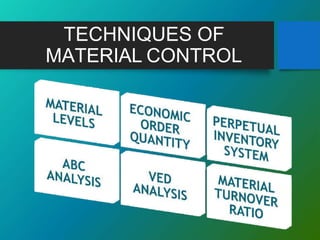
TECHNIQUES OF
MATERIAL
CONTROL
TECHNIQUES OF
MATERIAL CONTROL
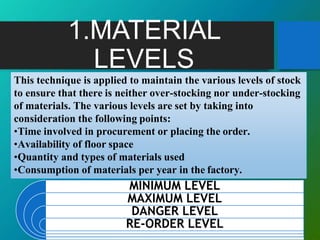
1.MATERIAL
LEVELS
MINIMUM LEVEL
MAXIMUM LEVEL
DANGER LEVEL
RE-ORDER LEVEL
This technique is applied to maintain the various levels of stock
to ensure that there is neither over-stocking nor under-stocking
of materials. The various levels are set by taking into
consideration the following points:
•Time involved in procurement or placing the order.
•Availability of floor space
•Quantity and types of materials used
•Consumption of materials per year in the factory.
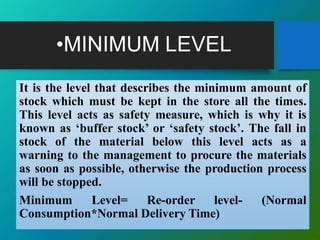
•MINIMUM LEVEL
It is the level that describes the minimum amount of
stock which must be kept in the store all the times.
This level acts as safety measure, which is why it is
known as ‘buffer stock’ or ‘safety stock’. The fall in
stock of the material below this level acts as a
warning to the management to procure the materials
as soon as possible, otherwise the production process
will be stopped.
Minimum Level= Re-order level- (Normal
Consumption*Normal Delivery Time)
•MAXIMUM LEVEL
It is the highest level of stock that should be available with the
company. The stocking of materials above this point indicates
the locking up of capital and overstocking of materials in the
concern..
Maximum Stock Level= Re-order level+ Re-order Quantity-
Consumption*Minimum time required for(Minimum
delivery)
OR
Maximum Level= Re-order level- Consumption during the
time required to get supplies at minimum rate +Economic
Order Size
•RE-ORDER LEVEL
It is the stock which is fixed between the maximum and
minimum stock levels. It is the level at which the order for the
purchase of materials is placed. It is set generally higher than
the minimum level to cover any emergency which may arise as
a result of abnormal usage of materials or unexpected delay in
obtaining fresh supplies.
Re-order level= maximum stock + average consumption during
normal delivery time
OR
Re-order level= Maximum consumption* Maximum delivery
time.
•DANGER LEVEL
Danger level is fixed at a point below the minimum
level and represents the limit at which special steps
must be taken to obtain emergent supplies of
materials.
It can be calculated as follows:
Danger Level= Normal consumption per
day/week/month* Time required to obtain emergent
supplies
2.ECONOMIC ORDER
QUANTITY
Economic order quantity is that size of the order which given
maximum economy in purchasing any item of material. There
are two main costs that are considered while determining the
economic order quantity. These are:
Material Acquisition Costs are related to the number of orders
placed during a given period. These costs are part of wages
and operating expenses for departments like production
control, purchasing, receiving and stores is incurred for
purchasing and possessing the materials.
Material carrying costs includes the interest charges on
investment in materials, insurance costs, storage costs etc.
3.PERPETUAL
INVENTORY SYSTEM
Perpetual Inventory System refers to a system of maintaining
such records as will reflect the receipts, issues and balance of
all items of materials in store all the times.
The records maintained in a manufacturing concern for
material accounting are divided into two parts:
Bin Card: It is maintained in the stores department and
shows the quantities of materials received, issued and
balance in hand after each receipt and issue.
Stores Ledger: It is maintained by costing office and deals
with the quantities and values of materials received, issued
and balance in hand.
4.ABC ANALYSIS
ABC analysis is a technique that is followed for the purpose of
exercising control over materials according to their importance or
value.
Category ‘A’ consists of materials which consists 5% to 10% of the
total items in a store and represent 70% to 85% of the total store
value.
Category ‘B’ consists of materials which consists of 10% to 20% of
the total items in a store and represent 10% to 20% of the total
store value.
Category ‘C’ consists of materials which consists of 70% to 85% of
the total items in a store and represent 5% to 10% of the store
value.
It is also known as Always Better Control method since it aims at
obtaining maximum control over materials and minimum cost of
control.
5.VED ANALYSIS
•‘V’ stands for‘Vital’
•‘E’ stands for‘Essential’
•‘D’ stands for‘Desirable’
Vital spare parts are those parts, the unavailability of which
will interrupt the production process for quite some time.
Essential spare parts are those spares, the absence of which
cannot be tolerated for more than few hours or a day.
Desirable spare parts are those spares which are needed but
their non-availability for even a week or so will not lead to
interruption in production.
6.MATERIAL
TURNOVER
Turnover of materials refers to movement into and out of an
organization. It can be calculated by comparing balance of
stores with the total issues or withdrawal during a particular
period of time.
Material Turnover Ratio= Value of materials consumed during
the period/ value of average stock
High material turnover ratio indicates that the material item is
fast moving and exhausts easily.
Low material turnover indicates that the material items are
slow moving and organization should not go for over stocking
of materials.
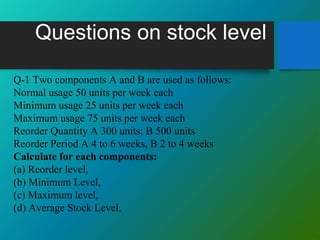
Questions on stock level
Q-1 Two components A and B are used as follows:
Normal usage 50 units per week each
Minimum usage 25 units per week each
Maximum usage 75 units per week each
Reorder Quantity A 300 units; B 500 units
Reorder Period A 4 to 6 weeks, B 2 to 4 weeks
Calculate for each components:
(a) Reorder level,
(b) Minimum Level,
(c) Maximum level,
(d) Average Stock Level.
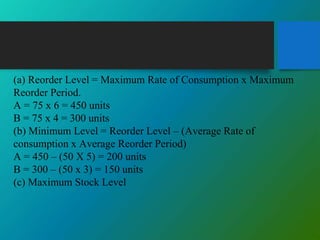
(a) Reorder Level = Maximum Rate of Consumption x Maximum
Reorder Period.
A = 75 x 6 = 450 units
B = 75 x 4 = 300 units
(b) Minimum Level = Reorder Level – (Average Rate of
consumption x Average Reorder Period)
A = 450 – (50 X 5) = 200 units
B = 300 – (50 x 3) = 150 units
(c) Maximum Stock Level
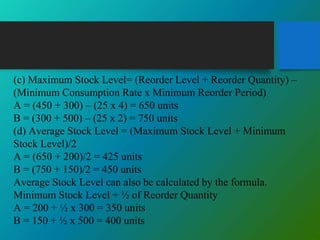
(c) Maximum Stock Level= (Reorder Level + Reorder Quantity) –
(Minimum Consumption Rate x Minimum Reorder Period)
A = (450 + 300) – (25 x 4) = 650 units
B = (300 + 500) – (25 x 2) = 750 units
(d) Average Stock Level = (Maximum Stock Level + Minimum
Stock Level)/2
A = (650 + 200)/2 = 425 units
B = (750 + 150)/2 = 450 units
Average Stock Level can also be calculated by the formula.
Minimum Stock Level + ½ of Reorder Quantity
A = 200 + ½ x 300 = 350 units
B = 150 + ½ x 500 = 400 units
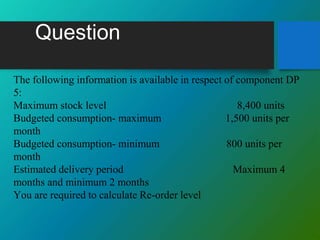
Question
The following information is available in respect of component DP
5:
Maximum stock level 8,400 units
Budgeted consumption- maximum 1,500 units per
month
Budgeted consumption- minimum 800 units per
month
Estimated delivery period Maximum 4
months and minimum 2 months
You are required to calculate Re-order level
Ordering Level
Ordering level= Maximum consumption * Lead Time [maximum]
Ordering level= 1,500 * 4
Ordering level= 6,000 Units per week
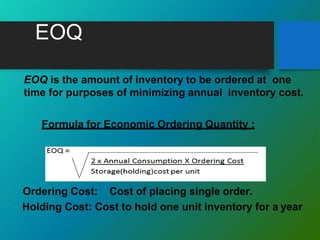
EOQ
EOQ is also referred to as the optimum lot size. The formula to
calculate the economic order quantity (EOQ) is the square root
of [(2 times the annual demand in units times the incremental cost
to process an order) divided by (the incremental annual cost to
carry one unit in inventory)].
EOQ
 EOQ is the amount of inventory to be ordered at one
time for purposes of minimizing annual inventory cost.
Formula for Economic Ordering Quantity :
Ordering Cost: Cost of placing single order.
◦ Holding Cost: Cost to hold one unit inventory for a year
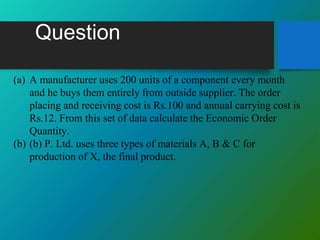
Question
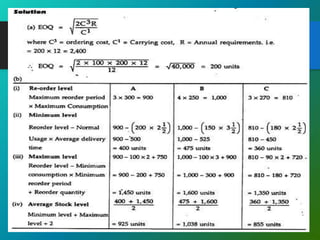
(a) A manufacturer uses 200 units of a component every month
and he buys them entirely from outside supplier. The order
placing and receiving cost is Rs.100 and annual carrying cost is
Rs.12. From this set of data calculate the Economic Order
Quantity.
(b) (b) P. Ltd. uses three types of materials A, B & C for
production of X, the final product.
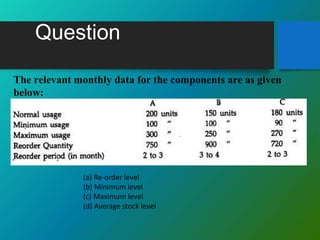
Question
The relevant monthly data for the components are as given
below:
(a) Re-order level
(b) Minimum level
(c) Maximum level
(d) Average stock level
Pricing of Issue of
material
Materials are purchased at different times and at different prices.
Now the question arises: At what price should materials be issued
to production? Frequent changes in the prices of ...
FIFO-First In first out
LIFO-Last
HIFO-Highest
NIFO-Next
Simple Average
Weighted Average.
First-In First-Out (FIFO) Method:
CIMA defines FIFO as “a method of pricing the issue of
material using, the purchase price of the oldest unit in the
stock”. Under this method materials are issued out of stock in the
order in which they were first received into stock. It is assumed
that the first material to come into stores will be the first material
to be used.
LIFO:Under this method most recent purchase will be the first to
be issued. The issues are priced out at the most recent batch
received and continue to be charged until a new batch received is
arrived into stock. It is a method of pricing the issue of material
using the purchase price of the latest unit in the stock.
Highest-in First-Out (HIFO) Method:
Under this method, the materials with highest prices are issued
first, irrespective of the date upon which they were purchased. The
basic assumption is that in fluctuating and inflationary market, the
cost of material are quickly absorbed into product cost to hedge
against risk of inflation. This method is used when the material is
in short supply and in execution of cost plus contracts. This
method is not popular and not acceptable under standard
accounting practices.
Simple Average Cost Method:
Under this method all the materials received are merged into
existing stock of materials, their identity being lost. The simple
average price is calculated without any regard to the quantities
involved. The simple average cost is arrived at by adding the
different prices paid during the period for the batches purchased by
dividing the number of batches. For example, three batches of
materials received at Rs. 10, Rs. 12 and Rs. 14 per unit
respectively.
Weighted Average Cost Method:
It is a perpetual weighted average system where the issue price is
recalculated every time after each receipt taking into consideration
both the total quantities and total cost while calculating weighted
average price. For example, three batches of material received in
quantities of 1,000 units @ Rs. 15, 1,300 units @ Rs. 16 and 800
units @ Rs. 14.
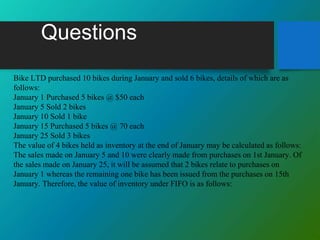
Questions
Bike LTD purchased 10 bikes during January and sold 6 bikes, details of which are as
follows:
January 1 Purchased 5 bikes @ $50 each
January 5 Sold 2 bikes
January 10 Sold 1 bike
January 15 Purchased 5 bikes @ 70 each
January 25 Sold 3 bikes
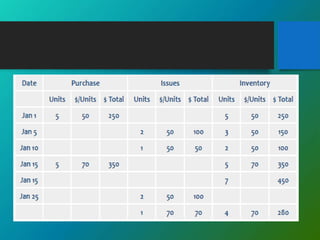
The value of 4 bikes held as inventory at the end of January may be calculated as follows:
The sales made on January 5 and 10 were clearly made from purchases on 1st January. Of
the sales made on January 25, it will be assumed that 2 bikes relate to purchases on
January 1 whereas the remaining one bike has been issued from the purchases on 15th
January. Therefore, the value of inventory under FIFO is as follows:
Material purchase
Procedure
Purchase Requisition
Selection of Supplier
Purchase order
Receipt of material
Inspection of material
Return to supplier
Approval of Invoices and Payments

Materialcontrol

  • 1.
  • 2.
    Material Control It isthe systematic control over the purchasing, storing, and using of material so as to have the minimum possible cost of material. In simple words, it is a system which ensures that right quality of material is available in the right quantity at the right time and right place with the right amount of investment. Material controls basically aims at efficient purchase, storage and consumption of materials.
  • 3.
    MATERIAL CONTROL Material controlis a system which ensures the provision of the required quantity of materials of the required quality at the required time with the minimum amount of capital investment. It can be defined as safeguarding of company’s property in the form of inventory and maintaining it at the optimum level, considering the operating requirements and financial resources of the business.
  • 4.
    NEED/ NECESSITY/ OBJECTIVES OFMATERIAL CONTROL ENSURING UN-INTERRUPTED PRODUCTION PROVISION OF REQUIRED QUALITY OF MATERIALS MINIMISATION OF WASTAGES AND LOSSES OF MATERIALS TO CONTROL INVESTMENT IN STOCK OF MATERIALS AIMS AT FIXING THE RESPONSIBILITY TO KEEP THE RECORDS
  • 5.
    ENSURING UN-INTERRUPTED PRODUCTION The mainobjective of the material control is to ensure the un- interrupted supply of materials for smooth flow of production. Material control helps in making available the right type of materials at right time. For this purpose, various material levels are set up such as: •Maximum level •Minimum level •Re-order level •Danger level, etc. The setting up the materials levels and following them ensures the availability of materials at all the time and non-stoppage of production process.
  • 6.
    PROVISION OF REQUIRED QUANTITYOF MATERIALS Material control is also associated with acquiring the quality material for production process. The material control department ensures the supply of quality material from the supplier which is to be used in the production process. As if the quality of material is not proper, it will ultimately affect the goodwill of the concern.
  • 7.
    MINIMISATION OF WASTAGES ANDLOSSES OF MATERIALS Material control system is being installed in the enterprise to ensure its minimal loss and wastages. For this purpose, various techniques are used such as: •ABC analysis (Always Better Control) •VED analysis (Vital Essential Desirable) ABC analysis is used to classify the materials on the basis of its importance and then applying the required degree of control. VED analysis categorize all the material of the business concern into three categories i.e. vital, essential and desirable and on the basis of this, the control is exercised on materials. The minimization of losses and wastages of materials ultimately leads to cost reduction and cost control.
  • 8.
    TO CONTROL INVESTMENT INSTOCK OF MATERIALS Material control system ensures no under-investment or over- investment in stock keeping. The main aim is to make available only that amount of raw materials which are needed. There should be no holding of idle stock. This may lead to lock up of large amount of capital. Efficient material control system aims at keeping the optimum level of stock at all the times. This may be done by using the techniques like: •Economic Order Quantity •Material Levels •Perpetual Inventory System
  • 9.
    AIMS AT FIXINGTHE RESPONSIBILTY In a materials control system, the personnel is required to perform the duties of keeping the records regarding materials receipt, issue, inspection etc. the material control system aims at fixing the responsibility of operating units and individuals connected with the handling of the materials.
  • 10.
    TO KEEP THE RECORDS Materialcontrol system ensures the proper record keeping of the materials purchased, stored, issued and received. This can be made possible by adopting the perpetual inventory system. For keeping the records, following systems are sued: •Bin Card •Stores Ledger
  • 11.
  • 12.
  • 13.
    1.MATERIAL LEVELS MINIMUM LEVEL MAXIMUM LEVEL DANGERLEVEL RE-ORDER LEVEL This technique is applied to maintain the various levels of stock to ensure that there is neither over-stocking nor under-stocking of materials. The various levels are set by taking into consideration the following points: •Time involved in procurement or placing the order. •Availability of floor space •Quantity and types of materials used •Consumption of materials per year in the factory.
  • 14.
    •MINIMUM LEVEL It isthe level that describes the minimum amount of stock which must be kept in the store all the times. This level acts as safety measure, which is why it is known as ‘buffer stock’ or ‘safety stock’. The fall in stock of the material below this level acts as a warning to the management to procure the materials as soon as possible, otherwise the production process will be stopped. Minimum Level= Re-order level- (Normal Consumption*Normal Delivery Time)
  • 15.
    •MAXIMUM LEVEL It isthe highest level of stock that should be available with the company. The stocking of materials above this point indicates the locking up of capital and overstocking of materials in the concern.. Maximum Stock Level= Re-order level+ Re-order Quantity- Consumption*Minimum time required for(Minimum delivery) OR Maximum Level= Re-order level- Consumption during the time required to get supplies at minimum rate +Economic Order Size
  • 16.
    •RE-ORDER LEVEL It isthe stock which is fixed between the maximum and minimum stock levels. It is the level at which the order for the purchase of materials is placed. It is set generally higher than the minimum level to cover any emergency which may arise as a result of abnormal usage of materials or unexpected delay in obtaining fresh supplies. Re-order level= maximum stock + average consumption during normal delivery time OR Re-order level= Maximum consumption* Maximum delivery time.
  • 17.
    •DANGER LEVEL Danger levelis fixed at a point below the minimum level and represents the limit at which special steps must be taken to obtain emergent supplies of materials. It can be calculated as follows: Danger Level= Normal consumption per day/week/month* Time required to obtain emergent supplies
  • 18.
    2.ECONOMIC ORDER QUANTITY Economic orderquantity is that size of the order which given maximum economy in purchasing any item of material. There are two main costs that are considered while determining the economic order quantity. These are: Material Acquisition Costs are related to the number of orders placed during a given period. These costs are part of wages and operating expenses for departments like production control, purchasing, receiving and stores is incurred for purchasing and possessing the materials. Material carrying costs includes the interest charges on investment in materials, insurance costs, storage costs etc.
  • 19.
    3.PERPETUAL INVENTORY SYSTEM Perpetual InventorySystem refers to a system of maintaining such records as will reflect the receipts, issues and balance of all items of materials in store all the times. The records maintained in a manufacturing concern for material accounting are divided into two parts: Bin Card: It is maintained in the stores department and shows the quantities of materials received, issued and balance in hand after each receipt and issue. Stores Ledger: It is maintained by costing office and deals with the quantities and values of materials received, issued and balance in hand.
  • 20.
    4.ABC ANALYSIS ABC analysisis a technique that is followed for the purpose of exercising control over materials according to their importance or value. Category ‘A’ consists of materials which consists 5% to 10% of the total items in a store and represent 70% to 85% of the total store value. Category ‘B’ consists of materials which consists of 10% to 20% of the total items in a store and represent 10% to 20% of the total store value. Category ‘C’ consists of materials which consists of 70% to 85% of the total items in a store and represent 5% to 10% of the store value. It is also known as Always Better Control method since it aims at obtaining maximum control over materials and minimum cost of control.
  • 21.
    5.VED ANALYSIS •‘V’ standsfor‘Vital’ •‘E’ stands for‘Essential’ •‘D’ stands for‘Desirable’ Vital spare parts are those parts, the unavailability of which will interrupt the production process for quite some time. Essential spare parts are those spares, the absence of which cannot be tolerated for more than few hours or a day. Desirable spare parts are those spares which are needed but their non-availability for even a week or so will not lead to interruption in production.
  • 22.
    6.MATERIAL TURNOVER Turnover of materialsrefers to movement into and out of an organization. It can be calculated by comparing balance of stores with the total issues or withdrawal during a particular period of time. Material Turnover Ratio= Value of materials consumed during the period/ value of average stock High material turnover ratio indicates that the material item is fast moving and exhausts easily. Low material turnover indicates that the material items are slow moving and organization should not go for over stocking of materials.
  • 23.
    Questions on stocklevel Q-1 Two components A and B are used as follows: Normal usage 50 units per week each Minimum usage 25 units per week each Maximum usage 75 units per week each Reorder Quantity A 300 units; B 500 units Reorder Period A 4 to 6 weeks, B 2 to 4 weeks Calculate for each components: (a) Reorder level, (b) Minimum Level, (c) Maximum level, (d) Average Stock Level.
  • 24.
    (a) Reorder Level= Maximum Rate of Consumption x Maximum Reorder Period. A = 75 x 6 = 450 units B = 75 x 4 = 300 units (b) Minimum Level = Reorder Level – (Average Rate of consumption x Average Reorder Period) A = 450 – (50 X 5) = 200 units B = 300 – (50 x 3) = 150 units (c) Maximum Stock Level
  • 25.
    (c) Maximum StockLevel= (Reorder Level + Reorder Quantity) – (Minimum Consumption Rate x Minimum Reorder Period) A = (450 + 300) – (25 x 4) = 650 units B = (300 + 500) – (25 x 2) = 750 units (d) Average Stock Level = (Maximum Stock Level + Minimum Stock Level)/2 A = (650 + 200)/2 = 425 units B = (750 + 150)/2 = 450 units Average Stock Level can also be calculated by the formula. Minimum Stock Level + ½ of Reorder Quantity A = 200 + ½ x 300 = 350 units B = 150 + ½ x 500 = 400 units
  • 26.
    Question The following informationis available in respect of component DP 5: Maximum stock level 8,400 units Budgeted consumption- maximum 1,500 units per month Budgeted consumption- minimum 800 units per month Estimated delivery period Maximum 4 months and minimum 2 months You are required to calculate Re-order level
  • 27.
    Ordering Level Ordering level=Maximum consumption * Lead Time [maximum] Ordering level= 1,500 * 4 Ordering level= 6,000 Units per week
  • 28.
    EOQ EOQ is alsoreferred to as the optimum lot size. The formula to calculate the economic order quantity (EOQ) is the square root of [(2 times the annual demand in units times the incremental cost to process an order) divided by (the incremental annual cost to carry one unit in inventory)].
  • 29.
    EOQ  EOQ isthe amount of inventory to be ordered at one time for purposes of minimizing annual inventory cost. Formula for Economic Ordering Quantity : Ordering Cost: Cost of placing single order. ◦ Holding Cost: Cost to hold one unit inventory for a year
  • 30.
    Question (a) A manufactureruses 200 units of a component every month and he buys them entirely from outside supplier. The order placing and receiving cost is Rs.100 and annual carrying cost is Rs.12. From this set of data calculate the Economic Order Quantity. (b) (b) P. Ltd. uses three types of materials A, B & C for production of X, the final product.
  • 32.
    Question The relevant monthlydata for the components are as given below: (a) Re-order level (b) Minimum level (c) Maximum level (d) Average stock level
  • 33.
    Pricing of Issueof material Materials are purchased at different times and at different prices. Now the question arises: At what price should materials be issued to production? Frequent changes in the prices of ... FIFO-First In first out LIFO-Last HIFO-Highest NIFO-Next Simple Average Weighted Average.
  • 34.
    First-In First-Out (FIFO)Method: CIMA defines FIFO as “a method of pricing the issue of material using, the purchase price of the oldest unit in the stock”. Under this method materials are issued out of stock in the order in which they were first received into stock. It is assumed that the first material to come into stores will be the first material to be used. LIFO:Under this method most recent purchase will be the first to be issued. The issues are priced out at the most recent batch received and continue to be charged until a new batch received is arrived into stock. It is a method of pricing the issue of material using the purchase price of the latest unit in the stock.
  • 35.
    Highest-in First-Out (HIFO)Method: Under this method, the materials with highest prices are issued first, irrespective of the date upon which they were purchased. The basic assumption is that in fluctuating and inflationary market, the cost of material are quickly absorbed into product cost to hedge against risk of inflation. This method is used when the material is in short supply and in execution of cost plus contracts. This method is not popular and not acceptable under standard accounting practices.
  • 36.
    Simple Average CostMethod: Under this method all the materials received are merged into existing stock of materials, their identity being lost. The simple average price is calculated without any regard to the quantities involved. The simple average cost is arrived at by adding the different prices paid during the period for the batches purchased by dividing the number of batches. For example, three batches of materials received at Rs. 10, Rs. 12 and Rs. 14 per unit respectively.
  • 37.
    Weighted Average CostMethod: It is a perpetual weighted average system where the issue price is recalculated every time after each receipt taking into consideration both the total quantities and total cost while calculating weighted average price. For example, three batches of material received in quantities of 1,000 units @ Rs. 15, 1,300 units @ Rs. 16 and 800 units @ Rs. 14.
  • 38.
    Questions Bike LTD purchased10 bikes during January and sold 6 bikes, details of which are as follows: January 1 Purchased 5 bikes @ $50 each January 5 Sold 2 bikes January 10 Sold 1 bike January 15 Purchased 5 bikes @ 70 each January 25 Sold 3 bikes The value of 4 bikes held as inventory at the end of January may be calculated as follows: The sales made on January 5 and 10 were clearly made from purchases on 1st January. Of the sales made on January 25, it will be assumed that 2 bikes relate to purchases on January 1 whereas the remaining one bike has been issued from the purchases on 15th January. Therefore, the value of inventory under FIFO is as follows:
  • 40.
    Material purchase Procedure Purchase Requisition Selectionof Supplier Purchase order Receipt of material Inspection of material Return to supplier Approval of Invoices and Payments