RDF Data Model
Departamento de Informática
Universidad de Oviedo
Jose Emilio Labra Gayo
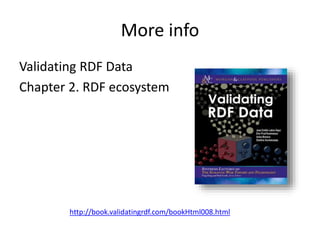
More info
Validating RDF Data
Chapter 2. RDF ecosystem
http://book.validatingrdf.com/bookHtml008.html
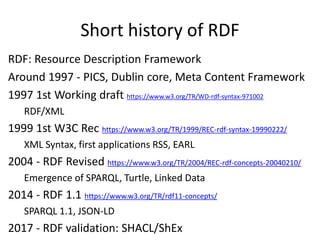
Short history of RDF
RDF: Resource Description Framework
Around 1997 - PICS, Dublin core, Meta Content Framework
1997 1st Working draft https://www.w3.org/TR/WD-rdf-syntax-971002
RDF/XML
1999 1st W3C Rec https://www.w3.org/TR/1999/REC-rdf-syntax-19990222/
XML Syntax, first applications RSS, EARL
2004 - RDF Revised https://www.w3.org/TR/2004/REC-rdf-concepts-20040210/
Emergence of SPARQL, Turtle, Linked Data
2014 - RDF 1.1 https://www.w3.org/TR/rdf11-concepts/
SPARQL 1.1, JSON-LD
2017 - RDF validation: SHACL/ShEx
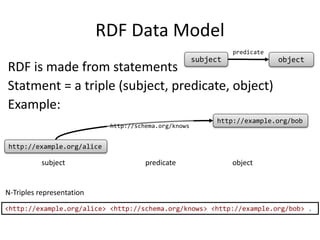
RDF Data Model
RDF is made from statements
Statment = a triple (subject, predicate, object)
Example:
http://example.org/alice
http://example.org/bob
http://schema.org/knows
subject predicate object
<http://example.org/alice> <http://schema.org/knows> <http://example.org/bob> .
N-Triples representation
subject object
predicate
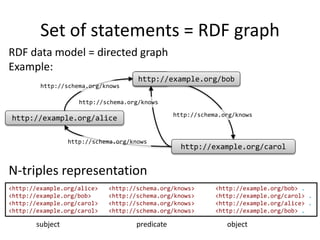
Set of statements = RDF graph
RDF data model = directed graph
Example:
http://example.org/alice
ex:bob
http://example.org/carol
http://example.org/bob
http://schema.org/knows
N-triples representation
<http://example.org/alice> <http://schema.org/knows> <http://example.org/bob> .
<http://example.org/bob> <http://schema.org/knows> <http://example.org/carol> .
<http://example.org/carol> <http://schema.org/knows> <http://example.org/alice> .
<http://example.org/carol> <http://schema.org/knows> <http://example.org/bob> .
subject predicate object
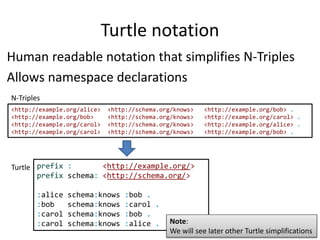
Turtle notation
Human readable notation that simplifies N-Triples
Allows namespace declarations
<http://example.org/alice> <http://schema.org/knows> <http://example.org/bob> .
<http://example.org/bob> <http://schema.org/knows> <http://example.org/carol> .
<http://example.org/carol> <http://schema.org/knows> <http://example.org/alice> .
<http://example.org/carol> <http://schema.org/knows> <http://example.org/bob> .
prefix : <http://example.org/>
prefix schema: <http://schema.org/>
:alice schema:knows :bob .
:bob schema:knows :carol .
:carol schema:knows :bob .
:carol schema:knows :alice .
Turtle
N-Triples
Note:
We will see later other Turtle simplifications
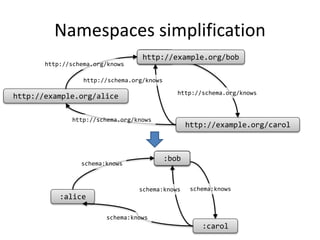
Namespaces simplification
http://example.org/alice
ex:bob
http://example.org/carol
http://example.org/bob
http://schema.org/knows
:alice
ex:bob
:carol
:bob
schema:knows
schema:knows
schema:knows
schema:knows
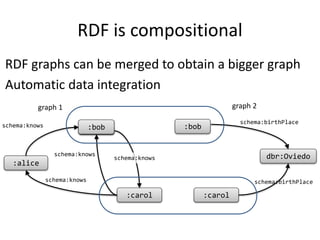
RDF is compositional
RDF graphs can be merged to obtain a bigger graph
Automatic data integration
schema:knows
schema:knows
schema:knows
:alice
ex:bob
:carol
:bob
schema:knows
schema:birthPlace
:carol
schema:birthPlace
dbr:Oviedo
:bob
graph 1 graph 2
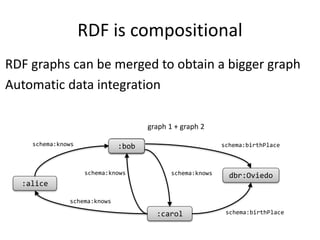
RDF is compositional
schema:birthPlaceschema:knows
schema:knows
schema:knows
:alice
ex:bob
:carol schema:birthPlace
dbr:Oviedo
:bob
schema:knows
graph 1 + graph 2
RDF graphs can be merged to obtain a bigger graph
Automatic data integration
Turtle syntax
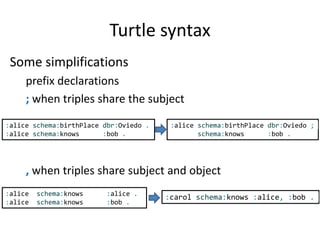
Some simplifications
prefix declarations
; when triples share the subject
, when triples share subject and object
:alice schema:birthPlace dbr:Oviedo ;
schema:knows :bob .
:alice schema:birthPlace dbr:Oviedo .
:alice schema:knows :bob .
:alice schema:knows :alice .
:alice schema:knows :bob .
:carol schema:knows :alice, :bob .
Turtle syntax
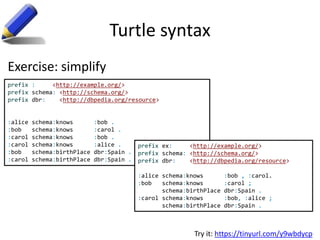
Exercise: simplify
prefix : <http://example.org/>
prefix schema: <http://schema.org/>
prefix dbr: <http://dbpedia.org/resource>
:alice schema:knows :bob .
:bob schema:knows :carol .
:carol schema:knows :bob .
:carol schema:knows :alice .
:bob schema:birthPlace dbr:Spain .
:carol schema:birthPlace dbr:Spain .
prefix ex: <http://example.org/>
prefix schema: <http://schema.org/>
prefix dbr: <http://dbpedia.org/resource>
:alice schema:knows :bob , :carol.
:bob schema:knows :carol ;
schema:birthPlace dbr:Spain .
:carol schema:knows :bob, :alice ;
schema:birthPlace dbr:Spain .
Try it: https://tinyurl.com/y9wbdycp
RDF Literals
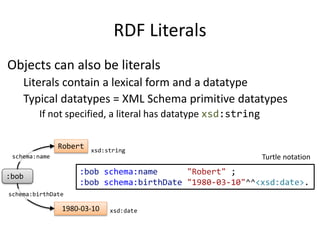
Objects can also be literals
Literals contain a lexical form and a datatype
Typical datatypes = XML Schema primitive datatypes
If not specified, a literal has datatype xsd:string
:bob
Robert
schema:name
1980-03-10
schema:birthDate
xsd:date
xsd:string
:bob schema:name "Robert" ;
:bob schema:birthDate "1980-03-10"^^<xsd:date>.
Turtle notation
prefix : <http://example.org/>
prefix schema: <http://schema.org/>
prefix dbr: <http://dbpedia.org/resource>
:alice schema:knows :bob , :carol.
:bob schema:knows :carol ;
schema:birthPlace dbr:Spain;
schema:name "Robert";
schema:birthDate "1980-03-10"^^<xsd:date>.
:carol schema:knows :bob, :alice ;
schema:birthPlace dbr:Spain .
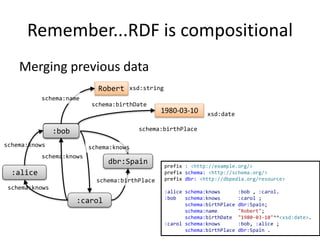
Remember...RDF is compositional
Merging previous data
schema:birthPlace
schema:knows
schema:knows
schema:knows
:alice
ex:bob
:carol
dbr:Spain
schema:birthDate
:bob
Robert xsd:string
1980-03-10 xsd:date
schema:name
schema:knows
schema:birthPlace
Blank nodes
Subjects and objects can also be Blank nodes
:carol
schema:knows
23
:age
"Carol knows someone whose age is 23"
:carol schema:knows _:x .
_:x :age 23 .
:carol schema:knows [ :age 23 ] .
Turtle notation with local identifier
Turtle notation with square brackets
x(schema:knows(:carol,x)  :age(x, 23)
Mathematical meaning:
Blank nodes
ex:alice
ex:carol
schema:knows
schema:knows
schema:birthPlace
ex:dave
schema:birthPlace
:age 23 xsd:integerschema:knows
Alice knows someone who
knows Dave Carol knows someone whose
age is 23 that was born in the
same place as Dave
:alice schema:knows [ schema:knows :dave ] .
:carol schema:knows [ :age 23 ;
schema:birthPlace _:p ] .
:dave schema:birthPlace _:p .
Language tagged strings
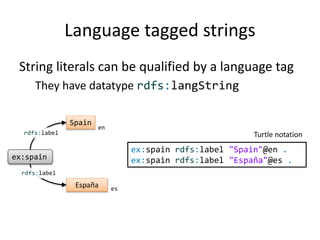
String literals can be qualified by a language tag
They have datatype rdfs:langString
ex:spain rdfs:label "Spain"@en .
ex:spain rdfs:label "España"@es .ex:spain
Spain
rdfs:label
España
rdfs:label
es
en
Turtle notation
RDF data model
schema:knows
schema:knows
schema:knows
ex:alice
ex:bob
ex:carol
schema:birthPlace
dbr:Spain
schema:knows
schema:knows
schema:birthDate
ex:bob
Robert xsd:string
1980-03-10 xsd:date
schema:name
schema:birthPlace
schema:knows
ex:dave
schema:birthPlace
schema:age
23 xsd:integerschema:knows
Spain
rdfs:label
España
rdfs:label
es
en
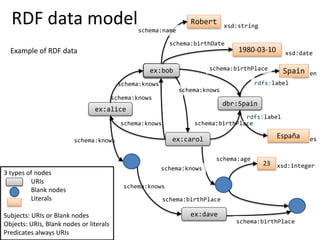
3 types of nodes
URIs
Blank nodes
Literals
Subjects: URIs or Blank nodes
Objects: URIs, Blank nodes or literals
Predicates always URIs
schema:birthPlace
Example of RDF data
...and that's all about the RDF data model
The RDF Data model is very simple
RDF ecosystem
RDF Syntax
Shared entities and RDF vocabularies
Applications of RDF
Inference and ontologies
Query languages
RDF Validation
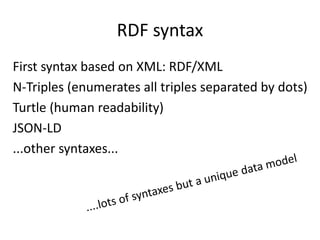
RDF syntax
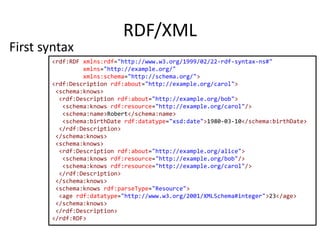
First syntax based on XML: RDF/XML
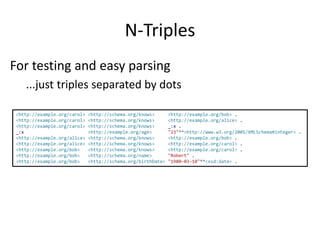
N-Triples (enumerates all triples separated by dots)
Turtle (human readability)
JSON-LD
...other syntaxes...
RDF/XML
<rdf:RDF xmlns:rdf="http://www.w3.org/1999/02/22-rdf-syntax-ns#"
xmlns="http://example.org/"
xmlns:schema="http://schema.org/">
<rdf:Description rdf:about="http://example.org/carol">
<schema:knows>
<rdf:Description rdf:about="http://example.org/bob">
<schema:knows rdf:resource="http://example.org/carol"/>
<schema:name>Robert</schema:name>
<schema:birthDate rdf:datatype="xsd:date">1980-03-10</schema:birthDate>
</rdf:Description>
</schema:knows>
<schema:knows>
<rdf:Description rdf:about="http://example.org/alice">
<schema:knows rdf:resource="http://example.org/bob"/>
<schema:knows rdf:resource="http://example.org/carol"/>
</rdf:Description>
</schema:knows>
<schema:knows rdf:parseType="Resource">
<age rdf:datatype="http://www.w3.org/2001/XMLSchema#integer">23</age>
</schema:knows>
</rdf:Description>
</rdf:RDF>
First syntax
N-Triples
<http://example.org/carol> <http://schema.org/knows> <http://example.org/bob> .
<http://example.org/carol> <http://schema.org/knows> <http://example.org/alice> .
<http://example.org/carol> <http://schema.org/knows> _:x .
_:x <http://example.org/age> "23"^^<http://www.w3.org/2001/XMLSchema#integer> .
<http://example.org/alice> <http://schema.org/knows> <http://example.org/bob> .
<http://example.org/alice> <http://schema.org/knows> <http://example.org/carol> .
<http://example.org/bob> <http://schema.org/knows> <http://example.org/carol> .
<http://example.org/bob> <http://schema.org/name> "Robert" .
<http://example.org/bob> <http://schema.org/birthDate> "1980-03-10"^^<xsd:date> .
For testing and easy parsing
...just triples separated by dots
Turtle
Concise
Designed to be human-readable
prefix : <http://example.org/>
prefix schema: <http://schema.org/>
:alice schema:knows :bob , :carol .
:bob schema:knows :carol ;
schema:name "Robert";
schema:birthDate "1980-03-10"^^<xsd:date>.
:carol schema:knows :bob, :alice ;
schema:knows [ :age 23 ] .
JSON-LD
Json for linked data
{
"@context" : {
"knows" : { "@id" : "http://schema.org/knows", "@type" : "@id" },
"age" : { "@id" : "http://example.org/age",
"@type" : "http://www.w3.org/2001/XMLSchema#integer" },
"name" : { "@id" : "http://schema.org/name" },
"birthDate" : { "@id" : "http://schema.org/birthDate", "@type" : "xsd:date" },
"@vocab" : "http://example.org/",
"schema" : "http://schema.org/"
},
"@graph" : [
{ "@id" : "http://example.org/alice",
"knows" : [ "http://example.org/bob", "http://example.org/carol" ] },
{ "@id" : "http://example.org/bob",
"birthDate" : "1980-03-10",
"knows" : "http://example.org/carol",
"name" : "Robert" },
{ "@id" : "http://example.org/carol",
"knows" : [ "http://example.org/bob", "http://example.org/alice", "_:x" ] },
{ "@id" : "_:x",
"http://example.org/age" : 23 }
]
}
Other Turtle simplifications
RDF type property
Numbers
Collections
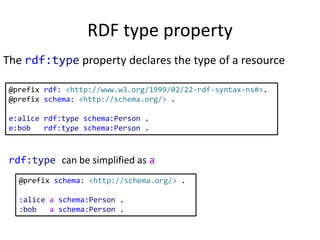
RDF type property
The rdf:type property declares the type of a resource
@prefix rdf: <http://www.w3.org/1999/02/22-rdf-syntax-ns#>.
@prefix schema: <http://schema.org/> .
e:alice rdf:type schema:Person .
e:bob rdf:type schema:Person .
@prefix schema: <http://schema.org/> .
:alice a schema:Person .
:bob a schema:Person .
rdf:type can be simplified as a
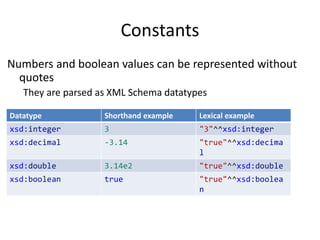
Constants
Numbers and boolean values can be represented without
quotes
They are parsed as XML Schema datatypes
Datatype Shorthand example Lexical example
xsd:integer 3 "3"^^xsd:integer
xsd:decimal -3.14 "true"^^xsd:decima
l
xsd:double 3.14e2 "true"^^xsd:double
xsd:boolean true "true"^^xsd:boolea
n
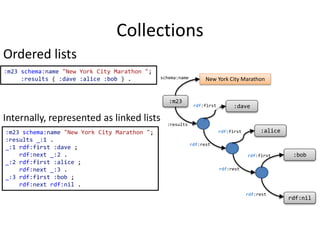
Collections
Ordered lists
:m23 schema:name "New York City Marathon ";
:results ( :dave :alice :bob ) .
:m23 schema:name "New York City Marathon ";
:results _:1 .
_:1 rdf:first :dave ;
rdf:next _:2 .
_:2 rdf:first :alice ;
rdf:next _:3 .
_:3 rdf:first :bob ;
rdf:next rdf:nil .
Internally, represented as linked lists
rdf:first
rdf:rest
rdf:rest
rdf:rest
schema:name
:m23
:results
New York City Marathon
rdf:nil
:bob
rdf:first :alice
:daverdf:first
Shared entities and vocabularies
The use of URIs instead of plain strings facilitates:
Merging data from heterogeneous sources
Avoid ambiguity
Challenge: Agreeing on common entities and properties
Appearance of some popular vocabularies:
schema.org: Joint effort from Google, Yahoo, Microsoft, Yandex
Linked open vocabularies Project: http://lov.okfn.org/
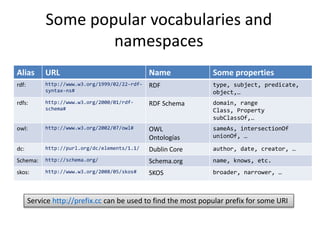
Some popular vocabularies and
namespaces
Alias URL Name Some properties
rdf: http://www.w3.org/1999/02/22-rdf-
syntax-ns#
RDF type, subject, predicate,
object,…
rdfs: http://www.w3.org/2000/01/rdf-
schema#
RDF Schema domain, range
Class, Property
subClassOf,…
owl: http://www.w3.org/2002/07/owl# OWL
Ontologías
sameAs, intersectionOf
unionOf, …
dc: http://purl.org/dc/elements/1.1/ Dublin Core author, date, creator, …
Schema: http://schema.org/ Schema.org name, knows, etc.
skos: http://www.w3.org/2008/05/skos# SKOS broader, narrower, …
Service http://prefix.cc can be used to find the most popular prefix for some URI
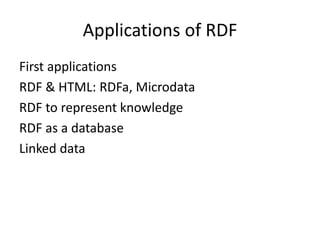
Applications of RDF
First applications
RDF & HTML: RDFa, Microdata
RDF to represent knowledge
RDF as a database
Linked data
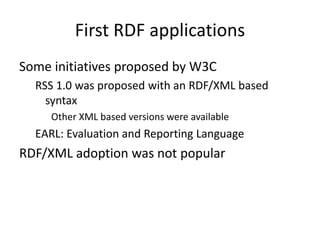
First RDF applications
Some initiatives proposed by W3C
RSS 1.0 was proposed with an RDF/XML based
syntax
Other XML based versions were available
EARL: Evaluation and Reporting Language
RDF/XML adoption was not popular
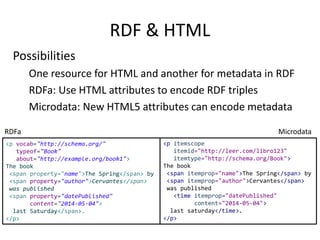
RDF & HTML
Possibilities
One resource for HTML and another for metadata in RDF
RDFa: Use HTML attributes to encode RDF triples
Microdata: New HTML5 attributes can encode metadata
<p vocab="http://schema.org/"
typeof="Book"
about="http://example.org/book1">
The book
<span property="name">The Spring</span> by
<span property="author">Cervantes</span>
was published
<span property="datePublished"
content="2014-05-04">
last Saturday</span>.
</p>
<p itemscope
itemid="http://leer.com/libro123"
itemtype="http://schema.org/Book">
The book
<span itemprop="name">The Spring</span> by
<span itemprop="author">Cervantes</span>
was published
<time itemprop="datePublished"
content="2014-05-04">
last saturday</time>.
</p>
RDFa Microdata
RDF to represent knowledge
Freebase: developed by Metaweb (2005)
Open, shared database of world's knowledge
Acquired by Google in 2010. It is the basis of Google
knowledge graph
DBpedia (http://dbpedia.org)
Extracts knowledge from Wikipedia and converts it to
RDF
Wikidata (http://wikidata.org/)
Free knowledge base edited collaboratively
Developed by Wikimedia foundation
RDF as an internal database
Specialized RDF databases (triplestores)
RDF = very flexible, easy to adapt to domain
changes
Several big companies are using RDF internally
Example: BBC
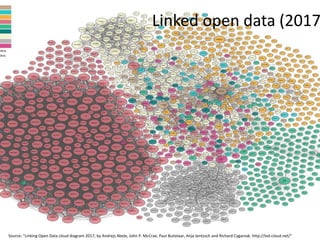
RDF for Linked open data
Principles proposed by Tim Berners-Lee to publish
data:
1. Use URIs to denote things
2. Use HTTP URIs so that people can look up those
names
3. When someone looks up a URI, provide useful
information, using the standards (RDF*, SPARQL)
4. Include links to other URIs. so that they can
discover more things.
Linked open data (2017
Source: "Linking Open Data cloud diagram 2017, by Andrejs Abele, John P. McCrae, Paul Buitelaar, Anja Jentzsch and Richard Cyganiak. http://lod-cloud.net/"
RDFS & inferences
RDFS
Originally RDF Schema (2000)
Defines a vocabulary for common concepts
Classes: rdfs:Class, rdfs:Property,
rdfs:Literal
Properties: rdfs:domain, rdfs:range,
rdfs:subClassOf, ...
RDFS
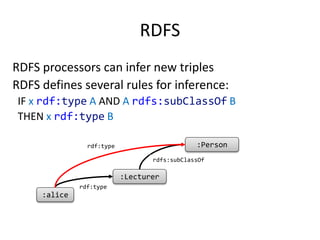
RDFS processors can infer new triples
RDFS defines several rules for inference:
IF x rdf:type A AND A rdfs:subClassOf B
THEN x rdf:type B
:alice
:Lecturer
rdf:type
:Person
rdfs:subClassOf
rdf:type
OWL
Web Ontology Language.
First version (2004), OWL 2 (2009)
Based on description logics
Language to describe classes, individuals,
relationships
OWL example
<> a owl:Ontology .
:Man a owl:Class ;
owl:equivalentClass [
owl:intersectionOf (:Person
[ a owl:Restriction ;
owl:onProperty schema:gender ; owl:hasValue schema:Male
] )
] .
:Woman a owl:Class ;
owl:equivalentClass [
owl:intersectionOf ( :Person
[ a owl:Restriction ;
owl:onProperty schema:gender ; owl:hasValue schema:Female
] )
] .
[ a owl:AllDisjointClasses ; owl:members ( :Woman :Man ) ] .
:Person owl:equivalentClass [ rdf:type owl:Class ;
owl:unionOf ( :Woman :Man )
] .
:alice a :Woman ;
schema:gender schema:Female .
:bob a :Man .
:alice a :Person .
:bob a :Person .
:bob schema:gender schema:Male .
Instance data
Inferred data
OWL
OWL can been used to describe domain
ontologies
Different kinds of ontologies:
Upper level ontologies (SUMO, WordNet, ...)
Domain specific (example: SNOMED)
Tools to edit ontologies: Protégé editor
Myths about linked data
Too expensive
It's free
No one will want our data
It is not trendy
Too much openness
Our project will be a success
It is too expensive
Not really
It is possible to learn from previous experiences
Follow the lemma:
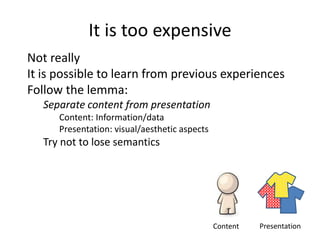
Separate content from presentation
Content: Information/data
Presentation: visual/aesthetic aspects
Try not to lose semantics
Content Presentation
It is free
...well, no
It requires to complement with visualizations
Only data = too restrained
Requires to define data models and URIs
Stable and cool URIs
Challenge of continuous updates
Take care of data pipelines
No one will be interested in our data
Just the opposite...our data = our treasure
Search engines index semantic content
schema.org Project (Google, Bing, Yandex,...)
If we help them  better SEO
Automatic processable data = more valuable data
Promote data culture
New business opportunities and applications
Government = catalyzer: Hackathons y similars...
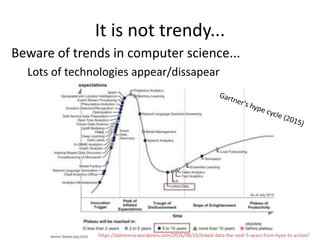
It is not trendy...
Beware of trends in computer science...
Lots of technologies appear/dissapear
https://ablvienna.wordpress.com/2016/08/15/linked-data-the-next-5-years-from-hype-to-action/
Too much open
If we really believe in transparency...
We will pursue reusable data
Nevertheless...
It is useful to distinguish between:
Open data
Linked data
Public/private data
Aggregated data
Partially open data
Linked and closed data
...

RDF Data Model

  • 1.
    RDF Data Model Departamentode Informática Universidad de Oviedo Jose Emilio Labra Gayo
  • 2.
    More info Validating RDFData Chapter 2. RDF ecosystem http://book.validatingrdf.com/bookHtml008.html
  • 3.
    Short history ofRDF RDF: Resource Description Framework Around 1997 - PICS, Dublin core, Meta Content Framework 1997 1st Working draft https://www.w3.org/TR/WD-rdf-syntax-971002 RDF/XML 1999 1st W3C Rec https://www.w3.org/TR/1999/REC-rdf-syntax-19990222/ XML Syntax, first applications RSS, EARL 2004 - RDF Revised https://www.w3.org/TR/2004/REC-rdf-concepts-20040210/ Emergence of SPARQL, Turtle, Linked Data 2014 - RDF 1.1 https://www.w3.org/TR/rdf11-concepts/ SPARQL 1.1, JSON-LD 2017 - RDF validation: SHACL/ShEx
  • 4.
    RDF Data Model RDFis made from statements Statment = a triple (subject, predicate, object) Example: http://example.org/alice http://example.org/bob http://schema.org/knows subject predicate object <http://example.org/alice> <http://schema.org/knows> <http://example.org/bob> . N-Triples representation subject object predicate
  • 5.
    Set of statements= RDF graph RDF data model = directed graph Example: http://example.org/alice ex:bob http://example.org/carol http://example.org/bob http://schema.org/knows http://schema.org/knows http://schema.org/knows http://schema.org/knows N-triples representation <http://example.org/alice> <http://schema.org/knows> <http://example.org/bob> . <http://example.org/bob> <http://schema.org/knows> <http://example.org/carol> . <http://example.org/carol> <http://schema.org/knows> <http://example.org/alice> . <http://example.org/carol> <http://schema.org/knows> <http://example.org/bob> . subject predicate object
  • 6.
    Turtle notation Human readablenotation that simplifies N-Triples Allows namespace declarations <http://example.org/alice> <http://schema.org/knows> <http://example.org/bob> . <http://example.org/bob> <http://schema.org/knows> <http://example.org/carol> . <http://example.org/carol> <http://schema.org/knows> <http://example.org/alice> . <http://example.org/carol> <http://schema.org/knows> <http://example.org/bob> . prefix : <http://example.org/> prefix schema: <http://schema.org/> :alice schema:knows :bob . :bob schema:knows :carol . :carol schema:knows :bob . :carol schema:knows :alice . Turtle N-Triples Note: We will see later other Turtle simplifications
  • 7.
  • 8.
    RDF is compositional RDFgraphs can be merged to obtain a bigger graph Automatic data integration schema:knows schema:knows schema:knows :alice ex:bob :carol :bob schema:knows schema:birthPlace :carol schema:birthPlace dbr:Oviedo :bob graph 1 graph 2
  • 9.
    RDF is compositional schema:birthPlaceschema:knows schema:knows schema:knows :alice ex:bob :carolschema:birthPlace dbr:Oviedo :bob schema:knows graph 1 + graph 2 RDF graphs can be merged to obtain a bigger graph Automatic data integration
  • 10.
    Turtle syntax Some simplifications prefixdeclarations ; when triples share the subject , when triples share subject and object :alice schema:birthPlace dbr:Oviedo ; schema:knows :bob . :alice schema:birthPlace dbr:Oviedo . :alice schema:knows :bob . :alice schema:knows :alice . :alice schema:knows :bob . :carol schema:knows :alice, :bob .
  • 11.
    Turtle syntax Exercise: simplify prefix: <http://example.org/> prefix schema: <http://schema.org/> prefix dbr: <http://dbpedia.org/resource> :alice schema:knows :bob . :bob schema:knows :carol . :carol schema:knows :bob . :carol schema:knows :alice . :bob schema:birthPlace dbr:Spain . :carol schema:birthPlace dbr:Spain . prefix ex: <http://example.org/> prefix schema: <http://schema.org/> prefix dbr: <http://dbpedia.org/resource> :alice schema:knows :bob , :carol. :bob schema:knows :carol ; schema:birthPlace dbr:Spain . :carol schema:knows :bob, :alice ; schema:birthPlace dbr:Spain . Try it: https://tinyurl.com/y9wbdycp
  • 12.
    RDF Literals Objects canalso be literals Literals contain a lexical form and a datatype Typical datatypes = XML Schema primitive datatypes If not specified, a literal has datatype xsd:string :bob Robert schema:name 1980-03-10 schema:birthDate xsd:date xsd:string :bob schema:name "Robert" ; :bob schema:birthDate "1980-03-10"^^<xsd:date>. Turtle notation
  • 13.
    prefix : <http://example.org/> prefixschema: <http://schema.org/> prefix dbr: <http://dbpedia.org/resource> :alice schema:knows :bob , :carol. :bob schema:knows :carol ; schema:birthPlace dbr:Spain; schema:name "Robert"; schema:birthDate "1980-03-10"^^<xsd:date>. :carol schema:knows :bob, :alice ; schema:birthPlace dbr:Spain . Remember...RDF is compositional Merging previous data schema:birthPlace schema:knows schema:knows schema:knows :alice ex:bob :carol dbr:Spain schema:birthDate :bob Robert xsd:string 1980-03-10 xsd:date schema:name schema:knows schema:birthPlace
  • 14.
    Blank nodes Subjects andobjects can also be Blank nodes :carol schema:knows 23 :age "Carol knows someone whose age is 23" :carol schema:knows _:x . _:x :age 23 . :carol schema:knows [ :age 23 ] . Turtle notation with local identifier Turtle notation with square brackets x(schema:knows(:carol,x)  :age(x, 23) Mathematical meaning:
  • 15.
    Blank nodes ex:alice ex:carol schema:knows schema:knows schema:birthPlace ex:dave schema:birthPlace :age 23xsd:integerschema:knows Alice knows someone who knows Dave Carol knows someone whose age is 23 that was born in the same place as Dave :alice schema:knows [ schema:knows :dave ] . :carol schema:knows [ :age 23 ; schema:birthPlace _:p ] . :dave schema:birthPlace _:p .
  • 16.
    Language tagged strings Stringliterals can be qualified by a language tag They have datatype rdfs:langString ex:spain rdfs:label "Spain"@en . ex:spain rdfs:label "España"@es .ex:spain Spain rdfs:label España rdfs:label es en Turtle notation
  • 17.
    RDF data model schema:knows schema:knows schema:knows ex:alice ex:bob ex:carol schema:birthPlace dbr:Spain schema:knows schema:knows schema:birthDate ex:bob Robertxsd:string 1980-03-10 xsd:date schema:name schema:birthPlace schema:knows ex:dave schema:birthPlace schema:age 23 xsd:integerschema:knows Spain rdfs:label España rdfs:label es en 3 types of nodes URIs Blank nodes Literals Subjects: URIs or Blank nodes Objects: URIs, Blank nodes or literals Predicates always URIs schema:birthPlace Example of RDF data
  • 18.
    ...and that's allabout the RDF data model The RDF Data model is very simple
  • 19.
    RDF ecosystem RDF Syntax Sharedentities and RDF vocabularies Applications of RDF Inference and ontologies Query languages RDF Validation
  • 20.
    RDF syntax First syntaxbased on XML: RDF/XML N-Triples (enumerates all triples separated by dots) Turtle (human readability) JSON-LD ...other syntaxes...
  • 21.
    RDF/XML <rdf:RDF xmlns:rdf="http://www.w3.org/1999/02/22-rdf-syntax-ns#" xmlns="http://example.org/" xmlns:schema="http://schema.org/"> <rdf:Description rdf:about="http://example.org/carol"> <schema:knows> <rdf:Descriptionrdf:about="http://example.org/bob"> <schema:knows rdf:resource="http://example.org/carol"/> <schema:name>Robert</schema:name> <schema:birthDate rdf:datatype="xsd:date">1980-03-10</schema:birthDate> </rdf:Description> </schema:knows> <schema:knows> <rdf:Description rdf:about="http://example.org/alice"> <schema:knows rdf:resource="http://example.org/bob"/> <schema:knows rdf:resource="http://example.org/carol"/> </rdf:Description> </schema:knows> <schema:knows rdf:parseType="Resource"> <age rdf:datatype="http://www.w3.org/2001/XMLSchema#integer">23</age> </schema:knows> </rdf:Description> </rdf:RDF> First syntax
  • 22.
    N-Triples <http://example.org/carol> <http://schema.org/knows> <http://example.org/bob>. <http://example.org/carol> <http://schema.org/knows> <http://example.org/alice> . <http://example.org/carol> <http://schema.org/knows> _:x . _:x <http://example.org/age> "23"^^<http://www.w3.org/2001/XMLSchema#integer> . <http://example.org/alice> <http://schema.org/knows> <http://example.org/bob> . <http://example.org/alice> <http://schema.org/knows> <http://example.org/carol> . <http://example.org/bob> <http://schema.org/knows> <http://example.org/carol> . <http://example.org/bob> <http://schema.org/name> "Robert" . <http://example.org/bob> <http://schema.org/birthDate> "1980-03-10"^^<xsd:date> . For testing and easy parsing ...just triples separated by dots
  • 23.
    Turtle Concise Designed to behuman-readable prefix : <http://example.org/> prefix schema: <http://schema.org/> :alice schema:knows :bob , :carol . :bob schema:knows :carol ; schema:name "Robert"; schema:birthDate "1980-03-10"^^<xsd:date>. :carol schema:knows :bob, :alice ; schema:knows [ :age 23 ] .
  • 24.
    JSON-LD Json for linkeddata { "@context" : { "knows" : { "@id" : "http://schema.org/knows", "@type" : "@id" }, "age" : { "@id" : "http://example.org/age", "@type" : "http://www.w3.org/2001/XMLSchema#integer" }, "name" : { "@id" : "http://schema.org/name" }, "birthDate" : { "@id" : "http://schema.org/birthDate", "@type" : "xsd:date" }, "@vocab" : "http://example.org/", "schema" : "http://schema.org/" }, "@graph" : [ { "@id" : "http://example.org/alice", "knows" : [ "http://example.org/bob", "http://example.org/carol" ] }, { "@id" : "http://example.org/bob", "birthDate" : "1980-03-10", "knows" : "http://example.org/carol", "name" : "Robert" }, { "@id" : "http://example.org/carol", "knows" : [ "http://example.org/bob", "http://example.org/alice", "_:x" ] }, { "@id" : "_:x", "http://example.org/age" : 23 } ] }
  • 25.
    Other Turtle simplifications RDFtype property Numbers Collections
  • 26.
    RDF type property Therdf:type property declares the type of a resource @prefix rdf: <http://www.w3.org/1999/02/22-rdf-syntax-ns#>. @prefix schema: <http://schema.org/> . e:alice rdf:type schema:Person . e:bob rdf:type schema:Person . @prefix schema: <http://schema.org/> . :alice a schema:Person . :bob a schema:Person . rdf:type can be simplified as a
  • 27.
    Constants Numbers and booleanvalues can be represented without quotes They are parsed as XML Schema datatypes Datatype Shorthand example Lexical example xsd:integer 3 "3"^^xsd:integer xsd:decimal -3.14 "true"^^xsd:decima l xsd:double 3.14e2 "true"^^xsd:double xsd:boolean true "true"^^xsd:boolea n
  • 28.
    Collections Ordered lists :m23 schema:name"New York City Marathon "; :results ( :dave :alice :bob ) . :m23 schema:name "New York City Marathon "; :results _:1 . _:1 rdf:first :dave ; rdf:next _:2 . _:2 rdf:first :alice ; rdf:next _:3 . _:3 rdf:first :bob ; rdf:next rdf:nil . Internally, represented as linked lists rdf:first rdf:rest rdf:rest rdf:rest schema:name :m23 :results New York City Marathon rdf:nil :bob rdf:first :alice :daverdf:first
  • 29.
    Shared entities andvocabularies The use of URIs instead of plain strings facilitates: Merging data from heterogeneous sources Avoid ambiguity Challenge: Agreeing on common entities and properties Appearance of some popular vocabularies: schema.org: Joint effort from Google, Yahoo, Microsoft, Yandex Linked open vocabularies Project: http://lov.okfn.org/
  • 30.
    Some popular vocabulariesand namespaces Alias URL Name Some properties rdf: http://www.w3.org/1999/02/22-rdf- syntax-ns# RDF type, subject, predicate, object,… rdfs: http://www.w3.org/2000/01/rdf- schema# RDF Schema domain, range Class, Property subClassOf,… owl: http://www.w3.org/2002/07/owl# OWL Ontologías sameAs, intersectionOf unionOf, … dc: http://purl.org/dc/elements/1.1/ Dublin Core author, date, creator, … Schema: http://schema.org/ Schema.org name, knows, etc. skos: http://www.w3.org/2008/05/skos# SKOS broader, narrower, … Service http://prefix.cc can be used to find the most popular prefix for some URI
  • 31.
    Applications of RDF Firstapplications RDF & HTML: RDFa, Microdata RDF to represent knowledge RDF as a database Linked data
  • 32.
    First RDF applications Someinitiatives proposed by W3C RSS 1.0 was proposed with an RDF/XML based syntax Other XML based versions were available EARL: Evaluation and Reporting Language RDF/XML adoption was not popular
  • 33.
    RDF & HTML Possibilities Oneresource for HTML and another for metadata in RDF RDFa: Use HTML attributes to encode RDF triples Microdata: New HTML5 attributes can encode metadata <p vocab="http://schema.org/" typeof="Book" about="http://example.org/book1"> The book <span property="name">The Spring</span> by <span property="author">Cervantes</span> was published <span property="datePublished" content="2014-05-04"> last Saturday</span>. </p> <p itemscope itemid="http://leer.com/libro123" itemtype="http://schema.org/Book"> The book <span itemprop="name">The Spring</span> by <span itemprop="author">Cervantes</span> was published <time itemprop="datePublished" content="2014-05-04"> last saturday</time>. </p> RDFa Microdata
  • 34.
    RDF to representknowledge Freebase: developed by Metaweb (2005) Open, shared database of world's knowledge Acquired by Google in 2010. It is the basis of Google knowledge graph DBpedia (http://dbpedia.org) Extracts knowledge from Wikipedia and converts it to RDF Wikidata (http://wikidata.org/) Free knowledge base edited collaboratively Developed by Wikimedia foundation
  • 35.
    RDF as aninternal database Specialized RDF databases (triplestores) RDF = very flexible, easy to adapt to domain changes Several big companies are using RDF internally Example: BBC
  • 36.
    RDF for Linkedopen data Principles proposed by Tim Berners-Lee to publish data: 1. Use URIs to denote things 2. Use HTTP URIs so that people can look up those names 3. When someone looks up a URI, provide useful information, using the standards (RDF*, SPARQL) 4. Include links to other URIs. so that they can discover more things.
  • 37.
    Linked open data(2017 Source: "Linking Open Data cloud diagram 2017, by Andrejs Abele, John P. McCrae, Paul Buitelaar, Anja Jentzsch and Richard Cyganiak. http://lod-cloud.net/"
  • 38.
  • 39.
    RDFS Originally RDF Schema(2000) Defines a vocabulary for common concepts Classes: rdfs:Class, rdfs:Property, rdfs:Literal Properties: rdfs:domain, rdfs:range, rdfs:subClassOf, ...
  • 40.
    RDFS RDFS processors caninfer new triples RDFS defines several rules for inference: IF x rdf:type A AND A rdfs:subClassOf B THEN x rdf:type B :alice :Lecturer rdf:type :Person rdfs:subClassOf rdf:type
  • 41.
    OWL Web Ontology Language. Firstversion (2004), OWL 2 (2009) Based on description logics Language to describe classes, individuals, relationships
  • 42.
    OWL example <> aowl:Ontology . :Man a owl:Class ; owl:equivalentClass [ owl:intersectionOf (:Person [ a owl:Restriction ; owl:onProperty schema:gender ; owl:hasValue schema:Male ] ) ] . :Woman a owl:Class ; owl:equivalentClass [ owl:intersectionOf ( :Person [ a owl:Restriction ; owl:onProperty schema:gender ; owl:hasValue schema:Female ] ) ] . [ a owl:AllDisjointClasses ; owl:members ( :Woman :Man ) ] . :Person owl:equivalentClass [ rdf:type owl:Class ; owl:unionOf ( :Woman :Man ) ] . :alice a :Woman ; schema:gender schema:Female . :bob a :Man . :alice a :Person . :bob a :Person . :bob schema:gender schema:Male . Instance data Inferred data
  • 43.
    OWL OWL can beenused to describe domain ontologies Different kinds of ontologies: Upper level ontologies (SUMO, WordNet, ...) Domain specific (example: SNOMED) Tools to edit ontologies: Protégé editor
  • 44.
    Myths about linkeddata Too expensive It's free No one will want our data It is not trendy Too much openness Our project will be a success
  • 45.
    It is tooexpensive Not really It is possible to learn from previous experiences Follow the lemma: Separate content from presentation Content: Information/data Presentation: visual/aesthetic aspects Try not to lose semantics Content Presentation
  • 46.
    It is free ...well,no It requires to complement with visualizations Only data = too restrained Requires to define data models and URIs Stable and cool URIs Challenge of continuous updates Take care of data pipelines
  • 47.
    No one willbe interested in our data Just the opposite...our data = our treasure Search engines index semantic content schema.org Project (Google, Bing, Yandex,...) If we help them  better SEO Automatic processable data = more valuable data Promote data culture New business opportunities and applications Government = catalyzer: Hackathons y similars...
  • 48.
    It is nottrendy... Beware of trends in computer science... Lots of technologies appear/dissapear https://ablvienna.wordpress.com/2016/08/15/linked-data-the-next-5-years-from-hype-to-action/
  • 49.
    Too much open Ifwe really believe in transparency... We will pursue reusable data Nevertheless... It is useful to distinguish between: Open data Linked data Public/private data Aggregated data Partially open data Linked and closed data ...