Two graph data models
RDF and Property Graphs
Andy Seaborne
Paolo Castagna
andy@a.o, castagna@a.o
Introduction
This talk is about two graph data models
(RDF and Property Graphs), example of a
couple of Apache projects using such data
models, and a few lessons learned along the
way.
Graph Data Models
➢ RDF
● W3C Standard
➢ Property Graphs
● Industry standard
RDF
➢ IRIs (=URIs), literals (strings, numbers, …),
blank nodes
➢ Triple => subject-predicate-object
● Predicate (or property) is the link name : an IRI
➢ Graph => set of triples
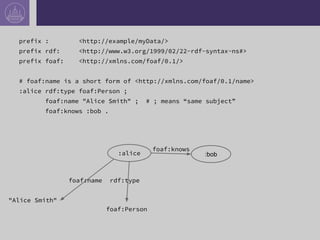
prefix : <http://example/myData/>
prefix rdf: <http://www.w3.org/1999/02/22-rdf-syntax-ns#>
prefix foaf: <http://xmlns.com/foaf/0.1/>
# foaf:name is a short form of <http://xmlns.com/foaf/0.1/name>
:alice rdf:type foaf:Person ;
foaf:name "Alice Smith" ; # ; means “same subject”
foaf:knows :bob .
:alice
foaf:knows
"Alice Smith"
foaf:name
foaf:Person
rdf:type
:bob
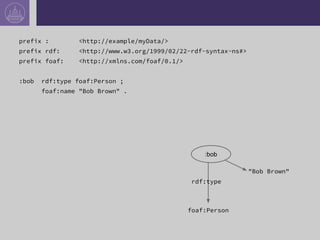
prefix : <http://example/myData/>
prefix rdf: <http://www.w3.org/1999/02/22-rdf-syntax-ns#>
prefix foaf: <http://xmlns.com/foaf/0.1/>
:bob rdf:type foaf:Person ;
foaf:name "Bob Brown" .
"Bob Brown"
foaf:Person
rdf:type
:bob
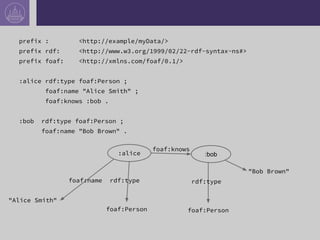
prefix : <http://example/myData/>
prefix rdf: <http://www.w3.org/1999/02/22-rdf-syntax-ns#>
prefix foaf: <http://xmlns.com/foaf/0.1/>
:alice rdf:type foaf:Person ;
foaf:name "Alice Smith" ;
foaf:knows :bob .
:bob rdf:type foaf:Person ;
foaf:name "Bob Brown" .
:alice
foaf:knows
"Alice Smith"
foaf:name
foaf:Person
rdf:type
"Bob Brown"
foaf:Person
rdf:type
:bob
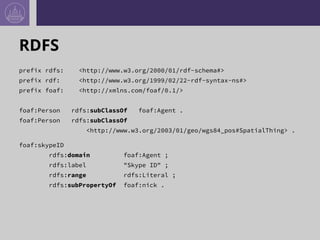
RDFS
prefix rdfs: <http://www.w3.org/2000/01/rdf-schema#>
prefix rdf: <http://www.w3.org/1999/02/22-rdf-syntax-ns#>
prefix foaf: <http://xmlns.com/foaf/0.1/>
foaf:Person rdfs:subClassOf foaf:Agent .
foaf:Person rdfs:subClassOf
<http://www.w3.org/2003/01/geo/wgs84_pos#SpatialThing> .
foaf:skypeID
rdfs:domain foaf:Agent ;
rdfs:label "Skype ID" ;
rdfs:range rdfs:Literal ;
rdfs:subPropertyOf foaf:nick .
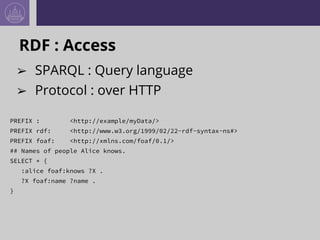
RDF : Access
➢ SPARQL : Query language
➢ Protocol : over HTTP
PREFIX : <http://example/myData/>
PREFIX rdf: <http://www.w3.org/1999/02/22-rdf-syntax-ns#>
PREFIX foaf: <http://xmlns.com/foaf/0.1/>
## Names of people Alice knows.
SELECT * {
:alice foaf:knows ?X .
?X foaf:name ?name .
}
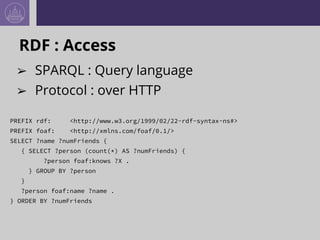
RDF : Access
➢ SPARQL : Query language
➢ Protocol : over HTTP
PREFIX rdf: <http://www.w3.org/1999/02/22-rdf-syntax-ns#>
PREFIX foaf: <http://xmlns.com/foaf/0.1/>
SELECT ?name ?numFriends {
{ SELECT ?person (count(*) AS ?numFriends) {
?person foaf:knows ?X .
} GROUP BY ?person
}
?person foaf:name ?name .
} ORDER BY ?numFriends
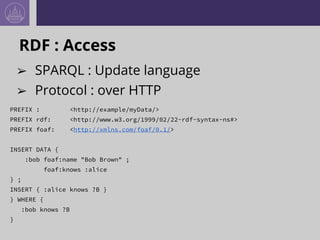
RDF : Access
➢ SPARQL : Update language
➢ Protocol : over HTTP
PREFIX : <http://example/myData/>
PREFIX rdf: <http://www.w3.org/1999/02/22-rdf-syntax-ns#>
PREFIX foaf: <http://xmlns.com/foaf/0.1/>
INSERT DATA {
:bob foaf:name "Bob Brown" ;
foaf:knows :alice
} ;
INSERT { :alice knows ?B }
} WHERE {
:bob knows ?B
}
Apache Jena
TLP: April 2012
➢ Involvement in standards
➢ RDF 1.1, SPARQL 1.1
➢ RDF database
➢ SPARQL server
Other RDF@ASF:
➢ Any23, Marmotta, Clerezza, Stanbol, Rya
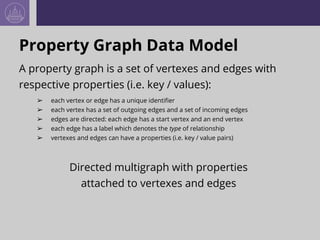
Property Graph Data Model
A property graph is a set of vertexes and edges with
respective properties (i.e. key / values):
➢ each vertex or edge has a unique identifier
➢ each vertex has a set of outgoing edges and a set of incoming edges
➢ edges are directed: each edge has a start vertex and an end vertex
➢ each edge has a label which denotes the type of relationship
➢ vertexes and edges can have a properties (i.e. key / value pairs)
Directed multigraph with properties
attached to vertexes and edges
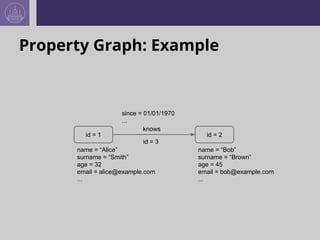
Property Graph: Example
id = 1 id = 2
name = “Alice”
surname = “Smith”
age = 32
email = alice@example.com
...
name = “Bob”
surname = “Brown”
age = 45
email = bob@example.com
...
since = 01/01/1970
...
id = 3
knows
Apache Spark: GraphX*
// Creating a Graph
val vertexes: RDD[(VertexId, (String, String))] =
sc.parallelize (Array((1L,("Alice", "alice@example.com")), (2L,("Bob", "bob@example.com"))))
val edges: RDD[Edge[String]] =
sc.parallelize(Array(Edge(1L, 2L, "knows"))
val graph = Graph(vertexes, edges)
...
Example of parallel graph algorithms available:
// Find the triangle count for each vertex
val triCounts = graph.triangleCount().vertices
// Find the connected components
val cc = graph.connectedComponents().vertices
// Run PageRank
val ranks = graph.pageRank(0.0001).vertices
* GraphX is in the alpha stage
Property Graphs @ASF
➢ Apache Tinkerpop (incubating)
➢ Apache Spark > GraphX
➢ Apache Giraph
➢ Apache Flink > Gelly
Use Case for Graphs
➢ Analytics
● Social networks and recommendation engines
● Data center infrastructure management
➢ Knowledge Graphs
● Happenings: people, places, events
● Customer databases / products catalogues
Some Conclusions
➢ Data Graphs are (still) new to many people
➢ RDF emphasizes information modelling
→ Knowledge graphs
→ SQL-like query
➢ Property Graph emphasizes data processing
→ Data capture
→ Graph analytic algorithms
➢ Naive layering of data models leads dissatisfaction
→ Can only mix toolsets by knowing it’s layered
➢ Could share technology
→ Storage, data access, query algebra
Thanks and Q&A
?

Two graph data models : RDF and Property Graphs

  • 1.
    Two graph datamodels RDF and Property Graphs Andy Seaborne Paolo Castagna andy@a.o, castagna@a.o
  • 2.
    Introduction This talk isabout two graph data models (RDF and Property Graphs), example of a couple of Apache projects using such data models, and a few lessons learned along the way.
  • 3.
    Graph Data Models ➢RDF ● W3C Standard ➢ Property Graphs ● Industry standard
  • 4.
    RDF ➢ IRIs (=URIs),literals (strings, numbers, …), blank nodes ➢ Triple => subject-predicate-object ● Predicate (or property) is the link name : an IRI ➢ Graph => set of triples
  • 5.
    prefix : <http://example/myData/> prefixrdf: <http://www.w3.org/1999/02/22-rdf-syntax-ns#> prefix foaf: <http://xmlns.com/foaf/0.1/> # foaf:name is a short form of <http://xmlns.com/foaf/0.1/name> :alice rdf:type foaf:Person ; foaf:name "Alice Smith" ; # ; means “same subject” foaf:knows :bob . :alice foaf:knows "Alice Smith" foaf:name foaf:Person rdf:type :bob
  • 6.
    prefix : <http://example/myData/> prefixrdf: <http://www.w3.org/1999/02/22-rdf-syntax-ns#> prefix foaf: <http://xmlns.com/foaf/0.1/> :bob rdf:type foaf:Person ; foaf:name "Bob Brown" . "Bob Brown" foaf:Person rdf:type :bob
  • 7.
    prefix : <http://example/myData/> prefixrdf: <http://www.w3.org/1999/02/22-rdf-syntax-ns#> prefix foaf: <http://xmlns.com/foaf/0.1/> :alice rdf:type foaf:Person ; foaf:name "Alice Smith" ; foaf:knows :bob . :bob rdf:type foaf:Person ; foaf:name "Bob Brown" . :alice foaf:knows "Alice Smith" foaf:name foaf:Person rdf:type "Bob Brown" foaf:Person rdf:type :bob
  • 8.
    RDFS prefix rdfs: <http://www.w3.org/2000/01/rdf-schema#> prefixrdf: <http://www.w3.org/1999/02/22-rdf-syntax-ns#> prefix foaf: <http://xmlns.com/foaf/0.1/> foaf:Person rdfs:subClassOf foaf:Agent . foaf:Person rdfs:subClassOf <http://www.w3.org/2003/01/geo/wgs84_pos#SpatialThing> . foaf:skypeID rdfs:domain foaf:Agent ; rdfs:label "Skype ID" ; rdfs:range rdfs:Literal ; rdfs:subPropertyOf foaf:nick .
  • 9.
    RDF : Access ➢SPARQL : Query language ➢ Protocol : over HTTP PREFIX : <http://example/myData/> PREFIX rdf: <http://www.w3.org/1999/02/22-rdf-syntax-ns#> PREFIX foaf: <http://xmlns.com/foaf/0.1/> ## Names of people Alice knows. SELECT * { :alice foaf:knows ?X . ?X foaf:name ?name . }
  • 10.
    RDF : Access ➢SPARQL : Query language ➢ Protocol : over HTTP PREFIX rdf: <http://www.w3.org/1999/02/22-rdf-syntax-ns#> PREFIX foaf: <http://xmlns.com/foaf/0.1/> SELECT ?name ?numFriends { { SELECT ?person (count(*) AS ?numFriends) { ?person foaf:knows ?X . } GROUP BY ?person } ?person foaf:name ?name . } ORDER BY ?numFriends
  • 11.
    RDF : Access ➢SPARQL : Update language ➢ Protocol : over HTTP PREFIX : <http://example/myData/> PREFIX rdf: <http://www.w3.org/1999/02/22-rdf-syntax-ns#> PREFIX foaf: <http://xmlns.com/foaf/0.1/> INSERT DATA { :bob foaf:name "Bob Brown" ; foaf:knows :alice } ; INSERT { :alice knows ?B } } WHERE { :bob knows ?B }
  • 12.
    Apache Jena TLP: April2012 ➢ Involvement in standards ➢ RDF 1.1, SPARQL 1.1 ➢ RDF database ➢ SPARQL server Other RDF@ASF: ➢ Any23, Marmotta, Clerezza, Stanbol, Rya
  • 13.
    Property Graph DataModel A property graph is a set of vertexes and edges with respective properties (i.e. key / values): ➢ each vertex or edge has a unique identifier ➢ each vertex has a set of outgoing edges and a set of incoming edges ➢ edges are directed: each edge has a start vertex and an end vertex ➢ each edge has a label which denotes the type of relationship ➢ vertexes and edges can have a properties (i.e. key / value pairs) Directed multigraph with properties attached to vertexes and edges
  • 14.
    Property Graph: Example id= 1 id = 2 name = “Alice” surname = “Smith” age = 32 email = alice@example.com ... name = “Bob” surname = “Brown” age = 45 email = bob@example.com ... since = 01/01/1970 ... id = 3 knows
  • 15.
    Apache Spark: GraphX* //Creating a Graph val vertexes: RDD[(VertexId, (String, String))] = sc.parallelize (Array((1L,("Alice", "alice@example.com")), (2L,("Bob", "bob@example.com")))) val edges: RDD[Edge[String]] = sc.parallelize(Array(Edge(1L, 2L, "knows")) val graph = Graph(vertexes, edges) ... Example of parallel graph algorithms available: // Find the triangle count for each vertex val triCounts = graph.triangleCount().vertices // Find the connected components val cc = graph.connectedComponents().vertices // Run PageRank val ranks = graph.pageRank(0.0001).vertices * GraphX is in the alpha stage
  • 16.
    Property Graphs @ASF ➢Apache Tinkerpop (incubating) ➢ Apache Spark > GraphX ➢ Apache Giraph ➢ Apache Flink > Gelly
  • 17.
    Use Case forGraphs ➢ Analytics ● Social networks and recommendation engines ● Data center infrastructure management ➢ Knowledge Graphs ● Happenings: people, places, events ● Customer databases / products catalogues
  • 18.
    Some Conclusions ➢ DataGraphs are (still) new to many people ➢ RDF emphasizes information modelling → Knowledge graphs → SQL-like query ➢ Property Graph emphasizes data processing → Data capture → Graph analytic algorithms ➢ Naive layering of data models leads dissatisfaction → Can only mix toolsets by knowing it’s layered ➢ Could share technology → Storage, data access, query algebra
  • 19.