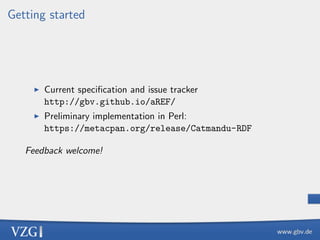
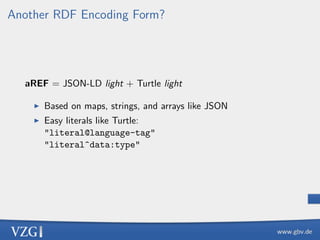
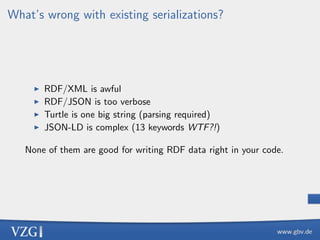
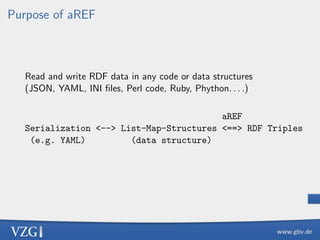
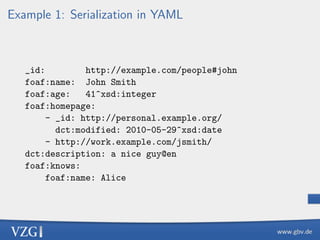
The document presents 'another rdf encoding form' (aref), a new method for serializing RDF data using simpler structures like JSON, YAML, and Perl code. It critiques existing formats such as RDF/XML, Turtle, and JSON-LD for their complexity and verbosity, arguing that aref offers a more user-friendly solution for writing RDF data directly in code. Example serializations in YAML and Perl demonstrate how aref can represent RDF triples in an accessible format.
![Example 2: Serialization in Perl-Code
$rdf = {
_id
=> ’http://example.com/people#john’,
foaf_name => ’John Smith’,
foaf_age => ’41^xsd:integer’,
foaf_homepage => [
{
_id => ’http://personal.example.org/’,
dct_modified => ’2010-05-29^xsd:date’,
},
’http://work.example.com/jsmith/’,
],
dct_description => ’a nice guy@en’,
foaf_knows => { foaf_name => "Alice" },
};](https://image.slidesharecdn.com/aref-131126093153-phpapp01/85/Another-RDF-Encoding-Form-6-320.jpg)