Deflection of Beams
Introduction:
We see that whenever a cantilever or a beam
is loaded, it deflects from its original position. The
amount, by which a beam deflects, depends upon
its cross-section and the bending moment. In
modern design offices, following are the two
design criteria for the deflection of a cantilever or
a beam:
1. Strength 2. Stiffness.
As per the strength criterion of the beam
design, it should be strong enough to resist bending
moment and shear force. Or in other words, the
beam should be strong enough to resist the
bending stresses and shear stresses. And as per
the stiffness criterion of the beam design, which is
equally important, it should be stiff enough to resist
the deflection of the beam. Or in other words, the
beam should be stiff enough not to deflect more
than the permissible limit* under the action of the
loading. In actual practice, some specifications are
always laid to limit the maximum deflection of
cantilever or beam to a small fraction of its span.
In this chapter, we shall discuss the slope and
deflection of the entire line of beams under the
different types of loadings.
Methods for Slope and Deflection at a Section:
Though there are many methods to find out
the slope and deflection at a section in a loaded
beam, yet the following two methods are important
from the subject point of vi
1. Double integration method.
2. Macaulay's method.
It will be interesting to know that the first
method is suitable for a single load, whereas the
second method is suitable for several loads
Double Integration Method for Slope and
Deflection:
We have already discussed earlier that the
bending moment at a point,
and integrating the above equation once again,
It is thus obvious that after first integration the
original differential equation, we get the value slope
at any point. On further integrating, we get the value
of deflection at any point.
Note. While integrating twice the original
differential equation, we will get two constants C1, and
C2. The values of these constants may be found out
by using the end conditions.
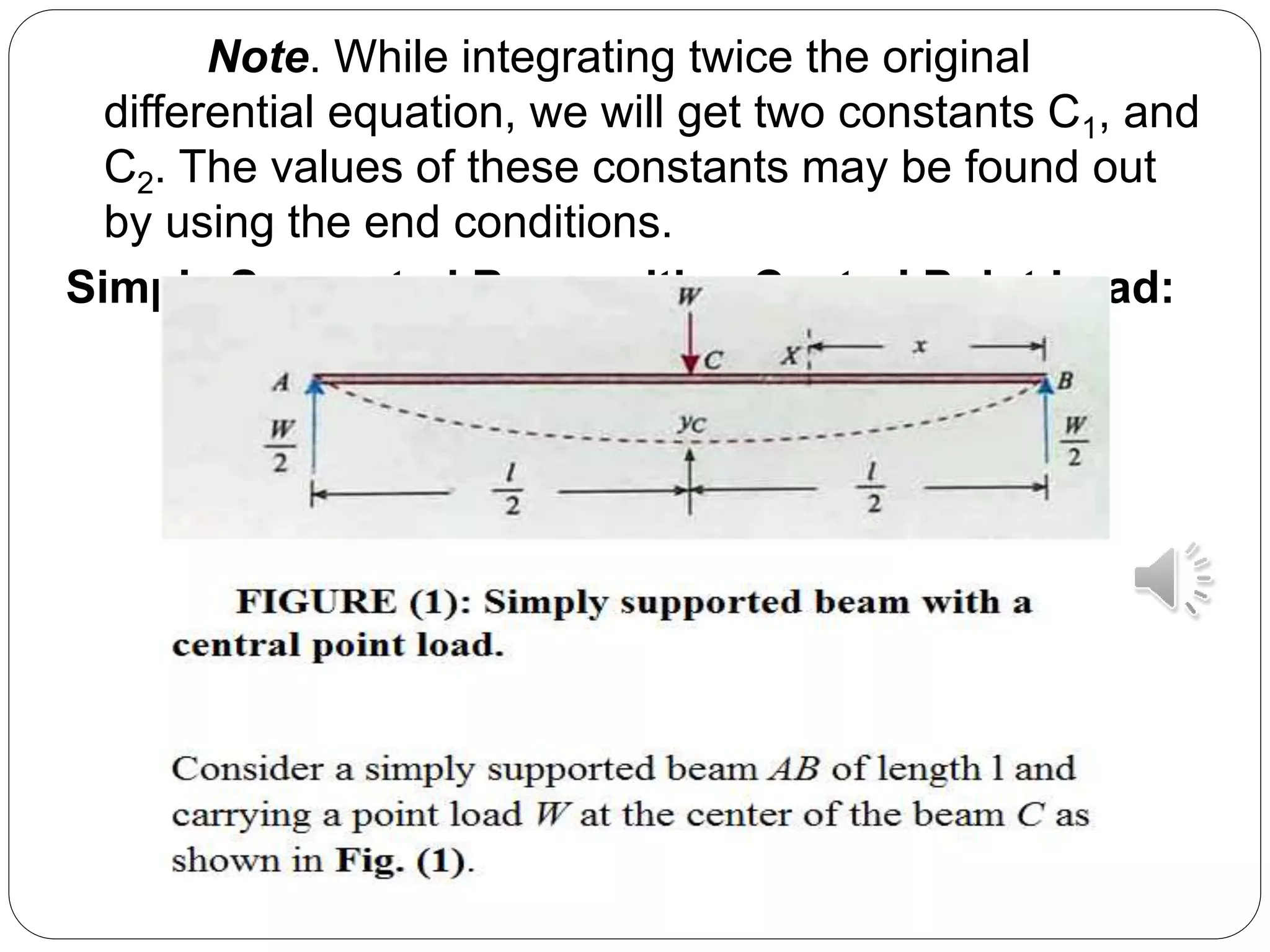
Simply Supported Beam with a Central Point Load:
From the geometry of the figure, we find that the
reaction at A,
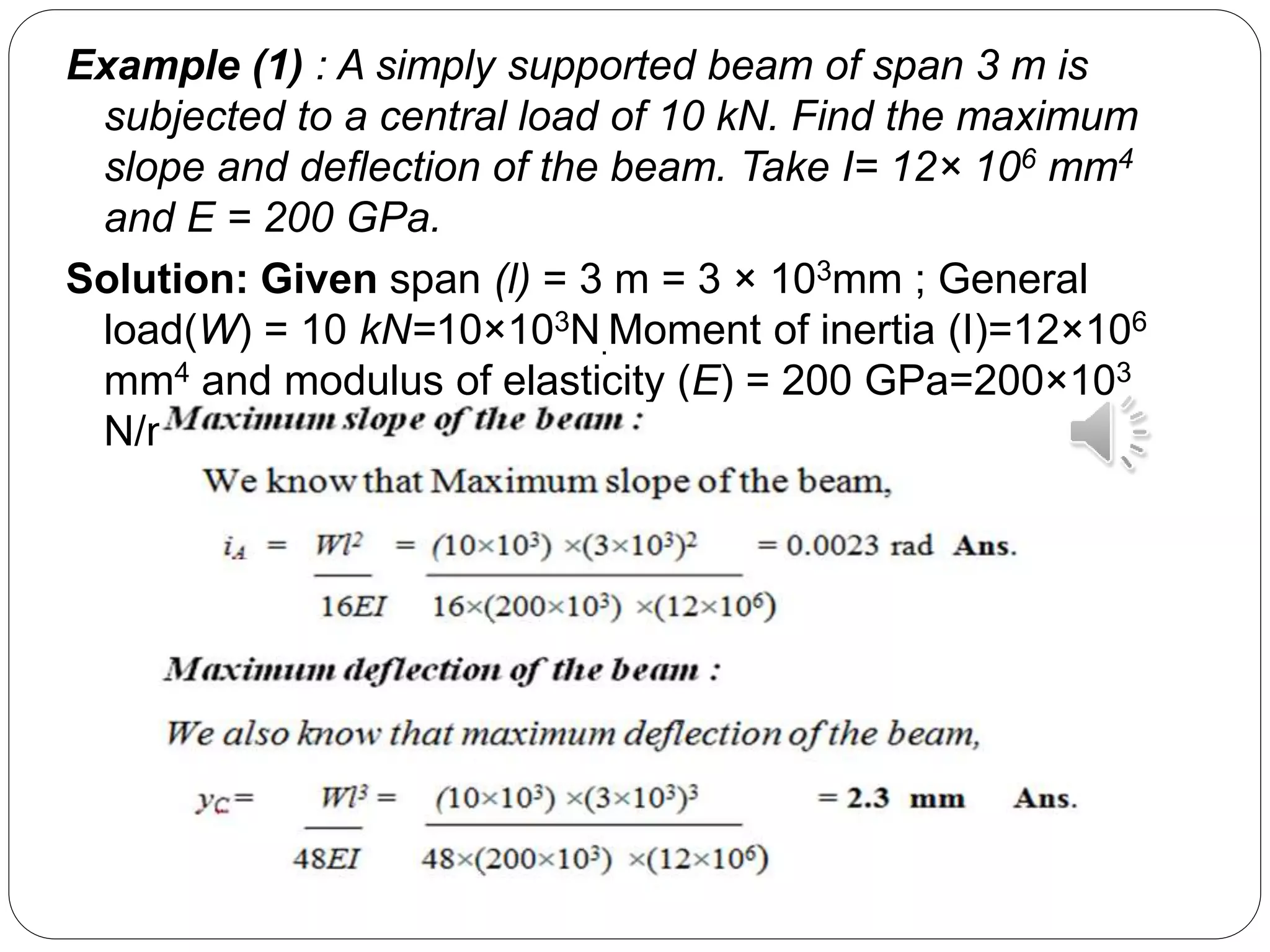
Example (1) : A simply supported beam of span 3 m is
subjected to a central load of 10 kN. Find the maximum
slope and deflection of the beam. Take I= 12× 106 mm4
and E = 200 GPa.
Solution: Given span (l) = 3 m = 3 × 103mm ; General
load(W) = 10 kN=10×103N.Moment of inertia (I)=12×106
mm4 and modulus of elasticity (E) = 200 GPa=200×103
N/mm2.
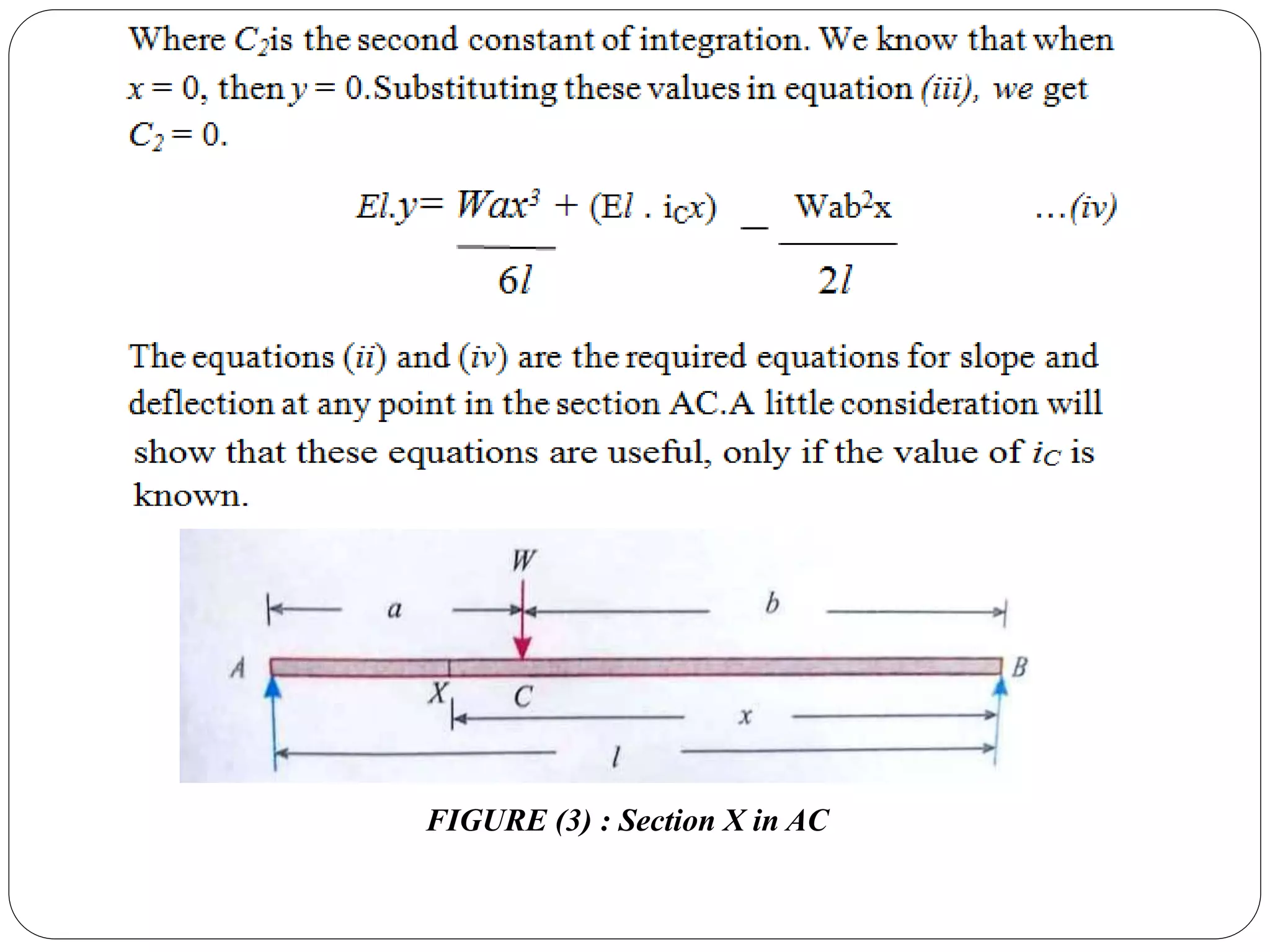
FIGURE (3) : Section X in AC
The equations (vii) and (ix) are the required equations for the slope and
deflection at any point in the section AC. A little consideration will show
that these equations are useful, only if the value of iC is known. Now to
obtain the value of iC, let us first out the deflection at C from the
equations for sections AC and CB.
Now substituting x = b in equation (iv) and equating the same with
equation (ix),
This is required equation for slope at any section in BC. We
know that the slope is maximum at B. Thus for maximum
slope, substituting x = 0 in equation (x),

Deflection of Beams.pptx......pptx

  • 1.
  • 2.
    Introduction: We see thatwhenever a cantilever or a beam is loaded, it deflects from its original position. The amount, by which a beam deflects, depends upon its cross-section and the bending moment. In modern design offices, following are the two design criteria for the deflection of a cantilever or a beam: 1. Strength 2. Stiffness.
  • 3.
    As per thestrength criterion of the beam design, it should be strong enough to resist bending moment and shear force. Or in other words, the beam should be strong enough to resist the bending stresses and shear stresses. And as per the stiffness criterion of the beam design, which is equally important, it should be stiff enough to resist the deflection of the beam. Or in other words, the beam should be stiff enough not to deflect more than the permissible limit* under the action of the loading. In actual practice, some specifications are always laid to limit the maximum deflection of cantilever or beam to a small fraction of its span. In this chapter, we shall discuss the slope and deflection of the entire line of beams under the different types of loadings.
  • 4.
    Methods for Slopeand Deflection at a Section: Though there are many methods to find out the slope and deflection at a section in a loaded beam, yet the following two methods are important from the subject point of vi 1. Double integration method. 2. Macaulay's method. It will be interesting to know that the first method is suitable for a single load, whereas the second method is suitable for several loads Double Integration Method for Slope and Deflection: We have already discussed earlier that the bending moment at a point,
  • 5.
    and integrating theabove equation once again, It is thus obvious that after first integration the original differential equation, we get the value slope at any point. On further integrating, we get the value of deflection at any point.
  • 6.
    Note. While integratingtwice the original differential equation, we will get two constants C1, and C2. The values of these constants may be found out by using the end conditions. Simply Supported Beam with a Central Point Load:
  • 7.
    From the geometryof the figure, we find that the reaction at A,
  • 11.
    Example (1) :A simply supported beam of span 3 m is subjected to a central load of 10 kN. Find the maximum slope and deflection of the beam. Take I= 12× 106 mm4 and E = 200 GPa. Solution: Given span (l) = 3 m = 3 × 103mm ; General load(W) = 10 kN=10×103N.Moment of inertia (I)=12×106 mm4 and modulus of elasticity (E) = 200 GPa=200×103 N/mm2.
  • 16.
    FIGURE (3) :Section X in AC
  • 20.
    The equations (vii)and (ix) are the required equations for the slope and deflection at any point in the section AC. A little consideration will show that these equations are useful, only if the value of iC is known. Now to obtain the value of iC, let us first out the deflection at C from the equations for sections AC and CB. Now substituting x = b in equation (iv) and equating the same with equation (ix),
  • 21.
    This is requiredequation for slope at any section in BC. We know that the slope is maximum at B. Thus for maximum slope, substituting x = 0 in equation (x),