Brian Kram, Prince George’s Community College
Kiersten Newtoff, Montgomery College—Germantown
sing
ontraditi
onal
edagogy:
earning
sing
ames
Hosted by Cecil College, North East, MD
Session 3.3: January 10, 2019
GAME-BASED LEARNING
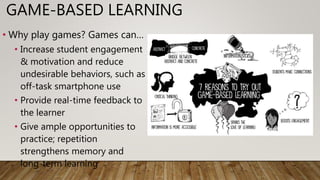
• Why play games? Games can…
• Increase student engagement
& motivation and reduce
undesirable behaviors, such as
off-task smartphone use
• Provide real-time feedback to
the learner
• Give ample opportunities to
practice; repetition
strengthens memory and
long-term learning
WEREWORDS
BY TED ALSPACH
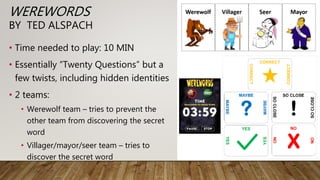
• Time needed to play: 10 MIN
• Essentially “Twenty Questions” but a
few twists, including hidden identities
• 2 teams:
• Werewolf team – tries to prevent the
other team from discovering the secret
word
• Villager/mayor/seer team – tries to
discover the secret word
INTRODUCTION TO WEREWORDS
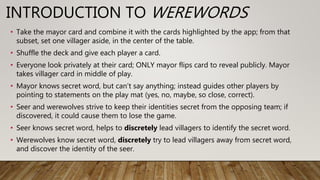
• Take the mayor card and combine it with the cards highlighted by the app; from that
subset, set one villager aside, in the center of the table.
• Shuffle the deck and give each player a card.
• Everyone look privately at their card; ONLY mayor flips card to reveal publicly. Mayor
takes villager card in middle of play.
• Mayor knows secret word, but can’t say anything; instead guides other players by
pointing to statements on the play mat (yes, no, maybe, so close, correct).
• Seer and werewolves strive to keep their identities secret from the opposing team; if
discovered, it could cause them to lose the game.
• Seer knows secret word, helps to discretely lead villagers to identify the secret word.
• Werewolves know secret word, discretely try to lead villagers away from secret word,
and discover the identity of the seer.
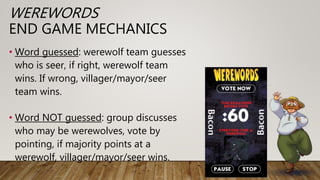
WEREWORDS
END GAME MECHANICS
• Word guessed: werewolf team guesses
who is seer, if right, werewolf team
wins. If wrong, villager/mayor/seer
team wins.
• Word NOT guessed: group discusses
who may be werewolves, vote by
pointing, if majority points at a
werewolf, villager/mayor/seer wins.
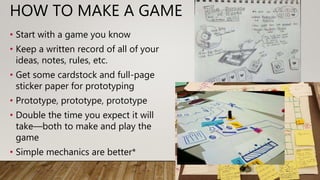
HOW TO MAKE A GAME
• Start with a game you know
• Keep a written record of all of your
ideas, notes, rules, etc.
• Get some cardstock and full-page
sticker paper for prototyping
• Prototype, prototype, prototype
• Double the time you expect it will
take—both to make and play the
game
• Simple mechanics are better*
CODENAMES (AND CODENAMES:
PICTURES)
BY VLAADA CHVÁTIL
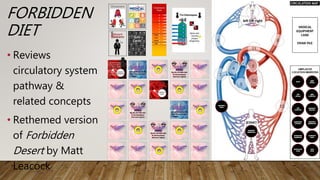
FORBIDDEN
DIET
• Reviews
circulatory system
pathway &
related concepts
• Rethemed version
of Forbidden
Desert by Matt
Leacock
systemic
capillaries
aorta
left
atrium
right
atrium
right
ventricle
left
ventricle
systemic
arteries
systemic
veins
pulmonary
arteries
pulmonary
capillaries
pulmonary
veins
vena
cava
systemic
capillaries
systemic
veins
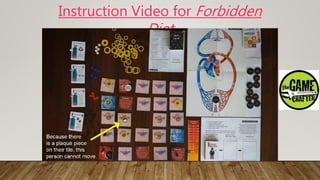
Instruction Video for Forbidden
Diet
QUESTIONS OR COMMENTS?
• Access digital copies of today’s materials by visiting
https://goo.gl/9LX3dM or use the camera on your
smartphone to scan this QR code for easy access:
• Please feel free to contact Brian Kram at
krambw@pgcc.edu for further information

How to encourage students to unplug

  • 1.
    Brian Kram, PrinceGeorge’s Community College Kiersten Newtoff, Montgomery College—Germantown sing ontraditi onal edagogy: earning sing ames Hosted by Cecil College, North East, MD Session 3.3: January 10, 2019
  • 2.
    GAME-BASED LEARNING • Whyplay games? Games can… • Increase student engagement & motivation and reduce undesirable behaviors, such as off-task smartphone use • Provide real-time feedback to the learner • Give ample opportunities to practice; repetition strengthens memory and long-term learning
  • 3.
    WEREWORDS BY TED ALSPACH •Time needed to play: 10 MIN • Essentially “Twenty Questions” but a few twists, including hidden identities • 2 teams: • Werewolf team – tries to prevent the other team from discovering the secret word • Villager/mayor/seer team – tries to discover the secret word
  • 4.
    INTRODUCTION TO WEREWORDS •Take the mayor card and combine it with the cards highlighted by the app; from that subset, set one villager aside, in the center of the table. • Shuffle the deck and give each player a card. • Everyone look privately at their card; ONLY mayor flips card to reveal publicly. Mayor takes villager card in middle of play. • Mayor knows secret word, but can’t say anything; instead guides other players by pointing to statements on the play mat (yes, no, maybe, so close, correct). • Seer and werewolves strive to keep their identities secret from the opposing team; if discovered, it could cause them to lose the game. • Seer knows secret word, helps to discretely lead villagers to identify the secret word. • Werewolves know secret word, discretely try to lead villagers away from secret word, and discover the identity of the seer.
  • 5.
    WEREWORDS END GAME MECHANICS •Word guessed: werewolf team guesses who is seer, if right, werewolf team wins. If wrong, villager/mayor/seer team wins. • Word NOT guessed: group discusses who may be werewolves, vote by pointing, if majority points at a werewolf, villager/mayor/seer wins.
  • 6.
    HOW TO MAKEA GAME • Start with a game you know • Keep a written record of all of your ideas, notes, rules, etc. • Get some cardstock and full-page sticker paper for prototyping • Prototype, prototype, prototype • Double the time you expect it will take—both to make and play the game • Simple mechanics are better*
  • 7.
  • 9.
    FORBIDDEN DIET • Reviews circulatory system pathway& related concepts • Rethemed version of Forbidden Desert by Matt Leacock systemic capillaries aorta left atrium right atrium right ventricle left ventricle systemic arteries systemic veins pulmonary arteries pulmonary capillaries pulmonary veins vena cava systemic capillaries systemic veins
  • 10.
    Instruction Video forForbidden Diet
  • 11.
    QUESTIONS OR COMMENTS? •Access digital copies of today’s materials by visiting https://goo.gl/9LX3dM or use the camera on your smartphone to scan this QR code for easy access: • Please feel free to contact Brian Kram at krambw@pgcc.edu for further information

Editor's Notes