I believe children today suffer from stifled and ignored creativity, 
and that creative thinking development methods should be adapted to the 
education of all children. 
Michelle Korenfeld 
The role of the teacher and the teaching method presented in 
this abstract are based on my teaching at The Dr. Erica 
Landau Institute for the gifted in Tel Aviv, Israel, based on her 
book "The Courage to be Gifted" [2], and on conversations 
with Dr. Moshe Rishpon, who established the Science 
Oriented Youth Department in the Weizmann Institute of 
Science, Rehovot, Israel. The Science Oriented Youth 
Department is a pioneer in the field of science education and 
a leader of that field worldwide. Both institutes' teaching 
methods have enabled children to become leaders in their 
fields of expertise.
A leap in technological development is expected in a 
few decades. We will enhance the intelligence that 
evolution has bestowed on us. Human creativity will be 
amplified. Yet the ability to act on our destructive 
inclinations will be amplified, too [6]. Our challenge as 
educators is to develop students' thinking skills and 
humane approach. Our goal is that tomorrow's adults use 
technology ethically, to take the world a step further into 
an age of creativity and humanity.
The Future of Education [6] 
Every person all over the world will have ready access to the highest quality 
knowledge and instruction. 
The learning experience for each student will improve, as computer programs 
will adapt to each student's needs and there will be virtual 
laboratories. 
In a few decades artificial intelligence will merge with human intelligence. 
Vast knowledge embedded in our brains will merge with the vastly greater 
capacity, speed and knowledge sharing ability of our technology. 
We will then have the ability to download knowledge and skills .
Future professions will require: 
• Creativity 
• Flexibility and Constant Development [3] 
• Innovation [3] 
• Interdisciplinary vision [3] 
• Decision Making [3]
Creativity Being Stifled by 
Education 
Young children enter pre-school alive with creative confidence. 
By the time they leave high school, many have lost that confidence 
entirely [1]. 
today's mainstream education has been shaped by particular ideas 
about academic intelligence, which disregard abilities that are 
important for creativity and innovation [1]. 
Teachers lack understanding of the nature of creativity and undervalue 
creativity [7].
Complementing Classical Learning with Creative 
Thinking development 
Creativity is possible in every discipline and should be promoted 
throughout the whole of education [1]. 
Case studies of teachers who have experience with teaching gifted and 
creative students can bring new insights into understanding and 
teaching creative students. For example, Sak's research: About 
Creativity, Giftedness, and Teaching the Creatively Gifted in the 
Classroom [7].
About Creativity 
According to Freud creativity presents a healthy form of sublimation, 
using unfulfilled unconscious drives for productive purposes [4]. 
According to Kris creative individuals are able to recreate a childlike state of mind 
in which unconscious ideas are more accessible to the conscious mind [4]. 
According to Skinner individuals' actions are determined solely by their history of 
reinforcement. Thus, creativity can be influenced by reinforcement [4]. 
According to Mednick Individuals who frequently bring remote ideas together should be 
more likely than others to produce creative ideas [4]. 
According to Maslow and Rogers the ability to express ideas frequently without self-criticism 
is essential to creativity, and is paralleled to the innocent, happy creativity of 
secure children. Creativity is the product of healthy human growth [4].
About Creativity 
According to Csikszentmihalyi flow is a state in which the person is deeply 
involved in an activity, and concentration is high. There are a loss of 
self-consciousness and a diminished sense of time. Artists painting, 
musicians practicing, and scientists absorbed in their work are 
examples of individuals in flow. Thus, flow is tied to creativity [4]. 
According to Dr. Landau playfulness is typical to creativity. 
Many scientists and artists approach problems playfully, thus coming up 
with new solutions [2]. Humor is seeing something from a different 
perspective. The discovery of new connections creates the humoristic 
surprise. It is enabled by flexibility. That is in fact the definition of 
creativity, as well. 
According to Seelig scientists and artists of all types are the world's 
"noticers". They are trained to pay attention and to communicate what 
they see and experience to the rest of the world [8].
About Creativity 
According to Sak – Research on Gifted Students' Class: 
Being creative is being perceptive. It's about being able to understand or 
perceive the complexity of the outer world. It's about what people can do to 
make the world interesting, innovative and original. It's about coming up 
with a newer idea or manner that are unusual [7]. 
Creativity comes from insights. 
Emotions intensity plays a significant role in the creative personality [7].
The Role of the Teacher 
• Teacher as a leader who raises leaders 
• Teacher as facilitator of students' creativity 
• Developing independent thinking, creativity, reason and humanity. 
• Mastering the art of listening and encouraging 
• Identifying strengths and building confidence 
• Developing lateral thinking (restructuring patterns and 
provoking new ones) ]4[ ]9[ 
• Developing critical thinking 
(In critical thinking the individual assesses. 
In creative thinking the individual originates. [5]) 
• Encouraging curiosity to experiment and expressions of creativity 
• Raising happy productive individuals 
• Teacher as role model for life
Creative Thinking Development Methods in Class 
Conversations - a conversation is more than a discussion of the material. 
In conversations thoughts are mixed with feelings. The mixing of feelings 
with thoughts contributes to the internalization of the knowledge. Creativity 
depends on interactions between feeling and thinking [1]. It is an opportunity 
for seeing how the subject is manifested in different fields in order to raise 
interdisciplinary vision. 
Questions - teaching for creativity involves asking open-ended questions, 
where there may be multiple solutions [1].Our wish is that the questions we 
ask the students, and the ones they raise, be creative. 
Experiments – learning through experiencing to arise conversation and 
thinking. 
Expression in Writing and Drawing – independent time for students to 
extend ideas and connect them to real life.
Activity to Ignite Creative Thinking 
– My Experience 
Through a dramatized story, the students enter a state of flow of 
an hour and a half, in which they are confident to express their 
creativity. 
Conversation and teaching aids - discovering the world in an 
interdisciplinary vision: symmetry, the colors of the rainbow, colors 
of animals (camouflage, courting and warning). 
Students who at the beginning have expressed lack of confidence in 
their creativity, later participate in painting freely with oil colors. 
Learning through experiencing – darkening the classroom and 
playing with flashlights covered by red, blue and green cellophanes 
(The primary colors of light).The activity is thoroughly explained in 
Creative Children Like the Animals of the World (“A Rainbow of 
More than Seven Colors”) 
The magic of words and colors – The children do the magic that 
preserves their creative thinking for life using rainbow glasses.
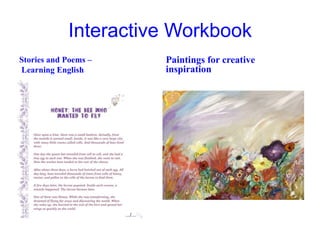
Interactive Workbook – My Experience 
The stories, poems and paintings 
in Creative Children Like the 
Animals of the World's purpose 
is to inspire children to write 
and draw freely themselves. 
While taking a journey toward 
broader horizons and creative 
thinking, they create their 
personal book.
Interactive Workbook 
Stories and Poems – 
Learning English 
Paintings for creative 
inspiration
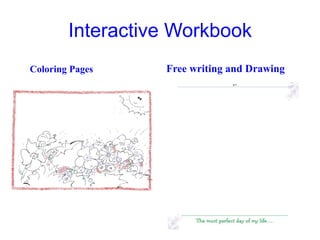
Interactive Workbook 
Coloring Pages Free writing and Drawing
Experiences and Elaborations
Conclusion 
Classical learning enhanced by technology is the future of education. However, 
education is the future of humanity. In the process of fostering creative thinking, 
we also develop reason and humanity. Classical education therefore needs 
not only be enhanced by technology, but also complemented by teaching 
for creativity. 
The future world, with its technological advancement raises fears. What if 
tomorrow's human being will be characterized only by technological 
advancement and academic skills? What if we will lack humanity and 
creativity? I believe we need to make sure our education not only doesn't 
stifle them, but develops them as much as possible. 
Human intelligence is predicted to merge with artificial intelligence by the time our 
students are grown. How can we make sure the advanced human being of 
the future remains humane? By making sure the children of today develop 
a humane approach, and by ensuring they don't lose their creative 
thinking, curiosity and imagination – their human spark.
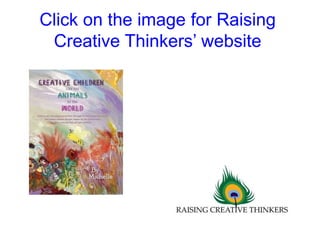
Click on the image for Raising 
Creative Thinkers’ website
Contact 
Please feel free to contact. Your feedback will be 
much appreciated: 
mailto:mchll555@gmaill.com 
Thank you for your time and patience 
MichelleKorenfeld
References and Links 
[1] Robinson, K. (2011). Out of our Minds – Learning to be Creative. 
Capstone Publishing Ltd, pp. 49-80, 245-286. 
Ted Lecture: Do Schools kill Creativity? Sir Ken Robinson 
[2] Landau, E. (1990). The Courage to be Gifted. Trillium Press Inc. 
[3] Davies, A., Fidler, D., Gorbis, M. (2011). Future Work Skills 2020. 
Institute for the future for the University of Phoenix Research Institute. 
www.iftf.org , pp. 8-13. 
[4] Strake, A.J. (2014). Creativity in the Classroom. Routledge, 
pp. 6-9, 161-164, 283-286. 
[5] Paul, R., Elder, L. (2008). The Thinkers Guide to 
the Nature and Functions of Critical and Creative Thinking. Kindle edition, 
part 1.
References and Links 
[6] Kurzweil, R. (2005). The Singularity is Near. Penguin Books, pp. 7-34, 
335-336. 
Ted Lecture: A University for the Coming singularity - Ray Kurzweil 
[7] Sak, U. (2004). About Creativity, Giftedness, and Teaching the 
Creatively Gifted in the Classroom. Roeper Review, Vol. 26, No. 4, pp. 
216-222. 
http://home.anadolu.edu.tr/~usak/documents/AboutCreativityGiftednespubl 
ishedinRR.pdf 
[8] Seelig, T. (2012). inGenius: A Crash Course on Creativity. 
HarperCollins Publishers, pp. 65-84. 
[9[ deBono, E. (1970). Lateral Thinking: Creativity step by Step. 
Harper and Row Publishers, pp. 7-14.
Links 
Activities for Children and Youth in The Weizmann Institute 
The Clore Garden of Science - The Weizmann Institute 
Mihaly Csikszentmihalyi: Flow, the secret to happiness

Raising Creative Thinkers

  • 2.
    I believe childrentoday suffer from stifled and ignored creativity, and that creative thinking development methods should be adapted to the education of all children. Michelle Korenfeld The role of the teacher and the teaching method presented in this abstract are based on my teaching at The Dr. Erica Landau Institute for the gifted in Tel Aviv, Israel, based on her book "The Courage to be Gifted" [2], and on conversations with Dr. Moshe Rishpon, who established the Science Oriented Youth Department in the Weizmann Institute of Science, Rehovot, Israel. The Science Oriented Youth Department is a pioneer in the field of science education and a leader of that field worldwide. Both institutes' teaching methods have enabled children to become leaders in their fields of expertise.
  • 3.
    A leap intechnological development is expected in a few decades. We will enhance the intelligence that evolution has bestowed on us. Human creativity will be amplified. Yet the ability to act on our destructive inclinations will be amplified, too [6]. Our challenge as educators is to develop students' thinking skills and humane approach. Our goal is that tomorrow's adults use technology ethically, to take the world a step further into an age of creativity and humanity.
  • 4.
    The Future ofEducation [6] Every person all over the world will have ready access to the highest quality knowledge and instruction. The learning experience for each student will improve, as computer programs will adapt to each student's needs and there will be virtual laboratories. In a few decades artificial intelligence will merge with human intelligence. Vast knowledge embedded in our brains will merge with the vastly greater capacity, speed and knowledge sharing ability of our technology. We will then have the ability to download knowledge and skills .
  • 5.
    Future professions willrequire: • Creativity • Flexibility and Constant Development [3] • Innovation [3] • Interdisciplinary vision [3] • Decision Making [3]
  • 6.
    Creativity Being Stifledby Education Young children enter pre-school alive with creative confidence. By the time they leave high school, many have lost that confidence entirely [1]. today's mainstream education has been shaped by particular ideas about academic intelligence, which disregard abilities that are important for creativity and innovation [1]. Teachers lack understanding of the nature of creativity and undervalue creativity [7].
  • 7.
    Complementing Classical Learningwith Creative Thinking development Creativity is possible in every discipline and should be promoted throughout the whole of education [1]. Case studies of teachers who have experience with teaching gifted and creative students can bring new insights into understanding and teaching creative students. For example, Sak's research: About Creativity, Giftedness, and Teaching the Creatively Gifted in the Classroom [7].
  • 8.
    About Creativity Accordingto Freud creativity presents a healthy form of sublimation, using unfulfilled unconscious drives for productive purposes [4]. According to Kris creative individuals are able to recreate a childlike state of mind in which unconscious ideas are more accessible to the conscious mind [4]. According to Skinner individuals' actions are determined solely by their history of reinforcement. Thus, creativity can be influenced by reinforcement [4]. According to Mednick Individuals who frequently bring remote ideas together should be more likely than others to produce creative ideas [4]. According to Maslow and Rogers the ability to express ideas frequently without self-criticism is essential to creativity, and is paralleled to the innocent, happy creativity of secure children. Creativity is the product of healthy human growth [4].
  • 9.
    About Creativity Accordingto Csikszentmihalyi flow is a state in which the person is deeply involved in an activity, and concentration is high. There are a loss of self-consciousness and a diminished sense of time. Artists painting, musicians practicing, and scientists absorbed in their work are examples of individuals in flow. Thus, flow is tied to creativity [4]. According to Dr. Landau playfulness is typical to creativity. Many scientists and artists approach problems playfully, thus coming up with new solutions [2]. Humor is seeing something from a different perspective. The discovery of new connections creates the humoristic surprise. It is enabled by flexibility. That is in fact the definition of creativity, as well. According to Seelig scientists and artists of all types are the world's "noticers". They are trained to pay attention and to communicate what they see and experience to the rest of the world [8].
  • 10.
    About Creativity Accordingto Sak – Research on Gifted Students' Class: Being creative is being perceptive. It's about being able to understand or perceive the complexity of the outer world. It's about what people can do to make the world interesting, innovative and original. It's about coming up with a newer idea or manner that are unusual [7]. Creativity comes from insights. Emotions intensity plays a significant role in the creative personality [7].
  • 11.
    The Role ofthe Teacher • Teacher as a leader who raises leaders • Teacher as facilitator of students' creativity • Developing independent thinking, creativity, reason and humanity. • Mastering the art of listening and encouraging • Identifying strengths and building confidence • Developing lateral thinking (restructuring patterns and provoking new ones) ]4[ ]9[ • Developing critical thinking (In critical thinking the individual assesses. In creative thinking the individual originates. [5]) • Encouraging curiosity to experiment and expressions of creativity • Raising happy productive individuals • Teacher as role model for life
  • 12.
    Creative Thinking DevelopmentMethods in Class Conversations - a conversation is more than a discussion of the material. In conversations thoughts are mixed with feelings. The mixing of feelings with thoughts contributes to the internalization of the knowledge. Creativity depends on interactions between feeling and thinking [1]. It is an opportunity for seeing how the subject is manifested in different fields in order to raise interdisciplinary vision. Questions - teaching for creativity involves asking open-ended questions, where there may be multiple solutions [1].Our wish is that the questions we ask the students, and the ones they raise, be creative. Experiments – learning through experiencing to arise conversation and thinking. Expression in Writing and Drawing – independent time for students to extend ideas and connect them to real life.
  • 13.
    Activity to IgniteCreative Thinking – My Experience Through a dramatized story, the students enter a state of flow of an hour and a half, in which they are confident to express their creativity. Conversation and teaching aids - discovering the world in an interdisciplinary vision: symmetry, the colors of the rainbow, colors of animals (camouflage, courting and warning). Students who at the beginning have expressed lack of confidence in their creativity, later participate in painting freely with oil colors. Learning through experiencing – darkening the classroom and playing with flashlights covered by red, blue and green cellophanes (The primary colors of light).The activity is thoroughly explained in Creative Children Like the Animals of the World (“A Rainbow of More than Seven Colors”) The magic of words and colors – The children do the magic that preserves their creative thinking for life using rainbow glasses.
  • 14.
    Interactive Workbook –My Experience The stories, poems and paintings in Creative Children Like the Animals of the World's purpose is to inspire children to write and draw freely themselves. While taking a journey toward broader horizons and creative thinking, they create their personal book.
  • 15.
    Interactive Workbook Storiesand Poems – Learning English Paintings for creative inspiration
  • 16.
    Interactive Workbook ColoringPages Free writing and Drawing
  • 17.
  • 18.
  • 19.
    Conclusion Classical learningenhanced by technology is the future of education. However, education is the future of humanity. In the process of fostering creative thinking, we also develop reason and humanity. Classical education therefore needs not only be enhanced by technology, but also complemented by teaching for creativity. The future world, with its technological advancement raises fears. What if tomorrow's human being will be characterized only by technological advancement and academic skills? What if we will lack humanity and creativity? I believe we need to make sure our education not only doesn't stifle them, but develops them as much as possible. Human intelligence is predicted to merge with artificial intelligence by the time our students are grown. How can we make sure the advanced human being of the future remains humane? By making sure the children of today develop a humane approach, and by ensuring they don't lose their creative thinking, curiosity and imagination – their human spark.
  • 20.
    Click on theimage for Raising Creative Thinkers’ website
  • 21.
    Contact Please feelfree to contact. Your feedback will be much appreciated: mailto:mchll555@gmaill.com Thank you for your time and patience MichelleKorenfeld
  • 22.
    References and Links [1] Robinson, K. (2011). Out of our Minds – Learning to be Creative. Capstone Publishing Ltd, pp. 49-80, 245-286. Ted Lecture: Do Schools kill Creativity? Sir Ken Robinson [2] Landau, E. (1990). The Courage to be Gifted. Trillium Press Inc. [3] Davies, A., Fidler, D., Gorbis, M. (2011). Future Work Skills 2020. Institute for the future for the University of Phoenix Research Institute. www.iftf.org , pp. 8-13. [4] Strake, A.J. (2014). Creativity in the Classroom. Routledge, pp. 6-9, 161-164, 283-286. [5] Paul, R., Elder, L. (2008). The Thinkers Guide to the Nature and Functions of Critical and Creative Thinking. Kindle edition, part 1.
  • 23.
    References and Links [6] Kurzweil, R. (2005). The Singularity is Near. Penguin Books, pp. 7-34, 335-336. Ted Lecture: A University for the Coming singularity - Ray Kurzweil [7] Sak, U. (2004). About Creativity, Giftedness, and Teaching the Creatively Gifted in the Classroom. Roeper Review, Vol. 26, No. 4, pp. 216-222. http://home.anadolu.edu.tr/~usak/documents/AboutCreativityGiftednespubl ishedinRR.pdf [8] Seelig, T. (2012). inGenius: A Crash Course on Creativity. HarperCollins Publishers, pp. 65-84. [9[ deBono, E. (1970). Lateral Thinking: Creativity step by Step. Harper and Row Publishers, pp. 7-14.
  • 24.
    Links Activities forChildren and Youth in The Weizmann Institute The Clore Garden of Science - The Weizmann Institute Mihaly Csikszentmihalyi: Flow, the secret to happiness