Credit Appraisal – An Overview
CA. E Guru Prasad
Presentation Schema
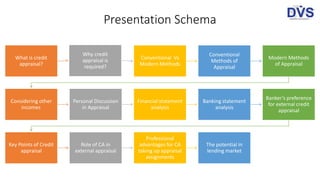
What is credit
appraisal?
Why credit
appraisal is
required?
Conventional Vs
Modern Methods
Conventional
Methods of
Appraisal
Modern Methods
of Appraisal
Considering other
incomes
Personal Discussion
in Appraisal
Financial statement
analysis
Banking statement
analysis
Banker’s preference
for external credit
appraisal
Key Points of Credit
appraisal
Role of CA in
external appraisal
Professional
advantages for CA
taking up appraisal
assignments
The potential in
lending market
What is Credit Appraisal?
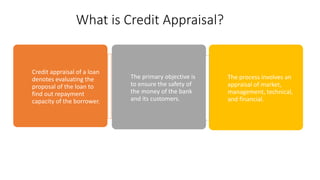
Credit appraisal of a loan
denotes evaluating the
proposal of the loan to
find out repayment
capacity of the borrower.
The primary objective is
to ensure the safety of
the money of the bank
and its customers.
The process involves an
appraisal of market,
management, technical,
and financial.
Why
Credit
Appraisal
is
required?
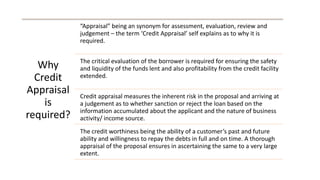
“Appraisal” being an synonym for assessment, evaluation, review and
judgement – the term ‘Credit Appraisal’ self explains as to why it is
required.
The critical evaluation of the borrower is required for ensuring the safety
and liquidity of the funds lent and also profitability from the credit facility
extended.
Credit appraisal measures the inherent risk in the proposal and arriving at
a judgement as to whether sanction or reject the loan based on the
information accumulated about the applicant and the nature of business
activity/ income source.
The credit worthiness being the ability of a customer’s past and future
ability and willingness to repay the debts in full and on time. A thorough
appraisal of the proposal ensures in ascertaining the same to a very large
extent.
Conventional Vs Modern methods
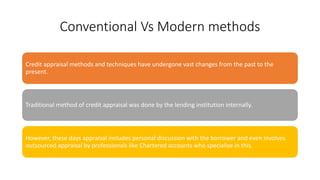
Credit appraisal methods and techniques have undergone vast changes from the past to the
present.
Traditional method of credit appraisal was done by the lending institution internally.
However, these days appraisal includes personal discussion with the borrower and even involves
outsourced appraisal by professionals like Chartered accounts who specialise in this.
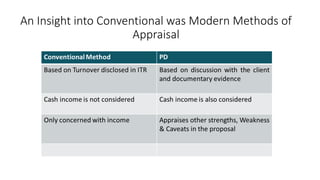
An Insight into Conventional was Modern Methods of
Appraisal
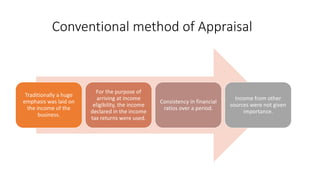
Conventional method of Appraisal
Traditionally a huge
emphasis was laid on
the income of the
business.
For the purpose of
arriving at income
eligibility, the income
declared in the income
tax returns were used.
Consistency in financial
ratios over a period.
Income from other
sources were not given
importance.
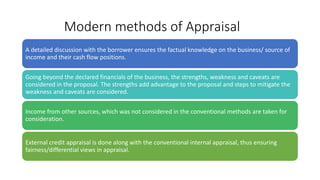
Modern methods of Appraisal
A detailed discussion with the borrower ensures the factual knowledge on the business/ source of
income and their cash flow positions.
Going beyond the declared financials of the business, the strengths, weakness and caveats are
considered in the proposal. The strengths add advantage to the proposal and steps to mitigate the
weakness and caveats are considered.
Income from other sources, which was not considered in the conventional methods are taken for
consideration.
External credit appraisal is done along with the conventional internal appraisal, thus ensuring
fairness/differential views in appraisal.
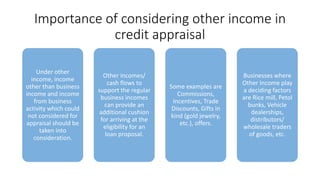
Importance of considering other income in
credit appraisal
Under other
income, income
other than business
income and income
from business
activity which could
not considered for
appraisal should be
taken into
consideration.
Other incomes/
cash flows to
support the regular
business incomes
can provide an
additional cushion
for arriving at the
eligibility for an
loan proposal.
Some examples are
Commissions,
Incentives, Trade
Discounts, Gifts in
kind (gold jewelry,
etc.), offers.
Businesses where
Other Income play
a deciding factors
are Rice mill, Petol
bunks, Vehicle
dealerships,
distributors/
wholesale traders
of goods, etc.
Personal Discussion (PD) in an appraisal
Takes the customer into
confidence and get him
in comfort zone
Analyze the customer
and his business
operations in detail
Having an informal chat
about the business and
market conditions
Assess the level of stock
& business activity.
Verify some
documentary evidence
to substantiate the
turnover.
Understanding the
process flow of the
business.
Anything unusual
should be questioned
and never take anything
for granted.
Find out the sources of
income and list it out.
Discuss about each
income source
separately
Get to know the
strengths and weakness
in a proposal.
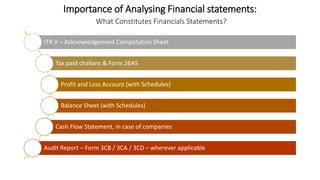
Importance of Analysing Financial statements:
What Constitutes Financials Statements?
ITR V – Acknowledgement Computation Sheet
Tax paid challans & Form 26AS
Profit and Loss Account (with Schedules)
Balance Sheet (with Schedules)
Cash Flow Statement, in case of companies
Audit Report – Form 3CB / 3CA / 3CD – wherever applicable
Contd..
Points to be
checked/
verified in
Acknowledgement
Original or revised
return
Date of Filing
Acknowledgement
number/ Bar code
Current Year Loss
Tax Payment
Details
Digital Signature
wherever
applicable
Contd..
Points to be
verified in
Computation
Sheet
Categorization of
income under various
heads
Whether the
deductions claimed
are in line with the
Prevailing limits
Income from Other
sources,
speculations, capital
gains are usually not
considered for
appraisal.
Disallowances
TDS Deducted and
Tax paid details
Brought forward loss
and unabsorbed
depreciations
Contd..
Points to be
verified in
P&L Account
Direct
Incomes
Indirect
Incomes
Depreciations
Opening &
Closing stocks
Gross profit &
Net profits
Ratios
Consistency in
Turnovers and
profitability
figures
Contd..
Points to be
verified in
Balance
Sheet
Share
Capital,
Reserves and
surplus
Secured &
Unsecured
loans
Creditors/
Debtors
Other
Liabilities
Bank
accounts
P & L Debit
balance
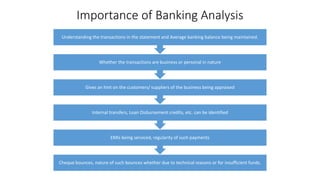
Importance of Banking Analysis
Cheque bounces, nature of such bounces whether due to technical reasons or for insufficient funds.
EMIs being serviced, regularity of such payments
Internal transfers, Loan Disbursement credits, etc. can be identified
Gives an hint on the customers/ suppliers of the business being appraised
Whether the transactions are business or personal in nature
Understanding the transactions in the statement and Average banking balance being maintained.
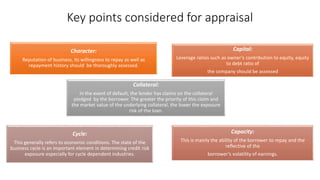
Character:
Reputation of business, its willingness to repay as well as
repayment history should be thoroughly assessed.
Capital:
Leverage ratios such as owner’s contribution to equity, equity
to debt ratio of
the company should be assessed
Capacity:
This is mainly the ability of the borrower to repay and the
reflective of the
borrower’s volatility of earnings.
Cycle:
This generally refers to economic conditions. The state of the
business cycle is an important element in determining credit risk
exposure especially for cycle dependent industries.
Collateral:
In the event of default, the lender has claims on the collateral
pledged by the borrower. The greater the priority of this claim and
the market value of the underlying collateral, the lower the exposure
risk of the loan.
Key points considered for appraisal
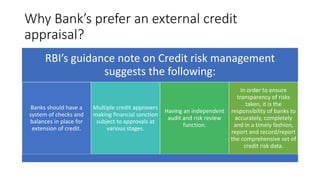
Why Bank’s prefer an external credit
appraisal?
RBI’s guidance note on Credit risk management
suggests the following:
Banks should have a
system of checks and
balances in place for
extension of credit.
Multiple credit approvers
making financial sanction
subject to approvals at
various stages.
Having an independent
audit and risk review
function.
In order to ensure
transparency of risks
taken, it is the
responsibility of banks to
accurately, completely
and in a timely fashion,
report and record/report
the comprehensive set of
credit risk data.
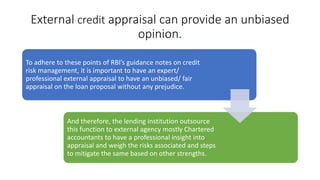
External credit appraisal can provide an unbiased
opinion.
To adhere to these points of RBI’s guidance notes on credit
risk management, it is important to have an expert/
professional external appraisal to have an unbiased/ fair
appraisal on the loan proposal without any prejudice.
And therefore, the lending institution outsource
this function to external agency mostly Chartered
accountants to have a professional insight into
appraisal and weigh the risks associated and steps
to mitigate the same based on other strengths.
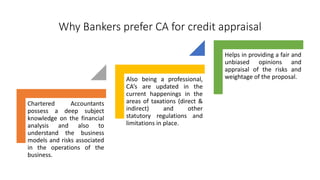
Why Bankers prefer CA for credit appraisal
Chartered Accountants
possess a deep subject
knowledge on the financial
analysis and also to
understand the business
models and risks associated
in the operations of the
business.
Also being a professional,
CA’s are updated in the
current happenings in the
areas of taxations (direct &
indirect) and other
statutory regulations and
limitations in place.
Helps in providing a fair and
unbiased opinions and
appraisal of the risks and
weightage of the proposal.
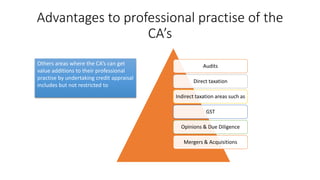
Advantages to professional practise of the
CA’s
Audits
Direct taxation
Indirect taxation areas such as
GST
Opinions & Due Diligence
Mergers & Acquisitions
Others areas where the CA’s can get
value additions to their professional
practise by undertaking credit appraisal
includes but not restricted to
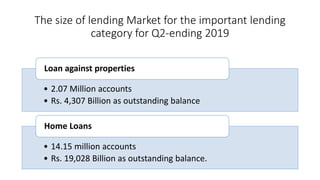
The size of lending Market for the important lending
category for Q2-ending 2019
• 2.07 Million accounts
• Rs. 4,307 Billion as outstanding balance
Loan against properties
• 14.15 million accounts
• Rs. 19,028 Billion as outstanding balance.
Home Loans
Thank You
DVS Advisors LLP
India-Singapore-London-Dubai-Malaysia-Africa
www.dvsca.com
Copyrights © 2019 DVS Advisors LLP
Scan the QR Code to Join our
Research Group on WhatsApp
Scan the QR Code to explore more
Research from our Website

Credit appraisal an overview

  • 1.
    Credit Appraisal –An Overview CA. E Guru Prasad
  • 2.
    Presentation Schema What iscredit appraisal? Why credit appraisal is required? Conventional Vs Modern Methods Conventional Methods of Appraisal Modern Methods of Appraisal Considering other incomes Personal Discussion in Appraisal Financial statement analysis Banking statement analysis Banker’s preference for external credit appraisal Key Points of Credit appraisal Role of CA in external appraisal Professional advantages for CA taking up appraisal assignments The potential in lending market
  • 3.
    What is CreditAppraisal? Credit appraisal of a loan denotes evaluating the proposal of the loan to find out repayment capacity of the borrower. The primary objective is to ensure the safety of the money of the bank and its customers. The process involves an appraisal of market, management, technical, and financial.
  • 4.
    Why Credit Appraisal is required? “Appraisal” being ansynonym for assessment, evaluation, review and judgement – the term ‘Credit Appraisal’ self explains as to why it is required. The critical evaluation of the borrower is required for ensuring the safety and liquidity of the funds lent and also profitability from the credit facility extended. Credit appraisal measures the inherent risk in the proposal and arriving at a judgement as to whether sanction or reject the loan based on the information accumulated about the applicant and the nature of business activity/ income source. The credit worthiness being the ability of a customer’s past and future ability and willingness to repay the debts in full and on time. A thorough appraisal of the proposal ensures in ascertaining the same to a very large extent.
  • 5.
    Conventional Vs Modernmethods Credit appraisal methods and techniques have undergone vast changes from the past to the present. Traditional method of credit appraisal was done by the lending institution internally. However, these days appraisal includes personal discussion with the borrower and even involves outsourced appraisal by professionals like Chartered accounts who specialise in this.
  • 6.
    An Insight intoConventional was Modern Methods of Appraisal
  • 7.
    Conventional method ofAppraisal Traditionally a huge emphasis was laid on the income of the business. For the purpose of arriving at income eligibility, the income declared in the income tax returns were used. Consistency in financial ratios over a period. Income from other sources were not given importance.
  • 8.
    Modern methods ofAppraisal A detailed discussion with the borrower ensures the factual knowledge on the business/ source of income and their cash flow positions. Going beyond the declared financials of the business, the strengths, weakness and caveats are considered in the proposal. The strengths add advantage to the proposal and steps to mitigate the weakness and caveats are considered. Income from other sources, which was not considered in the conventional methods are taken for consideration. External credit appraisal is done along with the conventional internal appraisal, thus ensuring fairness/differential views in appraisal.
  • 9.
    Importance of consideringother income in credit appraisal Under other income, income other than business income and income from business activity which could not considered for appraisal should be taken into consideration. Other incomes/ cash flows to support the regular business incomes can provide an additional cushion for arriving at the eligibility for an loan proposal. Some examples are Commissions, Incentives, Trade Discounts, Gifts in kind (gold jewelry, etc.), offers. Businesses where Other Income play a deciding factors are Rice mill, Petol bunks, Vehicle dealerships, distributors/ wholesale traders of goods, etc.
  • 10.
    Personal Discussion (PD)in an appraisal Takes the customer into confidence and get him in comfort zone Analyze the customer and his business operations in detail Having an informal chat about the business and market conditions Assess the level of stock & business activity. Verify some documentary evidence to substantiate the turnover. Understanding the process flow of the business. Anything unusual should be questioned and never take anything for granted. Find out the sources of income and list it out. Discuss about each income source separately Get to know the strengths and weakness in a proposal.
  • 11.
    Importance of AnalysingFinancial statements: What Constitutes Financials Statements? ITR V – Acknowledgement Computation Sheet Tax paid challans & Form 26AS Profit and Loss Account (with Schedules) Balance Sheet (with Schedules) Cash Flow Statement, in case of companies Audit Report – Form 3CB / 3CA / 3CD – wherever applicable
  • 12.
    Contd.. Points to be checked/ verifiedin Acknowledgement Original or revised return Date of Filing Acknowledgement number/ Bar code Current Year Loss Tax Payment Details Digital Signature wherever applicable
  • 13.
    Contd.. Points to be verifiedin Computation Sheet Categorization of income under various heads Whether the deductions claimed are in line with the Prevailing limits Income from Other sources, speculations, capital gains are usually not considered for appraisal. Disallowances TDS Deducted and Tax paid details Brought forward loss and unabsorbed depreciations
  • 14.
    Contd.. Points to be verifiedin P&L Account Direct Incomes Indirect Incomes Depreciations Opening & Closing stocks Gross profit & Net profits Ratios Consistency in Turnovers and profitability figures
  • 15.
    Contd.. Points to be verifiedin Balance Sheet Share Capital, Reserves and surplus Secured & Unsecured loans Creditors/ Debtors Other Liabilities Bank accounts P & L Debit balance
  • 16.
    Importance of BankingAnalysis Cheque bounces, nature of such bounces whether due to technical reasons or for insufficient funds. EMIs being serviced, regularity of such payments Internal transfers, Loan Disbursement credits, etc. can be identified Gives an hint on the customers/ suppliers of the business being appraised Whether the transactions are business or personal in nature Understanding the transactions in the statement and Average banking balance being maintained.
  • 17.
    Character: Reputation of business,its willingness to repay as well as repayment history should be thoroughly assessed. Capital: Leverage ratios such as owner’s contribution to equity, equity to debt ratio of the company should be assessed Capacity: This is mainly the ability of the borrower to repay and the reflective of the borrower’s volatility of earnings. Cycle: This generally refers to economic conditions. The state of the business cycle is an important element in determining credit risk exposure especially for cycle dependent industries. Collateral: In the event of default, the lender has claims on the collateral pledged by the borrower. The greater the priority of this claim and the market value of the underlying collateral, the lower the exposure risk of the loan. Key points considered for appraisal
  • 18.
    Why Bank’s preferan external credit appraisal? RBI’s guidance note on Credit risk management suggests the following: Banks should have a system of checks and balances in place for extension of credit. Multiple credit approvers making financial sanction subject to approvals at various stages. Having an independent audit and risk review function. In order to ensure transparency of risks taken, it is the responsibility of banks to accurately, completely and in a timely fashion, report and record/report the comprehensive set of credit risk data.
  • 19.
    External credit appraisalcan provide an unbiased opinion. To adhere to these points of RBI’s guidance notes on credit risk management, it is important to have an expert/ professional external appraisal to have an unbiased/ fair appraisal on the loan proposal without any prejudice. And therefore, the lending institution outsource this function to external agency mostly Chartered accountants to have a professional insight into appraisal and weigh the risks associated and steps to mitigate the same based on other strengths.
  • 20.
    Why Bankers preferCA for credit appraisal Chartered Accountants possess a deep subject knowledge on the financial analysis and also to understand the business models and risks associated in the operations of the business. Also being a professional, CA’s are updated in the current happenings in the areas of taxations (direct & indirect) and other statutory regulations and limitations in place. Helps in providing a fair and unbiased opinions and appraisal of the risks and weightage of the proposal.
  • 21.
    Advantages to professionalpractise of the CA’s Audits Direct taxation Indirect taxation areas such as GST Opinions & Due Diligence Mergers & Acquisitions Others areas where the CA’s can get value additions to their professional practise by undertaking credit appraisal includes but not restricted to
  • 22.
    The size oflending Market for the important lending category for Q2-ending 2019 • 2.07 Million accounts • Rs. 4,307 Billion as outstanding balance Loan against properties • 14.15 million accounts • Rs. 19,028 Billion as outstanding balance. Home Loans
  • 23.
    Thank You DVS AdvisorsLLP India-Singapore-London-Dubai-Malaysia-Africa www.dvsca.com Copyrights © 2019 DVS Advisors LLP Scan the QR Code to Join our Research Group on WhatsApp Scan the QR Code to explore more Research from our Website